






Abstract
Using a pre–post randomized controlled trial, the purpose of this study was to determine whether a social problem-solving curriculum, Take CHARGE!, based on a cognitive-behavioral approach, could improve students’ knowledge of problem-solving skills, as well as self-report of social behaviors for 92 middle school students with emotional and behavioral disorders (EBD) in 11 self-contained classrooms. Dependent variables included student-report measures of problem-solving knowledge and skills. Findings indicated that the Take CHARGE! curriculum was related to significant increases in students’ social skills knowledge and problem-solving skills for middle school students with EBD. Teachers were able to implement the curriculum with a high degree of fidelity, and they indicated they would like to continue using it in the future. Implications for practicing teachers support the use of role-plays, think-alouds, and explicit instruction in problem-solving steps. Future research methodologies including observational research and longitudinal exploration are discussed.
Keywords
The interpersonal dynamics within schools have the potential to contribute to students’ academic and social success (Breeman et al., 2015; Farmer et al., 2008; Greenberg et al., 2003; Jennings & Greenberg, 2009; Pianta, Belsky, Vandergrift, Houts, & Morrison, 2008). How students perceive and interact with teachers and peers within academic and social environments is in part related to how students are able to problem solve in difficult social circumstances (Graziano, Reavis, Keane, & Calkins, 2007). For some adolescents, difficulties related to emotional and behavioral disorders (EBD) may impede their ability to accurately perceive and interpret social and academic environments (Maggin, Wehby, Farmer, & Brooks, 2016; Mayberry & Heflinger, 2013). Farmer (2013) defined EBD as “a disability in the capacity to adapt” (p. 36), with many students with or at risk for EBD exhibiting social deficits and behavior problems. Often, behavior interventions are used to address behavioral problems; however, few would argue that teaching students with EBD how to socially adapt, in part, requires changing their thinking. Knowledge about how to change one’s thinking is foundational to behavioral change (Bandura, 1999).
Oftentimes, an inability to adapt to social situations affects how students with EBD perceive and interact with others, resulting in problematic social interactions and poor social relationships (McDaniel, Bruhn, & Troughton, 2017). Gresham (2015) defined the inability to successfully adapt as a lack of social competence, or the inability to appropriately choose behaviors that accomplish goals and are seen by others as acceptable behaviors. Such deficits in adapting to the social environment can result in students with EBD being avoided, isolated, and rejected by peers and adults, which further reduces their positive social networks and successful academic and behavioral outcomes (Goddard, 2003). If students with EBD do not possess the knowledge of how to alter their thinking to make problematic social interactions into nonproblematic ones, they are at risk for more severe social and emotional problems (Guess & Bowling, 2014). For many students, such difficulties may negatively affect their personal relationships and social networks throughout life (Erickson & Pianta, 1989; Van Loan & Marlowe, 2013). One factor that may help improve such negative outcomes for students with EBD is instruction in social problem-solving.
Social Problem-Solving
Although much research has been conducted about observable behavior resulting in empirically validated interventions based on applied behavior analysis (Alberto & Troutman, 2016), another factor that plays into effective interventions to help students with EBD improve their behavior is addressing their cognition, or how they think (Polsgrove & Smith, 2004). Cognitive processes, as explained by Crick and Dodge (1994) using a social information processing model, theorize that people’s behavior includes the thoughts they have as they experience stimuli, what they focus on as they internally interpret the experience, and then how they choose to act. One method for addressing the way students with EBD think and make sense of social environments is through cognitive-behavioral interventions (CBIs). For nearly five decades, researchers have investigated the use of CBIs, such as social problem-solving, and found it effective in promoting social competence and decreasing emotional and behavioral difficulties in regular educational settings (Crick & Dodge, 1994; Daunic et al., 2011; D’Zurilla & Goldfried, 1971; D’Zurilla, Nezu, & Maydeu-Olivares, 2002; Merrill, Smith, Cumming, & Daunic, 2017). Conceptually, CBIs are based on the premise that how individuals think in a social situation directly influences their behavior (Meichenbaum, 1977). One assumption of cognitively based instruction in social problem-solving is that by addressing the cognitive processes, students’ behaviors will generalize across new and novel situations. For example, a student can adjust her/his behavior through verbal self-regulation and self-talk (De Matos et al., 2012; B. W. Smith, Sugai, & Brown, 2000). According to S. W. Smith and Daunic (2006), acquisition of these techniques requires instruction to (a) recognize that a problem exists, (b) define the problem, (c) generate solutions, (d) evaluate outcomes from solutions and act upon one, and (e) assess the outcome. Instruction should be systematic and include modeling, role-plays, feedback, and reinforcement.
D’Zurilla and Goldfried (1971) pointed out that instruction in social problem-solving requires two things. First, students must know how to identify that there is a problem. Second, the student must then select an appropriate approach to solving the problem. Effectively used, these concepts allow students to recognize a problematic social situation, think about their own behavior, make a change that yields a positive result, and then become reinforced by successful outcomes. Still, D’Zurilla and Goldfried emphasized the difference between knowing problem-solving concepts and solution implementation. One can think about possible solutions for a social problem; however, how a solution is brought to fruition in a problematic situation is a separate skill set (D’Zurilla, Nezu, & Maydeu-Olivares, 2004). Approaches rooted in applied behavior analysis shape student behavior through manipulation of environmental variables that are external to the student (Alberto & Troutman, 2016). Alternatively, the CBI approach focuses on those variables that are internal to the student. By targeting students’ particular knowledge of social problem-solving skills, teachers can begin to change students’ cognition with the intent of shaping their behaviors.
Students With EBD in Self-Contained Settings
Self-contained settings remain one of the most common placements for students with EBD (U.S. Department of Education, 2016); yet, only two other studies have investigated the use of social problem-solving instruction in such settings (Rahill & Teglasi, 2003; Robinson, Smith, & Miller, 2002). Students who exhibit EBD and are placed in restrictive educational settings (e.g., self-contained classrooms) have fewer opportunities to explore the interpersonal nature of social relationships (Meehan, Hughes, & Cavell, 2003). Moreover, these students are often impulsive when responding, may be unaware of their own and others’ feelings and perspectives, struggle to identify problematic situations, and can lack social competence (Gresham, 2015; Mayer & Van Acker, 2009). Such characteristics often arouse negative feelings in others (e.g., teachers, peers, administrators), resulting in alienation, less close relationships, and fewer positive social networks, all of which coalesce and ultimately prevent academic, social, and emotional learning opportunities (Graziano et al., 2007; Kauffman & Landrum, 2009).
When students experience high frequencies of conflict-oriented interactions, have few skills to cope with the fast pace of social encounters, and cannot problem solve during difficult interactions, their chances of success in school are hindered (Van Loan & Marlowe, 2013). For example, if students view teacher–student interactions within self-contained classrooms as overly controlling or coercive, they may perceive the classroom environment as aversive, and without the requisite cognitive skills to address the problem, they may display undesired escape or avoidance behaviors (Sutherland, Lewis-Palmer, Stichter, & Morgan, 2008; Wehby, Symons, & Shores, 1995). These behaviors may prevent successful integration into more inclusive settings (Farmer & Hollowell, 1994), which then restricts access to vital social networks (Croninger & Lee, 2001; Crosnoe, Kirkpatrick-Johnson, & Elder, 2004; Ferguson, 2006).
For students with EBD in self-contained settings, knowing how to solve social problems can foster self-control by helping them inhibit impulsive responding, increase awareness of their own and others’ feelings and perspectives, and identify problematic situations (Mayer & Van Acker, 2009; Zins, Elias, Greenberg, & Weissberg, 2000). Teaching students to use a cognitive-behavioral approach can help them develop knowledge about self-regulation of aggressive thoughts that can lead to a decrease in the frequency of their impulsive responses, and an increase in their use of prosocial responses (McCart, Priester, Davies, & Azen, 2006). If children placed in self-contained classrooms are to successfully reintegrate into general education settings, or experience more positive interactions with peers and adults within their current setting, then they must be prepared with the requisite social problem-solving skills perceived by others as socially competent (S. W. Smith, Graber, & Daunic, 2009).
Purpose of the Study
Students with EBD placed in self-contained settings are denied high rates of typical school-day interactions, further limiting their ability to practice the requisite social skills needed for successful interactions in inclusive general educational settings. The purpose of the current study was to determine whether a social problem-solving curriculum, Take CHARGE!, based on a cognitive-behavioral approach, could improve knowledge and development of social problem-solving skills. The following research questions guided the study:
Method
Setting and Participants
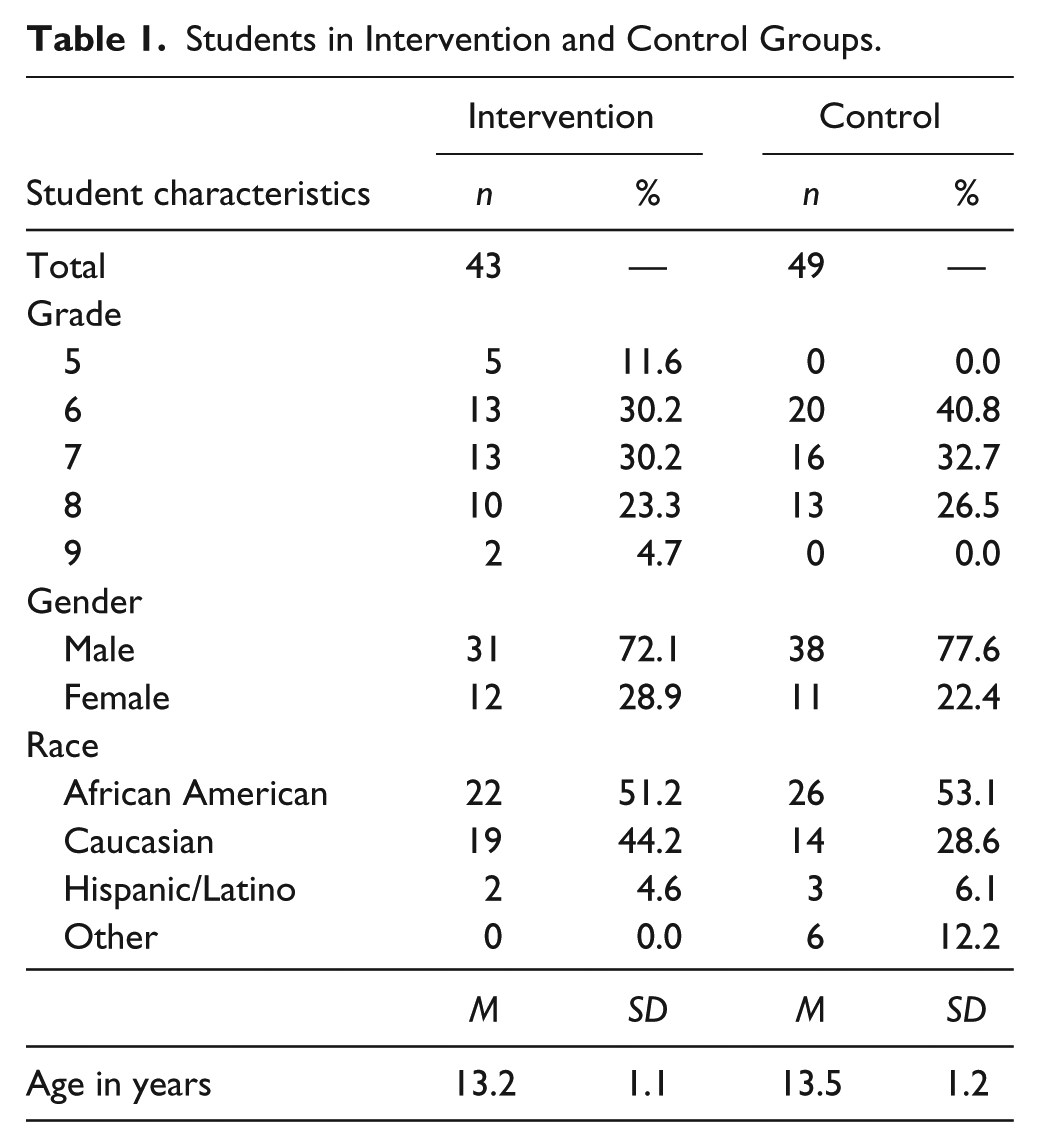
The setting for this study was 11 middle school self-contained classrooms located in four counties in a southeastern state. All counties were low-income, rural areas with a minimum of 60% of students receiving free or reduced-price lunch. Total eligible study participants included 11 self-contained, EBD classroom teachers and 96 middle school students identified with EBD in accordance with state and federal law. Parental consent was solicited for each student and a 97% participation rate was achieved for a final sample of 92 students. The sample included 69 males and 23 females, with a mean age of 13.3 years (SD = 1.1). Racial demographics for the students included 48 African American, 33 Caucasian, five Hispanic/Latino, and six students designated into an Other category. Table 1 includes demographic information on student participants separated by treatment group. There were a total of 11 teachers—six males (54.5%) and five females (45.5%)—racially comprised of seven Caucasian (63.6%), two African American (18.2%), and two Hispanic (18.2%) teachers. Based on results from t tests and chi-square difference tests, there were no significant differences between students in the intervention and control groups, or between teachers in each group, on any demographic variables or on any pretest assessments of social problem-solving knowledge or skills.
Students in Intervention and Control Groups.
Design
To investigate the effects of the CBI-based problem-solving curriculum versus “business-as-usual,” we implemented a pre- or postrandomized controlled trial with a wait-list control group, which received the curriculum once the study was completed. We solicited schools and sought permission for participation with district personnel, principals, and self-contained teachers. School personnel were informed that they had an equal chance of assignment to either an intervention or control condition. For schools and teachers who agreed to participate, the process of matching and random assignment occurred at the school level because typically there is only one self-contained EBD classroom per school. For schools that contained more than one self-contained classroom (N = 2), all classes within a school were assigned to the same condition, which helped to reduce threats to internal validity that might have occurred from cross-contamination among classrooms within a school.
Assignment to intervention or control occurred by pairwise matching, as suggested by Bloom, Bos, and Lee (1999), or blocking groups into strata, by ranking schools from highest to lowest according to salient characteristics. We paired schools first by the total number of EBD students, second by racial composition, and finally by class size. This procedure ensured that intervention and control groups contained similar characteristics. High-poverty schools were equally distributed across intervention and control groups. To compensate for history or events outside of this study that may have contributed to any effect between and within subjects, the time between pre and post was limited to approximately 11 weeks. Maturation (social and emotional growth) was addressed by use of a control group. Finally, selection-maturation interaction of subject-related variables (e.g., age of participants, years of teacher experience) was controlled for by random assignment and matching. After assignment to either an intervention or control condition, 49 students and five teachers were in the intervention group, and 43 students and six teachers were in the control group.
Intervention
Take CHARGE! is a 26-lesson curriculum designed from a social information processing model (Dodge, 1993) and is based on Tools for Getting Along: Teaching Students to Problem Solve for elementary students (Daunic et al., 2011; S. W. Smith et al., 2016). Take CHARGE! is used as a selective, classroom-based intervention or an intervention targeted specifically toward individuals, such as middle school students with EBD, who have difficulty solving social problems. There are 20 core lessons that last approximately 30 min to 40 min each. Initial lessons introduce problem-solving and highlight six key steps (e.g., Check—see if you’re angry, Hold on—calm down and think, Analyze—figure out the cause, Reflect—on possible solutions, Go for it—pick a solution, and Evaluate—see what happened). Out of the 20 core lessons, 15 content lessons cover the six steps, and five strategically placed role-play lessons provide opportunities to practice steps as they are learned. Following the 20 core lessons, six booster lessons provide additional review and opportunities for generalization. Core lessons were conducted at an average rate of 3 times a week for a total of approximately 7 weeks, and booster lessons were conducted 2 times a week for a total of approximately 3 weeks. Thus, intervention across all classrooms lasted for approximately 10 weeks.
Each lesson includes a cumulative review, teacher presentation of new material, and activities for guided and independent practice. The curriculum also includes components such as overt teacher self-talk, teachable moments, and on-the-spot assessments (OTSA). Overt teacher self-talk, or cognitive modeling, is a strategy teachers use to reveal their covert, inner thoughts and the processes used to solve social problems. Students who are provided a model of a good thinker thinking are more likely to learn the explicit steps of social problem-solving (S. W. Smith & Daunic, 2006). The purpose of OTSA is to “catch students being good,” specifically as they use the explicit steps of social problem-solving in natural settings such as transitions and lunch lines. The teacher and student discuss the steps that were observed in the natural setting. The intent of OTSA is to promote the generalization of problem-solving to other settings and to reinforce the student for using the problem-solving steps. Overall, the curriculum and specific strategies such as self-talk and OTSA, which are aligned with emotional and instructional support strategies associated with high-quality teacher–student relationships (Hamre & Pianta, 2005), should help students develop self-management of behavior through the purposeful manipulation of overt, and eventually covert, verbalizations.
Procedures
Premeasures were administered in January of the school year to allow sufficient time for teachers and students to develop relationships with each other. In all classrooms, at least one paraprofessional was present to monitor the class during these times. After administration of pretest measures, intervention teachers were trained on the Take CHARGE! curriculum and in the use of CBI strategies such as self-instruction techniques and cognitive modeling to help students develop problem-solving skills hypothesized to improve behavior and interpersonal interactions. The 1-day training lasted approximately 7 hr and covered the curriculum’s conceptual underpinnings, purpose, organizational features, content, and instructional procedures. Then, over the next few months (February–April), intervention teachers administered the program followed by postdata collected in late April and early May in both intervention and control conditions. Upon completion of the study, teachers in the control condition were offered the Take CHARGE! training.
Measures
Social problem-solving knowledge
The Knowledge Questionnaire (KQ; Daunic, Smith, Brank, & Penfield, 2006) served as a measure of learned social problem-solving concepts taught in Take CHARGE!. There are 11 multiple-choice questions and five fill-in-the-blank/short answer questions on the KQ. Sample items included People usually get frustrated when they . . ., and Check all the ways your body may feel when you are angry. Other sample items required students to supply information (e.g., What are three levels of anger, from lowest to highest?). The original instrument, used in a parallel study (Tools for Getting Along; Daunic et al., 2006), was pilot tested to 35 students exposed to the curriculum and then used in a larger study. Items with low item-to-total scale reliability were eliminated or revised. Reliability estimates from the parallel study reported a Cronbach’s alpha of .72. As Take CHARGE! parallels the content in Tools for Getting Along, the only adjustment necessary was to modify the grammar of the questionnaire to make it more age appropriate for middle school students versus upper elementary students.
Approaches to problem-solving
The Social Problem-Solving Inventory–Revised (SPSI-R; D’Zurilla et al., 2002) is based on a theoretical model of problem-solving that incorporates two general components. Problem orientation focuses on metacognitive processes that reflect general awareness and appraisals of problems encountered in everyday life, and problem-solving style focuses on the following four complex skills that are necessary to solve a problem successfully: (a) problem definition and formulation, (b) alternative solution generation, (c) decision making, and (d) implementing a solution and evaluating its outcome. These skills closely parallel those taught specifically in Take CHARGE! (also addressed in Dodge’s, 1986, social information processing model). The SPSI-R includes 52 Likert-type self-report items that comprise five scales: Positive Problem Orientation, Negative Problem Orientation, Rational/Adaptive Problem-Solving (RPS), Impulsive/Careless, and Avoidance. The five-factor model emerged from an exploratory and confirmatory factor analysis and was based on goodness of fit, parsimony, and cross validation criteria (Maydeu-Olivares & D’Zurilla, 1997). A detailed description of scale reliability and validity can be found in the manual (D’Zurilla et al., 2002). For the current study, the RPS (20 items; α = .89) was used to measure students’ problem-solving behavior. Sample items include the following: I try to look at problems in different ways before choosing a solution, and When solving problems, I think of different ideas and combine some of them to make a better solution. The RPS scale is designed to detect a deliberate, systematic coping style that incorporates social cognitive problem-solving principles and techniques.
Treatment Fidelity and Social Validity
Treatment fidelity was assessed by observing 20% of lessons taught using checklists corresponding to lesson content. A portion of these observations (17%) were made by pairs of trained observers (e.g., graduate students, university professors) to assess interrater reliability. Treatment fidelity training for all observers consisted of an overview of curriculum features, examples of curriculum content, and scoring of treatment fidelity forms. Training occurred until a minimum interobserver agreement (IOA), measured by Cohen’s (1960) kappa, of .80 was achieved. Beyond these treatment fidelity steps, assurance that teachers would be comparable with intervention delivery across classrooms was likely because Take CHARGE! is a partially scripted curriculum. However, complete control of intervention delivery was not possible due to the specific problem-solving examples generated within classrooms and individual student needs. Moreover, when using scripted curricula with students enrolled in self-contained classrooms, simple curricular modifications that target student interest and provide student choice are sometimes necessary to increase student engagement and reduce disruptive behaviors (Kern, Bambara, & Fogt, 2002).
To measure the social validity of Take CHARGE!, a survey was distributed to all intervention teachers focused on ease of use, appeal/utility to students, and effectiveness for reducing negative behaviors. The survey incorporated a 5-point Likert-type scale ranging from 1 (strongly disagree) to 5 (strongly agree). Each teacher answered items such as The content of the curriculum was useful to students and The lessons were easy to teach.
Data Analysis
To determine whether the curriculum affected students’ knowledge of social problem-solving and their self-reported approaches to problem-solving behaviors, separate two-level hierarchical linear modeling (HLM; Raudenbush & Bryk, 2002) analyses were conducted using the MIXED procedure in SAS 9.3. The model was comprised of two random levels: students and classrooms. It was necessary to use HLM analysis because students were nested within classrooms. Three-level nesting was explored, but intraclass correlations (ICCs) for the KQ (.03) and RPS (.05) indicated very little dependency in the data at the school level. At the classroom level, ICCs did indicate a level of clustering for both the KQ (.41) and RPS (.44) that needed to be accounted for in the models. The dependent variable in each model was the respective postintervention KQ or RPS score. Covariates included condition (0 = control, 1 = intervention) at Level 2 and preintervention scores on the respective measures. No additional covariates (e.g., poverty levels of schools) were included in the analysis because there were not significant differences between intervention and control groups in prior analysis. Intervention and control conditions were fixed factors within the models:
Effect sizes for statistically significant effects were calculated using Cohen’s (1992) d (d = M1 – M2 / σpooled) and were categorized as small (.20), medium (.50), or large (.80).
Results
The first research question was the following: Does Take CHARGE! improve student knowledge of social problem-solving skills? There were no significant differences in students’ KQ scores in the intervention and control groups at pretest (see Table 2). At posttest, there were significant differences favoring the intervention group on the KQ, t(90) = 10.57, p < .001. A main effect (see Table 3 for HLM results) was found for condition (b = 8.58, p < .001), such that students in the intervention group had significantly higher posttest knowledge of social problem-solving scores after adjusting for pretest, resulting in a large effect (d = 1.47).
Students’ KQ and RPS Scores (N = 92).
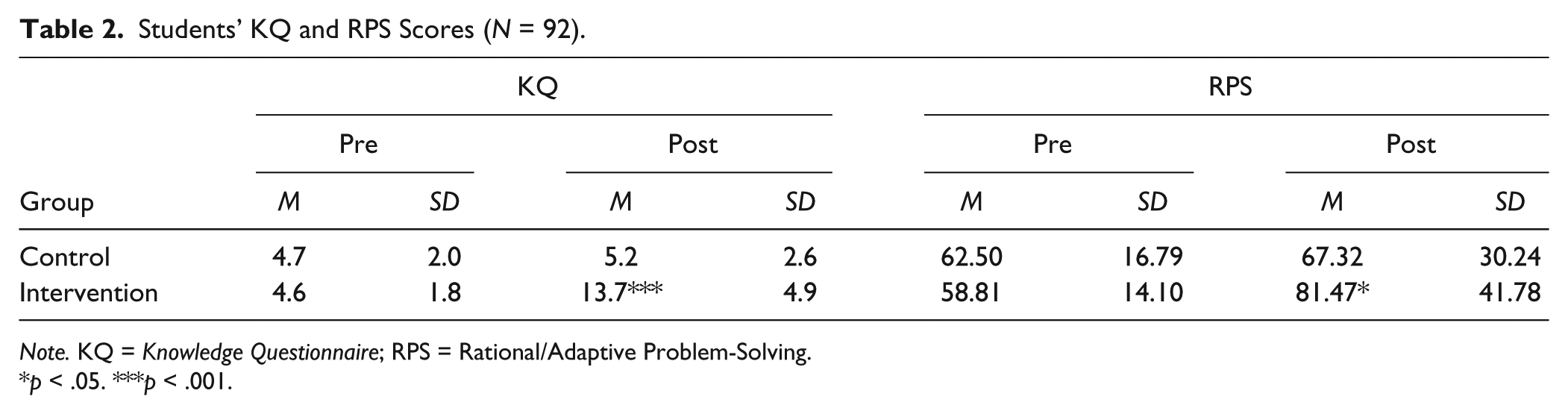
Note. KQ = Knowledge Questionnaire; RPS = Rational/Adaptive Problem-Solving.
p < .05. ***p < .001.
Hierarchical Linear Modeling Results for the KQ and RPS.
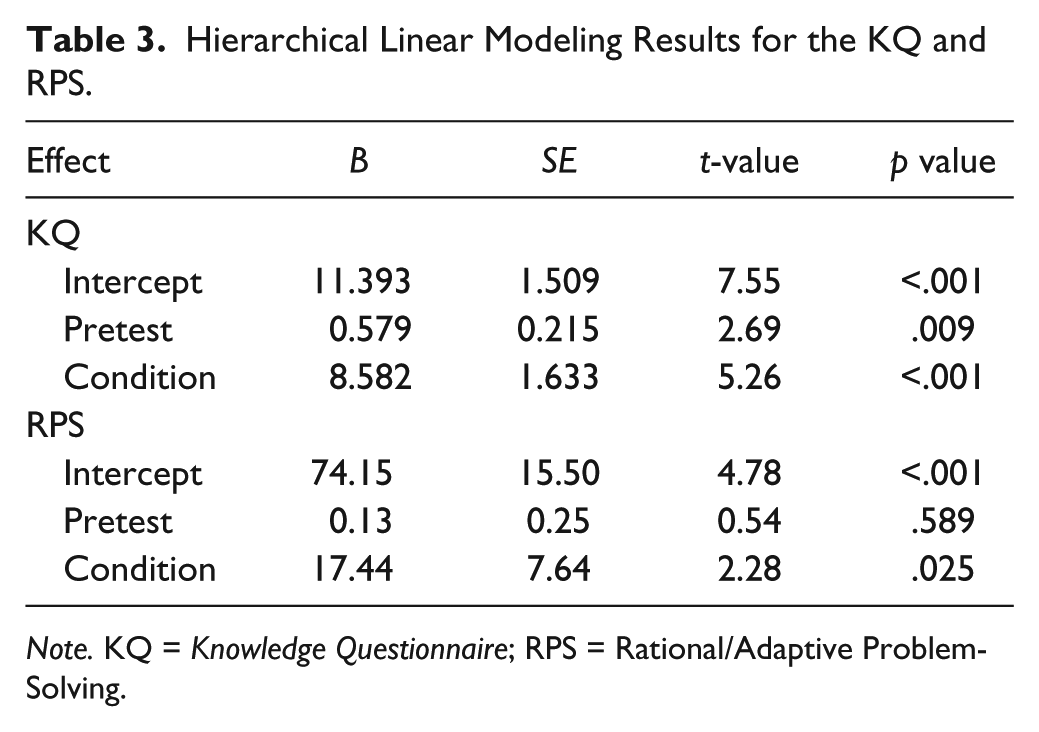
Note. KQ = Knowledge Questionnaire; RPS = Rational/Adaptive Problem-Solving.
The second research question was as follows: Does Take CHARGE! improve students’ approaches to problem-solving? There were no significant differences in students’ RPS scores in the intervention and control groups at pretest (see Table 2). At posttest, there were significant differences favoring the intervention group on the RPS, t(90) = 2.44, p = .037. A main effect (see Table 3) was found for condition (b = 17.44, p = .025), such that students in the intervention group self-reported significant improvements in adaptive/rationale problem-solving behaviors after adjusting for pretest, resulting in a moderate effect (d = 0.48).
Treatment Fidelity and Social Validity
Based on teacher reports, treatment fidelity checklists, and observational data, teachers implemented Take CHARGE! with a high degree of fidelity. Of the lessons observed, treatment fidelity was 100% and IOA among observers was 100%, indicating that all observed teachers followed the curriculum as prescribed. Teachers in the intervention group reported teaching all of the lessons. All five teachers in the intervention condition returned the Take CHARGE! Curriculum Checks. For the 15 core lessons, all respondents reported they had covered “most” or “all” lesson content. Lessons averaged 30 min, including completion of activities. Overall, the teachers reported that Take CHARGE! was a socially valid curriculum for middle school students with EBD. Teachers reported the curriculum was easy to use and was appealing and useful to their students, and they primarily agreed the curriculum was effective for improving student behavior and indicated that they would use the curriculum again. The overall mean score on the social validity questionnaire, which included a scale ranging from 1 (strongly disagree) to 5 (strongly agree), was 4.0, with no rating on any question lower than 3.
Discussion
The purpose of this study was to discover if a CBI-based problem-solving curriculum, Take CHARGE!, could positively affect the social problem-solving knowledge and self-reported behaviors of middle school students with EBD being educated in self-contained classrooms. First, students were assessed on knowledge of social problem-solving using the KQ, an assessment of problem-solving concepts and skills based on Take CHARGE!. There was a statistically significant effect on knowledge in social problem-solving for students in the treatment group when compared with control. Although this is not surprising, it demonstrates that middle school students with EBD can learn concepts within the curriculum and, as D’Zurilla and Goldfried (1971) suggested, this is an important first step in behavioral change. Second, students self-reported their social problem-solving behaviors, and results suggested a statistically significant effect for students in the intervention group. This suggests that not only did students improve their knowledge of social problem-solving, but their ratings on how they applied problem-solving skills changed as well. In other words, students may have been able to generalize their knowledge to actual behaviors. By improving knowledge resulting in self-reported behavior change, the Take CHARGE! curriculum was able to target both students’ acquisition and performance deficits. In other words, can’t do and won’t do deficits (Gresham, Sugai, & Horner, 2001) were both addressed in the current study.
Foundational knowledge is a requisite skill to the application of and future attempts at social problem-solving. Given the characteristics of the students within this study (e.g., aggression, anger, distorted perceptions), the fact that students demonstrated the ability to learn social problem-solving skills is important because it equips them with the tools to successfully interact with others. Moreover, considering the high rate of problematic situations within self-contained classrooms for students with EBD, a student with the requisite knowledge on how to solve social problems has a plethora of opportunities to be reinforced when successfully using her or his new skill. If students in self-contained EBD classrooms increase rates of positive interactions and reintegrate into inclusive instructional programming, then they have greater opportunities to expand positive social networks.
Social Competence and Social Networks
Learning social competence requires that students take knowledge from others and then apply it as part of a skill set to future social situations. When applied correctly, students are rewarded (Bandura, 1997) and are more likely to try the application of skills again. As a student tries new knowledge, interacts, and is pleased with the outcome, she or he is more likely to repeat the skills across any social interaction. As most individuals prefer social interactions to contain little to no conflict and to meet specific needs, a mutual perception of successful interactions is ideal. When generalized across contexts, along with behavioral history, individuals are seen as socially competent. Theoretically, from a cognitive-behavioral perspective, if proficient social competence is mutually perceived by two individuals, they are more reinforced to trust and reciprocally interact, which results in the likelihood of building and benefiting from a broader range of positive social networks. Students with EBD need to acquire the requisite knowledge to form individual relationships and build positive social networks. Teachers within this study were able to provide the foundational knowledge needed that served as a model for forming positive interactions. Students were then able to take that knowledge to change their social behaviors, according to self-report data.
Considerations for Practice
Although the majority of literature on social problem-solving instruction to prevent behavior problems in schools has occurred at the school- or class-wide level in general education settings with large groups of students, there is some limited evidence supporting the effectiveness of targeted interventions in small groups (Merrill et al., 2017). Teachers wishing to enhance any social-emotional curricula may choose to design age- and developmentally appropriate role-plays, brainstorming sessions where teachers think aloud about how they solve social problems (McDaniel et al., 2017). Merrill and colleagues (2017) conducted a comprehensive review of social problem-solving interventions and identified explicit instruction in problem-solving steps, a focus on regulation of emotions, and planning for generalization as essential to extend concepts within a lesson, such as those provided within the Take CHARGE! curriculum.
Merrill and colleagues (2017) also suggested teachers place a greater emphasis in activities involving larger groups of peers. In self-contained classrooms, this may require collaboration with other classrooms. Teachers will also need the support of administrators, counselors, and other school staff. To support teachers who elect to nurture students by providing social and emotional strategies, administrators may wish to emphasize components of the curriculum across the school that benefit not only targeted students, but also the entire school culture (Elias, Zins, Graczyk, & Weissberg, 2003). Maintaining a supportive culture throughout the school, year to year, is particularly important for students with EBD whose social competence deficits are severe and require long-term intervention (Gresham, 2015; Kazdin, 1995). Teaching students skills that improve social interactions and relationships is equivalent to academic instruction, in that neither should be terminated after only a few months (Maag, 2005).
Limitations and Considerations for Future Research
Due to the exploratory nature of this research, the study had limitations that leave open the possibility for several new avenues of empirical inquiry. First, the large effect found for social problem-solving knowledge in the intervention group compared with the control group may have been expected, given that intervention students received the curriculum and control students did not. However, the significantly large gain in knowledge for students with EBD cannot be disregarded. These students comprise one of the most vulnerable groups in school and their disability is defined in part by social skills deficits (Farmer, 2013; Gresham, 2015). Results from the current study suggest that when offered instruction, these students can in fact improve their knowledge of social skills and apply that knowledge to social behaviors.
Second, as suggested by Arnold and Hughes (1999), future studies may include students with EBD in both inclusive and self-contained settings to test for differential effects. Such a comparison may allow researchers to tease out potentially unintended effects of grouping students with a high concentration of undesired behaviors together as compared with students who have greater access to peer models of prosocial behaviors. From a cognitive-behavioral perspective, youth who share similar knowledge, thoughts, attitudes, and beliefs are more likely to trust and associate with each other. According to multiple research teams (Dishion, Patterson, Stoolmiller, & Skinner, 1991; Farmer et al., 2015), the processes by which early adolescents seek out peer groups that share similar beliefs subsequently promote further behavioral alignment. Interventions such as Take CHARGE! also promote a common language for teachers and students, and future research should consider including a focus on instruction navigating negative and positive peer groups.
The third limitation was the reliance on student self-report as a measure of their social skill behaviors. Future studies may be improved by using multiple raters of student behavior (e.g., teachers, parents), but student self-report instruments are fairly common in education research (Levitt, Saka, Romanelli, & Hoagwood, 2007). Although the original plan was to supplement student self-reports with OTSA, unfortunately, the majority of teachers did not return OTSA data. In addition, although teachers’ use of self-talk was assessed using fidelity checks during lessons, future research with more person-power may wish to observe self-talk and teachable moments outside of scheduled lessons.
The fourth limitation was the lack of social validity from the student perspective. However, teachers reported the curriculum was useful for students and the changes in students’ social knowledge and social skills behavior suggests that they did find the program somewhat useful. Still, future studies may benefit from direct assessment of students’ opinions about Take CHARGE!. Finally, the use of alternative methodologies would provide differing and supporting perspectives on the influence of a social problem-solving curriculum on teacher–student interactions. For example, single-subject design research could target each interaction within self-contained classrooms during social problem-solving instruction for observable and subtle changes in the ratio of positive to negative interactions that contribute to students’ relationship quality with teachers and peers. Longitudinally, researchers could gain insight into the process of internalizing problem-solving skills and how those skills generalize to new and novel settings.
A social problem-solving curriculum may serve as a structural antecedent (Lazarus, 1981) or model that establishes behavioral norms for both the teachers and their students. Specifically, a model that provides shared knowledge and use of problem-solving skills in self-contained EBD settings establishes norms by which to interact. Self-contained EBD settings typically provide numerous opportunities to use and practice the acquired social skills during the school day as compared with regular education settings, thereby providing ample opportunity to model and time for practice. Although many researchers have advocated for increased use of problem-solving curricula in classrooms (Daunic et al., 2011; Gresham, 2015; Jennings & Greenberg, 2009; Merrill et al., 2017), broader outcomes and effects that extend beyond a curricula are still unknown (Maag, 2005). Hence, further research investigating the additional benefits and utility of a problem-solving curriculum including targeted interventions that result in trusting interactions and improved relationships between teachers and students with EBD may prove useful. As teacher–student relationships are crucial to social-emotional and academic competence (Pianta et al., 2008), an emphasis on developing quality relationships between teachers and students can be viewed as a viable intervention for reinforcing positive social, emotional, and academic development (Mihalas, Morse, Allsopp, & McHatton, 2009).
Conclusion
Based on the KQ, RPS, treatment fidelity, and social validity measures, the current study demonstrated that teachers could deliver a CBI-based curriculum, resulting in their students acquiring knowledge of social problem-solving that they were then able to generalize into changes in social behaviors, which was measured from student self-report data. Future research should include direct observation methods to confirm the accuracy of students’ self-reported behavior changes. This study also supports previous efficacy literature, wherein trained teachers are able to successfully deliver the knowledge within a curriculum versus effectiveness studies where researchers deliver the material (Daunic et al., 2011; Quinn, Kavale, Mathur, Rutherford, & Forness, 1999; S. W. Smith et al., 2016). The findings from this study demonstrate that middle school students with EBD can effectively learn concepts related to social problem-solving skills and rate themselves more proficient in solving social problems. Over time, such success may allow these students to integrate into more inclusive settings and expand their positive social networks.
Footnotes
Declaration of Conflicting Interests
The authors declared no potential conflicts of interest with respect to the research, authorship, and/or publication of this article.
Funding
The authors received no financial support for the research, authorship, and/or publication of this article.