







Abstract
Improving social, emotional, and behavioral outcomes of students with and at-risk for emotional and behavioral disorders (EBD) remains a challenge for educators, and it has long been noted that teachers do not consistently use effective instructional practices with students with EBD. Identifying evidence-based practices that address the problems experienced by students with EBD is a priority for the field, but there exist implementation challenges in authentic classroom settings. The purpose of this article is to address one implementation barrier by distilling the common practice elements found in evidence-based programs (EBPs) and practices delivered by teachers designed to target the social, emotional, and behavioral problems in young students. We conducted a systematic review of EBPs and early elementary classroom practices that have been evaluated in randomized group designs, quasi-experimental designs, and single-case experimental designs. A total of 103 articles employing 68 group (n = 53 randomized group designs, n = 15 quasi-experimental designs) and 35 single-case designs were identified, and an iterative process was used to identify common practice elements. Twenty-five practice elements were identified and submitted to review by experts. After expert review, 24 practice elements remained. Implications for practice and training as well as future research are discussed.
The early years of school are critical for students’ academic, social, and behavioral development and future success. Unfortunately, many students enter school with behavioral challenges that increase risk for emotional and behavioral disorders (EBD; Conroy, Sutherland, Snyder, & Marsh, 2008). Teachers report dealing with the problem behavior exhibited by students with EBD as the most difficult aspect of teaching (Maag, 2004; Reinke, Stormont, Herman, Puri, & Goel, 2011). However, the field has struggled to help teachers meet the needs of students with EBD. In part to address these concerns, there has been an increased focus over the past two decades on establishing evidence-based practices and programs recommended for use by teachers (e.g., Cook, Tankersley & Landrum, 2009; Odom et al., 2005). Although progress toward identifying evidence-based practices and programs for elementary schools has been made, barriers exist to implementing these practices and programs in authentic school settings.
One barrier faced by educators is selecting what evidence-based program (EBP) or practice to implement (Domitrovich et al., 2008; Durlak, 2015; Forman et al., 2013; Han & Weiss, 2005). Although numerous evidence-based practices and programs have been evaluated, the literature has yet to take steps to provide operational definitions for the instructional practices evaluated in the field (Powell & Dunlap, 2009). This represents an important barrier that limits the ability to interpret study findings and select specific programs or practices for implementation. Taking steps to generate operational definitions for the instructional practices that are widely studied within a field can thus help facilitate efforts to implement evidence-based practices and programs in elementary settings (Fairburn & Patel, 2014; Institute of Medicine, 2015).
In an effort to provide operational definitions for the field, it is important to distinguish between EBPs and evidence-based practices. EBPs are typically defined as collections of practices delivered to a specific population targeting outcomes that meet identified levels of scientific criteria, including replicated support in randomized clinical trials (e.g., Fixsen, Naoom, Blasé, Friedman, & Wallace, 2005; Weisz et al., 2013). Examples of EBPs include First Step to Success (Walker, Kavanagh, & Stiller, 1998) and Incredible Years (Webster-Stratton, Reid, & Hammond, 2004). Practices, on the contrary, are defined as statements, behaviors, or actions of a teacher that manipulate features of the learning environment in classrooms (McLeod et al., 2017). Examples of evidence-based practices include token economies (e.g., Kamps et al., 2011) and behavior specific praise (e.g., Matheson & Shriver, 2005). EBPs often consist of multiple practices and are evaluated using group designs whereas individual practices are commonly evaluated using single-case experimental designs.
One way to address these definitional issues is to identify the core ingredients or elements that comprise EBPs and practices from a given field (Becker & Domitrovich, 2011; Dishion, 2011; Durlak, 2010; Forman et al., 2013). A recent report by the Institute of Medicine (2015) recommended that the identification of the core elements of interventions is critical to implementation. To achieve this goal, the identification of core elements needs to be based on a thorough review of existing EBPs and practices so that a common terminology for defining core elements associated with specific outcomes can be established (Chorpita & Daleiden, 2009; Garland, Hawley, Brookman-Frazee, & Hurlburt, 2008; McLeod et al., 2017).
The recommendation to concatenate the key practice elements that comprise EBPs is not new in the education literature (Becker & Domitrovich, 2011; Dishion, 2011). Suggestions to identify core elements have been referred to as practice elements (Chorpita & Daleiden, 2010) or evidence-based kernels (Embry & Biglan, 2008). Hereafter we adopt the term practice elements, defined as the individual instructional practices common across various treatment manuals (Chorpita & Daleiden, 2010) that are associated with a desired treatment outcome. Becker and Domitrovich (2011) highlighted the utility of using a practice elements approach to prevention and intervention via their application to a variety of problem behaviors demonstrated by youth, the ability to capitalize on naturally occurring learning opportunities, their fit within tiered-levels of behavior support (e.g., Response to Intervention [RTI]; Positive Behavioral Interventions and Supports [PBIS]), and sustainability via the identification of high-quality implementers (e.g., teachers delivering practice elements with fidelity).
To date, researchers have used two methods to identify and catalog practice elements within the mental health and education fields. The first, developed by Chorpita and colleagues (Chorpita & Daleiden, 2009; Chorpita, Daleiden, & Weisz, 2005) begins with a codebook of predetermined practice elements created from the research literature and stakeholder input (e.g., therapists and intervention developers). These practice elements are then coded within EBPs, which is useful to help identify how broadly practice elements are represented within a treatment literature. Recently, Boustani et al. (2015) used this process to code common elements of evidence-based prevention programs focused on health promotion of adolescents, finding that problem solving was the most common practice element in this literature.
A second approach uses a review of the literature to define the list of practice elements. Garland et al. (2008) developed this approach and used it to identify practice elements common to EBPs for children (ages 4–13) with disruptive behavior problems. Following an iterative process these researchers defined and extracted 21 practice elements from eight studies. To illustrate, Garland et al. (2008) noted that modeling represents a practice element that appears in several EBPs for youth disruptive behavior problems, such as the Incredible Years program (Webster-Stratton et al., 2004). McLeod et al. (2017) recently used this approach to identify common practice elements from the early childhood social, emotional, and behavioral intervention literature. These researchers reviewed 29 randomized controlled trials, seven quasi-experimental designs, and 13 single-case design studies. From this literature, 475 practices were extracted that were distilled into 24 practice elements. This second approach is a good fit for the early elementary literature as we are unaware of previous attempts to define common practice elements associated with social, emotional, or behavioral outcomes. Moreover, this approach to defining common practice elements has the potential to facilitate teachers’ delivery of evidence-based practices in classroom settings (McLeod et al., 2017).
The purpose of the current study was twofold. First, we conducted a systematic review of the literature, focusing specifically on teacher-delivered programs and practices targeting social, emotional, or behavioral outcomes for students with and at-risk for EBD in early elementary classrooms. Next, we coded the identified literature (program manuals or, if manuals were not available, individual studies) and extracted instructional practices from the manual or study, which were then distilled into practice elements. We applied procedures created by Garland et al. (2008) and replicated by McLeod et al. (2017), as we wanted to identify all practice elements from the intervention literature in early elementary school classrooms and were unaware of any previous attempts to similarly synthesize this literature.
Method
Selection of Studies
A literature search was conducted to identify published studies investigating EBPs and practices targeting social, emotional, and behavioral outcomes for students with and at-risk for EBD that were delivered in early elementary classrooms (defined as Kindergarten through second grade). Articles were identified through a computer-based search that spanned 2005 to 2015. The year 2005 was chosen because of the publication of the special issue on evidenced-based practices in Exceptional Children (Odom et al., 2005), highlighting an increased emphasis on evidence-based practices in the field. Four electronic databases were searched: (a) Education Research Information Center (ERIC), (b) PsycINFO, (c) Elton B. Stephens Company (EBSCO), and (d) Web of Knowledge (Social Science Citation Index). Key search terms were used in each of the four databases: (engage* OR “on task” OR “off task” OR complian* OR noncomplian* OR behavior OR behaviors OR aggress* OR disrupt* OR problem* OR challeng* OR regulat* OR affect* OR social* OR emotion*) AND (interven* OR treatment* OR prevent*) AND (kindergarten* OR elementary* OR grade*) (NOT “Middle School” OR “High School” OR Adols* OR “Autism”). The initial search generated 7,232 results, which were reduced to 3,616 articles after removing duplicates (see Figure 1).
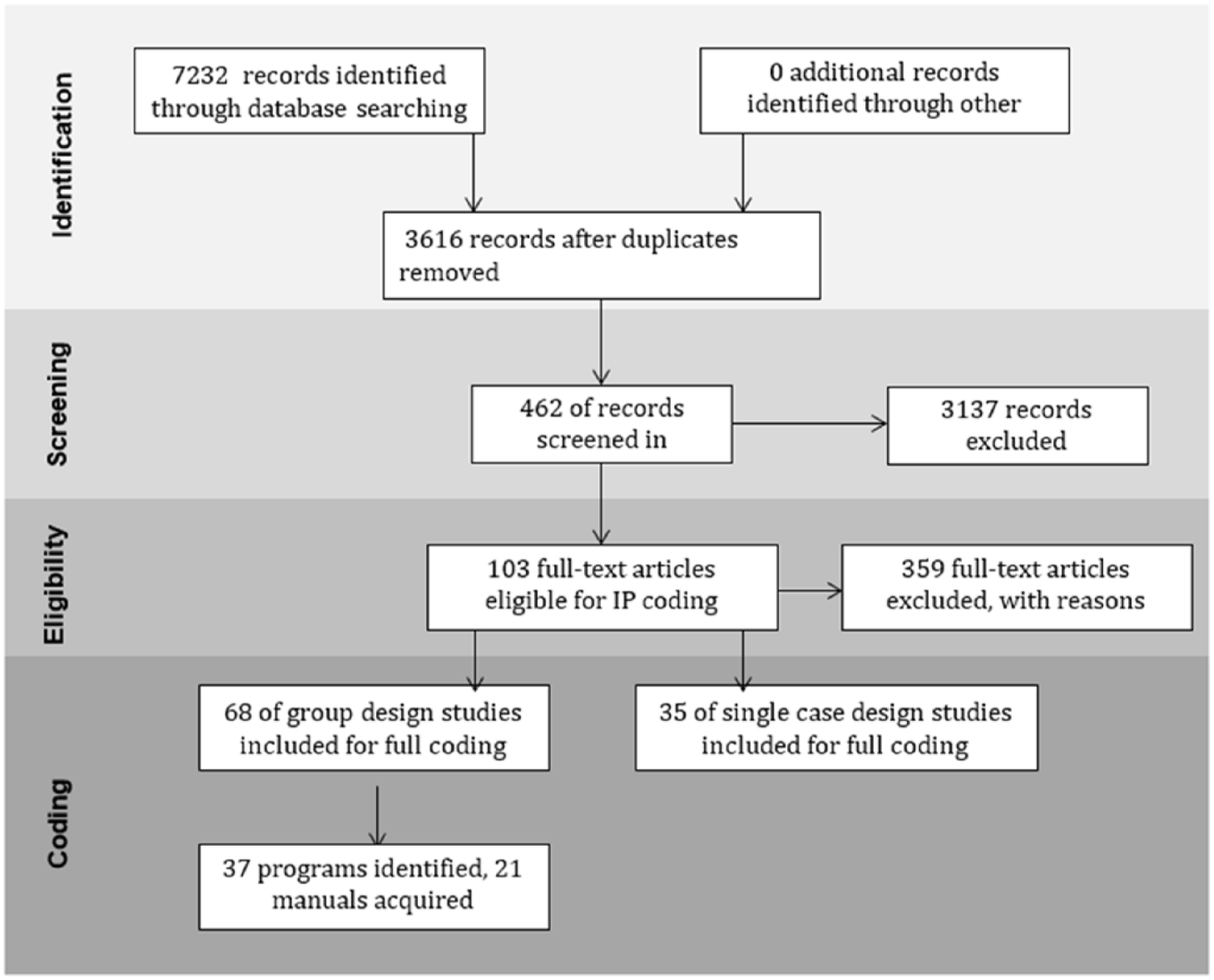
Literature review diagram.
Inclusion and Exclusion Criteria
All studies were screened through two levels of inclusion criteria. The first level of inclusion/exclusion focused on participants and settings and included three criteria. First, the average age of participants was between 5 to 8 years of age, or if age was not provided the midpoint of the grade range was within kindergarten through second grade. Second, participants diagnosed with autism spectrum disorder were excluded, as we were interested in outcomes for students with or at-risk for EBD. Third, studies must have taken place in a school using practices that target social, emotional, and behavioral outcomes of students.
The second level of screening focused on study methodology. First, the study must have demonstrated experimental control through either a group design (i.e., randomized control, quasi-experimental) or a single subject design (e.g., withdrawal/reversal designs, multiple baseline). Second, the intervention/program needed to be delivered by a teacher or other adult in a classroom (i.e., interventions/programs delivered on a playground or medication-based interventions did not qualify). Third, the study was published in English. Finally, function-based interventions were not included as these interventions target outcomes for a specific child based on individually identified function of behavior and therefore were not considered to be generalizable to the broader population.
Two authors read titles and abstracts to identify studies for further review; studies that did not meet initial screening criteria (e.g., average participant age between 5 and 8 years) were removed, resulting in 462 unique studies. The two authors next read the full texts of each of these 462 studies using inclusion and exclusion criteria (e.g., demonstrate experimental control, teacher-delivered intervention/program) resulting in 103 articles employing 68 group (n = 53 randomized group designs, n = 15 quasi-experimental designs) and 35 single-case design studies. Thirty-seven programs were represented in the 68 group design studies; of these 37 programs, 21 program manuals (e.g., Tools of the Mind: Bodrova & Leong, 2007; INSIGHTS: McClowry, 2014) were acquired.
Coding of Instructional Practices
Instructional practices were coded using the bottom-up procedure (i.e., all practices in the literature base were coded and classified) developed by Garland et al. (2008) and used by McLeod et al. (2017). Three sources were considered for coding the instructional practices: (a) practices were coded directly from the program manuals; (b) if the program manual was not available, the most explicit description of the program available was used (e.g., Caldarella, Williams, Hansen, & Wills, 2015; Robichaux & Gresham, 2014); and (c) if this was not possible, the practices were coded directly from the article. All articles and manuals were double coded by five coders, all of whom were graduate students in PhD programs in Special Education, Educational Psychology, or Clinical Psychology. Following the initial coding of the article or manual coding, any discrepancies were consensus coded.
For the purpose of this review, an instructional practice was defined as “a specific statement, behavior, or action of a teacher that manipulates features of the physical, temporal, interactional or instructional environment in the classroom” (McLeod et al., 2017, p. 207) to promote student social, emotional, or behavioral competence. We used the following steps to extract and code individual instructional practices. First, individual instructional practices were extracted from manuals or articles and coded. Second, the Target Goal of each practice was identified; this was the outcome domain of student functioning or skills the practice targeted. Nine target goals were coded (i.e., teacher–child relationships, problem/challenging behavior, social skills peers, social skills adults, self-regulation, emotion identification/expression, social problem solving, engagement/task-oriented behavior, and academic). Next, like practices were combined into practice elements (e.g., emotion identification and emotion regulation were combined into emotion regulation). Last, practice elements were grouped into two categories: content or delivery items. Content items were defined as broad domains that teachers target to improve students social, emotional, and behavioral outcomes, and delivery items were how teachers deliver instruction to a student. That is, content items are considered to be practice elements that have evidence at improving child outcome via a focus on a broad domain of functioning, while delivery items are the practice elements that teachers might use to deliver instruction within a content item domain.
Expert Review
Six experts with extensive experience conducting research in elementary schools with a particular focus on students with EBD participated using a modified Delphi procedure that consisted of rating the list of practice elements. The experts did not participate in the extraction and coding of the practice elements, but rated the practice elements independent of the process. All six experts held a PhD with specialization in education; one in educational psychology, and five in special education. A survey was provided to rate the practice element as either a content or delivery item, and experts then rated each practice element as “essential,” “useful but not essential,” or “not useful” in terms of the social, emotional, and behavioral outcomes for students in kindergarten through second grade. Practice elements rated as either useful or essential by 75% of the experts were retained.
Results
The first phase of coding resulted in a total of 100 practices (e.g., praise, opportunities to respond) from program manuals and articles. After removing redundancies and consensus coding to resolve discrepancies, a second phase of coding resulted in 42 practices. Following this phase, like items (e.g., goal setting, self-management and behavior contract combined to self-management) were combined into practice elements, resulting in 25 common practice elements that were then placed into two categories: content or delivery items. A total of 13 content (emotion regulation, self-management, home-school communication, instructional antecedent, instructional feedback and discussion, peer tutoring, problem solving, punishment, reinforcement, routines, social skills, teacher–student relationships, group contingency) and 12 delivery (active supervision, behavioral momentum, choice, error correction, modeling, opportunities to respond, praise, precorrection, response cost, rules, rewards, time out) items were sorted.
The expert review resulted in 24 of 25 practice elements remaining (see Table 1). Nine of the practice elements (instructional feedback and discussion, teacher–student relationship, reinforcement, error correction, modeling, opportunity to respond, praise, rules, home-school communication) were rated as essential by all of the experts. Five practice elements (emotion regulation, social skills, routines, instructional antecedent, active supervision) were rated as essential by five of the six experts and useful, but not essential by one expert. Four practice elements were rated as essential by four experts and useful but not essential by two experts (self-management, problem solving, choices, precorrection). One practice element (punishment) was rated as essential by three experts and not useful by three experts. Three items were rated as essential by two experts (behavioral momentum, time out, peer tutoring); behavioral momentum and peer tutoring were rated as useful but not essential by four of the experts, and time out was rated as useful but not essential by two of the experts. Three items were rated as essential by one expert (group contingency, tangible rewards, response cost); group contingency was rated as useful but not essential by five experts, tangible rewards and response cost were rated as useful but not essential by four experts.
Common practice elements, definitions, target outcomes, and frequency counts.
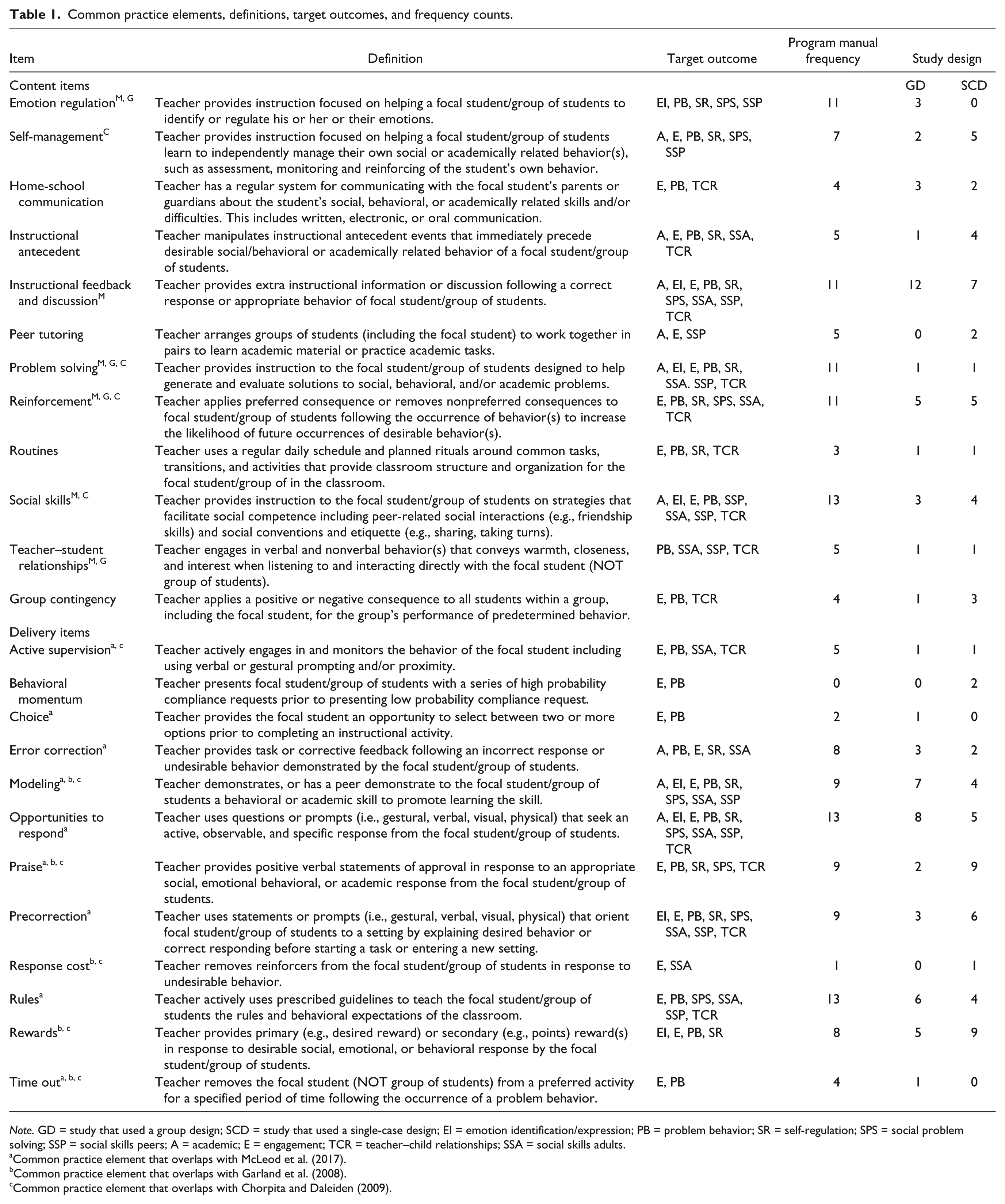
Note. GD = study that used a group design; SCD = study that used a single-case design; EI = emotion identification/expression; PB = problem behavior; SR = self-regulation; SPS = social problem solving; SSP = social skills peers; A = academic; E = engagement; TCR = teacher–child relationships; SSA = social skills adults.
Common practice element that overlaps with McLeod et al. (2017).
Common practice element that overlaps with Garland et al. (2008).
Common practice element that overlaps with Chorpita and Daleiden (2009).
Discussion
The purpose of this article was to systematically review the literature and identify common practice elements within EBPs and practices delivered by teachers designed to target social, emotional, and behavioral outcomes of young elementary students with and at-risk for EBD. Using the process described by Garland et al. (2008) and McLeod et al. (2017), we conducted the literature review, coded treatment manuals and articles, and consulted with experts. We identified 24 common practice elements, including 12 content and 12 delivery items, describing a range of practices that teachers can use to promote the social, emotional, and behavioral development of elementary school students at risk for EBD. Below we highlight evidence supporting the validity of the current study findings based upon a comparison to previous work in this area, the utility of this process as it relates to implementation efforts, limitations of the current approach, and implications for future work in this area.
It is informative to examine overlap from the practice elements identified in the current paper with previous work that has examined interventions for disruptive behaviors in both mental health (e.g., Chorpita & Daleiden, 2009; Garland et al., 2008) and education (McLeod et al., 2017). First, of the 20 most frequent practice elements identified by Chorpita and Daleiden, nine overlapped with those from our list (see Table 1). Of the 21 practice elements identified by Garland et al., nine overlapped with our list, while 12 practice elements overlapped with the 24 items from the McLeod et al. list. This overlap across these efforts provides initial support for the content validity of our list. For example, problem solving, reinforcement and praise were represented in each of the four lists, highlighting the importance of these practice elements in treating disruptive behavior problems across both mental health and education contexts. In addition, seven items overlapped across three of the four lists, including emotion regulation, social skills, teacher–student relationships, modeling, response cost, rewards, and time out. Although not necessarily indicative of the level of evidence of each of these practice elements, their existence in practices and EBPs across disciplines, settings (e.g., community-based mental health, early childhood classrooms, elementary classrooms) and developmental levels (e.g., early childhood, early elementary, adolescence) speaks to the potential flexibility of these practices for use by therapists, caregivers, and teachers across settings.
At the same time, differences in the practice elements across the four efforts suggest some unique approaches across various disciplines and contexts. For example, practice elements unique to educational contexts such as instructional feedback, error correction, opportunities to respond, precorrection, and rules were evident only in the current study and McLeod et al. (2017). This is understandable as McLeod et al. also focused on teacher-delivered practices in early childhood settings and many of the instructional and classroom management principles are similar across these contexts (i.e., classrooms) and practitioners (i.e., teachers). At the same time, some differences between practice elements identified in McLeod et al. and the current study were found. There were 12 practice elements identified in this paper that were not identified by the preschool review. Practice elements such as self-management may not have been found in the early childhood literature due to the developmental skills of young children, while peer tutoring and group contingency take advantage of the growing role peers play for students in elementary school.
The field has struggled to implement evidence-based practices in classrooms for students with and at-risk for EBD (e.g., Shores, Gunter, & Jack, 1993; Wehby, Symons, Canale, & Go, 1998). Our findings take an important step toward addressing a potential implementation barrier by providing operational definitions for the instructional practices that have been the focus of research. Importantly, the relatively small number (n = 24) of practice elements identified by the process in this paper highlights the common active ingredients present in EBPs and interventions targeting students’ social, emotional, and behavioral outcomes in early elementary school. Of these 24, we classified 12 as content items (broad domains targeted by teachers) and 12 as delivery items (how teachers deliver content).
The identification of 24 practice elements linked to target outcomes has the potential to help educators select evidence-based practices for use in authentic school settings. To illustrate, if a teacher or program administrator has concerns about the peer-related social skills of a student or group of students she might focus on implementation of the 11 practice elements (e.g., emotional regulation, self-management) associated with this target outcome. However, if a student or group of students has challenges with both peer and adult related social skills she might focus the practice elements (e.g., problem solving, social skills) that target both outcomes. In this way teachers may deliver practices that have maximum utility and promise to address the specific learning needs of students with and at-risk for EBD.
The identification of practice elements also has the potential to inform training and intervention programs. The flexibility of use of practice elements can be seen in both preservice and professional development training for teachers. The small number of practice elements identified in the current review could be used in preservice training programs to better prepare teachers to meet the needs of students exhibiting challenging behavior, which could help address the lack of preparation for dealing with problem behavior identified by teachers (e.g., Reinke et al., 2011). Training programs could broadly focus on content items (e.g., emotional regulation, self-management, problem solving) that have some evidence of effectiveness with young students with and at-risk for EBD as potential targets for interventions delivered by teachers, while focusing on delivery items (e.g., choice, modeling, praise) as evidence-based practices for providing instruction in these key areas. The use of a practice elements approach may thus offer a more individualized, modular approach to addressing individual students’ needs, providing teachers with greater flexibility in adapting evidence-based practice elements within the complexity of ongoing classroom instruction.
Although results from the process described in this article to identify common practice elements from EBPs and intervention targeting the social, emotional, and behavioral outcomes of young students with and at-risk for EBD are promising, the process is not without limitations. First, similar to McLeod et al. (2017), but unlike Chorpita and Daleiden (2009) and Garland et al. (2008), we did not require that programs and studies included in this review met certain levels of efficacy or effectiveness. This was done to capture the largest set of studies and programs to initially catalog practice elements in this literature; at the same time we recognize that different practice elements may have more (or less) effectiveness with groups of students and, more importantly, individual students.
Second, though establishing a quantifiable level of evidence for the individual practice elements represents an important goal for the field it was beyond the scope of the current paper. One challenge to this effort is that some practice elements are represented in EBPs that have been tested in randomized controlled trials, while others are tested independently or as part of a treatment approach in single-case experimental design studies. Quantifying the magnitude of effects in single-case design studies remains a challenge (Shadish, Hedges, Horner, & Odom, 2015) that will need to be resolved before effect sizes for individual practice elements can be computed.
In summary, we used a practice elements approach to identify 24 common practice elements across EBPs and interventions targeting the social, emotional, and behavioral outcomes of young elementary school students with and at-risk for EBD. Results from this process indicate that there is some overlap with other efforts to identify common elements in mental health and early childhood education, highlighting potential practice elements that may be effective across different contexts. The practice elements approach has much promise for informing implementation and dissemination efforts, as well as both preservice and professional development training and support for teachers. In addition, this approach can be replicated with other developmental levels (e.g., middle school) for a variety of treatment targets (e.g., disruptive behavior, attendance) in the hopes of making interventions most evidence-based, efficient and sustainable.
Footnotes
Authors’ Note
The opinions expressed by the authors are not necessarily reflective of the position of or endorsed by the U. S. Department of Education.
Declaration of Conflicting Interests
The author(s) declared no potential conflicts of interest with respect to the research, authorship, and/or publication of this article.
Funding
The author(s) disclosed receipt of the following financial support for the research, authorship, and/or publication of this article: This research was supported by grants from the U. S. Department of Education, Institute for Education Sciences (R305A150246) and Office of Special Education Programs (H325H140001).