






Abstract
Mandatory and voluntary standards for bunk beds were written to eliminate the risk of head and neck entrapment in end panels. However, these standards do not address entrapment potential in the area of a side-mounted ladder. This article profiles the fatal strangulation of one child whose head and neck slipped into the space between the side ladder and lower bunk. The use of anthropometry data was essential in detecting this design hazard. Moreover, had this type of analysis been conducted prior to the product’s entry into the marketplace, this hazard could have been prevented.
Keywords
Until the bunk bed standard is updated to address less obvious hazards like this one, fatalities of this type are likely to continue.
Ryan was just a few months shy of his fifth birthday when he died on the bunk bed where he was sleeping. When his mother last saw him, the night before, he was going to sleep in the lower bunk, with his 9-year-old sister sleeping in the upper bunk. In the morning, his mother went to awaken the children. It was then that she found Ryan with his neck caught between the vertical post of the side ladder and the mattress. His body was outside the bed, with his back to the mattress and his bottom on the floor. Ryan was already dead when his mother found him.
Ryan died as a result of neck compression injuries suffered when his head and neck became entrapped between the vertical post of the bunk bed ladder and the side of the mattress. With his chin hooked over the vertical post of the ladder and his body positioned off the bed, a pulling force was exerted on his neck, strangling him.
Ryan is not the only child to have become entrapped between a bunk bed side ladder and bed. Incidents have been reported dating from 1983 (Consumer Product Safety Commission [CPSC], 2009). The hazard could have been anticipated and prevented had a thorough human factors and ergonomics (HF/E) analysis been conducted. Specifically, knowledge and application of anthropometry data were needed to recognize that spaces created by side structures can cause a fatal entrapment.
Head and Neck Entrapment
Head and neck entrapment incidents have occurred in playgrounds, toy chests, strollers, hospital beds, shopping carts, beds, bed rails, cribs, toddler beds, and bunk beds. In the past several decades, millions of products that pose a head entrapment hazard have been recalled, and standards have been published in an attempt to prevent future incidents.
There are three primary ways in which children become entrapped in the openings of products: head first, feet first, and neck first. In neck-first entrapment, which is what happened to Ryan, a child inserts his or her neck into a partially bounded opening in the top of the product but cannot extricate the head. Removing the head is particularly difficult if the jaw becomes hooked and/or if the head is pinned.
It is important to note that even with their feet and knees on the ground, children have strangled when their heads became entrapped in an opening. For example, strangulation deaths involving old-style toddler climbing gyms resulted after children inserted their heads through a space in a ladder but were unable to figure out how to pull their heads out of the space. Although their feet were on the ground, the weight of the head over the ladder rung caused strangulation when the children were no longer able to hold their head and neck up.
The Specific Risk of Head and Neck Entrapment in Bunk Beds
The bunk bed industry has developed and revised a number of voluntary standards to address this hazard. The evolution of these voluntary standards was based on incident data demonstrating the risk of head and neck entrapment in bunk beds. The standards included spacing limitations intended to reduce the likelihood of head entrapment in bunk bed end structures (ASTM, 1992, 2007; CPSC, 1999).
In addition to requiring testing for head entrapment, the mandatory standard requires testing for neck entrapment. (Any portion of the opening in the bed’s end structure that is required to be tested for head entrapment, and that passes, must satisfy neck entrapment provisions.) This neck entrapment requirement was added after the CPSC learned of a death involving a cutout in an end panel. The cutout was designed such that if a child’s neck dropped into the opening, it could slide sideways into a horizontal channel and become entrapped. A neck template was designed on the basis of two key assumptions. First, a child would not be able to insert his or her neck sideways into an opening that is smaller than 1.88 inches. This dimension represents the neck breadth of a 5th-percentile 2-year-old, less 25% for tissue compression (Deppa, 1991). Second, there is a minimal likelihood of entrapment if the boundaries of an opening converge on the neck at an included angle greater than 75 degrees.
Today, the risk of head and neck entrapment in end structures is quite low in complying bunk beds. However, the risk of head and neck entrapment in the space between the ladder and side of the lower bunk exists, as it has never been addressed in any standard.
HF/E Assessment of the Ladder Entrapment Hazard
In Ryan’s bunk bed (and other bunk beds with a side-attached ladder), the hazardous opening was not in an end panel. Rather, it was a U-shaped opening created by the juxtaposition of the side of the lower bunk mattress, the lower bunk platform, and the inside vertical post of the ladder. This U-shaped opening is shown in Figure 1.
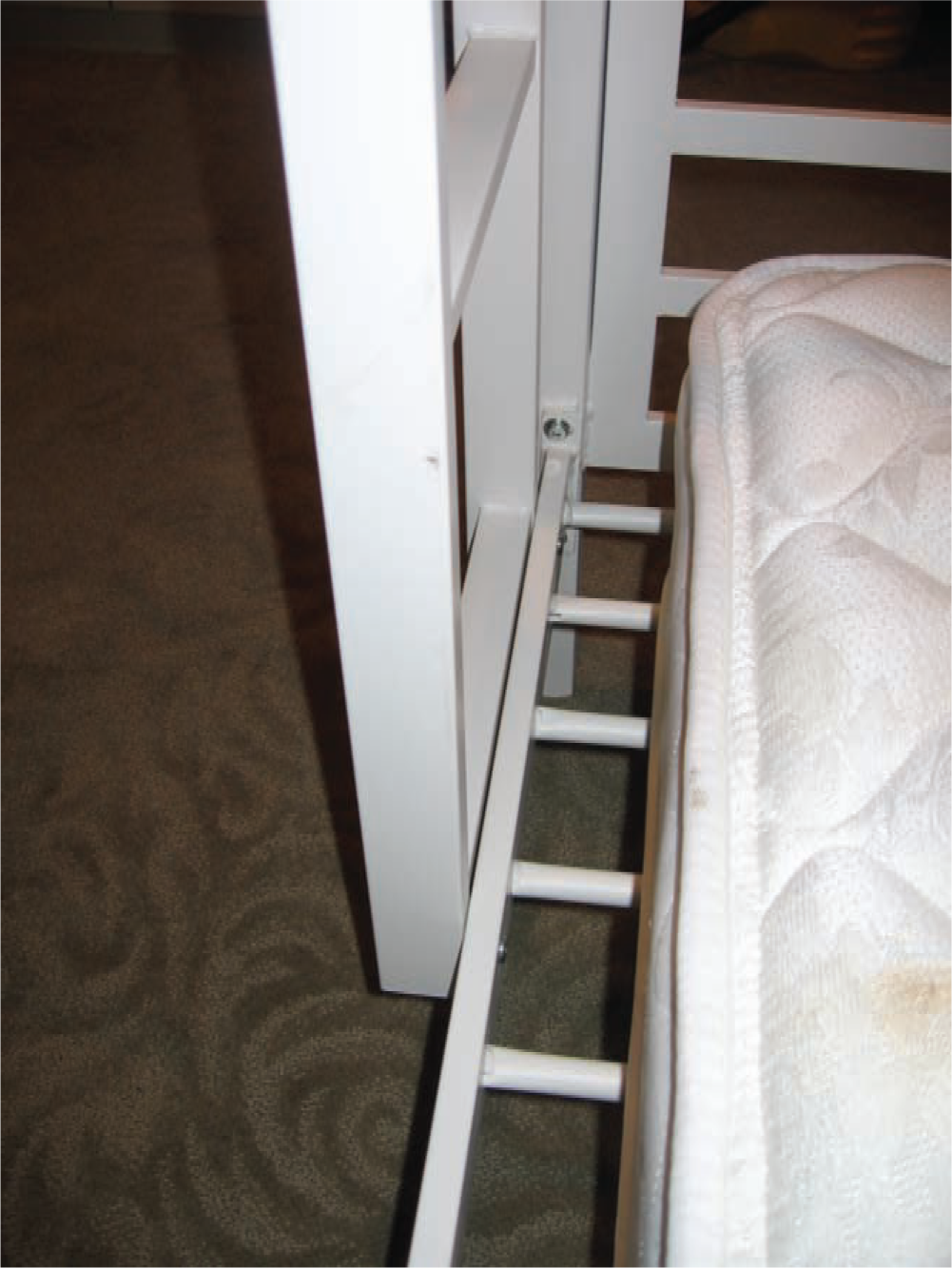
U-shaped opening at side of lower bunk created by side of mattress, lower bunk platform, and inside vertical post of the ladder.
This opening presented a sequential entrapment first of the head, then of the neck. Uncovering and understanding this hazard pattern required a complex anthropometric assessment. Anthropometry is the study of the dimensions and abilities of the human body. Anthropometric data are useful for understanding whether certain openings might create an entrapment hazard. A number of different head and neck measurements are relevant and must be compared against the different dimensions of the open space created by bed side structures to ascertain the potential for injury.
Entrapment in the three-dimensional, U-shaped space required that (a) the child’s face breadth fit in the 5-inch space between the upper edge of the mattress and the lower edge of the second rung, (b) the child’s neck fit in the 3-inch gap between the side of the mattress and the vertical post of the ladder, and (c) the child’s head (from under the chin to the top of the head) fit between the two vertical posts of the ladder, which are 10.4 inches apart.
To assess entrapment potential, one first looks to data on head sizes for the smallest user. The youngest intended user of a bunk bed is a 2-year-old, as children younger than 2 years typically sleep in cribs. According to anthropometry data (Schneider, Lehman, Pflug, & Owings, 1986), the maximum face breadth of the smallest (5th-percentile) 25- to 30-month-old measures 3.7 inches. Thus, the smallest user’s face easily fits through the 5-inch space between the upper edge of the mattress and the lower edge of the second rung.
An older child’s face can also fit in the space between the upper edge of the mattress and lower edge of the ladder’s second rung. Ryan was just younger than 5 when he died. Anthropometry data for children ages 4.5 to 5.5 years show that the maximum face breadth of the largest (95th-percentile) child in this age range measures 4.4 inches (Snyder, Schneider, Owings, Reynolds, Golomb, & Shork, 1977). Thus, Ryan’s face easily fit through the 5-inch space between the upper edge of the mattress and the lower edge of the second rung.
After a child’s face enters the opening between the ladder rungs, the head drops down to the mattress platform and the neck slips into the 3-inch space between the vertical post of the ladder and the side of the mattress. The depth of the neck (from front to back) of a 5th-percentile 25- to 30-month-old child measures 2.2 inches. After deducting 25% for neck compression, this measurement is 1.65 inches. Neck depth data are not available for 5-year-old children. However, the Schneider et al. (1986) study measured the neck depth of 95th-percentile 43- to 48-month-old children. After deducting 25% for neck compression, the neck depth of the largest child in this age range is 2.3 inches, which is obviously smaller than the 3-inch space between the vertical ladder post and side of the mattress.
After a child’s neck slips into the 3-inch space between the side of the mattress and the vertical post of the ladder, the head and neck are pressed forward by pressure from the mattress behind the head. The head moves into the space between the two vertical posts of the ladder. The head height of a 5th-percentile 25- to 30-month-old measures 6.3 inches, and that of a 95th-percentile 4.5- to 5.5-year-old measures 7.0 inches. The head easily fits into the 10.4-inch space between the vertical posts on the ladder measures.
With the head entering the ladder and the mattress against the back of the head, the neck is pushed against the vertical post of the ladder. In addition, the chin hooks over the ladder, further entrapping the head. With the head pushed forward and the front of the neck positioned against the vertical post of the ladder, the child is entrapped. Pressure is applied to the neck by the weight of the rest of the body that is out of the bed.
When Ryan died, his face apparently passed through the 5-inch space between the mattress and the ladder. After his head passed (partially) through the opening between the ladder rungs, his neck dropped down in the 3-inch space between the side of the mattress and the vertical post on the ladder. With his chin hooked over the vertical post, the mattress against the back of his head, and his body weight outside the bed, Ryan strangled on the vertical post of the ladder (see Figure 2).
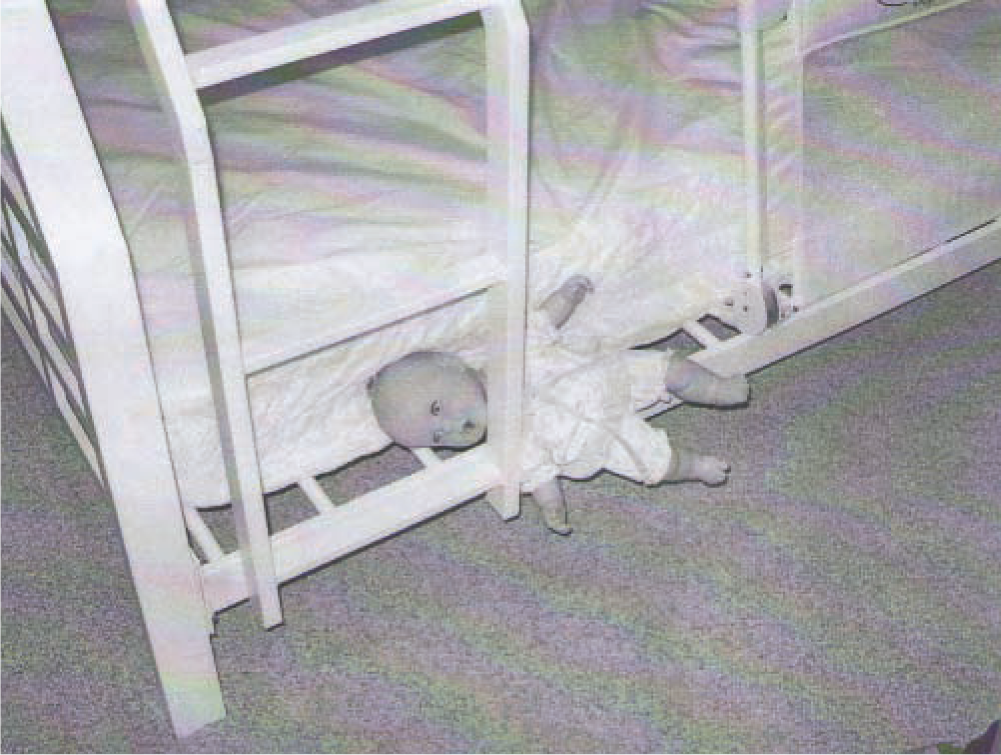
Demonstration of the neck entrapment hazard posed by lower bunk side structures (CPSC IDI No. 081021HWE7802).
Insufficiency of the Mandatory Standard
Ryan’s death demonstrates a serious omission in the mandatory standard for bunk beds. The standard prohibits end structures that present head and neck entrapment potential; however, it does not address this hazard in side structures (e.g., ladders). Although the rate of reported entrapment in side structures is low – fewer than one per year and two fatalities between 1998 and 2008 – it is just as risky and unacceptable a hazard as entrapment on end structures. (It is worth noting that the actual number of entrapment incidents between bunk bed side structures is not known, as non-injuries often go unreported).
In July 2010, the CPSC docketed and then published a petition by this author requesting that the mandatory standard for bunk beds be revised to address the risk of head and neck entrapment in the side structures of bunk beds. This petition is pending action by the commission.
Conclusions
Applying knowledge of anthropometry was essential in demonstrating the presence of an entrapment hazard in the side structure of Ryan’s bunk bed. This case demonstrates the importance of an applied HF/E assessment for detecting design hazards. Had a human factors analysis, such as the one performed during the forensic evaluation, been conducted in advance of this product’s entering the marketplace, the hazard could have been detected and prevented through a design modification.
Footnotes
Carol Pollack-Nelson, PhD, is a human factors psychologist specializing in consumer product safety. Through her company, Independent Safety Consulting, she evaluates the safety of all types of consumer products, including children’s toys, household furnishings and appliances, and recreational products. Her research publications address issues such as supervision of young children and the limitations of voluntary standards. She lectures on product safety topics throughout the world. She can be contacted at