






Abstract
Driver distraction and inattention countermeasure research and innovation are very active. The author reviews how new technologies are being developed to support attention. In the article, 16 emerging technology-based safety countermeasures are placed within a conceptual framework to cluster functions according to descriptive characteristics. A short state-of-the-art summary for each function is also provided in context with product maturity and safety impact results. It is argued that distraction and inattention countermeasure technologies show great potential to improve crash safety and that the future driver will almost certainly be assisted by attention technologies.
A variety of techniques – some already available – can be applied to in-vehicle technology to prevent driver distraction and associated risk.
Although technology has the potential to distract us in new ways, such as with smartphones, technology is also profoundly changing how we drive, including the way we attend to information outside the vehicle. This article reviews new “attention-improving” technologies. For further reading, see Regan, Lee, and Young (2009) in general and Engström and Victor (2009) in particular.
Measurement
Driver inattention is broadly defined as insufficient attention to activities critical for safe driving. It includes inattention by impairment and inattention caused by misprioritization between competing driving activities in addition to distraction, which is a type of inattention caused by a non-driving-related activity. On-market countermeasures either measure a coarse visual behavior metric – usually head direction on or off road – or measure the consequences of inattention, such as poor steering, lane keeping, or headway keeping. Countermeasures in development tend to use a prototype or lab-style eye tracker with higher-precision metrics (e.g., gaze, saccades), higher cost, and different hardware than what would be feasible in a final product. Precise, low-cost, mass-market in-vehicle eye trackers are still a few years away.
The most-needed development, in addition to eye tracker technology development, is a validated quantification of exactly which inattentive behaviors best predict crash involvement. Only recently has it become possible to determine this precise inattention-risk relationship from recorded crashes, including precrash video and data, thanks to ongoing naturalistic driving studies, such as SHRP2 (see http://www.trb.org/shrp2), and past studies, such as the 100-Car Naturalistic Driving Study (Dingus et al., 2006). Although current countermeasures are based mostly on assumptions of what should be measured, these assumptions will be replaced with more precise relationships between attentional performance and naturalistic precrash behavior. Naturalistic research clearly indicates that visual inattention – especially looking away from the road ahead – should be targeted by countermeasures.
Conceptual Framework
The conceptual framework in the figure on the next page plays a central role in this article. Its structure arises from combinations of four main descriptive characteristics:
Driving phase: Predrive, normal driving, precrash, or postdrive or postcrash.
Type of countermeasure (prevention or mitigation): Preventing inattention from occurring in the first place or mitigating the severity of consequences after it has occurred.
Nature of intervention (active during driving or not): Whether or not an intervention is an active, real-time function during driving.
Performance feedback (provided or not): If an intervention provides performance feedback (rectangular functions in Figure 1) or provides feedback by some other manner (oval functions in Figure 1).
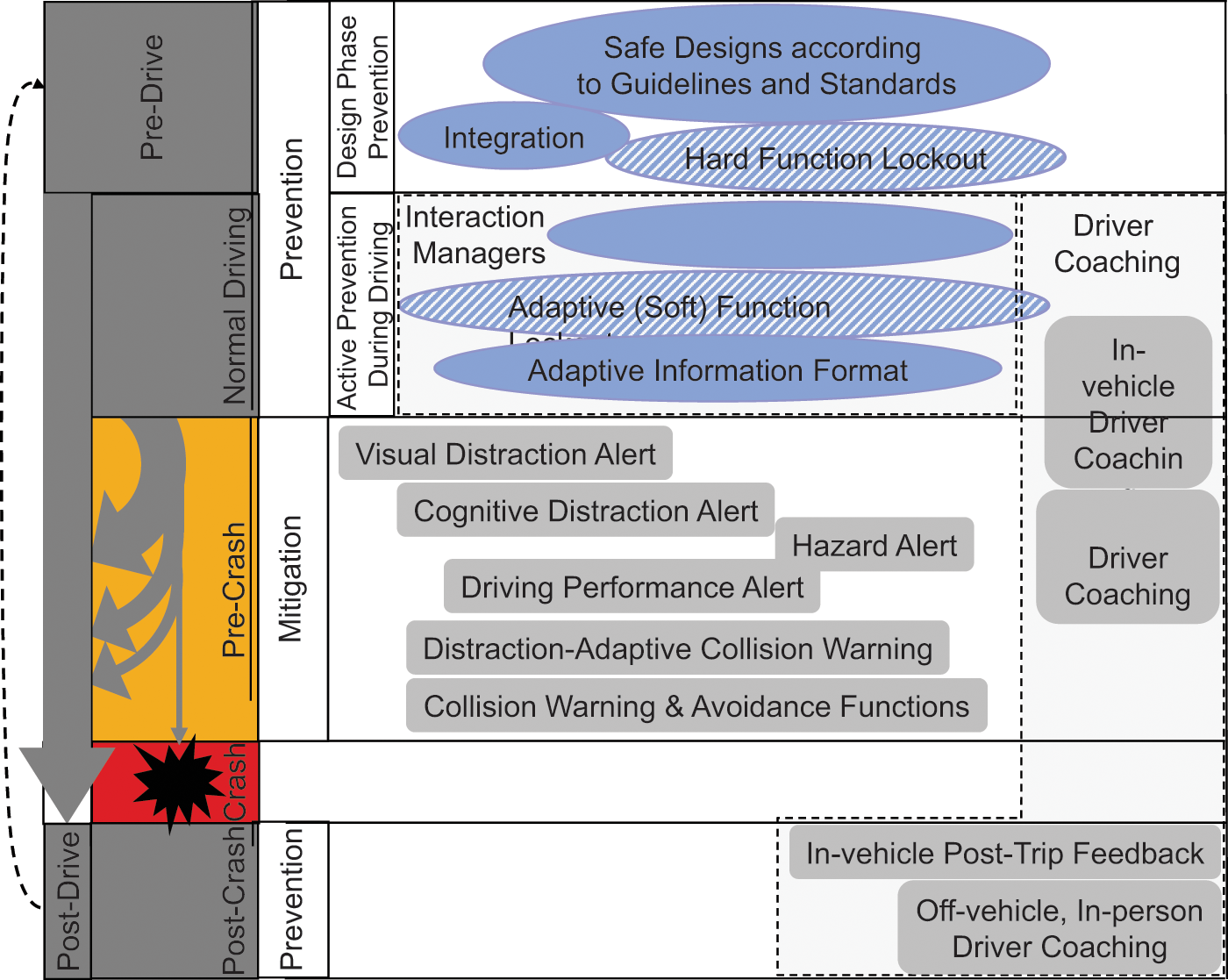
A conceptual framework for distraction and inattention countermeasures.
Although more information can be determined from the figure’s organizing structure, the following sections focus on a few key groupings in the figure.
Design Phase Prevention
One technological approach to countermeasures is to try to design systems so that they do not distract, such as the Safe Designs According to Guidelines and Standards countermeasure. Ergonomics guidelines and standards such as the European Statement of Principles, Alliance of Automobile Manufacturers, and Japan Automotive Manufacturers guidelines and International Organization for Standardization standards (see Regan et al., 2009) are important tools that should be used at different stages in the user-centered design process. Guidelines and standards range from those that are more precise and detailed to those that are less prescriptive and rely on expert judgment. There is a need for more detail among the elaborations that support the principles and for unambiguous and traceable references. One particular concern is that precise assessment and compliance conditions for some guidelines are still needed.
The number of systems and functions that interact with the driver is increasing, and problems arise during simultaneous interaction with multiple systems and warnings, such as smartphones, navigation systems, music players, and collision warnings. The need for integration as a countermeasure becomes apparent, whereby centralized human-machine interaction management by design is used to resolve presentation and interaction conflicts, such as auditory conflicts. Safe integration can be achieved at different levels ranging from basic (e.g., crashworthiness) to full integration.
An alternative to integration is hard function lockout. Although different controls and displays can be provided for the driver than for the passenger, most hard function lockouts react to driving motion to block functionality – such as TV, music player interaction, text messaging, or dialing – or just turn off devices. Other common features include rerouting calls to voicemail or sending automated text message responses when the user is driving. Cell phone function lockout is rapidly becoming more common.
Active Prevention During Driving
Active, real-time distraction prevention countermeasures, known as interaction managers (also dialogue or workload managers), include functions that serve the main purpose of preventing high mental workload and/or distraction from occurring in the first place. This functionality depends on the monitoring of relevant aspects of the driver-vehicle-environment state, such as driving demand, secondary task demand, driver impairment, traffic risk, and individual driver characteristics. The key issue is to identify the situations in which a certain type of information presentation should be altered.
Information scheduling ensures that the driver receives information only when it is needed and when he or she is available to receive it. For example, a message or incoming call is delayed until after a roundabout or lane change. Adaptive (soft) function lockout involves the disabling of a function or subfunction in certain conditions, such as high workload or demanding driving contexts. These lockouts are generally more dynamic and intelligent than the simple “driving-detected” hard-function lockouts.
Adaptive information format involves altering the way the information is presented in the current context; for example, presenting an important text message in auditory format (e.g., as a text-to-speech message). Although the majority of work within this area has been on embedded in-vehicle systems, such as the on-market systems by Volvo and Saab, nomadic device–based solutions can also implement these functions.
Mitigation
The goal of active distraction mitigation functions is to reduce the amount and effect of distraction when it occurs. These functions generally provide feedback to help the driver shift attention back to driving when he or she is judged as being “too distracted” according to predetermined criteria set by the system, the driver, or the owner. Countermeasures, such as mitigation, that target driver behavior through specific performance feedback seem to have great potential for improving road safety (e.g., Donmez, Boyle, & Lee, 2008; Heinzman & Zelinsky, 2010).
The basic idea behind the visual distraction alert is to help the driver realize that he or she is glancing away from the road for too long or too often and to “train” the driver to recognize some limit. Recent field trials of an on-market head rotation–monitoring system point to a 78% reduction in distraction event frequency, achieved by providing multiple types of feedback: a distraction alert, real-time transmitted dispatcher feedback, aggregated fleet manager feedback, and attention training (Croke & Cerneaz, 2009; Heinzman & Zelinsky, 2010). A similar multifeedback approach by Donmez et al. (2008) showed reduced secondary task engagement and increased attention to the roadway.
The cognitive distraction alert gives feedback when the driver is cognitively distracted. Gaze concentration on the road ahead is detected, for example, when excessive attention is directed to talking, listening, or internal thoughts. Feedback in the form of gently flashing LEDs at the left and right sides of the windshield is given to remind the driver to increase scanning behavior (see Victor, 2005).
An alternative to acting on eye or head movements is to warn for the effects of distraction in a driving performance alert. On-market systems, such as Volvo’s, detect impaired lateral predictive control (caused by, for example, distraction or drowsiness) by monitoring the vehicle’s movements between the road markings to assess whether it is being driven in a controlled way. If driver concentration drops, the driver is alerted with an alarm.
Eye or head tracking in combination with other active safety systems is a further countermeasure alternative. A hazard alert issues a warning when both distraction (off-road glances) and a detrimental effect, such as reduced lane keeping, are detected (Victor, 2005). Distraction-adaptive collision warnings adjust the timing and/or intensity of warnings, such as lane departure warnings or forward collision warnings, on the basis of whether or not the driver is attentive to the roadway. Such a system, like the on-market Lexus system, can enhance safety benefits by providing earlier warnings or reducing false alarms.
Collision warning and avoidance functions can be seen as a last warning to realert the driver to a critical situation. They warn for critical decrements of driving performance, such as lane departures or close encounters with lead vehicles, or attempt to mitigate the consequences of the crash, for example, by automatic application of the brakes when the crash is unavoidable.
Driver Coaching
Retrospective and cumulative feedback can be effective in training drivers (McGehee, Raby, Carney, Lee, & Reyes, 2007; Sharon, Selker, Wagner, & Frank, 2005). Driver coaching is being developed by many companies as a holistic approach in which feedback is provided at multiple time scales, settings, and sources to change both short-term and long-term behaviors. In-vehicle driver coaching can be given as preventive or mitigating feedback to drivers while driving, for example, as feedback summaries of driving performance. Off-vehicle driver coaching involves automatic messaging from the vehicle to a parent or fleet safety manager when an incident occurs (e.g., rapid deceleration event caused by texting). In-vehicle posttrip feedback involves providing the driver with more detailed attentive performance information when stopped, for example, in the form of a “report card.” Off-vehicle driver coaching typically involves in-person meetings between drivers and parents, safety managers, or employers to review and encourage safety performance.
Summary
Distraction and inattention countermeasure research and innovation are very active. Some first-generation products are already available, but there is little consensus regarding which real-time distraction countermeasure functions are the most effective and useful. Further work is needed to validate that countermeasures work as intended, are wanted by customers, are effective, and provide a reasonable return on investment. However, recent safety impact results are showing great potential, and no doubt the future driver will be assisted by attention technology.