






Abstract
The advent of e-reader technology has spawned a fundamental change in the reading experience. Such devices are meant to address what are perceived as shortcomings or flaws in the design of traditional paper-based books. Yet, as with any new technology, e-readers possess their own unique set of advantages and disadvantages, which we explore here. Research concerning reading media indicates a mild yet pervasive preference for traditional books, yet e-readers continue to gain in popularity. We offer quantitative data relating to readers’ attitudes and preferences for information presentation so as to better guide efforts for the design of e-reader systems.
Keywords
E-readers are easy to operate and provide users with access to information, but attitudes and preferences indicate that users prefer traditional paper-based books.
It is important to distinguish that this work specifically concentrates on e-readers (devices designed to supplant printed books) rather than multipurpose tools that are capable of displaying e-books, such as the iPad. The implementation of such e-reader technology presents its own unique set of benefits and drawbacks to the user. In this article we debate the economic, ergonomic, and ecological ramifications of this technology’s increasing popularity in our culture.
To better inform future design efforts concerning these issues, data concerning user attitudes and preferences are presented, having been elicited via questionnaire items modified from the Technology Acceptance Model (Davis, 1989; Venkatesh, 2000) and a scale eliciting motivation to engage in virtual worlds (Verhagen, Feldberg, van den Hooff, Meents, & Merikivi, 2012). Design may therefore be better guided by exploratory epidemiological data concerning the technology’s current prevalence in a reader-centric versus a device-centric research approach.
Finally, we predict the nature of the e-reader’s continuing development as an emerging educational tool using Bronfenbrenner’s ecological systems theory as a contextual framework (Bronfenbrenner, 1979).
Issues Concerning Adoption of E-Reader Technology
Here we address several factors that play into the decision of purchasing and therefore investing long term in the use of an e-reader device. We detail how each influence below leads to either increased or decreased use of e-reader technology.
Cost
The importance of cost cannot be underestimated, as it is the seminal issue one encounters when making the decision as to whether or not to adopt this technology. A traditional paperback book costs approximately $10, whereas the average e-book is $2 to $3 less (Greenfield, 2014). However, e-book prices are highly variable, as there is no standardization or regulation, a fact that has spawned a class-action lawsuit between the United States and a number of e-book vendors, principally Apple, Inc. (“US Sues Apple,” 2012). Several publishers settled before trial, but Apple was eventually convicted in federal court of colluding with publishers to raise the price of e-books (Raymond & Stempel, 2013).
Despite this victory for antitrust legislation, e-book pricing trends remain highly erratic and distorted because (a) self-published e-books compose a greater portion of the market since the ruling, (b) electronic book markets vary significantly by country, and (c) there is less competition among vendors as customers appear to be highly loyal to their e-book retailers regardless of competitors’ promotional deals (Owen, 2013).
Furthermore, e-books necessitate the initial investment in an e-reader, which can range between $80 and $200 or more, depending on the user’s desired features (Amazon, 2012). Further supplemental costs include a case to protect the screen and Internet access for certain wireless e-readers. The issue of cost will therefore be highly dependent on the type of person interested in utilizing this technology. For someone who reads only occasionally, the lower cost of e-books may take some time to offset the cost of an e-reader, whereas avid readers may quickly recoup the value of the e-reader’s initial investment thanks to relatively cheaper e-books.
Form
E-readers have been touted to represent an entire library in the palm of one’s hand, given that thousands of tomes can be read in a convenient, paperback-sized instrument that weighs as little as 5 to 7 ounces complete with a personal screen (Amazon, 2012; Hunter, 2011). The touch screen available on some models allows for quick navigation between menus, reading material, and the storefront. This screen can be rotated and read from a landscape or portrait orientation to accommodate the reading of certain material. Furthermore, its Internet connection eliminates the need to travel to the bookstore or wait several days for traditional books to arrive in the mail. Finally, each purchased e-book is automatically backed up online as a safeguard against loss or damage of the e-reader device.
However, e-book readers, compared with traditional books, lack an aesthetic or tangible connection with the text; many people find it more natural to flip a page than to press a button to advance through content. As a result, e-readers have no easy, intuitive ways (such as glancing at the position of a bookmark) of gauging where the reader is in the book, how far he or she has read, or how far there is yet to go.
Moreover, the e-reader is extremely susceptible to damage; dropping it, subjecting it to extreme temperatures, exposing it to a magnetic field, or spilling any kind of liquid on it effectively destroys the expensive instrument and prohibits access to the data. Should the instrument become lost or irreparably damaged, the entire library is lost. One must then purchase a new e-reader and engage in the effortful and time-consuming activity of restoring all the e-books to the new device.
Perhaps most important, however, research has shown that traditional books provide a better reading experience for the user. Kim and colleagues investigated legibility, eye fatigue, and subjective discomfort in readers using both e-readers and paper books (Kim, Min, Subramaniyam, & Cho, 2014). Both objective (fixation duration time, saccade length, blink rate) and subjective (discomfort) measures attested to the fact that paper books are easier and more comfortable to use compared with their electronic counterparts. Moreover, such effects may continue even after readers put down the book.
Chang and colleagues found that exposure to e-readers (as opposed to printed books) before bedtime resulted in poorer-quality sleep, phase shifts of participants’ biological clocks, and compromised alertness the next morning (Chang, Aeschbach, Duffy, & Czeisler, 2014). Potential users must therefore carefully evaluate whether the advantages of portability and accessibility adequately outweigh the risks of losing their entire collection at once and restoring it over a great length of time (at a possibly greater expense).
Environmental impact
Manufacturers of several goods have made efforts in recent years to become more “green” or environmentally conscious in both their products and production methods. E-books may be arguably better for the environment, as they are not printed on paper and thus obviate the need to consume trees in their fabrication process. Trees, however, are a renewable resource, unlike the power source necessary to run e-readers. The majority of electronic power in the United States is derived through the burning of nonrenewable fossil fuels, mainly coal (U.S. Energy Information Administration, 2011). Although current efforts are dedicated to developing new, more sustainable means of supplying renewable energy (which may provide the edge for e-books in the future), the present issue of the environmental friendliness of print versus e-books remains a stalemate.
Attitudes and Preferences
Having considered this host of theoretical and practical topics, we developed a questionnaire to assess people’s attitudes and preferences concerning e-reader technology versus paper-based books in an effort to better inform guidelines for e-reader design. We collected standard demographic data concerning age and gender. Questions regarding perceived ease of use were taken from the technology acceptance model developed by Davis in the late 1980s (Davis, 1989). Additionally, questions concerning perceived usefulness, economic value, and escapism were adapted from the questionnaire used in Verhagen and colleagues’ study relating to engagement in virtual worlds (Verhagen et al., 2012). Opinion-based questions were randomized, and answers were elicited using a 6-point Likert scale ranging from completely disagree to completely agree.
Demographic data
Participants were recruited via the University of Central Florida’s online Sona system, by which students may volunteer to take part in psychological studies in exchange for course credit. We collected data from a total of 143 participants (115 female) with an average age of 22.5 years (SD = 4.67 years). The sample included 51 respondents who reported owning an e-reader prior to completing the survey, leaving 92 participants who did not own e-reading systems.
Figure 1 illustrates e-reader ownership parsed by brand. Such a pronounced gender divide and imbalance between e-reader owners and nonowners should be regarded as a limitation to generalization of the current study’s findings. However, it is important to emphasize that in order to provide epidemiological data concerning the prevalence of ownership, participants were not recruited on the basis of these differences.
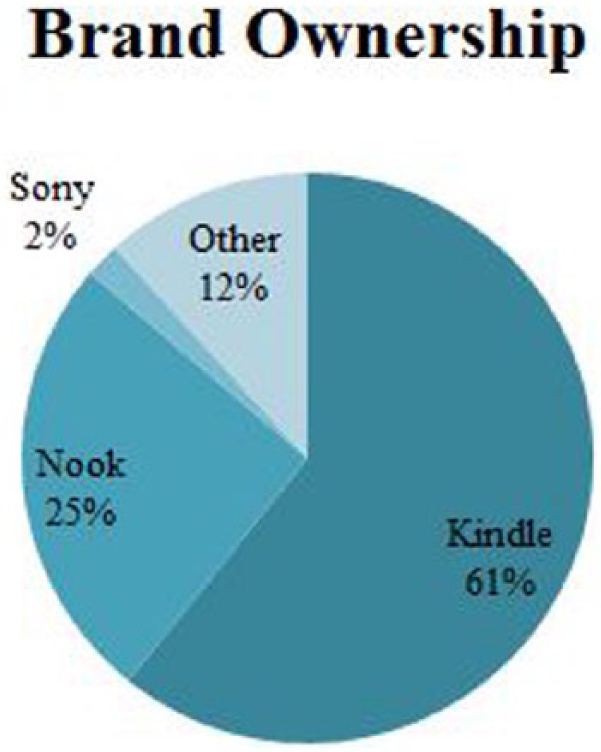
Brand popularity among e-reader owners: Kindle (Amazon), Nook (Barnes & Noble), other (Kobo reader, etc.).
Reading experience
Participants reported engaging in reading for an average of 7.4 hr per week (SD = 6.1 hr). A one-way ANOVA revealed that ownership of an e-reader did not significantly affect hours spent reading per week (F = 1.788, p = .183).
Preference for e-reader versus traditional books
Participants were asked to rate their preference for using e-readers or traditional books when reading for either leisure/fun or school/business on a scale of 1 (exclusively e-reader) to 6 (exclusively traditional book). Averages for leisure/fun (M = 4.23, SD = 1.91) and school/business (M = 4.24, SD = 1.95) indicate a small yet pervasive preference for traditional books when reading.
Preferred features in e-readers versus traditional books
We created a short list of the advantageous e-reader features (i.e., portability, incorporation of a search function, Internet connectivity, and environmental friendliness) and asked participants to select the feature that was most attractive or persuasive with regard to their use (if any) of e-reader systems. As is illustrated in Figure 2, respondents were overwhelmingly drawn to e-readers because of their portability.
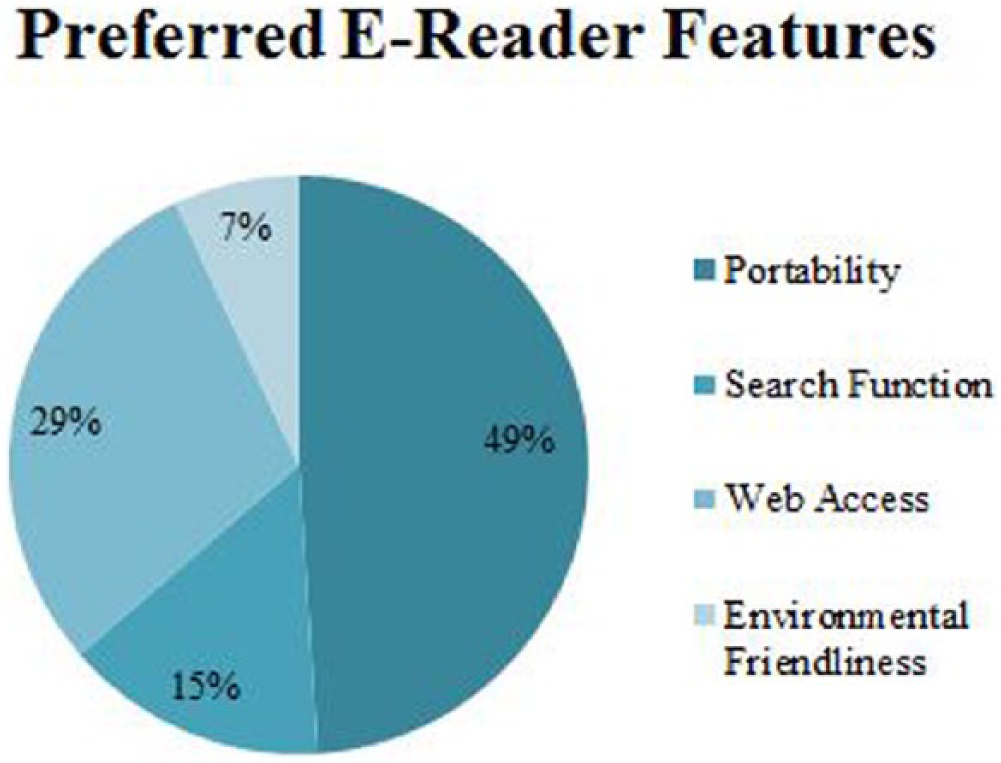
Results of forced-decision task identifying most attractive feature of e-readers.
We formulated a corresponding list of features for traditional books (e.g., their relative inexpensiveness compared with e-readers, the prospect of not losing one’s entire library because of theft or damage, the fact that they require no batteries or charging, the unrestricted use of traditional books in various settings). Figure 3 illustrates that people favor traditional books because print books eliminate the threat of power loss and obviate the inconvenient need for charging facilities.
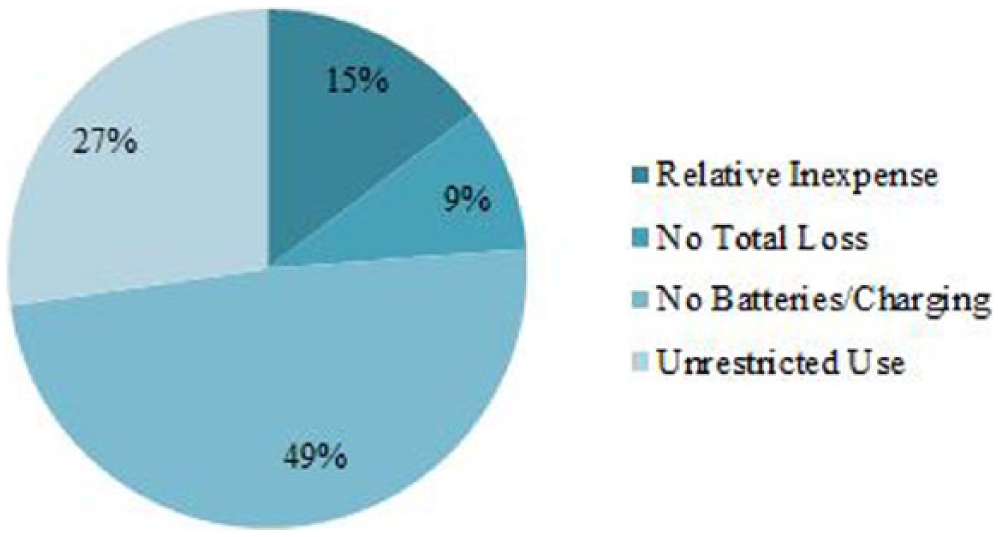
Results of forced-decision task identifying most attractive feature of traditional books.
These data are interesting given that traditional books (i.e., mainstream paperbacks) are themselves portable, though people report being drawn to e-readers for this reason. Moreover, as an illustrative case, if someone were to take an e-reader on a long journey to maximize the amount of reading material (via e-readers’ large storage capacity), he or she would therefore run the risk of experiencing the greatest concern regarding e-readers (and consequent preference for traditional books): loss of power. Traditional books therefore appear to have the relative upper hand in fulfilling user needs; however, paper books’ portability does not appear to be a salient feature for users, perhaps because users are distracted by the novelty of ascendant e-reader technology.
Perceived ease of use
All questionnaire data were analyzed using a 2 (device: e-reader, traditional book) × 2 (ownership: owns e-reader, does not own e-reader) repeated-measures ANOVA. With regard to perceived ease of use, there was a main effect for device (F = 14.051, p < .001, η2 = .091), indicating that participants perceived traditional books as significantly easier to use than e-reader systems (and see Figure 4).
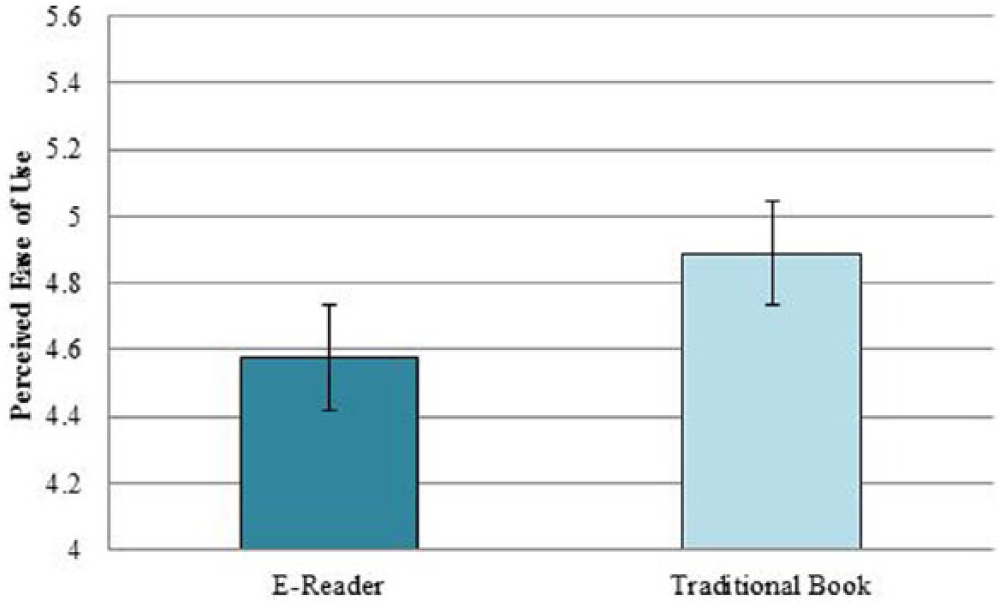
Perceived ease of use of e-readers versus traditional books. Error bars are standard errors. Scores range from 1 to 6, a higher score indicating greater ease of use.
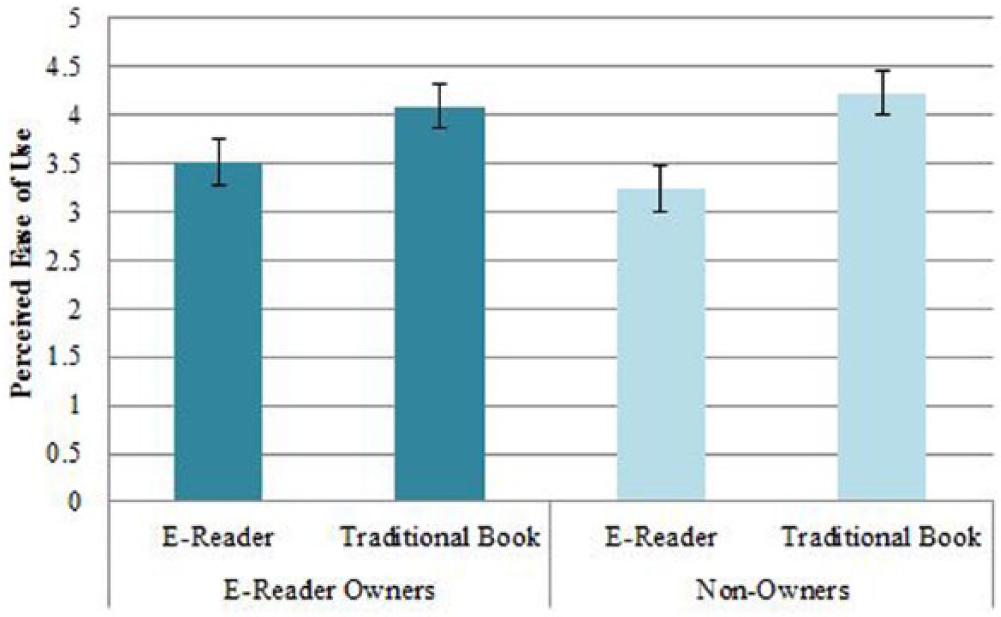
Perceived ease of use by e-reader ownership and type of device. Error bars are standard errors. Scores range from 1 to 6, a higher score indicating greater ease of use.
Data also indicated a significant Device × Ownership interaction (F = 7.273, p = .008, η2 = .049). Participants who already own e-readers rated them about as easy to use as traditional books, whereas participants who do not own e-readers rated traditional books as significantly easier to use. Such a pronounced discrepancy in perceived ease of use among nonowners could explain why these individuals have so far chosen to refrain from purchasing an e-reader system.
Perceived usefulness
Perceived usefulness data revealed a main effect for device (F = 17.495, p < .001, η2 = .110). Traditional books were rated as significantly more useful than e-books, as shown in Figure 6.
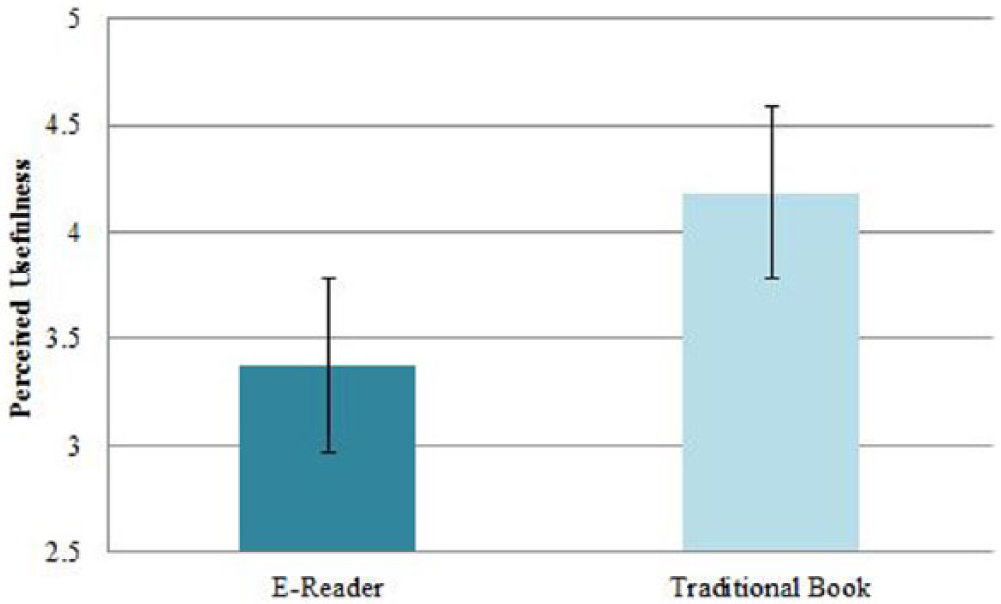
Perceived usefulness of e-readers versus traditional books. Error bars are standard errors. Scores range from 1 to 6, a higher score indicating greater usefulness.
Economic value
There were no significant main effects or interactions concerning the economic value of either traditional or e-books. These results suggest that consumers perceive e-books to be similarly economical compared with traditional books, despite the issues surrounding the expense of e-readers (i.e., the significant initial outlay of funds inherent in e-reader adoption and the ambiguity of what, precisely, is being purchased).
Escapism
We observed a significant main effect for device regarding escapism (F = 42.926, p < .001, η2 = .233), such that almost a quarter of the variance explaining individuals’ feelings of immersion in reading material was accounted for by the medium of presentation. The mean difference between the devices (mean difference = .811, p < .001) shows that traditional books were significantly more facilitative of escapism during reading compared with e-readers (and see Figure 7).
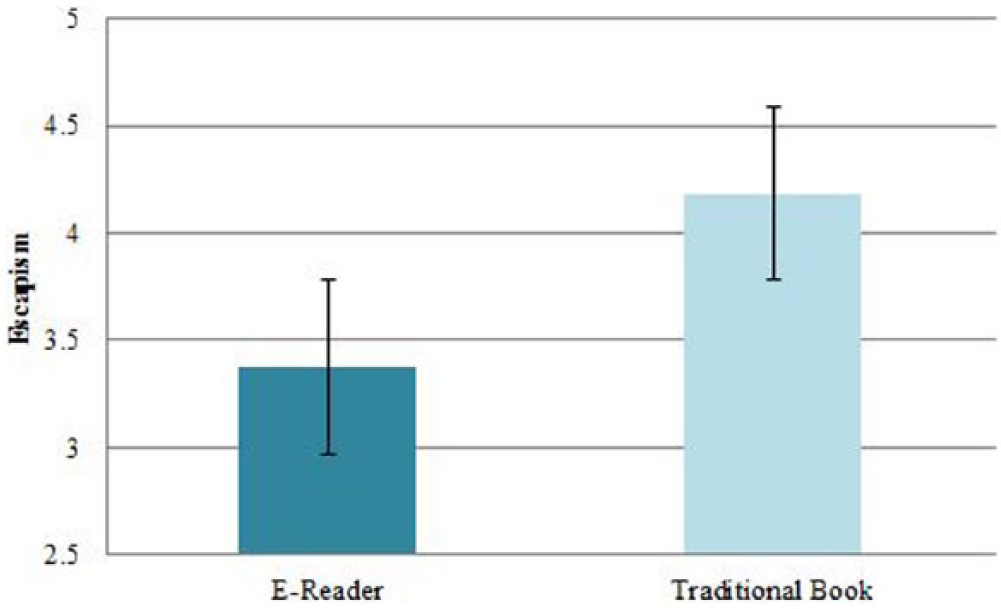
Escapism ratings for both e-readers and traditional books. Error bars are standard errors. Scores range from 1 to 6, a higher score indicating greater facilitation of escapism.
Future Directions
To better illustrate the micro and macro implications for the adoption of e-book technology, we couch our exploration of the e-reader’s present cultural position and its potential ramifications for the future within Bronfenbrenner’s ecological systems theory, with the interaction between the e-reader and the user taking the prominent focus (Bronfenbrenner, 1979). Although the e-reader is arguably easy to operate and no doubt provides the user with much greater access to information, it may do so at the expense of the reader’s direct social interaction with others at Bronfenbrenner’s microsystem level. As time is a limited resource, interaction with an e-reader will detract from the time available to socialize with family and peers.
At the exosystem level, e-book technology has had an enormous economic impact on the literary industry; long-standing book series such as the Encyclopedia Britannica are now accessible only electronically (Pepitone, 2012), and the rising popularity of e-readers is contributing to the escalating foreclosure rate of traditional bookstores (“12 Stats,” 2012). Furthermore, major legislative debates are under way regarding e-books and their acquisition. Piracy, for example, is rife and easily accomplished; and there is a debate regarding what one is actually purchasing when buying an e-book – a book or merely access to data?
Differential perspectives of the book as an object versus a license affect authors’ compensation rates. Hardcover books (viewed as on object) yield a 15% royalty rate for authors, whereas e-books (conceptualized as a license) have a compensation margin of 25% of the publishers’ receipts (Author’s Guild, 2011). Publishers are therefore biased to publish in the e-book format because their profits are greater due to lower production costs (there is no physical product to print) and the lower standard royalty rate paid to the author versus hardcover sales (Author’s Guild, 2011). Roughly one third of authors, however, are ignorant not only of their e-book compensation rate and how this figure was derived but also of their works’ availability in electronic format (O’Brien, 2013). Piracy precludes any remuneration for authors or publishers. Such issues are of increasing concern as major distributors are adding another layer of complexity to the problem by forwarding efforts to introduce “used” e-book sales (Shank, 2013).
At the macrosystem level, e-books may help foster the value of reading and education in younger readers. Children who have matured in the technology age have always expected the conveniences that e-readers provide, as they have a long-standing history of learning and being entertained via electronic media. Encouraging kids to read traditional books is therefore a difficult battle to wage when competing with video games, the Internet, and television. However, educators may use children’s proclivity to embrace technology to their advantage. Indeed, teachers have already implemented e-readers in the classroom with great success; literacy rates have been shown to increase with the use of e-book technology, as children consider it “cool” (Clark, Goodwin, Samuelson, & Coker, 2008).
Conclusions
Our experimental results revealed a mild yet pervasive preference for traditional paper-based books because print is perceived as easier to use, more useful, and more immersive than e-readers. However, the ultimate decision as to whether to make use of e-book technology lies with the inclination of the reader. The advantages and disadvantages of various issues we have presented are disproportionately desirable and tolerable to each individual user. Therefore, adoption is more likely when the pros seem to outweigh the cons; and according to statistics, more and more people are willing to live with the risks in order to reap the benefits offered by e-reading systems.
Footnotes
Acknowledgements
The authors would like to thank Keith MacArthur and Jessica Siler for their technical assistance throughout the production of this work.