







Abstract
In this article the authors measure a phenomenon they name “exit talk”: the undertheorized pressures that second-place contenders for presidential nominations face to exit the race. Content analysis of media exit talk from the 2008 Clinton candidacy compared with that of key comparators from other modern presidential campaigns suggests that Clinton experienced greater levels of exit talk than her historical comparators, though less explicit pressure to exit than was exerted on Ronald Reagan in 1976. The authors also find that a higher percentage of Clinton exit talk was unattributed to its source. They investigate the potential causes for these findings and recommend further study of whether this heightened pressure to exit constitutes an unexamined hurdle for female presidential contenders.
The presidential campaign of 2008 was unique in a variety of ways, including high levels of public interest in the campaign, record-breaking campaign spending, and, of course, an unprecedented contest for the Democratic nomination between an African American man and a white woman. The outcome of the Democratic nominating contest in 2008 also challenged a key contention of the political science literature: that the front-runners who emerge in the preprimary season (or “invisible primary”) usually win their party’s nomination (Mayer 2003, 2008). Senator Hillary Rodham Clinton was a vivid example of a clear early front-runner (Newport 2007; Citrin and Karol 2009; Todd and Gawiser 2009) who ultimately lost.
Various commentators argued during the campaign that as the contest between she and Senator Barack Obama wore on, Senator Clinton was subjected to unprecedented pressures to exit the race. We take these claims as an opportunity to explore a facet of campaign politics that has been undertheorized, a phenomenon we label “exit talk”: news coverage and media commentary that discusses whether, when, and how a candidate might end his or her campaign and leave the nominating race. Situated within the literature on candidate messaging and attrition during nominating contests and the literature on the media’s role in winnowing candidates, this study compares exit talk in media coverage of Hillary Clinton with that of four past candidates (Ronald Reagan in 1976, Ted Kennedy in 1980, Gary Hart in 1984, and Jesse Jackson in 1988) who waged long campaigns and came in second in their parties’ nominating contests. Our data show that exit themes were more numerous in media coverage of Clinton than any of these comparators and that exit talk around Hillary Clinton’s campaign was qualitatively different, emanating more from unattributed sources and/or reporters themselves rather than from named sources. To verify that finding and assess to what degree this may reflect changes in media norms and routines since 1988, we include a comparison of exit talk around Clinton with three other trailing candidates from 2008: John Edwards, Mitt Romney, and Mike Huckabee. We conclude our study with a discussion of the factors that contributed to the prominence and character of Clinton exit talk in 2008.
Exit Talk and the Nomination Attrition Game
Nominating contests are by definition a process of attrition (Norrander 2006). Most candidates will face decisions about when and how to exit the race—a process that has been dubbed the “calculus of concession” (Haynes et al. 2004). Several factors appear to drive candidates’ decisions. Money is key, of course, as is the number of delegates a candidate wins in early contests and the candidate’s standing in national polls. Candidates who are truly “office seekers” are likely to exit a race earlier than “nontraditional,” “policy-seeking,” or “agenda-seeking” candidates, whose goals are not necessarily hampered by remaining in a race they seem sure to lose (Haynes et al. 2004; Norrander 2006). 1
Media coverage looms as another important factor in candidate attrition since it is deeply intertwined with campaign fund-raising and political viability. The media actively (though not necessarily intentionally) contribute to the winnowing of candidates (Crotty 1985; Hagen and Mayer 2000; Matthews 1978; Patterson 1994)—a figurative “St. Peter guarding the gates of the presidential nomination process judging which candidates are worthy of precious news space” (Flowers, Haynes, and Crespin 2003, 259). Front-runners dominate media coverage (Hagen 1996; Kendall 2005), while those candidates lagging in fund-raising or in public opinion polls tend to be written out of the campaign coverage (Meyrowitz 1994)—potentially creating a vicious circle in which lack of media coverage lowers fund-raising, which further reduces media coverage and thus name recognition. A key dynamic in the modern age of nomination front-loading is this concurrent winnowing and attrition process, in which the media and the candidates, as well as contributors and some voters, determine who is and who will remain “viable,” often within a short period.
To the degree that a serious office-seeking candidate wishes to remain competitive, public pressure to exit a race—or to justify a decision to remain in the race—becomes an important feature of campaign discourse. While candidates’ decisions about when to exit have been studied (Haynes et al. 2004; Norrander 2006), less attention has been paid to the rhetorical pressures exerted on trailing candidates by their opponents, party elites, and media commentators and how trailing candidates respond to such pressures.
Incentives to engage in exit talk exist for virtually all players in the nominating process. Front-runners are likely to disseminate “negative competitive positioning” messages that overtly point out trailing candidates’ weaker standing (Haynes et al. 2002). It is but a short step from pointing out weaknesses to implicitly suggesting that the weaker opponent should exit the race. Trailing candidates, meanwhile, often attempt to maintain public perceptions of their electoral viability. Those who have enough financial and organizational resources and/or name recognition to continue to compete must seek to win over supporters of the front-runner, not just draw in undecided voters, and therefore their campaign messaging typically emphasizes their competitive viability vis-à-vis the front-runner (Haynes et al. 2002). Part of trailing candidates’ messaging, therefore, aims to fend off questions about whether and when they will exit.
Moreover, implicit or explicit exit calls may be expected from party leaders anxious to position their party for the general election. For example, in the crowded contest for the Democratic nomination in 1988, which included Al Gore, Jesse Jackson, Richard Gephardt, and Paul Simon as well as the eventual nominee Michael Dukakis, Democratic Party chairman Paul G. Kirk publicly asked all candidates after that year’s Super Tuesday contests to support what he called the “inevitable nominee” who would emerge by the final primaries in June (Oreskes 1988). Having lost four out of five prior presidential elections, Democrats were eager to anoint a winning nominee; Kirk’s announcement amounted to a call for all candidates but one to leave the race voluntarily.
The media also have ample incentives to promulgate exit talk. National political reporters typically bring the “horse race” script to elections coverage (Benoit, Stein, and Hansen 2005; Farnsworth and Lichter 2003; Kendall 2005; Lawrence 2000; Lawrence and Rose 2009; Patterson 1994)—what has been described as “the relentless tendency of the press [to craft] running narratives about the relative position of the candidates in the polls” (Project for Excellence in Journalism 2008). Knowing this tendency, campaigns expend “substantial effort to define the horse race for the media” (Haynes et al. 2002, p. 647). Moreover, news organizations face considerable challenges whenever the field is crowded with potential candidates. Reporters and editors look for signals about the candidates’ continued viability to decide whom to cover and who can defensibly be given less coverage (Meyrowitz 1992; Patterson 1994). These journalistic routines create incentives for reporters to amplify, and even to induce, the exit talk of candidates, party leaders, and pundits.
Research Objectives
One goal of the present study is to delineate exit talk as a particular form of campaign discourse. While the amount of media coverage various candidates receive is an important variable in nominating contests (Haynes et al. 2004; Shen 2008), as is the general framing of campaign coverage, here we consider a specific qualitative aspect of candidates’ coverage: What forms does exit talk take, and have those forms varied across electoral contexts?
A key reason for examining the forms of exit talk, beyond creating a categorization useful for future research, is that some forms are more problematic than others, depending upon the degree to which media exit talk reflects political realities versus the degree to which it shapes those realities. A key consideration is the source of exit talk. If media exit talk simply reflects the strategic communications of the various campaigns without favor to any particular candidate, it represents an expected part of the nominating process: the efforts of front-runners and trailing candidates to frame their competitive strengths (and their opponents’ weaknesses). At its most benign, media discussion of whether and when a candidate will leave the race simply reflects candidate strategies and political realities.
Various studies suggest, however, that media coverage of candidates in nominating contests is not strictly evenhanded. Among other patterns, front-runners often have greater success than trailing candidates in getting their messages across in the news. In its less benign forms, then, exit talk may represent one way in which leading candidates enjoy an advantage in sowing land mines of doubt among contributors and voters about their trailing competitors. And though this possibility has not been studied, exit talk also may be a way in which party elites attempt to “sway voters to ratify their choice” of a presidential candidate during a nomination contest, as one recent work on the nomination process suggests (Cohen et al. 2008, 3). Moreover, exit talk that emanates from reporters themselves, particularly reporters’ own speculation about future events, is normatively more problematic because it may reflect the media playing a direct role in candidate attrition. Thus, our first goal is to document, categorize, and evaluate the forms of “exit talk” and to map its sources in news coverage.
Our second research goal is to assess whether Hillary Clinton experienced historically unprecedented exit pressure as measured by media exit talk. By comparing coverage of her campaign to that of previous nominating contests, we shed light on the rhetorical pressures that have buffeted tenacious second-place presidential contestants while also illuminating the specific inflections of exit talk in campaign 2008.
Method
The task of comparing the degree of exit talk surrounding Clinton’s campaign to that in similar past candidacies requires that we choose appropriate comparators. Our first criterion was to choose candidacies occurring since the 1972 McGovern–Fraser reforms, dividing earlier nominating processes from those in current usage. Norrander (2000) provides a useful starting place by identifying two postreform nominating campaigns by second-place candidates who did not exit the race until their party’s convention: Massachusetts Senator Edward M. Kennedy in 1980 and Colorado Senator Gary Hart in 1984.
To these we added two additional cases. Norrander (2006) excludes “agenda-seeking” candidates from her analysis on the basis that agenda seekers have different incentives than office seekers and therefore can be expected to make their exit decisions differently, and she categorizes both of Jesse Jackson’s presidential bids as agenda seeking. Without quibbling about this categorization, we included Jackson in our analysis on the grounds that, as another “historic” candidate, it could be instructive to see what kinds of exit talk may have accompanied his campaign in comparison to Hillary Clinton’s. To maximize the comparative value of Jackson’s case, we limited our analysis to 1988, in which Jackson won eleven Democratic primaries and caucuses—a first for an African American candidate.
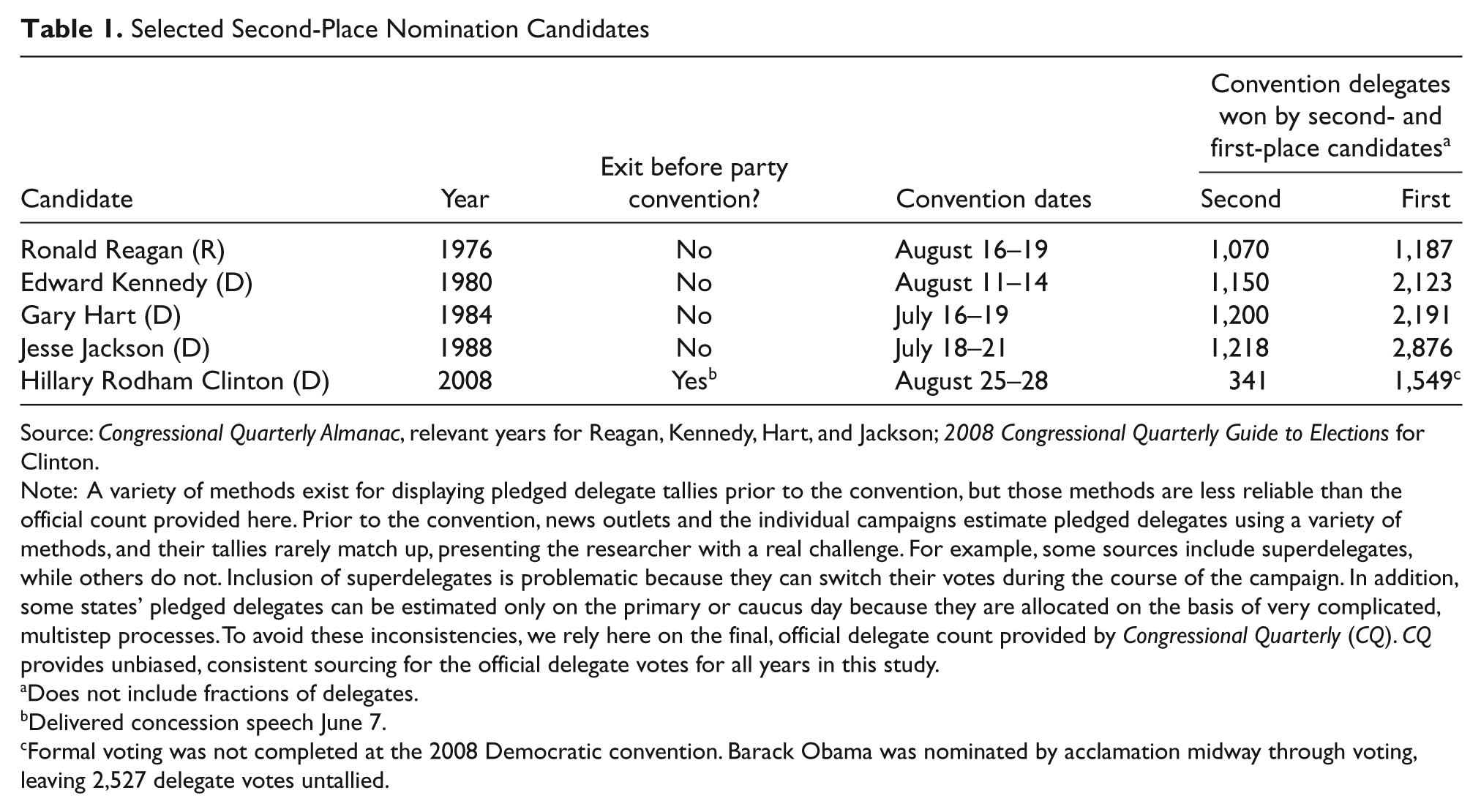
Finally, we added another case not included in Norrander’s analysis: that of Ronald Reagan’s first presidential bid in 1976, both to include a Republican case and because that protracted struggle was in some ways quite similar to Hillary Clinton’s in 2008. 2 As Lou Cannon observed, “Reagan won a slew of primaries in important states, as Clinton has, without ever quite catching Ford” (Cannon 2008). Table 1 displays the candidacies included in this study.
Selected Second-Place Nomination Candidates
Source: Congressional Quarterly Almanac, relevant years for Reagan, Kennedy, Hart, and Jackson; 2008 Congressional Quarterly Guide to Elections for Clinton.
Note: A variety of methods exist for displaying pledged delegate tallies prior to the convention, but those methods are less reliable than the official count provided here. Prior to the convention, news outlets and the individual campaigns estimate pledged delegates using a variety of methods, and their tallies rarely match up, presenting the researcher with a real challenge. For example, some sources include superdelegates, while others do not. Inclusion of superdelegates is problematic because they can switch their votes during the course of the campaign. In addition, some states’ pledged delegates can be estimated only on the primary or caucus day because they are allocated on the basis of very complicated, multistep processes. To avoid these inconsistencies, we rely here on the final, official delegate count provided by Congressional Quarterly (CQ). CQ provides unbiased, consistent sourcing for the official delegate votes for all years in this study.
Does not include fractions of delegates.
Delivered concession speech June 7.
Formal voting was not completed at the 2008 Democratic convention. Barack Obama was nominated by acclamation midway through voting, leaving 2,527 delegate votes untallied.
We gathered news content on these five races—Reagan in 1976, Kennedy in 1980, Hart in 1984, Jackson in 1988, and Clinton in 2008—from the New York Times (accessed via the Nexis database and supplemented, where necessary, by accessing the electronic archives of the Times). While there are obvious limitations of studying coverage by a single news organization, there are several sound reasons for doing so. The Times has long been identified as an agenda setter for news organizations around the country and a reflector—and shaper—of elite political discourse (Dearing and Rogers 1996; Weiss 1974). Studying the Times also offers the benefit of continuity across our chosen contests, since, unlike other leading newspapers, it is available in searchable electronic form as far back as 1976. Indeed, there were few other realistic choices for a study of this nature since many news databases have incomplete holdings for the earlier periods in our study. We therefore chose the one prominent national newspaper for which we could assemble complete sets of articles for all five of these races. Since the length and dynamics of each of these election seasons were different, we strove to create comparable comparison periods from which to gather news coverage: from the day after the first primary election or caucus of that season to the day after the party convention.
We crafted our search terms with the goal of identifying all news articles in which explicit exit talk appeared. 3 The items retrieved with this search were then examined to ensure that they were relevant to that year’s election, and irrelevant articles were discarded, as were letters to the editor (other editorial items were retained) and news summaries. Graduate student coders working independently then coded the exit talk in each story retrieved, treating paragraphs as the unit of analysis. This task proved instructive, for we found additional paragraphs that did not contain our search terms but that nevertheless contained exit discussion. Indeed, as we discuss further below, we discovered that exit talk takes a variety of direct and indirect forms. All relevant paragraphs were coded, for a total N of 783.
Within each paragraph, coders were asked to distinguish cases of an explicit call for a candidate to withdraw and cases of denial that a trailing candidate would leave the race. This distinction is based in research suggesting that front-runner candidates are likely to cast doubts on their competitors’ continued electoral viability and that second-tier candidates are likely to emphasize their continued viability vis-à-vis the front-runner (Haynes et al. 2002). Thus, “denials” include cases in which trailing candidates respond to reporters’ questions or the suggestions of their opponents that they might leave the race but also include proactive assertions of the candidate’s continued competitive viability. 4 All remaining exit talk that could not clearly be coded as either an explicit call to exit or a denial were treated as a third category, discussions of exit, which includes speculation about the possibility of withdrawal and descriptive or speculative discussion of a candidate’s continued viability and/or his or her reasons for remaining (or not remaining) in the race.
Coders were also asked to determine whether the exit talk in each paragraph was attributed to a named source and to categorize the named sources as (1) the trailing candidate himself or herself or sources working for his or her campaign, (2) the candidate’s electoral opponent or opponents or sources working for the opponent’s campaign, (3) party elites not identified as being affiliated with or supporters of any candidate, (4) rank-and-file voters identified as either supporters of the trailing candidate or of an opposing candidate, and (5) other sources. 5
It should also be noted that these estimates of the presence of exit talk in news coverage are undoubtedly conservative because our data include only explicit discussions of candidates leaving, being forced from, or staying in a race. For example, Reagan’s spirited 1976 challenge to Gerald Ford occasioned open calls for Reagan to withdraw, as when the governor of Michigan, the state’s party chairman, and the National Conference of Republican Mayors all issued public statements urging Reagan to quit after he was defeated in Illinois. Our coding captured those calls. Yet veiled exit talk appeared to be fairly rampant as well, commonly involving statements claiming the inevitable victory of the front-runner, as when Vice President Nelson Rockefeller told reporters that the Illinois returns “all but lock[ed] it up” for Ford. If such statements stopped short of actually discussing the trailing candidate’s exit, we did not code them; therefore, our data represent not the tip but the thick top layer of the iceberg of exit pressures during these campaigns.
Findings
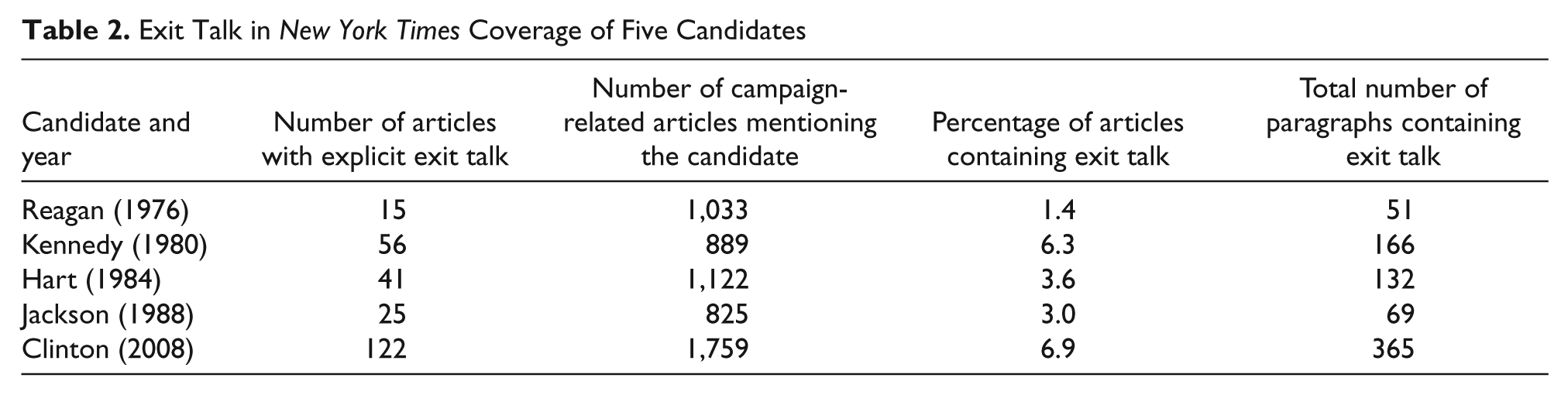
Table 2 lists the number of Times articles containing exit talk about each candidate and also shows that number as a percentage of all campaign stories mentioning the candidate throughout each primary season. The larger numbers of articles and passages containing exit talk in Clinton’s case should not be taken entirely at face value, in part because the total volume of coverage of her campaign (and likely of the 2008 election overall) was greater than for our other selected candidates because of the high news value of that particular contest. 6 Nevertheless, measured in raw numbers and as a percentage of her coverage overall (6.9 percent), Clinton did experience more exit talk than her historical comparators, though her percentage was nearly matched by Edward Kennedy’s in 1980 (6.3 percent).
Exit Talk in New York Times Coverage of Five Candidates
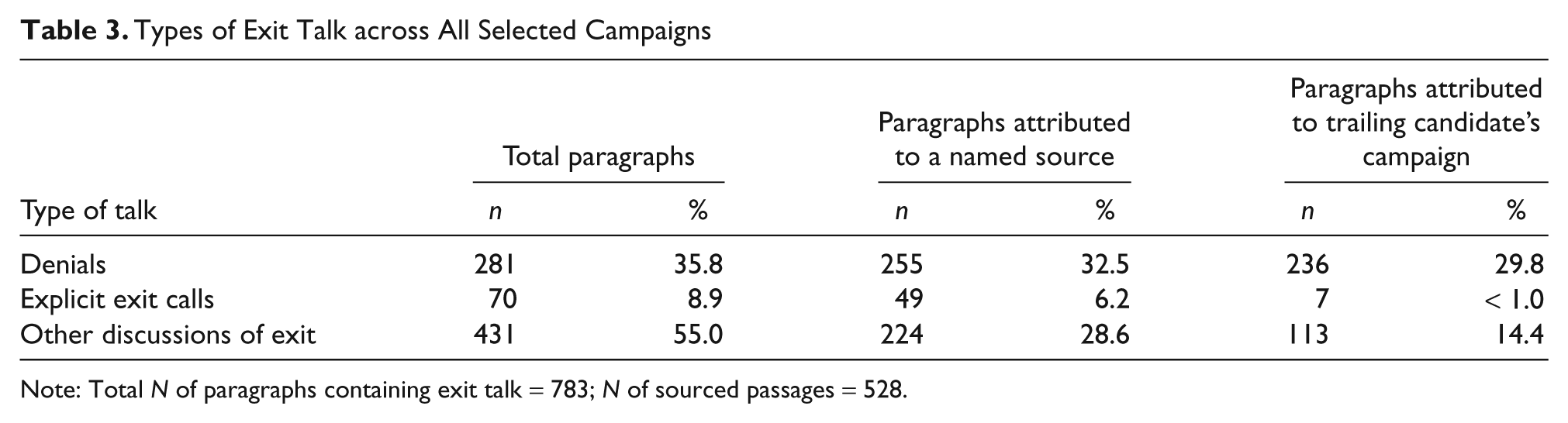
As Table 3 indicates, across the five candidacies, over one-third of all passages containing discussion of the candidate’s exit were actually denials, which, not surprisingly, were likely to emanate directly from the trailing campaign itself (91 percent of denials were attributed directly to the trailing candidate). It appears that a predominant form of exit talk is indeed, as Haynes et al. (2002) predict, assertions designed to maintain the trailing candidate’s appearance of competitiveness. Presumably, candidates sometimes make these kinds of claims when reporters, opponents, and others ask them how long they will continue to run. 7 Denials thus serve not just as examples of “competitive” framing by the trailing candidate (Haynes et al. 2002) but also as a useful index of pressures on the candidate to justify remaining in the race. 8
Types of Exit Talk across All Selected Campaigns
Note: Total N of paragraphs containing exit talk = 783; N of sourced passages = 528.
The three main origins of sourced exit talk (N = 528 paragraphs) across all five candidacies were the trailing candidate’s campaign (67.4 percent), the opponent’s campaign (15.5 percent), and unaffiliated party elites (7.2 percent; see Figure 1). The data suggest that front-runner candidates often played the predicted strategic messaging game, though with varying degrees of aggressiveness. In 1976 and 1980, discussed further below, presidents Ford and Carter each publicly pressured their second-place competitors to withdraw. In 2008, while Senator Obama himself often ducked opportunities presented by reporters to pronounce Senator Clinton’s campaign dead, his campaign team clearly fed the exit story line. On March 3, for example, on the eve of the important Ohio and Texas contests, Obama’s campaign manager David Plouffe told reporters that Clinton “keep[s] moving the goal posts,” a reference to the Clinton campaign’s shifting logic for winning the nomination after the Super Tuesday contests had left Obama with a clear delegate lead, “but at some point you run out of field” (Kornblut and Bacon 2008). Yet although they are the main source of explicit calls to exit, the opponent’s campaign and party elites appear to be less frequent sources of attributed exit talk than we might have expected—less than one-third (28.5 percent) across all five campaigns. (In 2008, only 9.3 percent of sourced passages regarding Hillary Clinton’s exit were attributed to the Obama campaign, with another 9.3 percent attributed to unaffiliated party elites.)
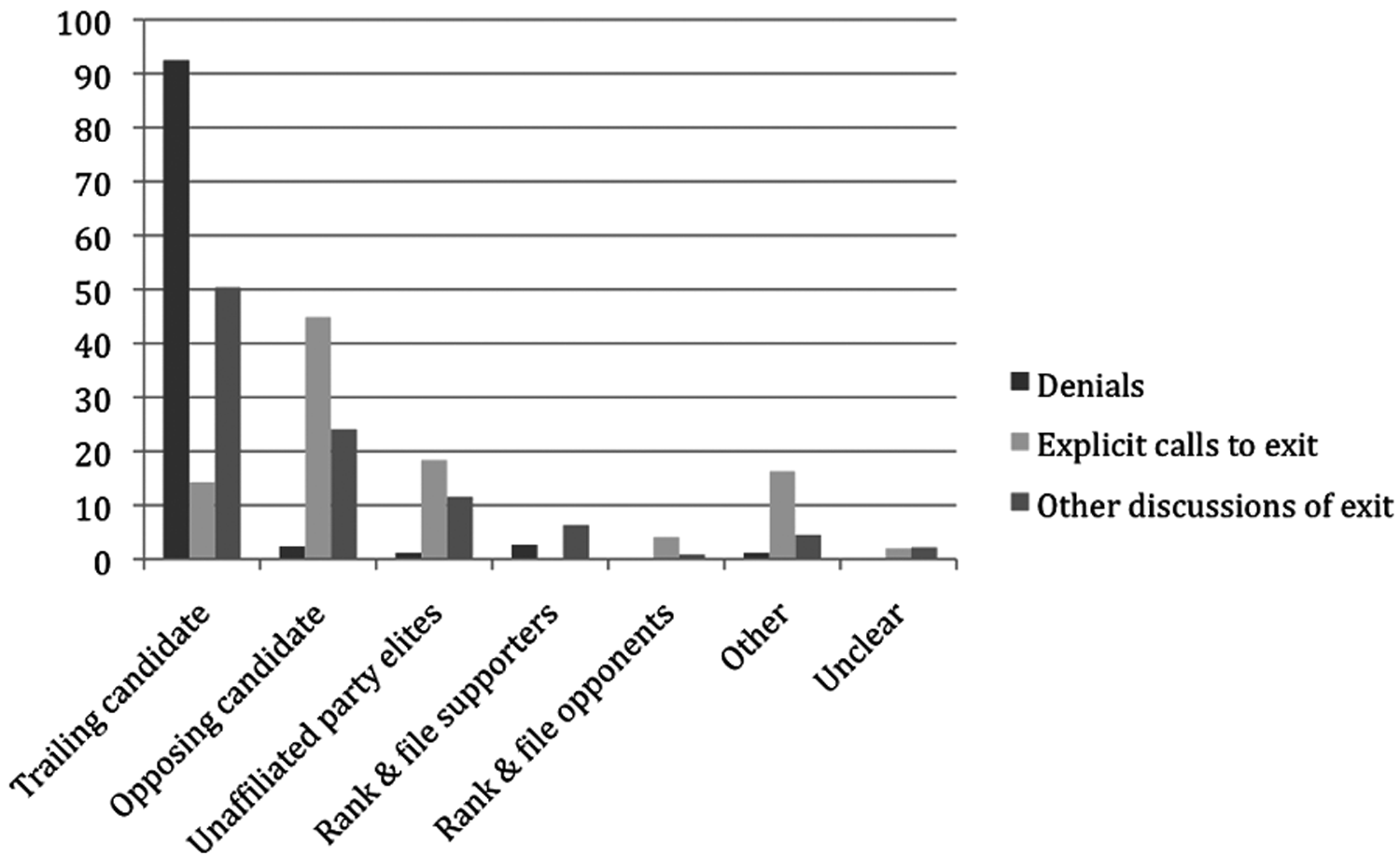
Origins of sourced exit talk across all candidacies, by type of talk
The significant percentage of exit talk coming directly from the trailing candidates is somewhat surprising. It reflects to some degree, however, the high volume of coverage of Hillary Clinton: she and her campaign spokespeople repeated often that she would not withdraw from the race before all primaries were held, and 30 percent of all denials in our data set were with regard to the Clinton campaign. It is also in part a function of relatively heavy coverage of two of these candidates’ eventual concessions. Kennedy’s concession to President Carter at the 1980 Democratic convention was discussed in twenty-two paragraphs in our sample, meaning that out of a total of 166 passages containing exit talk regarding Kennedy, 13 percent occurred concurrent with his exit. Similarly, 74 passages in our 2008 sample occurred after Hillary Clinton’s concession speech on June 7, 2008; thus, 19.6 percent of exit talk about her campaign occurred on or after the day she withdrew. (We discuss the timing of exit talk further below.)
Exit talk generated by the trailing candidate’s own campaign also reflects sources within the campaign sometimes admitting the candidate’s diminishing odds, such as when Gary Hart’s advisers, after the Pennsylvania primary in 1984, “acknowledged that after his defeat here he had little chance of gaining enough delegates in the remaining contests to win the nomination outright” (Raines 1984). Similarly, a Times story in early May of 2008 cited a “consensus” among “Clinton allies . . . that Mrs. Clinton has four weeks to make her case but then should exit quickly if she has not turned the race around” (Hulse and Herszenhorn 2008).
As anticipated, a shared theme across several cases was the worry among party leaders about whether the nominating battle between the front-runner and the second-place candidate would weaken their party’s chances in the general election. In 1980, for example, this worry was fed by poll results suggesting soft support for President Carter among Democratic voters and potential defections to Independent John Anderson, or even to Ronald Reagan (Smith 1980)—echoing concerns expressed in 2008 that embittered Clinton supporters would defect to Republican John McCain. These concerns, expressed openly by various partisans, or simply speculated upon by reporters, contributed to the relatively heavy exit talk in both cases.
Exit talk may also change as the campaign dynamics evolve from a contest among a large field of candidates to a two-person race. One indicator of these variations is simply the timing of exit talk. The data indicate no one clear pattern other than greater levels of exit talk later in the season, although Ronald Reagan was the outlier: only in his case did the bulk of exit talk occur relatively early, with 96 percent of passages appearing in March 1976. Anchoring the other pole is Kennedy, for whom the plurality of exit talk (34 percent) appeared on the eve of the Democratic convention in August 1980 (with another 32 percent appearing in June). For 1980 and 1984, years in which the Democratic convention occurred in late July, 59 percent of Hart’s exit talk appeared in June, while Jackson experienced a steadier stream of exit talk from April through July. The bulk of exit talk about Clinton, who unlike our comparators withdrew from the race prior to the August convention, occurred in May and June. One dynamic that seems clearer, however, is how the main sources of exit talk change over time. The bulk of exit talk emanating from the front-runner came early in the season, with 42.7 percent occurring in March. Trailing candidates themselves engaged in the most exit talk (again, mostly denials) in June (36 percent of sourced passages overall), contributing to the prominence of exit talk in that month overall.
Differential Coverage of the Clinton Campaign
Although, as noted above, Clinton experienced a much greater volume of exit talk in raw numerical terms, analysis of sourced exit talk regarding each candidate (see Table 4) shows that almost two-thirds (60.3 percent) of paragraphs about Clinton contained either explicit calls for her exit or discussions of her possible exit, a figure slightly exceeded by Kennedy in 1980 (61.2 percent) and by Reagan in 1976 (62.5 percent). Reagan also experienced more explicit pressure to quit the 1976 race, with nearly 23.0 percent of his paragraphs containing explicit exit calls, versus 10.8 percent for Clinton and 7.8 percent for Kennedy. 9 Hart came in a close fourth, at 6.2 percent, while very few apparently called for Jesse Jackson to exit the 1988 race.
Types of Exit Talk as a Percentage of Sourced Exit Talk Regarding Each Candidate
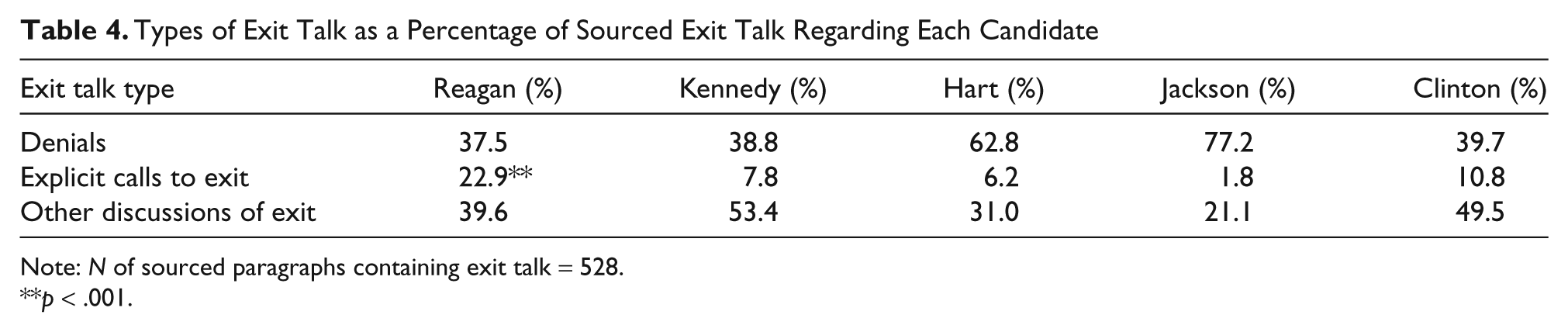
Note: N of sourced paragraphs containing exit talk = 528.
p < .001.
Moreover, a striking imbalance is found in the amount of exit talk in 2008 that emanated from journalists themselves or from sources that went unnamed. As mentioned above, nearly one-third (32.0 percent) of all exit talk across the five races was not attributed to any source. This unsourced exit talk was much more prevalent in 2008 than in the previous elections examined here: over two-thirds (66.9 percent) of all unsourced paragraphs in our data occurred in 2008. As Figure 2 shows, nearly one-half of exit talk regarding Hillary Clinton was unsourced—a significantly higher ratio than for our other candidates (p < .001, f = 21.308); the closest comparator was Edward Kennedy, with 30.0 percent unsourced exit talk. 10 After filtering out stories that appeared after Clinton withdrew (a context in which unsourced exit talk is both less surprising and less problematic), 41.7 percent of the remaining instances of exit talk were unsourced, versus 58.3 percent that were sourced. This percentage is still significantly greater than the amount of unsourced exit talk experienced by Clinton’s comparators (p < .000, f = 16.532). 11
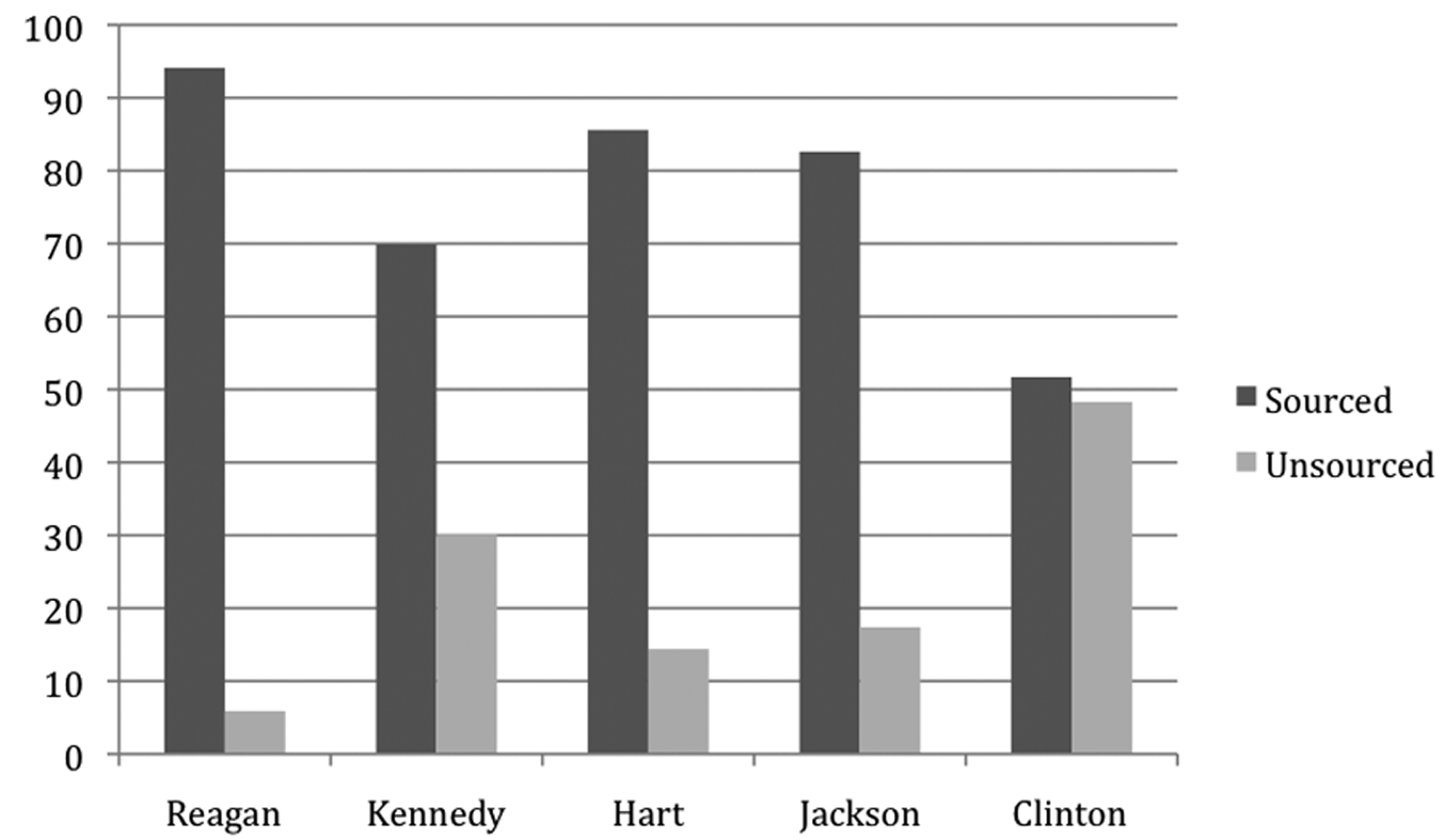
Percentage of sourced versus unsourced exit talk across five selected candidacies
In this sense, the exit pressure on Hillary Clinton was qualitatively different. The contrast with Reagan’s bid in 1976, in which President Ford and an array of party leaders publicly urged Reagan to give up his bid, is the most sharp. The headlines of Times stories from that campaign dramatically chronicle their efforts: “Ford Aides Send Signal to Reagan; Suggest He End Insurgency and Perhaps Join Party’s Slate as Running Mate” (March 10), “Reagan, Resisting, Pressed Again to Quit as Gesture toward Party Unity” (March 18, just after the Illinois primary), “Ford Says Reagan Fight Can Hurt G.O.P. in Fall” (March 20), and, in a spirited rebuttal, “Reagan Suggests Ford Quit the Race” (March 19).
In Clinton’s case, much of the exit pressure took the amorphous form of unsourced reporting on whether and when she would “have to” leave the race. Most of this unsourced talk, however, occurred in May and June (see Figure 3), when it was arguably less consequential to a campaign that had little hope by that point of winning the nomination through a straightforward process of amassing delegates in the remaining primaries. Indeed, May marked a critical turning point in perspectives on Clinton’s electoral chances (Lawrence and Rose 2009); by mid-May, Clinton was down by more than one hundred pledged delegates with no sizeable races left. The May 8 primaries, in which Clinton won Indiana by a narrow margin but lost North Carolina by a resounding 14 percent, appear to have been particularly influential in spurring media exit talk. In fact, just hours after those results came in, as one reporter observed,
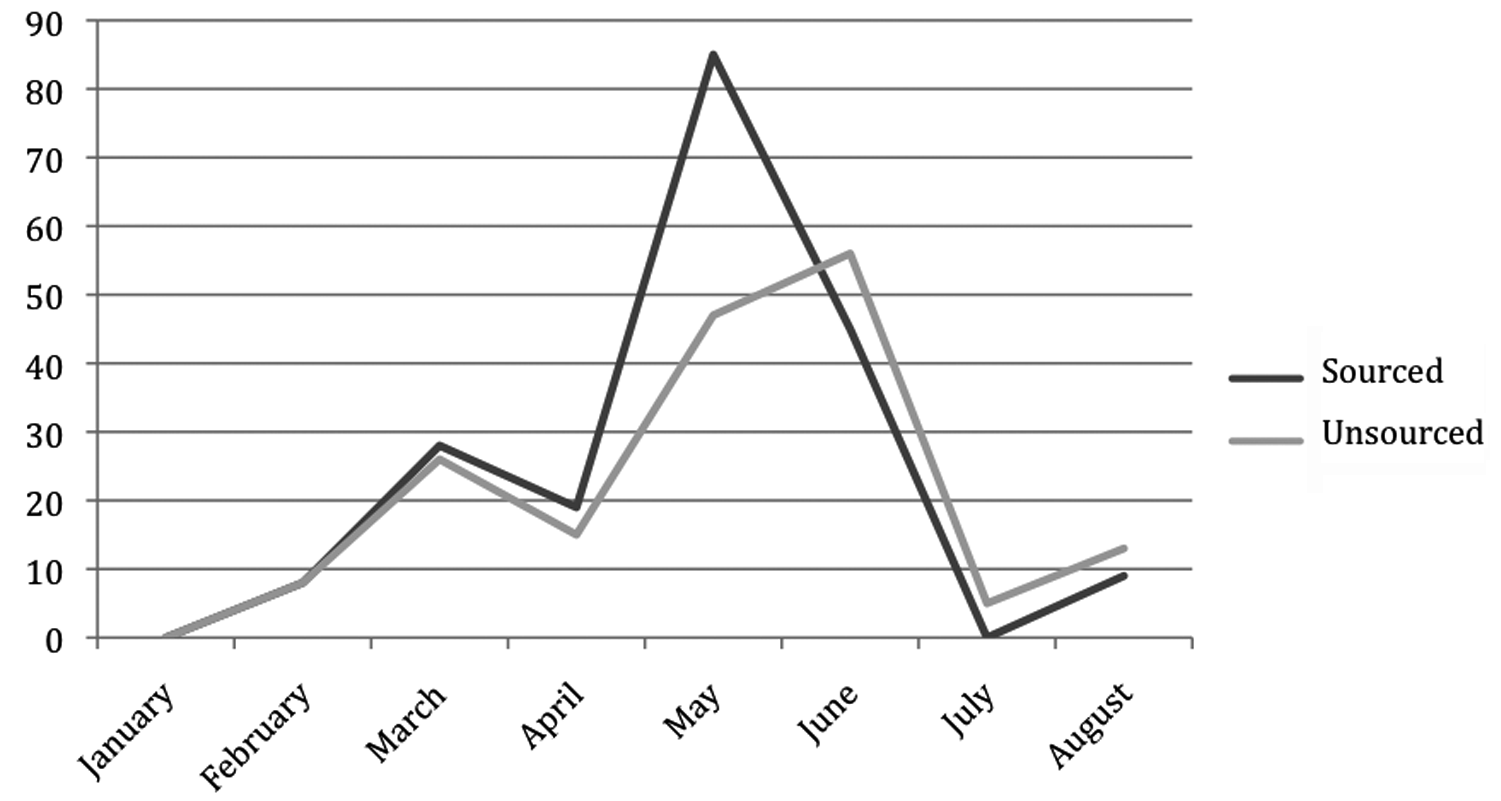
Sourced and unsourced exit talk regarding the Hillary Clinton campaign (2008), in numbers of paragraphs
the conventional wisdom of the elite political pundit class that resides on television shifted hard, and possibly irretrievably, against Senator Hillary Clinton’ continued viability as a presidential candidate. The moment came shortly after midnight Eastern time, captured in a devastatingly declarative statement from Tim Russert of NBC News: “We now know who the Democratic nominee’s going to be, and no one’s going to dispute it,” he said on MSNBC. (Rutenberg 2008)
While such media pronouncements enraged some of Clinton’s supporters and seemed to show the media (or at least Russert) playing a direct role in winnowing the candidates, it is hard to argue that reporters’ assessments of Clinton’s chances by that point were inaccurate or that exit talk in May and June strongly influenced the ultimate outcome of the race. Moreover, as Figure 3 shows, unsourced exit talk trailed the trajectory of sourced exit talk until June, when unsourced talk became slightly more prevalent.
The reasons for the increased level of unsourced exit talk in 2008 cannot be ascertained definitively. Some might suggest sexism was at work, a possibility that, as we suggest below, deserves further analysis. Others might guess that fear of Clinton-family retribution explains this increase in unattributed exit chatter, a possibility that is by its nature more difficult to assess. Another potential explanation is changes in media norms and routines that, by 2008, allowed reporters greater interpretive and speculative freedom (see Patterson 1994; Steele and Barnhurst 1996; Zeldes, Fico, and Lacy 2008). 12 Against the backdrop of intensifying horse race coverage, some research suggests that reporters themselves have become a main source of assertions in news coverage of primary elections (Benoit, Stein, and Hansen 2005).
To assess that potential explanation, we conducted an additional analysis of three comparator campaigns from 2008, also relying on the New York Times and using identical search parameters as for the Clinton data: on the Republican side Mitt Romney, who withdrew on February 7, and Mike Huckabee, who exited on March 4 (each with fewer than three hundred delegates), and on the Democratic side John Edwards, who withdrew from the race on January 30, 2008, after securing only six delegates. Because each of these was more clearly a distant trailing candidate than Hillary Clinton, these comparisons are less apt than the comparators chosen for our main analysis. Nevertheless, evidence of greater use of unnamed sources in exit talk surrounding these other recent candidacies could indicate that changes in media norms can explain, at least in part, our findings in Figure 3.
The 2008 comparative data (not shown here) indicate that exit talk about both Edwards and Romney was sourced in about two-thirds of paragraphs (67.0 percent and 63.5 percent, respectively), making the level of unsourced exit talk around their campaigns similar to that seen in 1980 around the Kennedy campaign. In the case of Huckabee, who because of the length of time he remained in the race provides the closest 2008 comparator to Hillary Clinton, exit talk was attributed to a named source in 78.8 percent of paragraphs—an even sharper contrast to the nearly 50.0 percent of unsourced exit talk in Clinton’s case. If the media were freer to offer unsourced exit talk in 2008 than in earlier elections examined here, that freedom was not exercised with regard to Huckabee, Romney, or Edwards.
Discussion
Our data show that Hillary Clinton was not the first trailing candidate to be urged to get out of a nomination race and that the most explicit exit calls among the five candidacies we studied were those directed at Ronald Reagan in 1976. Yet measured in raw numerical terms and as a percentage of all coverage, the level of exit talk around Clinton’s 2008 campaign was greater than for her four closest historical comparators, even that of Ted Kennedy in 1980.
Closer analysis suggests qualitative differences in these candidates’ exit strategies that may help to explain differences in levels and forms of exit talk. Reagan, Kennedy, and Clinton sent different signals about how determined and divisive their fights might ultimately be. In 1976, Reagan vigorously challenged Gerald Ford’s hold on his party’s nomination, insisting, “I’m taking this all the way to the convention in Kansas City, and I’m going even if I lose every damn primary between now and then” (Kengor 2006). The Kennedy team was also fairly brazen in saying they would take their fight all the way to the convention, 13 and indeed Kennedy announced his withdrawal from the race only hours before his appearance at the 1980 Democratic convention. Kennedy also refused throughout his campaign to say whether he would support President Carter in the general election. Though Hillary Clinton made it clear she would continue her campaign until all the primaries had been held, she formally suspended it and endorsed Barack Obama within a week after the last primary. She also generally said throughout the campaign that she would support the winner if she lost the nomination (though she declined to cast herself in the losing role; Lawrence and Rose 2009).
It may be that, for those with long historical memories, these differences in context and exit strategies contributed to the sense that Clinton was inordinately pressured to exit. Reagan’s and Kennedy’s more brazen challenges to sitting presidents help to explain the relatively heavy pressure to exit focused on their campaigns, while Clinton, in contrast, was competing in an open race, not against an acknowledged party leader. At the same time, the exit talk focused on Clinton reflected to some degree her own missteps in making the case for her continued campaign (Lawrence and Rose 2009)—in particular, Clinton’s reference in May 2008 to the 1968 assassination of Robert F. Kennedy as a rationale for her refusal to exit. 14
It is also clear that although Clinton may have experienced less direct and explicit pressure from her main opponent and party leaders, she was certainly pressured to exit. For example, Democratic Party chairman Howard Dean told reporters the day after the Super Tuesday contests (in which Obama and Clinton had each enjoyed victories and Obama had failed to edge Clinton out decisively) that the two candidates should not engage in a drawn-out battle for the nomination and that if a clear winner had not emerged by mid-March or April, the party would have to “get the candidates together and make some kind of arrangement” (Healy 2008). Given Obama’s delegate lead after Super Tuesday, it is reasonable to assume that Dean’s warning was directed primarily at Clinton. Dean’s call was later echoed by other leading Democrats, including Senator Patrick Leahy, who said in late March that Clinton should leave the race because her continued campaign weakened Barack Obama “more than anything John McCain has said” (Nagourney 2008, A1); George McGovern, who said in early May that Clinton should bow out because winning had become mathematically impossible (Healy and Zeleny 2008); and John Edwards, who told Face the Nation in early May that Clinton “has to be really careful that she’s not damaging our prospects” by staying in the race. As Cohen et al. (2008) describe, over the course of the primary season many Democratic elites made up or changed their minds in favor of Barack Obama (who began the election season as a candidate untested on the national stage). This dynamic led to a crescendo of support for Obama and pressures, both publicly and privately expressed, on Clinton to bow out of the race. 15
Examining our findings in conjunction with the contextual facts of 2008 also suggests that Hillary Clinton was subjected to relatively heavy (though less explicit, historically speaking) exit talk because of the interaction of changes in the nominating calendar and the closeness of the 2008 contest. The long 2008 campaign season, reflecting a trend in presidential politics toward ever greater “front-loading” of primaries (Menefee-Libby 2000; Ornstein and Mann 2000; Mayer and Busch 2004; Wayne 2008), meant that more state primaries had concluded earlier in 2008 than in the previous contests analyzed here. The delegate math of 2008 dictated that as early as Super Tuesday, Clinton had only a remote chance of securing the nomination through the popular vote, in large part because of the way the Democratic Party awards delegates. 16 Nevertheless, the race was extraordinarily close, with Obama holding a thin delegate lead over Clinton through much of the primary season. Indeed, Obama never reached the 25 percent to 33 percent lead in committed delegates that has induced other recent second placers to exit the race (see Norrander 2000). But in reality the delegate gap became nearly impossible for Clinton to close because even her wins in big states did not translate into large numbers of delegates (Todd and Gawiser 2009, 14-15).
In this context, Clinton’s exit remained one of the few things for reporters and their sources to talk about once most states had spoken by mid-March. For reporters and pundits who increasingly felt they had precious little left to cover, the story of the 2008 contest became “when will it end?” As Ana Marie Cox, reporter and blogger for Time, said of the 2008 campaign, “Of course it’s historic, it’s amazing, I feel lucky to be covering it. But how many more stories do I have to read, or be forced to write, about when Hillary will drop out?” (Kurtz 2008, C1). Another journalist reported that, in contrast to most elections in which reporters look eagerly for “comeback” stories to keep the election interesting to their audiences, “This is a really strange phenomenon in that you’re seeing people who can’t wait for it to be over. There’s only so many stories you can write, and we’re running out of them” (ibid). Meanwhile, coverage of campaign 2008 appears to have set records for its emphasis on the horse race (Lawrence and Rose 2009; Project for Excellence in Journalism 2008), possibly amplifying pressure on reporters to call the race before it was complete. Heavy horse race coverage clearly invites greater discussion of not only who will win but also who will concede.
Overall, our study suggests that the dynamics of exit talk may vary in proportion to the seriousness of the challenge the trailing candidate poses to the front-runner. Mike Huckabee’s threat to the eventual victory of John McCain in the 2008 Republican contest, for example, and Jesse Jackson’s challenge to Dukakis in 1988 were qualitatively different from Ronald Reagan’s audacious challenge to a sitting president in 1976, while Hillary Clinton’s close and protracted battle with Barack Obama raised intense concerns about a divided Democratic Party heading into the general election—as did Ted Kennedy’s hard-fought campaign in 1980. Our findings of greater exit talk regarding Reagan, Kennedy, and Clinton fit a general, commonsense pattern: exit talk swirls most fiercely around the closest-fought and politically most consequential trailing candidacies.
Thus far, we have not addressed the possibility that the heavy exit talk found in the Clinton case is a result of the candidate’s gender. The women and politics literature would predict, in fact, unique viability challenges for the first woman candidate to come within striking distance of her party’s nomination. While women candidates do not suffer from across-the-board gender disadvantages, especially when running for lower offices (Dolan 2004; Fox 2006; Sanbonmatsu 2005), they are more likely to have their political “viability” questioned than are men, a disadvantage manifest in fund-raising and media coverage (Heldman, Carroll, and Olson 2005; Falk 2010; Kahn 1996, 46) as well as in public attitudes and the attitudes of party leaders (Woodall and Fridkin 2003; Sanbonmatsu 2005). Until 2008, scholars have not had the opportunity—or perhaps the reason—to consider whether doubts about “viability” might dog even the woman candidate who seemingly has no initial viability problem. One form that such gendered doubts might take is the phenomenon we label exit talk, which at times in 2008 was strongly inflected with gendered language and assumptions (Lawrence and Rose 2009).
Sorting out the respective effects of gender stereotypes and these other explanatory factors is challenging, however, because of the limited number of appropriate comparator candidates. The female presidential candidates prior to Hillary Clinton, such as Shirley Chisolm, Pat Schroeder, and Elizabeth Dole, never cleared the hurdles of fund-raising and name recognition to become truly viable contenders for their party’s nominations. A similar challenge exists with regard to comparing trailing candidates, regardless of gender, within and across election years: very few if any trailing candidates have lost their nomination bid by such a narrow margin as Hillary Clinton did in 2008. Future studies of exit talk would do well to examine the effects of gender more closely than our present data set allows. For now, we suggest that whatever the future findings regarding the role of gender, the other factors identified here also played an important role in the amount and the type of exit talk seen in 2008.
Conclusion
The modern-day nominating process, characterized by early and intensive winnowing, crowds many candidates out of contention before most voters have had an opportunity to vote. Indeed, nominations expert John Aldrich (2009), recently proclaimed that “we have now reached a point where the standard nomination . . . can barely be considered truly a democratic at all” (see also Norrander 2006; Steger 2007). Elections expert Larry J. Sabato (2009, p. 137) appears to agree: “Some call it a ‘steamroller,’ others a ‘slingshot,’ but the effect is clear: a lightning-quick nomination of that initial victor.”
Our study sheds a different light on nomination battles. Exit talk becomes most intense in battles that are not “lightning quick,” though its prevalence and forms differ across contexts. Denials of any intention to exit are a primary type of exit talk coming out of trailing candidates’ campaigns, while explicit calls to exit, though somewhat more rare, are relatively common from leading candidates. Just as prevalent is exit discussion casting doubt on the trailing candidate’s likelihood of remaining in the race; in 2008, these more nuanced and implicit forms of exit talk emanated almost as much from reporters and unnamed sources as from named sources, such as the front-runner.
From these findings, many questions for future research beckon. Is exit talk indeed another form of viability questioning for women candidates, and does it harm female candidacies? Does exit talk appear with similar frequency and in similar form in broadcast, cable, and nonelite newspaper coverage? How does exit talk function as a method for party leaders to “sway voters to ratify their choice” of a presidential candidate (Cohen et al. 2008, 3)? What are the informal “rules” of the exit talk game? Will exit talk increase or decline as party nomination rules continue to evolve? We will examine these questions in our ongoing research.
Footnotes
Appendix
Pilot testing identified additional useful terms and identified drawbacks with some terms (the word stop, e.g., is used frequently to describe “campaign stops”—i.e., campaign events—so we eliminated that term). We therefore searched for articles that contained the selected candidate’s name and a mention of either campaign or election, along with the words (or words containing) quit, concede, bow out, suspend, give up, get out, withdraw, end, step (as in step aside), or stay. Our finalized search term was “[candidate name] and (quit! or conced! or bow out or suspend! or give up or get out or withdraw! or ending or stay! or step!) and (campaign or election).” The candidate’s name was constructed as his or her first name within two words of his or her last name (primarily to capture articles in which Hillary Clinton might be called Hillary Rodham Clinton. Truncation (“!”) instructs the Nexis search engine to find all words containing that root. Because this broad set of search terms inevitably picked up unrelated articles (e.g., those discussing candidates’ stands on the Soviet “withdrawal” from the Olympics in 1984, articles discussing a proposed “suspension” of the gasoline tax in 2008), careful culling was necessary to locate only those that featured explicit exit talk regarding the candidates in question.
The specific date ranges for each search were as follows: 1976 Reagan: 1/28–8/20; 1980 Kennedy: 1/22–8/15; 1984 Hart: 2/21–7/20; 1988 Jackson: 2/9–7/22; and 2008 Hilary Clinton: 1/4–8/29. News coverage was tracked through each year’s party convention because, as discussed further below, four of the five candidates in this study did not bow out before their party’s convention.
Acknowledgements
The authors wish to thank Christina Wollbrecht, Barbara Norrander, Johanna Dunaway, and the anonymous reviewers for their comments on earlier versions of this work and Tyler Browne, Benjamin LaPoe, Chris McCullough, Erica Taylor, and Jessica Tollestrup for their research assistance.
The author(s) declared no potential conflicts of interests with respect to the authorship and/or publication of this article.
The author(s) received no financial support for the research and/or authorship of this article.