






Abstract
The passage of electoral gender quotas raises questions about why male elites would support policies that seemingly go against their self-interests. Recent work on France suggests that quota adoption is self-interested because male legislators benefit from alleged voter bias against female candidates. This article evaluates this explanation as a means for understanding quota adoption globally. It argues that the key actors are not legislators but political parties. Developing an alternative causal story centered on “party pragmatism,” it finds that decisions to introduce quotas are rational and consistent once a range of incentives—ideological, electoral, and strategic—are taken into account.
Keywords
In recent years, gender quotas regulating the candidate selection process have been adopted in more than one hundred countries. Although varied in format, these policies stipulate that women constitute a minimum proportion of candidates and/or representatives. Quotas have been justified on the grounds that women constitute a small minority of elected officials—on average, only 19 percent of parliamentarians worldwide (Inter-Parliamentary Union 2011). Strikingly, the vast majority of these measures have been passed nearly unanimously by male-dominated political parties and legislatures. Alongside their global diffusion, this fact implies widespread consensus behind the goal of increasing women’s representation. Yet given women’s low numbers, implementing quotas necessitates a reduction in the proportion of men. This raises the question: why would party elites and legislators—who are overwhelmingly male—support a policy that appears to go against their own self-interests?
Existing research on gender quotas offers three primary explanations. One highlights electoral incentives, suggesting that parties tend to pursue quotas when seeking to capture women’s votes (Davidson-Schmich 2006; Kittilson 2006; Meier 2004). A second emphasizes ideological incentives, attributing adoption to congruencies between quotas and principles informing party and national models of inclusion (Krook, Lovenduski, and Squires 2009; Meier 2000; Opello 2006). A final set of arguments points to strategic incentives, contending that elites support quotas to sustain an existing regime (Howard-Merriam 1990), consolidate control over rivals (Chowdhury 2002), and respond to international pressures (Krook 2006). These accounts offer important insights into motivations behind quota policies. However, all three explanations remain at the macro level: they address influences and determinants but do not closely explore actual decision-making processes. The result is that relatively little is known about how these incentives have been translated more concretely into action.
An interesting advance in this regard is a recent analysis by Guillaume R. Fréchette, François Maniquet, and Massimo Morelli (2008; hereafter FMM). In an article on France, they attempt to explain these processes at the micro level, using game theory to model the calculations of individual legislators leading to reform. Their answer is simple: quota adoption is in male legislators’ self-interest. While their finding is counterintuitive, FMM propose that the inducement to adopt quotas emerges from a “male advantage” in French elections, whereby women are easier to defeat than men. According to this logic, male incumbents stand a greater chance of being reelected if they face a female challenger. This prospect of reelection, FMM suggest, provided a rational incentive to incumbents to support a parity law, which would boost their chances of facing a female opponent. However, to ensure that they would not be at risk of deselection, deputies also introduced a lenient financial penalty, creating a loophole whereby parties could violate the law to protect male incumbents. FMM argue that this self-interested motivation for introducing parity explains the law’s low effectiveness, with the proportion of women in the French National Assembly rising only marginally from 10.9 percent in 1997 to 12.3 percent in 2002.
While FMM’s study reflects a much-needed effort to connect incentives to the decision to approve quotas, the game-theoretic model can be valid only if it operates with correct assumptions—in this instance, an accurate assessment of legislator motivations. Closer examination of the French case, however, reveals two key errors. First, while men win a greater number of seats than women, FMM misattribute the nature and origins of male advantage. They conclude that it is rooted in voter bias against female candidates, yet do not control adequately for seat effects, that is, the relative “winnability” of various districts. If such a control is introduced, the premise of voter bias in favor of men no longer holds. Rather, inferior outcomes for women are the direct result of seat placement by parties rather than discrimination by voters. Second, FMM assume that legislator incentives guide party policy, when in fact the opposite is true. The central role of parties in policy making in France means that when parties have preferences distinct to those of legislators, they are in a position to compel legislators to vote in particular ways because of mechanisms of party discipline reinforced by party control of candidate selection processes. Thus, while legislators made the immediate decision to pass the quota, they were heavily influenced by parties, whose independent motivations are wholly absent from FMM’s account.
With this model rendered invalid, an alternative explanation is needed to understand dynamics of quota adoption globally. The French case offers a useful starting point. In 2000, the electoral law was reformed to require that parties field an equal number of male and female candidates in most elections. The policy is unusual in mandating “parity” rather than the lower proportions established elsewhere. 1 In addition, the percentage of women in parliament in France has long been below the world average. This combination of features—the high level mandated by the new law and the low numbers of women in parliament at the time of passage—means that adoption of parity in France embodies more acutely the puzzle regarding men’s interests raised by quota reform in all countries. This case thus provides an opportunity to explore in greater depth motivations for quota passage more generally.
Placing parties at the center of analysis also enables us to link the question of quota reform to the broader literature on political parties and their reasons for adopting new policy positions. This work is concerned with theorizing the trade-offs that parties face when devising their electoral strategies and party programs, requiring them to balance vote-seeking and policy-seeking objectives (Przeworski and Sprague 1986; Spoon 2011; Strom 1990). These dilemmas are ongoing, fueled by shifting internal and external conditions generated by struggles for power within parties (Schofield and Sened 2006) and the rise of new challenges within the broader political environment (Adams and Ezrow 2009; Harmel and Janda 1994). Drawing on this work, we introduce a theory of “party pragmatism” arguing that parties engage in balancing acts across three types of potentially conflicting incentives—electoral, ideological, and strategic—that have been only partially incorporated within existing frameworks.
We begin by discussing FMM’s model and its limitations for explaining the passage of the parity law in France. We focus on their claim of voter bias in favor of men, arguing that it does not hold. In the second section, we explore reasons for male advantage through two new statistical models. The first discredits the theory of voter bias, while the second—in line with an account centered on parties—indicates elite bias to be a more plausible cause. In light of these findings, the third section introduces party pragmatism as an alternative explanation. We suggest that the seemingly bizarre decision to introduce the law and then breach it at considerable cost may be considered rational once a range of conflicting incentives are taken into account. We argue, furthermore, that reasons for quota reform cannot be treated in isolation from political institutions. This offers a more holistic yet parsimonious model of quota adoption, linking together incentives, actors, and institutions through a focus on the role of political parties. After making the case for party pragmatism as the most plausible and comprehensive theory, we conclude with reflections on what this case offers for understanding patterns of quota adoption around the world.
The FMM Thesis: Male Advantage, Voter Bias, and Parity Reform
FMM’s account of quota reform differs from other explanations focused on strategic incentives because of their attention to micro-level incentives and behaviors and their focus on male advantage and voter bias as a key motivation for passage of the parity law. Although FMM apply their model only to France, carefully dissecting this argument is essential for thinking more comparatively about the puzzle of quota adoption. By connecting broad motivations to actual decision-making processes, FMM provide a means for reorienting the research question to focus on the incentives of legislators—and by extension, party officials—immediately responsible for quota reform. However, their model overlooks key elements of the French political context, undermining its accuracy and ability to offer a persuasive explanation of quota reform in France as well as elsewhere. A close reading therefore helps inform a more general framework of determinants leading to the promulgation of quota policies.
The Formal Model and Statistical Test
FMM’s formal model proposes that the single-member plurality electoral system for the National Assembly leads deputies to anticipate an incumbency advantage against challengers. As most incumbents are men, quotas enhance this effect due to male advantage, increasing opportunities for male incumbents to face off successfully against female challengers. Crucial to this hypothesis are the mild financial penalties for noncompliance: whereas “pure parity” would decrease the probability for male incumbents to run again, “parity with fees” enables a larger number to stay on and defend their seats, if their parties can absorb the resulting loss of state funding. As such, the details of the law are attractive for male incumbents, raising the probability that they will run against women, while not preventing them from competing. This “model of constitutional design,” FMM stress, does not apply to senators who face “pure parity” because of the different electoral system used for the Senate. FMM argue that these rational incentives explain the near-unanimous support for parity by deputies and the opposition to it by senators.
The strength of this model depends on the ability to verify the two core assumptions of male advantage and voter bias. While FMM (2008, 895) claim that “proving the existence of such a male advantage is all that matters,” their game-theoretic model hinges on their ability to demonstrate statistically the presence of male advantage and its source in voter bias. To simplify their tests, they focus on only districts where the election went into a second round and where the candidates were from the two major parties, the Socialist Party (PS) and the Union for a Popular Movement (UMP). FMM seek to explain a candidate’s percentage of votes in the second-round elections in 2002, controlling for the score obtained in the previous election by the candidate in the same district and party, the age difference between opponents in the same district, and the party affiliation of each candidate. The key independent variable is male advantage, captured by noting when a male has a female opponent (value 1), the two candidates are of the same sex (value 0), and a female has a male opponent (value -1).
The authors find that male advantage is statistically significant for both new candidates and incumbents: “For a male, having an opponent of opposite gender increases the probability of winning—and for a woman it decreases it” (FMM 2008, 898). The party holding the district in the previous election also has a significant positive effect, as do age and whether the candidate represents the UMP. FMM dismiss the possibility of party bias on the grounds that the analysis controls for party score in 1997 and 2002, and thus the “winnability” of the district in 2002 and 2007. They conclude, therefore, that “no party has shown a biased preference for men over women in ‘good’ districts where it did not have an incumbent” (FMM 2008, 900). Despite evidence for bias in 2007, FMM conclude that their finding for 2002, combined with the discovery that men win irrespective of level of experience, “leaves voters’ bias as the most likely explanation for male advantage” (FMM 2008, 901). This finding is then built into the game-theoretic model through the simplifying assumption that “if a man candidate runs against a woman, he is elected no matter what the voters of that district think of the candidates’ policy platforms” (FMM 2008, 901). In other words, voter biases in favor of men trump other considerations such as policy preferences or voter loyalties to individual parties.
A Critique of the FMM Thesis
The micro-level account developed by FMM offers a striking, counterintuitive hypothesis for why male legislators might vote for a measure that appears to go against their self-interests. This explanation may be applicable to other instances of quota reform, however, only if the model—and the statistical analysis used to bolster it—in fact constitutes a valid description of this case. The claim that male candidates obtain higher scores in elections than female candidates—the presence of a male advantage—has been confirmed by other studies on France (Murray 2004, 2008; Zimmermann 2003). Yet there are strong reasons to doubt the assumption regarding voter bias, which runs contrary to the main findings of the literature on this topic. Most comparative studies find that when features like seat, region, and incumbency are controlled for, citizens vote for female candidates at equal or greater rates (Black and Erickson 2003; Brians 2005; Norris, Vallance, and Lovenduski 1992). A similar lack of voter bias against women has been confirmed in France (Murray 2008), although elites have explained recruitment choices favoring men based on perceived voter preferences (Charlot 1980).
The disparity between FMM’s assumption about voter bias and conclusions of other scholars can be traced back to several problematic elements in their statistical analysis. In their model, FMM seek to distinguish between different sources of bias by examining the scores obtained by male and female candidates in each seat, controlling for “the score in the second round of the [previous election] obtained by the candidate of the same district and same party.” They claim that “[t]his party- and district-specific variable accounts for the aggregate preference toward a specific party within each district. It also serves the purpose of controlling for the fact that women might be sent to ‘worse’ districts than men” (FMM 2008, 895).
There are several reasons why this research design does not control sufficiently for these effects. First, their measure of seat safety does not control properly for swing because it overlooks a central feature of French elections: alternance, or frequent changes back and forth between governments of different parties. Its importance is strikingly illustrated by the fact that the 2007 election was the first since 1978 to feature reelection of the incumbent government. As such, excluding swing from a measure of electoral performance is a serious omission, especially given significant variations in regional swing and individual seat volatility. Furthermore, a small swing has greater significance in a seat held by a small majority of votes, whereas a safe seat may be able to tolerate a larger swing without changing hands. As we argue below, these dynamics may have a greater impact on women because of the seats in which they are placed, and may thus influence findings on the presence and origins of male advantage.
Second, FMM do not control for changes in the sex of candidates over time. Changes in party performance from one election to the next can be attributed to sex only if there is a corresponding change in the sex of one or both candidates in the second election. Third, although FMM control for incumbency, and whether the opponent was a new candidate or loser from the previous election, they fail to capture two other important trends. First, the status of losing the previous election does not distinguish between candidates who were incumbents prior to losing the seat and candidates who had previously contested it unsuccessfully. This is a crucial distinction in light of alternance, as many seats feature a former incumbent seeking to regain the seat at the next shift of the electoral tide. Second, seats have a history that precedes the previous election. There are numerous seats where the runner-up had won the seat in 1993 or even 1988 and had not been reelected since. As men are more likely than women to have a prior electoral history within a seat, a robust control for this history is required.
The interpretation of these statistical results has crucial implications for the subsequent framing of the micro-level story. Similar to work on voter bias, FMM’s account of quota adoption in France does not echo conclusions reached by other scholars. References to the enormous body of work on parity are notable by their absence, despite the fact that the French case is among the most extensively studied in the rapidly expanding literature on gender quota reforms (among others, see Baudino 2003; Bereni 2007; Krook 2009; Lépinard 2007; Mossuz-Lavau 1998a; Murray 2010; Opello 2006; Scott 2005). The overarching reason for disjunctures in both instances relates to the role conferred to political parties. In France, as is the case in nearly all countries around the world, parties play the central role in selecting candidates and allocating district and list positions (Gallagher and Marsh 1987; Norris 1997). As such, the choices made by party elites—rather than voters—are almost entirely responsible for trends in women’s and men’s electoral performance (Kittilson 2006; Lovenduski and Norris 1993).
The game-theoretical model proposed by FMM, in contrast, focuses centrally on the incentives of individual legislators. On the few occasions when “party leaders” are referenced, they are assumed to have preferences identical to those of sitting male deputies, namely “the reelection of incumbents” rather than “the election of new candidates” (FMM 2008, 892). However, the independent calculations of parties cannot be dismissed so lightly. Parties are integral to all aspects of political life in a way that is much more significant in France—and most other countries—than in the United States. 2 In addition to overseeing candidate selection, parties exert pressures on legislators through norms of party discipline, leading to strong patterns of voting along partisan lines. Parties thus play an important role in policy making, guided by preferences that are potentially distinct from those of legislators. These policy priorities may come from a variety of sources, including groups within the party as well as highly visible presidential candidates, creating multiple possible influences on policy reform.
Two New Models: Advantage, Bias, and Candidate Performance
Rather than replicating FMM’s analysis, which we contend is misspecified and missing data crucial for determining the presence of voter bias, we develop two alternative statistical models that test in greater depth claims about male advantage. The intent is not to dispute male advantage (the tendency for men to win more seats than women) but rather to ascertain whether it emerges from voter bias (model 1) or from party bias (model 2). The first model measures change in party performance from one election to the next, controlling for swing, a party’s prior history within each seat, and changes in candidate sex and incumbency status. The second draws on more nuanced data on the safety and desirability of the seats in which men and women are placed.
Model 1: Male Advantage Is Not Caused by Voter Bias
Model 1 explores voter bias by analyzing differences across elections to measure more effectively whether changes in candidate sex have a corresponding impact on party performance. 3 If voters are indeed biased in favor of men, we would expect parties to benefit if they switch their candidate from a woman to a man, and/or if the opponent party changes its candidate from a man to a woman. Similarly, if a party shifts its candidate from a man to a woman, or if its candidate faces a man instead of a woman, it might expect an electoral penalty. Conversely, if these changes have no bearing on party performance, we must conclude that voters are not biased against female candidates.
The model uses an original dependent variable to capture change in a party’s performance in a seat over time, controlling for swing and for individual seat effects. 4 The dependent variable measures change in the party’s performance from one election to the next, contrasting this with change in the party’s fortunes in the region. As party strengths are not evenly distributed throughout the country, regional swing is a much more sensitive gauge than national swing. This creates a baseline measure of how a party may be expected to perform in any given seat, controlling for swing. To determine whether a party has performed better or worse than expected in a given election, the party’s performance needs to be compared not only to the current regional performance but also to the seat’s baseline measure.
A decrease in the dependent variable indicates a stronger performance than expected for the left, while an increase indicates an enhanced performance for the right. Information for each election draws on data from the two preceding elections; hence, using a data set of five elections (1988, 1993, 1997, 2002, and 2007), we are able to model results from 1997 onward. This setup allows us to contrast the last election held before the introduction of parity with the two elections held after parity’s passage. If FMM’s argument of voter bias as an incentive for parity reform is correct, evidence of voter bias in 1997 would be particularly important, as this might have influenced the behavior of deputies in 2000.
Against the dependent variable, we can test whether changes in independent variables between the two elections might have affected the party’s performance. The two key variables of interest are sex (to gauge whether men benefit from an electoral advantage over women) and incumbency (to control for effects that might otherwise be erroneously attributed to sex). We measure these effects by monitoring the sex balance and the incumbency status of the second round candidates from one election to the next, and determining whether this has any significant impact on party performance. Expanding the number of observations used by FMM, who examined only the two major parties, the PS and the UMP, we include all second-round elections that featured a left-right battle. The reason for this is that a key feature of French politics is the presence of formal and tacit electoral agreements among left-wing and right-wing parties, respectively, to avoid splitting the left-right vote. 5
We use two sets of independent variables to control for changes in the sex and incumbency status of candidates from both parties from the previous to the current election (t−1 to t0). For both sets of variables, party is integrated into the variable design, eliminating the need for a separate independent variable controlling for party. A change in candidate sex is measured through a series of dummy variables, controlling for every interaction of party and sex over both elections. The model denotes right-wing candidates using the letter R and left-wing candidates using an L. If a party’s candidate is male at t−1 and female at t0, this is reported as m-f, and vice versa as f-m. For example, if the right-wing candidate in both elections was male while the left-wing candidate was a man at t−1 and a woman at t0, this would be categorized in the model as “R same; L m-f.”
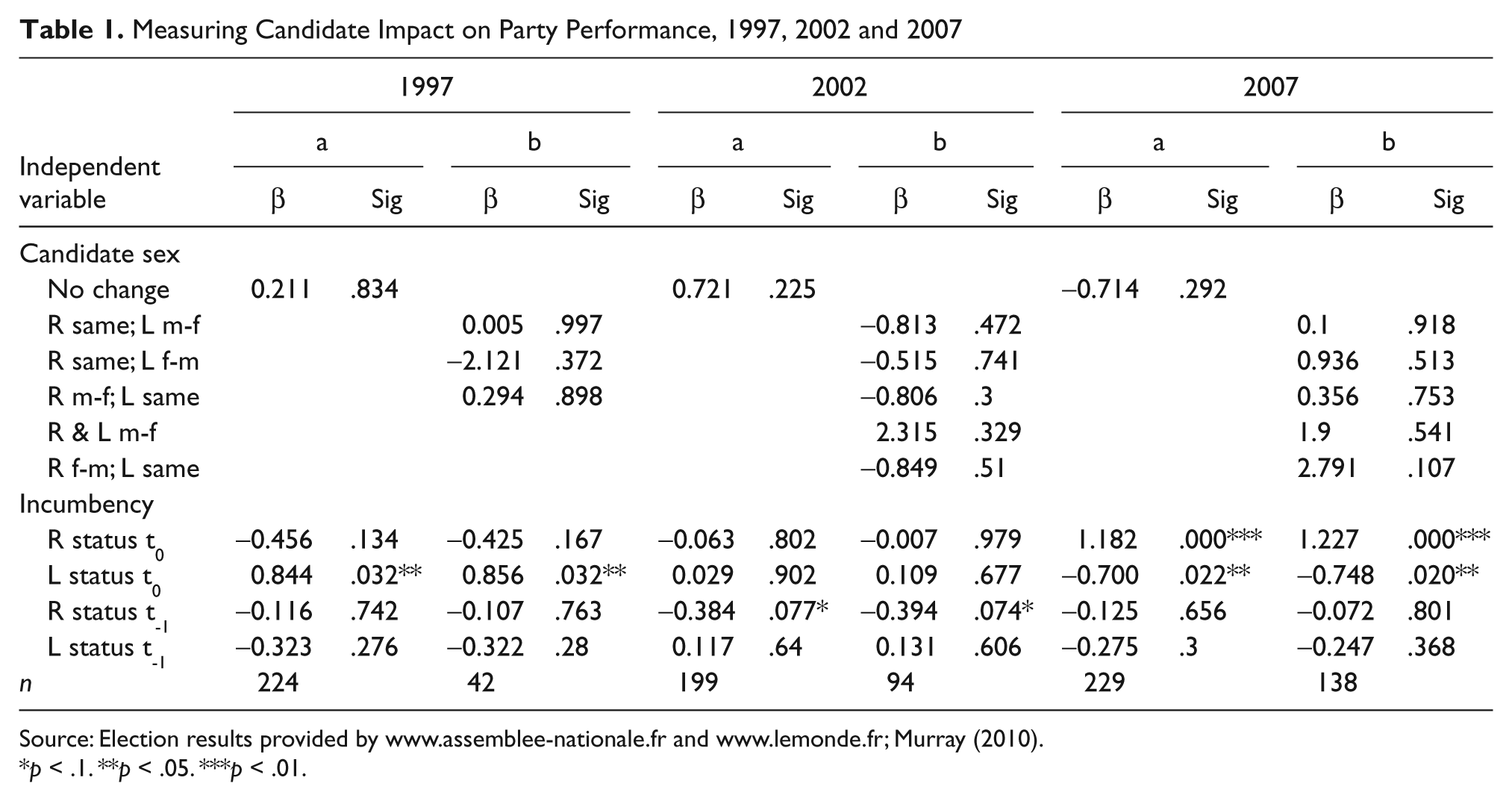
To control for incumbency, we created a variable measuring different levels of prior experience in that seat. The four measures were incumbent (coded as 4), former incumbent (anyone who had won the seat prior to the previous election but was no longer the incumbent; coded as 3), former candidate (anyone who had previously qualified for the second round in that seat but without winning; coded as 2), and new candidate (coded as 1). We coded incumbency status for candidates of all parties and for both time periods to measure any change. The results of our models are reported in Table 1.
Measuring Candidate Impact on Party Performance, 1997, 2002 and 2007
Source: Election results provided by http://www.assemblee-nationale.fr and http://www.lemonde.fr; Murray (2010).
p < .1. **p < .05. ***p < .01.
A striking observation is that none of the measures of change in candidate sex is significant in any of the models. Once appropriate controls for safety of seat, swing, and incumbency are applied, sex has no additional impact. Furthermore, the direction of the relationships contradicts FMM’s theory, with a change from a male to a female candidate helping a party eight out of ten times, while a change from a woman to a man hurts a party three out of five times. These results negate the voter bias argument put forward by FMM as an explanation for male advantage. A secondary finding is that incumbency does appear to have some significance, although its impact is not constant across all elections. As most incumbents and former incumbents are men, while the majority of women are new candidates, controlling for incumbency might conceal an underlying sex effect. However, examining the results in more detail renders such a conclusion implausible.
The right-wing landslide in 1993 produced an unusually high number of incumbents on the right in 1997. Rather than benefiting from incumbency, many of these candidates lost their seats as the left swept back into power. Meanwhile, although incumbency was significant for left-wing candidates in 1997, the direction of the relationship counters expectations. An increase in the incumbency ranking for left-wing candidates is actually associated with weaker performance. A possible explanation for this trend is that in 1993, the left was able to retain seats only in constituencies with strong concentrations of baseline supporters. Hence, swing to the left in these very safe seats was likely to be lower than the swing in those seats where floating voters returned to the left in 1997. At the same time, the PS commitment to a target of 30 percent women led to a significant rise in the number of new female left-wing candidates. 6 As swing to the left was higher in seats without a left-wing incumbent, it appears that new candidates, many of whom were women, delivered the strongest performances for the left in 1997.
Incumbency status has no significance at all in the 2002 election. The control variable for incumbency status in 1997 indicates a negative and weakly significant relationship between incumbency and electoral performance for right-wing candidates, which is consistent with the findings for 1997, when many right-wing incumbents lost their seats. Finally, in 2007, incumbency is highly significant for both parties. This outcome is intuitive, as 2007 was the only election to feature the reelection of the incumbent government. Hence the success rate for incumbents in this election was 87.4 percent, compared to 71.4 percent in 2002 and only 57.6 percent in 1997. In light of these stark variations in performance, it is hard to accept the thesis that voters reelected incumbents in 2007 because of preference for this type of candidate.
A much more plausible explanation lies in the new electoral calendar introduced prior to the 2002 elections, following a referendum in 2000. This resulted in harmonization of the presidential and legislative electoral terms, such that the presidential elections now occur shortly before the legislative elections. Prior to this change, it was possible to have a president of one party and a government of another party, resulting in the unpopular scenario of “cohabitation.” The harmonization was designed to increase the likelihood of giving the president a parliamentary majority. 7 For this reason, the best predictors of the 2002 and 2007 legislative election results were the presidential elections that preceded them. Together, these findings clearly demonstrate that male advantage cannot be explained by voter discrimination against female candidates, as FMM propose. Furthermore, the discovery of weak incumbency effects undermines FMM’s claim that parity with fees would invariably benefit male officeholders.
It is also worth noting that, even if parties believed there to be voter bias against women, this would not lend support to FMM’s argument of incumbent incentives to support parity. According to such an account, the perceived strategic advantage of fielding a male candidate would be greatest in the most vulnerable seats, as this would maximize a party’s chance of gaining or retaining a seat. However, this would involve one of two scenarios. The first is that parties would prioritize male incumbents in the seats they were most likely to lose to increase their prospect of retaining the seat, a theory disproved below. The second is that parties would field male challengers in the seats they felt most likely to win. This would involve extending fees to challengers’ seats as well as those of incumbents.
If party nomination decisions are truly motivated by perceptions about voter bias, parties would only field women in a few safe seats. Hence, any male incumbent at risk of losing his seat would still find himself facing a male challenger, but with additional cost to his party. Although FMM allow for this possibility as an extension to their formal model, they argue that it would not affect their main result, and a “parity with fees” system would still be optimal. This argument is intuitively implausible: if both parties assume male advantage and hence field men in key seats, the result will be suboptimal, as it merely maintains the status quo but at added financial cost. A model of parity with fees to protect and enhance the electoral interests of incumbents is therefore not credible, and cannot be the correct explanation for the introduction of parity.
Model 2: Male Advantage Is Explained by Party Bias
Male advantage clearly exists in France, given the low numbers of women in office. Having disproved FMM’s claim that voter bias is the source of male advantage, it is necessary to explore an alternative explanation. FMM dismiss party bias as the source because they find that in 2002 there is no statistically significant evidence that parties send new female candidates to less favorable districts (FMM 2008, 900). However, this conclusion contradicts their results for 2007, which support this hypothesis. Although FMM overlook these conflicting findings, and privilege the former, the latter is consistent with prior research on France arguing that women are indeed placed in tougher districts.
One study, for example, employs the 2002 presidential election results as a gauge of a party’s likely prospects in the legislative elections two months later. The score for a party in the presidential elections was, on average, 6.9 percentage points higher in constituencies where a man was running compared to those constituencies where women were fielded (Zimmermann 2003, 12; for similar findings using a different methodology, see Murray 2004). Despite this support for an alternative theory, FMM use an additional measure to support their conclusion that male advantage is not attributable to party bias: the overall average score of seats where new candidates are selected. However, this does not take into account the proportion of men and women who are selected to winnable seats, nor does it consider ongoing placement biases from previous elections. To address these shortcomings, we offer an alternative test of party bias to determine whether this can better explain patterns of male advantage.
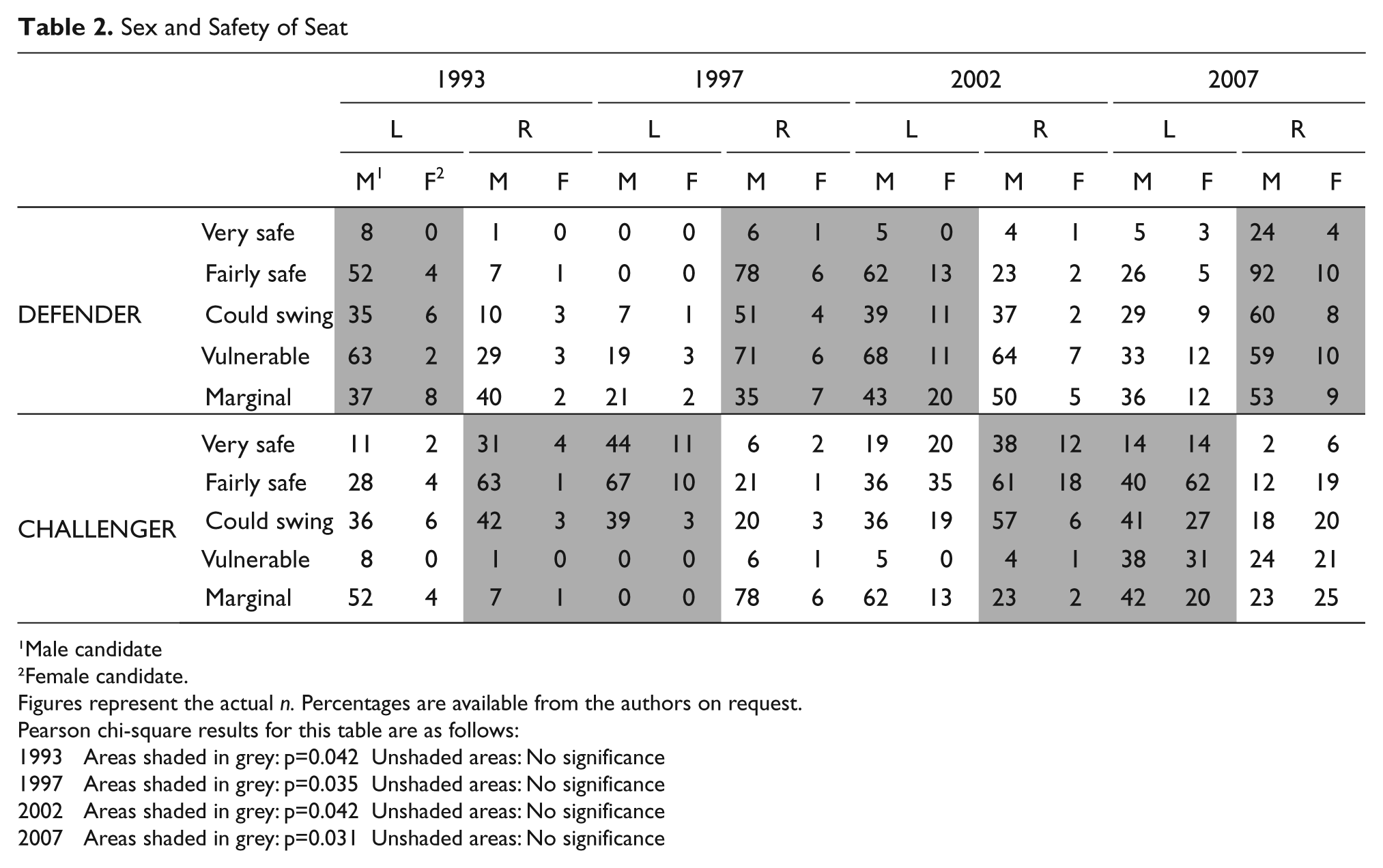
Model 2 focuses on the safety of the seat in which men and women are placed. Using average swing prior to 2007 as a barometer, we group seats into five categories of safety according to the swing required to overturn the seat: very safe (> 15 percent), fairly safe (8–15 percent), “could swing” (5–8 percent), vulnerable (2–5 percent), and marginal (< 2 percent). The desirability of a seat depends not only on its safety but also on whether the party is seeking to conserve or gain the district. Given the history of alternance, the outgoing party of government will primarily be concerned with minimizing losses and defending seats. For this party, the most desirable seats will be those held with the highest margin. Conversely, for the opposition party, the main focus will be on attacking, and trying to take back as many seats as possible. For this party, the most desirable seats will be those held by its opponents with the lowest margin.
We find that women are consistently allocated the most challenging districts, with men placed disproportionately in the more desirable seats. The evidence suggests that parties shift their strategy in relation to female candidates depending on whether they are attacking or defending: sex differences in the key seats are statistically significant, whereas the distribution of unimportant seats is not significant. In other words, women from defending parties are overrepresented in the most marginal seats, while women from attacking parties are overrepresented in the seats least likely to fall.
Table 2 demonstrates that these trends were significant in all elections. Taken together, these findings support the hypothesis that male advantage emerges not from voter preferences but from men’s placement in favorable districts. If parties had acted from beliefs about voter bias, they might have adopted a different electoral strategy, namely placing women in safe seats to compensate for voter discrimination, while directing men to the most vulnerable seats to maximize their chances of retaining the seat. The results presented in Table 2 therefore offer a clear indication of party bias in favor of male candidates, serving as the most plausible explanation for male advantage.
Sex and Safety of Seat
Male candidate
Female candidate.
Figures represent the actual n. Percentages are available from the authors on request.
Pearson chi-square results for this table are as follows:
1993 Areas shaded in grey: p=0.042 Unshaded areas: No significance
1997 Areas shaded in grey: p=0.035 Unshaded areas: No significance
2002 Areas shaded in grey: p=0.042 Unshaded areas: No significance
2007 Areas shaded in grey: p=0.031 Unshaded areas: No significance
An Alternative Theory: Party Pragmatism and Parity Reform
The finding that parties in France appear to be biased against female candidates in selection procedures is consistent with other work, emphasizing that parties are the gatekeepers responsible for hindering or encouraging women’s access to political office (Kittilson 2006; Lovenduski and Norris 1993). Parties’ central role in candidate selection means that party officials are crucial to determining who is selected and where individuals are placed. Yet it is not clear why parties that seem biased against female candidates would come together in the legislative arena to introduce parity, especially as the French policy is relatively radical compared to provisions elsewhere. This puzzle is to some degree raised by quota adoption in all countries. We argue, however, that these seemingly incompatible actions are in fact consistent with a theory of party pragmatism. In contrast to the single incentives highlighted in existing research on gender quotas, our theory draws from literature on party strategy to emphasize the “balancing act” (cf. Spoon 2011) that parties confront in relation to potentially competing electoral, ideological, and strategic motivations. We argue that this perspective—integrating disparate insights on the various incentives behind party decision making—helps make sense of apparent contradictions and, crucially, also accounts for recent initiatives to strengthen the parity law.
Our theory departs from FMM by contending that parties, rather than individual legislators, are the actors responsible for quota adoption. Parties influence legislator behavior through centrally determined policy programs, and the government and parliament are shaped along party lines, with strong cohesion and high levels of partisan voting (Chagnollaud 1993; Knapp 2002). In France, attempts to cultivate party cohesion are also driven by the need to maximize electoral performance, as the main source of income for parties is a state subsidy based on the number of votes and seats won in legislative elections. However, as in other countries, parties in France are not unitary actors with a single consistent set of motivations (Harmel and Janda 1994). While their prerogatives heavily influence the behavior of legislators, parties confront and seek to balance the demands of competing factions (Harmel and Tan 2003; Schofield and Sened 2006) and an array of potentially contradictory incentives for action (Przeworski and Sprague 1986). Our theory of party pragmatism focuses attention in particular on the role played by party leaders in enforcing pragmatic solutions to competing demands.
Central actors within French parties are presidential candidates: while no presidential hopeful can campaign without the backing of a party, France’s volatile party system is often reshaped by the egos of those who would be president. The leadership of such candidates was prominent in the 1997–2002 parliament when parity was debated, because of semipresidentialism and cohabitation among the two leading candidates from the 1995 election and presumed frontrunners in 2002: President Jacques Chirac, leader of Rally for the Republic (RPR, which later joined with other right-wing parties to form the UMP), and Prime Minister Lionel Jospin, leader of the PS. Interdependence among these actors means that pragmatism and compromise are integral features of French politics. Party organizations, however, are central in bringing together a coordinated outcome. The parity reforms, we propose, emerged as a pragmatic compromise at a time when parties faced a number of pressures. Party actions to maximize gains and minimize losses, in turn, led to promulgation of an ambitious law rendered ineffective by loopholes. Party pragmatism thus offers a unified and parsimonious explanation, focused on interactions and balancing among electoral, ideological, and strategic incentives for reform.
Electoral Incentives
Electoral considerations were perhaps the most important influencing factor leading to the introduction of parity, but they operated in very different ways to the incumbent incentives hypothesis offered by FMM. These motivations were shaped by a series of significant events prior to the constitutional revision in 1999 and the parity legislation of 2000. Parity became a key theme of many women’s groups in the early 1990s, when numerous activities—including debates, roundtables, conferences, newsletters, and demonstrations—were organized with the goal of putting parity on the political agenda (Scott 1998). To increase their influence, an umbrella organization Demain la parité (Tomorrow Parity) was created with the goal of mobilizing public support and collecting a million signatures in favor of constitutional reform. Following extended public debate, parties and their presidential candidates were pressed to take positions on various proposals made by proparity groups.
A crucial moment was the run-up to the presidential elections in 1995. Presidential elections have long been used as an opportunity for agenda setting by interest groups, as candidates are keen to attract voters and take on board new ideas. Feminist groups have exploited such opportunities by using the argument of wooing the women’s vote (Sineau 2008). Parity was a key feminist demand in 1995, and the election of 1995 was the ideal time to force presidential candidates to take a stance on the issue. Put on the spot at a debate sponsored by women’s groups, and anxious not to alienate women voters, all three major candidates came out in favor of some type of political reform (Mossuz-Lavau 1998a; Sineau 2001). So did then-President François Mitterrand (PS), who agreed that dramatic increases in women’s representation were unlikely to occur on their own (Krook 2009).
Jospin, who was hoping to court the women’s vote in the manner of Mitterrand (Jenson and Sineau 1995), offered strong support for parity and the use of financial penalties to ensure compliance. On the right, Édouard Balladur (RPR) proposed a 30 percent quota for elections governed by proportional representation (PR), which would not include elections to the National Assembly. Meanwhile, Jacques Chirac demonstrated a level of commitment to parity that likely exceeded his personal beliefs, 8 so as to distinguish himself from Jospin and Balladur without alienating female voters. His support for parity was somewhat halfhearted: although not expressing support for legal quotas, he promised to create a state agency responsible for overseeing their implementation. Upon his election, he established the Observatoire de la Parité (Parity Observatory) to study and develop strategies concerning women in politics. Yet, intending it as a largely symbolic gesture, he did not provide this body with the resources required for it to function effectively. 9
Ironically, Chirac’s public—if shallow—commitment to the principle of parity in 1995 later forced him to support constitutional and legal reform. The reason for this was the so-called Juppettes scandal, which emerged from the decision by the prime minister appointed by Chirac in 1995, Alain Juppé, to nominate a record number of twelve women to the cabinet, only to dismiss eight of them in a cabinet reshuffle six months later. This created a scandal that tarnished the RPR’s reputation and made it difficult for it to take further stances against parity (Le Monde, February 18, 1999). Following a series of polls indicating that the majority of the French population, both male and female, supported the adoption of measures to further women’s representation, 10 both Juppé and Jospin publicly endorsed a constitutional amendment (L’Express, June 6, 1996). However, Juppé later backtracked, suggesting that it be reduced to a temporary measure to encourage female candidates (Mossuz-Lavau 1998b). Pressures from within the prime minister’s own party motivated this shift backward; a 1997 survey showed that 75 percent of deputies opposed inscribing parity in the constitution, with most opposition coming from the conservative majority of the RPR and Union for a Democratic France (UDF; Sineau 2001, 176).
A vote on parity was curtailed when Chirac called an early election in 1997 which was won by the PS, leading to the appointment of Jospin as prime minister, who swiftly announced that he would seek to incorporate parity into the constitution (Le Monde, June 21, 1997). Chirac soon responded that he too would support constitutional reform, if nothing else could be done to ensure women’s access to office (Mossuz-Lavau 1998a). Over the next two years, openly opposing parity became increasingly difficult for all politicians as public awareness of women’s underrepresentation in politics began to grow and the issue retained a high media profile (Sineau 2001). These pressures were especially acute for Chirac, as Jospin was his presumptive opponent in the 2002 presidential elections. Despite any private reservations he may have had, therefore, he took no open steps to block parity, recognizing that he could not afford to stand in its way if the government—which, in light of cohabitation, he did not control—placed it on the agenda.
Jospin, meanwhile, had strong electoral incentives for promoting parity. First, aware that the issue was polling very favorably, he saw an opportunity to capture the issue for the left and capitalize on it in light of the Juppettes scandal. Second, he was under pressure from one of his coalition partners, the Greens, which had long supported parity for ideological reasons. Third, because the PS had already introduced a 30 percent quota in 1996, they were already meeting the costs of quota implementation, such as disgruntled men who were forced to make way for women. By passing a quota for all parties, the PS could impose similar costs on their rivals. In addition, the PS knew that parity would meet with greater resistance within the RPR because of ideological indifference or opposition, resulting in a higher penalty for their party (Le Monde, February 14, 1999). For all these reasons, the left-wing government had the potential to gain from parity, both by enhancing its own reputation and by imposing political and financial costs on its opponents. As PS rules require absolute voting discipline, a motion led by the party leader could expect to receive a parliamentary majority (Knapp and Wright 2006, 152).
By contrast, as FMM observed, members of the Senate did not have any direct electoral incentives to support parity. Although deputies are elected directly by voters, senators are elected indirectly by an electoral college made up of regional and local councilors. As such, most members of the electoral college in 1999 were men whose positions were threatened by the introduction of a parity law. At the same time, the strict application of parity in the larger districts that used PR would threaten the reelection of sitting male senators. To the degree that senators had electoral incentives on this issue, therefore, they were more inclined to oppose, rather than support, parity reform.
Ideological Incentives
While completely absent from the account offered by FMM, ideological motivations clearly played a role in parity adoption in France. Ideological support was strongest among the parties of the left. The PS was broadly in favor, with a history of quotas spanning almost three decades and strong internal mobilization from the party’s women’s section. As Opello (2006) points out, PS officials’ belief in the republican and humanist goal of achieving liberty and equality, as well as progressive stands on women’s issues, made the party favorable to parity reform. Indeed, party women, who demanded quotas shortly after the founding of the PS in 1973, used the party’s ideology to frame their demands for gender quotas within the party. They argued that these would turn the party’s ideas about sexual equality into reality, proving that the PS was the party of social advancement and transformation. A more personal source of ideological pressure on Jospin came from his wife, the feminist philosopher Sylviane Agacinski, who was publicly in favor of parity and wrote on the topic (Agacinski 2001).
In addition to the PS, the two smaller parties on the left, the Greens and the French Communist Party (PCF), also expressed support for positive action. The Greens have applied parity to all party lists since 1989 (Lipietz 1994). A sign of the party’s commitment to the issue is the fact that their members regarded influence on parity as of almost equal importance to their influence on the environment when they participated in the coalition government (Villalba and Vieillard-Coffre 2003, 69). The PCF, for its part, has been the party that has most consistently included a high proportion of women among its candidates and elected representatives, although it did not formally incorporate parity into its bylaws until the passage of the national law in 2000 (Mazur 2001).
In contrast, ideological opposition to parity was most intense among right-wing parties. This resistance was most evident in the main party on the right. Created in 1976 as the RPR and joining the UMP in 2002, the RPR supported neither the incorporation of quotas into their party statutes nor the adoption of positive action, despite demands made for them by female supporters. Gaullists viewed quotas as an affront to the universalistic values of French republicanism. They drew on more traditional conceptions of gender roles to rationalize a family-oriented policy on women, as well as a belief in personal responsibility to justify opposition to positive action (Opello 2006, 55). As observed, however, in the 1995 presidential elections the party’s rival candidates came out in support of parity and related measures, largely in response to pressure from women’s groups due to a sense that women’s votes would be decisive in the tightly contested election.
These partisan divides also partially explain the differing viewpoints on parity of the left-controlled National Assembly and the right-dominated Senate. However, the influence of ideology is not absolute: parity had some strong advocates on the right, such as Roselyne Bachelot-Narquin, while being fiercely criticized by some politicians and feminists on the left, including Senator Robert Badinter and his wife, feminist philosopher Elisabeth Badinter. Hence ideology played a contributing but not determining role in the introduction of parity, indicating a need to consider other incentives for reform.
These dividing lines map more closely on a related, but separate set of ideological concerns, namely debates over the match between parity and core features of French republicanism (Scott 2005). Over the course of the 1980s and 1990s, parity advocates began to argue that concepts of equality and representation were originally deemed to apply only to men. They proposed reforming the constitution, asserting that this was the only way to recognize explicitly the two sexes of the abstract universal citizen. In their view, “sex” was the universal difference among human beings, a division that cut across all other groups, categories, and communities. 11 While this reformulation had strong opponents, it remained sufficiently ambiguous to garner the support of a wide range of groups spanning women and men in civil society, the parties, and the state (Krook 2009). Crafting the demand for parity as consonant with—and, indeed, as a fuller realization of—the core ideology of French citizenship thus played a role as well in cultivating support for constitutional reform.
Strategic Incentives
Strategic considerations were similarly prevalent in the events leading up to parity reform, but operating in more complex ways than presented by FMM. A more accurate approach is to focus not on the motivations of individual male legislators, but rather on processes of strategic bargaining taking place within and across parties at the moments of both parity design and adoption. Understanding these negotiations—as well as why the current law mandates equal numbers of women and men—requires knowing about an earlier 25 percent quota law for women in local elections passed in 1982. It was overturned by the Constitutional Council that same year on the grounds that it breached the principle of equality before the law, which precluded the division of voters and candidates into categories. “Parity,” however, was advocated as a potential strategic solution to the constitutional ban on quotas, with supporters arguing that it reflected the “natural” divide of citizens into two sexes (Scott 2005).
However, the demand for parity was mitigated in three key ways in the course of strategic bargaining. First, on the insistence of Chirac, the term “equal access” was substituted in the place of “parity.” Second, conservatives in the Senate pressed for the insertion of “promotes” rather than “guarantees” equal access, thereby reducing the claim for equal representation to the goal of increasing the number of female candidates (Krook 2009). Third, the introduction of a financial penalty for legislative elections created a loophole, providing opportunities to build up more slowly toward parity rather than revolutionizing the composition of parliament overnight. This enabled parties to amass a supply of female candidates coming up through the implementation of parity at the local level and over the long term, while avoiding the costly deselection of incumbents. 12 Symbolic policies with limited immediate impact along these lines are not uncommon in France as pragmatic responses to policies which are desirable electorally but difficult to implement (Mazur 1995).
When introduced in the National Assembly, the parity reform was presented strategically in such a way as to make it difficult to oppose. Minister of Justice Élisabeth Guigou opened the debate, arguing that constitutional reform would not introduce a sexual cleavage, but would bring an end to political exclusion and finally fully realize the goals of the French Revolution. This speech reveals that the arguments made by parity supporters entered official discourse and were used, together with strong public pressure, to make it difficult for male deputies to express outward opposition to parity. Notably, the most public resistance came from female politicians who lobbied against parity, contending that a good cause had taken the wrong path (L’Express, February 11, 1999). In spite of their efforts, the amendment was adopted almost unanimously by the National Assembly in March 1999.
The Senate, in contrast, rejected the measure on its first readings, in large part because it was dominated by members of the UDF and RPR. Under heavy pressure from Chirac, however, senators eventually passed it by an overwhelming majority (Opello 2006). When the two houses then met at a special session in Versailles in July 1999, the reform was approved by a vote of 742 for, 42 against (all on the right), and 48 abstentions (all on the right; Le Monde, June 30, 1999). These patterns indicate that relatively few deputies and senators departed from the instructions of their parties, in a context where open opposition on the part of men was especially taboo. The majority of those who did vote against the amendment, furthermore, were from the right, consistent with party ideologies.
Passage of the constitutional amendment required reform of the electoral law. At this juncture, there were increased opportunities to write the law in such a way that it would not have much effect, along the lines described by FMM. To advocates’ disappointment, the bill presented by the government focused on the nomination of female candidates, not the proportion of women elected. For National Assembly elections, the bill mandated that parties present equal numbers of men and women. 13 The penalty for noncompliance was financial, with parties losing a portion of their state funding equal to half the difference in percentages of male and female candidates presented in the first round. However, parties could recoup part of this funding by winning a greater number of seats in the second round.
The passage of the law also demonstrated strategic behavior from the RPR. Although many RPR deputies did not support parity, they still voted for the law. As the RPR did not have enough votes in the National Assembly to prevent its passage, voting against the bill would have been a futile gesture which would have embarrassed Chirac and reinforced the image of the RPR as old-fashioned and sexist (Le Monde, February 18, 1999). Many right-wing deputies therefore supported the bill, relying on the Senate for opposition. A similar strategy was adopted in 1982, when gender quotas were voted for by a quasi-majority of both the National Assembly and the Senate, including many legislators who did not actually support quotas but knew that the bill was likely to be overturned by the Constitutional Council (Mossuz-Lavau 1998a). In 2000, there would be no recourse to the Council because of the constitutional amendment to support parity in 1999, but deputies might have hoped that the Senate would weaken the law as it had weakened the constitutional amendment.
The Senate did attempt some opposition by blocking amendments designed to strengthen the parity law, including minimum placement of women on party lists and the extension of parity to smaller towns. However, senators ultimately did not block the passage of the law, despite having both electoral and ideological incentives to do so. The explanation for this lies in a strategic emphasis on party unity behind the party leader. Chirac, aided by Christian Poncelet (president of the Senate and a member of the RPR), exerted heavy pressure on senators to support passage (Opello 2006). Parties’ strategic priorities thus prevailed over the incentives of individual deputies and senators to oppose the law.
Combined Incentives
The various actors responsible for parity were therefore influenced by a range of competing incentives, both in favor of and against parity. The law that eventually emerged was the product of competing motivations, mediated and guided by political parties. Parties on the left sought to play the situation to their maximum advantage by introducing a law that met their electoral and ideological goals while being strategically designed to manage the impact of these reforms on male incumbents. Meanwhile, parties on the right tried to minimize their losses by reducing the impact of parity where possible and supporting the law publicly where necessary. As a result, none of the parties other than the Greens were wholly committed to implementing full parity from the outset; the loopholes benefited all parties by allowing them to introduce female candidates more gradually.
These mixed motivations do not simply explain the events leading up to the promulgation of quotas in France. The framework of party pragmatism also offers a means for understanding both the poor implementation of parity in 2002, when nearly all parties took advantage of the loopholes on offer, 14 and developments since 2002 to strengthen the parity law. Ideological resistance to parity has softened as parties have discovered the indirect electoral benefits of parity, which is associated with progress and renewal. Initially, the new right-wing government elected in 2002 began discussion on a number of electoral reforms that would undo several of the most effective aspects of the parity law, including changes to the electoral system for regional, European, and Senate elections (Krook 2009).
However, since then, legislators have considered measures to strengthen the parity provision. In 2003, a new law was passed to require strict alternation between women and men on lists for regional elections. In 2007, a new law extended the reach of the parity law and increased the financial penalties that were already in force by 50 percent. Although this latter change will not come into effect until 2012, nearly all parties came closer to parity in 2007, with the rise of women deputies to 18.5 percent being the result of a collective effort to increase women’s presence. This reform is likely to escalate pressures on all parties to comply with parity, as the costs to their reputations and their coffers increase. In addition, the unprovoked promise of a parity government by Nicolas Sarkozy in the 2007 presidential election—a promise which he went some way toward fulfilling 15 —demonstrates that parties continue to associate women’s representation with attempts to modernize their image and broaden their electoral appeal.
The lens of party pragmatism thus helps to explain both the introduction and expansion of the parity law. Parties perceived various benefits in introducing parity, and loopholes ensured that the costs would not exceed these benefits. Subsequent developments suggest that elites have continued to feel compelled by voters to take more concrete steps to incorporate women into the political process, even in light of the zero-sum stakes this may entail for male incumbents and aspirants. A focus on the self-interested incentives of individual male legislators, in contrast, fails to capture the trade-offs among the competing goals that informed the design and passage of the parity law.
Party pragmatism, furthermore, offers a means to better theorize developments beyond the case of France by highlighting the part of multiple and often competing motivations, theorized but not fully brought together in work on party strategy emphasizing one or two of these dimensions but not all three (see Harmel and Janda 1994; Przeworski and Sprague 1986; Spoon 2011; Strom 1990). Evidence from several cases illustrates these points, although the benefits of this approach are not limited to these countries. Research on Germany, for example, highlights the electoral incentives to explain the diffusion of quotas across the party spectrum (see Davidson-Schmich 2006; McKay 2005). Yet, as many of these accounts also note, left-wing parties were the first to implement quotas and, tellingly, the main center-right party describes its policy as a “quorum” and not a “quota,” a move in line with its ideology but also reflecting an effort to placate various party factions (Wiliarty 2010).
Work on Belgium, in turn, often attributes the adoption of quotas to a broader tradition of group representation (Meier 2000). Developments over time, however, indicate that parties have increased their quotas in competition with other parties (Meier 2004) but have avoided full implementation by retaining men at the top of their lists (Carton 2001), suggesting that elections and strategy may mediate the impact of political ideals. A key study of quota adoption in Mexico, finally, emphasizes strategic decisions by party leaders and courts to support quotas as a means to control candidate selection and demonstrate independence, respectively (Baldez 2004). Others, nonetheless, observe that left parties were the first to adopt quotas, at the same time that all parties experienced pressures to do so because of the mobilization of women within their ranks (Bruhn 2003). The theory of party pragmatism thus presents an opportunity to unify the various accounts put forward by scholars in a way that better captures the trade-offs and conflicting incentives faced by parties in all countries.
Conclusion: Gender, Bias, and Quota Reforms
The rapid global diffusion of gender quotas implies the emergence of new norms to facilitate women’s access to elected office. Yet the need in most cases to displace men raises questions as to why the same elites who may lose their seats as a result of these reforms would pass quotas. The explanation by FMM proposes that, in light of voter bias against women, male incumbents were inspired to pursue parity as a means to enhance their prospects for reelection. However, failure to recognize key features of French politics imposes severe limitations on the validity of their analysis. Correcting these gaps, we developed two alternative models. The first assessed whether voter bias is present by measuring change in party performance from one election to the next, controlling for swing, a party’s prior history in each seat, and changes in candidate sex and incumbency status. The second explored the possibility of party bias by analyzing the safety of the seats in which men and women are placed. The findings dispute FMM’s conclusions regarding voter bias, undermining the core assumption on which their game-theoretic calculations rest—and by implication their model of constitutional design itself.
However, the discovery that parties exhibit a bias in favor of men does not explain why the same parties would come together in the legislative arena to introduce parity. To resolve this puzzle, we developed an alternative account centered on party pragmatism, building on but also going beyond the existing literature on party strategy focused primarily on trade-offs between vote-seeking and policy-seeking goals. In contrast to FMM’s focus on the strategic calculations of individual legislators, we highlight the crucial role played by parties in French politics and place their incentives at the center of analysis. Because they are not unitary actors, parties face an array of competing incentives, which may be electoral, ideological, or strategic. Decisions regarding parity reform are the result of pragmatic compromises by parties to maximize gains and minimize losses. Parties on the left were mainly motivated by electoral and ideological factors, although the PS also acted strategically on occasion to promote, and occasionally undermine, parity reform. In comparison, parties on the right were more resistant on ideological grounds but were coerced into supporting parity by public opinion and pressure from their leaders, especially Chirac.
These dynamics also help explain the distinct tactics witnessed in the two houses of parliament. Deputies voted in overwhelming numbers for parity for ideological reasons, because they agreed with it; for electoral and party political reasons, because they were whipped into supporting it by party leaders; and for strategic reasons, because they recognized that support was easier than opposition to a popular bill. Senators, in contrast, had electoral and ideological incentives for blocking parity, given their mode of election and majority of conservative legislators. However, strong pressure from Chirac led to a strategic decision by most right-wing senators to agree to its passage. Despite these developments, implementation patterns indicate ongoing party bias in the placement of male versus female candidates. In addition to contributing to the pattern of male advantage, these outcomes are indicative of many parties’ limited ideological commitment and their unwillingness to displace men. Voters are limited in their ability to punish parties, contrary to the assumptions made by FMM, as parity is one issue out of many that might determine voter choice. However, poor efforts can have a subtle and damaging effect on a party’s image, as parties of all persuasions appear to be keenly aware.
Overall, our theory of party pragmatism in the face of competing incentives offers a richer account of parity design and adoption by incorporating insights from French politics and the parity campaign—as well as accounting for apparent anomalies and subsequent developments. There are also reasons to believe that this theory may hold beyond the borders of France. While FMM limit their findings to France, a framework focused on the competing incentives of parties has resonance in many other cases of quota reform. Putting these elements together in a common framework is thus likely to facilitate cumulative research on the question of quota adoption, a necessary first step in testing this theory cross-nationally through more detailed case studies of party decision making in other instances of quota reform. In turn, the finding that party bias, and not voter bias, is the driving force behind patterns in electoral performance offers crucial insights for theorizing and evaluating trends in quota implementation globally. In particular, it helps explain the puzzling pattern of why many quotas are passed but not fully enforced. Uncovering these dynamics offers insights for designing more effective policies, thus better realizing the ambitions of quota reform.
Footnotes
Acknowledgements
The authors would like to thank Rosie Campbell, Amanda Driscoll, Pippa Norris, Jennifer Piscopo, Michelle Taylor-Robinson, and the anonymous reviewers for their invaluable feedback and comments.
Declaration of Conflicting Interests
The author(s) declared no potential conflicts of interest with respect to the research, authorship, and/or publication of this article.
Funding
The author(s) received no financial support for the research, authorship, and/or publication of this article.
Notes
References
Supplementary Material
Please find the following supplemental material available below.
For Open Access articles published under a Creative Commons License, all supplemental material carries the same license as the article it is associated with.
For non-Open Access articles published, all supplemental material carries a non-exclusive license, and permission requests for re-use of supplemental material or any part of supplemental material shall be sent directly to the copyright owner as specified in the copyright notice associated with the article.
