







Abstract
Prior research on citizen political participation suggests a narrow role for organizations, that they promote the political activity solely of their members. Yet studies at the individual level cannot assess any other role for organizations than a narrow, direct one. The authors estimate hierarchical models of how the intensity of Christian Right groups’ activism in the states affects individual political participation as a means of identifying the degree of context dependence of grassroots activism. The authors find evidence to support a broad-based, pluralist effect of movement activism rather than a narrow effect of mobilizing a target constituency.
While studies of political participation have affirmed the importance of organizations in their roles promoting direct recruitment into politics and civic training, we have lost sight of some of the larger concerns about interest groups in a democracy. Much of the interest group literature points to the presence of an “interest group spiral” (J. M. Berry and Wilcox 2009), where the mobilization of political interests spurs countermobilization and a cycle of interest group growth. However, prior research on citizen political participation suggests a narrow role for organizations, that they promote the political activity solely of their members. Clearly there is a disconnect between observations of interest group activity on the aggregate level and the behavior of individuals as they are mobilized into and through their organizations. Yet, for obvious reasons, studies at the individual level cannot assess any other role for organizations than a narrow, direct one. Only studies with system-level observations can adequately assess the degree to which interest organizations are Olsonian (Olson 1965) narrow, niche players or promote a broader pluralism that encourages democratic involvement of the citizenry (Truman 1951). Taking inspiration from the ecological turn in the interest group literature, we explore how interest group systems affect citizen political participation using a multilevel design with individual-level survey data and observations of Christian Right activism in the American states.
An Organizational Democracy
As befits the associational character of American democracy and society, studies of political participation have reserved a prominent role for organizations. A vibrant civil society makes democracy work (Putnam 1993, 2000) by affecting most all components of prominent understandings of citizen participation (Warren 2001). In Verba, Schlozman, and Brady’s (1995) civic voluntarism model, political activity is the result of three basic forces working in tandem—the (1) recruitment of (2) motivated and (3) resourceful individuals. Organizations, whether parties, interest groups, or even churches, may be directly involved in asking people to take action (recruitment; Abramson and Claggett 2001; Brady, Verba, and Schlozman 1999; Djupe and Gilbert 2009; Huckfeldt and Sprague 1995; Knoke 1990; Leighley 1996; Rosenstone and Hansen 1993), may boost their impulse to participate through shaping their concerns about issues (motivation; Djupe and Gilbert 2009; Rosenstone and Hansen 1993), and may serve as democratic training grounds helping individuals to build the skills necessary to participate (resources; Brady, Verba, and Schlozman 1995; Djupe and Grant 2001; Djupe and Gilbert 2006; Leege 1988; Verba, Schlozman, and Brady 1995). Though some research has suggested the limits of organizational influence, locating the effects in voluntary organizations (vs. workplaces—Ayala 2000), finding influence concentrated in purposive versus material and solidaristic groups (Pollock 1982), or finding that skill-building opportunities are not open to all members (Djupe and Gilbert 2006; Djupe, Sokhey, and Gilbert 2007), the literature is united in the conclusion that organizations promote political participation in direct and consequential ways.
We do not seek to challenge this bedrock influence on political activism. Instead, we wish to augment it by acknowledging that group behaviors are affected by organizational dynamics at the system level that should then affect individual participation rates. If actions by one group in the system create disturbances that drive the reactions of other groups (Truman 1951; Gray and Lowery 1996b), then the intensity of activism by one set of groups in the system should activate other groups and therefore boost the participation rates of the citizenry. Furthermore, adding a view of the system level allows us to comment on the role that groups play in a democracy, reengaging an old but important debate about the pluralist nature of American politics.
First, however, there are ample reasons to suspect that the number of organizations representing a constituency may have only a narrow effect on citizen participation, mobilizing only constituents. Groups have been found to have few communication channels open across ideological divides within policy domains and thus may have little idea what the other side is doing—the hollow core may serve to constrain the effects of organizational ecology (Heinz et al. 1993), though this finding predates the World Wide Web. Niche-seeking organizations may avoid conflict, preferring to occupy a narrower and safer policy space (Browne 1990; Salisbury et al. 1987; Gray and Lowery 1997). Gray and Lowery (1996a), in a different way, also suggest that citizen participation may be narrowly confined since only isomorphic organizations and not ideologically distinct organizations tend to experience competition. If ideological competition is displaced by the scrabble over the resources needed to maintain organizations, then we should expect no broad-based effects of group activity on citizen participation.
We, and others, argue to the contrary, that public interest group activism will have a pluralist effect on citizen participation. Interest groups perform a dual role within the system—representation of the interests of their members through the provision of information, services, and even policy alternatives for state-level decision makers, all the while maintaining a watchful eye on what government and other interest groups are doing (e.g., Knoke 1990; Olson 1965; Schlozman and Tierney 1986; Truman 1951; Walker 1991). In this way, interest groups have a significant impact on not only the policy that is passed and implemented in the state but also the political environment in which these decisions take place. This is what led Truman (1951, 59) to postulate famously that interests emerge and come to lobby government in response to disturbances from technology, other groups, and government (see Lowery et al. 2005 for a review and critique of subsequent work in this area).
Truman’s disturbance theory was rebranded as the countermobilization hypothesis and has been invoked in a wide range of studies of interest group behaviors. For instance, while interest groups have a tendency to develop and maintain an individual identity, when driven by competition they often find it useful to work together in coalitions (Djupe and Niles 2010; Gray and Lowery 1998; Hojnacki 1997; Holyoke 2009; Hula 1995; Salisbury et al. 1987). The distribution of group contacts, the stakes, and the presence and strength of opposition change how interest groups communicate with each other (Carpenter, Esterling, and Lazer 2003, 2004) as well as which forum organizations target to lobby (Holyoke 2003), including whether they will testify in front of Congress (Holyoke 2008). Even the simple visibility of a firm may trigger mobilization efforts in anticipation of competition (W. L. Hansen and Mitchell 2000). Nownes (2000, 231) reports that citizen groups introduce uncertainty and conflict into the system, thus generating the raw materials for countermobilization and “pitched conflict among citizen groups.” Though there is considerable diversity among these inquiries, the overriding theme is that when confronted with competition, groups tend to react in defensive ways that bolster their position and increase policy activism.
Two additional features of this research serve to weaken expectations of a narrow role for group activity. The relevant set of organizations to consider for this question is not composed of institutions but public interest groups that are motivated to pursue purposive benefits and showcase their worth in providing them to members (Moe 1980; Rothenberg 1988). Though public membership groups may do this by internal communications that they are pursuing a lobbying campaign, groups may also provide members the opportunity to join that campaign to increase commitment and further distribute purposive benefits (Knoke 1990; Rothenberg 1988). Numerous studies link grassroots lobbying activity directly to the presence of competition. Gais, Peterson, and Walker (1984, 173) find that “[c]itizen groups, once they experience conflict, are twice as likely as all types of occupational groups to appeal to the public through the mass media and to engage in various forms of grass-roots lobbying at the local level.” Moreover, while mobilization may concern issues of a very narrow range in a niche, other research has showcased how effective opposition is in soliciting contributions (Knoke 1990; Walker 1990; Wilcox and Larson 2006). Still others show how public interest groups are outmatched by the resources of institutions and may therefore be more likely to be reactive in their efforts (Schlozman and Tierney 1986). Therefore, a mixture of push and pull forces encourage public interest groups to engage their ideological competition on open terrain.
One last reason why public interest group activity may result in broad countermobilization comes from a grassroots, social network perspective. Contrary to conventional wisdom, Djupe and Neiheisel (2008; also see Djupe 2011) find that those likely to provide support for the Christian Right are more likely to be in less insular and more disagreeable social networks. That is, when faced with disagreement, those already likely to support the movement because of their policy stands seek out information about Christian Right groups and form an opinion of them. This serves to diffuse conflict and group mobilization throughout society rather than concentrate mobilization efforts within tightly connected communities of people united in agreement.
Therefore, while there are reasonable, competing perspectives on this question, we submit that the intensity of interest group activity should have a broad, positive impact on the degree to which citizens pursue policy goals in the political arena. Systems with dense and intense group activity host expanded spaces for citizens to make contact with government through a variety of mechanisms that extend beyond narrow interest group mobilization. Conversely, a system where the population ecology of interest groups is more porous would exhibit a corresponding decreased level of citizen political activity, not just because there are fewer direct attempts at recruitment but because the lower rate of group activity does little to inspire other organizations to countermobilize. In this way, organizational political activity can be contagious and can boost citizen participation.
We test this theory using the activism of the Christian Right in state politics. The Christian Right is a reasonable case with which to test for ecological effects. There is some support for the opposite of what we predict for this set of groups. The movement is centered in a community with a distinctive set of beliefs and friendship networks, based primarily within American evangelicalism (Wilcox and Larson 2006). It is a clearly delineated subculture that rarely seeks cues from outside groups and uses a highly specialized set of culturally scripted cues (see, e.g., Calfano and Djupe 2009; Djupe and Gwiasda 2010; Kuo 2006). From this perspective, the test is weighted toward finding a narrow organizational influence of the Christian Right on the level of citizen participation among evangelicals. But, at the same time, the movement lives in tension with society (Wald, Owen, and Hill 1989), other groups exist to counter the Christian Right and publicize their activities, and the movement has had an easier time fielding candidates in more pluralistic environments (Green, Guth, and Hill 1993), suggesting it is a good candidate for fostering countermobilization efforts.
Data and Design
To begin to explore the effects of group ecology on political participation, we utilize a set of three linked data sets—consisting of one individual-level data set, one with religious data at the state level, and one data set with reports of Christian Right activism at the state level. The first is an individual-level dataset on 5,603 Americans who were surveyed as part of the Public Role of Mainline Protestantism project funded by the Pew Charitable Trusts with Robert Wuthnow as the principal investigator that was conducted from January to March 2000. 1 Dubbed the 2000 Religion and Politics Survey (RPS), the RPS is nearly ideally suited to our task. Its large sample size means that it covers almost all of the continental United States (sans Wyoming), averaging 117 per state (Mdn = 84), with a low of 4 in South Dakota and a high of 603 in California. Therefore, this breadth and depth of coverage permit an analysis of state-level variation. The survey also included a number of measures of political participation, religious adherence and other factors that would influence participation, and other sentiments about religion’s role in the public sphere that play an important part in the analysis.
The primary dependent variable from the RPS we seek to explain is the political participation of American state residents. The RPS included a broad range of participation questions asking if the respondent had contacted a government official, donated money to a candidate or party, participated in a rally, attended a political class, or worked for a campaign (thus ranging from 0 to 5). This measure covers a broad spectrum of activities representative of those that more extensive treatments have included (see, e.g., Verba, Schlozman, and Brady 1995). The secondary dependent variable, which we use to establish the validity of our claims, simply asks if the respondent would like to see more, the same amount, or less of “religious leaders forming political movements” (see the appendix for all variable coding). Other things equal, if people are countermobilized in response to the threat of Christian Right activity, then they should also desire a decreased presence of “religious leaders forming political movements.”
Our key independent variable, Christian Right activism, comes from a survey of political observers constructed from available lists of activists, party officials, political consultants, reporters, and political scientists as assembled by Conger (2010a, 2010b). Respondents in this nonrandom sample of observers from all fifty states were asked for their perceptions of the strength of the Christian Right in Republican politics in their state in 2000. Data from nearly four hundred responses were indexed into a Christian Right influence score for each state based on five questions:
Overall, how influential is the Christian Right in the politics of your state?
How active was the Christian Right in the 2000 campaigns in your state?
Thinking about the Christian Right’s impact on the outcome of the 2000 elections in your state, would you say the movement had a great, substantial, some, little, or no impact?
What percentage of your state’s Republican Party Committee would you say support the agenda of the Christian Right?
What percentage of your state’s Republican Party Committee would you say are members of a Christian Right organization?
The first three are coded 0–4 (not at all active to extremely active for the first two; no impact to great impact for the third). The last two are summed and divided by 50 to return a singular 0–4 range. The index is created by summing the first three with the combination fourth measure and then dividing by 4 to keep the final range from 0 to 4. 2 The actual state index scores range from 0.48 (Rhode Island) to 3.17 (Oklahoma). The mean score is 2.18 and the median is 2.35. The scores exhibit good face validity, with high scores in many states where the movement should be strong (Iowa, South Carolina, and Alabama appear in the top of the rankings), while states in the Northeast occupy the bottom 10 percent of the scores. The indices are also robust to variance in measurement, producing very high correlations among indices containing combinations of these items (Conger 2010a, 265). Furthermore, the measure is highly reliable, as seen in the correlation of the 2000 index with the same measures used in 2004 (r = .74). Though some of the measures may be conceptually distinct and we might prefer to separate activity from impact, for instance, in practice they are tightly entangled (r = .75), and our small state-level data set is unable to help distinguish these effects. These data allow us to gauge the nature of the intensity of Christian Right interests in the American states and, combined with the individual data, help us to understand how Christian Right movement activity affects citizen participation.
We add other state-level data from several sources to fill in the picture of state context in the model and that might otherwise explain any effect of Christian Right activity. We use a measure of the ideology of the state generated by W. D. Berry et al. (1998 and updated by Fording 2010; we also tested the measure generated by Erikson, Wright, and McIver 1993, updated by McIver 2001). This controls for the possibility that participation is higher in states with a certain ideological slant. 3 We also include a measure of the ideological difference between partisans, with the expectation that increased polarization in a state will boost participation (Abramowitz and Saunders 2008; Hetherington 2008). 4 Taken from the survey data we employ, the measure takes the absolute value of the difference in the mean ideology of Republicans from Democrats (not including leaners). Religious adherence rates (total, evangelical, and mainline Protestant) for the states are taken from the 2000 denominational census conducted by the Glenmary Research Center (Jones et al. 2002). These data control for the possibility that Christian Right activism is simply present in highly religious states and/or just highly evangelical Protestant ones and it is the social capital generated from religious adherence that explains augmented participation rates.
This composite data set contains two levels of analysis: the individual and the state levels. Since we wish to test hypotheses at multiple levels, ordinary least squares (OLS) is inappropriate for our task because the clustering of individuals within states violates the assumption that the errors are uncorrelated. Using OLS in this situation would serve to depress standard errors, thereby augmenting the risk of committing a Type I error (false positives). More importantly, clustering is not simply a statistical nuisance to control for in this case since our aim is to gain estimates of state-level effects on individual behavior. Therefore, we use a hierarchical linear model that estimates the effects at each level separately and uses an algorithm to link them (Gelman and Hill 2007; Raudenbush and Bryk 2002; Steenbergen and Jones 2002). Importantly, hierarchical linear modeling is able to draw strength from large-N units (in this case states) to assist in the estimation of effects in low-N units (Raudenbush and Bryk 2002), 5 meaning we can use all of the information available in the data set without having to draw arbitrary cutoff points for the inclusion of states with lower numbers of cases.
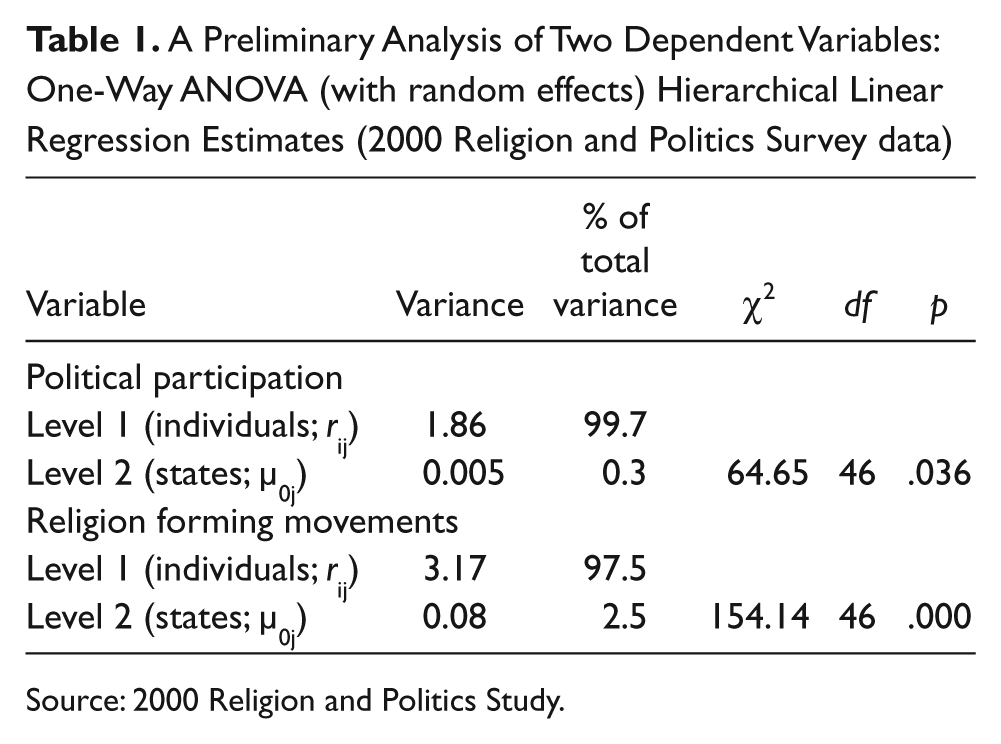
A useful strategy to begin the analysis is with the ANOVA model—using only the grand sample mean to estimate the dependent variable (Raudenbush and Bryk 2002). This serves to establish a baseline to use to compare the increase in explanatory power produced by the full model. It also apportions the variance between levels 1 (individual) and 2 (state) and supports a significance test at level 2 to justify the use of the two levels. The results of such a test for both of our RPS dependent variables can be found in Table 1. We find that the overwhelming amount of variance in political participation can be found at level 1, though there is significant variation at level 2 (p < .05) that does provide motivation to pursue the analysis. There is more variation at level 2 for our secondary dependent variable, support for more political activity by religious leaders, and, again, it is enough to sustain an investigation.
A Preliminary Analysis of Two Dependent Variables: One-Way ANOVA (with random effects) Hierarchical Linear Regression Estimates (2000 Religion and Politics Survey data)
Source: 2000 Religion and Politics Study.
Why is the variation so slim at level 2? For one, these two dependent variables are not limited to state-level politics, and in the American system many levels of government, especially the national government, draw individuals’ attention. It is frequently observed that diversity across American states is far less than diversity within them. Moreover, we would be loath to claim that the full variation in political participation rates across states is explained by the culture wars politics of the Christian Right when there are so many more interests at play (see also Layman and Green 2006).
Results—Participation in the 2000 RPS
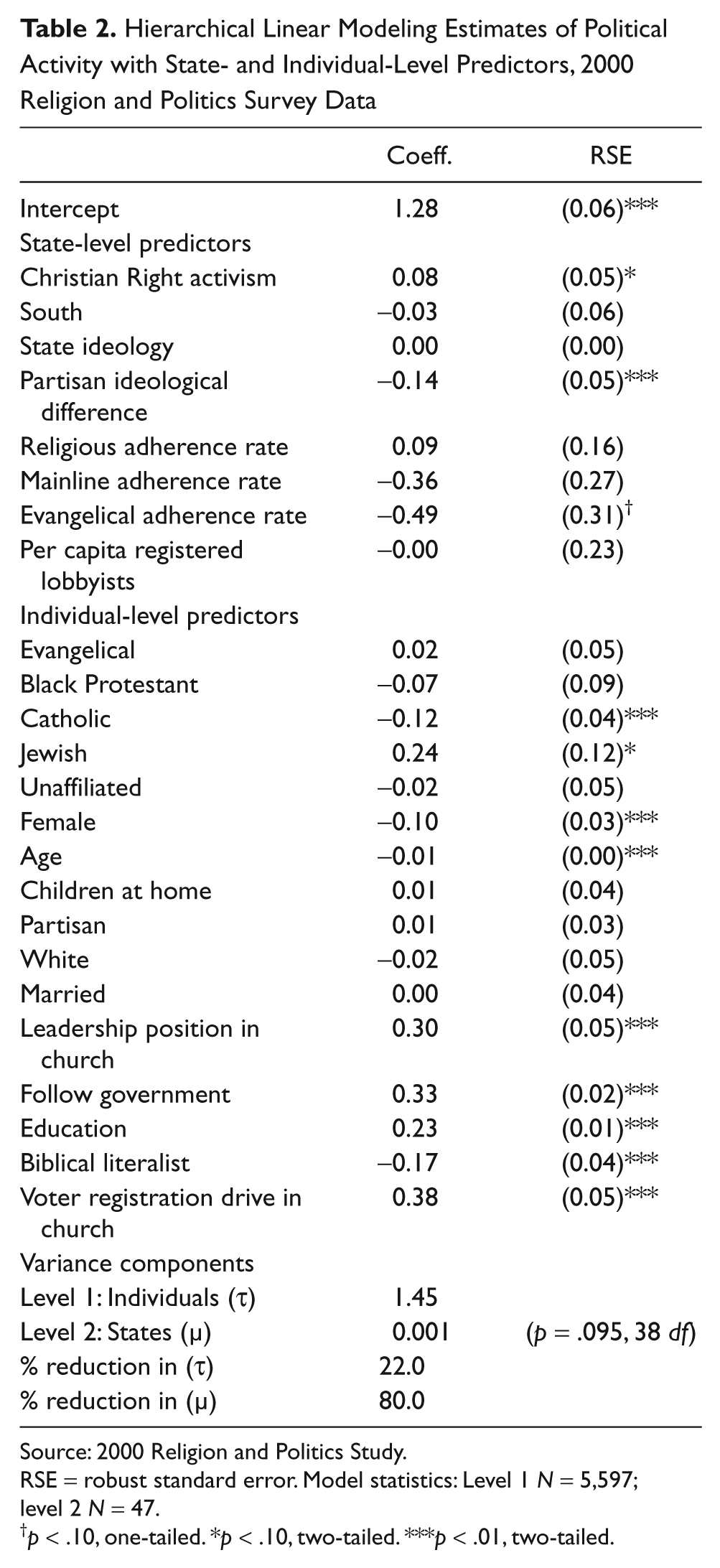
Our primary focus is on the model of political participation, the results of which are in Table 2. The results are apportioned between level 1 (individuals) and level 2 (states), with the state-level variables predicting deviations from the grand mean of the states (i.e., the national average). This assumes that each of the level 1 variables functions similarly across states and that only states themselves vary (this is referred to as a random intercepts model). Subsequently, we will test to see if the activity level of the Christian Right also affects the slope of evangelical participation specifically (a random slopes model).
Hierarchical Linear Modeling Estimates of Political Activity with State- and Individual-Level Predictors, 2000 Religion and Politics Survey Data
Source: 2000 Religion and Politics Study.
RSE = robust standard error. Model statistics: Level 1 N = 5,597; level 2 N = 47.
p < .10, one-tailed. *p < .10, two-tailed. ***p < .01, two-tailed.
The results in Table 2 follow most of the established models of political participation in the literature (see, e.g., Rosenstone and Hansen 1993; Verba, Schlozman, and Brady 1995). For instance, in the civic voluntarism model (Verba, Schlozman, and Brady 1995), political activity is a function of means, motivation, and recruitment. That is, participation is the result of politically relevant resources beyond socioeconomic status, including the by-product of organizational participation: civic skills. Here, holding a leadership position in church boosts political participation independent of the positive effect of additional years of schooling. The degree to which the respondent follows government is a measure of motivation that serves to drive up political activity. Biblical literalists have a different set of priorities that does not include political activity, ratified here in a negative and significant association with political participation. If the church holds a voter registration drive, the respondent is more likely to participate, showing the efficacy of including a measure of recruitment. Only two religious tradition measures find statistical purchase—Jewish Americans are more likely to participate compared to the excluded category of mainline Protestants and Catholics are less likely to participate.
Interestingly, partisan ideological polarization is found to have a negative effect on individual participation, in contrast to previous findings (Abramowitz and Saunders 2008; Hetherington 2008). Previous work assumes that polarization should increase participation, more specifically turnout, by augmenting the costs of apathy. The precise mechanism is opaque for the negative effect we observe but appears to differ from other recent findings of the demobilizing effects of polarization (Rogowski 2011). In Rogowski’s work, it is candidate “divergence” as measured by platform positions that demobilizes less resourceful voters; however, he does not control for polarization at the district level among partisans, leaving open the possibility that candidate divergence is a function of conditions in the electorate.
The effect of Christian Right activism, our key independent variable, is positive and significant (at the .10 level). Thus, greater activism of the movement is associated with greater participation of the state population. A shift of plus or minus one standard deviation (just over a point on the index) generates just under a tenth of a point increase in participation. While it is a small boost (in a 0 to 5 index), it is robust. Note that controls present at level 2 include several features of a state that would predict an active Christian Right movement. 6 Controls are present for living the South, religious adherence rates, the ideology of the state population (W. D. Berry et al. 1998), polarization, and the per capita number of registered lobbyists in the state. That is, the effect of Christian Right activism is not a proxy for the potential boost in participation of being conservative in a conservative, or more group intensive state, but the result of (1) the augmented mobilization from Christian Right organizations that diffuses through their natural constituency, (2) the vibrant debate about easy and divisive culture war issues that engages a wide portion of the population, and/or (3) the effects of countermobilization of groups antagonistic to the Christian Right. That is, this effect is either a narrow one resulting from organizational processes or a broader, pluralist one stemming from public debate and broad engagement.
Two additional tests should help us sort out the nature of the effect. First, we estimated a random slopes model, where state-level variables are used to predict different slopes for an individual-level variable. Essentially, we interacted the Christian Right activism index with being an evangelical. This particular formulation tests whether the natural constituency of the Christian Right, evangelical Protestants, is mobilized at higher rates to participate when the activism of the movement in the state is higher. This sensible hypothesis is found throughout the literature on the Christian Right and tests whether movement activity has a narrow mobilizing effect. We found no effect (result not shown). 7 The coefficient is positive but nowhere near significant (p = .60). On the basis of this test, we have some good evidence that the general participation effect of movement activism seen in Table 2 is not a function of a significant participation boost within a narrow constituency. While these results contradict the most commonsense hypothesis that Christian Right influence should increase evangelical grassroots activism (though see Claassen and Povtak 2010), they point to an even more interesting and important finding. Interest group activity in one part of the political environment, in this case by the Christian Right, can have an impact on grassroots mobilization throughout the state and not just within its original constituency.
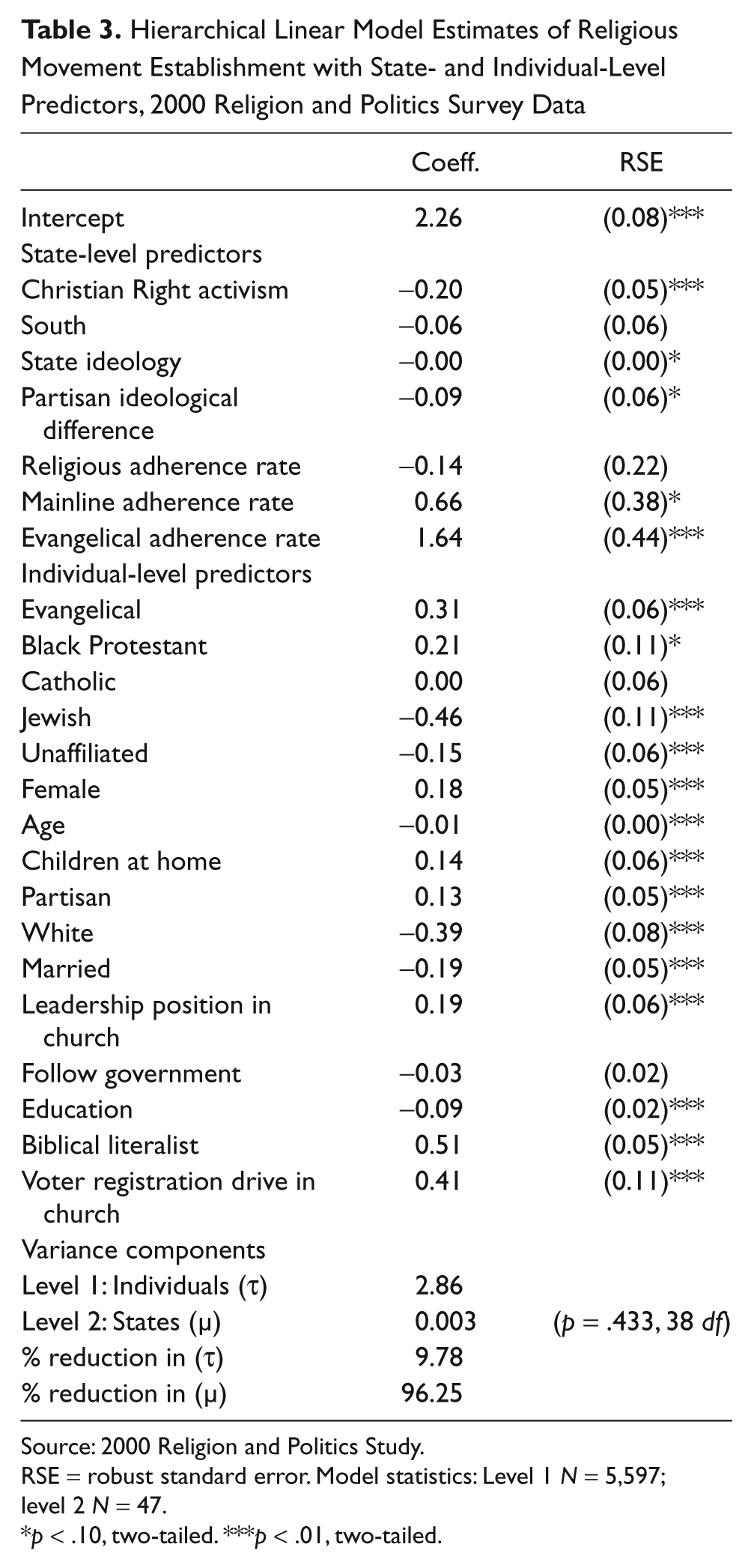
A second test will help us make the determination of whether the aggregate Christian Right activism effect is a narrow or broad-based one. It involves predicting responses to another question asked in the 2000 RPS: whether the respondent wishes to see less, the same, or more of religious leaders founding political movements in the future (more is coded high). If respondents in states with high Christian Right activism desire to see less religious leader activity in politics in the future (a negative effect), it would lend credibility to the countermobilizing effect that serves to boost participation for the general population. Though this relationship could support several interpretations, we suggest the desire for fewer religiously based political movements can be considered a preference for less policy threat. A sense of threat can be an effective mobilizing force to take action to reduce the threat (Campbell 2006; J. M. Hansen 1985; Herrmann, Tetlock, and Visser 1999; Huddy et al. 2005). In any event, if the two measures are independent of each other, it would undermine the case for a direct link between Christian Right activism and broad-based gains in participation.
For comparability, we estimate almost the same model as Table 2 and provide the results in Table 3. In this case, the effect of Christian Right activism is negative and significant, suggesting that a more vibrant movement in a state leads its residents to wish for fewer such movements in the future. Again, it is not a particularly potent result since a standard deviation shift only moves the dependent variable just over .15 on a 1–5 scale. But, the result holds in the presence of a significant and positive effect from the evangelical adherence rate, marginal positive effects of the mainline adherence rate and negative effect of state conservatism, and a host of positive and expected individual-level forces, such as evangelical and Black Protestant identifications, Biblical literalism, church involvement, partisan strength, having children at home, and being female. In addition, the more highly educated, whites, those married without children, Jewish people, and religiously unaffiliated people desire to see fewer religiously based political movements in the future. Moreover, we should probably expect small effects from the state-level independent variables since the dependent variable does not specify where the movement should or should not be formed: in the state, nation, or somewhere else. As with the participation model (in Table 2), we also assessed whether there was an interaction between being evangelical and Christian Right activism (result not shown); it is insignificant (p = .35) and negative, suggesting that, if it were significant, more Christian Right activism would depress evangelical support for religious leaders forming political movements at a greater rate than among nonevangelicals.
Hierarchical Linear Model Estimates of Religious Movement Establishment with State- and Individual-Level Predictors, 2000 Religion and Politics Survey Data
Source: 2000 Religion and Politics Study.
RSE = robust standard error. Model statistics: Level 1 N = 5,597; level 2 N = 47.
p < .10, two-tailed. ***p < .01, two-tailed.
In sum, since those exposed to a more activist Christian Right movement want to see fewer such political activism by religious leaders in the future, we believe that the boost to participation from Christian Right activism seen in Table 2 has more to do with the public, pluralist effects of a vibrant social movement than it does with narrow, organizational recruitment processes.
Confirming Results—Participation in the 2006 CCES
We attempted to confirm some of the essential findings above with the 2006 Cooperative Congressional Election Study (CCES), a suitable large-N data set (Ansolabehere 2006), which we combined with an updated survey of Christian Right observers from 2008. The 2006 CCES was conducted over the Internet by Polimetrix to a stratified national sample of 36,500 adults in three waves, one in August before the general election campaign season, one in October, and one immediately after the election. The common content portion of the survey hosts a variety of questions that bear on our research, including several electoral participation variables and controls that fairly closely mirror the 2000 RPS content. The participation questions are more limited than in the RPS, however, and thus we construct a dependent variable from the respondent either donating to a campaign or attempting to persuade another person about his or her vote (coded 1; it is coded 0 if he or she did neither activity).
Our key independent variable, state Christian Right activism, is compiled from a survey of political observers similar to the one conducted in 2000 discussed above. The data (provided by the investigator) are from 2008 and are based on a similar set of questions concerning Christian Right movement influence in state politics used to create an influence score for each state with a possible range of 0 to 4. Index scores for 2008 ranged from 0.69 (Maine) to 3.14 (Tennessee). The mean score is 1.80 and the median is 1.88. Though the data are two years removed from the 2006 individual-level data, there is considerable continuity in these scores over time as the 2000 index is very highly correlated with the 2008 index (r = .76, p = .00).
The 2006 model is slightly different from the 2000 RPS model since detailed civic skill variables are also absent from the 2006 CCES. Instead, we included variables capturing organizational membership and church attendance, which are strong correlates of skill practice (Djupe and Gilbert 2006; Verba, Schlozman, and Brady 1995). We also included the state mean proportion of residents belonging to an organization as an additional control for the robustness of civil society that may also affect a participatory citizenry. A measure of conservatism is taken by averaging the ideology of CCES survey respondents for each state, 8 and we again include the partisan ideological polarization measure. Furthermore, given the binary participation dependent variable, we use a nonlinear estimator and a logit link function for our hierarchical model. The initial ANOVA analysis used with the 2000 data (Table 1) is possible only with the linear model (Raudenbush and Bryk 2002), and thus we do not replicate this analysis with the 2006 data. The results of the estimation of this model are presented in Table 4.
Hierarchical Non-Linear Model (HNLM) Estimates of Citizen Political Activity with State- and Individual-Level Predictors, 2006 Cooperative Congressional Election Study Data

Source: 2006 Cooperative Congressional Election Study.
Level 1 N = 30,017; level 2 N = 50. RSE = robust standard error.
p < .10, two-tailed. ***p < .01, two-tailed.
The pattern of significant control variables looks generally like that in Table 2, with exceptions. Women, black Protestants, Catholics, and group members are less likely to participate in the ways captured by the CCES (either donating or attempting to persuade a voter), while older, white, married partisans with a standard set of resources like higher education and income are more likely to participate. At the state level, the mean level of group membership in the state drives up the likelihood of participation, as expected, while the partisan ideological polarization of the state drives it down, an effect consistent with the 2000 RPS result.
Importantly, we find confirmation of our hypothesis and finding from the 2000 RPS—more Christian Right activism in the state drives up the probability of participating in one of these electoral activities. A one standard deviation shift from the mean produces a change in probability of participating of 5.1 percent. 9 As we found with the RPS data, the pattern of effects here appears to support a broad-based influence of movement activism. The CCES did not include a comparable measure about the desire for more or less religious-based movements in politics (estimated in Table 3), but we were able to estimate whether the movement activism effect is concentrated among likely followers—white evangelical Protestants. As in the 2000 RPS, the interaction between the Christian Right activism measure and evangelical identification is insignificant and, in fact, points toward a dampening effect—evangelical are less likely to participate when their state has more Christian Right activism.
The CCES permits a further test since it asked whether respondents are members of the Christian Coalition—a much better measure of being in the Christian Right constituency. Being a coalition member itself boosts the likelihood of participation, but the interaction between membership and state-level Christian Right activism is insignificant (p = .89; results not shown). Coalition members are not more (or less) active in states where the movement is robust; the inclusion of the coalition measure does not affect other estimates. Thus, we have fairly strong evidence that the organizational activism effect is broad based and have no evidence supportive of a narrow mobilization effect in disguise.
Conclusion
The conventional wisdom in the political participation literature is that group activism affects just the participation of members and those citizens who support their issue positions—their constituency. But these investigations have ignored a system-level effect of interest group activity. We found that high levels of interest group activity, even confined to one sector, have an impact on the participation of the citizenry as a whole. Consistent with a long line of interest group research, mobilization seems to beget countermobilization, where the activities of one interest group increase the likelihood and broaden the opportunities for other groups’ activities. That means, of course, that Christian Right activism mobilizes a broad swath of citizens who both agree and disagree with the movement’s policy goals. These intriguing results, if substantively small, suggest that there may be even larger effects on citizen participation resulting from the population ecology of the entire interest group system and that citizen participation patterns can be broadly pluralist.
Residents of states with a vibrant Christian Right are more participatory but also desirous of a different kind of politics in the future. We see links to this pattern in two other literatures—interest emergence and negative campaigning. Though David Truman’s (1951) formulation that interests tend to emerge in waves has been found wanting (see Lowery et al. 2005; Olson 1965; Salisbury 1969), the criticisms are limited to the founding of groups, not their mobilization. The process of starting an organization is reliant on an entrepreneur who identifies an interest that may or may not involve citizens (Salisbury 1984) and may be underwritten by a wealthy patron (Walker 1991). None of this necessarily involves a reaction against other organizations as Truman implied. But what if the dynamics do not concern formation as much as they affect normal, ongoing group activity and therefore citizen activism? Citizens may not become agitated to protect their interests until there is a public threat (Gais, Peterson, and Walker 1984; J. M. Hansen 1985), and a wide variety of studies have found interest group activity is contingent on the actions of other groups (e.g., Gray and Lowery 1998; Heinz et al. 1993; Hojnacki 1998; Holyoke 2009). Therefore, individual participation is at least in part the result of a broader, public debate, where the mobilization and attendant countermobilization of competing organized interests is broadcast to the citizenry.
However, that formulation does not explain why people appear to have a negative reaction to such a clash of views (or at least wish fewer religion-based movements in the future in states with a vibrant Christian Right) while participating at increased levels. Perhaps a parallel can be drawn from negative campaigning, which no one seems to like but can have beneficial effects on citizen engagement. One hypothesis was that negative advertising turned off participants and turned them away from the political process (Ansolabehere and Iyengar 1995). However, that notion was disputed by further work (Lau et al. 1999). One study may suggest why. Geer (2006) argued that negative advertising can offer more information about the candidates on current policy controversies and past actions to establish the credibility of the attack. At the same time, there is some evidence that more negative campaigning (beyond advertising) has a sanguine effect on turnout in the next election (Djupe and Peterson 2002). Thus, it is possible that the divisive, sometimes incendiary politics of the Christian Right may not sit well with most citizens even while it may capacitate citizenship to a degree.
For too long in studies of political participation we have thought of interest groups as having only quite narrow, pernicious effects on the democratic process by mobilizing the self-interest of a small slice of the citizenry as a substitute for mass electoral politics. While we do not dispute that the heavenly choir may in fact sing with an upper-class accent (Schattschneider 1960), the standard methodological approach of the literature has simply not allowed a test that the interest group universe may have more inclusive, pluralist effects on citizen involvement in politics. 10 This one result here does not conclusively undermine concerns about interest group factionalism, but for now it does at least suggest a caveat and that we should more often link system-level observations of interest groups with individual-level outcomes.
Footnotes
Appendix
Acknowledgements
We wish to thank Robert Wuthnow for sharing his 2000 Religion and Politics Survey data and Virginia Gray for sharing data she gathered with David Lowery. Neither bear responsibility for our use of them. Thanks to Mike Brady, Jake Neiheisel, Todd Shaw, and the anonymous reviewers for their helpful comments on earlier versions of this work. A previous version of this article was prepared for delivery at the sixty-seventh annual meeting of the Midwest Political Science Association, Chicago, April 2–5, 2009. We dedicate this work in memory of Robert H. Salisbury.
Declaration of Conflicting Interests
The author(s) declared no potential conflicts of interest with respect to the research, authorship, and/or publication of this article.
Funding
The author(s) received no financial support for the research, authorship, and/or publication of this article.