







Abstract
Riker famously theorized that political actors faced with suboptimal outcomes might be able to garner a more desirable one by adding issues to the agenda. To date, limited support for Riker’s theory of heresthetics exists, primarily consisting of case studies and anecdotal evidence. We offer a systematic analysis of heresthetical maneuvers in the context of Supreme Court decision making. We argue justices who oppose a potential case outcome may add alternative issues to the record in an effort to restructure the terms of debate. Data from justices’ behavior during oral argument support Riker’s theory.
You can’t always get what you want, but if you try sometimes well you just might find…
…[I]t is possible for the prospective loser to rearrange politics to his advantage.
Riker’s (1986) theory of heresthetics suggests that, if they cannot be sure an outcome will end up where they prefer, political actors may alter the decision-making process to keep policy close to where they want it. According to his theory, one way prospective losers can accomplish this goal is by manipulating the alternatives available from which to choose. In this article, we seek to analyze whether political actors, as “herestheticians,” systematically add issues to the agenda to ensure that policy outputs stay as close as possible to their preferences (e.g., Riker 1984, 1986).
To test this use of heresthetical maneuvers, we turn to an institution ripe for their invocation: the U.S. Supreme Court. In particular, we examine the practice of justices highlighting or raising threshold issues during oral arguments that may keep the Court from reaching the substantive issues of a case. We theorize that justices, as strategic actors, deploy this tactic when the merits policy decision will be incongruent with their own preferences. Results from our empirical analysis provide partial support for our argument. We find that justices raise threshold issues more often during oral arguments when the Court’s merits outcome would push policy further from their ideal point than the current legal status quo.
Our study makes multiple important contributions. First, we provide a much-needed systematic empirical analysis of Riker’s seminal theory, which, to date, has received few such treatments. While Riker (1986) tasked future scholars to search for regularities in heresthetical behavior, as Epstein and Shvetsova (2002, 1001) put it, “His models [have] served rather as rationalized stories fitted to particular cases.” Second, our analysis also sheds substantive light on the role of threshold issues. While constitutional law scholars frequently emphasize these issues as important limits to judicial power, empirical treatments of the topic are scarce. As such, consistent with a growing body of literature on the joint effect of law and policy on judicial decision making (e.g., Hansford and Spriggs 2006), we find that justices can actually use these legal issues to pursue policy goals.
The Use of Heresthetical Maneuvers
What does it mean to behave in a heresthetical manner? As Riker (1983, 55) put it,
Heresthetics, in my coinage of the word, has to do with the manipulation of the structure of tastes and alternatives within which decisions are made, both the objective structure and the structure as it appears to participants. It is the study of the strategy of decision.
More generally, Riker argues that political actors can try to convince others to reach a particular outcome through persuasion or by restructuring the terms of debate during political processes.
In terms of the latter, in his earliest work on heresthetics, Riker (1983, 64) argues, “Those who expect their preferred alternative to lose initially may introduce new alternatives, even as mere participants and not leaders.” The intuition behind this strategy is that the new alternative offered is potentially better for the player who offered it than is the most popular alternative currently on the agenda. Thus, as Riker notes, if at least some of those who support the most popular choice are willing to switch to the new alternative, then there is a better chance of defeating the outcome the proposing player least prefers.
In his own work, Riker draws from the annals of history to provide several examples of heresthetical issue addition. He found the addition of “dimensions of judgment” in Thucydides (Riker 1983) as well as in the Lincoln–Douglas debates (Riker 1986). In the latter example, Lincoln’s tactic, when he posed his famous question to Douglas about slavery in new territories, added a new dimension to their debate. Douglas’s answer, in turn (to the delight of Lincoln), drove away some of his own supporters.
While a handful of studies systematically test other components of Riker’s theory, such as manipulating voting order (Johnson, Spriggs, and Wahlbeck 2005) and casting strategic votes (Calvert and Fenno 1994), we know of few rigorous inquiries into whether political actors heresthetically add issues to the agenda. 1 We turn next to examining how political actors—specifically U.S. Supreme Court justices—might engage in heresthetical issue addition.
Heresthetical Maneuvering on the Supreme Court
Threshold Issues
Before the Supreme Court can set lasting legal policy in a case, it must first determine whether a case is properly before it. To do so, the justices examine the extent to which a given case satisfies so-called “threshold issues.” These issues, jurisdiction and justiciability (i.e., whether there is a case or controversy), come from rules set out in Article III, Section 2 of the U.S. Constitution, which delineates what cases the Court may hear. While traditional wisdom suggests that procedural concerns are legal tools used to limit the reach of the judicial branch (e.g., Nichol 1987; Scalia 1983; Siegel 2007), we suggest justices can selectively, and strategically, add these issues to the legal record of a case so they may have the opportunity to derail the Court from reaching what they believe might be a poor policy outcome. 2
Two aspects of threshold issues justify this position and make them especially useful tools for such heresthetical maneuvering. First, as noted, the Court’s institutional norm is for justices to resolve any and all threshold issues before they decide the substantive merits of a case. If, for example, the Court does not have proper jurisdiction, then the justices are not supposed to reach the merits and no legal policy is set. Second, and more importantly, the power to determine whether a threshold issue has been met lies solely with the justices themselves. In other words, while the Constitution specifies the class of cases the Court may hear, the justices determine whether a particular case falls into that class. Moreover, as a technical matter, this determination can be—and often is—used even after the Court has granted review in a case (Goelzhauser 2011; Stern et al. 2002). Here, we offer a brief account of these malleable threshold issues.
We turn first to the Court’s jurisdiction to hear cases. Article III makes it clear the Court needs jurisdiction over the parties and issues of a case to hear it. It may have either original jurisdiction or appellate jurisdiction. In the former, the justices have jurisdiction over “all cases affecting ambassadors, other public ministers and consuls, and those in which a state shall be party” (Article III, Section 2, U.S. Constitution). If a case does not fall under one of these categories, then it cannot be brought to the Court on this path (Marbury v. Madison 1803). In all other cases, the justices have appellate jurisdiction, “both as to law and fact, with such exceptions, and under such regulations as the Congress shall make” (Article III, Section 2, U.S. Constitution). Thus, if Congress decides it does not want the Court to hear a certain category of cases, the justices are ostensibly barred from doing so (see, for example, Ex parte McCardle 1869; Hamdan v. Rumsfeld 2006).
Because of its obligation to adhere to these jurisdictional requirements, the Court’s own rules specify all parties must include jurisdictional statements in their briefs (both for certiorari and on the merits). There still may be times, however, when its jurisdiction is in question; in these instances, raising such issues may be heresthetically savvy for the justices. Indeed, if a justice does not want the Court to reach the merits of a case, he may suggest to his colleagues that the Court lacks jurisdiction to do so—even though the petitioning party already passed the agenda-setting stage (see, for example, Bush v. Gore (2000), where the justices focused a large portion of the oral arguments on jurisdictional concerns).
Beyond jurisdiction, Article III gives the Court judicial power to decide only cases and controversies under the law. In the Court’s vernacular, a case must be justiciable. While not explicitly delineated in Article III, cases and controversies have come to mean the Court may only hear cases that meet certain standards. For instance, a case must actually exist. Thus, the controversy between two parties must be ripe (International Longshoremen’s Union v. Boyd 1954; Kremen’s v. Bartley 1977). At the same time, the controversy cannot be moot—meaning it must still exist once it reaches the Court (DeFunis v. Odegaard 1974; Craig v. Boren 1976). Beyond these requirements, the parties before the Court must have proper standing (Elk Grove Unified School District v. Newdow 2004; Flast v. Cohen 1968), and the Court will not decide political questions (Baker v. Carr 1962).
The key to jurisdictional and justiciability requirements—and why they are likely candidates for invocation as heresthetical maneuvers—is that they are standards ultimately applied by the justices themselves. This means there are times when it may seem the Court does not have jurisdiction to hear a case but it still chooses to do so. For instance, scholars argue the Court overstepped its jurisdiction when it decided Bush v. Gore (2000; see, for example, Beytagh 2001). Others suggest the Court overstepped its powers when it decided Roe v. Wade (1973) because the case was clearly moot—Roe was certainly not still pregnant in 1973 when the case was finally decided (it was first argued at the Court in 1971). While the Court decided both these cases, the addition of the threshold issues to the record meant they were viable candidates to be derailed without reaching the merits. As Epstein and Knight (1998) argue in their analysis of Craig v. Boren (1976), justices’ use of threshold issues can be strategic (although they do not use the language of heresthetics).
Overall, our contention is that because the justices determine whether these Article III standards have been met, and because if the justices decide a case does not meet them, the Court will not reach the merits, they provide a potential heresthetical opportunity for anyone unhappy with the potential policy outcome. In particular, a justice can use these issues heresthetically in an attempt to dispose of cases without reaching the merits. To accomplish this goal, we posit justices are most likely to add them to the case record during oral arguments. We turn next to further developing this argument.
Threshold Issues and Oral Arguments
Oral arguments are the only recurring and formalized opportunity justices have to directly interact with litigants’ attorneys. These sessions take place after the parties have submitted their written briefs but before the justices meet to cast their initial merits votes. As such, oral arguments provide a unique opportunity for justices to add threshold concerns to the record of a case. Three extant findings support this claim.
First, research provides systematic evidence that oral arguments generally play an informational role in the Supreme Court’s decision-making process (Johnson 2001, 2004; Wasby, D’Amato, and Metrailer 1976). Other scholars substantiate these findings through detailed analyses of specific cases or issue areas (see, for example, Benoit 1989; Cohen 1978; Wasby, D’Amato, and Metrailer 1976). More specifically, Johnson (2001, 2004) shows that the types of information justices garner during oral arguments help them set policy as close as possible to their preferred outcomes.
Second, beyond the general informational role of oral arguments, it is also an excellent venue for justices to raise jurisdictional and justiciability concerns because the parties do not often raise them in the briefs. Indeed, Johnson (2001, 2004) finds that only about 4 percent of all briefed issues focus on threshold issues. In short, the parties or amici involved in a case are usually reticent to raise these issues. 3 Thus, if a case is going to be “killed” on threshold issue grounds, justices often must bring these issues to the fore of a case—and we posit they do so during oral arguments.
Third, scholars have known for some time that justices use oral arguments as a strategic tool (Wasby, D’Amato, and Metrailer 1976), and recent analyses provides systematic support for this contention (Johnson 2001, 2004). Specifically, during these proceedings, justices signal one another about issues important to them, take note of their colleagues’ questions and comments, and use the information they garner when building coalitions (Johnson 2004; Johnson, Spriggs, and Wahlbeck 2007). Our point is that if justices are prone to listening to one another and to acting on what they hear in the coalition formation process, then oral arguments provide an excellent venue for justices to engage in heresthetical issue creation in an attempt to convince their colleagues that a case should be decided on a threshold question rather than on the merits.
Theory and Hypotheses
The foregoing discussion demonstrates that Supreme Court justices can use oral arguments to raise or highlight concerns about threshold issues in cases before them. In other words, by adding an issue to the record, they leave open the option of disposing of a case without appreciably altering legal policy. Why, then, would a policy-minded justice raise concerns about jurisdiction or justiciability once the Court has already accepted a case for review? We believe the answer lies at the heart of Riker’s theory of heresthetics, which posits a principal concern of any decision maker is the possible outcome of the voting process.
Consider the simple spatial model presented in Figure 1. In it, we present a relatively liberal status quo point (denoted by SQ), which consists of the lower court opinion being challenged in the Supreme Court. Should the Court vote to affirm the lower court opinion, the policy outcome will be located at the status quo. Importantly, if the Court were to dispose of the case on threshold issues, then this generally has the effect of simply affirming the lower court opinion but not setting national legal precedent—rather the precedent would only control in the circuit from which the issue arose. 4
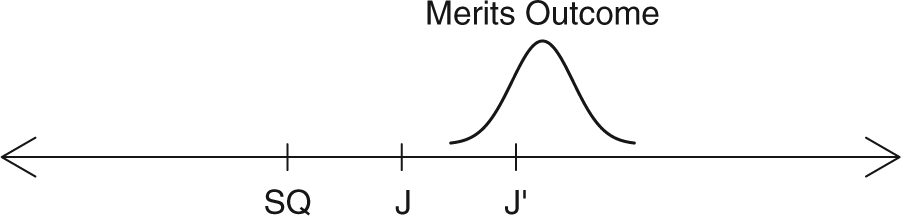
Spatial model illustrating the effect of uncertainty about the merits outcome on whether a justice prefers affirmance to reversal.
To the right of the status quo, we plot J, which represents the ideal point of a justice involved in the case, and J′, which is that justice’s indifference point vis-à-vis the status quo. These three points capture the range of merits outcomes that a justice prefers to the status quo. In other words, if the merits decision falls anywhere between SQ and J′, then that outcome would be preferable to affirming the lower court decision. Conversely, if the merits decision ends to the right of the justice’s indifference point, then the justice would prefer to keep the status quo over the potential merits outcome.
Note, finally, the presence of a bell-shaped curve to the right of J, which we label as “Merits Outcome.” This curve represents the distribution of where the Court could set policy should it reach the merits in a case. Here, we part ways with previous approaches, which assume that the alternative to the status quo—that is, the merits outcome—is known with complete certainty (but see Black and Owens 2012a). By relaxing this assumption, and by treating future policy as a range, we can highlight the lack of specific information justices have when sitting for oral arguments. Consider, for example, that when the Court sits for these proceedings, it has yet to take a preliminary vote on the merits outcome. Even if justices have some basic idea about the simple disposition of a case (i.e., whether the Court is likely reverse or affirm), their knowledge about the precise policy location of the Court’s opinion is likely to be rough or incomplete. At the same time, however, the justices have enough information to make a probabilistic estimate about how the Court will decide. For example, through either their own independent research or the reading of the litigants’ briefs, they are likely to know how the Court has decided previous cases presenting similar legal issues.
With this information in hand, a justice can determine the likelihood that the merits outcome will fall within the interval [SQ, J′], which is when she would prefer the merits outcome to the status quo. If the set of plausible merits outcomes is entirely within this range, our justice is certain to prevail on the merits decision. Conversely, if the set of plausible merits outcomes lies completely outside the justice’s indifference point, J′, the justice strictly prefers to uphold the status quo and can reasonably expect to lose the case on the merits. Finally, some justices fall in between these two extremes, where only a subset of the likely merits outcomes is preferable to the status quo. Such is the case we illustrate in Figure 1, where there is roughly a 20 percent chance of J preferring the merits outcome to the status quo.
Incorporating our model with Riker’s basic insights, we expect that justices who are likely to lose on the merits will be the ones most likely to act heresthetically by raising concerns about threshold issues during oral arguments. Doing so would be advantageous as it creates an alternative disposition to the case that has the potential to split the expected opposition (and winning) coalition. In other words, should the Court’s opinion end up being out of line with the preferences of a justice who was initially likely to lose on policy grounds, she now has the option of attempting to muster a coalition of justices to decide on a threshold issue rather than on the merits. That is, while this justice might prefer affirming the status quo and creating lasting precedent (set at the status quo), when faced with the choice of (1) issuing a decision that retains the status quo as precedent only in a particular circuit or (2) replacing the status quo with national precedent farther from her ideal point, the former is less onerous than the latter.
Data and Measurement
To test our hypothesis, we constructed a data set consisting of justices’ oral argument behavior in the 545 cases decided between 1998 and 2006 that came to the Supreme Court through a federal court of appeals. These restrictions in both time and scope are necessary due to the limitations in available data. First, prior to its 2004 term, Supreme Court transcripts did not provide identification of which justice was asking a question; all remarks from the justices were simply denoted with the phrase “Question.” We bridge the gap between 1998 and 2004 by using voice-identified transcripts provided by the Oyez Project (http://www.oyez.org). Second, we limit our analysis to cases from the circuit courts, as we ultimately need to place the lower court’s decision in the same policy space as those rendered by the Supreme Court. Because no measure currently exists for state courts, we necessarily must omit these decisions.
Our unit of analysis is each justice’s behavior in each of our 545 cases for a total of 4,319 observations. 5 Our dependent variable is Threshold Words, which is a count of the number of threshold words spoken by each justice during oral argument. To measure it, we downloaded each case’s voice-identified transcript from the Oyez Project. We then analyzed the words spoken by the justices in these cases—a universe of more than 2.2 million total words—and counted the number of times each justice used a threshold word in each case. In particular, we searched for justiciabl*, jurisdiction*, moot*, standing, collusion, ripe*, federal question, improvident*, and advisory opinion, where “*” denotes a wildcard for zero or more characters. Thus, a search for “moot*” would return either “moot” or “mootness.” Finally, we manually reviewed and corrected the results of these computer searches to eliminate any false positives. 6 The variable has a mean of 0.22 words and takes on a nonzero value in roughly 10 percent of the 4,319 observations.
Policy Considerations
Our hypothesis of interest argues that justices least likely to prevail on the merits from Figure 1 are more likely to raise threshold issues than those who probabilistically expect the merits decision to more closely align with their policy preferences. To operationalize this hypothesis, we need to locate, on the same spectrum, each justice’s policy preferences, a distribution of expected outcomes if the Court were to reach the merits in a case, and the legal status quo—that is, the policy being reviewed by the Court. To do so, we turn to the Judicial Common Space (JCS), which allows us to make comparisons between the Supreme Court and the lower federal courts, as well as among justices (Epstein et al. 2007).
We generate the distribution of likely merits outcomes by examining the policy preferences of the majority coalition justices in previous Supreme Court decisions that were in the same issue area as the current case. For example, consider a First Amendment case before the Court. To generate our estimate of the likely merits outcome for this particular decision, we look to other First Amendment cases that were decided prior to the oral argument date in the instant case. For each of these previous cases, we followed a host of studies (e.g., Carrubba et al. 2012; Clark and Lauderdale 2010; Hansford and Spriggs 2006; Spriggs and Hansford 2002) and used JCS scores to identify the median justice within that decision’s majority coalition. To translate these individual values into an underlying policy distribution, we use kernel density estimation (Rosenblatt 1956). 7
The final component is the position of the legal status quo. To measure this, we follow Black and Owens (2009) and start with a circuit court judge’s JCS score. While a justice’s JCS score is based on her observed behavior, a circuit judge’s score is coded based on the senatorial courtesy argument initially proposed by Giles, Hettinger, and Peppers (2001. 8 These judge-level scores in hand, we turned to the panels on which these circuit court cases were decided. For each case, we coded the location of the legal status quo as the median of the majority coalition. In the typical unanimous three-judge panel decision, then, the status quo is the JCS score of the median judge of the panel. When there was a dissent or special concurrence (i.e., only two judges in the opinion coalition), we coded the status quo as the midpoint between the two judges in the majority. If the lower court decision was en banc, then we coded the status quo as the median judge in the en banc majority. 9
Using these quantities, we then determined the probability that a justice would prefer the merits outcome to the current legal status quo. We obtain this by calculating the area under the likely merits distribution that falls within a justice’s preferred-to region. Our variable, Likelihood Merits Preferred, takes on values between 0 and 1, where 0 indicates that a justice always prefers the status quo and 1 indicates that a justice always prefers the likely merits outcome. We follow existing studies (e.g., Black and Owens 2012a; Johnson, Spriggs, and Wahlbeck 2005) and also include the squared value of this variable. Substantively, this approach allows us flexibility in assessing whether the effect of policy predictions might be substantial when a justice is certain or nearly certain she will dislike the merits (i.e., low values of our variable) but attenuated for justices who have more reason to believe the merits outcome might be favorable. 10
Legal Considerations
While our argument centers on how policy considerations lead justices to invoke threshold issues as a heresthetical tool, other potential explanations exist. It could be, for example, that a justice raises threshold issues during oral argument not for strategic reasons but rather because there are objective reasons to doubt that the case is properly before the Court. This, of course, mirrors the prevailing wisdom in the legal literature about how the Court engages such issues (e.g., Bickel 1986; Monaghan 1973; Nichol 1987). As with nearly all tests of the so-called “legal model,” however, the difficulty lies in finding a way to objectively and reliably code what the “right” legal answer is in a given case. Ideally, we would measure a variable that identifies cases where these concerns are present. In the absence of such a measure, we turn instead to some surrogates that we believe are likely correlated with it.
First, we take a step back in the case’s procedural history and examine the opinion in the lower court. 11 Using the same approach as identified above, we searched the full text of all lower court opinions—including dissents—for threshold language. Lower Court Threshold Language is coded as the total number of instances where the lower court opinion discussed threshold issues.
Next, we look to the content of the briefs filed by the litigants in each case. Using the same procedure deployed in constructing our dependent variable, we used LexisNexis to identify briefs that had threshold language contained in their “Summary of Argument” section. Supreme Court rules require that all merits briefs include this section and instruct litigants to provide “a clear and concise condensation of the argument made in the body of the brief” (Supreme Court Rules 24-h-1). Our variable, Number of Threshold Briefs, is a count of the total number of merits briefs filed by either the litigants or amici curiae that contain some threshold language.
Finally, and in a related vein, we also pay special attention to briefs filed by the Solicitor General (SG), whose previous research has been identified as being especially influential in the Court’s decision-making process (e.g., Bailey, Kamoie, and Maltzman 2005; Black and Owens 2012b; Pacelle 2003). To capture the SG’s special role, we include a dummy variable, SG Threshold Brief, which we code as 1 if the SG filed a brief with threshold issues and 0 otherwise.
To summarize, we use three data sources to identify cases where the occurrence of threshold language during oral arguments is likely driven by legal, as opposed to policy, considerations. This argument requires that we assume that the usage of threshold language in these sources is not motivated by strategic considerations on the part of the litigants/SG (for briefs) or judges who participated in the decision below (for lower court opinions). If this assumption is systematically incorrect, then our measures would be capturing something other than legal considerations. We have ample reason to believe our assumption is plausible for all three data sources.
Consider, first, the lower court language variable. Although lower court judges are not immune from hierarchical influences (Kastellec 2011), there is scant evidence that they can successfully anticipate what cases are likely to be subsequently reviewed by the Court (Bowie and Songer 2009; Klein 2002)—likely a necessary condition for the strategic usage of threshold issues in their written opinions. Consider, next, the Number of Threshold Briefs variable. By examining only the comparatively short “Summary of Argument” section, we focus only on what a litigant believes are her most important arguments. While a litigant might make a large number of arguments to try and sway the Court—with the hope that something will stick—she is unlikely to rest her main arguments on such issues (especially because the Court has already granted review). Finally, in the case of the SG’s brief, the fact that his success depends on the extent to which the Court perceives him as an agent of the Court (Wohlfarth 2009), the risk of strategic threshold argumentation is all the more unlikely.
Control Variables
We also control for several potentially confounding variables. First, we control for the complexity of a given case. All else equal, justices should be less likely to raise threshold issues in complex cases as the number of available issues to consider—and potentially decide the case on—is already high. We follow the recent insights of Collins (2008) and measure the Number of Amicus Briefs submitted in a case. 12
In addition, following Baum’s (1995) logic and Johnson, Spriggs, and Wahlbeck’s (2007) evidence, we know oral arguments may have less influence on case outcomes in salient cases. Moreover, when a case is highly salient, justices might feel obligated for reasons of institutional legitimacy to reach and resolve the merits (Epstein and Knight 1998). Accordingly, we suggest in more salient cases that justices will be less likely to raise threshold issues. To operationalize this concept, we follow the general approach of Epstein and Segal (2000) by examining media coverage of the case. We code Case Salience as 1 if, prior to oral arguments, a story discussing the case appeared in the New York Times. 13
Finally, as a practical matter, verbose justices are simply more likely to utter threshold words than their more stoic counterparts. Accordingly, we include Justice’s Oral Argument Activity, which is the average number of words spoken by a justice during oral arguments for the term in which the case was being heard. 14
Method and Results
Our dependent variable, Threshold Words, is a count, so we estimate a negative binomial regression model. Parameter estimates for the model are reported in Table 1. The results provide partial support for Riker’s theory of heresthetics. As we expected, a justice who is probabilistically less likely to prevail on the merits is subsequently more likely to introduce threshold language during oral argument proceedings than a justice who is uncertain about his or her chances of success on the merits. However, as indicated by the positive sign on the squared term, we also find that the relationship reverses at some point across the values of our variable—that is, justices who are probabilistically more likely to prefer the merits outcome in a case similarly use a higher rate of threshold language than do other, less certain justices.
Negative Binomial Regression Model of Threshold Language Usage by Justices during Oral Argument.
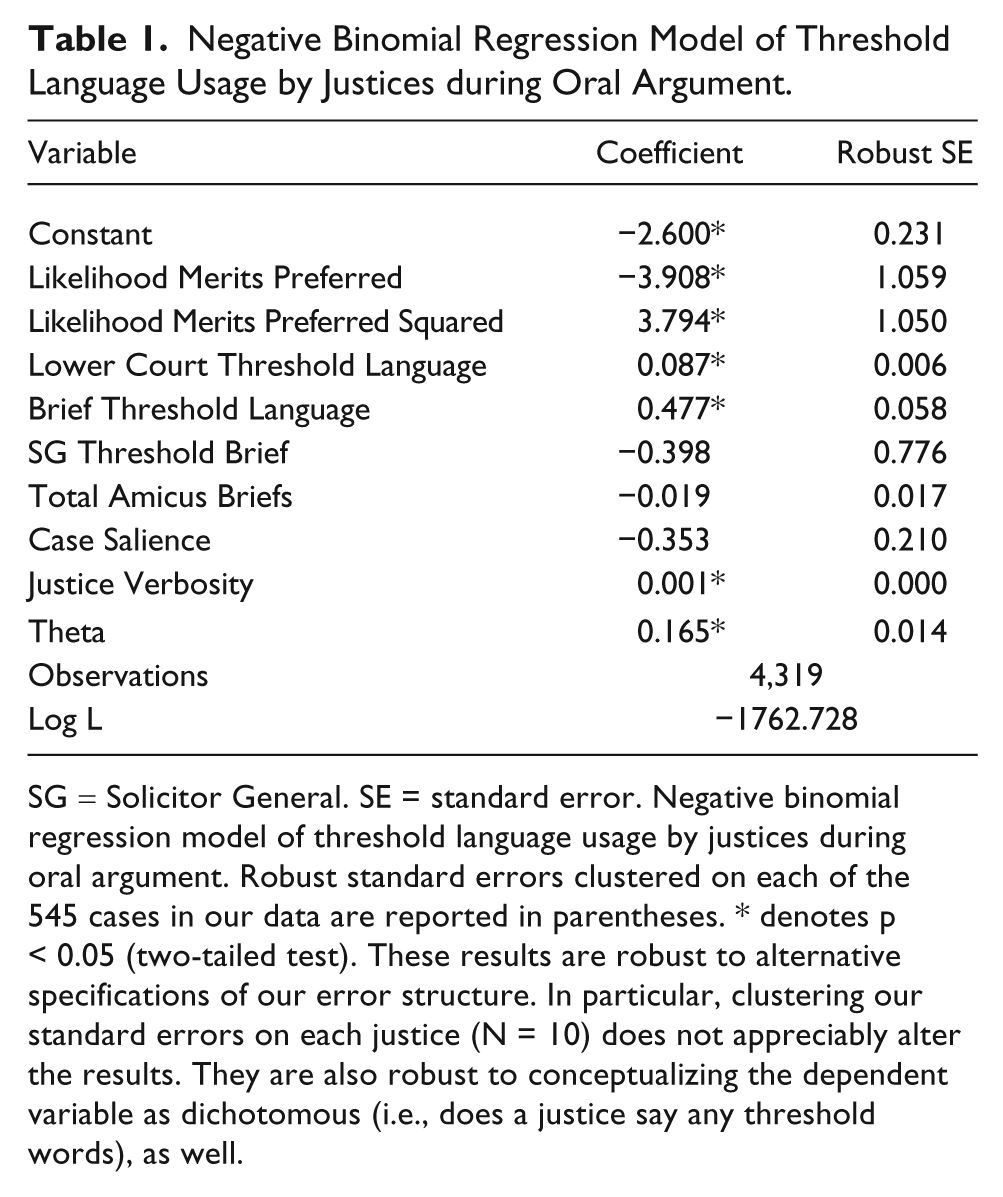
SG = Solicitor General. SE = standard error. Negative binomial regression model of threshold language usage by justices during oral argument. Robust standard errors clustered on each of the 545 cases in our data are reported in parentheses. * denotes p < 0.05 (two-tailed test). These results are robust to alternative specifications of our error structure. In particular, clustering our standard errors on each justice (N = 10) does not appreciably alter the results. They are also robust to conceptualizing the dependent variable as dichotomous (i.e., does a justice say any threshold words), as well.
While the regression table identifies this unexpected result, given the nonlinear nature of both the underlying model and the variable of interest, we turn next to Figure 2, which shows predicted values from our model. Along the x-axis, we show the probability that a hypothetical justice would prefer the Court’s likely merits outcome to the status quo. On the y-axis, we present that justice’s predicted usage of threshold language—that is, the expected number of words—during oral argument.
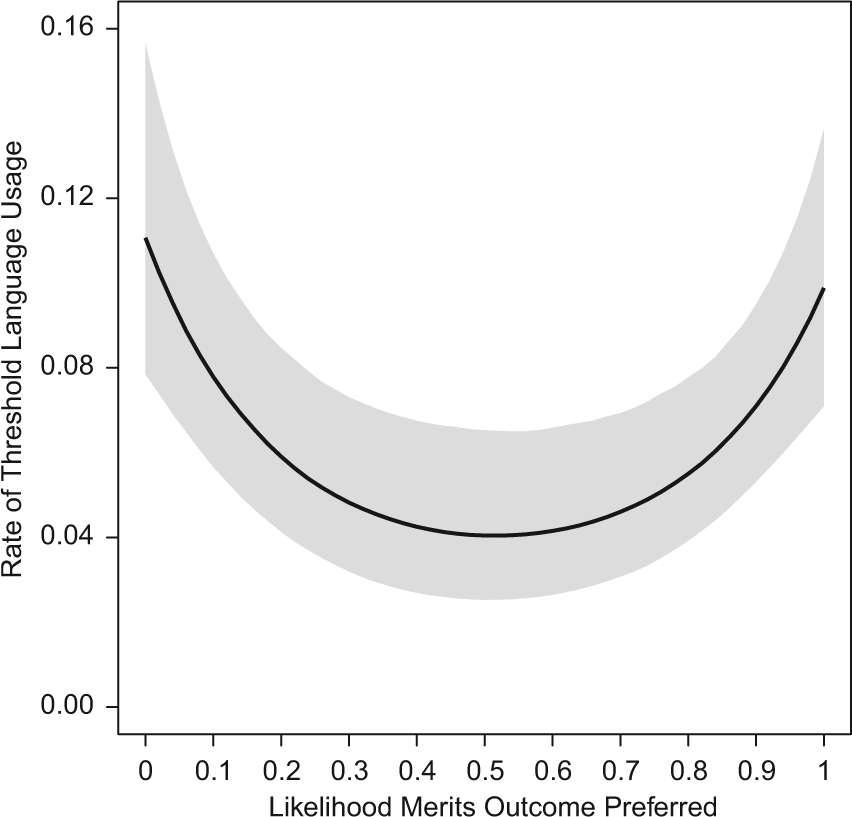
Effect of preference for the likely merits outcome over the status quo on a justice’s usage of threshold language during oral arguments.
Starting on the far left of the figure, we examine a justice who has a very low likelihood of preferring the Court’s merits outcome to the status quo, which is to say she would prefer to affirm the lower court decision. For such a justice, we estimate that she uses 0.11 threshold words per case (i.e., about one word in every ten cases). As we move to the right of the figure and increase her likelihood of preferring the merits outcome, we observe a gradual decline in her estimated threshold language usage. In particular, when the Likelihood Merits Preferred takes on a value 0.52, the justice’s estimated threshold language usage is 0.04 words per case. While the raw substantive values are not overwhelming due to the overall rarity with which threshold language occurs, the relative decrease between the two values is approximately 64 percent.
While this half of the figure is entirely consistent with our expectation, when we continue moving to the right on the x-axis, we are confronted with the surprising portion of our results. As the figure makes clear, we now observe a positive relationship between the likelihood a justice prefers the merits to the status quo and the rate with which he or she uses threshold language during oral argument. In fact, the magnitude of the effect is nearly identical, where a justice who is certain to prefer the merits uses an estimated 0.10 threshold words per case. To be sure, this second finding is unexpected and, at first blush, rather puzzling. In the “Discussion” section below, we return to this finding and offer a few (admittedly speculative) thoughts about what might be driving it.
Turning to the variables intended to measure legal considerations, we find a positive and statistically significant effect for both Brief Threshold Language and Lower Court Threshold Language. As the frequency of litigant and lower court usage of such language increases, so too does the extent to which the topics are part of the Court’s discussion during oral argument. In a case with a median level value of the independent variable, we predict that an individual justice will only utter 0.05 threshold words. Shifting to the approximately 95th percentile value (about twenty words) results in more than a fivefold increase in the threshold language rate (approximately 0.26 words per justice).
The substantive results from the litigant’s briefs are also strong. Moving from the median case with no briefs that contain threshold language to a case with a single brief yields a 59 percent relative increase in the expected number of threshold words used by a justice. Moving between the median and the 99th percentile value of five briefs generates a tenfold increase in the expected usage rate. While litigant briefs appear to exert a strong influence in terms of shaping the Court’s conversation at oral argument, we fail to find any evidence that briefs filed by the SG are of higher influence than non-SG briefs. This finding should be read with some caution, however, due to the relative lack of observations where the SG’s brief makes such arguments (only 8 out of our 545 cases).
Finally, among our control variables, we fail to find a systematic relationship between either the complexity of a case or its media salience and a justice’s tendency to invoke threshold language during oral argument. We do find, unsurprisingly, a positive relationship between a justice’s verbosity and her threshold language usage. Holding constant all other factors, a shift between a justice in the 10th and 90th percentiles of verbosity (241 and 811 words per argument session, respectively) roughly doubles her expected language usage.
Discussion
When it comes to setting policy, political actors cannot always get what they want. In this article, we have asked whether Supreme Court justices, when faced with a potential defeat, use heresthetical tactics to try and avoid suboptimal policy outcomes. In particular, we consider whether justices strategically use oral argument to raise concerns about threshold issues in a case, where doing so could prevent the Court from reaching the merits, thereby avoiding what might otherwise be a damaging policy outcome.
To test this hypothesis, we analyzed the individual oral argument behavior of justices across more than 500 cases from nine recent terms of the Court. Our results demonstrate that justices’ behavior is, at least partially, consistent with that of Riker’s famed heresthetician. Justices who have little reason to believe a merits outcome will be favorable to them discuss threshold issues during oral argument at a rate that is nearly triple that of justices who have a coin-flip chance of being made better off by a potential opinion on the merits. Notably, however, our empirical results do not completely comport with the most straightforward application of Riker’s theory. That is, while would-be losers discuss threshold issues relatively frequently, so too do certain winners—justices who are very likely to prefer the Court’s merits opinion to the legal status quo.
To be sure, this finding is unexpected and, at first cut, somewhat puzzling. Nonetheless, we believe a tentative—and admittedly post hoc—answer lies, appropriately enough, with Riker himself. In adding an issue to the agenda, a political actor is seeking to alter the content of an ongoing discussion or debate over policy outcomes. Such debates are seldom monologues where others, including those who might strongly oppose the heresthetical tactic, cannot respond. As Riker (1986, 110) observes, “Once such an issue is raised, it cannot be ignored.” This is especially true of oral arguments on the Court where, despite strong norms of collegiality, justices will often compete against one another to get a word in edgewise (Black, Johnson, and Wedeking 2012; Johnson, Black, and Wedeking 2009). Once an issue has been raised in oral argument, the justices who wish to reach the merits have an incentive to develop the case record and attempt to neutralize the heresthetical maneuver. In so doing, of course, they are likely to use the very same threshold language that is the basis for our data.
In addition to being consistent with the parabolic shape shown in Figure 2, this argument finds further support in evaluating several of its likely empirical implications. First, if threshold issues are being raised heresthetically in the manner just described, then we would expect to see relatively few cases where only a single word occurs. Second, among cases with more than one occurrence, we should expect to see multiple justices who discuss the issue. Third, the ideological composition of these justices should be diverse as the two sides attempt to support their opposing views on the issue.
Our data strongly support all three of these conjectures. Among the cases where some threshold language occurs, we observe an average of 5.9 instances per case. In only 29 percent of the cases is the language confined to a single utterance. Within those cases with multiple uses of threshold language, an average of 3.4 unique justices are involved in the discussion. In just 12 percent of the cases do all occurrences come from a single justice. Finally, we observe meaningful ideological variation among the discussing justices in fully 92 percent of the cases where multiple justices use threshold language. 15
Viewed together, our findings make at least two important contributions. Most broadly, we provide an analysis of an important (and, to the best of our knowledge, previously untested) component of Riker’s (1986) theory. Interestingly, Riker’s written work on heresthetics makes him seem skeptical that systematic relationships might exist. Because “heresthetic is an art, not a science” (Riker 1986, ix), he argued that it is unlikely there “will turn out to be general equilibrium” (Riker 1984, 15; see also Riker 1980). He did, however, commission future scholars to look for regularities in behavior, hypothesizing that there are bound to be patterns among potential losers in the political arena (Riker 1984, 1986). Despite this expectation, few empirical studies lend support to Riker’s theory. Our results begin to fill this void, highlighting a systematic pattern by which potential losers attempt to manipulate the choice set, effectively restructuring the terms of debate by adding a new alternative to the agenda.
These findings also advance scholarly knowledge about the interplay between law and politics on the Supreme Court. While decades of scholarship has focused on how threshold issues act as a legal constraint on the Court, our study suggests this view needs to be updated to include a political component, as well. In this regard, threshold issues should be added to a growing list of tools that policy-minded justices can turn to when needed. While constitutional law scholars have long been troubled by the Supreme Court’s historically inconsistent application of threshold standards (Chemerinsky 1990; Pierce 1999; Winter 1988), there remains widespread belief that justiciability constraints serve a meaningful constitutional or prudential purpose by delineating the types of cases the Court may legally hear (Hall 2009; Lee 1992; Nichol 1987; Siegel 2007). For example, Justice Scalia (1983) argues that the standing doctrine prevents the judiciary from overstepping its constitutional limits and usurping authority from the other, elected branches of government. Conversely, our results provide evidence that, over and above these presumably objective legal concerns, justices frequently act as herestheticians by invoking threshold issues as a strategic, policy-driven ploy to manipulate the Court’s agenda through the addition of an alternate dimension of judgment.
We also believe our results open the door to future analyses of the Supreme Court. In particular, while our analysis focuses on the initial decision of a justice to act heresthetically, an equally compelling question may examine the downstream consequences of such behavior. For example, we can easily imagine that a strategically minded justice might attempt to leverage her usage of threshold language during the internal (and secret) negotiations over the Court’s majority opinion content. A policy-minded justice might use threshold considerations as a potential bargaining tool to influence the Court’s opinion. Are justices who raise threshold considerations during oral argument any more likely to engage the majority opinion author with proposed changes about the opinion’s content? And, how do majority opinion authors respond to these suggestions?
In addition, our study is necessarily limited in time and scope due to data availability. Indeed, we examine cases from nine terms, six of which occurred during the Rehnquist Court, where the Court’s membership remained stable. While we believe our results are generalizable, the ideological composition of the Court undoubtedly influences the prevalence of heresthetical behavior. 16 For example, during the relatively more ideologically homogeneous Warren Court of the 1960s, though the rate of dissent matched more polarized periods, the number of closely divided (i.e., minimum-winning) cases was lower than at any other point in the past sixty years (Clark 2009, 154). We suspect this would make heresthetical maneuvers a slightly less effective strategy for would-be losers, because it would require capturing more than just a single vote from the would-be majority. That said, this is ultimately an empirical question and one that will eventually be answerable once additional justice-level oral argument data are available.
Moreover, as more historical oral argument data become available, it will be fruitful to combine these data with existing archival sources to examine the role law clerks play in this heresthetical world. In particular, because law clerks draft bench memos to prepare justices for oral arguments, it is plausible that clerks raise procedural concerns, giving justices ammunition during the proceedings. Because such archival data exist for multiple justices who served at the same time (e.g., Justices Marshall, Blackmun, and Douglas) and were therefore exposed to the same cases, these data would likely provide a better surrogate for the strength of the legal considerations on the usage of threshold issues. In addition, they would allow scholars to determine whether clerks suggested heresthetical behavior on the part of their supervising justice and/or anticipated such behavior on the part of ideological foes.
While our discussion highlights several avenues for future judicial research, we believe—and, judging from the content of the case studies he used, so too did Riker—that the applicability of heresthetics stretches well beyond the confines of the Court. What is more, scholars now have the methodological tools necessary to gain access to the type of data required to systematically test Riker’s theory. Take, for example, the case of the U.S. Senate. During the nine terms analyzed in our data, the total number of words spoken by our justices was roughly 2 million. During the ten years from 1995 to 2004, the corpus of speeches entered into the Congressional Record for the Senate alone was approximately 73 million (Quinn et al. 2010). To make sense of this otherwise overwhelming torrent of data, Quinn and colleagues introduce a statistical learning model that allows researchers to automate the coding of legislative speeches. Their approach not only allows users to classify the general topic of a speech, but can also be applied to
examine the substantive content—the values and frames—that underlie partisan and ideological competition. We can, for example, track in detail the dynamics by which issues and frames are adopted by parties, absorbed into existing ideologies, or disrupt the nature of party competition. (Quinn et al. 2010, 226)
This, of course, goes to the heart of Riker’s theory of heresthetics. Thus, while we can currently say it remains an open question as to whether legislators and executives engage in widespread (and systematic) heresthetical behavior, we suspect that will soon no longer be true. As is always the case, there is more work to be done. At the end of the day, however, we have offered some of the first evidence that strategic political actors can and do exploit all tools at their disposal, heresthetical tactics included, to try and get at least some of what they want.
Footnotes
Acknowledgements
We gratefully acknowledge the research assistance of Amanda Bryan, Maron Sorenson, and Sarah Treul. For providing comments and feedback on previous drafts, we thank Christy Boyd, Dominik Duell, Lee Epstein, Dick Jenkins, Bert Kritzer, Wendy Martinek, Sally Scheel, the seminar on judicial politics at Princeton University, and the Junior Faculty Breakfast Club at Michigan State University.
Authors’ Note
Earlier versions of this article were presented at the 2009 annual meeting of the Southern Political Science Association, January 7-10, in New Orleans, Louisiana, and the 2007 annual meeting of the Midwest Political Science Association, April 12-15, in Chicago, Illinois.
Declaration of Conflicting Interests
The author(s) declared no potential conflicts of interest with respect to the research, authorship, and/or publication of this article.
Funding
The author(s) received no financial support for the research, authorship, and/or publication of this article.
Notes
References
Supplementary Material
Please find the following supplemental material available below.
For Open Access articles published under a Creative Commons License, all supplemental material carries the same license as the article it is associated with.
For non-Open Access articles published, all supplemental material carries a non-exclusive license, and permission requests for re-use of supplemental material or any part of supplemental material shall be sent directly to the copyright owner as specified in the copyright notice associated with the article.
