







Abstract
Institutional and behavioral theories of democracy abound but rarely intersect. Do executive lawmaking power and prowess condition democratic regime support in presidential democracies? We develop theoretical expectations linking the lawmaking powers of the president and mass regime support and test them by analyzing survey data from eighteen Latin American countries over ten years. As hypothesized, results indicate that preference for, and satisfaction with, democracy is highest where presidents have moderate legislative powers and success and lowest where presidents either dominate policymaking or face gridlock. Hence, a “happy medium” of presidential power promotes the attitudinal foundations of democracy.
At the outset of the third wave of democratization, theorists were highly concerned with “getting the institutions right.” To the potential chagrin of many (e.g., Mainwaring 1993; Shugart and Carey 1992; Stepan and Skach 1993), Latin American constitution drafters uniformly maintained presidential models of democracy. Seeking to avoid the political instability that plagued the first two waves, in many cases they modified the legislative powers of the presidency (Negretto 2009; Shugart and Carey 1992). Today, presidents’ lawmaking powers (Mainwaring and Shugart 1997; Negretto 2009) and legislative success rates (Alemán and Calvo 2010; Alemán and Navia 2009; Saiegh 2009, 2011) vary greatly across the region. Taking stock of the empirical record, scholars reckon that, despite the persistence of multipartism and the frequency of presidential challenges and interruptions, modern presidential regimes have delivered more democratic stability than predicted (Melo 2009; Pereira and Melo 2012; Pérez-Liñán 2007). Still, theorists link these regimes’ long-run viability to the support they foster among citizens (Almond and Verba 1963; Altman and Pérez-Liñán 2002; Diamond 1999; Easton 1975; Lagos 2003; Linz and Stepan 1996; Norris 1999; Torcal and Montero 2006).
Do the diverging types of presidentialism influence mass regime support in Latin American democracies? The scant consideration this question has received reveals a major gulf between institutional and behavioral theories of democracy, and exploring it will benefit both camps. For institutionalists, it will inform venerable debates on presidentialism’s capacity to produce democratic stability and quality. For behavioralists, appreciating the larger political environments within which democratic attitudes are “nested” (e.g., Dalton and Anderson 2011) will help identify the institutional roots of regime support. On a practical level, understanding the interplay between models of presidentialism and legitimacy will be valuable to institutional engineers tasked with crafting workable institutions for nascent democracies worldwide.
Joining the institutional and behavioral theoretical traditions, we model democratic regime support as a function of presidents’ legislative powers, conceived in three dimensions: formal powers, partisan powers, and recorded legislative success rates. We expect these powers to influence public regime evaluations in a nuanced fashion. On one hand, strong presidentialism puts citizens in the paradoxical situation of electing executives they cannot easily or effectively control. So presidents who dominate policymaking should be associated with lower regime support. On the other hand, if citizens value the political voice and accountability representative democracy, in theory, affords (Dahl 1971; Powell 2000), they may disparage political systems in which the president’s agenda is repeatedly thwarted. And by obscuring policy responsibility, weak presidents frustrate citizens’ ability to exact accountability (Mainwaring and Shugart 1997; Powell and Whitten 1993; Samuels 2004). So presidents who cannot advance their agendas should also be associated with lower regime support. By contrast, models of presidentialism that strike a balance between these two extremes should optimize public regime evaluations. If so, citizens should be happiest with democracy where presidents enjoy a happy medium of power.
We test these expectations with survey data from eighteen Latin American countries over a ten-year span. In line with our theoretical priors, two instrumental evaluations of regime support—belief that democracy is the best political system and satisfaction with how democracy is functioning—are lowest under extremely powerful and extremely weak presidents and highest at middling levels of presidential power and prowess. Theoretically and practically, this suggests models of presidentialism and legitimacy are linked: democracy’s attitudinal moorings are least secure when presidents’ lawmaking power is either grossly inflated or completely emasculated and most secure under institutional designs that foster compromise between presidents and legislatures.
Presidential Powers and Policymaking
The linkage between presidential power and mass democratic regime support begins with the lawmaking process in presidential regimes, which is largely conditioned by executive–legislative relations. As each branch holds its own electoral mandate, the “dual legitimacy” problem makes their relationship inherently tense (Linz 1990). Exactly how this plays out in the policymaking arena depends on the branches’ relative powers as well as the institutional arrangements and ideological constraints to which they are subject. For their part, presidents possess two types of lawmaking powers: formal constitutional powers and partisan powers derived from the distribution of partisan support in the legislature. We expect these powers, along with presidents’ actual success in lawmaking, to shape mass democratic regime support.
Formal Legislative Powers of the President
Presidents’ formal powers come in legislative and nonlegislative varieties. As our theory concerns the bilateral policymaking process, we restrict our analysis to the former. 1 Legislative powers are classified as proactive or reactive. Proactive powers include decree authority, agenda-setting powers, and budgetary powers; reactive powers consist of the veto, the partial veto, and exclusive bill introduction powers. Proactive powers help presidents change the status quo, while reactive powers help them defend it. Both types of power give presidents tools to limit the legislature’s role in the policymaking process (Mainwaring and Shugart 1997; Negretto 2004).
Democratic transitions in Latin America were generally accompanied by new constitutions or major amendments to existing ones that altered the president’s formal legislative powers. In many cases, however, these institutions remained in flux. Indeed, Negretto (2013, 39) counts eighteen post-transition reforms in the region from 1978 to 2008, two-thirds of which strengthened presidential lawmaking ability. Of these, only two instances (El Salvador in 1983 and Uruguay in 1996) raised power exclusively by bolstering the president’s veto power; the rest strengthened presidents’ agenda-setting powers. By 2008, only constitutions in Costa Rica, the Dominican Republic, Mexico, and Nicaragua deprived presidents of significant agenda-setting power.
Partisan Powers of the President
Beyond formal de jure powers, presidents’ de facto partisan powers strongly shape their policymaking capabilities. These powers vary with party discipline, legislative and party system fragmentation, unified (vs. divided) government, and majority (vs. coalition) rule. They affect presidential lawmaking insofar as “changing policy becomes increasingly costly as the number of parties to a negotiation, or the diversity of their preferences, increases” (Cox and McCubbins 2001, 27). Besides the number and preferences of the actors, their distribution across lawmaking bodies matters as well. Veto players theory views partisan powers in terms of individual and collective actors (e.g., legislative coalitions and legislative chambers) who must agree to change the status quo (Tsebelis 2002). Presidentialism in Latin America consistently takes place within multiparty contexts, and party discipline and ideological cohesion in the legislature and the government can vary widely. These facts of political life often require presidents to form coalitions or to cobble together majorities bill by bill (Mainwaring and Shugart 1997).
Legislative Success of the President
Presidents’ actual policymaking prowess can be gauged by their statutory success. According to Saiegh (2009, 2011), Latin American presidents pass their policy proposals at rates ranging from 10 to 90 percent. Saiegh argues executive statutory success is complicated by the uncertainty introduced by “cross-pressured” legislators who factor their values, constituents’ views, position-taking, and party leader preferences into their votes. Latin American presidents’ legislative success also reflects their more ephemeral and imprecise knowledge of the “political lay of the land” (Cox and Morgenstern 2002, 466). Thus, formal powers and partisan support imperfectly affect presidents’ clout because party discipline and presidents’ own perceptions are imperfect.
Theory
Under the assumption that democratic attitudes are held by “individuals who are embedded in political contexts” (Dalton and Anderson 2011, 3), much work on Europe (e.g., Anderson and Guillory 1997) and beyond (e.g., Lijphart 2012; Norris 1999; Singh 2014) explores how models of democracy affect regime support. Shugart and Mainwaring (1997, 53, emphasis added) posit that the most important explanation for presidentialism’s “poor record” of democratic stability in the region “is not institutional, but rather is an effect of lower levels of development and nondemocratic political cultures.” Yet neither they nor others (e.g., Booth and Seligson 2009; Vairo 2012) test how models of presidentialism influence regime support. Taking this possibility seriously, we advance a theory linking presidential power and prowess to regime support, which encompasses instrumental evaluations of democratic principles and performance (Dalton 2004; Easton 1975). We expect regime support is greatest where presidents enjoy moderate degrees of lawmaking clout and lowest where they are either exceedingly weak or exceptionally strong.
Our proposition that extreme executive power erodes regime support hinges on two principal–agent problems. First, voters (principals) who elect presidents (agents) expect a degree of control. Direct elections at once raise control by making executives more identifiable (Mainwaring and Shugart 1997), but also inflate perceived mandates: “[t]he feeling of having independent power, a mandate from the people . . . is likely to give a president a sense of power and mission that might be out of proportion to the limited plurality that elected him” (Linz 1994, 19). Thus, citizens should be more critical of the regime where the rules of the democratic game embolden them to elect exceedingly powerful presidents but provide only rare opportunities to rein these rulers in.
A second principal–agent problem emerges regarding representation. Voters (principals) elect legislators (agents) who they expect to represent their interests in the policymaking process (Mansbridge 2003). But what if principals feel an overbearing president supersedes their agents’ actions? Liberal representative democracy is meant to grant citizens a voice, a measure of self-rule, and mechanisms for accountability (Dahl 1971; Powell 2000). If perceptions of representation and responsiveness powerfully influence democratic attitudes (Almond and Verba 1963; Miller 1974), then feeling left out of the policymaking process could spur disillusionment with the principles and performance of democratic regimes (Anderson et al. 2005, 23–26). Where presidents do not (or are not obliged to) respect the balance of policymaking power, perceived government responsiveness should diminish and disgruntlement with democracy should grow.
Just as very powerful presidents fuel democratic discontent, so should very weak ones. Because presidents, like legislators, are directly elected and enjoy their own mandates, an enfeebled presidency can generate a principal–agent problem of representation similar to that just described. Moreover, presidents who lack formal and/or partisan legislative powers can contribute to two democratic deficits. The first goes by several names: policy stalemate, gridlock, deadlock, impasse, or immobilism. When leaders cannot alter national conditions, it can exclude marginalized groups from the governing process (Young and Dugan 2011) and threaten stability (Mainwaring 1993). Second, otherwise powerless presidents may advance their agendas with plebiscitarian or authoritarian overtures such as resorting to unilateral decree powers, holding national referenda, effecting self-coups, replacing the constitution, or packing the courts. Therefore, either by failing to resolve policy immobilism or resolving it in ways that undermine representation by violating the letter or spirit of the law, hamstrung presidents may hinder the “attitudinal consolidation of democracy” (Linz and Stepan 1996).
Overall, power extremities—too little or too much—should accentuate these principal–agent problems under presidentialism and, in turn, weaken citizen evaluations of regime principles and performance. From a citizen’s perspective, then, the sweet spot should lie in a happy medium. This expectation resonates with research on presidentialism and governability. Viewing the lawmaking process as a multilateral game, Pereira and Melo (2012) argue strong presidentialism works best when executives control discretionary coalition goods and face checks and balances in fragmented legislatures. While they acknowledge strong legislatures could bias policy toward the status quo and weak legislatures might not check executives (Pereira and Melo 2012, 167–68), they nonetheless propose “party fragmentation itself works to constrain a powerful executive, functioning as a kind of parliamentary oversight” (Pereira and Melo 2012, 161). Similarly, Pereira, Singh, and Mueller (2011) argue effective democratic governance requires a delicate balance between resoluteness and adaptability. Both logics align with our proposition regarding the value of a happy medium of executive authority vis-à-vis the legislature.
Behavioral evidence also indicates that citizens would prefer to strike a middle ground of presidential power. Saiegh (2011) finds violent riots are most frequent when executives pass either a very low (<15%) or very high (>80%) percentage of their bills, and least frequent when they pass roughly half (see also Machado, Scartascini, and Tommasi 2011; Przeworski 2010). If violent political protests correspond to presidential policy prowess in a nonlinear manner, democratic attitudes might reasonably be expected to do so as well.
While we expect moderate presidential powers are ideal for cultivating support for democratic regimes, there are several reasons why this might not be the case. One is that citizens may respect and desire a powerful, decisive figure at the helm. Presidentialism creates a unique “aura” and “self-image” around a leader (Linz 1990, 53), and some citizens are drawn to dominant authoritative figures (Pratto, Sidanius, and Levin 2006). Moreover, Latin Americans who are pleased with political and economic performance are often willing to grant presidents wide unilateral powers with the potential to undermine checks and balances (Carlin and Singer 2011). Second, it is possible that, independent of their actual powers, citizens generally perceive presidents to be quite powerful. Voters may reward or punish presidents for outcomes for which they are not necessarily responsible (e.g., Achen and Bartels 2004). Still, although baseline perceived presidential powers may be high, we expect variation in actual presidential powers and lawmaking prowess to alter citizens’ perceptions around this baseline and, in turn, their regime support.
A third concern is that the causal arrow may run the other direction: regime support may influence presidential power and prowess. Yet the theoretical grounds for this proposition are not well established. Across Latin America, presidents’ formal legislative powers and prerogatives were reshaped by new constitutions or major institutional reforms at the outset of democratic transitions. Thereafter, governability challenges prompted further reforms in a host of countries. Prevailing theories of institutional choice, however, suggest a disconnect between the crisis that precipitates constitutional change and nature of the eventual amendments or reforms adopted.
According to Negretto’s (2013) study of third wave Latin American democracies, constitutional change takes place when institutions fail to meet a cooperative goal—outcomes such as political order, stable government, effective decision-making, and citizen inclusion and participation (e.g., Jillson and Eubanks 1984; McGuire 1988). Although all actors agree that reforms are needed, they typically disagree about, or do not know, which are most appropriate. Moreover, institutional designers invariably seek to adopt rules to their political advantage. Thus, a correlation could plausibly exist between levels of regime support and reforms to alter presidential powers. But determining reverse causality requires a clear expectation as to the direction of such reforms—whether they moderate power or push it to strong or weak extremes—which is not obvious a priori. Nevertheless, we discuss some of these reforms in more detail and empirically analyze the possibility of reverse causality below and in the Supplemental Materials (http://prq.sagepub.com/supplemental/). We find no evidence that mass regime support precipitates institutional restructuring or changes in presidential prerogative and prowess within countries.
Data, Measurement, and Methodology
Dependent Variables
Our theory links presidential power to regime support, part of the broader concept of political support, which also includes support for the political community and support for authorities (Easton 1975). Dalton (1999, 2004) theorizes that regime support is directed at three main objects—principles, performance, and institutions—and citizens can hold affective and instrumental orientations to each. We expect presidential power and prowess to shape instrumental support for regime (democratic) principles and performance in line with the principal–agent problems and dilemmas inherent in the extreme (weak or strong) models of presidentialism outlined above.
To measure these two dimensions of regime support, we select indicators from the Latinobarometer, a widely used source of regional survey data (e.g., Alcañiz and Hellwig 2011; Cramer and Kaufman 2011; Fernandez and Kuenzi 2010; Sarsfield and Echegaray 2006). 2
Instrumental support for regime principles is measured with the classic Linzian item: With which of the following statements do you most agree? Democracy is preferable to any other kind of government. Under some circumstances, an authoritarian government can be preferable to a democratic one. For people like me, it does not matter whether we have a democratic or a nondemocratic regime.
From these responses, we create a dichotomous variable coded 1 for respondents who selected option A and coded 0 for those who chose B or C. Instrumental support for regime performance is gauged with a common measure of democratic satisfaction: In general, would you say that you are very satisfied, fairly satisfied, not very satisfied, or not at all satisfied with the way democracy works in (country)?
From these responses, we code an ordinal variable that assigns a 4 to respondents who are very satisfied, a 3 to those who are fairly satisfied, a 2 to those not very satisfied, and a 1 to those not at all satisfied. Nonresponses are coded as missing. Figures A1 and A2 of the Supplemental Materials illustrate the mean values of both dependent variables across the countries in our sample.
Under Dalton’s (1999, 58, Table 3.1) taxonomy, the Linzian item taps instrumental evaluations of regime principles and satisfaction with democracy taps instrumental evaluations of regime performance. This distinction matches Torcal and Moncagatta’s (2011) conceptual review, aligns with Linde and Ekman’s (2003) critical appraisal of these two measures, and is consistent with evidence that mass support for regime principles and performance, measured with these and similar indicators, retains an instrumental, utilitarian flavor in Latin America (Booth and Seligson 2009; Carlin and Singer 2011; Sarsfield and Echegaray 2006).
While these measures are commonly employed in the literature, they are imperfect. Both may suffer problems of comparability related to how respondents define “democracy” (Canache 2012). Finding that satisfaction with democracy correlates with support for regime principles, institutions, and political authorities, Canache, Mondak, and Seligson (2001) conclude it fails to measure any dimension of political support. A more sanguine reading of their evidence is that satisfaction with democracy “measures regime performance and is somewhere in between specific support and institutional confidence” (Anderson 2001, 11).
Principal component analysis 3 supports this basic intuition. Satisfaction with democracy (regime performance evaluations) loads moderately on both of the first two components, which together capture 64 percent of the variance; Linzian support (regime principles evaluations) is unrelated to the first component but strongly related to the second. Furthermore, institutional trust measures (Congress, parties, judiciary, president, government) are unrelated to the second component and strongly related to the first. Still, our two regime support measures are weakly related (polychoric correlation = 0.29), and we acknowledge the imperfection with which they can be separated.
Explanatory Variables
Our key explanatory variables, outlined below, were collected across each country for each available year in which the Latinobarometer survey was conducted.
Legislative powers of the president
As a de jure measure, we use Negretto’s (2009, see his Appendix A) Comparative Index of Legislative Powers, which records cross-national and over-time variation in the following constitutional powers of Latin American presidents: veto powers, decree authority, budgetary powers, whether the president can convene Congress at will, and whether a president can call a referendum on a bill. Theoretically, his Legislative Powers index captures the proactive tools presidents can use to enact their agendas. Because it is derived via principal component analysis, Legislative Powers overcomes the limitations of extant additive indexes, which assume that each particular power contributes equally to a president’s overall power (Negretto 2009, 127–28). The measure has a theoretical range of 1 to 100, with higher values indicating greater legislative powers of the presidency. In contrast to the alternative operationalizations of presidential lawmaking power described below, Negretto’s index is not relational, meaning it does not capture the president’s power vis-à-vis other political players and, thus, the constraints he or she faces in the policymaking arena.
Political constraints
As noted above, presidents also derive power from their partisan support within and between lawmaking branches. Veto players’ preferences across these branches must align for policy to change, and departures from the status quo are less likely where veto players are numerous and the ideal points of different veto players diverse (Tsebelis 2002, 2). Employing the veto players’ concept, Henisz (2000) creates a measure of political constraints gauging the likelihood of changing the policy status quo if the president’s preferences change. The measure accounts for the number of independent branches of government and the preferences of these branches, based on party composition. For example, if the president’s party has large majority in the legislature, the variable will decrease. Alternatively, if the president must rely on a fractionalized coalition in the legislature, the variable will increase. So whereas Negretto’s Legislative Powers index reflects the president’s constitutional powers, Henisz’s Political Constraints accounts for changing political landscapes. Its theoretical range is from 0 to 1. As Political Constraints approaches 0, it indicates that the executive faces an increasingly veto-free policymaking environment. Alternatively, as it approaches 1, it indicates that changing the status quo becomes increasingly difficult. 4
Legislative Box Score
Finally, we use a measure of presidents’ realized legislative success. The “Box Score,” as calculated by Saiegh (2009, 2011), is the percentage of bills initiated by the president that were approved by the legislature in the year under study. A low Box Score indicates the president’s agenda has met resistance in the legislature; a high Box Score suggests the president has little trouble implementing his agenda by statute.
Our models include both the raw and squared versions of each measure of presidential legislative power and prowess—Legislative Powers, Political Constraints, and Legislative Box Score—to determine whether they exhibit an inverted-U-shaped association with instrumental regime support, as our theory predicts. Specifically, we expect regime support to be lowest at the extremes of Legislative Powers than at more judicious degrees of power. Similarly, we expect lower levels of regime support when presidents face either very many or very few Political Constraints and greater support in moderately constrained contexts. Regarding Legislative Box Score, again we also expect that, up to a point, evaluations of democratic principles and performance should rise with the president’s ability to implement his or her legislative agenda, only to fall once the legislature begins to function as a rubber stamp for presidential initiatives.
In the Supplemental Materials, Figures A3 to A6 display the means of each presidential power index across the countries in our sample. Furthermore, Figure A7 illustrates that there are no strong linear dependencies among the indices of presidential power and prowess. This suggests our analyses are not exact replicas of one another but rather can be considered separate tests of the relationships between democratic regime support and presidential authority. Finally, Figures A8 to A13 plot the values of the presidential powers and prowess measures and the mean levels of support for democratic regime principles and performance over time across all eighteen countries.
Control Variables
We control for a host of factors previously linked to regime support. In the interest of space, we discuss the theoretical bases for the inclusion of each control variable and their measurement in the Supplemental Materials. At the survey level, we control for wealth, economic growth, and age of democracy. At the individual level, we control for age, gender, education, retrospective economic evaluations, political interest, ideological proximity to the president, and crime victimization.
Data on each of our variables is available across 142 surveys of a total of 107,330 individuals in eighteen countries for the years 1995–1998, 2000, 2001, and 2003–2005, 5 with the exception of Legislative Box Score, which is available for only thirteen of the eighteen countries in the sample. 6 As such, models employing this measure include just 71 surveys and 54,541 individuals. All variables are summarized in Table A1 of the Supplemental Materials.
Methodology
The data are observed at three levels, with individuals (Level 1) clustered within surveys (Level 2), which themselves are clustered within countries (Level 3). As there are only eighteen observations at Level 3, modeling the country-level effects in a multilevel framework is potentially inadvisable (cf. Heck and Thomas 2000; Hox 2002; Stegmueller 2013). Yet Wells and Krieckhaus (2006) show the importance of accounting for hierarchical data structures in cross-national models of democratic attitudes. To do so, we use multilevel models that estimate a random intercept for each survey within each country. While this does not explicitly account for country-level effects, it does model unobserved variance due to survey-level effects and characteristics attributable to the enveloping country. Furthermore, to examine the robustness of our findings, we estimated our models in a full three-level framework with both maximum likelihood and Bayesian estimation techniques. The results are robust to these approaches (see Tables A7–A10 in the Supplemental Materials).
Our general model is illustrated with following equation:
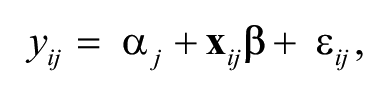
where
Each individual’s (i) score on the dependent variable in a given survey (j) is denoted as yij. Individual-level variables are contained in
For the dichotomous dependent variable tapping instrumental support for regime principles—the Linzian “democracy is best” measure—we use a logistic link to map from the covariates to the outcome; these results are presented in Table 1. For the ordinal-dependent variable gauging instrumental evaluations of regime performance—satisfaction with democracy—we use an ordinal logistic link; results are presented in Table 2.
Linzian Support for Democracy and Presidential Powers.
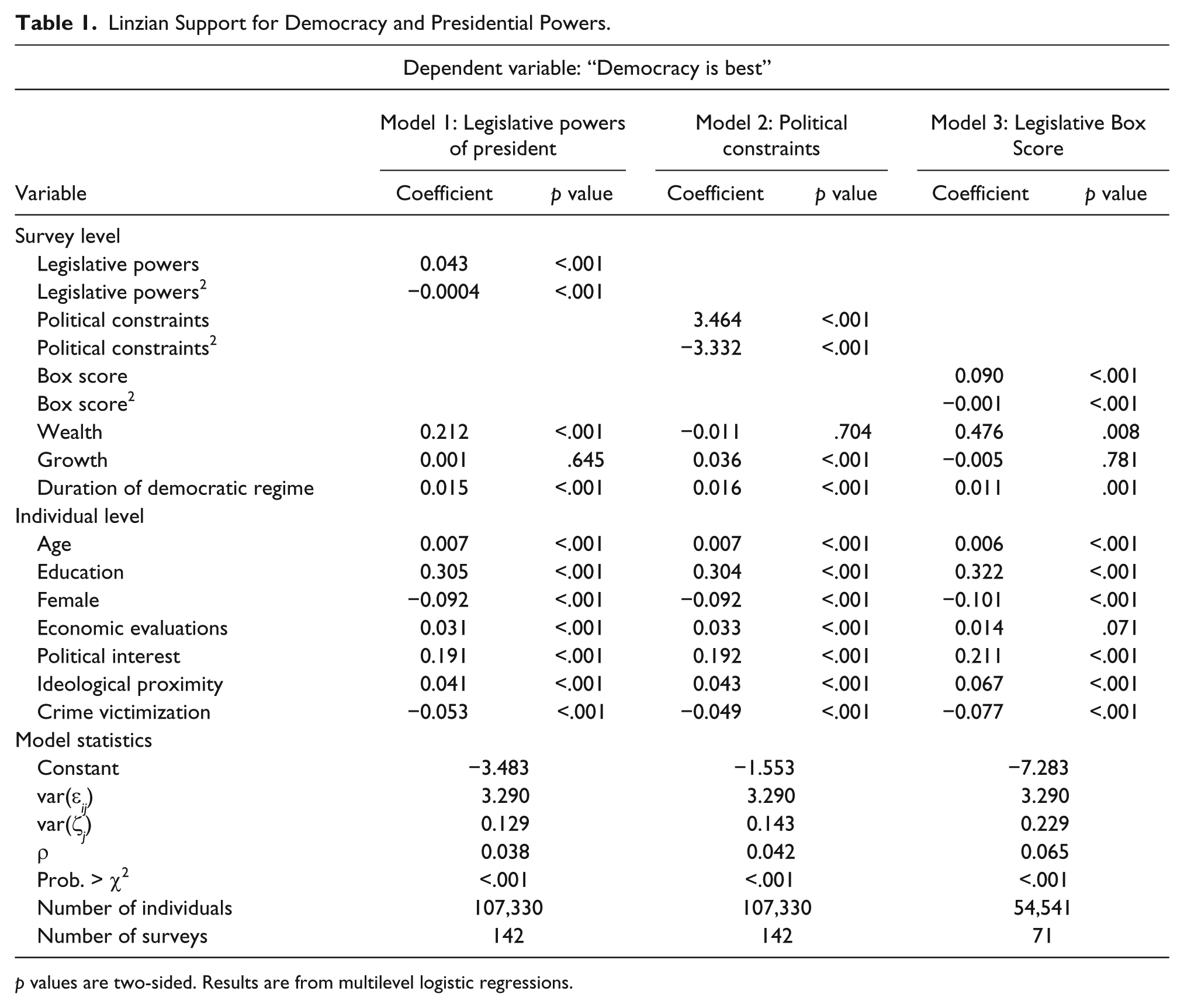
p values are two-sided. Results are from multilevel logistic regressions.
Satisfaction with Democracy and Presidential Powers.
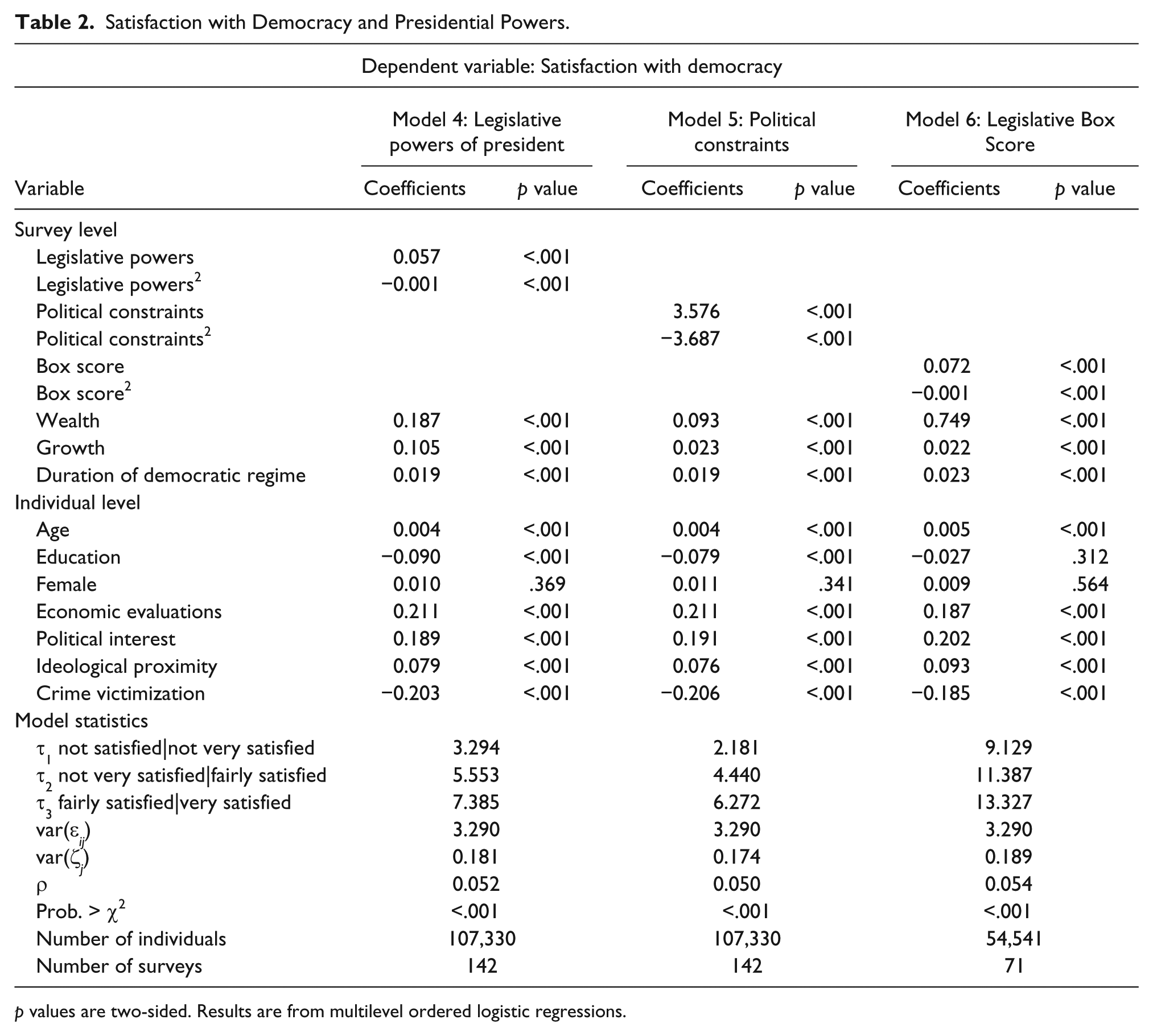
p values are two-sided. Results are from multilevel ordered logistic regressions.
Results
As expected, each model is consistent with our claim that instrumental evaluations of regime support initially rise as presidential powers and prowess rise, but at a certain point, further increases in presidential strength lower instrumental regime support. Figure 1 charts the relationships. The y-axes in the left-hand side panels capture the predicted probability that a respondent feels democracy is the best form of government (support for regime principles). The y-axes in the right-hand side panels illustrate the predicted probability that a respondent is either fairly or very satisfied with democracy (support for regime performance). 8
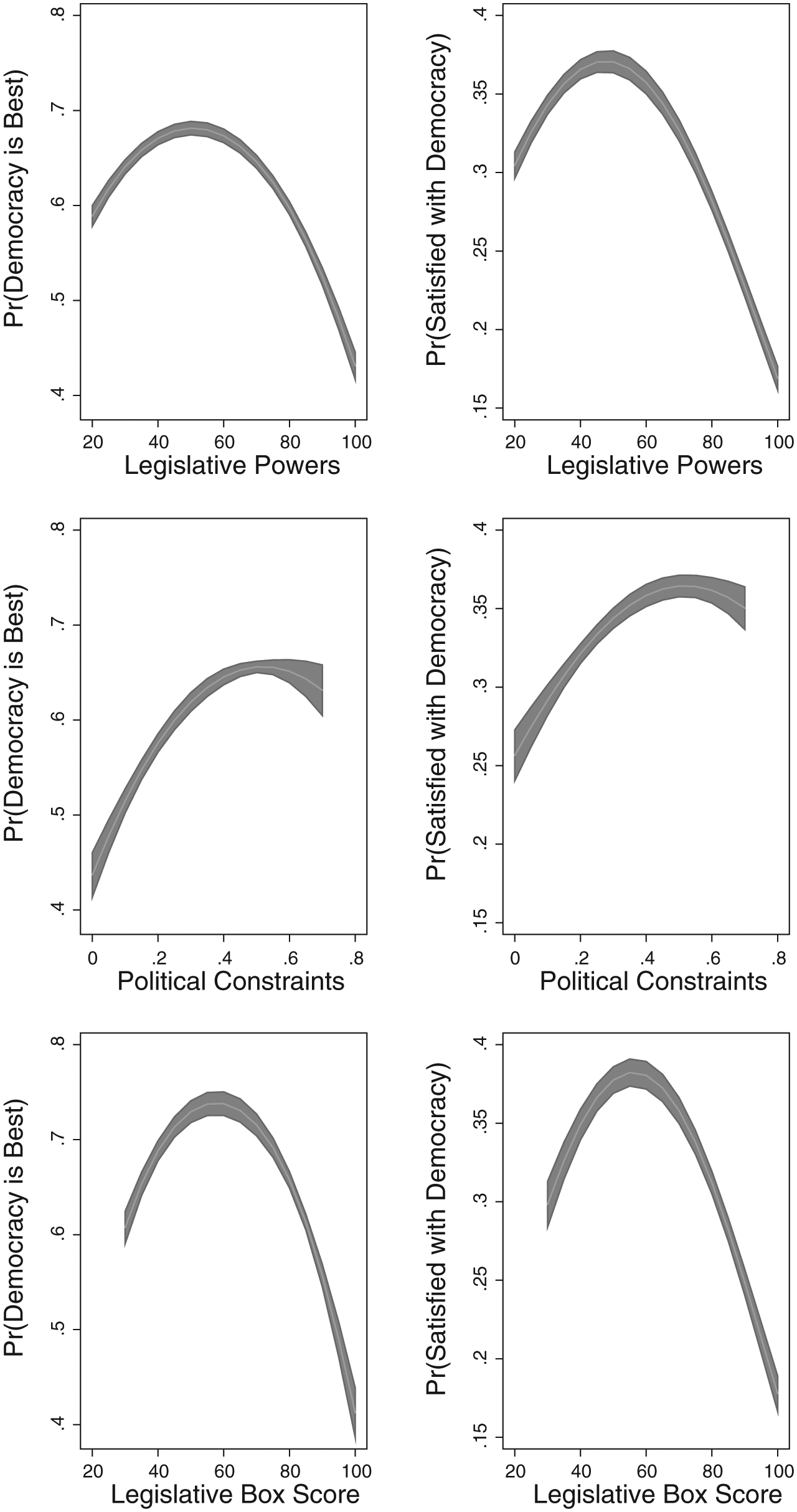
Democratic support and presidential powers.
The upper-left panel of Figure 1 helps visualize the key result from Model 1. It shows that the likelihood of a respondent agreeing that democracy is the best form of government builds with formal constitutional presidential powers (Legislative Powers) up to a score of about 54 before quickly deteriorating. At the sample minimum for the Legislative Powers index (21.4, Mexico 1917–present), a standard deviation (σ = 24.3) increase in the index is associated with about a 7 percentage point increase in the likelihood of Linzian support for regime principles. Contrast this with Argentina since 1994, which scores 67.2, about one standard deviation above the observed mean (54.1) of the Legislative Powers index. According to our model, if Argentina were to strengthen the president’s formal lawmaking power by one standard deviation, the likelihood of the average respondent viewing democracy as the best form of government is predicted to decrease by roughly 15 percentage points. In other words, instrumental evaluations of regime principles could be expected to fall if the Argentine president were to gain additional power.
The middle-left panel of Figure 1 depicts the parabolic relationship between the president’s partisan powers and Linzian democratic support estimated in Model 2. Respondents are more likely to view democracy as the best form of government as Political Constraints increase; that is, presidents lose partisan power. But the returns to instrumental support for regime principles begin to taper beyond their peak score at 0.52—Peru’s score from 2002 through 2006—as partisan support collapses. Based on these results, then, too much partisan support, and the associated lack of political constraint, is actually worse for mass support for democracy than too little.
When it comes to legislative prowess, as Model 3 and the bottom-left panel of Figure 1 show, instrumental support for democracy as the best form of government is most likely where the president enjoys moderate levels of statutory success and least likely where the president implements either very little or very much of his or her agenda. Ceteris paribus, this likelihood peaks at a passage rate of roughly 59 percent. In our sample, Argentina in 2003 comes closest to hitting this mark. But the chances of a respondent expressing Linzian democratic support are much lower at the sample maximum (Mexico in 1995 and 1996) than at the sample minimum (Argentina in 2001). This finding mirrors a pattern observed in the previous two analyses: positive instrumental evaluations of democratic regime principles are more difficult to generate at higher levels of presidential power than at lower levels. A happy medium of power and prowess, however, strikes the optimal balance for generating citizen support for a regime that poses them with two thorny principal–agent problems—controlling the president and delegating legislators to represent their interests.
Comparing panels in Figure 1 from left to right shows the relationships between the presidential powers and prowess and instrumental support for regime performance (satisfaction with democracy) are remarkably similar to those observed for Linzian instrumental support for regime principles. Levels of democratic satisfaction initially increase as formal constitutional powers (Legislative Powers, Model 4), partisan powers (Political Constraints, Models 5), and statutory success (Legislative Box Score, Model 6) increase, but at certain points, further increases are associated with lower levels of satisfaction. And the same asymmetry emerges: very strong and weak presidents both generate lower levels of instrumental regime support than presidents with a happy medium of power, but both Linzian support for democratic principles and satisfaction with regime performance are lower under very strong presidents than they are under very weak ones.
Rather than going through each model and graph in detail again, we flesh out the general pattern with the example of statutory success as measured by Legislative Box Score (bottom-right panel of Figure 1). Consider a president whose passage rate is just 33 percent, like Colombian president Ernesto Samper in 1996. Our theory predicts that where the president implements so little of his or her agenda, the public will desire a more effectual president. As such, instrumental support for regime performance will respond positively to increases in the president’s legislative success. Indeed, starting at a Legislative Box Score of 33, a standard deviation (σ = 18.2) increase in the passage rate is associated with about a 7 percentage point increase in the likelihood that a respondent reports being either fairly or very satisfied with democracy. Compare this to a president with twice the success rate (66%), such as Honduran president Carlos Roberto Reina in 1996. In this case, we expect citizens will be satisfied with the moderate, but not overwhelming, legislative success of the president but will become less satisfied if the president further imposes his agenda. Illustrating this dynamic, at a Legislative Box Score of 66, a standard deviation increase in passage rates is associated with about a 10 percentage point decrease in the likelihood of a respondent expressing satisfaction with democracy.
Across Models 1 to 6, likelihood ratio tests indicate that introducing the squared terms to nested linear models significantly improves model fit and a clear pattern emerges: citizens give democracy the best marks where their president is neither impotent nor omnipotent but instead possesses a moderate amount of authority and is thus able to successfully pass legislation with the consent of other political actors.
In the Supplemental Materials, we probe potential extensions of our theoretical framework. We first consider whether economic performance might condition the effects of presidential powers on democratic support. Citizens may appreciate a powerful president when the economy is robust but turn skeptical if the economy performs poorly (cf. Carlin and Singer 2011). If this is the case, the curvilinear relationships between presidential powers and satisfaction should change shape as economic conditions worsen or improve. We test this by interacting each presidential powers index with economic growth (Tables A3 and A4). The models indicate no consistent conditioning impact of economic performance on the influence of presidential powers for instrumental support either for regime principles or performance.
Next, though we theorize less regime support where very strong presidents dominate policymaking, citizens may plausibly express more support under vast presidential powers if they greatly trust the president. To test this proposition, we interact the presidential powers indices with trust in the presidency and trust in Congress (Tables A5 and A6). Again, we find no conditioning effect of trust on the relationship between presidential powers and instrumental support for regime principles or performance.
Finally, we consider the observable implications of reverse causality. As discussed above, all eighteen Latin American countries began their post-authoritarian periods with new or heavily amended constitutions stipulating, and often revising, formal presidential powers. In many cases, these rules were considered temporary or expedient and were thus subsequently changed. If reverse causality is at work, comparatively low levels of regime support should precede reforms that pushed presidential powers toward the extremes (high and low), and comparatively high regime support should precede reforms that moderated powers. Of the three cases we can use to test this proposition, only Ecuador in 1998 is partially consistent with the notion of reverse causality; the other two cases (Uruguay in 1996 and Brazil in 2001) are not. 9
Ecuador’s Constitution of 1998 heavily bolstered the president’s lawmaking powers. It granted presidents exclusive initiative in the areas of taxes and public spending and limited Congress’s ability to raise total spending above the level authorized by the president. It also reinforced presidents’ agenda-setting powers by granting them the authority to further modify such bills via amendatory observations and to promulgate nonvetoed parts of them in the case of partial observations. 10 These new constitutional features raised Ecuadorian presidents’ legislative power from middling, by regional standards, to one of the region’s strongest—nearly doubling on the legislative powers index from 42.2 to 82.2 (Negretto 2009, 139). In December 1997—seven months before the constitution’s text was adopted—Ecuadorians’ instrumental support for democratic principles (preference for democracy) was more than a standard deviation below the sample mean (see Figure A8) and, thus, in line with the reverse causality hypothesis. Instrumental support for regime performance (satisfaction), however, is quite close to the mean, which augurs against reverse causality (see Figure A9). Taken together, evidence of reverse causality is clearly mixed in this case.
While the bulk of Uruguay’s 1996 constitutional reforms were electoral, some raised the president’s already formidable formal powers in two ways. 11 First, they shortened how long Congress has before it must take action on bills the president sends for “urgent consideration.” Second, they facilitated the president’s formation of legislative blocs to prevent vetoes from being overridden. In July of 1996, five months before these reforms, support for democratic principles and performance were well above the mean level in Latin America (see Figures A8 and A9). Hence, the Uruguayan case presents no evidence that low levels of regime support spurred reforms to strengthen the president’s lawmaking powers, as the reverse causality hypothesis holds.
In Brazil, formal presidential legislative power tapered somewhat (though remained high) when President Fernando Henrique Cardoso and Congress agreed to amend constitutional Article 62 governing the use of “provisional measures” (medidas provisórias) in September 2001. While not stripping presidents of their ability to legislate by decree, the amendment doubled from thirty to sixty days, the period by which these decrees must be converted into law before lapsing, allowed presidents to reissue a lapsed decree only once rather than indefinitely, and declared a host of issue areas off-limits to decrees. 12 If this moderation in power was (reverse) caused by attitudes in the public, it would have been preceded by high levels of regime support. But this was not the case. The percentage of Brazilians that believed democracy was the best form of government in the quarter preceding the amendment was nearly two standard deviations below the sample mean (see Figure A8). At the same time, a low-to-middling percentage of Brazilian respondents were satisfied with how democracy was functioning (see Figure A9).
In all, any evidence across these three cases that is consistent with the reverse causality hypothesis is overwhelmed by evidence consistent with the null hypothesis of no reverse causality. To more systematically examine whether regime support affects presidential powers, we construct time-series cross-sectional models of our three powers and prowess variables as a function of the average level of support for, and satisfaction with, democracy in the preceding year. The results reported in Tables A11 to A13 again show no evidence of the reverse causality dynamic in our data.
Conclusion
A long theoretical tradition stretching from Weber, Dahl, Lipset, Easton, and Linz to more recent empirical work posits political systems that legitimize themselves to their citizens, both through the outcomes they produce and the inputs they use to produce them, have greater long-run stability and quality. While scholars have debated at length the relative merits of competing models of democracy for fostering these outcomes, the advantages and disadvantages of the varieties of presidentialism for ensuring regime support have nevertheless received little attention. This study tests whether executive lawmaking power and prowess affect citizen support for democratic regimes across Latin America’s presidential systems.
The basic theoretical proposition advanced here is that the relationship between presidential lawmaking power and regime support is best represented by an inverted-U-shaped parabola. Our findings are consistent with the hypothesis that citizens are happiest with, that is, most supportive of and satisfied with, democracy where presidents enjoy a happy medium of lawmaking power. They also suggest that although presidents with vast formal powers and/or broad majorities in the legislature can avoid gridlock and fluidly implement their agendas, they in the process fuel discontent with democracy and undermine its legitimacy. The same is true, but to a lesser extent, if the president’s every attempt to effect legislation is thwarted. Instead, Latin American citizens express the greatest regime support where presidents reside in a happy medium between ineffectual and almighty lawmakers.
These results reveal a striking embrace of the messy politics of separation of powers systems in a region often assumed to harbor a cultural preference for the swift, top-down rule of despots, strongmen, technocrats, and caudillos (Lagos 1997; Lewis 2006; Véliz 1980; Wiarda 2003). They also point to an appreciation for the intricacies of liberal representative democracy that belies the typically simple and, at times, empty and even pejorative ways in which Latin Americans define democracy (Canache 2012; Carrión 2008; Dalton, Shin, and Jou 2007). In this sense, the present study is optimistic about the prospects for the attitudinal consolidation of democracy in Latin America. It also supports the more general conclusion that minimizing the risk involved in the principal–agent relationships that arise in representative democracy, particularly under presidentialism, is more critical to mass support for democratic politics than any particular amount of power the executive enjoys vis-à-vis the legislature. Citizens are contented with presidential democracy when it grants both presidents and legislators the power to respond to and protect their interests in the spirit of compromise.
Our study also warns that machinations by Latin American presidents to strengthen their lawmaking powers could undercut democracy’s fragile but strengthening legitimacy in the region. As presidential powers continue to swell—whether via new constitutional provisions, shifting political alignments, deliberately stripping power from other branches, or other circumstances—any initially positive gains in democratic regime support may eventually turn into losses. Considering that both immense presidential powers and low levels of public support can theoretically accelerate the erosion of democracy, the finding that the two factors are interlinked is particularly disconcerting for the long-term stability of democracy in those parts of the region in which presidents actively seek to strengthen their hand. At the same time, however, it cautions against institutional designs that leave the presidency completely bereft of power.
On a final note, the idea of a “happy medium” of presidential power and prowess did not escape the framers of the U.S. Constitution. For example, while Alexander Hamilton recognizes the importance of “energy” in the executive (Federalist Paper No. 70), James Madison underscores the importance of checks and balances for effective government (Federalist Paper No. 51). As Madison famously wrote in No. 51, “Ambition must be made to counteract ambition.” As contemporary political commentators continue to debate whether presidentialism in the United States embodies Madison’s recommendation, constitutional framers in today’s more tumultuous nascent presidential and semi-presidential democracies, such as Egypt, Pakistan, and Russia, may consider the benefits of moderately powerful presidents for mass regime support.
Footnotes
Acknowledgements
The authors would like to thank Gabriel L. Negretto, Sebastian M. Saiegh, Matthew M. Singer, and Heather Stoll for helpful comments.

Declaration of Conflicting Interests
The author(s) declared no potential conflicts of interest with respect to the research, authorship, and/or publication of this article.
Funding
The author(s) received no financial support for the research, authorship, and/or publication of this article.
Notes
References
Supplementary Material
Please find the following supplemental material available below.
For Open Access articles published under a Creative Commons License, all supplemental material carries the same license as the article it is associated with.
For non-Open Access articles published, all supplemental material carries a non-exclusive license, and permission requests for re-use of supplemental material or any part of supplemental material shall be sent directly to the copyright owner as specified in the copyright notice associated with the article.
