







Abstract
Under what circumstances are women more likely to protest? Despite significant cross-national research on contentious politics in general and women’s collective mobilization in particular, no study to date has offered a systematic global analysis of mass mobilization among women. Using newly gathered data on women’s nonviolent protest for the years from 1991 to 2009, this article offers a cross-national analysis of the socioeconomic and political correlates of women’s protest. Drawing insight from the major theoretical approaches on contentious politics, the results from the data analysis indicate that higher levels of gendered economic and political discrimination, strong presence of women’s organizations, and higher female population rates in the general population significantly increase the likelihood of women’s protest events. The findings also indicate that collective mobilization among women is more likely in wealthier countries. Furthermore, mass mobilization among women appears to be more common in mixed political regimes rather than in consolidated democracies or autocratic polities. This manuscript complements and adds to the contentious politics literature by focusing on the factors that mobilize a specific segment of the society: women. The findings also speak to the gender and politics literature that lacks comprehensive cross-national studies exploring the determinants of women’s mobilization.
In high heels and head scarves, a small band of Afghan women took to the streets of the country’s capital, Kabul, on Thursday to protest harassment by men in public places.
In the middle of July 2011 in Afghanistan, a small group of women took to the streets of Kabul, armed only with flyers and signs reading “This street also belongs to me” and “We won’t stand insults anymore” (Nichols 2011). The women, organized by individuals from the nongovernmental organization (NGO) Young Women for Change, were demanding changes in societal norms concerning the treatment of women in the public sphere. Despite the ongoing significant restrictions to women’s socioeconomic and political rights in Afghanistan, the women’s protest in Kabul in July 2011 was not an isolated event. The following year, groups of women returned to the streets of Kabul to protest the execution of a woman accused of adultery (Arghandiwal 2012).
What leads to women’s collective mobilization? Despite significant general scholarship on contentious politics (e.g., Chenoweth and Stephan 2011; Davies 1962; Gurr 1968; Kitschelt 1986; Tarrow 1994; Tilly 1978), there has been very little, if any, research that offers a global analysis of women’s collective mobilization. The purpose of this study is to specifically focus on the cross-national determinants of protest by women. We suspect that the lack of comprehensive cross-national studies on this subject is due mostly to the lack of cross-national data over a long period of time. Yet, the omission also reflects the need to theorize further about the possible socioeconomic and political factors prompting mass mobilization among women. Thus, one major benefit of this study is to draw insight from major theories of contentious politics and assess whether women’s protest is driven by the same factors that scholars commonly attribute to protests that are not specific to women.
There are studies within sociology and the gender and politics literatures that have explored the determinants and success of women’s movements (e.g., Akchurin and Lee 2013; Baldez 2002; Costain 1992; Soule et al. 1999; Viterna and Fallon 2008). However, most of these studies focused predominantly on the North American and Western European experiences or analyze only a few less developed countries. Hence, another major benefit of our global approach is to provide a comprehensive, time-series, cross-national assessment of the factors that lead to mass mobilization among women. By doing so, we are better able to grasp the motivations, structures, and processes that drive women’s activism outside of specific cases and regardless of unique cultural and social settings. Our analysis, therefore, attempts to complement the earlier country- and region-specific studies on women’s protest to reach more generalizable conclusions.
The need for global quantitative data on women’s protest is also important for the position of the subfield within the discipline. Beckwith (2001, 373) notes that “the development of large statistical data sets that can be analyzed quantitatively may serve to validate the study of movements within the discipline while departing from the dominant and still necessary qualitative focus on women-and-movements scholarship.” This article responds to Beckwith’s (2001) call for more quantitative research on women and collective mobilization. Specifically, we constructed a global dataset of women’s protest that captures all nonviolent protest events led by or actively involving women from 1991 to 2009. We particularly focus on the nonviolent protest because of the previous literature’s dominant focus on women’s nonviolent activities. We also devote particular attention to women’s nonviolent protest to complement and add to the growing literature on the general nonviolent protest (Chenoweth and Cunningham 2013).
In this study, we adopt a comprehensive definition of women’s protest. The nonviolent protest events that we focus on include the cases where women and women’s groups are among the key agents of mobilization and often act based on gender related issues. The types of issues that drive women’s mobilization include women’s physical security (e.g., rape, sexual assault, and domestic violence), discriminatory treatment of women in the workplace and politics, and gendered social discrimination, among others. However, our conception (and hence the data) of women’s protest also encompasses the events and social causes not specific to women, such as women’s protest against war and corruption in the government, where women are the key actors of mobilization. We consider them as women’s protest activities because the factors that drive the women’s mobilization and leadership in those events, such as women’s protest against civil wars, are likely to be similar to the events where women rally for a specific gendered cause. This partially explains why women would assume a leading role in those events.
The rest of the paper is organized as follows. First, we outline existing theories of women’s mobilization and present some empirical implications of these theories. Next, we present the newly gathered data in detail and discuss the research design. We then report our empirical results and explain how our approach and new dataset add to our understanding of causes and consequences of women’s protest in a global sense. Our findings show that higher levels of women’s political rights violations increase the likelihood of mass mobilization among women. We also find that women’s protest is likely in countries with greater numbers of women’s groups and in countries with wealthier economies. We also find some evidence that collective mobilization among women appears to be more common in mixed political regimes rather than in consolidated democracies or autocratic polities. In the conclusion, we discuss the research implications of the findings for the contentious politics and women and politics literatures.
Why Women Protest
To develop testable hypotheses on the socioeconomic and political determinants of women’s mass mobilization, following Costain’s (1992) study on women’s social movements, we draw insight from the major theoretical approaches of relative deprivation, resource mobilization, and political process in the emergence of protest movements. We first begin by outlining the largely gender-neutral literature for each approach and then address the existing gender-specific theoretical and qualitative empirical research that has provided some support for that specific research approach.
Relative Deprivation
The early work of Davies (1962) and Gurr (1968) has been instrumental in theorizing how individual beliefs of relative deprivation could influence feelings of frustration, leading to mobilization and dissent. At the most basic level, this theoretical framework contends that dissent has a necessary condition: feeling that one’s current lot in life—one’s capabilities—do not match one’s expectations. As this discontent grows, insurgence is likely if social and environmental factors—such as international assistance and domestic political conditions—help in organization and mobilization. Since the theory was first outlined in the 1960s, however, empirical support for its implications has been somewhat mixed. In general, very little research has found that poverty or ethnic fractionalization alone drive rebellion. For instance, most scholars have found that civil wars are likely to be over “greed,” not “grievances” (Collier and Hoeffler 2004; Fearon and Laitin 2003).
One of the most difficult aspects of testing implications of relative deprivation theory is finding empirical proxies that capture how one’s “value capabilities” differ from “value expectations” (Gurr 1968, 1104). When studies go to length to show who the reference category is that individuals are basing their expectations on, the empirical support for relative deprivation is somewhat more consistently positive. For example, Piazza (2011) finds that domestic terrorism, as one type of possible rebellion, is greater in areas where minority groups have been denied the same economic rights as their majority counterparts, especially when the state has done little to overcome past legacies of deprivation. Wimmer, Cederman, and Min’s (2009) recent work on the drivers of ethnic rebellion also reflects key aspects of relative deprivation theory: when certain ethnic groups are excluded from the political process that is afforded to their peers, rebellion is more likely. In short, the mixed findings concerning relative deprivation can be explained, at least in part, by serious issues of measurability, particularly the position of individuals in relation to the reference category they are using to determine their expectations (Brusch 1996).
The literature on women’s mobilization has devoted much attention to relative deprivation, specifically negative treatment of women in the society, as a causal factor for why women rebel. Freeman (1975), in one of the earlier studies on the mass mobilization of women, highlights how relative deprivation drove the advancement of the post–World War II women’s movement in the United States. Recent studies on why women are not motivated about unequal pay in the workplace also highlight relative deprivation: here, “lower expectations” drive the lack of frustration and mobilization (Gibson and Lawrence 2010). Curran and Saguy (2013), however, find that relative deprivation drove migrant behavior in the case of Thailand women; they also find that feelings of relative deprivation can be reinforced through social network ties.
Building on this literature, we contend that women are likely to protest when they have grievances in line with relative deprivation theory. As such, women are likely to be mobilized when they face significant gendered-discrimination that causes their socioeconomic and political well-being to differ greatly from their expectations. By focusing on women’s protest in particular, we are able to measure relative deprivation in ways that closely reflect the central concepts of interest. In particular, because we examine collective mobilization by women, we contend that feelings of relative deprivation by women are greater in states with a lack of respect for women’s internationally recognized rights. Women’s rights are a concrete part of international expectations for human rights and have been codified in the United Nations human rights regime (Cole 2012).
When the government does not recognize or fails to enforce women’s economic and political rights, this can create a situation where a woman’s capabilities greatly differ from her expectations, either with a reference category of the male counterparts in the country or with a reference category of what women outside of her country are receiving. In other words, a woman in a state that does not respect internationally recognized women’s rights is likely to feel deprived when comparing herself to either women outside of her state who do enjoy these rights or the men within her state, who also do not face these same restrictions on their capabilities. If a woman is in a state that does not respect her right to hold office or her right to equal employment, she is more likely to have grievances consistent with relative deprivation theory. In the aggregate, these feelings will make it more likely for women to protest. At the state level, therefore, we expect the following:
Hypothesis 1 appears to have much face validity among accounts of recent nonviolent protest by women. For example, protests were held in several countries around the world on International Women’s Day in 2012. These protests centered on issues such as women’s equal representation in politics (Bosnia), ensuring that women’s rights were included in new constitutional drafts (Tunisia and Egypt), and expanding economic rights for women (Spain and Mauritania; AFP 2012b). Not all women’s protest events include such outward calls for the improvement of women’s rights. In Yemen in 2011, for instance, women took to the street as part of a larger effort to topple the Saleh regime (Al Jazeera 2011).
Resource Mobilization
Beyond feelings of deprivation, many scholars contend that protest is driven by the resources that individuals have at their disposal. Specifically, significant access to resources, such as financial and organizational support, makes collective mobilization less costly for individuals increasing the likelihood of dissent and protest (Bell et al. 2013; Jenkins 1983; McCarthy and Zald 1977; Tilly 1978). This argument could be especially applicable to nonviolent protest: both scholars and activists have contended that nonviolent techniques require a certain skill set and resource toolkit (Schock 2005; Smith 2001).
The seminal work by McCarthy and Zald (1977), for instance, emphasized the role of resources, particularly social movement organizations with access to outside resources, in driving mobilization and dissent. They maintain that the size and resources available to organized social groups influence their strategies and, in general, the preexisting NGO structure within a polity will influence the behavior and activities of a movement. Specifically, when individuals within a state are well connected to groups with resources for action, protest activities are more likely. These preexisting groups often plan and coordinate events and send calls-for-action to their members, all increasing the likelihood of mobilization. These groups can also provide communication resources, such as cell phones and printers, which can help spread the message about possible protest events (Murdie and Bhasin 2011).
The role of organizational resources in the overall contentious politics literature is also well established in cross-disciplinary studies on women’s collective action. For example, Viterna and Fallon (2008) argue that the strength of historical women’s movements in South Africa, Argentina, Ghana, and El Salvador explain gender equality and political rights as a result of collective mobilization. Focusing specifically on the events and outcomes of women’s mobilization in the United States, Soule et al. (1999) find that women’s social movement organizations increased mobilization events that occur both within the traditional political channels and outside of the traditional political channels, such as protest events (749–50). These organizations also aided in getting women’s issues actually on the floor of the U.S. House and Senate. Soule et al. interpret their findings as providing support for resource mobilization theory.
There are many examples of the significant role that women’s groups play in arranging women’s protest activities, in line with resource mobilization theory. For example, in Togo in 2012, the “women’s wing” of the Let’s Save Togo organization was actively involved in organizing anti-government protests in the capital (AFP 2012a). In addition, women’s protests against troop deployment in Palestine have been credited to the resources and organizational skills of the group, Four Mothers, in Israel (Eldar 2013).
Based on the above discussion, we formulate the following hypothesis:
Moving to focus specifically on nonviolent protest, the literature clearly outlines that nonviolent protest can be a learned behavior. Organizations and individuals throughout history have often supported the use of and education about nonviolent tactics, which, as recent research has shown, can be successful at influencing political change (Chenoweth and Stephan 2011). Higher levels of education have been shown to decrease individual level support for violent protest but to increase support for protest among those lacking close relationships to protesters (Rodeghier, Hall, and Useem 1991). Dalton, Van Sickle, and Weldon (2010) find that education levels are associated with increased protest participation.
Education can be thought of as a resource that makes nonviolent protest more likely. As Lombardi (2012, 6) contends, Higher educated people are better able to formulate and organize resistance against the oppressor, when there is a need to do this. They know better what is going on in the world, and possess the knowledge and skills to be able to formulate their needs against the possible oppressor.
Although Lombardi (2012) does not extend this to nonviolent action in particular, recent educational efforts have often been associated around “peace education” and “human rights education” protest in particular (Fountain 1999).
Focusing specifically on the role of education in women’s collective action, Moghadam (1999, 382) suggests that “many studies have sought to explain the rise of women’s movements in terms of women’s growing educational attainment and participation in the paid labor force, as well as in terms of the contours of political cultures.” Ray and Korteweg’s (1999) review of the structural determinants of women’s mobilization reaches a similar conclusion with respect to education as a precondition for mobilization in less developed countries. In line with these literatures, therefore, education is a resource that provides individuals with both the tools to resist violence and the knowledge of the benefits of nonviolent collective action. This line of reasoning leads us to the following hypothesis:
Furthermore, we contend that women’s collective action will be more prevalent in wealthier countries. It is likely that developed countries have more resources that women, as well as men, can use at their disposal to organize collective action, especially nonviolent collective action (Dalton, Van Sickle, and Weldon 2010). Economic wealth will allow for the purchasing of cell phones, computers, and office space, all of which are resources commonly used to mobilize collective action. Chenoweth and Lewis (2013), for instance, find that more developed countries are more likely to experience nonviolent campaigns but less likely to experience either violent protest or civil war. Within the scholarship on women’s protests specifically, perhaps development as a precondition to nonviolent mobilization could be used to explain the predominant focus on developed countries within the literature (Beckwith 2013). As a basic hypothesis related to resource mobilization theory, we expect the following:
Political Processes
The political process approach to contentious politics, with historical roots in Tilly (1978) and Lipset (1963), expanded with the work of Costain (1992) on the women’s movement in the United States. According to Costain, it was not relative deprivation or the resources of the movement that explain the development of women’s collective action since the 1950s. Instead, the mobilization depends on a favorable political situation: individuals must have some confidence that the movement will have a successful political outcome, and the government “must at least be willing to tolerate the movement’s appearance” (p. 12). As such, without a government that appeared to be at least somewhat tolerant of dissent and open to the will of the people, it is unlikely that organized protest, especially protest that is nonviolent, will occur.
As Lichbach (1998, 404) contends, Costain’s (1992) focus on the political process as influencing protest events is part of a larger movement in the literature to a “synthetic political opportunity theory,” where the focus is on how political opportunities and social and cultural structures help to encourage collective action. In line with this approach, the focus is on how certain political opportunity structures both provide the motivation to choose to protest and structure the tactics and types of demands made (Meyer 2004). Demands for action and the tactics used to address these demands depend on the political environment (Dalton, Van Sickle, and Weldon 2010; Kitschelt 1986; Lipset 1963; Tilly 1978).
In the most general sense, the political opportunity approach suggests that there will be more nonviolent political protest in open political systems (Schock 2005; Meyer 2004). Although Costain (1992) finds much evidence in favor of the political process model to explain the women’s movement in the United States, other research in the political process/political opportunity tradition has found mixed results. Meyer (2004, 131) states the “premises of the political process approach, at least as articulated by the scholars testing them, generally do not perform well.” With regard to women’s protest and activism outcomes in the United States, Soule et al. (1999) also find mixed evidence in support of the political opportunity framework.
In a review piece on the mixed empirical literature on political opportunity structures on protest, Meyer (2004, 141) calls on future researchers to focus on the “often-forgotten insight that the impact of openness on protest mobilization is curvilinear.” Although much of the focus on political opportunity structures centers on how political openness can uniformly facilitate contentious politics, similar to Meyer, Kitschelt (1986) and Norris (2002) focus on how political opportunity structures and institutional arrangements may encourage certain “repertories” of political action, including both insider and outsider tactics in ways that may go against the traditional linear focus on political opportunity structures and protest outcomes.
As Dalton, Van Sickle, and Weldon (2010, 53) state, “closed political systems are more likely to push actors outside conventional channels, thereby increasing levels of protest activity.” Protest is a costly and irregular political activity; if the political structures are such that citizens can voice their demands in a less costly manner through the traditional political channels, such as contacting their representatives directly or participating in a letter writing campaign, this may actually mean that closed systems are more likely to facilitate protest. Combining this reasoning with the earlier reasoning on political process and political opportunity structures, this could suggest an upper limit on the influence of an open political system or a “ceiling effect” on nonviolent protest: after a certain level, an open political system may not be associated with increased protests because individuals have alternative insider tactics to use to influence political outcomes.
In short, we contend that women’s protest is less likely in completely closed political systems; in these systems, women do not feel that their demands would be likely to be met. At the far end of political openness, however, women would have other means of getting their demands met, reducing the necessity of protest. With Meyer’s (2004) call for the theoretical focus of the political opportunity approach to include these ideas in mind, we suggest the following hypothesis:
Research Design
To test the empirical implications of the theoretical argument outlined in the preceding section, we use time-series and cross-section data delineated by years and countries, respectively. The time coverage of the analysis is the years from 1991 to 2009, inclusive. The sample size includes 145 countries for which the data are fully available. The time frame and the sample size are determined by data availability. The remainder of this section discusses the operationalization of the outcome and explanatory variables, and the methodological issues.
Outcome Variable: Women’s Protest Activities
No existing cross-national dataset exists that captures women’s protest activities over time. To gather data on women’s protest, we relied on a new coding of the updated Integrated Data for Events Analysis (IDEA) dataset from Virtual Research Associates (Bond et al. 2003). The IDEA dataset is based on an automated coding of all events in Reuters Global News Service. The data are organized in a “who” did “what” to “whom” manner for every single event (King and Lowe 2003). Previous work on protest in general has used the IDEA dataset to focus on both violent and nonviolent protests (Bhasin 2008; Murdie and Bhasin 2011). We follow Bhasin’s (2008) method of delineating nonviolent and violent protest events, and focus only on actions by domestic actors within a specific state. Demonstrations, sit-ins, protest marches, strikes, formal written petition drives, and boycotts are some common examples of nonviolent protests in this framework.
Building off of earlier work that uses the IDEA framework provides us with a nice starting point upon which to build our data on women’s protest. The use of Reuters Global News Services as the news source gives us greater and more accurate news coverage of the countries than the other widely used news sources such as the New York Times. Reuters allows us to capture a truly global sample of protest incidents, in part because it has more overseas bureaus. As Murdie and Bhasin (2011) report, Reuters has more than two hundred news offices across the world, whereas the New York Times, for instance, has less than sixty international offices.
To ensure that we captured only events by women, we relied on a new coding by Virtual Research Associates that isolated events to only those where the actor was clearly stated to be a “woman,” “women,” or “feminist,” in the body or header of the event and a protest event is cited in this same body or header. This procedure—one of a handful that we tried—produced what we and Virtual Research Associates agreed was a sample that we could be assured was not flooded with false-positive events. The procedure produced a total of 114,627 Reuters reports, samples of which we then examined for accuracy. As stated above, because our dataset was based on the IDEA event codings of these reports, we were able to focus only on nonviolent events within a specific state.
To show the typical women’s protest events included in the data, we briefly turn to two examples captured through the IDEA coding procedure. On September 26, 1991, Reuters reported the following header regarding a women’s protest event: “PERU: PERUVIAN WOMEN TAKE TO STREETS TO REJECT GUERRILLA VIOLENCE.” On this day, as Reuters reported, “more than 5,000 women from Lima shantytowns marched through the city centre . . . to protest against suspected Maoist guerrilla attacks and threats against food-for-the-poor organisers.” In our dataset, this event is coded as a nonviolent event from an organized group. Similarly, on August 31, 2003, in El Salvador, Reuters reported the following header: “EL SALVADOR: Women protest discrimination in El Salvador.” This event concerned protests that were held in the capital against, as the Reuters report states, “sexual violence and discrimination.” In our dataset, this is recorded as a protest event from an organized group to a government agent.
We created two outcome variables. The first variable, All Women’s Protest, accounts for the count of all nonviolent protest events in our dataset. The second variable, Anti-state Women’s Protest, comprises only nonviolent actions that specifically target a government or a state agent. We used the second measure to examine whether mass mobilization by women is in any way different when women are specially targeting a government or a state agent as opposed to our more general protest dependent variable. It is also consistent with earlier measures of protest that use the IDEA event-data approach to capturing protest (Murdie and Bhasin 2011).
Covariates of Women’s Protest Activities
To capture our concept of relative deprivation needed to test Hypothesis 1, we use the Women’s Economic Rights and Women’s Political Rights variables from the Cingranelli–Richards Human Rights (CIRI) dataset (Cingranelli and Richards 2012). These variables measure whether a government, as the highest political authority, recognizes and enforces international laws that prohibit socioeconomic and political discrimination against women. They range from zero to three, where a score of zero indicates that there are no legal rights for women, and that systematic discrimination based on sex may have actually been adopted into law. Conversely, a score of three indicates that nearly all of the internationally prescribed women’s rights are guaranteed through state law, and the government vigorously enforces these laws and does not tolerate gendered socioeconomic and political discrimination.
These indicators of women’s rights within a state respond to previous critiques about the operationalization of relative deprivation because they clearly relate both to the capacity of women as opposed to their male counterparts within a state and because they reflect women’s treatment in relation to international human rights standards. This operationalization is, thus, similar to other recent attempts to capture relative deprivation of an ethnic group in relation to others within a state (Piazza 2011; Wimmer, Cederman, and Min 2009).
To examine Hypothesis 2a, where the focus is on women’s groups as a resource around which protests can mobilize, we include an indicator of women’s international NGOs within a state, Women’s INGOs. This variable accounts for the number of women’s INGOs per year in a given country. The data for women’s INGOs are from Cole (2012). 1
For Hypothesis 2b, concerning education, we include Female Tertiary Education. It is the percentage of tertiary students that are women. We gathered the data from the United Nations Educational, Scientific and Cultural Organization’s (2013) cross-national database on education. For Hypothesis 2c, exploring the effect of economic development on women’s collective action, we control for the natural log of annual gross domestic product (GDP), GDP per capita (in 2005 constant U.S. dollars). Results from models with other indicators to capture economic development are provided in the Online Appendix at http://prq.sagepub.com/supplemental/.
To capture the concepts necessary for testing the relationship between political opportunity structures and women’s protest (Hypothesis 3), we control for the regime characteristics in a country using a Democracy variable, which comes from the Polity2 score of the Polity IV dataset (Marshall and Jaggers 2000). It is originally a score that ranges from −10 (high autocracy) to 10 (high democracy). We scale the variable so 0 is the least democratic, and 20 is the most democratic. We also include the squared term of this score, Democracy-squared, to the model specification to control for a possible curvilinear (an inverted U-shaped) relationship between democracy and women’s protests.
The Polity2 score is based on three major institutional characteristics of a political regime, including the regulation, competitiveness, and openness of executive recruitment; executive constraints; and regulation and competitiveness of political participation. Hence, it may not fully capture all democratic rights and freedoms. Our results were similar when we ran models using the Freedom House (2013) Index, another commonly used measure of regime type. The index variable is highly correlated with the Polity2 score (0.87) and measures various aspects of civil liberties (freedom of expression and belief, associational and organization rights, rule of law, and personal autonomy and individual rights) and political rights (fairness of electoral processes, extent of political pluralism and participation, and the freedom of elected officials to have a decisive vote on public policies).
Demographic features, most especially female population size, might also instigate women’s protest. To account for this possibility, we include two variables in the models, the natural log of the total Female Population (in millions) and the Female Population (%). The latter variable is the percentage of female population in the total population and used to explore whether the relative size of female population in the total population has any effect on protest activities. A large portion of female population in the general population implies a larger pool of people that can be mobilized by women’s movements. The data for population and economic development are from the World Development Indicators database (World Bank 2012).
We include the Media Coverage Bias variable, which is the number of all events about each country that appeared in Reuters Global News Service in the given year. We use this measure to effectively control for any media bias in Reuters concerning a country. To account for the role of possible unobserved region-specific effects, we control for five world region dummies: Asia-Pacific, former Soviet Union–Eastern Europe, Middle East–North Africa, Latin America–Caribbean, sub-Saharan Africa, and Western Democracies–Japan (reference category).
Methodological Approach
Because we use event-count data for women’s protest activities where there is positive contagion, the models are estimated using a negative binomial distribution (King 1989). This estimation technique enables us to account for discrete, nonnegative nature of count data, and directly models positive contagion (overdispersion) in the observed counts. The Huber/White sandwich estimator of variance is included to obtain robust standard errors. Each model also includes the Past Women’s Protest variable. It is a one-year lag (t − 1) of the outcome variables. It controls for autocorrelation, which is a common issue when cross-sectional time-series data are used (Beck and Katz 1995). The lagged outcome variable also controls for the theoretical expectation that the previous year’s protest events might be a significant predictor of the current year’s protests, given the possibility that organized actions breed more mobilization in the near future.
We also use a one-year lag of all the time-variant explanatory variables to mitigate any simultaneity issues between the outcome and explanatory variables. More specifically, lagged-explanatory variables allow us to make sure that the variables included on the right-hand side of the equation temporally precede the dependent variables to lessen any incorrect direction of inference.
Results and Discussion
Table 1 shows the results from the models using the count of all women’s protest activities as the outcome variable. Given the possible theoretical and empirical linkages between gender-specific socioeconomic and political variables, in the first four models, we test the effect of the gender-based political and economic variables separately to make sure that the results are not statistically biased due to collinearity. However, diagnostic tests (correlation coefficients and variance inflation factors) indicate that there was no issue with significant multicollinearity in any of the estimations when we include all the gendered political and economic variables in the same model. Therefore, we also report the results from a full model that includes all of the independent variables in the same equation (Model V).
Determinants of Women’s Protest Activities.
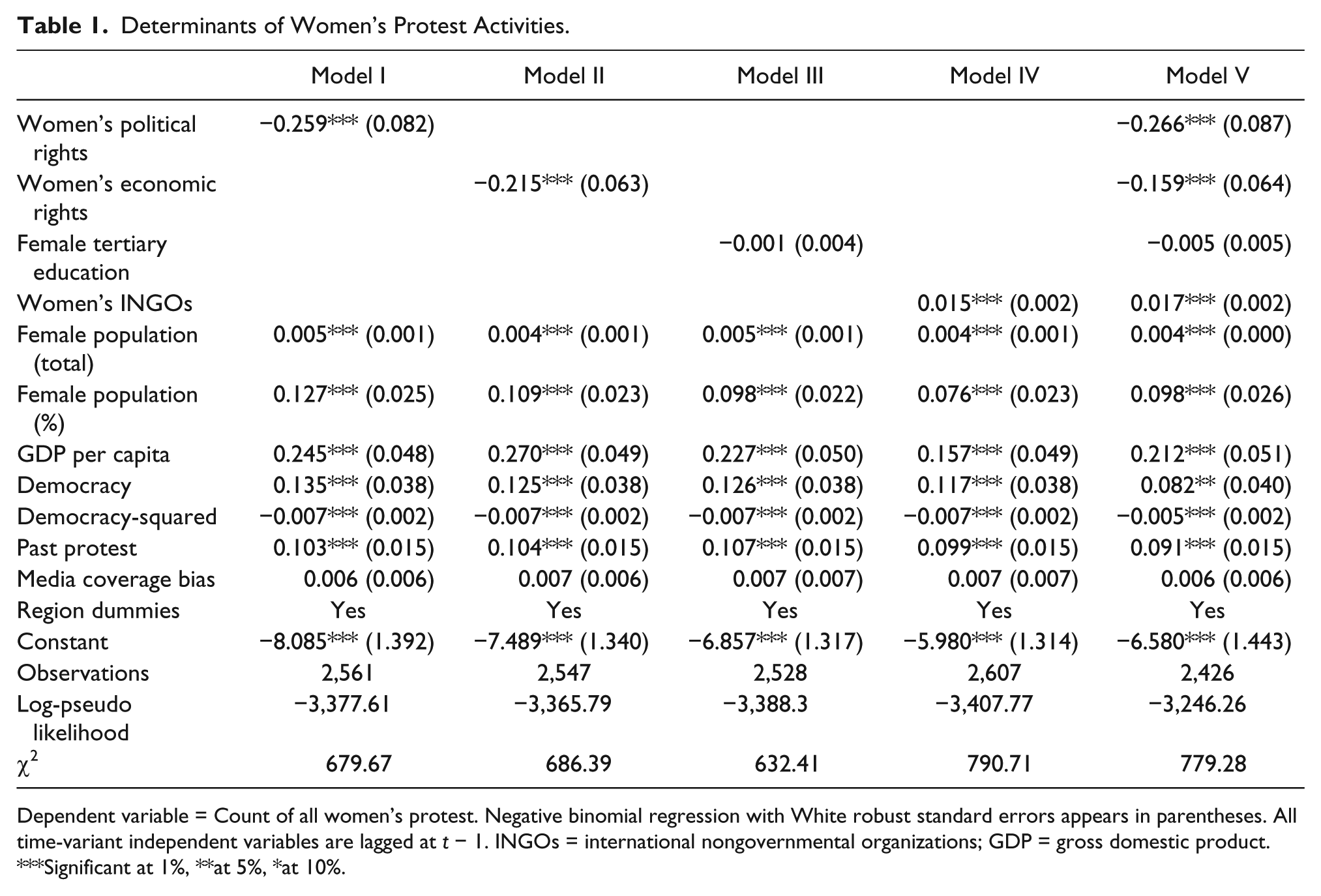
Dependent variable = Count of all women’s protest. Negative binomial regression with White robust standard errors appears in parentheses. All time-variant independent variables are lagged at t − 1. INGOs = international nongovernmental organizations; GDP = gross domestic product.
Significant at 1%, **at 5%, *at 10%.
The results for the women’s political rights variable indicate that the lack of respect for women’s basic political rights is likely to increase the possibility of women’s protest. Similarly, the findings indicate that gender-based economic discrimination increases the likelihood of women’s protest events. These findings, using an indicator that closely matches the concept of relative deprivation, support Hypothesis 1. The results in Table 1 also provide some support for parts of the resource mobilization argument. As to Hypothesis 2a’s contention, we find that nonstate women’s organizations facilitate the mobilization of women. In contrast, we find no evidence in support of Hypothesis 2b: the education variable in the models does not significantly covary with the outcome variable in any of the models.
The results in Table 1 also provide support for Hypothesis 2c: the extent of economic wealth in a country could be instrumental in estimating women’s protest events. The findings also suggest that both the total number of female population and its ratio to male population are significant indicators of the number of women’s protest activities. We, therefore, conclude that demographic factors are likely to increase the ability and willingness of mass mobilization among women.
Consistent with the political process hypothesis (Hypothesis 3), the political regime type also significantly varies with the outcome variable. When we interpret the two democracy variables together, we confirm the existence of a curvilinear (an inverted U-shaped) association between political regime type and women’s protest. More specifically, it appears that women’s protest activities are more common in polities that exhibit both democratic and authoritarian features (i.e., mixed regimes) than consolidated liberal democracies or fully authoritarian regimes.
To estimate the substantive impact of each of the significant variables, we examine the change in the number of women’s protest activities once the value of the variable under consideration moves from its minimum to maximum value while holding the other continuous independent variables at their mean values and the binary variables at zero. We report the substantive effects of the variables in Table 2. According to the results, when the women’s political rights variable moves from its minimum to maximum value, we find about one event decrease in the predicted count of women’s protest events. The same amount of change in the women’s economic rights variable results in less than one event decrease in the count of women’s protest activities.
Substantive Change in the Count of All Women’s Protest.
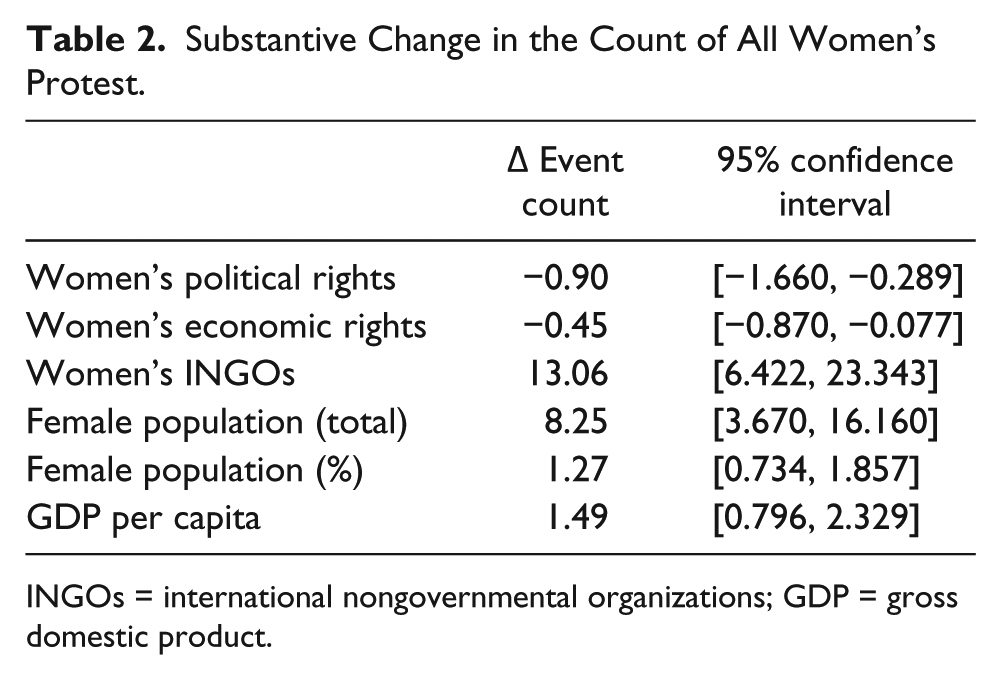
INGOs = international nongovernmental organizations; GDP = gross domestic product.
The numbers for the substantive effect of women’s political and economic rights variables may not seem very high. However, note that we observe on average two women’s protest events per country per year in the entire dataset. 2 Thus, given the global mean score of women’s protest activities, a one event change in the predicted values of the outcome variable can be considered a substantively significant influence in women’s mobilization. When the women’s INGOs variable shifts from its minimum score in the dataset to its maximum score, the women’s protest variable is expected to increase by about thirteen events, which clearly shows the strong substantive effect of women’s organization on the mass mobilization among women.
The same amount of change in the total number and the percentage of female population variables increase the outcome variable by about eight events and one event, respectively. The same amount of change in the GDP per capita variable results in about one event increase in the count of all women’s protest. The regime variables also show substantively significant effect on the outcome variable. As Figure 1 shows, with all other variables at their mean levels, as a regime first increases in openness, there is likely to be slightly more women’s protest events. As a regime continues to become more open, however, this positive effect is likely to decrease.
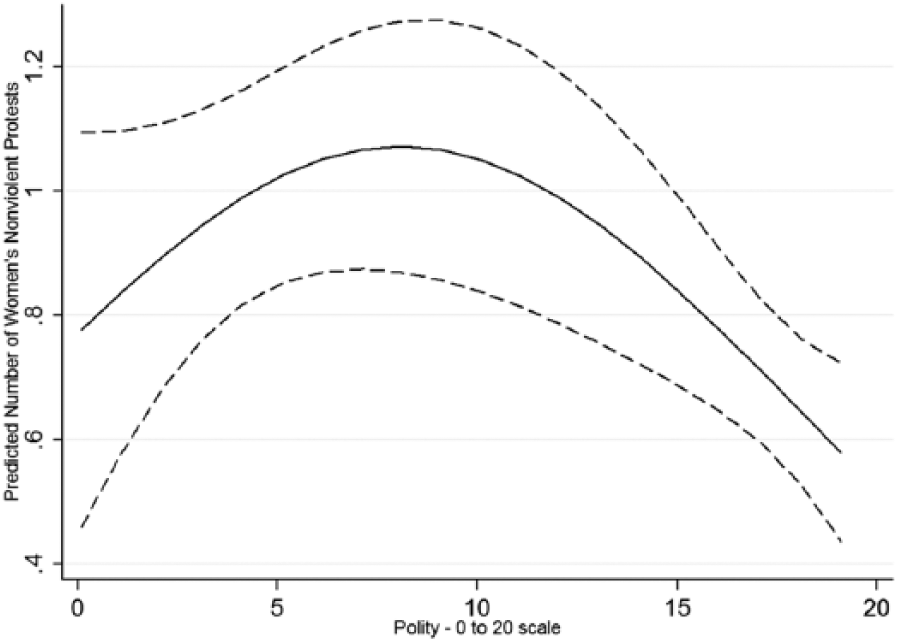
Predicted women’s protest events as regime type changes.
Table 3 reports the results from the models that use the women’s anti-state protest variable as the outcome measure. Similar to the results in Table 1, we find that gendered political discrimination is likely to prompt more women’s protests. The women’s economic rights variable is only statistically significant in one of the two models where it is included. The women’s economic rights variable fails to show a strong effect on the likelihood of anti-state protests, in part because women might be more inclined to target and/or blame private economic agents such as employers and big businesses for the gendered discriminatory economic practices than the state agents. This provides, perhaps, a robustness finding actually in line with the relative deprivation tradition.
Determinants of Women’s Protest Activities.
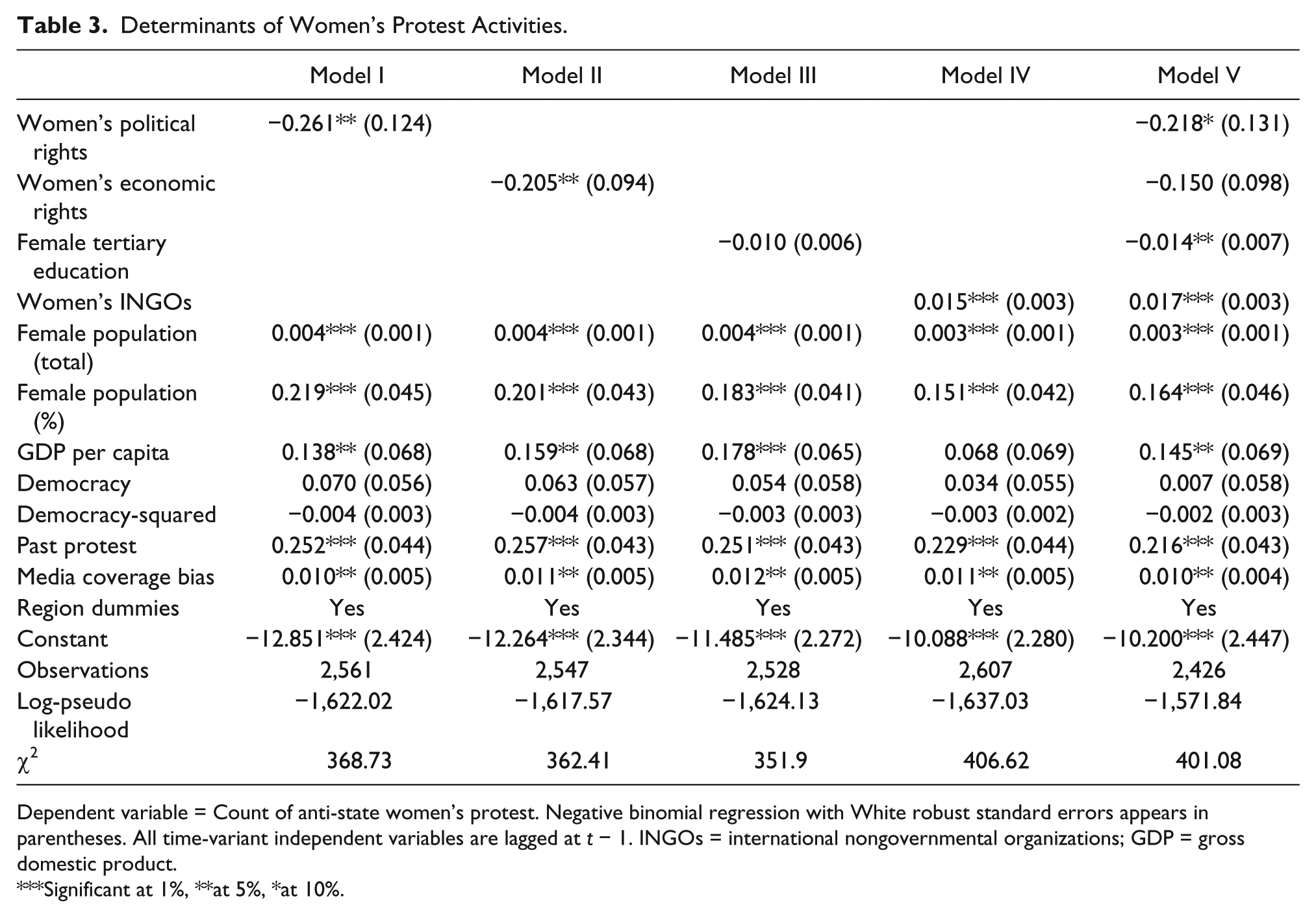
Dependent variable = Count of anti-state women’s protest. Negative binomial regression with White robust standard errors appears in parentheses. All time-variant independent variables are lagged at t − 1. INGOs = international nongovernmental organizations; GDP = gross domestic product.
Significant at 1%, **at 5%, *at 10%.
Table 3 also provides some evidence in support of the resource mobilization hypotheses. We continue to find much support for Hypothesis 2a: women’s INGOs are associated with increased anti-state protest. As to Hypothesis 2b, the female education variable is only statistically significant in one of the two models where it is included. We, therefore, do not find a robustly significant statistical association of the anti-state women’s protest with educational achievements. Consistent with the findings in Table 1, however, the economic wealth and the female population variables significantly covary with the count of women’s anti-state protest activities in Table 3.
In Table 3, both of the regime variables fail to show a statistically significant effect on the likelihood of women’s anti-state protests. This finding indicates that women are likely to mobilize against the state agents across different regime types. That is, it is unlikely that women’s protest events targeting the state occur more frequently in democratic or autocratic regimes, against the political process hypothesis. We take this result as consistent with earlier critiques of the political process approach (Meyer 2004; Soule et al. 1999). In general, this result highlights that women may be less influenced by regime characteristic when it comes to protesting against their state. Instead, their protests are driven by relative deprivation concerns and the availability of mobilization resources. Future research concerning the differences between anti-state and general protest covariates is definitely necessary.
According to Table 4, the substantive effects of the significant variables are relatively lower in the events where a specific state agent is cited than the findings for all protest events reported in Table 2. More specifically, when the women’s political rights variable moves from its minimum to maximum value, the predicted count of women’s anti-state protest activities is expected to decrease by less than one event. The women’s INGOs variable continues to show the largest substantive effect by increasing the predicted number of women’s anti-state protest events by about three events. The same amount of change in the total female population variable increases the predicted value of the outcome variable by about one event, whereas the same change in the scores for the percentage of female population and economic wealth variables results in less than one event increase in the predicted count of anti-state women’s protests.
Substantive Change in the Count of Anti-state Women’s Protest.
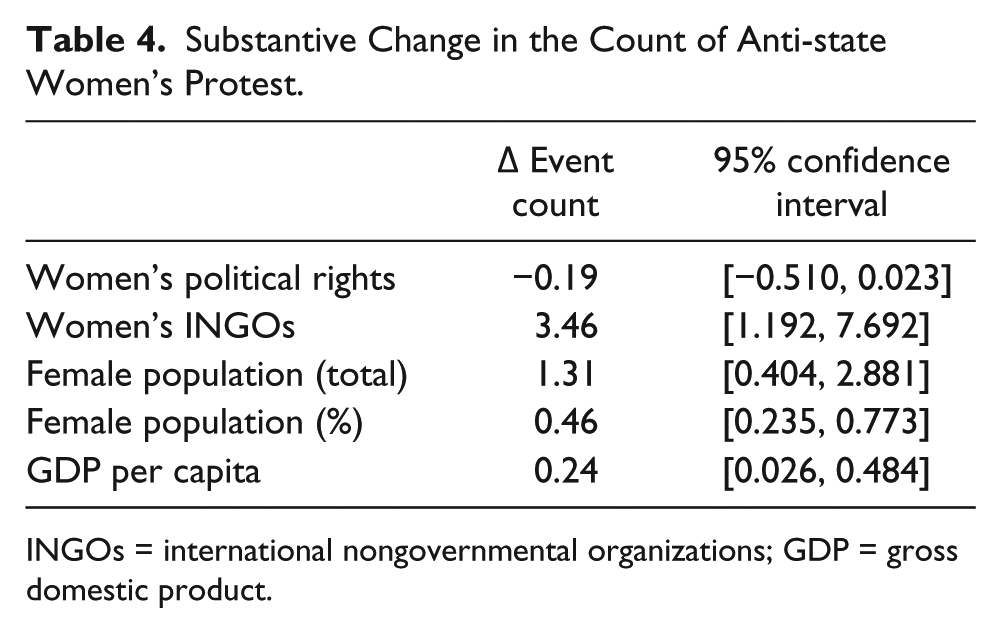
INGOs = international nongovernmental organizations; GDP = gross domestic product.
Conclusion
Why do women take to the street and protest? In this project, we provide a comprehensive analysis of the cross-national determinants of nonviolent protest by women. In general, we find some support for each of the large theoretical traditions in contentious politics. Consistent with the relative deprivation perspective, we find robust evidence that women protest nonviolently when their political rights are not respected. In line with the resource mobilization approach, we find consistently that women’s protest is likely in states with greater numbers of women’s groups and in countries where there is a higher GDP per capita. Finally, we find some evidence for a curvilinear approach to the political process model; this relationship only holds, however, when we focus on the total number of women’s protests against any actor, governmental or nongovernmental.
Our study continues with the current contentious politics literature’s focus on the determinants of nonviolent protest but provides a necessary extension in examining the determinants of nonviolent protest by a certain set of actors: women. By finding some support for each of the major research traditions, we show that the factors affecting women’s nonviolent actions are similar in many regards to the determinants of protest by the overall polity. This finding is important, in many regards, because the literature on women in political leadership positions has recently found that women behave differently than men in political positions (e.g., Chattopadhyay and Duflo 2004; Dollar, Fisman, and Gatti 2001; Koch and Fulton 2011). Other research finds that women vote differently than men and participate in regular, normal politics differently as well (e.g., Inglehart and Norris 2000; Kaufmann and Petrocik 1999; Welch and Hibbing 1992). When it comes to contentious politics, we do not find this difference. That is, our findings indicate that women’s protest is likely to be driven by the same motivations, structures, and processes cross-nationally as contentious politics that do not center on women.
Our paper provides a rich new dataset on women’s protest cross-nationally. This dataset allows us to test various empirical implications from the overall contentious politics and women’s protest literatures on a far greater number of countries than has been possible. As Beckwith (2001) pointed out, a dataset like this one is necessary for the advancement of the study of women’s contentious politics. Our global study does not examine the variance within each world region and country. Future studies could expand on our study specifying the region- and/or country-specific factors that might instigate women’s protest. Another future research venue could be to test our hypotheses focusing individually on different types of women’s protest such as those prompted by violence against women and gendered socioeconomic discrimination.
Footnotes
Authors’ Note

Declaration of Conflicting Interests
The author(s) declared no potential conflicts of interest with respect to the research, authorship, and/or publication of this article.
Funding
The author(s) received no financial support for the research, authorship, and/or publication of this article.
Notes
References
Supplementary Material
Please find the following supplemental material available below.
For Open Access articles published under a Creative Commons License, all supplemental material carries the same license as the article it is associated with.
For non-Open Access articles published, all supplemental material carries a non-exclusive license, and permission requests for re-use of supplemental material or any part of supplemental material shall be sent directly to the copyright owner as specified in the copyright notice associated with the article.
