







Abstract
Many scholars have offered explanations as to why women are underrepresented at all levels of government. Conventional wisdom states that fewer women are in public office due to lower ambition, and that the presence of gendered perceptions among women considering elected office contributes to women’s disinterest in the political arena. Using original survey data, this article expands the theory of gendered perceptions to current state-level appointed officeholders to explain their levels of interest in pursuing higher public office. The results indicate that gendered perceptions affect the progressive ambitions of appointees; like studies of ambition in elected officials, this study of appointed officials finds that women are generally less ambitious, and unlike studies of ambition in elected officials, this study of appointed officials finds that women with higher self-assessments are less ambitious rather than more.
Keywords
The political arena continues to be mostly populated by men. In 2014, less than 19 percent of Congress and less than a quarter of state legislatures were comprised of women. Only six governors were women, and fewer than 20 percent of statewide executives, such as secretaries of state, were female (Center for American Women and Politics [CAWP] 2014). The underrepresentation of women in politics even appeared in the 2012 presidential race. When asked what he would do about the wage gap between men and women, Mitt Romney said he was dedicated to including more women in the workforce, going so far as to question where the “binders full of women” were when trying to decide on candidates for political appointment within his gubernatorial administration. Lower numbers of women in public office means women may be unjustifiably excluded from political discussions and decisions.
Romney’s “binders full of women,” made to demonstrate how important it was to appoint more women to cabinet-level positions, reveals a political office that is rarely studied when we question women’s representation. Scholars have focused almost exclusively on the nascent ambitions, or initial interests of women for elected office, or the progressive ambitions (the interest in pursuing higher public office) of current elected officials. Few ask why women enter into appointed office, or even if appointed office is a more attractive pathway into the political arena and up the political career ladder.
Because it is unknown how appointments factor into the female pipeline to public office, we do not know what affects that pathway, including whether or not the same variables affect the appointed pathway as well as the elected pathway. For example, how does a woman’s perception of her capabilities, often different from a man’s and a strong predictor of her interest in elected office, affect her ambition for an appointment? It is this disparity between self-perceived qualifications, known as gendered perceptions, Lawless and Fox (2005, 116) said is “the most potent explanation we uncovered for the gender gap in political ambition.” No study focuses on the presence of gendered perceptions and their effects on the ambition for appointed office, or its effects on progressive ambition, despite the strong effect it has on the initial interest in elected office. Yet thousands of men and women are appointed at all levels of government, with thousands serving on the rarely studied state-level boards alone. 1 The most recent data indicate 35 percent of high appointees are women (Center for Women in Government and Civil Society [CWGCS] 2008). Given that the highest percentages of women in public office at the state level hold appointed and not elected office, this omission is significant in our understanding of gender and politics.
Using a unique data set of appointed officials drawn from the results of my State Political Pathways Survey, this article will show how progressive ambition among appointed women differs from their male counterparts, and from previously identified trends in progressive political ambition for elected office among women. I find that women in appointed positions have lower ambitions than men in appointed positions, mirroring the ambitions of women in elected office. That women in appointments continue to have lower progressive ambitions suggests a competitive environment may not be the only reason for women’s lower ambitions. Furthermore, my findings show that it is the women who self-assess their abilities the highest who are the least progressively ambitious. This complicates the role of self-assessment in women’s ambition. Put together, these two findings challenge the conventional wisdom that women are less ambitious because they do not like the competitive electoral environment and that women with more confidence in their abilities will automatically become more ambitious for public office.
Why Political Appointments?
Women in appointments are invisible when we focus on elected office alone. Little is known about who holds political appointments and their progressive ambitions at the local and state levels. This is due to an almost exclusive focus on federal or high-level state appointments coinciding with the study of electoral ambition alone. My focus on all state-level political appointments expands the definition of public office to include men and women who have been overlooked in prior political ambition studies to reveal how women exhibit different levels of progressive ambition for nonelected political positions. How do appointed women approach seeking higher public office? Do appointed women have lower progressive ambitions like female elected officials? To assume women in appointments have similar ambitions as women in elected positions is problematic because both kinds of offices represent very different levels of public exposure, time commitment, and skills necessary to attain each position.
Women in elected office rely upon support from party leadership and need an extensive fundraising background. Women tend to be much more concerned about their ability to fundraise and are much more reliant upon party recruitment to even consider elected office (Carroll and Sanbonmatsu 2013; Fox and Lawless 2010; Sanbonmatsu 2006; Welch 2008). Women running for elected office, especially if they are considering moving to more prestigious offices, have to expose themselves to a higher level of public exposure and media scrutiny. These requirements of fundraising and media exposure alone deter many women from considering seeking elected office at all or considering a higher public office.
The appointment world is different. Although party support is beneficial for networking, it is not a necessity. Seeking or being recruited for appointment does not require any fundraising, and if it is a low appointment, such as a commission appointment, it has little public scrutiny or media exposure. Board and commission appointments have low time commitments and concern specific issues or professions that directly affect potential appointees’ personal and professional lives. High appointments also allow for issue specificity and may act like any other full-time job, meaning appointees do not have to juggle a career alongside their political position like many elected officials must do. In contrast, potential electoral candidates need to be prepared to cover a wide range of issues. The lack of fundraising, lower media exposure, and the opportunity to work on a specific issue area may make political appointments more attractive than elected office for women, a notion that has not been considered in political ambition studies until now.
If it is important that women be equally represented in governmental bodies at all levels, then we need to better understand ambition for all offices, and not just the initial or progressive ambitions for elected office. Although this analysis cannot tell us for certain that a presence or lack of progressive ambition among appointees leads to more or less women in public office, it can begin to tell us how progressive ambition functions within the appointment world, and if the same psychological doubts that affect the initial interest in public office continue to affect interest in moving up in public office.
Gendered Representation
Elected office has been treated more as a pathway within the women’s and politics literature, with discussions on potential institutional, psychological, or social barriers and how any one or more of these may affect the road to elected office. Appointed office, however, is rarely treated as a pathway to public office. Studies on state political appointments, for example, reveal the glass ceilings and glass walls in particular state agencies or departments (Bullard and Wright 1993). The scholars who study the women in appointed office rarely ask why women pursued or were ambitious for their appointed positions. This is especially confusing given the benefits of being in appointed office versus elected office, such as the ability to work on one specific issue and the lower media exposure. Few studies have questioned whether the variables that affect the pathway to elected office (i.e., family, political, and state-specific dynamics) also affect the pathway to appointed office.
Family Dynamics and Women Seeking Public Office
At first, scholars focused on the challenge of being both a mother and a potential elected officeholder. It was argued that juggling both childrearing and running for political office could prove to be a unique obstacle for many women who consider adding their name to the ballot. Women do tend to be older when they first enter electoral politics, with childbearing and childrearing as two of the major reasons for the delay in entering politics (Carroll 1985a, 1985b; Diamond 1977; Dolan and Ford 1997; Kirkpatrick 1974). Both men and women reported family-related conflict to holding office, but men reported higher levels of conflict than women because women tended to forgo politically ambitious–related opportunities until they could devote their energy to it without losing time with their family (Sapiro 1982). Yet marital status, having children, and the amount of household responsibilities were insignificant predictors of nascent ambition for elected office, questioning the effects of children on a woman’s ambition for elected office at all (Fox and Lawless 2014; Lawless and Fox 2005).
Only one study in 1983 asked female appointees their marital status and whether or not they had children (CAWP 1983). No scholar has questioned whether or not having children affects a woman’s decision to seek or accept an appointment. Female appointees were less likely to be married and among appointees who were married, women had fewer children than the main sample (CAWP 1983). As these data are more than thirty years old and only included high-level appointments, we have no idea whether or not the trends in family dynamics for appointments have continued till today.
Personal Political Characteristics and Women in Public Office
Personal political characteristics, such as the value of an individual’s current position, affect progressive and nascent ambition for elected office. When elected officials feel they have a higher chance of winning and are risk takers, their interest in seeking higher elected office increases (Fulton et al. 2006; Rohde 1979). One study found women are more affected by the expected benefit gained from holding higher level office, making them as likely as men to be progressively ambitious (Fulton et al. 2006). Furthermore, the more qualified women feel to run for or hold elected office, the more likely they are to consider seeking elected office (Lawless and Fox 2005). This is all keeping in mind that women are less likely to feel qualified in the first place and are also less progressively ambitious once they reach elected office (Bledsoe and Herring 1990; Fox and Lawless 2011; Lawless and Fox 2005; Maestas et al. 2006; Palmer and Simon 2003).
Our understanding of the ambitions of appointed officials is limited in comparison with our understanding of the ambitions of elected officials. We do not know how the value of a current appointment (or perhaps a job outside of politics) affects interest in appointed office, nor do we know whether one’s feelings on their qualifications for the appointment affect the interest in appointed office. The 1983 CAWP study shows that women were more likely to express an interest in a future gubernatorial appointment. Why these women had ambitions for another appointment and whether or not they are interested in a higher level appointment is unknown. Also, because the 1983 CAWP study did not include board and commission members, we do not know what the ambitions of board and commission members are, and whether or not boards and commissions can act as a stepping stone to higher public office.
It remains incumbent on scholars of gender and politics to explain how and why we expect political ambition to function for women as compared with men. Although prior literature in this field has shown that female elected officials are more influenced by the expected benefits of seeking a higher office than by their lower ambitions (Fulton et al. 2006; Maestas et al. 2006), these studies have not taken into account how the candidates feel about their ability to either win the higher political position or govern effectively within it. Subjectively being able to say whether or not they may win an election for higher public office is not the same as understanding whether or not they feel they are qualified to run or hold that higher public office.
Furthermore, this study is situated in a nonelectoral environment. It may not be as clear to appointees whether or not they would be awarded the higher appointment, including how competitive it may be or if anyone else is seeking that appointment as well, nor is there necessarily a direct pathway up the appointment ladder like there is for those holding elected office, such as those in the state legislature considering a congressional campaign. This means it is very difficult to measure the chances of being awarded an appointment in addition to being theoretically problematic in a nonelected world. Given that women are less ambitious when self-perceived qualifications are taken into account, and that these self-perceived qualifications are relevant in both elected and nonelected positions, I argue that appointed women actually do hold lower progressive ambitions than men (Carroll 1994; Constanini 1990; Lawless 2012; Lawless and Fox 2005; Palmer and Simon 2003). Therefore, I seek to test the following hypothesis:
And because self-assessed qualifications have been shown to have such a strong effect on a woman’s ambition for elected office, I seek to test the following hypothesis:
Gendered perceptions, or the difference between how women view their capabilities versus how men view their capabilities, affect a woman’s initial interest in elected office (Lawless and Fox 2005). Timothy Bledsoe and Mary Herring (1990) also suggested a psychological barrier affecting female city councilor’s progressive ambition. They argued that experiences may be the same, but the perceptions of those experiences can diverge drastically based on the sex of the individual, which in turn affects future decisions. They contended that the higher men and women go up the political career ladder, the more their political experiences and circumstances should be similar, but this does not necessarily create a stronger link between experience and perception, especially as the female city councilors were more affected by their political circumstances (i.e., electoral security) than male councilors (Bledsoe and Herring 1990). Lawless and Fox (2005) found similar results and argued that men and women have very different perceptions of their qualifications to run for public office; these different perceptions in turn affect each sex’s ambition differently. Based on the earlier findings of Bledsoe and Herring, and the recent findings of Lawless and Fox, I seek to test the following hypothesis:
The appointee sample used in this analysis has a wide variety of appointments, from the lowest level board and commission to the commissioner of an entire state department. Lawless and Fox (2005) argued that studying individuals who hold public office means we are already studying individuals who have expressed some level of political ambition. However, the appointees in my sample may have very different levels of political ambition according to what level appointment they hold. A female appointed as the deputy commissioner of an entire state department may have a history of public office success in her past, which may in turn affect her perceptions of her qualifications for higher public office. This is in comparison with the female appointed to a low-level board and commission, who may be less likely to have a history of public officeholding and therefore a very different perception of her abilities to hold a higher public office. Given the differences in level of appointment and how the level of appointment may affect one’s self-perceived qualifications, I test the following hypothesis:
Testing these hypotheses on appointed officials expands our understanding of why there are fewer women holding public office at the state level beyond elected office. We can further our understanding of the role gendered perceptions play in decreasing the numbers of women holding public office by focusing on the climb up the political career ladder (i.e., moving up to a higher office) instead of concentrating on the first rung.
Data: The State-Level Political Pathways Project
This analysis uses data from my original survey of appointed state officials. 2 In the fall of 2013, I sent an email survey 3 through Qualtrics to more than 3,500 appointed officials in the state departments of Health, Commerce (including professional licensing), Environment, and Natural Resources across twenty states. 4 The twenty states were varied on their culture, region, professionalism of legislature, percentage of females in the legislature, and percentage of high-appointed females. The twenty states were Alaska, Arkansas, Connecticut, Illinois, Iowa, Kansas, Kentucky, Louisiana, Massachusetts, Michigan, Montana, North Carolina, North Dakota, Oregon, Tennessee, Utah, Vermont, Washington, Wisconsin, and Wyoming.
It was important to get as diverse a sample of states as possible to not bias the results. States were varied on the professionalism of their state legislature, for example, because states with professional legislatures are usually more competitive and prestigious, making them harder offices to attain. The characteristics associated with the public offices in states with professional legislatures, or in states with citizen legislatures, could affect a potential candidate’s political ambitions. Half (ten) of the states in the sample have semiprofessional legislatures, six have citizen legislatures, and four have professional legislatures.
States with higher percentages of female state legislators or female high appointees may suggest a more female-friendly state. Female-friendly states tend to be more liberal, have higher populations of underrepresented groups, and have a history of electing women to public office (Ondercin and Welch 2009). Women who live in female-friendly states or who have seen more females elected or appointed may have different levels of ambition. The opposite may be true as well, with women in states that are less friendly to women exhibiting lower ambitions, or bigger doubts about their ability to hold public office. The states in my sample therefore represent states with all levels of representation of females in their legislatures. The average percentage of women in the state legislature across the twenty states is 23.45 percent, just under the national average, and the average percentage of women in high appointments across the twenty states is 37 percent, slightly over the national average of 35.1 percent (CWGCS 2008). The diversification of the states on these five areas ensures the generalizability of the findings across the United States.
Although it is relatively easy to track down high-level appointee names and contact information, the same is not true for finding out information for boards and commissions. In fact, some states do not even have a complete listing of their boards and commissions (New York), other states have outdated lists (Massachusetts), and some states, such as North Dakota, have one portal where all board and commission members are listed with contact information. Contact information came from a variety of sources, including state websites, professional associations, and educational institutions.
Studying state-level appointees is advantageous for a few reasons. First, most state-level appointment structures are very similar from state to state—allowing for comparison between states and increasing the number of subjects studied. Second, our understanding of state-level appointments is lacking, mostly because appointment studies do not include board and commission members. Boards and commissions offer individuals the opportunity to take part in state government issues that are important to them with lower media exposure and time commitments. Because the appointment world offers unique opportunities to become involved in politics without some of the negativity associated with elected office, it is important that we consider how all appointments may serve as departure points for politically ambitious individuals. Third, studying the state level allows me to capture progressive ambition within the state level and to the federal level. Studying local appointments is far more difficult due to the varying governmental structures and difficulty of obtaining information on appointees.
In total, I gathered 12,544 appointee names from 1,314 boards and commissions, and sixty state agencies and departments. I was able to find the emails of 3,587. Of the 3,587 appointees I contacted, 1,130 completed the survey for a response rate of 31.5 percent. A total of 163 were high appointees and 967 appointees were serving on boards and commissions (low appointees).
The survey covered four areas: prior political history, current position opinions, future political ambitions, and demographics. Questions under prior political history included the number and types of offices run for and held (i.e., elected vs. appointed, local vs. state levels). Within the subheading of Current Position Opinions, I asked about the nature of their current position, including if it was part-time or full-time, was subject to term limits, and who they were appointed by. Future political ambition questions included their attitudes toward running for elected office, how qualified they felt to attain a higher level of office, and how likely it is they would win a campaign if they decided to run. The survey ended with demographic questions. (The entire survey is available in the online appendix accompanying this article.)
I chose state-level departments in three areas: Health, Commerce (including professional licensure), and Environment and Natural Resources. I chose these three areas for a few reasons. First, I wanted to make sure I was not biasing the departments; therefore I chose one distributive, regulatory, and redistributive department. This policy typology created by Theodore Lowi and built upon by Newman argues that the type of department one works in affects the amount of power one can wield (Lowi 1972; Newman 1994; Newman 1995; Ripley and Franklin 1991). The three areas within the typology have been studied by women and politics scholars and very often are gendered (Kelly and Newman 2001; Miller, Kerr, and Reid 1999; Newman 1994; Newman 1995). Commerce departments, for example, are a regulatory department where communication is most formal, lateral entry is most common, and is the kind of department most likely to be male dominated (Lowi 1972; Newman 1994; Reid, Miller, and Kerr 2004). Health departments, however, are redistributive, and afford the least amount of access to policy making (Ripley and Franklin 1991), yet is one of the areas women are most likely to be found (Newman 1994; Reid, Miller, and Kerr 2004). Finally, the distributive departments of Environment and Natural Resources most often support a patron–client relationship where everyone is a winner and cooperation is a must, and are more likely to be male dominated (Lowi 1972; Newman 1994).
Second, I chose the Health department because it is one of the areas that a substantial amount of a state budget is allotted to. States spend the majority of their budgets on K-12 education and Medicaid. More than 25.8 percent of states’ total expenditures go to Medicaid, 19.5 percent of state expenditure goes to K-12 education, and 10.1 percent goes to higher education (National Association of State Budget Officers 2014). Choosing the health department ensures I am capturing appointments that are important to the duties of state governments. Finally, these three areas were chosen because many of the boards and commissions within a state fall within one of these three areas. States can have dozens of professional licensing boards that fall under the Commerce department, dedicate substantial board and commission resources to understanding specific diseases, and use boards to regulate many areas of environmental law.
The appointees range from full-time department secretaries to board/council members who meet a few times a year. Board responsibilities and agendas vary widely, even within the same state. Some meet only four times a year and serve in an advisory capacity. Others meet monthly, and have the sole responsibility to set the regulations and rules regarding a certain profession. Still others concern very specific populations, and include members who are experts in a field, or who represent the populations most affected by the board’s mission.
For example, the Illinois Nature Preserves Commission in the Department of Natural Resources meets only three to four times a year but has a relatively wide scope of authority. The Commission’s mission is to protect and set policy for the land within the Illinois Nature Preserve System. This gives the commission the authority to protect lands currently within the Nature Preserve System and preserve the lands by overseeing a staff of biologists. No lands currently under the Nature Preserve System can be taken under the power of eminent domain without the approval of the commission, governor, and other invested public owners (Illinois Department of Natural Resources 2014). Boards such as the Illinois Nature Preserve Commission are both policymakers and regulators within their respective jurisdictions.
In contrast, the Illinois Real Estate Administration and Disciplinary Board (IREADB) meets every month, but as a regulatory board, only has regulatory power over the licensing of real estate agents within the state. The meetings for the IREADB comprise mostly of reviewing disciplinary cases and deciding the fines, penalties, and possible revoking of real estate licenses. The board meets every month, and all members are appointed by the governor besides the chair (Illinois Office of Executive Appointments 2014).
And finally the Illinois Advisory Board for Services for Persons Who Are Deaf-Blind (IABDB) represents advisory boards with the least amount of authority. The IABDB was created in 1975 and “provides advice to the State Superintendent of Education, the Governor, and the General Assembly on all matters pertaining to policy concerning persons who are deaf/blind, including the implementation of legislation enacted on their behalf” (IABDB 2014). The board must meet at least four times a year, but cannot meet more than twelve times. This board can act as a voice for the deaf/blind community and make recommendations on their behalf, but they cannot regulate any prior laws regarding services for individuals who are deaf/blind, nor can they implement any policies on behalf of those populations.
Descriptive Statistics: Individuals Appointed in State-Level Boards, Commissions, and Departments
The State Political Pathways Survey provides more insights into who holds state appointments. Table 1 provides descriptive statistics of the sample to better understand state-level appointees. More than 40 percent of appointees were female, with no variation between the percentage of females on boards and commissions or in high appointments. Appointees were also overwhelmingly white (90.09%), with boards and commissions slightly less diverse than high appointees. The average age of appointees was fifty-five, with high appointees younger than board and commission members by three years on average. The appointees in the sample are very well educated; more than 60 percent completed graduate school and more than 70 percent had family incomes at US$100,000 or higher. Many of the appointees were also married, and high appointees were almost 10 percent more likely than board and commissions members to have children below eighteen at home.
Descriptive Statistics.
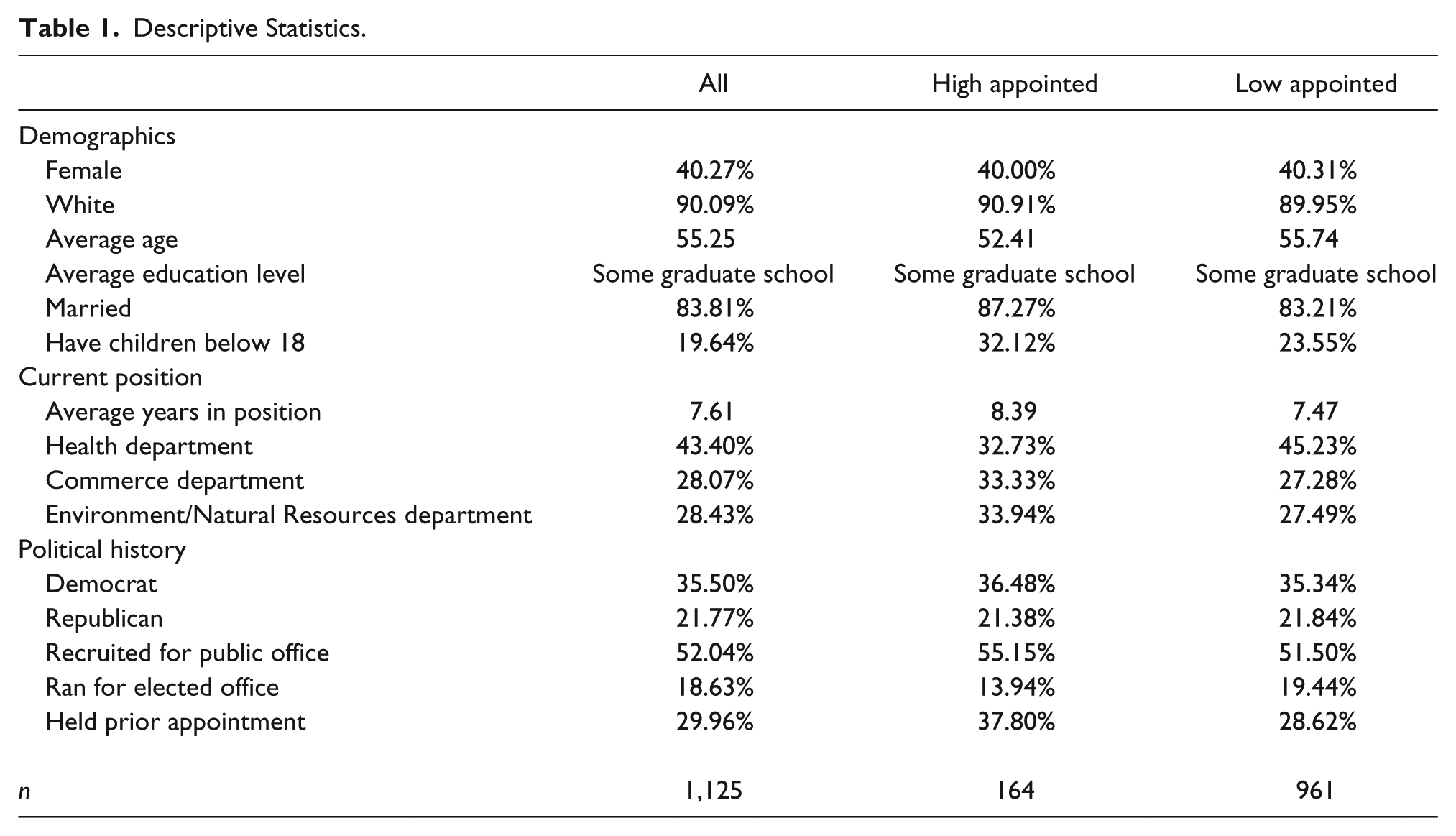
Moving to the characteristics associated with their current positions, appointees reported holding their current positions for an average of seven and a half years. Appointees were more likely to come from Health departments, with equal percentages coming from Commerce and Environment/Natural Resource department. The governor appointed most of the appointees (77%), and the average number of board members was eleven.
More appointees identified as Democrat than Republican. Over half of all appointees reported being recruited for elected or appointed office at some point, representing the importance of recruitment on political participation. Close to 30 percent of appointees overall, and more than 37 percent of high appointees had held a prior appointment; on average, appointees held two appointed positions in two different departments, with many appointees having held positions at the local level. Far fewer appointees reported having run for elected office, particularly among the high appointees.
Qualifications and Interest in Higher Office
Do appointed officials feel qualified for higher public office? In short, yes. Almost two-thirds of appointees felt qualified or very qualified for higher office. The number of high appointees (more than 80%) compared with the number of board and commission level appointees (more than 60%) who view themselves as qualified hints at an increase in confidence in one’s abilities as they climb the political career ladder, providing early support for Hypothesis 4 (see Table 2). In addition, the gender gap in self-qualifications continues for appointee holders, with males more likely to assess their qualifications higher than females, supporting Hypothesis 2 (Table 3, p < .01).
Self-Assessed Qualifications for Higher Office.
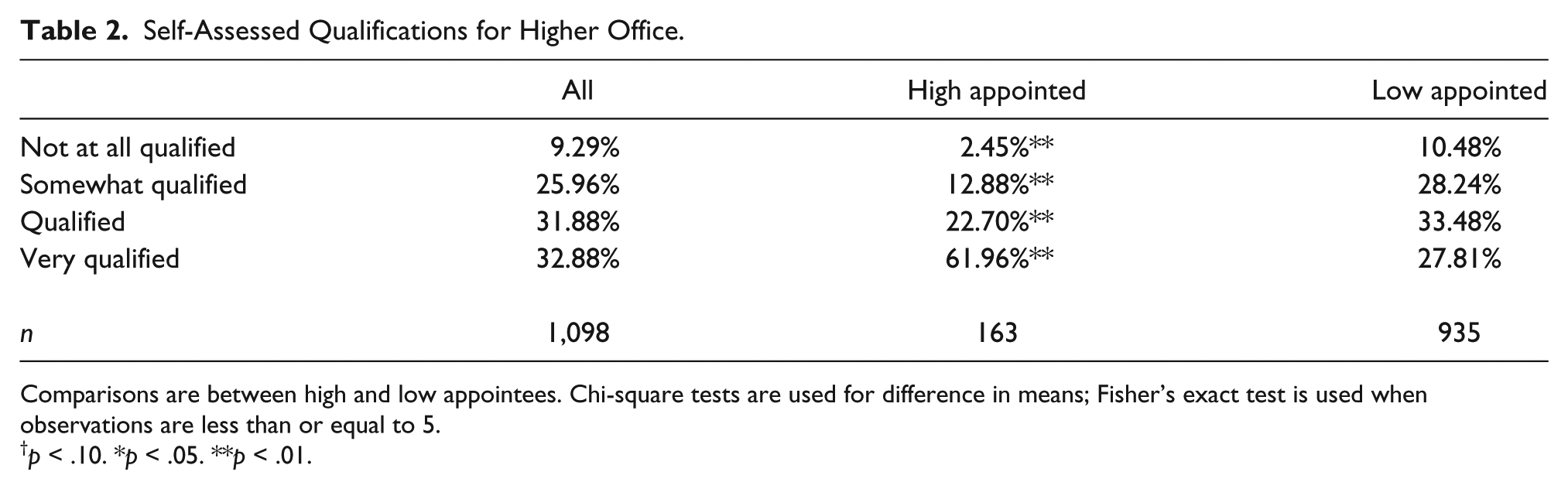
Comparisons are between high and low appointees. Chi-square tests are used for difference in means; Fisher’s exact test is used when observations are less than or equal to 5.
p < .10. *p < .05. **p < .01.
Self-Assessed Qualifications for Higher Office by Sex.
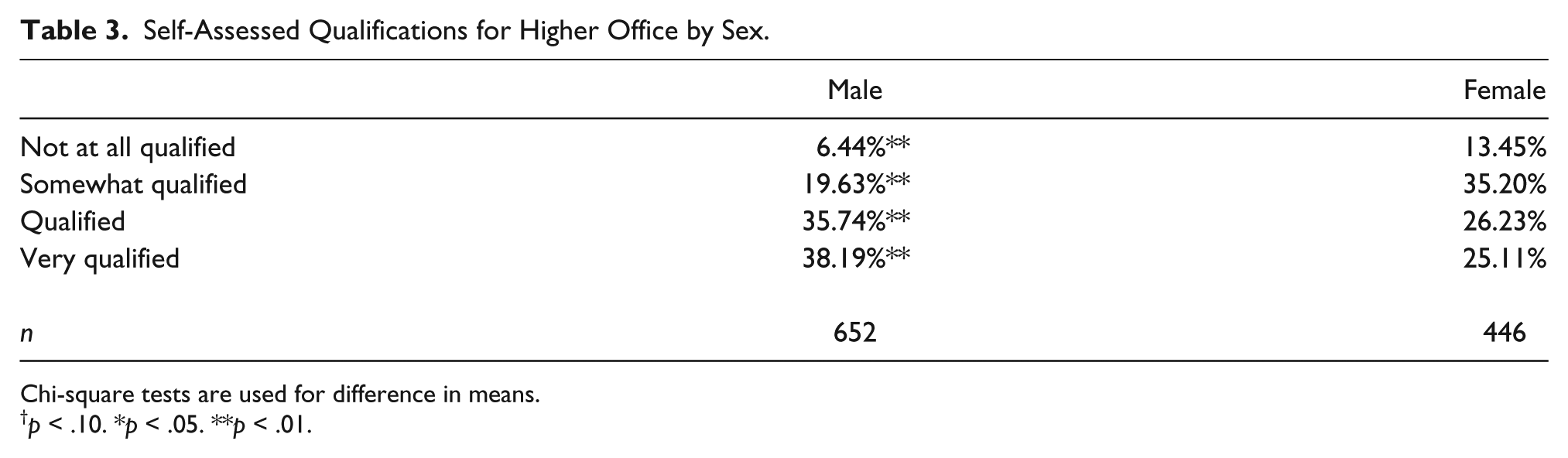
Chi-square tests are used for difference in means.
p < .10. *p < .05. **p < .01.
Board and commission members have the most doubt in their qualifications compared with any other group; females at the board and commission level suffer the greatest self-doubts (Figure 1). High-appointed men were more likely than high-appointed women to assess themselves as qualified for higher office, but the most dramatic split is between women on boards and commissions and women who hold high appointments. For example, the gap between a board-level female’s and a high female appointee’s responding that they were “very qualified” for high office is 45%, but is only 26% for men appointed to boards and commissions versus higher appointments.
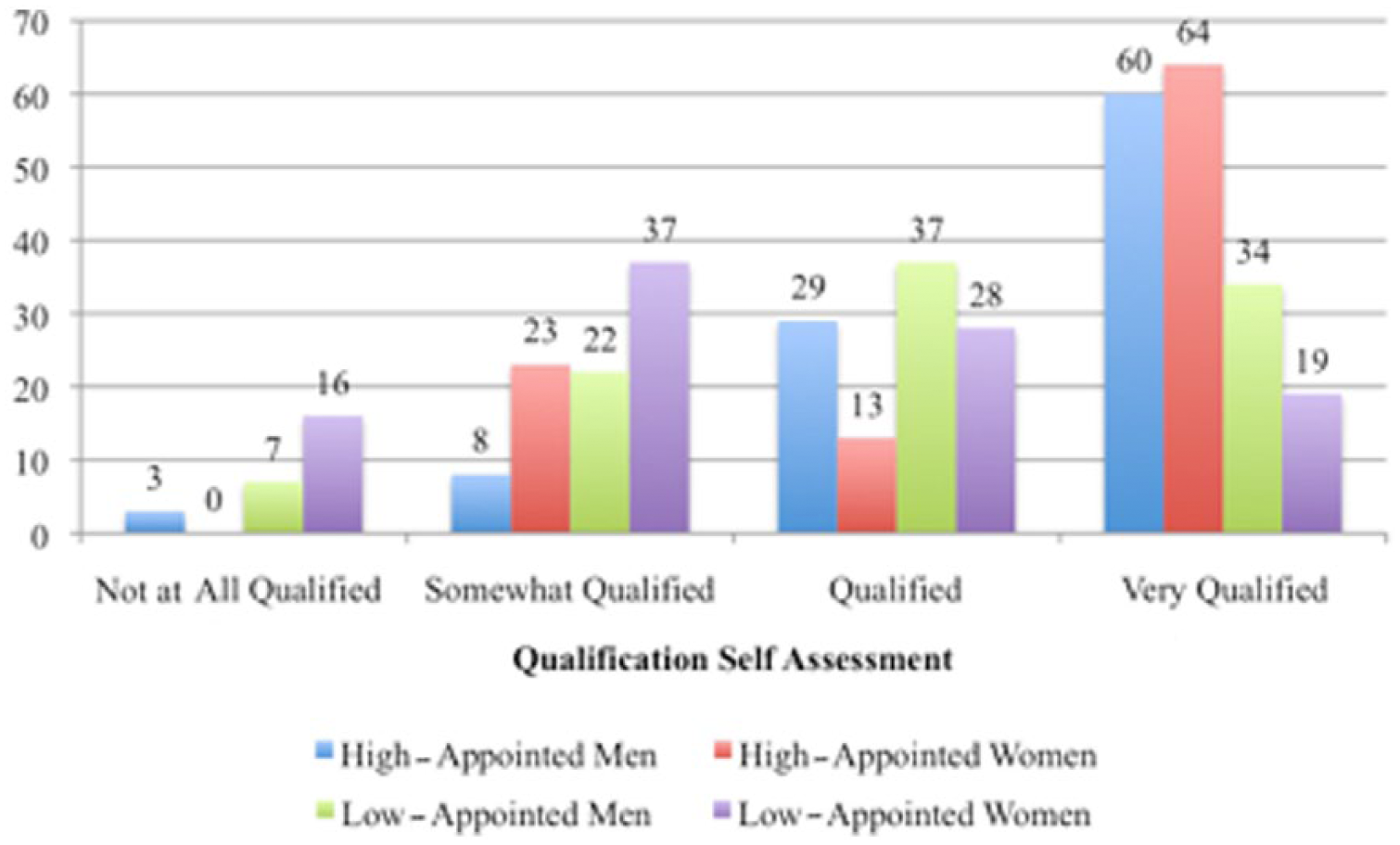
Appointee qualification self-assessment by level and sex.
Interest in Higher Office
A notable difference emerges between appointed men and women when it comes to interest in higher office (Table 4), the dependent variable. While appointed men and women exhibit similar levels of overall progressive ambition, with about 38 percent of males and 33 percent of females saying that they are somewhat or very interested in higher office, appointed women are about 5 percent more likely to not be interested at all in higher office (p < .10). Low appointees are slightly less progressively ambitious than high appointees (see the online appendix).
Current Interest in Higher Office by Sex.
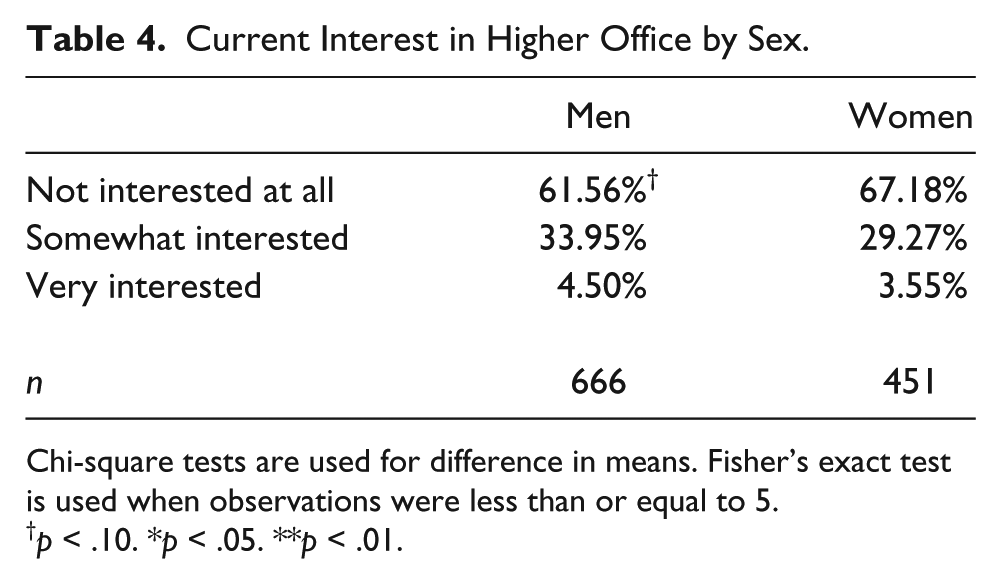
Chi-square tests are used for difference in means. Fisher’s exact test is used when observations were less than or equal to 5.
p < .10. *p < .05. **p < .01.
Part of the reason why low appointees seem to be uninterested in seeking higher office may be due to the nature of their current appointments. Many appointees at the board and commission level expressed their love of public service without a personal ambition for public office. As a male council member from North Dakota remarked, I am currently employed and very busy in my position as a manager in the energy industry. My appointment by the North Dakota Governor as Chairman of the North Dakota Workforce Development Council is based upon my interest in Workforce Development . . . My role as chairman is not monetarily compensated and part-time. It is more a labor of love. I have no political ambitions, but am seeking to provide better work opportunities in North Dakota for our young people.
A female appointee on a Louisiana commission said something similar: I first began in politics when I was 7 and [my] father ran for office; [I] have one MS in campaign management and another in public administration. I love politics and loved running campaigns—but never wanted to run for office. At present [I] work for an organization and [my] work encompasses policy and lobbying. My appointments are in areas where I have the greatest interest—workforce, education and healthcare. [I] have worked at all levels—city, state and as a Congressional staffer—and loved every position.
For others, their position is purely due to their specific qualifications as related to their job or education. A female board member from Oregon expressed a recurring theme among the appointees at the board and commission level, “The motivation to serve on a board in my state is directly related to my career. I am not at all interested in politics.” Still others expressed an active interest in pursuing higher office and even elected office, but age, self-doubts, and lack of support from family members interfere. A female commission member in Massachusetts stated the following: I am a perfect example of someone who never considered running for office even though I am passionate, articulate and have leadership skills. I advocated to be appointed to [my] commission for over a year. When I finally was appointed I was terrified to participate at that level of our government having no former experience. I have thrived there and have been one of the leaders despite the fact that I am out-experienced by almost everyone there. I also am from Western MA, which is a huge obstacle to real political engagement. Despite that, I have been a key leader on the committee and my leadership has grown. I am not clear what my own next steps might be at the state-level and I’m interested in pursuing more opportunities.
5
To reiterate, appointees overall feel they are qualified to attain higher public office, although differences exist between high and low appointees, with low female appointees least confident in their qualifications for public office. The most notable split is between male and female appointees and their self-assessed qualifications, and there is also a gender gap in the interest in higher office, with females slightly less interested in considering higher office at all.
Models and Results
To present a more systematic analysis of the gender dynamics for progressive ambition at the state appointed office level, I constructed several quantitative models. In the first model, I use interest in higher office as a dichotomous dependent variable where 1 denotes very interested or somewhat interested in higher office and 0 indicates no interest in higher office.
I use a series of controls that are hypothesized to influence progressive ambition. They include the following: (1) demographic measures (such as education level and family income); (2) family dynamics, including responsibility over household tasks; (3) political dynamics, such as recruitment; (4) personal political characteristics, including current position value; and (5) state-specific variables, such as state culture, state political opportunity structure, and local political opportunity structure. Both the local and the state political opportunity structure variables measure the number of offices available at each level, or the opportunity to hold public office at either the state or local level. All variable descriptive statistics and explanations for coding are available in the online appendix. Predicting interest in higher office was completed using robust logistic regression. The “Impact” column in Table 6 represents the change in probability for the variables that were statistically significant using Clarify. Table 5 presents the results for the ambitions for interest in higher office. The results are reported in terms of changes in predicted probability (Table 6) as well as reference coefficients (Table 5). 6
Logistic Regression Interest in Higher Office for Political Appointees.
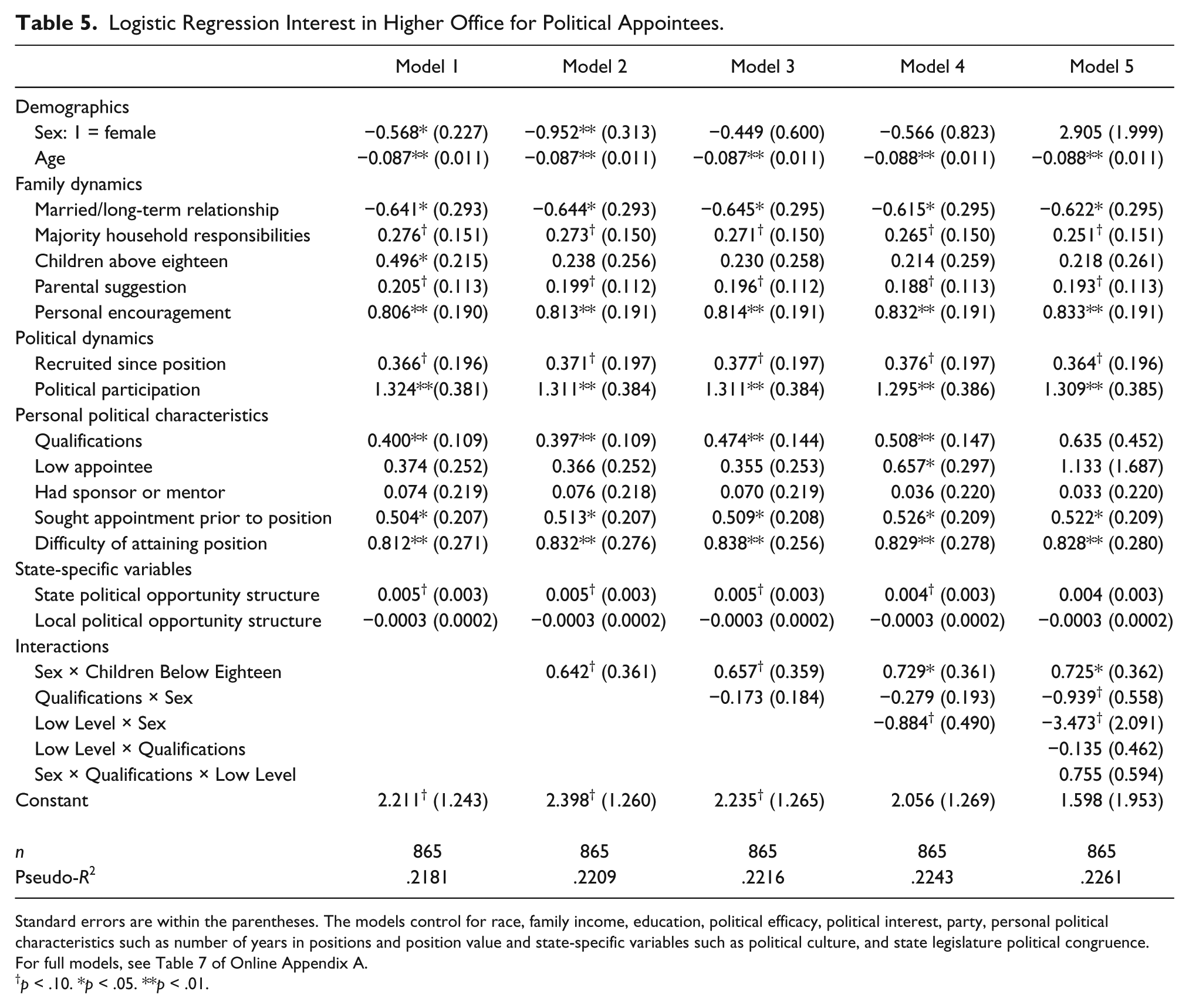
Standard errors are within the parentheses. The models control for race, family income, education, political efficacy, political interest, party, personal political characteristics such as number of years in positions and position value and state-specific variables such as political culture, and state legislature political congruence. For full models, see Table 7 of Online Appendix A.
p < .10. *p < .05. **p < .01.
Impact of Key Variables on Progressive Ambition for Political Appointees.
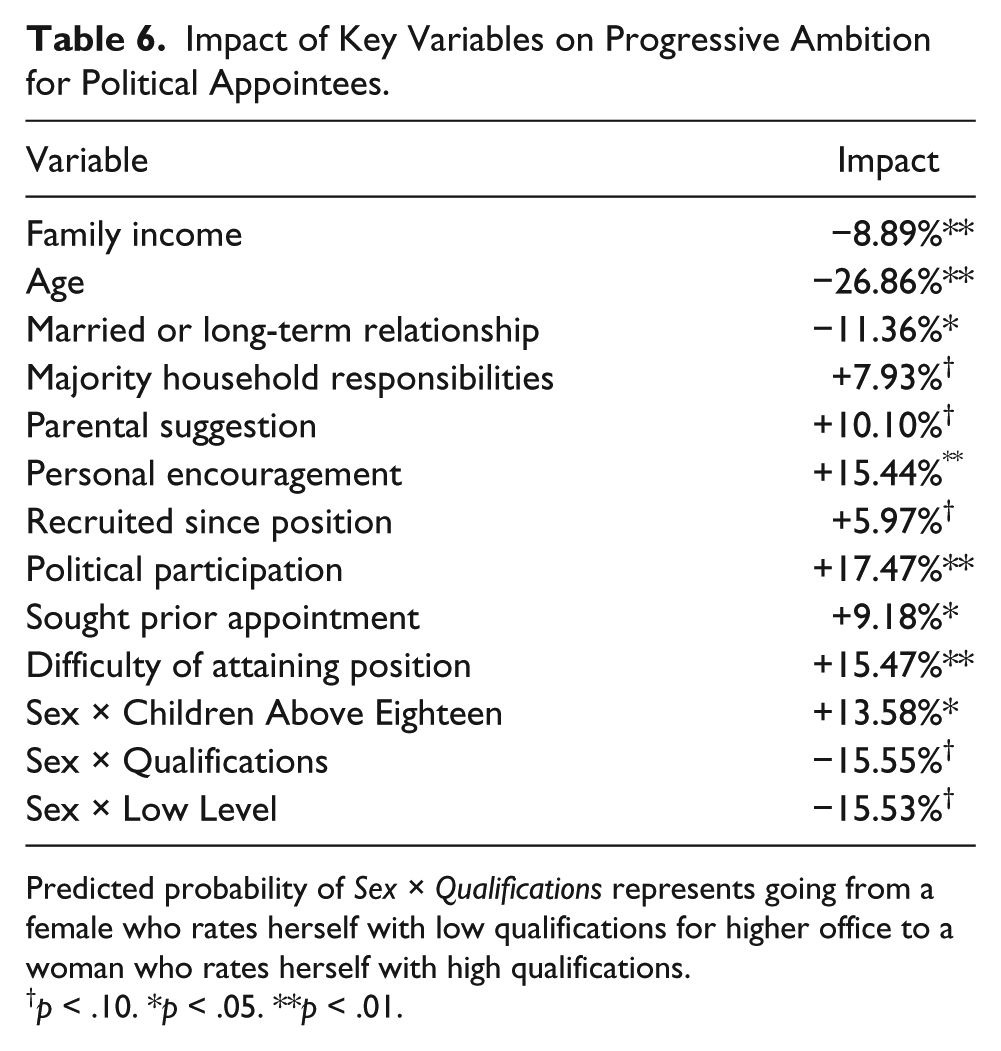
Predicted probability of Sex × Qualifications represents going from a female who rates herself with low qualifications for higher office to a woman who rates herself with high qualifications.
p < .10. *p < .05. **p < .01.
The variables of main interest here are the sex, level of office, and qualifications for higher office as well as their interactions. As stated above, I expect sex (Hypothesis 1) and self-assessed qualifications to be significant predictors of progressive ambition. In particular, gendered perceptions should be present in the analysis of progressive ambition (Hypothesis 3) and those gendered perceptions should be conditioned by the individual’s level of office (Hypothesis 4). 7
Results
There are three major patterns in the baseline model (model 1). First, all of the family dynamics variables are significant when predicting interest in higher office. Second, sex is a statistically significant predictor of progressive ambition (confirming Hypothesis 1 that female appointees will be less progressively ambitious). And finally, self-assessed qualifications are significant predictors of progressive ambition for appointed officials and supporting earlier research that with higher self-assessed qualifications comes more interest in seeking public office.
Focusing on the baseline model first and the two variables of main interest, self-assessed qualifications and sex, we can see that both qualifications and sex are significant. An appointee who assesses herself as very qualified for higher office is more than 19 percent more likely to be interested in higher office than an appointee who assesses herself as not at all qualified for higher office. Female appointees are about 9 percent less likely than male appointees to exhibit interest in higher office.
Indicators of family dynamics, such as being married, are a significant negative predictor of progressive ambition. Having a parent suggest that, someday, the respondent could run for office increased interest in higher office by almost 13 percent. Here we also see the effects of having children above eighteen: appointees with children above the age of eighteen were 8 percent more likely to be interested in higher office than those with no children or children below eighteen. With one notable exception (state political opportunity structure), all of the state-specific variables were insignificant.
The Role of Office Level, Sex, and Self-Assessed Qualifications for Appointees
The results in model 1 show the continued effects of self-assessed qualifications on progressive ambition as it relates to an interest in seeking higher public office. The results also show the negative effects of sex on political appointee progressive ambition. Models 2 to 5 test the interaction between level of office, sex, and self-assessed qualifications. 8 Table 6 provides the predicted probabilities of model 5 using Clarify.
Each model builds upon the baseline model by adding an interaction term. Model 2 includes the interaction of sex and having children above eighteen to test the long-held theory that women will become more ambitious after their children have left the home: being a mother to children above the age of eighteen does have a positive effect on progressive political ambition for appointees at the state level. A female appointee who has children above eighteen is almost 14 percent more likely to exhibit an interest in higher office than a woman who does not have adult children, as well as politically appointed men.
Models 3 to 5 tease out the relationship between sex, self-assessed qualifications, and level of office. Low female appointees are more than 15 percent less likely to have progressive ambition (p < .10). Both the interactions of sex and level of office, and sex and qualifications are significant at the p < .10 level. However, the direction of the interaction of sex and qualifications goes in the opposite direction from what was hypothesized in Hypothesis 3, which argued that appointed women would become more progressively ambitious as they have higher self-perceived qualifications for higher office.
The table also shows the null results of Hypothesis 4, which argued that gendered perceptions are conditioned by the level of office a female holds. The triple interaction of sex, self-assessed qualifications, and level of office fails to attain standard levels of statistical significance. This suggests that gendered perceptions do exist at the lower appointee levels, because the interaction between sex and self-qualifications is significant. However, these gendered perceptions are not related to the individual holding low-level appointed office because neither the interaction between qualifications and level of office, nor the triple interaction of level of office, sex and self-qualifications was significant.
Most interesting are the results for the interaction between sex and self-assessed qualifications: they go in the opposite direction that was hypothesized. Past gendered perception studies have found that women tend to have lower perceptions of their own abilities, which negatively affect their ambition; therefore, the higher perception a female has of her qualifications, the more ambitious she will become (Fox and Lawless 2011; Lawless and Fox 2005). Here, the coefficient of the interaction sex and self-assessed qualifications is negative, meaning that as women rate their own qualifications higher, they become less progressively ambitious. A female appointee who assesses herself as very qualified for higher office is more than 15 percent less likely to be progressively ambitious than a female appointee who assesses herself as not qualified at all for higher office. In this sense, having a higher perception of one’s qualifications is not an asset to progressive ambition, but a detriment, at least in the appointment world. Why might this be the case?
Discussion and Conclusion
The analysis of the State Political Pathways Survey demonstrates that what explains the progressive ambition of appointed officials does not fully explain the progressive ambitions of elected officials. In prior studies of nascent ambition, gendered perceptions were a major factor for women considering elected office (Lawless and Fox 2005). I have argued here that gendered perceptions persist in the calculations of progressive ambition for appointed women at the state level; higher self-assessed qualifications would increase a female’s interest in higher office, although her level of office would condition this. I did find that female appointees are less progressively ambitious than male appointees, and that this is affected by how a woman perceives her own qualifications. This relationship is not affected by an appointee’s level of office. However, the direction of this effect was unexpected; women with higher self-assessed qualifications are less ambitious than men and women with lower self-assessed qualifications, deviating from previous studies in this area (Bledsoe and Herring 1990; Fox and Lawless 2011).
Why might a female appointee who sees herself as qualified for higher office be less interested in higher office than a woman who assesses her qualifications lower? Part of the reason may be due to the fact that these women are appointed, and not elected. In American politics, we tend to think that the most powerful positions in our government are elected and not appointed, which may affect the ambitions for each kind of office. But the answer may be in the words of the appointees themselves. Appointees insisted that their positions are not political because they are only appointed due to their profession or expertise. In fact, many appointees, both high and low, argued their positions were not political, even though the state government appointed them, their board is funded by state governments, and they enact state policies and regulations. The disavowal of politics is an area that has been studied quite extensively (Baiocchi, Bennett, Cordner, Klein and Savell 2014; Bellah et al. 2008; Craig 1993; Macedo 2005; Pharr and Putnam 2000) and is likely part of the reason why appointees are hesitant to say they are in politics, and why female appointees with high self-qualification scores would be less ambitious for public office. The problem is not that these women do not see themselves as experts in their fields or as unqualified for higher positions, but that this expertise can be put to better use outside of the political arena.
The female appointees in the sample are a highly motivated and successful group of women, holding positions where they can make a real difference. These women have both a proven track record of success in their own lives, and a glimpse into the world of state politics through their appointments. This puts them in a unique position of having personal experience in state-level politics dedicating their time and energy to an issue they care about without committing to a more high-profile, demanding political position. In this sense, these women have a front row seat to the politics of state government and recognize that while they may be qualified to do the job as a more “political” public official, they are still opting out and in fact may feel they have never opted into a political position in the first place. These results suggest that we cannot assume that women with high-qualification self-assessments will automatically be interested in higher public office, or that politics is even something a woman would want to aspire to. They also suggest that we cannot assume that women should be politically ambitious, and that women in political positions, such as appointments, will perceive their appointment as political at all.
Future scholarship should examine why these women are not interested in higher office and at what point they consider their positions as political and why. Is it truly a disavowal of politics, or is it some other factor such as financial concerns, family obligations, or an ambition for something other than public office? It may even be that these women are satisfied with the impact they are having with their appointments, and do not feel they need to move higher up. What we do know for certain is that future studies on women and politics should consider including appointees as part of their analysis, as many women contribute to politics through appointed positions, yet behave differently than similarly situated women in elected positions. Future studies should also include individuals appointed to boards, as it may be an area where women feel they can make a difference in a policy area without committing to the responsibilities of a higher or more political public office. If we really want to understand representation of women in government, expanding beyond electoral national and state offices will go a long way to revealing the true status of women in public office in the United States.
Footnotes
Acknowledgements
I would like to thank Wendy Schiller, Susan Moffitt, Aaron Weinstein, Matthew Hodgetts, and the anonymous reviewers for their helpful comments on earlier drafts of this article.
Declaration of Conflicting Interests
The author(s) declared no potential conflicts of interest with respect to the research, authorship, and/or publication of this article.
Funding
The author(s) received no financial support for the research, authorship, and/or publication of this article.

Notes
References
Supplementary Material
Please find the following supplemental material available below.
For Open Access articles published under a Creative Commons License, all supplemental material carries the same license as the article it is associated with.
For non-Open Access articles published, all supplemental material carries a non-exclusive license, and permission requests for re-use of supplemental material or any part of supplemental material shall be sent directly to the copyright owner as specified in the copyright notice associated with the article.
