







Abstract
The Madisonian formulation suggests that (religious) pluralism is linked to moderate representation when filtered through republican selection. We leverage the quasi-experiment afforded by the ratification of the 17th Amendment to explore whether religious diversity shapes how senators vote. The shift from indirect to direct elections, coupled with roll-call and religious Census data, allows us to test hypotheses derived from differing conceptions of pluralism and the literature on constituency effects in Congress. We find that religious diversity is linked to ideological moderation, but that link weakens considerably in the immediate aftermath of the amendment’s passage.
Introduction
“Difference of opinion is advantageous in religion. The several sects perform the office of a Censor morum over each other.” “Bigness leads to power, and . . . all power—ecclesiastical as well as political—needs to be checked.”
Debates about the relationship between religion and faction date to the beginning of the republic, and exactly how religious diversity affected politics was a matter of some contention among the founding generation. While civic republicans such as John Adams argued that a core set of religious values would constrain the public and ensure stability (see also Tocqueville 1969), others, especially James Madison, saw the potential for the opposite relationship. That is, as Madison wrote in Federalist 10 and 51, only through the competition of a diversity of interests or sects filtered through republican institutions would the violence of faction be restrained. In this paper, we engage this debate by leveraging the institutional change wrought by the direct election of senators. We assess the degree to which the distribution of religious interests interacts with institutions to shape representational extremism. In doing so, we ask: how does the diversity of the religious landscape, conditional on the institutional environment, affect how senators vote in Congress?
Using data on senators’ scaled roll-call votes from the 51st through 74th Congresses (1890–1936), coupled with religious Census data collected by the U.S. Census over the same time period, we examine the moderating influence of state-level religious diversity on voting behavior in the U.S. Senate as senators’ principals shifted from state legislatures to the people of the states (see also Gailmard and Jenkins 2009). We find evidence for Madison’s view—a diverse religious environment serves as a Censor morum (a regulator of morals) over legislators when state legislatures select senators. Once direct elections are instituted, however, the power of religious pluralism to inhibit extremism weakens. That is, once direct elections engage it, religious diversity permits the ideology of senators to migrate toward the extremes. And while we might examine diversity writ-large, we focus here on religious diversity owing to the fact that religion was often at the center of political differences during the nineteenth and early twentieth centuries (Benson 1961; Jensen 1971; Swierenga 1990).
These results stand at odds with the pluralist truism that diverse interests encourage moderation by increasing competition between groups. But they fit with a broader constellation of findings that have emerged from research on congressional district heterogeneity (Bailey and Brady 1998; Bishin, Dow, and Adams 2006; Ensley 2012; Gerber and Lewis 2004; Kirkland 2014). Our results thereby help to reaffirm the paramount importance of republican institutions (see also Haider-Markel, Querze, and Lindaman 2007; Lewis 2011; cf. Lax and Phillips 2009), for much as Madison anticipated, a diversity of interests alone is not sufficient to stem movement toward the extremes.
Religion, District Diversity, and Voting in the Senate
The relationship between religion and the state in America has often been a complicated one. A number of the nation’s civic republican founders, such as John Adams, hoped that religion would continue to be a robust force in the country. They expressed doubt about the prospect that “political prosperity,” to borrow a concept from George Washington (quoted in Berns 1982, 166), was possible without a national morality rooted in religious belief. And Tocqueville, at least, preferred his religion dogmatic and majoritarian to promote action, cooperation among believers, and resistance to elites (Tocqueville 1969).
At the same time, Washington’s contemporaries, principally Jefferson and Madison, subscribed to a different view. A “multiplicity of sects,” they contended, would help to protect basic rights and aid in curbing the worst excesses of freedom, as well as the moral and religious certitudes that often accompany fervent devotion to a belief system (see Berns 1982). And while it is possible that a church with a monopoly over the religious marketplace
might exercise its political influence with restraint and tolerance . . . there is always the danger that a religious body in a monopolistic situation might be tempted to throw restraint to the winds and impose its views through legislation on the public in general. (Stedman 1964, 59–60)
Religious diversity, in other words, breeds competition and prevents any one view from predominating—a diversity of sects would exercise the office of a Censor morum to inhibit extremism.
Madison, notably, went a step further. While his contributions in the Federalist papers are clearly an attempt to promote the ratification of the Constitution, they also articulate a theory of how democracy can safely handle disagreement. His elegant formulation promoted equality through liberty rather than pitting those concepts against each other, and vested in the extent of disagreement the safeguard to stability. That is, diverse interests filtered through a republican set of institutions would work to monitor interests and act against attempts at encroachment.
It might seem difficult to translate Madison’s stated concern in Federalist 10 with controlling the “mischiefs of faction” into worries about ideological moderation among the people’s agents in government. However, a number of observers have noted that Madison, having been influenced by the ideals articulated during the Scottish Enlightenment, desired above all to promote moderation. These same observers (e.g., Farr 1988) see ideology as we conceive of it today as a natural outgrowth of the concept of enthusiasm—a construction that Madison and the other Federalists cautioned against and set in clear opposition to their proposed “science of politics” (Federalist 9). Elsewhere in his writings, Madison (1865, 327) explicitly connects religious enthusiasm with oppression, arguing that such a force would “hardly be seen with pleasure at the helm of Government.”
Subsequent empirical research, though, has found religion linked to representation on several levels. Legislators’ own religious affiliations and beliefs have been found to structure their voting behavior (Burden 2007; Green and Guth 1991; Guth and Kellstedt 2005; McTague and Pearson-Merkowitz 2013, 2015; Oldmixon 2005; Smith, Olson, and Fine 2010; Yamane and Oldmixon 2006; although, see Cann 2009). However, evidence that roll-call voting records (and other legislative behavior) are affected by the religious composition of a legislator’s constituency is mixed at best (Guth 2014; McTague and Pearson-Merkowitz 2013; Oldmixon 2005; Rosensone, Oldmixon, and Wald 2009; Wald 1987). The same might be said, however, for attempts at correlating other state or district-level demographic attributes with legislators’ roll-call voting records more generally (Aldrich et al. 2009). Nevertheless, a handful of studies have found that the denominational character of members’ districts correlates with representatives’ voting behavior (Green and Guth 1991; Guth and Kellstedt 2005; Oldmixon and Calfano 2007; Smith, Olson, and Fine 2010; see also Martin 2009), committee assignments (Lewis 2014), and the issues that they address in floor speeches (Blackstone and Oldmixon 2015).
Much of this research has focused on a relatively brief time span (typically, one Congress) during a period in which the connections between particular religious traditions and the political parties have proven remarkably stable, whereas the connection between religion and representation has changed considerably across time and space (Wright 1973). That is to say, that researchers interested in how the religious character of legislators’ districts shape their behavior in the legislative arena have used data from the modern era—a time period characterized by strong, even fused, ties between Evangelical Protestants and the Republican Party (Patrikios 2013) and the active political involvement of the faithful more generally. Moreover, although these studies typically include a host of other district-level characteristics as controls, none can credibly rule out the influence of other potential confounds (see Guth 2014). It certainly could be the case, for instance, that voters select representatives who reflect their own beliefs, thereby confounding the relationship between the religious character of the jurisdiction and the behavior of its elected officials.
We find parallels to this literature in the debates over the ethnocultural approach that endeavored to parse out which religious groups were linked by affinity to a particular political party (e.g., Kleppner 1970). Critics of the ethnocultural model have long argued that its utility is limited given that there is a great deal of variation in how a religious group cast its ballots over time and especially given which other religious groups are present in the organizational environment (see, for instance, Lichtman 1983; Wright 1973). Such variability within religious denominations necessitated that scholars limit the scope of their inquiries to particular time periods and specific geographies (most often, the Midwest; see Vandermeer 1981). We, therefore, argue that a different approach is needed to be able to build a generalizable model of religious distributions and democratic functioning.
Our attempt to engage the debate among the nation’s founding generations does not deny the findings in these literatures, but shifts to a different unit of analysis where it is not the particular religious groups present that matter but the fact of more or less diversity of groups. The primary advantage of this shift in focus is that it comes with a tighter tether to concerns about religion and support for democratic societies (e.g., Huntington 1996; Meyer, Tope, and Price 2006; Stepan 2000). While some of this work is interested in the particular religious group dominant in a state (e.g., Dalton and Ong 2005; Huntington 1996; Tessler 2002), others have found that the structure of religious diversity in a state conditional on its institutions (e.g., religious regulation) shapes democratic output (Barro and McCleary 2005; Fox and Tabory 2008; Gill 2007; Grim and Finke 2007). Our approach lies closer to this latter work, and envisions the religious economy of a particular state—the representation of diverse religious groups that might potentially be organized in a politically salient manner—as a key determinant of politicians’ behavior.
According to the Madisonian formulation, though, the representation of diverse interests in the organizational environment is a necessary, but not a sufficient, condition for both the protection of minorities and for curbing the worst excesses of enthusiasm in politics. Instead, diversity was to be coupled with republican institutions that would help to insulate certain elected leaders from the passions of the mass public. In our current application, then, the “select appointment” of senators (Federalist 62) by relatively expert state legislators limited the influence of extremist elements in the electorate—religious or otherwise. Indirect elections may have made it more difficult for groups that would seek to push their elected representatives in a particular ideological direction to do so. It seems unlikely that they would have a sufficient presence in every state legislative district to force enough legislators to the extremes to shift the body median. Indirect elections, therefore, served to ensure that the median state legislator was more moderate than the constellation of interests in the state. State legislators, as comparative experts, could reasonably be trusted to attend to the selection of more moderate U.S. senators. Direct elections by the mass public, however, often exhibit conflicts between the ideological extremes while an apathetic center divests from the process. It is this “missing middle” that allowed senators answering directly to the people the ability to cobble together a minimum winning coalition by mobilizing only their core supporters—those who number among perhaps the most ideologically extreme in any given jurisdiction.
The expectations of the Madisonian (or pluralist) approach to religious diversity find additional backing from investigations of the legislative effects of constituency diversity. At first blush, it might seem obvious that legislators representing diverse constituencies should, on average, exhibit more moderate voting records than those operating in more homogeneous electoral environments. According to this view, legislators representing heterogeneous districts must vote in a way that does not consistently raise the ire of any of the myriad activist groups to keep their seats. Consequently, these legislators might rate as more moderate as they find it in their best interest to appeal to one particular, salient subconstituency on one vote and a different one on the next (Bishin 2000; Bishin and Dennis 2002; Fiorina 1974; see also Gronke 2000).
That is to say that legislators do not take into account the totality or the ideological nature of their district (Fenno 1978). Instead, they are more likely to be aware of the interests of active groups with resources at their disposal (Miler 2007). Legislators also consider each vote that they cast on a case-by-case basis (Bianco 1994), meaning that the particular constellation of organized (or potentially organized—see Arnold 1990) interests that factor into their decision can shift from one vote to the next. The cumulative effect of such instability, with legislators appearing to be more liberal on some votes and more conservative on others, should force measures of legislator ideology toward the center (see Harden and Carsey 2012, 141).
A line of research stretching back decades, however, strongly suggests that heterogeneous districts afford legislators a wide degree of ideological latitude—at least in the modern era (Bailey and Brady 1998; Bishin, Dow, and Adams 2006; Gerber and Lewis 2004). More heterogeneous districts are consistently associated with ideological extremity among legislators (Ensley 2012; Kirkland 2014), as the need to cobble together a diverse reelection coalition often necessitates playing a “mobilization” strategy (Bullock and Brady 1983; Ensley 2012; Fiorina 1974). A corollary is that diverse districts make it difficult for challengers to put forth an effective set of policy positions, thereby affording even more of an advantage to incumbents (Ensley, Tofias, and De Marchi 2009). This fact helps to explain why there would be little evidence to support the common assumption that heterogeneous constituencies inherently make for more competitive electoral contests and, which, in turn, would force legislators running for reelection in such districts to converge toward the ideological center (Bond 1983; Gulati 2004; Sullivan 1973).
Leveraging Institutional Changes
Most studies that have uncovered evidence of ideological change and adaptation among legislators—as we seek to do here—have leveraged institutional reforms to examine whether legislators alter their voting behavior. Existing work, for instance, has similarly used the passage of the 17th Amendment to drive investigations of how senators’ behavior changed after the principal to which they answered shifted from state legislatures to the people (Bernhard and Sala 2006; Gailmard and Jenkins 2009; see also Meinke 2008).
Couching their analysis within a principal-agent framework, Gailmard and Jenkins (2009, 324) posit “that the [17th] amendment made senators direct agents of their ultimate principals, state voters, rather than indirect agents directly accountable to political intermediaries in the state legislature” (cf. Schiller 2006). As evidence of this point, they show that the policy preferences of the voters began to correspond with senator ideology only after the post-1913 shift from indirect to direct elections (see also Meinke 2008). The modern phenomenon of senators moderating their ideological positions in the run-up to a reelection campaign also quickly developed in the wake of the 17th Amendment’s passage (Bernhard and Sala 2006).
We adopt much the same analytic tack in this paper, exploring the effects of the 17th Amendment on senator ideology. We diverge from previous work, however, in that we posit that senators pay attention to whether their constituency is heterogeneous in nature, and not just to the ideological character of the electorate. Such an approach allows us to test different conceptions of the role that diversity—and, in particular, religious diversity—plays in stemming movement toward the extremes among the people’s agents in government.
Hypotheses
We suggest a pair of competing hypotheses distilled from the literature. The first is rooted in pluralist visions of how religiously diverse constituencies moderate the behavior of elected representatives. More formally stated, we test whether,
We call this the “simple pluralist hypothesis,” which does not depend on the selection mechanism. An alternate hypothesis, drawn from research on the effects of constituency diversity and Madison’s observations regarding the necessity of pairing republican institutions with a diverse populace, holds that,
The following section describes, in detail, the data and measures that we employ in testing these hypotheses.
Data and Method
Our key independent variable—state-level religious homogeneity—was culled from religious Census data. Although recent censuses of religious bodies and membership have been privately collected by the Glenmary Research Center, from the mid-nineteenth century until the early part of the twentieth century, the U.S. government collected figures on church membership separated by denomination by county. In particular, we use data from the 11th Census (1890), and the United States Census of Religious Bodies from the years 1906, 1916, 1926, and 1936. 1
Although not without sources of potential error (see Christiano 1984), the enumerations of religious adherents that we use in this study are, with the possible exception of the 1936 edition, “generally considered to exemplify statistical work on churches in its highest stage of methodological refinement” (Christiano 1984, 345). They are an excellent resource with which to examine religious diversity at the state level (Christiano 1984). 2
With these data, we calculated a Herfindahl-type index of concentration within the religious marketplace. The Herfindahl index, also known as the Herfindahl-Hirschman index, is a measure of concentration in, for example, the religious marketplace in a particular state. As Rhoades (1993, 188) summarizes, the Herfindahl index “is calculated by squaring the market shares of all firms in a market and then summing the squares.” In theory, this variable can range from 0 to 1, with 0 representing a religious landscape in which church membership is evenly distributed among the different “firms” (denominations) in existence in a state (high pluralism/diversity), and 1 representing a marketplace that is dominated by one religious group with a complete monopoly in the region (high homogeneity). In our dataset, this variable ranges from 0.005 to 0.49 with a mean of just 0.06 (SD = 0.06), reflecting the fact that the religious marketplace in the United States is quite diverse. Importantly, there is variation on this dimension, as the histogram displayed in Figure 1 indicates. These data are therefore well-suited to testing the theorized relationship between religious homogeneity and senators’ roll-call voting records in the wake of an institutional change. Intercensal years were filled in using simple linear interpolation.
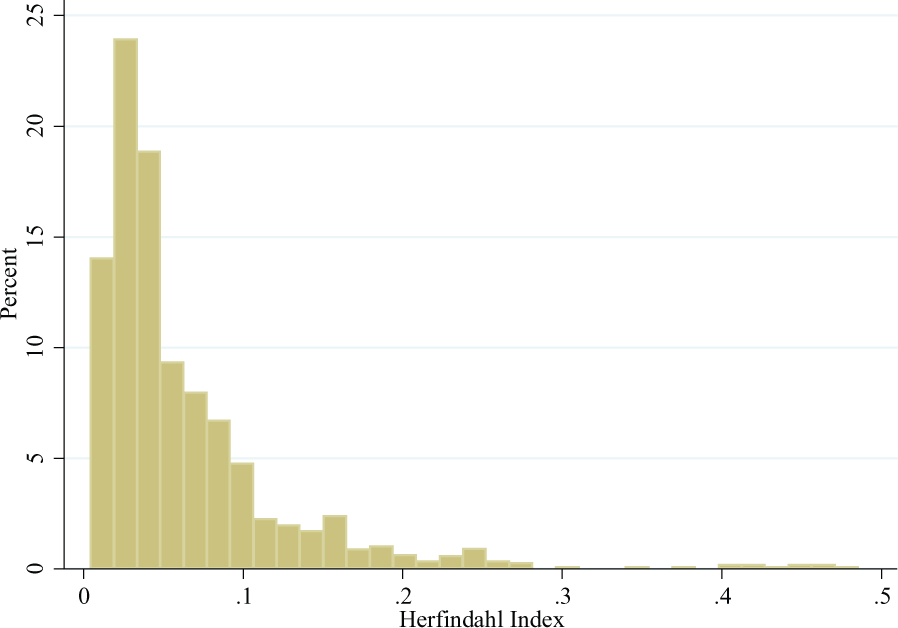
Histogram of the religious homogeneity of states (Herfindahl Index).
This variable is interacted with a dummy variable that switches on for observations after the passage of the 17th Amendment. It is this interaction that forms the focal point for our investigation, allowing the key test of what happens in diverse states after leaving behind republican selection. The implementation of the 17th Amendment therefore forms a key part of our identification strategy—one that allows us to say with some confidence whether religious diversity actually caused senators to shift their ideological leanings. 3
We employ folded first dimension DW-N scores (see Poole and Rosenthal 1997 for details), ranging from 0 to 1, to capture the degree of the senator’s ideological extremism. If the simple pluralist view is correct, this variable should exhibit lower values in states with more religious diversity. 4
We control for the partisan composition of a state’s legislature in each year with a measure called “Party Balance” that ranges from parity (at 0) to complete one party control (.5). These data were collected from Party Affiliations in State Legislatures (Dubin 2007). We believe this to be a reasonable proxy for the policy preferences or ideology of the state legislatures following previous work (see Bernhard and Sala 2006; Gailmard and Jenkins 2009; Rogers 2012). Missing values were filled in using simple linear interpolation. Missing values were quite rare and typically resulted from a state experimenting with a nonpartisan legislature (e.g., Minnesota after 1913 and Nebraska in the final few years covered by our data). 5
The ideology of the state’s electorate, as measured by the Republican share of the two-party vote for president in the state, is also included in all of the models (see Gailmard and Jenkins 2009). This measure was collected from Dave Leip’s Atlas of U.S. Presidential Elections 6 and was then folded to create a measure called “Party Competition.” As some of our models include observations from both midterm and presidential years, we simply used returns from the most recent presidential contest as a measure of state-level ideology in midterm years, even though such an approach is hardly ideal (see Rogers 2012). Fortunately, our results are not sensitive to the exclusion of observations from midterm years.
In addition, all models control for other sources of state-level diversity. Specifically, we calculated an abbreviated version of the Sullivan index (Sullivan 1973) that taps into some of the social and economic dimensions of the statewide constituency (it is also a sum of squared proportions measure). Included in this measure are rates of home ownership, nativity, and income (as proxied by per capita manufacturing output—see Gentzkow, Shapiro, and Sinkinson 2011). These constituent variables were culled from the decennial Census (Haines 2005), with intercensal years being filled in by linear interpolation.
We also experimented with removing from the dataset any senators who were appointed by a state’s governor to fill a vacancy in the state’s senate delegation (see Gailmard and Jenkins 2009). 7 Information on whether senators were appointed to their seats was gleaned from Congressional Quarterly’s Guide to U.S. Elections (Diamond 1975). Our results are not sensitive to the decision of whether or not to include observations from appointed senators.
All models are ordinary least squares regressions and include state fixed effects and a time trend variable. 8 Our model specifications throughout this paper mimic those used in Gailmard and Jenkins’s (2009) research and rely on state fixed effects to control for any unmeasured, time-invariant confounds.
Results
We begin by examining the evidence in favor of our hypotheses—the expectation that religious diversity effectively served to temper ideological extremity in the U.S. Senate (H1) and whether that extremity shifted after the switch to direct elections (H2). In the aggregate, there is little evidence to suggest much movement at all. Figure 2 plots the absolute value of senators’ DW-N scores over much of the time period under observation. There is considerable variance in ideological extremism throughout this period among individual senators, and the intercept shifts slightly lower post-Amendment. Of course, this may hide conditional effects of the amendment if some shifted more extreme and some moderated. It is important to note the strong, positive relationship between religious homogeneity of the state and extremism—senators hailing from the most homogeneous state are .2 more ideologically extreme than senators holding seats in religiously diverse states. Moreover, states were slightly more religiously diverse after the 17th Amendment’s adoption (about 1%, which is statistically significant).
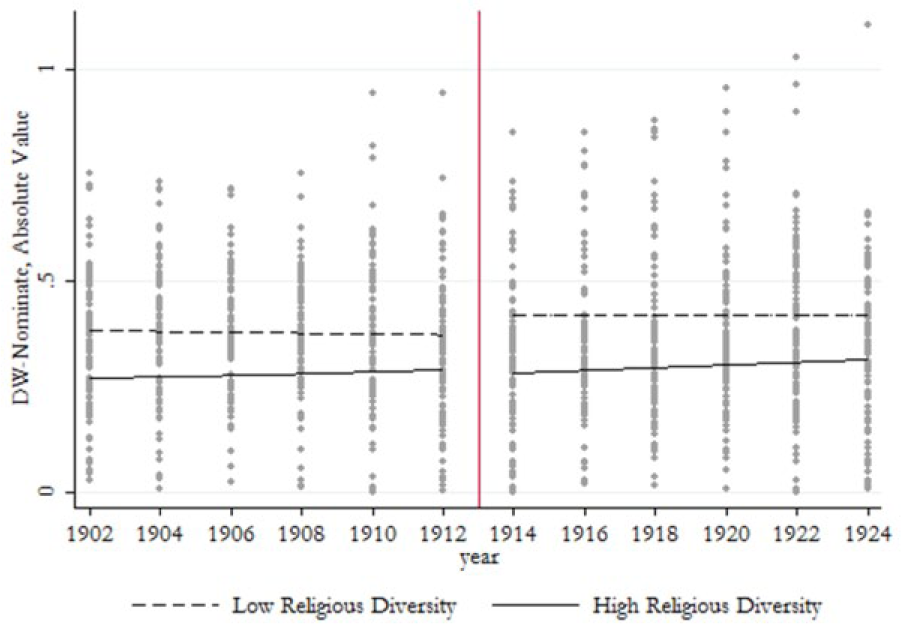
Scatterplot of folded DW-N by Congress with linear fit lines for low and high religious diversity states in pre- and post-Amendment periods imposed.
The model estimates displayed in Table 1 allow us to explore these variables in a multivariate framework. The first set of results is from a model that was estimated using data from only presidential years, while the second column presents estimates from a model fit using data from both midterm and presidential years. In substantive terms, it matters little whether we use the entire dataset or a subset containing only observations from presidential years, as the same constellation of results emerges from both models. Our measure of state-level religious diversity is statistically significant at conventional levels, as is an indicator variable that switches on after 1913—the year in which the 17th Amendment was passed. Crucially, an interaction term that multiplies the post-17th Amendment dummy by the Herfindahl-type index of religious diversity is also statistically significant. Although we do not dwell on it here, our measure of the partisan balance of the state legislature fails to reach conventional levels of statistical significance in either of the models displayed in Table 1. Greater degrees of partisan competition in the electorate, however, are associated with lower levels of ideological extremity.
The Effect of State-Level Religious Homogeneity on Senator Ideological Extremity (Folded DW-N), 1890–1936.
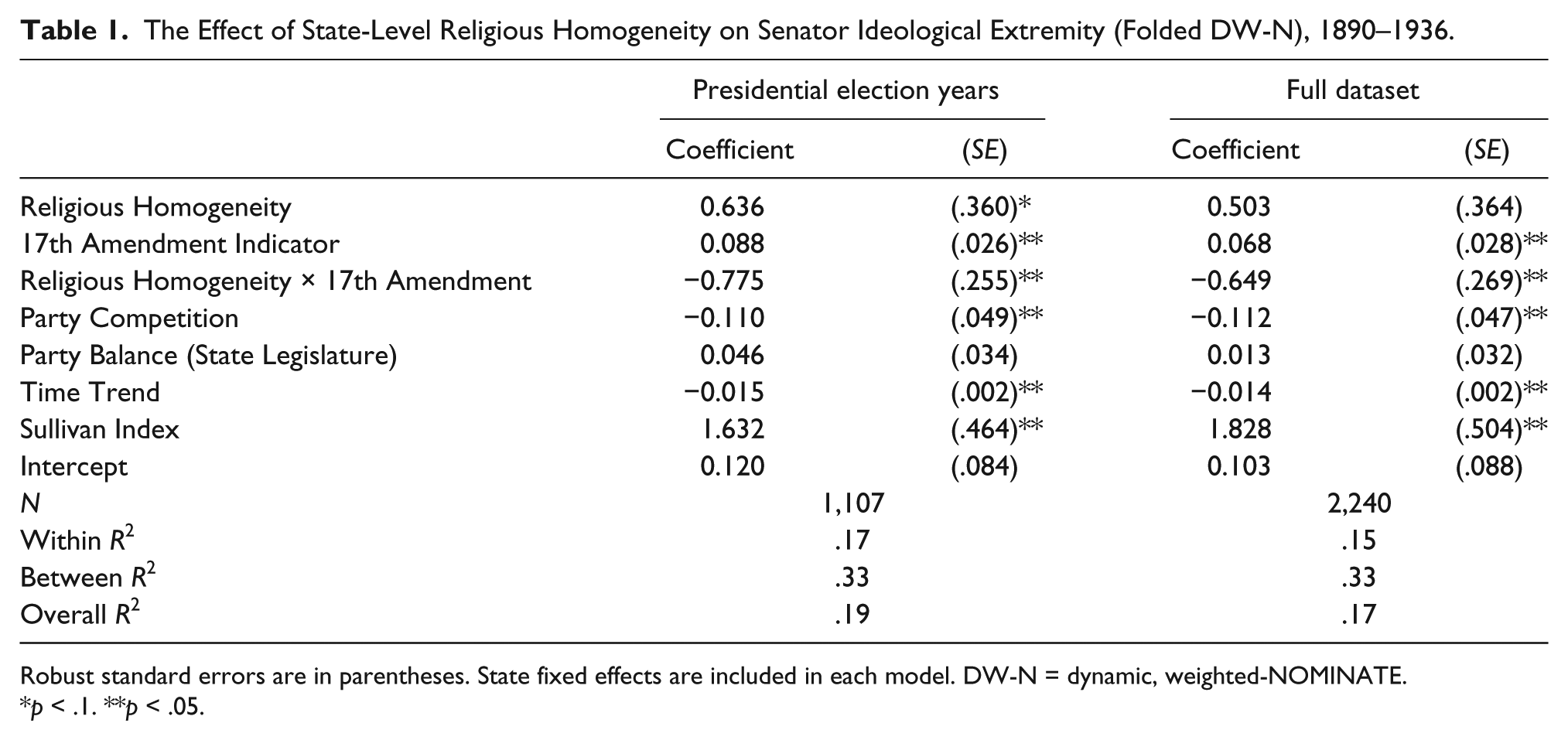
Robust standard errors are in parentheses. State fixed effects are included in each model. DW-N = dynamic, weighted-NOMINATE.
p < .1. **p < .05.
The multiplicative term in the models is particularly important. As it can be difficult to interpret the effect of one variable (in this case, the switch to direct elections for the U.S. Senate) conditional on value of another (state-level religious diversity in our formulation) from model coefficients alone, we explore this relationship visually. Figure 3 plots both the predicted values (the top panel) and the marginal effect (the bottom panel) of the transition to direct elections across the full range of values for our measure of religious diversity (the Herfindahl index). The Herfindahl index is coded such that greater concentrations of religious adherents in a few large denominations are on the high end of the scale (with a value of 1 representing a complete religious monopoly—a state in which every person of faith belongs to a single religious group). It is therfore important to focus on the leftmost part of the x-axis. The key take-away from both plots is that high religious diversity (the left side of the graph) is associated with greater degrees of ideological extremity among senators after the 17th Amendment. Focusing specifically on the predicted values of the dependent variable (folded DW-N scores), it is clear that there is a marked upward shift that results from the introduction of direct elections. At the same time, senators from states in which the faithful are concentrated within fewer religious groups (states that are above 0.15 on the Herfindahl index) do not differ appreciably in ideological terms after the passage of the 17th Amendment.
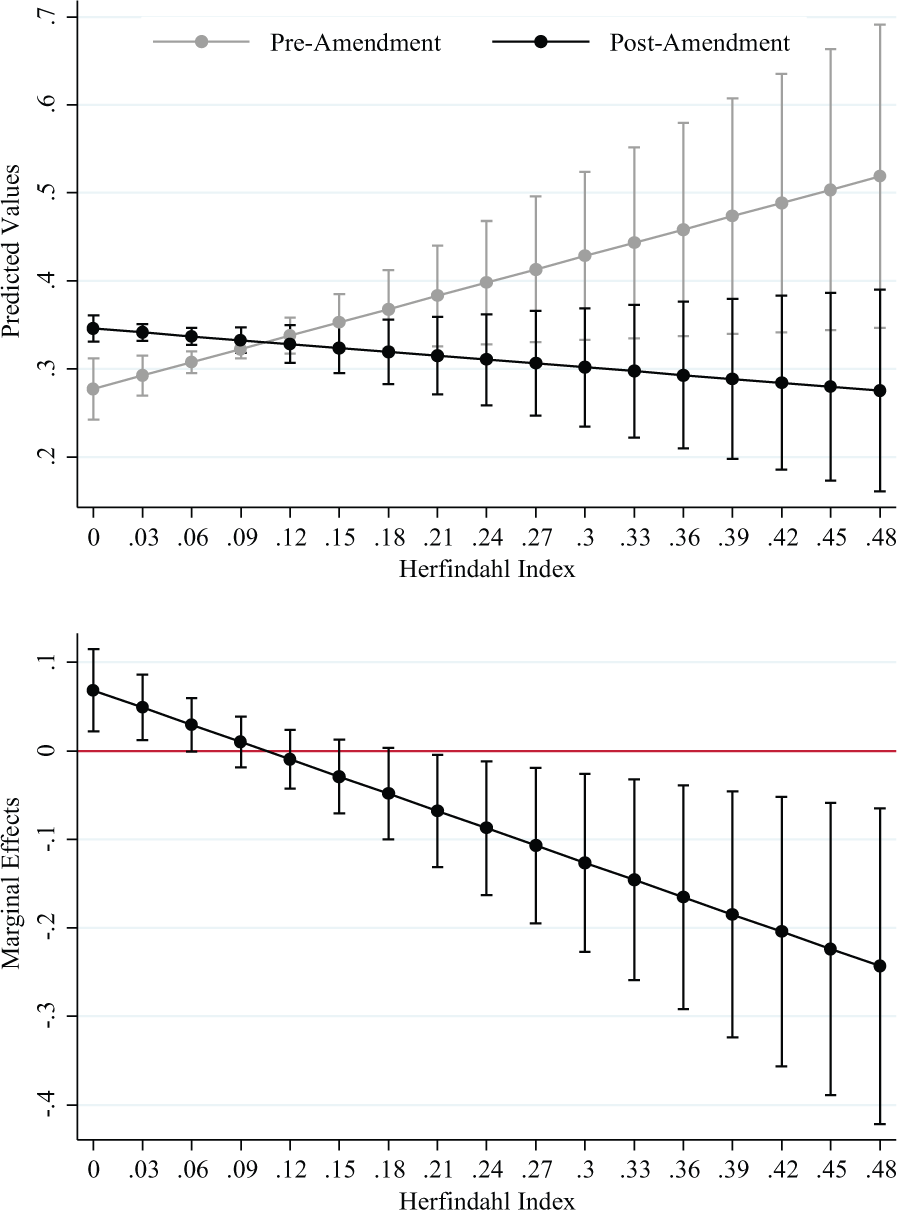
Exploration of the interaction between religious homogeneity and the 17th Amendment on senator ideological extremity (absolute value of DW-N).
This shift is most apparent in the marginal effects plot shown in the bottom panel of Figure 3, which reveals that religious diversity effectively allowed senators to move away from the ideological center, with senators representing the most religiously diverse states exhibiting roughly a 10 percent shift toward the ideological poles. This effect is indistinguishable from 0 in states that are more religiously homogeneous (again, in states that are above 0.15 on our measure of state-level religious diversity).
Another way to view these results is to examine the effect of pluralism conditional on the institutional selection mechanism—what constitutes our H1. In the pre-Amendment era, religious diversity constitutes an important force moderating senators’ ideological extremism. Extremism drops .24 points from the most homogeneous to the most religiously diverse state. 9 Notably, the effect of diversity post-Amendment weakens considerably and changes sign (−.07, p = .51). That senators from diverse states become (again, technically) indistinguishable from their peers from the most homogeneous states under direct elections should send a shock through Madison’s system. Religious diversity no longer demonstrated the same ability to tamp down the violence of faction or enthusiasm when paired with direct elections, at least in the short run.
Notably, the Sullivan index of homogeneity has the same effect. Greater concentration in these demographic categories is positively associated with senator ideological extremity. The full effect in the pre-Amendment period is to raise extremity by a whopping .75. As with religious diversity, the effect weakens in the post-Amendment period to .51. As seen in Figure A3 in the appendix ([supplementary material type] at http://prq.sagepub.com/supplemental/), the interaction with the amendment produces the same pattern as seen in Figure 3—the most demographically diverse states become more extreme after the amendment’s passage.
At this point, we can say with some degree of confidence that the 17th Amendment did have an effect on senator ideology, and this effect was conditioned by the constellation of religious groups in evidence in a particular state. 10 It therefore appears that, in the absence of republican institutions, religious diversity in the states did not serve as the kind of moderating force that some observers have postulated. Instead, greater degrees of fragmentation and competition in the religious marketplace are linked to extremity, whether by freeing senators to pursue their own goals (see Riker 1955, 468–69) or enhancing the power of salient subconstituencies (Bullock and Brady 1983; Ensley 2012; Fiorina 1974). 11 While, in his zeal for the Federalist cause, John Jay might have exaggerated the case for the indirect election of senators in Federalist 64 by describing state legislatures as being “composed of the most enlightened and respectable citizens,” there is good theoretical reason to believe that they were better equipped than the general population to keep tabs on the federal office over which the Constitution originally granted them dominion (see Gailmard and Jenkins 2009).
Next, we explore whether the effect of religious diversity decayed over time. Our approach is simple, but intuitive: we restricted our data only to observations after the implementation of direct elections, thereby obviating the need for a post-17th Amendment dummy. We then fit a model that interacts our measure of religious diversity with a time trend variable (in addition to the usual controls). Estimates from a pair of models that adopt this approach are displayed in Table 2. Religious diversity is a positive, statistically significant predictor of policy extremism. The Religious Diversity × Time Trend variable is also statistically significant and negative, meaning that the effect of religious diversity on senator ideology declined over time. More specifically, senators in the most diverse states very slightly dropped in extremism across this period, while the extremism by senators in homogeneous states rapidly decayed to join their colleagues from diverse states. These results suggest that the ability to migrate toward the ideological extremes that senators enjoyed after their direct principal shifted from state legislatures to the people of the states—movement made possible by the presence of multiple subconstituencies—was relatively short-lived. It could be that this particular result reflects a degree of learning by the mass electorate as they were forced to come to grips with the new options confronting them at the ballot box. Alternatively, it is possible that the decay effect could be the result of changes in the political meaning of religious alignments. Work by Christiano (1987), for instance, suggests that the latter years in our study were marked by an unusual degree of cooperation between Protestant denominations.
The Effect of State-Level Religious Homogeneity on Senator Ideological Extremity Diminishes Over Time (Folded DW-N), 1914–1936.
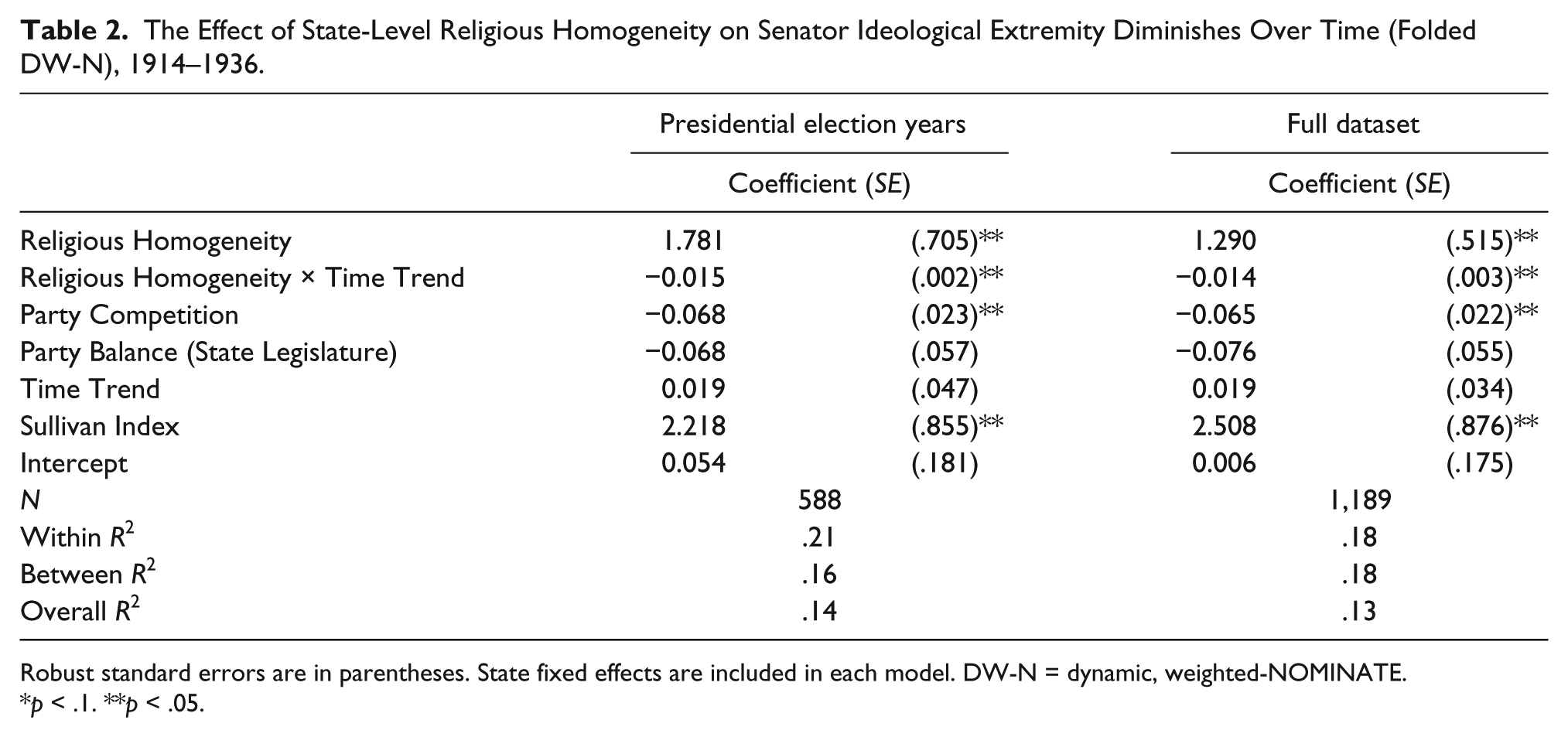
Robust standard errors are in parentheses. State fixed effects are included in each model. DW-N = dynamic, weighted-NOMINATE.
p < .1. **p < .05.
Robustness Checks
To the extent that the “Oregon system” of popularly electing U.S. senators prior to the passage of the 17th Amendment (see Meinke 2008; Riker 1955) had the same effect as the constitutional change introduced in 1913, our results likely understate the true impact of the amendment on senator ideology (conditional on state-level religious diversity). At the same time, the time window that we employ in our analyses (1890–1936) might obscure the underlying relationship between religious elements within the constituency and the behavior of their legislators.
In an effort to address both issues, we turn to a dataset made available by Scott Meinke (2008) that includes information on which senators were originally elected (whether after state-level reforms or the 17th Amendment itself). We also restrict our analysis to a shorter time period that covers the 57th Congress through the 72nd Congress (see Meinke 2008). We then estimated a pair of models that parallel those described above in Table 1, with the exception of a dummy variable capturing the method by which each senator was originally selected to serve in Congress. The first model was estimated using data only from presidential years, while the second model was estimated using the entire dataset. The specification is identical across both models, and includes an indicator for whether a senator was originally elected, our measure of state-level religious diversity (the Herfindahl index), and a multiplicative term that allows us to explore the effect of the 17th Amendment conditional on the diversity of the religious marketplace in the state. Both specifications also include controls for party competition and party balance in the state legislature, and include state fixed effects. Even with the addition of a control for selection method, our key results are undisturbed. What is more, the coefficient associated with the dummy variable tapping whether a senator was originally elected is not statistically significant (see Table A1 in the appendix [supplementary material type] at http://prq.sagepub.com/supplemental/).
As an additional robustness check, we included an indicator for whether a senator was newly elected or had served previously (using the same model specification reported above). The purpose is to assess whether the new selection process was doing the work or whether the process sent a signal that was interpreted similarly by all senators. This indicator was then included as part of a three-way interaction with our measure of state-level religious diversity and a binary variable that switches on after the passage of the 17th Amendment, complete with all accompanying factorial terms. This triple interaction is not statistically significant, nor were there portions of the range at which the effects were distinguishable (see Figure A1 in the appendix [supplementary material type] at http://prq.sagepub.com/supplemental/). At the same time, the interaction between religious diversity and our post-17th Amendment indicator is appropriately signed and remains statistically significant at conventional levels. The implementation of direct elections, it seems, affected all senators similarly, regardless of method of initial selection (Meinke 2008) and seniority.
Last, we explored whether Southern legislators differed from their Northern counterparts with respect to their reaction to the religious character of their constituencies in the wake of the 17th Amendment’s passage. In doing so, we estimated a model that is similar in specification to those reported in Table 1 with a few key differences, chiefly, the inclusion of a South dummy. This dummy is incorporated as part of a three-way interaction with religious diversity at the state level and the 17th Amendment dummy. This triple interaction is statistically significant at conventional levels (see Figure A2 in the appendix [supplementary material type] at http://prq.sagepub.com/supplemental/). Northern senators follow the general pattern reported above, becoming more ideologically extreme in states boasting of a great deal of religious diversity after the amendment. Senators representing states in the South, however, show the opposite pattern—less extremism in the wake of the 17th Amendment’s passage in diverse states and more extremism in religiously homogeneous states. Why this pattern emerges is not entirely clear, although we are certainly not the first to note that the effect of the 17th Amendment was different in the South; Rogers (2012) finds that the effect of the switch to direct elections was much more pronounced in the South, while we find that its impact was qualitatively different throughout that region.
Discussion
Recent years have seen calls for the repeal of the 17th Amendment from a number of Republican politicians and prominent conservative pundits. According to would-be reformers such as Republican Senator Ted Cruz, any sway that the states once exercised over the national government was taken away with the passage of the 17th Amendment (Greenblatt 2014). Their argument is hardly novel, however, as it contains shades of the worries that opponents of the amendment originally leveled during the debates leading up to the amendment’s passage and subsequent ratification. In particular, opponents of direct elections, such as Senator Elihu Root, believed that being held accountable to the relatively inexpert mass electorate would force senators to have to explain their actions to the voters and hasten the institution’s inexorable decline from its status as the world’s greatest deliberative body (see Riker 1955 for a review).
Whatever its effect on the power of the states relative to the federal government, one interpretation of our findings suggests that there is a profound irony in Root’s remarks: the direct election of senators actually afforded legislators representing diverse constituencies a measure of ideological leeway. Rather than continually having to explain themselves to the voters, the amendment allowed senators in diverse states the freedom to cater to more extreme subconstituencies rather than the median legislator in their state. Although it would seem obvious that heterogeneous constituencies offer fertile ground for challengers to wage a campaign against incumbent legislators, much of the available evidence suggests just the opposite to be true—it is often difficult for challengers to form a minimum winning coalition from diverse constituencies. In turn, incumbents representing a diverse electorate can often simply engage in mobilization efforts that necessitate firm policy stances rather than moderation.
It was this possibility, and not the struggle between state’s rights and federal power, that motivated John Jay to defend the practice of indirect elections. In Federalist 64, Jay wrote that “the activity of party zeal, taking advantage of the supineness, the ignorance, the hopes, and fears of the unwary and uninterested, often places men in office by the votes of a small proportion of the electors.” Such words, as we show here, would prove to be remarkably prescient, as a fragmented organizational environment allowed senators to move to the ideological extremes in the absence of effective oversight—at least in the immediate aftermath of the amendment’s passage. Therein lies the second great irony of current efforts at repealing the 17th Amendment: the most vocal champions of repeal efforts also number among the most conservative politicians on the political scene today. Were they still beholden to the “people in their collective capacity,” as Jay wrote about the institution of indirect selection, the current crop of legislative ideologues might not have quite as secure of a pulpit from which to operate.
Conclusion
The passage of the 17th Amendment allows us to evaluate Madison’s expectations regarding the necessity of combining a diversity of interests with republican institutions in curbing enthusiasm in politics and promoting moderation. Whereas a simple pluralist perspective emphasizes the need for a diverse populace, the fact that Madison also sought to insulate decision-makers to some extent is often overlooked (see also Haider-Markel, Querze, and Lindaman 2007). The developed congressional literature regarding constituency diversity in elections suggests the power of differences in institutional selection mechanisms.
We find that senators representing more religiously diverse states were more moderate than senators in homogeneous states, but those senators from diverse states became more ideologically extreme in the wake of the switch to direct Senate elections. Importantly, this effect is vested in more than 90 percent of the cases, highlighting how religiously diverse the American states were. Thus, although the evidence that we present here does not support the simple pluralist view that a diversity of religious sects alone serves as a Censor morum in society, it does serve to confirm the founders’ concerns over the importance of republican institutions—in this case, state legislatures in their role as a crucial intermediary between the people and their national leaders.
At the same time, our work contributes to the literature exploring religious constituency effects on legislator behavior. It has often proven difficult to demonstrate a direct link between the religious character of a particular geographic constituency and roll-call records. As a result, evidence that the religious composition of a legislator’s district shapes their legislative behavior is decidedly mixed. That disconnect may stem from the difficulties inherent in linking particular religious groups with policy demands and unobserved selection effects such that legislators personally reflect many of the attributes of the people they represent. We sidestep these difficulties in this paper by leveraging the institutional change that, in theory at least (see Riker 1955), shifted senators’ direct principals from state legislators to the people of the states. With this identification strategy, we find a link between religious diversity and moderation, although only before the institution of direct elections. However, we recommend shifting the focus of this work from the direction of roll calls to a central concern of American political thought—how religion contributes to the load that extreme views bring to the problems democracy must resolve.
Footnotes
Acknowledgements
The authors would like to thank Michele Margolis, Mike Brady, and the anonymous reviewers for a number of helpful comments and suggestions. They would like to extend their deepest thanks to Kevin Stout for providing excellent research assistance. Many thanks also go to Ian Conwell for Latin advice.
Authors’ Note
A previous version of this paper was presented at the 73rd annual meeting of the Midwest Political Science Association.
Declaration of Conflicting Interests
The author(s) declared no potential conflicts of interest with respect to the research, authorship, and/or publication of this article.
Funding
The author(s) received no financial support for the research, authorship, and/or publication of this article.
