







Abstract
How do Americans evaluate potential US Supreme Court candidates? Using a novel, two-part conjoint experiment, I show that respondents put high importance on the political leanings of potential Court candidates, a finding in contrast with the scholarly view that the public views the Court as different from other, more political institutions. Indeed, when respondents are given information about a nominee’s partisan leanings, they rely extensively on that information in deciding whether to support the candidate, whether they trust the candidate, and whether they find the candidate qualified. By contrast, when partisan information is withheld, respondents appear to use other kinds of signals, such as race, to fill in the gaps. Those who are most knowledgeable about the Court are most influenced by these partisan signals, providing further support for the importance of political heuristics. The results suggest that the public’s evaluation of judicial nominees is more in line with how it evaluates other political actors. They also suggest that even candidates with excellent qualifications need not garner bipartisan public support.
Introduction
How do members of the public form opinions on candidates to the US Supreme Court? The 2016 case of Merrick Garland is illustrative. Garland was, by all accounts, among the most qualified candidates ever named—a distinguished Harvard Law graduate who had spent nineteen years on the US Court of Appeals for the DC Circuit, three as its chief judge. However, despite his legal credentials and judicial experience, Garland’s nomination generated polarized responses from members of the public. According to one poll, Republicans were more likely than Democrats to have negative or somewhat negative opinions of Garland’s qualifications (24% to 11%) and to oppose Garland’s Senate confirmation (54% to 9%) (CNN). In sum, one of the most objectively qualified nominees generated significant partisan opposition—not just from elites, but also from members of the public.
Surprisingly, the literature on judicial nominations provides a limited insight into Garland’s nomination. Much of this literature suggests that the Supreme Court engenders strong feelings of deference and legitimacy, and that this belief of the Court as being “beyond politics” extends an aura of deference to the nominees themselves. However, as Garland’s nomination illustrates, even highly qualified candidates can generate significant public opposition. This in turn raises important and unanswered questions. What characteristics drive public support for candidates to judicial positions? How do these intersect with partisan affiliations? What explains that even extremely qualified candidates, such as Garland, can galvanize partisan opposition?
I address these questions via the use of a novel, two-part survey experiment involving 1,650 US adults. The experiment relies on a conjoint design that presents respondents with different potential candidates, all of whom have randomly generated characteristics. By evaluating which combinations lead to more support, the conjoint design enables the isolation of those characteristics that are more or less popular (Hainmueller, Hopkins, and Yamamoto 2014). In addition, by presenting respondents with a single professional and educational profile at a time, the conjoint design also closely reflects how candidates are presented to the public.
Using this design, I find, somewhat in contrast to the existing literature on legitimacy or judiciousness, that political signals are the most important factor in whether individuals support or trust potential candidates, or whether they think they are qualified to be named to the Court. More in line with growing literature demonstrating partisan responses to the Court and its rulings (B. L. Bartels and Johnston 2012, 2013; Christenson and Glick 2015, 2014) and with a robust literature documenting the importance of political affiliations in the formulation of beliefs more broadly (e.g., L. M. Bartels 2002a; Gerber and Huber 2009), I find that respondents are more likely to think that co-partisan nominees are more trustworthy, more qualified, and more likely to merit support as potential justices. Also contrary to some of the literature on legitimacy, I find that these differences persist both when examining reactions to the most highly qualified candidates and also regardless of how strongly respondents believe in the Court’s legitimacy. In addition, and also in line with literature in political psychology (e.g., Zaller 1992), the more respondents know about the Court, the more important partisan cues become. Such a pattern may be the case precisely because those who are more knowledgeable may be more exposed to news coverage of the Court—coverage that increasingly may portray the justices as influenced by their political views (Johnston and Bartels 2010).
However, nominees like Garland are touted for their professional experience, but little is said about their political or policy beliefs—a long-standing norm in Supreme Court nominations. Thus, to assess how people formulate opinions in a more realistic scenario in which precise information about the partisan or ideological views of nominees is withheld, I randomly assign some respondents to a conjoint design that withholds partisan information. Surprisingly, comparing the two respondent subsets suggests that, in the absence of clear political cues, respondents rely on other kinds of signals (e.g., race, gender) to infer candidates’ political leanings. The use of these cues in turn varies by respondents’ own party identification. To explain these results, I present a theory of nominee support called political searching, which builds off existing theories in political psychology. This framework posits that the political leanings of a nominee are highly salient to how Americans evaluate judicial candidates. As such, members of the public will examine the explicit political cues available and, in the absence of such cues, will seek out other information to try to piece together the candidates’ political leanings. This kind of information gathering is even more important for those who have extensive knowledge of the Court: these individuals are the most likely to know the Court’s political landscape and the possibility that appointments could affect later rulings. That is, political proximity appears to rise in importance the higher one’s level of awareness is about the Court.
This paper proceeds as follows. The first section discusses four theories of public attitude formation on nominees that motivate the experimental inquiry. The next section explains the conjoint design and its advantages. The core results demonstrating the importance of partisan cues are presented next, with attention to how this varies according to levels of knowledge and candidate quality and in the absence of political cues in the two sections that follow. The discussion section then explores how the findings provide support for politically oriented theories and less so for the theory of judiciousness. The final section concludes by noting the implications of this research for real-world nominations, specifically noting that characteristics associated with judiciousness may be important for the assessment of a candidate’s qualifications, but such characteristics do not necessarily lend themselves to support for or trust in the candidate.
Theories of How the Public Views Supreme Court Nominees
Drawing from existing literature on public opinion on the Supreme Court, I consider three theories for understanding public support of Court nominees: (1) judiciousness, (2) ideological agreement, and (3) political searching. I also discuss a fourth theory, which is (4) reasoning based on descriptive characteristics. These hypotheses inform the conjoint design.
Viewing Nominees via Judiciousness (or Legitimacy)
The dominant theory in the scholarly literature on the Supreme Court has been that of legitimacy, which posits that the Court enjoys greater deference than other branches (Casey 1974; Dahl 1957). Specifically, the Court’s intellectual atmosphere and ability to appear above politics engenders greater public confidence and deference. Numerous studies have shown that high levels of legitimacy are predictive of attitudes toward the Court as well as support for its rulings (Baird and Gangl 2006; B. L. Bartels and Johnston 2013; Casey 1974; Gibson 2007; Gibson and Caldeira 2009b, 2009c; Gibson, Caldeira, and Spence 2003; Scheb and Lyons 2000). Other studies have found that legitimacy continues to be an important frame through which Americans view the Court, despite increasing concerns about politicized rulings (e.g., Gibson and Caldeira 2011; Scheb and Lyons 2000). An extension to this framework concerns the relationship between knowledge about the Court and its legitimacy, with several studies finding a positive relationship (e.g., Gibson and Caldeira 2009a; Gibson, Caldeira, and Baird 1998). For example, Casey (1974) finds that more knowledgeable people are most likely to “mythify” the Court. I test these ideas below in considering the conflicting role of knowledge in the evaluation of nominees.
With regard to Supreme Court nominees, evidence in favor of legitimacy’s importance comes from Gibson and Caldeira (2009b), who find that public support for Samuel Alito was stronger than would be expected given his conservative views. As explanation, Gibson and Caldeira (2009b) argue that proponents of a candidate will frame his nomination in terms of “judiciousness” while opponents will use ideology. 1 They further argue that feelings of legitimacy toward the Court “shield” candidates from ideological scrutiny and that those with strong feelings of legitimacy put more emphasis on characteristics that would make a “good judge” and less on political ones. In an experiment on undergraduates, Hoekstra and LaRowe (2013) develop support for the theory, finding that among those with high legitimacy, assessments of “judiciousness” predict candidate support.
Linking this idea of “judiciousness” to the experiment here, respondents evaluating a candidate would be expected to prioritize the candidate’s overall level of qualifications, as opposed to ideological distance or other partisan cues. That is, under the judiciousness hypothesis, respondents will place more weight on objective qualifications and less on partisan positioning, holding the information environment constant. In addition, the stronger the candidate’s qualifications, the less partisan cues should matter. Following Gibson and Caldeira (2009b), these could include those “legal and technical qualifications necessary to be a good judge,” such as educational prestige or previous work experience. In addition, a key idea behind judiciousness is that these considerations work in tandem with the respondents’ pre-existing views, with respondents who believe the Court operates with high levels of legitimacy being the most likely to value professional characteristics as opposed to partisan considerations. This leads to a second implication of the judiciousness model, which is that respondents with high levels of legitimacy or knowledge will be most likely to rely on objective qualifications in evaluating candidates and least likely to rely on candidates’ partisan positioning. Furthermore, we would expect to see judiciousness matter more for a qualifications-oriented evaluation, a point I leverage below.
Viewing Nominees via Partisan Proximity
In contrast, a widely accepted scholarly view outside of the courts literature is that people form their voting and policy preferences in large part via their partisan affiliation (Angus et al. 1966; L. M. Bartels 2002a, 2002b; Berelson, Lazarsfeld, and McPhee 1954; Campbell, Gurin, and Miller 1954; Carsey and Layman 2006; Downs 1957; Gerber and Huber 2009; Zaller 1992). As the canonical work of Angus et al. (1966, chapter 6, 133) notes, “identification with a party raises a perceptual screen through which the individual tends to see what is favorable to his partisan orientation.” For Stokes (1962, 690), “the affairs of government are remote and complex,” and “[i]n this dilemma, having the party symbol stamped on certain candidates . . . is of great psychological convenience” to members of the public. More recently, L. M. Bartels (2002a, 117) finds that “party identification is a pervasive dynamic force shaping citizens’ perceptions of, and reactions to, the political world.” Others have found that partisan signals are a useful heuristic in deciding which candidates or policies to support (Lodge and Hamill 1986; Rahn 1993). To sum, the literature supports the notion that people support policies and politicians whose partisanship aligns with their own.
This view, dominant in other areas of American politics research, has influenced a growing literature on the Court. Caldeira and Gibson (1992), for example, find no connection between support for policy preferences and diffuse support for the Court, but they do find that “broad political values” (e.g., support for “democratic norms”) predict support. One step further, Hetherington and Smith (2007) find that conservatives are less supportive of the Court than are liberals, arguing that this may be artifact of a time when the Court itself was more liberal. B. L. Bartels and Johnston (2013) and Johnston, Hillygus, and Bartels (2014) extend this by arguing that the public views Court decisions through a subjective ideological lens, with ideological proximity being a strong determinant of feelings of legitimacy. Christenson and Glick (2014, 2015) find that the public has weakened feelings of legitimacy toward the Court when its rulings contradict respondents’ own political views. 2
Looking at confirmations, Gimpel and Wolpert (1996) examine controversial nominations and find that evaluations of candidates correlate with both respondents’ partisanship and with evaluations of the appointing presidents. Similarly, B. L. Bartels and Johnston (2012) develop a theory of “political reinforcement,” arguing that individuals perceiving the Court as “just another political institution” will evaluate nominees in terms of their ideological positions. For purposes of the experiment to follow, the hypothesis stemming from this is that respondents evaluate nominees by considering their political positions in tandem with their own. That is, respondents who are politically distant from a nominee will be less likely to support the nominee, to think that he or she is qualified, and to trust the nominee to reach the correct decisions compared with respondents who are co-partisans or politically proximate.
Interaction with knowledge
Such patterns may vary according to respondents’ familiarity with the Court. For example, the theory of judiciousness would predict that more knowledgeable individuals have stronger feelings of legitimacy, therefore suggesting a weakened reliance on partisan cues. On the other hand, B. L. Bartels and Johnston (2012) find that respondents who are more knowledgeable about the Court are the most likely to view its subsequent rulings in partisan terms. As they note, this finding is in line with a broader political psychology literature noting that more knowledgeable people tend to be those for whom partisanship matters the most (Carpini Delli and Keeter 1997; Goren 2004; Sniderman, Tetlock, and Brody 1993; Zaller 1992). For example, Zaller’s (1992, 297) analysis of presidential candidates finds that “individual differences in political awareness interact with partisanship and ideology in the assessment of presidential character. Among less aware citizens, partisanship has less of an effect; among the highly informed, the effect of partisanship is more pronounced.” This is also consistent with the heuristics literature; for example, as Sniderman, Tetlock, and Brody (1993, 24) note, the “comparative advantage [of the more knowledgeable] is not that they have a stupendous amount of knowledge, but that they know how to get the most out of the knowledge they do possess.” Looking at the Court, these papers would predict that more knowledgeable individuals may be those who have “received” the argument that the politics of the individual justices predict eventual rulings. This suggests a hypothesis in contradiction with that implied by the judiciousness hypothesis, which is that increased knowledge about the Supreme Court will correlate with increased reliance on partisan cues.
Viewing Nominees via Political Signaling
A problem with the political agreement hypothesis, however, is that the public frequently lacks accurate signals about the political leanings of nominees. The public surely gleans information about the political leanings of candidates from the identity of the appointing president; however, as has been argued by several scholars, this leaves the public with a weak sense of a candidate’s potential politics or directionality in terms of eventual rulings (Kagan 1995; Post and Siegel 2006), with the identity of the president often being an inaccurate signal (e.g., Earl Warren, Sandra Day O’Connor).
If the political agreement hypothesis is persuasive, then, in the absence of clear political signals, the public would be left without information with which to evaluate nominees. These concerns suggest an extension of the political agreement theory, which builds on existing literature in political psychology. This hypothesis, which I call political searching, predicts that when political positioning is missing, respondents will search for other cues that could predict political leanings. This is a concept similar to the use of heuristics (e.g., Lupia 1994; Popkin 1994; Sniderman, Tetlock, and Brody 1993), in which respondents look for cues—oftentimes in the form of party identification—to predict eventual decision making (Lodge and Hamill 1986; Rahn 1993). As several papers have noted (Lau and Redlawsk 2001; Popkin 1994), these cues could include ostensibly non-political characteristics such as candidate appearance, including race or gender. For example, using hypothetical candidate profiles, McDermott (1998) documents that both gender and race act as informational cues in low-information elections. Specifically, she finds that, in the absence of clear political cues, liberals and Democrats are more likely to support female and African Americans.
Similar to McDermott (1998), the mechanism underlying political searching operates in the context of missing (or low) information—which more closely mimics the information environment surrounding Supreme Court nominations. Under this theory of political searching, in the absence of partisan cues, respondents will look to other candidate characteristics that could correlate with political leanings. This implies that the importance of potential cues should vary from Democrats to Republicans. For Democrats, the absence of partisan signals might push them to consider race or gender—both of which have been documented as influencing judicial decision making (e.g., Peresie 2005; Scherer 2004). For Republicans, the absence of clear partisan signals may encourage them to look for judges who are male, white, or of a particular religious background (Yarnold 2000). For that reason, and to further account for partisan differences among respondents, many of the analyses below subset respondents by self-reported partisanship.
Viewing Nominees via Descriptive Connections
The last theory I consider is that demographic characteristics could influence how much respondents support a particular candidate. For example, consistent with a large literature on implicit bias, studies have shown that minority and female judicial candidates receive lower professional ratings, despite having comparable professional backgrounds (Gill, Lazos, and Waters 2011). Thus, one link is perhaps that implicit bias leads respondents to view minority (or female) nominees as less fit. Another possible link is that some respondents may have an affinity with candidates who resemble them descriptively, a finding consistent with Scherer and Curry (2010). I generalize these into a flexible hypothesis that respondent support might vary according to the race or gender of the nominee (and of the respondent).
Description of the Conjoint Experimental Design
I explore these theories via a conjoint experiment. Conjoint designs have been used extensively in marketing to study consumer preferences (Green and Rao 1971; Green, Krieger, and Wind 2001) and have been increasingly used in political science (Hainmueller, Hopkins, and Yamamoto 2014). The methodology here operates by presenting respondents with different hypothetical judicial profiles that rotate through a random set of professional and educational characteristics. Not only is this design useful for assessing the effect of any one characteristic on respondent opinion (Hainmueller, Hopkins, and Yamamoto 2014), but the presentation of judicial profiles also means that the design is well suited for studying Court nominations. Indeed, candidates are often presented to the public not on the basis of likely rulings, which candidates generally refuse to discuss, but mostly on the basis of personal characteristics and professional experience—a strategy used by the supporters of Alito, Sonia Sotomayor, Garland, and others. For example, in presenting Judge Garland to the public in 2016, Barack Obama devoted the majority of his remarks to detailing Garland’s resume, including his Ivy League education and experience as a federal judge.
The survey was conducted in December of 2013, with respondents recruited by Survey Sampling International (SSI), which employs online opt-in panels. The fifteen-minute survey involved 1,650 US adults non-probabilistically sampled so as to resemble the US population across age, gender, race or ethnicity, and geography. 3 The final number of respondents (N = 1,650) represents all who finished the survey. 4 All questions were randomly ordered within randomly ordered blocks, with the exception of the questions pertaining to knowledge and feelings of legitimacy, which came at the beginning of the survey to avoid mismeasurement. Where appropriate, all answer categories were randomly ordered.
Conjoint Design
Following Hainmueller, Hopkins, and Yamamoto (2014), each respondent was presented with six “candidate” profiles (Hainmueller, Hopkins, and Yamamoto 2014). 5 To test the political agreement and political searching theories, a random half of respondents were shown partisan information in these conjoint profiles (n = 886) and half were not (n = 764). Each profile thus contained eight (or seven) characteristics whose values were randomly assigned and ordered, with the random order assuring no profile order effect.
With this randomized design, respondents were exposed to one of sixteen thousand potential combinations with equal probability. 6 The characteristics were as follows:
Demographic Age: 30–40, 40–50, 50–60, 60–70, or over 70 years old Gender: male or female Race/ethnicity: white, black, Hispanic or Latino/a, Asian American Religion: Catholic, Evangelical Protestant, Jewish, Mormon, or Mainline Protestant
Qualifications Education: Law school ranked in the Top 14,
7
law school ranked 15–25, law school ranked 25–50, law school ranked 50–100, or law school not ranked in Top 100 Previous work experience: elected politician, law professor, lawyer in private practice, lower federal judge, non-profit lawyer, prosecutor, public defender, state judge Clerkship experience: Did not serve as law clerk or served as law clerk
Political (withheld randomly from half of respondents): Political leaning: strong Democrat, leans Democrat, Independent, leans Republican, or strong Republican
After each profile, respondents answered three questions using 5-point Likert-type scales: (1) “where would you place your level of support for this potential candidate,” (2) “where would you place your assessment of this candidate’s qualifications,” and (3) “how much would you trust that this potential candidate would reach the right decisions.” The questions were randomly ordered. As discussed below, respondents answered the three questions in different ways, suggesting that assessment of qualifications may not translate into support and vice versa.
Respondent demographics
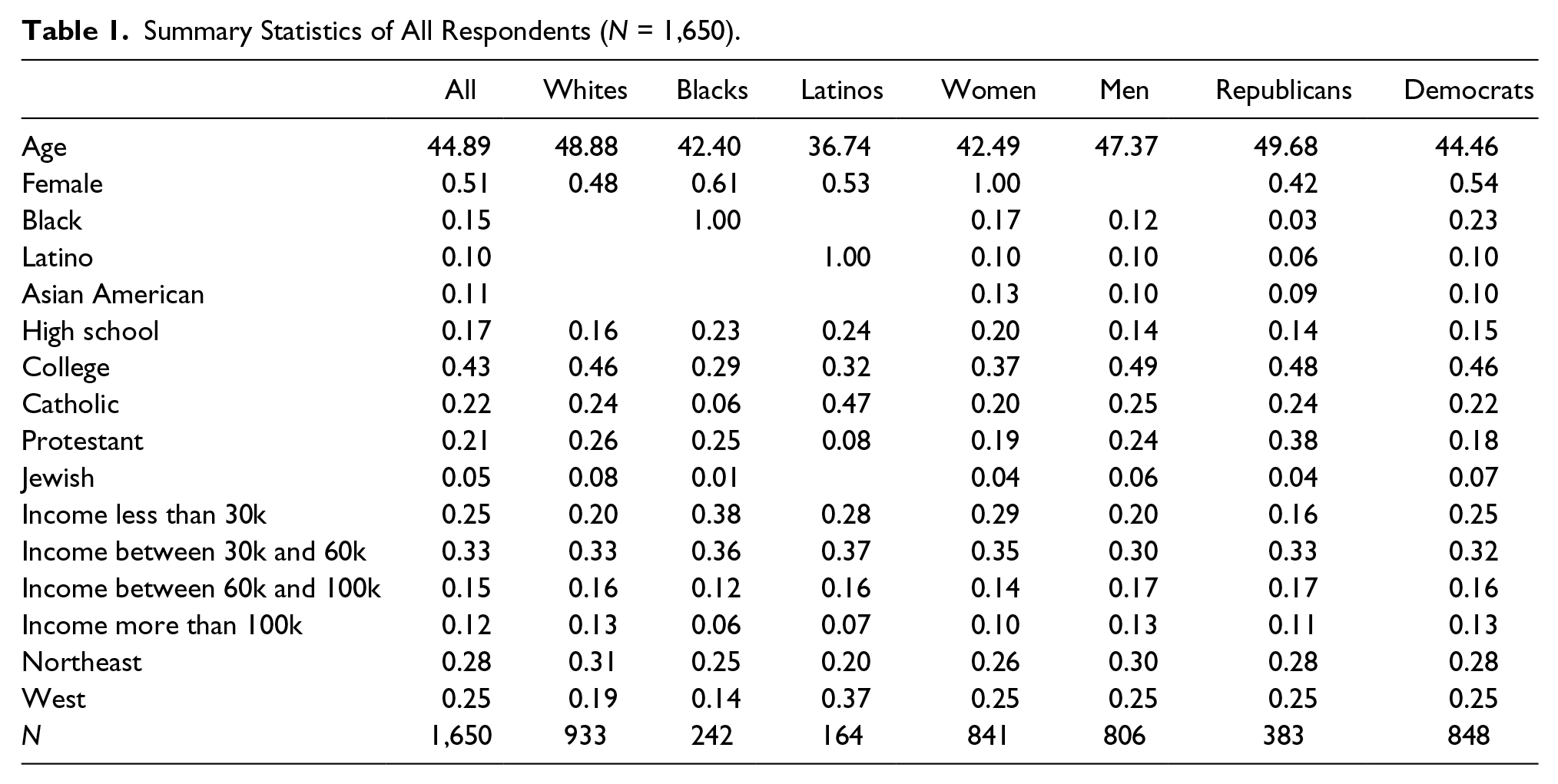
Table 1 provides demographic summary of all 1,650 respondents. Although the respondents resemble the US population across demographic and regional characteristics, the sample is skewed slightly toward Democrats/Independents and toward the well educated, common in panels recruited online. This does not affect the internal validity of the design (as shown via the covariate balance in the online appendix), but to assuage these concerns, I control for partisanship in many of the analyses below.
Summary Statistics of All Respondents (N = 1,650).
Measures of knowledge about the Supreme Court and of legitimacy
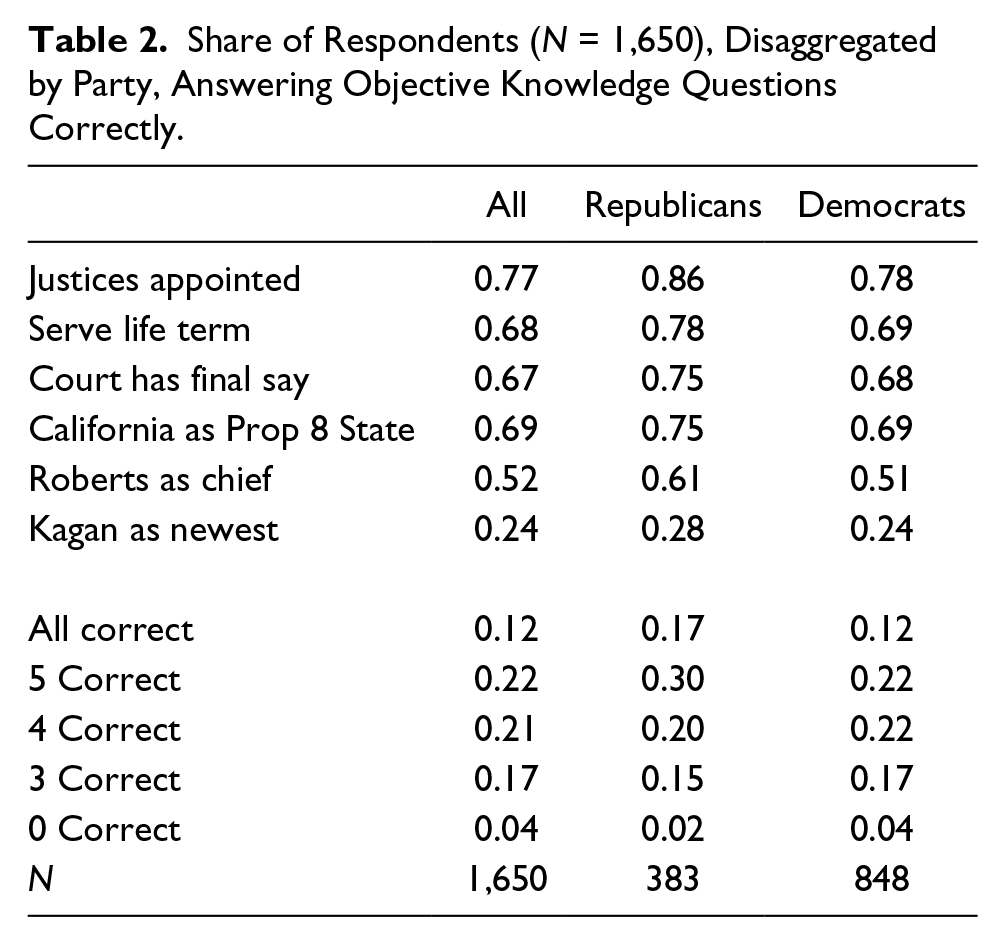
Objective knowledge about the Court influences subsequent views about the Court (e.g., Gibson 2007; Gibson and Caldeira 2009c). The survey thus included six questions to assess baseline knowledge. 8 (Full question wording is presented in the online appendix.) As shown in Table 2, a majority of respondents are able to identify the fact that justices are appointed by the president (77%), serve life terms (68%), and have the final say about Constitutional matters (67%). Knowledge lessens once the questions turn to current topics. For example, only 24 percent of respondents correctly identify the most recent nominee at the time of the survey (Kagan).
Share of Respondents (N = 1,650), Disaggregated by Party, Answering Objective Knowledge Questions Correctly.
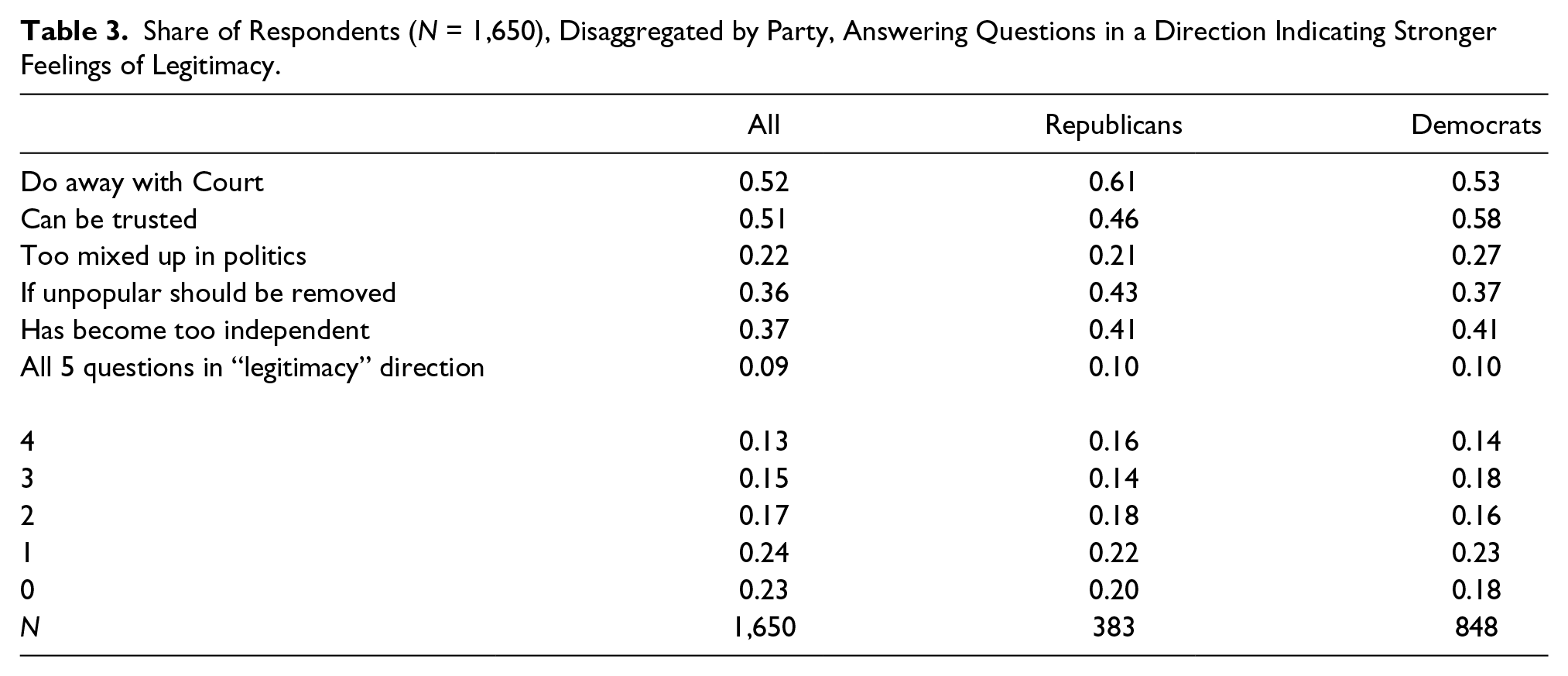
In addition, following Gibson, Caldeira, and Spence (2003), five questions addressed respondents’ feelings of legitimacy toward the Court. Table 3 reports the share answering each question in a direction indicating stronger feelings of legitimacy. A majority (51%) “agree” or “strongly agree” that the Court is to be trusted, and similar shares support the Court in the face of threats to “do away” with it. However, only a small share (22%) feels that the Court is not getting itself “too mixed up in politics.”
Share of Respondents (N = 1,650), Disaggregated by Party, Answering Questions in a Direction Indicating Stronger Feelings of Legitimacy.
How Partisan Signals Influence Attitudes toward Candidates
I first present the findings for those respondents who were randomly chosen to receive partisan information in the conjoint experiment (n = 886). The quantity of interest here is not the Average Treatment Effect, but the Average Marginal Component-Specific Effect (AMCE), or the treatment effect of any one of the profile characteristics. This is estimated by regressing the respondents’ feelings of (1) support, (2) qualifications, and (3) trust of the candidate on the various characteristics. Because the responses are ordered in nature, I use an ordered logit specification. (The online appendix presents results using a linear probability model.) Throughout, I use standard errors clustered at the respondent level to account for respondents being shown multiple profiles (following Hainmueller, Hopkins, and Yamamoto 2014). 9
Results among Co-partisans
Table 4 presents the main results and includes a dummy variable representing whether the hypothetical candidates’ partisanship matched the respondents’. Thus, this “Co-partisan” variable is “1” if a Republican respondent was shown the profile of a hypothetical candidate who “leaned” or was “strongly” Republican and “0” for a candidate “leaning” Democrat or Democrat. The table shows the clear strength of co-partisanship. Across the “support” and “trust” questions, it is the single most important factor predicting respondent opinions; for the “qualifications” question, it is only second to having a candidate graduate outside of the Top 100 law schools in predictive importance.
Ordered Logit Coefficients.
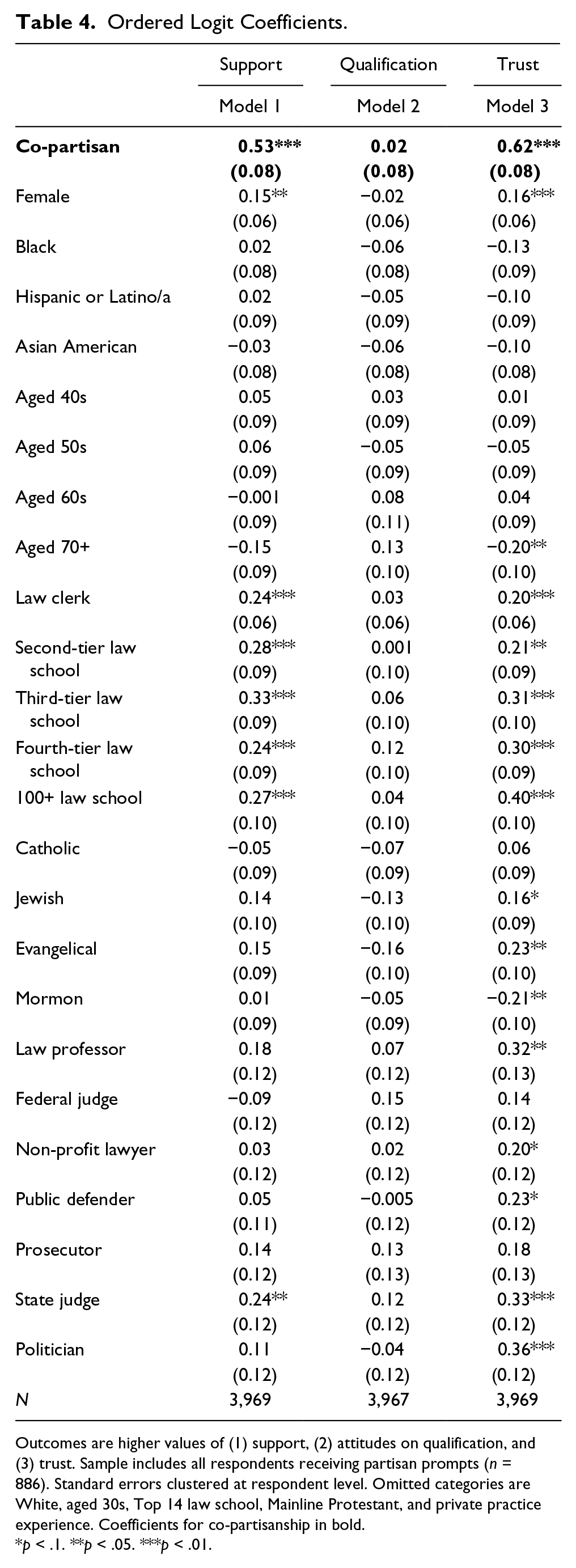
Outcomes are higher values of (1) support, (2) attitudes on qualification, and (3) trust. Sample includes all respondents receiving partisan prompts (n = 886). Standard errors clustered at respondent level. Omitted categories are White, aged 30s, Top 14 law school, Mainline Protestant, and private practice experience. Coefficients for co-partisanship in bold.
p < .1. **p < .05. ***p < .01.
In terms of substantive probability differences, Figure 1 demonstrates the change in probability associated with showing the respondent a profile that is not co-partisan versus a profile that is co-partisan. As the figure shows, there is a significant increase in the probability that a respondent will strongly support, think qualified, or trust a candidate when that candidate is a co-partisan as opposed to not. For strong support, this co-partisan bump is approximately 10 percentage points; for strong trust, it is around 8 percentage points. For thinking candidate highly qualified, the bump is slightly lower, at 7 percentage points. All of the co-partisan coefficients and differences are significant at the 1-percent level. In terms of the conceptual framework, this provides strong support for the political agreement and political searching theories.
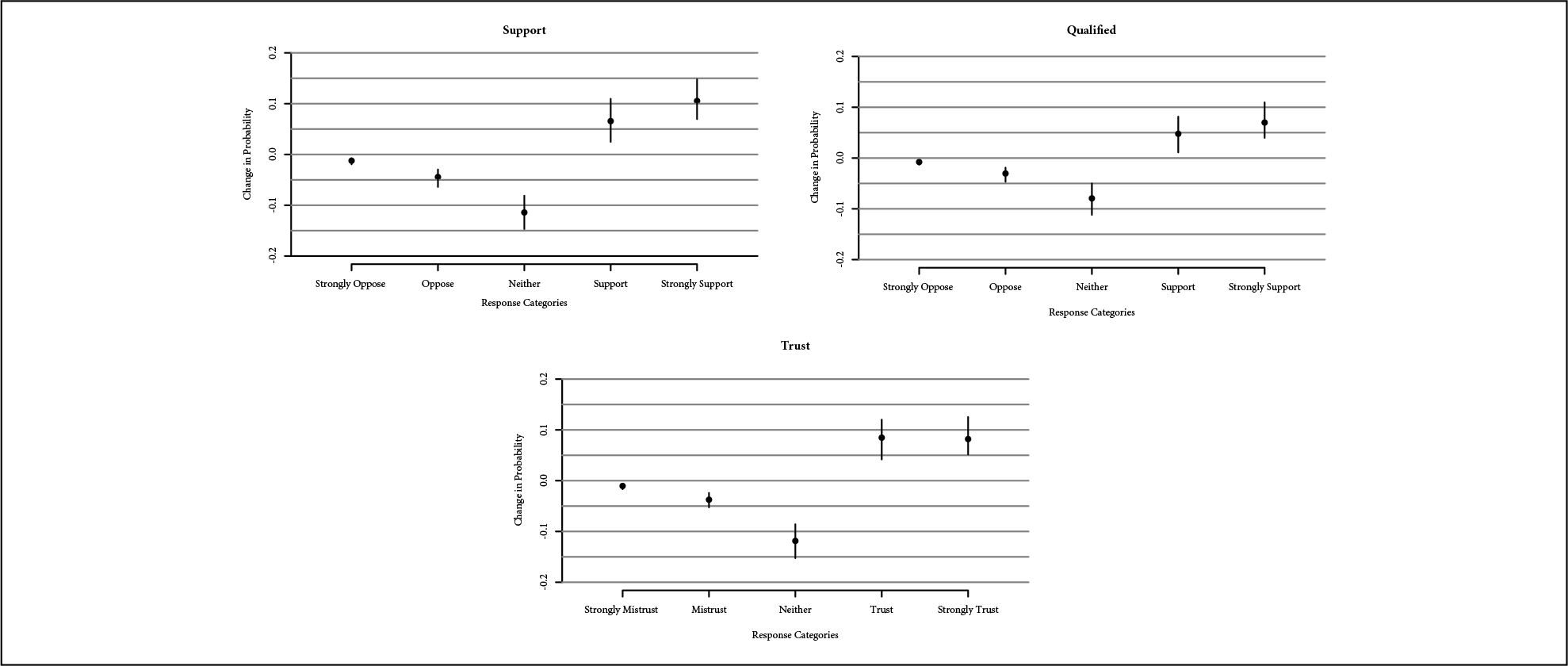
Predicted probability changes associated with a candidate going from a non–co-partisan to a co-partisan, with outcomes being (1) support, (2) beliefs about qualifications, and (3) trust.
By contrast, Table 4 presents weaker evidence for the theory of “judiciousness.” (Additional tests of the judiciousness theory are in Section “Examining Judiciousness More Closely.”) Candidates who have previous law clerkships are favored, particularly for the qualifications question; however, the magnitude is about half of the co-partisan effect. Respondents also have lukewarm responses to educational achievement, particularly for the support question; so long as the candidate does not graduate outside of the Top 100 schools, respondents are statistically indifferent about law school rank. Other “judiciousness” characteristics show no clear pattern. These findings suggest that, above a minimum bar, pedigree may be a weaker predictor of whether a respondent will eventually support or trust a candidate than partisanship.
Importantly, Table 4 shows differences between whether respondents “support” or “trust” the candidate versus whether they think the candidate is qualified. For example, religious minority status (e.g., a candidate being Mormon) appears to influence respondents’ overall levels of support or trust, but makes less of a difference for attitudes on qualifications. In addition, the party effect is the smallest for the qualifications questions. The implication, discussed further below, is that focusing exclusively on qualifications (as is often done) could mask differences in levels of support or trust, and the latter may be more important for respondent preferences. However, partisanship still matters as to whether respondents believe candidates to be qualified.
Here as in elsewhere, the data show little support for a theory resting on descriptive characteristics. For those candidates identified as racial or ethnic minorities, the results show several precisely estimated 0s. There is, by contrast, some support for a theory involving female candidates; however, the effect is fairly small (compared with co-partisanship) and operates in a positive direction—contrary to the implicit bias argument. Further analyses, not shown, also show no meaningful findings regarding interactions between these characteristics and corresponding respondent characteristics.
Results by Party
To further examine the relationship between co-partisanship and candidate support, I subset respondents into Democrats and Republicans. These results are presented in Table 5, which shows that co-partisanship continues to be by far the most important predictor of respondent attitudes. For example, consider the support question (columns 1 and 2). For Republican respondents, having a candidate who “leans” or is “strongly” Democrat makes them less likely to support the candidate, a drop that is significant at the 1-percent level. Contrariwise, having a candidate identified as a strong Republican makes them more likely to support the candidate, a relationship that is significant at the 5-percent level. These patterns are for the most part consistent across the different kinds of questions and across both Republicans and Democrats. That is, partisanship, whether co-partisanship or oppositional partisanship, is the most important factor in explaining potential support, trust, or beliefs about qualifications about a potential candidate.
Ordered Logit Coefficients.
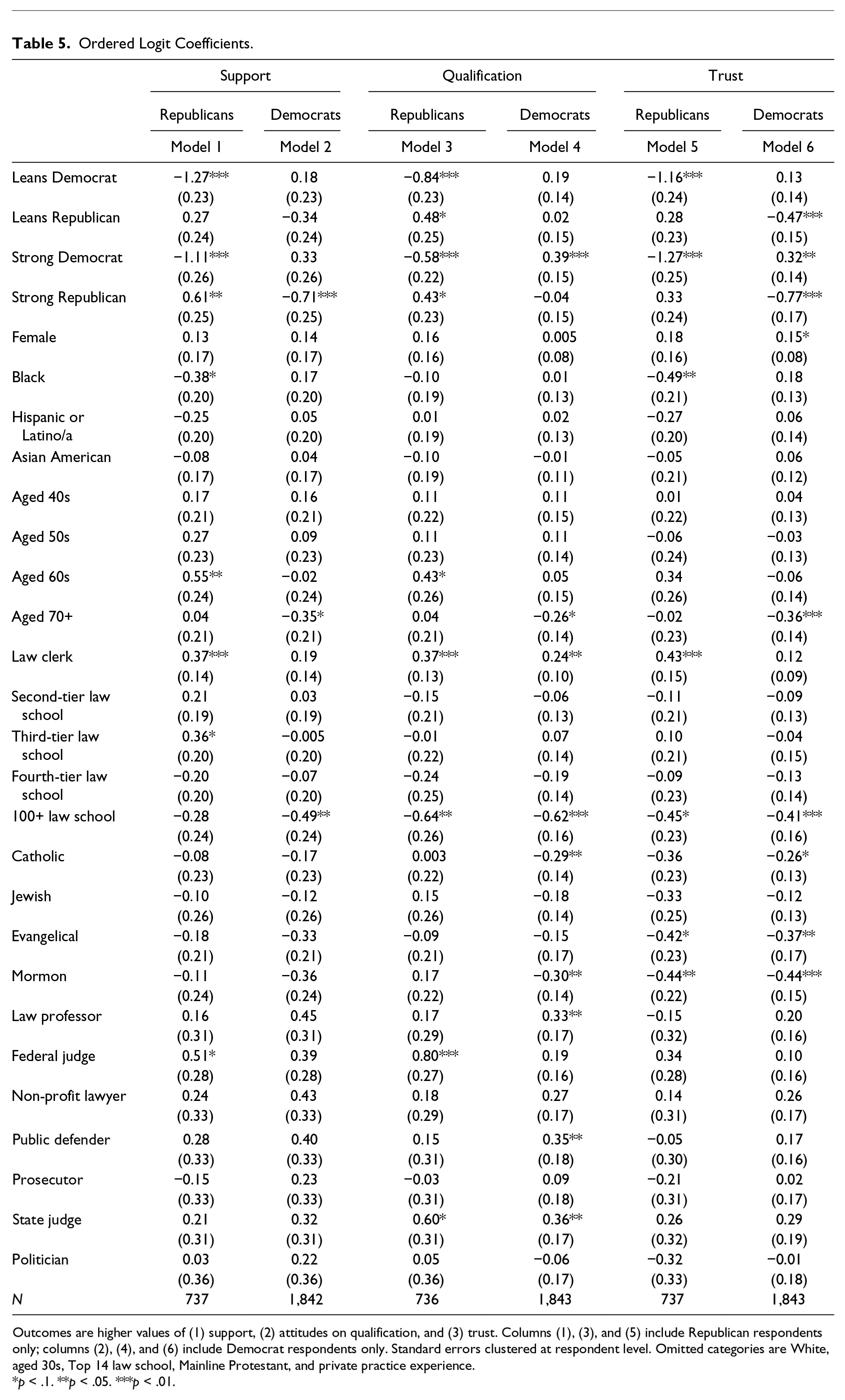
Outcomes are higher values of (1) support, (2) attitudes on qualification, and (3) trust. Columns (1), (3), and (5) include Republican respondents only; columns (2), (4), and (6) include Democrat respondents only. Standard errors clustered at respondent level. Omitted categories are White, aged 30s, Top 14 law school, Mainline Protestant, and private practice experience.
p < .1. **p < .05. ***p < .01.
Substantively in line with the previous analyses, Table 5 suggests a relative unimportance of those variables that capture judiciousness. For example, moving from a Top 14 school to a school ranked in the 15–25 range makes no discernible difference across respondent subsets. 10 Previous judicial experience was a positive predictor before but, as Table 5 shows, disaggregating by respondent partisanship lessens its importance across most subsets and questions. In addition, the results suggest that work experience is viewed primarily through a partisan lens: Democrats, for example, appear to think that law professors and public defenders are more qualified than attorneys in private practice. (However, these analyses have less power than the analyses in Table 4 because they subset by respondents, meaning that small treatment effects may not be detected.) Perhaps the strongest case for judiciousness concerns the law clerk variable; among many of the subsets, respondents prefer candidates with previous clerkships as opposed to those without. Even so, the effect size is smaller than the partisanship effects across all questions.
Consistent with Table 4, candidate race presents mixed findings. Looking at Republicans, there appears to be a negative relationship between a candidate being African American and support or trustworthiness; tellingly, there is no similar negative relationship when it comes to qualifications. Looking at gender, however, the previous findings showing increased support and trust do not hold. Taken together, these provide no consistent support for a theory based on descriptive representation. I therefore set this explanation aside for the rest of the analyses.
Examining Judiciousness More Closely
As noted above, the theory of judiciousness predicts those respondents with the strongest pre-existing legitimacy would be those least influenced by partisan cues and most influenced by prestigious professional characteristics (Gibson and Caldeira 2009b). We may also expect that, conditional on strong candidate qualifications, partisan cues would matter little (Gibson and Caldeira 2009b).
Interaction between Legitimacy and Knowledge and Co-partisanship
To test whether the influence of candidate partisanship depends on pre-existing levels of legitimacy and knowledge, I interact whether the respondent viewed a co-partisan profile with respondents’ (1) feelings of legitimacy and (2) objective knowledge. For judiciousness to be persuasive, we would expect a negative interaction—that is, as respondents’ legitimacy (or knowledge) increases, the importance of co-partisanship ought to weaken. At its weakest, the judiciousness model would predict no positive interaction.
In Table 6, I use a dummy variable for whether the respondent expressed high levels of legitimacy (answering either 4 or 5 of the legitimacy questions in a direction indicating increased legitimacy) or knowledge (answering either 5 or 6 of the knowledge questions correctly). As Table 6 shows, however, there is limited support for the judiciousness hypothesis. Consider the legitimacy interaction, presented in columns (1), (2), and (3). The interaction between legitimacy and co-partisan is positive and significant (at the 10% level) in at least one instance—when considering support. 11 In the other analyses, columns (2) and (3), the interaction is not significant, which suggests that the importance of co-partisanship does not vary according to pre-existing feelings of legitimacy. Figure 2 further presents these results graphically, displaying the predicted probability changes associated with the co-partisanship relationship, both for the high-legitimacy and for low-legitimacy respondents. At their weakest, the findings in Table 6 and Figure 2 suggest that we cannot eliminate the possibility that those who believe strongly in the Court’s institutional legitimacy are no more likely to depart from a partisan-oriented worldview than those who have lower feelings of legitimacy, counter to the judiciousness theory. I provide additional evidence of this in Section “Effect of Withholding Partisan Cues,” which compares those who were shown the partisan prompt with those who were not.
Ordered Logit Coefficients.
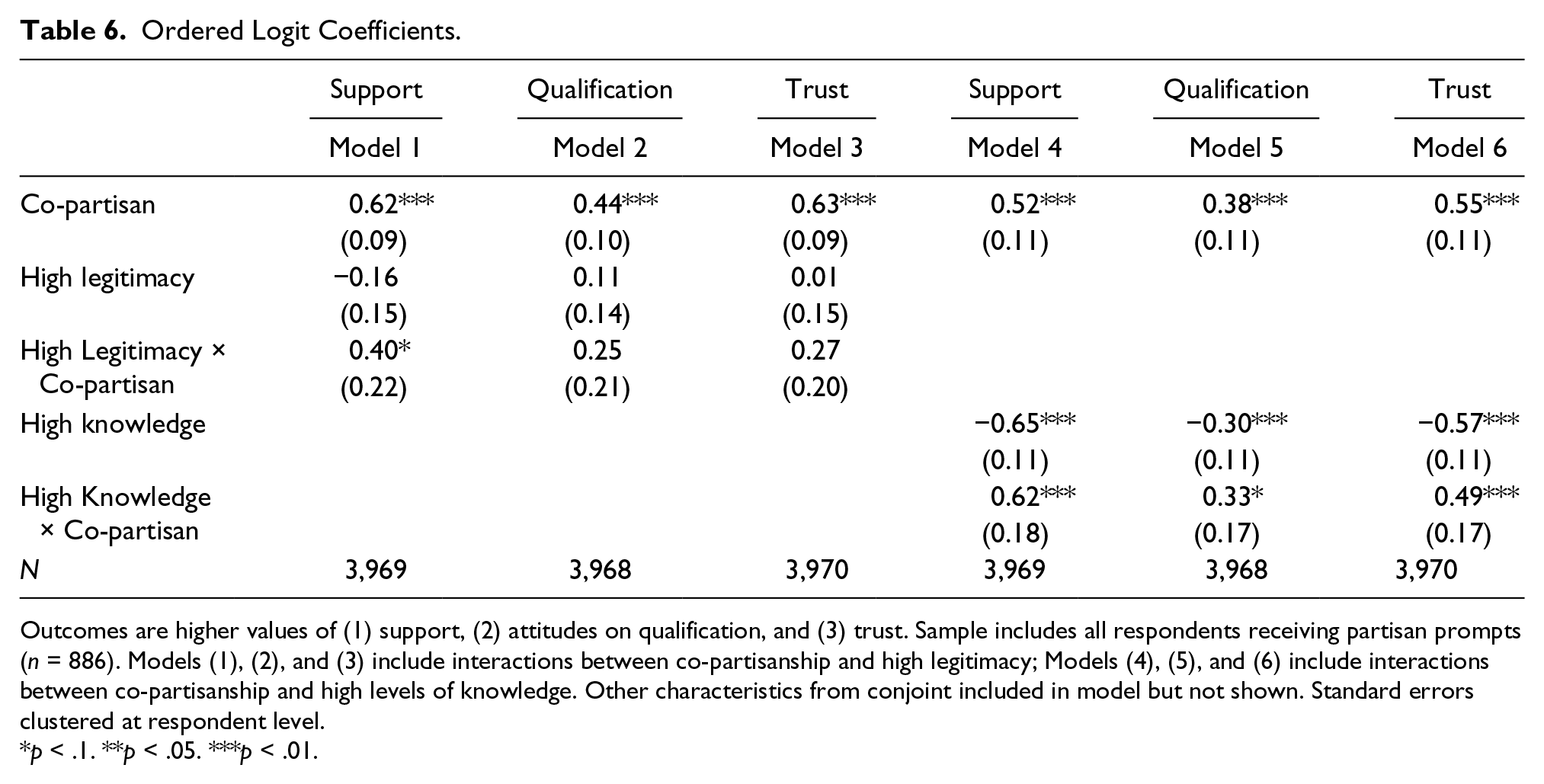
Outcomes are higher values of (1) support, (2) attitudes on qualification, and (3) trust. Sample includes all respondents receiving partisan prompts (n = 886). Models (1), (2), and (3) include interactions between co-partisanship and high legitimacy; Models (4), (5), and (6) include interactions between co-partisanship and high levels of knowledge. Other characteristics from conjoint included in model but not shown. Standard errors clustered at respondent level.
p < .1. **p < .05. ***p < .01.
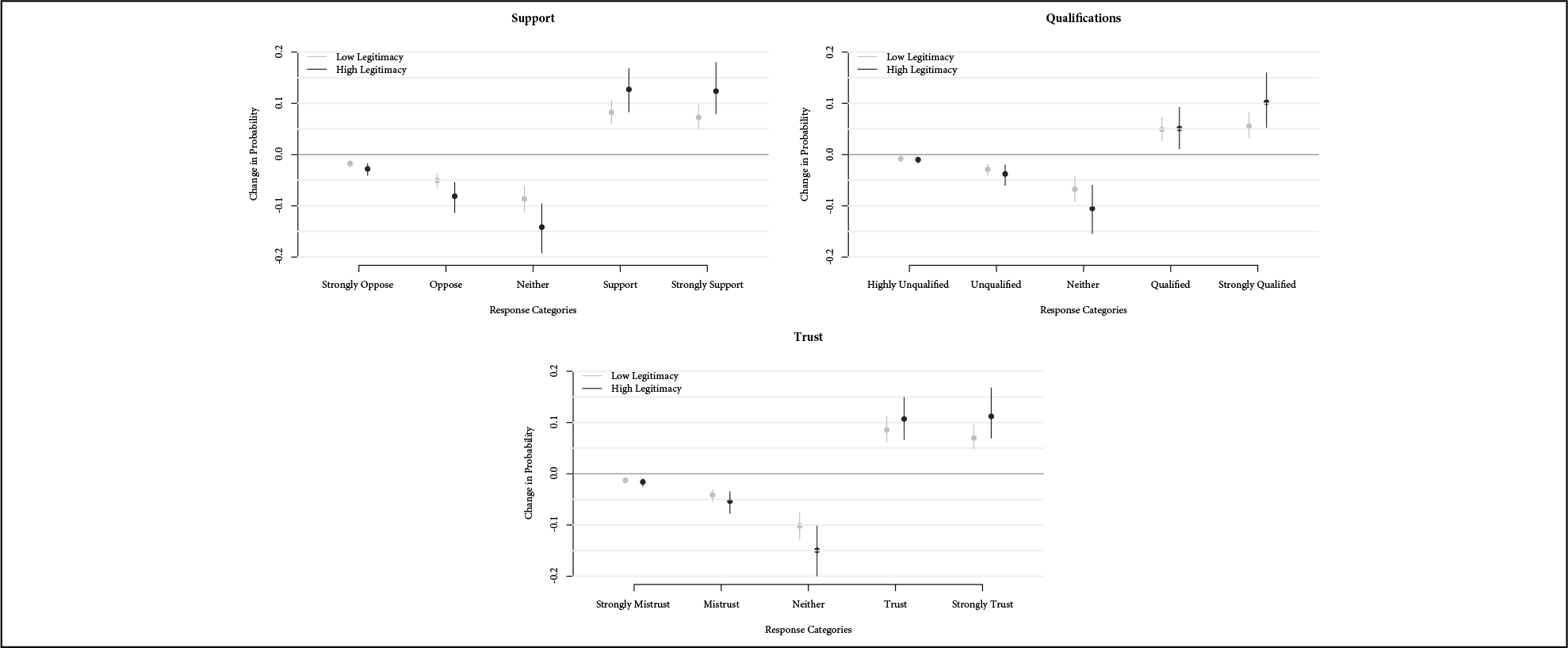
Predicted probabilities changes associated with a candidate going from a non–co-partisan to a co-partisan.
Even less consistent with the judiciousness theory are the analyses regarding respondent knowledge, presented in columns (4), (5), and (6) of Table 6. Consider the lower order knowledge term for the “support” and “trust” outcomes. The negative coefficient suggests that higher knowledge respondents are more likely to have a lower opinion of a cross-party candidate than those with little knowledge. In addition, the interaction term between high knowledge and the hypothetical candidate being a co-partisan is positive and significant across all questions, suggesting that the effect of the co-partisan variable increases along with the respondent’s awareness of the Court. These results are further highlighted by Figure 3, which shows the predicted probabilities for the co-partisan relationship for high-knowledge and for low-knowledge respondents. As the figure makes clear, more knowledge about the Supreme Court increases the importance of partisan signals. For example, for high-knowledge respondents, knowing that the candidate is a co-partisan results in an increased probability that they will “support” the candidate of around 15 percentage points; for low-knowledge respondents, it is only around 8 percentage points.
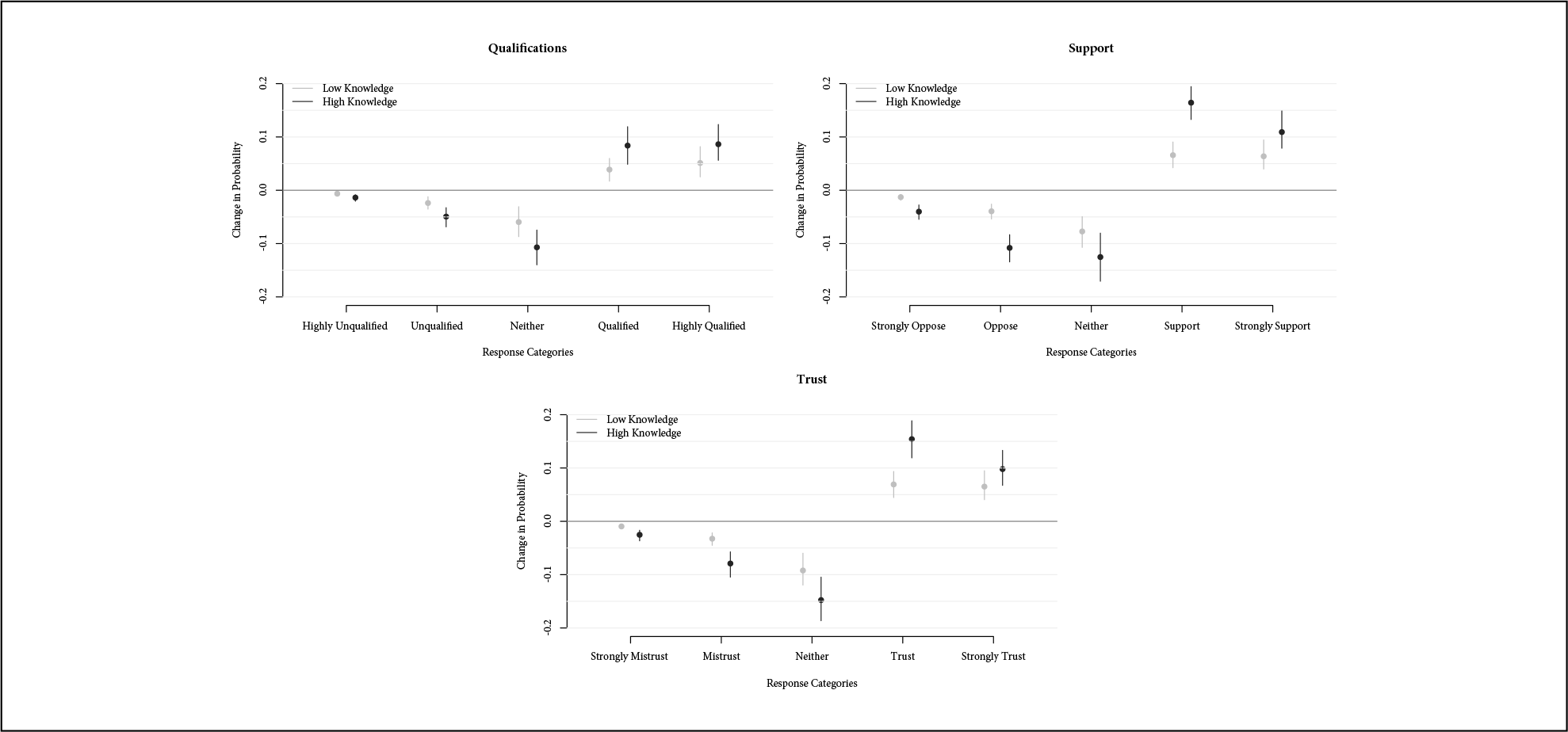
Predicted probabilities changes associated with a candidate going from a non–co-partisan to a co-partisan.
Conditioning on High-Quality Candidates
Another implication of the judiciousness model is that the stronger the qualifications of the candidate, the more partisan considerations will fade (Gibson and Caldeira 2009b). To explore this, I subset the conjoint profiles to those in which the hypothetical candidate was identified as (1) a former law clerk and (2) a graduate of a Top 14 law school. These determinants (particularly clerkship) were among the most important in the analyses in Tables 4 and 5, suggesting that these could represent the more “judicious” of the characteristics.
The results of analyses looking at such “highly qualified” hypothetical profiles are presented in Table 7. The table shows that the magnitude of the co-partisanship variable remains; the sample size decreases markedly because of the fewer profiles, resulting in larger p values, but the size of the coefficient decreases only slightly. It is only with regard to qualifications that the effect associated with co-partisanship loses statistical significance and the magnitude of the effect approaches zero. Substantively, this suggests that co-partisanship might matter less when respondents are assessing high-qualified candidates in the context of evaluating their pedigree. However, this does not appear to translate into support or increased trust; for these considerations, partisanship is highly salient.
Ordered Logit Coefficients.
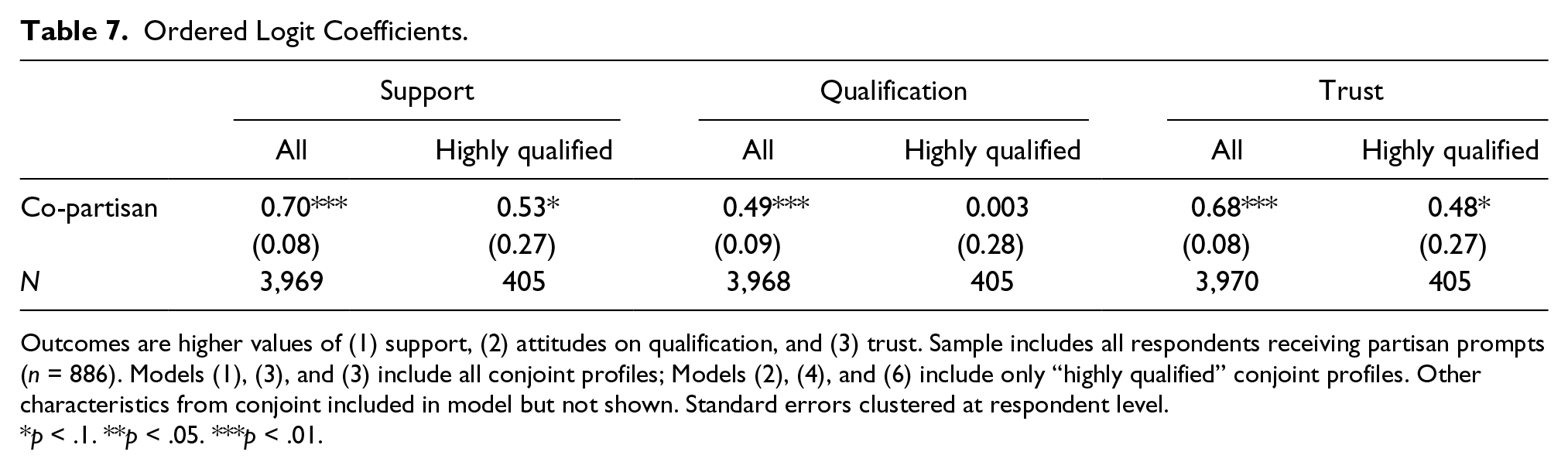
Outcomes are higher values of (1) support, (2) attitudes on qualification, and (3) trust. Sample includes all respondents receiving partisan prompts (n = 886). Models (1), (3), and (3) include all conjoint profiles; Models (2), (4), and (6) include only “highly qualified” conjoint profiles. Other characteristics from conjoint included in model but not shown. Standard errors clustered at respondent level.
p < .1. **p < .05. ***p < .01.
Effect of Withholding Partisan Cues
As noted, judicial candidates are often presented to the public primarily through their professional characteristics and personal experience, as opposed through their partisan or policy beliefs (beyond the identity of the appointing president, which may be a noisy signal). Thus, a comparison group of respondents (n = 764), randomly chosen, were shown conjoint profiles with partisan cues withheld. This complements the research design in two ways. First, withholding partisan cues tests whether respondents reach for other cues in the absence of partisan information (e.g., political searching vs. political agreement). Second, it allows the explicit comparison with and without partisan information for individuals with high levels of legitimacy and knowledge. This provides further testing of the judiciousness versus political agreement and political searching models.
Table 8 presents the results of analyses withholding partisan information. Similar to Table 5, Republicans and Democrats are examined separately. (Online Appendix Table A.6 shows the same analysis with all respondents included together.) Comparing this with the previous analyses makes clear that additional factors affect respondents’ opinions on Supreme Court candidates. This is particularly true among Democratic respondents, for whom demographic characteristics such as race and, to a lesser extent, gender become salient. For example, for Democrats, a candidate being identified as African American is linked with an increase in support, belief in qualifications, and trust, statistically significant at the 5-percent or 10-percent levels—unlike its non-significance in the previous analyses, where partisan information as included. Another example is religion. For Democrats, the predictive power of a candidate being a Mormon is statistically indistinguishable from zero when partisan cues are provided. However, when they are withheld, there is a negative effect of the candidate being Mormon on whether the respondent will trust him or her to reach the “correct” decision. Again, this suggests a different strategy in terms of how respondents respond to information, depending on whether partisan cues are provided. For Democrats, other patterns include an increased importance of education, a candidate being Hispanic or Latino/a (for trust), and a candidate being Asian American (also for trust). We also see an increased importance played by gender, with significance across two of the outcomes (qualifications and trust) and positive, although narrowly insignificant, results across the third (support). These findings provide evidence that different cues rise in importance depending on the information environment—support for a political searching theory.
Ordered Logit Coefficients.
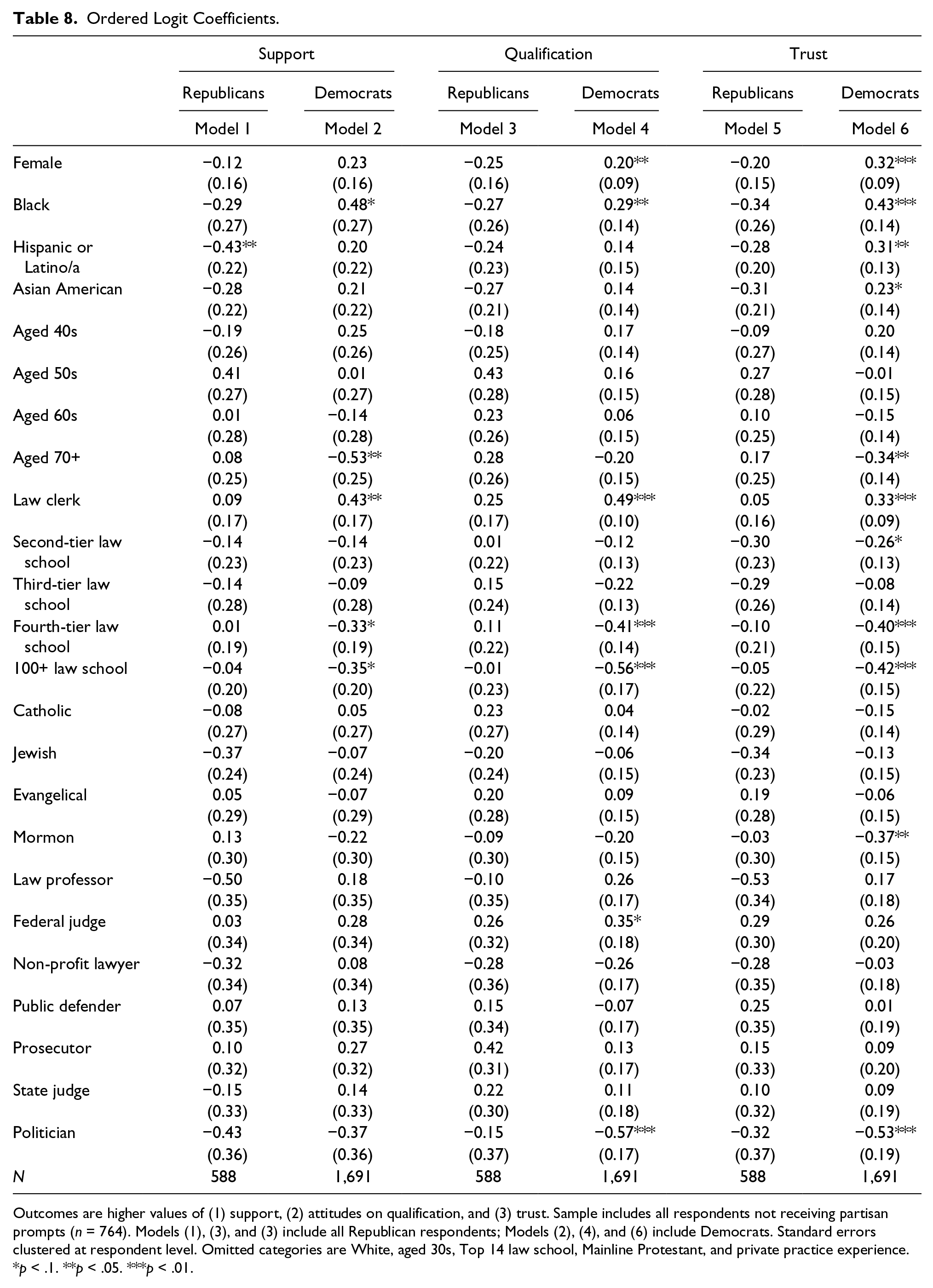
Outcomes are higher values of (1) support, (2) attitudes on qualification, and (3) trust. Sample includes all respondents not receiving partisan prompts (n = 764). Models (1), (3), and (3) include all Republican respondents; Models (2), (4), and (6) include Democrats. Standard errors clustered at respondent level. Omitted categories are White, aged 30s, Top 14 law school, Mainline Protestant, and private practice experience.
p < .1. **p < .05. ***p < .01.
Testing Differences between Partisan and Non-partisan Cues
To formally test these differences, I included all 1,650 respondents—both those who had received the partisan cues and those who had not—into one analysis. I then included a dummy variable for whether the partisan variable had been withheld. By interacting this dummy variable with the various treatment conditions, I therefore test whether the importance of the various characteristics vary according to whether the partisan prompt was provided or withheld.
Table 9 provides a summary of these findings by presenting those interactions that are significant for Republicans or Democrats. For example, for the African American variable, the interaction between African American and the partisanship treatment being withheld is positive for Democrats (with regard to overall support). The substantive interpretation is therefore that Democratic respondents are more likely to support an African American candidate when partisan information about that candidate is withheld. Combined with the fact that the coefficient on the African American variable is positive among groups not receiving the partisan prompt (Table 8) and not significant among those receiving the partisan prompt (Table 5), this leads to a key point: Democrats place positive weight on a candidate being African American only in the absence of partisan cues—that is, possibly because it appears to signal a more Democratic-oriented leaning.
Characteristics with Statistically Significant Interactions with whether the Party Treatment Variable Is Withheld (at least at the 10% Level).
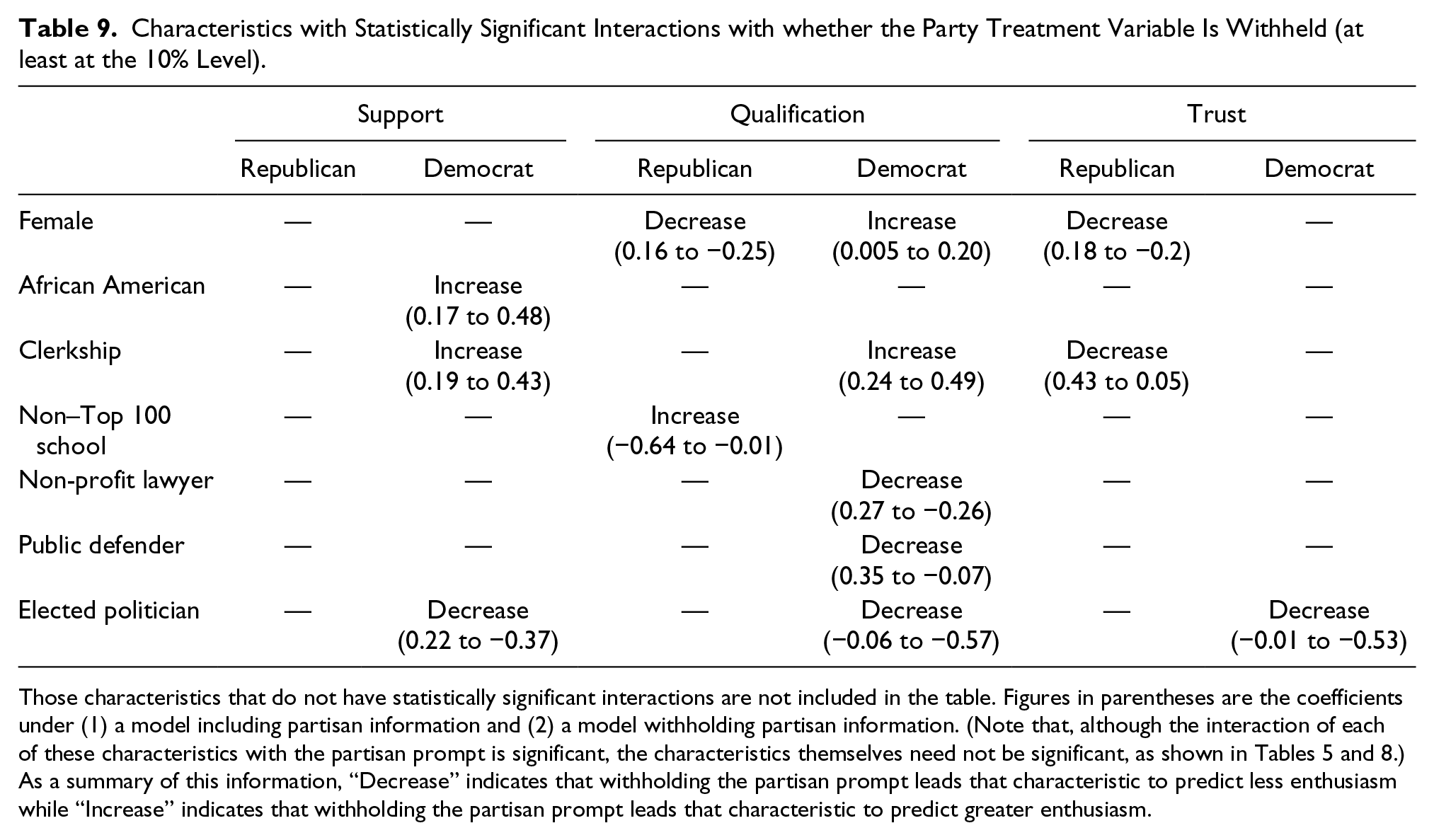
Those characteristics that do not have statistically significant interactions are not included in the table. Figures in parentheses are the coefficients under (1) a model including partisan information and (2) a model withholding partisan information. (Note that, although the interaction of each of these characteristics with the partisan prompt is significant, the characteristics themselves need not be significant, as shown in Tables 5 and 8.) As a summary of this information, “Decrease” indicates that withholding the partisan prompt leads that characteristic to predict less enthusiasm while “Increase” indicates that withholding the partisan prompt leads that characteristic to predict greater enthusiasm.
Other examples also indicate possible searching for partisan cues. For example, the effect of a candidate being identified as female also varies depending on whether partisan information is also provided. For Republicans, the interaction with partisanship is negative within the question on trust (and also on qualifications), meaning that withholding partisan information makes Republicans less likely to think that female candidates would be trusted to reach the correct decision. Given existing scholarship on how female judges may vote or influence their colleagues in a more progressive direction on gender-related questions (e.g., Boyd, Epstein, and Martin 2010; Peresie 2005), such behavior is rational. Another interesting pattern concerns the status of elected politicians. When partisan information is withheld, Democrats are more skeptical of candidates identified as former politicians, perhaps a rational response to the fact that this could indicate a higher probability that the candidate in question is a Republican compared with the average judicial candidate (Bonica and Sen 2016). With regard to clerkship experience, among the more important “judiciousness” variables, for Democrats, withholding the partisan cue makes clerkships more important in some instances. This could suggest a potential belief that clerkships are a signal of liberalism—echoing the fact that affiliates of top law programs tend to be more liberal than the overall population of attorneys (Bonica, Chilton, and Sen 2015). Note that an alternative interpretation is that this last finding could suggest that, if partisanship is not primed by the study (as is the case among those respondents not receiving the partisan prompt), then respondents are turning to qualifications (such as clerkships) as the primary cues for making their judgments. This explanation, however, would not explain the patterns seen for female judges or for African American judges.
Two patterns are, on the surface, puzzling: public defenders and non-profit attorneys. Democrats appear to devalue these traits when partisan information is withheld, at least with regard to beliefs about qualification. This is surprising, since both traits could be good proxies for liberal political leanings. Two factors help explain these results. First, Democrats’ attitudes on these characteristics do not extend to beliefs about support or trustworthiness, suggesting only a question of qualifications. Second, and relatedly, this might suggest that Democrats have different prior beliefs about the education or preparedness of conservative non-profit lawyers and public defenders, concerns that dissipate once the partisanship of the non-profit lawyer or defender is revealed. Indeed, under a design that includes partisan cues, Democrats actually do indicate increased support for non-profit lawyers and public defenders.
Interactions with Legitimacy
As a last check of the judiciousness theory, I interact whether the partisan treatment was withheld with (1) high legitimacy and (2) high knowledge. This has the effect of assessing whether effects associated with the partisan cue vary according to respondents’ pre-existing levels of legitimacy or knowledge. A strong version of the judiciousness theory would predict a positive interaction, which would suggest that those with high levels of legitimacy or knowledge are more enthusiastic in the absence of such cues (or, alternatively, that they are “turned off” when receiving partisan cues). These results are presented in Table 10, which shows no interactive effect associated with legitimacy or knowledge. Substantively, this means we are unable to rule out that that the effect of receiving partisan information does not vary by levels of legitimacy or knowledge—perhaps additional suggestive evidence against the judiciousness theory.
Ordered Logit Coefficients.
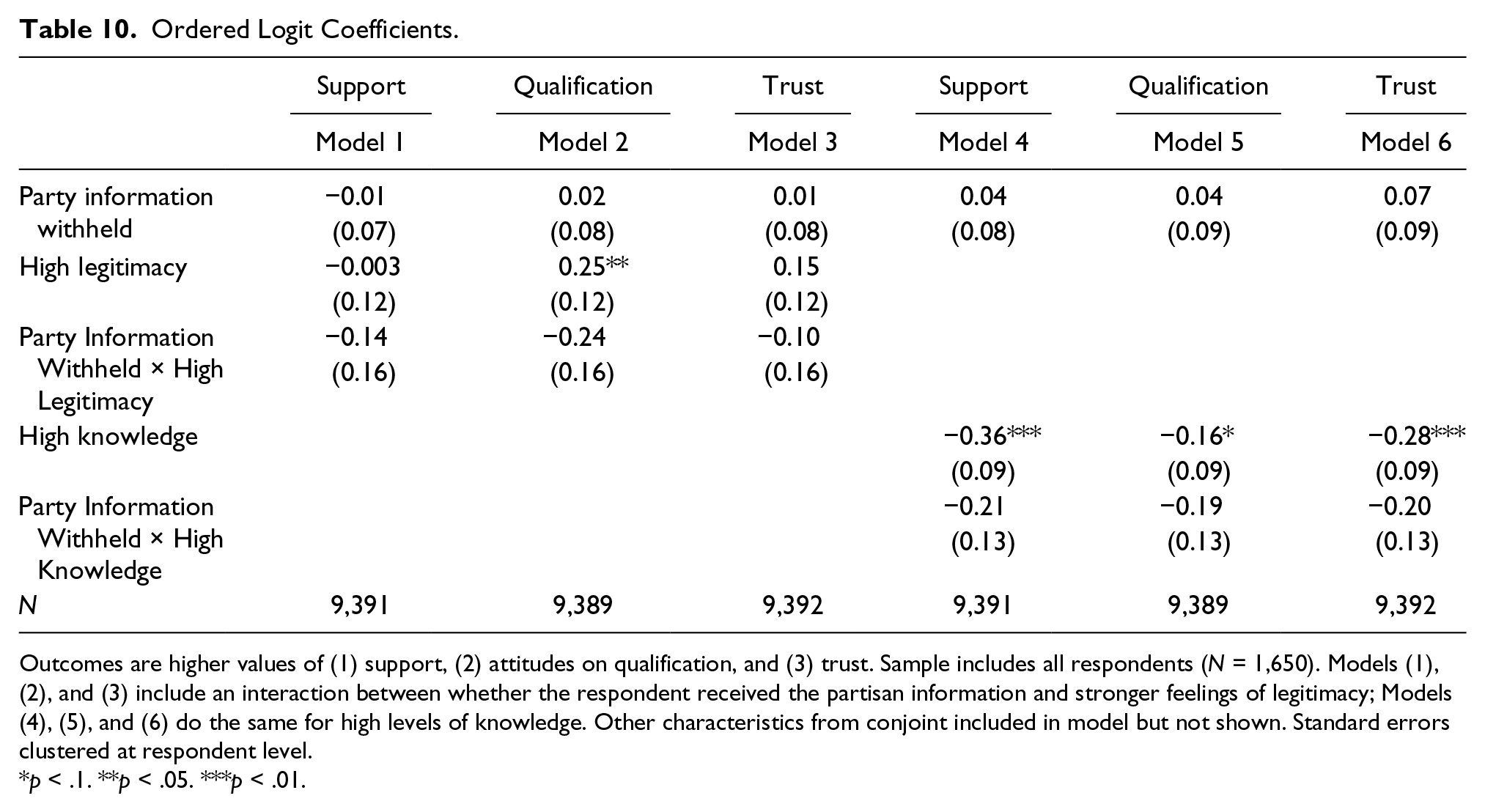
Outcomes are higher values of (1) support, (2) attitudes on qualification, and (3) trust. Sample includes all respondents (N = 1,650). Models (1), (2), and (3) include an interaction between whether the respondent received the partisan information and stronger feelings of legitimacy; Models (4), (5), and (6) do the same for high levels of knowledge. Other characteristics from conjoint included in model but not shown. Standard errors clustered at respondent level.
p < .1. **p < .05. ***p < .01.
Discussion: What Explains Public Responses to Supreme Court Candidates?
Given these results, how do members of the public evaluate, and come to support, Supreme Court candidates? These results suggest that partisan proximity is the most important characteristic in how these respondents approach nominees. Across the political spectrum, respondents prefer candidates closer to themselves politically and oppose candidates who differ. This is the case even looking at highly qualified candidates, for whom deference based on judiciousness should be highest, and also for respondents with high levels of legitimacy and knowledge about the Court. This is also the case when looking at public evaluations of support, trust, and qualifications (despite the fact that there are differences across these, noted below). Indeed, the fact that partisanship has an impact on how qualified respondents believe candidates to be suggests that motivated reasoning might play a role in these sorts of evaluations. That is, respondents assess nominees primarily on the basis of ideological agreement and then may rationalize and justify that support, adjusting their beliefs about the nominees’ qualifications.
This analysis also suggests that the information environment surrounding nominations plays an important role. Members of the public might not know the partisan leanings of Supreme Court nominees as well as they do members of Congress or presidential candidates. Moreover, presidents, perhaps trying to avoid partisan fighting, tend to focus on personal characteristics and professional experiences (as opposed to partisanship) in promoting Supreme Court nominees. However, when partisan cues are withheld in this fashion, this analysis suggests that other factors appear to rise in importance. Indeed, when cues about partisanship are withheld, a candidate’s gender or race may become salient. These findings are consistent with a vast literature in political psychology on heuristics and information short-cuts (e.g., Sniderman, Tetlock, and Brody 1993); they are also consistent with research showing that people assume that women and minorities may be more liberal and Democratic (McDermott 1998). In sum, looking at other characteristics is a reasonable strategy for people who know that politics matter in predicting how justices will vote, but lack reliable information. These findings also suggest that, even though executives and political actors may attempt to mute partisan signals in the introduction of Supreme Court candidates, a person’s partisan leanings will still serve as an important lens through which he or she will evaluate nominees.
The results also question the possibility that judiciousness is the primary factor in shaping public support or opposition to Court candidates, although more research is needed. Across all analyses, characteristics associated with “judiciousness” have mixed relationships with attitudes, particularly when it comes to the key questions of support and trust. However, the results also leave open the possibility that other judiciousness characteristics, not included in this conjoint, may predict respondent evaluations, and future research should address whether considerations such as years of experience, professional ratings, or peer evaluations might influence public perceptions. In addition, even these results suggest some exceptions: for example, a candidate being a former law clerk is positively associated with some evaluations, while a candidate graduating from a law school ranked outside of the Top 100 is associated negatively with evaluations. However, the findings here ultimately suggest that, above a certain bar, partisanship may be a more salient consideration. That is, between judiciousness (as measured here) and partisan considerations, partisanship is by far more important.
In addition, the predictive importance of partisanship strengthens when looking at respondents with the highest levels of legitimacy and knowledge. This is a finding contrary to the literature on judiciousness, which would predict that these individuals should be the least reliant on political signals. Instead, this is a finding more in line with the existing literature in political psychology, which suggests that partisanship tends to matter most to those who are politically knowledgeable (e.g., Zaller 1992). In terms of a possible mechanism, although this analysis did not provide a direct test, one answer may be provided by recent coverage of the Supreme Court, much of which has emphasized the polarized pattern of important rulings. Such news coverage paints the portrait of the Court as a partisan institution, a pattern that may in turn highlight for more knowledgeable respondents the importance of politics in the selection of Court nominees. This would be a mechanism in line with papers such as Johnston and Bartels (2010), which find that exposure to more “sensationalist” Supreme Court media coverage lessens respondents’ overall support of the Court. However, more research is needed to evaluate the nature of the cues received by the public about the Supreme Court.
Finally, although partisanship is one of the most important characteristics across all sorts of assessments, the findings also reveal a significant difference between support for, or trust in, a nominee versus a belief that the candidate is qualified. These discrepancies in turn suggest caution for scholars of public opinion: simply asking respondents which candidates they think are “qualified,” as is often done (not just by scholars, but also by polls), could mask deep ideological divides. These divides could ultimately explain strong or weak overall enthusiasm for even highly qualified candidates. Candidates such as Merrick Garland or Samuel Alito may be considered extremely qualified by members of the public, but this need not correspond to support.
Concluding Remarks
The contributions of this analysis are threefold. First, this analysis aids our understanding of how people in the real world evaluate Supreme Court candidates by linking discrete professional, partisan, and personal characteristics to public support. Of course, only the most highly qualified candidates are selected to be Supreme Court nominees, and these individuals are usually introduced to the public solely on the basis of their professional and personal characteristics—and not on the basis of their partisan leanings, which actually do serve to predict eventual Supreme Court votes.
As this analysis shows, however, people from across the political spectrum strongly prefer Supreme Court candidates politically closer to themselves and oppose candidates who are politically distant. This emphasis on partisanship would help explain strongly polarized responses to candidates like Merrick Garland, who, although by all accounts highly qualified, nonetheless engendered significant partisan responses—not just from elites, but also from members of the public. Looking at other nominations, we would expect that, even among the highly elite potential pool of federal court candidates, partisanship will strongly shape whether members of the public support Supreme Court nominations.
Second, and relatedly, these findings serve to link the literature on the Supreme Court with other literatures in American politics, which have documented that partisanship is an important frame—perhaps the most important frame—through which people form attitudes about policies and political candidates. This suggests that the Court, although in the past viewed as more non-partisan institution, may be instead, and perhaps increasingly, viewed as a fundamentally political branch, more in line with other political bodies. However, a fruitful area of further research would compare these findings with the relative importance of partisan proximity in the selection of, for example, elected officials. Other research might look to how expectations over ideology or legal philosophy, as opposed to party signals (examined here), shapes public expectations. Further research might examine these questions by looking at the relationship between candidate characteristics and both ideology and voting on certain issues. For example, do respondents tend to infer that female candidates will be more likely to favor reproductive rights? Or, do respondents tend to infer that Catholic candidates will be less likely to favor reproductive rights? How do these factors increase or decrease respondent support?
Finally, these points raise substantial implications for our current methods of choosing Supreme Court candidates. As noted, the public often has at best limited information about a potential candidate’s political and ideological beliefs, with most dialogue surrounding Supreme Court nominees purposely focusing on demographic characteristics or professional experience. Although the identity of the appointing president can provide a starting point for a candidate’s political leanings, candidates throughout the course of confirmation hearings can successfully avoid expressing their views on important political and legal topics. So much evasion happens at these confirmation hearings that Elena Kagan (1995, 920), in her time before the Court, wrote, “The confirmation process takes on an air of vacuity and farce, and the Senate becomes incapable of either properly evaluating nominees or appropriately educating the public.”
This analysis suggests, however, that Americans wish to have more information than this. Americans do rely on pedigree and experience, particularly in assessing candidate qualifications, but, beyond a baseline level of competence, partisanship is the main predictor of support of, and trust in, a potential candidate. In the absence of such information, Americans may simply turn to other cues—cues that are often noisy, inaccurate, or perhaps implicitly biased. Thus, when it comes to potential candidates for the Supreme Court, the public may be better served by a more transparent process—one that acknowledges political and ideological leanings much more openly.
Supplemental Material
SEN_conjoint_Appendix_online_supp – Supplemental material for How Political Signals Affect Public Support for Judicial Nominations
Supplemental material, SEN_conjoint_Appendix_online_supp for How Political Signals Affect Public Support for Judicial Nominations by Maya Sen in Political Research Quarterly
Footnotes
Acknowledgements
The author thanks L. Jason Anastasopoulos, Matthew Baum, Christopher Elmendorf, David Gelman, Yanilda González, Melissa Kappotis, Ryan Sheely, and Teppei Yamamoto for helpful feedback.
Author’s Note
The survey on which this research was based was pre-registered with Experiments in Government and Politics (EGAP).
Declaration of Conflicting Interests
The author(s) declared no potential conflicts of interest with respect to the research, authorship, and/or publication of this article.
Funding
The author(s) received no financial support for the research, authorship, and/or publication of this article.

Notes
References
Supplementary Material
Please find the following supplemental material available below.
For Open Access articles published under a Creative Commons License, all supplemental material carries the same license as the article it is associated with.
For non-Open Access articles published, all supplemental material carries a non-exclusive license, and permission requests for re-use of supplemental material or any part of supplemental material shall be sent directly to the copyright owner as specified in the copyright notice associated with the article.
