







Abstract
In this study, we explore the predictors of gender linked fate with a focus on marital status for different racial/ethnic groups. We argue that marriage alters women’s perceptions of self-interest by institutionalizing their partnerships with men and consequently leading women to feel less connected to other women. We assess our hypothesis using the 2012 American National Election Study. While we find that married white women and Latinas have significantly lower levels of linked fate than unmarried women of the same race/ethnicity, we find no such relationship for black women. We then explore the implications of these findings by examining the role of gender linked fate in explaining political differences among married and unmarried women using mediation analysis. Ultimately, we find that differences in perceptions of linked fate explain a significant amount of the variation in political ideology and partisanship for white and Latina women.
Linked fate is one’s identification with a group and the perception that one’s life chances are tied to the success of that group (Dawson 1994). According to several studies, linked fate plays a crucial role in structuring the political activities and behaviors of blacks, Latinos, and Asian Americans (see Dawson 1994; Junn and Masuoka 2008; Sanchez and Masuoka 2010; Sanchez and Vargas 2016; Stokes 2003; Tate 1993; Wright Austin, Middleton, and Yon 2011). While a robust literature explores the significance of linked fate for several underrepresented racial groups, the role of gender linked fate is conspicuously absent. This is surprising given the breadth of feminist scholarship documenting how gender structures life chances and identity (Ely 1995; Ferree 1990). This omission in the literature raises the questions, which women are most likely to have higher levels of gender linked fate, and do those differences matter for women’s political attitudes?
We gain insight into these questions from previous studies that explore differences in women’s attitudes about gender roles (Bolzendahl and Myers 2004; Chaney, Alvarez, and Nagler 1998; Kingston and Finkel 1987; Stoker and Jennings 1995). Much of this research identifies a consistent “marriage gap,” whereby married women tend to have lower levels of gender consciousness than their unmarried counterparts (Stoker and Jennings 1995). Because marriage alters women’s perceptions of self-interest by institutionalizing their partnerships with men, scholars have hypothesized that married women will have more conservative views on gender-related issues than will unmarried women (Bolzendahl and Myers 2004). In turn, marriage may lead women to express fewer connections with other women (i.e., lower gender linked fate).
What is more, these patterns may vary significantly by race. Most, if not all, previous research exploring the marriage gap in several areas has failed to examine whether the effects of marriage are constant for white, black, and Latina women (Bolzendahl and Myers 2004; Kingston and Finkel 1987; Stoker and Jennings 1995). Given that women of various racial/ethnic backgrounds have different experiences with both marriage and gender discrimination, there is good reason to expect that the intersection of race and marital status will have unique effects on perceptions of gender linked fate (Bedolla and Scola 2006; Hancock 2014; hooks 1981).
Differences in gender linked fate based on marital status are important because they may help us understand why public opinion polls often capture divergent political patterns between married and unmarried women. There is reason to believe that perceptions of gender linked fate structure political orientations. Given that the Republican Party has been perceived as unfriendly to women, women with higher levels of gender linked fate should be the least supportive of a conservative platform (Bolzendahl and Myers 2004). Differences in voting behavior between married and unmarried women may be a consequence of varying levels of gender linked fate. While previous research has identified a marital gap in politics, less has been done to empirically investigate the social patterns beneath these differences.
In this paper, we explore whether married and unmarried women of different racial/ethnic backgrounds differ in their levels of gender linked fate. To accomplish this goal, we first draw from the research on marriage and family to discuss why marriage may influence perceptions of a common fate among women of different racial/ethnic backgrounds. We then assess our research questions using the 2012 American National Election Study (ANES). We find that for whites and Latinas, married women have significantly lower levels of linked fate than single (i.e., never married) and divorced women. We also find that single black women do not report higher levels of gender linked fate than married black women after controlling for several confounding factors. Instead, divorced black women are the group with the highest levels of gender linked fate relative to their married and single counterparts.
Based on this result, we examine whether differences in gender linked fate among married and unmarried women have any implications for American politics. In particular, we explore whether differences in gender linked fate among women with different marital statuses can help us understand why unmarried women are more liberal and democratic than their married counterparts. Using mediation analysis (Imai et al. 2011), we find that variation in perceptions of linked fate explains a significant amount of differences in political ideology and partisanship for single and married Latinas and for unmarried and married white women. We also find that gender linked fate performs as well or better than other hypothesized predictors of the marriage gap in political preferences for whites and Latinas. As a result, differences in gender linked fate among married and unmarried women are important for understanding the political marriage gap in American politics.
Gender Linked Fate
A substantial literature examines the predictors of gender group consciousness, yet less is known about which factors shape gender linked fate (Gurin 1985; Harnois 2015). While the two concepts are related, they are distinct (Gay and Tate 1998; Sanchez and Vargas 2016). Group consciousness refers to a personal and internalized group identity and a political awareness of the group’s position in society (Miller et al. 1981). Linked fate refers to the sense that an individual’s life chances are inextricably tied to those who share some similar characteristics. Linked fate differs from group consciousness in that it emerges from perceptions about opportunities. A sense of linked fate relies on a group orientation when evaluating social and political contexts, with a collective “we” in mind, rather than a view that one’s outcomes in life are removed from the well-being of the group.
A strong group consciousness is generally a precursor to developing a sense of linked fate (Gay and Tate 1998; Tate 1993). However, high levels of gender group consciousness do not necessarily mean an individual has high levels of gender linked fate (Gay and Tate 1998). An individual can have strong feelings of identification as a woman and have a strong recognition that women are a subjugated group in the United States whose interests should be better represented (i.e., gender group consciousness), but not perceive her own opportunities in life as tied to other women (i.e., gender linked fate). In addition to being theoretically different, Sanchez and Vargas (2016) use principal components analysis to demonstrate that group consciousness and linked fate are statistically distinct and have different political and social consequences. Moreover, our own analysis of the correlation between gender consciousness and gender linked fate in the Supplemental Appendix reveals a significant but relatively weak correlation between the two forms of identity. 1
Gender and Marital Status: Shifts in Gender Linked Fate
There is a substantial body of research demonstrating that marriage alters individuals’ perceptions of the world and, in turn, changes their attitudes. Several longitudinal studies show women become more conservative on a number of gender-related issues and perceive themselves as having less in common with other women after they get married (Kingston and Finkel 1987; Stoker and Jennings 1995). Marriage scholars hypothesize that these differences occur because of both changing interests and changing social networks that often come with marriage (Kalmijn 2003).
Unmarried women shoulder disproportionate levels of inequality, poverty, and job insecurity (Casper and Bianchi 2001; Harris 1993). As a result, unmarried women may be more likely to believe their economic stability will increase with the passage of laws and regulations that redress gender inequities in the workplace, leading unmarried women to see their own chances of success being tied to the fate of other women. Consistent with this argument, Bolzendahl and Myers (2004) show that single women were more supportive of feminist issues than their married counterparts, finding that the more a woman depends on her own income, the more supportive she is of policies that advance opportunities for all women.
Of course, most married women also benefit from policies redressing gender inequities in the workplace. Yet, while there has been a dramatic increase in the number of women in the workforce, very few two-person households are financially supported exclusively by a female partner (Gerson 2010). Moreover, because of gender inequities in housework, pay, child care, and work promotions, women tend to contribute less than male partners to household income (Gerson 2010; Gupta 1999). As their financial well-being is not solely reliant on their own income, married women generally are less concerned about gender discrimination and the social position of women overall (Plutzer 1988; Zuo and Tang 2000). Indeed, some married women may perceive advances for women, such as lawsuits to mitigate pay discrimination, as coming at the expense of their male partners (Plutzer 1988; Zuo and Tang 2000). As a result, some married women view general advances for women as threatening to their own well-being (Chong, Citrin, and Conley 2001).
Moreover, married women who adhere to traditional gender roles may be less likely to experience these forms of discrimination or to recognize them as structured in gendered ways. For example, while married women are more likely to face a wage penalty for having a family (Budig and England 2001), they are less likely to perceive gender discrimination as a problem. Instead, married women are more likely to attribute differences in pay inequality to individual shortcomings (Cech and Blair-Loy 2010). Married women are also less likely to report being sexually harassed than unmarried women (Ragins and Scandura 1995). Because of their different orientations and experiences, married women may be less likely to see their outcomes as tied to the successes and failures of other women, and instead see their interests tied to their husbands’ workplace experiences. Conversely, unmarried women’s experiences with sexual harassment and their greater awareness of gender discrimination should contribute to their greater levels of gender linked fate.
Furthermore, married women have less contact with other women (in-group networks) and sparser social networks than unmarried women (Beck 1991; Jennings and Stoker 2001). Indeed, the transition into marriage reduces wives’ friendships and intensifies joint networks, with most ties shared with spouses (Kalmijn 2003). Even in their careers, married women are less likely than single women to be in professional women’s organizations (Rotolo 2000). These limited networks may have severe consequences. Gurin, Miller, and Gurin (1980) argue that women’s limited contact with their in-group (other women) but intense contact with their out-group (men) is a central reason why women lack levels of group consciousness shared by other groups. Based on this research, we expect that married women will be less likely to view their identities and fates as tied to other women.
Gender Linked Fate and Race/Ethnicity
However, we also expect that the influence of marriage on gender linked fate will vary across racial and ethnic lines (Brown 2014; Collins and Moyer 2007; Junn and Brown 2008). Because of assortative mating, where individuals tend to marry others of the same race, ethnicity, religion, and within proximate locations, the impact of marriage on perceptions of discrimination and economic status vary for women from different racial/ethnic backgrounds (Goldstein and Harknett 2006). For example, black women are much more likely than Latinas and whites to marry someone with less education than themselves (Reeves and Rodrigue 2015). This, and similar patterns, may reduce or magnify the influence of marriage on gender linked fate for white, black, and Latina women. Given that marital relationships may uniquely influence women of diverse backgrounds, it is important to disaggregate our analysis by race/ethnicity.
We expect that the relationship between marital status and gender linked fate will be weakest for black women. Black women on average are much more likely than white or Latina women to be the primary breadwinner in their families (Wang, Parker, and Taylor 2013). 2 As discussed above, married women’s lower levels of gender linked fate are associated with the feeling that their economic outcomes are tied to their husbands who disproportionately bring home more income. Given that, on average, black married women do not have the same economic arrangement with their husbands as women in other racial/ethnic groups, we should see more married black women reporting that their success in life is tied to the fate of other women.
Married black women also tend to rely on broader kinship networks compared with married white women. For example, Cherlin (1998) and Bulcroft and Bulcroft (1993) find that black women are as likely to rely on their parents, aunts, uncles, and siblings for assistance as they are on their husbands. In contrast, married white women are more likely to rely solely on their husband (Bulcroft and Bulcroft 1993). Given these patterns, it is not surprising that black women are more willing to end their marriages than are comparable white women (Cherlin 1998). Moreover, it may explain why black women are less likely to lose their sense of gender linked fate after getting married.
Finally, Gay and Tate (1998) and Simien (2006) demonstrate that black women in general have higher levels of gender linked fate than their white counterparts. Gay and Tate argue that black women’s experience with both racial and gender inequality increases their ability to recognize discrimination. In turn, this increases their levels of identification with other members of discriminated groups. Moreover, Baxter and Lansing (1983) show that black women see themselves as being in a unique position to overcome both the racist and patriarchal systems in the United States, and argue that this sense of responsibility often leads black women to identify with feminist causes. From this research, we expect black women will have universally high levels of gender linked fate and as a result there will be few differences in this measure between married and unmarried black women.
In contrast, Latinas on average are more likely than other women to adhere to traditional breadwinner–homemaker divisions of labor, reinforcing gender specialization within the home (Kane 2000; Sayer and Fine 2011). Indeed, Latina women spend more time in housework than their white or black female counterparts (Roehling, Hernandez-Jarvis, and Swope 2007; Sayer and Fine 2011; Wight, Bianchi, and Hunt 2013). Unlike black women, Latinas are the least likely racial/ethnic group to be breadwinners when married, which may reduce their sense of linked fate (Glynn 2012).
Latina culture may also increase the likelihood that marriage softens their gender linked fate. A vast majority of Latinas are either first or second generation and often maintain the culture of their country of origin (Silber Mohamed 2015). Previous research has demonstrated that Latinas tend to adhere to the ideals of “familism” which advocates for the interests of the family as a whole to take precedence over the interest of any single member of the family (Baca Zinn and Pok 2002; Vega 1990). As a result, it would not be surprising to find that married Latinas are more likely to overlook their connection to other women when assessing their own opportunities and instead believe their fate is linked to members of their immediate family. This may result in married Latinas expressing lower levels of gender linked fate than their unmarried counterparts.
Selection Effects and Gender Linked Fate
It is important to note that studies on the influence of marriage may by capturing selection effects, with more traditional women opting to marry at higher rates and earlier ages (Bianchi 1995). For these women, marriage may be more salient to their identities thus reducing their perceptions of gender linked fate. Reinforcing marriage (and the needs of one’s husband) over the individual (and the needs of the woman) is the definition of patriarchy, and feminists have long identified marriage as a hegemonic institution that disadvantages women (Connell and Messerschmidt 2005; Ferree 1990). While there are debates about whether traditional women are more likely to marry or whether marriage traditionalizes women’s attitudes, 3 from existing literature, it is clear that both processes are at work. Given our own data limitations, we unfortunately cannot identify the direction of the relationship. However, we can test whether married women report lower levels of gender linked fate.
Gender Linked Fate and Political Attitudes
We can also assess whether reported differences in gender linked fate are connected to the political marriage gap with single women reporting more support for progressive politics. Based on the previous research, we expect women with higher levels of gender linked fate to be more likely to identify as liberals and Democrats. For the former, a liberal ideology is often congruent with policies advancing women’s rights and interests (Bolzendahl and Myers 2004). For the latter, the Democratic Party is perceived to be better at working for women’s interests (Howell and Day 2000). For example, in the 2012 ANES, four times as many respondents thought that the Democrats did a better job looking out for the interests of women than the Republicans. Similarly, previous studies which examine roll-call votes in Congress find that liberal Democratic representatives often have significantly higher scores from progressive women’s interest groups (Kaufmann 2002). As a consequence, women who feel that they have a common fate with other women should be more supportive of the Democratic Party given its strengths on women’s issues. As a result, lower levels of gender linked fate among married women may explain a significant portion of the marriage gap in politics.
In addition to expecting that women of different racial/ethnic groups and marital status will report varying levels of linked fate, we also expect that the mediating influence of linked fate that comes along with marriage will matter less (or not at all) for predicting partisanship and ideology for African American women. There is more variation in partisanship and ideology among white women than there is among black women (Burden 2004). Black women tend to be overwhelmingly Democratic and significantly more liberal than black men and other women (Gay and Tate 1998). As a result, a marriage gap in politics should not exist for black women and there should be no relationship between marital status and political attitudes to explain.
Assessing Difference in Gender Linked Fate
To assess whether unmarried and married women of various racial/ethnic groups differ in their levels of gender linked fate, we use the 2012 ANES. The 2012 ANES is a useful data set to test our hypotheses because it includes a large sample of black and Latina respondents and it asks questions about a wide range of political attitudes and behaviors, including two questions about perceptions of gender linked fate, which were asked exclusively of women. The first asks female respondents, “Do you think that what happens generally to women in this country will have something to do with what happens in your life?” Those who answer affirmatively to this question are then asked the follow-up question: “How much does what happens to others affect you?” Responses to this second question are on a three-point scale: 1 = “a little,” 2 = “some,” and 3 “a lot.”
Using these questions, our dependent variable is a four-point measure, which assesses women’s attitudes about linked fate. Those who answered “no” to the first question are given a score of 1, those who answered “a little” to the second question are given a score of 2, those who answered “some” to the second question are given a score of 3, and those who answered “a lot” are given a score of 4. This approach is common for explorations of linked fate in other groups (see Dawson 1994; Junn and Masuoka 2008; Sanchez and Masuoka 2010; Stokes 2003). Given the ordinal nature of this variable, we employ ordered logit regression.
To assess the influence of marital status on gender linked fate for each racial/ethnic group, we compare single (i.e., never married), divorced, and widowed women separately with their married counterparts. 4 If our hypothesis is correct, we should observe higher levels of gender linked fate among unmarried groups (either never married or divorced) of women. To isolate the relationship between marriage and gender linked fate, we control for several potential confounders. First, we control for employment comparing those employed full- or part-time (value =1) with those who identify as retired, homemaker, student, or those who are unable to work. 5 In general, employed women report stronger feminist ideologies (Gerson 1987; Plutzer 1991). We also account for the presence of at least one child under eighteen years old in the home, which may structure women’s views on gender-related issues (Baxter and Lansing 1983; Bolzendahl and Myers 2004).
In addition, we control for attitudes about traditional gender roles based on the question, “Do you think it is better, worse, or makes no difference for the family as a whole if the man works outside the home and the woman takes care of the home and family?” We also control for perceptions of gender discrimination using a question which asks whether sexism limits women’s career opportunities. Women who identify as being more religious are generally less progressive on gender issues (Conover 1988), so we include self-reported religiosity in our models. For our analysis of Latinas, we control for the number of generations (which was asked only of Latinos) the female respondent has been in the United States. Previous studies demonstrate that Latinas hold differing views about identity and politics based on their generational status (Montoya 1996; Schildkraut 2007). To construct this variable, we compare those in the second generation (as measured by having at least one parent born in the United States and no grandparents born in the United States) and the third generation or more (as measured by having at least one grandparent born in the United States) with those without either parent born in the United States.
We control for partisan context using the Cook Partisan Voting Index for congressional districts. We expect that women in more liberal districts, all else being equal, should have higher levels of gender linked fate. Finally, we account for sociodemographic characteristics, such as age, household income (individual income is unavailable in the 2012 ANES), and education. Age is particularly important given that younger women not only may have higher levels of gender linked fate but also may be the most likely to be single (see Supplemental Appendix where we alternatively control for generation, that is, millennial, Generation X, and so on, rather than age). 6
Results—Differences in Gender Linked Fate
Figure 1 presents the percentage of women who identify with each of the four categories of gender linked fate separated by their marital status. Figure 1 presents distinct graphs for (A) white, (B) black, and (C) Latina women. The results presented in Figure 1 largely confirm our hypothesis that unmarried women have higher levels of gender linked fate than their married counterparts. The differences in marital status and gender linked fate presented in Figure 1 are significant at .05 based on a chi-square test for each racial/ethnic group. Married women of all races/ethnicities are more likely than single (i.e., never married) and divorced women to perceive no connection between their own life outcomes and the outcomes of women as a group. Ten percent more white and Latina married women stated that they had no gender linked fate compared with never married women of the same race/ethnicity. Similar to never married women, divorced women of all races/ethnicities were less likely to identify as having no gender linked fate than their married counterparts. However, the smallest difference was for black married and black never married women. Black married women were only 3 percent more likely than single black women to state that they had no gender linked fate.
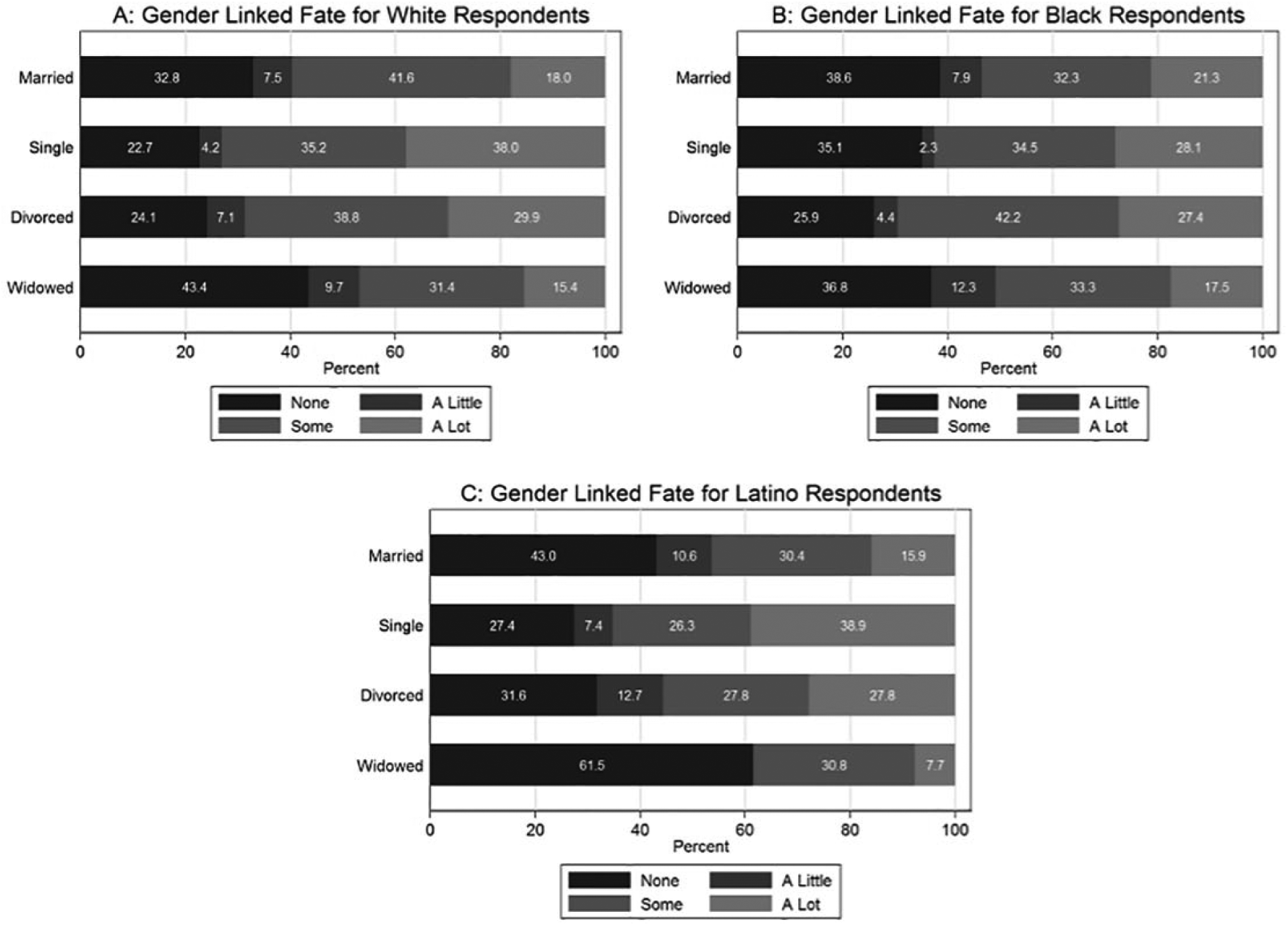
Gender linked fate by marital status by race/ethnicity.
In addition, single and divorced women of all races/ethnicities identified as having a lot of gender linked fate at greater rates than married women of the same race/ethnicity. The largest difference was for Latinas. Married Latinas were 23 percent less likely to identify as having a lot of gender linked fate than their never married counterparts. In fact, fewer than one in six Latinas who are married state that they have a lot of gender linked fate. This percentage is substantially lower compared with the almost 40 percent of single Latinas and 28 percent of divorced Latinas who state that they have the highest levels of gender linked fate. Non-Hispanic whites followed a similar pattern as Latinas; fewer than 20 percent (18%) of white married women displayed the highest levels of gender linked fate. In comparison, 38 percent of white single women and 30 percent of white divorced women stated that they had a lot of gender linked fate.
Again, the smallest difference was between black married and unmarried women. This is driven by two factors: the first is that married black women have the highest rates of “a lot” of gender linked fate compared with other racial/ethnic groups, and the second factor is that black women who have never married have the lowest levels of “a lot” of linked fate compared with other racial/ethnic groups. As a result, Figure 1 demonstrates that marriage for black women has weakest correlation with gender linked fate. However, contrary to our expectation that black women would as a group have the highest levels of gender linked fate, the opposite appears to be true for single black women. The results may indicate that black women tend to see their fates tied more to their race than to their gender (Mansbridge and Tate 1992). 7 Overall, we find descriptive evidence that marital status is associated with varying levels of gender linked fate and this differs by race/ethnicity.
Regression Analysis
Table 1 presents the results of three ordered logit regressions predicting gender linked fate (1 = none to 4 = a lot). The table presents the analysis of three regressions for (A) white women only, (B) black women only, and (C) Latinas only. The results of this table indicate that marital status is a strong and significant predictor of gender linked fate for whites and Latinas even after accounting for other factors like income, gender role attitudes, and employment. Married white and Latina women had significantly lower levels of gender linked fate than single and divorced women of the same race/ethnicity.
Ordered Logit Regression Predicting Gender Linked Fate.

Source. 2012 American National Election Study.
Standard errors in parentheses. Married is Omitted/Comparison Category. Model only includes female respondents. PVI = Cook’s Partisan Voting Index.
p < .10. *p < .05. **p < .01.
Figure 2 presents the predicted probability of no gender linked fate, a little gender linked fate, some gender linked fate, and a lot of gender linked fate for married, single, and divorced women of each racial/ethnic group. These values were calculated by holding all other variables at their mean and estimating the change in different responses to the linked fate question for women with different marital statuses. The results demonstrate that not only is the relationship between marital status and gender linked fate significant for white and Latina women, it is also substantial in magnitude. Married Latinas were about 15 percent more likely to state that they have “no” gender linked fate than their single and divorced counterparts. Along the same lines, white married women were about 8 percent more likely to state that they had no gender linked fate than single and divorced white women. Moreover, both white and Latina single women were about 13 percent more likely to have a lot of gender linked fate than married women of the same race/ethnicity after holding all other variables constant. Divorced white and Latina women were also about 11 percent more likely to have a lot of gender linked fate than married women of the same race/ethnicity.
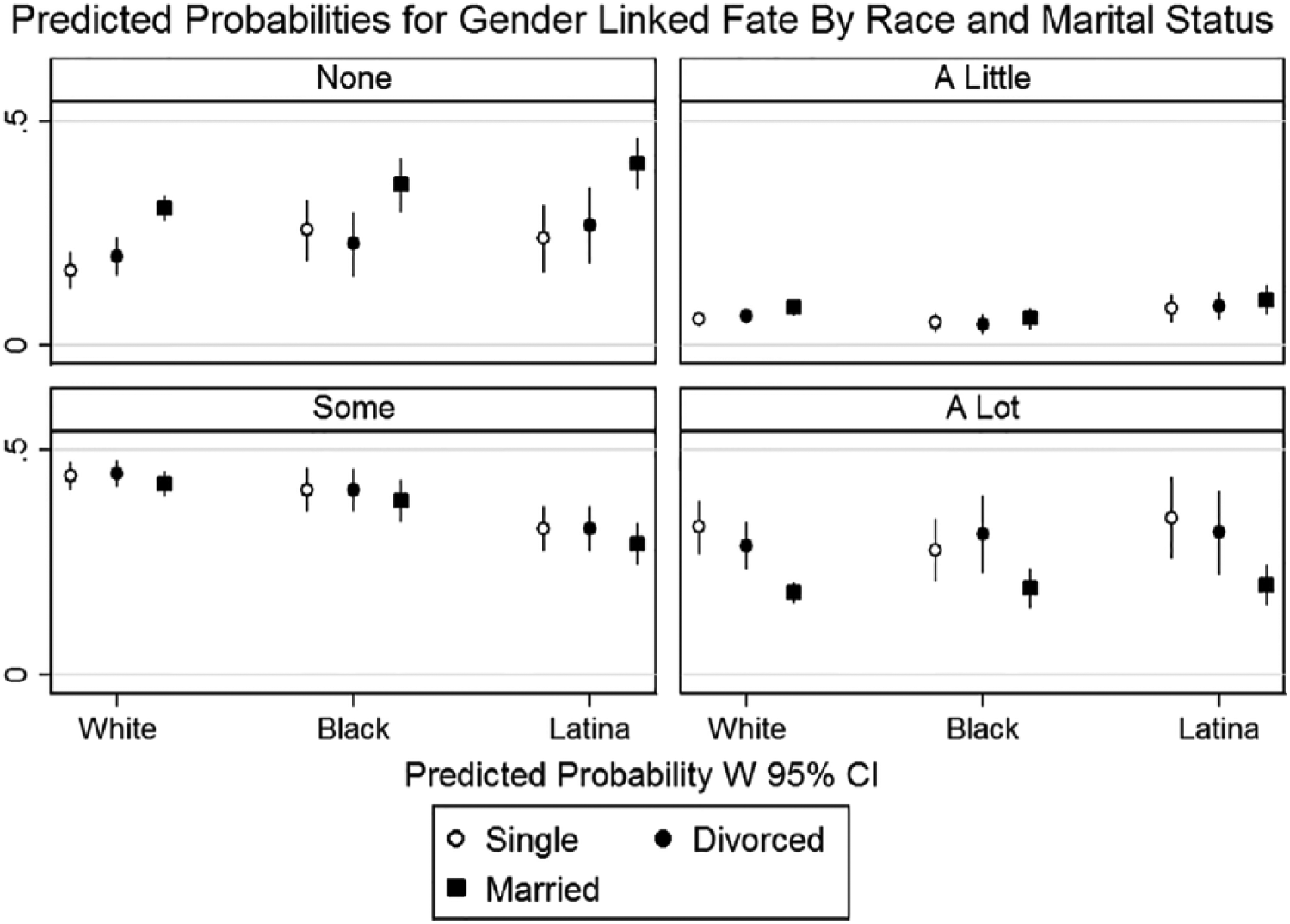
Predicted probabilities for single, married, and divorced women on gender linked fate by racial/ethnic group.
The effect of marital status on gender linked fate was not uniform for all racial/ethnic groups. Similar to other groups, black divorced women were significantly more likely to have higher levels of gender linked fate than married black women. Black divorced women were about 10 percent more likely to state that they had “a lot” of gender linked fate compared with their married counterparts. However, black single women did not have significantly higher levels of gender linked fate than married black women. This result suggests that it is the process of divorce, rather than marriage, which may influence gender linked fate for black women.
There are some theoretical justifications for this finding. First, the largest wealth gap between white and black women occurs among those who are divorced (Addo and Lichter 2013). Second, and related to the first point, black women are much more likely to receive custody of their children after divorce and are less likely to receive full child support (U.S. Census 2009). Thus, black divorced women face both greater financial hardships and an increased amount of housework than their married and single counterparts. In combination, the unique trials that black women face (on average) following divorce with regard to declining socioeconomic status and increasing familial responsibilities may increase their feelings of connection to other women.
Only a few other variables predict gender linked fate for women. For example, wealthier Latinas and blacks and more educated women of all racial/ethnic groups tend to have higher levels of gender linked fate. It may be that wealthier and more educated women are most aware of the glass ceiling which keeps women out of important positions (Dawson 1994). Older white women are more likely to display higher levels of gender linked fate which may be tied to their generational position during the second wave of feminism (see Supplemental Appendix for explicit estimation by generation). Unsurprisingly, women of all racial/ethnic groups who perceive discrimination to be a greater problem are more likely to have higher levels of gender linked fate.
Gender Linked Fate and Political Outcomes
While the previous section demonstrates that marital status is associated with differences in attitudes about gender linked fate, the question of whether varying levels of gender linked fate among married and unmarried women have tangible implications for American politics remains. We address the significance of our findings by exploring the role of differences in the marital gap in gender linked fate on broader political attitudes. While it has long been recognized that single and married women differ in their political preferences (Bolzendahl and Myers 2004; Stoker and Jennings 1995), less work has been done to empirically examine why these differences exist. As mentioned earlier, we suspect that the differences in gender linked fate between married and unmarried women found in the previous analysis may provide clues to these differences in political attitudes.
To assess whether differences in ideology and partisanship among married and unmarried women are, in part, correlated with differences in gender linked fate, we estimate several mediation models (Imai et al. 2011). 8 While structural equation modeling can estimate the same mediation effects, the approach recommended by Imai et al. (2011) is advantageous for this project because it is flexible enough to incorporate ordinal mediators, like gender linked fate, through the estimation of ordered logit regression.
These mediation models examine the mediating effect of a variable of interest (gender linked fate) between a specified independent variable (marital status) and dependent variable (ideology and partisanship) through the estimation of two separate regression models. These estimations produce four key pieces of information. The first is the average causal mediation effect (ACME) capturing the amount of the effect between marital status and ideology/partisanship which can be attributed to gender linked fate. The average direct effect (ADE) is the amount of the effect between marital status and ideology/partisanship which is not explained by gender linked fate. The total effect is the linear relationship between marital status and ideology/partisanship, an estimate equivalent to an ordinary least squares (OLS) coefficient.
Finally, the percent mediated is the percentage of the relationship between marital status and political outcomes that can be attributed to differences in unmarried and married women’s gender linked fate (the ACME divided by the total effect). For example, if the total effect of being single versus being married is .25 on the party identification variable, then single women have a quarter of a point higher score on the seven-point partisanship measure holding all other variables constant. The ACME is the portion of the total effect (0.25) that can be attributed to differences in gender linked fate. For example, if the ACME is .025 in the aforementioned example, than a tenth of the total effect (.25) is explained by single women’s higher levels of gender linked fate. Thus, the percentage of the direct effect of marital status on political attitudes mediated by gender linked fate is 10 percent. This modeling strategy improves upon traditional OLS regressions by estimating mediating pathways.
To assess the mediating effect of linked fate on married and unmarried women’s political attitudes, we estimate mediation models for two measures: ideology (1 = “Extremely Liberal” to 7 = “Extremely Conservative) and partisanship (1 = “Strong Democrat” to 7 = “Strong Republican) for white, black, and Latina women. For each racial/ethnic group, we compare A: single (never married) versus married women and B: divorced versus married women. The models with single versus married women only include women who are either single (i.e., never married) or married. Similarly, the divorced versus married women models exclude single and widowed respondents. Our mediating variable of interest is the female respondent’s levels of gender linked fate. Our models account for several confounding pretreatment (i.e., premarriage) measures, including age, education, perceived importance of religion, the partisanship of the congressional district they reside in, and generation status for Latinas. 9 All of these variables are important confounders which are minimally affected by marriage.
Results—Political Outcomes
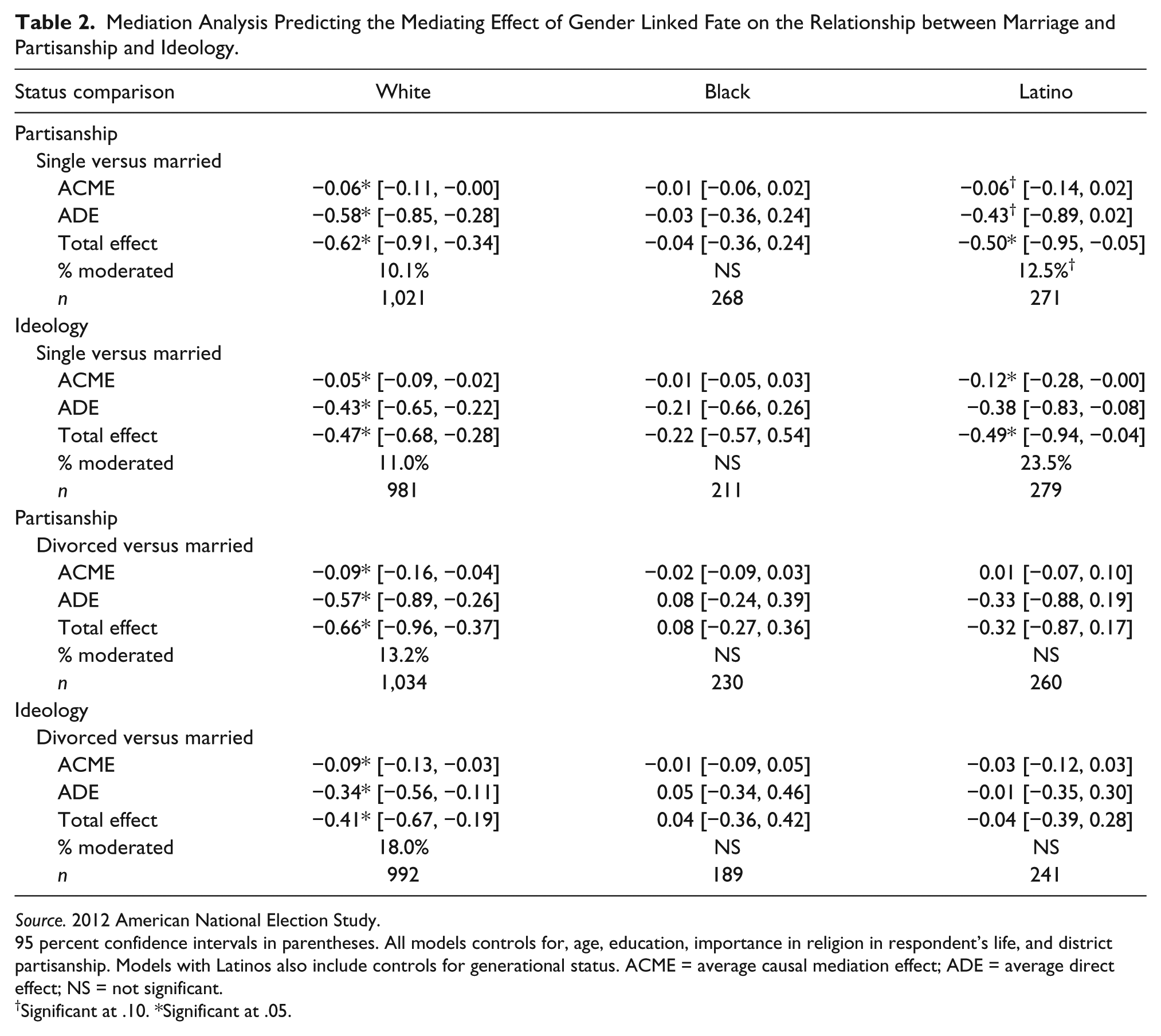
Table 2 presents the results of twelve separate mediation analyses predicting ideology and partisanship for white, black, and Latina women. The results are intriguing, documenting a marital gap in political preferences for whites and Latinas, but not for black women. Given that black women are almost universally supportive of the Democratic Party and are the most ideologically liberal, it is not surprising that there are not large differences between married and unmarried black women in these areas. However, contrary to expectations, Latinas who are divorced are not ideologically different and do not have different levels of partisanship than their married counterparts after controlling for several factors. This unexpected result may suggest that there is a residual political conservatizing effect of marriage for Latinas that continues even after marriage ends.
Mediation Analysis Predicting the Mediating Effect of Gender Linked Fate on the Relationship between Marriage and Partisanship and Ideology.
Source. 2012 American National Election Study.
95 percent confidence intervals in parentheses. All models controls for, age, education, importance in religion in respondent’s life, and district partisanship. Models with Latinos also include controls for generational status. ACME = average causal mediation effect; ADE = average direct effect; NS = not significant.
Significant at .10. *Significant at .05.
In contrast, white and Latina single (i.e., never married) women tend to be more liberal than their married counterparts even when controlling for several factors, including age, district partisan contexts, education, and religious importance. According to the total effect section of Table 2, white single women have a .47 point lower score than married women and Latinas who were never married have a .49 point lower score than their married counterparts on a scale which ranges from 1 = “Extremely Liberal” to 7 = “Extremely Conservative.” Similarly, whites and Latinas who were never married had .62 and .50 point lower scores, respectively, on a seven-point partisanship scale which ranges from 1 = “Strong Democrat” to 7 = “Strong Republican” than married women of the same race/ethnicity. White divorced women were also significantly more likely to be liberal and identify with the Democratic Party than their married counterparts. White divorced women have about a .66 point lower ideology score and a .41 point lower score on the Democrat to Republican partisanship scale than their married counterparts.
Differences in gender linked fate play an important mediating role in explaining the marriage gap where it exists. About 11 percent (see % mediated in Table 2) of the differences between married and single white women with regard to both ideology and partisanship are explained by differing levels of gender linked fate between white married and never married women. In other words, if married and never married women had the same levels of gender linked fate, the marriage gap in ideology and partisanship would be about 11 percent smaller. Gender linked fate explains a similar amount of variation in the relationship between marital status and ideology for white married and divorced women as 18 percent of the difference in ideology between these women is explained by differences in gender linked fate. Similarly, 13.2 percent of the total differences in partisanship between divorced and married white women are explained by divorced white women’s higher levels of gender linked fate.
Gender linked fate also explains a significant and substantial amount of the difference in partisanship and ideology among married and never married Latinas. Lower levels of gender linked fate account for about 14 percent of married Latinas’ higher levels of Republican partisanship. Gender linked fate plays a more substantial role in explaining why married Latinas are more conservative than their single counterparts. About a quarter of the difference in ideology between married and single Latinas is explained by single Latinas’ higher levels of gender linked fate. While not explaining all of why married and unmarried women differ, gender linked fate plays a nontrivial role in the marital gap in political preferences for white and Latina women.
Moreover, we find that gender linked fate is more consistent and, in most cases, a more substantial mediator between marital status and ideology/partisanship than the most prominent competing explanations of the marriage gap. These competing mediators include differences in income, the presence of children at home, employment status, perceptions of gender discrimination, attitudes about traditional gender roles, and racial linked fate (see Supplemental Appendix for discussion and analysis).
Conclusion
While linked fate has been commonly employed to understand the political opinions of other underrepresented groups, it has been overlooked in explaining women’s preferences. We find that, unlike blacks who have high levels of racial linked fate (see Dawson 1994; Tate 1993), there is more variance among women in their levels of common consciousness. In particular, unmarried (i.e., divorced and single) women tend to have higher levels of gender linked fate than married women. This heightened sense of a common fate among single and divorced women has important implications for American politics. The correlation between women’s sense of linked fate and liberal political preferences suggests that the Democratic Party will benefit from these marital trends, especially given the fact that women make up the majority of the population and vote at high rates.
While we find that single and divorced women tend to have higher levels of gender linked fate, our exploration of differences among racial/ethnic groups demonstrates that the effect of marital status on gender linked fate for black women was unique. In particular, there were no statistically significant differences between black single and black married women with regard to gender linked fate. Given that black married women tend to form different matrimonial unions than whites, being married does not seem to significantly shift black women’s gender attitudes. Instead, divorce accounts for much of the change in gender linked fate for black women. The distinct effects of divorce for the average black woman, including lowered socioeconomic status, closer familial ties, and greater home responsibilities, may explain why divorce increases feelings of connectedness to other women. Our results demonstrate that future studies exploring differences among married and unmarried women should disaggregate their results by race/ethnicity to gain a more nuanced understanding of how marriage affects public opinion.
In addition to demonstrating the effect of marital status on gender linked fate, our study demonstrates that differences in gender linked fate among married and unmarried women have important implications for American politics. While recent research has demonstrated the limitations of linked fate as a predictor of political attitudes (see Gay, Hochschild, and White 2016), our results demonstrate that linked fate plays a significant role in explaining the marriage gap in American politics. In particular, lower levels of gender linked fate among married women account for a significant amount of their lower identification with liberals and as Democrats than comparable unmarried women. Moreover, gender linked fate performed as well or better than many previous theoretical mechanisms used to understand the marriage gap in American politics such as the presence of children in the home, attitudes about traditional gender roles, and differences in income (see Supplemental Appendix for this analysis). While no one variable can completely explain the marriage gap in partisanship and ideology, differences in attitudes about gender linked fate between married and unmarried women play a crucial role in helping us make sense of this phenomenon.
We also demonstrate that the marriage gap in politics is not universal for all racial/ethnic groups. In previous studies, political differences among married and unmarried women were largely attributed to attitudes of unmarried white and never married Latina women (Edlund and Pande 2002; Jennings and Stoker 2001). The results of this analysis demonstrate that while a marriage gap does exist in American politics, and is associated with differences in gender linked fate where it does exist, it is not evenly distributed among all racial/ethnic groups.
Given the dearth of research in this area, this study advances our understanding of women’s attitudes about gender linked fate and demonstrates how these differences might affect political preferences. Nonetheless, more work needs to be done on this topic. First, scholars should examine internal differences within groups to explore whether the marriage gap in gender linked fate is greater or smaller for some women than others. For example, due to the relatively small numbers of Latinos in the 2012 ANES, we are unable to explore differences among Latinas of different national origins. Montoya (1996) demonstrates that groups like Puerto Ricans and Cubans differ dramatically in their attitudes about traditional gender roles. It is possible that a more nuanced study may find that a marriage gap in gender linked fate is driven by subgroups of the Latino population. Future research might also explore the positioning of linked fate survey questions relative to questions about membership in ethnic groups. Placing the survey question nearer to questions about their racial and ethnic identities might affect how women think about their relationships to other women.
Second, future research should further explore what mechanisms explain the differential influence of marital status on gender linked fate for women of different racial/ethnic backgrounds. In particular, scholars could assess whether factors attributed to assortative mating such as income and division of labor are driving these results, or whether factors around discrimination and culture are more associated with the stronger or weaker influence of marital status on gender linked fate for black, white, and Latina women.
Finally, we hope that future studies reevaluate our findings using panel data to better understand the causal relationship between marriage and gender linked fate over time to address problems with selection effects. At the time of writing this, we were unable to find such a data set. Of course, women who delay or forgo marriage are a distinct subgroup, reflecting higher levels of education and earnings (Lesthaeghe 2010). Yet, our results demonstrate that marital status predicts levels of gender linked fate net of the distribution of income, education, age, views about gender roles, and employment status. But, additional inquiry with longitudinal data linking these processes with political attitudes and gender linked fate would help explain how selection and causality structure these relationships. While more work is necessary, this study provides important information about the predictors and consequences of gender linked fate.
Footnotes
Declaration of Conflicting Interests
The author(s) declared no potential conflicts of interest with respect to the research, authorship, and/or publication of this article.
Funding
The author(s) received no financial support for the research, authorship, and/or publication of this article.
Supplemental Material
Replication data for this article is available with the manuscript on the Political Research Quarterly (PRQ) website.
Notes
References
Supplementary Material
Please find the following supplemental material available below.
For Open Access articles published under a Creative Commons License, all supplemental material carries the same license as the article it is associated with.
For non-Open Access articles published, all supplemental material carries a non-exclusive license, and permission requests for re-use of supplemental material or any part of supplemental material shall be sent directly to the copyright owner as specified in the copyright notice associated with the article.
