







Abstract
This paper proposes to investigate the influence of legislative quotas on gender differences in political participation by analyzing the within- and across-country effects of quotas. Gender quotas can signal to women that their presence in politics is welcome, leading to a subsequent increase in their involvement in political activities. This change in political behavior should not be reproduced in men; thus, when gender quotas are present, the gap between men’s and women’s participation narrows. Using the European Values Survey and data from eighteen European democracies, this paper demonstrates that this indeed occurs for some political activities when gender gaps are compared before and after the introduction of quotas within countries. This result, however, is not replicated for across-country analyses. European countries without legislative gender quotas tend to have smaller gender gaps than countries with them. This result is explained by referring to the context of the adoption of gender quotas.
Introduction
The adoption of gender quotas has been one of the major changes to women’s representation in the last two decades. It represents a “fast track” political measure that aims at solving women’s historical exclusion from politics over a shorter period of time (Dahlerup and Freidenvall 2005). Advocates of gender quotas argue that, in addition to increasing women’s representation in the legislature, quotas may signal the inclusion of women in the political sphere, which should have an influence on mass-level attitudes and behavior (Franceschet, Krook, and Piscopo 2012). This paper proposes to further the study of legislative gender quotas by investigating the impact of quotas on gender gaps in political participation in established European democracies and over time.
This paper uses cross-sectional longitudinal data, which differ from previous quantitative studies on the influence of legislative gender quotas on men’s and women’s levels of political involvement (Kittilson and Schwindt-Bayer 2012; Zetterberg 2009). 1 These latter investigations stipulate that countries with gender quotas should be associated with smaller gaps between women and men in political involvement levels. They cannot, however, assess whether the adoption of gender quotas is linked with changes in behavior within countries. The inclusion of longitudinal data along with cross-sectional data allows for the investigation of two separate effects of gender quotas—a within- and an across-country effect. Using data from eighteen established European democracies, I show that the adoption of gender quotas is associated with a reduction in gender gaps for some political activities, but not all, within countries. However, I demonstrate that when comparing countries with and without legislative gender quotas, quota countries have larger gender gaps in political participation. Thus, I argue that the two effects must be distinguished.
This paper also indicates that the positive effect of gender quotas within countries occurs only for certain types of political activities favored by women such as individual noninstitutional actions. For other political activities, these results are not reproduced. I argue that gender quotas may not be enough for women to overcome their lower levels of socioeconomic resources which are required for certain political activities such as political discussion or involvement in a political party. Women’s involvement in political activities demanding lower levels of socioeconomic resources—signing a petition or joining a boycott—will benefit from the adoption of legislative gender quotas. As explained below, gender quotas may provide women with symbolic, descriptive, and substantive representation which provides greater incentives for women to become involved in the political sphere. Hence, gender gaps for specific political activities may be reduced with the adoption of gender quotas.
Quotas and Gender Gaps in Political Participation
Two main categories of gender quotas exist in established European democracies: legislative and voluntary party quotas. First, legislative quotas are mandated by the constitution of a country or its legislature and require political parties to designate a certain percentage of female candidates (Norris 2004). Penalties can be applied if political parties do not respect the quota legislation. Second, party quotas are voluntarily adopted by political parties and not mandated by the state (Krook, Lovenduski, and Squires 2009). Under party legislation, the selection of candidates standing for election has to take into account a gender balance, usually in the form of a certain percentage of women candidates that needs to be met. Failure to respect the internal party legislation can result in sanctions.
In some debates surrounding the adoption of gender quotas, proponents argue that quotas can also affect citizen behavior and attitudes (Zetterberg 2009). It is important to note that when discussing gender quotas potential to change citizen behavior, most authors focus on the legislative type. They argue that this quota can lead to the political advancement of women in all spheres, beyond their presence in the legislature (Dahlerup and Freidenvall 2005); they can reshape attitudes and values about women’s role in politics (Kittilson 2005). It is believed that quotas “could help to empower women citizens and break their long-standing subordination in political life” (Zetterberg 2009, 715). Gender quotas can send cues to citizens about the appropriate place of both women and men in the political process, thereby influencing levels of political participation.
The literature identifies three mechanisms through which quotas can influence gender gaps in political participation. The first mechanism is symbolic representation, which refers to citizens’ feelings of being effectively represented (Pitkin 1967). Gender quotas may send a signal to citizens, and especially women, that the political sphere is open to women’s participation and that the political process is fair and legitimate (Krook 2007). By adopting a law mandating the presence of women on electoral lists, the government stipulates to women that they are not just subjects but also decision makers and leaders (Zetterberg 2009). This signal likely makes women feel better represented in the political process and may give them a more positive attitude about politics (Kittilson 2005), which in turn, may spur their levels of participation. Men’s levels of political participation should not be affected by gender quotas—at least not in the same way—since gender quotas directly target women’s inclusion in the political process.
The second mechanism links gender quotas to increases in women’s descriptive and substantive representation, which in turn affects gender differences in political participation (Schwindt-Bayer 2011; Zetterberg 2009). Substantive representation assesses whether representatives are acting in the interest of citizens while descriptive representation focuses on whether representatives mirror citizens in terms of sociodemographic factors (Pitkin 1967). The primary goal of gender quotas is to increase the descriptive representation of women through the number of women in the legislature. Studies have found that some gender quotas are successful in reaching this goal (Schwindt-Bayer 2009; Tripp and Kang 2008). It has been found that a greater proportion of women legislators is associated with greater consideration in the legislative process to issues and policies that are favored by women and with improving their evaluations of the political process (Bratton 2005; Childs and Withey 2004; Kathlene 1995; Saint-Germain 1989; Schwindt-Bayer 2006; Swers 2002; Taylor-Robinson and Heath 2003). This greater substantive representation of women that results from the adoption of gender quotas could provide incentives—such as greater perceived legitimacy (Norris and Franklin 1997) and confidence in representative institutions (Schwindt-Bayer and Mishler 2005)—to women in the electorate to be involved in political activities, leading to smaller gender differences. The argument is that women will be more likely to engage in political actions if they believe that the political system is responsive to them, which is more likely to occur when they are substantively represented.
The third mechanism through which gender quotas could lead to smaller gender gaps in political participation is mobilization (Schwindt-Bayer 2011). According to Schwindt-Bayer (2011, 7), quotas “give political parties a tool to reach out to women in the electorate and garner greater support.” In other words, gender quotas give political parties an argument for convincing women to support them. Gender quotas, moreover, create an incentive for political parties to target women’s vote. Quotas may make parties realize that women are an “undertapped market” (Kittilson and Schwindt-Bayer 2012) that is often overlooked. By creating an incentive to mobilize women, quotas may lead political parties to ask women to get involved in politics. This direct contact by political parties will likely result in women’s increased involvement with political parties and in electoral campaigns, thereby reducing gender gaps.
The adoption of gender quotas by a government is also usually associated with vigorous debates among the public and political elites (Schwindt-Bayer 2011) and with a re-energizing of the women’s movement, often a vocal participant in these debates (Krook 2007). The women’s movement may also act in a manner similar to political parties and reach out to women to ask them to get involved in the political process to increase the likelihood of gender quotas being adopted by the government. Again, this mobilization of women by the women’s movement may increase the former’s involvement in the political process and decrease gender differences in political participation.
Some single country investigations have found that gender quotas have positively affected women’s political attitudes and activities (Beaman et al. 2012; Krook 2006; Kudva 2003). However, large-N quantitative studies have mostly focused on the impact of legislative quotas on behavior in Latin America (Schwindt-Bayer 2011; Zetterberg 2009) and reveal no impact on gaps in political participation (Schwindt-Bayer 2011). Kittilson and Schwindt-Bayer (2012), however, find, in an analysis including more than thirty democracies from around the world, that legislative quotas are associated with greater women’s involvement and smaller gender differences in political persuasion and campaign activity. Importantly, this study—as well as Schwindt-Bayer’s (2011) investigation—only uses cross-sectional data; that is, they compare countries with quotas to countries without legislative gender quotas; they cannot link the adoption of gender quotas to changes in the size of gender differences in political participation. A notable exception to using cross-national data is the investigation of Kittilson and Schwindt-Bayer (2012) in France and Uruguay. They observe no decline of the gender gap in voting, political discussion, and political interest after the adoption of gender quotas in France as well as in political interest, persuading others, attending party meetings, and contacting government officials in Uruguay.
An issue with using cross-sectional data for investigating the impact of gender quotas on political participation is that countries opting to adopt quotas may share characteristics that influence women’s levels of political participation. For instance, a concern with increasing the presence of women in the political arena may reflect a low level of political participation from these women. This level of political participation might be lower than women’s participation in countries without gender quotas. The lower levels of participation is the reason for adopting quotas. If women are less likely to participate in politics originally, then the adoption of gender quotas may not lead to comparatively higher level of political participation for women. Consequently, using only cross-sectional data may not measure adequately the effects of gender quotas on political participation.
Furthermore, there is evidence that the legitimacy of gender quotas as a tool may matter for their impact on citizen behavior. In a study in Lesotho, Clayton (2015) argues that when gender quotas are adopted not as a result of domestic activities but as a consequence of an international organization’s pressures, women’s levels of political engagement actually reduce instead of increasing as expected. The latter reason for adopting gender quotas may lead citizens to see quotas as illegitimate and quota recipients as not worthy of their positions, which may lead to a negative effect of gender quotas on political engagement and participation (Dahlerup 2006). Clayton’s (2015) findings indicate that the theorized positive effect of gender quotas on women’s political participation may only occur when quotas are perceived as a legitimate tool to increase women’s representation. This situation may exist when quotas are adopted by elected domestic political actors. Gender quotas are also adopted as a response to women’s mobilization, as a tool to achieve strategic gains in elections, and to conform to the norm of equality some political parties defend (Franceschet, Krook, and Piscopo 2012). When actors associated with the domestic political process, such as politicians, political parties, and citizen groups, play a significant role in the adoption of gender quotas, these quotas may be associated with a positive influence on women’s levels of political participation and smaller gender gaps.
Among established European democracies, four countries have adopted legislative gender quotas—Belgium, France, Portugal, and Spain. 2 For these countries, international organizations play little role in explaining the adoption of gender quotas. Most investigations emphasize the role of the women’s movement and political parties as reasons for the adoption of gender quotas in these democracies (i.e., Meier 2012; Opello 2006; Verge 2012). Quotas have also been adopted in contexts where the underrepresentation of women in politics as well as gender inequality in society was the object of multiple debates between citizens and elites. In these situations, gender quotas were presented as a solution to an important problem by citizens and political parties. Consequently, it is expected that the adoption of gender quotas in established European democracies should lead to smaller gender gaps in political participation as these quotas are more likely to be perceived by citizens as a legitimate tool to increase the representation of women.
Hypotheses
According to the previous studies, the adoption of gender quotas should lead women to participate at higher levels in politics, thus, resulting in smaller gender differences between women and men than in countries without quotas as the incentives to political participation produced by gender quotas are not presented in the latter countries. Alternatively, it is possible that there is something particular about countries that adopt gender quotas, which also influences gender gaps in political participation. Only investigating across-country effects of gender quotas cannot identify which of these two alternatives may lead to smaller gender gaps. By including longitudinal data alongside cross-sectional data, we can increase confidence in the effects of gender quotas on differences between women’s and men’s levels of political participation. Hence, cross-sectional longitudinal data allow to test two distinct hypotheses regarding gender quotas:
Moreover, political activities are not all similar and have been associated with different gender gaps size (Coffé and Bolzendahl 2010; Stolle and Hooghe 2011). Political activities can be classified into three types. First, institutional forms of political activities focus on the electoral process. As such, party membership can be considered a traditional political activity. Hence, following Coffé and Bolzendahl (2010), we should expect larger gender gaps in party membership as “women’s lower average levels of socio-economic resources may make it more difficult for them to engage in time-intensive, expensive, or highly skilled forms of activity” (p. 320). Verba, Schlozman, and Brady (1995) identify time, money, and skills as the resources necessary for political action. Women’s lower levels of these resources combined with their lower levels of political knowledge, political interest, and political efficacy have traditionally been used to explain their lower levels of political participation when compared with men (Burns, Schlozman, and Verba 2001). In a cross-national setting, both Coffé and Bolzendahl (2010) and Kittilson and Schwindt-Bayer (2012) find that women have lower levels of political efficacy and political interest as well as lower levels of political resources than men. If, however, the adoption of gender quotas leads to increased mobilization of women by political parties, we could observe smaller gender gaps in party membership in countries that have adopted gender quotas when compared with countries without such quotas and smaller gender gaps after the adoption of legislative quotas within countries. When parties encourage women to be involved in politics, the former may recruit the latter to be members. The same result is less likely to occur if the other mechanisms are involved as they may not be enough for women to overcome their lower levels of free time, lower income, or lack of skills necessary to be involved in institutional political activities.
Second, signing a petition and joining a boycott are classified as individual noninstitutional activities as they are performed outside of formal avenues of participation such as political parties and elections and they do not involve interacting with other citizens. Again, following Coffé and Bolzendahl’s (2010) argument, I hypothesize that the influence of legislative gender quotas on political participation and gender gaps should be more likely to occur for these individual political activities. The positive influence of legislative gender quotas on women’s levels of political participation may occur for political activities that require lower levels of political resources. Individual activities—signing petitions and joining boycotts—can easily be incorporated in daily life and do not require high levels of time and/or skills to perform (Stolle, Hooghe, and Micheletti 2005); thus, women may find easier to translate the incentives to political involvement provided by the symbolic and descriptive mechanisms of gender quotas into participation in these activities. In addition, the mobilization mechanism can also lead women to be more likely to sign petitions as the increased activity of political parties and the women’s movement to adopt gender quotas may have focus on women’s participation. Consequently, we cannot identify which mechanism is more likely to lead to smaller gender gaps; however, all three should work in the same direction.
Third, collective activist political activities involve joining a demonstration, joining a strike, occupying a building, and engaging in political discussion. These actions engage multiple citizens acting collectively to influence the decision-making process outside of political institutions. Women have lower levels of socioeconomic resources, which are required for political involvement that is demanding in terms of time, money, and/or skills (Burns 2007; Burns, Schlozman, and Verba 2001). The incentives provided by gender quotas may not be enough for women to overcome these disadvantages. As mentioned above, however, if the political mobilization mechanism links gender quotas to gender gaps in political activities, women may be more inclined to participate in these collective activities when gender quotas are adopted.
Data and Method
Hypotheses stipulating that the adoption of legislative gender quotas should be associated with smaller gender gaps in political participation are tested with survey data from the European Values Study (EVS). 3 The sample includes data from three waves of the EVS from 1990 to 2008 and from eighteen established European democracies. 4 These three waves were selected as they include data from before and after the adoption of legislative gender quotas in the four countries that have passed such legislation in Europe. Information about these gender quota legislations can be found in Table 1.
European Countries with Gender Quota Laws.
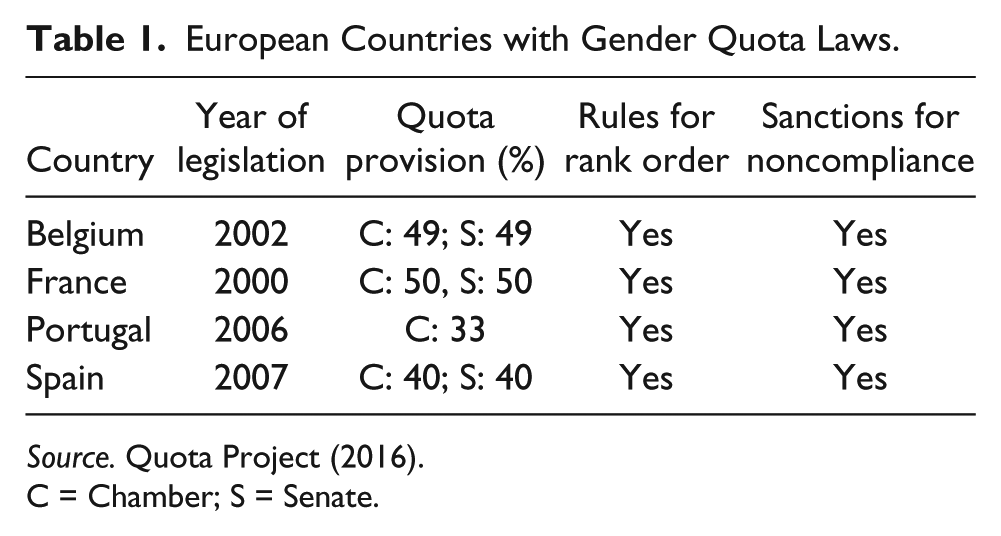
Source. Quota Project (2016).
C = Chamber; S = Senate.
Previous analyses on the influence of gender quotas on gender gaps in political participation tend to focus either on Latin American countries (Schwindt-Bayer 2011; Zetterberg 2009) or on a larger set of democracies (Kittilson and Schwindt-Bayer 2012). All these investigations, however, use cross-sectional data to test their hypotheses. This type of data only allows researchers to assess whether countries that have adopted gender quotas have smaller gender gaps than countries that have not. In other words, cross-sectional data investigate the across-country effects of gender quotas. The downside of this research strategy is that these studies are unable to link the adoption of gender quotas to changes in gender gaps in political participation within countries. However, within-country effects have previously been investigated, but not for gender quotas. Barnes and Burchard (2013) assess the within-country effects of increases in the presence of women in the legislature on gender differences in political participation. In doing so, they are able to link the increase of women’s representation to change in gender gaps. This present investigation proposes to extend the study of the impact of gender quotas on political behavior by analyzing cross-sectional longitudinal data, which will allow to distinguish between the across- and within-country effects of gender quotas.
Political participation is defined as any “activity that has the intent or effect of influencing government actions—either directly by affecting the making or implementation of public policy or indirectly by affecting the selection of people who make those policies” (Verba, Schlozman, and Brady 1995, 38). The EVS dataset contains five questions asking whether respondents have, might, or would never engage in different political activities. 5 These political activities are signing a petition, joining in boycotts, attending a lawful demonstration, joining unofficial strikes, and occupying buildings or factories. In addition to these five questions, the EVS asks how often respondents discuss politics with friends and whether they belong to a political party/group. While signing a petition, boycotting, and demonstrating are now conventional political activities, joining unofficial strikes and occupying buildings could be considered more extreme types of political actions unlikely to be performed by many citizens. The EVS dataset, unfortunately, does not include other indicators of political activities that are more commonly found in studies of participation such as voting or contacting an elected representative. However, the seven indicators of political participation used in this investigation allow to test the hypotheses elaborated above as they tap into the three main categories of political participation.
All these seven questions measuring political participation are self-reported; data on actual political actions performed are not gathered and, to my knowledge, do not exist cross-nationally. Consequently, it is possible for respondents to lie about their levels of political activities if they believe that political action is desirable. Political participation indicators are, nonetheless, recoded into dichotomous indicators where engaging in a political activity is coded “1” and otherwise is indicated with “0.” For the first five political activities, we code might and would never engage responses as “0.” 6 For political discussion, respondents who frequently and occasionally discuss politics are coded “1” while those who never discuss politics are coded “0.” Finally, members of political parties/groups are indicated with “1” and nonmembers with “0.”
The first independent variable is gender. It is coded either “1” for woman or “0” for man. Gender quotas are coded “1” for when a country has adopted legislative gender quotas and “0” for when a country has not. Following previous research, interaction terms are used to assess the influence of legislative quotas on gender gaps in political participation (Kittilson and Schwindt-Bayer 2012; Schwindt-Bayer 2011). As the aim of this paper is to assess two distinct effects of gender quotas—across- and within-country effects—two separate interaction terms are included. The first interaction term assesses whether the gender gap in political participation is different in countries with and countries without gender quotas. The second interaction term indicates whether the gender gap in participation is different before and after the adoption of quotas. Following Rabe-Hesketh and Skrondal’s (2012) instructions, first, the cluster mean of quotas is calculated, that is, the proportion of surveys within each country that occurs after the adoption of gender quotas. This transformation will allow for the assessment of cross-country effects of gender quotas. Second, the country-specific deviation from this proportion is calculated to obtain the within-country effects of quotas. These two indicators are then interacted with gender to obtain the influence of quotas on gender gaps in political participation before and after the adoption of quotas within a country and across countries.
Individual-level and country-level control variables are also included in the statistical analyses to assess the influence of other possible explanations for gender gaps in political participation. To control for socioeconomic differences between women and men, respondents’ age, education level, employment status, and marital status are added to the analyses (Burns, Schlozman, and Verba 2001). 7 In addition, a control for commitment to gender equality is included to assess for findings revealing that countries with greater commitment to gender equality have smaller gender gaps (Inglehart and Norris 2003). This control takes the form of a question asking respondents whether they believe sharing chores with their partner is important.
As for country-level controls, an indicator measuring the percentage of women in the legislature for each country the year before the EVS was conducted is added to the analyses. Some studies have shown that a higher percentage of women in the legislature is associated with smaller gender gaps in political engagement (Barnes and Burchard 2013; Desposato and Norrander 2009; Karp and Banducci 2008), and others that gender quotas can lead to an increase in the percentage of women in the legislature (Schwindt-Bayer 2009; Tripp and Kang 2008). Consequently, the inclusion of a control measuring the presence of women in the legislature is necessary to isolate the influence of legislative gender quotas from the one of women in the legislature. 8 The data on the percentage of women in the national legislature over time are made available by the Inter-Parliamentary Union. Furthermore, previous studies have also used the percentage of women in the workforce as an indicator of countries’ commitment to gender equality (see Beauregard 2014). Thus, the percentage of women in the workforce is included as a control. The data were obtained from United Nations Data.
The presence of left-leaning political parties in the legislature is included to control for the tendency of left parties to be more likely to adopt gender quotas (Caul 2001). Left political parties, furthermore, are more likely to work to advance gender equality (Caul 1999) and extend representation to historically marginalized groups (Matland and Studlar 1996). Thus, it is possible that the presence of left-wing political parties encourages women’s political participation, leading to smaller gender gaps. The Party Manifesto Database provides a classification of the political parties in each country included in this analysis into families. The percentage of seats occupied by socialist parties and social democratic parties in the same year that the EVS was conducted or the closest previous available year is included as a control. Caul’s (1999) findings also indicated that environmental political parties tend to have a larger percentage of women elected in the national legislature. Consequently, the percentage of seats won by ecological parties is included as a control. Data, again, are obtained from the Party Manifesto Database.
It has been found, in established industrial democracies, that electoral systems more demanding of socioeconomic resources are associated with larger gender gaps (Beauregard 2014). However, Kittilson and Schwindt-Bayer (2012) find that more proportional electoral systems are associated with smaller gender differences. Measures for the proportionality of the electoral system tend to include the district magnitude, the level of disproportionality, and the effective number of political parties (ENPP). In addition, the number of political parties and the number of elected representative per district can influence the amount of socioeconomic resources necessary for citizens to be involved in the political system. Thus, the district magnitude, level of disproportionality, and ENPP are included to control for the influence of the electoral system on gender gaps in political participation. 9 Data on district magnitude come from Carey and Hix (2011), and data for the level of disproportionality and ENPP are obtained from Gallagher and Mitchell (2008).
There is some evidence that voluntary party quotas are associated with an increase in the proportion of women in the legislature (Caul 2001; Norris, 2004; Tripp and Kang 2008). These increased number of women elected when major political parties adopt voluntary party quotas can lead, according to the second mechanism identified above, to smaller gender differences in political participation. Consequently, a control for party quotas is also added to the statistical analyses. Data were obtained from the Quota Project (2016), and the indicator takes the value of “1” if the country has at least one political party with party gender quotas the year of the EVS survey and “0” otherwise.
Finally, two dummy variables—one for each of the last two waves of the EVS (1990 is the reference category)—are included as control. These dummy controls help capture factors that may have occurred in each year the EVS was conducted which may influence political participation. Indeed, political participation has changed significantly in the years between 1990 and 2008 (see Stolle and Hooghe 2011).
Multilevel logistic regression is used to assess the influence of legislative gender quotas on gender differences in political participation. 10 A multilevel statistical strategy is better apt to correct for the potential estimation errors associated with the use of longitudinal cross-sectional data (Shor et al. 2007). As the data used in this investigation are composed of respondents nested within surveys nested within countries, it is possible that the control variables included in the statistical analyses do not account for all country-level or survey-level variations that may affect political participation. In multilevel modeling, it is possible to correct for this problem by including a random intercept for each survey and one for each country, which relaxes the assumption of independence of errors between respondents in the same survey and same country (Luke 2004; Rabe-Hesketh and Skrondal 2012; Steenbergen and Jones 2002).
Within- and Across-Country Effects of Gender Quotas
Results for the within- and across-country effects of gender quotas on political participation are presented in Table 2. The findings for the two separate effects of legislative gender quotas indicate that the expectations about the within-country effects of quotas (H2) were correct, but those concerning the across-country effects (H1) were misguided. First, for signing a petition and attending a demonstration, the interaction term for the within-country effects of gender quotas is positive and significant at the p <.05 level. Second, the interaction terms between woman and gender quotas for the cross-country effects are significant, but negative for four political activities—signing a petition, participating in a boycott, participating in a demonstration, and occupying a building or a factory. To facilitate the understanding of these significant interaction terms and of their sign—which is not straightforward in Table 2 (Kam and Franzese 2007)—what is presented and discussed here are the post-estimation effects (Brambor, Clark, and Golder 2006). For each significant interaction term, the predicted probability of engaging in a political activity for women and men is calculated according to whether gender quotas are adopted. These probabilities are then presented graphically. 11
Within- and Across-Country Effects of Gender Quotas on Political Participation.
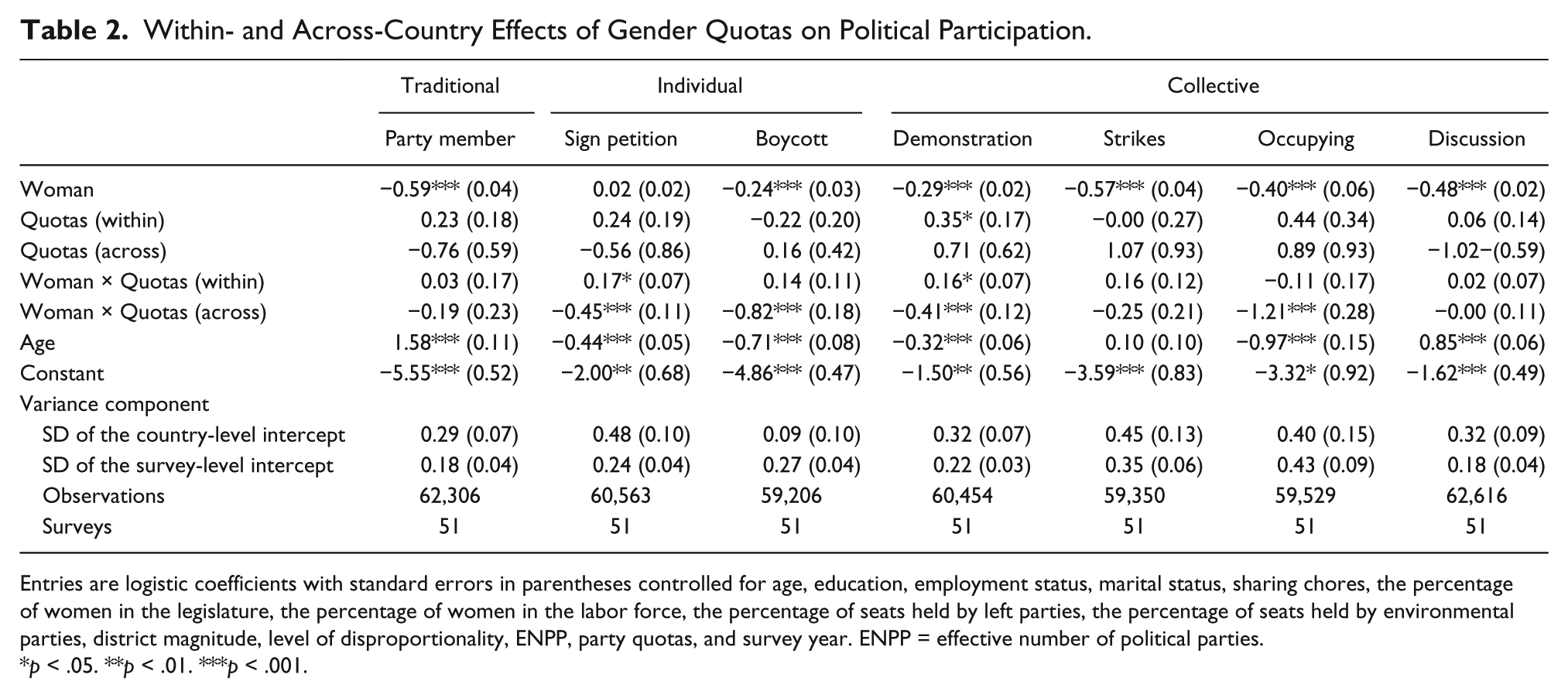
Entries are logistic coefficients with standard errors in parentheses controlled for age, education, employment status, marital status, sharing chores, the percentage of women in the legislature, the percentage of women in the labor force, the percentage of seats held by left parties, the percentage of seats held by environmental parties, district magnitude, level of disproportionality, ENPP, party quotas, and survey year. ENPP = effective number of political parties.
p < .05. **p < .01. ***p < .001.
Figure 1 represents the within-country effects of gender quotas while Figure 2 graphs the across-country effects for signing a petition. Figure 1 shows the probability of women and men signing a petition before and after the introduction of legislative gender quotas for each of the four countries in the sample that have done so. For these countries, men were more likely to sign a petition before the adoption of gender quotas, but it is women who are more likely to engage in this activity after the adoption of gender quotas; that is, the gender gap is reversed. As for Figure 2, it graphs men’s and women’s probability of signing a petition for countries with and without gender quotas. It demonstrates that, overall, countries with gender quotas have a larger gender gap where women are less likely than men to sign a petition.
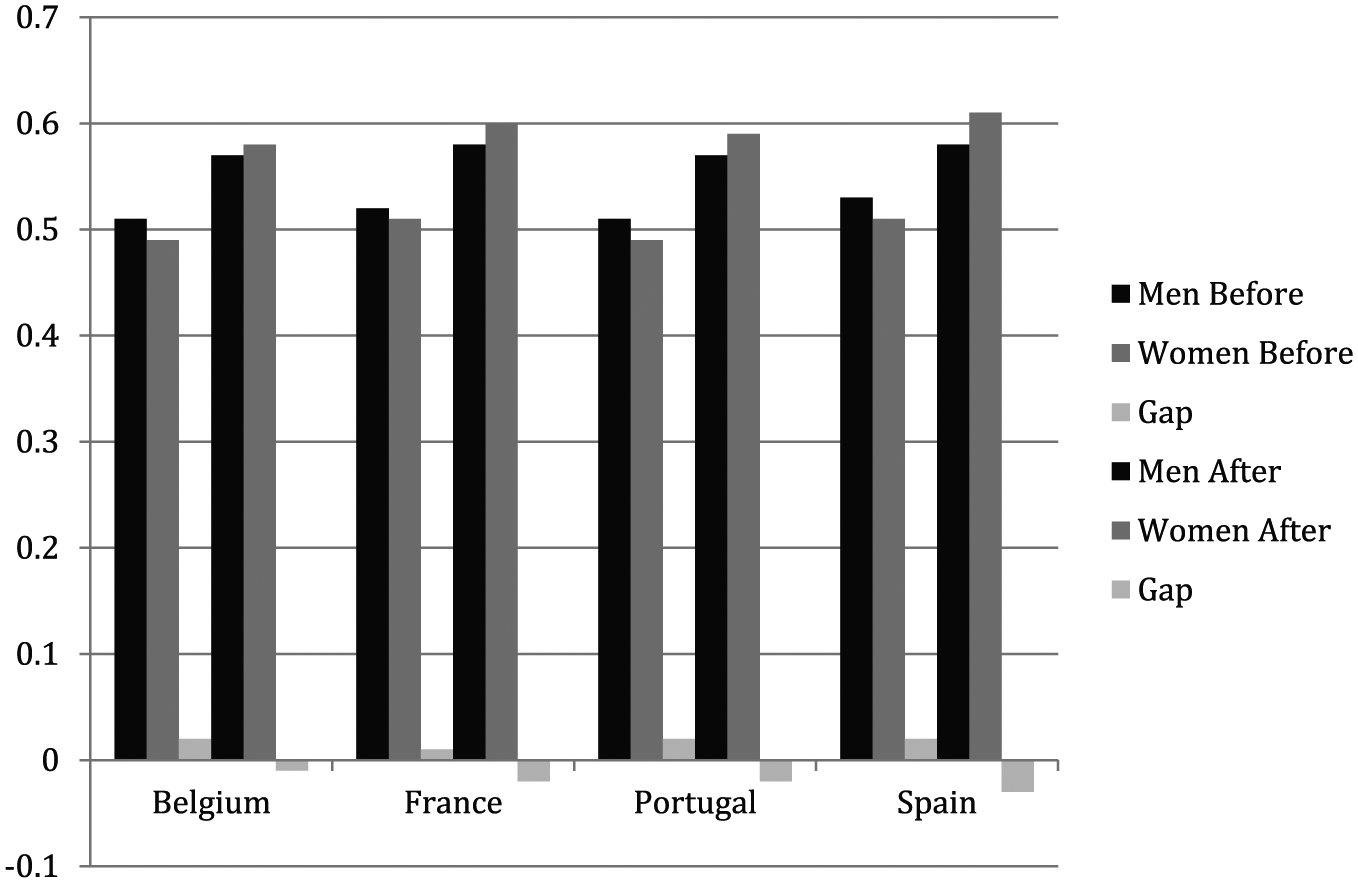
Probability of signing a petition before and after the adoption of gender quotas by country and gender.
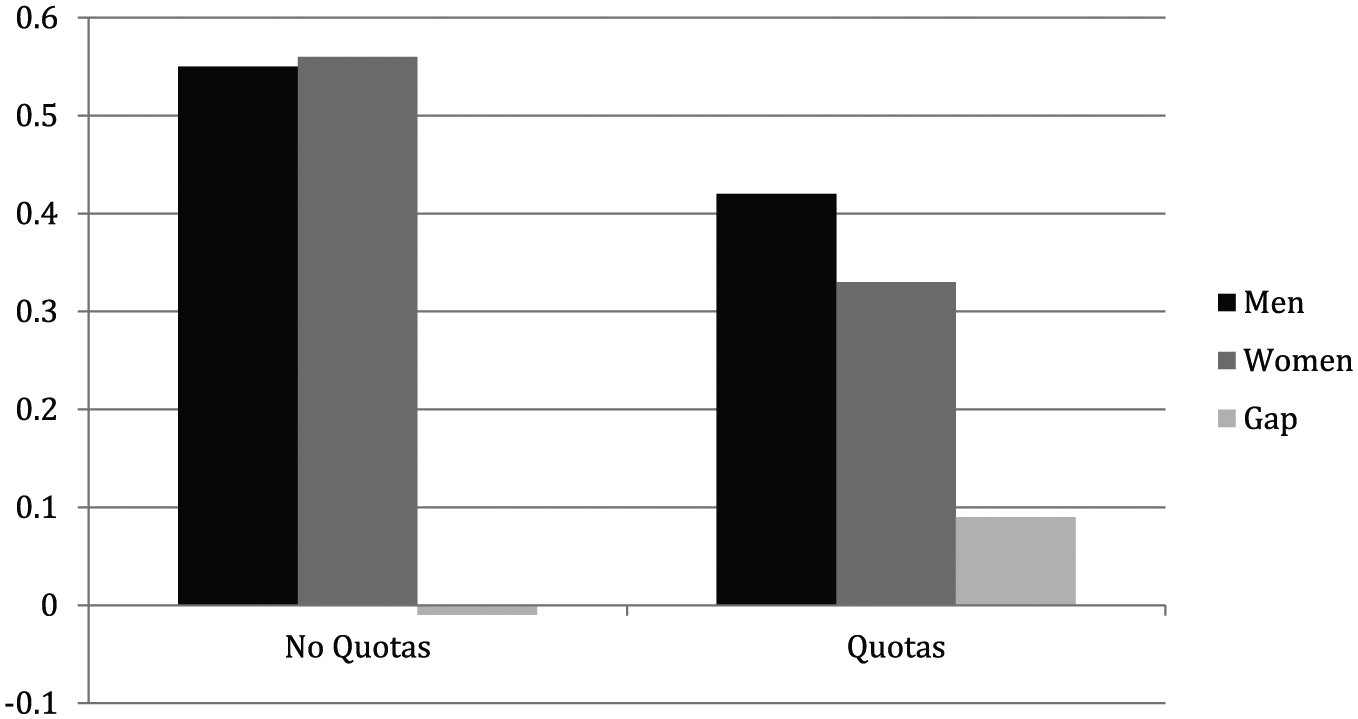
Probability of signing a petition for countries with quotas and countries without quotas by gender.
The same post-estimation analyses are conducted for the three other political activities associated with significant interaction terms between gender and quotas in Table 2. Figure 3 shows that for all four countries with gender quotas, the difference between women’s and men’s probability of engaging in a demonstration is smaller after the adoption of quotas. Furthermore, the across-country effects of gender quotas are related to larger gender gaps for country with gender quotas for the political activities of boycott, demonstration, and occupying a building. Figures 4, 5, and 6 illustrates these effects by demonstrating that gender gaps in the probability of engaging in political activities are larger in countries that have legislative gender quotas than in countries without them.
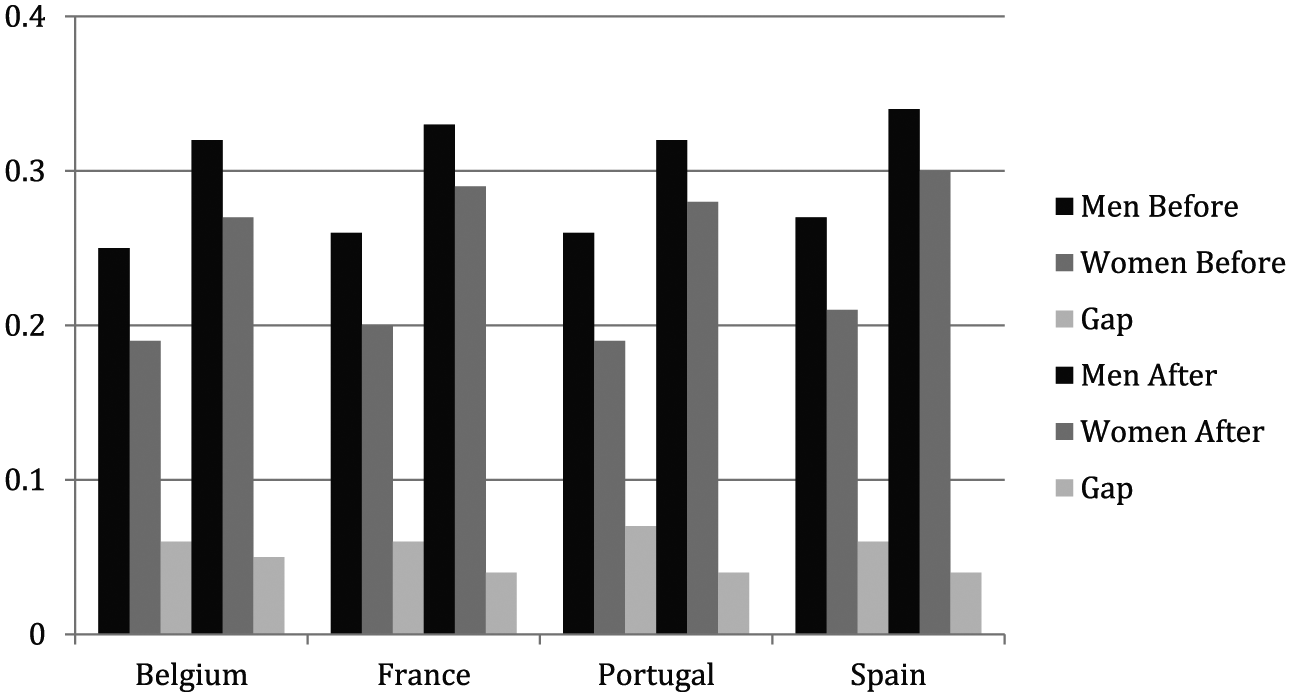
Probability of engaging in a demonstration before and after the adoption of gender quotas by country and gender.
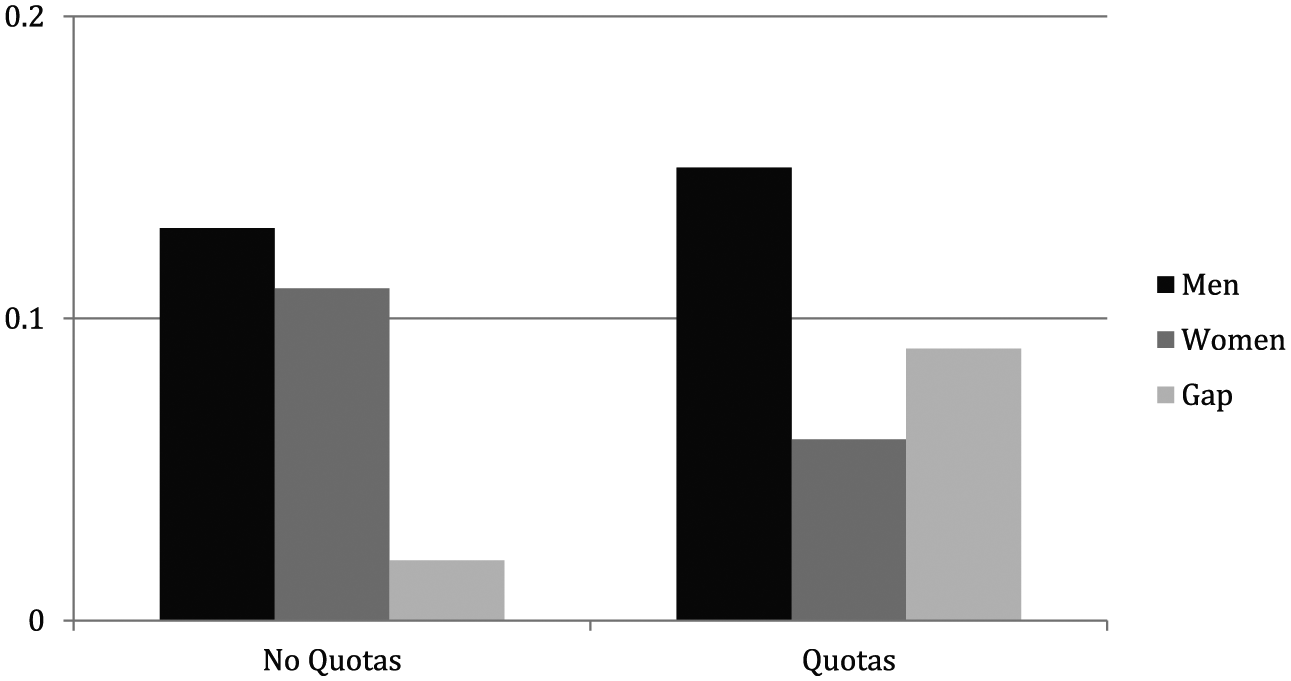
Probability of engaging in a boycott for countries with quotas and countries without quotas by gender.
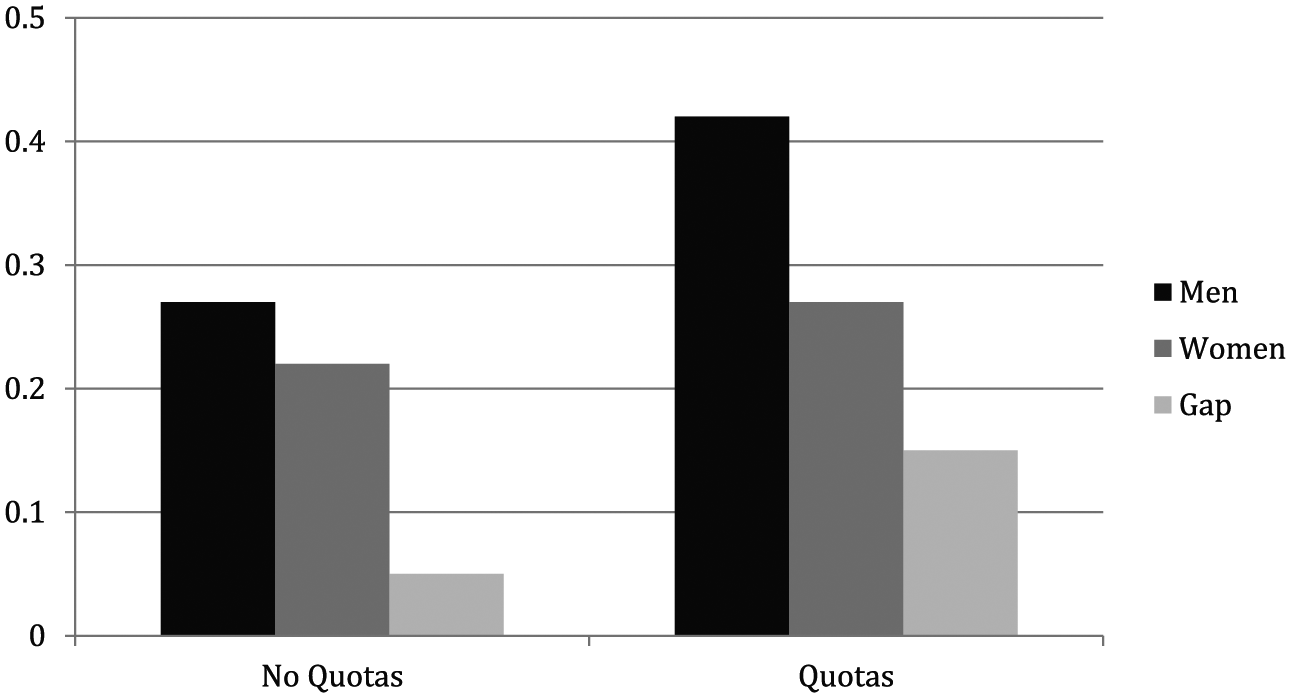
Probability of engaging in a demonstration for countries with quotas and countries without quotas by gender.
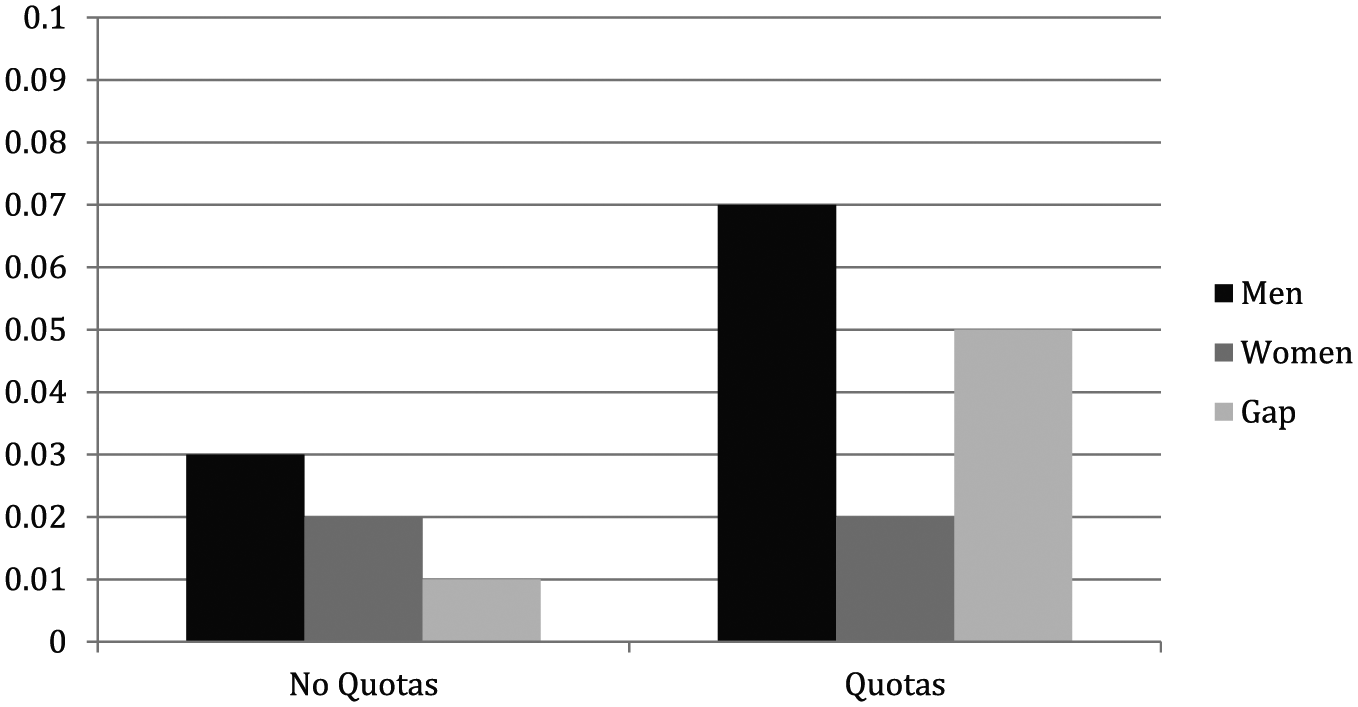
Probability of occupying a building for countries with quotas and countries without quotas by gender.
To assess the significance of the gender gap in political participation, post-estimation effects are calculated to obtain the marginal effects of gender on political participation. In Table 2, the woman coefficients only indicate whether gender differences are significant when the within- and across-country effects of gender quotas are 0, that is, when there are no quotas (see Brambor, Clark, and Golder 2006). This coefficient represents the average within- and across-country effects that being a woman has on levels of political involvement when there are no gender quotas, including before countries adopted them (Rabe-Hesketh and Skrondal 2012). By calculating the marginal effects of gender for when countries have adopted gender quotas, it is possible to assess the significance and size of gender differences in political participation in this situation. 12 As the influence of gender quotas on political participation has been separated in two distinct effects, marginal effects can calculate the within- and the across-country effects of being a woman when gender quotas are adopted.
Table 3 presents the marginal effects of gender on political participation according to the presence of gender quotas for the four political activities associated with significant interaction terms in Table 2. For signing a petition, there are no significant gender differences when gender quotas have not been adopted. The within-country effects of adopting gender quotas are associated with a significant and positive gender gap for signing a petition. In other words, when comparing countries before and after the adoption of gender quotas, women are more likely to engage in signing a petition than men after the adoption of gender quotas. However, when comparing countries with gender quotas to countries without them, women are significantly less likely to sign a petition than men in countries that have adopted quotas. For participating in a demonstration, in Table 3, it is possible to observe that the adoption of gender quotas is associated with a smaller and not significant women coefficient for the within-country effects. This table, moreover, indicates that the across-country effects of gender quotas are related to larger significant gender gaps for country with gender quotas for boycotting, demonstrating, and occupying a building.
Marginal Effects of Gender on Political Participation According to the Presence of Gender Quotas.
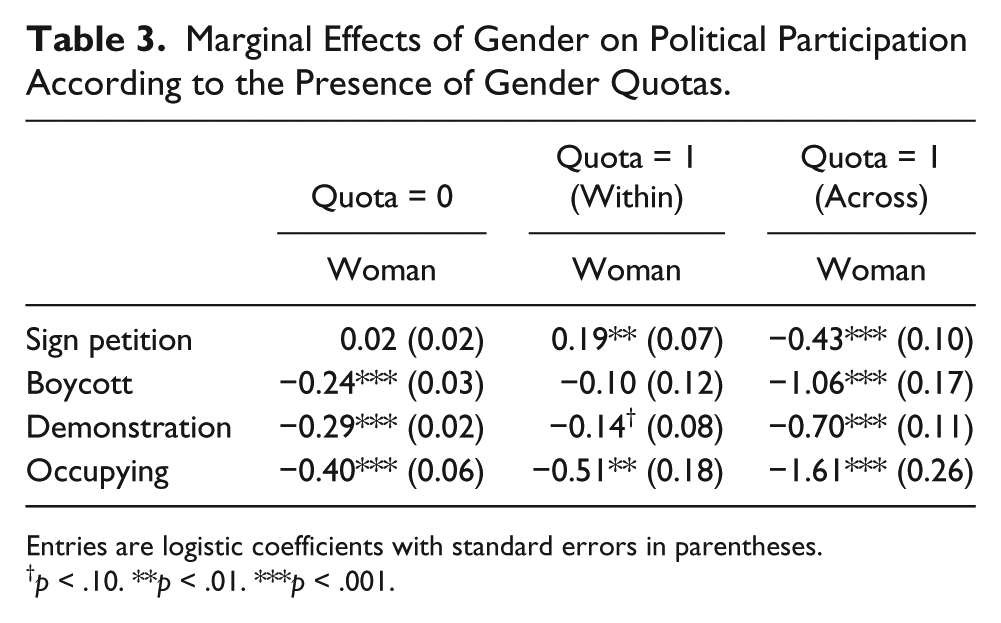
Entries are logistic coefficients with standard errors in parentheses.
p < .10. **p < .01. ***p < .001.
The results concerning the cross-country effects of gender quotas are consistent with the history of the adoption of gender quotas in established European democracies. One of the reasons for the adoption of quotas in France was a public concern about the lack of women in politics and especially about how France was lagging behind other democracies (Krook 2009; Murray 2012; Opello 2006). France’s lower percentage of women in formal politics may be a reflection of patterns of behavior existing at the mass level. Thus, when pooling data from a period of nearly twenty years, larger gender gaps in political participation emerge in countries that have adopted quotas as this lag was part of the reasons why quotas were adopted in the first place. Within these countries, the adoption of gender quotas helps women close the gap with men’s levels of political participation, but gender quotas may not be enough, yet, for these countries to be associated with smaller gender gaps as expected by H1 as other countries already had smaller gender differences.
Legislative gender quotas, furthermore, are linked to the decrease of gender gaps for some political activities when these gaps are compared before and after the adoption of quotas. This finding occurs even when gender quotas have famously not been considered successful. For instance, the adoption of the parity law in France was not associated with large increases in the percentage of women in the legislature; major political parties preferred to pay the fine instead of complying with the law (Murray 2012). Thus, the decrease of some gender gaps after the adoption of gender quotas in France might provide further evidence of Murray’s (2012) argument. She states that the parity law is a symbolic policy which has lead to important societal changes in France such as the adoption of legislations favoring parity in the workplace and a greater commitment from political parties to ensure diversity in political representation. Legislative gender quotas, consequently, do not have to lead to substantial increases in the presence of women in the legislature to have important consequences for women and men in the political process.
The results for signing a petition could, however, be explained by the mobilization efforts that occur in quota adoption campaigns. Political parties and the women’s movement may have asked women to sign petition supporting the adoption of gender quotas. As signing a petition requires a low level of political resources and can easily be performed in one’s daily life, women can easily change their levels of political participation in answer to their increased mobilization. Thus, the change in gender gaps before and after the adoption of gender quotas is not the direct result of these quotas, but of the action of political actors. In addition, the effect might be temporary as once gender quotas are adopted, mobilization rates of women and men will return to their previous levels.
Previous research has found a relationship between the increased presence of women in legislature and smaller gender gaps in Africa (Barnes and Burchard 2013) and Latin America (Desposato and Norrander 2009), but not in established industrial democracies (Karp and Banducci 2008). A possible explanation for this difference in the impact of women’s representation may be found in the work of Gilardi (2015) and Broockman (2014). Both found that the first few women elected to office in some established industrial democracies have empowering effects on other women, but over time, the presence of women in the legislature becomes something citizens are used to, reducing the effects of women’s representation. Thus, female citizens in established industrial democracies may need more than the “incremental track”—the gradual increase in women’s representation in the legislature (Dahlerup and Freidenvall 2005)—to change their political behavior. The adoption of legislative gender quotas—or the increased mobilization of women by political actors—may provide such change of “track” in women’s representation, which ultimately influences gender differences in political participation. Finally, it is important to note that these processes may take some time before leading to results, as it might be the case for more institutional forms of political participation, or might have a temporary influence as in signing a petition.
Additional Analysis
An important possibility is that these previous findings are not the result of the adoption of legislative gender quotas but of the influence of voluntary party quotas. Testing for this alternative explanation, the indicator for party quotas is transformed to assess its across- and within-country influences on gender difference in political participation. The two indicators of party quotas are then interacted with gender and added to the statistical analyses presented in the previous section. These additional analyses will allow to compare the effect of legislative gender quotas with the impact of party quotas on gender differences in political participation.
Results are presented in Table 4. Despite the introduction of the party quota indicators and associated interaction terms, most of the original results hold. The interaction term for the within-country effects of legislative gender quotas remains significant and positive for signing a petition while the interaction term for the across-country effects is also significant and negative for signing a petition, boycotting, demonstrating, and occupying a building. A notable distinction between Table 2 and Table 4 is that results are only significant at p <.10 for engaging in a demonstration when the additional controls are added. In other words, when the adoption of party gender quotas is considered, gender gaps in engaging in a demonstration are no longer reduced by the adoption of legislative quotas. The relationship observed in Table 2 may be caused by party quotas.
Within- and Across-Country Effects of Gender Quotas on Political Participation Controlled for Party Gender Quotas.
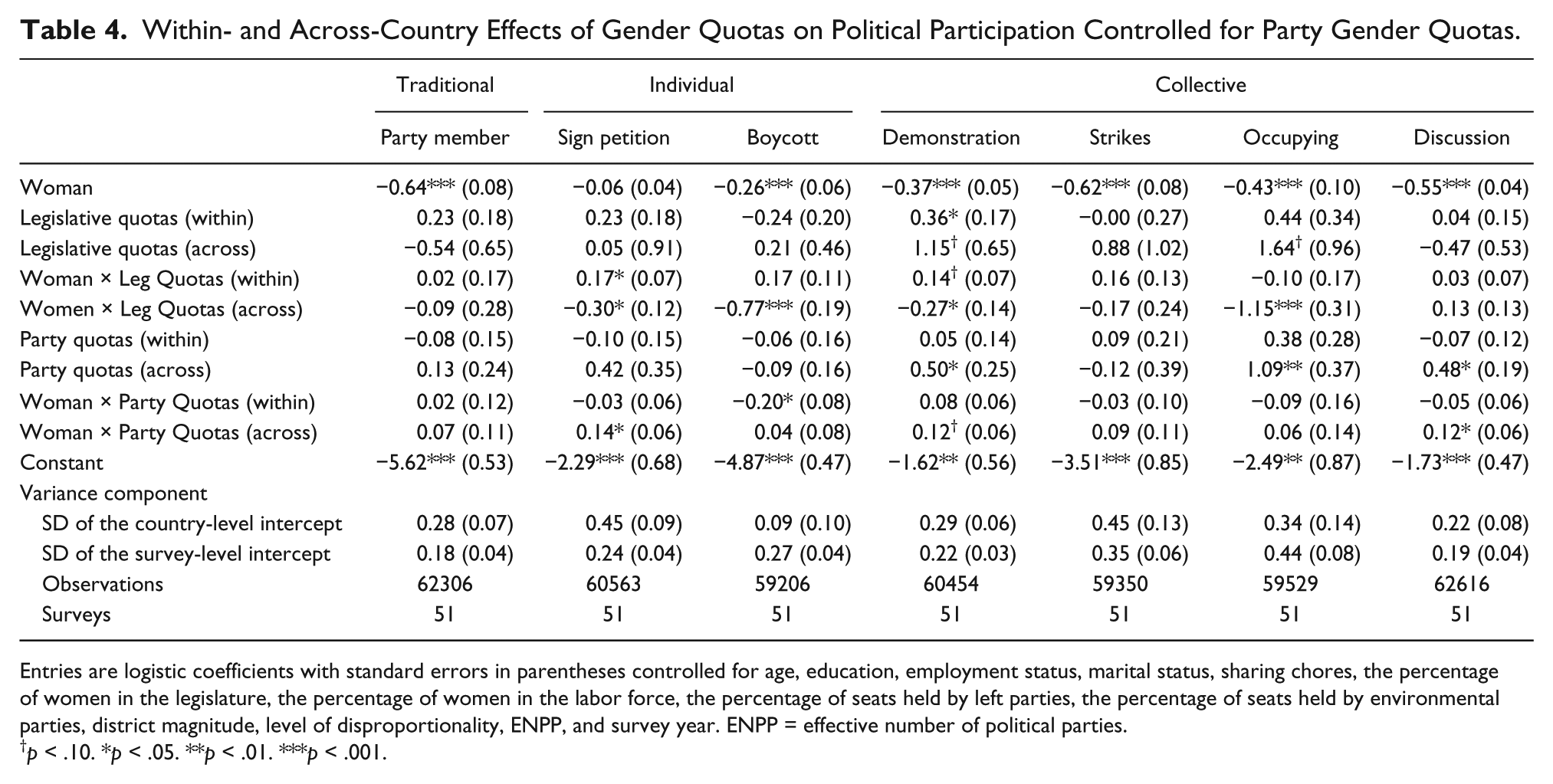
Entries are logistic coefficients with standard errors in parentheses controlled for age, education, employment status, marital status, sharing chores, the percentage of women in the legislature, the percentage of women in the labor force, the percentage of seats held by left parties, the percentage of seats held by environmental parties, district magnitude, level of disproportionality, ENPP, and survey year. ENPP = effective number of political parties.
p < .10. *p < .05. **p < .01. ***p < .001.
The combination of both analyses indicates that party gender quotas also affect gender differences in political participation and that this effect is different than the one from legislative quotas. Findings in Table 4 show significant and positive interaction terms between the cross-country effects of party quotas and gender for signing a petition and political discussion while this interaction reaches the p <.10 level of significance for attending a demonstration. These results indicate that when comparing countries with party quotas to countries without, countries with party quotas have smaller gender differences in selected political activities. This is shown in Figures 7 and 8 that graph the predicted probability of men and women signing a petition and engaging in political discussion for countries with and without party quotas. A possible explanation for this finding is that political parties in countries where women already participate to a greater extent—or closer to men’s level of participation—have adopted party quotas as a results of women’s engagement in the political process. Political parties in countries with lower women’s involvement and larger gender gaps in political participation may have faced less activism from women demanding actions to increase the presence of women in the legislature, leading to the absence of party quotas.
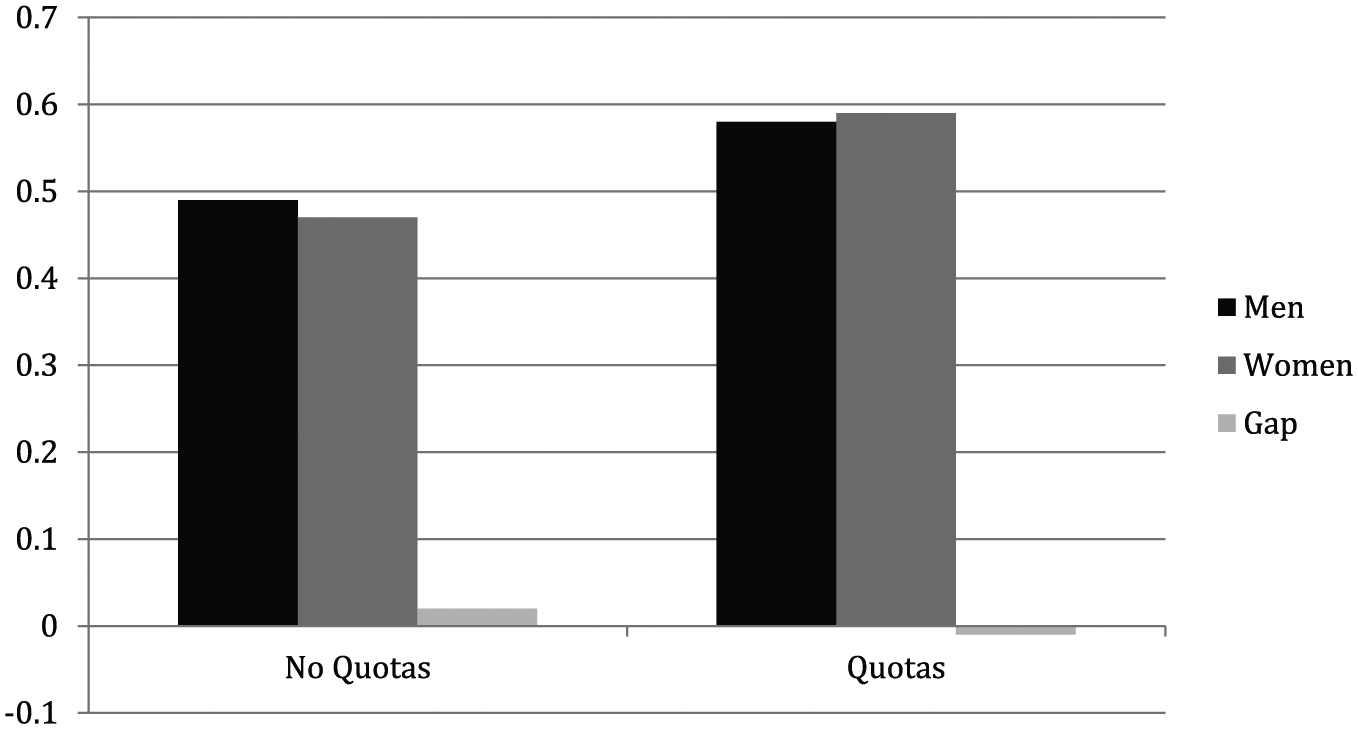
Probability of signing a petition for countries with party quotas and countries without party quotas by gender.
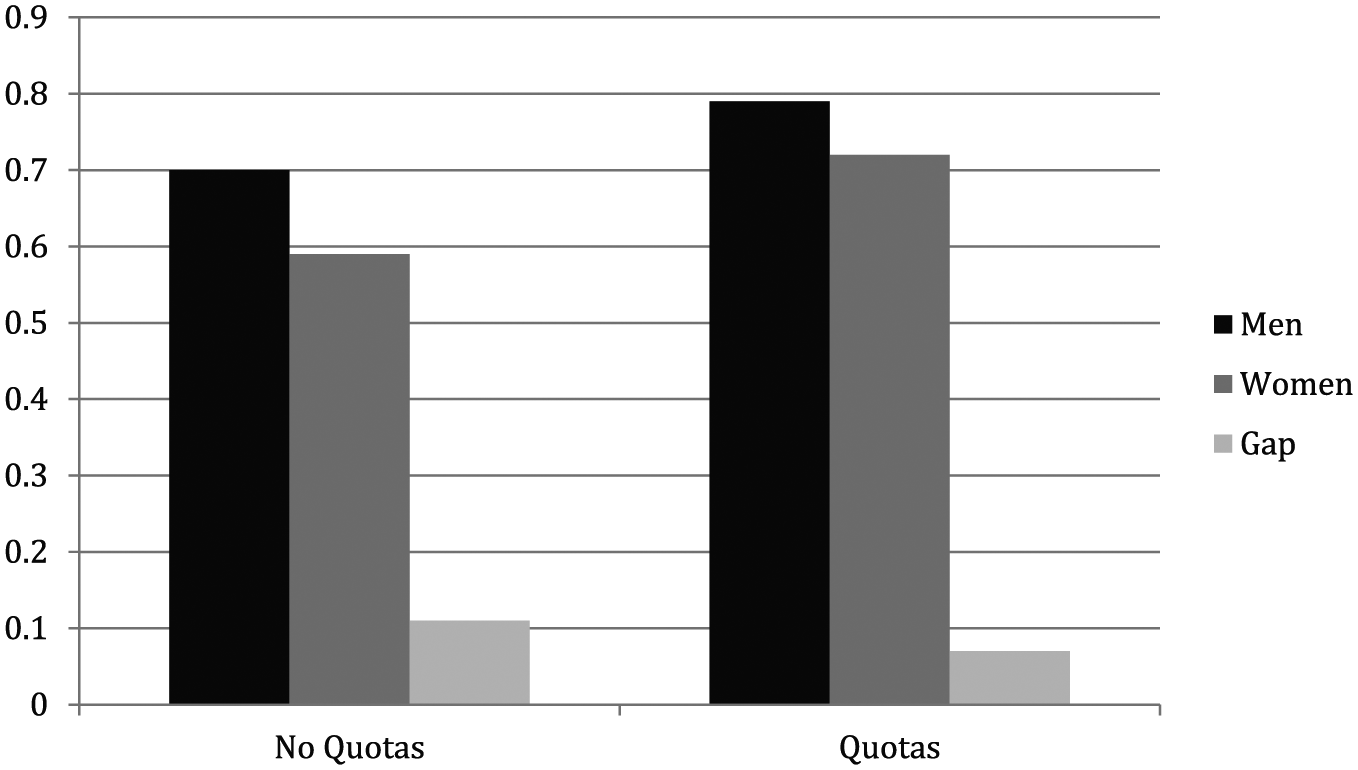
Probability of engaging in political discussion for countries with party quotas and countries without party quotas by gender.
In sum, when party gender quotas are considered alongside legislative gender quotas, it is possible to conclude that both types of quotas influence gender differences in political participation, but not always in the hypothesized ways. When gender gaps in political participation are smaller, party quotas tend to be adopted, while when they are larger, it is legislative quotas that tend to be adopted. The results of these additional analyses demonstrate, however, that it is not the absence of party quotas that lead legislative quotas countries to lag behind others in term of the size of the gender differences in political participation.
Discussion and Conclusion
A major contribution of this investigation is that it is the first study, to my knowledge, that combines cross-sectional and longitudinal data to assess the influence of gender quotas on political participation. By using data from three waves of the EVS, findings of this analysis indicate that the adoption of gender quotas is linked to smaller gender gaps for some political activities within countries, that is, when data are compared before and after the adoption of gender quotas. These smaller gender gaps, however, do not occur when the comparison is between countries with and without gender quotas, which is the expectation for most quantitative research on gender quotas and gaps in political involvement. Indeed, it seems that countries with larger gender gaps tend to adopt gender quotas to improve on their comparatively lagging involvement of women in politics.
Thus, results demonstrate a second important contribution of this study, that is, that the context of adoption matters. By investigating countries where the adoption of gender quotas is the result of actions performed by domestic political actors, we are able to identify a positive, but limited, influence of gender quotas on women’s levels of political involvement for specific political actions. These results are not replicated in other contexts or other parts of the world such as Latin America (Schwindt-Bayer 2011; Zetterberg 2009) and Lesotho (Clayton 2015). As it has been pointed out, there is a certain geographic pattern to the adoption of gender quotas, whereas the political context surrounding the adoption contains shared elements across countries within a region (Krook 2009). It is possible that in other geographical contexts, where the adoption of gender quotas is related less to a comparison of women’s levels of political involvement, results on the influence of quotas on gender gaps may vary. Future investigations of gender quotas and political behavior need to take into account both the context behind the adoption of gender quotas and the region where they occur to properly identify their impact.
Activities such as signing a petition, boycotting products, and participating in a demonstration, which tend to require less time and fewer skills, are the ones associated with the positive effect of gender quotas. H3 and H5 stipulated that if women are more likely to be mobilized by political actors when gender quotas are adopted, we could observe smaller gender gaps for collective political activities, either institutional or noninstitutional ones. No support is found for H3 and H5 in this investigation. Hence, it seems that legislative gender quotas help, for some political activities, close the gap between women and men, but they are not enough for women to overcome their comparatively lower levels of resources. However, political activities requiring low levels of resources such as signing a petition, the adoption of gender quotas or more importantly the campaign in favor of quotas may lead to a change in gender gaps.
The literature on the adoption of gender quotas specifies that multiple factors are linked with their success in increasing women’s representation. The reasons behind the adoption of gender quotas matter as well as the details of gender quotas, the institutional framework in which they are introduced, and the balance of actors for and against quotas as factors that are associated with the success of gender quotas in increasing the presence of women in the legislature (Krook 2009). As this study, along with others, has demonstrated that the context of adoption matters, it is likely that these other factors may also affect whether gender quotas change citizen behavior. Further investigations may wish to assess how political institutions and actors may interact with gender quotas to influence men’s and women’s political involvement.
Footnotes
Acknowledgements
The author thanks all participants as well as reviewers for their helpful suggestions and comments.
Author’s Note
A previous version of this paper has been presented at the 2015 European Conference on Politics and Gender at Uppsala University, Sweden, the 2015 Australian Society for Quantitative Political Science Annual Conference at the University of Melbourne, and the School of Politics and International Relation (Australian National University) Seminar Series.
Declaration of Conflicting Interests
The author(s) declared no potential conflicts of interest with respect to the research, authorship, and/or publication of this article.
Funding
The author(s) received no financial support for the research, authorship, and/or publication of this article.
Supplemental Material
Replication data for this article is available with the manuscript on the PRQ website.
Notes
References
Supplementary Material
Please find the following supplemental material available below.
For Open Access articles published under a Creative Commons License, all supplemental material carries the same license as the article it is associated with.
For non-Open Access articles published, all supplemental material carries a non-exclusive license, and permission requests for re-use of supplemental material or any part of supplemental material shall be sent directly to the copyright owner as specified in the copyright notice associated with the article.
