







Abstract
Existing literature shows that Republicans in the mass public demonstrate greater ideological inconsistency and value conflict than Democrats. That is, despite a commitment to the conservative label and abstract belief in limited government, Republican identifiers’ substantive policy attitudes are nonetheless divided. Conversely, Democrats, despite registering lower levels of ideological thinking, maintain relatively consistent liberal issue attitudes. Based on theories of coalition formation and elite opinion leadership, we argue that these differences should extend to Democratic and Republican Party activists. Examining surveys of convention delegates from the years 2000 and 2004, we show that Democratic activists’ attitudes are more ideologically constrained than are those of Republican activists. The results support our hypothesis and highlight that some of the inconsistent attitudes evident among mass public party identifiers can be traced to the internal divisions of the major party coalitions themselves.
The two major American political parties occupy distinct and increasingly distant points along the liberal–conservative ideological continuum. Divergent beliefs among Democrats and Republicans about the proper size and scope of government, primarily involvement in the economy but also incorporating racial issues and regulation of social affairs, underlie party competition (e.g., Poole and Rosenthal 2007). The two party coalitions are defined by opposing commitments to enduring American cultural values of equality, freedom, limited government, and traditional morality (Jacoby 2014; McCloskey and Zaller 1984). The values that each party espouses in turn shape its ideological composition. Namely, “liberal” Democrats embrace broad notions of social change and favor government programs designed to alleviate social inequality, whereas “conservative” Republicans prefer a smaller, less active government and laissez-faire economic policy, as well as traditional social arrangements. The parties then package agendas and sell their respective “brands” to voters based upon these organizing principles as the two coalitions contest elections at all levels of government (e.g., Aldrich 1995).
This canonical understanding of ideological party competition continues to be an object of scholarly interest partially because it decidedly does not provide a similar basis for mass public attitudes (e.g., Campbell et al. 1960; Goren 2012; S. J.Hill and Tausanovitch 2015; Jacoby 1995; Jewitt and Goren 2015; Lupton, Myers, and Thornton 2015; Luskin 1987). That is, despite the fact that value orientations shape some mass public attitudes (e.g., Brewer 2003; Feldman 1988; Feldman and Steenbergen 2001; Feldman and Zaller 1992; Jacoby 2006, 2014; Jost, Federico, and Napier 2009; Keele and Wolak 2006), they do not appear to function as “capping abstractions” of belief systems for the majority of the mass public (Converse 1964). As a result, citizens’ ideological identifications as “liberals” or “conservatives” do not always, or even mostly, correspond to their issue positions.
One particularly curious aspect of the canon of public opinion research suggesting that citizens are largely “innocent” of ideology (e.g., Campbell et al. 1960; Converse 1964; Kinder 1983) is that the phenomenon of inconsistent ideological identifications and policy attitudes is most prevalent among self-identified conservatives (Ellis and Stimson 2012).
1
In addition, in an analysis of the structure of citizens’ core values, Jacoby (2014, 766) notes that although “the conventional understanding holds that liberals are much more likely to experience value conflict than conservatives,” evidence reveals that a greater value consensus exists among liberals and Democrats compared with conservatives and Republicans. Indeed, although concern about the size of the state remains a central tenet of modern conservatism, this adherence to the value of limited government is more nuanced than it first appears: in a study of Tea Party activists, for example, Williamson, Skocpol, and Coggin (2011, 26) find that
the anger of grassroots Tea Partiers about new federal social programs such as the Affordable Care Act coexists with considerable acceptance, even warmth, toward long-standing federal social programs like Social Security and Medicare, to which Tea Partiers feel legitimately entitled.
Other evidence indicates that although Republicans conceptualize politics in ideological terms more than Democrats (Campbell et al. 1960; Ellis and Stimson 2012; Grossmann and Hopkins 2015a, 2016; Hagner and Pierce 1982; Lelkes and Sniderman 2016), Democrats and liberals nonetheless express more consistent issue attitudes (Feldman and Johnston 2014; Stimson 2004; Treier and Hillygus 2009). Thus, whether measured in terms of citizens’ ideological self-identifications, core values, or issue attitudes, studies report that the American right is more heterogeneous than the left.
The question remains, though, what accounts for these observed differences in ideological consistency across parties? We argue in this paper that the significant and persistent differences in Republicans’ and Democrats’ degree of ideological consistency may arise from the internal divisions of the party coalitions themselves, rather than a pathology unique to mass public identifiers. We investigate this possibility by analyzing the attitudinal consistency of Democratic and Republican Party activists, who have been recognized in previous research as the drivers of the major parties’ agendas (Layman et al. 2010; Noel 2012). Republicans represent individuals devoted to movement conservatism characterized primarily by a principled belief in limited government and unfettered commercial markets, but this devotion to small government in the abstract often conflicts with Republicans’ promotion of particular government programs. Moreover, the party’s adoption of both Christian and economic conservatism unites attitudinally heterogeneous individuals. Conversely, the Democratic Party is a coalition of diverse groups organized around a common desire for a more active government across policy domains. Our argument implies, then, that the issue attitudes of Democratic activists should be more ideologically constrained than those of their Republican counterparts, whose individual policy preferences should exhibit greater ideological diversity. Below, we outline our theory relating the ideological consistency of party activists to elite communication and the structure of mass public opinion through the lens of a group-centric conception of political parties.
A Theory of the Ideological Consistency of Party Activists
The mismatch between symbolic orientations and policy preferences reported in previous studies can be explained by the nature of elite communication about each of the two major parties. In particular, the defining characteristics of Republican identification are more often presented to the public as abstract principles and symbols, as opposed to specific issue positions. For example, Ellis and Stimson (2012) document that relative to “liberal,” the media use the word “conservative” more often and more positively. Grossmann and Hopkins (2015a), using newspaper opinion data collected by Noel (2013a), similarly conclude that conservative commentators typically write about politics and ideology philosophically in terms of the size and scope of government, whereas liberal commentators are more likely to issue explicit policy appeals. In other words, the media—including opinion writers who serve as important instruments for guiding and maintaining party and ideological coalitions (Noel 2012, 2013a)—describe the modern American right symbolically much more so than they do the left.
These media portrayals of the parties square with other evidence showing that Republican messaging across party platforms, presidential campaign speeches, campaign advertising, and claimed electoral mandates is more likely to express fealty to ideological principles than to emphasize particular policy positions, a relationship that is reversed among Democrats (Azari 2014; Grossmann and Hopkins 2014, 2015a, 2015b, 2016; Rhodes and Johnson 2015). As a consequence, given the role of elite cues for mass public attitude formation (Arceneaux 2008; Carsey and Layman 2006; Claassen and Highton 2009; Druckman, Peterson, and Slothuus 2013; Layman and Carsey 2002; Rahn 1993; Zaller 1992), the observed attitudinal inconsistency of the mass public likely reflects how elites present the parties and their associated ideologies to citizens.
One reason why the two parties might talk about politics differently is that they understand fully that the presentation of symbols and policies influences public attitudes (e.g., Edelman 1964; Free and Cantrill 1967; Schiffer 2000; Schneider and Jacoby 2005; Stone 2001). For example, Jacoby (2000) demonstrates that the general frame of government spending is highly unpopular, but that public support for greater spending increases markedly when individual programs—such as child care and unemployment—are the object of inquiry, consistent with other evidence that the public’s propensity to favor government spending increases as attention turns toward specific policies (Ellis and Stimson 2012). One reasonable conclusion to draw from this evidence is that Republican and Democratic elites strategically appeal to symbolic ideology and policy positions, respectively, to persuade voters by exploiting distinct bases of support in the electorate. However, although persuasion is undoubtedly a goal of such rhetoric, we suspect that the reliable differences in the substance of elite rhetoric across the two parties also reflect the internal dynamics of the parties themselves.
Existing evidence that Republicans in Congress are decidedly more divided ideologically than Democrats lends credence to our view. Specifically, Hare and Poole (2014) note that the variance of Republicans’ policy positions has increased as the party has adopted ever more conservative positions along the unidimensional ideological continuum, a finding that accords with other work underscoring the pressures within movement conservatism (Grossmann and Hopkins 2015a). 2 To understand the possible origins of these differences among elected officials and, in turn, the mass public, we examine another critical feature of the parties: the activists.
Activists are coalitions of policy demanders who invest precious resources nominating candidates and holding elected party representatives accountable to agreed upon platforms (Aldrich 2011; Bawn et al. 2012; Cohen et al. 2008; Noel 2013a). Although largely overlooked in traditional accounts of party development, activists recently have been identified as critical to understanding the origins and trajectory of parties because they shape the parties’ agendas and, consequently, the attitudes of party followers in the electorate (Bawn et al. 2012; Herrera and Taylor 1994; Layman et al. 2010; Noel 2013a, 2013b; Schickler, Pearson, and Feinstein 2010). A crucial component of this “group-centric” view of parties is that the attitudes of policy demanders can be fractured due to the inherent mix of goals that these individuals maintain. In this theory, the use of ideological abstractions and reliance on core values to describe parties’ platforms emerges specifically to manage coalition partners and obfuscate differences that exist among them. As Bawn et al. (2012, 574) write, “The conservative and liberal ideologies help the groups define the terms of their cooperation; they also promote the useful fiction that everyone in the coalition wants the same things.”
Building on this scholarship, we argue that party opinion formation begins with activists advocating for various positions that then become the agendas of the parties in government. The media, including opinion column writers and public intellectuals, next report and reflect the positions of the parties. Finally, partisans in the mass public adopt positions consistent with their preferred party (e.g., Lenz 2012). 3 Our theory posits that Republicans speak the language of abstractions and symbols and Democrats operate on the level of policy specifics as a form of coalition maintenance. Specifically, Republican rhetoric reflects the need for the party to mitigate internal policy divisions over specific programs as some activists push for ever more conservative issue positions against the objections of others, whereas Democratic rhetoric serves to satisfy the shared demand of the party’s constituent groups for a more active government across multiple policy domains. Our argument suggests two key observable implications: first, we expect to observe more coalitional heterogeneity among Republican activists, and second, Republicans will exhibit less individual-level attitudinal constraint than Democrats.
Data
We test our argument using the 2000 and 2004 Convention Delegate Survey (CDS), the most recent publicly available data of partisan elites comprising the major party coalitions. These “super activists” are not only the most involved partisans, but they also shape official party platforms, nominate presidential candidates, and influence the attitudes of both elected officials and the mass public (Herrera 1992; Jennings 1992; Layman and Carsey 1998; Layman et al. 2010). The delegate surveys are quite similar in structure and content to the American National Election Studies (ANES), offering us a rich data source with which to test our theory regarding the potentially disparate level of ideological constraint among Democratic and Republican Party activists. 4 Specifically, the surveys inquire about the activists’ ideological self-identifications and issue positions across various policy domains, thus enabling us to evaluate both the interrelatedness of issues in these individuals’ belief systems and the correspondence between their self-identified ideology and issue attitudes. The ten issues that we examine in this paper are as follows: government services, government versus private health care, public school spending, child care spending, welfare spending, assistance to blacks, spending on the environment, defense spending, abortion, and attitudes toward the protection of homosexuals from job discrimination. 5 These items, representing multiple distinct issue areas, permit us to investigate the activists’ ideological constraint across the social welfare, racial, and cultural policy domains (e.g., Layman et al. 2010). We begin by examining the distributions of the activists’ policy preferences across parties and then we construct and analyze several individual-level measures of constraint.
A Comparison of the Distribution of Issue Preferences across Parties
Before we examine individual-level ideological constraint, we begin by analyzing the distribution of the activists’ ideological ideal points generated from the ten policy issues featured on the 2000 CDS. We estimate the ideal points for each party separately using Poole’s (1998a, 1998b) “black box” scaling procedure, which is a generalization of Aldrich and McKelvey’s (1977) scaling technique. 6 The procedure extracts respondents’ latent score for the “trait,” which we argue is liberal–conservative ideology—this first step of our empirical analysis thus enables us to compare the two major party coalitions’ degree of ideological heterogeneity using the variance in the distribution of ideological ideal points across parties.
The results of the scaling procedure from 2000 and 2004, featured in Figure 1, demonstrate the unidimensionality of the party activists’ attitude structure—for example, the first dimension explains 66.4 percent of the variance for the ten issue items in 2000, and the second dimension explains only an additional 5 percent of the variance. The analysis of these data therefore confirms other evidence reporting that party activists’ issue attitudes are structured unidimensionally according to the liberal–conservative continuum (Converse 1964; S. J. Hill and Tausanovitch 2015; Jennings 1992; Jewitt and Goren 2015; Lupton, Myers, and Thornton 2015; Stimson 1975). 7 Moreover, the party activists, like elected officials, are predictably polarized along this dimension (e.g., Poole and Rosenthal 2007). However, although activists in both parties exhibit unidimensional attitude structures, the ideological diversity of the parties along the underlying ideological continuum should differ if our argument is correct. Recall that our expectation—drawn from our theory of coalition management—is that Republican activists will demonstrate greater ideological heterogeneity relative to Democratic activists. We observe precisely this result, as Republicans are less unified than their Democratic counterparts: a formal significance test leads us to reject the null hypothesis that σDemocrat = σRepublican (P < .05) in both years. 8
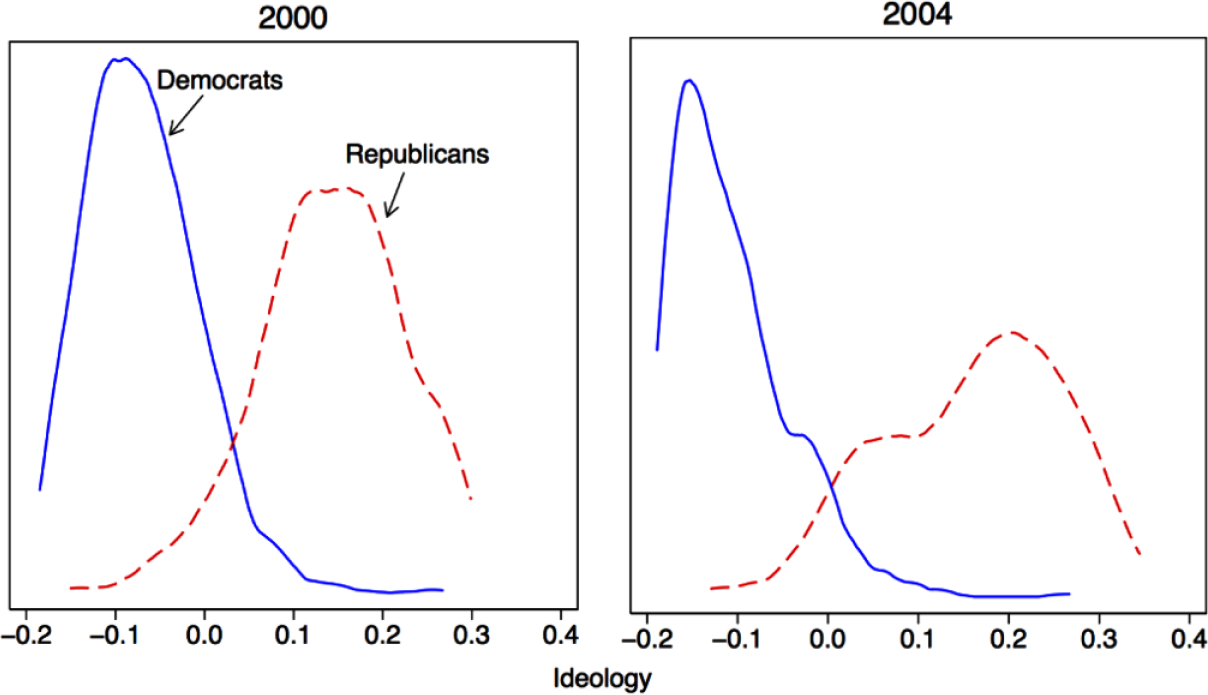
Distribution of ideological ideal points.
The finding that the distribution of Republican activists’ ideal points exhibits significantly more variance relative to that of their Democratic counterparts informs our understanding of coalitional heterogeneity, but “unpacking” this result by examining the distributions of several of the included issues from the 2000 CDS is especially useful because Ellis and Stimson (2012) indicate that “conflicted conservatism”—mismatched ideological self-identifications and policy positions defined by individuals maintaining conservative self-labels but moderate or liberal attitudes toward government spending items—is the primary cause of ideological inconsistency among the mass public. 9 The 2000 CDS data evince this same pattern: Republican activists, despite maintaining conservative self-identifications, do not uniformly—or in some instances even mostly—espouse the conservative preference to reduce government spending on social welfare programs or education. For example, consider attitudes toward education spending, which are displayed in Figure 2. Here we see that more Republicans want to increase education spending (40%) than prefer to decrease it (30%). Democrats exhibit considerably greater unity on the issue—indeed, more than 90 percent of Democratic delegates believe that education spending should be increased. We observe a similar pattern when we examine attitudes toward child care spending: only about 30 percent of Republicans wish to reduce spending on child care, whereas 36 percent want to maintain current spending levels and nearly one-third (31%) prefer to increase spending. We again see that more than 90 percent of Democrats want to increase spending on child care, part of a consistent pattern of greater attitudinal consistency among Democratic activists that also extends to the question of government assistance to blacks. Whereas Democratic delegates are united in their support of greater government spending and a strong social safety net—consistent with their liberal self-identifications—Republicans are divided in their attitudes toward these programs.
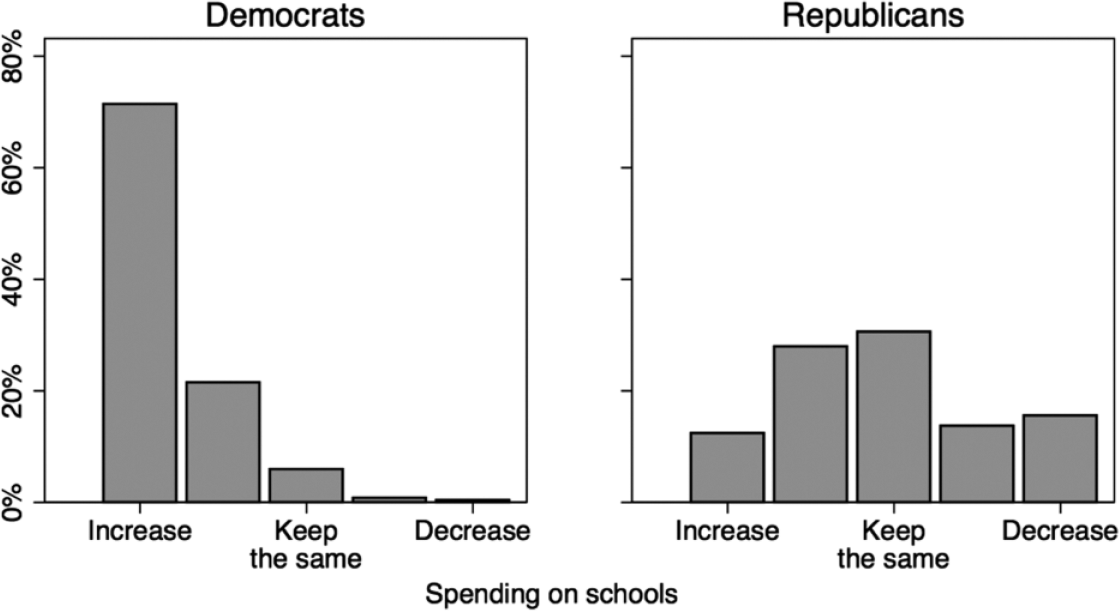
Attitudes toward government spending on public schools.
In addition, although most of our argument centers on support for portions of the welfare state as a source of division among Republicans, evidence suggests that these activists also are more likely to maintain heterogeneous attitudes toward abortion. Our expectation here is based upon existing evidence indicating that Democratic activists maintained more cohesive abortion attitudes than Republicans in the 1980s and 1990s (Carmines and Woods 2002). Moreover, Green and Guth (1988) show that much of Pat Robertson’s support in his insurgent 1988 presidential campaign was drawn from antiabortion forces opposed to the Republican mainstream, and Layman and Carsey (1998) note that the issue continues to contribute to Republican factionalism. We display attitudes toward abortion across parties in Figure 3. We again observe far greater attitudinal homogeneity among Democratic activists. Almost 80 percent of Democrats respond “always legal” and about 90 percent give an ideologically “correct” answer to the abortion question, whereas nearly 40 percent of Republican activists offer an ideologically incongruent answer.
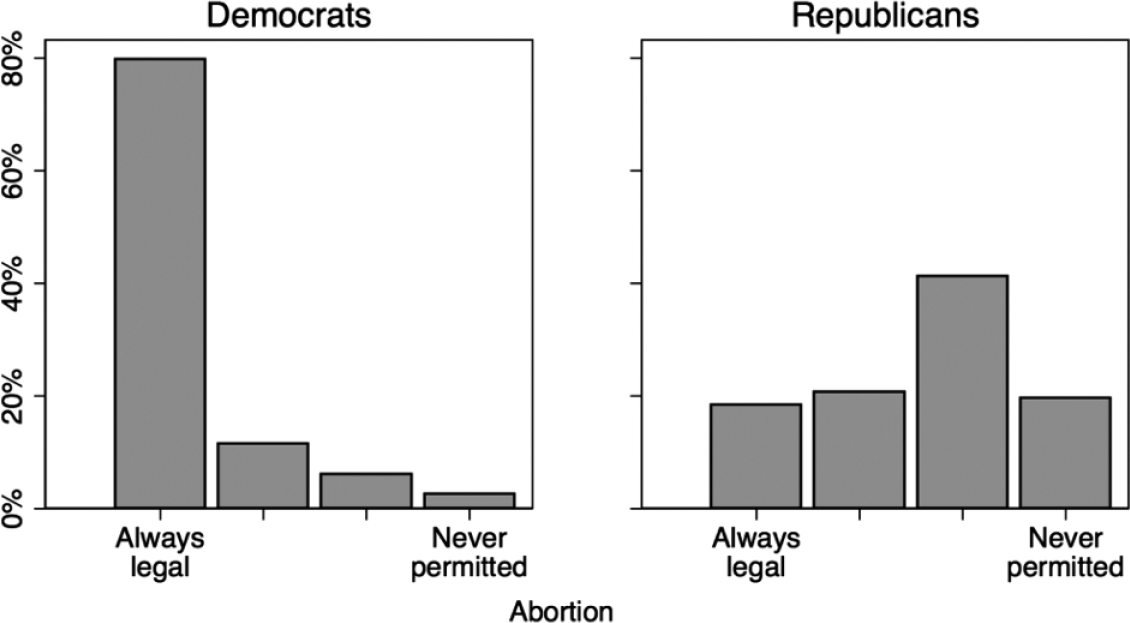
Attitudes toward abortion.
The observed divisions within the Republican Party on the level of issue attitudes are thus not solely a function of Republican activists’ mismatch between professed ideological conservatism and support for elements of the welfare state; they also emerge from the Republicans’ marriage of Christian and economic conservatism that unites in the same coalition a mix of pro-choice and pro-life supporters (e.g., Abramowitz 1995). Consistent with the result presented in Figure 1, we find that considerably more attitudinal heterogeneity exists among Republicans than Democrats across issue domains. 10 Worth noting is the caveat that Republicans are not more divided in their attitudes toward all ten issues. For example, the parties are equally unified on the issue of traditional welfare spending, and the Democrats display more heterogeneity in their attitudes toward defense spending. The distribution of activists’ attitudes toward all ten issues across parties is displayed in the online appendix. 11 Nevertheless, the issues considered here demonstrate that the activist core of the Democratic Party is, on balance, the significantly more ideologically constrained and cohesive coalition. We extend this coalition-level analysis to the level of the individual activists in the next section.
Before doing so, we believe that examining more recent data is worthwhile given that the primary analyses presented in this paper are conducted using surveys that are now nearly two decades old given that the 2004 CDS is the most recently publicly available dataset of convention delegates’ political attitudes. Thus, to ameliorate the concern that our findings are an artifact of an earlier period, we replicate our analysis of elites’ attitudes using pooled 2008 and 2012 ANES data. Although the resulting ANES sample necessarily differs from the elites surveyed in the CDS, we are nevertheless able to create approximately activist profiles by restricting our analyses of the former to the most participatory partisans. Specifically, we examine the ideological constraint of citizens who reported having participated in at least one campaign activity during the election, which constitutes 22 percent of the sample. The results of this supplemental analysis are wholly consistent with our above findings gleaned from our analysis of the CDS: Democrats display considerably more ideologically unified preferences than do Republicans. 12 We note that even our sample of relatively highly involved partisans exhibits less attitudinal homogeneity than do activists in either party, but, importantly, we find that Democrats are the more unified party across our elite and stratified mass public samples.
Ideological Constraint among Party Activists
We construct and analyze in this section three widely used individual-level measures of constraint adopted from previous research investigating ideological thinking among the mass public (Federico 2007; Federico and Hunt 2013; Federico and Schneider 2007). 13 The measures operationalize the key aspects of a belief system described by Philip E. Converse (1964). Converse explains that a complex, fully formed political belief system—or ideology—is defined by closely interwoven attitudes arising from the same few abstract principles. This conceptualization incorporates two types of constraint: horizontal and vertical. Horizontal constraint captures the extent to which an individual’s issue attitudes are interrelated, and it is an important aspect of ideological thinking because to the degree that an individual’s political preferences are crystallized products of the same few abstract principles relating to the liberal–conservative continuum—“crowning postures,” as Converse (1964) poetically explains, such as the value of equality or resistance toward change—then the individual should exhibit ideologically consistent issue attitudes. Intuitively, the argument implies that an ideologue’s cognitive lattice lends predictive power to any one of his or her issue positions—if we know that a single one of the ideologue’s issue attitudes is in the liberal direction, for example, then we would expect that all of the ideologue’s other issue attitudes are similarly liberal. We construct our measure of horizontal constraint by calculating the standard deviation of each individual delegate’s responses to the ten policy items that we examine. We then recode the measure such that higher values indicate greater constraint or less variability in the respondent’s issue attitudes (Barton and Parsons 1977; Federico and Schneider 2007; Wyckoff 1980).
Vertical constraint is defined by the relationship between one’s issue attitudes and ideological self-identification, capturing the idea that an ideologue’s issue attitudes are the products of a high-order construct, the liberal–conservative continuum (Converse 1964; Federico and Schneider 2007; see also Peffley and Hurwitz 1985). If one conceptualizes the political world fundamentally in left–right terms, then one’s individual issue attitudes should correlate strongly with one’s self-identification as an ideological “liberal” or “conservative.” A truly constrained belief system is thus hierarchical, with specific issue attitudes flowing from the broad evaluative “yardstick” of the liberal–conservative ideological continuum. We operationalize vertical constraint in two ways. First, we create a scale representing the proportion of each delegate’s responses that are consistent with his or her party identification—for example, an ideologically constrained response is liberal (conservative) for a Democratic (Republican) delegate. As a second measure of vertical constraint, we measure the average distance between each delegate’s issue attitudes and ideological self-placement (Federico and Hunt 2013).
We then combine these three measures—the measure of horizontal constraint and the two measures of vertical constraint—to create a composite measure of ideological constraint among Democratic and Republican Party activists in the years 2000 and 2004. 14 The constraint scale is reliable in both years, α2000 = .702 and α2004 = .846. After creating the three indices and the composite measure, we compare the distribution of overall constraint among Democratic and Republican activists, as well as the distribution of the three components of the composite constraint measure across parties.
Figure 4 presents these distributions separately for each year, where the dashed line represents Republicans and the solid line represents Democrats in both panels. The graph shows that Democrats exhibit markedly more constraint than their Republican counterparts. A formal difference of means test shows that the difference across parties is statistically significant: t = 11.76 (p < .001) in the year 2000; t = 15.72 (p < .001) in the year 2004. Moreover, the size of the effect is substantively meaningful, as the difference between Democrats and Republicans represents more than 6 percent of the scale. Consistent with our theoretical expectations, Democratic activists possess more tightly integrated issue attitudes. The results support our hypothesis that Republicans’ emphasis on principled and symbolic rhetoric reflects a desire to manage the ideological diversity of their party coalition. Our next task is to investigate the distribution of each of the three components of the constraint measure to elucidate the source of the party differences revealed in Figure 4.
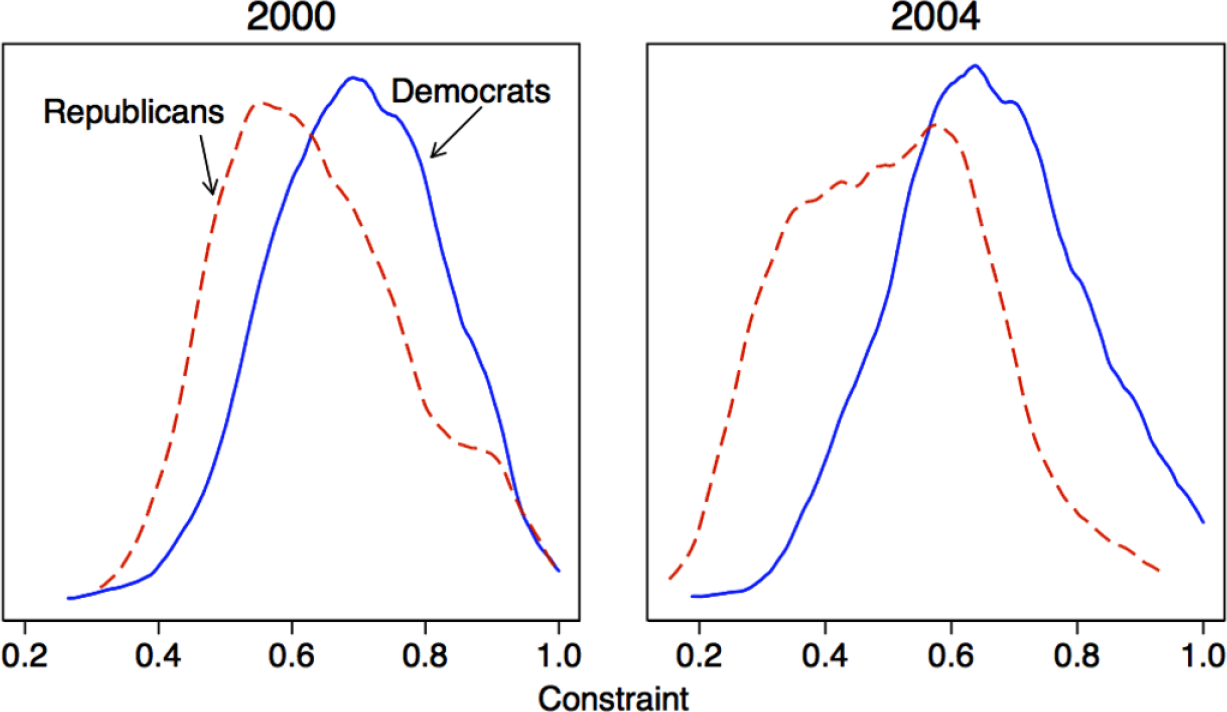
Distribution of composite constraint in 2000 and 2004 among party activists.
We first examine horizontal constraint, the distribution of which for both parties is displayed in Figure 5 for the year 2000. 15 Recall that this measure represents the standard deviation of each delegate’s responses to the ten policy items, recoded such that higher values indicate more attitudinal constraint—or less ideological variability in the delegate’s issue attitudes. As with the composite measure, we observe that Republicans are significantly less constrained relative to Democrats: t = 8.82; p < .001. This finding demonstrates that Democratic Party activists’ issue attitudes are more coherently organized—or interrelated—than are those of Republican activists. Again consistent with our theoretical expectations regarding the coalitional differences between the two parties, Democratic policy demanders maintain consistently liberal policy preferences, whereas their Republican Party counterparts do not possess similarly consistent conservative preferences.
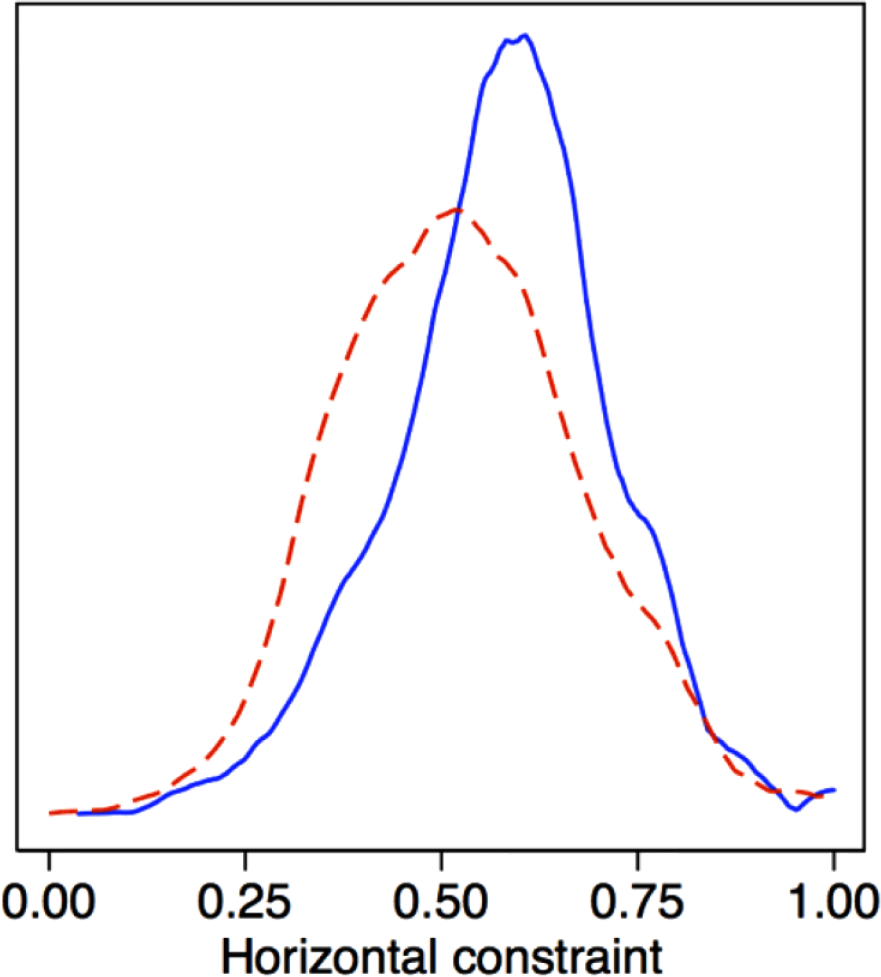
Distribution of horizontal constraint, represented by the standard deviation of each delegate’s responses.
We next assess the distribution of our first measure of vertical constraint for both parties. This measure represents the proportion of “ideologically correct” responses offered by the delegates to the ten issue items. The results of this analysis are featured in Figure 6, where the left-hand panel displays Democrats and the right-hand panel displays Republicans. This aspect of constraint appears to be the biggest driver of the observed difference in the overall level of constraint across parties featured in Figure 4. For example, more than 80 percent of Democrats offer an ideologically “correct” response to six or more policy issues, whereas 60 percent of Republicans respond correctly. Similarly, about 55 percent of Democrats, compared with approximately 32 percent of Republicans, provide eight or more “correct” responses. The difference between the parties on this measure is unsurprisingly statistically significant: t = 13.92; p < .001. Republicans’ issue attitudes vary substantially, as the party’s delegates offer extremely conservative answers to some questions and moderate or liberal answers to others. These individual-level findings are consistent with our observation in the previous section that Republicans are the significantly more attitudinally heterogeneous elite coalition.
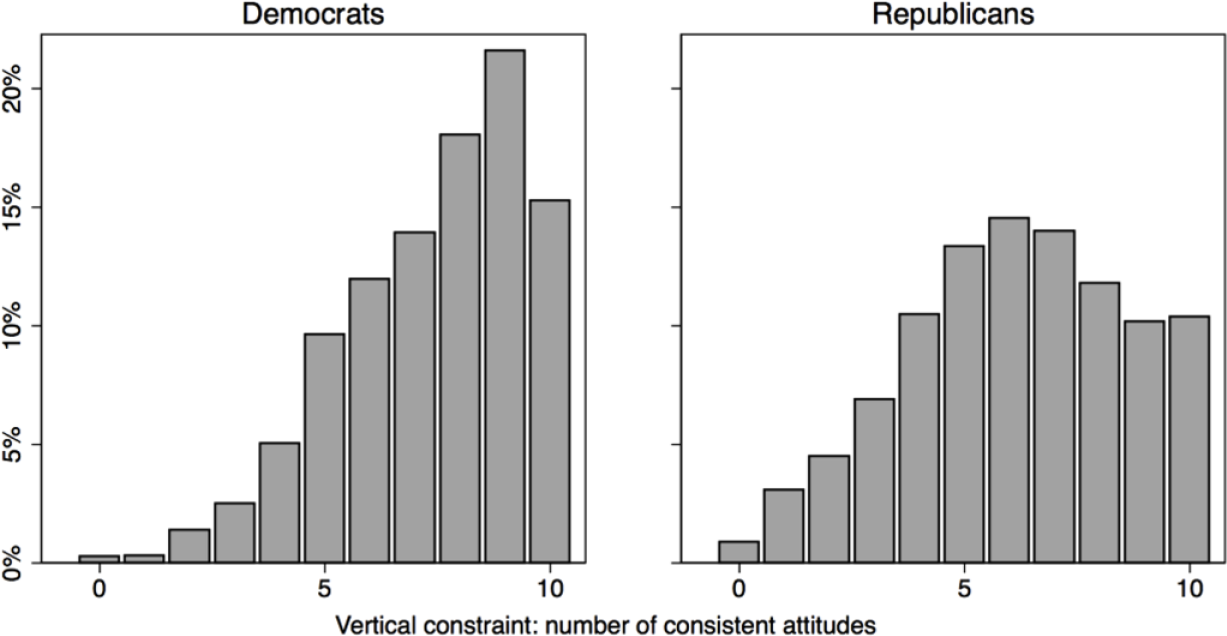
Distribution of vertical constraint, measured as the number of “ideologically correct” issue attitudes.
Finally, we examine the average difference between one’s ideological self-placement and one’s issue attitudes. The difference, presented in Figure 7, is less dramatic—but still statistically significant, t = 2.11; p = .018—as both Republicans and Democrats appear to link closely their ideological self-identification and many of their issue attitudes. This finding is expected given the high correlation between ideological identifications and issue attitudes among elites reported in previous work (e.g., Converse 1964; Jennings 1992; Jewitt and Goren 2015; Lupton, Myers, and Thornton 2015). Each of our measures thus illustrates that Republicans are less constrained than Democrats, and the difference is substantively meaningful in all but one comparison. 16
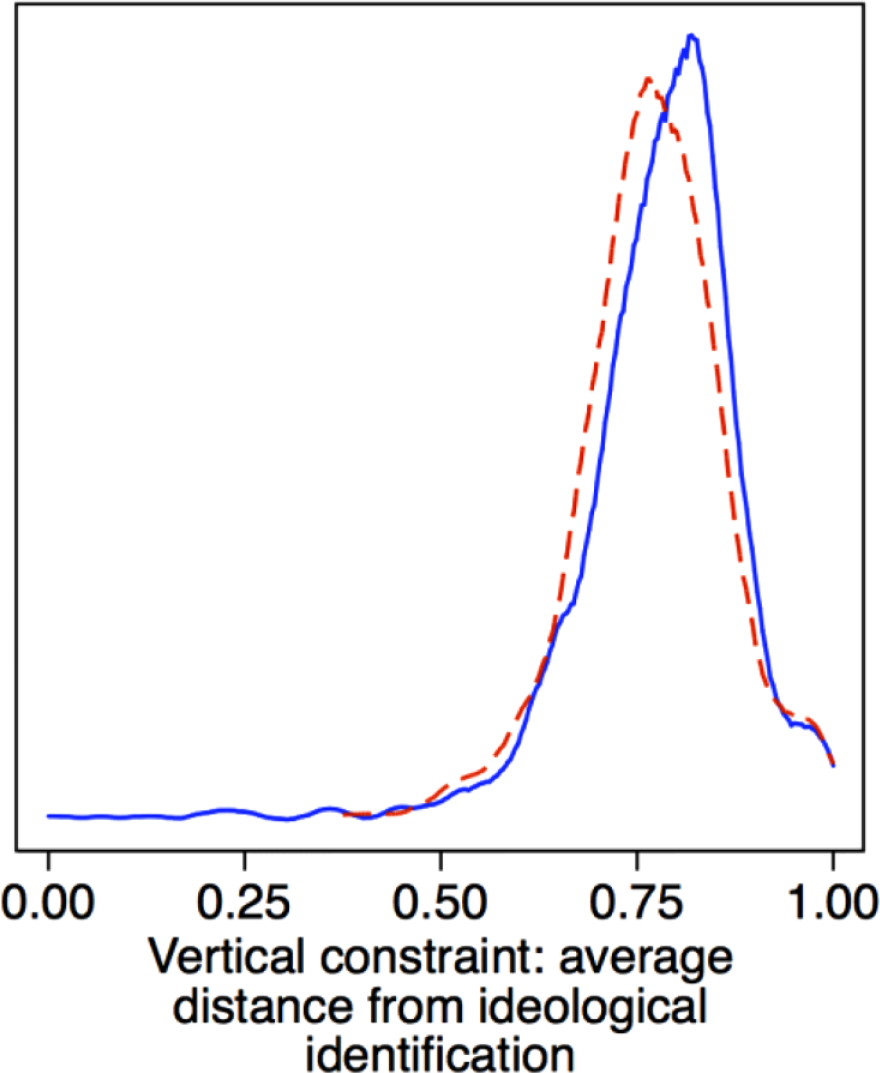
Distribution of vertical constraint, measured as the average distance between a delegate’s ideological self-placement and the delegate’s placement on a series of issue attitudes.
We next estimate a regression model in which composite ideological constraint is a function of partisanship and several control variables that may also relate to ideological constraint to assess more fully the differences we have discussed thus far. We include in the model age in years; income, measured with a six-point scale of self-reported family income; education, measured with a five-point scale ranging from less than high school to a postgraduate degree; partisan intensity, measured with a seven-point scale of how strongly the respondent supports his or her party; ideological intensity, measured with a four-point scale of how strongly the respondent identifies with his or her ideological label; and race, measured with three dummy variables: black, Hispanic, and other, with white as the excluded reference category. We also include gender, with females coded as one, as well as an eight-point scale of how long the respondent has served as a delegate, which ranges from 1 if the individual was first a delegate in 2000 to 7 if the individual has been serving as a delegate since 1972. Finally, we measure religiosity with a three-item index (α = .776) comprised of a six-point scale of how often the respondent attends religious services, a four-point scale of how much guidance religion provides the respondent, and a four-point scale of the respondent’s view of scriptures (ranging from “good book, not the word of God” to the “actual word of God”). 17 Our theory predicts that, controlling for these other factors—most importantly, partisan intensity, ideological intensity, and religiosity—Republican partisanship will relate negatively to ideological constraint. The model is estimated using ordinary least squares, where the dependent variable is the composite constraint measure.
The results of this model are displayed in Table 1, where the entries represent coefficients, standard errors, and p values. First, we observe that established sources of constraint, such as education and partisan and ideological intensity (e.g., Barker and Tinnick 2006; Jacoby 1988; Knight 1985), significantly predict constraint in our sample. Second, and most importantly, we find that even after controlling for these and other factors, Republican activists are less constrained than their Democratic counterparts. The estimated substantive effect is nearly identical to the earlier bivariate analysis: approximately 6 percent of the scale.
Model 1: Ideological Constraint.
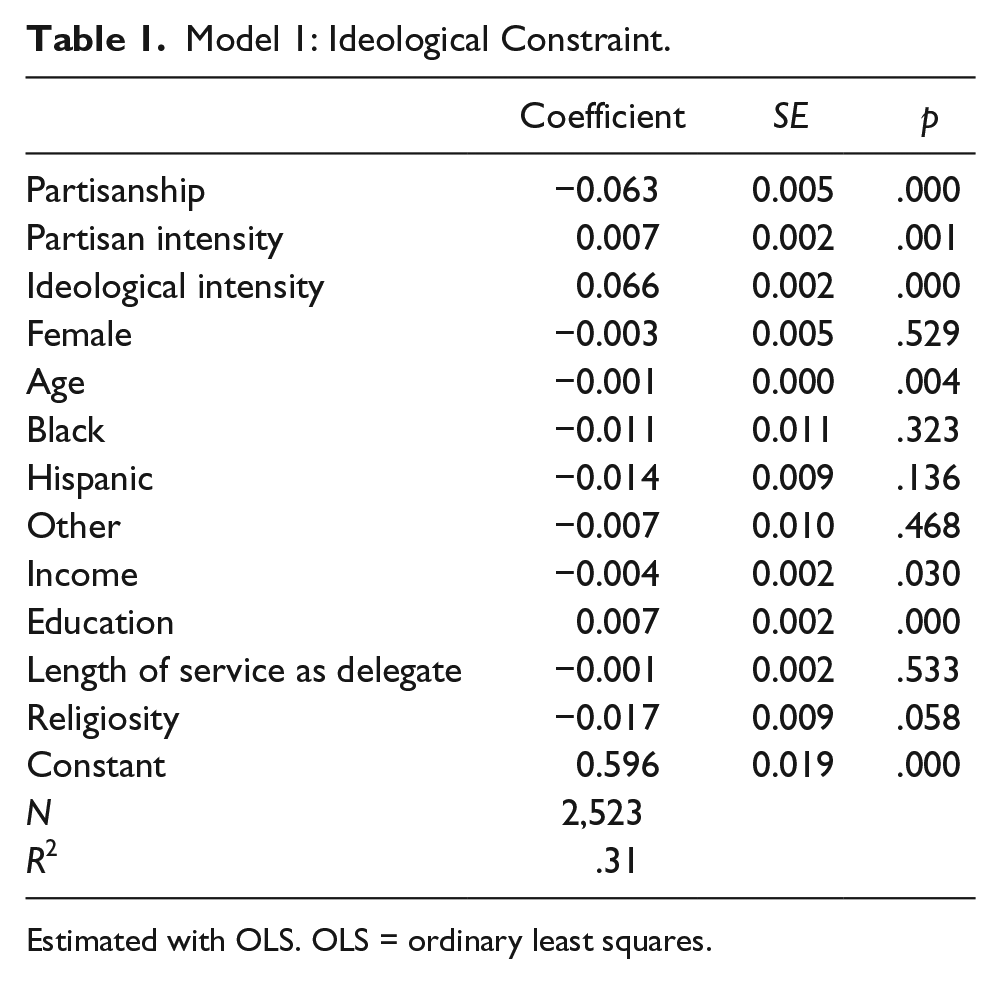
Estimated with OLS. OLS = ordinary least squares.
We test the robustness of this result in several ways. First, we examine each of the components of the index and find that partisanship is a significant predictor of each. These results are presented in Table 2, where the cell entries are coefficients and standard errors. To test further the robustness of our findings, we investigate the relationship between party and our constraint index using a matching procedure, and we find that partisanship relates significantly to constraint in a variety of model specifications. 18 Finally, although partisanship and ideology are highly correlated—for example, 95 percent of respondents in the 2000 CDS express consistent partisan and ideological identifications—we reestimate Models 1 to 4 controlling for ideology. 19 When doing so, we find that a typical Democrat exhibits greater constraint than a typical Republican.
Ideological Constraint.
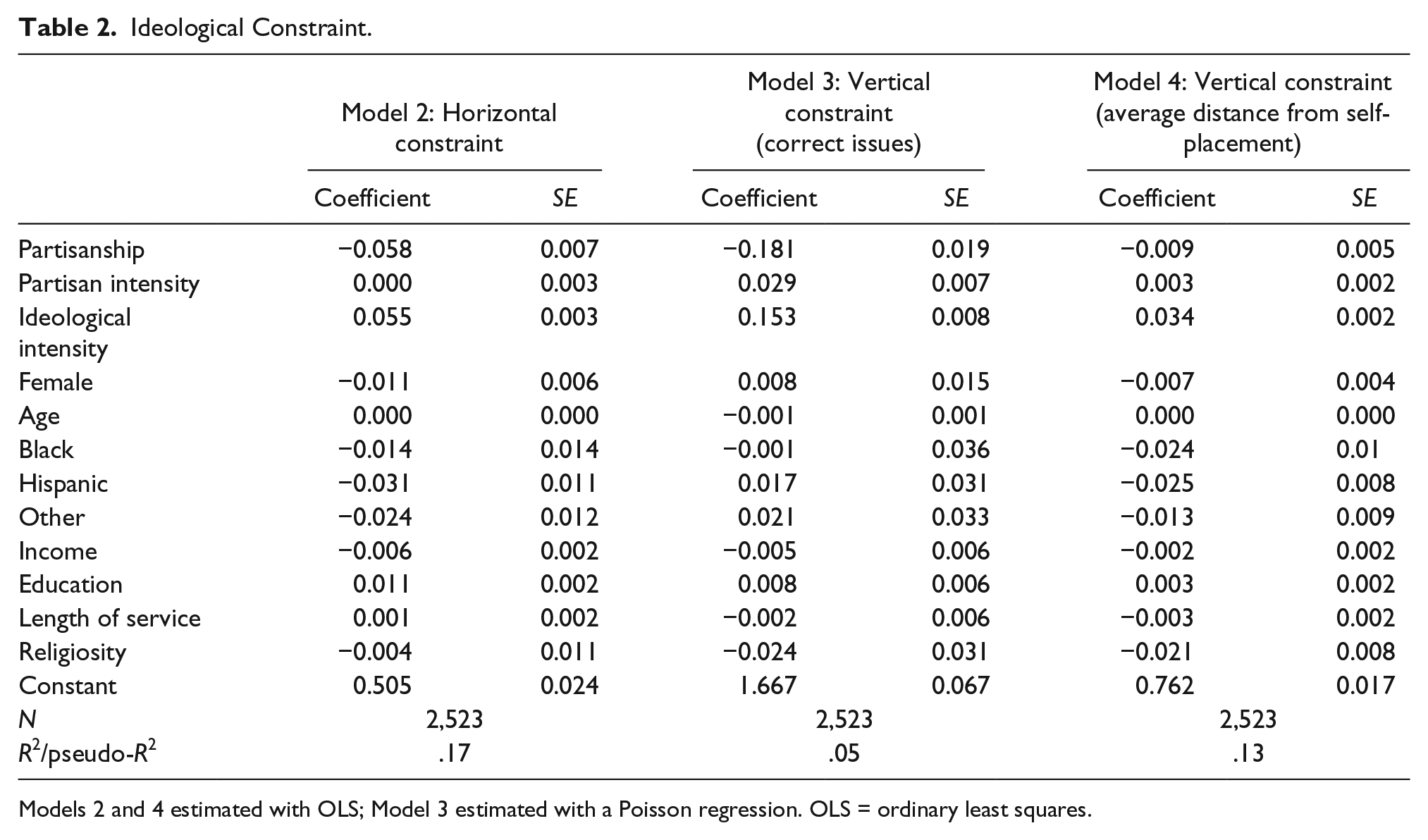
Models 2 and 4 estimated with OLS; Model 3 estimated with a Poisson regression. OLS = ordinary least squares.
Our core finding thus appears to be robust both to measurement and estimation choices. We conclude that whether measured in terms of the distribution of ideological ideal points, the interrelationships among disparate attitudes comprising the social welfare, cultural, and racial policy domains in American politics, or the linkages between ideological self-identifications and issue attitudes, the Republican activist coalition is more ideologically heterogeneous relative to its Democratic counterpart. Finally, we wish to note again that, as with the previous analysis, we examine pooled 2008 and 2012 ANES to confirm the contemporary meaningfulness of our results. As before, we restrict our analysis to the most participatory members of the mass public, and the results are again consistent with those previously reported: Republicans exhibit less ideological constraint than Democrats for each of the three constraint measures, as well as the composite measure. 20
The analyses presented here demonstrate that Republican activists are less ideologically constrained than their Democratic counterparts. Our findings are consistent with an array of evidence indicating that Republicans exhibit more attitudinal heterogeneity among both members of Congress (e.g., Hare and Poole 2014) and the mass public (e.g., Grossmann and Hopkins 2015a; Jacoby 2014; Stimson 2004). We wish to emphasize that although Democratic activists are more constrained than Republicans, both groups exist a world apart from the mass public. In other words, although the degree of attitudinal heterogeneity among Republican and Democratic activists differs significantly, we should not lose sight of the fact that both groups demonstrate substantially more constraint than the vast majority of the mass public (e.g., Converse 1964; Jennings 1992; Jewitt and Goren 2015; Lupton, Myers, and Thornton 2015).
Discussion and Conclusion
A rich public opinion literature regarding the paucity of ideological constraint among the mass public indicates that despite often self-identifying as conservative, most Americans maintain consistent support for the welfare state, an empirical observation reflecting ideologically “conflicted” policy positions (Ellis and Stimson 2012). This insight from mass-level ideology research recently has been tied to asymmetric polarization at the elite level. Namely, Congress, campaigns, and party coalitions scholars have demonstrated that Republican elites communicate in principled, abstract ideological language more often than their Democratic counterparts, whose appeals predominantly relate to specific policies and social groups (e.g., Grossmann and Hopkins 2015a, 2016; Noel 2013a). The goal of this paper was to explore precisely this connection between observed mass-level ideological inconsistency and elite rhetoric. We theorized that these twin facets of American politics share a potential common cause—substantive differences in the ideological diversity of the party coalitions themselves. Specifically, we argued that rhetorical differences among Republican and Democratic elites witnessed across diverse aspects of partisan and electoral politics are not simply a function of strategic appeals to party followers but rather also emerge from the nature of the internal divisions unique to each party.
To test our theory regarding the structural differences among major party elites, we chose to analyze the political attitudes of Democratic and Republican presidential nominating convention delegates. These party activists are ideal objects of inquiry for our purpose because they are salient “policy demanders” who shape party platforms, hold elected officials accountable, and influence public opinion (Bawn et al. 2012; Layman et al. 2010; Noel 2013a). Our results, derived from several estimation strategies across multiple years, unambiguously supported our theory that Republican activists’ attitudes are less ideologically constrained than are those of Democratic activists. Specifically, Republican activists’ attitudes are more dispersed along the liberal–conservative ideological continuum that structures party competition in American politics—and are less likely to fall on the “correct” side of the continuum or to correlate as highly with ideological self-identifications—relative to those of Democratic activists.
Despite a strong and unwavering rhetorical commitment to programmatic conservatism, the Republican Party is in fact an ideologically diverse coalition of policy demanders who under one official conservative banner variously support essential elements of the welfare state and social liberalism. The Democratic activist coalition, on the contrary, unites ideological liberals behind the common goal of increasing the scope of government to benefit myriad social groups. This distinction squares with a burgeoning literature documenting the “asymmetric” nature of the major political parties and offers an explanation why Republicans speak the language of abstractions, whereas Democrats talk in terms of policy specifics (e.g., Grossmann and Hopkins 2015a). Our results hold important implications for scholars’ understanding of American politics and the major party coalitions. Most importantly, if the causal arrow does indeed run from party elites to the mass public (e.g., Layman et al. 2010), then the observed mass-level inconsistency in ideological self-identification and policy attitudes is not a pathology of the electorate but rather reflects the attitudinal inconsistency of the Republican elite coalition—the public might not be poor recipients of elite messaging; instead the signals that are being sent are incongruent.
The political parties are different organizations (Freeman 1986), and our investigation of the issue attitudes and ideological basis of each party’s convention delegates potentially explains this observation: each party’s rhetoric is designed to manage the principles and issue attitudes of its activist core. These fissures are unlikely to subside given some activists’ ability to withstand party pressures to adopt particular issue positions (Layman and Carsey 1998), and the reality that the activists’ loyalty often lies not to their party’s electoral success but rather to particular candidates whose issue attitudes align with those of the activists (Herrera 1995; Herrera and Taylor 1994). Moreover, our results are particularly interesting amid ongoing developments in American party politics.
The rise of the Tea Party and the House Freedom Caucus, in particular, is entirely consistent with, and representative of, this study’s implications. The heterogeneity of Republican activists’ attitudes across a variety of issue areas ranging from traditional domestic spending matters to the environment, abortion, and protection for homosexuals against discrimination reveal a party coalition that suffers from deep divisions about how the power of government should be exercised. This lack of attitudinal constraint among Republican activists on spending measures especially reveals that a nontrivial core of activists is willing to abandon small government principles—the fundamental organizing principle of the party—if doing so means devoting greater government resources to their favored policy programs. This type of pragmatism, or dare we say “establishment politics,” is precisely the source of the Tea Party movement’s and the House Freedom Caucus’ rebellion. In other words, some Republican activists expected that elite party rhetoric emphasizing the importance of small government would be matched by decreased spending across all policy areas, and these more conservative members’ frustration with their compatriots’ ideological inconsistency turned the former from party loyalists into party insurgents. In the language of Hirschman (1970), this factional group speaking out—specifically, exercising voice as opposed to exit or loyalty—is a reflection of Republican activists’ lack of constraint.
Our study necessarily suffers some limitations. First, we examine only a snapshot of American party politics covering two election years. However, we would not expect the Republican Party to have become any less divided ideologically in the immediate past or to become so in the near future. Indeed, the emergence of ideological divisions in the 2016 Republican presidential primary and eventual party capture by an avowed outsider and nonpolitical figure, Donald Trump, has elevated Republican Party factionalism to center stage in American politics. Although the elected Republican establishment and unelected intellectual policy architects were surprised by Trump’s rise, his ability to secure support through the use of rhetorical symbolism highlights precisely the disconnect between ideological abstractions and ideological policy coherence that we documented in this paper.
Moreover, the Republican Party was at least initially—and as of this writing—unable to enact its signature health care law repealing and replacing the Affordable Care Act (ACA) amid policy differences among the White House, more moderate House members, and the far-right Freedom Caucus. 21 We suspect that the divergent policy views and electoral incentives of these competing factions—which reflect the ongoing effort of some Republican activists to move increasingly rightward along the ideological spectrum even as establishment officeholders are loathe to reduce certain government services and benefits—should only serve to heighten the tension within the party coalition moving forward. Moreover, we attempted to test empirically the reliability of our results in more recent years by analyzing the ideological consistency of highly politically active mass public partisans in more recent years. Although these citizens do not match the knowledge, interest, and involvement of party elites, they nonetheless reasonably approximate elites’ understanding of ideological abstractions and attitude structure (e.g., Barber and Pope, n.d.; Converse 1964; Jennings 1992; Lupton, Myers, and Thornton 2015). Our analysis of these exceptionally participatory citizens’ issue attitudes in 2008 and 2012 revealed that Republican activists are substantially more ideologically heterogeneous compared with their Democratic counterparts. This evidence comports with dominant narratives of contemporary party politics and supports our theory regarding the nature of the elite coalitions.
Second, our theory, in accordance with a wealth of existing evidence documenting the elite-driven nature of issue attitude formation, assumes that party elites first develop issue preferences and then communicate those preferences to the mass public via the media and other forms of party rhetoric. The reverse could be true if elite coalitions respond to mass-level preferences. Subsequent research will be required to uncover any possible reciprocal relationship among elite and mass public attitudes, but we believe that our work nonetheless represents an interesting and fruitful contribution to the party coalition literature in documenting the greater ideological diversity of Republican activists. Namely, despite the traditional understanding of the Republican Party as the more ideologically driven of America’s two major political parties, the Democratic Party in fact is the more attitudinally cohesive coalition at even the elite level. We hope that our efforts stimulate future work exploring the causal connections among activists’ attitudes, elite rhetoric, and mass public opinion, not only across parties but also across issues and through time.
Footnotes
Acknowledgements
We thank Brad Gomez for providing us with valuable comments for improving this project in his role as a discussant on the panel on which an earlier version of this paper was presented at the 2016 Southern Political Science Association annual meeting in San Juan, Puerto Rico. We also were fortunate to present previous drafts of this paper to the Department of International Affairs in the School of Public and International Affairs at the University of Georgia and later at the University of Georgia as part of their Department of Political Science “Effects of the 2016 Elections conference,” as well to the Department of Political Science at Michigan State University and the Department of Political Science at the University of Connecticut. At all of these places, we received myriad helpful comments, questions, critiques and suggestions, especially from the following individuals: Jason Anastasopoulos, Miles T. Armaly, Ryan Bakker, Alexa Bankert, Keith Dougherty, Adam Enders, Christopher Hare, Thomas Hayes, Gary Jacobson, William G. Jacoby, Jeffrey Ladewig, Jamie Monogan, Michael Morrell, Ian Ostrander, Saundra K. Schneider, Matthew Singer and Corwin D. Smidt. We owe special thanks to Keith T. Poole and Shane P. Singh, who not only offered insightful comments on our work, but also generously invited us to present this project in Athens, GA, on separate occasions. Paul Kellstedt deserves mention because he posed a discerning question to us via phoning the conference presentation room, the first instance of that method of inquiry of which we are aware. We are indebted to Matt Grossmann for the time he devoted to discussing thoughtfully with us this and other party coalitions projects over several years. His scholarship and discernment were invaluable throughout the process of formulating, drafting and revising this article.
Declaration of Conflicting Interests
The author(s) declared no potential conflicts of interest with respect to the research, authorship, and/or publication of this article.
Funding
The author(s) received no financial support for the research, authorship, and/or publication of this article.
Supplemental Material

Notes
References
Supplementary Material
Please find the following supplemental material available below.
For Open Access articles published under a Creative Commons License, all supplemental material carries the same license as the article it is associated with.
For non-Open Access articles published, all supplemental material carries a non-exclusive license, and permission requests for re-use of supplemental material or any part of supplemental material shall be sent directly to the copyright owner as specified in the copyright notice associated with the article.
