







Abstract
Do female executives exercise the authority of their office distinctly from their male counterparts? Anecdotal evidence suggests women legislators are likely to govern in a more consensual manner than men. Yet there has been little systematic research extending such claims to women in executive office. Using an original data set, we evaluate one aspect of policy agenda setting—rates of executive decree issuance—among four male–female pairs of Latin American presidents between 2000 and 2014. Female presidents are generally less prone to rule by decree, but this relationship is conditioned by presidential popularity. Female executives with high presidential approval ratings are less likely to rule via unilateral action than similarly popular male executives, but the gendered differences in decree issuance disappear when executives possess low approval ratings. Our findings have implications for understanding the potential benefits of feminine leadership styles for executive–legislative relations and good governance.
Keywords
“What I find is with all due deference to our male colleagues, that women’s styles tend to be more collaborative.”
There is evidence that the characteristics and preferences of different leaders may lead to distinct styles of governance that increase the possibility for problem solving via negotiations and consensus-building among elites. Several such characteristics are commonly associated with women, where studies have found them to display more communal and democratic tendencies while men are more inclined to autocratic styles of leadership. The literature on gendered decision-making in politics has typically focused on the legislative branch or subnational offices, as female national executives remain far rarer. Yet studying outcomes associated with higher proportions of female legislators may obscure the motives and decision-making of individuals behind those of the collective (e.g. committees, parties, etc.). In comparison, the executive has fewer opportunities to publicly demonstrate collective behavior, so we might expect less evidence of cross-partisan or communal decision-making by female executives.
Thus far, relatively little is known about the trends that might characterize female executives’ administrations or differentiate them from male executives. Despite the fact that leadership studies confirm the description of female behaviors and qualities offered above by Senator Collins (Eagly and Johannesen-Schmidt 2001; Eagly and Johnson 1990), women often face the contradiction of needing to prove their multifaceted or masculine attributes to obtain and retain leadership positions (e.g., Thomas and Adams 2010). Women may also have traditionally faced institutional and partisan constraints that led them to rely on more communal approaches to pursue their policy preferences (e.g., Barnes 2016). The incongruity in roles that women must display to achieve and survive in leadership positions begs the question of whether they wield their authority in distinct ways than their male counterparts. Although male and female candidates and leaders are often portrayed as having different campaign styles and policy preferences, there has been limited systematic assessment of women’s methods of commanding power and resources once they reach a country’s highest office. In light of the increasing complexity of influences and expectations faced by female leaders, what political factors might generate gendered opportunities or constraints for women in the highest political office? Do female executives exercise their authority differently than their male counterparts?
To answer this question, we focus on the relationship between gendered leadership style and use of authority under different levels of presidential popularity. Controlling for executive approval, do female executives issue the same numbers of decrees as their male predecessors? If not, this may indicate a divergence in governing styles. For example, women may be more likely to use democratic (negotiated) tactics and exercise self-restraint in the use of their power, such as working through standard legislative policymaking channels rather than legislating unilaterally “from on high.” This inclination need not stem from purely inherent preferences for negotiation and consensual outcomes but may also reflect a strategic calculation that women leaders make: they may perceive that they will face negative consequences for straying from displays of more stereotypically feminine (e.g., communal) behavior. This insight may extend the effect of gendered leadership styles to more general achievements in governability, regime stability, and successful policymaking efforts that might result from negotiation and cross-partisan solutions.
To test our expectations about how female executives wield their considerable authority, we draw on an original data set of executive decree issuance in paired comparisons of male and female executives in Argentina, Brazil, Chile, and Costa Rica between 2000 and 2014. Utilizing these within-country pairs, this is the first study to isolate the effects of executive sex from other factors that might otherwise explain differences across administrations. The results show distinct trends in the propensity of male and female executives to issue decrees, and that men and women exercise this authority most differently when they possess higher executive approval ratings that might otherwise enable them to act unilaterally. In other words, even when they are very popular, the female presidents in our sample are less likely to use decree power than their male counterparts. Perhaps most significantly, this model of enabled or constrained presidential action has wide-ranging implications beyond the study of gender and politics, toward a better understanding of executive politics and good governance more broadly.
Executive Behavior and Gendered Differences in Leadership Style
A long scholarly literature on executive-legislative relations has debated the institutional and informal political contexts under which presidents are more likely to abuse or overuse their executive authority at the cost of inter-branch checks and balances (e.g., Cox and Morgenstern 2001; Deering and Maltzman 1999; Shugart and Mainwaring 1997). This literature largely concludes that many presidents lean heavily on the strength of their office and are often enabled to do so through constitutional and/or de facto channels. Presidents typically have greater personnel and fiscal resources to pursue their agendas and they do not face the collective action problems plaguing weakly resourced and unprofessional legislatures (Jones et al. 2002; Pereira, Power, and Rennó 2005). Many executives possess a range of formal powers, including executive decrees and orders, veto powers, control over bureaucratic and government appointment, and provisional budgetary powers (Alemán and Tsebelis 2005; Carey and Shugart 1998; Morgenstern, Polga-Hecimovich, and Shair-Rosenfield 2013; Negretto 2004). Of these powers, one key area where the executive often wields unilateral authority is in the use of executive decrees and orders because such actions enable executives to set the policy agenda, augmenting or substituting for the ability to directly insert herself or himself into the legislating process. We focus on such actions, understanding them as one form of executive authority.
The literature is divided on how to interpret the observation of decree issuance. Proponents of unilateral action theory assume that decrees will be used by executives who cannot otherwise pass their legislative agenda, such as those facing a hostile congress (Cox and Morgenstern 2001; Moe and Howell 1999). Another perspective, delegation theory, assumes that legislatures give executives the prerogative to govern on their behalf because partisanship and congressional hostility permit and encourage such unilateral action when it serves to benefit legislators (Carey and Shugart 1998, 296; Epstein and O’Halloran 1999). Yet the empirical record in support of these theories remains mixed (e.g., Mayer 1999; Pereira, Power, and Rennó 2005), and the findings from recent studies instead highlight a general belief that presidents are more likely to use their decree authority when they anticipate fewer challenges from the legislature (Bolton and Thrower 2016; Shair-Rosenfield and Stoyan 2017).
Studies on executive behavior in the United States and Latin America have shed light on how public opinion can also contribute to the executive’s control over the policy agenda vis-à-vis the legislature. Presidents may attempt to increase issue salience in an effort to confront the legislature with public appeals (Eshbaugh-Soha and Peake 2011). Presidents also strategically appeal to the public to put pressure on the legislature; this may make them more likely to win in Congress (Edwards 2009). In the Latin American context, Calvo (2007) shows that popular Argentine presidents were nearly twice as likely to win legislative approval for their initiatives compared with their unpopular counterparts. Yet if those strategies prove insufficient to compel the legislature to support the president’s policy preferences, presidents may “go public” and feel emboldened to issue decrees when public opinion is on their side (Bond and Fleisher 2001; Canes-Wrone 2006). Strong presidential approval ratings will also lead the judicial and legislative branches to think twice about confronting or challenging a popular president (Howell 2003). Thus, public opinion can increase the opportunities and/or reduce the penalties that enable or encourage the executive to rely on unilateral action, such as in issuing decrees.
While the scholarship on variation in executive behavior and unilateral action covers partisan, institutional, and behavioral explanations, there has been less focus on the explanatory power of the identity of executives in cross-national or cross-temporal comparisons. One particular identifying characteristic that might explain variation in executive behavior, and particularly decree issuance, is gender. The literature on legislative/legislator behavior has provided empirical evidence of gender-based differences across a range of issues, such as general legislative behavior (Kathlene 1994), legislative committee leadership behavior (Rosenthal 2000), and the amount of floor time taken by individual legislators (Karpowitz, Mendelberg, and Shaker 2012). Yet studies of executive behavior have paid less attention to this distinction. 2
The empirical record on women and leadership styles suggests there may be reasons to consider whether gender plays a role in how a president approaches the use of unilateral action. For example, women may hold preferences for consensus-based leadership styles, such as those professed by Senator Collins. This might lead to an assumption that women would utilize their powers distinctly from their male counterparts, such as in the issuance of decrees. However, public perceptions about women’s roles may complicate women’s abilities to pursue or exercise these preferences.
While consensus-based styles of leadership are commonly associated with women candidates and elected officials, the voting public typically does not associate such styles with good leadership. As Jalalzai (2013, 56) notes, “the public still associates women with collaborative forms of governance, reinforcing ties between masculinity and dominant executive office types.” Therefore, women are compelled to demonstrate more “masculine” behavior, such as autocratic or aggressive styles of leadership, to be perceived as qualified to hold leadership positions (Powell, Butterfield, and Parent 2002; Schein 2001) or to fit institutional norms that rely on the use of such behavior (Rosenthal 2000, 32–33). If this is the case, women who attain high office will more likely be the ones who can “resemble” men or demonstrate similar qualifications or attributes (Jalalzai 2013; 2016).
However, in demonstrating more masculine behavior, women then face additional criticism for straying from stereotypically feminine behavior (Rudman and Phelan 2008). As a result, women leaders face a disadvantageous double standard resulting from the incongruity between the perception of what they are good at versus what “makes a good leader” (Eagly and Karau 2002; Heilman 2001). Men, in contrast, need only demonstrate the more masculine attributes typically desired of leaders (Johnson et al. 2008). Women thus face a quandary in how to present themselves as both masculine and feminine in the context of policymaking (Alexander and Andersen 1993; Jalalzai 2016). Thomas and Adams (2010) find that Chilean President Michelle Bachelet and Liberian President Ellen Johnson-Sirleaf both garnered electoral success by claiming traditionally masculine traits while appealing to gendered views of women’s particular leadership strengths. Therefore, this double standard may make the relationship between women’s preferences and actual executive behavior difficult to disentangle.
Women may face other constraints in exercising their preferences that men do not. An alternative argument focuses on the contextual and strategic nature of this trade-off. Regardless of whether women prefer a specific leadership style, they often do not possess the political power or capital to impose their influence on policy outcomes. Because they occupy positions of lesser within-party or -legislature authority, women are constrained from utilizing more authoritarian leadership styles. As a result, they adopt strategies focused on consensus or collaboration in an effort to shape policy outcomes (Barnes 2016). The institutional and political context surrounding women thus shapes the ways and moments in which they strategically employ a collaboration-based style. This logic suggests that even if a woman prefers to lead in a more authoritarian, less collaborative manner, she may be unable or unwilling to because of power-based constraints and considerations that do not plague her male counterparts.
Finally, female executives are often “elite” in their own right, even when the general socioeconomic context of women is low, conservative and traditional mores govern society, or the country is in a postconflict situation (Adams 2008; Jalalzai 2013; Tobar 2008). 3 In sum, women seeking executive office often emphasize similarities and traits shared with male candidates while expressing or demonstrating distinct preferences in governance styles. Given this mismatch, should we expect to see evidence that female executives in office act differently from their male counterparts?
Sex-Differentiated Expectations about Executive Behavior
We consider female executives as uniquely positioned to provide insight into gendered differences in the use of unilateral authority. It is sometimes difficult to isolate the relationship between individuals’ preferences or characteristics on legislative outcomes because legislative outcomes may be the result of some collective effort. In contrast, executives allow us to observe individual action unencumbered by a collective action problem or divergent interests. Hence, differences in leadership style may be more evident because the outcome is more directly the result of an individual’s preferences, characteristics, or actions. Executives typically hold the power to appoint cabinets, initiate or amend proposed legislation, control the bureaucracy, and appeal directly to public opinion. In addition, most presidents possess some form of decree or emergency rule powers. Thus, these types of powers endow executives with the ability to be more singularly decisive about their policy agendas.
If we suspect that women prefer to exercise their authority in distinct ways and executive office provides a way to evaluate individual action, we would expect to see differences in how female executives wield the power of their office. Perhaps women not only have different interests but prefer distinct approaches to and/or face different constraints in achieving those interests. To that end, do female executives govern in a manner distinct from their male counterparts? More specifically, do they wield unilateral authority differently or less frequently?
Women who rise to leadership positions through the electoral process, cabinet appointments, and advancement within political parties no doubt face challenges that are equal to or outstrip those of their male counterparts. The double standard results in a perception (or reality) that they will be penalized for failing to demonstrate both masculine and feminine traits, while strategic concerns facing women leaders results in a perception (or reality) that achieving policy goals may require differentiated styles of leadership. Based on these theoretical perspectives, we expect that women who reach presidencies are likely to exhibit and rely on both masculine and feminine traits. Subsequently, once they reach the top political position, they may rely more on a style of governance that relies on both. As a result, female presidents should wield their executive authority under greater constraint, either because of a distinct preference for communal leadership or out of strategic concern that pursuing unilateral action may have political costs. Thus, they should balance between unilateral and cooperative tendencies:
However, political context has been shown to affect the way executives choose to wield their authority. In particular, executives who have a “public mandate,” such as those holding high public approval ratings, may feel emboldened to “go public” and issue decrees if they perceive that they will not face retribution or penalties for doing so (e.g., Bond and Fleisher 2001; Canes-Wrone 2006). Thus, presidents with high approval ratings issue decrees to achieve their policy goals rather than waste time in negotiations with the legislature, especially if there is limited partisan support for the president’s agenda. We characterize this as less constrained behavior, particularly when presented with the opportunity to rule via unilateral action.
We apply a gendered lens to these insights, arguing that we should expect a differentiated outcome between low and high executive approval when held by male and female executives. For example, if women are expected to demonstrate more communal styles of leadership, either because of personal preference or strategic assessment, a female executive’s decision to push through policies or force the legislature’s hand by issuing decrees should not increase even as her approval rating does. A female president who perceives no or few alternatives may resort to unilateral action but should not increase such activity simply because her popularity increases. Thus, there should not be a distinct relationship between increasing executive approval ratings and the decree issuance rate of a female president. However, men are stereotypically expected to prefer more unilateral styles of leadership, and a male executive’s decision to issue decrees is less likely to be constrained by concerns of displaying authoritative leadership (e.g., he does not face the same double standard or strategic concerns). He should feel emboldened to issue decrees both when he perceives fewer obstacles and does not fear punishment for acting unilaterally. In other words, a male executive should issue more decrees when he possesses a higher level of executive approval, for example, can afford a lack of self-restraint. Thus, we propose a set of conditional hypotheses to test sex-differentiated opportunities and constraints on executive action:
The Latin American Context and Paired-Comparison Research Design
Data limitations have rendered answers to these questions difficult. Beyond an individual case or limited policy context, assessing distinctiveness of female decision-making and use of authority was hindered by small numbers of female office-holders. Female executives, cabinet ministers, and heads of powerful legislative committees were in short supply, preventing scholars from conducting systematic comparisons of their decisions. Only recently have the numbers improved enough to provide sufficient examples for comparative evaluations of women’s decision-making.
Latin America has experienced dramatic growth in the number of female executives in recent decades. The earliest elected female presidents were Violeta Chamorro of Nicaragua (1990–1997) and Mireya Moscosco of Panama (1999–2004), whose administrations were notable for ushering in new democratic eras. 4 By 2013, there were three female presidents—Cristina Fernández de Kirchner in Argentina, Dilma Rousseff in Brazil, and Laura Chinchilla in Costa Rica—shortly after joined by former Chilean president Michelle Bachelet, winner of a second round runoff against Evelyn Matthei. Across the region, female presidential candidates have been contenders in elections in Brazil (Marina Silva in 2010 and 2014), Peru (Keiko Fujimori in 2011; Lourdes Flores in 2006 and 2016), Mexico (Josefina Vázquez Mota in 2012), and Honduras (Xiomara Castro de Zelaya in 2013). In short, the number of observations for gender-based comparisons makes Latin America a viable place to test theories about gender and leadership.
We must address two considerations about the generalizability of our findings given our focus on Latin American executives. First, is the comparatively high number of Latin American female presidents indicative of another process that also drives how they govern? The region has been at the forefront in adopting electoral affirmative action policies since the 1990s; by 2015, nearly every country had experimented with some form of gender quotas, and mass opinion is generally supportive of female leadership (Hinton, Moseley, and Smith 2012, 69). However, regional advances in public opinion and gender equality are contingent on contextual factors, such as elite cues, and may be subject to reversal (Morgan and Buice 2013). Although women in the Americas largely vote at the same rates as men, they are underrepresented in other forms of democratic participation (Espinal and Zhao 2015; Hinton, Moseley, and Smith 2012). In addition, policies regarding women’s reproductive rights have faced staunch opposition by conservative populations, politicians, and the Catholic Church, and rates of intimate partner domestic violence are quite high (Heinemann and Verner 2006). Thus, it seems more likely that the regional increase in female presidents is associated with the general “left turn” characterizing Latin American politics from the late 1990s, rather than particularly progressive perspectives about societal gender equality. 5 If this is the case, comparing male and female executives from Left-oriented parties and similar sociopolitical frameworks should yield generalizable conclusions about gendered differences in leadership styles.
Second, do women issue fewer decrees to differentiate themselves from an unpopular norm of governance? Female executives in Latin America have faced very little public pressure to issue fewer decrees than their male predecessors. While concerns about abusive executives and hyperpresidentialism have arisen, the reformist trend largely preceded the administrations in our sample. Indeed, some of the male executives already represented “breaks” with the status quo: Nestor Kirchner was seen as a reformer on human rights (Roehrig 2009), Luiz Inácio “Lula” da Silva on issues of worker rights and pro-poor policies (Bianchi and Braga 2005), and Ricardo Lagos on issues of health policy and poverty alleviation (Huber 2009, 653). Latin America’s female executives predominantly entered office without specific public pressure to govern in a way distinguishable from that of their immediate predecessors.
We employ a paired-comparative research design to better isolate the relationship between executive sex and use of authority. We use four most-similar pairs where competing explanations for variation in outcomes—partisan policy preferences, institutional constraints, and social-demographic factors—are held constant, and the primary difference within the pair is the sex of the executive. 6 Latin America provides eight presidencies that fit this design: Nestor Kirchner and Cristina Fernández de Kirchner in Argentina (2003–2015), Luiz Inácio da Silva and Dilma Rousseff in Brazil (2003–2016), Ricardo Lagos and Michelle Bachelet in Chile (2000–2010), and Óscar Arias and Laura Chinchilla in Costa Rica (2006–2014). We limit our sample to decrees issued through December 2014.
This research design offers three distinct advantages that allow us to rule out alternative explanations. First, between 2000 and 2014, Leftist ruling parties dominated in the region. All four female executives come from the same party as their male predecessor. 7 Therefore, we control for a general change in agenda and broad party ideology, as well as for the argument that Left-based parties are more likely to prioritize women’s issues and women leaders. There is no Right–Left switch in our analysis, so distinctions in the quantity and issue areas of decrees are not attributable to ideological differences.
Second, comparing different administrations within country helps us rule out alternative explanations related to social and political institutional structures. There are certainly events and conditions that differ between administrations: for example, Kirchner facing the fall-out of Argentina’s 2001 macroeconomic crisis or Bachelet weathering a 7.7 magnitude earthquake and the ensuing damage and reconstruction in 2007. However, each case eliminates a host of variables—rural–urban divisions, societal and economic gender equality, rules governing judicial appointment, executive order powers, legacies of strong militaries and authoritarian rule, partisan opponents—allowing us to control for alternative explanations. In doing so, we limit concerns about incomparability across cases by focusing on the effect of executive sex within case.
Finally, all of these countries currently have gender quotas and received intense international nongovernmental organization (NGO) pressure to become more gender egalitarian across the political and social arenas. 8 The factors creating this environment have been similar across the cases, with the same NGOs and intergovernmental organizations playing key consultative roles in the debate about these countries’ proposed and adopted quota laws (Baldez 2004; Htun and Jones 2001; Krook 2006). Female representation increases in all the countries between 2000 and 2014, but differences between male–female pairs are relatively modest. 9
These cases demonstrate small within-pair differences in terms of ascendance to the presidency, although there is more cross-pair variation in prior professional training and prior political success. Both Argentine presidents came from the Front for Victory (FPV; Frente para la Victoria), were active in the Peronist Youth, were trained as lawyers at the National University of La Plata, and served in elected office prior to becoming president. Both Chilean presidents were active members of the Concertación alliance’s Socialist Party (PS; Partido Socialista), professionals who served as cabinet members prior to their elections, and each had lost their only other election bid before becoming president. Similarly, the Costa Rican presidents each were members of the center–left National Liberation Party (PLN; Partido Liberación Nacional), came from highly educated, professional backgrounds, and had limited experience and success with electoral politics. The relative exception, while both Brazilian presidents came from the Workers Party (PT; Partido dos Trabalhadores), their rise to executive office resulted from different educational and experiential backgrounds. While da Silva and Rousseff each had labor movement experience that contributed to their policy positions and roles in the PT, Rousseff’s climb to the presidency resulted from a series of bureaucratic postings rather than da Silva’s political party work. In short, there is more cross-pair than within-pair variation in prior professional training and political experience.
One might argue that women issued fewer decrees because they simply continued the agendas of their co-partisan male counterparts, who did the difficult policymaking work before women came to office. This might be particularly plausible in Argentina, where Fernández de Kirchner followed not only a man from the same party but also her own husband. Yet Fernández de Kirchner dealt with problems he had been unable to solve, alongside new problems that emerged during her administration. During her first term, she faced a deteriorating relationship with the United States, the anger of foreign investors, and pressure from international lenders. By January 2010, she decided to pay down Argentine debt using Central Bank reserves, a policy that faced partisan challenges in Congress; she issued a DNU (decretos de necesidad y urgencia) to this effect. When the Central Bank would not comply, she issued a second DNU to remove its chief. Facing an extremely unfavorable situation left unresolved by her predecessor, she resorted to decrees to shift the policy status quo.
Female executives may also take it on themselves to reverse the course of their predecessors. On the day she entered office, Chinchilla issued a decree banning open-pit mining in Costa Rica. This was aimed at the controversial Las Crucitas gold mine established by her predecessor, which had drawn massive protests by environmentalists. Although Chinchilla had not campaigned on environmental issues, she made it clear that she would support Costa Rica’s ecotourism industry and issued several decrees centering on environmental protection. These examples suggest that it would be unfair to say that female successors had no need or desire to advance policymaking; each was elected with a policy agenda and faced challenges in office.
Comparative Analysis
Qualitative Paired Comparison
We gathered quarterly counts of decrees issued under each pair of executives through the end of 2014. These data were available from governmental websites and typically included the date of decree issuance as well as a title and sometimes basic information regarding the content of the decree. We consider decrees to be one example of how executives wield power. Any analysis of decree issuance alone cannot give a comprehensive view of an executive’s leadership style; for example, it says nothing of her or his relationship with citizens. However, decrees are a powerful and important mechanism through which executives may unilaterally affect policy or set the agenda. They help explain the executive’s leadership style vis-à-vis the legislature.
When considering the possible variation in decree issuance, it is important to note that only four of the eight executives have what is traditionally considered to be full policy decree authority. The Argentine president has the authority to issue law-like decrees of necessity and urgency (DNUs); the Brazilian president has the authority to issue provisional measures (medidas provisórias or MPs), which carry the force of law and must be considered by the Brazilian congress for conversion to full law within ninety days or automatically converts to law. The Chilean and Costa Rican presidents have the authority to issue regulatory and administrative decrees and presidential decrees that implement existing policy, but neither has the ability to issue law-like decrees. In this sense, they may be limited to particular substantive policy areas. Thus, we compare decree issuance across country-pairs rather than within a pooled sample, since presidents from the same country have the same powers or constraints. Again, this is a distinct advantage of our paired-comparative design.
Finally, despite being constrained to administrative and regulatory areas, the Chilean and Costa Rican presidents do issue substantively impactful decrees. As previously mentioned, Chinchilla issued environmental protection decrees with significant consequences for the mining industry. Bachelet issued a decree that made the morning-after pill available to girls as young as fourteen years old without requiring parental consent, in the face of opposition from the Catholic Church. While this authority is distinct from the law-like authority of Argentine and Brazilian presidents, decrees issued by the Chilean and Costa Rican presidents may still shape or overturn politically sensitive and salient legislative policies. This suggests that even administrative and regulatory decrees can influence substantive policies such that some of the underlying logic governing executive–legislative relations on law-like decrees should apply to these cases. 10
Although we do not consider the substance of decrees in this analysis, it is worth noting that decrees issued in all four cases fall into one of six broad categories: administrative/symbolic, economic, social, law enforcement, foreign/security, and regulatory. The majority of traditional “women’s issues” tend to fall into the social policy category. All four pairs of presidents issued decrees across all six of these categories, and three of the four male–female pairs also issued a number of social policy decrees. This is not surprising given that the Argentine, Brazilian, and Chilean presidents all came from Left or Center-Left parties.
We compare decree issuance within pairs in Figure 1. These graphs reflect the count of decrees issued in each quarter of an executive’s administration, beginning with the first full month in office. 11 Male executives issued more decrees than their female counterparts in Argentina and Costa Rica. In Argentina, Fernández de Kirchner never issued more than five decrees in a single quarter. In contrast, Kirchner issued fewer than ten decrees in only seven quarters. Fernández de Kirchner’s total of forty-three decrees over twenty-seven quarters comprises only 24 percent of Kirchner’s total of 182 in eighteen quarters; her quarterly rate of issuance was only 16 percent of her predecessor’s. In Costa Rica, Chinchilla also issued far fewer decrees than her predecessor both quarterly and overall. Costa Rican decrees are issued at considerably higher rates than in other cases. Chinchilla issued an average of 114 decrees per quarter, and Arias averaged 171 (33 percent more per quarter). Furthermore, Chinchilla issued more than 150 decrees in a single quarter only three times, while Arias exceeded 150 decrees per quarter with only four exceptions.
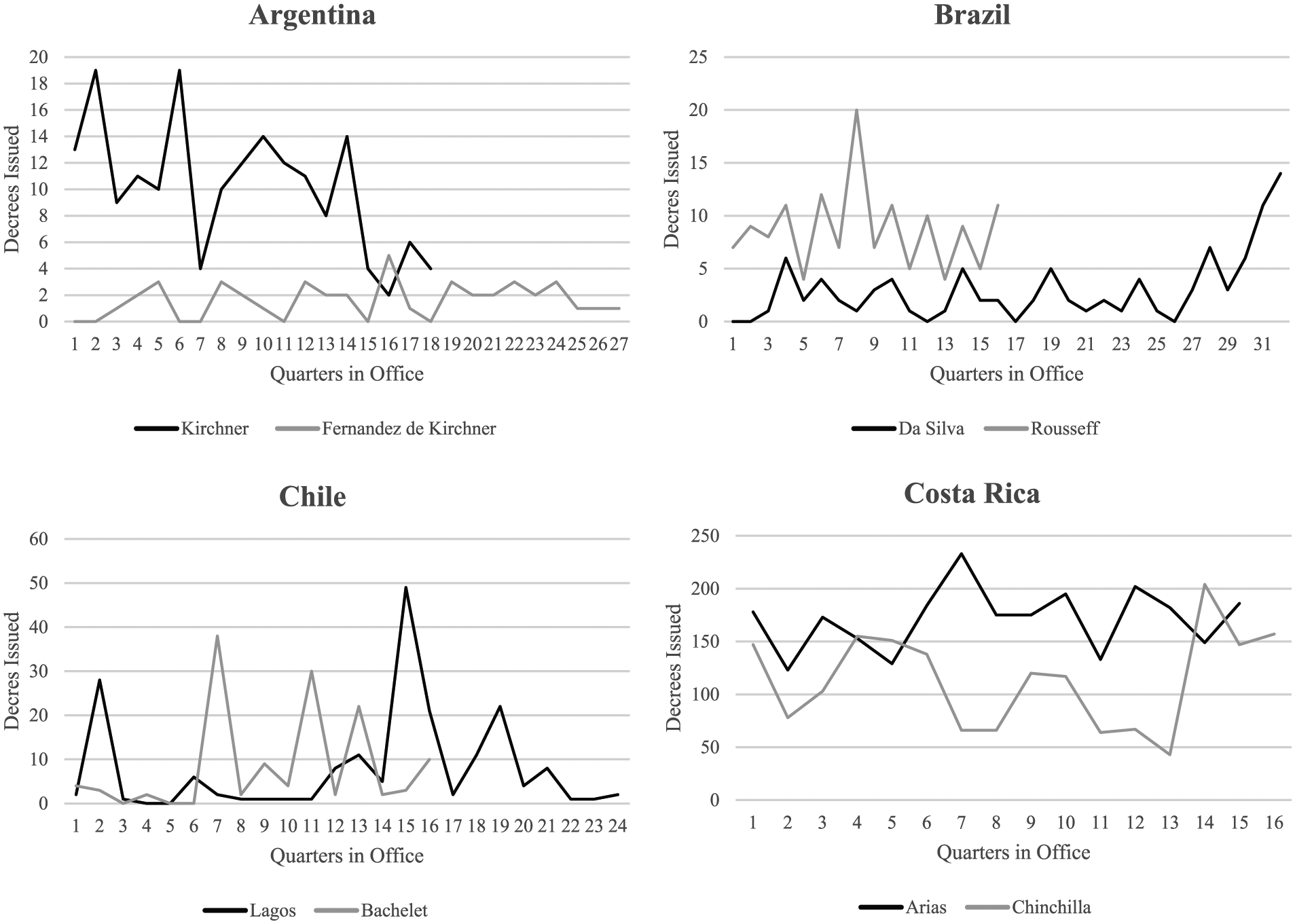
Executive decree issuance by president.
In contrast, Brazilian and Chilean female executives issued more decrees than their male counterparts. Rousseff issued more MPs than Lula in most of her quarters in office. Her total of 140 decrees in only sixteen quarters is 46 percent more than his total of ninety-six decrees in twice the time in office. However, it is also evident that da Silva steeply increased his issuance of MPs toward the end of his administration, so the political climate into which Rousseff took office had already begun to trend toward reliance on unilateral executive authority. In Chile, although Bachelet issued fewer decrees than Lagos overall—131 in sixteen quarters compared with his 188 in twenty-four quarters—her quarterly average is slightly higher—8.19 compared with his 7.89. Yet their quarterly averages are much more similar than the other presidential pairs. Bachelet has three quarters in which she issued no decrees and three where she exceeded ten decrees, while Lagos has two quarters in which he issued no decrees and six where he exceeded ten decrees.
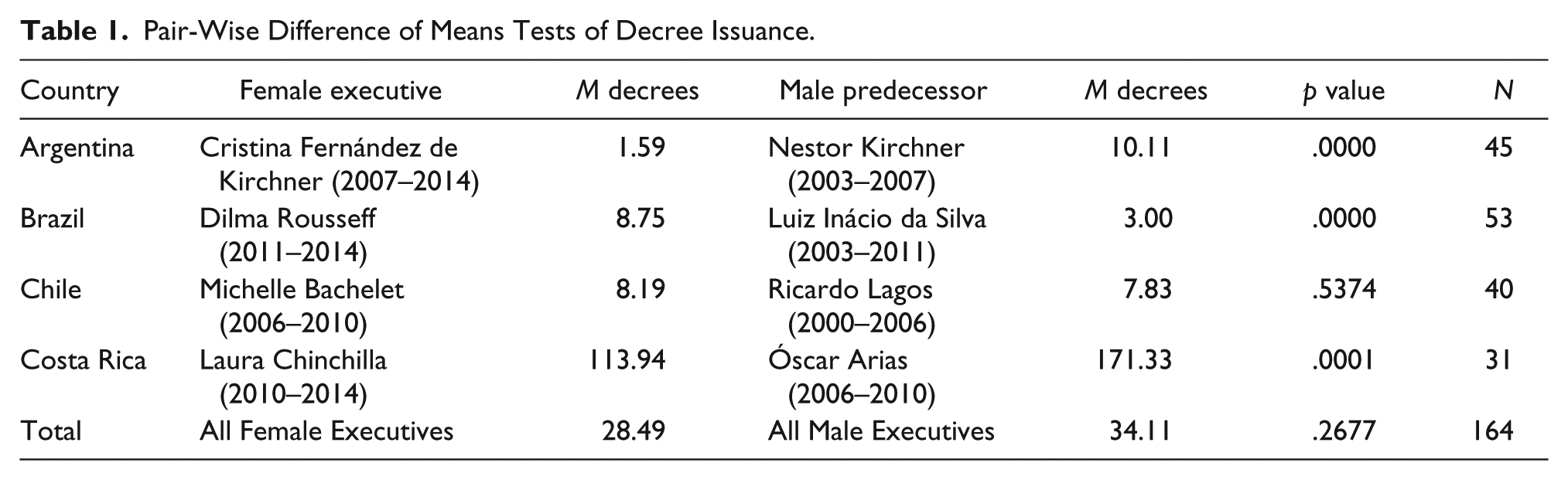
Table 1 presents average executive quarterly decree issuance between 2000 and 2014. 12 The total values at the bottom indicate that female presidents issue fewer decrees than male presidents, although not at a statistically significant rate. Yet there is considerable difference in the within-country propensity of male and female executives to wield their decree authority, which is a more appropriate test of our theory. Difference of means tests on each pair produce statistically significant differences at the .05 level, with higher means for the male executives in Argentina and Costa Rica and a lower mean for da Silva in Brazil. The exception is Chile where the slight difference in favor of Bachelet is not statistically significant.
Pair-Wise Difference of Means Tests of Decree Issuance.
Quantitative Paired Comparison
We use the decree count data detailed above as the dependent variable (Decrees) in a quantitative analysis of our hypotheses. The main explanatory variable, Sex, is a dichotomous measure for the sex of the executive, coded 1 for female. To capture the president’s support and influence vis-à-vis the public and the legislature, we include a lagged measure of Executive Approval, which is the approval rate from the previous quarter. 13 This variable comes from the Executive Approval Dataset, a quarterly smoothed measure coded on a 0 to 100 scale (Carlin, Hellwig, et al. 2015). 14 To control for a president’s need to issue decrees, we include the size of the Presidential Coalition by measuring the proportion of legislative lower-house seats held by the president’s party and any party that is formally a member of the president’s party coalition. 15 To control for term cycle dynamics, such as a postelection “honeymoon” period when a president might issue more decrees, we include a count of Quarters in Office. To account for macroeconomic crises, we include Lagged Inflation, a measure of the Consumer Price Index that is lagged one quarter.
We use negative binomial regression with country-level conditional fixed effects, as the assumption of unit dispersion is not valid in our sample. We maintain the comparative approach by assessing within-case variation between pairs of executives, rather than pooling our data. Model 1 includes all variables, while model 2 includes an interaction term between Sex and Executive Approval. Results are presented in Table 2.
Analysis of Executive Decree Count Data.
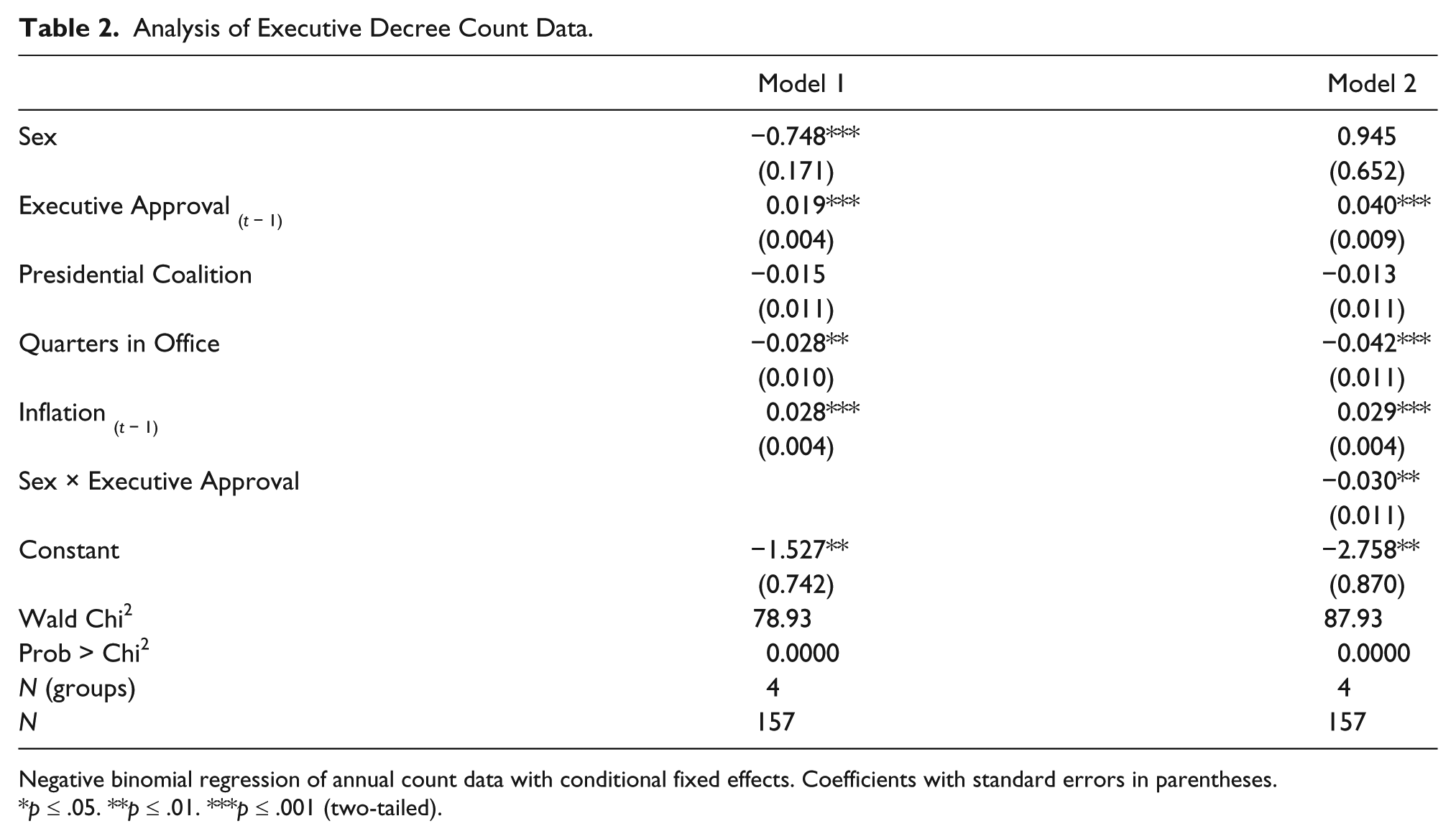
Negative binomial regression of annual count data with conditional fixed effects. Coefficients with standard errors in parentheses.
p ≤ .05. **p ≤ .01. ***p ≤ .001 (two-tailed).
Model 1’s results confirm expectations about the relationship between the sex of the president and the rate of decree issuance. Holding the controls constant, Sex has a negative and statistically significant relationship to executive decree issuance. As the coefficient values from negative binomial models are difficult to interpret, we calculate the predicted probabilities of a standard deviation change from the mean for key variables, holding all others constant at their means. This allows for a more intuitive explanation of the expected impact of variation in the predictors on decree count. Switching from a male to a female president results in a 53 percent decrease in decree issuance; supporting hypothesis 1, female presidents are less likely to use decree authority than their male counterparts. Executive Approval also has a direct relationship to decree issuance: a one standard deviation increase from the mean of Executive Approval leads to a 28 percent increase in decree issuance. 16 This suggests that presidents are more likely to use this authority when they are more popular.
However, executive approval may not only have a direct relationship to decree issuance, but this relationship may also be conditioned depending on the sex of the executive. To explore this, model 2 includes an interaction between Sex and Executive Approval. Here, we find a significant negative effect from the interaction term between Sex and Executive Approval. 17 As the coefficients of interaction terms may not fully explain the gap between male and female executives at different levels of executive approval, we plot the difference in marginal effects between male and female decree issuance across the observed range of approval in Figure 2. The difference in the slopes reflects our expectations: although they begin at statistically indistinguishable rates of decree issuance, as their approval ratings increase, women are significantly less likely than men to issue decrees. In other words, male and female executives show the greatest difference in decree issuance with high approval ratings; this difference becomes statistically significant at approval ratings over 50 percent, which is below the mean value across our sample (53.343). When an executive’s approval ratings are lower, there is no difference between decree issuance rates of men and women. Male presidents in the sample have a 60 percent average lagged approval rating while female presidents in the sample have a 46 percent average lagged approval rating, meaning that the significance range includes around half of both male and female presidential quarters in our sample.
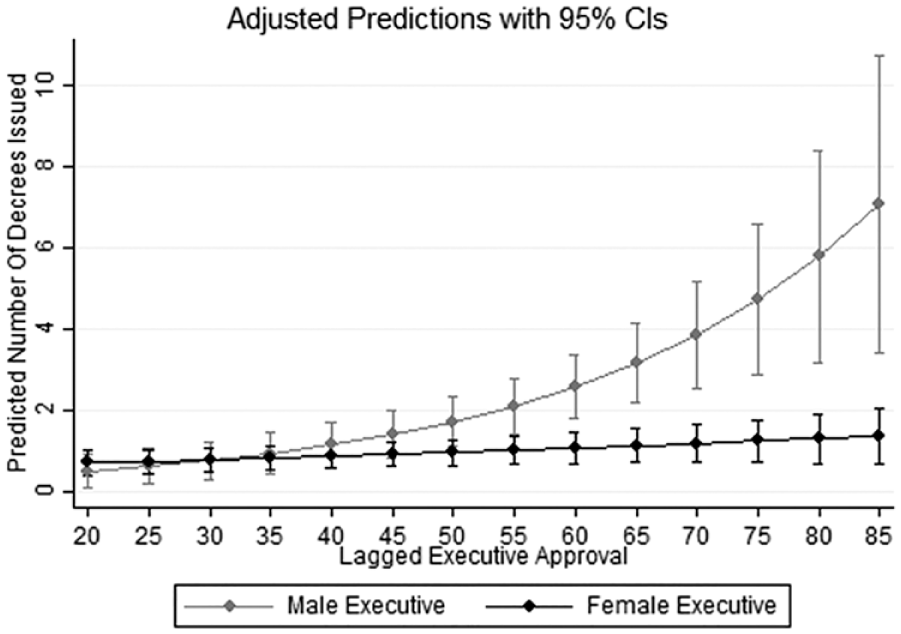
Decree issuance by sex at varying levels of lagged executive approval.
With regard to control variables, Presidential Coalition exerts a small negative effect on decree issuance that is not statistically significant at the .05 level. However, the direction of this effect makes intuitive sense because presidents with a partisan or coalitional majority may have less need to issue decrees. The coefficient for Quarters in Office is negative and statistically significant, suggesting some support for a “honeymoon” effect where executives feel emboldened by recent electoral victories to issue decrees at higher rates. In addition, the coefficient for Inflation is positive and statistically significant in all models, suggesting support for a response to economic crisis as executives facing issues such as high inflation must react quickly with emergency fiscal or monetary policies via decree rather than waiting for more slow-moving, deliberative legislative processes.
Overall, we find that the relationship between approval and decree issuance is conditioned by executive sex. The combination of a positive slope for male presidents and relatively flat slope for female presidents in Figure 2 supports the theoretical argument that women distinctly utilize unilateral authority when they possess higher levels of public approval. In general, women and men differ with respect to how likely they are to issue decrees, but the gap between male and female decree issuance is widest and most consistent under conditions of high presidential approval. In other words, male executives are more likely to use unilateral action when their approval rates are highest, compared with female executives who may be more constrained regardless of their approval. Yet these gaps narrow as executives face declining approval that prevents them from being able to assert their will. These findings provide support for our conditional hypotheses 2a and 2b.
We confirm that public approval is a particularly strong type of political capital wielded by executives, an idea long posited by the extant literature. This makes sense if the expectation is that presidents who prefer to rely on unilateral actions will undertake them when they feel cushioned from punishment and face few penalties for failing to exercise self-restraint. Having high public approval ratings offers an executive a fairly clear signal about popular support for her or his policies. If what an executive prefers is to enact her or his policy agenda and, where possible, win re-election, relying on public approval ratings as a justification for pursuing unilateral actions would be more strategically appealing than intervening in the legislative process simply because their party coalition holds fewer seats.
Conclusion
In many Latin American countries, we have seen dramatic shifts in women’s executive office-holding. However, presence alone does not mean that women are empowered to govern effectively, nor does it suggest that women will govern in a distinct way. Despite a substantial number of female executives to study, there has been no systematic analysis of how their leadership might (dis)confirm expected behavior compared with that of their male counterparts. We provide the first test, evaluating male–female presidential pairs in four Latin American countries. Once controlling for political factors, such as institutionalized authority and partisanship, we find that female presidents are less likely to rule by decree. Moreover, this difference in decree issuance is conditioned by executive approval.
Our findings suggest that women wield their executive authority in distinct ways from their male counterparts. The female executives in our sample were less likely to rule via decree than the male executives, even when they possessed the political capital that would enable such a choice. Building on evidence that women are more likely to win office when they more closely resemble men, once in office, female executives may continue to demonstrate a combination of stereotypically feminine and masculine leadership styles. Given that more participatory and democratic authority is commonly associated with effective leadership in the business world, this difference in the exercise of unilateral authority may indicate a more positive era of presidential governance in Latin America has arrived.
As more women around the world reach the highest political offices, further analysis could shed light on distinctions in women’s motivations for governing in the ways they do, both from the perspective of the different strategic motivations facing female presidents and the substance of policy they may choose to pursue. First, our analysis does not differentiate between female presidents who pursue consensus-based or collective policymaking for personal or strategic reasons and those who avoid unilateral actions for fear of being punished for taking them. For example, neither Fernández de Kirchner nor Rousseff were known for their interest in collaborative or consensus-based approaches to governing, and both were highly criticized at various points toward the end of their tenures for attempting to run roughshod over legislative counterparts. In this regard, it is possible that both would have preferred to rule via decree but felt compelled not to in ways that their male predecessors did not. 18 Yet from a governance standpoint, a more restrained presidential style of unilateral action may result from any of these underlying motives. Future research might differentiate between these sources of constraints on female presidents. It might also examine whether such sources exert similar or different effects on distinct policy issue areas or on other forms of unilateral executive action.
Second, in terms of substantive context, a growing body of research has investigated the ways in which men and women pursue distinct policy agendas, both with respect to domestic and foreign policy (Bratton and Ray 2002; Kittilson 2008; Koch and Fulton 2011; Shair-Rosenfield and Wood 2017). New evidence from Latin America indicates that women presidents appoint higher proportions of women cabinet ministers to traditionally “feminine” portfolios, where there is a larger supply of qualified nominees (Reyes-Housholder 2016). Focusing on the substantive content of executive decrees could provide further context regarding the ways in which women may choose to employ unilateral action, particularly if women presidents focus their attention and authority on distinct policy areas or “women’s issues.” For example, Bachelet used a decree to establish an advisory board on children’s issues, and Rousseff issued a decree to expand the home ownership rights of women during the process of divorce. Future research could rely on our paired-comparison approach to investigate this possibility in a systematic way. At present, no such substantively coded data set exists for these cases. There are significant challenges associated with collecting comprehensive decree count data from government sources for Latin American cases, let alone in analyzing and coding the content of thousands of decrees.
Finally, our findings have important implications regarding how personality traits, attributes, and behaviors may contribute to governing style. Future research could examine individual characteristics of executives, potentially linking style of governance and the exercise of self-restraint to effectiveness in the political arena. One logical next step for analysis would be investigating whether a more consensus-based leadership style produces more effective governance. For example, scholars may test whether more legislation is passed in countries with female executives where there are higher proportions of female legislators, which might indicate whether consensus-based or “democratic” bargaining styles in both branches increase legislative productivity. Furthermore, there is no reason to expect that such leadership styles are exclusively employed by women. Studies investigating when and why men exercise similar patterns of reliance on unilateral action may answer general questions about the effectiveness of different leadership styles on governance. An important avenue of future research should seek to understand not only whether self-restrained executives are more effective at governing but also when and why individuals—regardless of sex—adopt such leadership styles.
Footnotes
Acknowledgements
We would like to thank Ryan Carlin, Julie Dolan, Jonathan Hartlyn, Magda Hinojosa, Farida Jalalzai, Jana Morgan, Tracy Osborn, Jean Schroedel, Cameron Thies, Joshua Thompson, and three anonymous reviewers for their helpful comments and suggestions. All remaining errors are our own.
Authors’ Note
Previous versions of this article were presented at the 2016 Southern Political Science Association (San Juan, Puerto Rico) and 2016 Midwest Political Science Association (Chicago, Illinois) annual meetings.
Declaration of Conflicting Interests
The author(s) declared no potential conflicts of interest with respect to the research, authorship, and/or publication of this article.
Funding
The author(s) received no financial support for the research, authorship, and/or publication of this article.
Supplemental Material
Supplemental materials for this article are available with the manuscript on the Political Research Quarterly (PRQ) website. Replication data are publicly available on the authors’ websites.
Notes
References
Supplementary Material
Please find the following supplemental material available below.
For Open Access articles published under a Creative Commons License, all supplemental material carries the same license as the article it is associated with.
For non-Open Access articles published, all supplemental material carries a non-exclusive license, and permission requests for re-use of supplemental material or any part of supplemental material shall be sent directly to the copyright owner as specified in the copyright notice associated with the article.
