







Abstract
While the percentage of female heads of state in the world has increased to around 10 percent in the 2010s, a female president or prime minister still remains an exception. Recent scholarship has proposed a number of explanations behind this phenomenon, but there exist important gaps. The contribution of this paper is threefold. First, we use new and comprehensive data to undertake a systematic examination of the differences in the personal, education, and career backgrounds between female and male effective political leaders from 1960 to 2010. We find that female leaders are as qualified as men. Second, because the phenomenon of female leadership is still a rare occurrence, we argue that this fact must be accounted for in empirical modeling. Third, we show that many female leaders tend to acquire the necessary resources, support, and name recognition through political dynasties. To that end, women leaders need to rely on family ties more than men do. However, the importance of such connections attenuates when female suffrage has been in place for longer, and citizens are more open to women in politics.
What factors determine whether women are ultimately successful in holding the highest office in their country? Given the scarcity of female heads of state, one might assume that women tend to have fundamentally different levels of political experience or background traits than men do. However, because female leaders are such a rare occurrence, it is difficult to make inferences about the background characteristics that distinguish female leaders from males in terms of their qualifications for their country’s highest office.
We argue that two different but related factors come into play when considering women’s advancement to head of state. First, although women and men have similar paths to leadership in terms of their levels of education and career trajectories, female leaders require significant resources, connections, and networks to achieve political leadership—more so than their male counterparts (Folke, Rickne, and Smith 2017; Jalalzai 2013). Those resources most frequently take the form of being part of political dynasties, particularly when women are not present in politics more broadly. However, family dynasties are less important the longer that women have been active in political life more generally. We argue that once female suffrage has been institutionalized—that is, if voting rights have been in place to an extent that female participation in politics is regarded by citizens as commonplace—the importance of family ties will decrease. That is, women leaders benefit from family ties when women are scarce in political life generally, but as their participation in politics becomes normalized, family ties become less important.
We test our argument using a novel dataset that allows us to compare the individual backgrounds of all male and female leaders in the world from 1960 to 2010. Previous studies have only been able to compare female leaders with a limited selection of male leaders. Drawn from extensive firsthand research on the biographies of leaders around the globe, these original data allow us to broaden the scope of previous studies, by comparing the accomplishments and background of female leaders with their male counterparts around the globe, over five decades.
This paper makes a number of contributions. First, in contrast to studies that compare female and male leaders on a limited basis (such as comparing all female leaders with their immediate male predecessors in the same office, or in small-sized or contemporaneous samples), we study all female and male leaders, drawing from an original dataset of the background characteristics of leaders. These data allow us to gain unprecedented leverage on the personal attributes of male and female leaders alike. Second, because female leadership is a rare event, we account for possible bias in the estimates due to this scarcity, using techniques that are not common in the literature on women in executive posts. Third, we build upon, and extend, the “widow’s effect” argument (e.g., Folke, Rickne, and Smith 2017; Jalalzai 2013; Opfell 1993; Solowiej and Brunell 2003) by emphasizing the interactive aspect of the political climate and family connections, specifically, the ways in which the effect of dynasties changes once countries have established a tradition of women in politics.
These are important findings for the literature on representation in politics. Recent scholarship has examined the determinants of female leadership on a smaller scale—in a given country or region, for example; or even in a given institution such as the legislature; or through analyzing a few high-profile female leaders. But such studies may lead to incomplete or biased conclusions regarding the differences in political experience and traits between all male and female leaders. Our arguments build on a wealth of existing studies of female leadership in executive office (e.g., Bauer 2011; Genovese and Steckenrider 2013; Jalalzai 2016; Murray 2010a; O’Brien 2015; Opfell 1993; Thames and Williams 2016), but broaden them to consider the factors that, across history and for all parts of the world, might distinguish women from men with respect to their ability to reach top political leadership.
How Different Are Female Leaders?
Women remain underrepresented in nearly all aspects of professional and political life, particularly at the upper echelons. In 2016, less than 7 percent of all political leaders in the world were female (twenty-two out of 315 heads of state and heads of government). If we count effective leaders—excluding prime ministers in presidential systems or ceremonial presidents in parliamentary systems—the number is still 7 percent, or fifteen out 193 effective leaders. This lack of representation mirrors patterns in other professions. Women are more likely to be found in the lower tiers of business, academia, and public service, where representation tends to be on par with demographics. But their numbers thin dramatically as the ranks get higher.
Across disciplines, scholars acknowledge that the lack of women’s participation in public life cannot be attributed to their backgrounds. Experience and qualifications cannot explain the relative lack of female CEOs in publicly traded firms worldwide (Fawcett and Pringle 2000), and female cabinet ministers are generally as experienced as men (Escobar-Lemmon and Taylor-Robinson 2016). As Thames and Williams (2016, 39) underline, public perceptions regarding participation of female politicians in executive office are often clouded by the visibility of a limited number of influential leaders, such as Indira Gandhi or Golda Meir. Still, many scholars have offered significant insight into the attributes of female leaders more broadly. For example, Jalalzai (2013) compares the individual background of female politicians with preceding male leaders in the same office, finding that overall, women have similar educational qualifications and experience as men (although female leaders are more likely to have a background in human or social service ministries). Other studies focus on female executives in democratic regimes only (Thames and Williams 2016), or on later periods from 2000 (Jalalzai 2016). However, as of yet, we do not know whether the backgrounds of women leaders systematically differ from those of all male leaders, due to a lack of comprehensive data on the backgrounds of leaders in all political regimes over time.
By looking at the full spectrum of women in effective political leadership across a broad swath of countries and years, we can be better positioned to investigate differences between men and women leaders in different contexts around the globe. Before attempting to explain the phenomenon of female leadership on a global scale, first, we validate the above-mentioned accounts of the lack of differences between male and female leaders. To do so, we rely on a comprehensive original dataset from 1960 to 2010 that covers 1,501 effective political leaders in all political regimes, the first of its kind addressing the question of female leadership.
To avoid inflating the number of female executives, we focus on effective political leaders and exclude other leaders in dual arrangements, such as ceremonial presidents or monarchs in parliamentary systems where female politicians may appear. The data include background information, acquired from firsthand archival research, on leaders in all countries in the world, including parliamentary and residential democracies as well as nondemocratic countries. To our knowledge, these are the most comprehensive data available on the background of the heads of state, which make them ideal for differentiating the attributes of male and female leaders. 1
Generally speaking, individuals with traits conforming to the norms of existing regimes are typically selected for leadership (e.g., Sullivan et al. 1993). It is possible, therefore, that women leaders are more likely to emerge in political environments that favor politicians with typical traits and career paths, in contrast to political regimes that never experienced female leadership. As a result, if we restrict the sample to settings where female politicians are more likely to be encountered, such as democratic regimes, there may be no difference between genders. In contrast, we run the risk of inflating differences if we include settings where women leaders never appear, such as in military regimes. With the goal of conducting the most conservative comparison, here, we compare male and female leaders in all political regimes. This comparison substantiates previous findings reported on the basis of smaller samples (Escobar-Lemmon and Taylor-Robinson 2016; Jalalzai 2013). For robustness, in the online appendix, we compare leaders restricting to more democratic settings.
Figure 1 compares male and female political leaders in terms of their personal, educational, and professional background, as well as their political experience. Age is not a separating factor. On average, men and women alike enter office when they are 53 years old. There are also no significant differences in terms of whether they have civil service, business, or academic careers prior to the highest office.
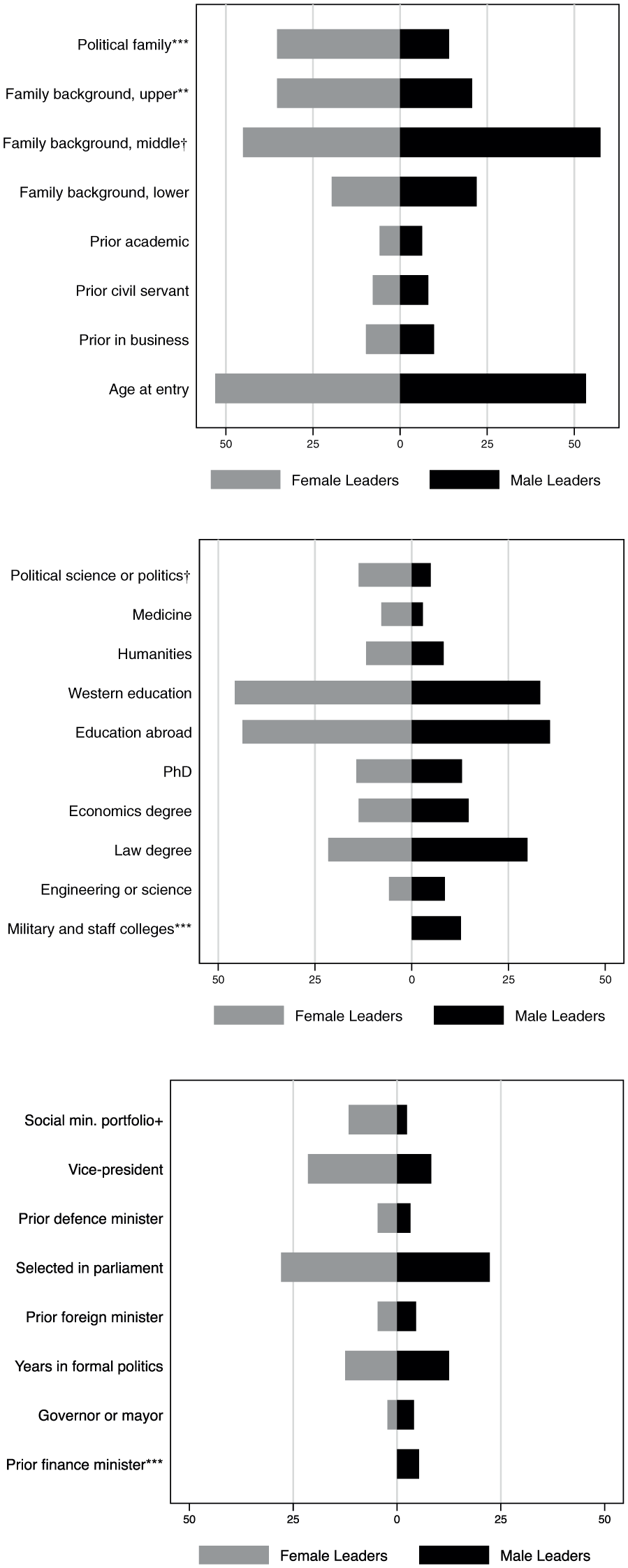
General background, education, and experience of female leaders.
Men and women leaders have similar educational backgrounds. They are equally likely to study abroad and in the West (among leaders of non-Western nations), or to have received an education in law, economics, the humanities, engineering and science, or in medicine. However, women are more likely to have a political science degree or the equivalent. Also, no female leader has ever received a military education.
There is no evidence that women lack in political experience compared with men. On average, prior to their post at the highest office, women and men spend thirteen years in formal politics, often as members of parliament, governors, or cabinet ministers. There are no notable differences in terms of the type of experience, such as whether female leaders occupied the post of foreign or defense minister. Even though 21 percent of female leaders, as opposed to 9 percent of male leaders (excluding nonpresidential regimes), are former vice-presidents, these differences are not statistically significant. What is different, however, is that male leaders are much more likely to have held a cabinet finance portfolio in the past. Women also tend to take on so-called “female”-oriented ministerial portfolios, related to health, education, employment, labor, environment, integration, or social affairs. This comports with findings from Escobar-Lemmon and Taylor-Robinson (2016), although they find that women in what they call “feminine policy domains” tend not to advance further in their careers.
However, female leaders tend to have a very different family background than do their male counterparts. This is initially apparent in terms of class: 35 percent of women come from upper- and upper-middle-class families (based on their parents’ socioeconomic status and profession as described in biographical entries), as opposed to 21 percent of men. More important, as opposed to only 14 percent of men, 35 percent of women belong to prominent political families where their fathers, husbands, or brothers occupied the highest political post in the past (e.g., Indira Gandhi of India) or alternatively were leaders of pro-independence or pro-democracy movements (e.g., Corazon Aquino of the Philippines). These two differences are statistically significant (see the online supplementary materials for further details).
In summary, while two differences do exist in terms of the type of ministerial portfolios, overall, women appear to be equally educated and experienced as men. The most notable trait that makes women leaders different from men, according to these data, is a much higher likelihood that they come from a prominent political family name. The following section reviews the literature and outlines our theory for when and why such family ties might matter for women, while the subsequent sections use these background characteristics to analyze the probability that a woman serves as a leader of her country.
When Do Family Ties Matter?
In comparative perspective, what distinguishes male and female leaders is not their education or experience, but whether they are likely to have family ties to politics. If women leaders generally have similar backgrounds to men, why is it that so many female executives—but not all—hail from political dynasties?
Scholars have presented no shortage of factors that come into play for the lack of female leadership more generally. Studies of political representation have long noted that participation at all levels tends not to favor women and minorities (Thomas and Wilcox 1998). The factors that account for these patterns are manifold, and social scientists have attempted to disentangle this phenomenon through various methods (for an overview, see Córdova and Rangel 2017; Folke and Rickne 2016). Leadership aspirations among girls in the population at large are affected by overall female participation (Beaman et al. 2012). Women are less likely to put themselves forward as candidates for office (Bledsoe and Herring 1990; Kanthak and Woon 2015), partially because they are more averse to competitive environments (Preece and Stoddard 2015). Even if they do so, they are more vulnerable to campaign negativity (Krupnikov and Bauer 2014) and perceptions of corruption (Barnes and Beaulieu 2014).
We focus particularly on two sets of arguments in this literature. The first concerns the informational and visibility disadvantages that women face when seeking high office, and the way that family ties can help them overcome those barriers. The second centers on the environments that enable women to make greater headway in the absence of family ties.
Family Ties and Female Political Advancement
The first set of arguments from which we draw centers on the disadvantages that both female candidates as well as voters face when encountering the prospect of running for high office (Werner and Mayer 2007). Women face financing barriers, as they have tended to be on a less sure footing economically than men and are less likely to have personal funds to finance their campaigns (Phelps 2004). Furthermore, funders do not view them as credible candidates (Conway 2001). Social networks play a vital role in political advancement (McClurg 2003), and many studies have looked at how women might be disadvantaged in their efforts to become part of such a network. In addition, they experience biases and encounter informational disadvantage with voters who are not accustomed to electing female candidates and who may be unfamiliar with their quality (Folke and Rickne 2016).
Because of the barriers women face, the required resources in terms of networks, financing, and brand recognition have traditionally come about through one key avenue: being part of a family dynasty of politicians, particularly in countries that do not have a precedent of women in politics. Because party leadership and male networks tend not to be open to females (O’Brien 2015), often women’s only option is to be born or married into them. Scholars have shown that well-connected social backgrounds are crucial for female participation in politics in non-Western politics (Franceschet and Piscopo 2013; Schwindt-Bayer 2011). Similarly, Gertzog (2002, 96) shows that in the United States up until 1942, particularly in the South, “most Congressional widows . . . were born into families whose men were part of their state’s socioeconomic and political elites.” Of women who were not widows, the largest group had significant family political connections, which were crucial in providing resources, reputation, and financing (Gertzog 2002, 100).
Around the world, women have traditionally entered first into politics as the wives of politicians. Indeed, some of the early women in politics replaced husbands who had died unexpectedly while in office. In the United States, the so-called “widow’s mandate” has been a pattern in political life since 1923. Jeanette Rankin was the first woman elected to Congress (specifically, the House of Representatives) in 1916, even though women in the United States were barred from the national vote until 1920. Up until 1942, nearly half of the female representatives to Congress were widows of former Congressmen (Gertzog 2002). The first time a female reached executive office in modern times was in 1960, when Sirimavo R. D. Bandaranaike, herself the wife of the assassinated prime minister, became the head of state of then Ceylon. More generally, Collins and Teele (2016) show that many initial instances of female suffrage were extended first to widows. The argument for the widow’s effect in politics is, therefore, not new (Solowiej and Brunell 2003). 2
The “widow’s mandate,” however, came with delineated expectations about the degree of autonomy and authority that women were meant to command. Their roles were limited, and the expectation was that they would simply serve as placeholders until a male successor came in. As expressed in Fitzpatrick (2016), women were expected to remain largely passive and to bow out gracefully when the time came:
A widow’s closeness to her late husband, and her familiarity with his political beliefs, offered at least the veneer of continuity as well as a tasteful, if temporary, memorial to the deceased office holder. As Mae Ella Nolan, the first widow elected to fill out her husband’s term, in 1923, put it, “I owe it to my husband to carry on his work. No one better knows than I do his legislative agenda.”
As time progressed, these political connections took on a different form, and the women who achieved tended to be either from family political dynasties or to have still-living political husbands. Even if women establish their political career alongside a spouse with similar ambitions, “the gendered rules of the game have meant that the male spouse has often been the first to succeed at high office, even within a marriage of equals” (Murray 2010b, 15).
The value of family ties goes beyond resources and political networks. Folke, Rickne, and Smith (2017) find that dynastic ties help women candidates to overcome a vote disadvantage in elections, where voters rely on familial relationships of female politicians as informational cues about their quality. We would, however, expect an amplified effect for heads of state. The social, reputational, and financial benefits of networks are helpful for office generally but pivotal in running for executive office. Of all public offices—with the possible exceptions of defense ministers (Barnes and O’Brien 2018) and party offices (Verge and Claveria 2016)—the presidency and prime ministership are the most gendered in politics, which makes them even more challenging for women to achieve (Clift and Brazaitis 2000). For instance, even though Cristina Fernandez of Argentina (2007–2015), the wife of former president Néstor Kirchner (2003–2007), as “an outspoken member of the upper house . . . was far better known than her husband when he was elected as president in 2003” (Popper and Grazina 2011), her election in 2007 was only made possible because she could rely on her husband’s resources and efforts (after departure from office, Kirchner headed the ruling party and “battled behind the scenes to shore up support for his wife from the kingpins of the fractious Peronist party” [Popper and Grazina 2011]). Thus, at the executive level, family dynasties would be even more important for female leadership.
The Interactive Effect of Family Ties and Female Political Participation
While many women leaders rely on family connections, even more of them—specifically, as Figure 1 indicates, two-thirds of female leaders—are elevated to high office without family ties. When do such ties matter? We argue that the importance of family ties is contingent on prevailing norms of female participation in politics. In many countries, especially those with traditional values—such as the settings that elevated Indira Gandhi of India or Khaleda Zia of Bangladesh—the norm is not to have a female politician, especially a female political leader. The only possibility to have female leaders elected in such countries, particularly when women leaders need to be elected directly, is through the widow’s effect. In contrast, family connections should not be as crucial for selection of women in settings where female participation in politics has long been established.
The adoption of female suffrage marks the onset of women’s formal participation in political life. The longer that suffrage has been in place, the less important a family dynasty will be in facilitating the rise of a female leader. The introduction of female suffrage requires a substantial amount of mobilization and lobbying, both at the political level and at the public level. As McConnaughy (2013) and Teele (2014) describe, women’s suffrage movements were characterized by information dissemination to raise awareness of the issue, including editorials, rallies, campaigns, and fundraising efforts. Women at the head of these movements also had to familiarize themselves with the existing political leaders and the legislative process necessary to change voting laws. Such organizational movements initiated the process of forging the political networks that later became useful to females hoping to enter politics more generally (Teele, forthcoming).
Once a government institutes female suffrage, women can enter politics first at the ballot box and then in political life more broadly. When women have had the right to vote for longer, citizens will be more open to women in politics than they would be otherwise. This, of course, can be accompanied by the development of other, more formal institutions that can make a significant difference in female participation, such as quotas and changes in party rules for participation. 3 But all of those political changes are preceded by the movement to extend the franchise. 4
Thus, we advance the widow’s effect argument by arguing that for women leaders, the effects of political dynasties and a history of female suffrage is interactive. Family connections play an important role in electing women in the early stages of a country’s political development. However, we argue that subsequent to suffrage, those ties are much less important. Furthermore, the routinization of females in political life is distinct from the mere passage of time or years of uninterrupted democracy, as we discuss in the empirical section “Results.” Consider Roza Otunbayeva of Kyrgyzstan or Dalia Grybauskaité of Lithuania, neither of whom could claim family connections to politics. Their nations, however, had a long history of female suffrage since independence in the aftermath of World War I and as the constituent parts of the Union of Soviet Socialist Republics (USSR). Arguably, it was not inconceivable or that unusual in these countries to have female leaders because of a long history of acceptance of women in politics.
Modeling Female Leadership
Earlier, we introduced data on all political leaders to validate previous findings that female heads of state are equally, if not more, qualified, than their male counterparts. The key difference is family ties, which for women manifest as political dynasties that provide visibility, mentoring, and financing, but can later be supplanted by other institutions after suffrage is introduced. Here, we test this argument and examine whether—and under what conditions—political ties make the selection of women leaders more likely, controlling for other factors.
Our research question centers on the selection of female politicians in office, not about their longevity in office. Therefore, we only include observations for the year of entry into office. Thus, the unit of analysis is the leader/country/year, but only for that initial year of service. The dependent variable is a binary indicator of whether the leader entering office is a female. The effects of cultural, socioeconomic, or personal factors, by the logic of the argument, only influence whether female leaders are chosen. This makes our analyses consistent with the literature on the selection of leaders (e.g., Baturo 2017; Besley and Reynal-Querol 2011), as opposed to that of the effects of leaders on various outcomes (Alexiadou 2015; Horowitz and Stam 2014).
These data cannot address the selection stage for female candidates. We only observe women who succeeded in their bids for high office, not candidates. While an examination of winning and losing candidates is feasible in single-country studies, or even in comparative studies of presidential elections across nations, it is more difficult in analyses that include all political regimes over time, as does the present study. Arguably, for parliamentary regimes, all members of parliament who belong to the majority party or coalition are potential political leaders. The identification of losing candidates in nondemocratic regimes would be even more challenging. These data also cannot account for the processes that lead women to choose to run for office in the first place, as others have studied in laboratory settings (Kanthak and Woon 2015). Indeed, such an omission even leaves out further examples of females who did not secure office even despite family connections. For example, Panama’s Mireya Moscoso—the widow of Arnulfo Arias, who was the country’s president on three separate occasions—had a failed run in 1994 before being elected to high office in 1999. 5 Thus, although a study of the selection process of female leaders would require much more extensive data, anecdotal evidence suggests that dynasties might have a foothold in these earlier stages as well.
In terms of sample selection, we want to ensure that we include only relevant observations. Even though female leaders may assume office in nondemocratic settings, such as Lydia Gueiler (1979–1980) of Bolivia or Rose Rogombé (2009) of Gabon, they are almost always interim leaders. Female leadership is, however, encountered in partly democratic or transitional settings. Therefore, we limit the estimation sample to more democratic settings where female leadership is likely to be encountered, to political regimes where the Polity2 score has positive values. 6 Altogether, there are forty-eight effective female political leaders from 1960 to 2010, or 5 percent in the estimation sample of 980 leaders. In the online supplementary materials, we also estimate on a full sample that includes nondemocracies and on a smaller sample that includes fully democratic regimes, that is, at or above Polity2 of +6 (Marshall and Jaggers 2011).
The emergence of female heads of state is clearly a rare event. However, most existing studies of female political leaders do not account for this reality in their modeling decisions, which may lead to a possible bias. Because only 5 percent of leaders in the estimation sample of our data are female, maximum likelihood estimation (MLE) of a logistic model may suffer from a small-sample bias. Therefore, we turn to a so-called penalized MLE procedure, proposed by Firth (1993). The method overcorrects for possible bias and allows convergence of finite estimates with rare-events data. Specifically, we fit the Firth method to logistic regression. In the online supplementary analyses, we also specify an alternative method, rare-events logit.
Family Ties and the History of Female Suffrage
We posited that reliance on family connections is often paramount for success for female leaders. However, family ties should particularly matter in settings where women are an unfamiliar sight in political life. We, therefore, expect that political family (a binary indicator for whether a woman has a relative in politics, either through birth or marriage) should particularly matter in new democracies or in countries with relatively short histories of female suffrage.
To study whether the effects of coming from a political dynasty depend on the extent of acceptance of female participation in politics, we specify an interactive model. In contrast to Collins and Teele (2016), who directly examine the effects of female suffrage on electoral politics, we rely on the length of time suffrage is in place. We argue that the duration of female suffrage can be employed as a proxy for the normality of female participation in politics, frequently followed by the introduction of formal institutions that solidify this participation, as we will show in supplementary analyses. The existence of the norm of having women in politics as perceived by citizens is similar to the concept of institutional routinization (Linz and Stepan 1996, 10).
We, therefore, include female suffrage, years, the number of years from the first introduction of female suffrage, even if complete female suffrage was not introduced at the time. 7 For example, for Belgium, female suffrage, years is counted from 1919 when a female’s right to vote—subject to conditions—was first introduced, not from 1948 when all restrictions were lifted.
Instead of a logarithmic transformation, we normalize years of female suffrage using an inverse hyperbolic sine transformation (Burbidge, Magee, and Robb 1988). The transformation accounts for the fact that some observations have the value of 0 for years of entry into office when female suffrage is not yet introduced. Furthermore, we want to ensure that the suffrage variable does not simply account for the passage of time. To that end, we, in addition, account for a possible time trend. 8 It may be difficult to distinguish whether political dynasties are more likely early on (coinciding with the introduction of female suffrage) or whether norms surrounding female participation in political life are weaker in the past. Therefore, we include time polynomials, that is, the count of years, as well as the squared and quadratic terms of the count of years. In the online appendix, we also fit models with fixed year effects for robustness.
Competing and Complementary Explanations
While we are primarily interested in the interactive effect of dynasties and institutions, we also consider additional explanations. Previous research has demonstrated the importance of democracy, gender parity, politically unstable contexts, and the mere fact of having a previous female leader in the past (Jalalzai 2008, 2013). Therefore, to account for the possibility that female leaders are more likely to emerge in more developed and democratic nations, we include income per capita (logarithm of rgdpl; Heston, Summers, and Aten 2012), and the Polity 2 score (Marshall and Jaggers 2011). Also, the so-called “glass cliff” phenomenon (Ryan and Haslam 2005) may imply that during a crisis, female qualities for leadership, such as compromise and pragmatism, may be seen as more desirable than they would be otherwise. To test for the possibility that women are more likely to be selected for leadership in perilous economic or political circumstances, we include two variables: the economic growth rate in the year before assuming office, as well as whether the country experiences a military conflict, also in the previous year. 9 It is also possible that observing female heads of state and government in the same region may make the elevation of a female leader more likely. Therefore, we include a lagged running count of female leaders in the same geographic region, women leaders, region.
We also include the Left ideology of the leader, based on “Left” in execrlc (Beck et al. 2001), which is extended to cover 1960–1974. Left and center-left parties typically advance female equality as one of their programmatic goals and are more likely to have internal female quotas (Krook 2010; Thames and Williams 2016). 10 A female leader may be an unusual proposition to the political class or the public at large, particularly when prevailing cultural norms are not accustomed to female country leaders.
In addition, Jalalzai (2013) finds that women are more likely to gain executive office in parliamentary systems, perhaps due to the fact that women often subscribe to a style of leadership based on consensus-building. In contrast, for women who can be elected as prime ministers by their own parties midterm or who assume presidential office in the process of succession from their vice-presidential office, family “brand names” will be less crucial. 11 Therefore, we add a measure of Presidentialism, which measures whether the effective political leader is the president (including presidents in semipresidential systems).
We further test whether family ties are particularly important when female candidates are subjected to nationwide polls. Arguably, it is not presidential nor parliamentary system as such that influences the likelihood of female leadership but the type of selection process that cuts across these regime types. Therefore, we distinguish between elected and selected leaders; family ties might be especially crucial for women who are elected. Strictly speaking, all female leaders are elected at some stage, whether as presidents—when they become effective political leaders upon that election, or as vice-presidents or the members of parliament. To categorize elected and selected leaders, we, therefore, distinguish between those who are elected as national leaders, 12 and those who are subsequently selected as such, following election to other positions. 13
Over time, with the female suffrage in place, women will become more organized into, with their participation being somewhat more normalized in, political life. To that end, in the years following the adoption of female suffrage, we would expect to see not only the emergence of female effective political leaders at some stage but also that women will be more prevalent in politics generally, for example, in the legislature. Likewise, there will be the development of formal political institutions that work to attract women in politics, including gender quotas. Unfortunately, variables related to gender quotas or women legislatures fail to cover all countries for significant periods of time, while our data cover all female leaders around the globe. The inclusion of such explanatory variables would limit the breadth of our analyses considerably. Nonetheless, as additional tests of factors behind women in politics, the online appendix includes supplementary specifications with these variables included.
Results and Discussion
As explained above, we primarily rely on Firth logit regression specifications to predict female leadership as a rare event. Conditional logit specification models (fixed-effects) with robust standard errors clustered by country are also fitted to account for time-invariant country-specific fixed-effects. Table 1 displays the results. Generally, female leaders are more likely to appear when they hail from political families and when female suffrage is in place for a considerable period of time, as indicated by statistically significant coefficients on this variable. Women are also more likely to rule during a recession—that is, when a crisis preceded their inauguration into office, which gives some support to the “Glass cliff” argument. Women are also more likely to come from left-wing parties than those on the right.
Understanding Women Leaders’ Selection into Office.
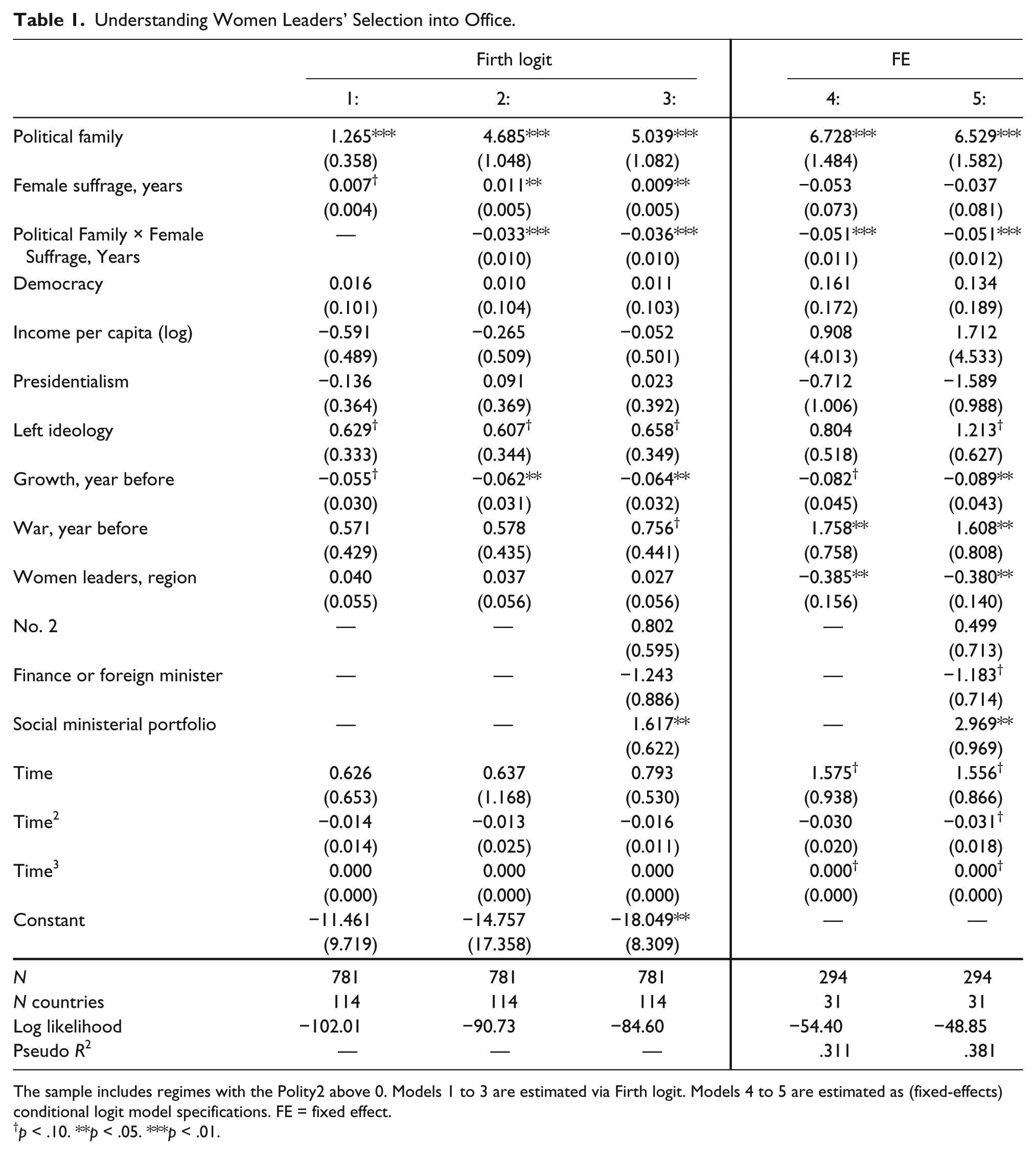
The sample includes regimes with the Polity2 above 0. Models 1 to 3 are estimated via Firth logit. Models 4 to 5 are estimated as (fixed-effects) conditional logit model specifications. FE = fixed effect.
p < .10. **p < .05. ***p < .01.
We show the results of the interactive model in column 2, Table 1. While political family and female suffrage, years have positive coefficients and are statistically significant, the interactive term has a negative coefficient and is also statistically significant. Because the model is nonlinear, it is difficult to interpret the effects of the interaction term. Figure 2, therefore, plots the change in the probability of observing a female leader when the value of political ties moves from 0 to 1 over the range of years since female suffrage was introduced. The effect is clearly interactive: when a leader has family ties, the likelihood of such a leader being a woman decreases from 43 percent to just under 1 percent over the range of suffrage years, that is, from 0 to the level of New Zealand, where women are very active in politics. This indicates that family ties are particularly important when the norm of having women in politics is not established yet. In contrast, for leaders without family ties, the probability goes from 0 to 10 percent over the same range, suggesting that family ties do not matter in settings where female participation is routine. That is, at high values of the suffrage years variable (specifically, when many years have passed since the introduction of female suffrage), the effect of family ties is the opposite from the effect of family ties at low values of the suffrage years variable.
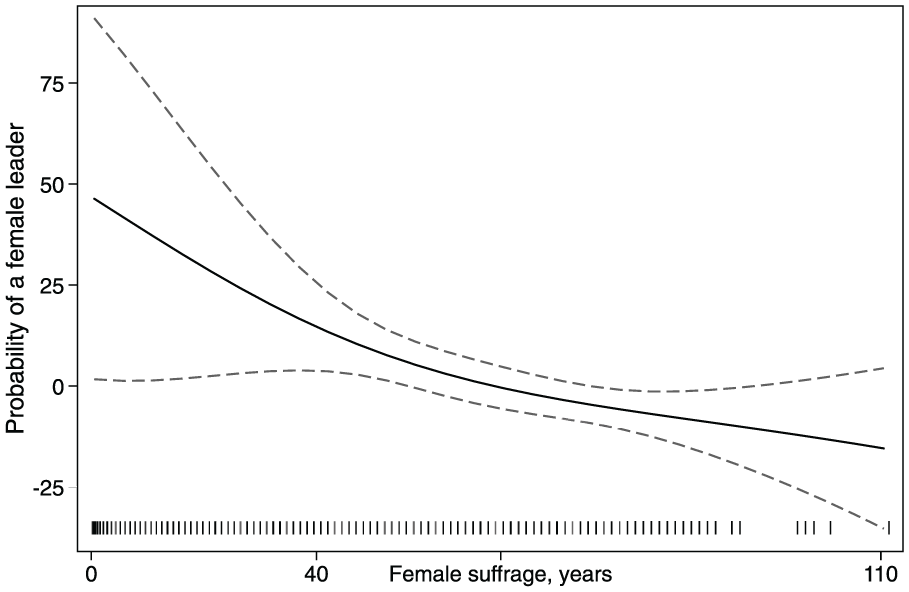
Declining importance of political family connections.
Because we do not compare winning and losing candidates, we cannot infer from our findings that joining a prominent political dynasty or aligning with a center-left party will result in the success of ambitious female politicians. Instead, we focus on the key factors that explain the likelihood of having female leaders across the world, accounting for the rarity of such an outcome. Holding other predictors at their mean levels (model 1 in Table 1), we estimate that without a family name, countries see a 2 percent probability of having a female leader, as opposed to 10 percent when such a leader has family ties. When the economy is in dire straits, that is, at –2 standard deviations below the average value of economic growth, the likelihood of a female leader is 5 percent, as opposed to only 1 percent when the economy is booming. A woman from the center-left party also has a 5 percent probability of becoming a leader. While the effects are statistically significant, substantively, the probability figures are very small. This, however, is not surprising as there are only 5 percent of female leaders from 1960 to 2010.
Additional Tests
Earlier, when we compared the various background and career traits of male and female leaders, we found that alongside political family, women leaders were less likely to hold finance portfolios in the past and are more likely to hold social ministerial portfolios. There was also a large percentage of women leaders elevated from previous vice-presidential posts, but the differences were not statistically significant. Here, we can, in addition, test if these differences are significant in inferential modeling. Indeed, while many female leaders—including Michelle Bachelet (2006–2010) of Chile or Helen Clark (1999–2008) of New Zealand—may have held social portfolios in their careers, such as those of health care or education, numerically, a larger number of male leaders had similar ministerial posts in the past, such as Gosta Ingvar Carlsson of Sweden (1986–1991, 1994–1996) or Goh Chok Tong of Singapore (1990–2004), who previously were minister for education and housing, and health care minister, respectively.
Table 1, model 3 provides a more nuanced view about differences in political experience and prior careers among female and male leaders in terms of their paths to leadership. This model includes three additional background indicators. The first is a variable that categorizes whether a political leader occupied a post related to social and human services, such as the ministry of health, education, employment, labor, environment, integration, or social affairs. Also, to account for the gravitas of their prior careers, we account for whether leaders occupied the second-most important post previously, that is, that of vice-president or prime minister in a presidential regime (No. 2). In parliamentary regimes, the second-most coveted post is that of finance or foreign minister, however. Therefore, we also account for whether leaders previously served as finance or foreign ministers—posts widely regarded as top ranked in the majority of democratic, or even nondemocratic regimes.
Results indicate that women and men are no different in terms of whether they occupied the No. 2 post in the past, or held the portfolios of finance and foreign affairs. However, there is strong support for the argument that women are, indeed, more likely to have “feminine” ministerial portfolios during their prior careers. Overall, the addition of three extra background variables does not alter the general results. The coefficients on the interactive term and growth, year before remain significant.
Because the likelihood of having female leaders may be determined by cultural norms prevalent in countries, models 4 to 5 in Table 1 include the same variables as in 2 to 3 but are fitted with fixed-effects for country. 14 The results, however, remain similar to those reported earlier: the coefficients on political family and the interactive terms retain their statistical significance.
Table 2, columns 1 to 2 include two model specifications fitted on two separate subsamples depending on how leaders acquire office. As we discussed above, internal party selection may be easier for women to navigate unaided, in contrast to running as future potential leaders in a general election, where family ties can help overcome voter biases however. Results displayed in columns 1 to 2 in Table 2 indicate that the interactive argument about institutions and political ties holds for elected leaders, but it is much weaker for selected leaders, as the coefficient is only borderline significant in the specification estimated on the “selected” sample. Indeed, family ties may not be crucial if women leaders are selected from within parties or legislatures. It also applies to “selected” interim leaders. For instance, after President Omar Bongo of Gabon died in June 2009, Rose Francine Rogombé, the country’s first female senator, served as the interim head of state for four months before the son of the deceased president was sworn in, in October 2009. Arguably, a female president with no political designs of her own represented a safe choice during the uncertainty of succession; she required neither additional networks nor public acceptance.
Understanding Women Leaders’ Selection: Additional Analyses.
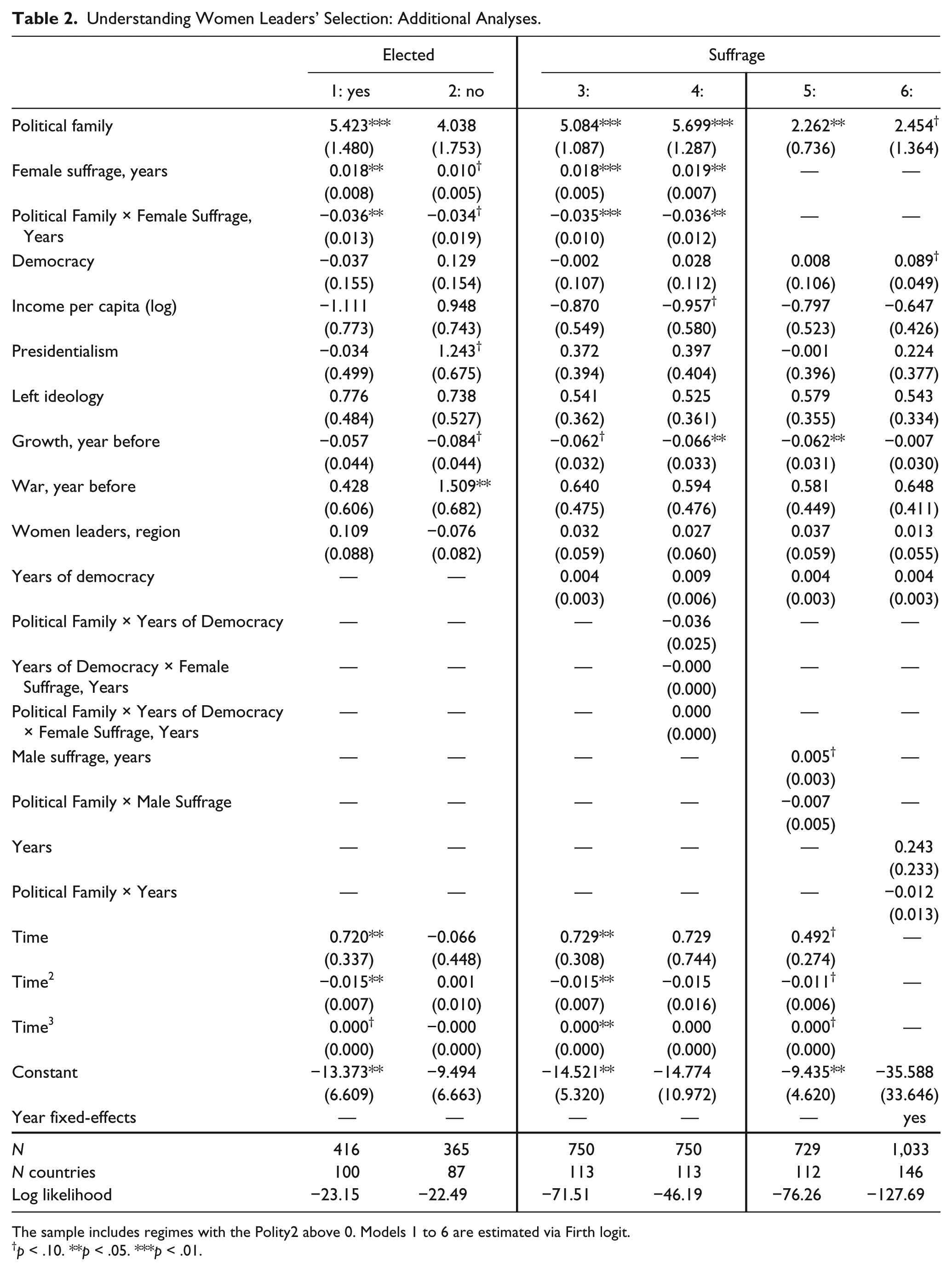
The sample includes regimes with the Polity2 above 0. Models 1 to 6 are estimated via Firth logit.
p < .10. **p < .05. ***p < .01.
Possible Confounding Factors
Is it possible that the effects of the female suffrage years are contaminated by other factors? In this section, we consider possible confounding factors. The online appendix also contains further tests, including alternative specifications to account for the time trend, more detailed tests of whether cultural norms ease the entry of women in political leadership, alternate ways of measuring the variable for female suffrage, and the effects of having female legislators, among others.
First, the extension and duration of the female franchise might be related to a country’s democratic record. It is, therefore, possible that the years of female suffrage are merely proxies for the years of democracy, as opposed to capturing the norm of female political participation.
Democracies vary widely in their timing of extending the right to vote to women. In terms of the competitiveness of electoral process, Switzerland had been a democracy for more than a century until female suffrage was adopted, in 1971. Many Western nations also introduced female suffrage after, not simultaneously with, the adoption of democracy. Furthermore, the majority of postcommunist nations had female suffrage for close to a century but only adopted democracy recently; likewise, many nations that became independent after World War II and where dictatorships quickly took hold, introduced universal suffrage, including female suffrage, right away (Przeworski 2009). In other words, while female suffrage is somewhat correlated with democracy years (.11) in the estimation sample, democracy is neither a necessary nor sufficient condition for female enfranchisement.
Still, to gauge the possible effect of the length of uninterrupted democracy, we conduct further tests. First, Table 2, column 3 includes the length of uninterrupted democracy as an additional variable, transformed via an inverse hyperbolic sine transformation. As can be seen, the main explanatory variables retain their statistical significance, while the length of democracy does not prove to be an important predictor. In turn, model 4 is specified as the full interactive model and includes the following terms: the old interactive term between family ties and suffrage years; the length of uninterrupted democracy, in addition, interacted with political family; and all constituent terms interacted with one another (Braumoeller 2004). The results hardly change, providing evidence for the importance of female suffrage years. Second, in the online appendix, we conduct additional tests, including mediation analysis, and find no support for the possible hypothesis that the effects of years of democracy are mediated through the years of female suffrage.
We can further test whether the years of female suffrage reflect the effects of other possible omitted variables, such as that of years of male suffrage, or if they capture a mere passage of time. In the first case, the danger is that we are not measuring the normalization of female political participation, but the institutionalization of electoral participation that often begins with male suffrage. In the second, years since the adoption of female suffrage may merely reflect the length of time that has passed from early on. For male suffrage, drawing from Przeworski (2015), we measure the length of time from the year when the suffrage indicator takes the value of 7, or full suffrage to all. To account for the passage of time, we include the count of years from the year of earliest entry into office in the sample. Because the count of years was already included among polynomial terms, to avoid collinearity and to still be able to account for the time trend, we include year dummy indicators (model 6). Two new indicators are also transformed via an inverse hyperbolic sine transformation.
Results displayed in columns 5 to 6, Table 2, reveal that the coefficients on the interactive terms with new constituent terms are not statistically significant. This offers additional evidence that the effects of female suffrage years are distinct not only from years of democracy but equally from years of male suffrage and the mere passage of time.
In summary, family connections are particularly important for female politicians, but their value diminishes when societies accept female political participation as normal. Family ties can provide financing, connections, and name recognition to a candidate, which women need more than men do. While we attempted to account for possible alternative and complementary explanations, as well as for confounding factors, alternative predictors and model specifications cannot be excluded. The supplementary online appendix, therefore, includes specifications with additional explanatory variables, robustness check, alternative models to account for rarity of outcomes on the dependent variable, and to account for time trend differently, the Random Forest classification, and mediation analyses. Undoubtedly, cultural norms about the role of women in public life matter for the likelihood of the emergence of female leaders. While fixed-effects estimations account for possible unobservable country-specific parameters, in the online appendix, we also report additional analyses based on public-opinion indicators on the acceptability of female participation.
Conclusion
Using a novel and comprehensive dataset, across a variety of analyses, we show that the backgrounds of effective political leaders do not differ much between men and women, except in one primary respect: their family connections in politics. This background characteristic has a strong influence on the likelihood that women—not men—will hold the highest office in their country. Other background characteristics, such as the level of education and amount of experience, are largely equivalent between the sexes. This suggests that women do not stay out of high-level politics on account of a lack of qualifications. Rather, their networks and connections need to be firmly in place for women to climb to the highest ranks in politics. However, the necessity of being part of a political dynasty lessens once the country has experienced female suffrage for a length of time. This interactive effect between background characteristics and the domestic political climate is previously underexplored in the literature on female leadership.
Female leaders often need to compensate for gender biases and structural barriers (Lawless and Fox 2010). One such compensatory tool is the availability of family ties that give women access to resources and networks. However, as we find from a variety of analyses, with time, as society gradually accepts women’s participation in politics as normal, female politicians no longer need such ties. In other words, many societies may be moving away from the stage where even if a wife is equally competent as her husband, “when his female partner steps up for her turn, she risks being dismissed as a ‘wife of’ rather than a qualified politician in her own right” (Murray 2010a, 15).
Our findings point the way forward to future research. Further studies could explore the particular types of domestic political institutions that can help voters become more amenable to female candidates. Significant work has already been done on some of these institutions, including the study of quotas. But quotas are a relatively recent innovation in political life. Historical research could uncover the microfoundations of how political ties could be supplanted by particular domestic conventions.
We hope our findings can to some extent destigmatize the family connections that women in politics might need. We have shown that females are no less qualified or experienced than their counterparts in high office. Entrenched modes of thinking in the early days of female political participation, however, may mean that women need an extra boost in terms of networks and support. Happily, the need for such assistance seems to decrease the longer that female politicians are prominent in the political life of their nations.
Supplemental Material
WomenLeaders_appendix_online_supp – Supplemental material for When Do Family Ties Matter? The Duration of Female Suffrage and Women’s Path to High Political Office
Supplemental material, WomenLeaders_appendix_online_supp for When Do Family Ties Matter? The Duration of Female Suffrage and Women’s Path to High Political Office by Julia Gray and Alexander Baturo in Political Research Quarterly
Footnotes
Declaration of Conflicting Interests
The author(s) declared no potential conflicts of interest with respect to the research, authorship, and/or publication of this article.
Funding
The author(s) received no financial support for the research, authorship, and/or publication of this article.
Notes
Supplemental Material
Replication data for this article are available with the manuscript on the Political Research Quarterly (PRQ) website.
References
Supplementary Material
Please find the following supplemental material available below.
For Open Access articles published under a Creative Commons License, all supplemental material carries the same license as the article it is associated with.
For non-Open Access articles published, all supplemental material carries a non-exclusive license, and permission requests for re-use of supplemental material or any part of supplemental material shall be sent directly to the copyright owner as specified in the copyright notice associated with the article.
