







Abstract
Interest group participation in state courts of last resort has increased substantially over the past four decades, and the scope of this litigation activity has expanded to include a wider range of group participation. Despite the fact that organized interests increasingly recognize state high courts as legitimate policy venues, little is known about how interest groups choose the specific cases in which they participate. Beginning with the assumption that interest groups seek policy influence, this paper tests the hypothesis that groups strategically target cases that will best serve the policy and institutional interests of the group, while focusing group resources on cases and courts where they are most likely to be successful. Using an original dataset assembled from content analysis of more than 2,300 state supreme court decisions handed down between 1995 and 2010 and spanning three distinct areas of law—products liability, environmental law, and free speech and expression—this paper investigates the case-level and court-level factors that attract interest group participation as amicus curiae in state high courts.
Introduction
Strategic behavior by interest groups is pervasive in the fragmented American political system. In pursuit of policy influence, interest groups are forced to make strategic decisions when selecting the policy venues within which to focus their resources. While much is known about how interest groups lobby Congress, federal administrative agencies, and the state-level counterparts, much less is known about the lobbying strategies of interest groups when engaging the judiciary. This oversight has been acknowledged with regard to the lobbying of the U.S. Supreme Court, and a growing literature now exists regarding interest group lobbying in the U.S. Supreme Court through direct sponsorship of litigation (Epp 1998; Epstein and Kobylka 1992; Gonen 2003; Kobylka 1991; O’Connor 1980; Olson 1984; Samuels 2004; Vose 1958, 1959; Wasby 1995), through the filing of amicus curiae, or friend-of-the-court, briefs (Box-Steffensmeier, Christenson, and Hitt 2013; Caldiera and Wright 1988; Collins 2004, 2007, 2008; Kearney and Merrill 2000; Songer and Sheehan 1993; Spriggs and Wahlbeck 1997), and the strategic calculations interest groups make when deciding to lobby the nation’s highest court (Caldeira and Wright 1990; Hansford 2004a, 2004b; Salzman, Williams, and Calvin 2011; Solberg and Waltenburg 2006; Spill 2001). Despite this recognition that interest groups act strategically to pursue policy goals in the federal courts, attention to the litigating strategies of interest groups at the state court level is virtually nonexistent.
This dearth of knowledge about interest group lobbying strategies in state courts is concerning for several reasons. First, state supreme courts decide tens of thousands of cases each year, with a very small portion of these cases ever reaching the U.S. Supreme Court on appeal. This gives state high courts far-reaching policy influence on most matters of state law including constitutional interpretation, commercial law, property rights, family and estate law, tort liability, criminal law, and also the interpretation of federal law as applied to the states. Understanding how interest groups make decisions about when and where to file amicus curiae briefs deepens our knowledge about interest group strategies to influence legal policy at the state level. Second, state-level interest groups often serve as the democratic avenue through which individuals can translate collective action into policy outputs regarding local matters that are of direct concern to American citizens. From this perspective, understanding the types of cases and courts that attract interest group involvement in state courts offers a chance to understand how groups help citizens attain policy goals in the judicial arena. Finally, because a growing body of research demonstrates that interest group participation as amicus curiae has the ability to influence state high court decision making (Songer and Kuersten 1995; Songer, Kuersten, and Kaheny 2000), it is important to understand what attracts amici to file in some cases and not others.
This paper develops a theoretical framework to explain the case-level and court-level attributes that attract interest groups to engage in amicus activity in state high courts. More specifically, interest groups are expected to file amicus briefs in cases in which the interest group can fill an information need, while also strategically targeting cases being heard by courts that are more institutionally capable and ideologically receptive to the information and arguments submitted by amici. Using an original dataset that comprises the universe of state supreme court decisions in three areas of law—products liability, environmental law, and free speech and expression—from 1995 through 2010, this paper tests hypotheses generated from this theoretical framework to understand the factors that attract interest groups to participate as amicus curiae in state high courts. Results show that interest groups consider the informational needs of state high courts when choosing cases to lobby, but that groups place greater emphasis on targeting cases pending in courts that are more institutionally equipped to use the information contained in amicus briefs and those that are directly accountable to the electorate.
Interest Groups, Amicus Curiae, and Information
It is assumed that, when lobbying the courts, just as when lobbying legislators and other political actors, interest groups seek to obtain policy outcomes as close to their preferred policy position as possible (Scheppele and Walker 1991; Schlozman and Tierney 1986). To influence policy in the courts, interest groups often choose to submit amicus curiae, or “friend of the court” briefs. Contrary to what the name “friend of the court” implies, interest groups who file as amici curiae actually submit information and legal arguments in support of a specific litigant in a case, not neutral information for the Court to use in rendering its decision. This allows interest groups to lobby courts for specific policy outcomes without being a direct party to a case. Participation as amicus curiae gives an interest group the opportunity to provide courts with information on the potential legal, social, and political ramifications of its decisions (Epstein and Knight 1999; Hansford 2004a) without committing the substantial resources required to pursue policy goals through the more lengthy process of filing test cases (Epstein 1991). Thus, the mechanism of interest group influence via amicus curiae briefs is often thought to be the information provided to the courts in these third-party briefs (Collins 2004; Hansford 2004a; Spriggs and Wahlbeck 1997).
To support this theory of informational influence, evidence exists that the U.S. Supreme Court regularly incorporates information from amicus briefs in its opinions (O’Connor and Epstein 1983; Spriggs and Wahlbeck 1997). Evidence also indicates that litigants supported by amici are more likely to win favorable outcomes both in the U.S. Supreme Court (Collins 2004, 2007, 2008; Kearney and Merrill 2000; Songer and Sheehan 1993) and in state supreme courts (Songer and Kuersten 1995; Songer, Kuersten, and Kaheny 2000). In fact, this informational role of amici is corroborated by state supreme court judges and clerks of courts themselves (Flango, Bross, and Corbally 2006). Thus, there is ample reason to believe that the information provided in amici briefs often proves to be an effective tool for lobbying the courts.
A Theory of Amici Attraction
With fewer than 1 percent of all state supreme court cases reaching the United States Supreme Court on appeal, state high courts stand as the final arbiters of most matters of state law (Tarr and Porter 1988), giving these courts wide-ranging policy influence. Recognizing the policy-making power of state high courts, a growing number of organized interests file amicus curiae briefs in these courts to advance a groups’ policy goals (Brace and Butler 2001; Epstein 1994). However, simple recognition of these courts as viable lobbying venues is not enough to guide interest groups in their endeavor to influence court-made policy. Interest groups have finite resources, and, as such, will not be able to participate as amicus curiae in all cases, in all state high courts, that advance a groups’ goals. Groups must make strategic decisions about what cases will best serve their interests and which courts will be more receptive to the information provided in their briefs. The question then is, what case-level and court-level attributes attract interest groups to participate as amicus curiae in state high courts?
To investigate this question, I begin with the assumption that organized interests engage in lobbying activities to secure policy outcomes as close as possible to the preferred position of the group (Schlozman and Tierney 1986). Interest groups regularly seek to influence policy outcomes by providing policy makers with information and substantive expertise on issues of importance to the group (Gais and Walker 1991). However, because group resources are finite, interest groups are forced to act strategically when choosing a lobbying venue to better their chances of policy influence. When applied to lobbying of state high courts, interest groups are expected to target cases that present an informational need for the groups’ expertise while also targeting cases under consideration by courts that are both institutionally capable and ideologically receptive to the information being presented by the organized interest. Cases that present an informational need and are being considered by institutionally capable and receptive courts offer interest groups an increased chance of lobbying success.
Informational Need
Amicus briefs provide courts with information. It is through this information that interest groups have the ability to advocate for the establishment of a specific legal rule or a specific case outcome. To achieve specific policy goals, interest groups use amicus briefs to provide information to the courts that may not be contained in litigant briefs, such as alternative legal arguments and frameworks, public policy arguments, evidence from public opinion data, scientific and social scientific data, and information regarding the preferences of elected officials. Interest groups are most likely to target cases that present an informational void in which the policy expertise of the group can be best used by state high courts. An interest group considering filing as amicus curiae may view a case as presenting an information need if the lower court failed to render an outcome that was consistent with the group’s preferred policy goals. State high courts are known to show a high level of deference to the rulings of the lower courts (Benesh and Martinek 2002; Songer, Kuersten, and Kahney 2000). To overcome this hurdle of lower court deference, organized interests are likely to view courts as being in greater need of additional information in a case where the lower court decision was counter to the interest group’s preferred policy goals.
Institutional Capacity and Court Receptivity
Unlike rendering decisions regarding the filing of amicus briefs before the U.S. Supreme Court, organized interests filing in state high courts have to navigate a landscape where courts differ in their abilities to evaluate and process the information contained in amicus briefs. The different institutional designs of state high courts may serve to incentivize interest group participation in some instances and deter group participation in others. As strategic actors, interest groups are expected to target courts with greater institutional capacities to evaluate and use the information presented in amicus briefs.
The submission of amicus curiae briefs is neither a costless nor an effortless endeavor. Individuals and groups seeking to file amicus briefs require costly legal resources that include the hiring of attorneys (either in-house or outside counsel) along with standard court filing fees. Amicus briefs also require interest groups to devote significant amounts of time and staff resources to following lower courts cases in the state court systems that may be of interest to a groups’ policy goals. Given the resource demands of filing amicus briefs in state high courts, interest groups seeking to lobby state supreme courts should be more likely to invest these resources in courts that possess greater organizational capacities with which to assess and use the information contained in amicus briefs.
State high courts vary greatly in their institutional capacities to generate and evaluate information. These differences are evident in the differences in judicial salaries, levels of court staffing, allocation of law clerks, and docket control across state high courts (Squire 2008). A court with higher staffing levels and more law clerks assigned to each justice will have greater resources with which to evaluate and use the information provided by organized interests filing as amicus curiae. Greater docket control also helps to make a court better equipped to use amici information by limiting the number of cases heard by a state high court each year and, thus, allowing more time and resources to be devoted to each case. All of these factors contribute to what is considered to be the professionalization of a state high court. A more professionalized court will be better equipped to use the information provided by amici and will, thus, give the interest group filing as amicus curiae a better chance of advancing its policy goals by influencing court outcomes.
Another strategic consideration that may guide interest group decisions to file amicus curiae briefs is the ideological receptivity of the court considering a case. It is long established that ideology is a major determinant of judicial behavior on state high courts (Brace and Hall 1997; Brace, Hall, and Langer 1999, 2001; Brace, Langer, and Hall 2000; Comparato and McClurg 2007; Gryski, Main, and Dixon 1986; Hall and Brace 1999; Hoekstra 2005; Langer 2002; Spiller and Vanden Berg 2003). Therefore, interest groups with liberal policy goals should be more likely to target liberal-leaning state high courts, and interest groups with conservative agendas should target conservative state supreme courts.
Unlike federal courts, in which judges have life tenure, a variety of methods are used to select and retain judges across the state judicial hierarchies. While methods of judicial selection and retention vary both between and within states, there are three primary ways that state high court judges are retained—competitive elections, which include both partisan and nonpartisan elections; retention elections, in which judges stand for an up-or-down vote to retain their office; and reappointment systems, in which judges are retained by a vote of the governor or state legislature. Only three states give their judges life tenure: Massachusetts, New Hampshire, and Rhode Island, with New Hampshire and Rhode Island requiring mandatory retirement at the age of seventy.
These differences in institutional design across state high courts structure and incentivize certain behavior by state high court judges. The process of electing judges makes state high courts and their judges more responsive to public opinion (Brace and Boyea 2008; Brace and Hall 1997; Caldarone, Canes-Wrone, and Clark 2009; Canes-Wrone, Clark, and Kelly 2014; Huber and Gordon 2004). However, judicial elections are widely criticized for opening courts up to potential conflicts of interests created by the demands of campaign fundraising (Cann 2007; Sample et al. 2010; Schotland 2001; Shepherd 2009, 2013; Skaggs et al. 2011; Streb 2007). These fears are fueled, in part, by the growing participation of interest groups in judicial campaigns in recent years. What were originally low-cost and low-visibility races, state supreme court elections are now costly and contentious races in many states, with the price of these state high court races more than doubling from $83.3 million in the 1990s to nearly $207 million over the following decade, with interest group contributions largely fueling the rising costs of judicial campaigns (Sample et al. 2010).
As strategic actors, interest groups recognize the incentive structures created by different methods of judicial retention used across the states and, as such, may be more likely to make competitively elected state high courts the target of their lobbying efforts. Indeed, research shows that judicial responsiveness to public opinion is strongest when salient issues are decided by competitively elected state high courts (Cann and Wilhelm 2011). This fact coupled with the increased politicization and cost of state judicial elections in recent decades may make it worthwhile for interest groups seeking to achieve policy influence as amicus curiae to focus particular attention on those state high courts where judges are subject to electoral and fundraising incentives. However, not all campaigns for elected state high courts attract the same level of interest group donation. In fact, competitively elected state high court races—both partisan and nonpartisan—are more expensive overall and draw comparatively more campaign donations from interest groups than do retention elected races for state high courts (Sample et al. 2010, 14). Thus, a rank ordering is expected with competitively elected state high courts attracting the greatest interest group participation as amicus curiae, with retention elected state high courts and appointed courts attracting comparatively fewer amicus brief filings.
There is reason to believe, however, that interest groups will not necessarily target all competitively elected state high courts equally. In fact, if acting strategically, groups may target elected state high courts that are ideologically sympathetic to their policy goals.
Data and Method
To test these hypotheses, I use an original dataset assembled from the content analysis of more than 2,300 state supreme court cases across three major areas of litigation—products liability, environmental law, and free speech and expression—from 1995 through 2010. These data represent the universe of cases heard and decided with full opinions in state high courts in each of the three areas of case law. These three areas of law draw relatively high levels of amicus participation across the state high courts and offer a diverse range of organized interests represented by amici.
Amicus Curiae Participation
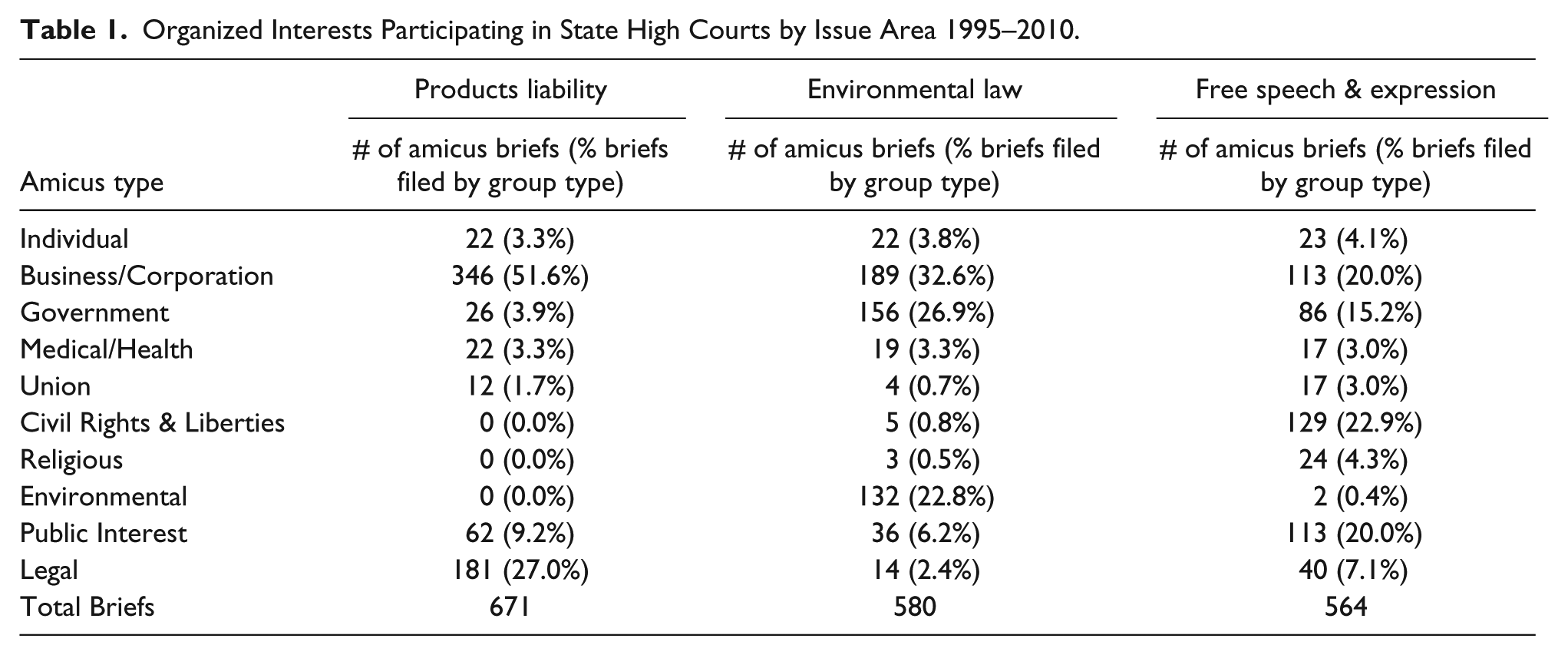
Data on interest group participation as amici were gathered to capture the identity of each group filing as amicus and the type of group filing each brief. While there was a wide range of interest group types filing as amicus curiae, each area of law attracted briefs largely from certain types of groups. Table 1 shows the distribution of amicus brief filings by group type across each area of case law. Cases involving products liability were dominated by two types of organized interests—business or corporate interests and legal groups. Environmental law cases drew a majority of amicus briefs from business interests, government interests, and environmental groups. And while there was no single group type responsible for a majority of the amicus filings in free speech and expression cases, civil rights and civil liberties groups, business interests, public interest groups, and government interests, all had a similarly strong presence as amicus curiae in these cases. The diverse set of groups filing briefs in free speech and expression cases suggests that the outcomes of court decisions in this area of case law affect a wider range of groups than the other areas of law examined here.
Organized Interests Participating in State High Courts by Issue Area 1995–2010.
Data on the ideological direction of the court outcome advocated by each brief/group were also gathered through content analysis of the amicus briefs, and when not available, the published court decision. In the context of products liability cases, a liberal court decision is one in which the state high court rules in favor of the consumer over the business or corporation that developed or manufactured the product at issue in a given case. In cases of environmental law, a liberal outcome is one that favors the protection of the environment over the interests of business, individuals, or the government. A liberal outcome in a free speech case is one that favors the expansion of first amendment rights for individuals, groups, or businesses rather than limiting and restricting these rights.
Figures 1 to 3 show the distribution of amicus briefs filed by the types of interest groups advocating for either a liberal or conservative ruling. By examining these figures, we see that amicus briefs advocating for liberal outcomes in products liability cases were overwhelmingly filed by legal groups such as the National Trial Lawyers Association and the Association of Trial Lawyers for America. Business and corporate interests dominated the filing of conservative amicus briefs in products liability cases with groups such as the U.S. Chamber of Commerce and the Products Liability Advisory Council serving frequently as repeat players. Liberal amici in environmental cases were largely filed by environmental and government interests, while conservative amici in these cases were filed primarily by business and corporate interests. National environmental groups were often repeat players as amici in environmental cases with groups such as the National Resources Defense Council, Sierra Club, and the National Wildlife Federation filing in multiple cases.
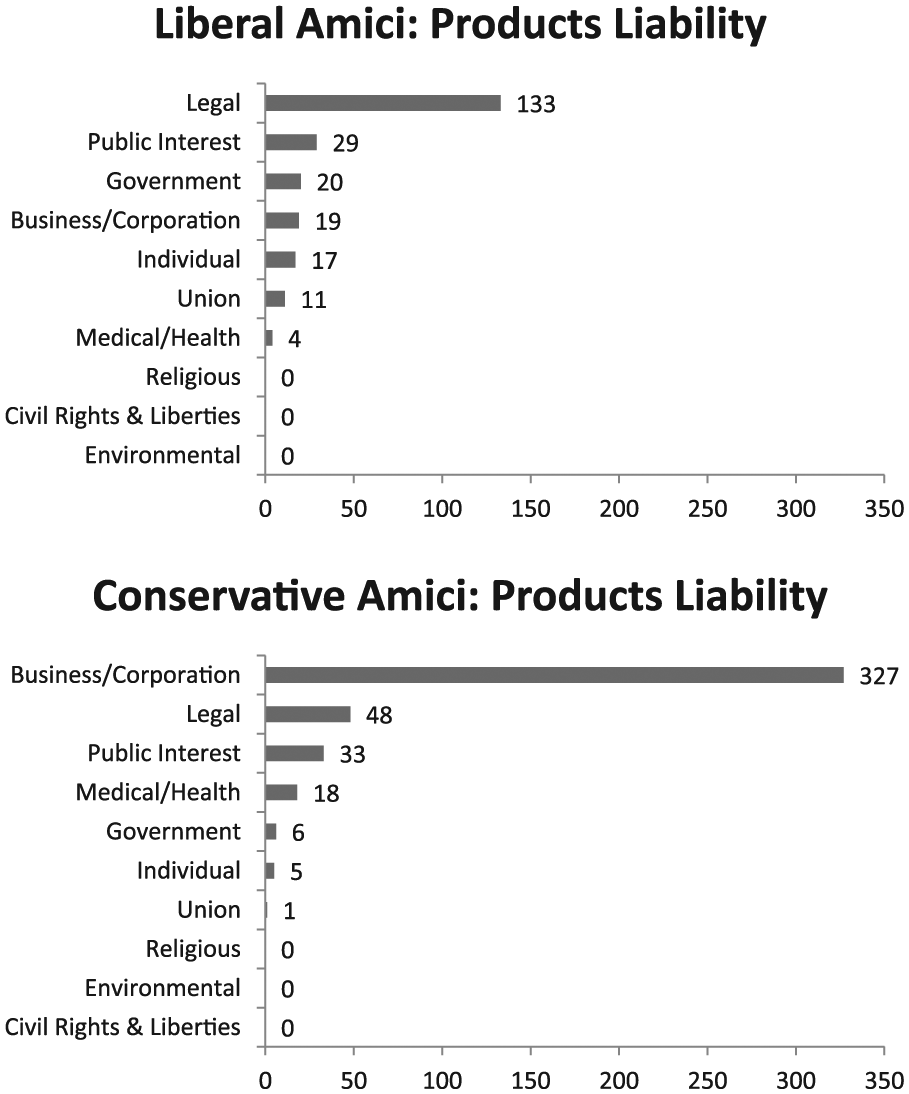
Types of interest groups filing as amici in products liability cases.
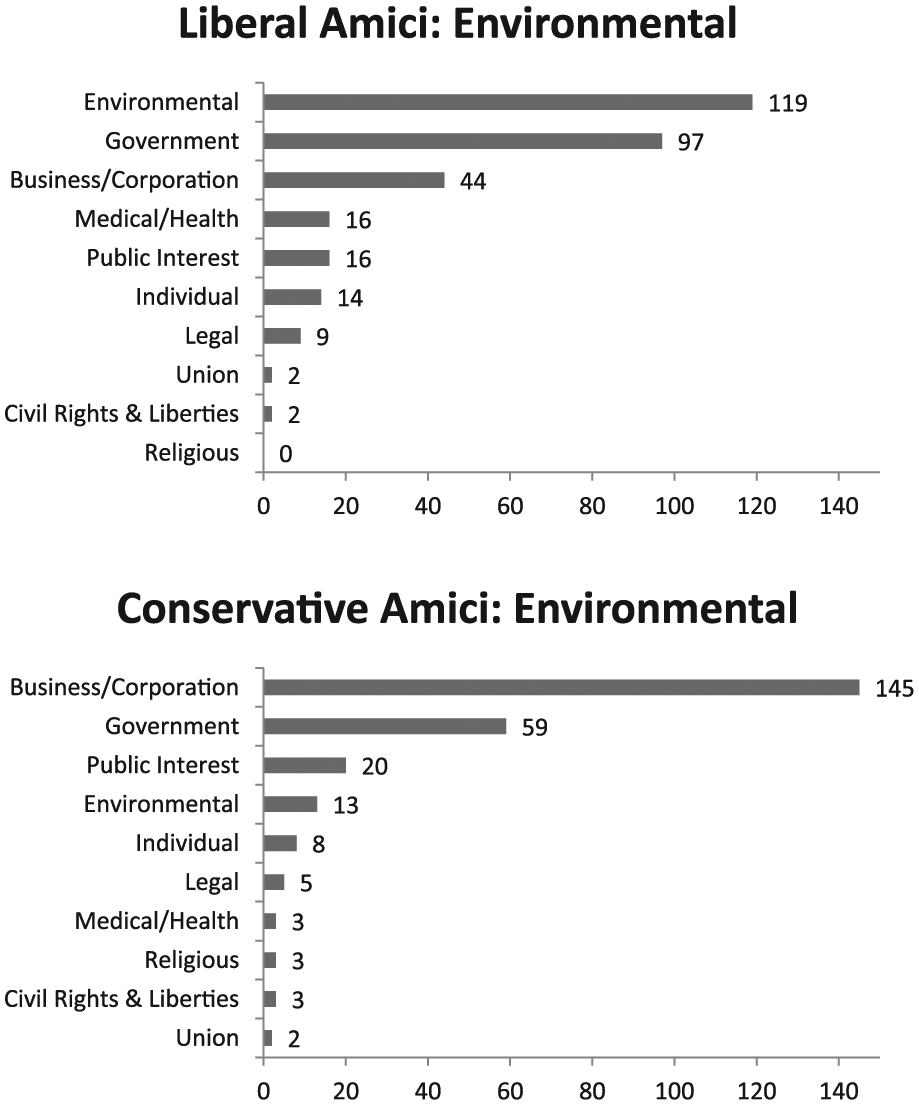
Types of interest groups filing as amici in environmental law cases.
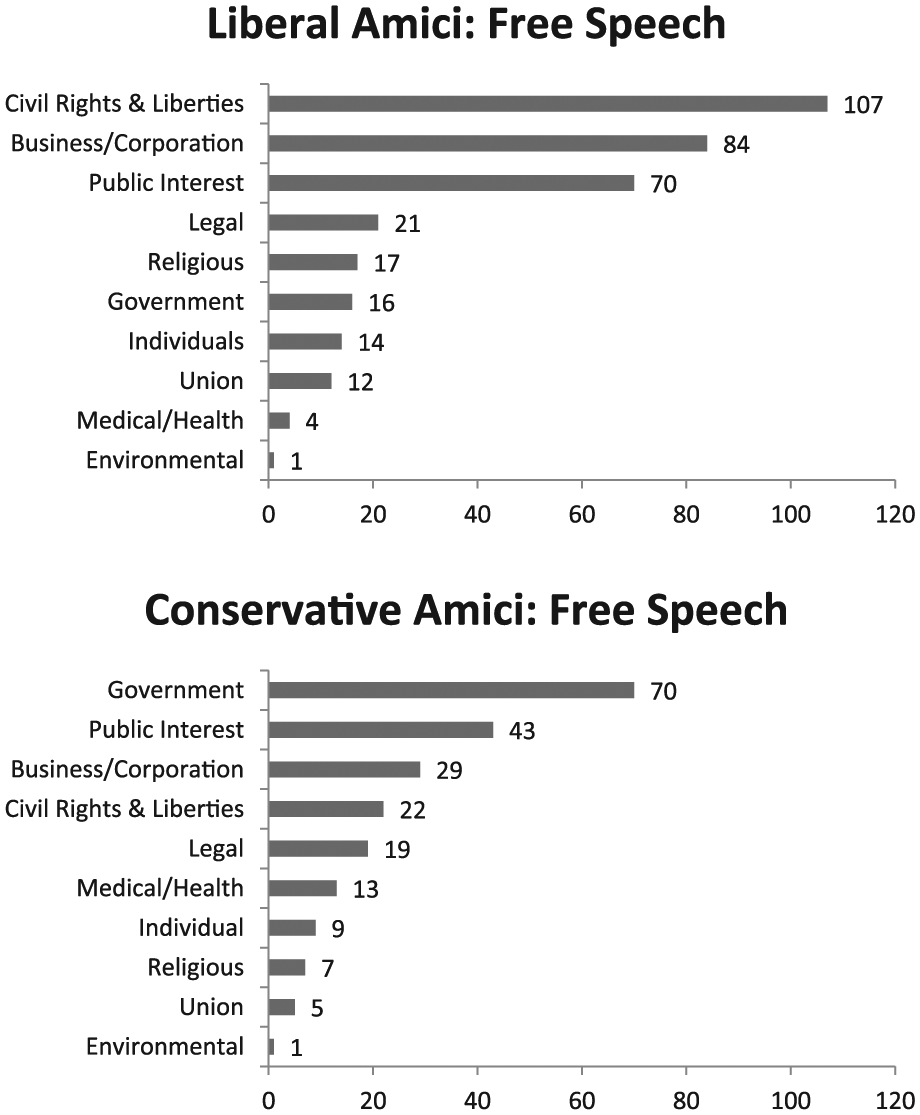
Types of interest groups filing as amici in free speech cases.
Diverse interests were found on both sides of the ideological divide in free speech and expression cases. Amicus briefs advocating for liberal outcomes were most often filed by civil rights and liberties groups, business interests, and public interest groups, with groups such as the American Civil Liberties Union, the Institute for Justice, and the Reporters’ Committee on Freedom of the Press serving as repeat players. Government interests were the most frequent filers of amicus briefs advocating for conservative outcomes in free speech cases.
Dependent Variable
To determine what factors attract interest groups to participate as amicus curiae in state high courts, the dependent variable is a dichotomous measure of whether or not a case attracted at least one amicus brief. 1 To account for the possibility that organized interests with different ideological agendas use different strategies when lobbying the courts (O’Connor and Epstein 1983) and may, therefore, target different cases and different courts, two multilevel logit models are estimated, one using the dependent variable, Liberal Amici, indicating the presence of at least one liberal amicus brief in a case, and another, Conservative Amici, for when one or more conservative amicus briefs are filed in a given case.
Independent Variables
To test the Informational Need Hypothesis, a variable Lower Court Direction is included and coded as 1 for a liberal lower court ruling and 0 for a conservative ruling. In the model predicting liberal amicus filings, the direction of the lower court decision is expected to be inversely related to the presence of a liberal amicus brief, while the measure is expected to be positively related to the presence of a conservative brief.
Several independent variables are included to assess the efficacy of the Institutional Capacity and Court Receptivity Hypotheses. To determine if the organizational capacity of state high courts attracts interest group involvement as amici, a measure of Court Professionalization is included. Squire’s (2008) measure of state supreme court professionalism is used to measure the degree to which a state high court has both the ability to generate and evaluate information. The index measure includes state high court salaries, number of law clerks available to each judge, and level of docket control to assess the relative level of professionalization across state high courts. The score ranges from a high of 1.004 for the Supreme Court of California to a low of 0.253 for the North Dakota Supreme Court.
To determine if interest groups file amicus briefs in cases heard by ideologically sympathetic courts, a measure of state supreme court ideology is needed. The measure of court ideology used is the common-space campaign finance (CFscores) ideology estimates created by Bonica and Woodruff (2015). These judicial CFscores were created from campaign finance data between 1979 and 2012, which were used to produce scaled estimates of ideology based on individual-level campaign finance data for each justice either as a candidate, as a contributor, or as an appointee (Bonica and Woodruff 2015, 476). Court-level CFscores are used, which represent the CFscore for the median justice on each state high court in the year a case was decided. 2 The variable Court Liberalism ranges from −1.21 (Idaho) to 1.52 (New Jersey), 3 with positive scores representing more liberal courts and negative scores more conservative. 4 This measure is expected to be positively related to liberal amici participation and inversely related to participation by conservative amici.
To test how the institutional context of state supreme courts function to attract or deter interest groups from filing amicus curiae briefs, several variables are included in the models. Each case is coded for the method by which judges on the state high courts are retained. Retention systems are represented by three indicator variables—Competitive Elections (partisan and nonpartisan), Retention Elections, and Appointment (gubernatorial and legislative)—each coded 1 for the system and 0 otherwise. 5 Data for judicial retention method were gathered from the National Center for State Courts’ website, which chronicles both the current method of selection and retention for state courts and the historical evolution of these selection systems, including when, if ever, selection methods were altered in each state. 6 The measures for competitive and retention elections are expected to be positively associated with the presence of amici, with competitive elections being associated with a greater probability of amicus filings than retention elections. However, to determine if interest groups strategically target state high courts based on both retention method and ideology, the retention system indicators are also interacted with the measure of court liberalism.
Despite being primarily motivated by policy goals, interest groups also consider their own membership goals and organizational capacities when devising strategies to lobby the courts (Hansford 2004a; O’Connor 1980; Scheppele and Walker 1991). To ensure that these group goals are not driving interest group participation to file amicus curiae in state high courts, several control variables are included. State population is included to control for the possibility that membership-based groups may be targeting their amicus filings on cases pending before high courts in the most populated states. As membership-based interest groups must concern themselves with providing members with purposive benefits to attract and maintain membership rolls (Moe 1980; Walker 1991), groups may be focusing their amicus filings on cases and courts in more populated states that offer a larger venue for highlighting a group’s commitment to membership representation.
And because interest groups have finite resources in terms of staff, expertise, and finances, two additional variables are included to control for factors that may influence interest group decision to file amici in state high courts. First, to conserve resources, groups may focus on filing amicus briefs in state courts that pose fewer restrictions on friend-of-the-court briefs. To control for this possibility, a measure devised by Corbally, Bross, and Flango (2004) that captures the relative difficulty of amicus filing requirements found in each state high court is included. The variable Amici Difficulty codes each state high court on a continuum from 1 to 3, where a court coded as 1 has the least restrictive filing rules and a court coded as 3 has the most restrictive rules. The difficulty of amicus filing rules is expected to be inversely related to the presence of liberal and conservative amici.
The second control variable included based on interest group resource constraints addresses the limited legal expertise that groups may possess. While groups may seek to focus their organization resources and expertise on ideological sympathetic courts, the ideological leanings of individual judges on state high courts are not easily discerned. This is especially true for groups that primarily focus on traditional lobbying of the legislative and executive branches. As such, interest groups may know less about the ideology of the judges sitting on each state high court, but may have a better sense of the overall ideological affinity of the state in which the court functions. Thus, Erickson, Wright, and McIver’s (1993) measure of state ideology is included to control for the possibility that resource-constrained groups may use state ideology as a proxy for court ideology.
Issue-specific controls are also included to control for case-level factors that may attract interest group participation as amicus curiae, but that are specific to the area of case law being considered. Products liability cases regularly pit an individual litigant or a class of litigants against a corporation or manufacturer whose liability for a product is being questioned in court. An indicator variable is included in the products liability model to control for the presence of a jury award for the plaintiffs in the lower court. It is expected that the presence of jury awards on appeal will be positively associated with the probability of amici participation from conservative interest groups as these groups would be opposed to large jury awards for tort liabilities. In both environmental law and free speech cases, an indicator variable is included to control for the presence of the state or state agency as a litigant in a case. Because state high courts are often deferential to state agency rules and decisions, interest groups may be deterred from filing as amici.
Results
Table 2 shows the results from the logistic regression models estimated for each of the three areas of law. All models include year fixed effects and standard errors clustered by state high court to account for non-independence within states. To ease the interpretation of logit coefficients in a model that is further complicated by the inclusion of interaction terms, average marginal effects were calculated and displayed in Table 3 to determine the substantive impact of a one unit change in each independent variable on the probability of observing an amicus filing. Because marginal effects of key independent variables and interactions in logit models are conditional on the values of other independent variables in the model, all marginal effects are estimated holding all other predictors, including the component terms of all interactions, at their true values. Whenever necessary, marginal effects are calculated for substantively meaningful values of independent variables of interest and are calculated across all values of constituent terms included in interactions.
Logit Model Predicting Amicus Brief Filings.
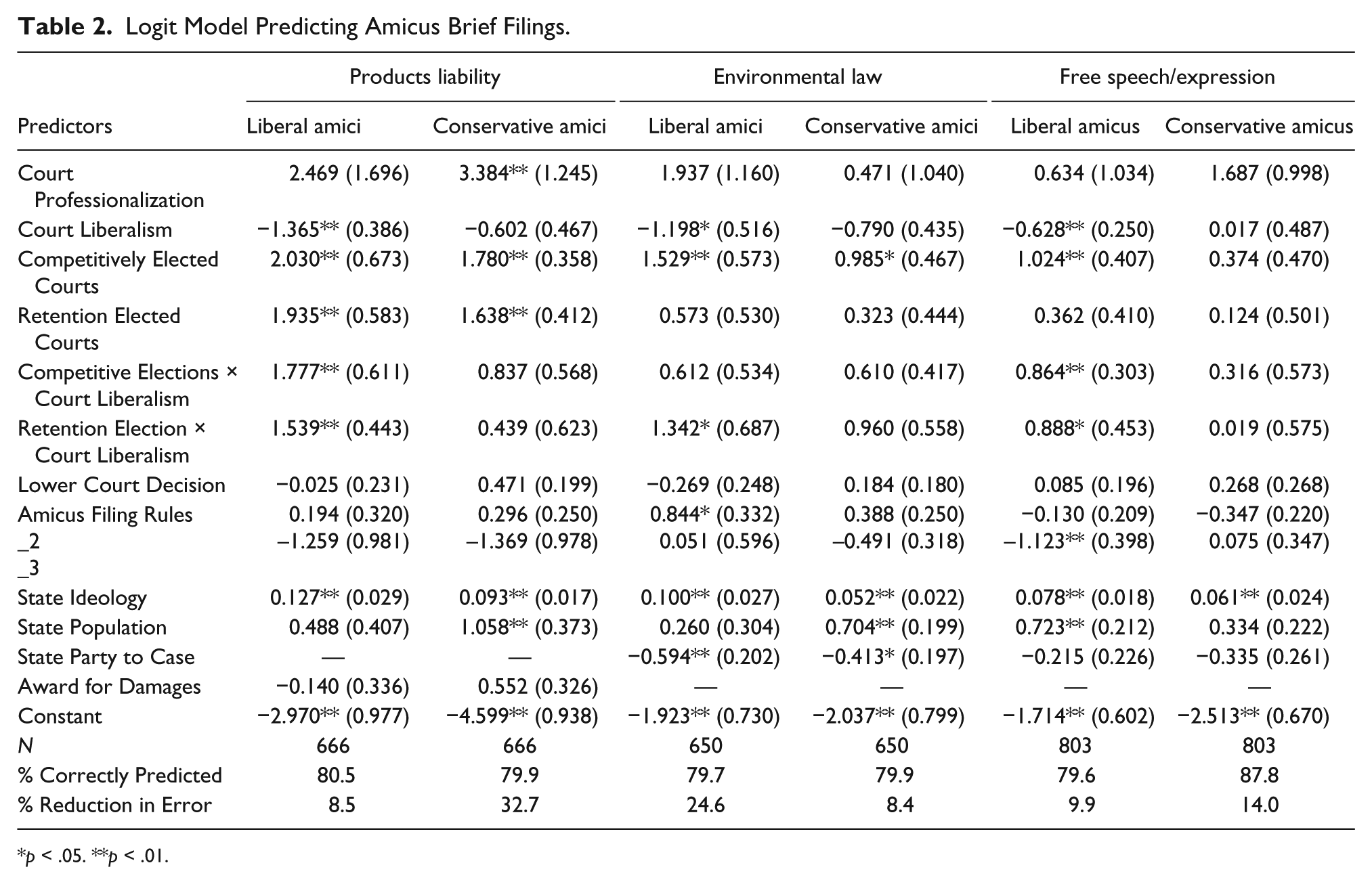
p < .05. **p < .01.
Average Marginal Effects of Logit Estimates.
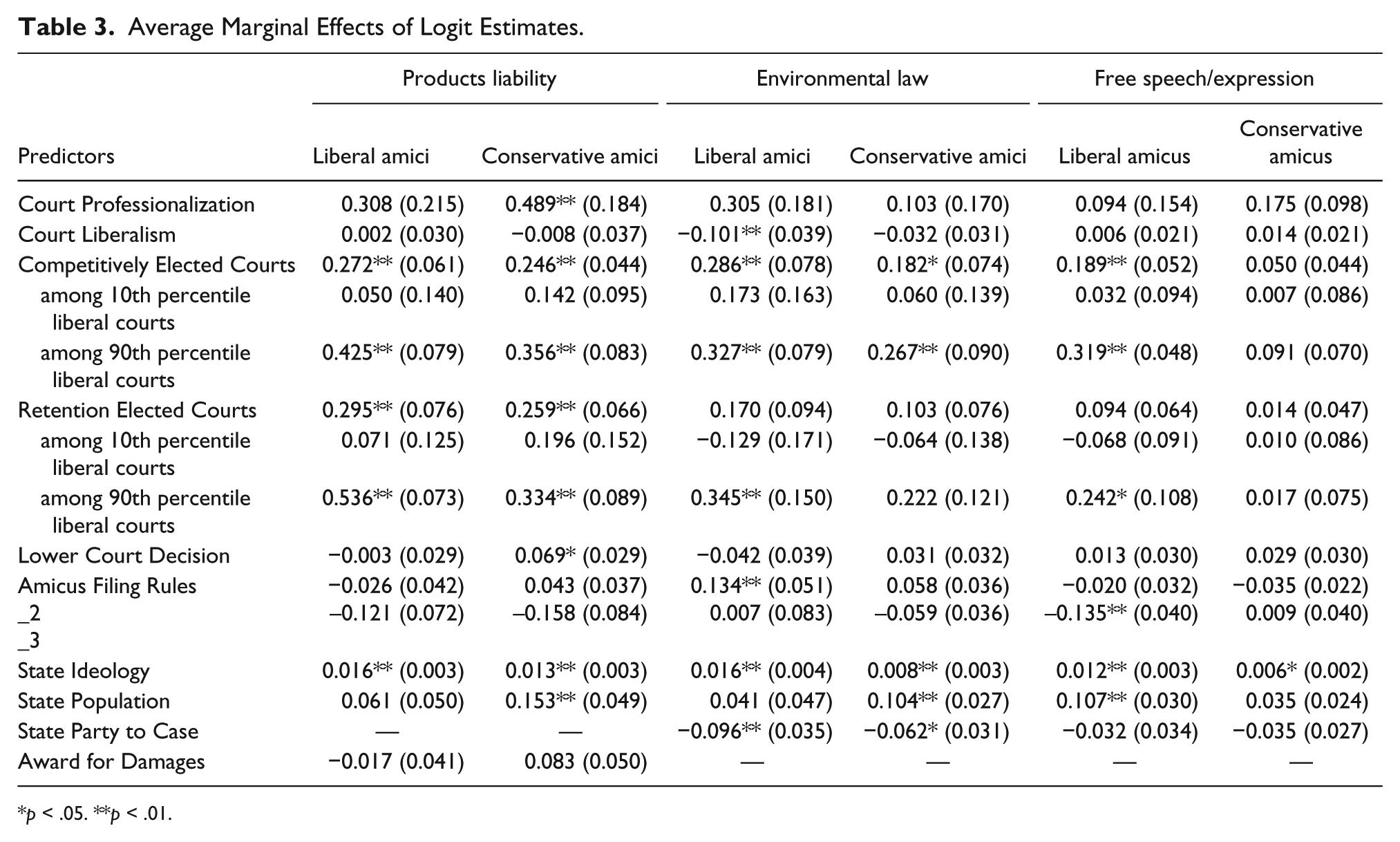
p < .05. **p < .01.
The Informational Need Hypothesis gained its only empirical support from the Products Liability Model that estimated the likelihood of observing amicus participation by conservative groups. When business interests with more conservative agendas determine where to file amicus briefs in products liability cases, they appear to target cases in which their preferred policy positions were unsuccessful in the lower courts. This suggests that conservative business groups believe using amicus curiae briefs to provide information to state high courts is an effective way to advocate for the upending of pro-plaintiff rulings by lower courts. More specifically, holding all other variables at their true values, products liability cases in which the lower court issued a liberal ruling will be 6.9 percent more likely to attract amicus participation by conservative groups when the case reaches the state high court. This suggests that at least in some instances, groups are targeting cases in which they believe their information and expertise can be helpful in overcoming a state high court’s deference to the decision of the lower court.
We also see that business interests filing conservative amici in products liability cases are the only groups systematically targeting more professionalized state high courts as hypothesized in the Institutional Capacity Hypothesis. Conservative groups filing amici in products liability are nearly twice as likely to target the most professionalized courts as opposed to the least professionalized courts in products liability cases. A state supreme court falling in the 90th percentile of professionalization increases the likelihood of attracting conservative amicus participation by 64.5 percent compared with only 37.8 percent in courts falling within the 10th percentile of professionalization. Despite this support for the Institutional Capacity hypothesis, there is no evidence to suggest that groups participating in amicus curiae in environmental and free speech cases are similarly targeting courts with greater organizational capacities.
Perhaps the most significant finding is that interest groups of all varieties appear to be attracted to cases pending before courts that are accountable to the public. While nearly all groups appear to be targeting competitively elected courts, this affinity of groups to target publicly accountable high courts also appears to have an ideological dimension. Figures 4 to 6 show that rather than groups strategically targeting courts that may be ideologically sympathetic to a group’s goals as hypothesized, both liberal and conservative groups appear to be focusing their attention on the most ideologically liberal elected courts. Most significantly, this pattern holds across all issue areas, suggesting that groups are not necessarily seeking ideological congruity with publicly accountable state high courts, but rather that groups view liberal courts as being more hospitable venues for taking into consideration the views of outside groups filing amicus curiae.
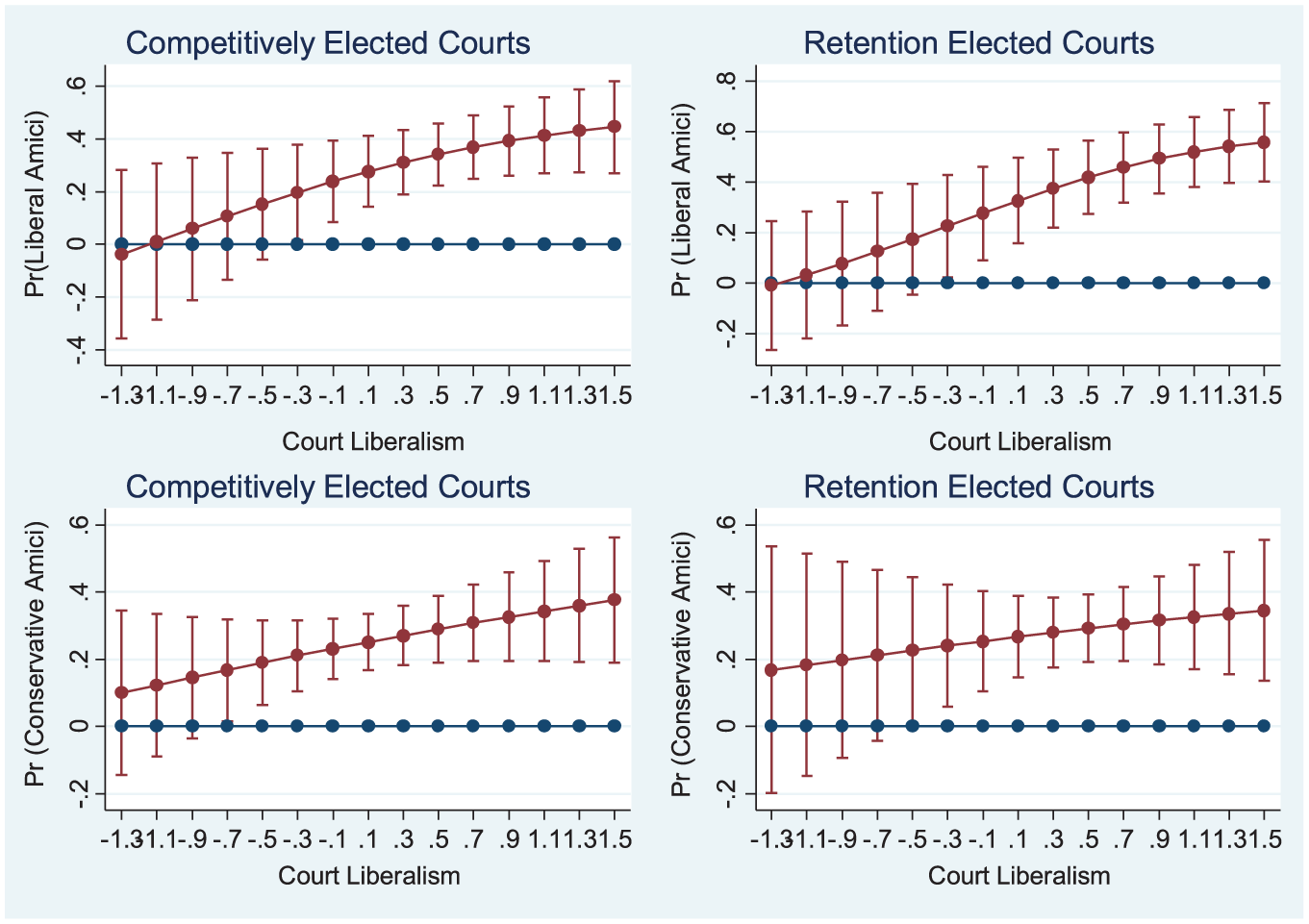
Effect of judicial retention method and court liberalism on amici filings in products liability cases.
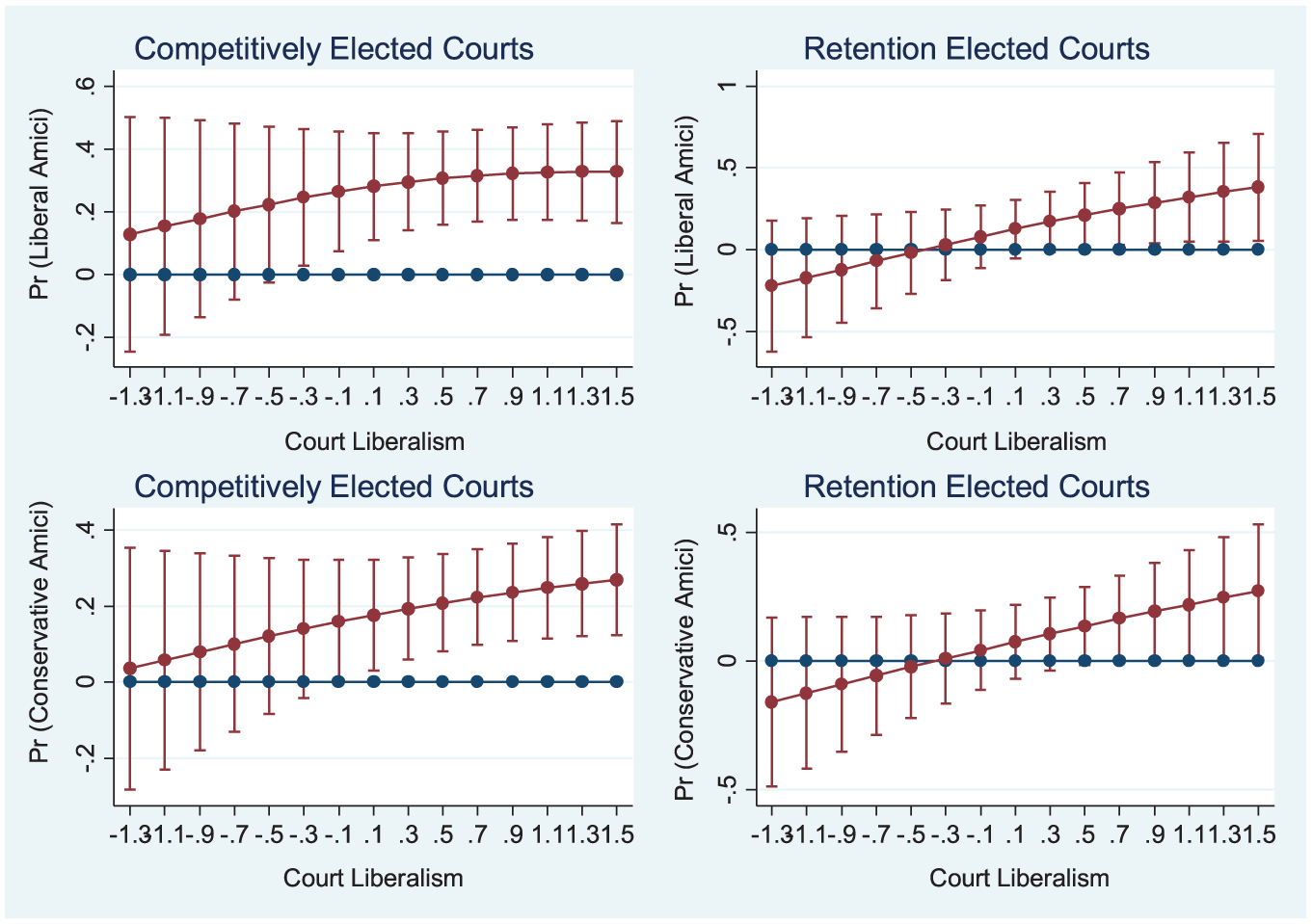
Effect of judicial retention method and court liberalism on amici filings in environmental law cases.
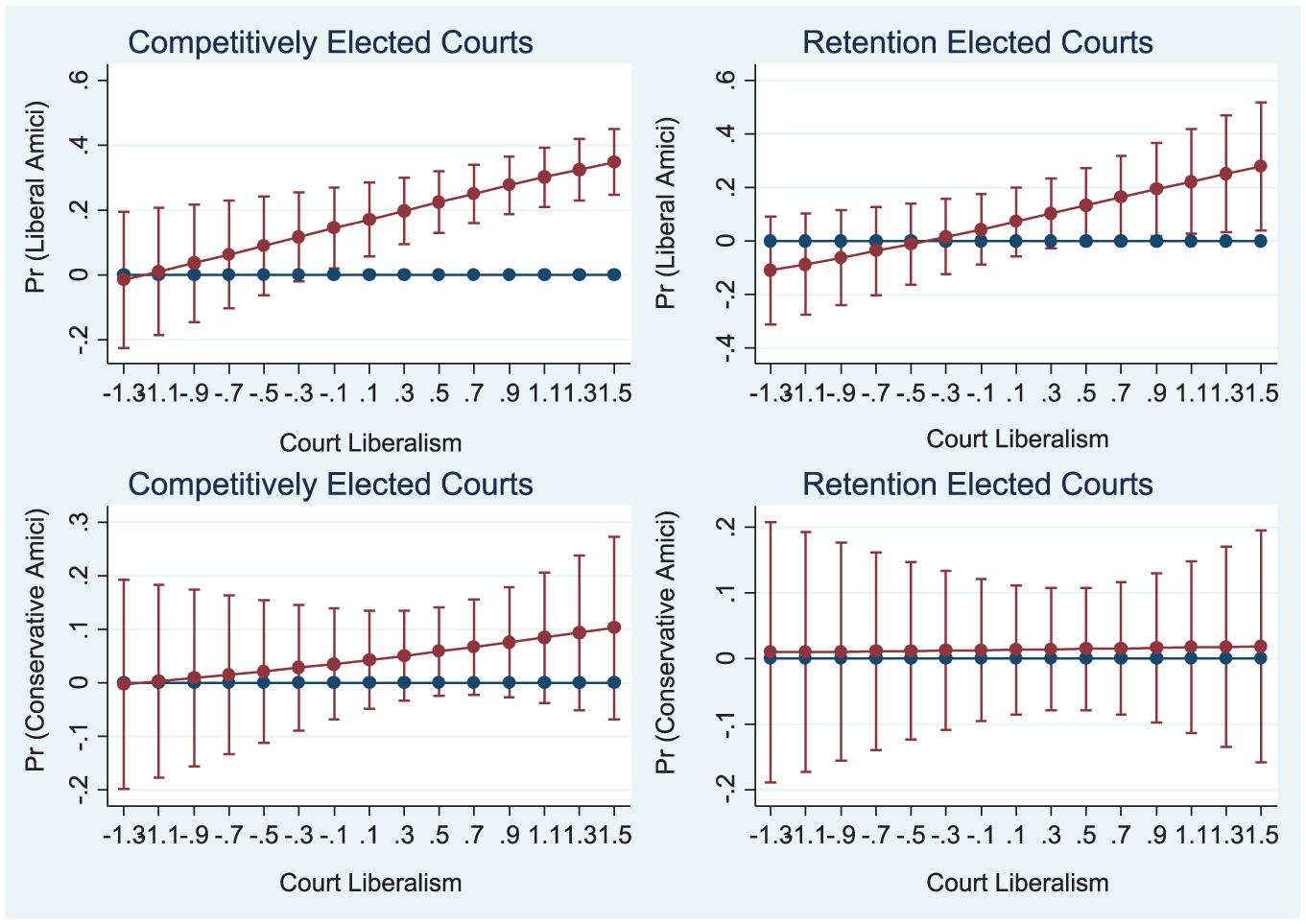
Effect of judicial retention method and court liberalism on amici filings in free speech cases.
The control for state ideology produced significant effects across all models, holding all other factors at their true values. This suggests that interest groups may also be looking to the overall ideological preferences of a state as an indicator of how liberal or conservative a state high court may be when making decisions about where to file amicus briefs. What is interesting about the results of the state ideology measure is that it suggests that all interest groups, regardless of their ideological affinity, are targeting cases pending before courts in liberal-leaning states. This again suggests that groups believe liberal courts to be more welcoming of third-party information than those found in more conservative states.
The control for state population also proved to be significantly related to amicus brief filings across all areas of law. While the specific causal mechanism for state population cannot be determined, there are several possible explanations for these results. First, state population may simply be a proxy measure for the overall litigation levels in state high courts. Larger, more populated states tend to have greater levels of litigation, which, in turn, may mean a greater likelihood of observing third-party participation by interest groups. State population could also be picking up the influence of interest group density in a given state. If there is a greater interest group presence in states with greater populations, there may be a greater likelihood of observing interest group involvement in state high courts. Finally, the influence of state population may be picking up artifacts of membership-based interest group strategies. Business associations, environmental groups, and free speech groups were all repeat players as amicus briefs in these areas of law, and are all membership-based groups who have responsibilities to represent the views of their respective memberships. It may be that membership-based groups are targeting courts in more populated states as a cost-effective way of representing their policy positions in the courts.
There were mixed results for several of the other control variables included in the models. Surprisingly, the restrictiveness of amicus filing rules did not consistently affect the likelihood of interest group participation as amici across the models. However, some groups did appear to be targeting state courts based on the ease of filing rules. Specifically, repeat players filing liberal amicus briefs in environmental cases are 13.4 percent more likely to target courts with more lenient filing rules while groups filing liberal amicus briefs in free speech cases are 13.5 percent less likely to target courts with more stringent filing requirements. This suggests that some groups are conserving group resources by targeting state courts that ease the process of third-party filings.
The indicator of state agency participation as a litigant in the Environmental Law Models had a statistically significant marginal effect on the filing of amicus briefs. As hypothesized, the state participating as a litigant in a case deterred liberal groups from filing as amici by nearly 10 percentage points. However, despite the prevalence for business associations and corporations to file amicus curiae in products liability cases, the indicator for a lower court jury award failed to show the hypothesized positive effect on the likelihood of amicus filings in products liability cases. Perhaps the propensity of groups to target cases with liberal lower court rulings, which would include those upholding large jury awards at the trial phase, already accounted for this strategic behavior on the part of business and corporate interests.
Discussion
Unlike when lobbying the U.S. Supreme Court, interest groups seeking to exert policy influence in state courts of last resort must navigate different institutional environments that render some state high courts more attractive as lobbying venues than others. The results of this study show that organized interests across three areas of law—products liability, environmental law, and free speech/expression—consider a court’s institutional design and ideological orientation when making strategic decisions about where to expend group resources to file amicus curiae briefs. Specifically, interest groups target publicly accountable courts and those that are ideologically liberal as the best venues in which to file third-party briefs reflecting group policy goals.
The most consistent finding across each area of law is that interest groups are targeting publicly accountable courts retained through competitive elections. This suggests an overall perception among organized interests that elected courts, both through partisan and nonpartisan elections, are more receptive to the information and arguments of outside interests filing as third parties to a case. And while interest groups do not appear to be targeting state high courts based exclusively on their level of ideological congruence with the group, organized interests do appear to be strategically targeting publicly accountable courts that are more ideologically liberal. This suggests that both liberal and conservative leaning groups view ideologically liberal elected state high courts as the most sympathetic or receptive venues for submitting third-party information, regardless of the policy argument advocated in the brief.
Perhaps interest groups feel a connection with elected judiciaries because these courts have a closer link to citizens and, thus, may be more receptive to the concerns of citizens and groups participating as amicus curiae. Or perhaps the affinity of interest groups to engage publicly accountable courts, especially competitively elected courts, is driven by the belief that the electoral connection and the need to raise money to mount judicial campaigns make these courts more receptive to the preferences of outside groups, some of whom regularly contribute to judicial campaigns. Future analysis is needed to definitively determine the motivating forces behind interest group attraction to elected state judiciaries.
While results suggest that some interest groups strategically target those courts with an informational need and with the greatest institutional capacity to process the information contained in third-party briefs, this type of strategic behavior is only systematically exhibited by interest groups advocating for conservative outcomes in products liability cases. Figure 1 highlights that business and corporate interests filed nearly three-quarters of all briefs in products liability cases advocating for conservative, pro-defendant outcomes. Corporate interests, like the Products Liability Council, possess two advantages that may best position these groups to target the most professionalized state high courts—resource advantages and repeat player status. These institutional advantages may explain why business and corporate groups view highly professionalized state high courts, which possess higher levels of staff, resources, and docket control, as better arenas for presenting their policy expertise.
While the results of this analysis suggest that the informational need of a given case does not appear to be of major concern to most interest groups seeking to file amicus curiae, a variable omitted from this study may potentially offer a better measure of informational need. Interest groups may target legally complex cases in which to file amicus curiae in hopes of offering unique information or legal frameworks from which the court can render a decision. In this sense, case complexity, as measured by the total number of legal issues raised by a case, may be a better indicator of a case’s informational need than an unfavorable lower court ruling. A measure of case complexity is excluded from this analysis due to the demands of data collection, but including such a variable in future analyses will serve to better assess the role that informational need plays in the strategic considerations of organized interests seeking to democratically engage state high courts.
Ultimately, the results of this study suggest that the institutional design and ideological composition of state high courts have tangible effects on the way in which organized interest groups choose to lobby the courts. Prospective amicus filers appear to be making strategic calculations about which state high courts will be most amenable to the interests of third-party groups to litigation and which high courts will have the institutional capacity to make use of the information provided in amicus briefs. As strategic actors with limited resources, organized interests target cases heard before publicly accountable courts that are more ideologically liberal. Through strategic targeting of state high courts, interest groups participating as amicus curiae can provide advocacy efforts on behalf of their membership while providing their policy arguments in court environments that offer the best chances for lobbying success.
Supplemental Material
Becker_Kane_Replication_Data – Supplemental material for Informational Need, Institutional Capacity, and Court Receptivity: Interest Groups and Amicus Curiae in State High Courts
Supplemental material, Becker_Kane_Replication_Data for Informational Need, Institutional Capacity, and Court Receptivity: Interest Groups and Amicus Curiae in State High Courts by Jenna Becker Kane in Political Research Quarterly
Footnotes
Declaration of Conflicting Interests
The author(s) declared no potential conflicts of interest with respect to the research, authorship, and/or publication of this article.
Funding
The author(s) received no financial support for the research, authorship, and/or publication of this article.
Notes
Supplemental Materials
Replication data for this article are available with the manuscript on the Political Research Quarterly (PRQ) website.
References
Supplementary Material
Please find the following supplemental material available below.
For Open Access articles published under a Creative Commons License, all supplemental material carries the same license as the article it is associated with.
For non-Open Access articles published, all supplemental material carries a non-exclusive license, and permission requests for re-use of supplemental material or any part of supplemental material shall be sent directly to the copyright owner as specified in the copyright notice associated with the article.
