






Abstract
How do ethnic group divisions affect parties’ linkage strategies? The provision of private or local club goods favoring co-ethnics by politicians has been well documented in the literature. However, whether clientelism tends to be more widespread in ethnically highly fragmented societies has not been systematically examined. Utilizing a dataset that includes information on more than 450 parties in eighty competitive party systems, we show that the mere presence of multiple ethnic groups does not lead to more clientelistic exchange. Nevertheless, in countries characterized by high levels of economic inequality between politically relevant ethnic groups, parties are more likely to rely on clientelistic strategies to attract votes. In addition, this positive relationship between ethnic income inequality and clientelism is contingent on parties’ ties to ethnic social networks. Specifically, in ethnically unequal societies, parties that can rely on existing ethnic organizations particularly engage in clientelistic modes of electoral mobilization.
Introduction
Clientelistic parties challenge the tendency to view the interaction between voters and politicians in democratic countries as a relationship between principals and agents based on broad policy platforms. While programmatic politics has frequently been seen as the normatively most adequate and satisfactory form of democratic competition, scholars have pointed to clientelism as an alternative mode of political exchange (Kitschelt and Wilkinson 2007). 1 Clientelism involves the direct provision of goods and services by politicians to individuals or small groups of voters in exchange for their support on election day. Voters in a clientelistic relationship expect particular goods targeting party supporters only, while voters who engage in a programmatic accountability mechanism can benefit from a broad policy package. At the same time, both clientelism and programmatic competition are rational and deliberative strategies of principal-agent interaction that maintain accountability (Kitschelt 2007).
Scholars have investigated the conditions under which parties and politicians tend to invest in clientelistic rather than programmatic strategies as more preferable ways to attract votes. The literature has pointed to the importance of several factors, including economic development (Calvo and Murillo 2004; Kitschelt 2000; Malagoni, Diaz-Cayeros, and Estévez 2007; Stokes et al. 2013), democratic experience (Keefer 2007), institutional arrangements (Ames 1999; Ordeshook 1995), and features of party organization (Calvo and Murillo 2013; Kitschelt and Kselman 2011). In addition to these conditions, scholars have also identified the ethnic aspect of clientelism in various contexts. The correlation between ethnic pluralism and the lack of political competition based on programmatic accountability strategies has been well documented. Many studies have pointed out that ethnically based parties or politicians tend to deliver goods to their own ethnic groups. For example, co-ethnics of the incumbent politicians are more likely to have pork barrel benefits (Fearon 1999), preferential access to primary schooling (Kramon and Posner 2016), more transport infrastructure in their districts (Burgess et al. 2015), or better health outcomes (Franck and Rainer 2012). Consistent with the argument, scholars have also linked the underprovision of universalist public goods to high levels of ethnic fragmentation (e.g., Alesina, Baqir, and Easterly 1999; Habyarimana et al. 2007; Miguel and Gugerty 2005).
However, the relationships between ethnic divides and partisan clientelistic strategies have not been systematically examined. It is still not clear whether clientelistic exchanges tend to be more widespread in ethnically highly fragmented societies. Which aspects of ethno-cultural differences are more conducive to parties’ clientelistic efforts and why is there the association? Is the tendency contingent on certain features of party organization?
To answer these questions, we first look into the patterns of ethnic divides. We argue that the mere existence of diversity, measured as the presence of multiple ethno-cultural groups (Fearon 2003), does not constitute a sufficient condition for parties to rely more heavily on clientelism. When ethno-cultural differences are paired up with wealth and income inequality between groups (Baldwin and Huber 2010), however, clientelism tends to ensue. In line with findings of previous studies (Alesina and Glaeser 2004; Luttmer 2001), we argue that when income disparities between ethnic groups are high, citizens have less preference for broad redistributive policies. In addition, poor ethnic groups, who tend to be marginalized in political decision making, may consider redistributive promises that require state intervention not credible (Morgan and Kelly 2017). The literature has shown that low-income voters are influenced more by direct and targeted transfers. Under the condition of high economic inequality between ethnic groups, parties may find members of poor ethnic groups especially responsive to clientelistic distribution.
Furthermore, we posit that the relationship between ethnic income inequality and clientelism is not uniform within countries. In societies characterized by ethnic income inequality, parties that can rely on existing ethnic social networks particularly utilize clientelism to attract votes. Ethnic networks enable these parties to recruit local brokers and distribute clientelistic benefits more easily, and thus facilitate the supply of clientelism. In addition, if the clientelistic exchange is a single-shot transaction, voters may defect from the implicit bargain and vote for any other party they like. Iteration of exchange embedded in durable networks may reduce such propensity, even if it does not fully eliminate it.
Our arguments are tested with data collected by the Democratic Accountability and Linkage Project (DALP), which is the most comprehensive cross-sectional dataset that includes detailed instruments of parties’ accountability strategies and organizational features. Based on public opinion survey data, we also construct an index measuring the level of economic inequality between ethnic groups within each country. Utilizing multilevel models, we show that parties are more likely to engage in clientelism in countries where ethnic groups are economically highly unequal, while the mere presence of ethnic fragmentation or polarization is not associated with clientelistic exchange. The relationship between ethnic income inequality and partisan clientelistic strategies is also tested with an instrumental variables setup. In addition, the results show that in ethnically unequal societies, it is parties with explicit ties to ethnic organizations that are particularly likely to approach voters with clientelistic tactics.
These findings have several implications for the study of democratic accountability and ethnic divides. By constructing a cross-sectional measure of income inequality between ethnic groups, this paper illustrates that the distribution of economic resources across groups, but not other aspects of ethnic diversity, has effects on parties’ accountability strategies. In addition, this paper shows that it is necessary to distinguish between contextual effects of country-level ethnic divides and the influence of parties’ connection with ethnic groups. Finally, the effects of ethnic social networks have been pointed out in the literature, and this paper provides evidence in the context of different levels of ethnic income inequality.
Ethnic Divides and Clientelism
A substantial body of work has studied the correlation between ethnic divides and distributive politics. Instrumentalist theories of ethnicity argue that ethnicity serves as a heuristic for parties to identify potential supporters. Parties try to attract votes along ethnic lines, while voters expect to obtain benefits targeting their ethnic groups (Bates 1974; Chandra 2007; Posner 2005). The ethnic profiles of politicians allow voters to overcome problems of limited information, since voters can anticipate the provision of more resources from co-ethnics. In exchange for their support, voters are likely to have private transfers and local club goods, such as preferential access to infrastructure, provided by co-ethnic politicians (Burgess et al. 2015; Hale 2007; Ichino and Nathan 2013; Wantchekon 2003). However, can these results be extended to the argument that clientelism tends to be more common in ethnic divided societies? This relationship has yet to be examined systematically. In this section, we highlight the “vertical” ethnic divides as defined by Horowitz (1971) and propose that economic inequality between ethnic groups leads to increased demands for clientelistic benefits. We also suggest that ethnic social networks facilitate parties’ supply of targeted goods.
Based on social identity theory (Tajfel and Turner 1979), once ingroups and outgroups are defined and differences are solidified, a pronounced urge for comparison between “them” and “us” emerges. Individuals acquire more utility from the welfare of ingroup members, which leads to behaviors of ingroup favoritism. Among various types of group differences, Horowitz (1971) has made the distinction between vertical and horizontal ethnic differentiation. Whereas horizontal ethnic differentiation is characterized by more fluid and cross-cutting differences that shift easily in terms of their political importance, vertical differentiation means that ethnicity is hierarchically organized, and social mobility within the hierarchy is restricted by certain ascriptive criteria. Countries where ethnic differentiation is primarily vertical are characterized by a “premise of inequality,” suggesting that access to benefits is stratified by ethnic groups distinguished by wealth, power, and social standing. When ethnic differentiation is coupled with economic disparities between groups, ingroup favoritism is strengthened even further (Gay 2006; Lei and Vesely 2010), and the political salience of ethnic divisions is amplified.
We argue that vertically stratified ethnicity will lead to demand for patronage: well-defined ethnic groups who differ significantly in economic status are expected to be more responsive to a clientelistic partisan strategy. There are several reasons for this expectation. First, as the existing literature has pointed out, ethnic fragmentation reduces the propensity to redistribute income, since ethnic heterogeneity decreases solidarity, and people are more reluctant to transfer money to outgroup members (Alesina and Glaeser 2004; Gilens 1999; Luttmer 2001). That is, when fractionalization is high and ethnic divides are salient in political competition, people are less likely to support general redistributive policies that may benefit all the poor regardless of ethnic backgrounds. More recent studies further argue that it is not merely social fragmentation that limits popular support for broad pro-poor policies; rather it is pronounced income disparities between groups that particularly undermine citizens’ favorable attitudes toward redistribution (Morgan and Kelly 2017) and affect redistributive policy outcomes (Yakter 2018). When ethnic group identity is closely linked to individuals’ positions in the income distribution, group-based preferences are more likely to be activated, and broad redistributive policies, which are usually featured in partisan programmatic appeals, are less attractive.
Second, we argue that between-group income inequality leads to more demand for clientelism also because ethnically concentrated poverty may undermine the credibility of policy commitments. One might contend that when economic inequality is paired with ethnic divides, the strengthened social identity should lead to support by groups with lower economic status for general redistributive policies, since the policies will primarily benefit them. And the between-group inequality (BGI) may even foster partisan programmatic competition along this line. However, there are reasons to believe that under the condition of substantial BGI, parties’ promises about broad redistributive policies that involve state intervention are not credible. Morgan and Kelly (2017) have found that “inequalities that disproportionately marginalize certain groups perpetuate the perception that government does little to alter entrenched hierarchies, thereby undermining the state’s credibility as a tool for achieving more equitable resource allocations for all sectors” (p. 194). In other words, voters belonging to low-income ethnic groups do not trust that politicians will deliver on their policy commitments when they have been consistently ignored, and the government has not proven to be effective in addressing this issue. As the credibility of broad policies is undermined, particularly in the view of low-income ethnic groups, parties are less able to rely on programmatic strategies to attract votes. As Keefer (2007) has pointed out, programmatic competition depends on politicians’ ability to make credible promises about public policies that can benefit broader social categories but require more time to be realized. When it is difficult to establish policy reputation with broad groups of voters, politicians tend to invest in direct and contingent exchange.
A variety of works have pointed out that, in general, poor voters are the main targets of clientelistic transaction (Baland and Robinson 2012; Calvo and Murillo 2004; Kitschelt 2000; Malagoni, Diaz-Cayeros, and Estévez 2007; Stokes et al. 2013). Poor voters are thought to have more pressing economic needs and shorter time horizons, and thus, are more responsive to clientelistic benefits. In the context of between-group economic inequality, redistributive policies are not viewed as credible to voters of poor ethnic groups, and clientelistic benefits become a particularly effective strategy to attract votes. 2 Nathan (2016) has found that in poor neighborhoods, voters tend to expect private goods distributed from their ethnically affiliated party.
Clientelistic strategies may be also utilized to “purchase cross-ethnic endorsements” (Arriola 2013, 241), if attracting the votes of a single ethnic group does not constitute a majority and parties need the support from multiple groups to be competitive in elections. When ethnic divides coincide with economic inequality, parties are not able to credibly promise the same policy package that satisfies the mutually exclusive economic preferences of different groups. Voters may worry that once the party supported by multiethnic voters wins power, it adopts policies that only benefit its core ethnic constituents and renege on commitments to other groups. Then direct and contingent inducements to accommodate the needs of different groups, particularly the poor ones, serve as a more effective strategy to secure support.
In general, when ethnic divides are accompanied with economic disparities between groups, group-based preferences for resource distribution are especially activated. Under such conditions, citizens have lower preference for general redistributive policies, and the political competition is less likely to be structured along the programmatic-ideological divides. Redistributive policies that require state intervention are viewed as not credible by poor ethnic groups, since they have been systematically marginalized in the vertical ethnic stratifications. Clientelistic benefits, direct transfers more commonly used to target the poor population, become particularly influential in attracting poor co-ethnics and mobilizing multiethnic support from groups with different economic status. These expectations lead to the formulation of the following hypothesis:
The Contingent Effect of Ethnic Networks
We also expect that between-group income inequality especially leads to parties’ reliance on clientelistic exchange when those parties have close ties to networks of ethnic groups, because the networks allow parties to have reliable local intermediaries and distribute private goods more efficiently. That is, ethnic networks facilitate the supply of clientelism and, thus, strengthen the positive relationship between ethnic economic inequality and partisan clientelistic strategies.
Parties need support networks that make the delivery of patronage possible. Scholars have pointed out that clientelism depends on a well-established network of local intermediaries (Holland and Palmer-Rubin2015; Koter 2013; Stokes et al. 2013; Szwarcberg 2014). Those on-the-ground operatives are essential in transmitting information about the preferences and needs of constituents to party officials. At the same time, parties rely on the networks to reach voters and distribute private goods more efficiently. Furthermore, such brokers may be also instrumental when parties try to ascertain that voters have lived up to their end of the clientelistic bargain. Under conditions of secret ballot, clientelistic exchanges may suffer from opportunistic voting behavior. Voters who obtained benefits before elections could defect from the implicit bargain and choose any other party they like. Social networks constitute subtle mechanisms to avoid moral hazard problems that arise between party officials, brokers, and voters when patronage linkages are formed. Organized groups have the advantage that the very network structure may substitute for explicit party organization and assume the burden of gathering information, distributing private goods, and monitoring opportunistic voter conduct. If parties can utilize existing social networks to build the clientelistic relationships with voters, they are able to attract votes “in bulk” at lower costs.
While a variety of organized networks can be utilized for clientelistic transactions, ethnic-based networks particularly facilitate parties’ supply of clientelism under conditions of ethnic economic inequality. Civic networks along ethnic lines, either more formal associations or informal local communities, are formed in various contexts (Varshney 2001). As explained in the previous section, when economic disparities between ethnic groups are large, group-based benefits become more attractive. Ethnic-based networks are, thus, especially amenable to the provision of contingent goods targeting their members. Parties may also find these existing networks helpful in delivering benefits to voters who expect clientelistic exchanges favoring their groups. That is, parties’ ties to ethnic networks reinforce clientelist transactions, particularly when such benefits are influential in attracting ethnic-based support.
As the literature has pointed out, ethnic social networks have the organizational capacities to help implement clientelistic exchanges (Nathan 2016). Local leaders of ethno-cultural groups can be employed to channel targeted benefits (Baldwin 2013; Koter 2013). In addition, existing social networks facilitate information dissemination among co-ethnics (Habyarimana et al. 2007; Larson and Lewis 2017; Miguel and Gugerty 2005). It is, thus, expected that with the help of ethnic networks, voters who defect from a clientelistic contract are more likely to be identified. Since information/rumors spread more easily among co-ethnics, if parties can rely on existing networks of ethnic groups, they are better able to have information about constituents’ demands and voting behavior. That is, clientelism is likely to take place through ethnic ties, as has been recognized early on (Lemarchand 1972, 83). 3
As theorized above, ties to existing ethnic social networks enable parties to lower their organizational transaction costs and, thus, facilitate the supply of clientelism. Parties may establish such ties through financial support or regular representation of associational/community leaders in party organs or decision-making processes. In countries where the levels of economic inequality between ethnic groups are high, ingroup favoritism is strengthened, and ethnic associations tend to be more responsive to benefits directly targeting their members. Under such conditions, parties that have close linkages with ethnic organizations particularly engage in clientelistic accountability strategies, because existing ethnic social networks allow them to reach potential supporters more easily. Based on these expectations, the following hypothesis is proposed:
Data and Measures
Dependent Variable
The measure of the dependent variable, the extent to which parties engage in clientelism to attract votes, is taken from the DALP. It is a research effort that studies parties’ accountability strategies in eighty-eight countries around the globe. The countries are selected to reflect polities with at least two million citizens and minimally competitive democratic elections. To meet the second criterion, a country needs to have had an average of at least 4.0 (partly free) on the Freedom House’s political rights index in 2007 and 2008. This restriction is important, because politicians are expected to engage in the highest degree of accountability exchange with voters primarily when elections do matter at least to a certain extent. For each country in the sample, the project contains judgments on electoral practices of all politically relevant parties as of the last elections prior to 2009, when the project implementation was concluded. This gives a sample of 506 parties that were evaluated by multiple country experts filling out a survey specifically designed to find out how parties go about their linkage to voters. 4
The party-level measure of clientelism is constructed based on five survey items that ask experts to assess the effort parties make in offering five types of clientelistic benefits to specific individuals or small groups of citizens in exchange of their votes. The five types of benefits include consumer goods, access to social policies, employment in the public sector, government contracts, and favorable application of regulations. They are coded on a 1 to 4 ordinal scale, where “1” refers to a negligible effort or no effort at all, and “4” means that the party is involved in a major effort to provide the benefit in question. An anchoring vignette with a scoring example precedes these survey questions, giving experts a benchmark for their scoring, to partially alleviate the concern that country experts may have different standards when rating on an ordinal scale. Responses to the five instruments are highly correlated to each other (r = 0.75–0.9). Experts’ ratings for the five components for each party are aggregated as the party-level measure of clientelism, ranging from 5 to 20.
Potential limitations of measures from the DALP include that experts may have less information about some parties or certain types of clientelistic goods. For robustness checks, we rerun the analyses excluding parties that few experts rated and those that experts had diversified judgments (see Tables A2 and A3 in the online appendix). Online Appendix 1 also includes more discussion of the survey instrument and measurement issues, as well as the wording and response categories of the DALP variables used in the analysis.
Independent Variable
To explore whether the difference in economic status between ethnic groups is conducive to partisan clientelistic strategies, we construct a BGI index as the key independent variable. The formula, as first developed by Baldwin and Huber (2010), is as follows:
where
To construct a cross-national BGI index, the information of group size and mean income of groups in each country is required. Since the macro level data of BGI is unavailable for most countries included in the DALP, we follow Baldwin and Huber and utilize public opinion surveys, including Afrobarometer (Bratton et al. 2008 Round 4), Comparative Study of Electoral Systems (CSES Module 3 and Module 2), European Social Survey (ESS 2008 Round 4), Latin American Public Opinion Project (LAPOP 2008), and World Value Survey (WVS 2005 the fourth wave and 2000 the third wave; Inglehart et al. 2014). We first identify the group divisions within a country based on Fearon’s (2003) criteria of “prototypical” groups. These criteria are centering on whether groups are perceived as having “descent basis,” whether group members have self-consciousness, and whether belonging to a group is viewed as socially or politically consequential. Thus, Fearon’s identification may be based on languages, races, tribes, or religions. We mirror this classification to identify the relevant groups of survey respondents for each country. Ethnic fragmentation within each country calculated based on the survey data is quite consistent with Fearon’s data, and they are correlated at r = 0.84.
For the mean income of groups, these surveys also include instruments to measure the well-being of respondents. In ESS, LAPOP, and WVS, respondents are asked to indicate the income range that the total monthly (or annually) income of their household fits on a ten-category scale. CSES surveys include a similar question on a 5-point scale. Afrobarometer includes several questions on how often the respondents or anyone in their family have gone without enough food, clean water, medical treatment, cash income, and fuel over the past year. Each item is coded from 0 to 4. The summation of the five responses is calculated to capture the well-being of respondents. The survey questions are listed in Table A4 in Online Appendix 2. 6
The correlation between BGI and the fractionalization index of Alesina et al. (2003) is 0.135, while BGI is correlated at 0.348 with the Gini index. 7 It is clear that neither the levels of ethnic fragmentation nor individual-level inequality can completely reflect the extent of BGI. Figure 1 displays the relationship between the fractionalization index and BGI. It shows that the correlation between them weakens as the fractionalization scores grow: many countries with high ethnic fragmentation levels, including several African countries and Canada, have groups that are relatively equal in their economic status. There are also countries with comparatively low fractionalization scores that have higher BGI, including Turkey and some Latin American countries. The country with the highest BGI in the sample, Guatemala, has two fairly equally sized ethnic groups with huge income gaps. The average earnings of nonindigenous people are around twice of indigenous people (41% of the population) (Ñopo and Gonzales 2008).
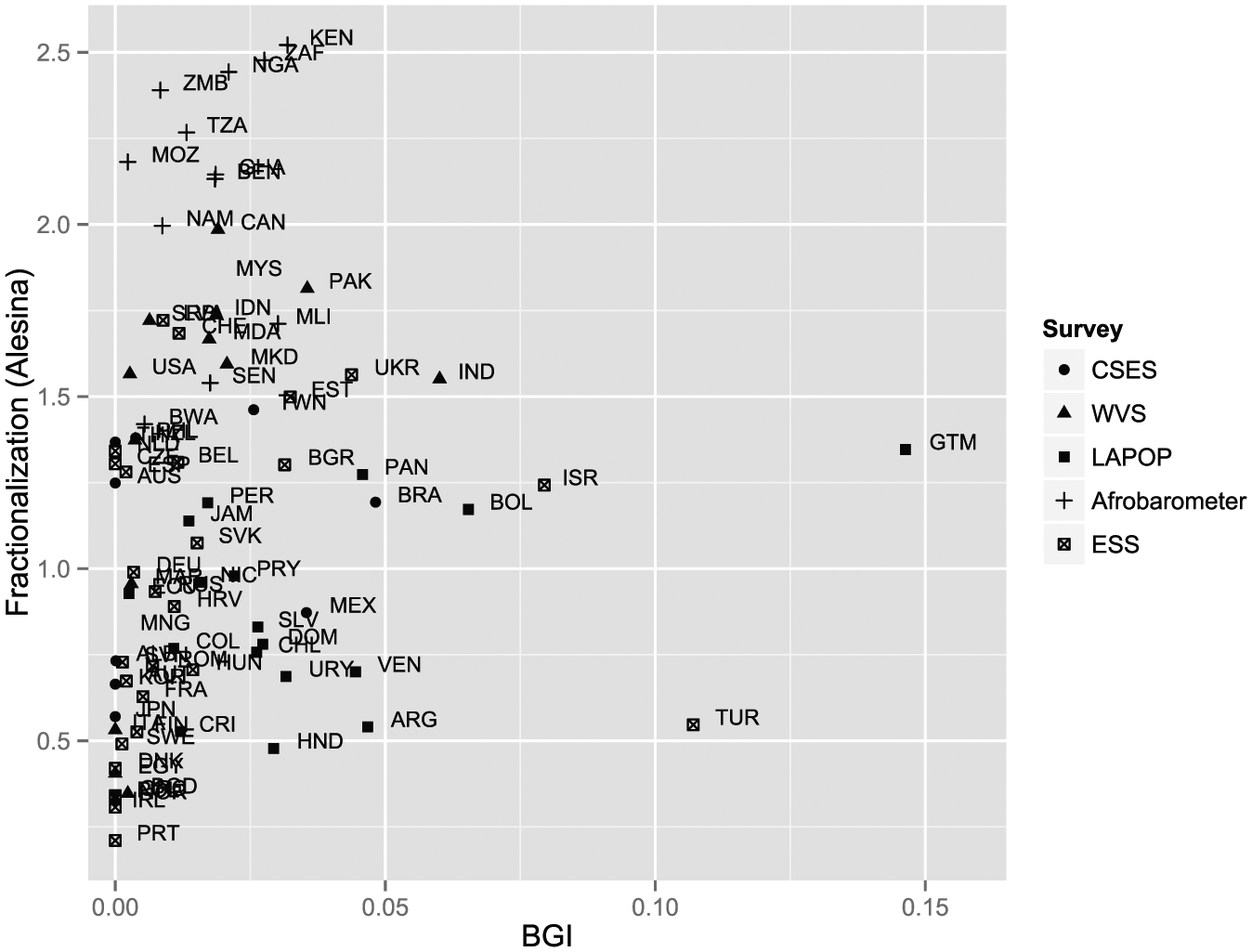
BGI and the fractionalization index (Alesina et al. 2003).
Moderating Variable
Hypothesis 2 specifies that the positive relationship between group inequality and clientelism is strengthened among parties that have close ties to ethnic organizations. We include a cross-level interaction term between BGI and a party-level measure of parties’ ties to existing ethnic networks. The measure of parties’ associational ties to ethnic groups is from DALP. Experts were asked whether a party has “routine and explicit linkages to ethnic/linguistic organizations. The linkages might include leadership and membership overlap, mutual financial support, reserved positions for representatives of these organizations at National Conventions, etc.” This survey item was rated on a yes/no basis by multiple country experts. Parties’ scores on this measure range from 0 to 1, representing the percentage of country experts who agree that the party has such ties to ethnic organizations.
Controls
A set of control variables, which have been shown to be correlated with clientelism, are included to complement the analyses. With regard to the structural factors, we first account for levels of economic development. The literature has shown that clientelism is less widespread in richer societies. We also include a quadratic term for economic development to capture the potential curvilinear relationship. Scholars have pointed out that the quality and age of democracy have effects on parties’ accountability strategies (Keefer 2007; Kitschelt and Kselman 2013). For the former, we include the Polity IV scores at the time the survey was conducted. For the experience with democracy each country has had, we utilize the variable of democracy stock developed by Gerring et al. (2005).
Furthermore, we include three institutional controls that account for the potential effects of electoral institutions and executive-legislative relations on the propensity to engage in clientelism. Scholars have pinpointed electoral formula and district magnitude as important determinants of the integrity of political process (Ames 1999; Chang and Golden 2007; Persson et al. 2003). We, therefore, include the variable of electoral formula, which is classified as majoritarian, mixed, and proportional (Reynolds, Reilly, and Ellis 2005), and mean district magnitude measure featured in the Database of Political Institutions (Beck et al. 2001). In addition, following the arguments about the clientelistic tendency under strong presidents (Kitschelt 2000; Ordeshook 1995), we include an indicator of whether a country is a presidential democracy.
At the party level, it is expected that government membership and party size are related to parties’ ability to invest in clientelism. The former makes it easier for a political party to have preferential access to information and resources when developing a clientelistic network (Calvo and Murillo 2013). The measure utilized here is an indicator that reflects whether a party had a cabinet minister when the DALP survey was implemented. The latter accounts for the fact that larger parties may be more likely to possess the organizational and material resources necessary for clientelism. This measure is operationalized as the percentage of seats held by the party as of the latest electoral cycle. In addition, it has been pointed out that parties with more centralized decision-making procedures are better able to engage in clientelism (Kitschelt and Kselman 2011). The variable of selection centralization, the degree to which national party leaders control the process of party candidate selections, is from the DALP dataset. Furthermore, scholars have found that right wing parties tend to more heavily rely on clientelism, while socialist parties may have less access to state resources necessary for clientelistic distribution (Hicks and Swank 1992; Shefter 1993; Tzelgov and Wang 2016). We, thus, include a variable of parties’ ideological position from the DALP. The variable is coded as “1” for parties that are furthest to the left on the ideological spectrum and “10” when they are furthest to the right.
Finally, we incorporate several alternative measures of societal diversity, including Alesina et al.’s (2003) index of ethnic, religious, and linguistic fractionalization, Reynal-Querol’s (2002) indexes of ethnic and religious polarization, relevant political groups’ power polarization (Cederman, Girardin, and Wimmer 2006), 8 and Gini coefficient (United Nations Development Programme [UNDP], 2009) as a measure of individual-level inequality. The descriptive statistics of all the variables are listed in Table A5 of Online Appendix 2. 9
Analysis
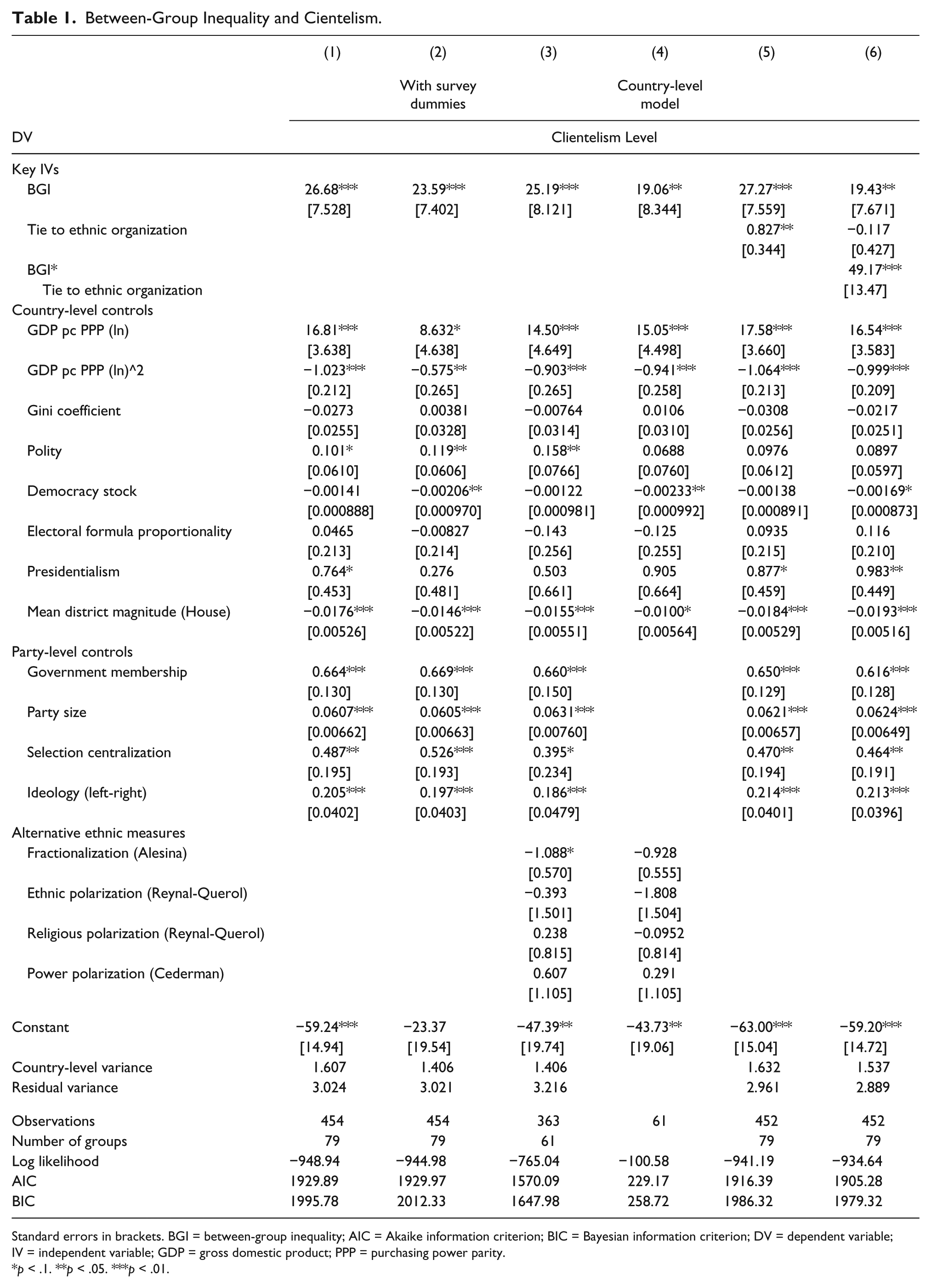
In the first hypothesis, we link economic inequality between politically relevant ethnic groups to higher levels of clientelism. The hypothesis is tested using multilevel mixed-effects linear regression models. We incorporate country-level covariates (including BGI, institutional features, economic development, and levels of democracy) along with party-level variables, including parties’ clientelistic efforts, ideology, size, and government membership. Multilevel mixed-effects models allow one or more of the coefficients to vary from group to group, but be fixed within them. In models 1 to 3 in Table 1, the statistical relationship specified in Hypothesis 1 is estimated with the multilevel models, while model 4 is an OLS regression at country level.
Between-Group Inequality and Cientelism.
Standard errors in brackets. BGI = between-group inequality; AIC = Akaike information criterion; BIC = Bayesian information criterion; DV = dependent variable; IV = independent variable; GDP = gross domestic product; PPP = purchasing power parity.
p < .1. **p < .05. ***p < .01.
Model 1 includes BGI along with the party- and country-level controls, while model 2 also includes dummies of different public opinion surveys used to construct BGI. Model 3 includes alternative measures of societal diversity. Model 4 is country-level analysis, in which only the country-level covariates are included, and the dependent variable is the averages of parties’ scores on clientelism in each country, weighted by parties’ vote shares in the most recent two elections before 2009. Results of these models all support the expectation of Hypothesis 1. Economic inequality between ethnic groups is positively related to parties’ clientelistic efforts. Going from the least to the most ethnically unequal country leads to a substantial increase in parties’ reliance on clientelistic appeals, which equals to roughly one standard deviation (3.7) increase in the clientelism measure. However, the results suggest that ethnic fragmentation, polarization, and political inequality do not significantly lead to more clientelistic efforts. 10
The coefficients on the potential confounding variables are in general consistent with previous research. The results of models 1 to 4 suggest that there is a curvilinear relationship between economic development and clientelism: across very poor countries, economic development tends to be accompanied with increased usage of clientelism, and only when GDP per capita reaches a certain threshold (approximately five thousand per capita GDP PPP 2005 international dollars) does clientelism decline as countries become wealthier. In addition, the district magnitude exerts a negative impact on parties’ clientelistic efforts. At the party level, large and incumbent parties are more likely to invest in clientelism. Parties’ right-wing ideology and centralized decision-making procedure are also positively related to clientelistic strategies.
To sort out the causal direction between ethnic group inequality and parties’ clientelistic effort, we employ the indicators of geographic heterogeneity within countries as exogenous instruments for BGI. These indicators, including the variation in elevation and land quality in a country, and countries’ mean levels of elevation, land quality, and absolute latitude as controls, are assembled by Michalopoulos (2012). The elevation and soil quality of lands are closely related to regional suitability for agriculture. Alesina, Michalopoulos, and Papaioannou (2016) have shown that differences in land endowments within countries are strongly associated with economic disparities across ethnic groups. Land endowments lead to location-specific human capital, which is then reflected in contemporary differences in well-being across groups.
Online Appendix 3 reports the results of two-stage least squares (2SLS) analysis, regressing BGI on the geographic indicators in the first stage, and regressing parties’ clientelistic efforts on BGI explained by the geographic indicators in the second stage. It is possible that geographic heterogeneity directly influences parties’ strategies, or through causal channels alternative to BGI. A potential alternative channel is that geographic heterogeneity predicts individual-level inequality or economic development, which then have effects on partisan clientelistic strategies. To account for this possibility, countries’ per capita GDP, Gini coefficient, and GDP growth rate are controlled. Another potential channel is through the spatial arrangements of political institutions/organizations. It is likely that in geographically heterogeneous countries, political authority is more decentralized (Beramendi and Wibbels 2009) and levels of party system nationalization are low, which then enable parties to engage in particular strategies. To address this concern, the indicators of elected regional government and party competition across regions are also controlled. 11 Model 1 includes the same controls as those in Table 1, and model 2 includes the additional confounders.
In both models shown in Online Appendix 3, the overidentification tests also support the exclusion restrictions. The tests confirm that the residuals from the second stage equation are not correlated with the instruments. The results of the first stage model suggest that indicators of geographic heterogeneity, especially the variation in elevation, are highly predictive of BGI. The second stage coefficients are consistent with the main results shown in Table 1: BGI are significantly related to parties’ clientelistic efforts. Since the geographic features are exogenous, the estimated relationships between geographic heterogeneity, ethnic economic inequality, and clientelism are not driven by reverse causation.
Having established the relationship proposed in Hypothesis 1, we now shift our attention to Hypothesis 2, testing whether the relationship between BGI and clientelism is contingent on parties’ associational features, and whether it is strengthened among parties that have close ties to ethnic organizations. To test this, we include the indicator of parties’ ties to ethnic organizations and its interaction term with BGI in models 5 and 6 in Table 1. Model 5 includes the ethnic organization variable additively without the interaction. The coefficient on the interaction term in model 6 is positive and significant. The estimates of model 6 show support for the expectation that the positive relationship between ethnic income inequality and parties’ clientelistic appeals is strengthened when parties can rely on existing ethnic networks. Figure 2 displays the estimated relationship between BGI and clientelism, depending on the extents of parties’ ties to ethnic groups. It is evident that in societies characterized by high BGI, parties that maintain explicit ties to ethnic organizations particularly engage in clientelistic strategies. The results also suggest that in countries where income inequality between ethnic groups is low, parties with ethnic linkages are not more likely to rely on clientelism. They are consistent with the expectation of Hypothesis 2.
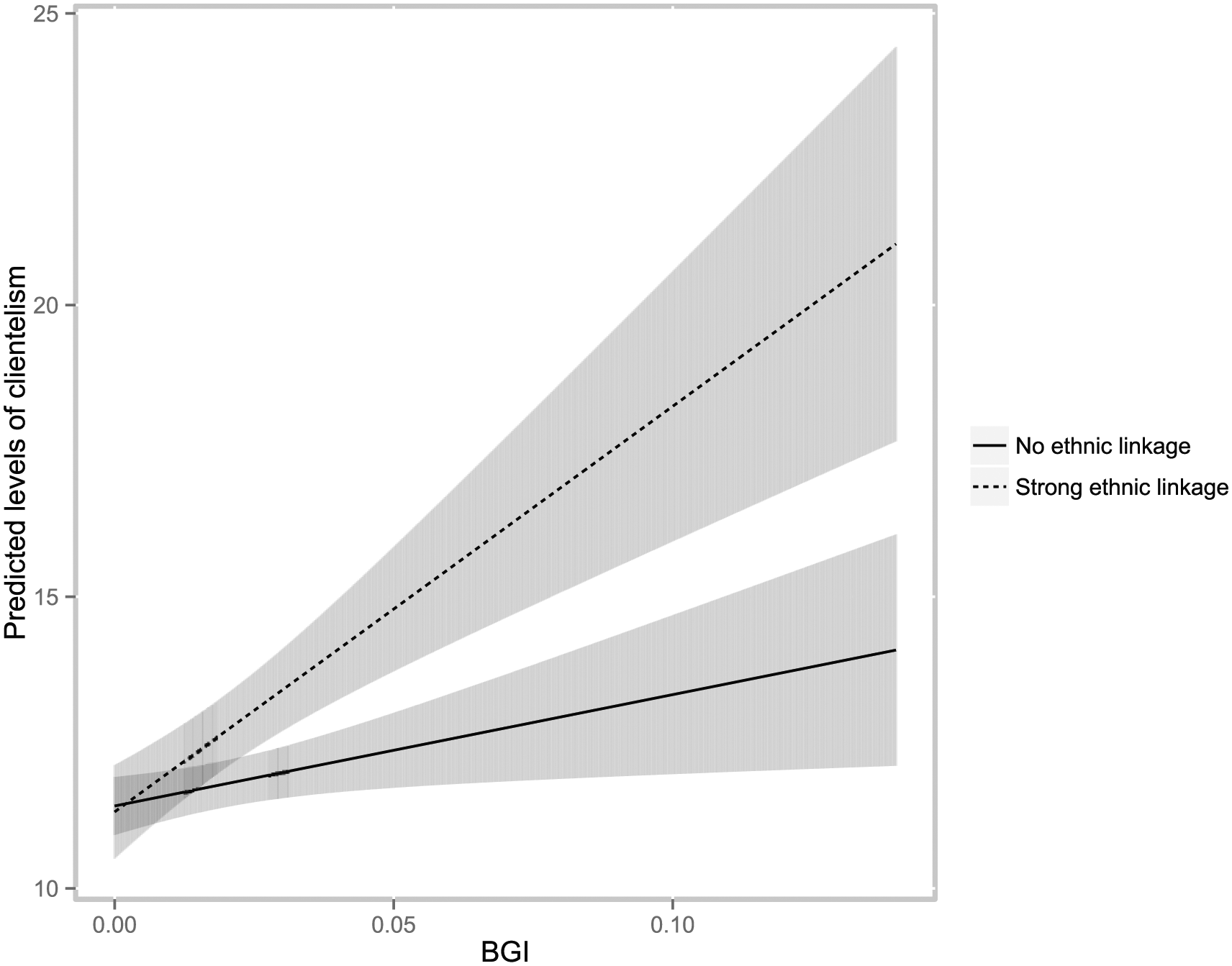
The contingent effects of parties’ ties to ethnic groups.
Conclusion
In this paper, we demonstrate a cross-national analysis investigating the relationship between ethnic divides and partisan clientelistic strategies using a comprehensive dataset with information on more than 450 parties in eighty competitive party systems. We emphasize the pattern of income distribution across ethnic groups. With public opinion survey data, we construct a cross-national measure of income inequality between ethnic groups. We find that in societies characterized by high economic inequality between ethnic groups, clientelism tends to be more widespread. We suggest this is the case because citizens have less preference for broad redistributive policies under such circumstances. Parties may find that members of low-income ethnic groups, who tend to be long marginalized in the political arena, are more responsive to direct and contingent transfers. In addition, our analysis shows that parties’ ties to ethnic social networks moderate this relationship. Specifically, in countries with high BGI, parties that can rely on existing ethnic organizations particularly engage in clientelistic exchange.
The findings have a number of implications. First, the results demonstrate the impacts of income distribution across ethnic groups on democratic accountability strategies. Future research should examine the variation of parties’ appeals over time. As the level of inequality is reduced, do parties respond by diversifying or switching strategies? Furthermore, under what conditions do parties start to invest in programmatic efforts? In addition, the analysis highlights the scarcity of reliable data on wealth or income inequality between ethnic groups across countries and time, which leaves ample avenues for future research. Analysis could also focus on the micro-level by studying individual attitudes. This can illuminate whether respondents who classify themselves belonging to poorer or less empowered ethnic groups are more open to receiving patronage.
Supplemental Material
supplemental_materials_online_supp – Supplemental material for Ethnic Group Inequality, Partisan Networks, and Political Clientelism
Supplemental material, supplemental_materials_online_supp for Ethnic Group Inequality, Partisan Networks, and Political Clientelism by Yi-ting Wang and Kiril Kolev in Political Research Quarterly
Footnotes
Acknowledgements
This article uses various data sources, one of which is a dataset collected under the auspices of the Democratic Accountability and Linkage Project, implemented by a political science research group at Duke University, with Herbert Kitschelt, Department of Political Science, as principal investigator. Funding for the data collection was provided by the World Bank, Duke University, the Chilean Science Foundation (research grant directed by Juan Pablo Luna and David Altman, Catholic University of Chile). The authors wish to thank Herbert Kitschelt and the participants of the Workshop on Democratic Accountability Strategies at Duke University in 2011 for their comments on earlier versions of this article.
Declaration of Conflicting Interests
The author(s) declared no potential conflicts of interest with respect to the research, authorship, and/or publication of this article.
Funding
The author(s) received no financial support for the research, authorship, and/or publication of this article.
Notes
Supplemental Material
Supplemental materials for this article are available with the manuscript on the Political Research Quarterly (PRQ) website.

References
Supplementary Material
Please find the following supplemental material available below.
For Open Access articles published under a Creative Commons License, all supplemental material carries the same license as the article it is associated with.
For non-Open Access articles published, all supplemental material carries a non-exclusive license, and permission requests for re-use of supplemental material or any part of supplemental material shall be sent directly to the copyright owner as specified in the copyright notice associated with the article.
