







Abstract
How do human rights violations affect post-election protest? Until recently, post-election protests have been explained primarily by election-related factors such as the level of manipulation and the quality of electoral institutions. We argue that there are three dimensions along which human rights violations influence post-election protest: (1) the physical cost to protesters, (2) the ability to connect the violation to an election outcome, and (3) the ability to connect the repressive action to the government. Using this framework, we identify political imprisonment as the physical integrity right violation most likely to increase the probability of post-election protest. We test our hypotheses empirically with data on all national-level elections in the world between 1982 and 2012. We find that political imprisonment, a violation easily connected to government action and election outcomes, and less costly physically than other physical integrity rights violations, increases the probability of post-election protest.
On November 4, 2012, hundreds of people filled the streets of Kyiv, Ukraine to protest over “stolen” elections. The opposition argued that the party of the president, Viktor Yanukovych, rigged the vote of the parliamentary election that took place on October 28. 1 However, the president and his allies were known for more than just rigging the ballot boxes. At the time of the election, the leading figure of the Ukrainian opposition and former prime minister, Yulia Tymoshenko, was imprisoned on charges that, many argued, were politically motivated. Furthermore, a year before the election, Amnesty International issued a report noting a significant deterioration of human rights in the country since Yanukovych took office in 2010. Among other violations, the organization pointed to an increase in the number of allegations of torture and other ill treatment as well as restrictions on the freedom of speech and assembly (Amnesty International 2011).
Ukraine is not alone. In the last three decades, more than 15 percent of all elections worldwide were followed by riots and post-election protests (Hyde and Marinov 2012, 2014). In many instances, opposition claimed fraud, but at the same time, the societies were struggling with more than just dirty elections. Are post-election protests driven solely by the reaction of the population to election fraud? Or do general government actions toward the population also have an impact on whether individuals are willing to collectively mobilize in response to election outcomes? In this manuscript, we examine whether violations of human rights have an impact on whether protests and riots occur in response to election results.
Given existing research on human rights, repression, and causes of post-election protest, there are two possible effects that human rights abuses can have. First, it is possible that repression serves as a deterrent to mass mobilization against election outcomes due to the potential physical costs to the population. Second, it is possible that human rights violations serve to “micro-mobilize” the population, thus making it easier to collectively organize in response to an election outcome, as a result increasing the probability of protest occurring.
We refine those existing claims and theorize that governments have a menu of repression tactics at their disposal and that some human rights violations are more likely to increase post-election protests than others. We identify three dimensions that explain this variation: connection to election outcome, connection to incumbent activity, and cost. We argue that human rights violations that affect the election outcome and that can be directly attributed to the incumbent government, but entail lower physical cost, will increase the probability of post-election protests. More specifically, we argue that political imprisonment is the repressive action that most closely matches that profile. As a result, we expect that when a government employs political imprisonment, and wins the election, that election is more likely to be protested.
Existing research tells us a lot about the impact of elections on broader forms of political violence such as riots and civil wars (Cheibub and Hays 2017; Snyder 2000; Wilkinson 2006). Recently, scholars have also begun to explore governments’ incentive for election violence (Collier and Vicente 2012; Hafner-Burton, Hyde, and Jablonski 2013) as well as the timing and the targets of state repression (Bhasin and Gandhi 2013; Davenport 1997; Poe and Tate 1994; Richards and Gelleny 2007). In this paper, we contribute to these literatures by examining the consequences of state repression for post-election mobilization.
We also make several contributions to the current explanations of post-election protests. Theoretically, we hope to improve our understanding of why some elections are followed by protests and others are not. There is a growing literature, which examines the impact of election-day factors, such as election fraud, on the probability of post-election protests (Beaulieu 2014; Beissinger 2007; Hyde and Marinov 2014; Thompson and Kuntz 2004; Tucker 2007). However, in this article, we seek to shed greater light on the extent to which the conditions that are exogenous to the election process can have an impact on how the population reacts to the result of an election. It is important to note that we are not theorizing about or empirically examining government violence tied directly to the election. What we are interested in is how the general human rights practices by the government affects the decision to protest an election outcome. It is also important to note that we are not claiming that election-day factors and more general societal factors are mutually exclusive explanations for post-election protest. It is of course possible, and likely, that both reports of fraud and the human rights practices of the incumbent government have an effect on post-election protest. We emphasize the broader societal factors here because they have received less attention in the literature.
Empirically, we also provide an additional test of whether government repression reduces protest or spurs it on. In particular, we present a more nuanced picture of how different types of repression, specifically torture, disappearances, extrajudicial killings, and political imprisonment, may work differently in the context of election protest. There is a long line of research seeking to answer this question using a number of different empirical approaches (Bell and Murdie 2018; Carey 2006; Davenport 2007; Lichbach 1987; Moore 1998; Rasler 1996; Schedler 2013). Some of this research looks at fine-grained data about individual states where weekly repression and protest dynamics can be observed (Moore 1998; Rasler 1996; Sullivan 2016). Other research designs analyze this question utilizing a state-year unit of analysis in a cross-national sample (Bell et al. 2013). To our knowledge, however, few have explored the impact of different types of human rights violations on post-election protests directly. 2
In this paper, we use the election as the unit of analysis to examine the relationship between repression and post-election protest between 1982 and 2012. Looking at protests in reaction to elections serves as a difficult case for testing existing hypotheses about the relationship between repression and protest. Given the data used here, we know that the protests observed, at least as a proximate cause, are connected to an election outcome. Finding that broad state-level repression is correlated with these election-specific protests, after controlling for election-level factors, will increase our confidence in the power that repression has in either deterring protest or mobilizing people to go to the streets.
The paper proceeds as follows: First, we discuss the extant literature on post-election protests, election fraud, and human right violations. Second, we present our theoretical expectations about the relationship between different types of physical integrity rights violations and post-election protest. Third, we test the proposed hypotheses using data on all national-level elections in the world between 1982 and 2012. We conclude with a summary and discuss the implications of our findings.
Why Post-Election Protests?
Until recently, post-election protests have been explained primarily by election-related factors such as the level of electoral manipulation (Beissinger 2007; Thompson and Kuntz 2004; Tucker 2007). Tucker (2007), for instance, argues that major electoral fraud can serve as a solution to a collective action problem by altering the individual’s calculus regarding whether to participate in the post-election protest or not. He defines major election fraud as “situations in which election results were knowingly tampered with in an effort to advantage one candidate . . . over another” and where such tampering “is suspected to have influenced the overall outcome” (Tucker 2007, 536). Similarly, Beissinger (2007), when analyzing the spread of color revolutions in the post-communist world and beyond, argued that the majority of post-election protests were initiated “in response to electoral fraud,” one of the essential elements in his proposed model of modular revolutions (Beissinger 2007, 262). For Thompson and Kuntz (2004), “stolen elections . . . contribute to societal mobilization by creating an ‘imagined community’ of robbed voters” (Thompson and Kuntz 2004, 162). So-called “stolen” elections contribute to mass mobilization by increasing the expectations that opposition parties could have won and consequently cause popular discontent when the victory is stolen.
Hyde and Marinov (2014) show that international monitors, by providing credible information about the fairness of elections, make the public response to elections, in the form of protest, more accurate. When they identify fraud, the probability of election-related protest increases. However, when they publicly rule out fraud, there is a lower probability of election-related protest. They subsequently show that this credible source of information, which aids in holding leaders accountable for fraudulent elections, strengthens democratic institutions in the long-run. In addition to election observers, Beaulieu (2014) finds that the victory of the incumbent and the strength of the opposition are the main factors that may affect the probability of post-election protests. She argues that as opposition grows stronger, it may force the incumbent to use additional manipulation to stifle electoral competition. Furthermore, a strong opposition might be less likely to accept election defeat even if electoral manipulation is not widespread.
Other scholars argue that it is not fraud per se that leads to post-election protest but rather institutional rules that govern the electoral process. In his 2002 piece, Schedler illustrates that during election periods, political actors interact in a two-level game, where “electoral competition is ‘nested’ inside electoral reform” (Schedler 2002, 103). During the elections, political parties not only compete for votes but also fight over the rules of the game. Chernykh (2014) tested this proposition empirically and found that parties were more likely to organize post-election protests when election-related institutions have been changed prior to the election in a manner that disadvantaged the opposition at the ballot box. These changes frequently led to disagreements among the political actors, which were especially heightened during the election period. To try to force change in the institutional framework and to level the playing field for the next election, opposition parties frequently turned to post-election protest as the only available tool.
Finally, although election fraud is a powerful trigger for post-election discontent, a number of scholars note that elections can serve as a focal point for expressing broader grievances against the regime. While analyzing post-election disputes in Mexico, Eisenstadt (2004) discovered that the Party of the Democratic Revolution (PRD) used elections as an opportunity “to contest broader socials ills” and mobilized its supporters primarily in response to the history of social conflict rather than electoral manipulation (Eisenstadt 2004, 158). Similarly, when recounting the reasons for Color Revolutions in post-communist countries, scholars identify not only election-day irregularities but also corruption and economic mismanagement perpetrated by the incumbent regime (Beissinger 2013; Karatnycky 2005).
These studies suggest that political parties and citizens may mobilize not only in response to election-specific factors like fraud but also in response to factors exogenous to election processes to express broader societal grievances. In this paper, we focus on one such factor—physical integrity rights violations perpetrated by the government.
Human Rights Violations and Post-election Protest
We are interested in systematically explaining the impact of state-perpetrated physical integrity rights violations on post-election protest. We define state perpetrated repression as efforts of the government to inhibit or suppress activities of its opponents (Carey 2006; Tilly 2005). Examples of these efforts may include physical sanctions such as politically motivated imprisonment or disappearances of opposition leaders and prominent activists. We expect that human rights violations sponsored by the regime, in addition to election characteristics, have an impact on the probability of mass mobilization in the aftermath of elections.
In an environment of widespread human rights abuses, elections may serve as a focal point for political parties and citizens to express grievances against the government. There are two main reasons why elections serve as a focal point for such actions. First, across countries, human rights are protected in different ways. But regardless of whether the rights are written in a single document, such as a constitution, or included in an ordinary legislation, the domestic judiciary is an important mechanism for enforcing human rights in a country and setting the limits for state behavior (Powell and Staton 2009). Therefore, if the government is able to perpetrate human rights violations without being held accountable by the judiciary, opposition elites and ordinary citizens will be less likely to seek legal recourse. Instead, public mass demonstration is the only available tool to combat the authorities.
Second, elections may present one of the best opportunities to protest abuses by the government. In recent decades, elections have become one of the most closely watched events by both domestic and international audiences (Bermeo 2016; Donno 2013; Hyde 2011). As Donno states it, “the domestic electoral game plays out before an international audience” (Donno 2013, 3). With all the attention of the world, post-election protest is frequently the best and sometimes the only leverage that opposition parties and the population have. Once the election period is over, it becomes difficult to get the attention of the authorities and the international community before the next election is held. Thus, in such circumstances, rejection of election results and subsequent post-election protests on the part of political parties and citizens can be a form of social movement, where parties and citizens use the post-electoral period to contest broader social problems and express anti-regime behavior. In other words, the public nature of elections opens up an opportunity to publicize broader grievances concerning government actions. The fact that there is an opportunity to highlight these grievances does not mean that all grievances will actually produce post-election protest. Looking at the different types of abuses that states employ, we develop a theory to gain greater insight into when we are more likely to observe a post-election protest.
A government typically has a “menu” of repressive tactics at its disposal (Payne and Abouharb 2016). The authorities may target opposition leaders using such tactics as political imprisonment, torture, extrajudicial killings, or disappearances. Bhasin and Gandhi (2013) find that the target of state repression varies depending on the timing of elections. Before the election, the incumbent regime primarily targets the opposition elites to prevent them from effective campaigning, whereas the repression of the general population increases in the post-electoral period to prevent ordinary citizens from protesting. We argue, however, that repression directed at the opposition is likely to have unintended consequences and increase the probability of post-election protest.
In particular, violations of some human rights are more likely to increase the probability of post-election protest than others. To identify the varying effects of different human rights violations on election protest, we locate four physical integrity rights (torture, disappearances, extra-judicial killings, and political imprisonment) on three dimensions (see Table 1). 3 First, how likely is it that the violation has affected or is perceived to be associated with the election outcomes? Second, can the violation be directly attributed to the actions of the government? And third, what is the relative physical cost of that abuse to individuals in the population?
Three Dimensions of Human Rights Violations.
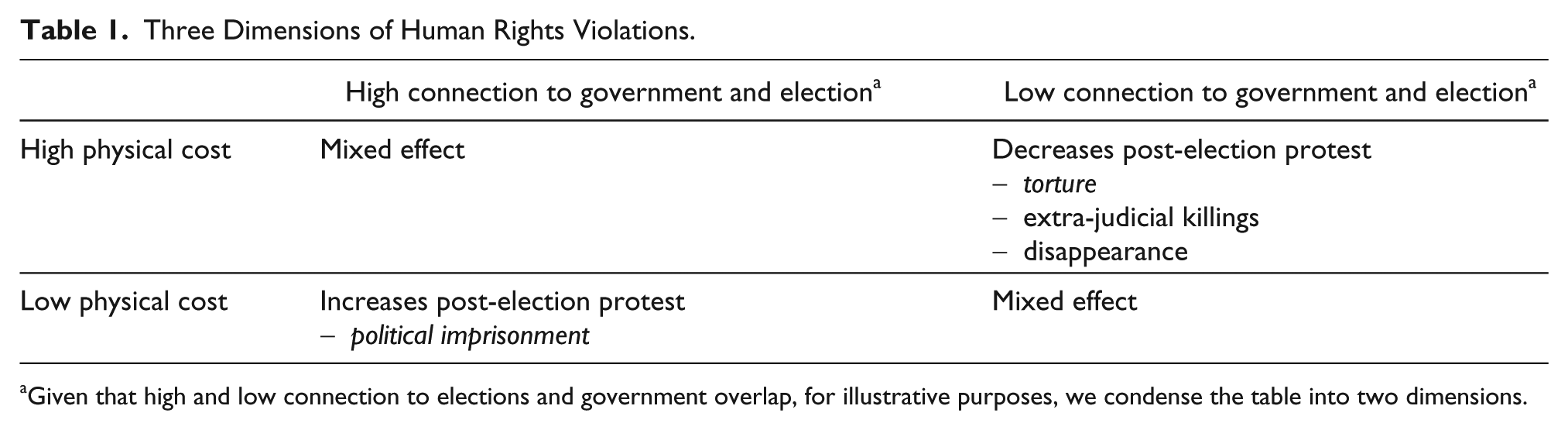
Given that high and low connection to elections and government overlap, for illustrative purposes, we condense the table into two dimensions.
Probit with Post-election Protest Dependent Variable.
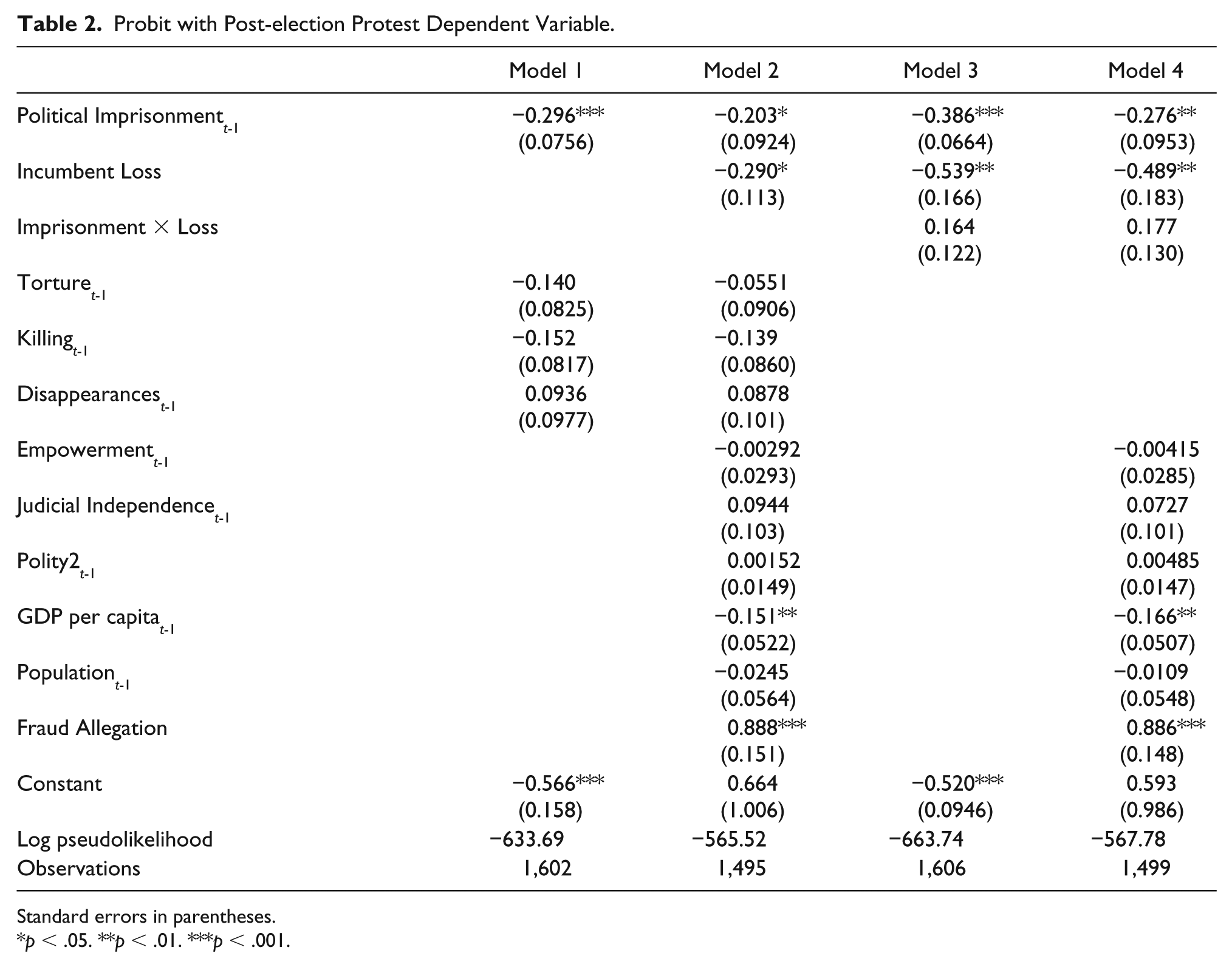
Standard errors in parentheses.
p < .05. **p < .01. ***p < .001.
First, repressive actions that are perceived by the citizens to have a connection to the electoral outcome are more likely to increase the probability of post-election protest. If an abuse is more easily connected to the election outcome, it is more likely that individuals and groups will mobilize in response to potential dissatisfaction with that election outcome. For instance, some repressive acts, such as political imprisonment, can be more easily connected to the election outcome. Political imprisonment is the incarceration of people by government officials because of their political activities such as nonviolent opposition or criticism of government policies or leaders (Cingranelli and Richards 2010). More than many other forms of repression, the imprisonment of opponents to the government can have a direct effect on the election process itself. Incarceration of political opponents prevents them from running in the election, frequently automatically forfeiting the contest to the incumbent party. To a lesser extent, it could be argued that disappearances of the political leaders could also have a connection to the outcome of the election; however, the connection cannot be made as clearly and explicitly as in the case of political imprisonment. Furthermore, neither torture nor extra-judicial killings are as likely as political imprisonment to be easily connected to dissatisfaction with an electoral outcome. These forms of repression are not as easily tied to the electoral process as being imprisoned for political purposes.
Second, some repressive acts tend to be more salient and can draw a lot of attention from both domestic and international audiences. They are frequently a result of a long-term carefully planned strategic decision by the authorities. As a result, such acts of repression are more likely to be directly attributed to the authorities and the incumbent party than other types of repression (Bell et al. 2013). Payne and Abouharb (2016) argue that governments that have signed onto the International Covenant for Civil and Political Rights (ICCPR) substitute away from human rights violations that are easily connected to the government and toward violations that are more difficult to tie to the government. They focus on substitution between extrajudicial killings and disappearances and argue that extrajudicial killings are more easily tied to the government than disappearances are. This leads to fewer extrajudicial killings and more acts of disappearing persons in states that have signed the ICCPR. Payne and Abouharb sought to compare different acts of government killing. Here, we consider the full spectrum of physical integrity rights and the extent to which they are easily connected to the leadership. We expect that when the state carries out repressive acts that are easily tied to the leadership, election-related protest is more likely. Again, while the election itself provides a focal point that produces the opportunity for protest, an abuse that is easily connected to the government is more likely to produce the mobilization necessary for post-election protests.
The physical integrity right violation that is most easily tied to leadership decisions is again the imprisonment of individuals for political purposes. Eliminating the main opponent and preventing her from running in the election, may make the executive and the ruling party appear weak, and afraid of the electoral challenge, which may further motivate post-election discontent. It is frequently difficult to directly connect acts of torture, disappearances, or extra-judicial killings to the actions of the incumbent (Bell et al. 2013). However, when an individual is imprisoned by the state for political purposes, the state cannot deny a role, and it is likely to be made public. Whereas, when someone disappears, the regime can at least refute responsibility for a longer period of time and blame others for a person’s disappearance. As Payne and Abouharb (2016) argue, extrajudicial killings are likely easier to connect to the state than disappearances, but they do not consider a comparison with political imprisonment.
The last dimension in our conceptual framework is the relative physical cost to individuals. Until recently, the physical cost of protest served as one of the defining theoretical building blocks when thinking about the relationship between human rights violations and post-election protest. Cost is an important factor that potential protesters consider when making the decision of whether to mobilize to the streets or not, and some types of repression have a greater deterrent effect than others. Existing literature shows that elites have considerable influence on protest in both democratic and nondemocratic settings (Reuter and Robertson 2015; Robertson 2007). However, the willingness of the people to come to the streets to support them is a necessary condition for a post-election protest to materialize. In an environment of heavy-handed government repression, citizens may be less likely to rush to the streets in support of political parties that lost, which may result in failure to stage a post-election protest.
In the repression and (nonelection) protest literature, there is existing theory suggesting that repression can serve as a deterrent to protest and dissent (Opp and Ruehl 1990; Pierskalla 2010; Rasler 1996). Opp and Ruehl (1990) argue that repression can deter dissent in the short-term. Pierskalla (2010) develops a strategic model of repression and protest and argues that in strong regimes, repression can serve to deter future protest. Regan and Norton (2005) provide evidence that while repression of minority groups might lead to full-scale rebellion and civil war, it does appear to reduce the probability of smaller scales protests. Although developed in the context of general domestic protest, these theories may also hold during the election period.
It is again helpful to consider how different forms of repression might vary in their deterrent effects on protest. Political imprisonment likely carries a lower physical cost to individuals than other forms of repression, like torture, disappearances, or extra-judicial killings. This is not to suggest that individuals do not pay a cost when imprisoned by a government for political purposes, but instead, compared with the three other forms of physical integrity rights, political imprisonment is less likely to deter future protest. While political imprisonment can include physical harm, the other three repressive tactics all explicitly involve either violent bodily harm or being killed. As a result, political imprisonment is the physical integrity right violation that is most likely going to generate grievances, while not necessarily deterring protest in reaction to those grievances. To the contrary, torture, disappearances, and extrajudicial killings are more likely to deter protesters.
Thus, in considering the three dimensions, only political imprisonment meets all three requirements. It is easily connected to election outcomes, can be more easily tied to the actions of the incumbent government, and has the lowest relative physical cost. As a result, we expect that the use of political imprisonment by governments will lead to an increase in post-election protest. While an election provides a focal point and opportunity to mobilize against government abuses of human rights, political imprisonment is the human right violation that is mostly likely to be acted upon, and as a result increases the likelihood of post-election mass mobilization.
This is illustrated using the earlier example of Ukraine. In 2011, many perceived the imprisonment of the most prominent opposition leader, Yulia Tymoshenko, to be politically motivated, a conjecture later confirmed by the European Court of Human Rights. 4 The sentence was set for seven years, preventing Tymoshenko from running in both the 2012 parliamentary elections and the scheduled 2015 presidential elections. Because this effectively eliminated the strongest opponent of the regime, few doubted that it was directly attributable to the president and the ruling party. At the same time, the imprisonment of Yulia Tymoshenko posed little direct physical threat to the general population.
The consideration of these three dimensions leads us to the following hypotheses:
It is important to note that the cost dimension clearly suggests that these three repressive tools will lead to a decrease in the probability of election-related protest. However, the lack of connection to the electoral outcome and incumbent government action should not decrease the probability of protest; it will just be less likely to motivate it in the same way that political imprisonment does. So, while all three dimensions clearly point to an increase in the probability of election protest when political imprisonment has occurred in a state, the negative prediction for torture, disappearances, and extrajudicial killings is really driven by physical cost and the possible deterrent effect of those forms of repression.
Finally, if potential dissenters are motivated to protest elections because of grievances related to political imprisonment, it is unlikely that they will be equally likely to protest against all election outcomes. If election protest is, in part, a response to human rights violations by the government, whether the incumbent wins or loses should condition the effect that political imprisonment has on whether protest is observed. When the incumbent wins, past political imprisonment can provide the incentive to protest that election result. However, when the incumbent loses the election, the violations that occurred under the previous government should have no effect on whether an election is protested. The logic here is that if the incumbent loses, there is little reason for individuals to go to the streets to protest against the human rights abuses of the previous government. If the incumbent wins, and that incumbent has been carrying out repressive practices that are easily connected to both itself and the election outcome, protest is more likely. Considering that the mechanism that we specify to be at work here is that protesters are motivated by a reaction to a government’s human rights abuses when protesting an election outcome, we test the following ancillary hypothesis:
To be clear, this is a conditional hypothesis. While existing literature shows that incumbent victories are more likely to be followed by protest (Beaulieu 2014), the expectation here is that incumbent victory conditions the effect of political imprisonment. More specifically, political imprisonment is more likely to be correlated with post-election protest when the incumbent wins, compared with when the incumbent loses. In the following section, we turn to the research design that we construct to test our hypotheses. Following that, we present our findings and discuss their implications.
Research Design
Given that our theory seeks to explain when we should observe post-election protests, we construct a research design with the election as the unit of analysis. This allows us to test the above hypotheses while controlling for variables that characterize the state and the specific election. The temporal domain of our analysis starts in 1982 and concludes in 2012. The constraint on the temporal domain is a result of using the Cingranelli and Richards Human Rights Data (CIRI) (Cingranelli, Richards, and Clay 2014). We identify the occurrence of an election using the National Elections across Democracy and Autocracy dataset (NELDA) (Hyde and Marinov 2012). In the original data, there are separate observations for executive and legislative elections, even if they occur simultaneously. To not double count these elections that occur simultaneously, we drop the duplicates and only count the executive election. In this section, we describe the dependent variable used to capture election protests, the independent variables used to measure physical integrity rights violations, and the set of control variables that are included in the models estimated.
Dependent Variable and Model
As discussed previously, there is a long line of literature examining the causes of political protest. Some of the existing analyses focus on single countries (Moore 1998; Rasler 1996), while some efforts to gather data on protest are cross-national (Banks and Wilson 2015; Bell and Murdie 2018; Murdie and Bhasin 2011). To test the hypotheses presented earlier, we identify datasets that capture the occurrence of protests in response to elections. Given the focus here on how human rights practices influence the mobilization of a protest event that is explicitly triggered by elections, it is important to measure protests that are directly connected to election outcomes. The NELDA dataset provides both a representative cross-national sample of elections, while also providing a measure of election protest and riots (Hyde and Marinov 2012). The election protest variable from the NELDA data is a dichotomous indicator. Cases with post-election protest are coded as a 1 and cases with no protests reported are coded as a 0. This measure is particularly well suited for testing the hypotheses presented above, as the NELDA coding scheme requires that “the riots and protests should at least somewhat be related to the handling or outcome of the election” (Hyde and Marinov 2015, 14). In addition, the protests are only coded if they occur after the election.
Given the dichotomous dependent variable, a probit model is estimated. To account for potential unequal variances across countries, the model is estimated with robust standard errors clustered on the country. All of the state-level variables are lagged one year prior to the election. 5 This is to make sure that the state-level conditions, like human rights abuses, precede the election protest and are not actually a consequence of it. The election observation, and as a consequence, the protest dependent variable, can be observed at any point in the year of the observation. Lagging the state-level variables allows us to have greater confidence that the conditions precede the election protests. However, the variables capturing any characteristics of the specific election are, of course, not lagged.
A growing body of research examining the relationship between repression and dissent highlights the need to account for potential endogeneity (Carey 2006; Ritter and Conrad 2016). Ritter and Conrad (2016) make a convincing case, that when looking at the daily interactions between governments and dissidents, it is necessary to account for the strategic expectations of both sides. However, for endogeneity to be a concern in this analysis, it is necessary that levels of repression in a state-year are, in part, determined by expectations of election-related protests in the subsequent year. In addition, the fact that we are focused on election-related protest makes this even less likely. Leaders, in deciding on whether to engage in repression, might consider the possibility that it will generally lead to protest in the future, but it is less likely that they consider future protest of elections specifically. As a result, we do not believe that endogeneity concerns are as great when looking at yearly level data as they are in looking at more fine-grained data. Existing research that demonstrates the need to account for potential endogeneity focuses on the more fine-grained day-to-day or week-to-week interactions between governments and dissenters.
Independent Variables
To measure the violation of different types of human rights, we use the CIRI data (Cingranelli, Richards, and Clay 2014). To test Hypotheses 1 and 2, that there might be variation in how violations of different physical integrity rights affect protest, we estimate models that include the individual components of the CIRI physical integrity rights index. In particular, we include the measures of political imprisonment, torture, disappearances, and extrajudicial killings. Each of these components is measured based on U.S. State Department human rights reports and Amnesty International reports on a scale from 0 to 2. A 0 on any of these measures indicates that the abuse is widespread; a 1 indicates that there are a few reported incidences, and a 2 indicates that there are no reports of the abuse. This allows us to test whether the effect of political imprisonment on election protest is different from the other physical integrity rights abuses. Including all the components together in a model allows us to assess whether political imprisonment has an independent effect on protest, even after controlling for other components of physical integrity rights. Again, we hypothesize that political imprisonment is both more likely to be connected to election grievances and easily connected to the incumbent leaders. The coding of political imprisonment captures both the political imprisonment of large groups of individuals as well as capturing when opposition leadership is imprisoned.
A couple of cases in the data help in illustrating the government actions that are captured. First, Belarus in 2005 serves as a good example of a case where activists are imprisoned for political activities. The CIRI data identifies multiple instances where pro-democracy activists were arrested and imprisoned because of their activism (Cingranelli, Richards, and Clay 2014, 24–25). Belarus is coded as a 1 on the political imprisonment variable (on a scale of 0 to 2). 6 Djibouti in 2005 serves as a good example of a case where members of the opposition party are imprisoned. The CIRI coders identified the imprisonment of four members of the Djiboutian Union for Justice in this year. As a result, the case is also coded as a 1. Cuba serves as an example of a case where there is widespread political imprisonment and is coded as a 0 across all the years in the data. Whether it is the average citizen or activist that is being politically imprisoned or the leadership of opposition political parties, we expect this to make individuals more likely to engage in protest after elections.
To test Hypothesis 3 that the effect of human rights violations on protest is conditioned by whether the incumbent wins the election, a variable from the NELDA data that measures whether the incumbent loses the election is used. We generate a dummy variable from this measure where it takes on a value of 1 in cases where the incumbent party lost the election and zero otherwise. 7 This variable is an important control as it is more likely that mobilization occurs in response to an incumbent government (Beaulieu 2014), but it is also important to include it as an interaction term with the political imprisonment variable. We generate an interaction term between political imprisonment and the incumbent loss variable. The expectation on this interaction term is that when the incumbent loses, political imprisonment should not have an effect on protest. When the incumbent wins, political imprisonment will increase the probability of election protest.
We also control for a set of election-level and state-level variables. As discussed above, existing research suggests that fraud is one of the primary factors that lead to election-related protest (Hyde and Marinov 2014; Tucker 2007). As a result, we control for whether a western third-party monitor makes an accusation of election fraud. This is a dichotomous variable that is also drawn from the NELDA dataset and identifies whether an election monitor from an Organisation for Economic Co-operation and Development (OECD) state alleges vote fraud. At the state level, previous research suggests that political regime type has an effect on whether the population engages in protest (Gupta, Singh, and Sprague 1993; Pierskalla 2010). We control for regime type with the polity2 indicator from the Polity IV dataset (Marshall, Jaggers, and Gurr 2014). This measure interpolates values for missing cases and ranges from -10 to 10 with higher values representing more democratic regimes. We also control for logged Gross Domestic P per capita. Existing research shows that protest is less likely in places where the population has greater wealth (Przeworski 1991). We draw the GDP per capita data from the World Bank World Development Indictors (WDI; The World Bank 2015). We also include a logged measure of population size to account for the possibility that states with larger populations have a greater opportunity for protest (Bell et al. 2013). The population data also comes from WDI. The final state-level characteristics that are controlled for both come from the CIRI data. The first is judicial independence. The judicial independence variable also ranges between 0 and 2 with higher values indicating greater independence. Higher level of judicial independence offers political parties and citizens legal routes of contesting electoral outcomes (e.g., courts) and, as a result, reduce the probability of post-election protest. Finally, we control for empowerment rights. We again rely on the CIRI data where the empowerment rights index is constructed from components capturing freedom of domestic movement, freedom of foreign movement, freedom of speech, freedom of assembly and association, workers’ rights, electoral self-determination, and freedom of religion. The index ranges from 0 to 14. Restrictions of empowerment rights might make it more difficult to mobilize protests. 8
Results and Discussion
Table 1 presents the results of the estimated probit models. In models 1 and 2, we examine hypotheses 1 and 2, whether there are specific components of human rights violations that have an effect on post-election protest. In model 1, a pared down model with just the four physical integrity rights measures, the coefficient on political imprisonment is negative and statistically significant at the .001 level. This indicates that higher levels of respect for the right to not be imprisoned for political purposes decreases the probability of a post-election protest. Consistent with hypothesis 1, this means that the more a government engages in political imprisonment, the more likely the population is to protest after an election. The coefficients for torture, disappearances, and extrajudicial killings are not statistically significant at conventional levels (p < .05). These results are not consistent with hypothesis 2. Once we control for other state- and election-level factors in model 2, the political imprisonment coefficient is still negative and statistically significant, and none of the other physical integrity right violation coefficients are. Together, these results demonstrate support for hypothesis 1, but no support for hypothesis 2. However, the fact that political imprisonment is the only physical integrity right to have a statistically significant relationship with electoral protest is of note.
The control variables at the election level are consistent with expectations. In model 2, the incumbent party loss dummy variable is negative and statistically significant. This indicates that when the incumbent party loses, protests are less likely. In other words, protests are more likely in response to incumbent victory. We further explore the conditioning role of the incumbent victory in models 3 and 4. We also find that when a western state monitor makes allegations of election fraud, the probability of a protest increases. At the state level, the only control variable to attain conventional levels of statistical significance is the coefficient on GDP per capita. Unsurprisingly, the higher wealth of a state, the lower the probability of election-related protest. The other control variables do not attain conventional levels of statistical significance.
Models 3 and 4 focus in on the conditional effect of political imprisonment on post-election protest. More specifically, they include an interaction term between the political imprisonment variable and incumbent loss variable. The interaction term allows for a more direct test of hypothesis 3 and the causal mechanism that election protests are partly a response to grievances against the government in place before the election. If election protests are partly driven by grievances against the sitting government, we should only observe the effect of political imprisonment on election protest when the incumbent party wins the election. If the opposition party wins the election, there is less of a reason to mobilize against past human rights abuses. Our expectation here is that the coefficient for political imprisonment should be statistically significant when the incumbent party wins, and not statistically significant with the incumbent loses.
Model 3 presents a pared down model with just the political imprisonment variable, the incumbent loss measure, and the interaction term. Model 4 presents the estimation along with the same set of control variables included in model 2. Across both models, the coefficients for political imprisonment and incumbent party loss are negative and statistically significant. The coefficients on the interaction terms are positive but not statistically significant (although the p value is .09). However, we cannot interpret the interaction terms without graphing out the marginal effects of each constituent variable across the range of the conditioning variable (Brambor, Clark, and Golder 2006).
Figure 1 graphs the conditional effect of a decrease in respect for political imprisonment (greater repression) between the condition where the incumbent wins compared with the condition where incumbent loses the election. 9 The figure shows the effect for a change from 2 (no reported abuses) to 0 (widespread abuses) on the political imprisonment measure. The values on the x-axis identify the marginal effect of a decrease in political imprisonment rights and can range between 0 and 1. 10 The plot shows the effect of a change in the imprisonment variable and the 95 percent confidence interval around the marginal effect for the conditions where the incumbent wins and when the incumbent loses. When the incumbent wins the election, the effect of a decrease in respect for political imprisonment (greater repression) is positive and statistically significant. Under the condition where the incumbent loses, the effect of political imprisonment rights is no longer statistically significant. This provides support for hypothesis 3, that political imprisonment increases protest after elections where the incumbent is victorious. It is important to note the overlap between the confidence intervals under these two different conditions. However, the loss of statistical significance on the political imprisonment variable, under the condition where the incumbent loses, is important to report and consistent with hypothesis 3.
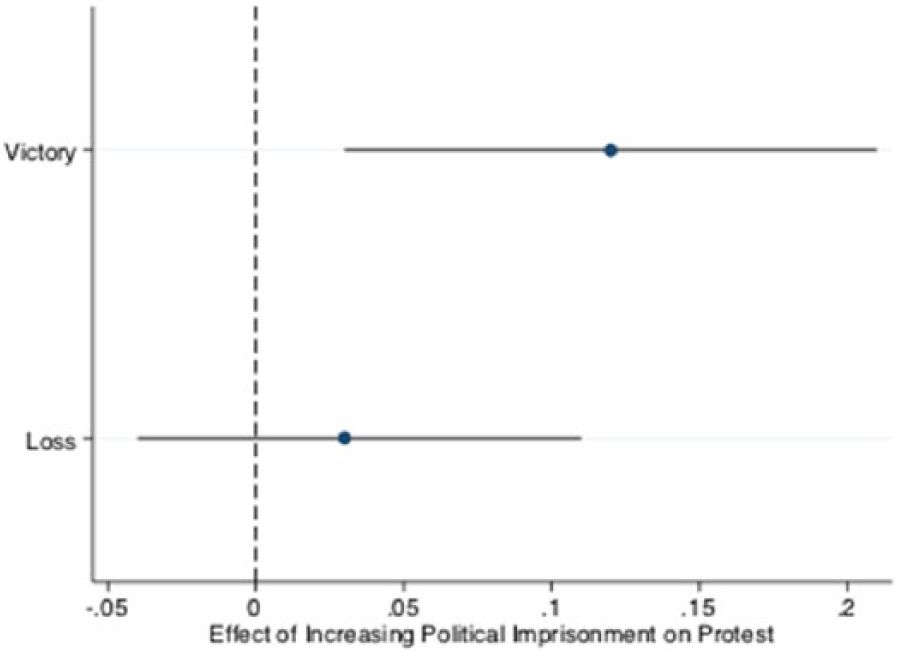
Political imprisonment conditioned by incumbent victory/loss.
Substantively, the plotted values show that when the incumbent wins, the difference in the probability of a protest between a government that engages in no political imprisonment (2) to a case that engages in widespread abuses (0) is 12 percent. This is not a trivial change in the probability of a protest. In all, 15.8 percent of the cases in the data experience a protest. Increasing the level of political imprisonment increases the probability from 8 to 20 percent (hence the 12 percent difference). For comparison, the first difference for a change from no fraud in an election, to a case with fraud, is 22 percent. This is almost twice the size of the change for political imprisonment, but it is important to keep in mind that the allegation of fraud is a specific election-related factor. The imprisonment of political opponents is a broader statewide phenomenon. It is not surprising that it has a smaller effect than an allegation of election fraud. However, given the baseline probability for a protest in a case without political imprisonment of 8 percent, an increase to 20 percent is substantively important. In the case where the incumbent loses, the coefficient is not statistically significant, so there is little reason to interpret predicted probabilities for that scenario. Overall, this finding provides some evidence that post-election dissenters are actually reacting to the victory of the leaders that carried out earlier human rights abuses.
Conclusion
In this paper, we examine the relationship between human rights violations and post-election mobilization. While election-day factors clearly affect the likelihood of post-election protest, we have also made the case that the factors exogenous to elections shape the response of political parties and citizens to electoral defeat. The main empirical finding is that post-election protests are more likely to occur if the government perpetrates human rights violations, especially violations that can be easily attributed to the incumbent, can affect the election outcome, but do not carry a relatively high cost to the general population. These findings highlight the importance of disaggregating human rights violations by target and purpose when studying both their determinants and effects (Bhasin and Gandhi 2013).
Furthermore, we find that the relationship between human right violations and post-election protests is conditional on incumbent victory. Opposition is more likely to stage post-election protest only in response to the victory of the incumbent who was repressive. These findings bring our attention to the importance of the strategic side of post-election mobilization, which deserves further consideration.
Our findings have two main implications for the study of electoral compliance and elections more broadly. First, when analyzing elections and post-electoral protests, it is important to account for not only election-day factors but also the broader social conditions. Political parties and individual citizens use election day to contest more than just dirty elections. Instead, closely watched election days serve as an important focal point to express boarder societal grievances against the regime. While human rights violations might be used by the government to stifle its opposition, they can have unintended consequences by providing an additional focal point and grievance for post-election mobilization.
Second, in addition to these implications for the study of post-election protests, our findings also have implications for the broader study of elections in authoritarian regimes. There is a growing literature on the effects of political institutions, such as elections and legislatures, in relatively autocratic regimes (Gandhi and Lust-Okar 2009; Gandhi 2008; Lindberg 2006). Our finding suggests an additional consequence of elections held in relatively autocratic regimes. Even in the environment of heavy government repression, elections might provide an opportunity for individuals within the state to mobilize against the state and protest.
The findings here also have implications for the general literature on repression and protest. This is another set of results demonstrating that government repression does not have its intended effect on deterring future protest. Furthermore, the mobilizing effect of repression on protest is found here in a sample where the known proximate cause of the protest is the election. Even when looking at election-specific protests, it appears that the broader human rights treatment of the population by the government has a significant impact on protest.
Supplemental Material
Appendix – Supplemental material for Human Rights Violations and Post-election Protest
Supplemental material, Appendix for Human Rights Violations and Post-election Protest by Sam R. Bell and Svitlana Chernykh in Political Research Quarterly
Footnotes
Declaration of Conflicting Interests
The author(s) declared no potential conflicts of interest with respect to the research, authorship, and/or publication of this article.
Funding
The author(s) disclosed receipt of the following financial support for the research, authorship, and/or publication of this article: Svitlana Chernykh acknowledges support from the Australian Research Council Early Career Discovery Researcher Award (Grant DE160101469).
Notes
Supplemental Material

Author Biographies
References
Supplementary Material
Please find the following supplemental material available below.
For Open Access articles published under a Creative Commons License, all supplemental material carries the same license as the article it is associated with.
For non-Open Access articles published, all supplemental material carries a non-exclusive license, and permission requests for re-use of supplemental material or any part of supplemental material shall be sent directly to the copyright owner as specified in the copyright notice associated with the article.
