







Abstract
Despite a wealth of studies examining Muslim religiosity and democracy, uncertainty regarding Islam and attitudes toward democracy remains. Although the claims concerning the incompatibility of Islam and democracy are generally discarded, public opinion scholarship has yet to build much further from this important first step or incorporate a strong theoretical framework for analysis beyond this basic foundation. This paper seeks to integrate literature in social theory on religious worldviews with novel conceptualizations and measurement of distinct religious outlooks among the religious faithful to explain patterns in attitudes toward democracy. We construct a theory with clear expectations regarding these relationships and use the largest and best available survey data (Arab Democracy Barometer, Wave III) to test our predictions using latent class analysis and a series of multivariate regression estimations. The results of our empirical analysis reveal that there are important differences among practicing Muslims regarding the role that religion should play in the social realm and that these differences are relevant to the analysis of how faith shapes preferences for regime type and democracy. The analysis makes a significant contribution to the study of religion and political attitudes.
Keywords
Introduction
The academic debate regarding Islam and democracy spans several decades, yet the literature tackling facets of this issue has retained elements of uncertainty even to the present. The debate has not suffered from a dearth of scholarship, yet, unlike the developing consensus or stalemate that exists in other areas of political research, it would be hard to argue that the existing literature has assuaged the curiosity engendered by the question. At this current juncture, starting with Tessler’s (2002) important work, an increasing number of micro-level studies have taken important steps to refute the essentialist claim that Islam and democracy are incompatible (Ciftci 2010; Robbins 2015; Spierings 2014; Tessler, Jamal, and Robbins 2012). Using survey data, this research has shown that the relationship between Muslim religiosity and democratic support is not necessarily negative. This study aims to build on these seminal works that have effectively challenged the essentialist claims and explore with greater nuance the nature of the relationships between distinct categories of religiosity and democratic preferences.
This paper addresses the relationship between Islam and democracy by switching from a conceptualization that measures the impact of religion through an index along a continuum ranging from “religious to non-religious” to an approach that differentiates various outlooks among the practicing individuals. Using social theory regarding religion, we posit the existence of distinct outlooks within the domain of those generally categorized in public opinion research as “religious” Muslims. Such a conceptual framework allows us to make an important contribution to the literature by moving away from conventional conceptualizations of religiosity toward an understanding of different positions among the religious individuals that might lead to more or less support for democracy. We argue that important variation in religious outlook exists among the devout, and these have important implications on people’s attitudes toward democracy. Therefore, just as others have noted important differences in political participation and voting behavior among various Christian communities in the United States and beyond (Campbell 2013; McClendon and Riedl 2015; Putnam and Campbell 2010), and as Stark and Finke (2000) have proposed generalizable distributions of faith communities (i.e., niches) that balance church-society relations and are influenced by church-state relations (Driessen 2014; Grzymala-Busse 2015), we predict that various religious communities among those normally designated as “religious” would generate distinct outlooks with different views regarding politics and democracy.
To this end, we develop a simple formal model and provide a theoretical rationale underlying the relationship between different categories (or classes) of religious outlooks—frameworks for understanding the role of religion in regard to social order and interactional norms—and support for democracy. Utilizing individual-level data from the third Arab Democracy Barometer (ADB), 1 we run latent class analysis (LCA) and a series of multivariate statistical estimations to identify divergent outlook patterns among religious individuals and test their effects on support for democracy. The LCA estimation utilizing survey items tapping individual views about the role of religion in social, economic, and political life confirms a theoretically informed four-class solution representing distinct types of Muslim religious outlooks. The results of multivariate statistical analyses, in turn, provide substantial evidence for the contention that these religious outlooks shape individual preferences toward democracy according to our theoretical expectations.
In an age of uncertainty, where the search for different governance formulas in the Middle East has given way to violent incarnations of Islamic state models, our analysis demonstrates the utility of conceptualizing and measuring the impact of religion on public opinion, not by the standard measures of religiosity but according to distinct religious outlooks. Our analysis shows that the relationship between Muslim religiosity and support for democracy is far more nuanced than the essential binary discussions can take us, and we believe this approach is an important initial attempt to take the next steps in the study of Islam and democracy and speaks to the broader literature on religion and political attitudes. Our novel operationalization of outlook categories and nuanced theory makes an important contribution to the scholarship on this topic. The paper concludes with a discussion of the ramifications of our findings and the way forward in future research. The implications of both our theoretical and empirical analyses extend beyond Arab and Muslim societies, and more broadly provide potential insights into the relationship between religious outlooks and political preferences in general.
Religiosity and Democracy in Muslim-Majority Countries
The early macro-level research on the Middle East and North Africa (MENA) region highlighted a pattern of authoritarianism and tended to draw conclusions of Muslim or Arab exceptionalism, assuming the scarcity of democracies in the region was best explained by cultural incompatibility (Huntington 1993). The causal mechanism to explain the correlation between religion, culture, and democracy, however, was never precisely agreed on. Some have argued that the principles of Islamic faith somehow ensure that democracy is highly unlikely, if not unattainable, for Muslim-majority countries (Gellner 1991; Kedourie 1994; Lewis 2010).
Of course, if Islam were the driving force behind the undemocratic norms that are prevalent in the Muslim world, a negative correlation between Muslim religiosity and preferences for democracy would be observed at the individual level. Research utilizing public opinion surveys, however, has persuasively shown that democracy is not incompatible for people in Muslim majority countries, nor does religiosity significantly affect one’s view of democracy. Tessler (2002) used survey data in several Arab countries to show that the vast majority of people from these populations do not hold nondemocratic orientations. When he added religiosity variables to the models, they were nonsignificant in most cases, a finding that allowed him to reject the essentialist claim that Islam is to blame for lack of democracy. In Muslim majority countries, where religiosity had a statistically significant impact, the influence on democratic attitudes operated in different ways from case to case. Ciftci’s (2010) analysis of World Values surveys in ten Muslim-majority countries echoes this overall conclusion. Bratton (2003) reports similar findings in comparisons between Christians and Muslims in African societies. Further studies of Arab countries have confirmed persistent support for democracy throughout the region regardless of the level of religiosity (Ciftci 2013; Jamal and Tessler 2008; Robbins 2015; Tessler 2015; Tessler, Jamal, and Robbins 2012).
Although many studies of public opinion in Muslim-majority countries have relied on an index of religiosity based on frequency of religious practices and self-identification as such, there exists a second generation wave of public opinion literature that has taken important initial steps in incorporating some measure of differentiation and nuance. For example, in an important study about religion and inequality, Karakoç and Başkan (2012) introduce a multilevel conceptualization of religiosity. They examine to what extent religion and religious people should take a role in the public sphere and introduce the novel concept of public religiosity/secularism. Ciftci (2013) divides the religious variable between religiosity and socio-religious attitudes. Greater nuance in these relationships have also been attempted by differentiating the democracy measure, such as including indices that distinguish preferences for secular or Islamic democracy (Collins and Owen 2012). This rich literature highlights the complexity of the relationship between Islamic religious identity and regime preferences, yet despite this complexity, we believe that there are important and theoretically informed ways to move our understanding forward. We argue that distinguishing categories of outlooks within the population normally designated religious may give us leverage in understanding the Muslim attitudes toward democracy.
A Multidimensional Classification of Religious Outlooks
While the bulk of the empirical evidence has substantially undermined the contention that Islam is inherently undemocratic, it is unlikely that religion plays no role in shaping preferences over regime-type and governance. It is also equally unlikely that there is a uniform religious outlook among practicing Muslims that would correspond to regime preferences and attitudes toward democracy. Therefore, if we desire to delineate distinct outlook categories among individuals lumped together as religious, how would we do so? In this regard, existing sociology theories are particularly instructive. One potentially beneficial contribution could be found in Davis and Robinson’s Moral Cosmology theory (Davis and Robinson 1996, 2006), which emphasizes two important intra-denominational trends that affect political and economic outlooks. The authors argue that within any religious community, we can distinguish an “orthodox” and a “modernist” trend. The “orthodox” trend espouses the view that divine authority provides an appropriate social order meant for all members of a society. Davis and Robinson assert that this outlook regards individuals as “subsumed by a larger community of like-minded believers who are all subject to the laws and greater plan of God” (Davis and Robinson 2006, 169). Established moral guidance and its benefits and obligations should apply to everyone in the broader sense, and adherence as a whole is of greater benefit than an individual’s freedom for personal discretion. Thus, using their terminology and that of others who have sought to measure a similar understanding, we refer to this outlook as “religious communitarian” (Benson and Williams 1982; Leege and Welch 1989). Consequently, it could be argued that these “religious communitarians” would support religious policy, legislation, and leadership with the understanding that divine authority is intended to be everyone’s shared good, be it moral prescriptions or charitable provision for the poor (Davis and Robinson 2006).
In contrast, Davis and Robinson (2006) point out that many within a faith community have an outlook that they deem a “modernist” cosmology, which espouses individual choice and responsibility. This understanding “combines support for individual choice and freedom with an expectation of individual responsibility, inclining its adherents to cultural individualism.” Whether it is appropriate or not to refer to this as “modern”—as if it were a recent product of the modern condition—it seems reasonable to assume the existence of such “religious individualists.” All things being equal, such a position would incline these “religious individualists” within a faith community toward religious pluralism, autonomous moral decision-making, and its accompanying individual responsibility and tolerance for other views.
Focused on societies in the MENA in particular, Bayat’s (2007) Islamism and post-Islamism distinction overlaps closely with the intra-faith categories emphasized by Moral Cosmology theory. In this distinction, Bayat’s conception of Islamist fits a “religious communitarian” position that champions the need for moral authority systematically structuring social order—that is, “Islam is the solution”—and an attendant focus on the poor and downtrodden.
His categorization of “post-Islamism” represents an outlook that—while maintaining an allegiance to Islamic values—prioritizes the decision-making power of individuals, pluralism, and tolerance toward other viewpoints. The pluralism attributed to this post-Islamist category, however, is understood as manifesting itself as both a condition and a project. Post-Islamism as a project, best represented by the reformists and the Green Movement in Iran in 2009, is primarily focused on the activism of a movement more than a category of individual; nonetheless, the people most clearly associated with such movements correspond to either the religious individualists of Davis and Robinson’s framework or the special category of conditioned post-Islamist that we delineate below.
Bayat (2007) theorizes that, on the more devout side of the spectrum, often through state repression and social marginalization, some erstwhile Islamists realize that an authoritative reordering of society will never be successfully achieved. Here, the resulting “condition” is post-Islamism. Those who have arrived at the “condition” of post-Islamism have been habituated toward an orientation to politics that concludes that they will never really be able to beneficially monopolize the public sphere with their religious ideology alone. The failed attempts to reorder society under a definitive Islamic framework lead some to re-conceptualize or reinvent their position (Bayat 2007). Thus, despite their high level of religious devotion and ardent beliefs, they come to accept a pluralist public sphere with rights for all, but also desire that their values contribute to the political discussion.
These theoretical concepts—religious communitarian, religious individualists, (conditioned) post-Islamists—ultimately hide behind generic measures of religiosity as operationalized by questions commonly asked in public opinion surveys. The questions asking whether people read the Qur’an, pray, or attend a mosque regularly could not begin to differentiate the variation in individual religious communities, just as questions of whether one goes to church, reads the Bible, or prays could differentiate between Baptists, Catholics, Lutherans, and Latter Day Saints in the U.S. context. Therefore, if we want to capture diversity in outlook to a greater degree among practicing Muslims in MENA, we need a way to track down these different theoretical conceptions of outlooks through different questions and methods.
Using the logic behind these categories, it is possible to consider categorization of religious respondents along two important attitudinal dimensions corresponding to our theoretical concepts proposed earlier. One would be a plurality-conformity attitudinal dimension—that is, how much tolerance do respondents have toward plurality of views and beliefs. The other dimension would relate to whether or not religion should primarily be a public or private phenomenon. A two-dimensional framework would lead to four logical categories:
Figure 1 illustrates how these categorizations would fit along a two-dimensional spectrum, and how these categories, which we will attempt to tease out among devout participants of the ADB III, could be relationally distinguished from one another.
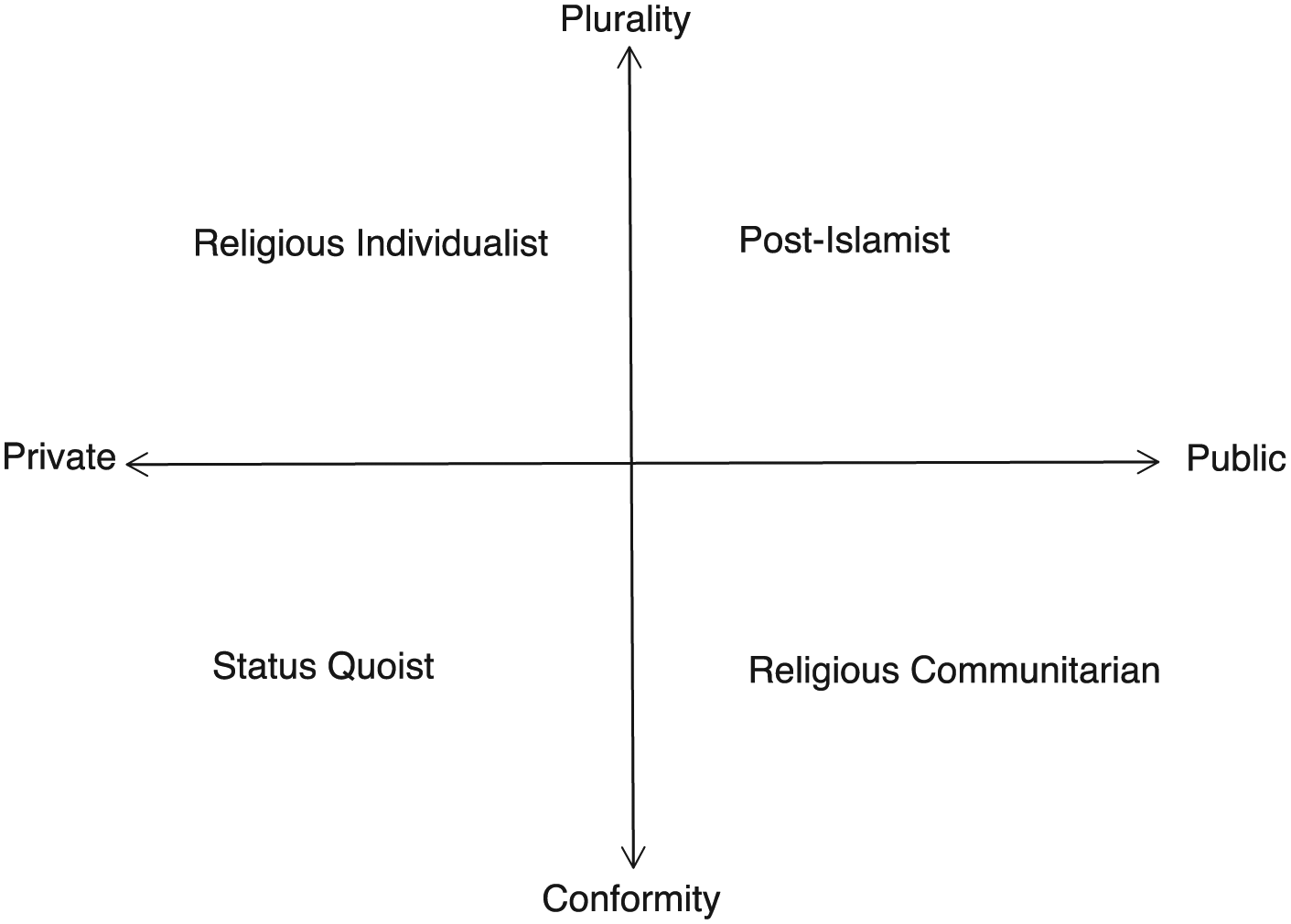
Dimensions of religious outlooks.
Religious Outlooks and Support for Democracy
Can distinguishing among these classifications help us predict attitudes toward democracy among religious Muslims? Conceptualizing and categorizing the relationship that individuals share with their faith is not simply an exercise meant to provide greater descriptive rigor or clarity. The role that others play in enhancing the quality of a person’s religious experience has the potential to fundamentally shape their social, political, and economic preferences (Gaskins, Golder, and Siegel 2013a, 2013b; Grzymala-Busse 2015; McClendon and Riedl 2015). Discussions of religion and democracy that focus exclusively on the intensity of an individual’s faith or adherence to a fundamentalist set of beliefs, while often insightful, neglect the influence that the social dimensions of religious belief have on preferences for political regime type. Is religion a private matter, or an inherently social undertaking that requires the participation of others? Do the religious contributions of others enhance an individual’s own experience? A person’s perspective on issues such as these should influence their beliefs regarding the appropriateness and suitability of democratic governance in their own state. We develop a formal model underlying the discussion and theoretical framework that follows. A nontechnical description of this model is provided in the following. The technical details and the solution of the formal model are presented in the supplemental file.
As Habermas (2006) and Dreyer (2011) contend, there is no inherent unresolvable tension between individual piety and the modern liberal democratic institutional framework. Within a liberal democratic state, both those who are and are not pious are afforded the opportunity to locate themselves ideologically and religiously in their personal lives closer to their preferred location given the regime’s imposition of lower costs from deviating from its preferred position. Given liberal democracy’s incorporation of freedoms that provide individuals the ability to act according to their own religious preferences at lower costs, why then might some pious Muslims in Islamic societies prefer authoritarian rule? 3 This is arguably because an individual’s preference for autocracy over pluralistic democracy derives not from preferences related to her own actions but from her preferences with regard to the actions of others (Feldman 2003; Feldman and Stenner 1997). It is the preference of individuals to limit the actions of others along certain dimensions that lead them to support more repressive regime types. While repression can and does occur in democratic contexts, a liberal democracy that incorporates individual rights regarding freedom of speech and religion largely provides for an environment that constrains the actions of others to a lesser extent than an autocracy. For those who benefit socially from a regime that institutionally constrains or promotes the religious behavior of its constituents, there should be a greater tendency to support an undemocratic regime.
The preceding sections provided a classification of pious Muslims into four categories inspired by social theory. It is reasonable to assume that each of these comes bundled with a set of beliefs regarding the role of Islam in society. While the set of beliefs that characterize each type is undeniably large and nuanced, for our purposes, it is the subset of beliefs that relate to the public and social realm that are of relevance to this inquiry. In particular, the previous sections highlighted the general positions of each category with regard to both social and religious cohesion, which we conceptualize as the inverse of a preference for pluralism, and the presence of religion in the public sphere.
Those possessing a strong preference for social cohesion and conformity implicitly, yet necessarily, prefer a less pluralistic society. Variance in terms of the religious practices of others negatively affects their own enjoyment of social interactions and threatens the social, economic, and political stability of their state (Easterly, Ritzen, and Woolcock 2006; Henrich 2000; Schotter 2008). An autocratic regime’s ability to coerce conformity to its preferred ideological and religious position through the imposition of costs for deviation provides benefits to those who have a strong preference for social cohesion (Feldman 2003). Thus, the stronger an individual’s preference is for social cohesion and conformity, the lower their support for a liberal democratic regime should be.
A preference for social cohesion is not the only variable related to the social dimensions of piety that is potentially capable of influencing preferences for democracy. As the literature on religion and public goods has repeatedly demonstrated theoretically and empirically, individuals derive utility from the religious contributions of others (Berman 2000; Iannaccone 1992, 1998; Owen and Vidras 2007). It is not simply conformity to a norm or social cohesion that produces benefits; the active participation of others provides an atmosphere for some that confers benefits that are both conditional and unconditional. For example, an individual may derive greater utility from attending a religious lesson or prayer when others participate as well (Berman 2000). An individual, however, may also benefit from the payment of zakat, or alms-giving, independent of their own pious actions or contributions. Thus, individuals may derive benefits from the religious contributions of others, and may prefer a regime type that increases these contributions, whether or not they contribute themselves.
Although religious contributions to the public domain may be achieved through coercion, the opposite is also true—coercion may be used to limit religious contributions to the public domain (Habermas 2006). Thus, democratization may potentially increase the influence of religion within the public domain or reduce it relative to its autocratic alternatives, contingent on the ideological position of both the society and the nondemocratic alternatives available. Although preferences over regime type may be driven by considerations related to the religious contributions of others, those preferences are tied to an individual’s perception of what viable alternatives to democracy exist. Therefore, preferences with regard to regime type and the presence of religion in the public sphere are mitigated by beliefs regarding the importance of social cohesion. Whereas a stronger preference for uniformity necessarily reduces the utility of democracy, a stronger preference for religion in the public sphere may increase or decrease the perceived utility of democracy. Thus, we can conclude that when all other variables are held constant, an individual’s support for democracy is decreasing in her preference for social cohesion (see Proposition 1 in the supplemental file) but cannot conclude that a preference for religion in the public domain will generally increase or decrease support for democracy.
Among the four categories of pious Muslims theorized in this article, two categories possess a preference for social conformity and antagonism toward religious pluralism. While religious communitarians and status quoists differ with regard to their support for religion in the public sphere, both are opposed to religious pluralism. The other two categories, religious individualists and post-Islamists, also differ as to their views on religion in the public sphere, but are both less likely to exhibit strong preferences for social conformity. Therefore, we would expect religious individualists and post-Islamists to be more supportive of democracy relative to religious communitarians and status quoists (see Corollary 1 in the supplemental file).
While the implications associated with the classification scheme and theoretical framework presented herein produce a number of potentially testable implications, the analysis that follows will broadly focus on the relationship between Islamic religious outlook and an individual’s probability of supporting democracy. 4 The fundamental argument being tested in this article is that individuals who adopt latent religious outlooks that emphasize socio-religious cohesion and homogeneity should be less likely, on average, to support democracy. 5 For our analysis, we reserve the status quo category as the reference category. Thus, all predictions are based on comparisons between status quoists and members of other groups. We present the measurement strategies corresponding to different types of democratic support in the next section.
Data and Variables
To test the above hypotheses, we use the third wave of the ADB. The sample includes Muslim-only respondents in Algeria, Egypt, Iraq, Jordan, Kuwait, Lebanon, Libya, Morocco, Palestine, Sudan, Tunisia, and Yemen with more than ten thousand individual observations. This dataset includes many items allowing the operationalization of religious categories, democratic orientations, and political attitudes. 7
Categories of Religious Outlooks
Our theoretical discussion builds on a classification of moderately to highly religious individuals with regard to their preferences for the role of Islam in social and political life. Since our theory proposes that we should observe different religious outlook categories among those who are at least moderately pious and that the simplistic scalar measurement from nonreligious to religious misses critical diversity among the devout, we intentionally truncate our sample to moderately and highly religious respondents to put this notion to the test. We also present the multivariate models with full sample of both religious and less-religious respondents below, but focus on the reduced sample that provides a more difficult case for testing our theory. 8 From a measurement perspective, it is imperative to observe clusterings of religious respondents into groups roughly corresponding to our fourfold conceptual construct. To that end, we use a statistical technique known as LCA. LCA uses information about the frequency of responses to survey questions and partitions these responses into unobserved groups (classes) based on similarities and differences as well as the probabilities of group membership for each individual. LCA is a finite mixture model that estimates underlying class memberships with categorical and continuous variables (Hagenaars and Mccutcheon 2002; Lazarsfeld 1950). 9
Since our categories assume variance among the devout with respect to their religious outlooks, we begin by separating the nonreligious from religious and utilizing only the respondents who report to be moderately to highly devout. Once we have selected our pool of respondents based on this category, we leave the variables measuring religiosity out of the LCA estimations. We use three questions tapping frequency of religious practice including daily prayer, Friday prayer attendance, and listening to or reading the Qur’an. Responses to these questions range from 1 (never) to 5 (always). We drop all respondents whose responses are never (1) and rarely (2) to obtain a reduced sample of moderately and highly religious individuals. We believe this strategy is superior to the existing approaches insofar as it allows us to show that empirically, pluralistic Muslims in Arab societies are not necessarily only those nonreligious, nonpracticing nominal Muslims.
Our analysis demonstrates that among the devout, there is, indeed, a heterogeneous set of beliefs regarding pluralism and religion’s role in the public square. We use twelve survey questions evaluating individuals’ views about pluralism and their preferences regarding the presence of religion in the public/political sphere in LCA estimation. 10 These questions tap individual preferences about the compatibility of law with Islam; the role of shari’a in private life, marriage, and the public sphere; membership in charitable organizations; attitudes toward religious minorities and non-Muslims; perceptions of disagreement among religious scholars; support for religious parties; perceptions about religious leaders taking office; and attitudes about the influence of religious institutions in voting. These questions are good proxies for assessing individuals’ positions about the role of religion in social and political life and, hence, allow us to move beyond self-reported religious practice as a measure of religiosity. 11
While the LCA estimation provides empirical distribution of responses that helps us determine feasibility of different number of classes, it does not guide researchers about how many classes are needed in allocating individuals to unobserved clusters. The choice about the number of classes should be driven by theoretical considerations complemented by the empirical patterns obtained in LCA estimation. In our analysis, we choose four-class specification over alternatives with fewer or more classes primarily based on our theoretical expectations. Supporting these expectations, posterior class probabilities of LCA estimations, percentages of class shares, and additional model fit statistics confirm that a four-class solution is the best fit for the data in hand. 12
The distribution of posterior probabilities for the response categories of twelve items is presented in Figure 2. The stacked bars show probabilities within the response categories of each variable ordered from the negative to positive preferences. By and large, individuals who prefer a greater role for Islam in social and political life have a higher probability of belonging to religious communitarians or post-Islamists than the other classes. Post-Islamists also lean favorably toward religious pluralism, a tendency that can be observed even more strongly among the members of the religious-individualist class. It should be noted that the empirical patterns from LCA reveal that post-Islamists swing between religious communitarians and religious individualists in their preferences. Therefore, when it comes to their preferences about institutional role of sharia or the religious principles, they may hold at least equally strong preferences as religious communitarians or in their pluralist preferences approach to religious individualists. Status quo class takes the middle positions with respect to religious pluralism and Islam’s role in social and political life. The same classification scheme also prevails in estimations with the full sample including both religious and nonreligious respondents.
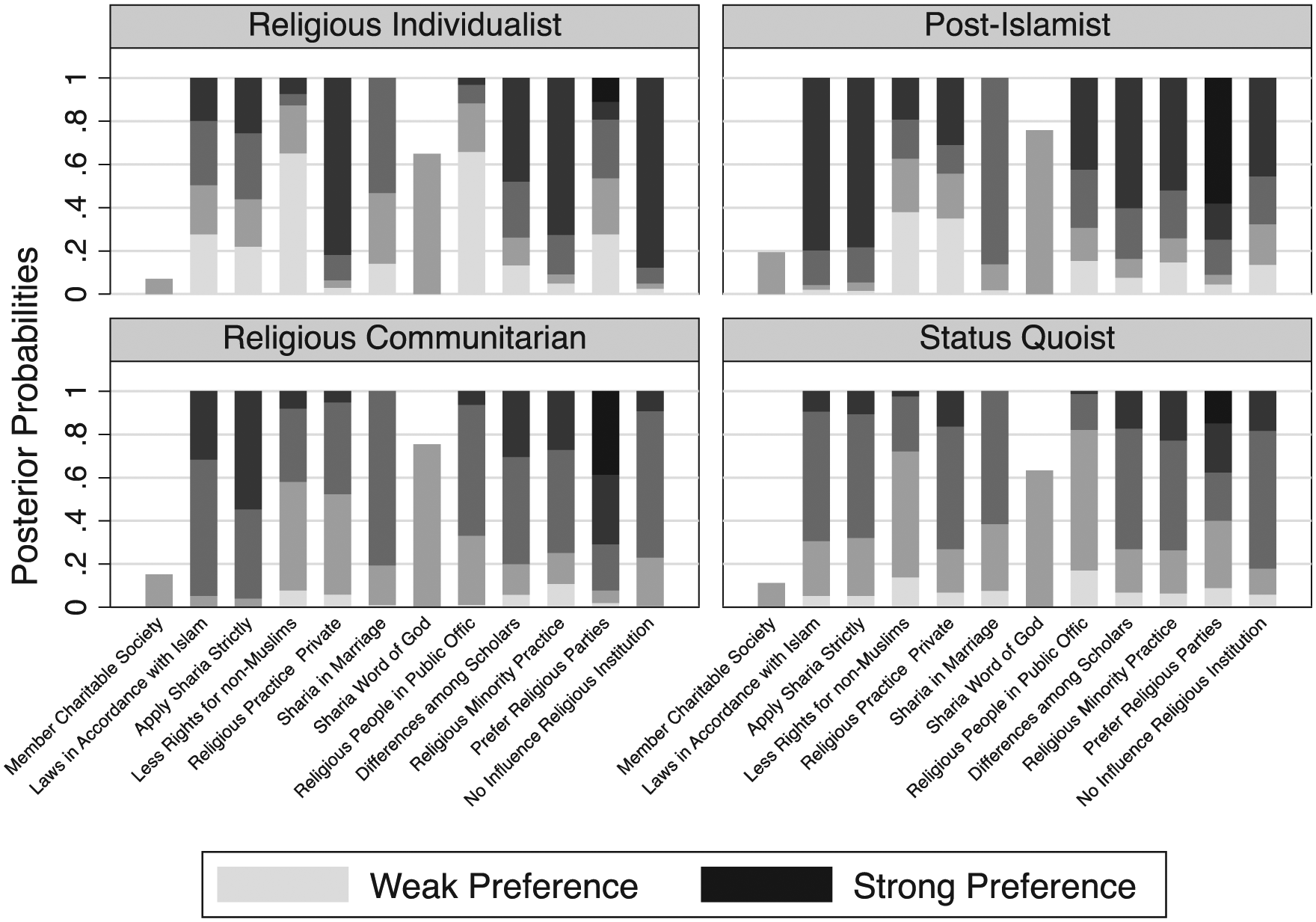
Distribution of posterior probabilities by religious outlooks.
Figure 3 shows class shares and probabilities along the distribution of religiosity index. As discussed earlier, this is an additive index of questions asking about daily prayer, Friday prayer attendance, and Qur’an readership. We only keep moderately to highly religious individuals in the analysis. According to Figure 3, religious communitarians and status quo categories have the largest class shares (38% and 26%, respectively) followed by post-Islamists (23%) and religious individualists (13%). Not surprisingly, a larger proportion of religious individualists are moderately religious. The class share of religious communitarian and post-Islamists increases at the higher end of religiosity index, but the post-Islamist class percentage also has a secondary spike among the moderately religious. Finally, members of status quo class have considerable shares across all categories of religiosity with a declining pattern at the highly religious end of the scale. Overall, religious communitarians and post-Islamists tend to be more religious, but members of four classes can be found across all categories of devout. Based on these findings, we argue that the four religious outlook categories unfold the variation in religiosity that might have been masked by conventional measures, and hence, religious outlook conceptualizations give leverage in explaining the nuanced relationship between Islam and democracy at the individual level.
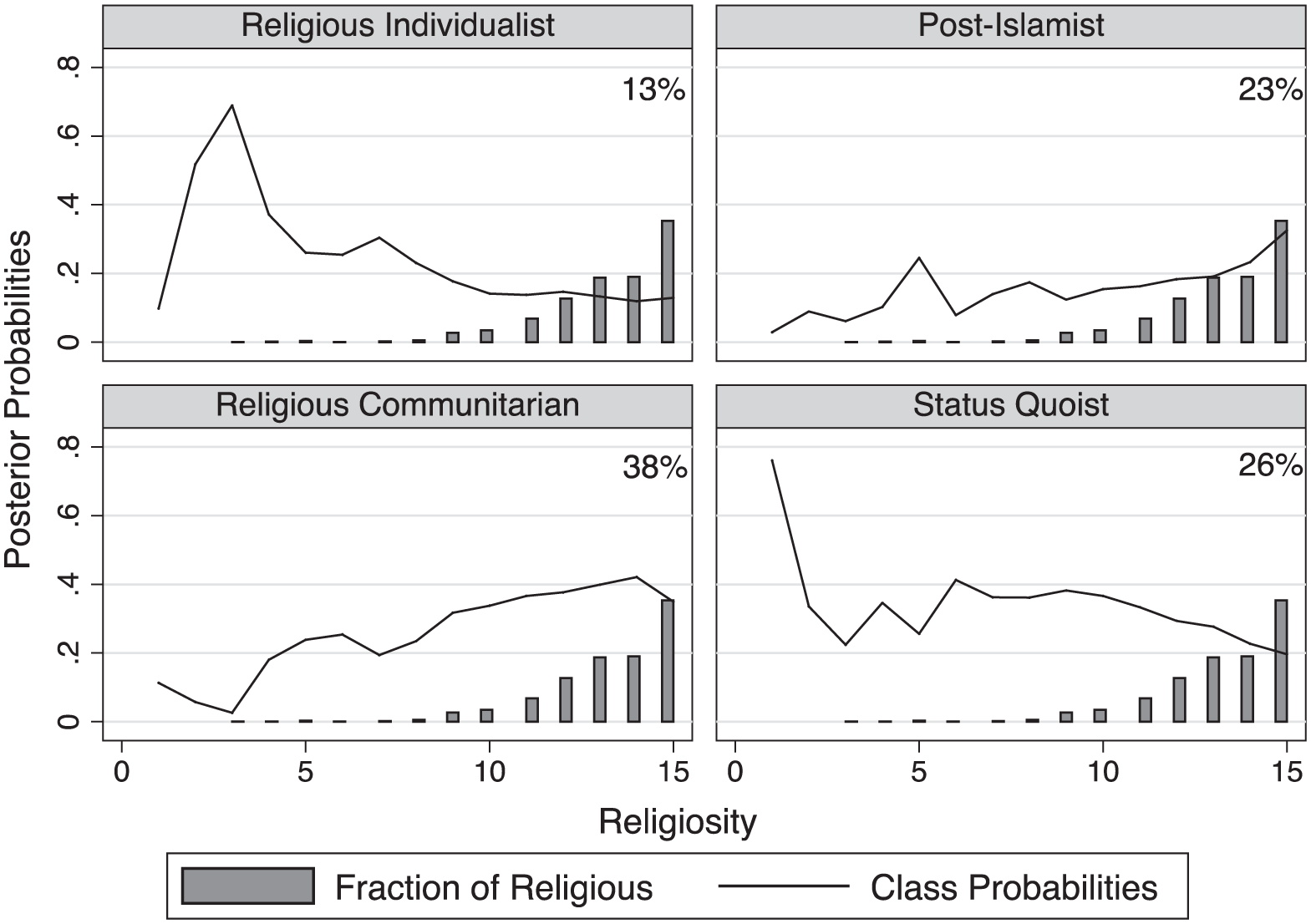
Distribution of the four religious outlooks along religiosity index.
Dependent Variable
Our main dependent variable is support for democracy. We use overt support for democracy to measure individual preferences that range from solid support to noncommitment to democracy (Inglehart and Welzel 2003; Klingemann 1999).
13
Rather than using a single item asking the respondents about their opinion of the democratic system, “overt support” takes the difference in responses to two questions: I will describe different political systems to you, and I want to ask you about your opinion of each one of them with regard to the country’s governance—for each one would you say it is very good, good, bad, or very bad? A democratic political system (Q517.1) A political system with an authoritarian president (nondemocratic) who is indifferent to parliament and elections (Q517.2)
Both questions are recoded to range from “very bad” (1) to “very good” (4). Then, we subtracted the second question from the first one to obtain an index ranging from −3 (weak support) to +3 (strong support). 14 The distribution of this index has a negative skew with 63 percent of the respondents holding very strong preference for democracy (a score larger than 1 on the index).
Independent Variables
Our main independent variable is the dichotomous variables for class membership obtained through LCA estimation. We keep dichotomous variables measuring Religious Individualist, Religious Communitarian, and Post-Islamist categories in the models and use the Status Quo group as the reference category. LCA provides probabilities of each response category in a question belonging to an estimated class. Class memberships for each individual are determined by the size of these probabilities. While one can also create a propensity score to obtain a continuous measure, we prefer the dummy variables approach because our theoretical model distinguishes between religious outlook classes and because this approach is commonly used in previous studies (Blaydes and Linzer 2008; Hagenaars and Mccutcheon 2002; Lazarsfeld 1950). 15
We also include several control variables commonly used by previous studies. Interpersonal Trust is a dichotomous variable taking the value of 1 if respondents believe most other people can be trusted. Political Trust is an additive index of items asking the respondents the degree of trust they have in certain political institutions (government, elected council, public security, the army). We use a self-reported level of interest in politics (Political Interest) on a scale ranging from not interested (1) to very interested (4). We also control for Egalitarian Gender Beliefs, a commonly used indicator of cultural modernization theory by previous studies (Ciftci 2010; Norris and Inglehart 2003). This index ranges between 3 (less egalitarian) and 12 (more egalitarian) and combines responses to three questions measured along a four-point agreement scale: men make better political leaders than women, a married woman can work outside the home, and university education is more important for males. Additional controls include respondents’ views about current (four-point scale) and future economic conditions (five-point scale) with higher values showing positive evaluations. All models include controls for gender (female = 1), level of education harmonized across twelve countries (seven-point scale), household income, age, and country dummies.
Results and Discussion
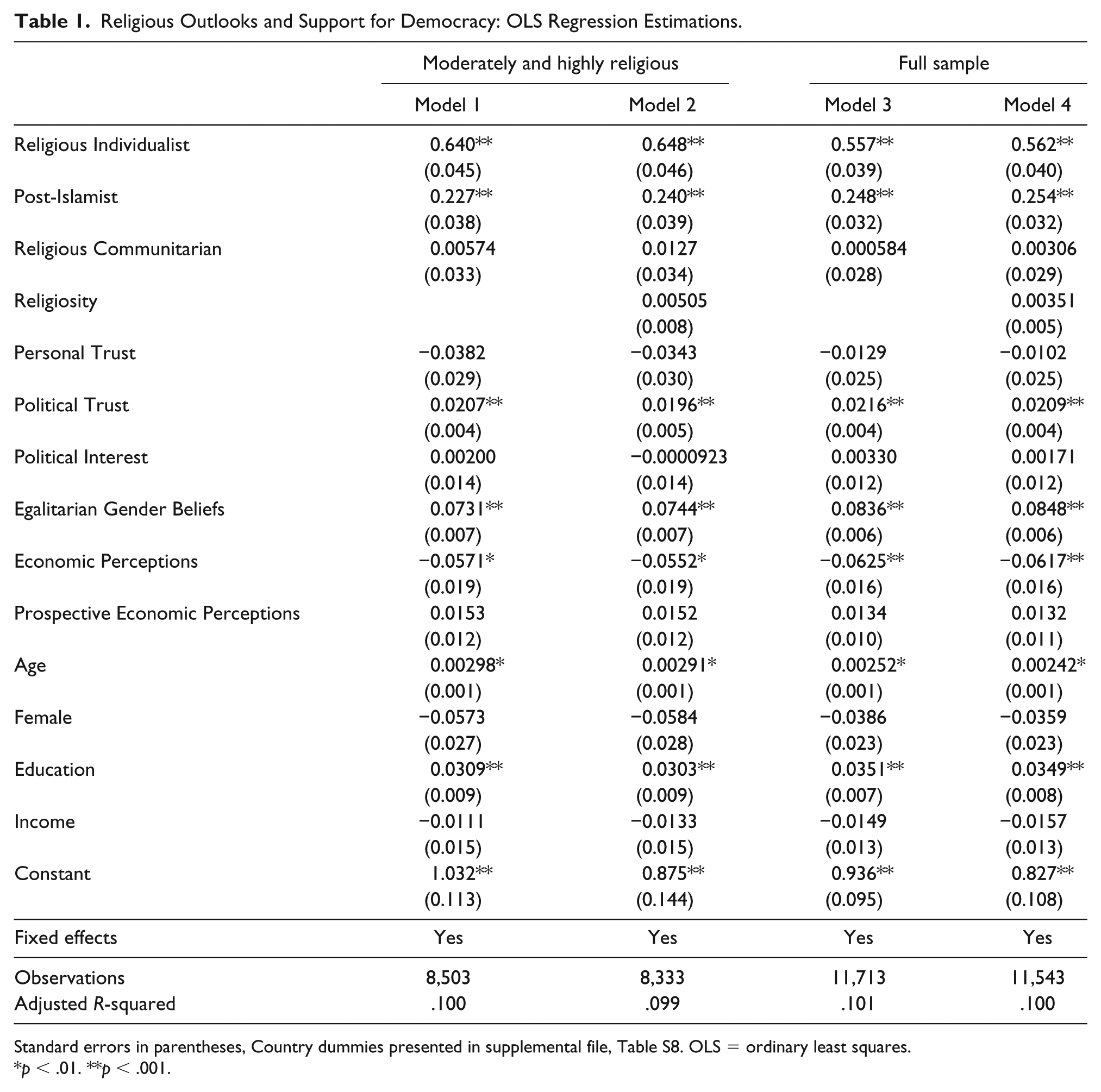
We present the results from the ordinary least squares (OLS) regressions for the reduced (moderately and highly religious) and full samples in Table 1. Because we propose that the effect of religiosity on democratic orientations can be better captured through religious outlook categories rather than a single religiosity index, we also present the models controlling for this conventional measure of religiosity for comparison purposes. Because we run pooled estimations with a large number of observations, we specify a higher threshold of statistical significance (p < .01). Overall, we find substantive evidence supporting the implications of our theoretical model as shown in Table 1.
Religious Outlooks and Support for Democracy: OLS Regression Estimations.
Standard errors in parentheses, Country dummies presented in supplemental file, Table S8. OLS = ordinary least squares.
p < .01. **p < .001.
We find that different social preferences emanating from religious outlooks can explain democratic orientations better than an essentialist approach searching for a negative or positive relationship between Islam and democracy based on binary measurements of religiosity. In the reduced sample estimations (models 1 and 2), religious individualists and post-Islamists are more likely to support democracy than those who prefer status quo. While these results lend support to H2 and H3, we were unable to reject the null hypothesis for religious communitarians’ support for democracy. This latter finding supports H1 proposing no difference between religious communitarians and status quoists in their democratic orientations. Thus, as our theory would have predicted, those who have strong preferences for pluralism (religious individualists and post-Islamists) are more supportive of democracy than those who hold strong preferences for social cohesion and conformity (religious communitarians and status quoists).
The significant effects of religious outlook categories remain robust to the addition of the conventional measure of religiosity (not significant) and to the estimations with the full sample. We especially highlight our findings with the reduced sample, because this estimation allows us to show that the differences across religious outlook categories with respect to democratic preferences have an empirical foundation, and we can observe these differences among the moderately to highly religious.
We calculated the marginal effects to present substantive differences among different religious outlook groups in relation to level of support for democracy. Figure 4 presents the marginal effects for each religious outlook class in reference to status quoists who form the reference group (models 1 and 3). In substantive terms, religious individualists, the group least likely to prefer social conformist views, hold considerably higher levels of support for democracy compared with post-Islamists who hold certain pluralist views and religious communitarians who are most likely to hold conformist views. These results hold in both reduced and full sample estimations. Post-Islamists, as expected, occupy the middle position between religious individualists and religious communitarians, but they are located closer to the latter group. This could be seen as an illustration of the theoretical relationship we have proposed regarding Bayat’s (2007) Islamist and post-Islamist categories. The proposition that these post-Islamists are erstwhile Islamists (i.e., religious communitarians) who have been conditioned into a shift toward pluralism over time seems to fit the relationship of the lines in Figure 4.
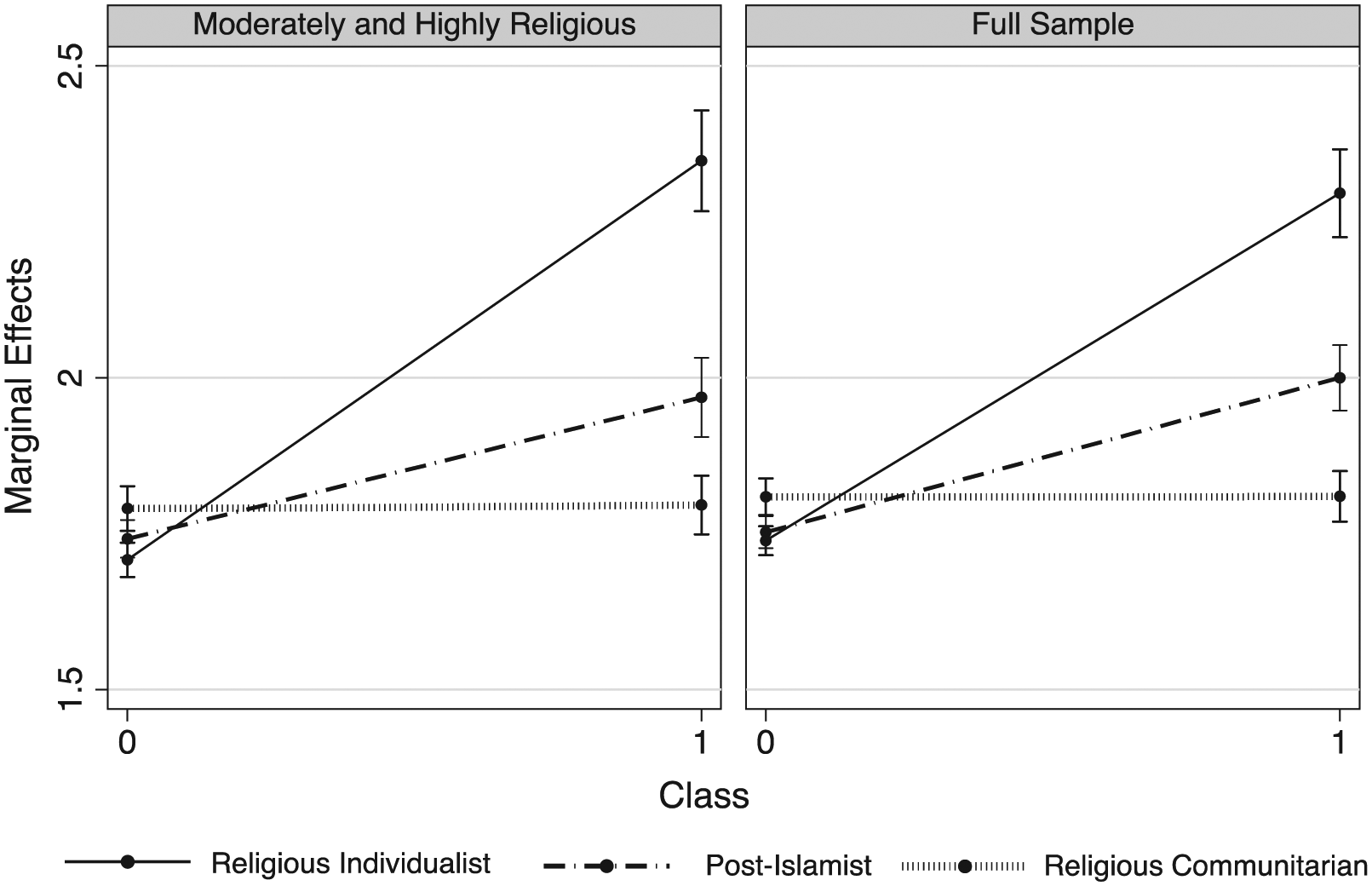
Marginal effects of religious outlooks on support for democracy.
The pattern of marginal effects across religious outlook categories in reference to democratic support remains the same in the reduced and full sample estimations. However, the difference between religious individualist and the other two groups is larger in the sample of moderately to highly religious individuals compared with the full sample. In addition, the distance between religious communitarians and post-Islamists gets marginally larger in the full sample estimation. These results once again confirm that political preferences associated with distinct religious outlooks will differ significantly and that some of these differences may be highly visible in the universe of the pious.
Finally, looking at the control variables in Table 1, religiosity has no statistically significant effect on support for democracy. We interpret this result in conjunction with the statistically significant effects of religious outlook dummies as indicative of shortcoming of using a conventional measure of religiosity in the empirical study of Islam and democracy. A binary measurement strategy of less to more religious may be masking the rich variance in the relationship between Muslim piety and support for democracy (Ciftci 2010; Tessler 2002). Highly educated individuals, those holding egalitarian gender views, and those with high levels of political trust are more supportive of democracy. Controlling for religious outlooks, we do not find a statistically significant gender gap in democratic orientations.
Robust Analysis
The results of the LCA and multivariate estimations are robust to alternative specifications. First, we ran the LCA estimation by dropping the questions related to minority rights as these items may favor a positive association between religious individualist category and support for democracy. 16 In these estimations and additional models with different combinations of survey items, four-class solution emerges as the most optimal solution, and the distribution of religious outlook categories and posterior probabilities for each item remain very similar. The results remain robust to alternative specifications of the dependent variable. Inglehart and Welzel’s (2003) operationalization of overt support include two additional items tapping the respondents’ views about military regime, and their opinion about the statement of “democracy may have problems, but it is better than other regimes” (Q516.4). Because the former is not available in the third wave of the ADB, we created an alternative index with three questions (two questions used in the construction of our dependent variable and Q516.4) and replicated the multivariate analysis with this measure. As reported in the supplemental file (Table S5), the results remain unchanged. We also ran multilevel regressions and models with survey weights, used the posterior probability of class membership in place of absolute class categorizations, and tried alternative specifications adding or dropping certain variables. In all of these specifications, the results remain robust confirming the utility of our conceptualization and theory in explaining democratic orientations. 17
Conclusion
While the theoretical literature on Islamic ideology has developed nuanced conceptualizations of the various belief systems adopted by Muslims, few scholars have attempted to explore the relationship between the adoption of these religious paradigms and an individual’s political preferences. Studies related to Islam and political preferences have largely focused on the intensity of an individual’s piety (Ciftci 2010; Robbins 2015; Tessler 2002; Tessler, Jamal, and Robbins 2012). Our analysis provides substantial theoretical and empirical support for the contention that there are important differences with regard to the role that devout Muslims believe religion should play in the social realm, and that these differences are relevant to the analysis of how faith shapes preferences over regime type.
We find that pluralist ideas are not necessarily exclusively supported by nonreligious individuals, but, contrary to the implications of essentialist theorizing putting the religious and nonreligious at odds with respect to their political preferences (Huntington 1993; Kedourie 1994), pious Muslims can actually have distinct outlooks that make them favorable toward democratic ideals. There is significant added value in theorizing religiosity as distinct religious outlooks rather than a binary concept. Most importantly, social preferences about the religious participation of others, a factor underlying different religious outlooks, can be instrumental in explaining orientations toward democracy among the pious Muslims. We believe this is an important contribution to the literature on Islam and democracy (Ciftci 2010; Kedourie 1994; Tessler 2002; Tessler, Jamal, and Robbins 2012).
The theory developed in this article subsequently explored how religious preferences over the social and political realms influence pluralist and conformist ideals, as well as the basis for an individual’s support for democracy. We predicted that religious pluralists (religious individualists and post-Islamists) would generally be more supportive of democracy. Our regression analyses corroborated the predictions drawn from our model, finding significant differences between the groups regarding their support for democracy. These results contribute to the literature on Islam and democracy by providing an answer to the questions that stem from the often negligible statistical relationship found between religiosity and support for democracy in many past studies. We find that this negligibility may be in part due to the differential effects of outlooks among pious individuals on regime preferences (see the solution of the formal model in the supplemental file).
The empirical and theoretical analyses in this article present a Muslim population that is far less homogenous in its religious and political preferences than has generally been presented in discourse on Islam and politics. Although significant differences with regard to preferences for democracy were illustrated, further exploration of the relationship between Muslim identity and preferences over regime type would likely be fruitful. Democracies and autocracies take on a large variety of different institutional configurations, and many of these differences may affect the role that religion plays in a society (Buckley 2016). Moreover, while an analysis of cross-country variations in the aggregate levels of our relevant categories of religious outlooks was beyond the scope of this immediate analysis (Grzymala-Busse 2015; Karakoç and Başkan 2012; McClendon and Riedl 2015), our expectation would be that group membership plays a role in explaining differences in aggregate levels of support for democracy between states. The intensity of such differences, however, should be contingent on the ideological location of the regime and perceptions of the ideal point of society. Thus, while we would expect that Muslim states made up of more pluralistic groupings may be more likely to produce or sustain democracy, such a result may depend on beliefs regarding the ability of democracy to produce religious public goods relative to its most likely political competitor.
The framework of our theory can be extended to explore attitudes and actions related to political violence, economics, social interactions, and other political phenomena. While the focus of this article was on pious Muslims in Arab societies, many of the intuitions that drove this particular study apply equally to individuals in other Muslim-majority countries and to the adherents of other faiths, and the relationship between their particular beliefs and political preferences. Broad conceptualizations of religious identity may serve as a good starting point for analyzing the intersection of religious and political attitudes, but the large variance in religious attitudes within many faiths make analyses of intra-faith differences necessary to adequately understand how religious beliefs influence political, economic, and social preferences. Thus, analyses of the relationship between religion and political violence, political party identification, and policy preferences that account for the social preferences adopted by different segments of the devout may prove to be fruitful.
Ultimately, our analysis shows that while essentialist arguments regarding Muslim political preferences generally lack credible evidentiary support, religious outlooks may play a role in shaping political preferences. This last conclusion has important implications for lack of democracy in the Middle East and the wider Muslim world. According to our results, Islam is not the reason creating a democracy gap in Muslim majority societies. Rather, we can find pluralist orientations among the devout whose access to political power may engender democratic institutions. However, if authoritarian regimes suppress religious individuals with pluralistic orientations, and elites in nascent democracies favor those with communitarian outlooks, democracy will not flourish.
Finally, this paper also raises a question that we were not able to tackle in this study: To the extent that we see variation in religious outlooks among these dimensions, what might the roots of these perspectives be in regard to types of religious communities and practices that exist, and if and how these outlooks vary from country to country? A strong path forward in understanding these religious outlooks and their implications is to track down the social realities on the ground that might predictably influence how members of a particular community are distributed across these outlook classes and the implications of this distribution for the democracy gap in the Middle East.
Supplemental Material
abIIICode – Supplemental material for Islam, Religious Outlooks, and Support for Democracy
Supplemental material, abIIICode for Islam, Religious Outlooks, and Support for Democracy by Sabri Ciftci, F. Michael Wuthrich and Ammar Shamaileh in Political Research Quarterly
Supplemental Material
additionalmodels – Supplemental material for Islam, Religious Outlooks, and Support for Democracy
Supplemental material, additionalmodels for Islam, Religious Outlooks, and Support for Democracy by Sabri Ciftci, F. Michael Wuthrich and Ammar Shamaileh in Political Research Quarterly
Supplemental Material
classprobabilities – Supplemental material for Islam, Religious Outlooks, and Support for Democracy
Supplemental material, classprobabilities for Islam, Religious Outlooks, and Support for Democracy by Sabri Ciftci, F. Michael Wuthrich and Ammar Shamaileh in Political Research Quarterly
Supplemental Material
figures – Supplemental material for Islam, Religious Outlooks, and Support for Democracy
Supplemental material, figures for Islam, Religious Outlooks, and Support for Democracy by Sabri Ciftci, F. Michael Wuthrich and Ammar Shamaileh in Political Research Quarterly
Supplemental Material
LCAandmodels – Supplemental material for Islam, Religious Outlooks, and Support for Democracy
Supplemental material, LCAandmodels for Islam, Religious Outlooks, and Support for Democracy by Sabri Ciftci, F. Michael Wuthrich and Ammar Shamaileh in Political Research Quarterly
Supplemental Material
PRQ_Supplemental_File_Final – Supplemental material for Islam, Religious Outlooks, and Support for Democracy
Supplemental material, PRQ_Supplemental_File_Final for Islam, Religious Outlooks, and Support for Democracy by Sabri Ciftci, F. Michael Wuthrich and Ammar Shamaileh in Political Research Quarterly
Supplemental Material
Readme – Supplemental material for Islam, Religious Outlooks, and Support for Democracy
Supplemental material, Readme for Islam, Religious Outlooks, and Support for Democracy by Sabri Ciftci, F. Michael Wuthrich and Ammar Shamaileh in Political Research Quarterly
Footnotes
Acknowledgements
The authors thank three anonymous reviewers, the editors, Jens Grosser for his valuable comments, and all conference participants for their valuable feedback.
Authors’ Note
Authorship is equal. An earlier version of this manuscript was presented at the annual meeting of the Midwest Political Science Association (2016) in Chicago and at “Social Justice in the Arab World since 2010: Changing Conditions, Mobilizations, and Policies” Conference at the American University of Beirut (AUB) organized by AUB’s Issam Fares Institute for Public Policy and International Affairs and the Mamdouha S. Bobst Center for Peace and Justice at Princeton University, February 2–3. 2017.
Declaration of Conflicting Interests
The author(s) declared no potential conflicts of interest with respect to the research, authorship, and/or publication of this article.
Funding
The author(s) received no financial support for the research, authorship, and/or publication of this article.
Notes
Supplemental Material
Replication data for this article are available with the manuscript on the Political Research Quarterly (PRQ) website or they can be requested from the corresponding author at

References
Supplementary Material
Please find the following supplemental material available below.
For Open Access articles published under a Creative Commons License, all supplemental material carries the same license as the article it is associated with.
For non-Open Access articles published, all supplemental material carries a non-exclusive license, and permission requests for re-use of supplemental material or any part of supplemental material shall be sent directly to the copyright owner as specified in the copyright notice associated with the article.
