







Abstract
In this article, we argue that the composition of trade is an important determinant of vulnerability to sanctions. Trade composition has changed considerably over the years since World War II, with growth in intra-industry trade: the exchange of similar, often branded, commodities that follows from varied consumer preferences and economies of scale. Conversely, we see relatively less of the traditional inter-industry trade: exchange of distinct and often homogeneous commodities that follows from comparative advantage. We demonstrate that targets maintaining higher proportions of intra-industry trade with senders benefit from greater resilience against economic coercion and thus are less likely to acquiesce to sanction threats. Importantly, however, we contend that bilateral intra-industry trade does not necessarily prevent the onset of sanction threats. Statistical tests of sanction threat cases and directed dyad-years spanning 1962–2005 support our expectations.
Introduction
Sanctions are threatened and imposed by states (senders) with the aim of changing some aspect of policy or governance of other states (targets). The loss in income or deprivation of necessary commodities following from sanctions are intended to produce pressure that aligns target incentives with sender interests. As trade itself often is the weapon of choice in sanctions episodes, it stands to reason that the composition of preexisting trade could be an important determinant of whether sanctions are threatened and imposed, as well as whether the target acquiesces to sender demands. Previous contributions to the literature in this area focus mainly on the how much sanction targets trade and with whom (Dashti-Gibson, Davis, and Radcliff 1997; Drury 1998; Drury, James, and Peksen 2014; Early 2009, 2015; Morgan and Schwebach 1997; Peterson 2018, see also Hirschman 1945; Keohane and Nye 1977; Wagner 1988)—rather than consider an important quality of trade—its composition. In this article, we examine a fundamental distinction between two types of trade that occur in the contemporary global economy: inter-industry trade versus intra-industry trade. The former is consistent with comparative advantage and specialization as states import and export distinct commodities—for example, importing oil while exporting pharmaceuticals—while the latter is a type of trade in which varied consumer tastes and increasing returns to scale drive states to export and import functionally similar, yet differentiated goods—for example, branded vehicles or computer software (Krugman 1979, 1981). We consider how this basic distinction in the composition of trade affects acquiescence to sanction threats by considering how it corresponds to vulnerability to trade interruption.
We argue that the degree to which target trade dependence on senders affects the target’s propensity to acquiesce to sanction threats is conditional on the composition of target–sender trade. Greater target trade dependence is associated with a higher probability of acquiescence under the condition that intra-industry trade is absent, as this condition suggests that targets will face higher (and potentially asymmetric) costs from economic restriction. However, this association diminishes toward zero as the proportion of target–sender intra-industry trade increases because higher IIT suggests that targets could more easily replace lost imports with domestically produced commodities. We also consider the potentially cross-cutting association between bilateral IIT and sanction onset. On one hand, a higher proportion of IIT suggests that potential targets are less vulnerable, possibly convincing would-be senders to exercise restraint to preclude issuing ineffective sanction threats. Simultaneously, however, because domestic lobbying within states potentially becomes dominated by firms rather than industry-level associations as IIT increases (Gilligan 1997), high-IIT dyads could see more sanction threats if the sheer number domestic actors desiring protection were greater. We test our expectations using the Threat and Imposition of Economic Sanctions data (Morgan, Bapat, and Kobayashi 2014) to isolate sanction threat episodes, as well as directed dyad-years, spanning 1962 to 2005. We find support for the hypothesis that low-IIT targets are more likely to acquiesce to sanction threats as their trade dependence on the sender increases, but that this effect diminishes as the proportion of intra-industry trade increases. We find little to no evidence that dyadic sanction threat initiation varies systematically with dyadic IIT levels.
Our findings hold implications for scholars and policy makers. Importantly, we focus attention to the structure of trade, often overlooked in favor of attention to the mere extent of trade. We demonstrate that we must look beyond a measure of trade value to understand its influence on international politics. For policy makers in sanctioning states such as the United States, we highlight factors that correspond to expected costs of sanctions for targets. Understanding how easily targets could adjust to sanctions is critical for policy makers who seek to threaten or impose sanctions that either will coerce target concessions, or at least inflict sufficient harm on the target to signal internationally that defiance of U.S. demands is costly. Our theoretical focus on how intra-industry trade corresponds to trade partners’ capacity to produce imported commodities domestically holds promise to advance the broader study of leverage and vulnerability. Understanding factors that contribute to vulnerability is particularly important for policy makers in the United States given that sanctions often represent a “first resort” to demonstrate action (Whang 2011); knowing when sanctions would fail to achieve policy-maker goals could facilitate strategic restraint (Peksen and Peterson 2016). Similarly, our attention to the possibly cross-cutting impact of intra-industry trade on domestic attitudes opens for consideration in future research how the similarity of exported and imported commodities affects a wide variety of individual behaviors and political outcomes.
Trade Extent versus Trade Composition
Existing theories that link trade to international politics are limited by reliance on models that emphasize the extent of trade in distinct, homogenous commodities—that is, inter-industry trade. Inter-industry trade arises from comparative advantage and specialization. In the ideal Ricardian model of inter-industry trade, states export commodities that they can produce relatively cheaply, importing other commodities rather than engaging in relatively inefficient domestic production. The types of commodities that states are likely to export depend upon the factors of production (such as land, labor and capital) that a state holds in relative abundance (Ohlin 1933). Seminal works have examined how exposure to (typically inter-industry) trade influences individual preferences for openness or restriction (e.g., Hiscox 2001; Rogowski 1987). As Hiscox (2001) notes, when inter-industry factor mobility is low, political cleavages over trade policy are likely to form around industries as predicted in the Ricardo–Viner Model. Conversely, when inter-industry factor mobility is high, political cleavages over trade policy are likely to form between the holders of scarce versus abundant factors of production, with holders of the scarce factor preferring protectionism—including sanctions (Lektzian and Patterson 2015).
However, the models discussed above do not consider the evolving nature of international trade that has seen a decline in inter-industry trade and a rise in intra-industry trade, particularly during the latter half of the twentieth century (Bernatonyte and Normantiene 2015; Melitz 2003; Thies and Peterson 2015). Consumer demands for variety, along with potential for increasing returns to scale, contribute to the rise in intra-industry trade, which involves trade in differentiated goods such as automobiles and household appliances, in contrast to inter-industry trade that revolves around the exchange of homogeneous goods such as oil or timber—and indeed often, though not always, involves the one-way flow of primary commodities in exchange for manufactured goods (Krugman 1979). Intra-industry trade creates a monopolistically competitive environment in which a relatively small number of firms within a given state have considerable market power (Krugman 1981). Firms participating in intra-industry trade often are expected to be less prone to seek protectionism because they can adjust more easily to competition (Aquino 1978; Balassa 1966), though other work suggests that these are also more easily able to overcome collective action problems to lobby for their preferred policy, whether they are supportive of protectionism or openness (Gilligan 1997).
Although the domestic political consequences of states’ trade orientations are important to consider, we contend that, to understand how trade influences economic coercion, these factors must be considered in conjunction with the aggregate costs associated with trade interruption. The composition of trade could have important implications for states’ ability to adjust to trade interruption because it is tied inherently to the concept of vulnerability (Hirschman 1945; Keohane and Nye 1977). The key feature of intra-industry trade, from our theoretical perspective, is that a higher bilateral proportion of IIT implies that trade partners could more easily produce domestically (some variant of) commodities for which they currently trade. Conversely, the termination of inter-industry trade could have an asymmetric effect on trade partners, especially where one trade partner relies on the other for strategically important goods, as the provider of the strategically important commodities could hold significant leverage in the event of a dispute. Indeed, previous research suggests that trade dependence will invite successful economic coercion only when an unexploited asymmetry in gains—and thus bargaining power—exists (Wagner 1988). In contrast, the termination of intra-industry trade results in the loss of goods for which domestic substitutes are often readily available, suggesting that neither trade partner would hold leverage when they trade similar commodities.
Notably, the loss of intra-industry trade likely often suggests the loss of differentiated commodities (such as automobiles) available only from the sender, whereas the loss of inter-industry trade implies the loss of homogenous commodities (such as oil) that could be imported from a number of alternate trade partners. However, our argument rests not on overall sanction costs but in the leverage such costs inflict upon targets. Although it could be more difficult for the target to replace specific IIT commodities, the very nature of IIT suggests that both trade partners produce more similar commodities. Thus, in the event that sanctions were imposed, the sender would face similarly high costs, suggesting lower leverage.
Second, trade composition has important implications for citizens’ perceptions of trade partners, and thus their support for trade restrictions. Intra-industry trade is more likely than inter-industry trade to have a positive influence on citizen perceptions of trade partners. For example, aluminum exports from Nigeria to Canada do very little to change the general public opinion Canadians have of Nigerians whereas exports of KIA vehicles from South Korea to Canada has the potential to influence public opinion of Canadians regarding the technical prowess and engineering capabilities of South Koreans. Previous research finds that individuals harmed by foreign competition hold less favorable views of trade partners and indeed could even perceive trade partners as security threats (Fordham and Kleinberg 2011, 2012, 2013). Although inter-industry trade could produce conflict among the winners and losers from trade exposure (in accordance with either the Stolper–Samuelson or Ricardo–Viner models), we expect negative views to be less common when intra-industry trade composes a larger proportion of total trade because, under this condition, fewer individuals will be harmed by trade. Indeed, individuals who benefit from trade should be more common in a state’s population as intra-industry trade increases.
Importantly, while strategic vulnerability and domestic opposition to trade exposure are less of a concern in the presence of intra-industry trade, trade interruption nonetheless could result in significant losses in terms of consumer satisfaction. A disruption in the flow of BMW cars from Germany to the United States would not deprive U.S. drivers of adequate vehicles, but would create a market vacuum in the minds of consumers that could not easily be filled by other manufacturers. Conceivably, the public is less likely to advocate for and support sanctions against countries that are perceived positively (such as American perceptions of South Korea or Brazil) compared with those that are perceived negatively (such as American perceptions of North Korea or Iran) (Dorussen and Ward 2010; Polachek 1980). A greater extent of bilateral intra-industry trade by definition implies the mutual presence across trade partners of the types of differentiated (and potentially branded) commodities that consumers value, and thus more IIT suggests mutual citizen demand to maintain trade relationships. This fact could explain why IIT relationships tend to be more durable (Thies and Peterson 2015). And the presence of IIT thus could suggest that neither state holds leverage that could be used for successful economic coercion.
Intra-Industry Trade and Vulnerability to Sanctions
We contend that the theoretical mechanisms tying trade to the outcome of sanction threats follow from the ways in which trade composition influences vulnerability. We define vulnerability as the power implications of trade exposure (Keohane and Nye 1977), what Hirschman (1945, 15) deemed the “influence effect of trade.” Vulnerability exists when there would be especially high costs associated with the loss of established markets for trade. A vulnerable state thus is subject to the demands of its trade partner when trade is leveraged, assuming the cost of compliance is less than the cost of resistance. Given the discussion above, we begin with the assumption that a sanction target with higher vulnerability to trade interruption is more likely to acquiesce to sanction threats, ceteris paribus. Indeed, a large literature finds that sanctions (or threats thereof) are most effective when targets would face higher costs (Drury 1998; Early 2011, 2015; Hufbauer et al. 2007). Although domestic politics within the target state (as well as the sender state) certainly are important determinants of sanction threat outcomes, we contend that the bottom-line costs that would follow from sanction imposition nonetheless limit the ability of target leaders to resist sender demands. Similarly, sender costs limit its ability to follow through with a sanction threat, and accordingly inform target leaders regarding whether the sender is resolved to impose and maintain sanctions.
Less clear is whether the extent of preexisting sender–target trade is associated with the target’s vulnerability. On the contrary, a higher target reliance on trade suggests that it generally could be more vulnerable because it stands to lose more. However, while we assume that established trade ties reflect the lowest-cost arrangement for both trade partners, the extent of trade nonetheless conveys no information regarding how easily each trade partner could adapt to trade restrictions (Crescenzi 2003; Early 2011, 2015; McLean and Whang 2010; Peterson 2014, 2018). States vary in the degree to which they can reroute lost trade to new markets, as well as in how easily domestic substitutes could be produced. Our main argument is that vulnerability (or lack thereof) associated with trade depends on its composition. Our literature review describes a number of features that distinguish intra-industry from inter-industry trade in terms of vulnerability to trade disruption. We know that, when trade is terminated, both trade partners generally will be worse off. Yet, in the case where a state engages primarily in inter-industry trade, its trade costs could be asymmetrically high. For example, it could import strategically important goods (e.g., oil or steel, or even agricultural commodities) and export commodities that are not strictly necessary (e.g., luxury goods). States facing high costs for trade interruption—particularly in the case that their trade partner faces low costs—have been found to be most vulnerable to economic coercion (Barbieri 1996; Keohane and Nye 1977; Peterson 2014).
Conversely, a state that engages in relatively more intra-industry trade is less likely to face asymmetrically high costs from trade termination. By definition, a higher proportion of bilateral intra-industry trade suggests that its imported commodities are relatively similar to those it exports. Accordingly, strategically vital commodities will not be threatened in the event of sanctions. Although a state’s consumers might be unhappy with the lack of diversity in their choice of products if trade were interrupted, as we note above, higher IIT implies that domestic sources of lost goods are available; thus citizens would not be forced to seek other foreign suppliers of a given product, potentially at a much higher price. Most important is the fact that more intra-industry trade implies symmetry across trade partners of costs associated with trade interruption, as both states can produce domestically those commodities that they import, and because citizen demand for a trade partner’s distinct variety of a two-way traded commodity should vary proportionally to the proportion of IIT with regard to that commodity. Sanctions of IIT could impose high costs and could deprive the target of distinct (but substitutable) commodities, yet the target would know that the sender faces similar costs and likewise risks deprivation of distinctive goods. The asymmetries in sanction costs associated with leverage—and successful economic coercion (Drury 1998; Hufbauer et al. 2007)—are absent. As a consequence, we expect that states with a higher proportion of IIT will be less likely to acquiesce to sanction threats, all else equal.
All else equal, we therefore expect a higher proportion of bilateral intra-industry trade between sender and target states to suggest a lower likelihood of sanctions acquiescence. However, it is critical to conceptualize intra-industry trade not only as a proportion, but rather in conjunction with the overall extent of dyadic trade. 1 Even knowing that a dyad engages entirely in intra-industry trade would tell us very little about each states’ vulnerability without simultaneously considering the extent to which that dyad trades. Having a very low trade volume (relative to income) suggests that trade interruption would have minimal effects irrespective of trade composition. States that trade more thus have more potential to be vulnerable, but we contend that the composition of that trade informs us regarding whether the states are vulnerable. Thus, trade composition and trade extent must be considered in conjunction. Higher levels of trade, in a scenario where a state engages entirely in inter-industry trade, suggest higher vulnerability because specialization has led to a lack of domestic availability of some strategically important commodity. Conversely, when intra-industry trade composes a larger share of total trade, a greater extent of trade should no longer suggest (unilaterally) high target costs associated with trade interruption. Expectations regarding the interaction between these two variables lead to our first hypothesis:
Intra-Industry Trade and Sanction Threat Onset
Importantly, a target’s expected response to sanction threats could influence its likelihood initially to be threatened with economic coercion. Indeed, the composition of trade, as well as its extent, could influence the opportunity and willingness for disputes to originate and escalate to sanction threats. Although we have clear expectations regarding the relationship between trade composition—conditional on trade extent—and target acquiescence, the ways in intra-industry trade influences the likelihood that a state is targeted with sanction threats is less straightforward, with possibly cross-cutting effects. First, the fact that intra-industry trade suggests less vulnerability to trade interruption also could suggest that fewer sanction threats are initiated among high-IIT dyads. Indeed, as we note above, specific trade partners with which a (potential) target engages in intra-industry trade should face similar costs for trade interruption. Sender leaders might anticipate the target’s disinclination to acquiesce to the sender’s demands when bilateral IIT is high, and thus avoid initiating sanction threats either to avoid the appearance of ineffective sanctions if it follows through with its threat (Peksen and Peterson 2016), or to avoid the appearance of weakness if it is unwilling to impose sanctions.
However, while the imposition of sanctions typically depends on coordinated behavior by the sender government, the onset of sanction threats can follow from the behavior of lower level government actors who threaten sanctions to satisfy some constituency—either citizens who witness proscribed behavior and demand action (McLean and Whang 2014; Whang 2011) or domestic industries that seek protection against foreign competitors (Kaempfer and Lowenberg 1988). For example, the commonly used Threat and Imposition of Economic Sanctions (TIES) data record the onset of a sanction threat even when only a single legislator suggests that sanctions could follow from some perceived misbehavior by the target (Morgan, Bapat, and Kobayashi 2014). Domestic groups in the potential sender might not be informed of total expected costs, and in some cases (particularly when considering import competitors) will not be deterred from seeking sanctions even if they do understand the consequences thereof. Furthermore, research suggests that intra-industry trade reshapes the nature of political coalitions that develop to lobby for trade policy; industry associations become less active because the industry as a whole benefits from intra-industry trade, while individual firms become more active—with unproductive firms supporting protectionism and productive firms favoring openness (Gilligan 1997; Madeira 2016). Lobbying for sanctions could be one tactic used by unproductive firms in industries that experience high levels of IIT, and the ease with which government agents—and particularly legislators—can initiate sanction threats suggests that high levels of IIT therefore could suggest considerably higher opportunity for sanction threats to result. Given the unclear theoretical expectations presented above, we do not produce a specific hypothesis regarding sanction threat onset, though we explore the link between dyadic trade composition and threat onset in our analysis below.
Research Design
To test our hypothesis, we use data spanning 1962 to 2005. This time frame is delimited on the left by the availability of data used to calculate intra-industry trade proportions, and on the right by the availability of sanctions onset data. Given our focus on trade composition and sanction threat outcomes, we focus specifically on sanction threats that involve restrictions on trade. 2 Using the Threat and Imposition of Sanctions (TIES) data (version 4; Morgan, Bapat, and Kobayashi 2014), we keep only cases in which threatened sanction types include at least one of the following: total economic embargo, partial economic embargo, import restriction, export restriction, blockade, as well as unspecified. 3 As noted above, our focus on how trade composition influences sanction threat outcomes could necessitate attention to sanction threat origination. As such, we also construct a directed dyad-year data set using data on state system membership from the Correlates of War, 4 adapting the TIES data to identify every dyadic threat initiation (again where the sanction type involves trade) over the 1962–2005 period. 5
For the analysis of sanction threat episodes, we use TIES to code target acquiescence, a dichotomous variable equal to 1 if the target gives in to sender demands, and equal to 0 otherwise. The TIES data distinguish between complete and partial acquiescence; accordingly, we specify multiple versions of this variable. First, we code acquiescence only if TIES reports total acquiescence by the target (given that partial acquiescence is also partial resistance). Second, we create a broader measure of acquiescence that includes total or partial acquiescence as equal to 1. In the supplemental appendix, we code an ordinal version of the dependent variable with three categories (from lowest to highest): no target acquiescence, partial acquiescence, and total acquiescence. We code acquiescence as equal to 0 in cases where sanctions are imposed irrespective of whether the target later acquiesces to imposed sanctions (which is rare), though results look similar if we incorporate acquiescence to imposed sanctions as equal to 1. We code dependent variables for the year t + 1, while all other variables are coded for year t, to preclude feedback bias.
For the dyadic threat initiation models, we code sanction threat onset, a dichotomous variable equal to 1 if a state experiences at least one dyadic sanction threat as a target in a given year. Again, we present multiple operationalizations of this variable. First, we examine the onset of a sanction threat over any issue—using all sanction cases (where restrictions specifically on trade are threatened) in TIES. Second, given that many sanctions are little more than escalated economic disputes over “low politics” issues (Drezner 2003), we also examine the onset of a sanction threats over issues other than the environment, trade practices, or economic reform (TIES issues 12, 13, and 14). 6 Again, we code dependent variables for the year t + 1, while all other variables are coded for year t, to preclude feedback bias.
We use generalized linear mixed model (GLMM) with a logit link function that includes random intercepts for target state to estimate sanction threat outcome models. Similarly, we estimate GLMM models of sanction threat initiation, including random intercepts for the potential sender and target. 7 The supplemental appendix includes a variety of alternate specifications to demonstrate the robustness of our results—notably simpler logit models that exclude random effects, as well as the addition of random intercepts for the issue in threat outcome models.
Primary Explanatory Variables
Our primary explanatory variables capture dyadic trade composition and trade extent, interacted to assess how each conditions the association between the other and our dependent variables. First, we code bilateral intra-industry trade proportion (IIT) for all dyads 1962–2005 using the method developed by Grubel and Lloyd (1971). For each commodity k, IIT is calculated as follows:

where Xijk represents commodity-level exports from state i to state j and Mijk represents commodity-level imports of state i from state j. The final bilateral IIT measure aggregates across n commodities, weighted by their share of bilateral trade:

We use data from the United Nations (UN 2018) Comtrade database, specifically taking trade flows at the Standard International Trade Classification 4-digit (SITC-4) level (i.e., the “sub-group” level). 8 Although not the most disaggregated SITC level (the 5-digit or “basic heading” level further distinguishes commodity characteristics), the SITC-4 level is useful for our purpose because it best captures similarity of traded commodities with respect to our primary theoretical mechanism regarding capacity to produce imported products domestically. In some cases, commodities grouped at this level of aggregation can vary (e.g., grouping together different root vegetables or special purpose motor vehicles and including parts along with completed products in some cases) such that individual consumers would not necessarily consider them substitutes. However, we contend that these commodities are similar enough that a state exporting one could relatively easily produce others, thus suggesting a lack of strategic dependence on imports. Furthermore, commodities at the SITC-5 level of aggregation in some cases could separate commodities to the extent that IIT levels appear artificially low (e.g., separating motorcycles into five categories based on minor variation in engine size at the SITC-5 level while grouping them into a single category at the SITC-4 level). Overall, the SITC-5 level might be more likely to distinguish consumer substitutes (and thus better capture our second mechanism), but might in some cases separate relatively similar commodities with respect to a state’s capacity to produce domestically products for which it currently trades (thus less well capturing our first mechanism). As such, we replicated all models using an IIT measure calculated with SITC-5 level commodity data. Ultimately, results are quite similar using both aggregation levels. These results and an expanded discussion of the aggregation issue are available in the supplementary appendix. 9
Given that some sanction cases involve multiple senders, we utilize two different versions of the intra-industry trade variable. First, we estimate models including a variable for the proportion of IIT between the target the primary sender. Second, we take the mean IIT value across all target–sender dyads. As such, in the case of unilateral sanctions, these two versions are coded identically.
To capture dyadic trade extent, again we utilize two versions of target trade dependence, mirroring our two variants of IIT. First, we code the target’s exports to and imports from the primary sender, divided by its own gross domestic product (GDP), using GDP data from Gleditsch (2002). Second, we code trade dependence for all target–sender dyads, and then sum these together to obtain a measure of total target GDP that derives from trade with all senders. Again, the two version of this variable are equal in the event of unilateral sanctions.
Additional Explanatory Variables
We include additional right-hand variables in each model to reduce the potential for spurious correlation to bias our results and to improve model fit. First, in our acquiescence equations, we present models with variables capturing characteristics of the sanctions episode that might correlate both with dyadic trade composition and with the target’s tendency to acquiesce to sender demands. Specifically, we include a variable capturing the target’s trade balance, calculated as the log of its exports less the log of its imports. Taking the difference of logged values creates a natural symmetry, 10 where, for example, a 2-to-1 trade surplus would be equal to log(2/1) = 0.69, while a 2-to-1 trade deficit would be equal to log(1/2) = −0.69. We code this variable using the same Comtrade data with which we code intra-industry trade and trade dependence. Given the mathematical construction of IIT, a high imbalance would preclude a higher proportion of two-way trade in similar commodities. Simultaneously, high imbalances (particularly a high target surplus) might create tension between the sender and target.
To capture target economic strength, we code a variable equal to the log of the target’s GDP, using data from Gleditsch (2002). All else equal, wealthier states tend to have lower proportions of trade to income (regardless of composition), while wealthier targets might also resist sender demands more easily. We include a dichotomous variable equal to 1 in the presence of a multilateral sanction (with at least two senders), and equal to 0 in the event of a single sender. Similarly, a dichotomous variable indicates the backing of an international institution. More senders or institutionally backed sanctions might imply costlier (potential) restrictions on trade (Bapat and Morgan 2009), while senders might be more eager to pile on when the target appears less able to resist due to reliance on imports of distinct commodities—that is, when IIT is low.
We include four additional dummy variables. Two of these identify target regime types. We identify democratic targets with a dichotomous variable coded as 1 if a target’s 21-point combined Polity score is greater than 6, while autocratic targets are those with Polity combined scores lower than −6 (Marshall and Jaggers 2014). We identify the United States as a sender, given its unique status as a global power. Finally, we include a dichotomous indicator capturing whether the underlying issue could be considered “low politics” (Drezner 2003)—specifically whether the issue involves the environment, trade practices, or economic reform (TIES issues 12, 13, and 14). In the supplementary appendix, we specify alternate models in which we exclude this issue dummy variable and instead incorporate random intercepts by issue. 11
The dyad-year models estimating sanction threat onset include a variety of control variables capturing characteristics that could correlate both with trade composition and with the likelihood of a dyadic sanction threat initiation. Rather than just incorporating (potential) target trade dependence, we also include a variable indicating (potential) sender trade dependence, also interacting this variable with intra-industry trade. When deciding whether to initiate sanctions, we expect that senders will consider their own vulnerability along with that of their targets—whereas, in our case models, the sender has already considered its own potential for harm. Using similar logic, we code the relative capabilities as (the log of) the ratio of potential sender’s Composite Index of National Capability (CINC) score to the potential target’s CINC score (Singer, Bremer, and Stuckey 1972). We also include a variable identifying the log of average distance between the states, using data from CEPII (Mayer and Zignago 2011). We include the logged value of GDP both for the potential sender and potential target, taken from Gleditsch (2002). Using the same data source, we include a variable identifying the (logged) population of each state, given that higher populations could suggest more opportunity for sanctions (or any international interaction) to occur. As noted above, IIT proportions are mathematically limited in the case of trade imbalances; as such, we control for the dyadic trade balance, coded as logged exports from the potential sender to the potential target minus its logged imports from the potential target.
Again mirroring the coding of controls in the case-level models, we code two dichotomous variables indicating joint democracy (both states score above 6 on the Polity combined score) and joint autocracy (both states score below −6 on the Polity combined score), leaving mixed dyads as the reference group (Marshall and Jaggers 2014). Finally, to account for duration dependence in the sanction onset models, we include a counter of years as the directed dyad last experienced a sanction threat, as well as a squared and cubed term of this counter (Carter and Signorino 2010). 12
Analysis
We find strong support for our main expectation that higher target trade dependence on the sender(s) is associated with a higher probability of target acquiescence to sanction threats when dyadic trade is composed primarily of inter-industry trade, but that this association between trade dependence and acquiescence diminishes toward zero as the proportion of bilateral intra-industry trade increases. Thus, hypothesis 1 is largely confirmed by our empirical analysis. Conversely, our results for sanction threat initiation show that bilateral intra-industry trade does not necessarily reduce the likelihood that one state is targeted with sanction threats by another.
Table 1 presents coefficients and 95 percent confidence bounds for four sanction threat-level models examining target acquiescence. Models 1 and 2 consider target trade dependence and IIT with the primary sender, while models 3 and 4 consider target summed trade dependence across all senders as well as average IIT across all senders. Models 1 and 3 estimate total acquiescence, while models 2 and 4 estimate total or partial acquiescence. We find that the coefficient for IIT, both with the primary sender (models 1 and 2) and averaged across all senders (models 3 and 4), is not statistically significant. However, this lack of significance should be interpreted modestly, given that it represents a case where bilateral trade/target GDP is equal to 0—in which event no IIT is even possible. The coefficient for trade/GDP is positive and significant in all four models (p < .001 in model 1, p < .01 in models 2 and 3, and p < .05 in model 4), providing initial evidence that, when the sender–target dyad engages only in inter-industry trade (i.e., when the bilateral IIT proportion = 0), the target’s likelihood of acquiescing to sender demands increases with its dependence on trade. The interaction term is negative and significant in all four models, suggesting that the association between target trade dependence on senders and acquiescence to sanction threats becomes increasingly negative as the composition of bilateral trade increasing consists of intra-industry trade. However, coefficients in nonlinear models, particularly when interacted, are limited in explanatory power. Accordingly, we present a graphical illustration of the interaction, examining the probability that the target acquiesces to the sender’s demand (holding all other variables at their medians).
Coefficients and 95 Percent Confidence Bounds for Models Examining Intra-Industry Trade Proportion (SITC-4 Commodities), Trade Dependence, and Acquiescence to Sanction Threats.
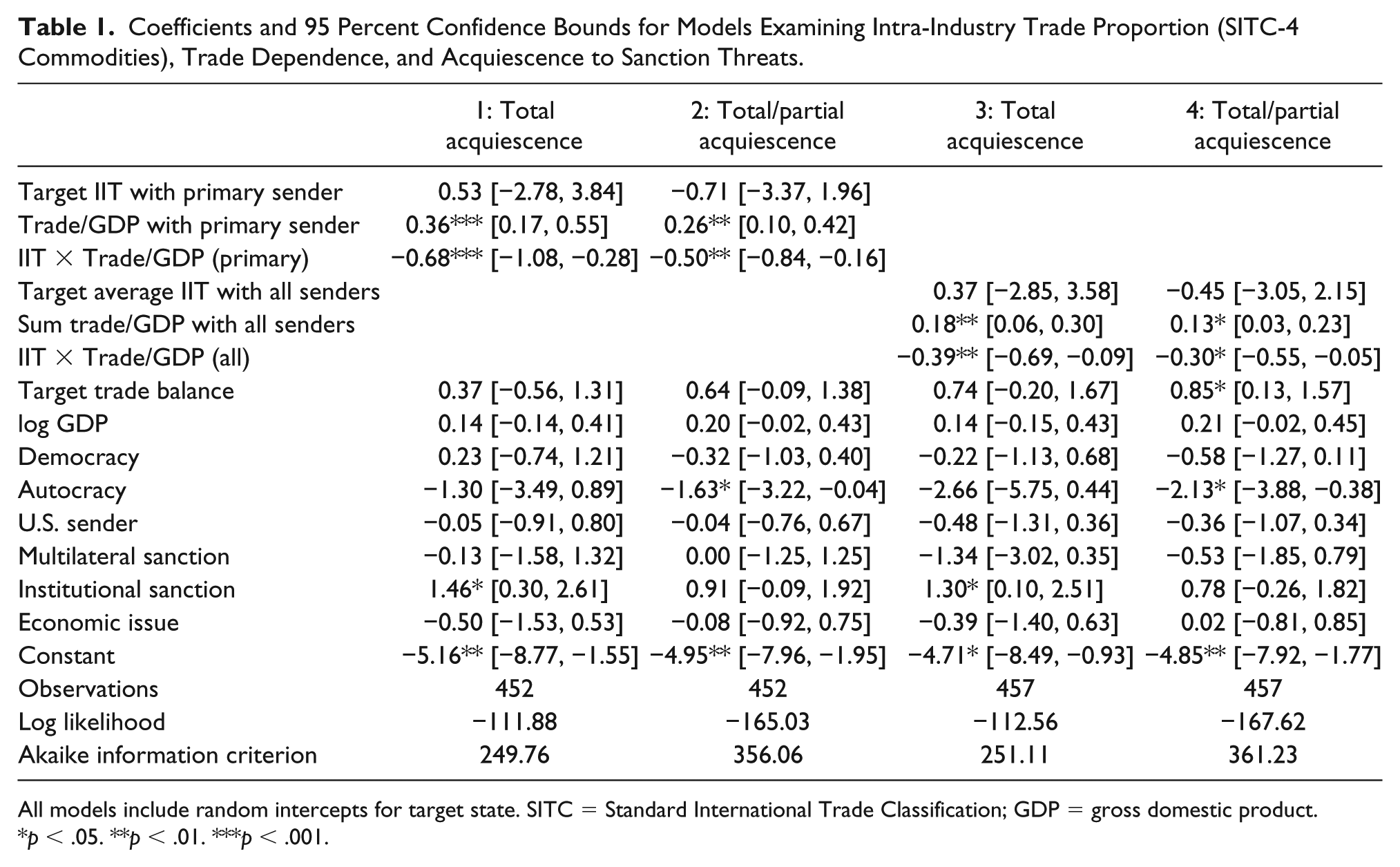
All models include random intercepts for target state. SITC = Standard International Trade Classification; GDP = gross domestic product.
p < .05. **p < .01. ***p < .001.
Figure 1, created using the estimates from model 1 (top plot) and model 3 (bottom plot), illustrates the probability of acquiescence over a range of target trade dependence spanning the 5th to the 95th percentile, for low (5th percentile) and high (95th percentile) levels of bilateral IIT. Holding intra-industry trade at 0, with respect to target trade with the primary sender (model 1, top plot), the probability of target acquiescence increases steadily from less than 0.1 to approximately 0.8 as trade dependence increases from its 5th to 95th percentile. Similarly, holding intra-industry trade at 0, with respect to trade with all senders (model 3, bottom plot), the probability of target acquiescence increases steadily from less than 0.1 to more than 0.4 as trade dependence increases from its 5th to 95th percentile. Conversely, when IIT is high, the probability of meeting the sender’s demand remains low and flat as trade openness increases. Indeed, there is a slight decline in the probability of acquiescence in this case, though it is not statistically significant.
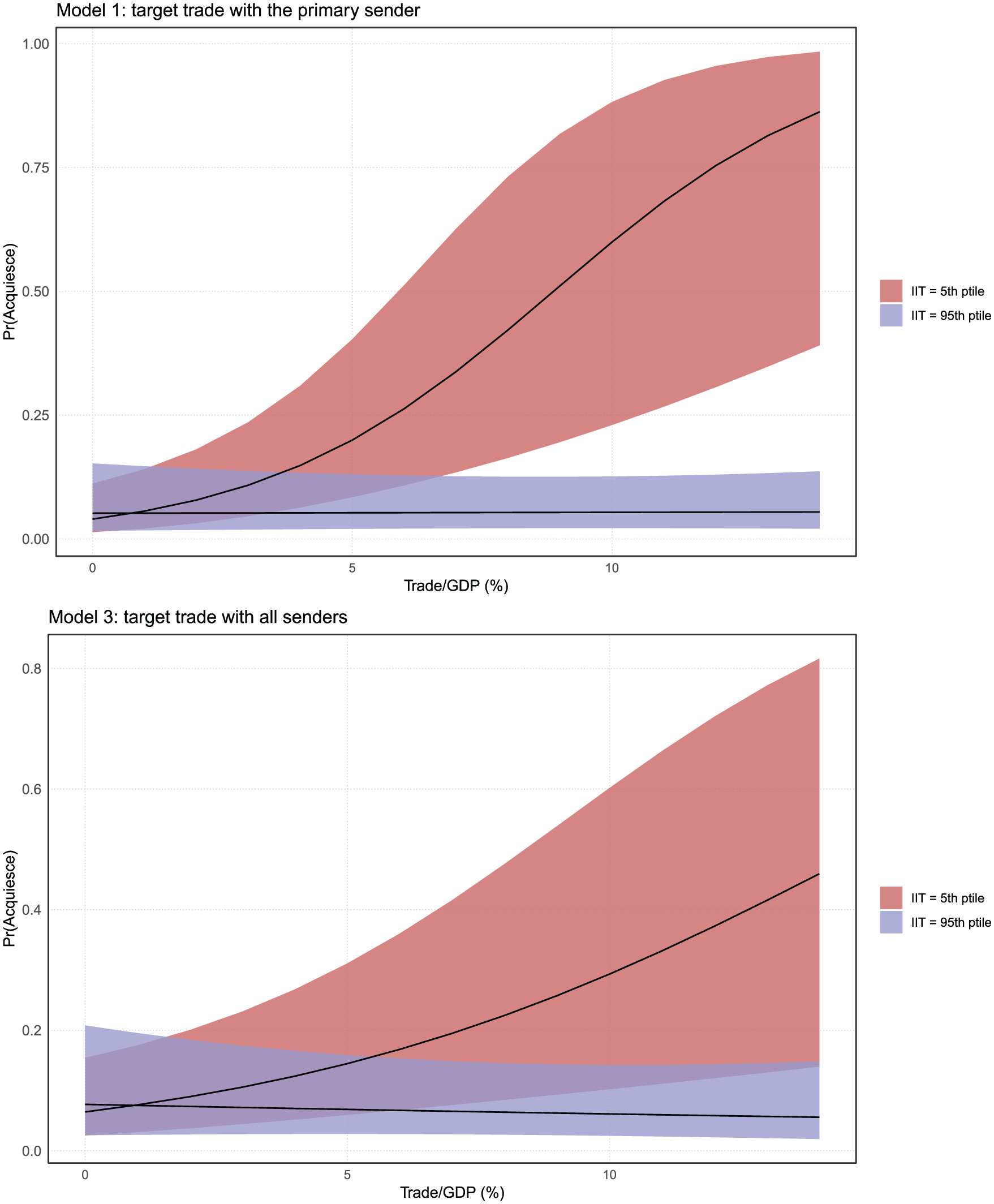
Interaction illustrated: estimated probabilities of acquiescence to sender demands with 95% confidence bounds, for levels of intra-industry trade and trade dependence (from Models 1 and 3). GDP = gross domestic product.
Table 2 presents coefficients and standard errors for models 5 and 6, examining the link between bilateral IIT, trade dependence, and initiation of sanctions, using data on directed dyad-years spanning 1962–2005. Results from these models are quite distinct from those examining acquiescence to sender demands. Model 5 examines the initiation of sanction threats over any issue, while model 6 considers only initiation of sanction threats over noneconomic issues (ignoring trade practices, the environment, and sender desire for target economic reform). First, the coefficient for IIT proportion is statistically only in model 6. This coefficient does not have a substantive interpretation, however, as it suggests that more IIT is associated with a lower likelihood of a sanction threat initiation when both the sender and target do not rely on trade with each other, at all, for income. The coefficient for target trade/GDP is positive and significant in model 5, suggesting that when bilateral trade is composed entirely of inter-industry trade, higher reliance by the target on trade with the sender for income could foster attempts at economic coercion. However, this pattern does not emerge in model 6, when excluding initiation of sanction threats over economic issues. Notably, the interaction terms are not significant in either model.
Coefficients and 95 Percent Confidence Bounds for Models Examining Dyadic Intra-Industry Trade Proportion (SITC-4 Commodities), Trade Dependence, and Onset of New Sanction Threat Episodes.
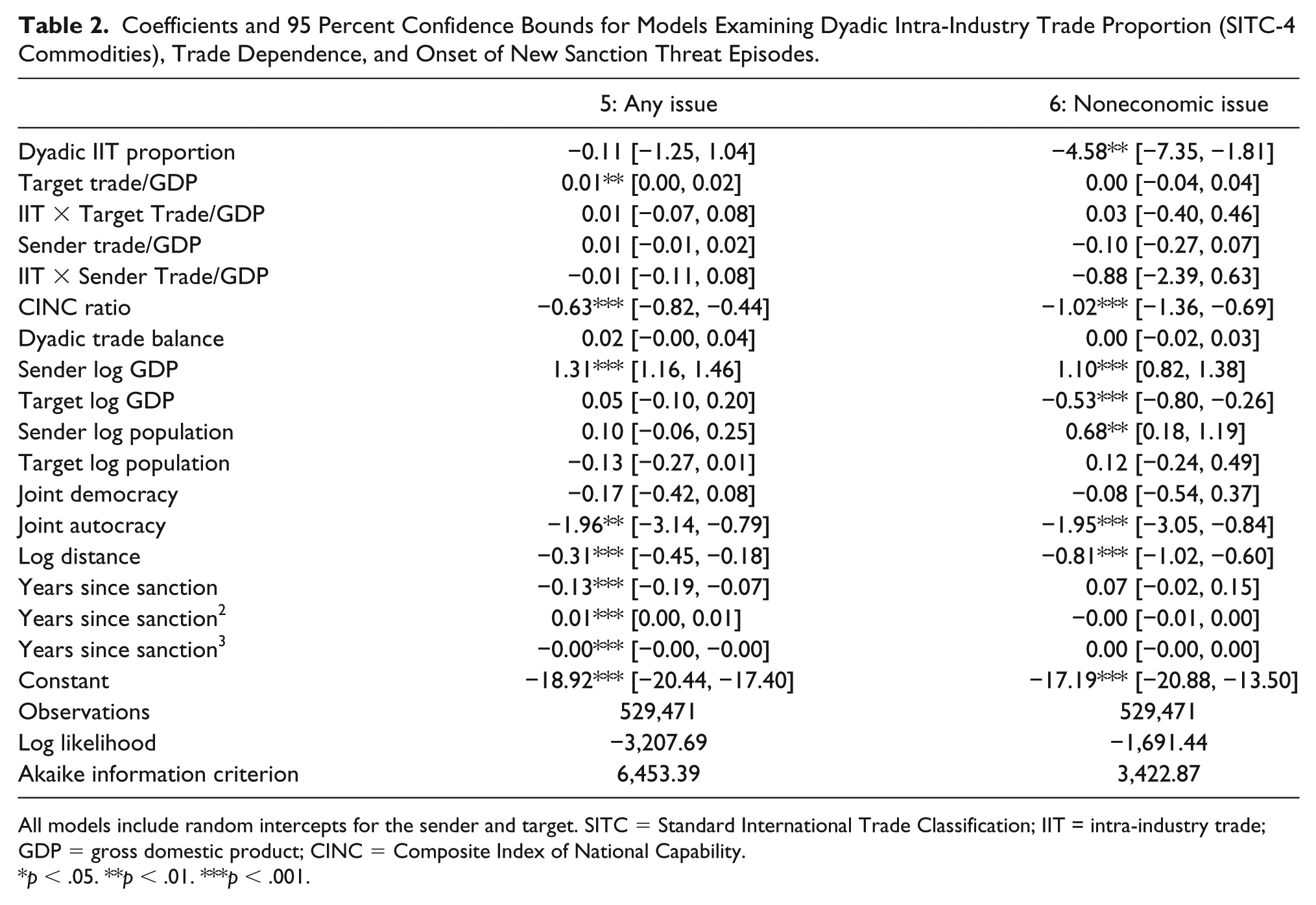
All models include random intercepts for the sender and target. SITC = Standard International Trade Classification; IIT = intra-industry trade; GDP = gross domestic product; CINC = Composite Index of National Capability.
p < .05. **p < .01. ***p < .001.
To illustrate predicted probabilities of sanction threat initiation, we present Figure 2, the axes of which mirror those in Figure 1. The top plot utilizes estimates from model 5 (initiation of threats over any issue), while the bottom plot illustrates results from model 6 (initiation of threats over noneconomic issues). Figure 2 illustrates that there is essentially no relationship between prospective target trade dependence, irrespective of IIT levels, and initiation of sanction threat by the prospective sender. The only evidence even close to statistically significant emerges with respect to the lower plot (from model 6), in which case, the probability of sanction threat initiation looks somewhat higher when bilateral IIT is low, across all levels of target trade dependence. However, confidence bounds are too wide to render this inference very useful.
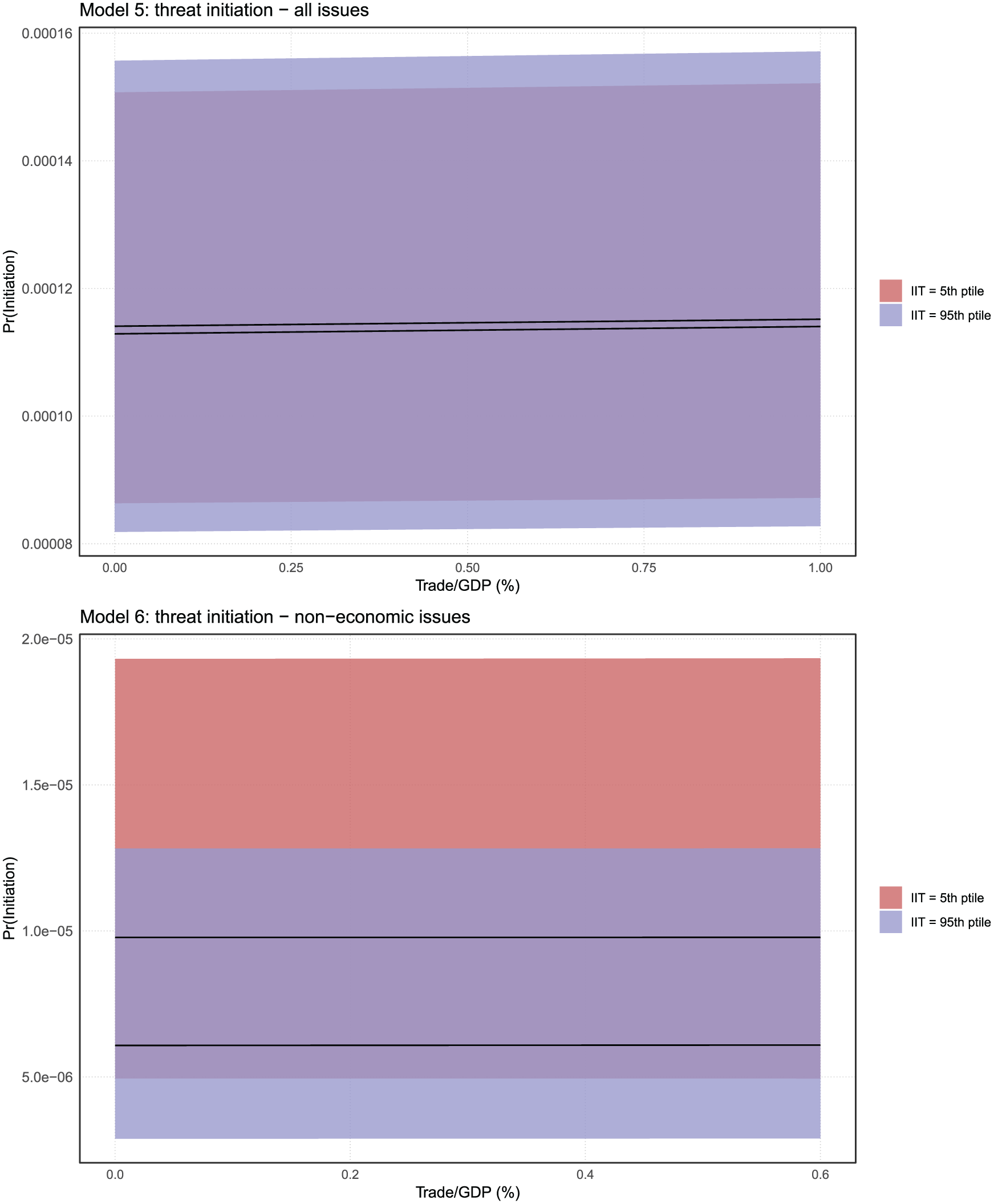
Interaction illustrated: estimated probabilities of dyadic sanction threat initiation with 95% confidence bounds, for levels of intra-industry trade and (potential) target trade dependence on the (potential) sender (from Models 5 and 6). GDP = gross domestic product.
Conclusion
In this article, we demonstrate that the association between trade dependence and acquiescence to sanction threats is conditional on the composition of bilateral trade. We also show that trade dependence and composition appear to have no association with the initiation of sanction threats. This latter lack of a clear relationship could follow from the cross-cutting effects of intra-industry trade on incentives for sanction initiation by senders. However, senders might restrain themselves from making demands against trade partners when trade is composed of IIT because they understand that the target could more easily endure economic restrictions. Conversely, the domestic politics of IIT suggest that there are more points of origin for sanction threats—though possibly not imposition—to emerge. Future research can benefit from exploring how intra-industry trade affects lobbying for sanctions and whether legislatures and executives are responsive to relatively narrow, firm-based lobbying toward these ends. Nonetheless, our work suggests that the economic environment in which domestic actors operate is an important structural factor that exerts influence on how states respond to sanction threats.
One implication of our results is that the coercive (and to some extent the signaling) utility of sanctions for a sender decreases as it becomes more dependent on intra-industry trade with a potential target. Consequently, another potentially fruitful avenue for future research is to examine how sender states adapt to this changing dynamic. Specifically, when bilateral IIT is higher, are sanction threats more likely to escalate into militarized conflicts? Although previous research has found that dyads with a higher proportion of intra-industry trade are less likely to be involved in militarized interstate disputes (Peterson and Thies 2012), it is possible that this association follows because such dyads experience fewer conflicts of interest on average. When a political dispute does arise among states with a high proportion of intra-industry trade, the lessened ability to use economic leverage to achieve a nonmilitarized (yet still coerced) solution might provoke armed conflict. More broadly, future research can consider the broader implications of trade composition for a variety of political interactions between states.
Our discussion of commodity aggregation also raises possible avenues for future researchers to improve operationalization of critical concepts such as leverage and vulnerability. Intra-industry trade measures at different product aggregation levels likely could capture different aspects of a trading relationship. For example, when using the 1- or 2-digit SITC level, a measure of IIT would capture the degree to which trade partners trade in broadly similar categories of goods—for example, animal products, chemicals, or manufactured goods. Moving beyond the SITC-5 level—and perhaps focusing a classification as detailed as the United States Schedule B, a ten-digit classification building from the six-digit Harmonized System—could more precisely capture consumer substitutability and firm competition within international markets.
Related, future research also could examine the distinction between horizontal and vertical intra-industry trade. The conceptualization and operationalization used here is largely agnostic regarding this distinction given that we focus on state capacity to produce imported commodities, which should function regardless of the price differentials that distinguish variation in quality typically associated with vertical intra-industry trade (Thies and Peterson 2015). However, future researchers might consider whether and how vertical inter-industry trade, as well as participation in global value chains, could influence the behavior of (potential) senders and targets.
Supplemental Material
Online_Appendix – Supplemental material for Trade Composition and Acquiescence to Sanction Threats
Supplemental material, Online_Appendix for Trade Composition and Acquiescence to Sanction Threats by William Akoto, Timothy M. Peterson and Cameron G. Thies in Political Research Quarterly
Footnotes
Declaration of Conflicting Interests
The author(s) declared no potential conflicts of interest with respect to the research, authorship, and/or publication of this article.
Funding
The author(s) received no financial support for the research, authorship, and/or publication of this article.
Notes

References
Supplementary Material
Please find the following supplemental material available below.
For Open Access articles published under a Creative Commons License, all supplemental material carries the same license as the article it is associated with.
For non-Open Access articles published, all supplemental material carries a non-exclusive license, and permission requests for re-use of supplemental material or any part of supplemental material shall be sent directly to the copyright owner as specified in the copyright notice associated with the article.
