







Abstract
A growing body of research in political science is influenced by conceptual advances in socialization theory which posit that children can influence adults’ learning across a wide range of topics. The concept of bidirectional influence describes socialization led by one’s parents and children. One outstanding need in the effort to import this concept to political socialization research is a measure that captures the influence of both parents and children. We meet this need with a measure of relative influence from both parents and children as sources for political learning. We provide evidence of measurement validity using separate samples of Asians, Blacks, Latinos, and Whites. Our findings suggest that our metric is portable across groups, and that the range of what individuals recall about their familial socialization experience includes more child-to-parent influence than existing studies suggest.
Fundamental to behavioral political science research are processes of political socialization (Flanagan 2004; Terriquez 2011; Westheimer and Kahne 2004). Following the so-called “death” of socialization research in the 1970s (Niemi and Hepburn 1995), scholars breathed new life into the topic, advancing classic “top-down,” parent-to-child transmission models (Gidengil, Wass, and Valaste 2016; Jennings, Stoker, and Bowers 2009; Rosenstone and Hansen 1993; Verba, Schlozman, and Brady 1995; Verba, Schlozman, and Burns 2005). A core assumption of classic models is that parents know their country’s political system and transfer their politics to their children. However, disparate lines of political socialization research show that the degree of inculcation and political sophistication among parents varies by socioeconomic status (SES) (McDevitt and Chaffee 2000, 2002) and immigration experience (Garcia-Castanon 2013; Terriquez and Kwon 2015; Wong and Tseng 2008). Moreover, increasing economic inequality in America (Gould 2018) and the growing share of American children born to immigrants (Zong and Batalova 2017) indicates that “top-down” models may be less adequate, and offer less accuracy, for understanding the full range of political socialization experiences in the twenty-first century. Considering the diversity in baseline political interest and knowledge among individuals, scholars developed models of “trickle-up” or child-to-parent transmission. In these models, children are re-imagined as influencers in their social networks (McDevitt and Chaffee 2002; Ojeda and Hatemi 2015; Terriquez and Kwon 2015; Wong and Tseng 2008). Corroborating the conceptual model of child-to-parent transmission is evidence that children who live in low-SES households (McDevitt and Chaffee 2002), as well as those whose parents are immigrants (Wong and Tseng 2008), perform critical “brokering” activities that boost their parents’ political knowledge and civic engagement.
The growing recognition of children and younger persons as agents of influence in adult political socialization processes reflects a broader acceptance in communication, psychology, and sociology literatures of a bidirectional framework. This framework unifies the traditional direct-transmission model with processes of child-to-parent influence (Bell 1968; Knafo and Galansky 2008; Mola and Buysseb 2008). However, the literature remains theoretically unclear about whether those influences are complimentary or competitive. Furthermore, efforts to import the concept of bidirectional influence to models of political attitudes and behavior have proceeded without a measure that adequately captures the influence of both parents and children (Knafo and Galansky 2008; Paschall and Mastergeorge 2016).
We argue that the conceptual development of bidirectional influence is sufficiently mature to support concomitant measurement efforts. We introduce indicators of perceived parent-to- child and child-to-parent political influence and offer a theory that connects concept to measurement. Our aim is to capture the range of influence individuals perceive from children and parents, as it relates to what they know and think about politics. In doing so, we generate a two-dimensional understanding of the political socialization process capturing bidirectional child and parent socialization (Bi-CAPS) and total child and parent (familial) socialization (TFS).
From existing political socialization literature, we identify conditions under which we expect to observe more or less influence from either parents or children, both, or neither. Following guidelines established by Adcock and Collier (2001) and King, Keohane, and Verba (1994), we assess evidence of measurement validity for our Bi-CAPS score with nationally representative samples of Asians, Blacks, Latinos, and Whites. We find that Bi-CAPS meets different types of validation across groups, suggesting our measure is appropriate for a multicultural America. Contrary to expectations from direct-transmission and trickle-up models, most people rate their parents and children as similarly important sources of political learning. Importantly, even when an individual perceives the combined influence of their parents and children (TFS) to be low, the relative weight they attribute to parents versus children remains distinct and predictable. We probe the robustness of our Bi-CAPS measure and show how our two-dimensional concept of socialization can be used to assess political attitudes and behavior.
Top-Down, Trickle-Up, and Bidirectional Models of Political Socialization
Tracing broad conceptual advances in the extant socialization literature that includes political science, communication, psychology, sociology, and child development studies, it is clear that conceptual advances converge on a notion of bidirectional parent–child learning dynamics. The growing consensus about a systematized concept provides ripe ground for theorizing and introducing measures of bidirectional socialization.
Three stages of political socialization research history—the initial rise, the revival, and recent branching—lead us to the concept of bidirectional influence. The first stage was motivated by the presumption that the legitimacy of political regimes depends on intergenerational transfers in political knowledge, habits, and values. By showing that children learned about politics from their parents, these studies argued that political socialization within families ensures long-term stability of political institutions (Easton 1965; Hyman 1959). This early literature bequeathed to scholars the “top-down” or direct-transmission model. These models generally characterize children as having less agency or capacity to shape their environment than adults. By contrast, adults, and especially parents, are viewed as teachers and exemplars (McDevitt and Chaffee 2002; Verba, Schlozman, and Burns 2005). The role of parents as authorities in their households, according to this view, is to teach their children how the world of politics works.
By the 1970s, this line of research expanded theoretical interpretations of what constitutes socialization. For example, scholars began to reassess traditional “top-down” models and assumptions about the stability of attitudes acquired during childhood and early adolescence (Jennings 1981; Jennings and Niemi 1974; Searing, Schwartz, and Lind 1973). Although parent-to-child political learning was found to shape attitudes later in life, a revival in research beginning in the late 1990s uncovered a great deal of variation across levels of parental interest and engagement in politics (Jennings, Stoker, and Bowers 2009; Verba, Schlozman, and Burns 2005), community demographics (Pacheco and Plutzer 2008), and political context (Gimpel and Lay 2005; Sears and Valentino 1997). 1 In both the initial decades of research and the subsequent revival, the direct-transmission model guided most political science research.
Developing parallel to the direct-transmission revival in political science, scholars explored the extent to which child-to-parent political socialization occurs within the home. 2 In a landmark study of “trickle-up” political socialization, McDevitt and Chaffee (2002) echoed the excitement voiced by earlier scholars (Jennings 1981; Niemi and Hepburn 1995; Sigel 1995) about the possibility that children could be active participants in their own political development. Assessing the effects of an interactive civics instruction program, McDevitt and Chaffee (2000, 2002) demonstrated that students who were exposed to this curriculum were more knowledgeable about elections, paid more attention to the news, and were more likely to discuss politics with their parents. Importantly, political knowledge gains from the program also transferred to parents, with the largest knowledge transfers observed among parents of low SES. Drawing from Stinchcombe (1968), McDevitt and Chaffee explain that parents are like “managers” who seek to maintain a homeostatic balance in the home, and low-SES parents are motivated to learn about politics to maintain their authority within the family.
Similar concerns about the relationship between intra-family dynamics and political integration (Bloemraad 2006; Portes and Rumbaut 2001; Waters 1990), and how this relationship matters for the stability of political institutions, are addressed in research about the politics of immigrant integration (Gordon 1964; Huntington 2004). Connecting these concerns to models of political socialization, Wong and Tseng (2008) conceptualize a bidirectional model of socialization to explain the transmission of political information within immigrant families and across multiple racial and ethnic groups. They argue that because the children of immigrants living in the United States are often exposed to more U.S. politics than their parents (through schools, peers, and the media), they may be critical sources of political information for their parents. The bidirectional theory stipulates that “youth perform ‘brokering’ activities such as language translation and explaining government documents, aspects of the US political system and particular political issues; and, these brokering activities can inform parents’ political socialization as well as political knowledge, attitudes and behavior” (Wong and Tseng 2008, 155). 3
These various branches of research reflect a broader consensus acknowledging both parent- to-child and child-to-parent socialization. Following seminal research by child psychologist Richard Bell (1968), Davidov et al. (2015, 948) explain, “the view of socialization as a bidirectional process became increasingly accepted, and it has eventually prevailed as the dominant view.” However, as Davidov et al. (2015) note, the empirical research and attempts to measure bidirectional socialization processes lag behind our theoretical advances. Across socialization literatures, including political science, scholars have yet to develop a measure that captures the range of influence from children and parents within individuals.
Next, we introduce a conceptual variant of bidirectional influence that imagines “top- down” and “trickle-up” as familial socialization processes that are distinct and complimentary. Our conceptual innovation suggests a pair of indicators of how individuals perceive parent-to- child and child-to-parent learning, and how to systematically relate those perceptions to one another. We aim to demonstrate that this metric is applicable to political socialization research and is potentially portable across the fields of psychology, development, and communication.
Toward a Theory of Relative and Total Parent–Child Socialization
The core feature of bidirectional models of socialization is that both parents and children can influence one another, representing ideal types of “top-down” and “trickle-up” learning. However, existing theory provides less guidance on whether or how to distinguish parents and children as competing or concurring influences. There is a need for a theory acknowledging the possibility that for any individual, one ideal type dominates, both processes are equally influential, or neither source is important. 4
We assume that a person might recall being socialized more or less by their parents compared to children. For some, parents are the dominant influence. For others, children lead familial political socialization processes. Some credit parents and children for teaching them about politics, though not all weigh both equally important or unimportant. Conceptually, we view familial socialization dynamics in two dimensions. One dimension treats top-down and trickle-up processes as ideal types, anchoring opposite ends of a continuum of competing familial socialization agents. The second dimension taps variation in the sum of an individual’s exposure to parent and child socialization. So far, as we are aware, we are first in the political socialization literature to view bidirectional influence in terms of these two dimensions.
Distinguishing two dimensions of parent and child influence in political socialization—one specifying the two as competing forces and the other specifying their combined influence—is useful for capturing the range of socialization experiences. For instance, investigating whether people view their own socialization experience as more “trickle-up” or “top-down” is difficult without acknowledging that some individuals are socialized in politically active family milieu (i.e., high on the combined/sum dimension), whereas others live in politically disengaged kinship networks (i.e., low on the combined/sum dimension). In theory, the relative influence of parents versus children should vary considerably less (and perhaps serve as a less meaningful socialization indicator) among those who report little to no influence from children and parents combined, at least when compared to people who extend more credit to familial sources for learning about politics. However, even among those with low levels of combined parent–child socialization, we are likely to observe some variation in bidirectional influence. The same factors that explain and predict the extent to which children or parents are more influential at high levels of combined influence are worth assessing for those whose combined experiences offer less inspiration and fewer teaching moments.
Separating combined and relative dimensions of familial socialization also offers a chance to probe major claims in the literature. For instance, earlier research linked parent-to-child transfers in political knowledge and values to institutional stability (Easton 1965; Hyman 1959). Our conceptual refinement allows us to investigate whether such links depend on a “top-down” socialization experience, or if learning voids can be filled by combinations of parent and child influence. We are not claiming that learning from children has the same effect on attitudes and behavior as learning from parents. Rather, our point is that imagining parent–child influence in terms of relative and combined dimensions offers greater analytical scope and precision to study a range of familial political learning experiences, consisting of contributions from both parents and children, relative and complimentary to one another.
Below we propose indicators that correspond to relative and combined dimensions of familial socialization. For each dimension, we explain how scores associated with parent-to-child and child-to-parent learning are collected, and how these self-reported experiences relate to one another and differ from one person to the next. While both aspects of familial socialization deserve attention in any effort to translate concept to measurement, the state-of-the-art literature appears primarily concerned with bidirectional influence. Thus, we center our measurement validation analysis on a relative, parent versus children, political socialization score. This focus helps answer questions about which source of influence (parents or children) is more or less dominant, for whom, and under what circumstances.
Data and Method for Constructing the Relative Bi-CAPS Score
We use data from four large-n surveys with Asian (n = 3,006), Latino (n = 3,003), Black (n = 3,102), and White (n = 1,035) samples. These samples are drawn from the 2016 Collaborative Multi-racial Post-election Survey (CMPS 2017), which was fielded in the United States immediately after the 2016 election. All interviews were conducted online. Details about the survey are outlined by Latino Decisions (Barreto et al. 2017).
To evaluate our new concept and proposed scoring approach, we crafted original items asking respondents to rate the importance of their parents and children for learning about politics. First, we asked: “How important would you say each of the following sources have been in learning about what you currently know or think about US politics?” Respondents rated parents and children or younger persons in terms of their importance on a nine-point scale ranging from “not at all important” (1) to “extremely important” (9). 5
In Figure 1, we show how we combined and adjusted scores from the original items to craft a relative socialization score for each individual (Bi-CAPS). Beginning with Step 1, we subtracted the values that respondents assigned separately to parents and children (or younger persons) to convey their respective importance in learning about U.S. politics. This raw relative influence score (for all racial groups combined) ranges from −8 to +8 and is presented in the first row of Figure 1. A score of +1 indicates that children were scored one unit more important than parents. Respondents who marked their parents a five and their children a six, as well as respondents who marked their parents a one and their children a two, were assigned the same relative difference score. Scores from Step 1 indicate that most respondents perceive parents and children to have similarly influenced what they know and think about politics. Approximately 40 percent of respondents score zero in the distribution of raw relative influence. One feature of this raw measure is that it does not distinguish between people who rate parents and children equally important or equally unimportant.
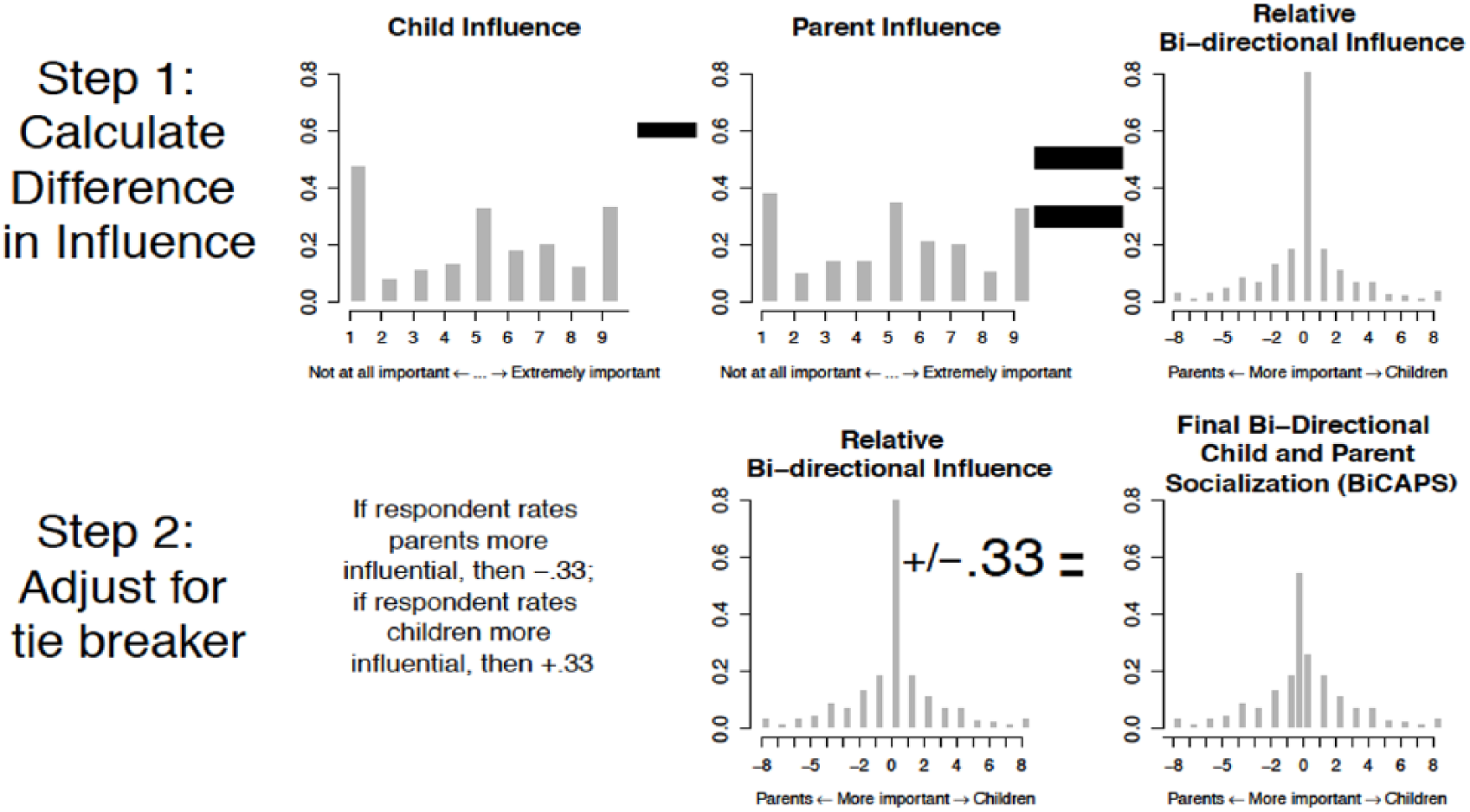
Step-by-step description of how the original items evaluating parent and children influence in politics are combined and adjusted to create our Bi-CAPS measure.
Because our principle aim is to sort individuals according to the relative importance they assign to parents and children, we deployed a follow-up question that works like the tie-breaker questions used to assess partisan leanings of independents. Our tie-breaker asks, “If you had to say which was more important, how would you rank the importance of each source below for learning about U.S. politics?” with “your parents” and “your children or younger persons” as the options. 6 Using this procedure, we reduced “ties” by 77 percent, from 4,096 cases to 1,325. 7
We made one of two adjustments to the raw relative influence score, depending on the response to the tie-breaker question. In Step 2 of Figure 1, we adjusted scores by −0.33 for those respondents who broke the tie to say their parents were more important. For those who broke the tie to say their children were a greater influence, we adjusted scores by +0.33. This tie-breaker strategy maintains our original range [−8 to +8] and reduces the kurtosis of our distribution. The final, adjusted relative influence score is approximately normally distributed. We call this final score, the relative Bidirectional Child and Parent Socialization score or Bi-CAPS.
Note the symmetry in the distribution of these self-reported perceptions. Lower Bi-CAPS scores represent pure direct transmission or “top-down” parent-to-child socialization, which suggests that less than 5 percent of cases self-report this “ideal” version of political socialization. Similarly, very few respondents say they learned about politics through a purely “trickle-up” experience.
Given the critical role that adults play in the lives of children more broadly, including teaching them how to walk, read, and drive a car, we anticipated classifying more people with lower (negative) Bi-CAPS scores, indicating greater parental influence. Yet, across all four racial/ethnic groups, we observe a concentration of cases in the middle values (top row of Figure 2). Most people credit neither parents nor children as primary agents of familial political socialization. Additionally, we cannot say that child-to-parent socialization is only characteristic of immigrant-proximate groups such as Latinos and Asians. In fact, Bi-CAPS is similarly distributed for each group, ranging from a low mean of −0.44 (standard deviation = 2.95) among Whites to a high mean 0.08 (standard deviation = 2.71) among Asians.
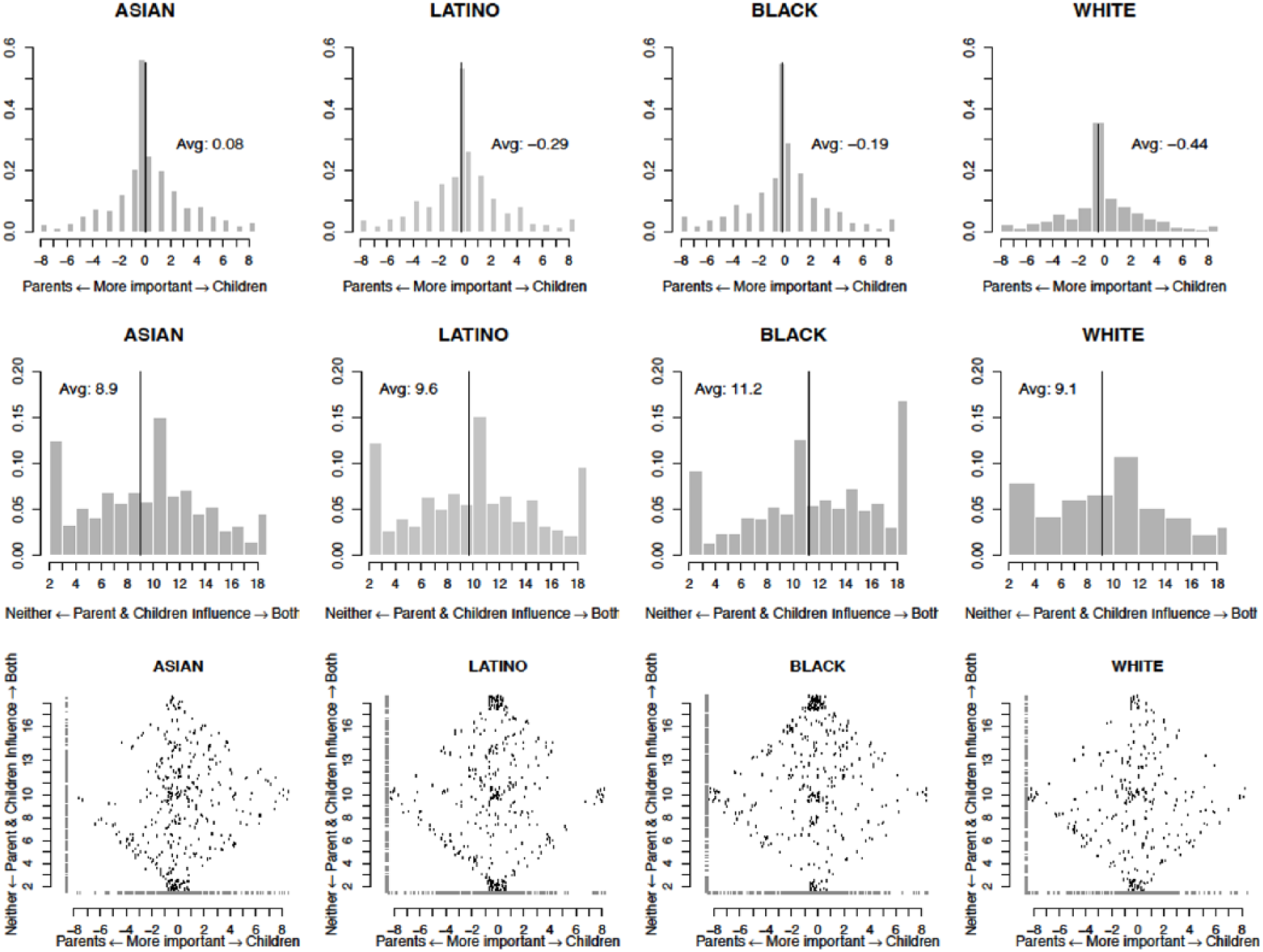
Top row shows the distribution of relative Bi-CAPS; middle row shows the distribution of total familial socialization or TFS; and bottom row shows the scatter plots of Bi-CAPS and TFS.
Symmetrical distributions of Bi-CAPS scores are not evidence that parents and children equally influence the political development of family members. The lesson we draw from the data is that individual-level perception of influence of parents versus children varies and does so similarly across racial groups. Our scoring approach provides compelling evidence that the concept of bidirectional socialization applies to a much broader share of the American population than existing research suggests (e.g., not just immigrants and not just low-SES individuals). We also uncover rich variation even among those who score both sources equally prior to the tie-breaker.
We produce a measure of TFS by summing the scores of perceived influence from parents and children for individual respondents. The second row of Figure 2 illustrates this complimentary dimension. 8 Like we observed for Bi-CAPS, scores are distributed similarly across group, approximating a normal curve with “shoulders.” Self-reported TFS clusters at low (about 17% score 4 or lower), moderate (about 25% score between 9 and 11), and high (about 15% score 16 or greater) scores.
A scatter plot of Bi-CAPS and TFS captures considerable variation in the perception of familial socialization dynamics (see bottom row of Figure 2). People differ in their views of the balance of parent–child influence they have experienced (i.e., Bi-CAPS on the x-axis) and also differ in their reports of the combined level of influence from both parents and children (i.e., TFS on the y-axis). Figure 2 offers a clearer idea of how a Bi-CAPS score of 2 can be produced by different experiences. An active familial socialization experience, one where a child is extremely influential (e.g., +9) and their parent is also influential but not as much (e.g., +7), can generate the same score as an experience where both parent and child influence is perceived to be low (e.g., +2 and +4, respectively).
Simple distributions of our proposed political socialization scores reveal a modal perception of similar levels of influence from parents and children. Yet, the political socialization literature has been guided by models that emphasize the experiences at the extremes of the bidirectional continuum, either “top-down” or “trickle-up.” Prior work assessing bidirectional socialization certainly does not ignore variation in familial socialization experiences across individuals; however, we provide a scoring procedure to capture this variation. To the extent that Bi-CAPS and TFS adequately and accurately capture the range of perceived political influence from parents and children (or younger persons), we position future research to gain new knowledge using scores that more appropriately reflect the leading conceptual developments in socialization research.
Having established how our Bi-CAPS and TFS scores are related to the systematized concept of bidirectional influence, we turn to analyzing the evidence of measurement validation, again with special attention to the Bi-CAPS metric. Drawing from existing scholarship, we identify the cases and circumstances where we would expect parents or children to be perceived as more or less important sources for learning about politics.
Assessing Validity of Relative Parent–Child Socialization Measure
Our goal is to establish whether our scores reflect the theoretical differences that our concept of interest captures. Following guidelines set forth by Adcock and Collier (2001), we focus specifically on content, convergent/discriminant, and nomological/construct measurement validation; crucial types of validation for establishing “adequacy of content” for measures. 9 In our assessment of the extent to which Bi-CAPS scores tap the idea of bidirectional socialization, we draw from the literature on political socialization to identify several indicators that correspond to these validation approaches.
To begin, we assess content validity. According to Adcock and Collier (2001, 536), evidence of content validation establishes “whether operationalization captures the ideas contained in the systematized concept.” The concept of bidirectional political socialization suggests that people with children should be more likely to be influenced by children or younger persons (i.e., score higher on Bi-CAPS), if for no other reason than because they are more likely to spend time with younger persons than non-parents. 10 Any operationalization of bidirectional influence must show that parents, more than non-parents, perceive children to be more influential.
That said, our measure allows non-parents to say that younger persons influence what they learn about U.S. politics. This inclusive wording potentially works against the strategy to leverage parent status for assessing content validity. This is because it invites responses from non-parents that would minimize differences between them and parents in our score. If we find no difference by parental status, or if non-parents score higher on our indicator than parents (i.e., if non-parents rate children or younger persons as more important relative to parents), then our operationalization of bidirectional influence would lack content validity.
Content validity of Bi-CAPS can also be assessed by examining differences across age. We should see that older adults rely less on their parents as a source of learning about politics and turn to younger persons, including their own children, for information. This “trickle-up” learning is more likely to occur among middle-aged individuals (between 35 and 50 years of age), who are most likely to have children of school-age. 11
If alternative approaches to measuring the same underlying concept are unrelated, then our claims about the validity of our proposed measurement are undermined. We shift to evidence of convergent/discriminant validity by comparing our measure to an alternative measure of parent versus children influence. 12 For this type of validation, we rely on a question that asked individuals to rank the importance of different sources of learning about politics, including their parents and children. 13
Like Bi-CAPS, the alternative rank-based measure allows an analyst to sort individuals according to the importance that they assign to children relative to their parents. We produce a comparable measure, which should correlate positively with Bi-CAPS, by subtracting the ranking for children from that of parents. For example, if someone ranked their children first (1) and their parents second (2), we assigned them a score of 1 (2 − 1 = 1). A person who ranked their children third (3) and their parents first (1) would be scored −2 (1 − 3 = −2). We chose to ask these alternative measurement items of Latinos and Asians, for whom we can later account for factors such as nativity and acculturation, which we know to vary less among Blacks and Whites.
If evidence of content and convergent/discriminant validation are the seeds of a valid measure, then the roots are connections to existing knowledge bases, what Adcock and Collier (2001) and Hill, Hanna, and Shafqat (1997) term evidence of construct or nomological validation. To assess the roots of Bi-CAPS, we turn to differences by nativity and level of education. 14 Drawing on growing evidence of children as information leaders in immigrant families (Bloemraad and Trost 2008; McDevitt and Butler 2011; Terriquez and Kwon 2015; Wong and Tseng 2008), we expect that immigrants, compared to the U.S.-born, are more likely to seek information from their children than from their parents. We expect that second-generation immigrants are less likely than first-generation immigrants to learn about politics from their parents. The empowering experience of serving as an information broker, coupled with exposure to K-12 civic lessons, means that second-generation immigrants are less likely to turn to their own children for lessons on host-country politics. By the third generation, we should see a return to a balance of direct transmission and greater influence from parents.
Finally, we presume that adults with less knowledge in politics are more likely to rely on children and youth as agents of political socialization. The extant literature suggests that individuals of low SES have lower levels of interest and knowledge about politics (Brady, Verba, and Schlozman 1995). From the perspective of socialization research, learning about politics from parents is not happening early in life for these individuals. Although the spread of political information through campaigns and mass media can attenuate gaps in political knowledge across SES levels (Jerit, Barabas, and Bolsen 2006), such gaps nonetheless persist. However, such knowledge gaps may close in an indirect fashion via children (McDevitt and Chaffee 2000, 260), particularly when low-SES parents, in response to their child’s increasing political sophistication, are motivated to learn about politics to reassert their leadership role in the family.
Findings
We collect initial evidence of validation in Table A.1 of the Supplemental Appendix. For content validation, we compare the average score for parents and non-parents. For each group, the difference in Bi-CAPS between those who have children and those who do not exceeds 1.6 (two-sample t-test, p > .000). Consistent with the literature on bidirectional socialization theory, parents average a positive Bi-CAPS score (higher child influence) compared to non-parents, who average negative scores (lower child influence). This initial evidence is crucial because it gives us confidence that we are on the right path to measuring bidirectional influence.
Comparing our score to an alternative measure, we find evidence of convergent validation (Adcock and Collier 2001). For Asians and Latinos, those who rank children as more important, on average, score positive Bi-CAPS, whereas those who rank parents as more important score negative Bi-CAPS. The statistically significant differences in Bi-CAPS by ranking for Asians and Latinos are 1.86 and 1.51, respectively. Because the two alternative approaches allow for respondents to evaluate the importance of children and parent’s relative to one another, we are confident that they are tapping the same underlying concept of bidirectional influence.
We find evidence of nomological/construct validity by examining differences by nativity in our score. Asian immigrants score an average 0.50, whereas their U.S.-born counterparts score an average of −0.28. This difference of 0.78 is statistically significant (two-sample t-test, p < .001). A similar difference in average scores is observed between Latino immigrants (0.26) and U.S.-born Latinos (−0.48) (two-sample t-test, p < .001). We uncovered a smaller, though statistically significant, difference of 0.6 in parent-versus-children socialization scores for Blacks (0.34 among immigrants versus −0.23 for U.S.-born; two-sample t-test, p > .006). The largest difference by nativity is 1.16 among Whites (0.66 among the foreign-born and −0.45 among the U.S.-born), which is also statistically significant (two-sample t-test, p > .003). The differences by nativity in our socialization scores corroborate claims by Wong and Tseng (2008) that the balance of parent-over-children influence in the bidirectional model of political socialization depends, at least in part, on the immigration experience. Critically, these findings extend their work because the importance of nativity also applies to blacks and whites.
Finally, differences in our score by SES also indicate evidence of nomological/construct validity. In general, those with lower levels of formal education rate their children as relatively more influential for learning about U.S. politics.
For all four racial groups, we regress individual Bi-CAPS on parent status, age, immigrant generation, education level, household income, as well as a number of controls. It is likely that asking people to evaluate the role of their parents and children in learning about politics taps into attitudes regarding submission to authority and preferences for conventionalism. We attempt to parse out the role of such attitudes using partisan attachment and ideology. In addition, we include a measure of conventional political participation, expecting greater support for voting and conventional contact (more positive scores) to correspond with higher levels of authoritarian personality, and a lower propensity to rely on children for political learning. The details of the variable coding are presented in the Supplemental Appendix.
More Evidence of Content Validation
Across all four race/ethnicity groups, we find strong evidence of content validation (see Table 1). Parental status is positively associated with greater influence from children (see Figure 3). Latino parents, on average, report children are 1.26 units more influential than their parents compared to Latino non-parents (β = 1.263; SE = 0.118). For White parents, the difference between parents and non-parents is 1.5 (β = 1.502; SE = 0.217), and for Asian and Black respondents that difference is 1.59 (β = 1.599; SE = 0.108) and 1.58 (β = 1.586; SE = 0.120), respectively.
OLS Models of Bidirectional Child and Parent Socialization.
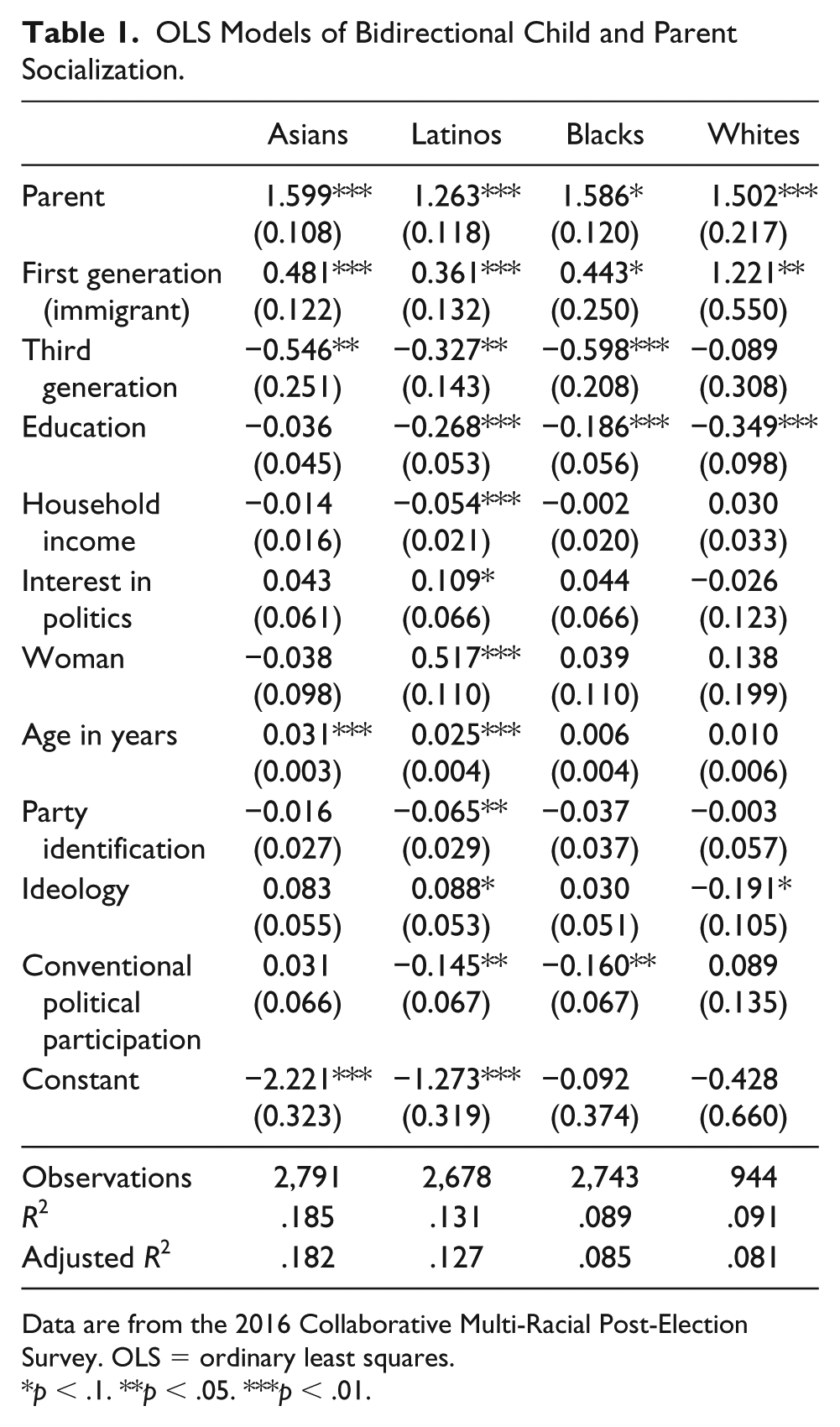
Data are from the 2016 Collaborative Multi-Racial Post-Election Survey. OLS = ordinary least squares.
p < .1. **p < .05. ***p < .01.
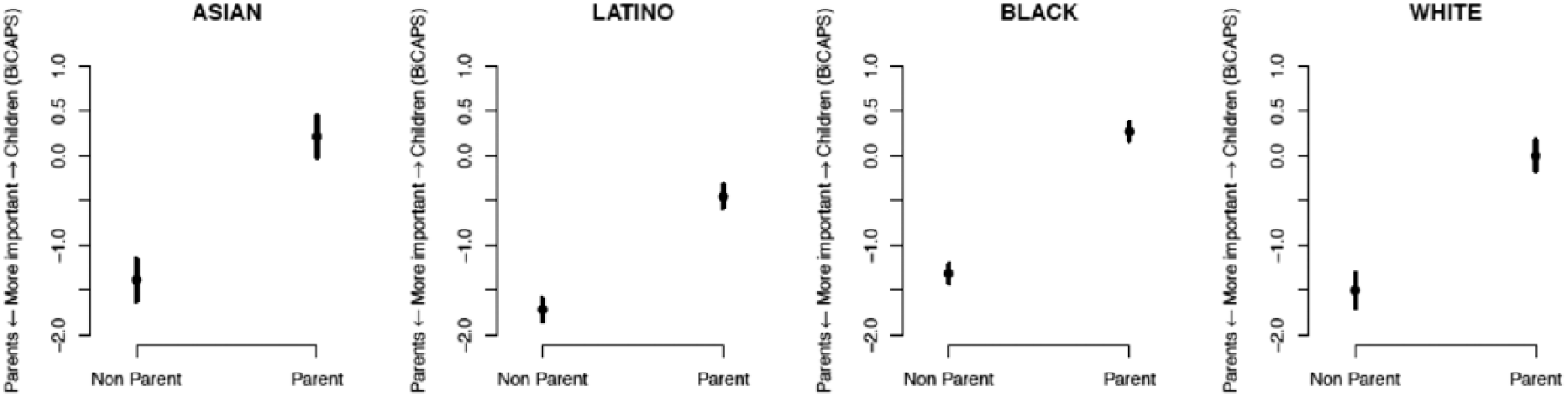
Post-estimation plots from OLS models reported in Table 1.
Also relevant for content validation is the relationship between age and Bi-CAPS. We find that older age is associated with children having greater influence in learning about politics (see Figure A.1 in the Supplemental Appendix). This pattern is consistent with the idea that experience with parenting children who have matured sufficiently to offer political lessons to their parents is most likely among older respondents. 15
We also anticipate that children’s influence on parents should be greater for those who are older, ceteris paribus. As a further test of content validation, we evaluate the interaction between parental status, age, and Bi-CAPS. We find that the marginal effect of age is greater for parents than for non-parents, especially for Asians and Blacks (see analysis details in Table A.7 and Figure A.3 of the Supplemental Appendix).
More Evidence of Convergent/Discriminant Validation
From scores based on ranking the importance of seven sources for learning about U.S. politics, we show the distribution of the difference in ranking parents and children compared to our Bi-CAPS measure in Figure 4. We added a minor “jitter” to the data to show where the observations are concentrated.
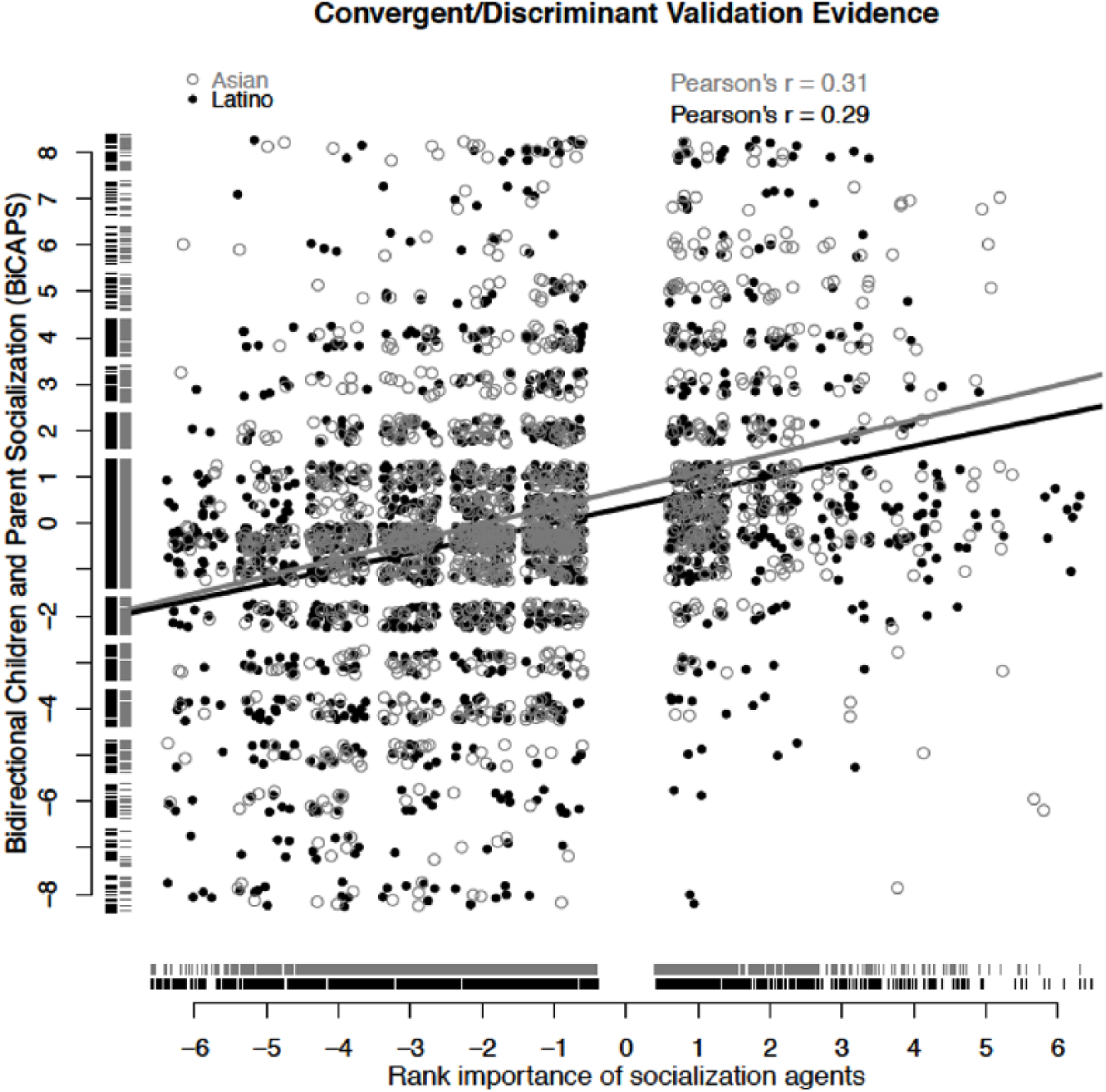
Scatter plot of our proposed measure and an alternative measure of bidirectional influence using a ranking approach.
The alternative ranking measurement and Bi-CAPS are positively related, as expected, though Pearson’s r correlation is modest for both Asians (r = .32) and Latinos (r = .29). Recall that no tie is allowed between any two sources of political learning in the alternative measurement approach, which explains why no respondent scores zero. Still, the distribution of the alternative ranking similarly clusters in the middle values. Regardless of measurement strategy, few individuals report a political socialization experience shaped exclusively by parents or exclusively by children. 16
More Evidence of Nomological/Construct Validation
Finally, we further examine nomological/construct validity by examining how our original Bi-CAPS measure relates to immigrant-generational status and levels of education. As Hill and Hurley (1999) note, this is the most demanding type of validation to assess.
In Figure 5, we show how estimated Bi-CAPS scores vary across generational status, simulated from results of regression models that are reported in Table 1, and corresponding to the coefficients for first generation and third generation. On average, the estimated influence of children compared to parents is highest for immigrants in all groups, at least when compared to the second generation, the omitted baseline category in the model. 17 Children are less influential in the second and third generations, which is consistent with existing research.
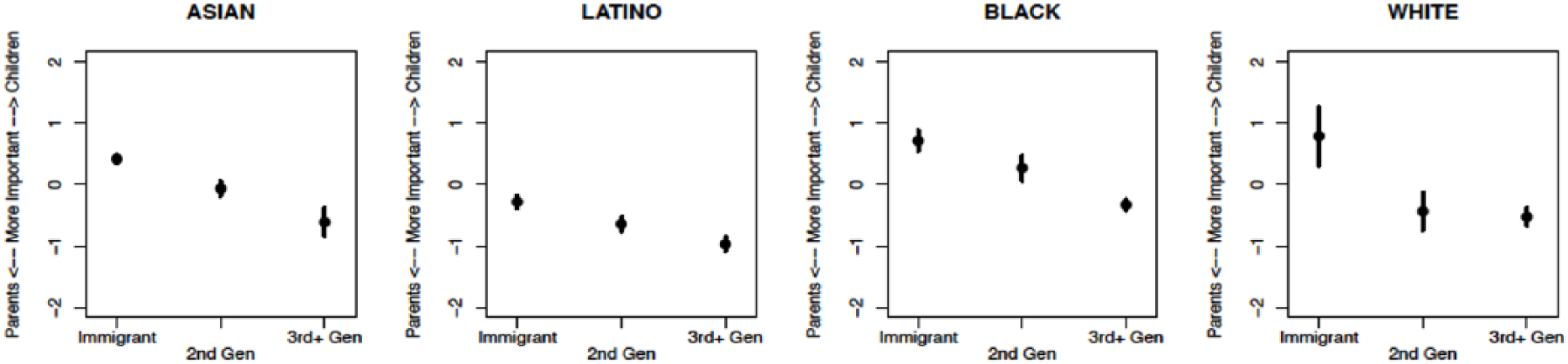
Distribution of bidirectional socialization by race/ethnicity.
We interpret the relationship between succeeding immigrant generations and the decline in the influence of children (or increase in parent influence) as an expression of a disparity in exposure to the basics of U.S. government and politics. If our interpretation is accurate—that the balance between “trickle-up” and “direct-transmission” pivots on how much parents themselves have learned about U.S. politics—then, we should also observe less influence by children relative to parents among those who complete more formal education.
Using this more direct measure of exposure to civic lessons than immigrant generation, we find that higher levels of formal education correspond to reporting less learning from children (see Figure A.5 in the Supplemental Appendix). This negative relationship between education and Bi-CAPS score should also differ by parent status. To evaluate this claim, we assess the interaction between parental status, immigration status, and two-way political socialization. We find that in general, parents with greater levels of education say that they rely less on children for their political knowledge than their counterparts with less education. However, even parents with college degrees may occasionally find themselves on the learning side of a teaching moment (see details in Table A.9 and Figure A.6 in the Supplemental Appendix).
Additional Robustness Checks and Theoretical Considerations
We conduct additional robustness checks to assess the generalizability of our measure. First, if bidirectional effects are driven by immigrants, then we should find less compelling evidence of our validation exercise using only U.S.-born respondents. However, we find patterns consistent with those presented across the entire sample (for details, see Table A.10 and Figure A.7 in the Supplemental Appendix). Second, we analyze models of perceived parent and child influence separately (see Table A.11 in the Supplemental Appendix). Overall, we find that the components of Bi-CAPS behave as expected. Thus, while combining measures offers richer information to discuss bidirectional influence within individuals, we are not overlooking the processes that underlie socialization in either direction.
Remember, we are most concerned with the concept of bidirectional influence and how to explain and predict when top-down and trickle-up processes are most likely to occur. However, as our theoretical argument highlights, it is essential to consider familial socialization as two-dimensional, where our second dimension captures total familial socialization (TFS). One hard test is whether we can explain the bidirectional nature of political learning for those with low levels of TFS (i.e., those who rate parents and children as less important sources for learning about politics).
To address this, we split our sample into groups that perceive high familial socialization (scores of 14 or higher out of a possible 18; an example would be scoring children as a 6 and parents as 9 or children and parents both as 8 or 9, etc.), medium (scores between 7 and 13), and low (6 or less). Then, we replicate the main regression analysis using these split samples. We find that the relationship between age and Bi-CAPS for parents and non-parents is significant across all groups. This suggests that we can predict the direction of child–parent political learning even among those who are not reporting high levels of TFS. 18
Further evidence of construct validation for low levels of TFS is presented in Figure A.9 of the Supplemental Appendix. Again, we find that for all individuals reporting low TFS (excluding Asians), non-parents are much less likely to say they rely on children for learning about politics and this reliance further declines as education levels increase. Parents are more likely to say they rely on children across all groups, but this reliance again decreases as education levels increase for all respondents reporting low TFS. 19
Distinguishing Bi-CAPS and TFS also inspires us to revisit existing claims in the socialization literature. Arguments about the role of parents as a lynch pin of democracy suggest that each subsequent generation is inculcated with values and habits that sustain political institutions. One such habit in a democracy is participation in politics. In modeling levels of non-voting political participation (e.g., discussing politics, signing a petition, and joining a protest), we find no relationship with Bi-CAPS. The top row of Figure 6 shows that knowing whether you are influenced more by parents or by children offers little insight into your propensity for civic engagement. By contrast, the middle row shows that the total sum of familial socialization is positively related to a person’s level of political involvement (for details, see A.15 in the Supplemental Appendix). Moreover, using our alternative ranking measure as a proxy control for Bi-CAPS (available for Asians and Latinos only), we find TFS remains positively related to political participation (bottom row).
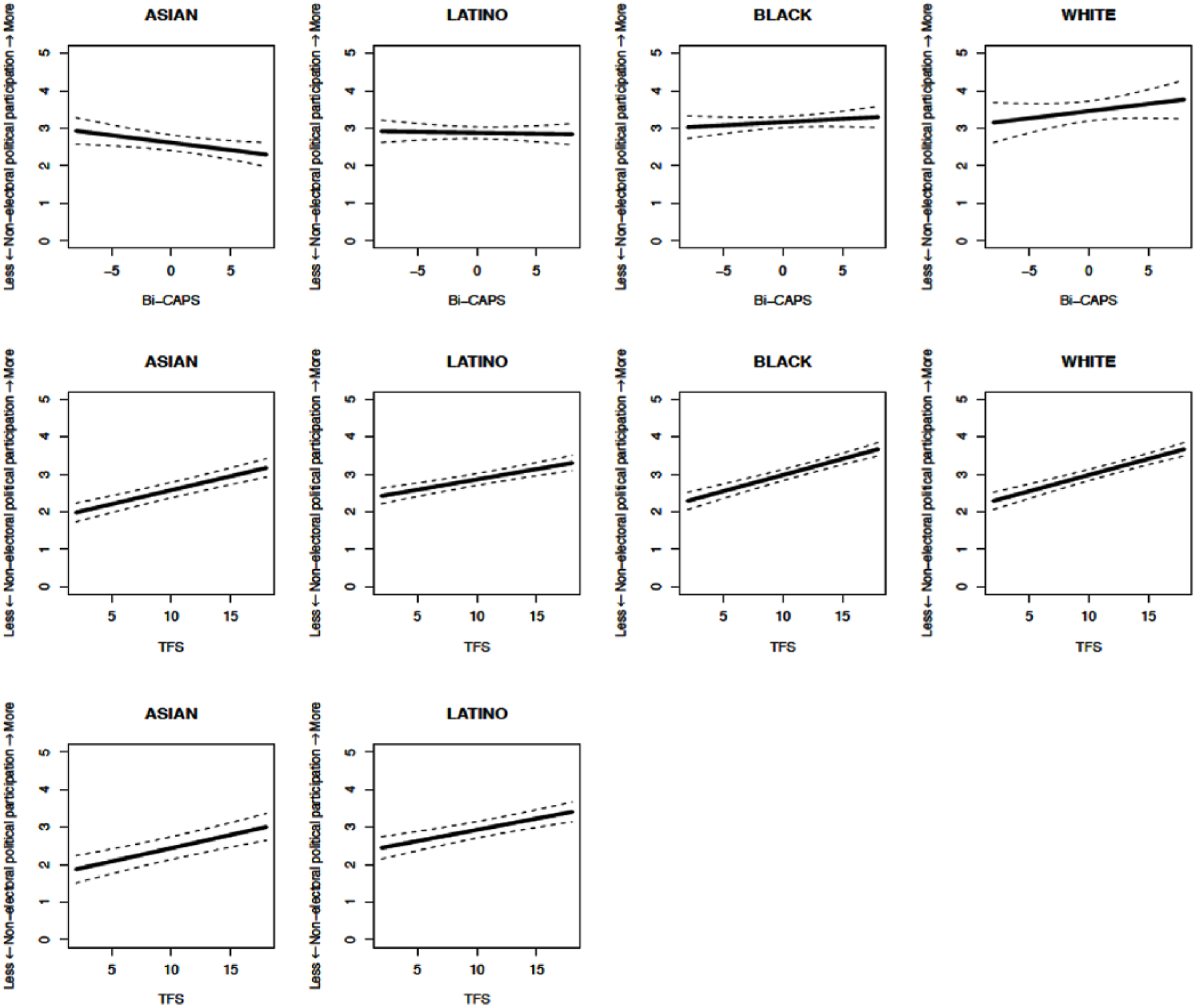
In-sample predictions of level of non-electoral political participation as a function of Bi-CAPS (top row), TFS (middle), and TFS controlling for an alternative measure of Bi-CAPS using a ranking approach (bottom).
Specifying parental and child influence separately, we also find that the effects of TFS are not simply being driven by parents. Perceiving children as important agents of socialization is related to more non-electoral political engagement (see Table A.16 in the Supplemental Appendix). This is not to say that children and parents are given the same weight in terms of political learning, but rather that contributions from both sources matter. Again, this may be somewhat surprising, given the critical role that adults play in the lives of children more broadly.
The null relationship between non-electoral political participation and Bi-CAPS, combined with strong, consistent, and positive relationships for TFS and the separate child and parent influence indicators teaches us that for some, parents are more influential, and for others it is children. For the sake of sustaining civic engagement, what appears to matter most is that some family-based socialization occurs and less so the source of that socialization.
Conclusion
This investigation builds on efforts to compliment “top-down” models of political socialization with “trickle-up” models that emphasize pathways that run from children to parents. This area of research was presaged by earlier political scientists and paralleled by research outside of the discipline. Our primary contribution is the introduction of a two-dimensional concept of socialization and a novel measure of individual-level, perceived relative importance of child and parent political socialization (Bi-CAPS). Using original survey items, we show that Bi-CAPS passes numerous validation tests and coupled with our second dimension, TFS, or the sum of parent and child socialization, we are able to tap into the range of perceptions of socialization from both parents and children, as they relate to and compliment each other.
We contend that our two-dimensional measure of socialization is portable across a range of contexts and can inform research in multiple disciplines. For political science, analysis of Bi-CAPS reveals that neither parents nor children are overwhelmingly credited as the primary agents of political socialization. Instead, for most people, the modal political socialization experience is a mix of the two. As the country diversifies in terms of race, ethnicity, immigration status, and income, capturing this range of experiences will prove crucial for understanding how people gather information about politics.
In addition to collecting evidence of content, convergent, and nomological measurement validation, we show that our measure holds up to a number of robustness checks. Whether we split our sample by nativity, divide Bi-CAPS by the constitutive parts of parent and child influence, or restrict our analysis to those whose combined familial socialization experience is more or less influential, we find consistent and confirmatory evidence of measurement validation. We also learned that levels of non-electoral forms of political participation are unrelated to Bi-CAPS, but are linked to TFS. Collectively, these results speak to the dynamics of political discussions in the home that evidently go beyond the more traditional “parents as managers” approach (Stinchcombe 1968) and further suggest that citizenship and the stability of institutions are nonetheless buttressed by socialization processes that happen both in trickle-up and top-down fashions. We believe this provides the most persuasive evidence to date regarding bidirectional socialization because up until now, the evidence has not been as robust as the findings presented above.
The concepts and measures introduced here motivate future research. Although we have no way of knowing which facts and opinions are actually transferred from child-to-parent or parent-to-child, the results remain insightful because perceptions nonetheless provide information about attribution and what individuals value, and, therefore, can lend insight into political attitudes and behavior. We presume that if a respondent says she learns from her children or younger people, this means she values that contribution. And given that aside from parents, schools operate as primary socialization venues for children (Jennings and Niemi 2015), this could also hint at the subsidiary educational gains parents can acquire by having kids in school. For example, we might expect that low-SES and immigrant status not only predicts reliance on children for information but may also lead to knowledge transfers from children to parents. This, in turn, may close knowledge gaps between those with more social and educational capital and those who are less endowed. In any case, we encourage replicating our measure in a way that captures the actual influence of children and parents, rather than perceptions of influence.
Supplemental Material
Online_Appendix – Supplemental material for Validating a Measure of Perceived Parent–Child Political Socialization
Supplemental material, Online_Appendix for Validating a Measure of Perceived Parent–Child Political Socialization by Francisco I. Pedraza and Brittany N. Perry in Political Research Quarterly
Footnotes
Acknowledgements
The authors are grateful for insight and comments on earlier drafts from Matt Barreto, Dan Biggers, Ben Bishin, Miguel Carreras, Loren Collingwood, Martin Johnson, Jane Junn, Jenn Merolla, Efrén Pérez, Molly Ritchie, Nick Valentino, Nick Weller, Bryan Wilcox-Archuleta, Janelle Wong, Elizabeth Zechmeister, participants of the 2016 Southern California Political Behavior Conference, participants of the Politics of the Race, Immigration, and Ethnicity Consortium, and our thorough and thoughtful PRQ reviewers.
Declaration of Conflicting Interests
The author(s) declared no potential conflicts of interest with respect to the research, authorship, and/or publication of this article.
Funding
The author(s) received no financial support for the research, authorship, and/or publication of this article.
Notes

References
Supplementary Material
Please find the following supplemental material available below.
For Open Access articles published under a Creative Commons License, all supplemental material carries the same license as the article it is associated with.
For non-Open Access articles published, all supplemental material carries a non-exclusive license, and permission requests for re-use of supplemental material or any part of supplemental material shall be sent directly to the copyright owner as specified in the copyright notice associated with the article.
