







Abstract
This study focuses on the gendered nature of ambassadorial appointments. Analyzing the diplomatic services of ten Latin American countries between 2000 and 2018, we examine the factors that explain the designation of women to ambassadorships. More especially, we are interested in whether the election of women to the presidency in Argentina, Brazil, Chile, and Costa Rica had an impact on the gender gap at the top of those countries’ foreign services. Drawing on an original dataset on diplomatic appointments, we show that the presence of women ambassadors has increased only marginally over the past two decades. Furthermore, multivariate regression analysis demonstrates that women presidents on the left have (partially and temporarily) corrected the gender gap in their foreign services through political appointments, provided they had the discretionary powers to do so. Our findings suggest that the impact of women-led presidencies is conditional on the chief executive’s vested interest in gender parity and the scope of presidents’ prerogatives to appoint ambassadors. In so doing, the study contributes to debates on the descriptive underrepresentation of women in executive positions and the gender gap in diplomacy.
Introduction
While women remain underrepresented in all political leadership positions, this is especially true in diplomacy. 1 Recent studies suggest that women occupy only 15 percent of all ambassadorships worldwide (Aggestam and Towns 2019, 23; Towns et al., 2018, 193), and most women ambassadors concentrate in less prestigious postings, which limits their career opportunities and political influence (Calin and Buterbaugh 2019; Schiemichen 2019; Towns and Niklasson 2018). Ambassadors represent their home country and its interests abroad. They are senior executive appointees tasked with conducting international relations on a day-to-day basis. Yet ambassadors are often unrepresentative of the country’s population they represent.
This study focuses on the gendered nature of ambassadorial appointments. Analyzing the diplomatic services of ten Latin American countries between 2000 and 2018, we examine the factors that explain the appointment of women to ambassadorships. More specifically, we are interested in whether the election of women to the presidency in Argentina, Brazil, Chile, and Costa Rica impacted the gender gap at the top of those countries’ foreign services.
The past two decades saw an unprecedented wave of women that came to power in Latin America, including Michelle Bachelet in Chile (2006–2010, 2014–2018), Cristina Fernández in Argentina (2007–2015), Laura Chinchilla in Costa Rica (2010–2014), and Dilma Rousseff in Brazil (2011–2016). 2 In particular, Bachelet became internationally recognized as a champion for gender equality (see Franceschet and Thomas 2015; Thomas 2016). She appointed Chile’s first gender parity cabinet in 2006 and became the inaugural Executive Director of UN Women after her first term in office.
Bachelet, Fernández, and Rousseff also formed part of the so-called “pink tide” that brought leftist governments to power across Latin America. Despite running on platforms that emphasized social justice and equality, these progressive governments did not always advance women’s rights (Blofield et al., 2017). As in Chile, the election of women to the presidency in Argentina and Brazil raised expectations that the presidentas would act on behalf of women. However, both Fernández and Rousseff faced criticism for not making gender equality a priority (Jalalzai 2015; Jalalzai and dos Santos 2015; Lopreite 2015). By the same token, the impact of Laura Chinchilla’s center-right government on women’s advancement in Costa Rica remains contested (Piscopo 2018, 168). We ask whether these women used their presidential prerogatives to appoint more women to ambassadorships.
Studies on the gender gap in political representation have proliferated in recent years. While earlier scholarship focused on the presence of women in legislative bodies, an increasing number of studies examines the gendered process of executive appointments (see Field 2020). These studies expect that core executives chose appointees based on their preferences and in response to political incentives. At the same time, they recognize that selectors are gendered actors who make decisions within a context shaped by gender-based assumptions and expectations (Annesley et al., 2019). Reyes-Housholder (2016), for example, observes that women presidents in Latin America appointed more women to their cabinets because of their electoral mandates and gendered networks. Although scholars disagree on whether women in power appoint more women, they agree that institutional and political factors condition the effect (Annesley et al., 2019; Barnes and O’Brien 2018; Childs and Krook 2009; Field 2020; Krook and O’Brien 2012).
We provide the first cross-national comparative study on the importance of the selector’s gender for understanding the descriptive underrepresentation of women in diplomacy. 3 Our contribution is twofold. First, the study expands the scope of the present literature to an underexplored area of executive appointments. Second, it also speaks to recent debates on the political and institutional origins of the gender gap in diplomacy. In contrast to the public and scholarly scrutiny that the appointment of cabinet ministers has received, we still know little about the process in countries’ diplomatic services, especially outside Europe and North America (Aggestam and Towns 2019, 23; Lequesne 2019, 781).
To that end, we analyze an original dataset that contains information on the (attributed) gender of ambassadors and whether they were recruited from the professional foreign service or political appointees. 4 Unlike prime ministers, presidents tend to have considerable discretion in the appointment of ambassadors. While constitutional prerogatives empower incumbents, as selectors, they also face constraints because political allies may expect ambassadorships in exchange for their support (Fedderke and Jett 2017; Hollibaugh 2015). Furthermore, in many countries, the career service conditions the “supply” of eligible personnel, often to the detriment of women. Existing research suggests that women in diplomacy continue to face unequal opportunities, leading to their underrepresentation at the top of the organizational hierarchy (Aggestam and Towns 2019, 17). Although political considerations and the presence of a career service impose limitations on the executive, selectors can use their prerogatives to bypass these constraints. Discretion creates space for selectors to act as key allies or “critical actors” for advancing women’s presence in leadership positions (Aggestam and True 2020; Annesley et al., 2019, 19). 5 We expect that selectors invested in gender parity will (partially) correct the “supply-side” failure in the career service through political appointments, provided they have the discretion to do so.
Consistent with existing scholarship, we find that women are underrepresented in our sample of Latin American foreign services, accounting for only 15 percent of all ambassadors in 2018—well below the parity target of 50 percent. We further observe that women-led governments have not consistently yielded an increase in the proportion of women ambassadors. The positive effect only occurred in three cases of leftist governments headed by women (Argentina, Brazil, and Chile). In contrast, the proportion of women appointed to ambassadorial positions decreased during Laura Chinchilla’s term in office (Costa Rica). Our findings confirm previous evidence that leftist governments tend to advance women’s participation in political leadership (Barnes and O’Brien 2018; Bashevkin 2014; Claveria 2014; Davis 1997; Escobar-Lemmon and Taylor-Robinson 2005). The effect is further dependent on the scope of presidential discretion over political appointments (high in Argentina and Chile; low in Brazil). We conclude that the impact of women-led presidencies is conditional on political and institutional factors, namely the executive’s vested interest in gender parity and the scope of discretionary power to appoint ambassadors.
The remainder proceeds as follows: The second section examines the history of women’s inclusion in Latin America’s foreign services, focusing on the reasons of women’s underrepresentation and the role that discretionary appointments played in opening opportunities for women outside the career bureaucracy. The third section reviews the literature on the gendered dynamics of executive appointments. The fourth section develops our main argument, which centers on the role of critical actors in overcoming the limited supply of women in the career service. The fifth section introduces the data and presents descriptive and multivariate regression results. We discuss these findings in the sixth section and drew out their implications in the conclusion.
Women in Latin America’s Foreign Services
Diplomacy has long been the domain of elites, and men in particular. Modern diplomacy is built around the reciprocal exchange of resident embassies. Since their origins during the Italian Renaissance, ambassadors have embodied sovereign princes at foreign courts and were predominately recruited from the aristocracy until the creation of professional foreign services in the nineteenth and early twentieth centuries. The bureaucratization of diplomacy, however, entailed the formal exclusion of women from the profession. “Women were not believed to be able to play the role of foreign envoys efficiently, partly because their gender would limit their access to the public (male) officials and informal (male) networks necessary for gathering information,” Niklasson (2020, 14) writes. It was not until the gradual opening of foreign services in the twentieth century that women could become career diplomats (McCarthy and Southern 2017, 22–23; Nash 2019; Sluga and James 2016, 6). Today, not only are women consistently underrepresented at the apex of diplomacy, but research shows that women ambassadors are disproportionally appointed to less prestigious positions and to places that are regarded as “soft,” characterized by lower economic and political power, less violence, and better human rights practices (Calin and Buterbaugh 2019; Jacob et al., 2017; Schiemichen 2019; Towns and Niklasson 2018). Diplomacy remains a deeply gendered institution.
Women increasingly entered Latin America’s foreign ministries during the interwar period, initially occupying consular positions and representing their countries in international conferences and organizations. As in Europe and the United States, discretionary appointments performed an important function in opening the path for women given that formal institutional barriers prevented women from entering the career service until the second half of the twentieth century. 6 Brazil, for example, (re-)opened the entry exam to women in 1954 and appointed the first women career diplomat to an ambassadorship in 1959 (Odette de Carvalho e Souza, to Israel) (Roeder Friaça 2018, 197). 7 Although these legal hurdles were gradually abolished, women remained systematically disadvantaged; for example, due to restrictions that first prohibited married couples from remaining in the civil service and later required one spouse to take a leave of absence, often forcing women to abandon their careers (De Souza Farias 2017; De Souza Farias and Do Carmo 2018).
However, even after the end of legal discrimination, institutional glass ceilings persist. Studies on Brazil and Mexico suggest that the number of women in these foreign services has increased over the years. Nevertheless, like their peers in Europe and North America, women in Latin America tend to be overrepresented in administrative and support roles and underrepresented in leadership positions within these bureaucracies (De Souza Farias and Do Carmo 2018, 114; Flores 2006, 774). Furthermore, these studies highlight the continuing existence of structural inequalities and fewer career opportunities that result, among other things, from institutional structures historically tailored to suit the role of men as single breadwinners. They also emphasize the continuation of gender stereotypes that cast women as less able and ill-suited for stints abroad. 8
The situation in other Latin American countries remains poorly understood. However, reports on the Argentine and Chilean cases indicate a similar “supply-side” failure that leads to fewer women at the top of the career service. In early 2020, 300 Argentine career diplomats signed a petition urging the government to end discriminatory practices and increase the number of women at the top of the career service (Martínez 2020). Chilean diplomats have voiced similar concerns. A rigid, seniority-based promotion system only allows career diplomats to ascend if their immediate superiors are promoted or retired, leading to “career stagnation” that disproportionately affects women who concentrate in the lower ranks (Muñoz and Bywaters 2020). The second Bachelet government passed a reform in 2018 that sought, among other things, to make diplomatic appointments more flexible. However, the succeeding government of Sebastián Piñera has yet to implement this aspect of the “modernization law.” In December 2020, Chilean diplomats petitioned the government to ensure gender parity in candidate selection and address women’s underrepresentation in senior positions. 9
Finally, in early 2020, Mexico became the first Latin American country to adopt an explicit feminist foreign policy. While similar proposals in Canada and Sweden focus on development cooperation, Mexico’s feminist foreign policy centers primarily on the gender mainstreaming of its foreign service (Secretaría de Relaciones Exteriores de México 2020). 10
Latin American states readily adhered to international agreements aimed at advancing women’s rights and gender parity. Following the adoption of the UN Convention on the Elimination of All Forms of Discrimination Against Women (CEDAW), Latin American states were vanguards in implementing gender quotas for elected officers, starting with Argentina in 1991 (Jones 2009). However, there are few policies in place to increase the representation of women in appointed positions. This is especially true of ambassadorships. Although some countries have national plans on gender equality in the public sector, executive prerogatives and separate legal statutes for the career service exclude ambassadorial appointments from these measures. Incipient initiatives to increase the presence of women mainly focus on the recruitment stage. If continued, they will require many years to show results, for it takes decades to rise to the top of the bureaucratic hierarchy.
What is more, because they are rarely institutionalized, these efforts ultimately depend on political will. In this sense, ambassadorships are not unlike executive appointments, such as cabinet ministers. However, whereas cabinet members are recruited from among the political elite, the career service provides a pool of candidates that the chief executive can bypass if the selector wishes to do so.
The Gendered Dynamics of Executive Appointments
While women have made significant inroads into political office in recent years, they are still underrepresented in executive positions. According to data from Nyrup and Bramwell (2020), the presence of women in cabinets worldwide rose from 3 percent in 1980 to 25 percent in 2018. At the same time, the inclusion of women in the executive has lagged behind their presence in the legislature, where the implementation of gender quotas in many countries has changed the rules of the political game (Bauer and Tremblay 2011). In explaining the persistence of the gender gap in executive appointments, studies commonly distinguish between demand and supply factors (see Field 2020; Krook 2010). 11
Supply factors influence the availability of suitable candidates. Duflo (2012), for example, argues that economic development goes together with the empowerment of women in society. Societal factors have a bearing on the number of women suitable for leadership positions. Numerous studies expect that women’s educational attainment and participation in the labor force should be positively correlated with their presence in cabinet positions (Barnes and O’Brien 2018; Escobar-Lemmon and Taylor-Robinson 2005; Krook and O’Brien 2012). Likewise, the greater availability of women in congress should raise the possibility that more women are appointed to leadership positions (Claveria 2014; Davis 1997; Escobar-Lemmon and Taylor-Robinson 2005; Jalalzai 2013; Stockemer and Sundström 2018). As the number of women in parliament rises, so should their visibility in politics and the possibility of strategic coalitions among women to influence the nomination process (Crowder-Meyer 2013, 1163). Empirical studies, however, find mixed results, suggesting that regime type and country-specific recruitment norms condition the effect (Arriola and Johnson 2014; Siaroff 2000; Whitford et al., 2007).
Demand-side factors shape the incentives for the appointment of women. International norms, such as CEDAW and the Beijing Declaration and Platform for Action, generate pressure on states for compliance (Bush and Zetterberg 2020; Jacob et al., 2017; Towns 2010). Women’s rights groups can invoke these commitments to hold governments accountable, raising the political costs of sidelining women. Norms can take many forms, ranging from legal requirements, such as gender quotas, to informal rules that create social expectations for the greater inclusion of women. Annesley et al. (2019) posit that the appointment of women to the cabinet by one selector defines a “concrete floor” that binds successors, even if such threshold is not legally enforceable (see also Claveria 2014; Jacob et al., 2014; Thomas 2016).
Ideological orientation also features prominently as a demand factor in the literature. Leftist parties have led in the integration of women into politics. The literature consequently expects leftist governments to appoint more women (Barnes and O’Brien 2018; Bashevkin 2014; Claveria 2014; Escobar-Lemmon and Taylor-Robinson 2005; O’Brien et al., 2015; Siaroff 2000). However, here, too, empirical results are inconclusive. Focusing on Western and industrialized countries, Stockemer and Sundström (2018) show that the effect of leftist governments on cabinet appointments has declined as conservative parties gradually changed their position toward gender parity. Although Celis and Childs (2012) warn against conflating leftist ideologies with pro-women agendas, more recently they contend that the “inter-party gender gap” remains relevant (Celis and Childs 2020, 58).
Regarding Latin America, Blofield et al. (2017, 347) argue that the election of socialist and social democratic governments during the “pink tide” opened a window of opportunity for the advancement of women in the region. They find that the left was indeed “more amendable than the right to demands for gender equality” (Blofield et al. 2017, 350). However, rather than the result of ideological commitment, the implementation of pro-women policies was often instrumentally motivated and responded to civil society mobilization. Only those governments with close ties to civil society groups advanced women’s rights and gender parity. By contrast, populist leftist governments, such as that of Hugo Chavez in Venezuela, lacked these channels and consequently failed to act on behalf of women.
Finally, authors disagree on whether the selector’s gender matters for the appointment of women. A common expectation in the literature is that women in leadership positions will support the promotion of other women. As Field (2020, 1) summarizes, “[w]omen may be more inclined to campaign on women’s representation and value gender diversity than men; they may have networks that include more eligible women; or they may be less likely to employ gender stereotypes.” Although several studies have confirmed a positive relationship (Cheng and Tavits 2011; Crowder-Meyer 2013; Davis 1997; Reyes-Housholder 2016), the author finds little evidence to this effect. Field’s (2020) study is consistent with previous research that considers the effect of women in power either to be absent or mediated by political and institutional factors (Annesley et al., 2019; Childs and Krook 2009; Field 2020; O’Brien et al., 2015). Despite these disagreements, studies coincide that women in leadership positions can act as key allies or critical actors to reduce the gender gap. Their interest in gender parity is not determined by their sex but depends on selectors’ incentives and discretion to act on behalf of women (Aggestam and True 2020; Annesley et al., 2019; Celis and Childs 2012; Childs and Krook 2009; Escobar-Lemmon and Taylor-Robinson 2005; Field 2020). Feminist institutionalists argue that gendered institutions, both formal and informal, condition women’s recruitment into public office (Kenny 2014; Krook 2010; Waylen 2014). We draw on these arguments to formulate our theoretical expectations.
Theoretical Expectations
We are interested in the effect of women-led presidencies on the appointment of women ambassadors. First, in line with existing studies, we expect an increase of women in ambassadorial appointments over time in Latin America. Women have long been barred from occupying formal roles in diplomacy, and they continue to face unequal access to career opportunities. However, women have increasingly achieved leadership positions in both the private and public sectors. These changes should also be evident in countries’ foreign services—irrespective of who occupies the presidency. This leads to our first hypothesis:
Second, we assume that some governments are more invested in gender parity than others. Authors disagree whether women in power will bring other women along. Women presidents are not necessarily “critical actors” by virtue of being women. Prominent leaders, such as Indira Gandhi, Golda Meir, and Margaret Thatcher, painstakingly avoided being associated with women’s rights claims. Similarly, in Costa Rica, Laura Chinchilla distanced herself from the country’s feminist movement (Piscopo 2018, 172). However, the existing scholarship also emphasizes that selectors are gendered actors who appoint senior officials based on their own preferences and in response to incentives. Women may act on behalf of other women either because of their own normative commitment or because they expect to benefit politically from pro-women policies. Finally, they may also appoint more women due to their gendered networks and “homophily,” that is, the tendency of people to associate with others who are similar to them (Crowder-Meyer 2013; Reyes-Housholder 2016). We therefore expect a positive effect.
Existing scholarship further argues that leftist governments should be more attuned to women’s rights. However, these studies also show that the relationship has weakened recently. As Htun and Weldon (2010) emphasize, women’s rights contain multiple issues that do not neatly line up with the left-right ideological divide. In Latin America, governments on both sides of the political spectrum implemented gender quotas, and both leftist Cristina Fernández and center-right Laura Chinchilla hindered the decriminalization of abortion during their presidencies.
Yet Fernández also increased the number of women in the cabinet, and key legislation on assisted fertilization and against gender violence was passed during her presidency. Rousseff largely followed the preceding leftist government of Lula da Silva in supporting redistributive policies that benefited Brazilian women. Internationally, she also followed her predecessor in pursuing a foreign policy in line with the United Nations Security Council’s Women, Peace and Security agenda without explicitly adopting a pro-women stance (Salomón 2020). However, as Jalalzai and dos Santos (2015, 118) note, Rousseff had a “direct impact” on increasing women’s descriptive presentation in the executive branch. Among Latin America’s presidentas, Bachelet stood out for her open support for women’s rights. Her insistence on gender parity in the appointment of high-ranking officials opened Bachelet to the criticism that she favored “sex over merit” (Franceschet and Thomas 2015, 645; Thomas 2016, 95). We therefore hypothesize the following relationships between ideology and gender:
We further expect the effect of women in power to be more evident among leftist presidents.
Last, we expect that governments committed to gender parity use discretionary appointments to augment the number of women in the diplomatic service. Existing studies show that the effect of women-led governments on the appointment of senior officials depends on the institutional context. Yet, the bulk of the recent literature on women in diplomacy focuses on a limited number of foreign services in Europe and the United States. Studies have examined the prestige of diplomatic postings, but they have not considered differences in appointment procedures. Distinguishing between the type of appointment is important because not all ambassadors have risen through the bureaucratic ranks of the career service. Political appointments, for example, are well studied in the case of the United States, where they amount for (at least) 25 percent of all ambassadorial appointments (Fedderke and Jett 2017, 385; Haglund 2015, 659; Hollibaugh 2015, 48). Politically sensitive missions may benefit from an ambassador’s closer ties with the chief executive. Yet ambassadorships may also become political prizes. The percentage of discretionary appointees rose dramatically under U.S. President Donald Trump, sparking a renewed debate about nepotism and the erosion of professional diplomacy. Although less common in Europe, in the United States, the recruitment of personnel from outside the career service reflects a long-standing practice where ambassadorial stints are regularly given to campaign supporters (Fedderke and Jett 2017). Although past presidents used their discretionary powers to select the first women ambassadors, today, political appointees in the U.S. foreign service are predominantly male, which highlights the role that the selector’s discretion plays in this regard (Calin and Buterbaugh 2019; Schiemichen 2019, 21).
Latin America’s constitutions grant wide discretionary powers to the chief executive. While these political systems are often described as “hyper-presidentialist,” the power allocated to presidents to control the legislative process or appoint cabinet ministers varies across the region (Shugart and Mainwaring 1997). In Brazil, all ambassadorial appointments require congressional confirmation, and discretional appointments are narrowly circumscribed and uncommon. Moreover, a powerful state bureaucracy with a strong esprit de corps opposes the recruitment of diplomats from outside the career service. In Argentina, legal provisions establish a numerical limit of 25 political ambassadors. However, these are honored more in the breach than in practice. In Chile and Costa Rica, presidents have broad discretion, as these constitutions stipulate no limitations on the appointment of political ambassadors, nor is parliamentary confirmation required (see Table 1-A in the Online Appendix).
In a recent study, Amorim Neto and Malamud (2019, 814–815) consider political appointees in many Latin American diplomatic services as an indicator of low institutional autonomy. In this view, the practice of political appointments contrasts with merit-based recruitment and promotion. The “corporate” interests of professional and political diplomats frequently put them at odds. Chilean diplomats, for example, have long (and publicly) criticized patronage and the use of ambassadorial appointments as political “consolation prizes” (Fuentes 2009, 64).
The preceding discussion shows that discretionary appointments have played an important role in opening the door for women in diplomacy. Furthermore, existing studies suggest that Latin America’s foreign service exhibit what Putnam termed “the law of increasing disproportion,” which holds that the number of women decreases with each step closer to political authority (cited in Aggestam and Towns 2018, 12; Bashevkin 2014, 411). In other words, career services suffer from a “supply-side failure”: not only have women been historically underrepresented, but they are increasingly rare toward the top of the institutional hierarchy. We argue that discretionary appointments allow for the (partial) correction of this bias—provided that the chief executive is amenable to doing so.
We purport that both women-led and leftist governments are more invested in gender parity than their corresponding counterparts. We therefore expect two conditional effects.
Data and Analysis
We constructed an original dataset on ambassadorial appointments in ten Latin American counties to test these propositions. 12 We obtained data for the period between 2000 and 2018 through freedom of information requests, supplemented with publicly available information, such as institutional reports and websites. Unfortunately, several ministries did not respond to our requests (Ecuador, Dominican Republic, and Panama) or provided incomplete information that we were unable to complete (Honduras). Hence, data availability issues prevent us from analyzing the full set of Latin American countries. It also means that our data are censored as they do not include cases of leftist populist presidents who governed in Bolivia, Ecuador, and Venezuela at the time. 13 We are therefore unable to test differences among Latin America’s left. However, we believe that the sample is large enough to compare the four countries that had women-led governments with wider regional trends.
We limit our analysis to the heads of missions with ambassadorial rank. Countries with small foreign services often dispatch ambassadors to multiple (adjacent) countries, and not all countries appoint representatives to international organizations at the rank of ambassador—technically, these are not “ambassadors” but “permanent representatives.” Therefore, and to allow for meaningful comparison, we exclude concurrent appointments and diplomatic representatives to international organizations.
We impute the gender of ambassadors based on their Spanish or Portuguese first name(s), which we corroborated through additional biographical research. Our dataset contains a total of 8,424 embassy-year observations, with 1,919 individual ambassadors (272 of which are women, or 14% of the total).
Descriptive Analysis
The data show that women continue to be underrepresented in our Latin American sample. At the beginning of the time series, women accounted for approximately 12 percent of all ambassadorial appointments across the region; this percentage rose to 17 percent in 2010 and declined to about 15 percent in 2018. However, these yearly averages conceal considerable cross-country differences (see Figure 1). Guatemala, which has the smallest diplomatic service in our sample, is an extreme case where the number of women ambassadors dropped from 3 out of 8 (38%) in 2012 to 0 in 2015. 14 Perhaps more striking is the persistent increase in Argentina starting in 2005 and the sudden drop after 2015, corresponding with the end of Cristina Fernández’s government and Mauricio Macri’s accession. At its peak, 14 of out 44 Argentine ambassadors were women (38%). On the other extreme, Brazil has one of the world’s largest foreign services, which is also reflected in the more gradual change. In 2013, 18 out of 118 Brazilian ambassadors were women (16%). In 2018, that number was reduced to 4 out of 78 (5%). 15 Although the Itamaraty is famed for its professionalism and meritocracy, the proportional decline over time suggests that women have not consistently risen to the top.
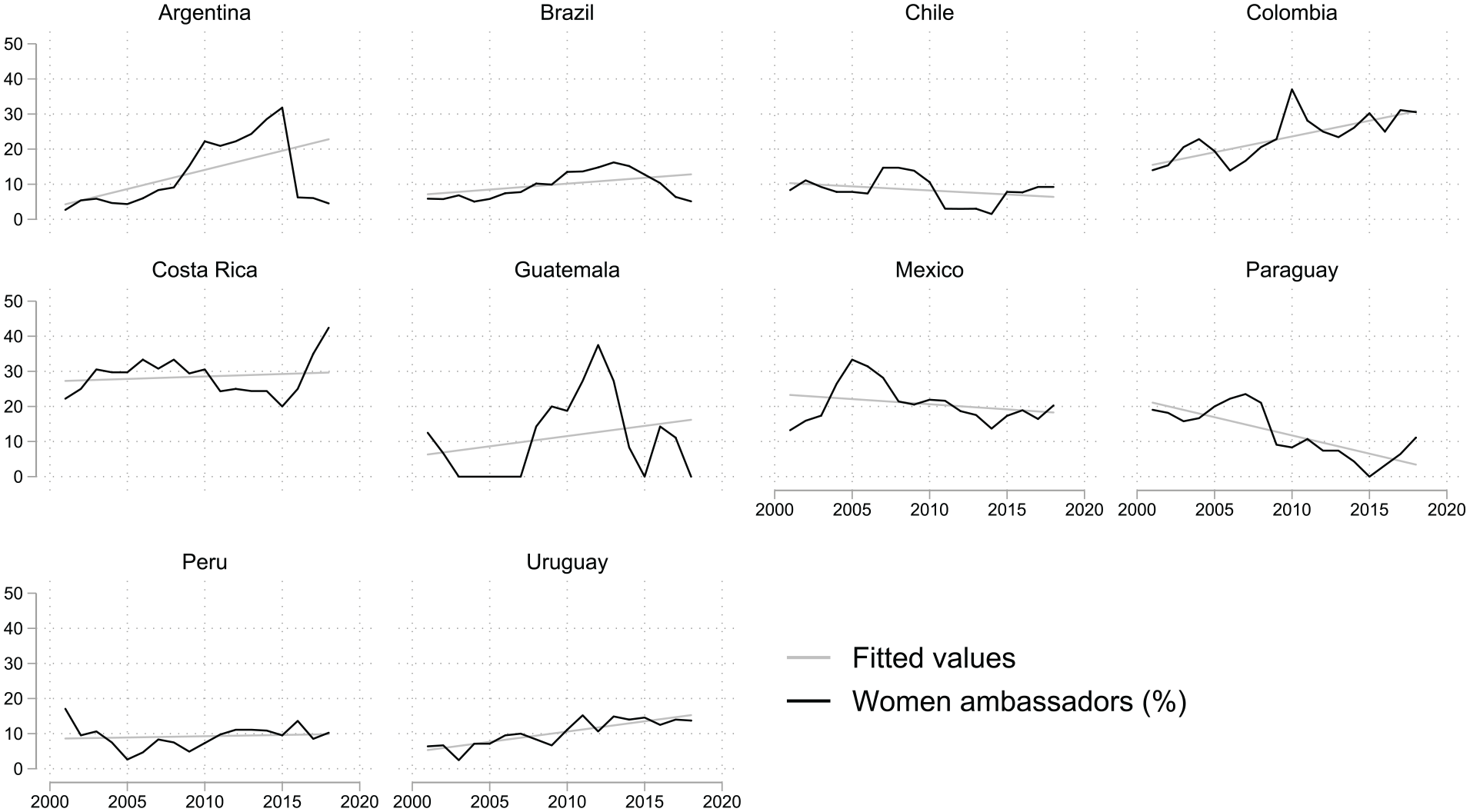
Proportion of women ambassadors by country.
Figure 1 further shows that the percentage of women has not increased consistently across the region. Although the linear projections provide a poor fit for the data in most cases, they suggest that the proportion of women ambassadors has followed a downward trend over the two-decade period in Chile, Mexico, and Paraguay. By contrast, Colombia represents an example where women have clearly made inroads, although here, too, women remain underrepresented, accounting for about one-third of all ambassadorial appointments in 2018. The percentage of women ambassadors never fell below the 20 percent mark in Costa Rica, which ranks globally among the countries with the smallest gender gap (World Economic Forum 2019).
Figure 2 focuses on the four cases of Latin American countries with women-led governments. It shows the proportion of women ambassadors (black solid line), the proportion of political appointment (gray dashed lines) and identifies the period(s) in which each country was governed by a woman (gray shaded areas).
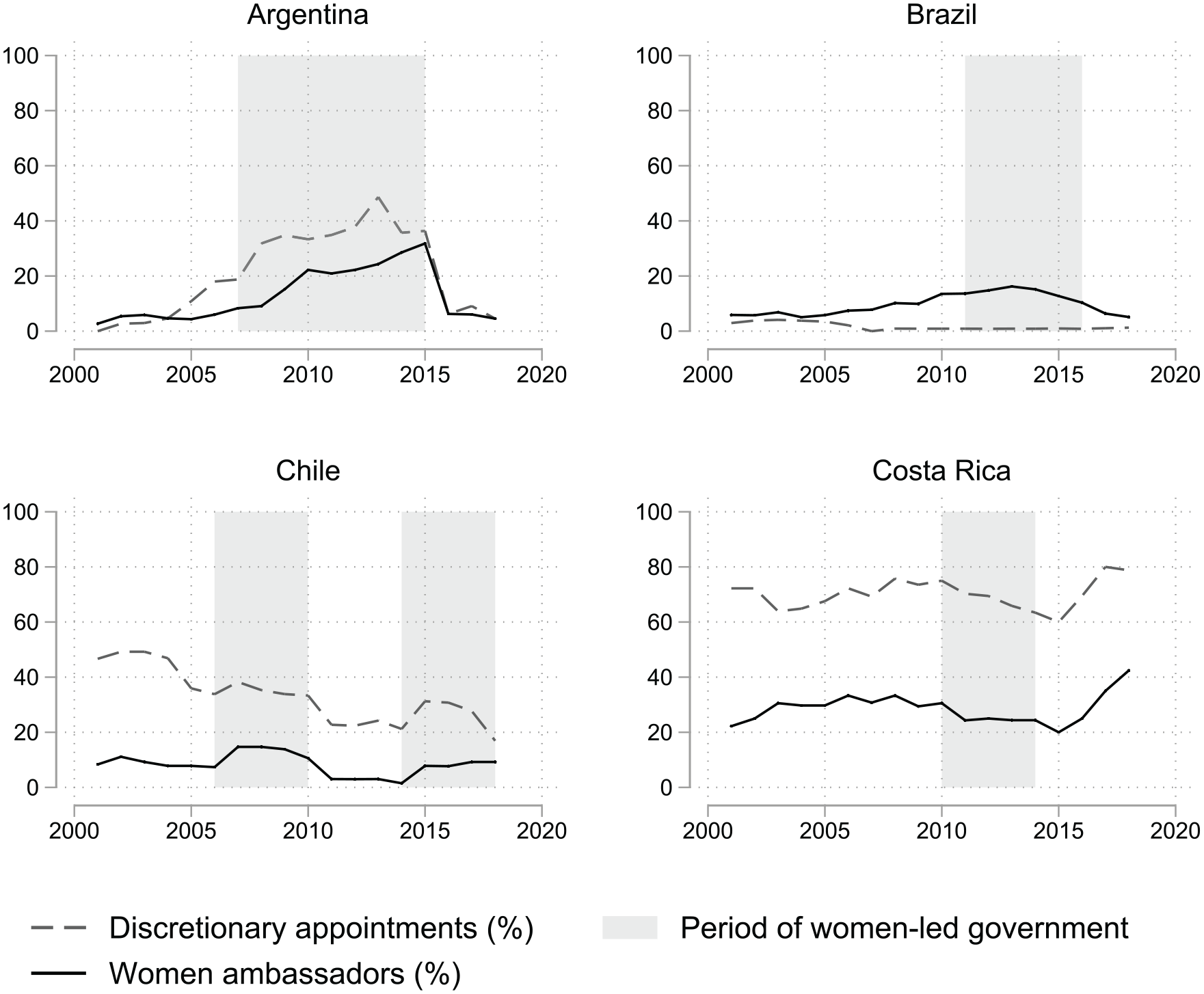
Four Latin American countries with women-led governments.
The four countries vary significantly regarding the prevalence of political appointees: the practice hardly exists in Brazil, is prevalent in Costa Rica, and has declined over time in Chile. 16 In Argentina, Cristina Fernández has made extensive use of her prerogatives—considerably more so than her predecessor or successor. As noted in Figure 1, women-led governments are associated with a substantive increase in the proportion of women ambassadors. The effect is also visible in the case of Michelle Bachelet’s two terms in office, although it is less pronounced. In Costa Rica, the proportion of ambassadors marginally declined during the presidency of Laura Chinchilla. Finally, the Brazilian case shows a slow increase during the rule of the PT that culminated with Rousseff’s government.
Overall, our descriptive findings support three preliminary conclusions. (1) The proportion of women rose only marginally between 2000 and 2018. (2) We observe an increase in the proportion of women ambassadors during women-led governments in three of the four cases, corresponding to leftist governments. (3) In Argentina and Chile, it appears that presidentas used their prerogatives to (partially and temporarily) correct the gender gap. However, the case is less clear for Brazil, where presidents have little discretion in this regard. In all three cases, rightist successor governments headed by men appointed fewer women. Costa Rica presents a different picture altogether. Despite wide-ranging constitutional powers, Chinchilla did not use political appointments to increase the proportion of women ambassadors. However, from visual inspection alone, it is difficult to clearly attribute the positive effect to women in power.
Regression Analysis
We use multivariate regression models to analytically disentangle the impact of women in power from other potential explanatory factors. Our dependent variable is a binary indicator of whether a diplomatic mission was headed by a woman ambassador in a given year or not. We include the dummy variable head of government (HOG) with the value of 1 if a woman governed a country and 0 if not in any given year. We add a second dummy variable to account for government ideology. Here, we build on Murillo et al.’s (2011) dataset on the chief executive’s ideological orientation while in office, which we expanded to 2018. The source scores each presidency on a five-point scale that ranges from left (1) to right (5). Because our sample includes no data from governments at the extreme left of the political spectrum, and because we make no assumptions about the gradual difference between left and right, we collapse the five categories into two. Left has a value of 1 if a left and center-left government was in power and 0 otherwise (centrist, center-right, and right). We furthermore include a binary variable with the value of 1 if an ambassador was a discretionary appointment. Table 1 provides summary statistics of our variables.
Summary Statistics.

Data compiled by authors unless otherwise indicated.
Adapted from Murillo et al. (2011).
Correlates of War’s National Material Capabilities 5.0 (Singer et al., 1972).
Table 2 reports the result of our regression models. Models 1 to 4 include only our three explanatory variables. In a next step, we include the hypothesized interactions effects in model 5. Model 6 then introduces government-specific controls, namely whether the foreign ministry was headed by a woman (foreign minister), the percentage of women in cabinet at a given year, and the time a government coalition remained in power (administration age). The first two controls capture the prominence of women in cabinet below the chief executive. Administration age accounts for the observation in the literature that the number of political appointees in government tends to increase over time (Dahlström and Niklasson 2013). To control for broader societal trends, model 7 adds women’s educational attainment, labor force participation, and GDP per capita as proxies for the political empowerment of women in a country. 17 Last, our fully specified model (8) also controls for the prestige of a position (host status). All models include additional covariates to control for year and country-fixed effects. The data are set up in embassy-year format. Because of our binary dependent variable, we employ logistic panel regression models. 18
Logistic Regression Results (DV=Woman Ambassador).

Coefficients reported as odds ratios; t statistics in parentheses. HOG = head of government; AIC = Akaike information criterion.
Statistical significance: *p < .05, **p < .01, ***p < .001.
The models need to be interpreted with caution due to the small number of female presidents in our sample and the fact that our time series only includes one woman president who was not on the left of the political spectrum (Costa Rica). The base model (4) shows that the logistic regression coefficients for two of our three explanatory variables are significant and in the postulated direction. The likelihood that a woman heads an embassy increased by 86 percent if a woman was in power and by 29 percent if the left governed the country in a given year, all else being equal. The proportion of political appointments is not significant in model 4.
Finally, models 5 to 8 include our three interaction terms. They show that the effect of women in power is conditional on political ideology and the use of political appointments. They further indicate that leftist governments tend to appoint more women using selectors’ discretional powers. These results remain unchanged even when controlling for potential cofounders. The coefficients for administration age, the percentage of women with a university degree, and a country’s economic development are significant and point in the expected direction. Contrary to the literature on the gendered nature of diplomatic appointments, the host country’s status is not statistically significant at the 5 percent level.
Brambor et al. (2006, 64) warn against the interpretation of constitutive terms in interaction models. For example, after including the interaction terms (models 5–8), the coefficient for head of government misleadingly suggests a negative relationship (because the coefficient now reflects the effect of women in power when the variables left and appointment take both the value 0). Because interaction effects are difficult to interpret directly from coefficients, they recommend reporting substantive marginal effects.
Figure 3 shows the predicted probabilities of model 8 to aid in the interpretation of the interaction terms. The graph illustrates how gender, ideology, and institutions interact. Overall, leftist governments, irrespective of the selectors’ gender, appoint more women ambassadors from outside the career service. However, the effect is significantly larger in the case of women-led governments: the probability that a woman is appointed almost doubles, rising from about 16 percent (men and left) to 30 percent (women and left) in the case of discretionary ambassadors. Under men-led governments (non-left), the probability that a woman is appointed from outside the career service drops to 9 percent. There is no statistically significant difference when it comes to career appointments, irrespective of the selector’s gender or ideological orientation.
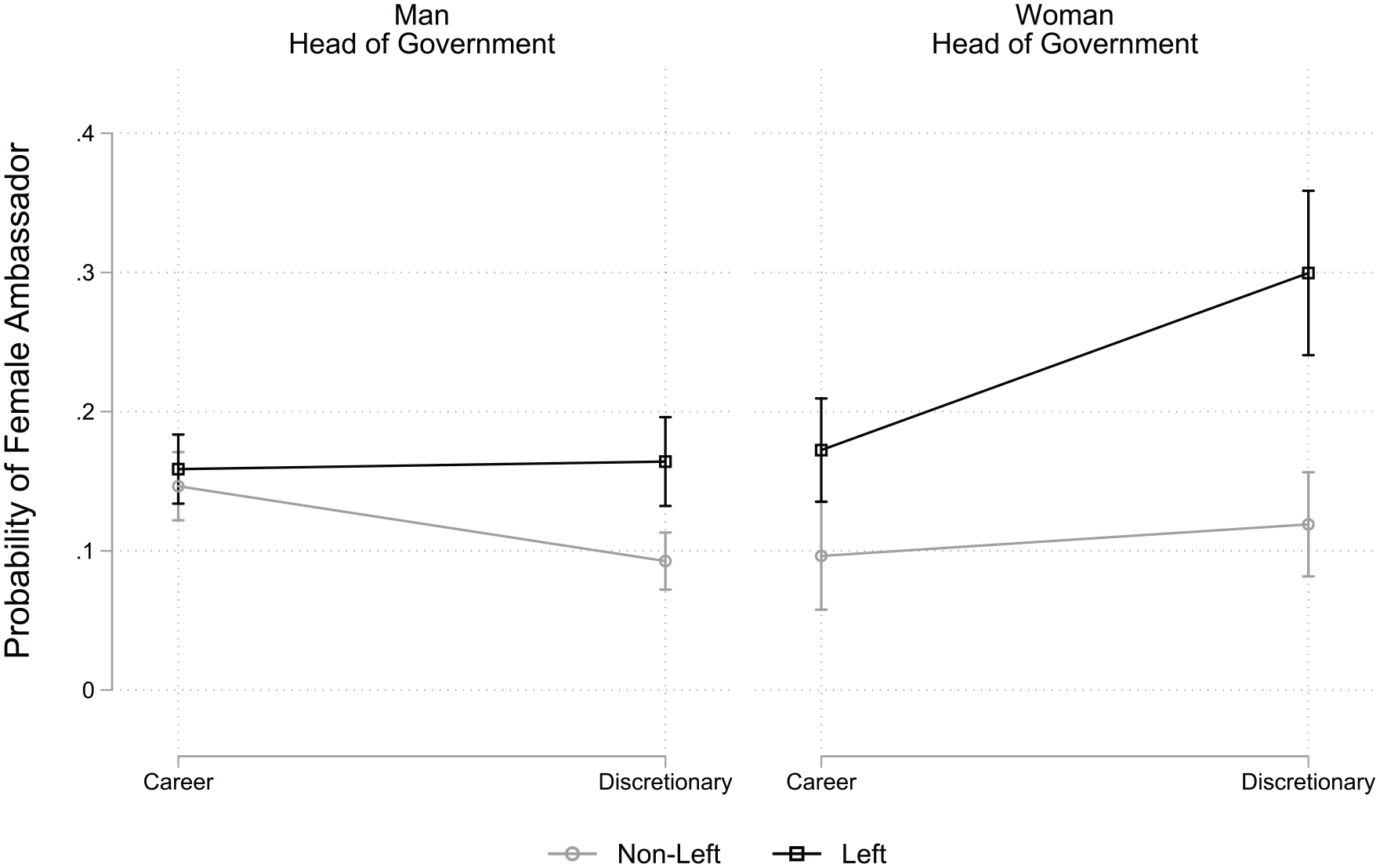
Predictive margins with 95 percent confidence intervals (model 8).
Discussion
Overall, we find a marginal increase in the appointment of women ambassadors among the ten Latin American countries for the period between 2000 and 2018. This supports H1, which expects the relative number of women to rise over the years. However, this pattern only holds true for the regional average as we observe significant cross-country heterogeneity: Colombia and Uruguay represent cases where the gender gap has narrowed, whereas it seemingly widened in Chile, Mexico, and Paraguay. There are also considerable yearly fluctuations in many countries, suggesting that the inclusion of women is not explained by their growing presence in the career service. If women have been increasingly entering Latin America’s foreign services and being promoted on equal terms, we would expect a more consistent pattern. This is not the case. Consider the Chilean example: although the proportion of career diplomats has steadily increased over the years, the proportion of woman ambassadors did not. This suggests that women do not rise through the diplomatic ranks as easily as men. Last, although the proportion of women ambassadors in the region has increased, the positive change falls far below the 50 percent gender parity mark.
H2 and H3a point to different explanations concerning the appointment of women ambassadors. Whereas H2 posits that women in power are more likely to appoint women to ambassadorships, H3a suggest that the political orientation of the chief executive is more important than their gender. We find mixed evidence in support of both hypotheses as the effects of either gender or ideological orientation are conditional on other factors. As models 5 to 8 show, the positive effect of women in power disappears when considering the relationship between presidents’ gender and their ideological orientation: in our sample, only women-led leftist governments appointed more women (H3b). By contrast, the relative number of women appointed during Laura Chinchilla’s center-right government in Costa Rica declined. Although the literature on women-led governments during the “pink tide” argues that not all presidentas exhibited a normative commitment to women’s rights, all three brought more women into cabinet. We provide evidence that they also appointed more women to ambassadorships.
The results also support our hypotheses regarding the use of discretionary powers. They show that both women-led (H4a) and leftist (H4b) governments nominate more women through discretionary appointments. Leftist governments, irrespective of the incumbents’ gender, selected more women through discretionary appointments. The effect was starkest in Argentina, where presidents have considerable leeway in appointing political ambassadors despite de jure restrictions that impose a numerical limitation on discretionary appointees. The effect was also evident in the Chilean case, where Bachelet increased the proportion of women ambassadors during her two terms in office. However, women remained a small minority even then. Existing studies on Bachelet’s record regarding gender parity emphasize her vested interest in increasing the number of women in senior executive positions. Evidently, the same can be said about Chile’s diplomatic service. According to Alberto Van Klaveren, Chile’s Undersecretary of Foreign Affairs (2006–2009), Bachelet explicitly asked for the selection of more women as there were only few eligible candidates among the career diplomats who had the required seniority. 19 In Brazil, PT rule also corresponds with an increase in the proportion of women in Brazil’s foreign service—a process which peaked during the government of Dilma Rousseff. However, the limited “room for maneuver” of Brazil’s presidents vis-à-vis the strong Itamaraty bureaucracy likely explains the attenuated effect. The fact that the number of women ambassadors declined after the impeachment of Rousseff provides further evidence of the “supply-side failure” in Brazil’s foreign service. Although Costa Rica’s presidents have significant autonomy to appoint political ambassadors, Laura Chinchilla did not use her discretional powers to narrow the gender gap during her government.
Finally, the effects persist even when controlling for the presence of women below the chief executive, the years a government coalition spent in power, and general societal trends. Surprisingly, we did not find that the host country’s status significantly affects the probability of women appointed to ambassadorships. One reason might be that existing studies on the gender gap in diplomacy have focused on developed countries in Europe and North America. The logic might well be different in the developing world, where the appointment of women ambassadors may be used as a signal of progressiveness and the status of women in these societies (see Towns 2010).
Conclusion
Our analysis of Latin American diplomatic services between 2000 and 2018 demonstrates that women-led governments indeed led to an increase in the appointment of women ambassadors. However, our results also show that political and institutional factors condition the effect. In other words, the impact of women-led government depends less on presidents’ gender than on their vested interest in and discretional powers to address the gender gap. Our findings are broadly in line with the existing literature on the gendered nature of executive appointments. They also confirm the general trend observed in the literature on women in diplomacy: the gender gap has somewhat narrowed over the years but remains substantive. In fact, we only observe a 3 percent increase in the presence of women over almost two decades—hardly a success story.
Our study suggests that future research on women in diplomacy should pay more attention to cross-country differences in the appointment of women to ambassadorial positions. Governments’ discretionary powers vary considerably. In the United States, ambassadorial appointments have long served as a form of patronage for political supporters. Women remain underrepresented among political appointees, whereas the number of women career diplomats has increased over the years. The picture is less clear for Latin America. However, our research indicates that women have not shattered the institutional “glass-ceiling” of the career service.
Furthermore, it shows that discretionary appointments, while indicating less foreign policy autonomy of the professional bureaucracy, have been an important tool in mitigating the gender gap—even if only partially and, perhaps, temporarily. Discretional appointments have historically played an important role in opening the diplomatic service to women. As we demonstrate, they also provided woman presidents with a means for increasing the proportion of women at the helm of the diplomatic service. However, these appointments have not contributed to a consistent and sustained narrowing of the gender gap, which requires institutional mechanisms to overcome “supply-side” failure in the career service. As Carreiras (2006, 200) concludes in the case of armed forces, changing gendered institutions requires long-term policies as the mere inclusion of women does not ensure their descriptive representation at the top of the organizational hierarchy.
All this suggests that we need to know more about the role of women in Latin America’s diplomatic services. Our analysis focuses on the top rank exclusively. Future research is needed to better understand the obstacles women face within those bureaucracies, both formal and informal. Hence, ethnographic work could greatly enhance our understanding of the general patterns that we analyzed here. Further research should also broaden the scope to include women at different career stages for understanding the origins of the “supply-side” failure that underpins the relative absence of women at the top of diplomacy. Finally, and relatedly, our analysis focuses on ambassadorial appointments to sovereign states exclusively; future research should consider differences in appointments between states and international organizations, and between diplomatic and consular branches.
Research on the gender gap among senior officials has advanced our understanding of the structural inequalities that impede women’s equal participation in decision-making. Although the bulk of the literature focuses on cabinet appointments, countries’ diplomatic services remain somewhat uncharted territories, especially outside Europe and the United States. Our research demonstrates that many of the dynamics observed in these cases also apply to Latin America. Turning attention to the place of women in diplomacy not only allows us to better understand the role of gender in international affairs, but also provides important input for addressing the gender gap in this field.
Supplemental Material
sj-docx-1-prq-10.1177_1065912921997922 – Supplemental material for Madame President, Madame Ambassador? Women Presidents and Gender Parity in Latin America’s Diplomatic Services
Supplemental material, sj-docx-1-prq-10.1177_1065912921997922 for Madame President, Madame Ambassador? Women Presidents and Gender Parity in Latin America’s Diplomatic Services by Matthias Erlandsen, María Fernanda Hernández-Garza and Carsten-Andreas Schulz in Political Research Quarterly
Footnotes
Acknowledgements
An earlier version of this study was presented at the “Gender and Diplomacy Workshop,” University of Gothenburg, October 8–9, 2020. We thank the organizers and participants for their critical suggestions. We are also grateful to the editors and the three anonymous reviewers at Political Research Quarterly for their constructive comments. Finally, thanks are in order to Víctor Abujatum, Carla Alberti, David Altman, Christian Arnold, Octavio Amorim Neto, Sabrina Cordero, María del Carmen Domínguez, Luz Mariana Espinoza Castillo, Claudia Fuentes, Robert L. Funk, Patricio Le Cerf, Laura Levick, Tom Long, Andrés Malamud, Constanza Meneses, Carolina Merino, Carola Muñoz, Andrea Oelsner, Diego Telias, Francisco Urdinez, and Alberto van Klaveren for their helpful suggestions.
Authors’ Note
The authors are listed alphabetically. All contributed equally to this work.
Declaration of Conflicting Interests
The author(s) declared no potential conflicts of interest with respect to the research, authorship, and/or publication of this article.
Funding
The author(s) disclosed receipt of the following financial support for the research, authorship, and/or publication of this article: The research received financial support from Chile’s National Commission for Scientific and Technological Research (CONICYT, now ANID) through Fondecyt de Iniciación No. 11170185.

Supplemental Material
Supplemental materials for this article are available with the manuscript on the Political Research Quarterly (PRQ) website.
Notes
References
Supplementary Material
Please find the following supplemental material available below.
For Open Access articles published under a Creative Commons License, all supplemental material carries the same license as the article it is associated with.
For non-Open Access articles published, all supplemental material carries a non-exclusive license, and permission requests for re-use of supplemental material or any part of supplemental material shall be sent directly to the copyright owner as specified in the copyright notice associated with the article.
