







Abstract
While the U.S. House and Senate differ in many significant ways, perhaps the most important is the ability of House leaders to control the legislative process through the usage of special rules, which establish the terms of debate on a bill and can limit the number and content of amendments allowed. House members of both the majority and minority party have complained about their recent increased usage. In contrast, the Senate lacks a comparable tool and scholars have reported sharp increases in the number of floor amendments being proposed. In this paper, we examine the increase in proposed floor amendments in the Senate; arguing that, in addition to an increased value from electoral position-taking, the procedures employed in the House influence the floor behavior of senators. Specifically, we find that senators are more likely to offer amendments to bills that were passed under a restrictive rule in the House.
As Sinclair (2000, 65) explicitly states, “The Senate operates under the most permissive floor rules of any legislature in the world.” As a result, by the end of the 113th Congress, Senate Majority Leader Harry Reid (D-NV) was under siege. Responding to an increased number of minority party amendments, Reid frequently employed a strategy of “filling the amendment tree” to bar these amendments from the floor. He was criticized for this by members of both parties. For example, Senator Orrin Hatch (R-UT) referred to the Senate under Reid as “a sham” and argued that under his “heavy hand, the twin pillars of the Senate’s careful deliberation – unlimited debate and an open amendment process – have been almost entirely curtailed” (Hatch 2014). Senator Christopher Murphy (D-CT) went so far as to say that he “got more substance on the floor of the House in the minority than I have as a member of the Senate majority” (Raju and Everett 2014). Most notably, the minority leader, Senator Mitch McConnell (R-KY) claimed Reid and the Democrats “have turned the Senate into a graveyard of good ideas and good democratic debate” (Hulse 2014) and pledged to restore a more open amending process should Republicans control the Senate in the 114th Congress.
Republicans did pick up enough seats to control the Senate in the 114th Congress. However, McConnell was unable to keep his pledge to not fill the amendment tree in all cases. He allowed an open amendment process on the Keystone Pipeline bill—the first major bill considered in the Senate—and was greeted by nearly 300 filed amendments. Later, House and Senate Republicans criticized McConnell for filling the amendment tree to ensure a vote on a “clean” funding bill for the Department of Homeland Security. In response, a Republican staffer called it “frustrating,” pointing out that they made filling the tree a central argument against Reid’s leadership during the election (Bolton 2015). In June, after suffering what was dubbed his “biggest legislative defeat” of the Congress, members of both parties criticized the Majority Leader for barring amendments to the U.S.A. Freedom Act (Zeller 2015).
Defenders of the practice of filling the amendment tree point to the massive increase in filed amendments in the Senate in recent congresses (see e.g. Lee 2016; Madonna and Kosar 2015 for more on the rise of messaging amendments in the Senate). As Smith (2010, 23–24) states, “both majority and minority senators exploit opportunities to speak at length and on any subject on the floor, to offer non-germane amendments, and to object to the consideration of legislation through holds or other means.” As such, Reid argued that his hand had been forced by this behavior. In addition to the volume of amendments, Reid suggested many of them were divisive, irrelevant amendments offered for electoral purposes. Even some Republicans concurred. Senator Saxby Chambliss (R-GA) noted that “we have some folks who are bound and determined to come up with some wild and crazy amendments that are intended to be purely political amendments rather than doing the business we were sent here to do in a very serious way” (Warren 2015).
This issue underscores the tension between individual and institutional explanations for effective governing. If the decision to block senators from offering amendments is a product of the majority leader’s personality or ideology (as rank-and-file senators suggest), then voters might rationally anticipate replacing him will result in a change in governing. However, if the decision is the product of institutional rules and changing electoral conditions, then changing how we govern will necessitate more nuanced and complex reforms. In short, simply replacing the Senate majority leader is insufficient to address the loss of deliberation, the consolidation of power, or other issues that ail the chamber. Instead, any changes or reforms should consider external factors that can shape how the Senate conducts its business.
Specifically, in this article, we suggest that part of the rise in electoral amendments in the Senate is related to the decreasing amending opportunities in the U.S. House (Wolfensberger 2018). As such, we examine the relationship between special rules in the House and filed amendments in the Senate. In doing so, ours is the first study to employ a unique dataset of 125,492 filed amendments for 3,307 bills across 57 congresses. Our results indeed depict a relationship in which limiting amendments in the House increases amending activity in the Senate. This is especially important in light of recent debates on how to reform and improve congress’s legislative output. Particularly, it highlights the fact that there is no unicameral “fix” to gridlock or the centralization of power within leadership.
Special Rules and Amendments in the House
The increased conflict over the floor amending process in Congress is not surprising. Floor amending plays an important role in both legislative policy-making and electoral position-taking. From a policy standpoint, floor amendments “provide the crucial linkage between procedural mechanisms and final passage votes and have the ability to fundamentally shift the substantive content of bill proposals in Congress” (Carson, Madonna, and Owens 2013, 108). Formal theoretic models of legislative politics highlight the important role of the floor amending process in checking the preferences of committees. In its absence, majority party and committee leaders can produce non-median policies (Denzau and MacKay 1983; Romer and Rosenthal 1978; Cox and McCubbins 2005, 2007; Jenkins and Monroe 2012a, 2012b; Monroe and Robinson 2008).
This is increasingly the case in the contemporary U.S. House, where nearly all major bills come to the floor with a special rule. Among other features, special rules allow bills to bypass other measures that may be ahead of it on House calendars, block amendments from consideration, and dictate the length of time a measure is debated under (Oleszek et al. 2016). 1 Control over the crafting of special rules serves the majority party in several ways (Monroe and Robinson 2008). First, the Rules Committee can use its scheduling power to provide restrictive special rules to proposals that shift existing status quo points the majority party opposes and deny rules for proposals that shift status quo points away from the majority party. Second, the Rules Committee can construct restrictive rules that bar amendments that would allow proposals to collapse to the policy preferences of the floor median. As such, scholars have argued that the majority party possesses the tools necessary to tilt policy outcomes away from the chamber median if it so desires (Rohde 1991, Binder 1997, Maltzman 1997, Aldrich and Rohde 2000). 2
Use of Special Rules
Recent congresses have witnessed numerous pieces of legislation considered with little to no opportunity for rank-and-file members—even those in the majority—to offer amendments. Indeed, this invariably leaves members of the House frustrated as they are often unable to influence the legislation beyond simply supporting or opposing final passage. This not only reduces their policy influence, but it could also reduce their chances of electoral success as position-taking and credit claiming are key components in each member’s reelection bid (Mayhew 1974). The rising usage of restrictive rules is evident from Figure 1, which plots restrictive rules as a percentage of all special rules from 1905 to 2018 (Lynch, Madonna, and Vick 2020). Restrictive rules in the House, 1905–2018.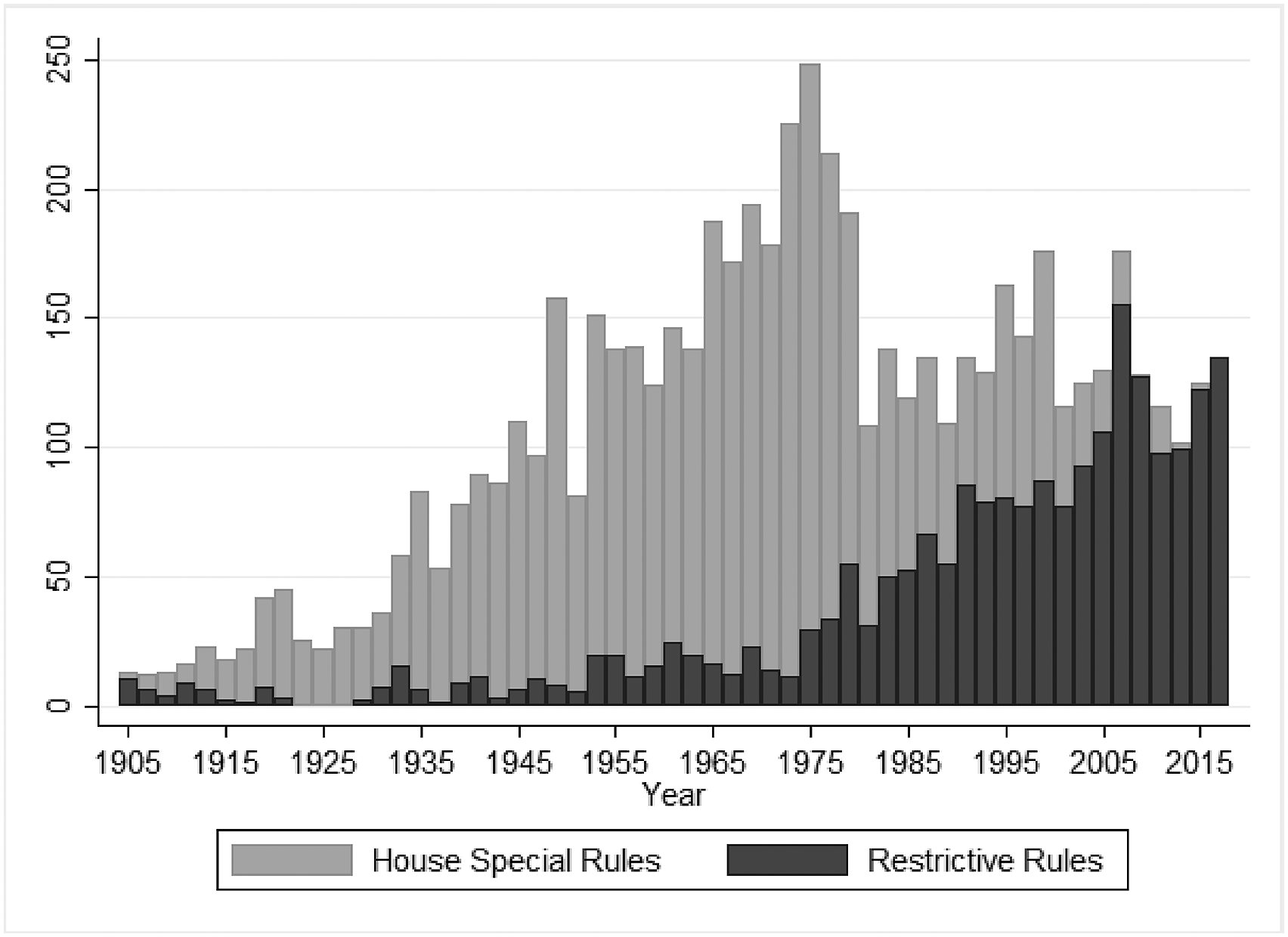
This has resulted in numerous accusations of congressional leaders fostering an undemocratic legislative process and calls for a return to “regular order” or a process by which bills are openly deliberated and subject to amendment. In fact, upon being elected as the 54th Speaker of the House on October 29, 2015, Paul Ryan (R-MN) stated, "We need to let every member contribute, not once they earn their stripes, but now… Let’s open up the process… In other words, we need to return to regular order.” 3
However, by March 24, 2017, under his leadership, the House began consideration of HR 1628, The American Health Care Act of 2017, which was subject to a special rule disallowing any amendments. The bill was ultimately pulled before a vote was taken as it lacked sufficient support to pass. One could speculate that perhaps allowing members (namely those who were undecided or only somewhat opposed to the legislation) to alter the bill, or at least some sections within it, could have provided the Republican leadership with enough support to successfully pass the bill. For example, Rep. Justin Amash (R-MI), one of six Republicans who opposed the rule asserted his opposition was due to the restriction of amendments. 4 During his speakership, Ryan would go on to break the record for most closed rules in a session (Bade 2017).
Why then would Speaker Ryan so quickly renege on his call for a return to “regular order”? Special rules provide leadership with a means to pass legislation that most closely resembles its preferences. More importantly, eliminating floor amendments greatly increases legislative efficiency. Opening bills to amendments on the floor provides Representatives with an opportunity to enhance their electoral fortunes, which in turn lengthens debate and increases the probability of failure through the introduction of “poison pill” amendments. These amendments serve to sink legislation or at least force an embarrassing vote for members of the opposite party. The rare instances Speaker Ryan and his predecessor, Speaker John Boehner (R-OH), allowed open or modified open rules in his tenure highlight these dangers.
Open Rules in the Republican House
On July 25, 2015, the House of Representatives began consideration of HR 2822, the Department of the Interior, Environment, and Related Agencies Appropriations Act of 2016. The measure was the first appropriations act considered in the 114th Congress. And like most appropriations bills, it was considered under a modified open rule that allowed members to offer amendments unchecked by the majority party (Hanson 2016; Reynolds 2016). 5 Members of both parties took advantage of this, and over the course of 2 days, the House considered 116 amendments.
Three of these amendments were offered by Democrats and sought to restrict groups and individuals from displaying the confederate flag on federal grounds (including cemeteries and national parks). 6 Citing a recent mass shooting of nine black parishioners in Charleston, South Carolina, the amendments sponsors argued they would bar the federal government from promoting the confederacy (Steinhauer and Weisman 2015). The bill manager, Rep. Ken Calvert (R-CA), noted that the first amendments’ language was consistent with Park Service policy and “urged its adoption.” (Congressional Record, 114th Congress, July 7, 2015, H4811). All three amendments passed via voice vote. However, after the day had concluded, a number of Southern Republicans became aware of the amendments and demanded Speaker John Boehner (R-OH) remove them from the bill (Steinhauer and Weisman 2015).
The next day, Calvert stalled final passage on the measure while a new amendment was written (Dumain 2015). That amendment prohibited funds from being used to enforce the previously adopted confederate flag amendments. In support, Calvert argued the measure would simply “codify existing National Park Service policy.” (Congressional Record, 114th Congress, July 7, 2015, H4945) This led to a series of aggressive attacks from minority Democrats who pointed out that the House would be voting on the “Calvert” amendment on the same day South Carolina removed the Confederate flag from its capitol building (Dumain 2015). 7 Realizing they lacked the votes to pass the amendment and hoping to shield their members from casting a difficult vote, Republican leaders pulled the bill from the floor (Fuller 2015). The threat of comparable Confederate flag amendments not only shutdown the usage of open rules on appropriation bills in the 114th Congress but it also derailed the appropriations process in the first session. No additional free-standing appropriation bills were considered by the House in the summer of 2015 and a government shutdown loomed (Plautz 2015). 8
Boehner resigned several months later. That decision, and the subsequent withdrawal of his heir apparent, Majority Leader Kevin McCarthy (R-CA) were seen by many to be a response to frequent criticism from conservative members of the Republican caucus of Boehner’s leadership style (see e.g. Steinhauer 2015). For example, Amash (R-MI), a member of the conservative House Freedom Caucus asserted that his objection to Boehner was not because he “isn’t conservative enough,” but rather because he “doesn’t follow the process” (Sherman 2014). Chief among these critiques—which often called for a return to “regular order”—was Boehner’s usage of restrictive rules to block floor amendments (Drutman 2015). 9 Conservatives had been defecting from votes on restrictive rules in greater numbers, leading to punishments from leadership. 10
Immediately after his election as Speaker, Ryan sought to keep his promise to employ more open processes. Indeed, he oversaw a number of open rules on appropriations bills that led to a large number of amendments, some of which were controversial. For example, Huffman’s confederate flag amendment that derailed the Interior Appropriations bill in 2015 was adopted 265–159 during consideration of a Veterans Affairs Appropriations bill. However, despite this pledge and early success, scholars and journalists were skeptical of Ryan’s ability to maintain an open floor process (see e.g. DeBonis 2015; Madonna and Kosar 2015; Reynolds 2016).
This skepticism was confirmed in May of 2016, when HR 5055, the Energy and Water Development and Related Appropriations Act was defeated on the House floor 112–305. Considered under an open rule, Rep. Sean Patrick Maloney (D-NY) offered an amendment that prohibited funds being used that would contribute to discrimination based on sexual orientation and gender identity (McPherson 2016). 11 The amendment was adopted, leading conservative Republicans to join Democrats in opposing HR 5055 on final passage. The threat of the Maloney amendment led Ryan to announce he was abandoning open rules in favor of restrictive structured rules for appropriation bills (Collender 2016).
Ryan’s decision to abandon “regular order”—or at least open rules for appropriation bills was met with some criticism. 12 Members of the House Freedom caucus suggested that leadership used restrictive rules to bar amendments from their members to protect centrists (Binder 2015). Democrats suggested Ryan was “rigging votes and bending the rules” (Maloney and Hoyer 2016) and the decision was “hypocritical” given his previous pledge to move toward regular order (Snell 2016).
Amending Activity in the Senate
The preceding discussion highlights some of the pitfalls of open amending processes. Moreover, it provides us with some theoretical leverage to analyze the change in Senate amending behavior. In our view, the increase in Senate amendments is related to not only increased electoral and position-taking incentives for members, but also the rise in closed processes on the House side. This suggests any normative reforms should be considered in a bicameral context.
Legislators, especially freshman and other junior members with less institutional knowledge, must rely on unelected actors for several reasons. First, various lobbyists and interest groups provide certain policy expertise across numerous issues that members simply cannot be expected to possess. Second, trusted and effective legislative staffers allow members to delegate some responsibilities—including policy-making—to them. This then allows members to allocate their scarce resources—namely time—to tasks that cannot be delegated to others, such as committee hearings and campaigning. Therefore, political actors other than those serving in Congress routinely draft legislation as well as amendments to legislation that individual members can then take ownership of and introduce on the floor during debate.
Closed rules prohibit the introduction of such amendments. However, members in the House of Representatives are not alone in their desire to influence policy, nor are they the only actors who can do so. Therefore, interest groups, staffers, or other amendment authors can simply redirect their efforts to have amendments offered to certain pieces of legislation by turning to similarly minded legislators in the Senate.
An example of this occurred during consideration of HR 2997, the Agriculture Appropriations bill for fiscal year 2010, which funded programs for rural development, the Food and Drug Administration, and other agencies. During the 111th Congress, the Democratic majority used structured rules when the chamber considered appropriations legislation, in contrast to prior congresses when a more open amending process was common (Tollestrup 2015). Accordingly, its passage was marked by minority Republican complaints at the structured rules limiting the amending process.
In his opening statement as ranking member of the House Subcommittee on Agriculture, Rural Development, Food and Drug Administration, and Related Agencies, Rep. Jack Kingston (R-GA) brought up earmarks, noting a significant reduction in them since 2006, and called for an open rule. 13 This was to be a focal point of debate about the bill in both chambers. Multiple members of the minority echoed Kingston’s arguments against the structured rule under which the House considered the legislation. One of them, Rep. Jeff Flake (R-AZ) had a reputation for sponsoring numerous amendments that sought to strip legislation of earmarks.
This reputation was well earned. From the 109th (2005–2006) to the 111th Congress (2009–2010), Flake sponsored over 850 amendments—making him the most prolific member by far. The bulk of these were submitted to the Rules Committee during the 111th Congress. His reputation was so well-known that during consideration of one amendment, Rep. Corrine Brown (D-FL), reminded her colleagues “if it’s a Flake, it’s no.” (Congressional Record, 111th Congress, July 29, 2010, H6376)
Flake had proposed 12 amendments to HR 2997, but under the rule, he was permitted to offer “not to exceed three” of those amendments. The rule, Hres 609, did permit him to select which three. 14 During debate, Flake decried the process, pled for more open rules, and argued the restrictions rendered congressional transparency moot. He argued: “When you’re denied the ability to offer amendments on the floor or are restricted in the number that you can offer, then you aren’t able to use that transparency to any good effect.” (Congressional Record, 111th Congress, July 8, 2009, H7783) 15 All three of Flake’s amendments were rejected, and the bill passed the House via recorded vote by 266–160, mostly along partisan lines.
The Senate began consideration of HR 2997 several months later. Of the 400 amendments that were filed by senators to HR 2997, 313 of them (or 78%) were sponsored by Senator John McCain (R-AZ), the senior senator from Arizona and former presidential candidate. As a point of comparison, McCain had filed 196 amendments in the previous three congresses combined. During debate, he railed against earmarks, though he asserted he only planned on offering three of the amendments. At least two of the amendments he mentioned during debate sought to strip earmarks targeted by two of Flake’s amendments. 16 Of the three amendments McCain pressed, one was rejected by voice and two by recorded votes. The bill then passed 80–17. 17
Procedural Explanations for Cross-Chamber Amending
Furthermore, there are other procedural reasons that could result in amendments crossing chambers. As Lynch et al. (2018, 145) state, “senators have been reluctant to allow chamber power to be centralized.” Namely, Senate leadership lacks the same agenda control powers that their House counterparts possess. In order to bring a bill or nomination to a vote in the Senate, a member needs to successfully make a procedural motion to proceed to consideration of that bill or nomination. Additionally, since the mid-1930s, the majority leader enjoyed the right of first recognition. This has practically meant that only the majority leader (or his designee) will have the floor in order to offer this motion. Theoretically, this would allow the majority party some degree of positive agenda-setting power (at least in the modern era). However, this is comparably weak compared to a special rule, because at least with bills, this can be filibustered (since at least the late 1940s). The Senate majority party can avoid a filibuster on the motion to proceed through substitute amendments. For example, the House passed a minor bill in the 111th Congress restricting lawsuits against certain federal officials. The Senate moved to concur in that bill with a substitute—this is a non-debatable motion and hence, cannot be filibustered. The substitute amendment was the DREAM immigration act. However, there are three problems with this as a positive agenda control mechanism: (1) it requires coordination with the House; (2) again, the bill can be filibustered (as was the case with the DREAM Act); and (3) on its own, it is still subject to amendment.
The last point is important, as according to Madonna et al. (2019, 1351), “The right to offer nongermane amendments is one of the Senate’s most distinguishing features.” This means, unless the majority leader fills the amendment tree, he has no ability to restrict party-splitting amendments from receiving votes on the floor. Unless cloture is invoked, there is no limit on the number of the amendment votes that can be taken. Additionally, because of the lack of a germaneness requirement, even when considering a non-controversial bill, the majority leader can be surprised by a controversial amendment. This happened fairly often in the 1980s when conservative Republicans like Jesse Helms (R-NC) and Strom Thurmond (R-SC) would propose amendments restricting access to abortion on spending bills.
Den Hartog and Monroe (2012) point to two mechanisms the majority can employ in dealing with the open amendment process. The first is the motion to table. Moving to table an amendment effectively kills the amendment. This is a non-debatable (cannot be filibustered) procedural motion which—theoretically—can provide cross-pressured members with political cover. However, unlike special rules, there still must be a direct vote on the motion to table the amendment on the floor. Interest groups often “score” these votes and use them against members (Smith, Ostrander, and Pope 2013).
Second, and more effectively, the majority leader can fill the amendment tree. In the Senate—like most legislative bodies—only a certain number of amendments can be pending at any one time. To fill the tree, the majority leader takes advantage of his right to first recognition and offers all allowed amendments, which are typically minor substantive changes. He then files for cloture on the bill, and if invoked, debate is cut off and all amendments fail. This does provide some theoretical agenda-setting powers, though it is limited in important ways. First, as a procedural strategy it was not routinely employed until the mid-1980s, therefore making it difficult to claim it is important in a long, historical study such as the one we conduct here. Second, it requires the support of 60 senators to end debate. Recently, we have seen minority party members refuse to support cloture unless their party is offered the opportunity to offer amendments.
Additionally, we further expect to see increased amending activity in the Senate when partisan control of Congress is split. For example, a Republican-controlled House can pass a bill that is noticeably more conservative than the entire chamber by utilizing a closed rule. Therefore, the bill would need to moderate considerably in order to pass a Democratic-controlled Senate, and one of the primary means of doing so would be through individual amendments to said legislation (Lynch et al. 2016).
Lastly, as Shepsle et al. (2009) illustrate, the staggered nature of Senate elections relative to regular House elections produces different incentive structures within each chamber, which can lead to deliberate changes in how legislation is crafted. Specifically, they conclude that the Senate appropriates more dollars to states with an incumbent up for reelection and fewer dollars to states with incumbents who are not up or are retiring at the end of the congress. However, the House corrects for this bias by allocating fewer resources to states with a Senate incumbent facing reelection and more resources to states where a senator is retiring. Expanding on this logic suggests that both chambers can and do consider the actions taken by the other when crafting and considering legislation.
To summarize, the House possesses the ability to consider legislation under a variety of circumstances, ranging from a completely restrictive process (where members are offered only a yea or nay vote on the bill) to an essentially unlimited debate (where any member can offer amendments to the underlying bill). However, increased debate increases the probability of a bill deviating from the preferences of chamber leadership. House leadership possesses sufficient power to drastically curtail amending activity in a way that the Senate does not. Meanwhile, there is a pool of other actors with policy preferences they would like to see realized through amendments to legislation under consideration. Given this dynamic relationship and the preceding discussion, our specific hypothesis to be tested is as follows:
H1: Restricting amending activity in the House through special rules will result in increased amending activity on the same enactment in the Senate.
Data and Methods
To evaluate our hypothesis, we employ a dataset on congressional amendments as coded by the University of Georgia Congress Project. These unique data consist of 125,492 filed amendments to 3,307 important bills over 57 congresses, beginning with the 59th Congress (1905–1906) and ending in the 115th Congress (2017–2018). 18 The long time series allows us to track temporal changes in the roll call generating process.
Our first step in this massive undertaking involved constructing a dataset of “important” legislation from 1905 to 2018. The decision to focus on only amendments to landmark enactments was motivated by several factors, which are discussed in greater detail in Online Appendix A.
19
Altogether, this left us with a list of 2,159 enactments across 57 congresses.
20
Second, we tasked teams of coders to read the through the Congressional Record and collect data on all amendments to those bills. This process is discussed in Online Appendix B.
21
Figure 2 below plots the number of enactments per Congress. Important enactments per Congress by type.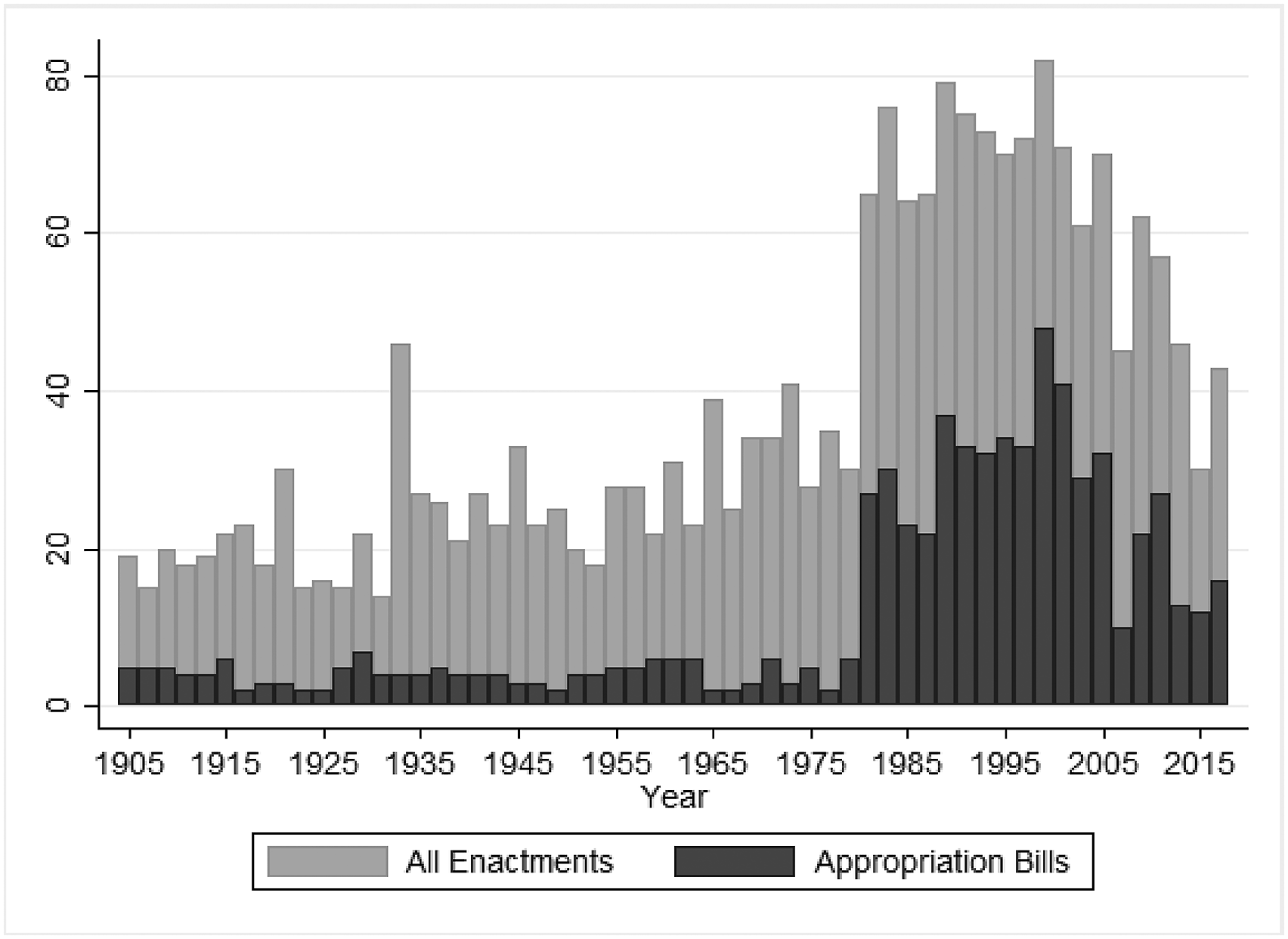
We then restricted the important enactment data to only measures successfully enacted into law.
22
This was the only way we could ensure the bill was considered in both chambers. Student coders then went through the Congressional Record to identify how the measures were considered in the House. For measures considered under a special rule, we used rule type data on all 8,027 House rules considered during this period as coded by Lynch, Madonna, and Vick (2020).
23
These data are discussed in greater detail in Online Appendix C. Figure 3 plots the measures by how they were initially considered on the House floor.
24
As expected, the figure demonstrates a substantial increase in both the percentage of measures receiving any rule on the House floor and the percentage of those measures that were considered under restrictive rules. “Restrictive rules” are defined to include closed rules, modified-closed rules, and structured rules. Measures not granted a special rule were typically considered on the House floor either by unanimous consent, Calendar Wednesday, or suspension of the rules. Important enactments by initial House floor consideration, 1905–2018.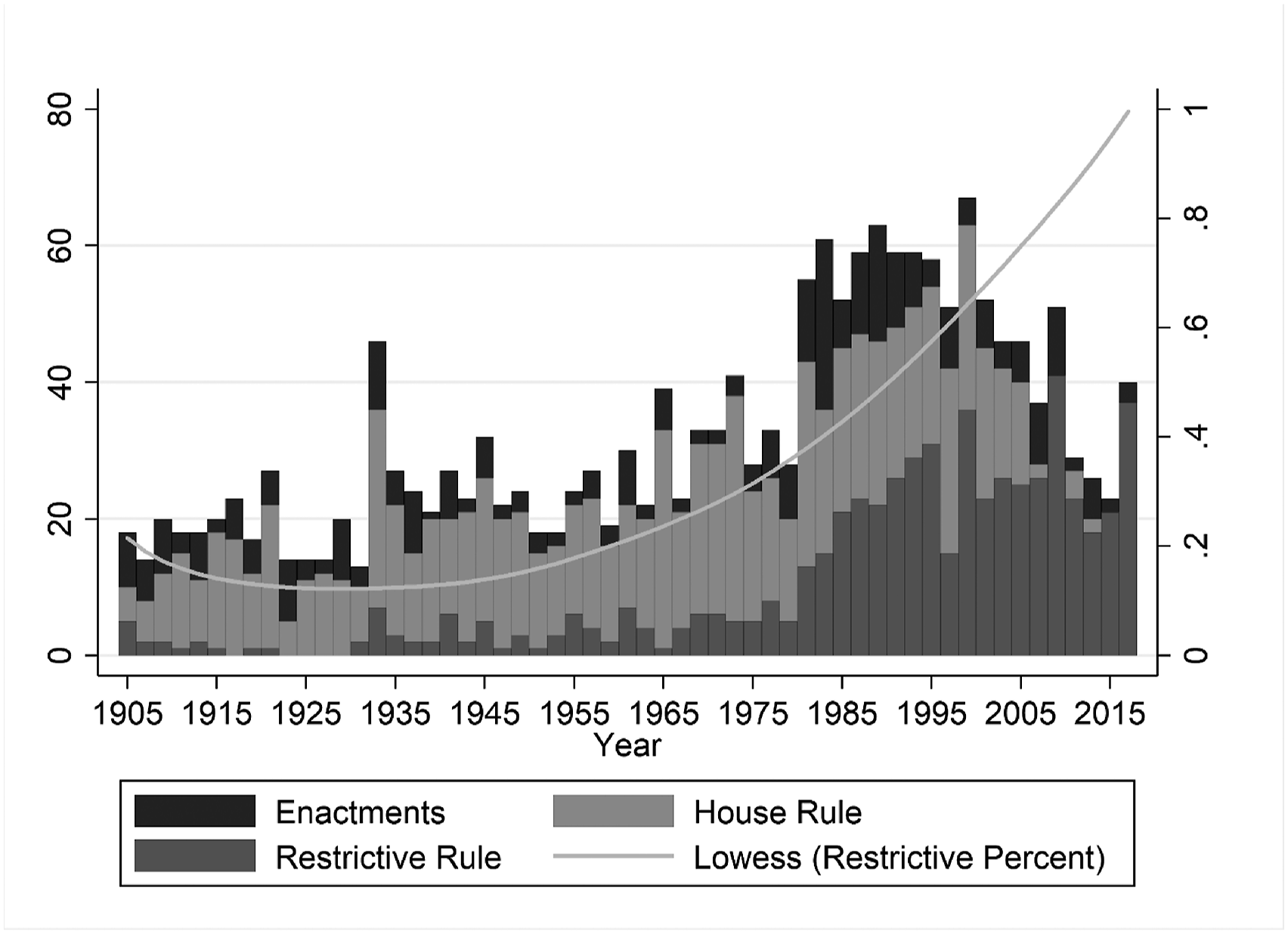
Our key independent variable is a binary variable indicating the presence of a restrictive special rule. Using the amendment data, we were able to construct our dependent variable, a count of all Senate amendments to each piece of landmark legislation. Since the dependent variable for this model is a count measure of all Senate amendments to a specific enactment considered, employing OLS could lead to biased and inefficient results (Long 1997). In light of potential concerns about over-dispersion (making Poisson regression inappropriate), we rely on negative binomial regression to estimate our model. We also report robust standard errors clustered by Congress. Figure 4 reports the average number of Senate amendments per enactment for each Congress with a simple lowess smoothing line. Senate amendments per enactment by Congress, 1905–2018.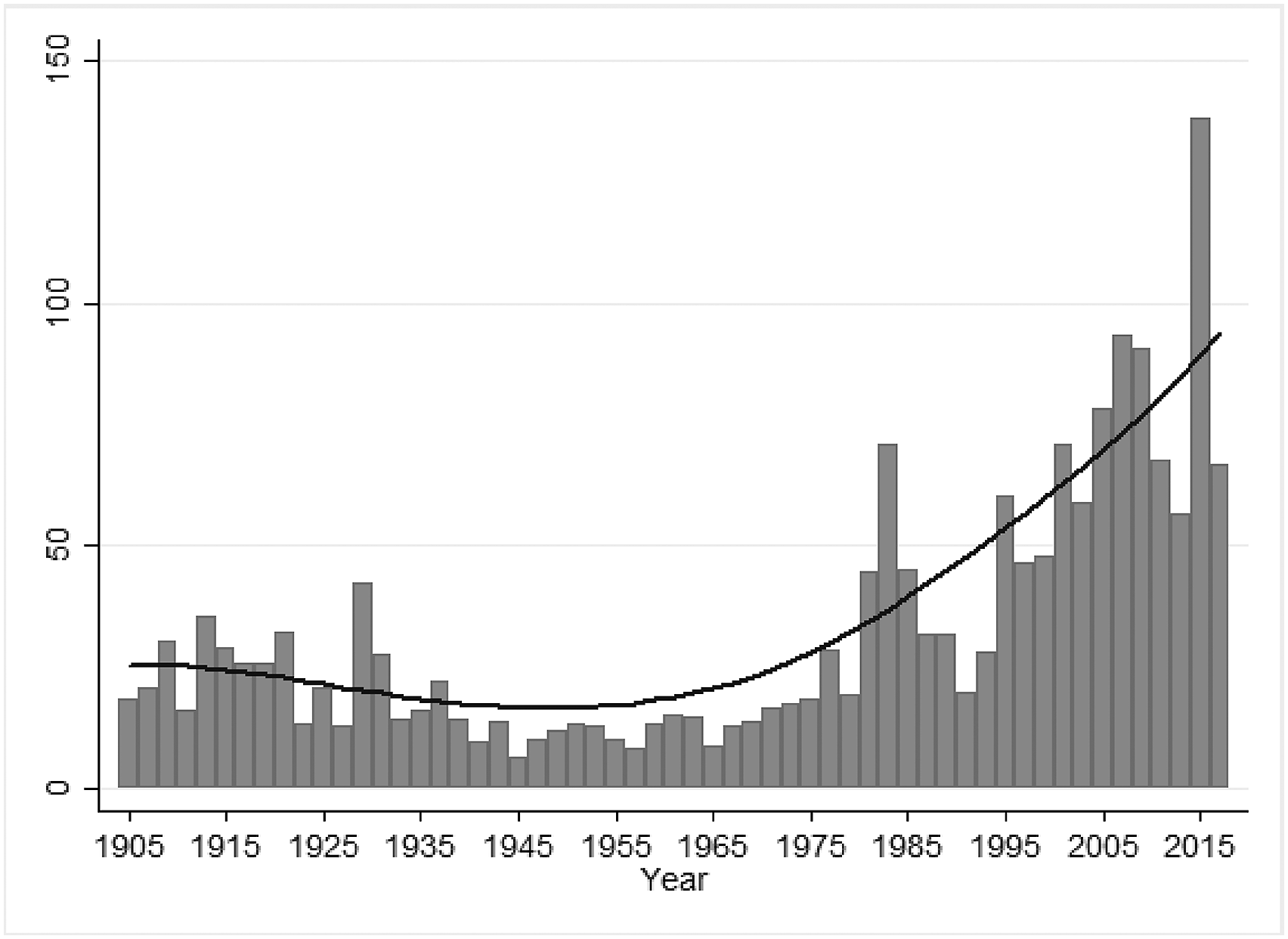
We also include a number of control variables that will likely influence amending behavior. The most obvious of this is issue content. Even when narrowing a dataset to only important or landmark legislation, certain issues are likely to generate more controversy than others. Accordingly, we include controls for three of these: tariff legislation, civil rights bills, and revenue bills (Madonna 2011). The dataset also includes a subset of routine appropriation bills—in addition to landmark measures—so we control for those, anticipating more Senate amendments. We also separate routine appropriation bills from continuing appropriation bills, the latter of which are rarely subjected to amendments in either chamber. 25
When control of the chamber is in doubt and the two parties are ideologically diverse, the utility of messaging amendments should increase (Lee 2016). Accordingly, we include controls for the number of seats the majority party holds and chamber polarization. 26 We include a control for divided government as well, under the assumption that it necessitates political compromise and should lead to more amending opportunities. Finally, we include additional controls for measures that passed the House under suspension of the rules and the number of pages and total bills included in each enactment. Measures that pass the House under suspension are likely less controversial, suggesting fewer Senate amendments. Additionally, longer bills generally create more opportunities for amendments.
Finally, as a robustness check, we estimate two additional models. First, Figure 4 demonstrates a stark increase in filed Senate amendments in the 1980s. Accordingly, in order to demonstrate that our findings are not simply a factor of a long, pooled time series, we restrict one model to the “post-reform” era (Rohde 1991). This model examines only filed amendments from the 91st (1971–1972) to 115th Congress (2017–2018).
Negative binomial regression of number of amendments introduced, 1905–2018.
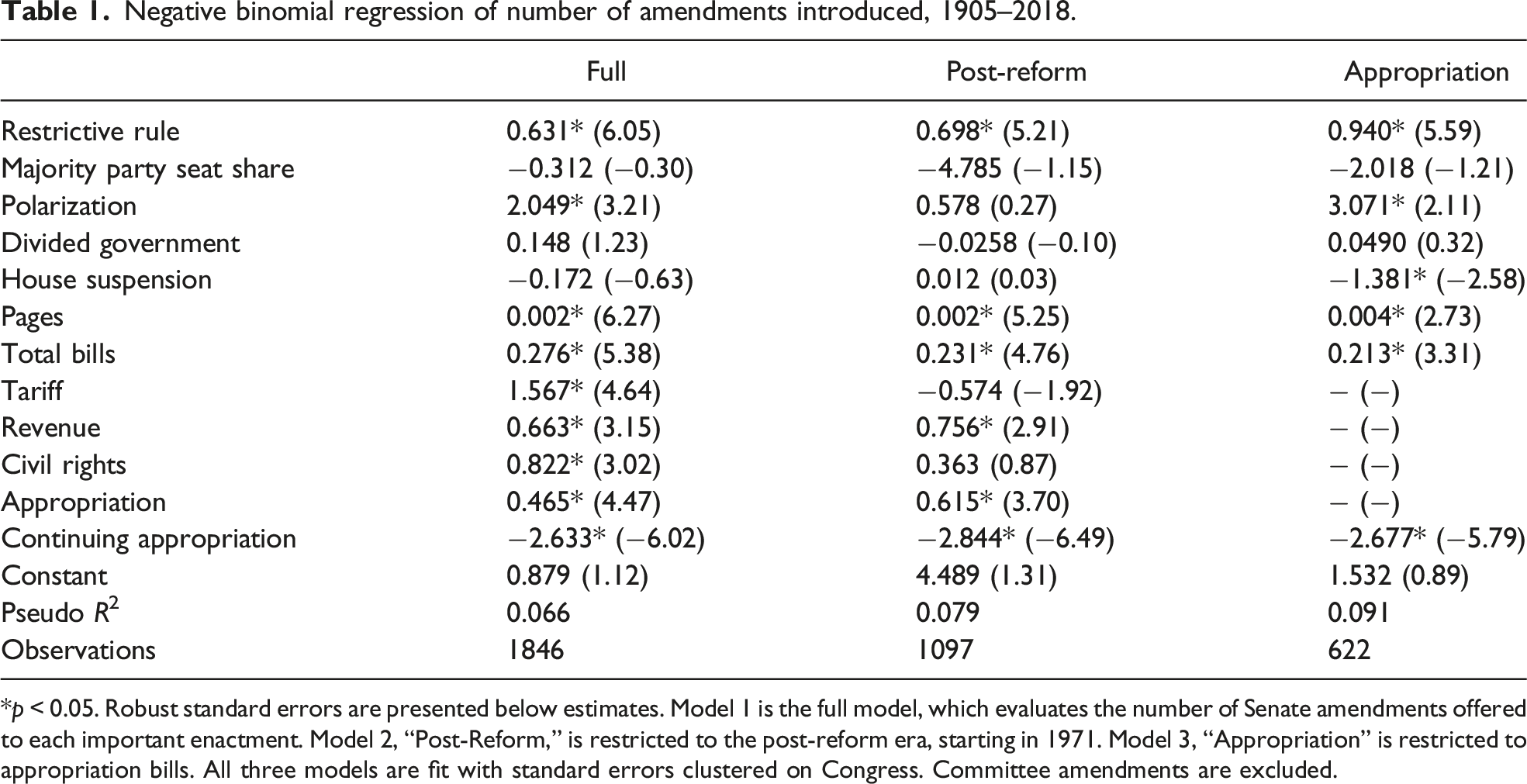
*p < 0.05. Robust standard errors are presented below estimates. Model 1 is the full model, which evaluates the number of Senate amendments offered to each important enactment. Model 2, “Post-Reform,” is restricted to the post-reform era, starting in 1971. Model 3, “Appropriation” is restricted to appropriation bills. All three models are fit with standard errors clustered on Congress. Committee amendments are excluded.
Results and Conclusion
We have argued that an increase in amendments in the Senate may, at least in part, be a function of to how amending opportunities are restricted in the House. Although it is important to note that our model cannot explicitly provide an underlying causal explanation, our results are generally supportive of this hypothesis. Even after controlling for factors like polarization and issue area, enactments considered in the Senate after being subjected to a special rule in the House are likely to see more filed amendments. 28 The indicator variable denoting the presence of a restrictive special rule in the House is positive and significant in our full model, the post-reform model, and the appropriation model. This consistently comparable finding, in conjunction with our data collection and modeling strategy, provides us with confidence in our findings and allows us to credibly rule out some alternative explanations even absent a causal model.
In the full model, the use of a restrictive rule is associated with a nearly two-fold increase in the predicted number of Senate amendments. Setting total bills to one and the remaining variables at the modal or median values, the predicted number of Senate amendments increases from 15.1 to 28.4 when a restricted rule is applied. In the appropriation-only model, the predicted number of Senate amendments is 61.3 when a restrictive House rule is used and 30 otherwise.
29
Using our full model, we have also depicted the marginal effect of restrictive rules on the predicted number of Senate amendments in Figure 5 below. Without a restrictive rule, the predicted number of Senate amendments is 15.9, compared to 29.9 when the House employs a restrictive rule. The 95% confidence interval ranges from 13.3 to 18.5 without a restrictive rule, but from 24.2 to 35.5 when House amending activity is prohibited. Marginal effect of House restrictive rules on Senate amendments.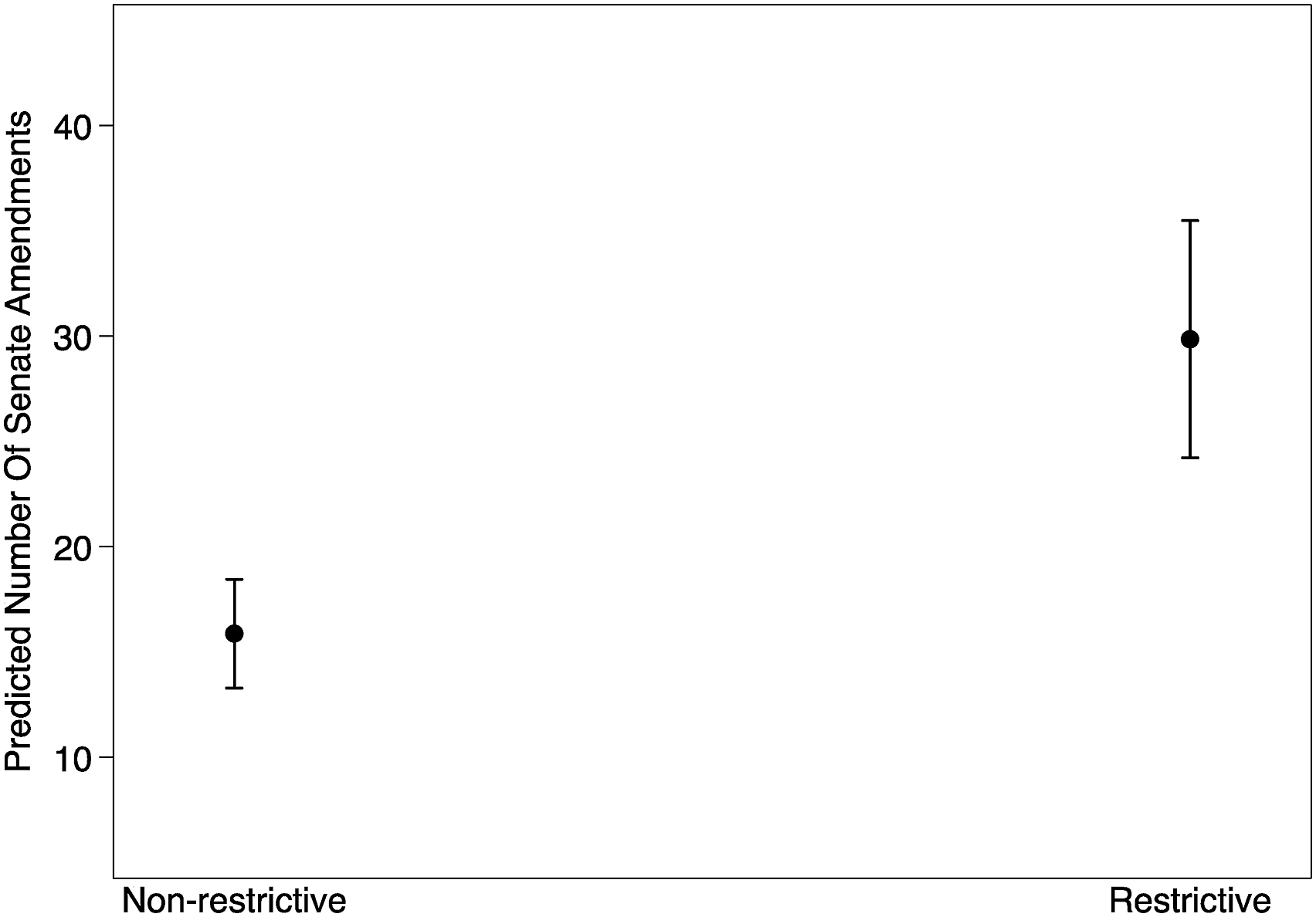
The work presented here is the first to systematically analyze amendments in both the US House and Senate from over 100 years of landmark legislation. When considering the presence of special rules in the House, we find the amending activity increases in the Senate when their House counterparts are unable to change legislation themselves. We believe these results are suggestive of several important conclusions.
First, they highlight the important role rules and institutions play in dictating member behavior. Second, they suggest members often look to outside sources for legislative and amendment drafting. Interest groups and other interested actors outside of Congress are potentially able to “shop around” among members in both chambers. Therefore, if they are unable to find a Representative to offer their amendment due to a restrictive rule, they can instead try to secure a Senator’s support. This in turn enables Senators to take advantageous positions on issues and claim credit for successful changes in policy when members of the House cannot, therefore further frustrating those in the lower chamber.
Perhaps most importantly, these results bear important implications for the prospect of successful reform in Congress that results in improving legislative output. While a great deal of discussion has focused on the role of the Senate majority leader in restricting floor amendments by filling the tree, our results suggest leadership cannot be considered in a vacuum. As leaders themselves have argued, they have employed tree-filling tactics in response to an increase in amendments, many of which serve minimal policy value. The increasing number of filed amendments is attributable to a variety of factors within and outside of Congress. House leadership has responded through increased usage of restrictive rules. This, we have found, has further exacerbated the challenge facing Senate leadership. Accordingly, observers of the chamber should not be surprised to see an increase in filling the amendment tree. It also seems likely to persist irrespective of new Senate majority leaders.
The results presented here have only scratched the surface of research that can be conducted using these new, unique amendment data. It is our hope that these data can be used to answer a slew of questions about congressional behavior. Furthermore, as previously mentioned, we examine but one connection between Senate amendments and House rules. Future research should consider additional connections and endeavor to identify causal relationships between them.
Supplemental Material
sj-pdf-1-prq-10.1177_10659129221082321 – Supplemental Material for Interbranch Warfare: Senate Amending Process and Restrictive House Rules
Supplemental Material, sj-pdf-1-prq-10.1177_10659129221082321 for Interbranch Warfare: Senate Amending Process and Restrictive House Rules by Anthony J. Madonna and Ryan D. Williamson in Political Research Quarterly
Footnotes
Declaration of Conflicting Interests
The author(s) declared no potential conflicts of interest with respect to the research, authorship, and/or publication of this article.
Funding
The author(s) received no financial support for the research, authorship, and/or publication of this article.

Supplemental Material
Supplemental material for this article is available online.
Notes
References
Supplementary Material
Please find the following supplemental material available below.
For Open Access articles published under a Creative Commons License, all supplemental material carries the same license as the article it is associated with.
For non-Open Access articles published, all supplemental material carries a non-exclusive license, and permission requests for re-use of supplemental material or any part of supplemental material shall be sent directly to the copyright owner as specified in the copyright notice associated with the article.
