







Abstract
Do undocumented immigrants matter as constituents for state legislators? In this study we examine legislator responsiveness to differing ethnicities and immigration statuses of immigrant constituents through a field experiment conducted in 2014 in 44 U.S. state legislatures. We advance a theory of citizen advantage, that citizens and particularly white citizens will reap greater representation from legislators, but that even undocumented immigrants can constitute a meaningful subconstituency that receives some, albeit less, responsiveness from legislators. Each legislator received a constituent request that was identical in content and varied the constituent’s race/ethnic identity by using a first name and surname cue (Latinx or Eastern European) and immigration status (undocumented/citizen/control). We found that legislators respond less to undocumented constituents regardless of their ethnicity and are more responsive to both the Latinx and Eastern European-origin citizen treatments, with Republicans being more biased in their responsiveness to undocumented residents. Nuances within the data reveal that despite limited electoral incentive, some legislators are responsive to undocumented immigrants regardless of race or ethnicity; however, when immigration status is not cued, white residents receive greater responsiveness than Latinx.
Debates about undocumented immigration have been an enduring feature of U.S. politics for decades. A significant research agenda concerns the attitudes held by Americans about immigrants and immigration policy (Espanshade and Calhoun 1993; Frasure-Yokley and Wilcox-Archuleta 2019; McCabe et al. 2021; Merolla et al. 2013). More recently, research has probed the organizing done by undocumented immigrants and their allies on issues that affect the population (Reny, Wilcox-Archuleta, and Cruz Nichols 2018; Zepeda-Millan 2017), as well as the positions legislators take on polices that affect undocumented immigrants, and immigration more broadly (Casellas and Leal 2013; Grose et al. 2015). While these questions are important advancements in our understanding of the politics surrounding undocumented immigrants, questions of representation for undocumented immigrants have remained understudied. Whether legislators provide representation to undocumented immigrants is an important question because it documents whether the exclusion of undocumented immigrants in society extends to the behavior of legislators and signals the extent to which undocumented immigrants are being incorporated into the political system. In this paper, we ask: Do legislators discriminate against service requests from undocumented immigrants in comparison to citizens?
We build upon the subconstituency theory of representation (Bishin 2009) and advance a theory of citizen advantage. We argue that while legislators will prioritize and respond more to citizens because of the possibility of a direct electoral reward, undocumented immigrants provide an indirect electoral reward to legislators, which is why legislators might respond to them. Undocumented immigrants are a highly ostracized group that often serves as a target of punitive policies (Collingwood and O’Brien 2019) and xenophobic rhetoric (Perez 2015), yet they are also increasingly a long-settled population in the United States (Myers 2007). The group is heavily racialized in the U.S. public’s consciousness because the majority of undocumented immigrants are from Latin America (Sampaio 2015). While undocumented immigrants lack the right to cast a ballot in favor of a legislator, they are nonetheless present in legislative jurisdictions and live in families and communities with other voters whom they could influence. Therefore, we posit that the subconstituency of undocumented immigrants can potentially provide legislators with an indirect reward premised on their relationship to others who can vote or the perception of legislators who might view them as potential future voters. The nature of a legislator’s relationship with an undocumented constituent may be enhanced beyond the indirect electoral reward because undocumented immigrants are entitled to certain government services that legislators or other elected officials could potentially help them access.
We test our citizen advantage hypothesis and subconstituency theory of representation using a field experiment across 44 states 1 that measures the responsiveness of legislators to undocumented immigrants. We disentangle the possible effects of racial bias by testing our results using two different ethnicities. Our findings indicate that legislators provide responsiveness to emails from undocumented immigrants but prioritize them below that of citizens, suggesting that some legislators recognize their duty to represent all residents in their districts, even those who cannot provide a direct electoral benefit to them. The findings represent an important insight as the country grapples with changing demographics and a decades-long inability to find a policy solution to the problems facing our current immigration system.
Representation for the Undocumented
The representational relationship between a legislator and their constituents is most typically conceptualized as dyadic (Miller and Stokes 1963; Weissberg 1978), in which a constituent is conceived as being represented by a legislator selected from their district. Both normative and empirical scholars have long examined this relationship to understand the quality considerations in the representational relationship, or, in other words, how well or poorly a constituent is represented (Achen 1978; Butler and Broockman 2011; Mansbridge 1999; Pitkin 1967). Fenno (1977) famously argued that multiple constituencies exist within a legislator’s electoral district. The largest of these include the geographic constituency where all residents reside, followed by the more electorally important reelection constituency.
Undocumented immigrants are a unique type of geographic constituent because they reside in legislative districts without legal authorization to be present in the United States. While undocumented immigrants face formal exclusion from many arenas of public life, they experience varying levels of federally mandated incorporation at the state and local level. As it relates to representation, undocumented immigrants are included in census tallies and cannot be excluded for redistricting purposes. Moreover, undocumented immigrants have some rights and protections under federal law, such that state and local legislators should be responsive to a constituent request. Because undocumented immigrants are excluded from the franchise at the state and federal level, however, their direct electoral control of legislators is limited. Though the vote is still the primary mechanism for representation (Mayhew 2004), we posit that physical presence, as conceived by Fenno’s geographic constituency, is sufficient to necessitate some representation for non-voting and traditionally stigmatized constituencies. Furthermore, Weissberg (1978) argued that in addition to the dyadic relationship between legislators and constituents, institutions can collectively represent a people. To the extent that any legislators are responsive to undocumented immigrants, could constitute a form of collective representation, such that the interests of the undocumented are heard and voiced within a legislature.
Who would be expected to represent undocumented immigrants? Studies examining descriptive representation have found that representatives who share similar identities tend to provide greater policy representation for these groups (Hayne 2002; Thomsen and Sanders 2020; Reingold and Smith 2012; Reynolds 2013). The story of Latino representation is mixed, with some scholarship finding support for distinctive representative behavior (Kerr and Miller 1997; Minta 2011; Rouse 2013) and others finding that partisanship, among other factors, better explains policy responsiveness to Latino populations (Hero and Tolbert 1996; Knoll 2009). Rouse (2013) and Wallace (2014) do find that on immigration policy, Latino legislators behave in ways designed to provide more favorable legislation for undocumented immigrants. For undocumented immigrants, however, the lack of legal status makes it highly unlikely to see undocumented immigrants serving in legislatures—as most states require U.S. citizenship to run for office. 2 As legislatures generally lack people who have experienced life as an undocumented immigrant, undocumented immigrants cannot count on that facet of difference to facilitate descriptive representation.
Due to the intersectional nature of all identities (Crenshaw 1994; Hancock 2016), the undocumented identity does not occur in a vacuum, but is accompanied by a racial identity. With the majority of undocumented immigrants being Latino, it is reasonable to assume that Latino legislators might be more responsive to undocumented Latinos because of their shared ethnic identity. The few studies done on responsiveness to Latino constituents by legislators finds that Latino and white legislators tend to not respond differentially to white and Latino constituents (Butler 2014). Given these mixed results, it is reasonable to hypothesize that Latino legislators might behave as descriptive representatives toward undocumented Latinx immigrants, which we examine further in this study.
Citizen Advantage Theory
Service provision is an important aspect of the job of an elected official, and one that often goes unnoticed. Legislators regularly receive requests for assistance with consular services or navigating health care, welfare, and educational services. Service provision in the form of casework (Eulau and Karps 1977; Serra and Cover 1992) is a representative domain that is entirely under the purview of the legislator and gives insight to the value placed on different groups of constituents. Given the multitude of requests, how might legislators prioritize responding to some constituents rather than others? The anticipation of potential benefits or consequences—such as a vote for or against the legislator in the next election—factor into their logic of whether to respond (Arnold 1990; Harden 2013). Responses to constituent requests are also the primary vehicle of securing the personal vote of someone who disagrees with the legislator on policy or for whom the legislator assumes disagrees with them on policy (Cain, Ferejohn, and Fiorina 1984, 2013). For example, Grose, Malhotra, and Van Houweling (2015) find that the assumed private nature of constituent outreach leads to whether and how legislators tailor the messages to assuage the concerns of voters. The personal vote represents a direct reward for legislators, assuming the constituent can vote.
Policy responsiveness, the more public-facing form of representation, is more visible to the public and therefore more open to public scrutiny. Policy position taking tends to be attenuated by the preferences of the majority as opposed to a minority subconstituency. The calculation of whether to respond can be based on the potential racial configuration of the legislator’s electoral district and the relative importance a legislator might assign to certain groups. Grose (2011) finds that members of Congress will provide greater substantive representation based on which group tends to hold the majority of the population in the district. Response to constituent requests, however, occupies a more private domain of service responsiveness and is wholly at the discretion of the legislator. Numerous scholars have found evidence of discriminatory responsiveness based on race and ethnicity (Butler and Broockman 2011; Mendez and Grose 2018; White, Nathan, and Faller 2015; Lajevardi 2020). There is mixed evidence, however, regarding Latinx constituents as some scholars find there is no differential in the responsiveness of legislators to Latinx constituents, even by party (Landgrave 2020).
We offer an additional test of the literature and build upon this work by advancing a theory of citizen advantage. We argue and will demonstrate that citizen constituents have an advantage over undocumented immigrants of the same ethnic background in receiving a response from legislators. This is due to the direct electoral reward that a citizen can potentially provide, that an undocumented immigrant—who may make legitimate representational requests given the patchwork of federal laws that apply to them, but who lacks the ability to vote—cannot provide. While citizens have the advantage of being prioritized by legislators in their responsiveness, we contend that noncitizens constitute a subconstituency within a legislator’s jurisdiction. We posit that legislators may choose to represent these smaller and often more stigmatized subconstituencies, particularly by responding to individual constituent requests that are less publicly visible and therefore potential costs to the legislator are limited. While we anticipate differences in responsiveness to citizens and subconstituencies of undocumented immigrants, we do not preclude the possibility that legislators may discriminate in their responsiveness based on race or ethnicity, as has been well documented, and is further examined in this study.
Subconstituency Hypothesis
We build upon the work of Bishin (2009) who argued that legislators will represent subconstituents over the preferences of the majority due to the intensity of the smaller groups. A subconstituency is a small group within an electoral district that has a shared identity and/or which leads to shared interests and increased visibility to legislators and elected officials. This theory argues that these smaller groups engage in electoral politics to pressure elected officials to respond to them. One key element of this theory, however, is that the subconstituency must possess the means to participate in electoral politics, namely by donating or voting (Bishin 2009). The subconstituency theory would seem to not apply to undocumented immigrants who cannot legally participate in electoral politics due to their lack of citizenship, but we offer a pathway to understanding why representatives might provide responsiveness to them.
We argue that the presence of undocumented immigrants could provide elected officials with an indirect reward for representation. While the electoral connection still primarily explains the behavior of elected officials, a broader view of the represented makes it likely that legislators attach different values to different constituents. While citizens and likely voters have the most value to legislators, even non-voting constituencies like children or legal permanent residents offer some indirect reward to legislators due to their potential to become voters or their perceived relationship to voters. Stimson et al. (1995) argue representation is a dynamic process in which legislators shift their actions on policy and electoral campaigning tactics as public sentiment shifts. Similarly, Miler (2007) finds that a legislator’s perception of their district influences their behavior in office. Drawing on this logic, we argue the value a legislator, who is electorally motivated, places on a subconstituency of undocumented immigrants may shift depending not only on changing public sentiment but also changing demographics of their district. Responding to an undocumented immigrant may also be motivated by a personal or even moral interest in responding to a disadvantaged class of constituents. Thus, if legislators perceive that undocumented immigrants can provide some type of indirect reward, then legislators may be motivated to respond to their requests, particularly if that request is not publicly visible.
What indirect reward might an undocumented immigrant hold for a legislator? First, we consider how legislators may view indirect electoral rewards that undocumented immigrants could provide. While undocumented immigrants could be from any national origin background, the majority are from Latin American countries and have been racialized as political subjects (Passel and Cohn 2018; Sampaio 2015). Over the last two decades, the Latinx community has become an increasingly important voting bloc (Baretto et al. 2005, Collingwood 2020). While being undocumented is certainly a disadvantaged status with many risks to the individual, it is not an entirely powerless status. Undocumented immigrants often live in mixed status families (Abrego 2019) and are connected to broader communities that include active voters (Walker et al. 2020). In addition, the effort to pass immigration reform has galvanized an organized movement complete with legislative advocacy and street protests of undocumented immigrants and a wide range of supporters from unions, religious leaders, students, and cross-racial civil rights and social justice advocates (Carter 2019; Hinton 2015; Narro et al. 2007; Nteta and Wallsten 2012; Zepeda-Millán 2017). Further, undocumented immigrants have become more politically visible and active in electoral activities like voter registration and get out the vote (GOTV) efforts (Barreto et al. 2005; Ramirez 2007).
It may be logical for a legislator to assume that responding to an undocumented Latinx immigrant might result in influencing Latinx voters within the district. For example, a Democrat in a competitive district might require Latinx support to be reelected, as a majority of White voters might be reliable Republican votes. Conversely, a Republican legislator in an increasingly Latinx district might respond to an undocumented immigrant in hope of showing symbolic support of Latinx issues to prevent mobilization against her by pro-immigrant forces (Leal and Fraga 2004; Zhinger 2014). This is not to overlook the vast diversity of the Latinx community or to overstate the unity of Latinx voters (Beltran 2010), but should the demographics of a legislator’s district be shifting and the size of the Latinx community be growing, a legislator may be motivated to be responsive to an undocumented constituent because they believe they could influence the perceptions of Latinx voters.
A legislator’s prospective assessment of the fate of undocumented immigrants may constitute a secondary indirect electoral reward. When this study was fielded, comprehensive immigration reform legislation was still on the horizon in Congress. Should such legislation have passed, undocumented immigrants could have received a path to citizenship, making them full voting members of society. Legislators motived by electoral outcomes may respond to an undocumented immigrant and a request to assist their child with a school issue because they view them as potential future voters (Street, Jones-Correa, and Zepeda-Millán 2017a, 2018b). Indeed, undocumented immigrants have often been referred to as “Americans in waiting,” given the ways they are settled into neighborhoods, incorporated into local communities, and economically necessary to maintain numerous essential industries in the United States (Motomura 2006). Consistent with Stimson et al.’s (1995) notion of dynamic representation, some legislators will be motivated to respond to a request from an undocumented immigrant because they believe that the action will provide an electoral benefit at some point in the future. To assess these electoral dynamics, we include in our study an examination of the proportion of Latinx residents in a legislator’s district as it is the best proxy for the significance of the Latinx vote to a legislator’s electoral future.
Explaining Nonresponsiveness
We have argued that some legislators will be responsive to undocumented immigrants because they comprise a subconstituency. Legislators may value undocumented immigrants because they perceive the group can offer an indirect reward such as influencing other voters, becoming a future voter, or serving a personal moral imperative of the legislator. Despite this, we maintain that legislators will likely prioritize responsiveness to constituents who are citizens, and then make time for undocumented constituents only after citizen requests are fulfilled. In this section, we detail three explanations why we might anticipate legislators to not respond to requests from undocumented immigrants, including variations in professionalism of the legislature, partisanship of the legislator, and the state context in terms of policy toward immigrants.
From state to state the level of legislative professionalism varies. In some states, being a state legislator is a full-time job, with salaried legislators with numerous staff members to respond to constituent requests (NCSL 2015). We can anticipate that legislators who operate in a highly professionalized state will have more time and resources to respond to requests from undocumented immigrants who do not offer direct electoral rewards. Alternatively, in states like Mississippi, or New Hampshire, where being a state legislator is considered a part time position with little staffing, a legislator themselves may be the one to respond to constituent requests and thus must make tradeoffs in prioritizing to whom they take the time to respond. We might anticipate that legislators in more professionalized legislatures may have greater resources to respond to undocumented immigrants, while legislators in less professionalized legislatures might prioritize citizens over undocumented immigrants.
Party dynamics may also influence whether legislators respond to undocumented immigrants. Prior to 2014 when this study was fielded, and even still today, Democrats are ideologically aligned with and electorally dependent upon Latinx voters, while Republicans face conflicts between their electoral incentives and their policy preferences. Zingher (2014) has shown that at the state level, Democrats are not likely to introduce punitive immigration bills in legislatures, while Republican support for such bills is partially conditioned on the size of the Latinx population. Rocca et al. (2022) studying the 2013-2017 time period, find no relationship between Democratic legislators support of Latinx policies and the proportion of Latinx residents in a district. They argue Democrats overwhelmingly support a pro-Latinx agenda regardless of the proportion of Latinx residents in their districts. While both Democratic and Republican legislators might respond to a request from an undocumented immigrant, this research suggests we might expect that Democrats would be more responsive than Republicans.
While polarization on the issue of immigration may explain variations in responsiveness between Democrats and Republicans
Finally, we might anticipate that legislators will discriminate in their responsiveness based on the race or ethnicity of the constituent making a request. As it pertains to undocumented immigrants, national status, whether one is a citizen or noncitizen, is deeply entwined with race and ethnicity. The study of direct representation of undocumented immigrants is minimal within the political science literature. There has been more limited research as to what role national status, has on service responsiveness. Gell-Redman et al. (2018) find that national status does not affect responsiveness, but that the race of the constituent does. Gell-Redman et al. find that responsiveness to Latinos generally is predicated on partisanship. They examine the effect of race/ethnicity and national status, but their investigations rely on an implied legal status on the part of the constituent. Landgrave (2020) does not find citizenship status to be a predictor of responsiveness to the aliases in his field experiment but does not explicitly theorize about the advantages citizens might have over undocumented immigrants. Unpublished work on undocumented immigrants finds that undocumented Latinos receive less representation than white citizens and Latino citizens, but do not disentangle citizenship and ethnicity (Janusz and Lajevardi 2016; Mendez 2013) making it unclear whether it is indeed citizenship status alone that determines responsiveness. This study breaks new ground and offers a novel contribution to the literature by disentangling the effects of immigration status and racial or ethnic identity.
Hypotheses
This study argues that legislators prioritize their responses to constituent requests from citizens over that of undocumented immigrants. Using a field experiment we contend that while some undocumented immigrants will receive a response from legislators, citizens will receive greater responsiveness. To isolate the responsiveness of legislators to undocumented immigrants over citizens, we randomized a list of state legislators in 44 states between treatment and control groups. If legislators are motivated almost exclusively by electoral goals and undocumented immigrants are marginalized constituents who lack the ability to vote, then the direct electoral goals hypothesis, a null hypothesis, would suggest the following:
Yet despite their stigmatized and precarious status, undocumented immigrants constitute a subconstituency within districts. They do have rights to particular services that could warrant a response from a state legislator, and legislators might derive indirect benefits given the connectedness of undocumented immigrants to voting communities, the potential of undocumented immigrants to become future voters, or for ethical or altruistic benefits for the legislator. For this reason, we posit the citizen advantage responsiveness hypothesis:
Research Design
Testing Identities
To test our hypotheses, we employ a constituent request field experiment that disentangles ethnicity and national status. The experiment was conducted in 2014, during a time in which undocumented immigration was salient, but prior to the Trump administration that brought heightened awareness to the issue of undocumented immigration and their fervent attempts to remove undocumented immigrants from the Census and reapportionment. Field experiments offer a novel way to evaluate elite behavior by randomizing the assignment of subjects to treatment and control groups, therefore controlling for confounding factors (Grose 2014; McDermott 2002; Morton and Williams 2010). Such studies have been used to determine how representatives at the local, state, and federal level respond to inquiries from constituents and to uncover legislator bias either in favor of, or against certain groups (Butler and Broockman 2011; Costa 2017; Grose 2014; Kalla and Broockman 2016).
To disentangle ethnicity and national status, we utilize Eastern European and Latin American/Latinx origin constituent aliases in combination with three national status types: undocumented, citizen, and a control group without an identifier. At the time of fielding, Eastern Europeans accounted for 44% of all European immigrants (Russell and Batalova 2012) and comprised the majority of European undocumented immigrants (DuMontier 2014). Though scholarship on undocumented European immigrants is limited, most undocumented Eastern Europeans arrive in the United States on tourist visas and then stay and work without authorization (DuMontier 2014). Due to the diversity of cultures and languages of Eastern Europe, a specific nationality needed to be chosen, and in this case, the Russian nationality was chosen as they are one of the largest groups of Eastern European immigrants (Russell and Batalova 2012). Russians are among the younger populations of Eastern European immigrant (EEI) groups in the United States, with more young adults among the first-generation than any other EEI group (Rumbaut 2004). Given the relative youth of the Latinx population, having a comparison group that features a substantial number of young people was a key consideration for the selection of a Russian alias.
Consistent with Butler (2014), who used multiple aliases in addition to other randomization schemes to lessen the likelihood of contamination (p. 93–94), this experiment uses multiple aliases for both the Latinx constituent and the Eastern European, with ethnicity being signaled by the name of the constituent. Names and surnames have regularly been used and found to be a meaningful heuristic to identify an individual’s race or ethnicity, particularly in a low information environment (Abrajano, Elmendorf, and Quinn 2018; Pérez-Stable et al. 1995; Sadhwani 2020). The Latinx constituent aliases include Veronica Hernandez, Juana Martinez, and Margarita Lopez. These names were all selected from among the top 10 Spanish surnames in the United States according to the U.S. census. The first names were selected from a list of Spanish first names for girls. The Russian constituent aliases include Anastasia Popov, Anna Smirnov, and Daria Ivanov. The names were randomly selected from a list of Russian surnames and a list of Russian female names (see Appendix for addition discussion of methodology).
To isolate the response to national status, three treatments were developed that explicitly designate the constituent as an undocumented immigrant, a citizen, and a control group that does not mention national status and instead uses the term resident. The content of the message is the same with the only differences being the legal status and ethnicity of the constituent. In total, to test the varying identities six treatment groups were used with two distinct constituent aliases, a Latinx alias and an Eastern European alias, and three different national origin identities used for each alias (see Figure 1: Constituent Treatments). Constituent treatments.
Experimental Design
The subjects of analysis were state legislators, who were emailed simple constituent requests and asked to respond. The sample population included state legislators from all states with publicly available email addresses, equating to 6062 state legislators from 44 states and 85 state legislative chambers. 3 Only six states are missing from this data set due to a lack of publicly available email addresses, these include Idaho, Kentucky, Ohio, Oregon, South Carolina, and South Dakota. Legislators were block randomized into the different treatment groups and the treatments were sent via emails 3 weeks prior to Election Day in November 2014. 4
Each of these legislators received a request from a constituent asking about information on early childhood education on behalf of her sister. Early childhood education programs were selected as the subject of the requests because undocumented immigrants are eligible to enroll in public education programs. This is a legacy of the Plyer v. Doe Supreme Court case, which ruled in favor of undocumented immigrant children being able to attend public schools (Bosniak 2008). Forty-six U.S. states in total had publicly funded early childhood education programs in 2014 when the experiment was fielded. Consistent with elite field experiment best practices, the messages to legislators from constituents did not require significant legislator (or staff) time and resources and carried no political risk for the legislators. The only variation in the message is the perceived ethnicity (Russian/Latinx) signaled by first and surnames and immigration status of the constituent, which explicitly identifies her as an undocumented immigrant, citizen, or resident.
The exact text of these treatments can be found below: 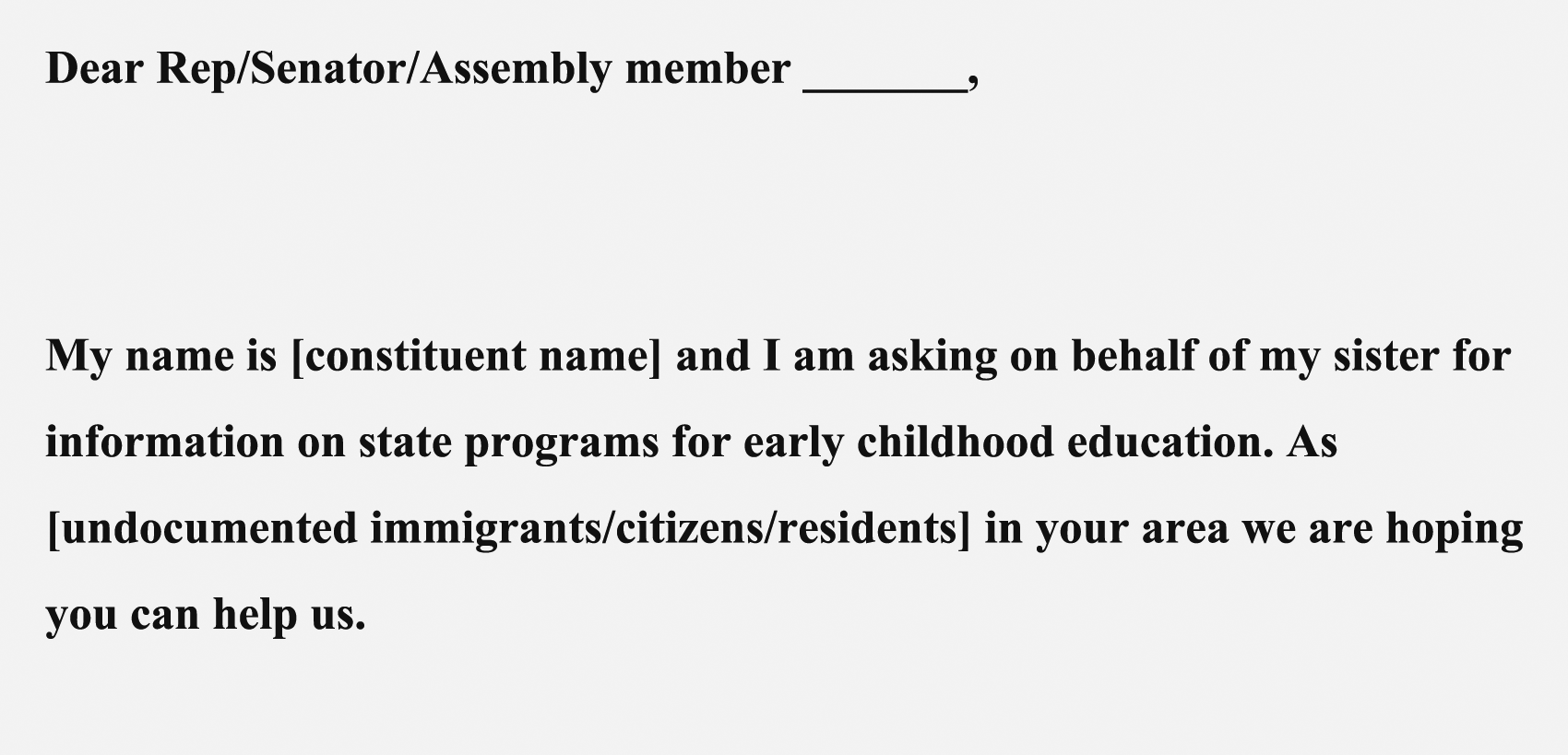
Method of Analysis
The outcome variable of this analysis is dichotomous, whether the legislator responded (1 = response; 0 = nonresponse). 5 The independent variables of interest represent the six treatment groups which test race and ethnicity (Latinx or Eastern European) and citizenship status (undocumented, citizen, or control). We first compared the response rate to the undocumented Latinx treatment as reference group against the following constituent types: undocumented Eastern European, control Latinx, control Eastern European, citizen Latinx, and Citizen Eastern European. We used t-tests to determine if there is a significant difference between groups.
In a second stage analysis, we sought to evaluate legislator responsiveness after controlling for potentially confounding factors using a logistic regression model. First, we identified the race/ethnicity of all legislators by using membership in ethnic caucuses, self-declared statements, and newspaper reports, consistent with other scholarship (see, for example, Fraga, Gonzalez Juenke, and Shah 2020 and Sadhwani 2022). We considered that a Latinx legislator might be intrinsically motivated to respond to a Latinx constituent with a shared identity, as has been found for Black legislators (Broockman 2013). We also included the percentage of Latinx residents in a district using 5-year estimates from the American Community Survey because legislators with large Latinx populations might be more responsive given the potential direct and indirect electoral rewards.
In addition, we consider two variables to assess the impact of partisanship and the state-level dynamics of the immigration debate. First, we include the partisanship of the legislator with the expectation that a Republican legislator may be less likely to respond. Previous research finds that Republicans’ policy responsiveness is influenced by different factors than Democrats (Jaeger 2019; Rocca et al. 2022; Skulley et al. 2018). Between 2010 and 2014 several Republican-led efforts to penalize undocumented immigration were salient and moving through state legislatures (Wallace 2014). State-level immigration dynamics could signal to a legislator that their constituents would reward or punish them if they are seen as being overly welcoming or restrictive to undocumented immigrants based on the sentiment toward undocumented immigrants held by the constituents. To model for state-level immigration dynamics we include a variable to distinguish red states from blue states, drawing upon the electoral college results of the previous 2012 presidential election between Barack Obama and Mitt Romney. During that election, the candidates were severely split in their views of immigration policy. In particular, the candidates were divided on their positions to SB 1070, an Arizona an aggressive and highly restrictive measure dubbed the “show me your papers law.” The law allowed law enforcement to ask residents for citizenship documentation and would deputize local law enforcement as immigration agents. We include a dummy variable that sorts states between those that Republican Mitt Romney won and those that Barack Obama won in 2012. While this is not a perfect measure of state-level immigration sentiment, it captures states at a moment in time when national immigration policy discussions and the response from state and local governments was at a high and would have been influencing the mindset of legislators seeking election in 2014, when this study was fielded.
Other important considerations for inclusion in the model considered potential resource differentials between legislators. For example, we include the Squire index for legislative professionalism (Squire 2007), the chamber in which the legislator serves, and a fixed effects variable for states.
Results
We evaluated the responsiveness of a total of 6062 legislators for two immigrant constituent types, relative to four other non-immigrant constituents. Across all legislators and constituent types, 21.5% responded to constituent emails. Figure 1 visualizes the response rates across experimental conditions and shows undocumented immigrants are at a disadvantage in receiving responsiveness from legislators: The undocumented Eastern European treatment received the least response (15.2%), followed by the undocumented Latinx (16.2%), while the control Eastern European treatment received the most response (29.1%), followed by the Latinx citizen (27.3%). The raw response rate finds that there is no meaningful difference in the responsiveness of legislators to undocumented Latinx and Eastern European constituent requests, but that legislators are responding to undocumented immigrant constituents is of substantive value. Consistent with our citizen advantage hypothesis, citizens and the control groups receive greater responsiveness from state legislators, yet approximately 15% of legislators are nonetheless responsive to the residents of their district who cannot vote or directly influence the legislator’s electoral future. 6
In addition, the raw response rates show that legislators are differentially responding within racial categories. Amongst the Eastern European treatments, the control group (identified in the constituent request simply as a resident), received the highest response rate, followed by the citizen and lastly the undocumented immigrant. For the Latinx treatments, the citizen treatment received the greatest response rate. This is consistent with the main findings from Gell-Redman et al. (2018), who found that white constituents have a higher response rate from legislators than Latinx constituents. However, in consideration of the difference between the control and citizen conditions, these findings run counter to Gell-Redman et al.’s secondary finding that legislators tend to exhibit bias against those who mention their nativity (p. 524). It may be the case that for Eastern Europeans who are white, their nativity does bias a legislator’s responsiveness: The Eastern European control received a greater response than the Eastern European citizen who signaled their nativity and possibly cued immigration status. The Latinx conditions, however, see a reverse a pattern: Legislators bias their response to Latinx treatments that specifically identify as citizens over the more benign control which identifies simply as a “resident.” This may be the result of the racialization of the Latinx community as both an immigrant group and as undocumented immigrants, as the term “resident” may have left some doubt in the minds of legislators about the national origin status of the Latinx constituent. Moreover, a white resident, even with a Russian name may be assumed to be a citizen, whereas a Latinx resident is not.
One-tailed difference of means tests shows that the proportion of legislators who responded to emails was significantly higher across all constituent types when compared to the undocumented Latinx, except for the undocumented Eastern European. Undocumented Latinx and Eastern European constituent groups did not differ significantly in the likelihood to receive an email from a legislator as compared to the undocumented Latina constituent group (p-value = 0.118 and 0.597, respectively).
Similarly, the proportion of legislator responsiveness was significantly higher across all constituent types when compared to the undocumented Eastern European, with the exception of the undocumented Latinx. The differences between the undocumented treatments and the other constituent types were all statistically significant (p < 0.05). Treatment effects were measured using a linear probability model (Figure 2). Based on this model, the Eastern European and Latinx citizen constituent groups, and control Eastern European constituent group were significantly more likely to receive an email from a legislator as compared to the undocumented Latinx constituent group. These findings suggest that citizens indeed have an advantage in soliciting a response from a legislator. Particularly striking is the variation between the Latinx control (19% response) and the Eastern European control (29.1% response) results. When immigration status cues are no longer present, Eastern European white residents receive significantly greater responsiveness than Latinx residents (Figure 3). Percent of legislator responsiveness to the undocumented Latinx constituent. Note: The percent of legislator responsiveness for Response = 1 is shown for each constituent type next to its corresponding confidence intervals in parenthesis. Results from one-tailed difference of means test that compared the mean responsiveness of legislators for each constituent type relative to the undocumented Latina are shown, the t-statistic followed by its corresponding mean difference in percentage within parenthesis. “*” indicates statistical significance, *p < 0.05, **p < 0.01, and ***p < 0.001. Treatment Effects. Note: Results of a linear probability model that examines the effect of the treatment variable on legislator responsiveness, with the undocumented Latinx condition as the reference variable. The probability of a Latinx citizen receiving a response is about 9% higher than an undocumented Latinx constituent.
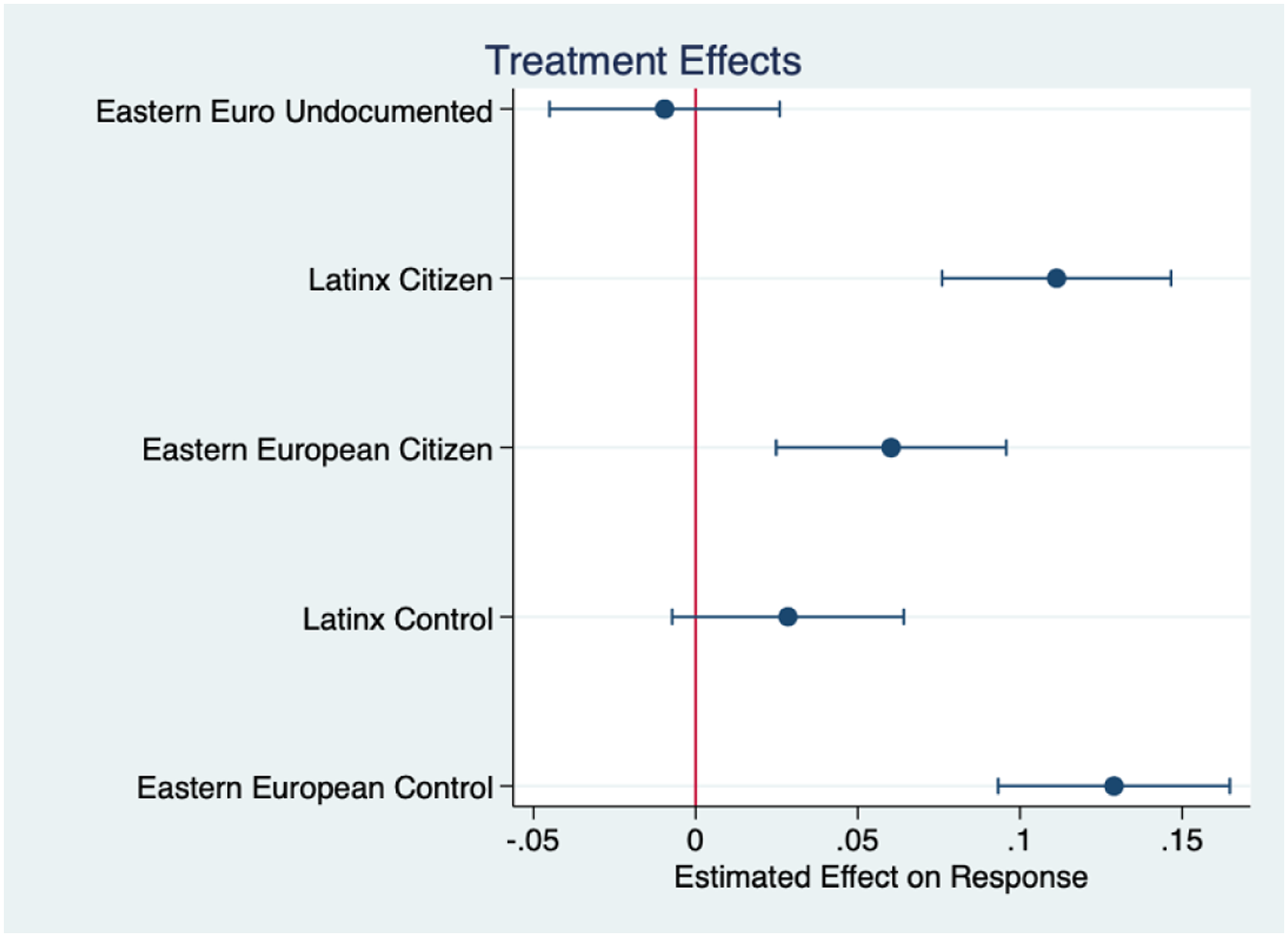
The results indicate support for the citizen advantage hypothesis as state legislators respond more to the citizen treatments at statistically significant levels. State legislators do not differentially respond to the undocumented treatments by race so there is no advantage to being White or Eastern European. We believe the results demonstrate support for our theory that there is an indirect reward to responding to an undocumented immigrant, as legislators in that treatment still responded to those groups at a rate of 16.2% (undocumented Latinx) and 15.2%, (undocumented Eastern European).
Our results provide evidence that legislators do, indeed, respond to undocumented immigrants, allowing us to reject the direct electoral rewards hypothesis. The fact that legislators responded 16.2% to the undocumented Latina and 15.2% to the undocumented Eastern European but responded more to the citizens provides support for our citizen advantage hypothesis. These results offer support for our hypothesis that citizens, regardless of ethnicity, provide a greater benefit to legislators and therefore are prioritized over undocumented immigrants. We also show evidence that the ethnicity of the undocumented immigrant does not matter as both undocumented treatments were statistically similar, but that as immigrants acculturate into American society, bias in responsiveness to Latinx resident in comparison to white residents can be found when an immigrant cue are no longer present
Multivariate Analysis
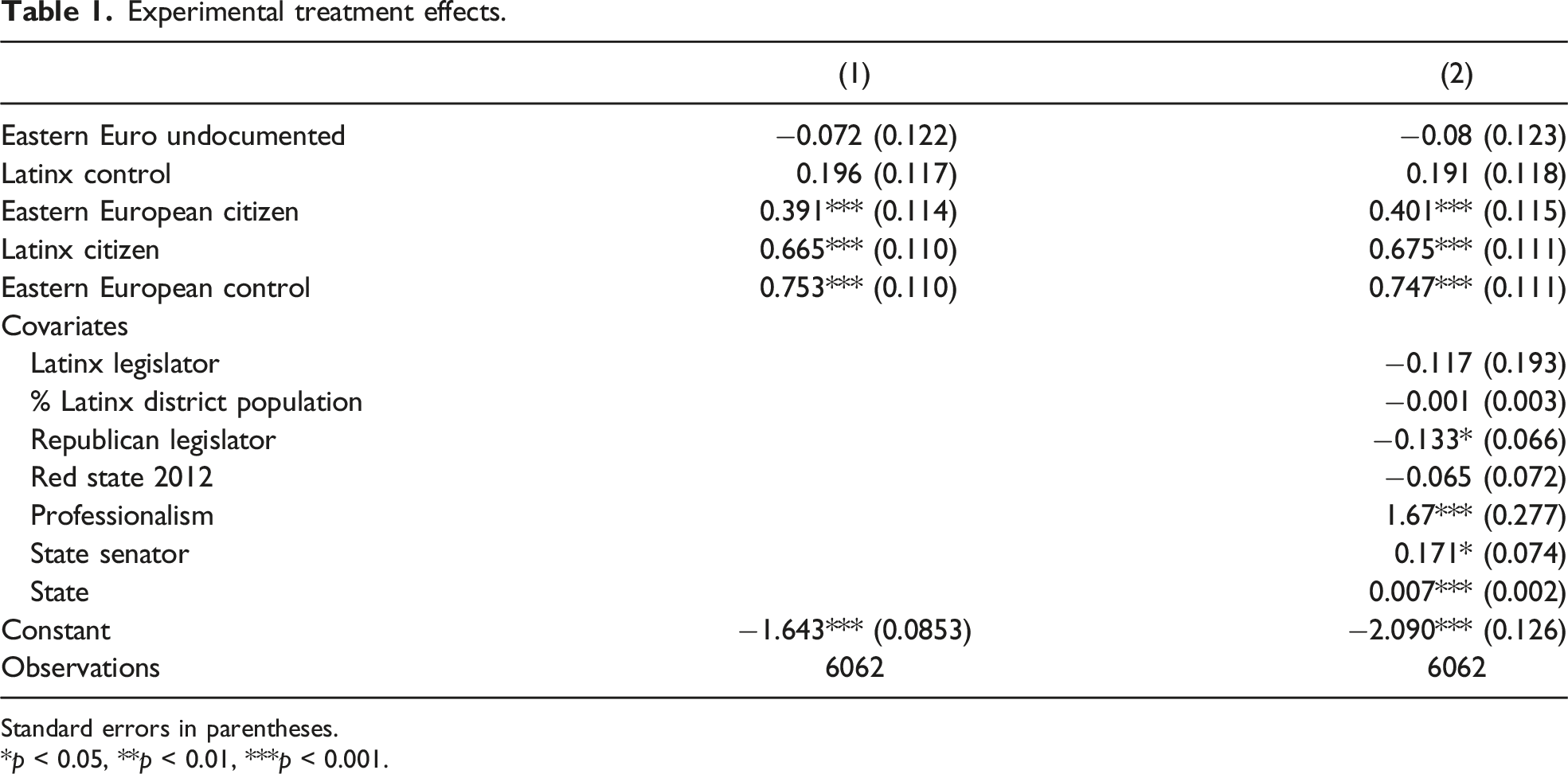
Experimental treatment effects.
Standard errors in parentheses.
*p < 0.05, **p < 0.01, ***p < 0.001.
Notably, while we had expected to find an affinity between Latinx legislators and undocumented Latinx constituent requests, there was no significant relationship found in the responsiveness of Latinx legislators or with the percentage of Latinx residents within a district. This would suggest that Latinx legislators are not serving as descriptive representatives to undocumented Latinx constituents in any significant way. The results do find, however, that the partisanship of a legislator is meaningful in responsiveness. Republican legislators are less likely to respond to the request from the undocumented Latinx constituent (p < 0.05). To further examine the potential impact of sentiments toward immigrants and immigration at the state level, we included a variable (“2012 Romney states”) to examine if legislators in states that went to Romney in the 2012 presidential election were less likely to respond do a request from an undocumented immigrant. We found no such relationship in the data. These findings comport with other research that have found that partisanship better explains policy responsiveness to Latinx populations than coethnicity between legislator and constituent (Hero and Tolbert 2004; Knoll 2009; Zhinger 2014) or the state-level sentiment toward immigrants.
In addition, we found the level of partisanship of a legislature to be highly correlated with the likelihood of a legislator to respond to the request. Professionalism in a legislature is typically associated with legislators’ ability to generate and digest information in the policymaking process due to access to staffing resources and salaried legislators who do not need to split their time elsewhere (Squire 2007). Professionalism of legislatures is measured in the model using the Squire index (Squire 1992). In addition, serving in the upper chambers rather than the lower chamber of the legislature, which typically suggests longer terms of service, are also predictive of responsiveness.
This study examined legislator responsiveness to differing ethnicities and immigration statuses of immigrant constituents through a randomized field experiment conducted in 2014 in 44 U.S. state legislatures. Advancing a theory of citizen advantage, we argued that citizens will reap greater representation from legislators. The analysis supports this claim with the undocumented treatments receiving the least response, while citizen and control treatments received greater responsiveness. To add to the literature and further disentangle the effects of national origin and immigration status, we observe a differential in responsiveness to the Eastern European treatments and the Latinx treatments. For Eastern Europeans who are white, their nativity does not appear to bias a legislator’s responsiveness as the control received a greater response than the Eastern European citizen treatment, which possibly cued immigration status, suggesting that a white resident, even with a Russian name may be assumed to be a citizen. We argued that even undocumented immigrants can represent a meaningful subconstituency that receives some, albeit less, responsiveness from legislators, and indeed found that both Eastern European and Latinx undocumented treatments received responsiveness from legislators.
Conclusion
The question of undocumented immigrants and the place of Latinx Americans in the United States has, arguably, become more salient since this experiment was fielded in 2014. During this time period the status of the approximately 11 million undocumented people—living and working within the shadows of America—has changed very little. These results provide insight on key questions facing the nation about the treatment that undocumented immigrants receive and the placement of Latinx Americans in the greater racial hierarchy of the United States (Masuoka and Junn 2013).
We offer evidence to support our hypothesis that state legislators believe there is an indirect reward for helping undocumented immigrants, but prioritize them below that of citizens, who offer a more direct reward. It is important to note that responsiveness is tied to the professionalization of the legislature, giving support to our supposition that greater resources make responsiveness less costly for legislative offices (Landgrave and Weller 2020). Our paper leaves us with some more important questions, including whether the Latinx community, regardless of citizenship status, are racialized as foreign-born without the help of a citizenship signifier. This finding, coupled with the fact that citizens of either ethnicity receive higher responsiveness than undocumented immigrants, potentially indicates how legislators might “other” Latinxs. The results also find that partisanship of a legislator may be a better predictor of responsiveness to an undocumented Latinx constituent than being a Latinx legislator. Studies of Latinx political behavior have shown that desire for Latinx descriptive representation and ballot box mobilization relies upon the strength of Latinx identity of individuals (Cassellas and Wallace 2015; Valenzuela and Michelson 2016). The findings presented here suggest the same might be true on the part of legislators: Despite often being outspoken advocates or legislative leaders on immigration related measures, Latinx legislators are no more likely than their non-Latinx colleagues to be responsive to appeals from undocumented immigrants, suggesting that a Latinx legislator is not inherently a preferable descriptive representation (Dovi 2002).
In the absence of a citizenship status cue, the low response rate to the Latinx control and its statistical similarity to the undocumented treatments suggests a microaggression against all Latinx residents. The racialization of undocumented immigrants as Latinx means that state legislators are likely to assume that Latinx residents are undocumented immigrants, unless specifically informed otherwise. Given that the Eastern European control is statistically distinct from the undocumented treatments, suggests that this ostensibly white alias is assumed to be a citizen by state legislators. When and why does an Eastern European immigrant “become” white or fully incorporated in the eyes of a legislator, such that they receive greater responsiveness than Latinx residents? The assumption of difference and the potential racialization of Latinx constituents as foreign needs to be further examined and represents an important area for future research.
Immigration has long been a point of contention in the United States. Though the United States took a more welcoming posture toward immigrants in the passage of the Immigration and Nationality Act of 1965 and the Immigration Reform and Control Act of 1986, the last three decades has been marked by stricter enforcement of immigration laws and more exclusionary policies. Despite their precarious position with the American racial hierarchy, undocumented immigrants are here embedded within communities and, as our study demonstrates, even state legislators realize that their presence matters as constituents in the jurisdictions where they live.
Supplemental Material
Supplemental Material - ¿Quién Importa? State Legislators and Their Responsiveness to Undocumented Immigrants
Supplemental Material for ¿Quién Importa? State Legislators and Their Responsiveness to Undocumented Immigrants by Matthew Mendez Garcia and Sara Sadhwani in Political Research Quarterly
Supplemental Material
Supplemental Material - ¿Quién Importa? State Legislators and Their Responsiveness to Undocumented Immigrants
Supplemental Material for ¿Quién Importa? State Legislators and Their Responsiveness to Undocumented Immigrants by Matthew Mendez Garcia and Sara Sadhwani in Political Research Quarterly
Footnotes
Declaration of Conflicting Interests
The author(s) declared no potential conflicts of interest with respect to the research, authorship, and/or publication of this article.
Funding
The author(s) received no financial support for the research, authorship, and/or publication of this article.

Notes
References
Supplementary Material
Please find the following supplemental material available below.
For Open Access articles published under a Creative Commons License, all supplemental material carries the same license as the article it is associated with.
For non-Open Access articles published, all supplemental material carries a non-exclusive license, and permission requests for re-use of supplemental material or any part of supplemental material shall be sent directly to the copyright owner as specified in the copyright notice associated with the article.
