







Abstract
The aftermath of the 2016 election cycle ignited significant interest in populism among scholars of American politics, yet relatively little engagement has gone toward how American political elites and institutions respond to populist insurgencies. This is problematic as the response a populist insurgency receives likely affects its degree of success, thereby conditioning the substantive importance of rising populism. This paper addresses this shortcoming by articulating an audition and assimilation theory of party response to populist insurgencies. This theory predicts that parties, presented with an electorally viable populist insurgency in a presidential primary contest, can choose to assimilate the message while removing the populist content to diffuse the insurgent nature. In contrast, an electorally unviable populist insurgency is treated as a failed audition, warranting no response. Using a corpus of presidential primary candidate speeches, I show that party nominees assimilate the topics used by populists who demonstrate electoral viability but do not become more populist themselves. This assimilation is also found among party platforms. Furthermore, assimilation is only performed by the Democratic party and exceeds assimilation of topics used by electorally viable, non-populist rivals.
While Hillary Clinton began her quest for the 2016 Democratic party nomination as a heavy favorite and eventually won it by a comfortable margin, the campaign itself was anything but uncontentious. Bernie Sanders, the self-styled Democratic Socialist who did not openly affiliate with the Democratic party until 2019, came close to pulling off a remarkable upset. Part of how he transitioned from relative obscurity to the leader of a political movement was via his left-wing populist appeal. 1
The nascent Americanist study of populism often points to Sanders’ 2016 campaign as emblematic of increasingly frequent populist insurgencies (e.g., Oliver & Rahn 2016). In documenting Sanders’ populist appeals, however, something important is overlooked: How the Clinton campaign and the Democratic party reacted to this insurgency. Did they remain static, sticking true to the message that made Clinton the establishment favorite to begin with? Or were they dynamic, adapting in light of Sanders’ electoral performance? By not addressing such questions, existing studies of American populism provide an incomplete picture of the consequences of populist insurgencies.
Conventional wisdom holds that parties and their standard-bearers, fearing party fracture (e.g., Southwell 2010), often make concessions to the losers of nomination contests. Parties are coalitional and strategic (Hassell 2021) making the balancing of competing interests and priorities second nature. Populist challengers, however, present a different obstacle. Populism is inherently antagonistic toward the coalitional pragmatism of political parties (Lee 2019; Levitsky & Ziblatt 2018). The anti-pluralism, anti-partyism of populism makes it an insurgent faction (Blum 2020) seeking takeover instead of concessions. Given this natural hostility, do parties respond to populist insurgencies as if they were another, less bellicose internal party dispute? I argue that they do. Parties are aided in this process by the electoral rules of nomination contests, which functionally allow parties to “audition” insurgencies. Should an insurgency demonstrate electoral viability, the party concedes some by assimilating the issues emphasized by the populist while discarding the populism itself.
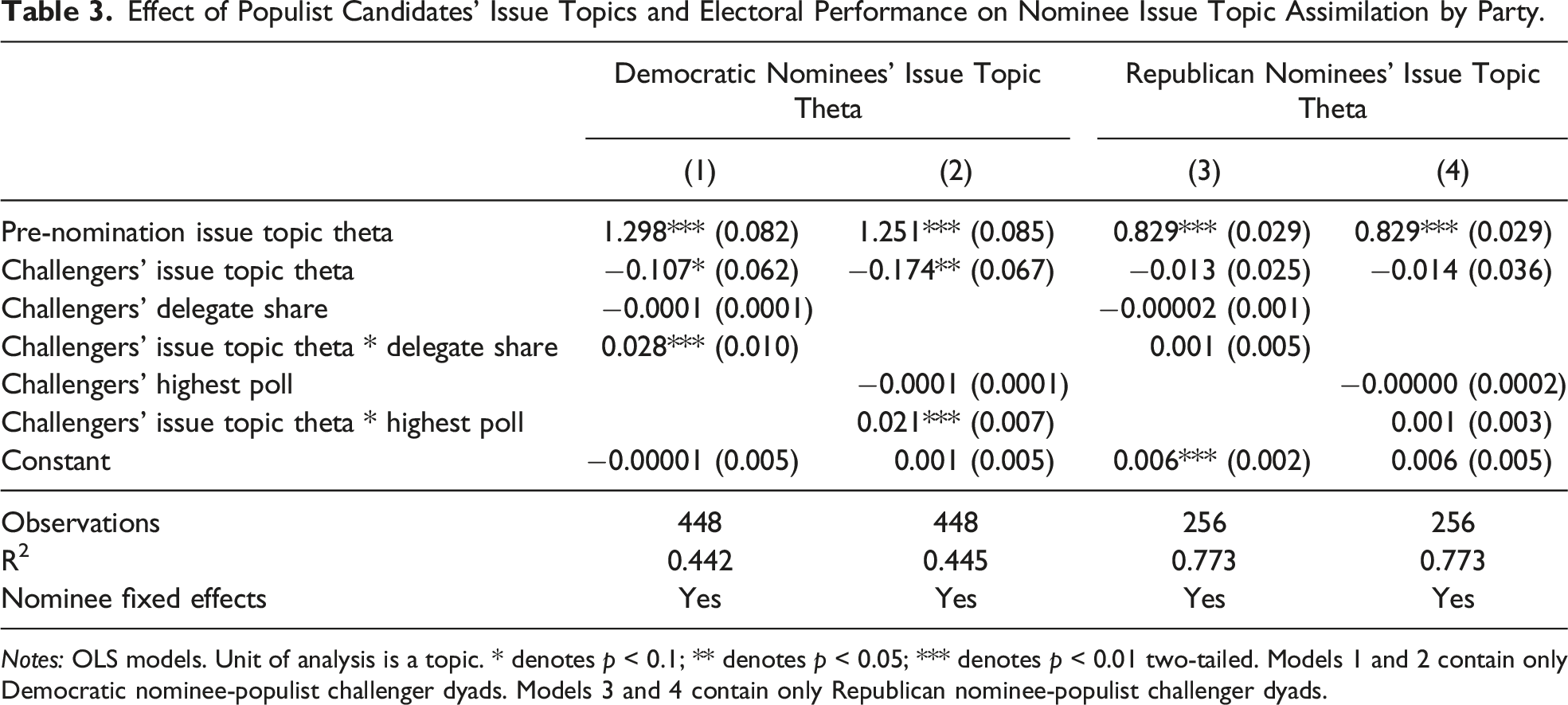
I test this theory using the Presidential Primaries Communication Corpus (PPCC), a corpus containing almost 3400 speeches by presidential primary candidates in contests from 2000–2020 (Scott 2021). I show that nominees assimilate the issue topics of populist candidates who demonstrate electoral viability but exhibit no change in issue topics in response to nonviable populist insurgencies. But the candidates do not become more populist themselves. This assimilation extends beyond the nominees to the party platforms as well. When compared, assimilation from viable, populist rivals appears more consistently than assimilation from viable, non-populist challengers. Interestingly, only the Democratic party exhibits this pattern of issue topic assimilation.
American Populism
The 2016 U.S. presidential election ignited Americanist academic interest in populism (Groshek & Koc-Michalska 2017; Lacatus 2019; Lamont, Park, & Ayala-Hurtado 2017; Oliver & Rahn 2016; Schneiker 2020). While some pointed to earlier movements as forerunners (Gervais & Morris 2018; Husted 2015), the pervading notion was that some new phenomenon had suddenly materialized. Of course, populism was hardly new to American politics (Kazin 1995) or political science (e.g., Armony & Armony 2005; Canovan 1999; Hawkins, Kaltwasser, & Andreadis 2018; Laclua 2005; Weyland 1999). What was new was its afforded prominence in the discussion among Americanists (Hawkins & Littvay 2019). Consequently, students of American politics suddenly found themselves playing catch-up on decades of insight.
An Americanist would likely come to two overarching conclusions upon first encounter with the comparativist populism literature: one of surprising controversy and another of strong consensus. Beginning with the former, the populism literature has struggled to articulate what populism is. The starkest definitional divide lies between the strategic and ideational approaches to populism. The strategic school of thought conceptualizes populism primarily as a communication style dominated by simplistic, emotional, and blame-laden presentational attributes (Bos, van der Brug, & de Vreese 2010; Bucy et al. 2020; Jagers & Walgrave 2007). In contrast, the ideational school sees populism as a worldview positing a dichotomy between the morally pure people and the dastardly elites (Hawkins & Kaltwasser 2017; Mudde & Kaltwasser 2017). It is a “thin-centered ideology” (Mudde 2004), meaning that it does not, by itself, provide much guidance on political issues or policy as the wants and desires of “the people” are flexible. Instead, populism typically exists attached to some other ideology, acting as a framing device or moral justification.
While possessing distinctive attributes, significant commonalities remain between these two camps. Both schools focus on the communicative patterns of elites, but the ideational approach places more emphasis on what populist politicians say, while the strategic approach stresses how they say it. Both also feature a strong, people-centric component to this communication. For the ideationalist this people-centrism is explicit, while it takes on a more symbolic form in the strategic conceptualization. And both note the thin, malleability of populism that allows it to match with seemingly any left-right ideological position.
Furthermore, while often discussed as alternatives, it is not entirely clear what the relationship is between the two. Experimental evidence suggests that it is the “populist style” (i.e., the strategic communication) rather than “populist rhetoric” (i.e., the ideational framing device) that causes the greater reaction among the public, although the effects are heterogeneous by respondent cynicism and education (Bos, van der Brug, & de Vreese 2013). Observationally, it is possible that the two conceptualizations of populism co-occur at high rates. For example, candidates who use ideationally populist rhetoric might also tend to do so in a simplistic and emotional manner. It is also possible that the two are orthogonally related; simplistic and emotional appeals might be readily used by candidates who don’t frame political conflict in people-versus-elites, Manichean terms.
Populism has been conceptualized in distinctive, if not entirely discrete, ways that creates a lack of clarity as to how the two conceptualizations relate. Examining American populism thus requires an investigation of the political communication of people-centric messaging, but the precise form that this takes is subject to debate.
While defining populism has proved schismatic, articulating the consequences of populism has resulted in significant harmony. Populism tends to be destabilizing to democracy (Cohen et al. 2022; Lee 2019). Populist candidates and parties mobilize constituencies predisposed against compromise (Bakker, Schumacher, & Rooduijn 2021) and higher in discriminatory attitudes (Anduizo & Rico 2022). Once mobilized, populism tends to be dispositional and blame-oriented (Busby, Gubler, & Hawkins 2019; Hameleers, Bos, & de Vrees 2017), emphasizing the types of simple and quick solutions that can attract attention but are unlikely to truly address systemic problems. Populist movements are more effective at scapegoating than they are at truly addressing everyday issues. For example, populist regimes tend to erode press freedom (Kenny 2020), often as populist ire is directed at journalists as “the enemy of the people” for reporting on the problems that populist regimes are failing to address.
This scapegoating occurs not only because it is naturally compatible with the psychological appeal of populism but also because populists often struggle to govern (Ravanilla, Sexton, & Haim 2022). While in part because populist politicians tend to be inexperienced outsiders, governing difficulties also arise from a crucial attribute of populism itself. Populism has two opposites. The first, which is self-explanatory, is elitism. The second, pluralism, stems from populism’s inherent homogenization of the “people.” By defining the people as a singular entity, populism assumes a singular, common good. To such a perspective, balancing competing interests through compromise, the heart of modern pluralistic democracy, can only produce a worse outcome. This leads populism to be hostile to political institutions that negotiate the conflict between competing interests, chief among them being political parties. As Levitsky & Ziblatt (2018, 22) put it, “Populists tend to deny the legitimacy of established parties, attacking them as undemocratic and even unpatriotic.” 2
Students of populism have made a compelling case that populism is inherently disruptive to pluralistic democracy, which should prompt concern from Americanists noting its increasing prominence. But there is an important, unconsidered question. The anti-elite, outsider perspective of populism, either as a rhetorical style or as a communication frame, would seem to be naturally anathema to elites and institutions. When confronted with such a challenge, what do they do?
This shortcoming is significant. Parties are not static entities (Karol 2009). There is no reason to think that they remain idle as populism surges. Elite and institutional responses play a role in the consequences of insurgent populism. Without an appraisal of their reactions, it is difficult to assess the degree of risk populism poses.
Audition and Assimilation Theory of Party Responses to Populist Insurgencies
Populism, either as a rhetorical style or as an ideational framing device, draws a contrast between the political establishment and the masses. At its heart, it is about centralizing a conflict between those perceived to be “in power” against the common citizen either by drawing attention toward their symbolic differences or to their different interests and inherent morality.
Political conflict in a democracy is structured by political parties. In multiparty democratic systems, populist movements often form their own parties to exert influence over this conflict-structuring process. This is not a viable path to success in the American party system, however, given the remarkable durability to the two main parties. The American case has been defined by the same two political parties for more than 160 years. Multiparty systems tend to be fluid, with new parties arising to meet new movements or causes. In the durable, two-party American system, movements and causes must instead define themselves in relation to the existing party status quo. Populist movements are no different. 3
Which is not to imply that the American parties are completely static entities. The parties compete to build electoral coalitions capable of helping them win elections (Bawn et al. 2012; Hershey 2017; Schattschneider 1942). To do so, they need to offer concessions to maintain the loyalty of existing coalition members and to recruit new groups into the coalition (Karol 2009). Over time, the policy programs of the parties may come to be associated with an ideological brand, but the origination and maintenance of this ideology is largely performed by intellectuals outside the party apparatus (Noel 2013). Parties want to win elections, not to remain ideologically pure, and so concessions to a group that alters the party’s policy brand are acceptable if such concessions are necessary to assemble a more promising electoral coalition.
While voters may penalize inconsistency (Tomz & Houweling 2010), candidates can change presentational attributes, including which issues they choose to emphasize, without altering their policy positions and incurring this penalty (Acree et al. 2020). This provides the requisite flexibility for parties and their nominees to adapt in the aftermath of divisive primaries (e.g., Southwell 2010). Emphasizing the core issues of prominent intraparty factions sends a signal that their interests will still be addressed, even if their preferred candidate wasn’t victorious.
That winning campaigns will seek to offer concessions to the losers of a nomination contest is conventional political wisdom. For example, Biden forming a climate change “policy panel” was understood in such terms. 4 But primary challenges from populist rivals pose a fundamentally different circumstance. That populism movements in American politics occur within the parties makes them a form of intraparty faction (Blum 2020), or a miniature party within the party. The parties are composed of many such factions. But the anti-pluralistic nature of populism means it is best understood as an insurgent faction, seeking its own ends irrespective of the benefit of the whole. As the faction represents the interests of the unerringly good “people” then any compromise produces an unacceptable outcome. Faced with such a hostile coalitional partner, do parties offer the same deal that conventional wisdom suggests they do for other factional candidates?
I argue that they do. Parties, and by extension their nominees, are institutions comfortable with conflict. Parties have long had to balance competing interests (Karol 2009), even when such interests appear to be diametrically opposed (Schickler 2016). Consequently, parties are no strangers to in-fighting. The pragmatism of parties is aided by the “thin” nature of populism. Whether a strategic or ideational form of communication, populism alone does not offer much in the way of a political program (Mudde 2004). Instead, populism can be grafted onto nearly any set of policy objectives, making the constituency for a given populist movement an unstable combination of those prioritizing the populism and those more interested in whatever policies this particular populist is promoting. Not every supporter of a populist movement is equally hostile to the party, which provides leverage for cracking the populist movement. Essentially, parties do not care that populist factions attack the pluralism that parties practice so long as there are voters to be won, and not all supporters of a populist movement are populism-or-bust. This creates permission for parties to respond to populist movements as they would any intraparty faction—evaluating if appeasing the movement is necessary to win elections and then offering concessions if the answer is in the affirmative—even as this particular intraparty faction decries the very existence of political parties.
The evaluation stage is made simpler by the two-stage electoral system where intraparty nomination contests are followed by interparty general elections. Parties do not need to speculate about how a particular populist insurgency resonates with voters. They can observe if a populist insurgency, connected to a specific candidate articulating a defined message, is able to demonstrate electoral viability. Of course, this system of open competition for party nominations ultimately allows populist insurgencies to wrest control of the party outright (Cohen et al. 2016). But the multicandidate and intraparty nature of primary contests makes primaries fundamentally a coordination problem and the parties are vested with significant resources like money, endorsements, and experienced campaign staff to help identify focal points for rank-and-file voters (Bawn et al. 2012), which is why the parties get their way more often than not (Cohen et al. 2008). Given these advantages, parties can use primary contests to audition populist insurgencies. If the candidate at the head of the populist insurgency demonstrates that there is a constituency for their appeals, then the party can respond by offering concessions to maintain the electoral coalition. If the candidate is unable to demonstrate support, the party can treat it as a failed audition and opt not to respond.
If the populist insurgency appears electorally viable, what types of concessions can the party offer? The answer is complicated by the nature of populism. As mentioned above, what populist movements want is inherently an amalgamation of disparate policy ends along with a more amorphous desire to usher in the ascent of “the people” over “the establishment.” Populism, as a coalition partner, wants some policy things and to feel like the voice of the people is being heard over the din of those currently in power.
The parties could conceivably concede on both or either one of these things, but the anti-party hostility of populism itself makes it a poor fit for assimilation. Policy concessions come naturally to parties as a tool of coalition building and maintenance. Political parties and their politician figureheads are part of the establishment that populism posits as antithetical to the people, and so conceding on the merits of populism itself is fundamentally delegitimizing. This suggests that a successful audition is more likely to produce concessions in the form of an assimilation of the policy message of the populist insurgency rather than a populist transformation of the party itself. This theory therefore posits that parties and their nominees respond to the viable, populist insurgencies by stripping out the elements most antithetical to party politics and then adapting the same way conventional wisdom suggests they do for viable, non-populist rivals. Stated formally, the two hypotheses from the audition and assimilation theory are:
Assimilation Hypothesis—Political parties and their nominees will assimilate the issue topics of electorally successful populist primary candidates more than unsuccessful populist primary candidates.
Populism Rejection Hypothesis—Political parties and their nominees will not assimilate populist topics regardless of the electoral success of populist primary candidates.
Up to this point, I have treated the two parties as mirror images of each other. But recent work suggests that this is a false equivalency. Grossman & Hopkins (2016) argue that the Democratic party is fundamentally a coalition of social groups and specialized interests maintained by elites who dole out selective benefits to their various constituency groups. The Republican party, on the other hand, is fundamentally an ideological movement dedicated to conservatism in both economic and cultural domains. Populist movements can exist in both parties regardless of these fundamentally distinct structures because populism, either as a strategically deployed rhetorical style or as an ideational worldview, can be tied to both group-oriented policy demands and an ideological orientation. But the predicted dynamism of the parties articulated by the Assimilation Hypothesis would vary based on the party’s inherent structure. If the Republican party is truly an ideological movement, then maintaining ideological purity would be a higher priority than it is for their Democratic counterparts. This would lend itself toward a disinclination toward issue topic assimilation, at least relative to a party more comfortable with making policy concessions to appease its group-oriented base. If the asymmetric nature of the two American political parties is correct, then we should expect asymmetric assimilation of policy messages in response to populist insurgencies.
Asymmetrical Assimilation Hypothesis—The Democratic party and its nominees will be more prone to assimilating the issue topics of electorally successful populist candidates than the Republican party and its nominees.
Data and Methods
I use the Presidential Primary Communication Corpus (Scott 2021) to test these hypotheses. The PPCC includes the transcripts of campaign events hosted by all major presidential primary candidates from 2000–2020, retrieved from the C-SPAN Video Archive. This amounts to 3395 transcripts for 104 candidates across the nine contested (i.e., no incumbent president facing only token opposition) primary campaigns.
Measuring the populism of these documents is complicated by the diversity of existing measures. Scholars from both the ideational and strategic schools have devised numerous automated measures of populism, but no one has assessed how these various measures relate. 5 To that end, I surveyed the literature to identify the myriad automated means of assessing populism in political text. 6 I applied all of these measures to the PPCC, 7 then conducted a Principal Component Analysis of these assorted measures. The Eigenvectors, as presented in Online Appendix A, suggest that there are two prominent dimensions with additional dimensions providing diminishing returns in explained variance. 8
Figure 1 shows where the various included variables load on these two dimensions. The anti-elite and pro-people dictionaries all point in a similar direction: the bottom-right quadrant. This suggests that these dictionaries, while designed for diverse political contexts, tap into a singular construct. The top-right and bottom-left quadrants appear defined by presentational attributes of the speeches. The former is best explained by the complexity and the emotionality of the language. The two variables measuring focus on the present are by far the strongest determinants of the bottom-left quadrant. The top-left quadrant is sparse, with only the two variables measuring focusing on the past pointing in this direction. Principal component analysis of populism measures.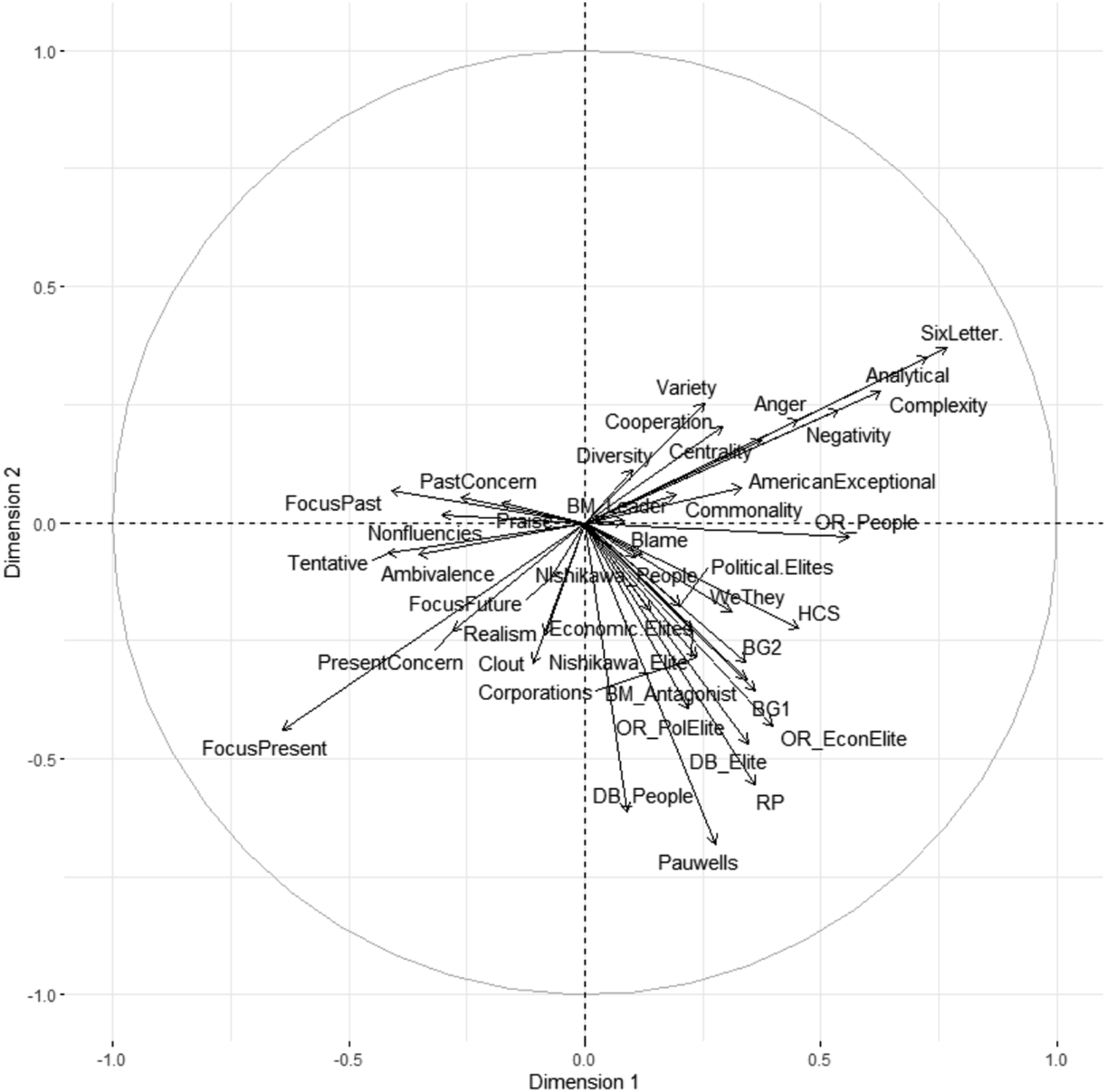
In general, it appears that Dimension 1 is largely presentational (i.e., “populist style”) while Dimension 2 is an anti-elite and pro-people content (i.e., “populist rhetoric”). This suggests that the ideational and strategic measures of populism are orthogonal to one another. This does not tell us if one is better at measuring populism. It is possible, for example, that both dimensions in tandem provide conceptual value. To identify if this is the case, I plot the mean scores on each dimension for the major primary candidates in Figure 2 as a face validity check. Placement of major campaigns on first and second dimensions measures.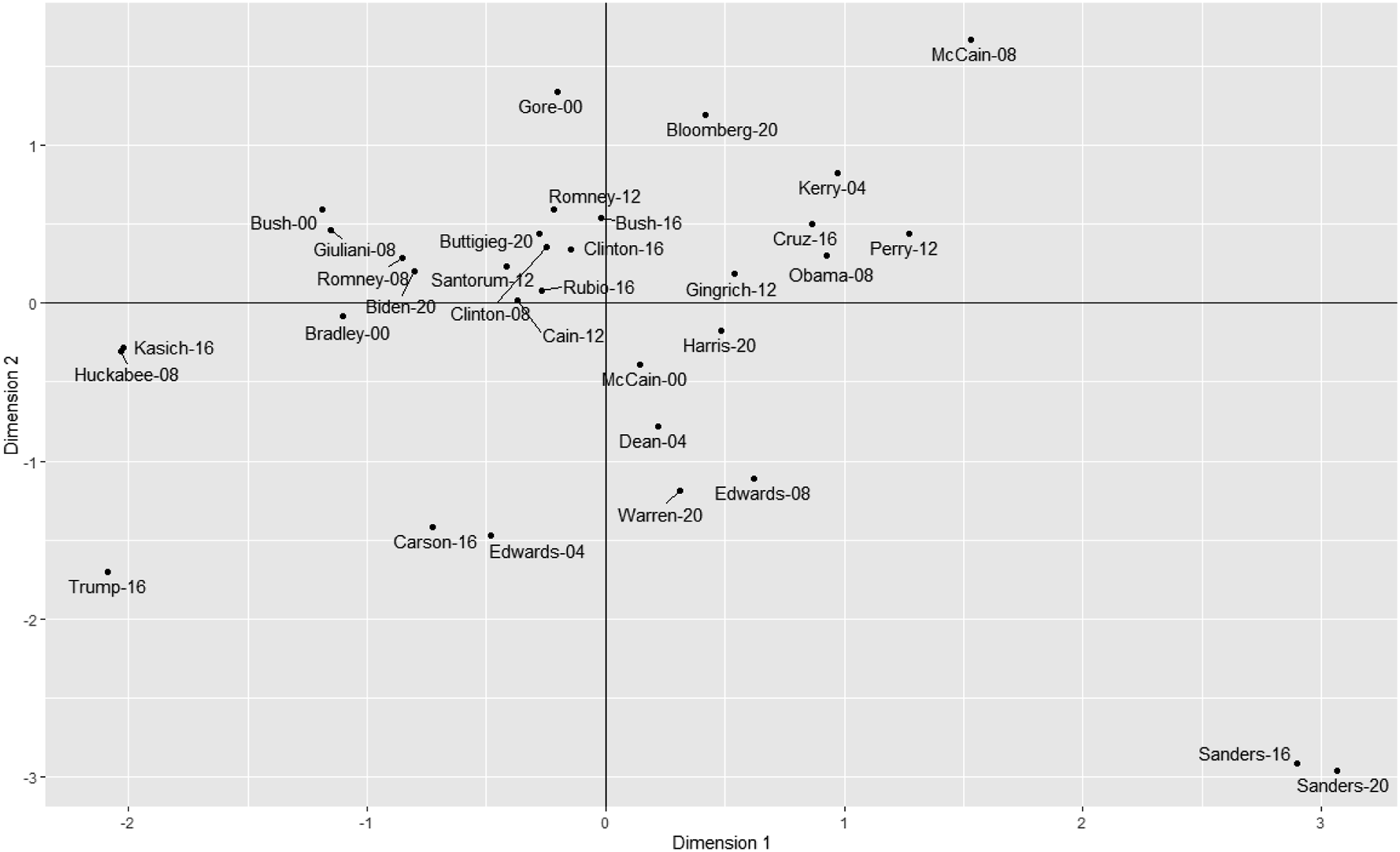
Conventional wisdom as well as academic and journalistic consensus identifies Trump and Sanders as the two most prominent populist primary candidates in recent history. As Figure 2 shows, speeches from the Trump-2016, Sanders-2016, and Sanders-2020 campaigns score the lowest on Dimension 2 on average relative to all other major primary candidates from 2000–2020. Furthermore, they are at opposite ends of Dimension 1, suggesting that this dimension cannot be identifying anything about the mutual populism of those two candidates. Other notable candidates scoring low on Dimension 2 include political outsider Ben Carson and the economically populist campaigns of John Edwards and Elizabeth Warren. 9 As such, I take low values on Dimension 2 to correspond to higher populism scores.
How low of a value is necessary to qualify a candidate as a “populist?” After some trial and error, I choose a cutpoint of −0.5 on Dimension 2 as the threshold for classifying a candidate as a populist. This provides a list of 23 candidates (22 of whom did not become the party’s nominee), including 14 Democrats and 9 Republicans 10 with at least one populist candidate in every primary race except the 2000 Democratic contest. 11
Of interest is whether party standard-bearers and the parties themselves assimilate the issue topics of successful populist insurgents. To measure the issue topics used by nominees and populist candidates, I use Structural Topic Model (Roberts et al. 2014), which is an unsupervised topic model that allows for the introduction of covariates in the topic identification stage. This is useful when dealing with diverse corpora. I control for three attributes of each document. First, the speaker’s party. Parties own issues (Petrocik 1996) and so it is likely that a document from a Democrat will use different topics than one from a Republican. Second, the campaign. Issue saliences evolves over time based on current events and so we should expect speeches from 2000 and 2020 to discuss different topics. Third, an indicator variable for if the candidate is coming from a career outside politics. This was included specifically to help identify populist topics as these candidates are likely to be the most critical of political elites.
Documents were processed according to standard procedures including stemming words, removing stop words, removing punctuation, and switching all words to lower case (Grimmer & Stewart 2013). The number of topics was set via the Lee & Mimno (2014) algorithmic method at 98. The complete list of topics is in Online Appendix B.
Each document is expressed as a combination of these 98 topics via theta scores, which comprise a numerical estimate of the relationship between each document and each topic. The theta scores for all topics for a given document always sum to 1, and so can be interpreted roughly as percentage matches between a document and a topic. Not all topics are useful for testing the hypotheses described above. For example, a topic defined by words like “booker,” “newark,” and “jersey” clearly concerns Senator Cory Booker’s backstory. No matter how impressive Booker's primary performance, Joe Biden is unlikely to assimilate the message of being a former mayor of Newark, New Jersey. As such, only topics that convey a substantive appeal concerning an issue or populism are relevant. To identify which topics fall into these categories, I read through the high-frequency words and consulted closely matched excerpts. Of the 98 total topics, I identify 32 as related to campaign issues (i.e., anything that could be seen as an articulated reason for supporting or opposing a candidate, hereafter “issue topics”) and another four as related to populism (hereafter “populism topics”).
The unit of analysis is a topic used by each nominee-populist dyad. The audition and assimilation theory posits that nominees assimilate the issue topics (but not the populism topics) of electorally viable populists but ignore the issue topics of electorally nonviable populists. This inherently concerns a change in issue topics and a lack of change in populism topics, therefore requiring a measure of nominee’s issue and populism topics at two distinct periods of time. I divided the speeches given by the winner of each primary campaign into two time periods: before and after they won enough delegates to guarantee themselves the nomination. The dependent variable is the average theta score for a given topic by a nominee across all speeches in the corpus after securing the nomination. This variable is continuous, warranting OLS regression. All models then control for the average theta score for the same topic by the nominated candidate across all speeches prior to securing the nomination to ensure that what is being measured is truly a change in the candidates’ rhetorical behavior. 12 The Assimilation Hypothesis is tested using the 32 issue topics (for each of 22 nominee-populist dyads, producing an n of 704), while the Populism Rejection Hypothesis is tested using the four populism topics (for each of 22 nominee-populist dyads, producing an n of 88). 13 As a point of comparison, I also test for assimilation of issue topics using the dyads of nominees and non-populists (73 dyads, producing a total n of 2336).
Testing these hypotheses requires a measure of the emphasis on each topic by the populist candidate and a measure of the populist candidate’s electoral viability. Starting with the former, I use the average theta score for each topic (issue or populist) for each populist candidate throughout their entire campaign. I measure the electoral viability of populist candidates in two ways: the share of delegates won and the highest poll value. 14 Both measures capture different elements of electoral success. Winning delegates grants formal influence at the convention and so is the most tangible form of electoral success. Alternatively, peaks in polls can occur in the invisible primary stage long before any votes are cast. The highest poll demonstrates the potential constituency for this populist rather than any sort of clear electoral influence. Both measures are related, but each conveys distinctive nuance that makes employing them both substantively useful. The key independent variable is the interaction between populist candidate’s average theta score and their electoral viability.
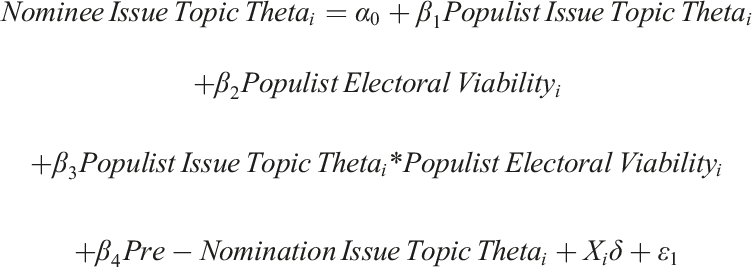
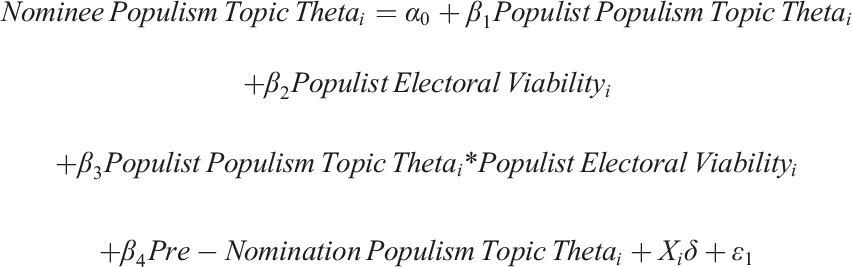
Finally, to account for idiosyncratic candidate and temporal effects, I include nominee fixed effects. Equations (1) and (2) present the models for the Assimilation Hypothesis and Populism Rejection Hypothesis, respectively.
Equation 1 (Assimilation Hypothesis)
Equation 2 (Populism Rejection Hypothesis)
I replicate the models described above separately for each party to test the Asymmetric Assimilation Hypothesis.
Finally, as a secondary test of the Assimilation Hypotheses, I applied the plagiarism-detection package cheatR 16 to the populist candidates’ speeches and party platforms. The unit of analysis is a speech. The dependent variable is an indicator variable for the detection of any plagiarism between the speech and the party platform. Because the dependent variable is binary, I utilize logistic regression. The independent variables are the two measures of populists’ electoral viability described above. To account for temporal variation, I also include campaign fixed effects. Again as a means of comparison, I conduct a similar analysis of detected plagiarism between party platforms and non-populist primary candidate speeches.
Results
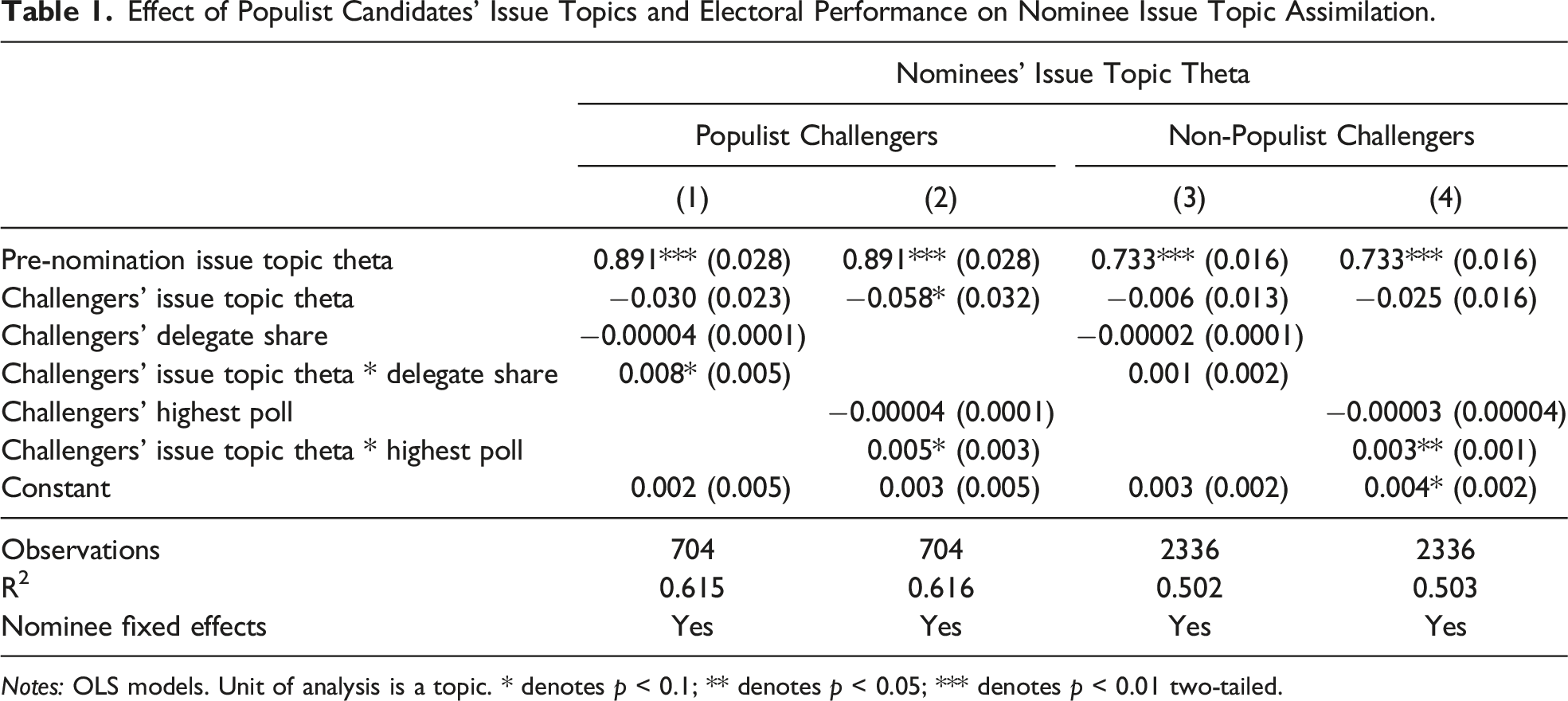
I begin with models testing the Assimilation Hypothesis. I regress the nominee’s average theta for a given issue topic on the populist candidates’ average theta for the same issue topic, the populist candidates’ electoral viability, and the interaction between the two while controlling for the nominee’s average issue topic theta prior to securing the nomination. The models, therefore, estimate the extent to which a nominee discusses an issue topic (e.g., labor) as a function of how much the nominee discussed labor prior to winning the nomination, how much the populist challenger discussed labor, how viable the populist challenger was, and the interaction between the last two variables.
Effect of Populist Candidates’ Issue Topics and Electoral Performance on Nominee Issue Topic Assimilation.
Notes: OLS models. Unit of analysis is a topic. * denotes p < 0.1; ** denotes p < 0.05; *** denotes p < 0.01 two-tailed.
While the results are directionally as expected, the marginal statistical significance suggests that a deeper investigation of substantive significance is necessary. To start, I compared the results against those for assimilation of non-populist issue topics. As described above, conventional wisdom suggests that nominees make concessions to the defeated factions to heal the party after a primary. Despite the insurgent nature of populist factions, we observe that nominees appear to do so in the aftermath of a populist primary challenge, regardless of populism’s anti-party antagonism. Is the assimilation of a similar magnitude as when the challengers are non-populist? Models 3 and 4 in Table 1 provide insight into this question by testing nominee’s assimilation of non-populist issue topics. The models are identical to those in Models 1 and 2, only using the electoral viability and average issue topic theta score for non-populist challengers. The coefficients on the interaction terms are positive in both models, indicating that nominees assimilate the issue topics used by electorally viable, non-populist challengers. But only the interaction coefficient in the model using the highest poll is statistically significant at conventional levels. Furthermore, both interaction coefficients are smaller than those in Models 1 and 2, suggesting that nominees appear more willing to assimilate issue topics from populist challengers than non-populist rivals.
To visualize this, I use the coefficients from these four models to plot nominee’s predicted average issue topic theta scores in Figure 3. I choose values of delegate share and highest poll to reflect a common range of outcomes for populist candidates. At the low end is the plight of the also-ran: no delegates won and never polling above zero. At the high end are the values for Sanders’ 2020 campaign. The left side of the figure plots the interaction effects for populist challengers, while the right side of the figure plots the interaction effects for non-populist challengers. Effect of challenger candidates’ issue topics and electoral performance on nominee topic assimilation. Notes: 95% confidence intervals. Plot of interaction effects using coefficients from Models 1–4 from Table 1.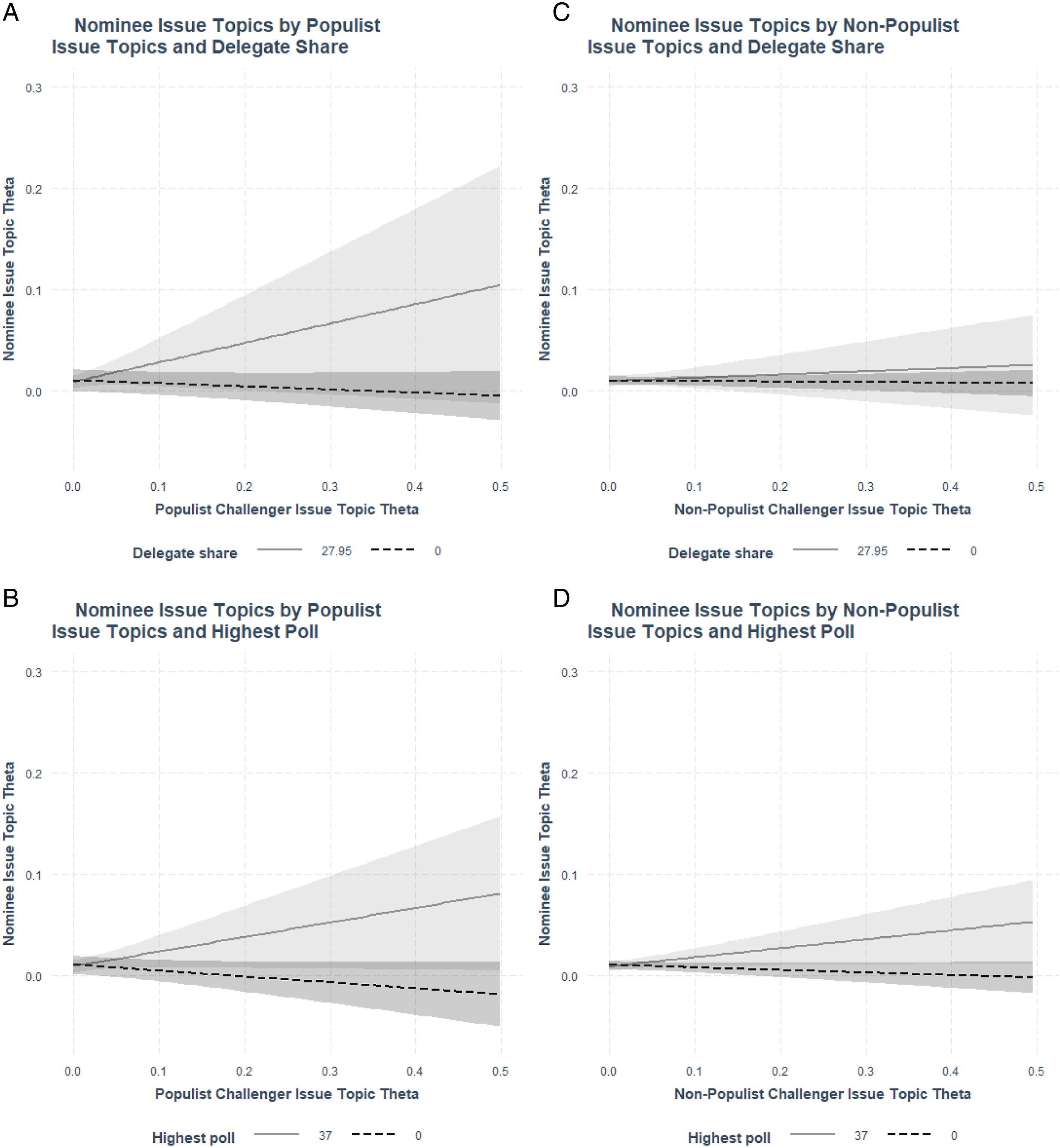
As a reminder, a theta score reflects the percentage match between a document and a topic, and so the sum of all topics for a single document (or the average across multiple documents, as is the case here) will always equal 1. The structural topic model used here featured 98 topics, and so a document that was equally matched to each topic would be expressed as 98 theta scores, each of about 0.01. With that in mind, we observe substantively large differences in nominee issue topic thetas by populist candidates’ electoral viability and issue topic thetas. A viable populist challenger, either in terms of delegate share or highest poll, whose speeches are on average 50% matches to a single issue topic are correlated with nominees’ speeches 9–10% matched to that same issue topic, controlling for the nominees’ proclivity to discuss the issue topic prior to securing the nomination. In contrast, party nominees do not assimilate the issue topics of nonviable populists. When electorally viable populists hammer an issue topic, nominees assimilate the issue topic, but populist challengers who demonstrate no constituency are treated as failed auditions not warranting a callback.
We observe no assimilation of issue topics used by nonviable, non-populist candidates. Nominees do assimilate the issue topics used by non-populists who polled at high levels. A non-populist rival who polls at Sanders-2020 levels whose speeches are on average 50% matched to a single issue topic is correlated with a nominees’ speeches 6–7% matched to that same topic, controlling for the nominee’s prior proclivity to mention the issue topic. This is supportive of the conventional wisdom of healing party wounds, but still suggests that parties are no less, and perhaps more, inclined to heal wounds inflicted by antagonistic insurgent factions as they are friendly team players. 17
To contextualize these results, consider how John Kerry’s campaign message changed as he locked up the 2004 Democratic party nomination. Figure 4 plots the average issue topic thetas by month for John Kerry on the four issue topics most used by the Edwards campaign. Having weathered a late surge by economic populist Edwards, Kerry suddenly embraced labor issues as a major campaign issue. To a lesser extent, he also began emphasizing nuclear threats, education, and health care more than he had at any point save very early in his campaign. Having survived a populist insurgency led by Edwards, Kerry assimilated the key issue topics of the Edwards campaign. Average issue topic thetas by month for 2004 Kerry campaign (top Edwards campaign issue topics).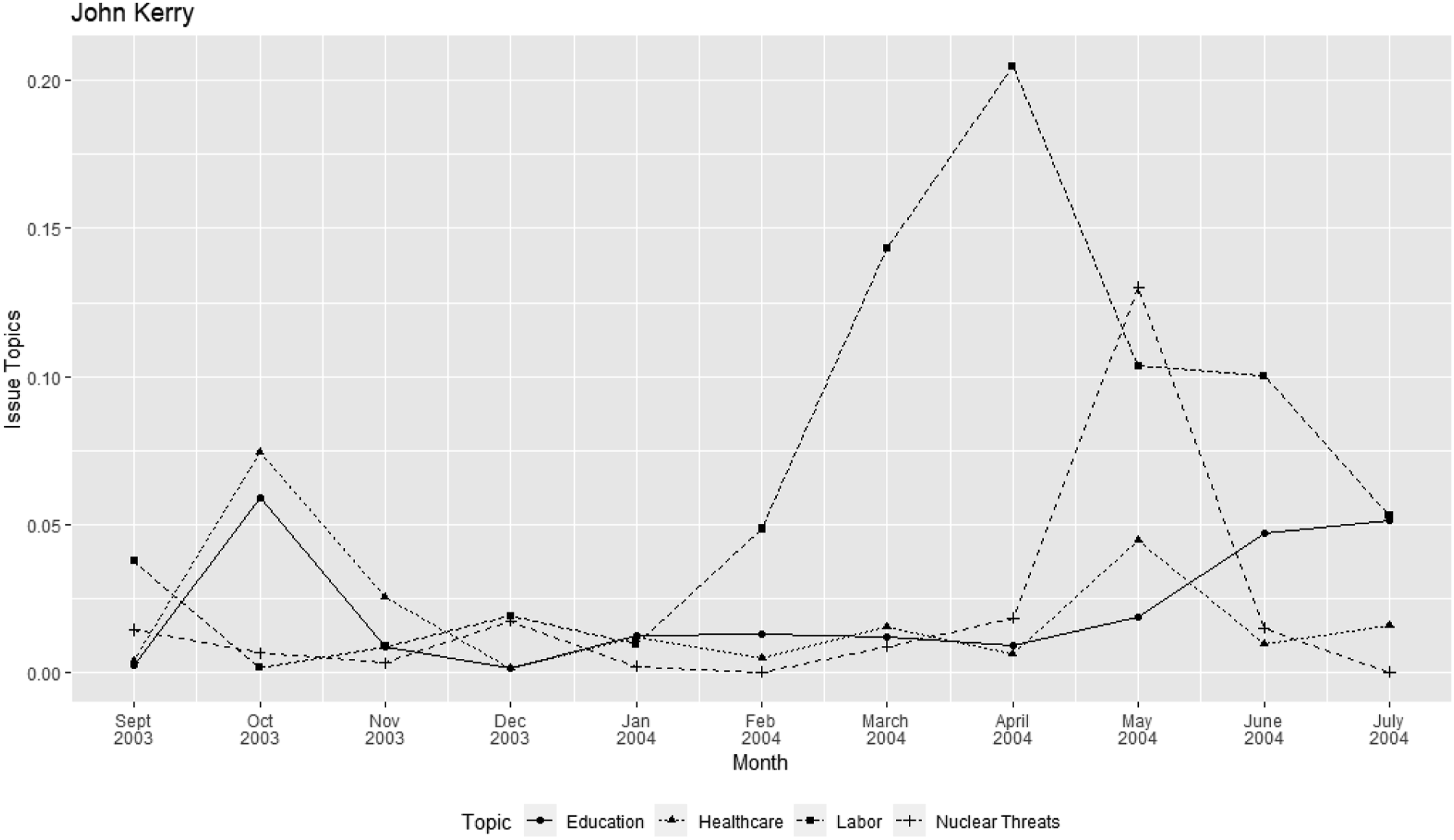
Effect of Populist Candidates’ Issue Topics and Electoral Performance on Nominee Populism Topic Assimilation.

Notes: OLS models. Unit of analysis is a topic. * denotes p < 0.1; ** denotes p < 0.05; *** denotes p < 0.01 two-tailed.
Effect of Populist Candidates’ Issue Topics and Electoral Performance on Nominee Issue Topic Assimilation by Party.
Notes: OLS models. Unit of analysis is a topic. * denotes p < 0.1; ** denotes p < 0.05; *** denotes p < 0.01 two-tailed. Models 1 and 2 contain only Democratic nominee-populist challenger dyads. Models 3 and 4 contain only Republican nominee-populist challenger dyads.
So far, the evidence is consistent with all three hypotheses with regards to party standard-bearers. But the possibility remains that this assimilation is only cheap talk. Nominees could embrace the issue topics invoked by populist rivals, sans populism topics, to stabilize their party coalitions going into the general elections and prevent fracturing after contentious primaries. If that is the case, it would still be a notable example of coalition maintenance and a substantively important phenomenon. But the importance of assimilation would be more significant if it extended beyond rhetorical appeals into more explicit concessions.
Effect of Populist Candidates’ Electoral Performance on Probability of Detected Party Platform Plagiarism.
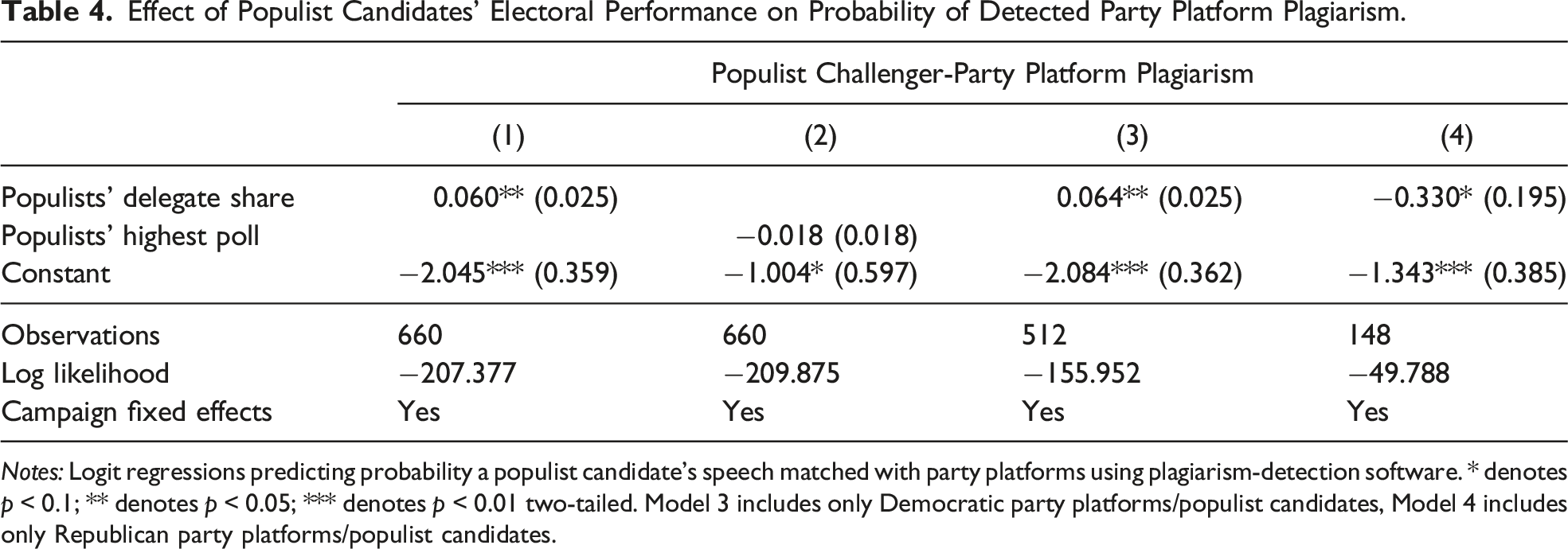
Notes: Logit regressions predicting probability a populist candidate’s speech matched with party platforms using plagiarism-detection software. * denotes p < 0.1; ** denotes p < 0.05; *** denotes p < 0.01 two-tailed. Model 3 includes only Democratic party platforms/populist candidates, Model 4 includes only Republican party platforms/populist candidates.
Included in the supplemental appendix are models regressing detected plagiarism between non-populist speeches and party platforms on variables measuring the electoral viability of the non-populist candidate. This allows comparisons between the relative strength of the assimilation of non-populist messages (which conventional wisdom expects) and the assimilation of populist messages. Both greater delegate shares and highest polls are positively correlated with detected plagiarism between non-populist candidates’ speeches and party platforms, which supports the conventional wisdom’s expectation. The average increase in predicted probability of detected plagiarism, holding campaign fixed effects at observed values, is 8.31-percentage-points higher when the non-populist candidate has 27.95% of delegate than when they have 0% of delegates. This is less than half the effect of delegate shares on detected plagiarism with populist candidate speeches. However, the predicted difference is 7.27 percentage points when the non-populist candidate’s highest poll is 37% than when their highest poll is 0%, whereas a populist candidate’s highest poll is substantively unrelated to the probability of detected plagiarism.
Models 3 and 4 again address the Asymmetric Assimilation Hypothesis, limiting analysis to the delegate share independent variable. The results are again strongly supportive of the asymmetric nature of assimilation of populist agendas. The coefficient in Model 3, which includes only Democratic populists and Democratic party platforms, is positive, statistically significant, and essentially equivalent in terms of substantive magnitude to Model 1. In Model 4, which includes only Republican populists and Republican party platforms, the coefficient is negative, suggesting that electoral success is actually a hindrance to agenda assimilation. The coefficient is imprecise, however, which is not surprising given the smaller n. I again simulate predicted probabilities varying values for delegate share but keeping the campaign fixed effects constant at observed values. Democratic party platforms are 16.1-percentage points more likely to be flagged as plagiarizing from populist candidate speeches with 27.95% of delegate than populist candidates with no delegate shares. In contrast, Republican party platforms are 20-percentage points less likely. Collectively, then, there is consistent and robust evidence in support of the Assimilation, Populism Rejection, and Asymmetric Assimilation hypotheses.
Conclusion
Both parties have seen populist candidates perform remarkably well in recent presidential primary cycles. This has ignited significant interest in, and concern for, rising populism. Overlooked has been what the parties do about it. This paper addresses this topic by articulating an “audition and assimilation theory” for how parties respond to populist insurgencies. This theory asserts that parties overlook the anti-partyism of populist primary candidates and treat the insurgencies as they would any other significant intraparty faction. Parties can use intraparty nomination contests as an opportunity to audition populist insurgencies. A populist candidate who never accumulates a significant constituency can be treated as a failed audition, but a populist candidate who demonstrates electoral viability makes it past the audition stage, warranting greater attention. Nominees can assimilate the message of the populist as a signal that they are willing to make concessions to maintain the electoral coalition.
Using an impressive corpus of presidential primary speeches and rigorous text analysis and statistical methods, I show that nominees and parties assimilate the issue topics of populist candidates who demonstrate electoral viability. This assimilation is limited to the adoption of issue topics; nominees do not assimilate populism topics in response to populist insurgencies. This assimilation is only found among the Democratic party, a finding consistent with the asymmetric theory of American political parties. Furthermore, in extending the analysis to non-populist rivals, I was able to contextualize these findings against the (now empirically supported) conventional wisdom that parties assimilate as a concession to less antagonistic factions. In total, this evidence suggests that parties can respond to populist insurgencies by managing them as they would any other coalition member, although only the Democratic party avails itself of this tactic.
As is typical of studies employing observational methodologies, purchase on causality is elusive. Without the ability to simulate primaries without populist candidates’ participation, we cannot say with certainty that the nominees’ issue topics and party platforms are in fact changing because of populist insurgencies. That said, controlling for the nominee’s issue topics pre-nomination ensures that what is being estimated is the change in issue topic focus. It cannot simply be the case that populists are offering alternative visions of the frontrunner’s issues. Likewise, the use of detected plagiarism establishes a high bar for influence on party platforms. The parties could arrive by mere happenstance on a similar agenda as a populist. It is unlikely that chance alone would lead them to borrow their exact words. This should create a conservative test of issue topic assimilation that reduces fears that the observed correlation is spurious.
As significant as these contributions are, there is still much about the intersection of American institutions and populism that remains understudied. This paper looks at the responses of nominees and parties to populist candidates, and in doing so makes an implicit assumption about what the supporters of populist candidates are doing. Such assumptions provide fruitful terrain for future investigation. Others have debated the effect of contested primaries (e.g., Southwell 2010). Do attempts to appease the constituencies of populist candidates work? Are there certain conditions that facilitate assimilation as an appeasement method? Furthermore, this analysis has treated the populists as bystanders once they have lost the elections. In my theoretical formulation, they effectively disappear once they leave the audition stage. This is, of course, is not the case. Of particular interest is how the perceived irascibility of the populist affects the decision to assimilate. If a presumptive nominee thinks that the populist is willing to fall in line, is assimilation necessary? Examining the conditions that affect the proclivity to assimilate or success at assimilating populist messages are important questions, but they are predicated on a theoretical argument and empirical demonstration that such assimilation is within the interests of the parties and actually occurs. By making these theoretical and empirical contributions, this study paves the way for such inquiries.
Supplemental Material
Supplemental Material - Inviting the Populists to the Party: Populist Appeals in Presidential Primaries
Supplemental Material for Inviting the Populists to the Party: Populist Appeals in Presidential Primaries by Zachary Scott in Political Research Quarterly
Footnotes
Acknowledgments
The author would like to thank Betina Wilkinson and the anonymous reviewers for invaluable feedback on this manuscript. For helpful discussions on this project, the author would like to thank David Karol, Andrew Lugg, Jared McDonald, Shanna Pearson-Merkowitz, and panel attendees at the 2022 Annual Meeting of APSA. Replication data and code can be found at  .
.
Declaration of Conflicting Interests
The author(s) declared no potential conflicts of interest with respect to the research, authorship, and/or publication of this article.
Funding
The author(s) received no financial support for the research, authorship, and/or publication of this article.
Supplemental Material
Supplemental material for this article is available online.
Notes
References
Supplementary Material
Please find the following supplemental material available below.
For Open Access articles published under a Creative Commons License, all supplemental material carries the same license as the article it is associated with.
For non-Open Access articles published, all supplemental material carries a non-exclusive license, and permission requests for re-use of supplemental material or any part of supplemental material shall be sent directly to the copyright owner as specified in the copyright notice associated with the article.
