







Abstract
This paper proposes that the General Agreement on Tariffs and Trade (GATT) and its successor, the World Trade Organization (WTO), experienced a deepening/widening tradeoff: as their membership increased (greater width), their effectiveness in promoting trade between members/participants declined (lesser de facto depth). This proposition is tested using gravity models of bilateral trade, first separating the GATT and WTO, which are usually combined into a single variable, and then adding a width variable corresponding to each institution. The results show that (1) both regimes were the deepest, or the most trade effective, when they had the fewest member-states and (2) their trade effectiveness declined, eventually becoming statistically insignificant, as more countries joined. As a quantitative case study, this paper provides some of the first evidence consistent with a tradeoff between depth and width within international institutions.
Keywords
Introduction
Scholars have long posited a potential tradeoff between the depth and width of international regimes (e.g., Oye 1986; Milner 1992; Downs, Rocke, and Barsoom 1996). The concept of “depth” captures the extent to which international agreements and institutions influence the behavior of member-states based on the idea that deeper regimes are more effective at promoting cooperation among participating countries. The concept of “width” refers to the number of countries within the regime with decision-making privileges and the ability to exit (von Borzyskowski and Vabulas 2019) when they are dissatisfied with its policies (i.e., formal members). If empirically valid, then this tradeoff represents one of the most serious challenges to received international cooperation theory: while regimes may help promote cooperation, this effect diminishes with size. On this basis, the more effective international regimes would be those with fewer member-states, thus limiting the scale of their cooperative influence.
The depth/width tradeoff is often advanced as a static hypothesis comparing regimes at their construction: those formed with more member-states should demand less of these participants. However, the few cross-sectional tests of this hypothesis (e.g., Bernauer et al. 2013; Slapin and Gray 2014) find little support, consistent with Gilligan’s (2004) argument that there should be no depth/width tradeoff when member-states are allowed to set their policies at different levels. Indeed, at regime formation, Bearce, Eldredge, and Jolliff (2015, 232) even provide evidence of a positive relationship between de jure depth and width when regimes are formed. However, most international regimes are not intended to be static. Many seek to deepen their cooperation and also to attract more countries. Thus, even if there is no depth/width tradeoff when regimes are first constructed, a similar tradeoff could emerge dynamically (Downs, Rocke, and Barsoom 1998). This related proposition, which considers the effectiveness of an international regime as it evolves, might be better termed as a deepening versus widening tradeoff.
In this paper, we explore the possibility of this dynamic internal tradeoff, focusing on the General Agreement on Tariffs and Trade (GATT) and the World Trade Organization (WTO) based on their consensus practice (Steinberg 2002). While we consider a broad research question (is there a deepening versus widening tradeoff within international regimes?), what follows should be read as a case study on the GATT and WTO. In the final section, we discuss why this tradeoff may be expected within other international regimes, and our research design provides a way to test for a deepening/widening tradeoff in other issue-areas.
We focus on these sequential multilateral trade institutions for three reasons. First, objectively measuring their “depth” is feasible, unlike for many international regimes in other issue-areas. Indeed, there is arguably not much empirical evidence bearing on the relationship between depth and width because while the latter is relatively easy to capture (by counting the number of member-states, which may change over time), capturing the former is more challenging. However, the gravity model of bilateral trade offers a way to estimate the de facto depth of the GATT and WTO. 1 Included on the right-hand side in this specification, the coefficient on a trade institution joint membership variable is an estimate of how much it increases commerce between member-states, or fosters trade cooperation, which is precisely what the concept of “depth” means in this issue-area. 2
Second, these multilateral trade regimes do not represent “easy” cases for any form of a depth/width tradeoff. As Gilligan (2004, 460) noted about the GATT’s creation, “one finds no references to a ‘broader versus deeper’ debate.” Indeed, we accept that when it began operations in 1948, the GATT was arguably the deepest and widest trade regime in existence. However, did the GATT become less effective at promoting trade cooperation as more countries joined? Furthermore, after the long Uruguay Round of trade negotiations (1986–1994), the presumably deeper WTO entered into force in 1995 with around 100 member states, suggesting depth with width. But how much more did the WTO promote trade compared to the supposedly shallower GATT and did the WTO’s trade impact decline as it further added member-states into the 21st century?
Third, the GATT and WTO represent substantially important cases since evidence about their de facto depth bears on another major political-economy debate. Concerning the effectiveness of these global trade regimes, a prominent Economics paper (Rose 2004) provided evidence that the GATT/WTO had no significant impact on member-state trade, but it did not develop any argument for why this should be true. Political scientists (Goldstein, Rivers, and Tomz 2007; Tomz, Goldstein, and Rivers 2007) countered that Rose had not properly captured GATT/WTO obligations and, once non-formal participants were included, the coefficient on the global trade regime became statistically significant and substantively large. On this basis, no theory would be needed to explain the shallow impact of the GATT/WTO because its trade effects were, in fact, quite deep.
However, subsequent bilateral trade models (e.g., Eicher and Henn 2011) that include multilateral resistance controls (e.g., importer/year and exporter/year fixed effects), now considered to be a standard part of the gravity specification, show that no matter how the GATT/WTO is measured, either in terms of formal membership or when including non-formal participants, the overall effect of the multilateral trade regime has been relatively modest. We thus need to explain why the GATT and WTO have had a perhaps surprisingly weak average effect on trade cooperation, requiring a theory that Rose (2004) did not provide. 3 Has their influence varied based on the number of countries within these sequential institutions? And if the impact of the GATT and WTO has differed on this basis, then did they become less trade effective as more countries joined, thus weakening their average annual effect? If so, then this would represent evidence consistent with a deepening/widening tradeoff, and we need to explain why such a tradeoff might exist within these multilateral trade organizations. We now turn to this task.
The Argument
In this section, we discuss the GATT and WTO as separate, but sequential, multilateral trade institutions, proposing that both became less effective, or shallower on a de facto basis, as more states joined due largely to their practice of consensus. Consensus decision-making within these regimes is best understood as a practice, and not as a formal rule, since the 1947 Agreement permitted majority voting. But this practice, which allows every member-state to exercise veto power regardless of its size, quickly became the norm. Indeed, the “principle of consensus decisionmaking is perhaps the most significant and consistent feature of GATT administration” (Stiles 1996, 122).
First, we argue that the consensus practice in bargaining created a floor for how much these institutions could deepen on a de jure basis (e.g., negotiate new agreements to restrict other forms of trade protection beyond tariffs and expand coverage beyond manufactured products into agriculture and services) through their multiple negotiation rounds, although we will discuss the possible exception of the Uruguay Round below. But not only did consensus bargaining create a limit on de jure deepening, this limit may have worked to decrease the de facto depth of these institutions because it allowed member-states to shift their trade protection from prohibited tariffs towards non-tariff barriers (NTBs) to trade (e.g., Marvel and Ray 1983; Anderson and Schmitt 2003; Kono 2006; Drope 2007; Grübler and Reiter 2021), which these multilateral institutions failed to prohibit due to the consensus practice in bargaining.
Second, the consensus norm negatively affected the enforcement of existing rules, also making these institutions less effective with more member-states, or contracting parties. As described by Kalla (1986, 90 capitalization in original), the panel procedure was the GATT’s “basic model in dispute settlement.” In response to a perceived rule violation, a member-state could ask for a panel to investigate, but the “adoption of [subsequent] panel reports requires a consensus by the CONTRACTING PARTIES, which means the losing country can block a negative report.” And while the WTO ended the ability of a single member-state to reject a panel report, enforcement remained a problem within the WTO because of the overload placed on the judicial bodies with a growing number of member-states and because any member-state could block appointments to the seven-judge Appellate Body, which requires at least three judges to hear a case.
On this basis, we argue that while the consensus practice hindered further deepening, it also threatened the existing depth of these multilateral trade institutions, making them less effective at promoting trade with more member-states (and not simply not more effective with the same). Our argument thus includes both international bargaining and enforcement (Fearon 1998): consensus problems in the bargaining phase constrained further deepening and consensus problems in the enforcement phase eroded existing depth. Furthermore, problems in one phase create obstacles for the other phase; for example, consensus problems in the bargaining phase hindered the enforcement of free trade as one cannot require compliance with free trade practices (e.g., fewer NTBs and reduced subsidies) that have not yet been successfully negotiated.
General Agreement on Tariffs and Trade
As discussed by Gilligan (2004), the GATT appeared to begin as a relatively effective, or deep, multilateral trade institution when it started operations in 1948 after concluding the 1947 Geneva I negotiation round. At this time, although it was certainly wider than any other existing international trade regime, it also had its fewest number of member-states and those members were motivated “to establish a track record” for the new institution (Martin and Messerlin 2007, 351). However, deepening appeared to stall in the subsequent negotiation rounds (especially Annecy 1949 with 20 members, Torquay 1950-1 with 33, Geneva II 1955-6 with 35, and Dillon 1960-1 with 40 members), producing fewer tariff cuts (ibid, 349) and no real progress to prohibit other forms of trade protection or to expand GATT’s coverage beyond manufactured products.
Not only did the consensus practice hinder bargaining to further deepen the GATT, but this practice also hindered enforcement, which threatened its existing depth. As noted above, any single country, including the losing party, could block the adoption of a panel report. And as discussed by Lowenfeld (1994, 479–80), the blocking of a panel report “happened not infrequently. Indeed, in some instances a contracting party was able to block, or at least delay, appointment of a panel in the first place.” Given this blocking threat, GATT panel reports tended to be weak. As described by Pescatore (1993, 13), GATT panels “do their best to avoid controversial issues and try to present their arguments as being the expression of the obvious. Reports thus become exercises in understatement and in the expression of legal platitudes.” Indeed, even with weak panel reports, the GATT’s enforcement of them was problematic with “only two-fifths of rulings for the complainant result[ing] in full compliance by the defendant. In nearly a third, defendants fail[ed] to comply at all, effectively spurning panel rulings (as a result, some of these rulings were not invested with formal legal authority by virtue of the defendant’s veto)” (Busch and Reinhardt 2000, 167–8).
Indeed, by the late 1970s, observers like John Jackson (1978, 96) were describing a “near breakdown of the international institutional framework for the trading system” that had “served us remarkably well heretofore.” On this point, he (ibid, 97) specifically noted the GATT’s inability to negotiate new rules to prohibit the emerging forms of trade protection used as tariff substitutes and the “ease with which parties can evade” the existing rules about tariffs on manufactured products, precisely the two problems highlighted above for deepening within a widening regime that practices consensus. Indeed, even after the conclusion of the 74-month Tokyo round in 1979, many observers still saw this trade institution as failing due to its growing size. According to Thomas Graham (1983, 128): “[p]reviously, that GATT operates by consensus was a strength” but “the need for consensus led to economic stalemate as GATT's membership diverged.” On this basis, he concluded that “the 88-member GATT is [now] less wieldy than when the 24 mostly like-minded governments drew it up in 1947.”
To revive, or deepen, what appears to have become an ineffective, or shallow, multilateral trade regime, the Uruguay round of international negotiations began in 1986. The fact that this bargaining phase took so long to conclude is arguably consistent with an internal depth/width tradeoff, but the fact that it was concluded at all with so many member-states may appear inconsistent. However, as Steinberg (2002, 366) described, it was the “raw use of power” by the United States, joined by European Community representing their member-states in bloc, that finally made it possible to “close the Uruguay Round” after more than 8 years of protracted bargaining. Thus, we are not arguing that a wider institution can never deepen; deepening with widening may sometimes be possible, consistent with “imposed” or “coercive” cooperation (Martin 1994; Milner 1992).
WTO
This exceptional power-based effort to overcome the bargaining problem associated with a consensus practice produced a different institution not only in terms of its name—the WTO—but also in terms of its structure, adding a General Agreement on Trade in Services and an agreement on Trade-Related Property Rights, among other new features. The WTO’s dispute settlement procedures also became more legalized with panel reports that could now only be rejected by consensus and the creation of a new judicial organ known as the Appellate Body. By all appearances, the new WTO was a deeper institution than what it replaced. As described at the time by Martin and Winters (1995, 3), the WTO represented “the most fundamental reform of the world trading system since the establishment of the GATT in 1947.”
But how much deeper was the new WTO? Comparing the depth of the WTO with that of the GATT cannot be done in a gravity model specification that treats the GATT and WTO as the same institution when they are packaged together into a single right-hand side variable, which returns the same coefficient for both trade institutions. Among other innovations, we will split the standard GATT/WTO variable into separate GATT and WTO variables in the next section, thus providing a separate coefficient for each institution. And could the WTO’s depth (at whatever level) be sustained as it further widened? There were reasons to be skeptical as this new multilateral trade institution retained the consensus norm, now codified in Article IX of the WTO Agreement on Decision-Making: “the WTO shall continue the practice of decision-making by consensus followed under the GATT 1947” (Footer 1996/1997, 679).
While the WTO ended the ability of any country to veto a panel report, its new legalism encouraged the growing number of member-states to file more complaints, and the creation of the Appellate Body led the growing number of member-states to appeal more panel decisions, thus delaying their implementation (Bütler and Hauser 2000). Consequently, observers quickly raised alarms about enforcement within the new WTO. Based on the growing number of member-states and their ability to file complaints that could not be blocked by another state, Jackson (2000, 190) noted the “sheer number of cases and thus the exceptional work load of the WTO dispute settlement system, both at the first-level panel stage and at the appellate stage.” Indeed, he argued that “the problems of caseload, which risk overloading the system” represented the most important issue for the new WTO to address (ibid, 209). On this point, Hudec (2000, 224 emphasis added) similarly argued that “consensus decisionmaking has already been, and will continue to be, more difficult under the WTO than it was before.” Perhaps counter-intuitively, the WTO’s legalism invited the newer and smaller member-states to exercise their rights (ibid, 225), including their veto option.
Observers also quickly raised alarms about bargaining within the new WTO. As offered by Schott and Watal (2000, 284), the “WTO still operates by consensus, but the process of ‘consensus building’ has broken down. This process emerged long before the [1999] WTO ministerial in Seattle; indeed, it was evident at the birth of the WTO itself” as the institution’s membership “greatly expanded, encompassing many developing countries that previously were outsiders or inactive players in trade negotiations.” Furthermore, “WTO members can no longer ‘free ride’ on negotiated agreements. Starting with the Uruguay Round accords, countries have had to participate in all of the negotiated agreements as part of a ‘single undertaking’” (ibid). Indeed, the single undertaking functioned as an obstacle to deepening through the Doha Development Agenda, beginning in 2001. As described by Hartman (2013, 413), the “Single Undertaking principle makes it particularly challenging for the Doha Rounds to come to a resolution, since there is no agreement unless ‘everything is agreed’” to “by a broad cross section” of countries.
Following the 2015 Ministerial Conference in Kenya, these international trade negotiations were ended without any resolution after 14 years of stalemate. Thus, since the establishment of the WTO, there has been no successful completion of even a single bargaining round that would deepen this institution at least on a de jure basis. Furthermore, it has arguably become less deep on a facto basis as member-states continue to substitute non-prohibited forms of trade protection (e.g., NTBs) for prohibited tariffs (Cottier 2007; Ketterer 2016; Grübler and Reiter 2021). And while a single member-state can no longer reject a panel recommendation, consensus remains a problem for enforcement within the WTO because any member-state can block appointments to its seven-person Appellate Body, which requires at least three judges to hear a case. The United States has exercised this veto option multiple times, leaving the Appellate Body with only one judge as of December 2019. And while it is the largest country that has most recently exercised this veto option, the WTO’s consensus practice means that any other member-state could follow the US example, regardless of its size and status within the institution. Indeed, as argued by Gantz (2000, 351 emphasis in original), smaller developing countries are “aware of the fact that they can block any further consensus actions in the WTO at any level.”
Hypothesis
While this qualitative evidence suggests a deepening/widening tradeoff first within the GATT and later within the WTO, it remains important to consider how well it matches with the quantitative evidence. Accordingly, we hypothesize that the GATT and the WTO both began as trade effective institutions, increasing commerce between member-states, but their positive impact weakened as more countries joined. This hypothesis is notable for two reasons. First, it runs contrary to what one might expect based on the understanding that the accession requirements for joining these institutions, although they vary by country, have tended to increase over time (Allee and Scalera 2012; Davis and Wilf 2017; Jones 2009; Pelc 2011). More rigorous accession terms for later entrants might be expected to add depth, making these multilateral institutions appear more effective with additional member-states. Second, based on the successive negotiation rounds within the GATT, which arguably increased its de jure depth (Davis 2004), one might also expect the institution to become de facto deeper as more countries joined. We hypothesize to the contrary.
The Evidence
Research Design
Our hypothesis is tested using a gravity model of bilateral trade that first separates GATT from WTO membership to estimate the depth of each institution and then adds variables capturing their respective widths. With the directed dyad/year as the unit of analysis, the gravity model takes country i’s Imports from country j in year t as its dependent variable. As independent variables, our analysis focuses on dichotomous indicators for joint formal membership in the GATT and WTO with the coefficient on these variables providing the average effect of the institution on annual trade between member-states. Thus, the de facto depth of a trade regime is estimated. However, the width of the trade regime must be coded into separate independent variables that count the number of member-states in the GATT and WTO, which varies by year.
Using information from the WTO, 4 we calculate the number of countries in these two sequential institutions in each year beginning in 1948. Since a country could join at any point during the year, we code it as becoming a member in the first year when it was a member for at least 6 months, or for a majority of the year. 5 We would obtain very similar results based on the number that joined at any point during the year, but the former appears to offer a more valid operationalization of “width” as it was actually experienced within the institution during that calendar year. Consistent with our argument that a deepening versus widening tradeoff emerged within the GATT and WTO due to their consensus practice, our measure of width does not weight (by GDP or some other measure of country size or power) the number of member-states because the consensus-based veto options related to bargaining and enforcement could be exercised by any country within the institution regardless of its size or status. Indeed, we provided evidence in the previous section about how even the smaller developing countries were aware of their veto option and stood ready to exercise it, especially within the WTO. Furthermore, there would be an endogeneity problem associated with weighting the width of the multilateral institution by any variable related to country size since trade has been demonstrated to have an important positive effect on national income (e.g., Frankel and Romer 1999).
Figure 1 plots this unweighted count of the number of member-states for the GATT and WTO by year. Not surprisingly, there appears to be a structural break in 1995 when transitioning from the GATT to the WTO based on ratification delay within certain countries that were GATT members in 1994 but did not officially join the WTO immediately. Thus, while the width of these multilateral institutions tends to increase over time, this increase is not monotonic with a decrease in the number of member-states in 1995 that is not restored to at least the 1994 value until 1997. The number of member-states in the GATT (1948–1994) and WTO (1995–2020).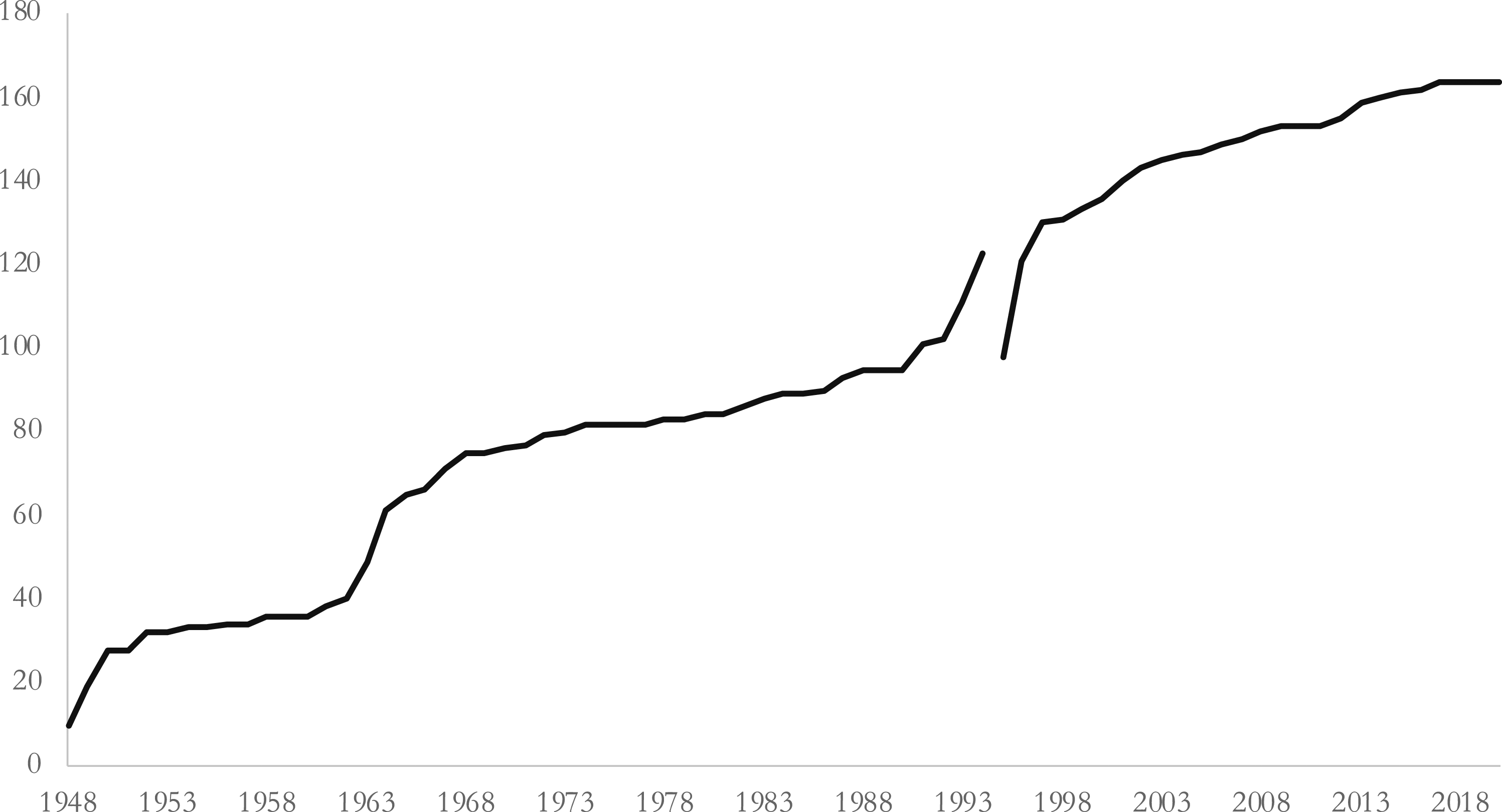
Using the information from Figure 1, our gravity models follow the basic structure of equation (1)
6
, where Joint Membership represents a dichotomous variable indicating whether countries i and j are both members of the same multilateral institution, either the GATT or WTO, in year t. These membership dummies are then interacted with their Width measure, coding the number of members in the respective institution in year t. Given this interaction variable, the coefficient on the Joint Membership constitutive variable (B1) estimates the de facto depth of the institution in question when its Width is equal to 0. Obviously, this is an out-of-sample value since the GATT and WTO always had a non-zero number of members. But B1 combined with B2, (the coefficient on the interaction variable) with the latter multiplied by the number of member-states provides the marginal effect of Joint Membership given its institutional Width. Our hypothesis that the GATT and WTO began as trade effective institutions, but with a weakening impact as more countries joined, predicts that their marginal effect on bilateral trade between members should be positive and large with fewer member-states, while smaller, even statistically insignificant, with greater member-states. This latter proposition requires B2 to be negatively signed, while the former expects B1 to take on a strong positive sign.

Our research design includes several different estimates of equation (1) using existing gravity model datasets (e.g., Bearce, Eldredge, and Jolliff 2016; Goldstein, Rivers, and Tomz 2007), that should be familiar to many readers, thus allowing one to compare our conditional estimates of the GATT’s and WTO’s impact on bilateral trade with the unconditional estimates that already appear in the literature. More specifically, we organize our empirical analysis into three sets of results with two appearing in the on-line appendix due to space constraints. In this main text, we provide the set of results estimated log-linear OLS with three-way fixed effects: directed dyad, importer/year, and exporter/year. And in the online appendix, we provide a second set of results using a very restrictive specification (poisson pseudo-maximum likelihood with three-way fixed effects and standard errors clustered on all three dimensions) and a third using what used to be the standard gravity specification (log-linear OLS with two-way fixed effects).
OLS With 3-Way Fixed Effects
Making use of the dataset from Bearce, Eldredge, and Jolliff (2016) with annual coverage from 1948 to 2012, we estimate OLS models of the logged value of country i’s Imports from country j in year t (measured in constant 2009 US dollars). 7 The gravity model is traditionally estimated in a log-linear form so that the coefficients provide the percentage change in Imports. Consequently, the dependent variable becomes the log of Imports, and the independent variables enter either as dichotomous indicators (e.g., GATT WTO joint membership) or as the logged value of a continuous variable (e.g., GATT WTO width).
Our control variables address potential sources of unobserved heterogeneity when trying to estimate the impact of the GATT and WTO. We begin by including a dummy variable for joint membership within a preferential trading arrangement (PTA), most of which are nested within GATT and/or WTO dyad/years. Thus, the omission of a PTA control would bias our estimate of GATT and WTO effects, likely in a positive direction. Including the PTA dummy also allows us to compare the estimated effect of narrower PTAs with the wider GATT and WTO, which bears on the depth versus width tradeoff across different types of trade regimes.
We next include directed dyad fixed effects to capture the trade heterogeneity based on attributes related to the pair of states; these fixed effects proxy the trade barriers between the two countries and their common history/experience among other dyadic factors. The concept of “multilateral trade resistance” (Anderson and van Wincoop 2003) emphasizes that the amount of trade between two countries is determined not only by the barriers between them but also by the barriers to and opportunities for trade that each country faces with other countries, which changes over time. 8 This concept can be captured with time dummies for each country within the dyad (Baldwin and Taglioni 2006), so we also include both importer/year and exporter/year fixed effects. We might also add a set of year fixed effects common to all countries, but they would drop due to perfect collinearity with the importer/year and exporter/year fixed effects.
Of course, including these three sets of fixed effects (directed dyad, importer/year, and exporter/year) cause most of the traditional gravity model control variables to fall from our model. For example, the inclusion of directed dyad fixed effects eliminates variables such as the distance between the countries, whether they share a language or border, their combined land area, and the number of landlocked or island countries within the dyad. Likewise, the inclusion of importer/year and exporter/year fixed effects eliminates any variable measuring the properties of a single country within the dyad, including those that change over time such as their economic size, population, and level of economic development. Finally, and as mentioned in earlier footnote, any set of year fixed effects, including importer/year and exporter/year, cause the Width constitutive variable to drop from equation (1) since its variation is only temporal. However, with three-way fixed effects, we can estimate the Joint Membership constitutive term and its interaction with Width, which are the two variables in equation (1) necessary to test our hypothesis.
We note this exchange of specific control variables for the three sets of fixed effects because while our specification may seem sparse in terms of the familiar gravity model controls, it is, in fact, quite rich with more than 45,000 fixed effects: approximately 25,000 directed dyads, 10,000 importer/years, and another 10,000 exporter/years. Furthermore, there is no real tradeoff with this exchange of traditional controls for fixed effects at least in terms of testing our hypothesis since none of the coefficients on the former bear on the proposed deepening/widening tradeoff. Indeed, the coefficients that are required to test our hypothesis would be biased without three-way fixed effects, so it becomes necessary to privilege them over the traditional controls.
On this latter point, it is also important to consider how these many fixed effects reduce the endogeneity problem associated with the non-random assignment of countries into the GATT and WTO. To the extent that countries join (or stay out of) these multilateral institutions based on their history and relationship with other countries, such factors are well approximated by the dyadic fixed effects. And to the extent that membership in the GATT and WTO is based on country attributes (which may change over time), the two sets of country/year fixed effects control account for all such country-specific properties.
Primary Results
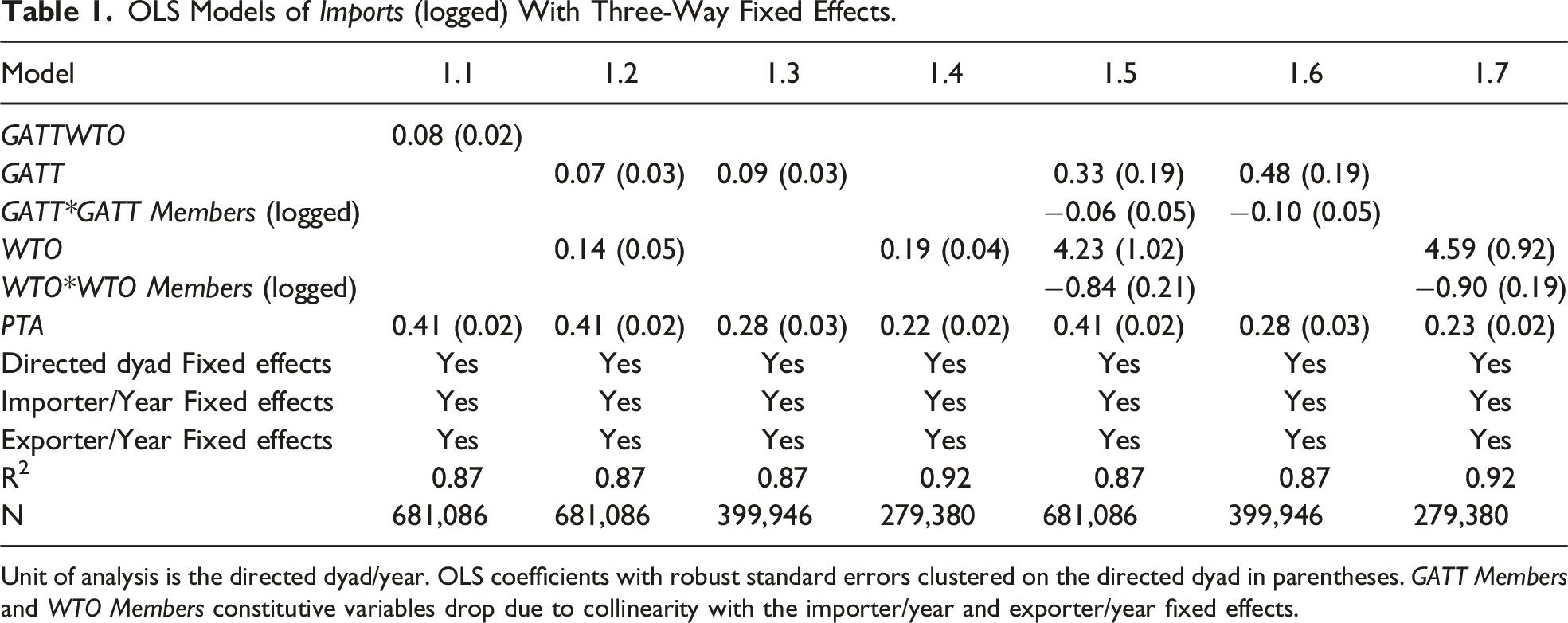
OLS Models of Imports (logged) With Three-Way Fixed Effects.
Unit of analysis is the directed dyad/year. OLS coefficients with robust standard errors clustered on the directed dyad in parentheses. GATT Members and WTO Members constitutive variables drop due to collinearity with the importer/year and exporter/year fixed effects.
In model 1.2, we depart from the standard specification that combines the GATT and WTO by including separate variables for each institution to compare their average annual effect on trade between member-states. Consistent with the argument that the Uruguay Round negotiations worked to deepen the multilateral trade institution (Martin and Winters 1995), the WTO’s coefficient is twice as large as the GATT’s, although this difference is not quite significant at conventional levels. 9 However, our result showing that the WTO’s average trade effectiveness is not weaker than the GATT’s bears some discussion. Others have argued that one should observe a weaker effect for the WTO because “after the Uruguay Round,” marking the start of the WTO, “only a handful of countries remained outside the regime: a few Middle Eastern nations, formerly Communist countries, and microstates” (Goldstein, Rivers, and Tomz 2007, 56). Indeed, this membership variation may produce problems in a specification without importer/year and exporter/year fixed effects, but our inclusion of these country time trends absorbs the effect of any country-specific attribute, including those that vary over time (e.g., being a petro-state, having a former Communist government, and the country’s size). And with this specification, we observe results more consistent with the standard expectation that the WTO was deeper on average than the regime that it replaced.
It is also important to note that there may be hidden model misspecification when combining the GATT years with those that include the WTO. Not only is there no overlapping coverage between these two variables to require that their years be combined into the same sample, but the combined sample also forces certain controls (e.g., all those represented in the form of directed dyad fixed effects) to have the same effect across both the GATT and the WTO eras, which may be invalid. We thus split the sample into the GATT era and WTO era in models 1.3 and 1.4, respectively, and tend to have greater confidence in these split sample estimates. In model 1.3, the GATT coefficient enlarges by about 30 percent compared to the same in model 1.2, while in model 1.4 the WTO coefficient expands by about 40 percent compared to model 1.2. Indeed, the WTO coefficient in model 1.4 is significantly larger than the GATT coefficient in model 1.3, 10 consistent with the understanding that the WTO has been, at least on average, a deeper trade institution than was the GATT.
Having provided some validity for our decision to separate the GATT from the WTO, we now test our hypothesis by interacting these joint membership variables with their respective width measures: GATT Members (logged) and WTO Members (logged). As stated earlier, the deepening versus widening hypothesis predicts that the GATT and WTO constitutive terms should enter with positive signs and their interaction terms with negative signs to indicate declining de facto depth as these multilateral trade institutions became wider. The full sample results in model 1.5 accord with these expectations with the coefficients enlarging in the expected direction when looking the split sample results in models 1.6 and 1.7.
More important than the individual coefficients in these models are their combined effect at different width values. With a separate panel for each model, Figure 2 graphs the marginal effects of the GATT and/or the WTO (on the y-axis) for different values of their width (on the x-axis). It should be noted that since the marginal effect of the GATT and WTO provides their de facto depth, Figure 2 plots depth over width with a negative slope showing a tradeoff between these two dimensions. As illustrated in the first panel (from model 1.5), the GATT was its most trade effective when it had the fewest members (10 corresponding to a logged value of 2.3) with a marginal effect of 0.19, which is more than two times larger than its average annual effect in model 1.2 (0.07). However, the marginal effect of GATT becomes statistically insignificant when GATT Members (logged) passes 4.0, corresponding to roughly 60 members, which was the width reached by the GATT around 1964 when it started the Kennedy round of negotiations. The GATT era results from model 1.6 show a similar pattern with an even steeper tradeoff between de facto depth and width in the second panel of Figure 2. The Marginal Effect of GATT and WTO Conditioned on Width: _Members (logged). The x-axis provides the marginal effect, and the y-axis provides the number of _Members (logged). The solid line indicates the point estimate with the dashed lines indicating 95 percent confidence intervals.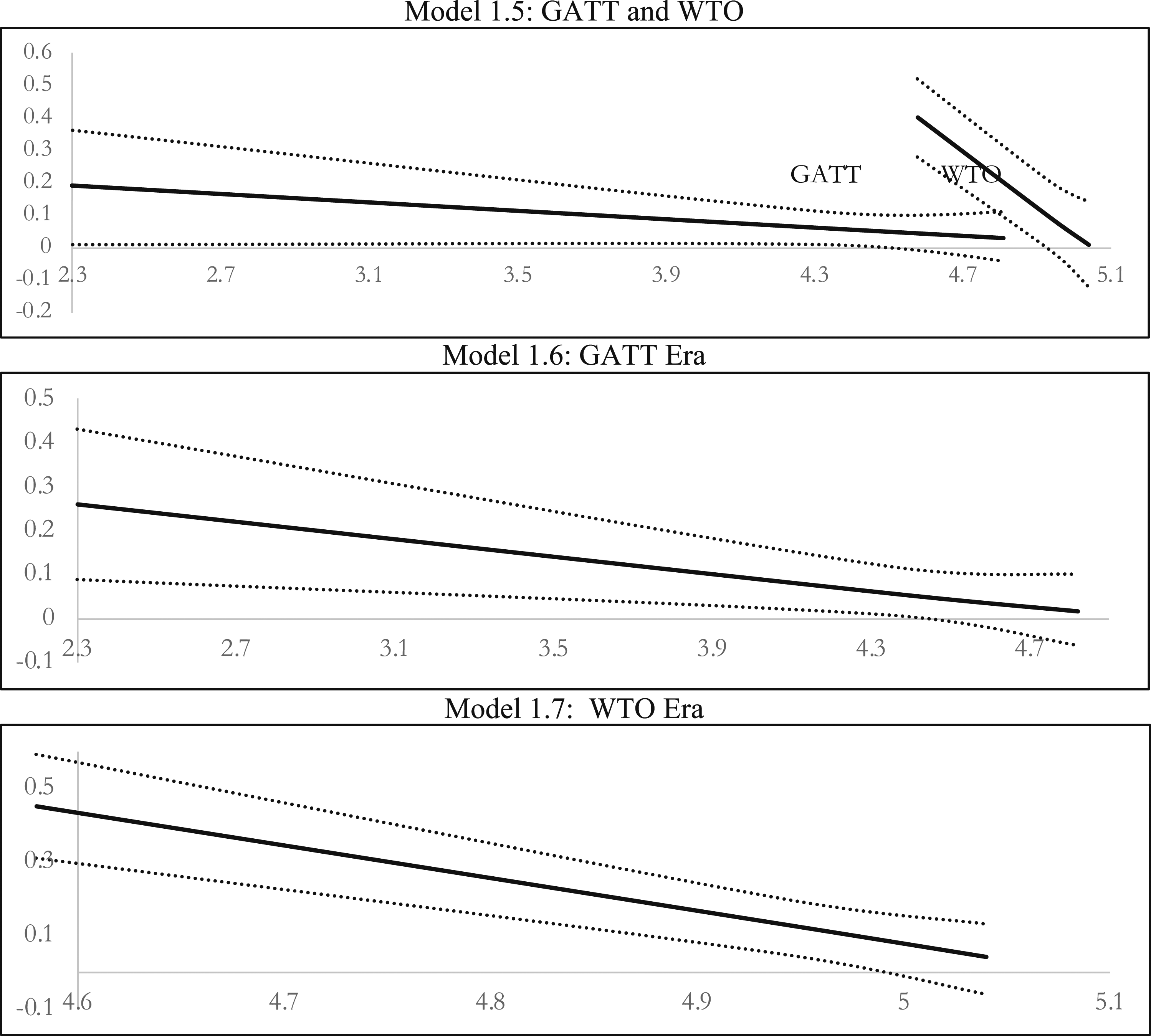
The deepening/widening tradeoff is even starker for the WTO. From model 1.5, this institution was its most trade effective in 1995 with its fewest number of members (98 corresponding to a logged value of 4.6). At this width, the marginal effect of the WTO was 0.40, which is almost three times greater than its average effect from model 1.2 (0.14). However, its de facto depth declined quickly, becoming statistically insignificant as WTO Members (logged) approached 5, corresponding to about 148 members, which was the width reached by 2005. The third panel of Figure 2 from model 1.7 reveals similar results for the WTO in closer detail.
Additional Results
To the extent that the number of GATT and WTO members trends upward over time, one might be concerned that the coefficients on our width interaction variables also capture other time trends within these multilateral institutions. For example, it appears to be the case these trade institutions, especially the GATT, focused on easier trade reforms first, leaving harder reforms for later. Likewise, it may be the case that there are diminishing returns over time within trade institutions even if they do not become wider. Finally, it is possible that the declining effectiveness of the GATT and WTO can be explained by the growing complexity of international trade law over their respective periods.
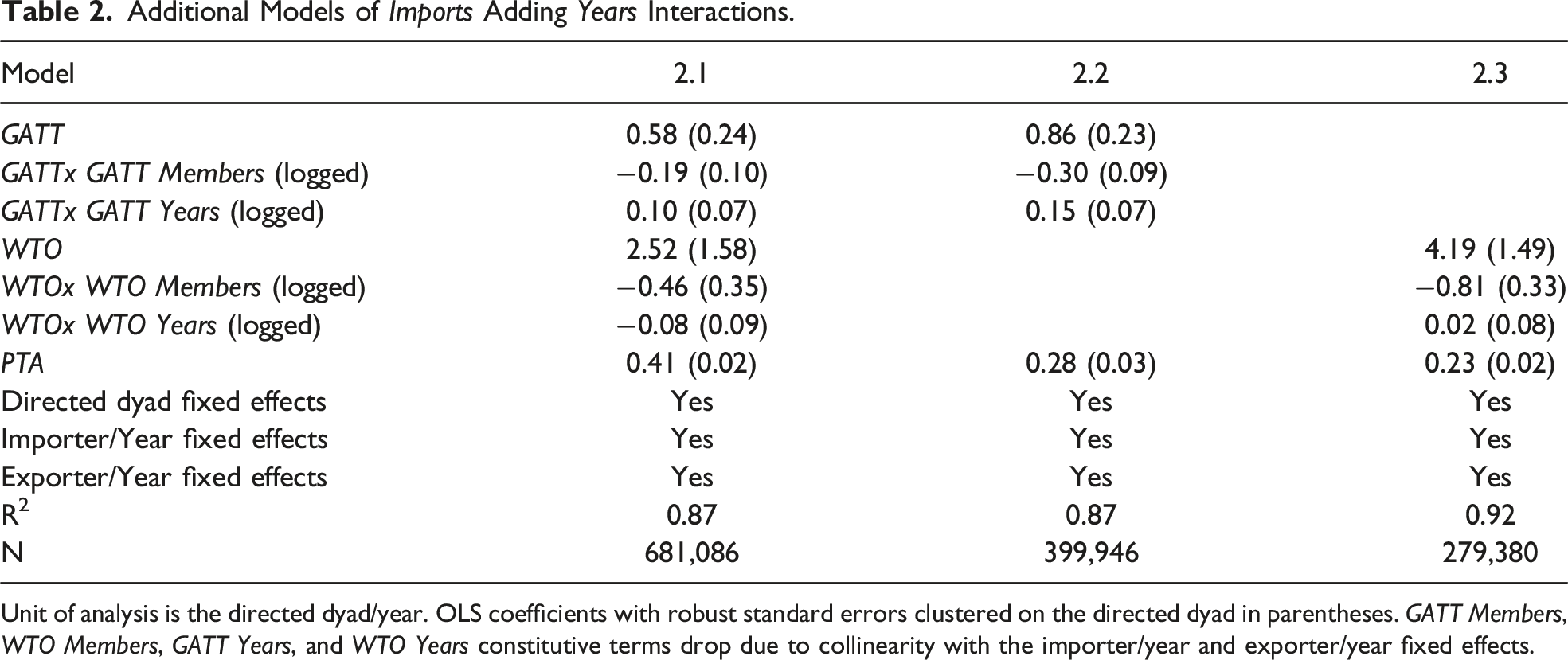
Additional Models of Imports Adding Years Interactions.
Unit of analysis is the directed dyad/year. OLS coefficients with robust standard errors clustered on the directed dyad in parentheses. GATT Members, WTO Members, GATT Years, and WTO Years constitutive terms drop due to collinearity with the importer/year and exporter/year fixed effects.
Indeed, with the addition of the GATTx GATT Years (logged) and the WTOxWTO Years (logged) interaction terms, the results in Table 2 provide evidence for an even stronger deepening/widening tradeoff within the GATT when comparing its coefficients in models 2.1 and 2.2 to the parallel results in models 1.5 and 1.6: the GATT constitutive term takes on larger positive coefficients, while its width interaction also gets larger in a negative direction. These results can be explained by the possibility that our width variable was also capturing deepening accession terms and greater de jure depth achieved through successive GATT negotiations rounds, consistent with the statistically significant positive coefficient for GATTxGATT Years in model 2.2. Therefore, once we control for these countervailing trends, the evidence for a deepening/widening tradeoff within this multilateral trade institution becomes even stronger.
The same coefficients for the WTO in models 2.1 and 2.3 do attenuate compared to the parallel results in models 1.5 and 1.7, possibly because there have not been the same countervailing deepening trends with this successor institution to be captured by the WTOxWTO Years control variable (e.g., there has been no successful achievement of a negotiation round since 1995 that would have deepened the WTO on a de jure basis). Indeed, this understanding is consistent with the statistically insignificant coefficient for WTOxWTO Years in both models 2.1 and 2.3. Nonetheless, WTO and WTOxWTO Members both remain statistically significant with the correct signs, indicating that this successor multilateral trade institution also became less trade effective as it added member-states, even when controlling for other time trends within the WTO.
Finally, in our on-line appendix, we provide two additional sets of results that show a deepening/widening tradeoff with the GATT and WTO. The first employs poisson pseudo-maximum likelihood (PPML) estimation with three-way fixed effects (and with the standard errors clustered on all three of these dimensions) in an expanded version of the dataset from Bearce, Eldredge, and Jolliff (2016) that drops no observations associated with small values of trade. The second uses the replication dataset from Goldstein, Rivers, and Tomz (2007) following their gravity specification based on GATT/WTO participation and estimated using log-linear OLS but with two-way fixed effects (directed dyad and year). In these results, we show that whenever there is a significant positive trade effect for either multilateral institution, this association also weakens as the institution becomes wider consistent with our proposed deepening/widening tradeoff. Thus, the results in the main text are robust to other datasets, other estimation techniques, and other specifications.
Discussion
While limited to the GATT and WTO, this paper has provided some the very first evidence consistent with a depth versus width tradeoff within international regimes. Even if there is no such tradeoff at regime formation (e.g., Gilligan 2004; Bernauer et al. 2013; Slapin and Gray 2014; Bearce, Eldredge, and Jolliff 2015), a similar tradeoff may emerge as regimes seek to add more countries, especially when they operate by consensus. And while a consensus practice is certainly not common to all international regimes, it exists in many beyond just these two multilateral trade institutions (Steinberg 2002, 340–1). Thus, we suggest, but do not test within this paper, that a similar deepening/widening tradeoff may be present in other international organizations, especially the ones that operate by consensus.
Furthermore, the research design used here offers a way to consider this possibility. While there may not be a “gravity model” equivalent in many issue-areas, any model that seeks to test how much an international regime has influenced the prescribed behavior of participating countries is estimating its de facto depth. Thus, the addition of a width independent variable interacted with a regime membership variable can tell us whether the latter shows a lesser (greater) effect on cooperative state behavior as the number of participating countries grows (declines). For example, this research design could certainly be applied to human rights agreements and environmental treaties, where the dependent variable is some measure of member-state compliance.
Finally, this research design applied to multilateral trade institutions helps to explain a puzzling result that appeared within the literature on trade regimes. Rose (2004), in his set of empirical exercises to show that the GATT/WTO has not had a significant effect in increasing trade, allowed its effect to vary over time and by negotiation round (ibid, 105-6, Tables 2 and 3), finding declining effects by year and by negotiation round. But he offered no explanation for why this might be the case, other than to point out that these results were generally consistent with the weak average impact of these multilateral trade regimes. Likewise, in their response paper, Tomz, Goldstein, and Rivers (2007, 2015) performed the latter exercise, also finding declining effects by negotiation round but emphasizing that the effects were positive and statistically significant in most rounds.
However, why should the trade impact of these multilateral institutions fall with successive negotiation rounds when the purpose of each round was to increase de jure depth, or to expand their coverage in terms of products and forms of trade protection? Indeed, if de jure depth simply translates into de facto depth, then we should observe these multilateral institutions becoming more trade effective with each negotiation round. But the literature has shown the opposite, and the argument/evidence presented in this paper can explain why this should be true: over time and concurrent with each negotiation round, the GATT/WTO also became wider with a negative impact on its de facto depth even if its de jure depth increased. Thus, we cannot infer de facto depth based on de jure depth, and these two concepts may even move in opposite directions as regimes widen.
Our results also provide an alternative explanation for those presented in Mansfield (1998) and Mansfield and Reinhardt (2003), showing that states are more likely to form a PTA during a GATT negotiation round based on the logic that doing so might “enhance their bargaining leverage in these negotiations” (Mansfield 1998, 535–6). We do not dispute that this logic may be true, but their result can also be explained by the unmet demand for freer trade during and even after the conclusion of a negotiation round. To the extent that many states demand deeper trade that the multilateral/global regime could not meet due its growing width with a consensus practice, then these states might be expected to satisfy their demand for depth through narrower PTAs, which our results show to be deeper on a de facto basis when compared to the GATT/WTO. For example, the results in model 1.2 in Table 1 show that the de facto depth of the average PTA is almost six times greater than the GATT (on average) and more than three times greater than the WTO (on average). Thus, rather than identifying the proliferation of PTAs as a cause for the GATT/WTO’s weakness (e.g., Bhagwati 2008), our argument/evidence suggests that PTA proliferation may be the result of the GATT’s and WTO’s weakness, or de facto shallowness.
Supplemental Material
Supplemental Material - A Deepening/Widening Tradeoff? Evidence from the General Agreement on Tariffs and Trade and World Trade Organization
Supplemental Material for A Deepening/Widening Tradeoff? Evidence from the General Agreement on Tariffs and Trade and World Trade Organization by David H. Bearce and Cody D. Eldredgen in Political Research Quarterly
Supplemental Material
Supplemental Material - A Deepening/Widening Tradeoff? Evidence from the General Agreement on Tariffs and Trade and World Trade Organization
Supplemental Material for A Deepening/Widening Tradeoff? Evidence from the General Agreement on Tariffs and Trade and World Trade Organization by David H. Bearce and Cody D. Eldredgen in Political Research Quarterly
Footnotes
Acknowledgments
Earlier versions of this paper were presented at the University of Colorado Boulder in 2020 and at PEIO and ISA in 2021. We thank Brett Bessen, Sam Brazys, Brendan Connell, Christina Davis, Judy Goldstein, Clara Park, Andy Phillips, Adrian Shin, Jonathan Strand, Jaroslav Tir, and Mike Tomz for helpful comments and suggestions. We also thank Max Chernoff and Brandy Jolliff Scott for their research assistance.
Declaration of Conflicting Interests
The author(s) declared no potential conflicts of interest with respect to the research, authorship, and/or publication of this article.
Funding
The author(s) received no financial support for the research, authorship, and/or publication of this article.

Supplemental Material
Supplemental material for this article is available online.
Notes
References
Supplementary Material
Please find the following supplemental material available below.
For Open Access articles published under a Creative Commons License, all supplemental material carries the same license as the article it is associated with.
For non-Open Access articles published, all supplemental material carries a non-exclusive license, and permission requests for re-use of supplemental material or any part of supplemental material shall be sent directly to the copyright owner as specified in the copyright notice associated with the article.
