







Abstract
From where does discontent against globalization originate? Current explanations emphasize material conditions and the emergence of globalization-skeptical parties. We argue that party-affiliated factions play a critical but underappreciated role. Such factions provide foundational support for elite appeals, acting entrepreneurially to construct new narratives that are later invoked by elites. We test this by studying a unique case: the “globalist” insult on Twitter. We find that “globalist” mentions co-occur with hashtags and terms associated with right-wing conspiracies, “alt-right” media figures, and Donald Trump. We further find that the most consistent correlate of the “globalist” insult is its use by the alt-right media organization Breitbart, not by traditional political elites or in response to changes in economic conditions. The results suggest that a conceptualization of political parties as organizers of political conflict, specifically ones that incorporate factions and non-elite entities like partisan media, helps make sense of anti-globalization political movements.
Introduction
In 2018, then United States (US) President Donald Trump joked of his outgoing economic advisor, Gary Cohn, that he “may be a globalist, but I still like him.” Cohn had obstructed Trump’s isolationist and protectionist impulses (Skowronek, Dearborn, and King, 2021). By labeling him a “globalist,” Trump was (insultingly) invoking the lingo of a particular faction of supporters. Along with slogans like “America First” and “Take Back Control,” the term globalist serves as a linguistic signal that one is also a critic of international cooperation. Within American politics, there is nothing new about skepticism toward global cooperation or the need to disparage it: In the 1940s, Congresswoman Clare Booth Luce referred to then-Vice President Henry Wallace’s proposal to allow foreign airlines to fly into US airports as “globaloney.” Nor is this a purely American phenomenon. The populist Hungarian Prime Minister Victor Orbán got a standing ovation at the 2022 meeting of the Conservative Political Action Conference (CPAC) for saying “Globalists can all go to hell.”
Across multiple countries, citizens have elected politicians who disparage international cooperation. Scholars have developed a large body of research seeking to explain this backlash against international cooperation, of which “globalist” is a part. Yet there remains considerable debate about why it is occurring and its underlying ideological character. Some argue that anti-globalization rhetoric is driven by demand from the “losers” of economic globalization (e.g., Broz et al., 2021; Colantone and Stanig, 2018; Rodrik, 2021). Others contend that it is being supplied by political parties and elites, especially emerging right-wing populist parties and politicians, seeking to politicize the issue for electoral gain (e.g., De Vries et al., 2021; Walter, 2021). Still others note that the language mimics anti-Semitic conspiracy theories like those of the notorious forgery, The Protocols of the Elders of Zion (O’Donnell, 2021).
We contend that current conceptualizations of the origins (and form) of this backlash are incomplete. Specifically, we theorize that extended party networks play an important and underappreciated role in promoting and shaping the language of the current backlash (Koger et al., 2009). This shifts the focus away from the most visible leaders of the parties like traditional political elites and formal organizations to entities connected to political parties but lacking a singular, recognizable figurehead. The entities of the party networks provide invaluable resources to political elites by developing platforms to reach audiences and subsidizing the work of policymaking. Political elites and formal party organizations, being electorally minded, are motivated to “hunt where the ducks are.” Factional entities, which may prioritize long-term policy or symbolic ends over short-term electoral success, can act to congregate ducks in certain areas. In our case, an anti-globalization faction disseminates a message and builds support for its cause, creating a permission structure for political elites.
We put this theory to the test by examining the “globalist” insult as a particular case of an anti-globalization appeal. This is an interesting case because the term itself has shifted in usage over time and could adopt any meaning. Effectively, the term is a box that can be plausibly filled with myriad contents. What is currently in the box, and who put it in there? Was the box filled with materialist concerns by everyday people? With campaign slogans by electorally motivated political elites? Or, as we contend, the particular grievances of factional entities? We retrieve every English-language tweet mentioning the word “globalist” from 2008 to 2021. We find that the content of globalist mentions is dominated by conspiracy theories, anti-elitism, and cultural grievances rather than discussion of the material conditions created by globalization. We further find that the frequency of globalist mentions is correlated with use by Breitbart, an “alt-right” conservative media organization. In contrast, we find few uses of “globalist” by American political elites.
What this suggests is that we can better understand the spread of anti-globalization rhetoric by looking beyond established political elites or real-world economic conditions and toward a broader set of entities that comprise the infrastructure of political parties. It is these entities that supply frames to public debate. In this view, the emergence of anti-globalization rhetoric in the US is not an inevitable response to changing economic conditions or part of a concerted campaign by political elites to win elections, but rather has emerged due to changes in the “broad agendas of political conflict” that occurs as coalitions vie for influence within parties (Bawn et al., 2012, 589). For example, it was not inevitable that anti-globalization rhetoric found a home on the right in US politics, as the redistributive economic agenda of the left might just have easily accommodated such appeals, especially if the underlying rationale was economic dislocation alone (Rodrik, 2021). Rather, the difference seems to be that these appeals were used by a right-leaning organization that successfully built an audience; an entity that grafted “globalism” onto existing cultural and political grievances.
The Politicization of International Cooperation
The dominant explanation for the current backlash against international cooperation is that it is driven by demands from the “losers” of globalization. This “demand-side” explanation argues that when a country is exposed to globalization, often in the form of a “shock,” certain social groups lose and will consequently mobilize against globalization. Several types of shocks have been identified. One of the most studied is international trade. Numerous articles show that increases in Chinese imports, or the “China shock,” have led to increased support for anti-globalization and populist policies and parties (Autor et al., 2020; Colantone and Stanig, 2018). Others look more broadly at how globalization has contributed to “deindustrialization,” which is often correlated with an increase in support for populism (Broz, Frieden, and Weymouth, 2021). Another commonly proposed explanation is immigration. According to this view, immigrants decrease the share of income to domestic labor, leading to a backlash by affected groups (Dinas et al., 2019). Still others suggest that financial globalization, economic insecurity, inequality, and other material factors related to globalization play a role (see Baccini and Sattler, 2023; Eichengreen, 2018; Guriev and Papaioannou, 2020; Rodrik, 2021).
Yet, there are reasons to doubt that backlash stems from material causes alone. Studies of individual attitudes suggest that citizens are unaware of the material benefits and costs of globalization and studies show that attitudes toward globalization are stable over time (Walter, 2021). In the domain of international trade, studies show that citizens are ill-equipped to evaluate the distributional impact (Mansfield and Mutz, 2009; Medrano and Braun, 2012; Rho and Tomz, 2017), casting doubt on a link between income effects and backlash. In fact, across multiple issues, including foreign direct investment, foreign aid, and international organizations, studies show that there is considerable variation in public attitudes (Bearce and Jolliff Scott, 2019; Bechtel et al., 2019; Becker, Fetzer, and Novy, 2017; Nguyen and Spilker 2019). Moreover, econometric analyses of the economic impact of “pro-globalization” policies, such as trade agreements, tend to be quite small (Caliendo and Parro, 2015; Francois and Pindyuk, 2013).
In response to this mixed evidence, Stephanie Walter (2021) and others (De Vries et al., 2021) suggest that it is not a shift in public opinion (or an increase in direct harm from globalization) that is driving the backlash, but rather the politicization of international cooperation (Zürn, Binder, and Ecker-Ehrhardt, 2012). This possibility has also been explored by economists who suggest that anti-globalization messages might amplify pre-existing cultural or identity-based social divisions (Bonomi et al. 2021; Grossman and Helpman, 2021). In other words, we must examine the “supply-side” to better understand who politicizes globalization and where. This work suggests that political parties play the key role. Walter (2021), for example, analyzes party manifestos and shows that parties around the world have developed more anti-globalization positions since the 1990s, and Trubowitz and Burgoon (2022) demonstrate that debates about globalization have become more negative. Other research shows that elite cues and framing impacts public opinion, but that the effects vary based on issue area, tone, and target (Dellmuth et al., 2022; Guisinger and Saunders, 2017). In sum, this perspective suggests that there is a new dimension of contestation in politics in which political parties increasingly position themselves in opposition to globalization (De Vries and Hobolt, 2020; Hooghe, Lenz, and Marks, 2019).
Related to supply-side perspective are arguments that politically created backlashes to globalization are motivated by anti-Semitism (O’Donnell, 2021). Scholars studying far-right party rhetoric have noted anti-Semitic themes co-occurring with anti-globalization appeals (Rensmann, 2011; Samardzija and Robertson, 2012; Zúquete, 2015). Within the US, this is most clearly articulated in arguments that anti-globalization rhetoric mimics anti-Semitic conspiracy theories (Marlin-Bennett and Jackson, 2022). In short, scholars studying modern forms of anti-Semitic political appeals would suggest that anti-globalization insults are not the result of genuine harm from globalization but are used because they serve as anti-Semitic dog whistles.
Ultimately, the view that political elites matter as purveyors of anti-globalization messages still does not provide us with a clear understanding of why they use these messages. It is not obvious that they are reacting to changing public attitudes. So why then are we seeing an increase in the supply, and why do we see the adoption of anti-globalization messages by parties in countries like the US and UK that have benefited from globalization? This latter question is particularly vexing in the US which is less materially affected by globalization than many countries, and often drives cooperation on its own terms. 1 The US is well positioned to be a winner of globalization. American political elites have, and could continue to, message to their constituents as if that is the case. If mass backlash to globalization is politically crafted, why is such politicking advantageous or worthwhile?
The Role of Extended Party Networks in Spreading Anti-Globalization Arguments
Recent literature on the politicization of globalization moves us beyond a simple demand-side explanation toward one that focuses on the supply-side role played by domestic political actors such as political parties. We view this as a useful theoretical advancement. But there are crucial questions concerning the conditions that facilitate supply-side dissemination of anti-globalization messages that have not been addressed. Primary among these is who exactly is doing the supplying, as well as understanding the tenor of anti-globalization rhetoric.
Our contention is that current explanations are rooted in a limited definition of political parties that overlooks the role that the broader party apparatus, beyond political elites, can play in the politicization of issues that were previously not salient. Formal party organizations serve many purposes, but their primary fixation is on winning elections (Noel, 2013). The same is true for political elites (Mayhew, 1974). Both formal party organizations and political elites are therefore motivated to stake out positions that they expect to be electorally viable. If party manifestos or candidate speeches are becoming more antagonistic toward globalization, then the question remains why such election-minded actors have concluded that this is a viable political strategy.
We argue that the answer lies in what else makes a political party. We adopt a theoretical perspective that conceptualizes interest groups, think tanks, media, and social movements as important party participants (Cohen et al., 2009; Koger et al., 2009; Bawn et al., 2012). By conceptualizing them as loose networks, as opposed to just the visible elites and formal organizations, we view parties as broad coalitions of entities bound together by a shared belief that each can get a bit more of what they want if they team up. 2 Crucially, such entities may have ends of their own to which electoral success is but a means. Even if their position is unpopular and unlikely to yield electoral benefits, they can choose to advocate on its behalf. And they can undertake actions to try to make their positions more electorally beneficial. If they are successful in this latter approach, they will create a permission structure for political elites and formal party organizations to follow suit. Importantly, by viewing parties as composed of multiple entities with idiosyncratic preferences, rather than as a monolith seeking only to win elections, we can better understand intraparty political discourse. Moreover, this helps us understand why discourse often seems dominated by extreme voices (Bawn et al., 2012, 590).
Focusing primarily on the role of external conditions in propagating anti-globalization sentiment misses the vital role that parties play in defining the state of the world. Voters carry with them a conflicting bundle of unstable opinions, especially on matters related to economics, so parties are important because they tell voters how to make sense of a complicated reality (Evans and Andersen, 2006, 194; Bisgaard and Slothuus, 2018). But attempting to incorporate the role of parties solely by looking at political elites is incomplete as it overlooks the broader party apparatus which is crucial for defining what is and is not acceptable for the ambitious politician or party manifesto to say. To understand the full range of rhetorical appeals a politician could adopt, we must look at the various entities within the broader party coalition.
Because these assorted party-adjacent entities do not necessarily agree on preferences or priorities, they act as factions within the parties (Blum, 2020), particularly in the US case where the two major parties are more heterogeneous than counterparts in multi-party democracies. Such factions create political conflict within the parties, not just between them, and such conflict can prompt parties to shift their policy positions or ideological orientation even without significant changes in underlying public opinion (Karol, 2009, 67–84; Noel, 2013). In the US, factions promoting anti-globalization positions have been prominent before. The most notable example is the John Birch Society led by Robert Welch (Miller, 2021). The Bircher faction can be characterized by its rabid anti-communism which frequently moved into the realm of conspiracy theories. International agreements and cooperation were characterized as attempts to weaken American cultural independence by communist sympathizers. The faction existed as a newsletter and a network of local chapters. Its leader never held any high state or federal office. While certainly not a formal party organization or led by a political elite, the John Birch Society proved influential within Republican Party politics by building and organizing grassroots support for anti-globalization policies so Republican politicians could feel electorally rewarded by staking out such positions.
While the John Birch Society itself has declined in relevance, this history remains important because of what it suggests about the style and content of current anti-globalization appeals, including the “globalist” insult. The Bircher wing of the American right proved adept at spreading arguments skeptical of global cooperation by leveraging conspiratorial suspicion toward the motives of other countries that might seek to work with the United States, communist government or not, as fundamentally about undermining American culture. If modern day anti-globalization appeals are rooted in the similar factional appeal, then they should also take on other aspects of the faction’s general style.
We expect to see anti-globalization appeals directed toward citizens' concerns over their social status and that of their country rather than direct material losses. The messaging should be about corrupt elites who are harming true Americans and how they are conspiring to do so, rather than the material harms of specific policies associated with globalization, deindustrialization, unemployment, inequality, or trade policy.
(Anti-Globalization Content Hypothesis): Tweets mentioning the term “globalist” will frequently mention conspiracies as well as cultural and identity-based issues. Tweets mentioning the term “globalist” will not frequently mention concrete, economic policy-related issues.
Our first hypothesis evaluates the character of the globalist insult to better understand its emergence and use. However, our primary argument about the importance of extended party networks also implies that we should see this rhetoric emerge in distinct parts of the party network. Miller (2021, 281) specifically suggests that the entities comprising the “alt-right” serve as newer incarnations of the John Birch Society, noting that leaders of the alt-right movement, like former Breitbart editor Steve Bannon, were “presaged” by leaders of the conspiratorial right like Robert Welch. The alt-right is stylistically similar to the conspiratorial right of the 50s and 60s in its bombast while sharing a central motivation in its emphasis on the threats of liberalism and its pervading belief that conservative establishment figures are not fighting hard enough against these threats (Marwick and Lewis, 2017). As such, the alt-right should serve as the primary disseminator of (conspiratorial and cultural) anti-globalization messages.
Importantly, “public visibility of the alt-right grew exponentially during the 2016 election cycle” (Thompson and Hawley, 2021, 1168) culminating in the ensconcement of one of its most prominent members, Steve Bannon in the Trump campaign and then the White House. This faction’s increasing prominence was positioned as a more extreme alternative to “orthodox” Republican politics. This is true with respect to international trade and globalization more generally, which were widely supported by mainstream factions within the party for much of the post-WWII era (Karol, 2009; Irwin, 2017, 657–661). Even today, many entities in Republican politics such as the Chamber of Commerce and Koch network continue to push the virtues of free trade and globalization, but find themselves in open conflict with the alt-right faction. This motivates our second hypothesis:
(Alt-Right Hypothesis): Uses of the globalist insult by alt-right entities will be correlated with more globalist mentions on Twitter.
Data and Methods
To test these hypotheses, we retrieved every English-language tweet mentioning the phrase “globalist” from January 1, 2008 through December 31, 2021. This amounted to 4,949,858 tweets. 3 To evaluate H1, we performed qualitative text analysis of the corpus of tweets. Evaluating this hypothesis is challenging, given that there is no universally agreed upon way to study Twitter data or to assess the presence or absence of rhetorical frames (Grimmer, Roberts, and Stewart, 2022, ch.2). We use several common techniques for assessing the primary characteristics of the discourse. First, we analyze the most frequent hashtags and words used in the corpus. Second, we estimate a series of topic models which allows us to evaluate the dominant themes. We employ the structural topic model (STM) (Roberts, Stewart, and Tingley, 2019), which incorporates document-level metadata. A more comprehensive overview is available in the appendix.
To test H2, we conduct time series analysis. Our dependent variable is the number of globalist mentions at the monthly level. We choose months because it leaves variation in our dependent variable while removing random noise. After an inspection of the data, we found that the monthly count of globalist mentions did not adhere to a normal, Gaussian distribution. We therefore used the natural log of globalist mentions in a month.
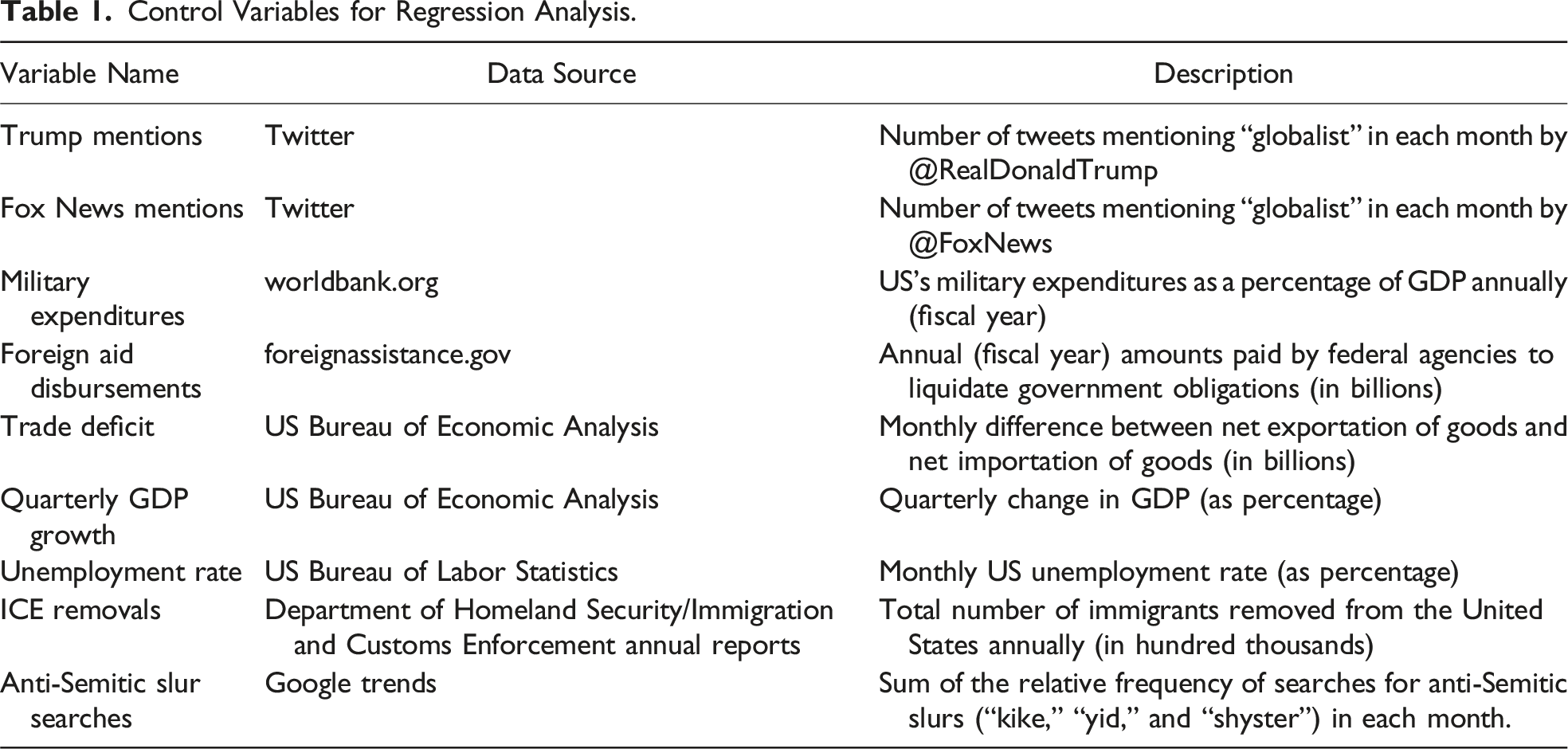
Control Variables for Regression Analysis.
Results
We begin our analysis by testing H1, which established our theoretical expectation that the content of globalist mentions exhibits ontological characteristics of the alt-right. We do so by examining our corpus qualitatively. We expect usage of the term to co-occur with conspiratorial, cultural, and identity-based themes rather than more specific policy debates related to trade, unemployment, and deindustrialization. The term globalist is an important test case, given that the term was rarely used in public throughout the latter half of the 20th century. Moreover, to the extent that it was used, it was either a value-neutral term to describe US foreign policy or was used by left-leaning academics criticizing neoliberalism. 5 Importantly, a more qualitative, text-based exploration of the tweets also helps contextualize which users and where in the Twitter ecosystem the globalist insult appears.
As a first step, we use frequency analysis to examine common hashtags. We isolate hashtags using regular expressions and then plot their frequency. Figure 1 shows that many of the most common hashtags are related to Donald Trump, indicated by “#maga,” “#trump,” “#americafirst,” “#trump2020landslide,” etc. This appears to be an initial piece of evidence that former president Donald Trump activated far-right activists who use the term online. While this may seem to indicate that the term is oriented around the electoral fortunes of an elite, it is notable that Trump rarely used “globalist” himself. He only invoked the insult four times on Twitter even as Trump-supporting entities in the party network stoked its wide-spread use.
6
Most common hashtags in globalist corpus.
19
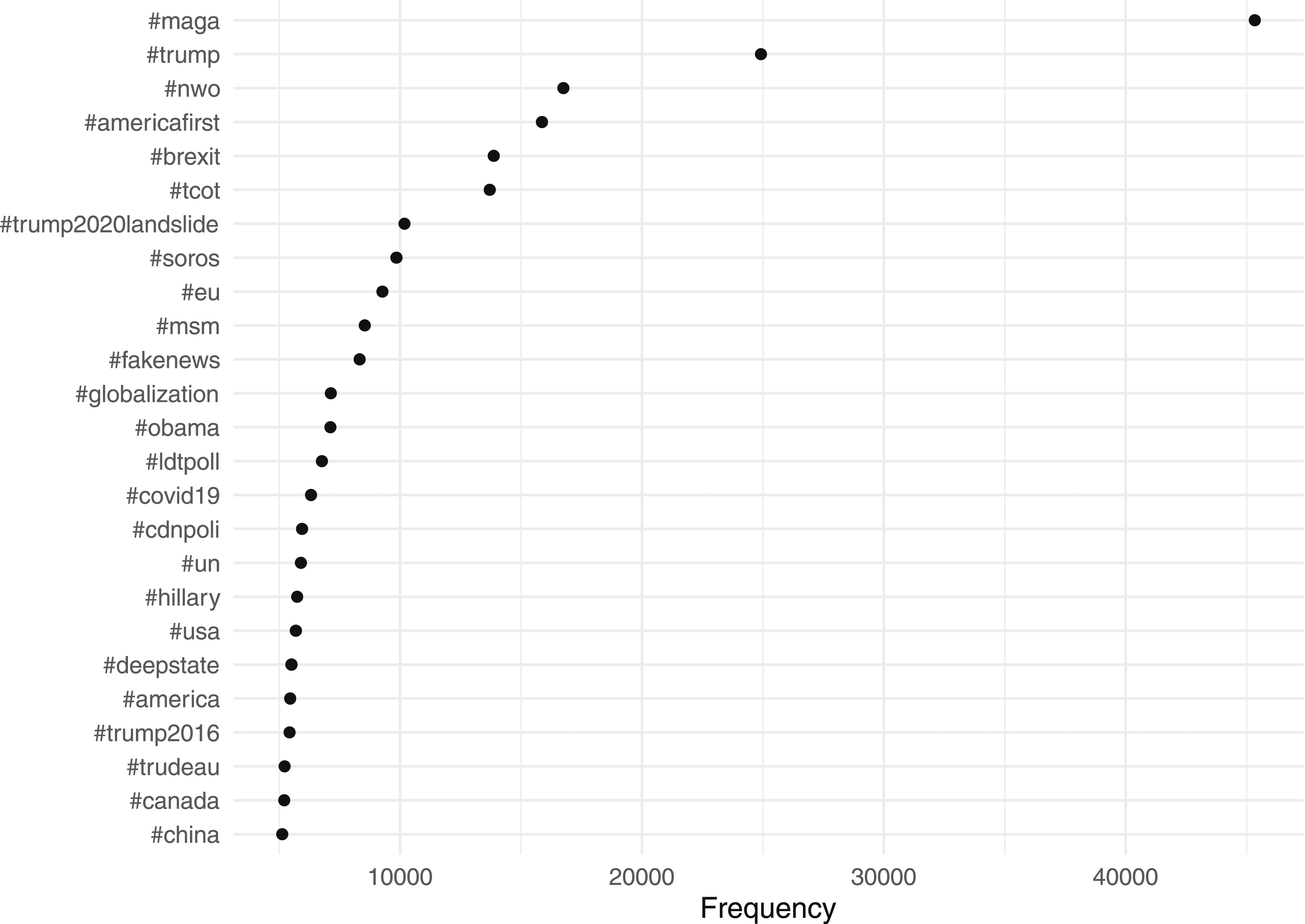
Moving on, a simple analysis of the most frequent hashtags also shows the degree to which these tweets are conspiratorial in nature. Hashtags such as “#nwo,” which stands for the prominent New World Order conspiracy theory, appear alongside hashtags such as “#fakenews” and “#deepstate.” 7 Other conspiracy theories show up farther down the list, for example, “#qanon,” “#thegreatreset,” “#greatreset,” and “#newworldorder” are 29, 35, 40, and 45th most prominent hashtags in the corpus. 8
We observe a number of elite targets both in terms of alt-right boogeymen such as “#soros,” “#obama,” and “#hillary,” and also the mention of oft-derided global organizations including “#eu” and “#un.” We also see patriotic themes such as “#americafirst,” “#america,” and “#usa.” This indicates that the most prominent and recurring subjects associated with globalist are oriented toward support for Donald Trump, who had taken up the mantle of the alt-right, as well as conspiracy theories, anti-elite attacks, and cultural grievances.
Figure 2 plots the 50 most common words in the corpus. Again, we see “trump” and “@realdonaldtrump” among the most common. We also see a variety of right-wing conspiracy related terms such as “soros,” “elites,” “media,” “obama,” “left,” “state,” “think,” and “china.” We again observe patriotism-associated terms including “us,” “people,” “America,” and “one.” The only international organization that shows up in the top 50 is the “un” which is among the top 35.
9
As with the hashtags, the top terms demonstrate that the discourse was dominated by alt-right themes related to conspiracy theories, Donald Trump, and cultural messages. The fifty most common words in the globalist corpus.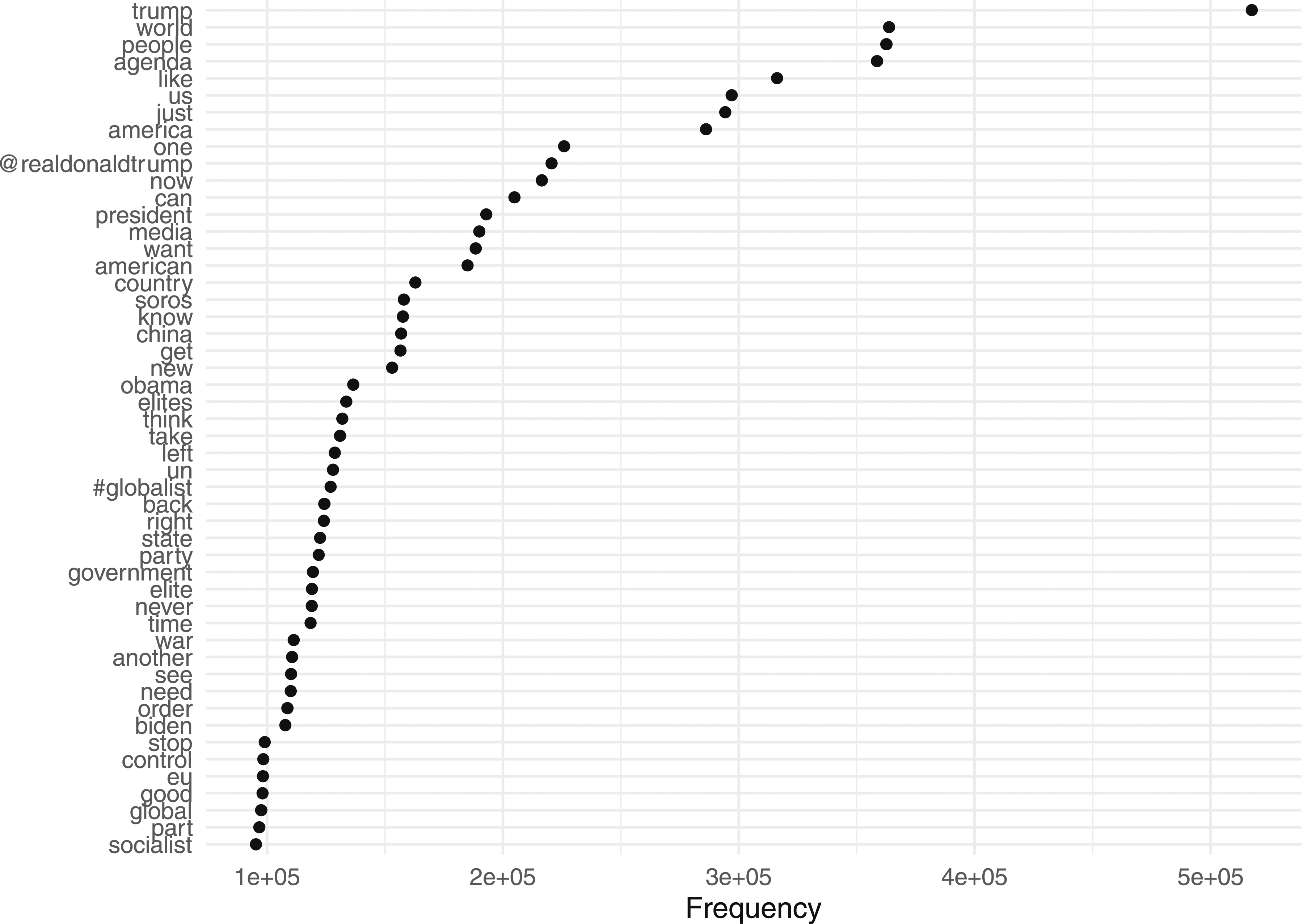
These analyses paint a picture of a public space that is dominated by the stylistic trappings of the alt-right: invocations of conspiracy theories and emphasis on how globalization threatens a perceived American cultural identity. One of the dominant themes is characterizing globalists as a cabal of elites—largely composed of Democrats, media and business personalities, and other figures from the “the establishment”—who are plotting against “real Americans.” Thus, we see language invoking “the true people” and the “general will” which are expressed via themes like patriotism and “us” versus “them” language. Finally, we also see themes which paint figures such as Donald Trump and other conspiracy theorists as heroes who are supposedly fighting back against the globalists in language evocative of action such as “never,” “take,” and “back.”
Importantly, what we do not see are words related to the material aspects of globalization. We see few mentions of words and themes related to jobs, unemployment, and trade, which is what we would expect to see in line with demand-side explanations. 10 For example, nowhere in the top 50 hashtags 11 are any mentions associated with losses of manufacturing jobs, trade-based inequality, or even immigration, which are commonly put forward as demand-side explanations for the spread of anti-globalization sentiment. The same story is true if we look at words or, as we do in the appendix, bi-grams. By far the most prominent words relate to liberal boogeymen, conspiracy theories, and cultural grievances, rather than terms that we might find if the conversation was focused on the actual impact of globalization.
Topic models corroborate the simple frequency analyses, showing evidence that material factors are overshadowed by themes of cultural and status grievance, elite criticism, and conspiracy theories. We estimate STM models with 15, 25, 50, 75, and 100 topics. 12 We provide an overview of the results here, but note that model diagnostics and a full walkthrough can be found in the appendix. Across all models, we find that the majority of the topics, and certainty those that are most prevalent, relate to cultural grievances and conspiratorial themes prominent among the alt-right. In contrast, there are few topics related to the material factors commonly cited by those who argue that demand-side forces are driving the backlash against globalization.
Figure 3 plots the most common words and labeled topics for a 25-topic model.
13
The y-axes display the most frequent words contained in each topic. This exercise is illustrative because it shows that virtually all of the estimated topics are related to conspiracy theories, anti-elite messaging, and cultural grievances rather than direct material harms associated with globalization. In fact, the only topics that contain any reference to objective material conditions were the “white nationalism” topic which contained the stem “immigr” and the “individual will” topic which contained the stem “economi.” However, in both cases, the dominant themes were related to xenophobic tropes and taking back control from elites, respectively. Interestingly, there was an entire topic related to the use of songs by the band Muse in conspiracy theory videos. The fact that this oddly specific topic emerges, but topics related to trade or other material conditions do not, further demonstrates that the discourse is dominated by themes popular with the alt-right. Ten most common words contained in a 25-topic model of globalist tweets.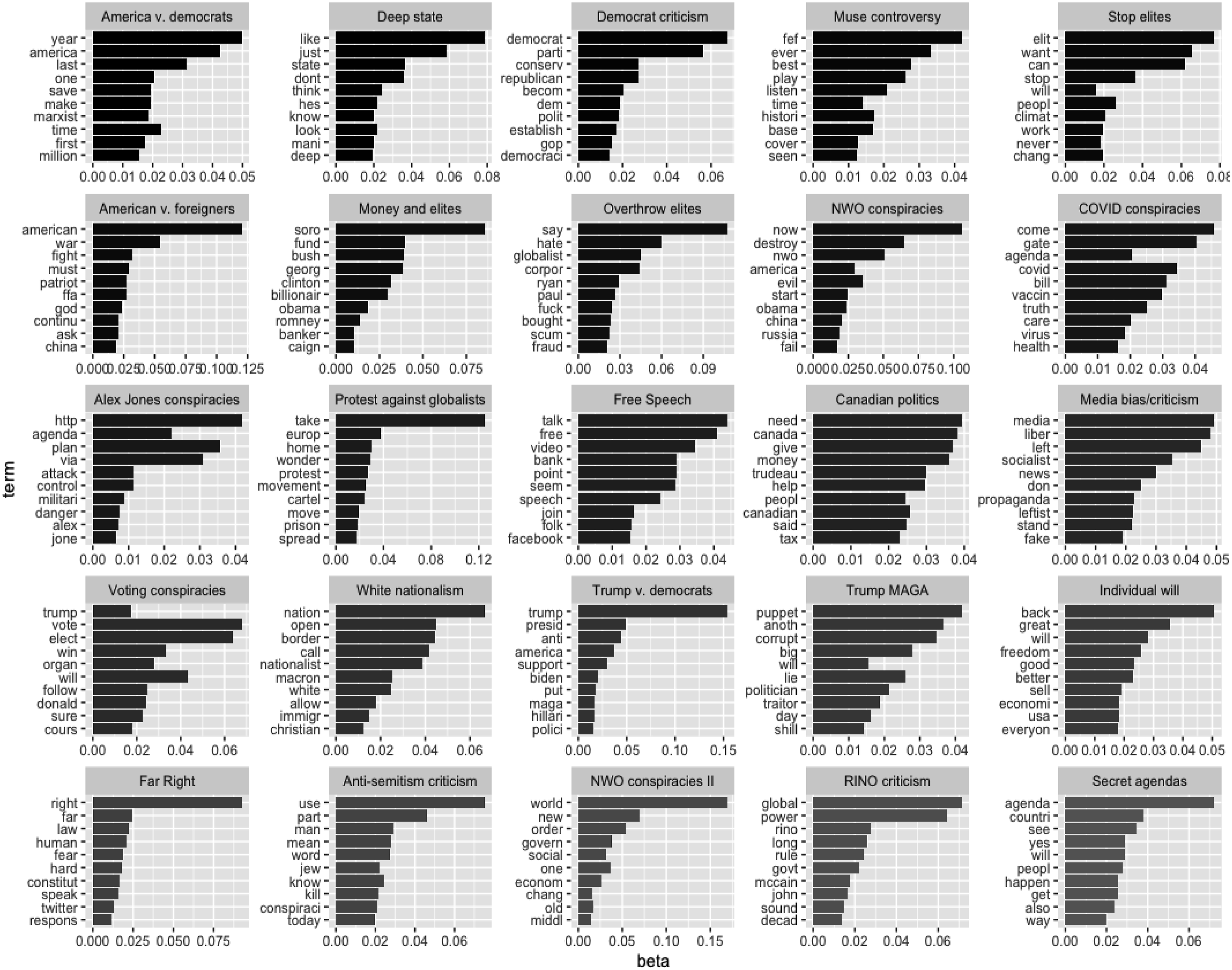
Overall, our qualitative assessment of the corpus leads us to conclude that the content of discussion invoking the globalist insult tends to adopt the stylistic trappings of a particular faction within the American conservative movement, which we think provides an important initial test of our faction-based argument. Our theory also implies that we should see the globalist insult being disseminated not by traditional Republican elites but rather by entities associated with the alt-right. We postulated in H2 that the frequency of globalist mentions would be correlated with the frequency of mentions by the inheritor of this factional tradition: Breitbart. We begin the analysis by visualizing our time series to get a sense of the data. The trend line, with counts of globalist mentions measured daily, is presented in Figure 4. Number of “globalist” mentions in English-language tweets by day.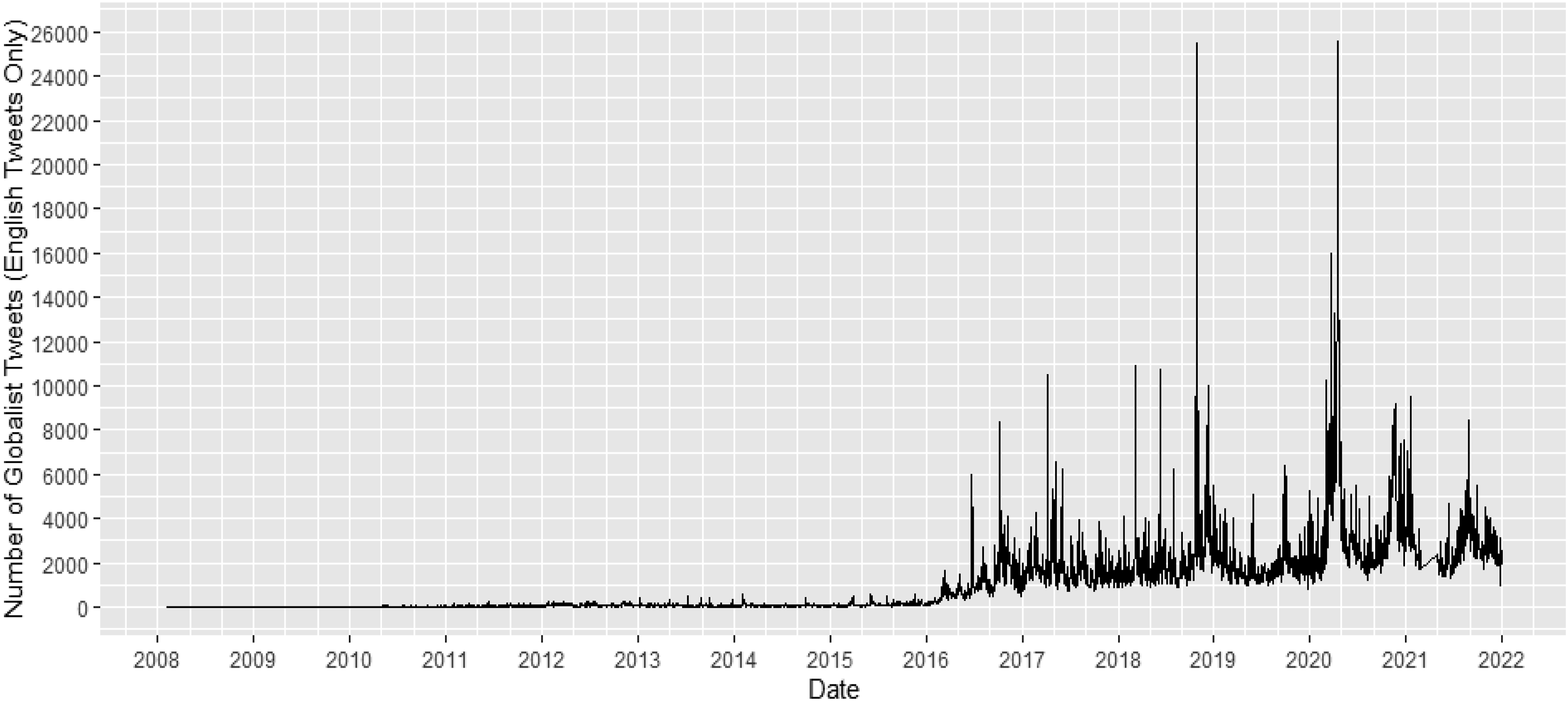
We can see that mentions of globalists are infrequent for much of the series. It is not until 2016 that we see an uptick, with a further increase occurring in 2020. Otherwise, the series is noisy, including several spikes. Two are particularly large: October 27–28, 2018 and April 12–19, 2020. October 27 was the date of the mass shooting in the Tree of Life—Or L’Simcha Congregation synagogue which killed 11 people. Less than a week prior, then President Trump said “Radical Democrats want to turn back the clock. Restore the rule of corrupt, power-hungry globalists. You know what a globalist is, right? A globalist is a person that wants the globe to do well, frankly not caring about our country so much” during a campaign rally in Houston, Texas. The Twitter response to the anti-Semitic attack included drawing significant connections with Trump’s coded anti-Semitic language, meaning this spike was largely driven by critics of Trump saying that the word “globalist” inspired the attack. The April 2020 surge appears to be in response to the COVID-19 pandemic, specifically to Dr Anthony Fauci and conspiracies that pandemic lockdowns were a tool for the World Health Organization to exert control over America. Some of the most viral tweets from that time frame are posted in the supplemental appendix.
Regression Models of the Natural Log of the Number of “Globalist” Tweets per Month.
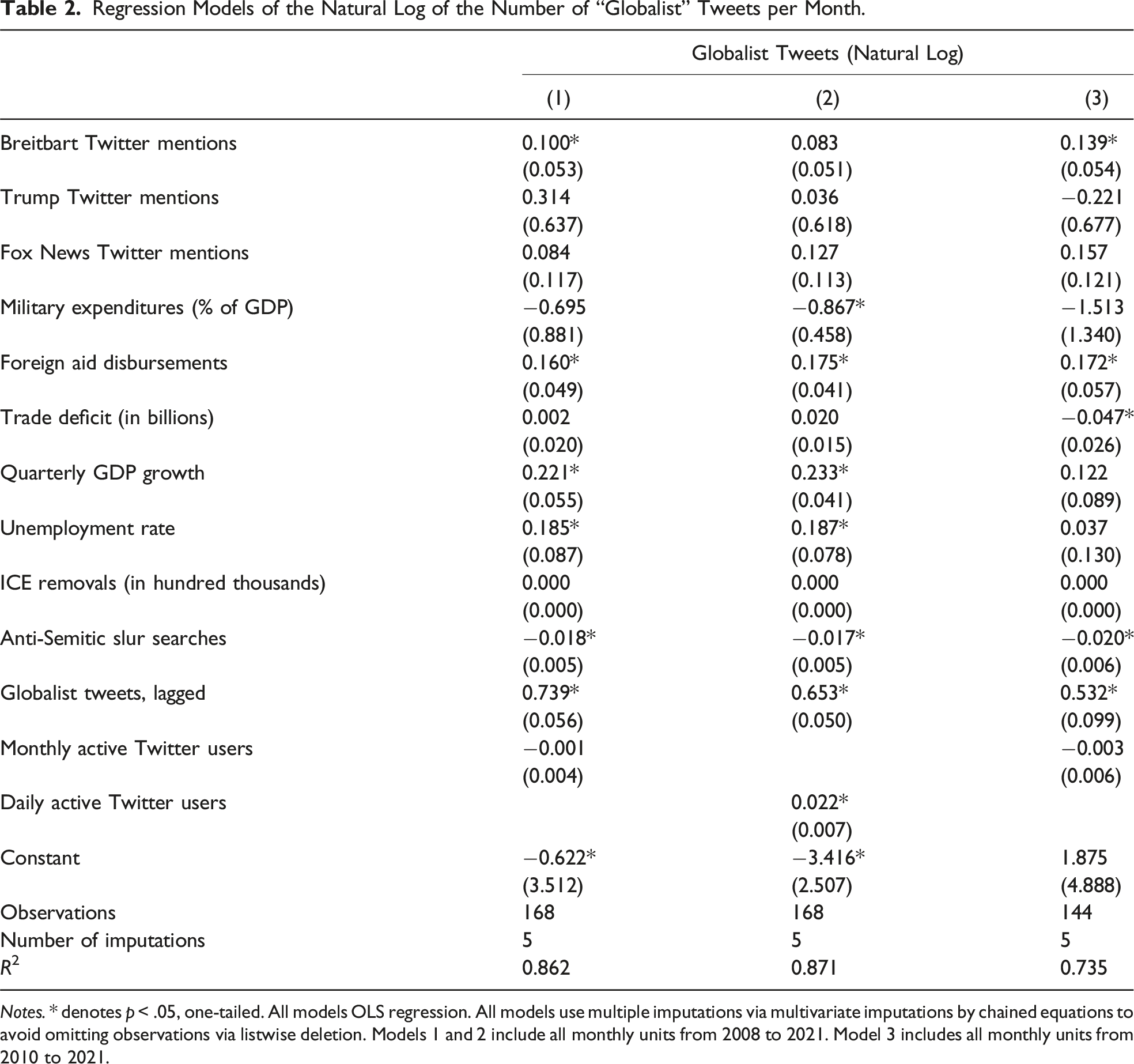
Notes. * denotes p < .05, one-tailed. All models OLS regression. All models use multiple imputations via multivariate imputations by chained equations to avoid omitting observations via listwise deletion. Models 1 and 2 include all monthly units from 2008 to 2021. Model 3 includes all monthly units from 2010 to 2021.
Model 1 imputes values of the average monthly active Twitter users. The results are largely in line with our hypothesis. The coefficient for Breitbart is positive and statistically significant, indicating that more “globalist” mentions by the alt-right media website on Twitter are correlated with more globalist mentions on Twitter overall. In terms of substantive significance, a single mention of globalists by Breitbart is correlated with a 10% increase in globalist mentions on Twitter. This provides support for H2.
Model 2 imputes the values of unique daily active Twitter users. Again, more mentions of globalists by Breitbart are correlated with an increase in the natural log of globalist tweets, although here the coefficient is smaller and below the conventional statistical significance level. The substantive significance is smaller than in Model 2, but still impressive; a single Breitbart tweet mentioning the globalist insult is correlated with 8.3% more globalist tweets.
Model 3 again imputes the values of monthly active Twitter users but omits observations from 2008 to 2009. These years are dropped because the observed values were not found from Twitter’s quarterly filing reports but rather from contemporaneous media sources. The results are similar to the prior models. More globalist mentions by Breitbart are again correlated with more globalist mentions on Twitter to a substantively large and statistically significant degree.
Overall, we find support for H2. The coefficients for Breitbart mentions are uniformly positive and substantively large while also reaching conventional levels of statistical significance in two of the three models. Breitbart has no formal power within the Republican Party. It represents only a particular faction within the party network. But from that position it can seemingly shape the nomenclature of discourse.
To contextualize these results, we turn to a discussion of the control variables. Recall that predominant explanations suggest that we should see an effect for demand-side factors as well as supply-side factors related to political elites and openness to anti-Semitic dog whistles. What we find, however, is that many of these factors do not seem to be important. For example, more globalist mentions by Donald Trump’s Twitter handle are unrelated to globalist mentions on Twitter, providing no support for a purely elite-driven theory of anti-global cooperation attitudes. 14 Tweets mentioning globalist by @FoxNews, a conservative media outlet that represents the Republican Party in comparison to the factional nature of Breitbart, are positively correlated with globalist mentions on Twitter but never statistically significant. 15 Similarly, most control variables associated with current demand-side explanations were only weakly correlated with globalist mentions. ICE removals are uncorrelated with globalist mentions. The coefficients for trade deficits and military expenditures are only significant in one model each, but both are in the opposite direction of what the materialist theory would predict. The quarterly GDP growth coefficients are statistically significant in two models but always positive indicating that improving economic conditions are related to more globalist discussion. The results regarding unemployment offer some support for supply-side factors. The coefficients are positive, statistically significant, and substantively large in two models. A 1-percentage-point increase in the US unemployment rate is correlated with more than an 18% increase in globalist mentions on Twitter. But the result is not consistently observed; the coefficient is much smaller in Model 3.
The only control variable testing the effect of material conditions that consistently supports this alternative theoretical perspective is Foreign Aid Disbursements. This variable is statistically significant in all three models. It is always positive, indicating that more money spent on foreign aid is correlated with an increase in monthly globalist tweets, and the substantive magnitude is large. This result is perhaps not surprising given that foreign aid, even though it is a small portion of the US federal budget, has long been politicized in right-wing politics in the US. However, to our knowledge, demand-side explanations do not typically emphasize this factor. Thus, we see that this material factor does co-associate with the use of the globalist insult, but we wager that it does not provide much support to demand-side explanations, which tend to emphasize more direct factors such as job losses or inequality.
Finally, the relative frequency of Google searches of anti-Semitic slurs is strongly and consistently correlated with globalist mentions on Twitter, but in the opposite of the expected direction. More anti-Semitic slur searches are correlated with fewer globalist tweets. While it is possible that “globalist” operates as a replacement term for anti-Semitic slurs, we think it is more likely that most uses of the term are intended to convey an attitude toward globalization rather than anti-Semitism. This does not remove the connection between the two, as anti-Semitic conspiracies of Jewish domination of international institutions are longstanding and pernicious. And, certainly, the term has been prominently applied to Jewish people like George Soros. But our results suggest that contemporary references to globalists carry a connotation that goes beyond anti-Semitic conspiracies.
Discussion
The literature on the backlash against globalization has largely focused on demand-side factors, typically by showing that changes associated with economic globalization are correlated with the rise of anti-globalization populism in Western Europe and the US (Autor et al., 2020; Rodrik, 2021). Additional work has begun to explore supply-side factors, such as the adoption of anti-globalization positions by political parties seeking to capitalize electorally (Walter, 2021). We theorize that other aspects of the supply-side have been neglected. Specifically, if we adopt a view of political parties as extended networks, we gain further purchase over when and how anti-globalization politicization emerges, as well as its ideological character. This provides an alternative pathway to the politicization of globalization, where backlash is conceivably endogenous to domestic politics rather than a reaction to externally induced economic changes.
Our data on the usage of the globalist insult on Twitter provides a unique case to test for the importance of extended party networks, as well as a way to evaluate the impact of more established demand- and supply-side theoretical approaches. Several findings emerge from this exercise. First, the meaning and usage of the globalist insult does not seem to be related to materialist conditions. This does not necessarily refute the impact of demand-side factors—such as the much discussed “China shock”—but it does suggest that sentiment online, to the extent that it is a proxy for the larger societal level conversation, may not be as causally determined by economic factors as some suggest.
Second, our results show that a supply-side argument that focuses narrowly on parties and candidates directly competing in elections as the chief peddlers of anti-globalization messages is also incomplete. Specifically, we could not find any correlation between traditional political elites’ usage of the globalist term (either on- or off-line) and its wider use on Twitter. Beyond the statistical relationships that did not materialize are simple counts. It has not been used in a party platform in the past three presidential election cycles. When we began working on this project, there were only 19 instances of any member of Congress using the term in their fundraising emails during the decade-plus time period of the Twitter data (Cormack, 2017), with more than a third of those occurring during the last 6 months (well after its proliferation on Twitter). Notably, there have been 27 uses 16 in the two-and-a-half years since then (all but one by Republicans), suggesting that Republican elites are only now beginning to adopt language that the alt-right has been using for years. For elites or parties to be the main culprit here, they would have to use the term before or concurrent with its broader adoption. Simple time trends make it clear that this is not the case.
This dynamic can be shown more clearly using a different corpus of tweets. Drawing on more than 2000 Twitter timelines associated with the Republican Party networks between January 6, 2021 and December 31, 2021 (Scott, 2022), we find that among the most prolific users of “globalist” (10 or more uses) there is only one handle associated with a traditional political elite. 17 Almost all Republican members of Congress, governors, and former members of the Trump administration cabinet avoided the term. The handles associated with the national Republican Party organization never used the term either. Only one state Republican Party (West Virginia) used it, and only once. This remarkable lack of use by Republican Party officeholders, national party organizations, and state parties would seem to preclude a “top-down” supply-side explanation for the term’s use.
The Breitbart Twitter handle was the most prolific user of “globalist” in 2021 among the Republican Party-aligned handles, which aligns well with what our data show. Use of the globalist insult on Twitter is correlated with usage by this most prominent of the alt-right platforms. The manner in which it is used is devoid of language linking the term to objective economic conditions associated with globalization, such as trade, unemployment, and immigration, instead favoring the conspiracy theories, cultural grievances, identity politics, and more abstract notions about lost sovereignty that are Breitbart’s calling card. From a position adjacent to, but decidedly outside, the formal Republican Party, this factional entity seems to exhibit power by organizing the language of anti-globalization backlash. This, we argue, provides initial support for the important role that entities in the extended party networks play over political discourse.
The results are collectively in line with our theoretical argument that an extended party network approach helps enhance explanations about the rise of anti-globalization backlash. Our results, however, are not without limitations. Twitter is not representative of the totality of public debate. It is possible that the impact of objective material conditions and elite discourse works differently in other arenas, and across other indicators. Moreover, by focusing on the term globalist, we necessarily omitted other types of discourse, which may be more positive or may be in response to alternative stimuli.
These limitations are important, but they are attenuated by important trends we see more broadly. First, descriptive evidence suggests that the term globalist has begun to spill-over into broader discourse. In Figure 5, we show that it was rarely used in English-language newspapers in the early 2000s, with 306 mentions in newspapers in 2000 gradually increasing to 740 in 2014. Usage then skyrocketed, peaking at over 6000 articles in 2018. Second, the evidence also suggests that the rise of the more pejorative term “globalist” is likely a substitute for the more value-neutral term “globalization.” The secondary x-axis in Figure 5 shows that in recent years the ratio of globalist to globalization articles has increased from close to zero to above 0.15. Similarly, in the supplemental appendix, we show that the sentiment of articles mentioning globalist is more negative on average than articles mentioning globalization. These dynamics suggest that the term globalist has successfully entered the public debate as a negative alternative to more positive terms. Traditional news media mentions of “globalist” over time and relative to “globalization.”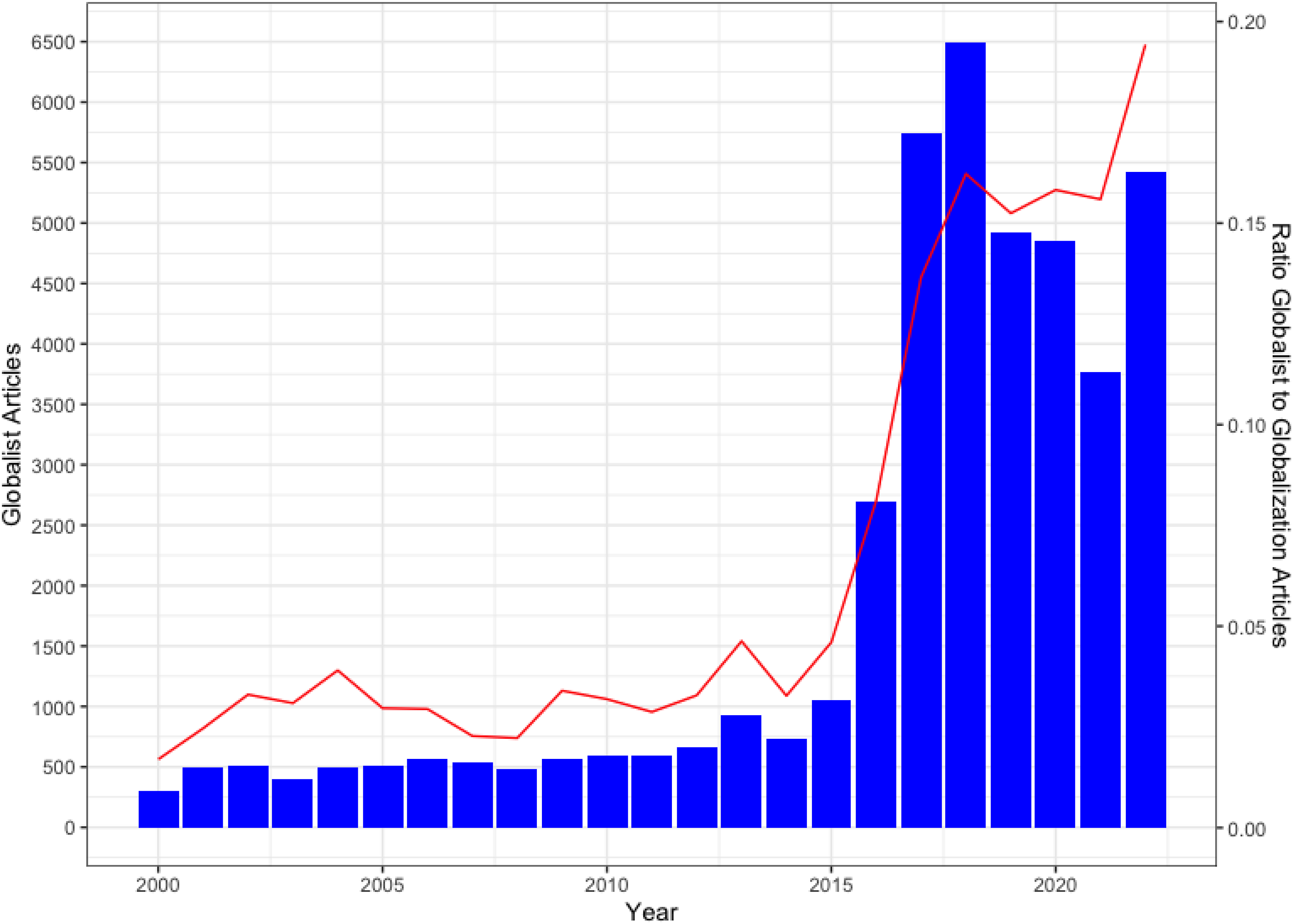
Conclusion
A growing backlash against globalization has cast doubt on the ability of countries to engage in international cooperation aimed at solving the world’s most pressing problems such as the looming threats from climate change and global pandemics. 18 Understanding where this backlash originates (and how it evolves) is crucial. Our theoretical innovation here was to argue that actors within extended party networks play an underappreciated role in shaping and disseminating anti-globalization language. Using the “globalist” insult as a case study, we find support for this argument. First, text analysis shows that anti-globalization discourse bears the stylistic markings of a historically anti-globalization faction within the American conservative movement. Second, we show that usage of the term on Twitter is driven by alt-right entities. Third, we find no correlation between the use of the term and usage by traditional elites or in response to changes in material conditions.
Our argument has important implications. First, the results shed light on an important puzzle. Observers have struggled to understand how ostensibly unpopular policy positions, on everything from trade to NATO, are being promoted by politicians. Our analysis suggests that this backlash may not be driven by elites in a top-down fashion, nor was it these politicians tapping into rising demand in society in response to objective economic conditions. Rather, this path was available due to groundwork laid by the alt-right in the US, the inheritor of the conspiratorial right’s mantle, even if many of their policy positions were (and remain) unpopular among ordinary citizens. Thus, a key challenge for researchers is to understand the conditions that have facilitated the rise of this faction within the Republican Party, as well as whether these appeals have subsequently led to a durable shift in public opinion.
Second, our results speak to important debates about the rise of anti-globalization populism more generally. At a fundamental level, our argument suggests that these types of backlashes could be generated endogenously in response to domestic politics rather than via external shocks due to globalization. Understanding whether a particular society is likely to experience a backlash requires understanding something about the structure of their political system and its historical legacy.
Third, our argument implies that understanding the form that popular backlashes take requires a robust understanding of a country's party system. There is nothing inherent to populism, with its “thin-centered ideology” (Mudde, 2004), that makes it anti-globalization. Conspiracy theories are also a game that anyone can play (Uscinski and Parent, 2014) and so are not necessarily anti-globalization. It is not because the alt-right is populist or conspiratorial that it is the home of the “globalist” insult. It is because of the factional mantle it inherited, a mantle whose legacy stretches back for decades. It is only from an understanding of the legacy of the American parties that such an observation can be made. The same is true of other party systems across the globe. For example, the Brexit movement in the United Kingdom was nominally internationalist toward trade and investment, but anti-European and anti-immigration, policies that may seem inconsistent but make sense in the context of British politics (Zappettini, 2019). As such, our research suggests that supply-side explanations help us better understand growing anti-cooperation sentiment, but the circumstances under which it arises and the form that it takes depends on the country.
We envision two important pathways for future research. First, studies should do more to understand the historical development of anti-globalization factions, including their genesis, their evolution, and the conditions that presage their expansion (or decline). In the US context such factions have emerged for various reasons and their locations on the left or right of the political spectrum have varied, as illustrated by the progressive movement of the late 19th and early 20th centuries. But their legacy, like that of the John Birch Society, still impacts what is (and is not) politically viable. Second, more studies should engage in comparative research to understand how party development affects the timing and tenor of backlash in societies both similar to and different from the US. We also suspect that in an era of increased globalization there are likely—somewhat ironically perhaps—important spill-over effects from one country to another.
Our results also have policy implications. Supporters of traditional models of political parties prescribe a distinct course of action for supporters of international cooperation. If popular backlash arises primarily because globalization creates “losers,” then the obvious means of reducing such skepticism is attempting to create fewer losers (or compensate them better). If backlash is instead politically constructed and organized, however, then the more appropriate path would be to either prevent the messengers from disseminating their message or proliferating a contrary message. Some have suggested, for example, that the current backlash may provoke successful counter-mobilization by pro-globalization forces (De Vries et al. 2021). On this point, the elite-centric arguments and our own factional-centric argument are in alignment.
Where we depart is in how this might be accomplished. If elites or formal party organizations are the primary disseminators of anti-cooperation messages, then electoral defeat of these elites and organizations would be sufficient. However, if the elites and organizations only reflect factions within the party, then this will not be effective. It would only be addressing a symptom rather than the root cause. In the US, the more effective solution would be to grow the support of critical factions. It would require the strengthening of establishment Republican-affiliated entities in the extended party network to successfully marginalize the MAGA movement and its alt-right supporters.
Supplemental Material
Supplemental Material - Globaloney: Extended Party Networks and the Dissemination of Anti-Globalization Insults
Supplemental Material for Globaloney: Extended Party Networks and the Dissemination of Anti-Globalization Insults by Andrew Lugg and Zachary Scott in Political Research Quarterly.
Supplemental Material
Supplemental Material - Globaloney: Extended Party Networks and the Dissemination of Anti-Globalization Insults
Supplemental Material for Globaloney: Extended Party Networks and the Dissemination of Anti-Globalization Insults by Andrew Lugg and Zachary Scott in Political Research Quarterly.
Footnotes
Acknowledgments
The authors are grateful for the helpful comments and suggestions provided by the anonymous reviewers and the PRQ editor. We also thank participants at the 2022 APSA annual meeting. All errors are our own.
Declaration of Conflicting Interests
The author(s) declared no potential conflicts of interest with respect to the research, authorship, and/or publication of this article.
Funding
The author(s) received no financial support for the research, authorship, and/or publication of this article.

Data Availability Statement
The data for this article is available online in the supplemental files.
Supplemental Material
Supplemental material for this article is available online.
Notes
References
Supplementary Material
Please find the following supplemental material available below.
For Open Access articles published under a Creative Commons License, all supplemental material carries the same license as the article it is associated with.
For non-Open Access articles published, all supplemental material carries a non-exclusive license, and permission requests for re-use of supplemental material or any part of supplemental material shall be sent directly to the copyright owner as specified in the copyright notice associated with the article.
