







Abstract
Judicial councils are often seen as institutional safeguards that protect courts from political interference and uphold the rule of law. Yet their real-world effects on executive behavior vary widely across countries. This paper investigates the conditions under which judicial councils promote or undermine government compliance with court rulings. I develop a model in which executives strategically design or reform judicial councils to influence court assertiveness, depending on the level of transparency and reputational risk. The model yields clear empirical expectations about when councils facilitate compliance and when they serve symbolic or even suppressive functions. To test these claims, I construct an original panel dataset of 47 European and neighboring countries (1945–2025) that includes detailed institutional features of judicial governance. Using multilevel regression models and extensive robustness checks, I find that councils only promote compliance when they are judge-dominated, institutionally empowered, and embedded in transparent political environments. By contrast, politically dominated or merely symbolic councils are associated with lower levels of compliance. The findings challenge the assumption that judicial councils are inherently democratizing and highlight how institutional design interacts with political context to shape executive-judicial relations.
Introduction
Why do some governments comply with court rulings while others defy them? Although judicial independence is widely regarded as a necessary condition for compliance, scholars have long recognized that institutional insulation alone does not ensure executive acceptance of adverse judicial decisions (Carruba 2009; Staton 2010; Vanberg 2001). Compliance is a political outcome, shaped by incentives, visibility, and the anticipated costs of defiance. One of the most prominent institutional mechanisms intended to mediate these dynamics is the judicial council—a body responsible for judicial appointments, promotions, discipline, and broader judicial governance. Judicial councils have proliferated across Europe and beyond, often under constitutional, international, or accession-related pressures (Kosar̆, 2016), yet their effects on judicial independence and executive compliance vary widely (Garoupa and Ginsburg 2009).
This paper argues that judicial councils are neither inherently democratizing nor neutral safeguards of judicial autonomy. Rather, they are strategic governance institutions whose effects depend on how they are designed and embedded in their political environment. Councils can empower courts and raise the costs of executive defiance when they are controlled by judges, endowed with meaningful authority, and operating in transparent settings where noncompliance is visible and reputationally costly. Under opaque conditions, however, councils may be politicized, hollowed out, or deployed symbolically to legitimize executive control while dampening judicial assertiveness. Compliance, therefore, is not an automatic consequence of institutional design but a conditional outcome shaped by internal governance and political observability.
The paper develops this argument in two steps. First, it advances a strategic theory of judicial governance in which executives anticipate the political costs of noncompliance and design or manipulate judicial councils accordingly. The framework yields three expectations: judicial councils increase compliance only when (1) judges control decision-making, (2) councils possess real governance powers, and (3) executive behavior is publicly observable. Second, the paper evaluates these expectations using an original panel dataset covering 47 European and neighboring countries between 1945 and 2025. The empirical analysis shows that councils are associated with higher compliance only when autonomy and powers are jointly present in transparent political contexts; politically dominated councils or those operating under opacity are associated with neutral or even negative compliance outcomes.
The paper contributes to three literatures. First, it qualifies institutionalist accounts of judicial independence that emphasize formal insulation and legal design (Dixon and Ginsburg 2018; Ferejohn and Kramer 2002), showing that autonomy without authority or visibility is often ineffectual. Second, it extends theories of executive compliance by integrating judicial governance into enforcement-based accounts centered on reputational costs and observability (Staton 2010; Vanberg 2005). Third, it contributes to strategic theories of institutional design (Carruba 2009; Stephenson 2004) by demonstrating that judicial councils themselves may be engineered as instruments of constraint or control, depending on executive incentives and political context.
More broadly, the paper challenges the view of judicial governance as a checklist of best practices. Judicial councils do not operate in a vacuum: their effects depend on who controls them, how much authority they wield, and whether their actions are visible to relevant audiences. Courts are only as independent—and executives only as constrained—as their institutional and political environments allow.
The paper proceeds as follows. Next section reviews the literature on judicial councils, judicial independence, and executive compliance. Next, I present the theoretical framework, followed by the section providing a case-based illustration. After that, I describe the data and empirical strategy. Finally, I present the results, discuss the findings, and conclude.
Judicial Councils in the Literature on Independence and Compliance
Judicial councils have been widely discussed in the literature on judicial independence. Traditional institutionalist accounts emphasize insulating courts from political interference through mechanisms such as constitutional entrenchment, tenure protection, and appointment rules (Ferejohn and Kramer 2002; Ginsburg 2003; Rı́os-Figueroa 2016). Within this framework, judicial councils are often portrayed as safeguards of autonomy, entrusted with managing appointments, promotions, and disciplinary procedures to buffer judges from external political pressures (Garoupa and Ginsburg 2009; Guarnieri and Pederzoli 2002; Kosař 2016).
This perspective has strongly influenced global reform agendas, which often treat the creation of a judicial council as a best-practice indicator of independence. Yet much of this literature implicitly assumes that councils are functionally equivalent or normatively desirable, paying limited attention to how their internal design—particularly composition and authority—shapes their actual effects. Recent work challenges this assumption, showing that judicial councils can be captured by political actors (Popova 2010), reinforce elite pacts and appointments (Castillo-Ortiz 2023; Vallbé 2026a), or serve symbolic roles that legitimize political control while undermining real autonomy (Magalhães 1999). Especially in transitional or hybrid regimes, councils may be created less to protect courts than to signal rule-of-law commitments or institutionalize control (Ginsburg and Moustafa 2008; Kosař 2018). Adding further nuance, Šipulová et al. (2023) develop a Judicial Self-Governance Index and show that the mere existence of a council reveals little about judges’ actual power in judicial governance.
Comparative research further complicates the view of judicial councils as a uniform or necessary institutional solution. Studies of Nordic countries and other high-capacity democracies show that strong judicial independence and high levels of compliance can be sustained without classical judicial councils, relying instead on professional norms, bureaucratic insulation, and transparency rather than judicial self-governance (Aarli and Sanders 2023). Conversely, work on Central and Eastern Europe and the Western Balkans documents how formally empowered councils may function as instruments of political control or elite accommodation, even when judges hold a majority of seats (Bunjevac 2020; Preshova, Damjanovski, and Nechev 2017). From this perspective, councils are neither necessary nor sufficient for independence or compliance, but one among several governance arrangements whose effects depend on internal incentives, external monitoring, and political context. A synthesis by Garoupa (2025) underscores this point, emphasizing that judicial governance must be analyzed in terms of who exercises control in practice and how visible that control is, rather than through formal design alone.
Recent scholarship pushes this critique further by questioning whether formal indicators of judicial council control—such as nomination rules or numerical majorities—adequately capture who governs the judiciary in practice. Drawing on longitudinal evidence from Central and Eastern Europe, Kosař, Šipulová, and Kadlec (2024) show that judge-majority councils may nonetheless be politically aligned or internally fragmented, producing “judges versus judges” dynamics that facilitate accommodation with governing elites. In cases such as Poland, Slovakia, and Georgia, they argue that some of the most problematic councils are not weak or politically dominated bodies, but strong and formally judge-controlled institutions lacking internalized norms of independence. This distinction between formal control rights and effective control motivates both the paper’s conditional theoretical approach and the system-level measurement strategy adopted in the empirical analysis.
These limitations mirror broader insights in the compliance literature. Bureaucratic and judicial actors do not automatically implement legal rules but respond strategically to anticipated costs and enforcement credibility. Spriggs (1997), for instance, shows that U.S. federal agencies comply with Supreme Court rulings when legal clarity and litigation pressures raise the costs of noncompliance. Courts and councils alike operate in implementation environments shaped by strategic anticipation.
A second body of work focuses more directly on executive compliance with judicial decisions. This literature models compliance as a function of legitimacy and political costs, showing that executives are more likely to comply when public visibility is high and reputational sanctions are credible (Carruba 2009; Driscoll and Nelson 2023; Krehbiel 2021; Staton 2010; Vanberg 2001). Courts, in turn, may moderate or assert themselves based on expectations of enforcement. Yet most of these models treat the judiciary as a unitary actor and largely omit the internal governance institutions that structure judicial cohesion, incentives, and strategic behavior.
This omission reflects the contexts from which many compliance models emerge—such as the United States, Latin America, or constitutional courts in Europe—where judicial councils are weak, nonexistent, or irrelevant to the judges under study (Chavez 2004; Clark 2012; Driscoll and Nelson 2023; Helmke 2005; Vanberg 2005). As a result, compliance is often analyzed without reference to governance institutions that are central to ordinary judicial careers in much of Europe, Africa, and parts of Asia.
Differences in judicial visibility further shape compliance dynamics. As Calvin, Collins, and Eshbaugh-Soha (2011) show, U.S. Courts of Appeals—operating largely outside public scrutiny—exhibit limited responsiveness to public mood. More recent work demonstrates that public attitudes toward courts depend on how rulings are covered and framed in the media, with implications for legitimacy and compliance (Boston and Krewson 2025). Judges themselves adjust language depending on audiences (Krewson 2019), underscoring the importance of observability and transparency as strategic variables.
To date, there has been no systematic attempt to theorize how the design of judicial councils—particularly their composition and formal powers—conditions executive compliance or judicial willingness to confront political authority. This paper addresses that gap by integrating judicial councils into a model of strategic compliance, conceptualizing compliance not as an automatic institutional response but as a conditional outcome shaped by design, autonomy, and visibility.
Theory: Judicial Councils and Strategic Compliance
Judicial Councils as Strategic Governance Institutions
Judicial councils are commonly presented as institutional safeguards designed to insulate courts from political interference and to promote judicial independence. In policy discourse and parts of the academic literature, their effects are often treated as largely automatic: once insulated from political control, courts are expected to act independently, and executives are expected to comply with adverse rulings. This paper adopts a more cautious and conditional perspective. I argue that judicial councils are best understood as strategic governance institutions whose effects depend on their internal design and on the political environments in which they operate (Castillo-Ortiz 2023; Garoupa and Ginsburg 2009; Kosař 2018).
Throughout the paper, executive compliance is treated as an observable political behavior—whether judicial decisions are implemented in practice—analytically distinct from judicial independence, understood as the capacity of courts to decide without external interference in the adjudicatory process (Ferejohn and Kramer 2002). Compliance is not assumed to be normatively desirable in all contexts, nor is it mechanically derived from judicial insulation.
In most civil-law systems, judicial councils play a central role in structuring judicial careers. Through their involvement in appointments, promotions, discipline, and administration, they shape the incentive environment in which judges operate and mediate relations between the judiciary and elected officials (Garoupa and Ginsburg 2009; Guarnieri and Pederzoli 2002). Yet councils vary substantially across countries and over time. Some are judge-dominated and exercise meaningful authority over careers; others are politically dominated, weakly empowered, or largely symbolic. Treating these institutions as functionally equivalent obscures important variation in how judicial power is actually governed (Šipulová et al., 2023).
This variation matters for executive compliance. Executives decide whether to comply with adverse rulings by weighing the expected political and reputational costs of defiance against the policy costs of compliance (Clark 2012; Vanberg 2005). Judicial councils affect this calculus indirectly, by shaping judicial incentives and by influencing whether judicial conflict becomes credible, coordinated, and difficult to contain. In practice, these incentives are shaped through routine governance decisions—such as promotions, disciplinary actions, leadership appointments, and the selective use of investigations—that signal protection or vulnerability to judges well before politically salient rulings arise. Where councils empower judges and protect them from retaliation, courts may be more willing to issue and sustain assertive rulings; where councils discipline, fragment, or politicize the judiciary, courts may anticipate noncompliance and adjust behavior accordingly (Garoupa and Ginsburg 2015; Helmke 2005).
Importantly, councils need not affect compliance only through long-term changes in judicial composition. Even in the short to medium term, they shape expectations: judges’ expectations about enforcement throughout the judicial hierarchy, executives’ expectations about judicial assertiveness, and broader expectations about whether conflict will escalate beyond the courts. These anticipatory dynamics are central to compliance behavior and well documented in the literature on judicial enforcement (Staton 2010; Vanberg 2005).
Endogenous Institutional Design
A central implication of this perspective is that judicial councils should not be treated as exogenous institutional constraints. Instead, they are often endogenously designed or reformed by political actors operating under strategic incentives (Carruba 2009; Stephenson 2004). Executives may support strong, judge-dominated councils when deviation from judicial decisions would be publicly costly and institutional credibility matters. Conversely, they may politicize councils, limit their powers, or maintain formally impressive but substantively weak bodies when transparency is low and reputational risks are limited.
A growing comparative literature documents how formally similar judicial councils conceal wide variation in actual control over judicial governance, ranging from genuine judicial self-government to systems in which autonomy is largely nominal (Kosař 2016, 2018; Šipulová et al. 2023). In hybrid or competitive authoritarian regimes, councils may function less as constraints on political power than as instruments that facilitate political influence while signaling commitment to judicial independence (Bunjevac 2020; Ginsburg and Moustafa 2008).
This perspective cautions against assuming that judge-majority councils are inherently independence-enhancing. Judges are not uniformly oppositional actors, and judge-dominated councils may themselves become sites of internal capture, informal bargaining, or accommodation with political elites. Empirical studies document how judicial actors may trade assertiveness for institutional stability, career advancement, or protection from retaliation, even in systems formally organized around self-governance (Popova 2010; Šipulová et al. 2023). Composition and authority must therefore be considered jointly, and always in context.
The framework developed here abstracts from the micro-level composition of judicial councils and focuses instead on their expected incentive effects at the system level. As emphasized by Kosař, Šipulová, and Kadlec (2024), formal nomination rules and numerical majorities may mask substantial variation in the political alignment, professional trajectories, and informal loyalties of individual council members. While such distinctions are crucial for understanding internal council dynamics, they are difficult to observe systematically in long-run, cross-national data. The analysis therefore treats council composition as a proxy for expected governance incentives and coordination capacity rather than as a direct measure of individual-level loyalty. The theoretical expectations and empirical tests are accordingly framed in conditional and probabilistic terms.
Detailed case-based studies reinforce the need for this conditional approach. Research on Slovakia, Georgia, and other post-communist systems shows how judicial self-governance has coexisted with informal accommodation, elite monitoring, and weak internalization of independence norms (Bunjevac 2020; Preshova, Damjanovski, and Nechev 2017; Šipulová and Spáč 2023). Consistent with this literature, the argument developed here does not assume that judges are inherently independence-seeking actors, nor that judge-majority councils automatically induce assertiveness or compliance. Judicial behavior is treated as strategic and context-dependent, shaped by governance structures, visibility, and expectations about enforcement and retaliation.
Transparency, Observability, and Compliance
Judicial councils influence compliance primarily through their interaction with transparency, understood here as the public observability of executive responses to judicial decisions. Executives are more likely to comply when noncompliance is visible and reputationally costly (Vanberg 2001, 2005). Where media freedom is high and information flows are unrestricted, defiance is harder to conceal and more likely to provoke domestic or international backlash (Clark 2012; Staton 2010). Where transparency is low, executives may ignore or undermine courts with limited consequences.
Reputational costs need not be imposed exclusively by the mass public. In many political systems, executive behavior is monitored by multiple audiences, including political elites, parliamentary actors, and institutional participants in judicial governance (Helmke 2005; Vanberg 2005). Under such conditions, judicial councils may function as focal points for elite monitoring and coordination, shaping whether judicial conflict escalates beyond the courts and becomes politically costly for the executive (Kosař and Šipulová 2023).
Judicial councils are therefore most consequential under intermediate conditions. In highly transparent systems, compliance may be largely assured regardless of council design. In highly opaque systems, even well-designed councils may be ineffective. Between these extremes, council design shapes whether judicial conflict becomes salient and credible. Empowered and autonomous councils can increase the likelihood that courts issue assertive rulings and sustain them, thereby raising the expected costs of noncompliance. Politically dominated or weak councils, by contrast, may dampen judicial assertiveness or diffuse responsibility, allowing executives to manage conflict without overt defiance.
Crucially, this mechanism operates through incentives and expectations rather than immediate changes in judicial personnel. Compliance emerges as a strategic equilibrium outcome, not as a mechanical consequence of institutional form (Carruba 2009; Vanberg 2005). While judicial independence and executive compliance are often treated as closely related, the framework developed here treats them as analytically distinct but strategically linked. Independence may increase the likelihood of compliance when defiance is visible and costly, but it is neither necessary nor sufficient. Independent courts may face systematic noncompliance when executives can ignore rulings at low political cost, while politically constrained courts may exhibit high compliance because their decisions align with executive preferences (Staton 2010; Vanberg 2005).
The strategic logic developed in this section is formalized in a simple game-theoretic model presented in the Online Appendix. The model clarifies the equilibrium reasoning linking judicial council design, transparency, and executive compliance, without generating additional hypotheses beyond those tested in the empirical analysis.
Theoretical Expectations
This framework yields three testable expectations. H1. Transparency and Compliance. Executive compliance with adverse judicial rulings increases with the public observability of executive behavior and the credibility of reputational sanctions, regardless of judicial council design. H2. Conditional Effect of Judicial Council Powers. Judicial council powers increase executive compliance only when councils are not politically dominated. When empowered councils are insulated from political control, judicial challenges are more credible and the expected costs of noncompliance are higher. H3. Symbolic Councils in Opaque Contexts. In low-transparency environments, politically dominated councils with formal powers are associated with lower executive compliance, as such councils function primarily as symbolic devices that do not raise the expected costs of noncompliance.
These expectations highlight the paper’s central claim: judicial councils do not have uniform or additive effects on executive compliance. Their influence depends on how internal design interacts with political context. Analyzing councils in isolation risks conflating institutions that constrain executive power with those that merely repackage it.
Case-Based Illustration
This section offers a brief illustration of the mechanisms developed in the theoretical framework. Its purpose is not to test hypotheses or provide causal accounts of individual cases, but to clarify how judicial councils can affect executive compliance in practice through routine governance decisions that shape judicial incentives, expectations, and the credibility of confrontation. Drawing on secondary literature, the cases show how formally similar institutions can generate sharply different compliance dynamics depending on composition, control, and political context.
Poland: Formal Power and Political Control
Poland illustrates how a judicial council with extensive formal authority can function as an instrument of executive control when its composition and surrounding governance framework are politicized. As documented by Sadurski (2019), post-2015 reforms to the National Council of the Judiciary (KRS) altered the selection of judicial members, shifting effective control over appointments and promotions toward political actors. While the council retained its formal powers, these reforms changed judicial incentives by tying career advancement more closely to political approval.
Disciplinary and managerial levers further reinforced this dynamic. Expanded political influence over disciplinary proceedings and court leadership allowed the executive to shape internal coordination and case management without directly intervening in adjudication. Rather than requiring immediate changes in judicial personnel, these reforms operated by altering expectations: judges could anticipate defiance or retaliation in salient cases, while executives could expect limited judicial escalation.
Importantly, this configuration did not eliminate judicial activity. Courts continued to decide routine cases, many of which were implemented. Yet in politically salient domains, conflict became fragmented and easier to manage. Compliance was often selective or symbolic, while noncompliance could be justified by contesting the authority of particular judicial bodies. Poland thus illustrates how a formally strong but politically dominated council can lower the expected costs of defiance and dampen judicial assertiveness.
Spain: Politicized Governance under High Transparency
Spain provides a contrasting illustration from a consolidated democracy characterized by high transparency but persistent partisan control over judicial governance. The General Council of the Judiciary (CGPJ) plays a central role in appointments, promotions, and discipline, yet its composition is determined through parliamentary bargaining. Prolonged deadlock in council renewal has further entrenched political influence (Vallbé 2026a).
In this context, councils shape compliance less through overt coercion than through selective protection and informal accommodation. Control over disciplinary procedures and discretionary appointments signals which forms of judicial behavior are tolerated, affecting judges’ assessments of escalation risks in politically sensitive cases. As a result, high levels of routine compliance can coexist with governance arrangements that weaken credible constraint in salient domains.
The Spanish case clarifies the distinction between judicial independence and executive compliance emphasized in this paper. While most judicial decisions are implemented, struggles over council composition and disciplinary authority shape which conflicts arise and which persist. Compliance here reflects alignment and institutional stability rather than unconditional executive restraint.
Implications for the Empirical Analysis
These cases illustrate the mechanisms underlying the empirical analysis. Judicial councils affect compliance less by slowly reshaping judicial composition than by functioning as career-governance institutions that influence expectations, coordination, and the anticipated costs of confrontation. Composition and powers matter jointly, and their effects are mediated by transparency and political monitoring. These dynamics motivate the empirical focus on formal control over councils and the scope of authority delegated to them, which together shape incentive structures and coordination capacity.
Data and Empirical Strategy
Judicial Councils as Institutional Variants
To explore these patterns empirically, I compiled a cross-national dataset covering institutional features of judicial governance and executive compliance between 1945 and 2025. The sample includes all member states of the Council of Europe with populations over 100,000, excluding microstates such as Andorra, Liechtenstein, Monaco, and San Marino, whose judicial governance structures and political dynamics are not comparable to those of larger systems. In addition, the dataset includes Russia, which was a Council of Europe member until 2022, and Kosovo, which—despite not being a formal member—has been closely integrated into Council of Europe legal and judicial governance frameworks during the period under study. Israel is also included, consistent with its frequent inclusion in comparative European institutional datasets, due to the structural features of its legal system, its long-standing engagement with European judicial governance debates, and the relevance of its judicial council-like institutions to the theoretical questions examined here. Sample inclusion and exclusion are thus rule-based and driven by institutional comparability rather than geographic criteria alone. In total, the dataset covers 47 countries.
In this study, a judicial council is defined as any institution formally established to manage key aspects of judicial governance—such as appointments, promotions, discipline, or court administration—thereby mediating relations between the judiciary and other branches of government. This definition is intentionally broad. It does not assume that all such bodies enhance judicial independence or constrain executive power; rather, it captures the presence of an institutional intermediary through which judicial governance is organized. This baseline definition allows for systematic cross-national comparison while leaving the substantive effects of these institutions to be determined empirically.
While valuable typologies classify judicial governance institutions according to their composition, functions, and degree of self-government (Garoupa and Ginsburg 2009; Kosar̆ 2018; Castillo-Ortiz 2023; Šipulová et al., 2023), the analytical strategy adopted here emphasizes internal variation along dimensions that are theoretically relevant for executive compliance. Specifically, the framework distinguishes between three attributes: the legal entrenchment of judicial councils, who exercises formal control over them, and the scope of their powers over judicial careers. These attributes shape whether councils are likely to alter judicial incentives and the credibility of judicial confrontation, rather than assuming uniform effects across institutional forms.
The first attribute is legal entrenchment. Some judicial councils are established directly by constitutional provisions, making them more durable and difficult to modify (Garoupa and Ginsburg 2009). Others are created through ordinary legislation and are therefore more vulnerable to political revision (Rosenthal, Barzilai, and Meydani 2021). Legal entrenchment is not assumed to guarantee independence, but it affects the executive’s ability to reshape judicial governance in response to adverse rulings. Information on constitutionalization is drawn from the Comparative Constitutions Project (Zachary and Ginsburg 2022).
The second attribute captures composition and formal control. This variable reflects which actors possess formal appointment authority over council members (e.g., judges, parliament, or the executive), rather than the individual preferences or loyalties of specific appointees. While this measure does not capture whom political or judicial actors actually nominate, it reflects the institutional allocation of control rights that structure incentives and expectations ex ante. Councils dominated by political appointees grant executives greater leverage over judicial governance, whereas councils insulated from political appointment reduce the immediacy of such leverage, even if they do not eliminate informal influence or accommodation. This variable is coded ordinally: 0 when judicial governance is directly exercised by the Ministry of Justice, 1 when councils are politically controlled, 2 when control is mixed, and 3 when councils have a clear judge majority.
The third attribute is functional power. Councils vary in the extent to which they exercise authority over core judicial governance functions, including appointments, promotions, and discipline. High-powered councils hold significant leverage over judicial careers and thus have greater potential to affect judicial incentives. In contrast, advisory bodies or court services with purely administrative roles may improve efficiency without materially affecting judicial behavior or executive-judicial conflict. This variable is coded as 0 when judicial governance remains under ministerial control, 1 when a governance body exists but lacks effective authority over appointments, promotions, or discipline, and 2 when councils or court services exercise operational control over at least one of these domains.
Data on council composition and powers are based on Castillo-Ortiz (2023) and have been extended longitudinally using judicial governance statutes, official institutional sources, Council of Europe and CCJE reports, and secondary accounts (e.g., Kosar̆ (2016)). Together, these dimensions define a typological space in which judicial councils can be located, allowing the analysis to test whether—and under what conditions—particular configurations of judicial governance are associated with higher or lower levels of executive compliance.
Descriptives of the main variables
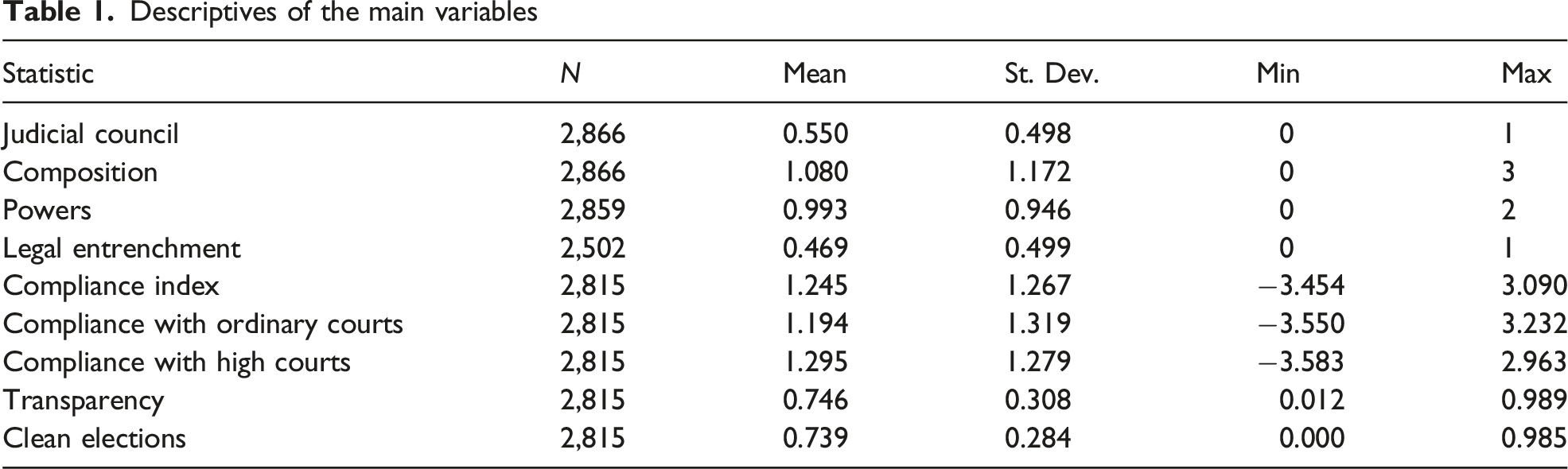
Formal powers over judicial careers are likewise constrained. The mean value of the powers variable is 0.99 on a 0–2 scale, suggesting that many governance bodies either lack effective authority over appointments, promotions, or discipline, or exercise only partial control. Constitutional entrenchment of judicial councils is also uneven: fewer than half of observations (47%) involve councils established at the constitutional level, highlighting the political malleability of judicial governance arrangements over time.
Executive compliance exhibits substantial variation, both across countries and within countries over time. The compliance index has a mean of 1.25 and a large standard deviation (1.27), with observed values spanning the full range from systematic defiance to near-universal compliance. Importantly, the distributions of compliance with ordinary courts and high courts are highly similar, supporting the use of a composite indicator to capture system-level enforcement dynamics rather than court-specific idiosyncrasies.
Political observability and accountability are likewise heterogeneous. Transparency and electoral integrity display relatively high mean values (approximately 0.74 on a 0–1 scale) but with wide dispersion, indicating that the sample includes both highly transparent democracies and opaque or weakly accountable regimes. This variation is central to the paper’s empirical strategy, which focuses on how institutional design interacts with political context rather than assuming uniform enforcement conditions.
Compliance and Transparency
Data on executive compliance, transparency, and democratic quality come from the Varieties of Democracy (V-Dem) Project (Coppedge et al., 2025). The main dependent variable captures executive compliance with judicial rulings, understood as the extent to which executive authorities implement or respect judicial decisions in practice. Importantly, this measure is not intended as a proxy for judicial independence or normative legality, but as an indicator of observable political behavior reflecting whether adverse judicial decisions are enforced.
I construct a composite compliance index by averaging two closely related expert-based survey items from V-Dem: the frequency with which the executive complies with important decisions of the high court (v2juhccomp) and with decisions of other courts (v2jucomp), even when it disagrees.
1
The two items are highly correlated (
Like all expert-based measures, this index reflects aggregated perceptions rather than direct observation of individual enforcement decisions. Its value lies in capturing general patterns of compliance over time, not in adjudicating the legality or desirability of particular rulings. Consistent with this interpretation, the measure tracks major political shifts that plausibly affect enforcement incentives. It reflects increases in compliance following democratic transitions in Spain (after 1978), Poland and Hungary (after 1989), and Croatia (after independence in the early 1990s), as well as declines in compliance associated with executive challenges to judicial authority in Turkey, Poland, and Hungary during the 2010s. Figure 1 illustrates the distribution and temporal variation of this index for selected countries. Distribution of executive compliance with judicial rulings in selected countries (1945–2025).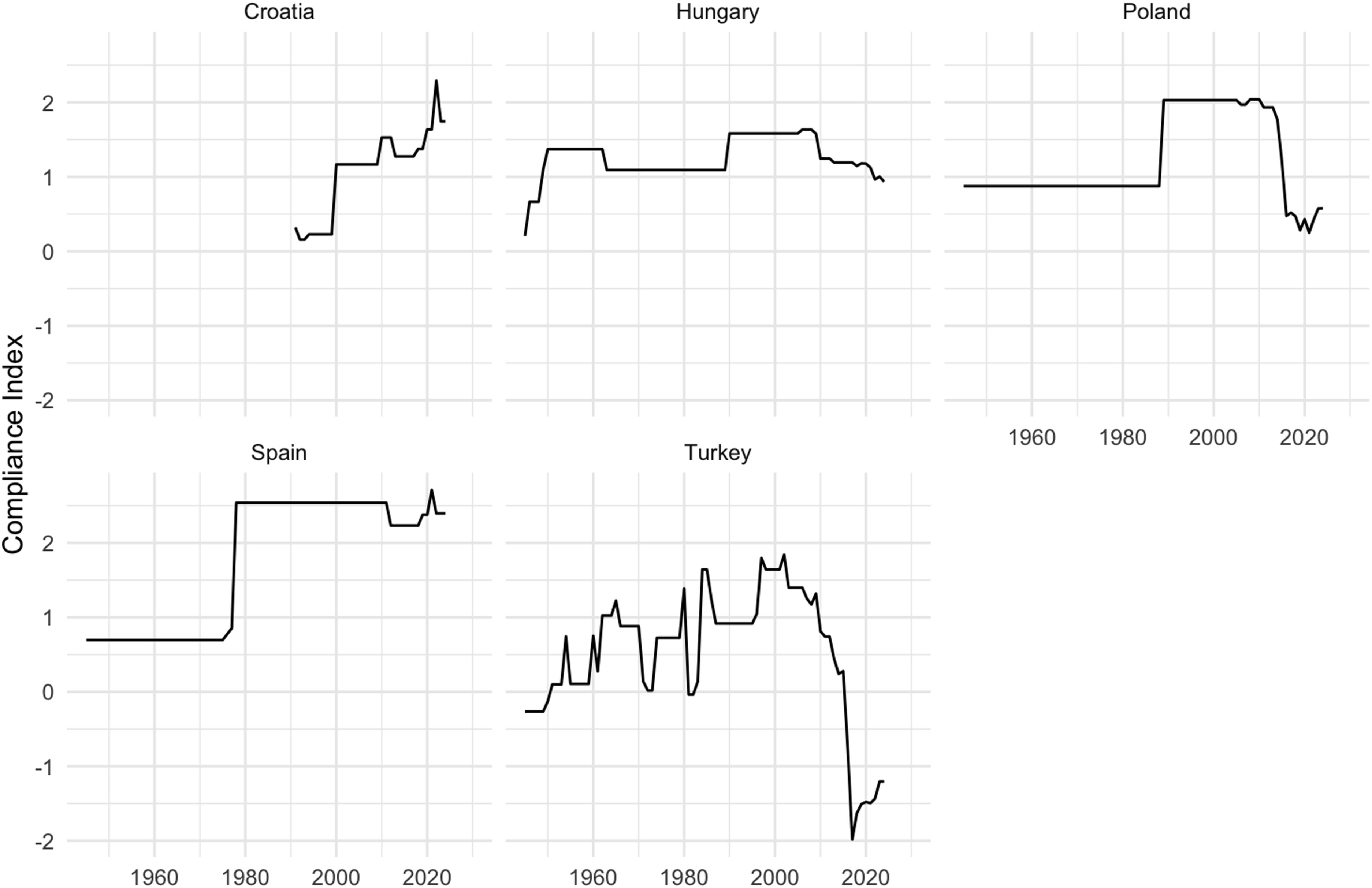
It is important to note that higher levels of observed compliance in authoritarian or pre-democratic periods should not be interpreted as evidence of judicial independence or executive respect for the rule of law. In such contexts, compliance often reflects hierarchical enforcement, political control of the judiciary, or coercive mechanisms rather than voluntary adherence to judicial authority (Guarnieri 2010; Hilbink 2007; Toharia Cortés 1974). The compliance measure used here captures whether judicial decisions are implemented in practice, not the conditions under which they are produced or enforced. This distinction helps explain why some authoritarian periods display relatively high compliance values despite extensive political control over courts.
One of the main covariates in the analysis is transparency, understood as the political observability of executive responses to judicial decisions rather than as a general measure of democratic quality. Transparency is proxied using V-Dem’s Freedom of Expression and Alternative Sources of Information Index (v2x_freexp_altinf), which captures the extent to which media operate independently of government control and politically relevant information circulates freely. While broad, this index reflects the core conditions under which executive noncompliance is likely to become visible to politically relevant audiences and, consequently, reputationally costly.
Importantly, observability need not operate exclusively through mass public mobilization. Independent media and open information environments also facilitate monitoring by political elites, parliamentary actors, and institutional participants in judicial governance, increasing the likelihood that noncompliance generates political costs even in the absence of widespread public reaction (Helmke 2005; Kosař and Šipulová 2023; Vanberg 2005). For this reason, the index provides a theoretically appropriate proxy for the enforcement visibility emphasized in strategic accounts of judicial compliance (Krehbiel 2021).
In addition, electoral integrity is measured using V-Dem’s Clean Elections Index (v2xel_frefair), which captures the extent to which elections are free and fair. This variable serves as a complementary indicator of political accountability, reflecting the extent to which executives face credible electoral consequences for behavior that undermines judicial authority.
Empirical Strategy
To test the hypotheses derived from the theoretical framework, I estimate a series of multilevel linear models using panel data. The dataset combines cross-national and longitudinal variation, allowing the analysis to examine how institutional features of judicial governance interact with political context to shape executive compliance with judicial rulings. The empirical strategy is designed to assess conditional associations consistent with the paper’s strategic framework, while accounting for unobserved heterogeneity across countries and time.
All models include random intercepts by country and by year. Country-level random intercepts capture unobserved, time-invariant characteristics—such as legal traditions, constitutional history, or judicial culture—that may systematically affect compliance but are not directly observed. Year-level random intercepts account for common temporal shocks and global trends, including waves of institutional reform or democratic erosion, that may influence compliance across multiple countries simultaneously. This multilevel specification makes it possible to retain between-country variation and to estimate the effects of institutional variables that change infrequently over time, such as the presence and design of judicial councils.
I prefer this approach to fixed-effects estimation for both substantive and statistical reasons. Substantively, the paper’s core interest lies in cross-national differences in institutional design rather than solely in within-country change. Statistically, fixed-effects models would either eliminate or substantially attenuate predictors with limited within-country variation, thereby constraining the ability to test the hypotheses of interest. Nevertheless, as a robustness check, I estimate alternative specifications with country fixed effects in the Online Appendix. These models yield substantively similar results, indicating that the main findings are not driven by the choice of estimator.
A central concern in this analysis is the potential endogeneity of judicial council design. The theoretical framework treats council composition and powers as institutions that executives may design or reform strategically, raising the possibility that observed institutional features respond to prior patterns of judicial assertiveness or compliance. To mitigate concerns about reverse causality, the main models rely on lagged measures of judicial council attributes, ensuring that institutional design is measured prior to the observed compliance outcome. Moreover, judicial council characteristics tend to be highly stable over time, with major reforms typically occurring during regime transitions, constitutional overhauls, or externally constrained reform processes. As a result, in most cases observed compliance follows (rather than precedes) the institutional configuration of judicial governance.
In addition, many reforms to judicial councils, particularly in Eastern and Southern Europe, were shaped by exogenous pressures such as EU accession conditionality, constitutional negotiations, or recommendations from international legal bodies, including the Venice Commission (Kosar̆, 2016). These dynamics suggest that institutional design was often politically constrained and not solely a reaction to short-term compliance dynamics. To further probe endogeneity, robustness checks reported in the Online Appendix test whether lagged compliance predicts subsequent changes in council design and include a permutation placebo test in which compliance values are randomly reassigned across observations. These analyses provide no evidence that prior compliance systematically drives institutional design. Nonetheless, the results are interpreted as associational rather than as estimates of isolated causal effects.
Consistent with this framework, composition is interpreted as a system-level proxy for expected control rights, not a direct measure of individual members’ political loyalty (Kosař, Šipulová, and Kadlec 2024).
The models include a limited set of control variables chosen to align closely with the theoretical framework and to avoid over-conditioning on conceptually overlapping or post-treatment factors. In addition to judicial council attributes, all specifications control for transparency (media freedom) and electoral integrity, which capture the political observability of executive behavior and the credibility of accountability mechanisms. These variables directly affect the expected reputational and strategic costs of executive defiance and are therefore central to enforcement-based theories of judicial compliance.
I deliberately refrain from including a broader array of political controls—such as populism, polarization, divided government, or general measures of democratic backsliding—in the main specifications. Conceptually, many of these factors operate through the same mechanisms emphasized in the theory, particularly observability and political accountability. Including them alongside transparency and electoral integrity would risk conditioning on intermediate outcomes rather than on exogenous sources of variation. Moreover, several such variables are plausibly endogenous to judicial conflict itself, raising concerns about post-treatment bias. The multilevel structure, with random intercepts for countries and years, further absorbs substantial unobserved heterogeneity, reducing the likelihood that omitted political variables drive the results. However, to assess whether the findings are robust to unobserved political context, I include ideological polarization as an additional control in a reduced sample of countries for which longitudinal data are available, and results are presented in the Online Appendix.
A further specification issue concerns the coding of judicial council composition and powers. Both variables take a value of zero in cases where judicial governance is exercised directly by the Ministry of Justice, generating a strong mechanical correlation between them. While such collinearity does not bias coefficient estimates, it can inflate standard errors and complicate interpretation. To assess whether the results are driven by this coding structure, I re-estimate the main models excluding cases in which both variables equal zero. The results, reported in the Online Appendix, remain substantively consistent, including the interaction effects central to the argument, indicating that the findings are not artifacts of collinearity.
In sum, this empirical strategy prioritizes theoretical coherence, transparency, and interpretability. The results should therefore be understood as conditional associations consistent with the paper’s strategic framework, rather than as estimates of deterministic or unconditional causal effects.
Results
Main Empirical Results
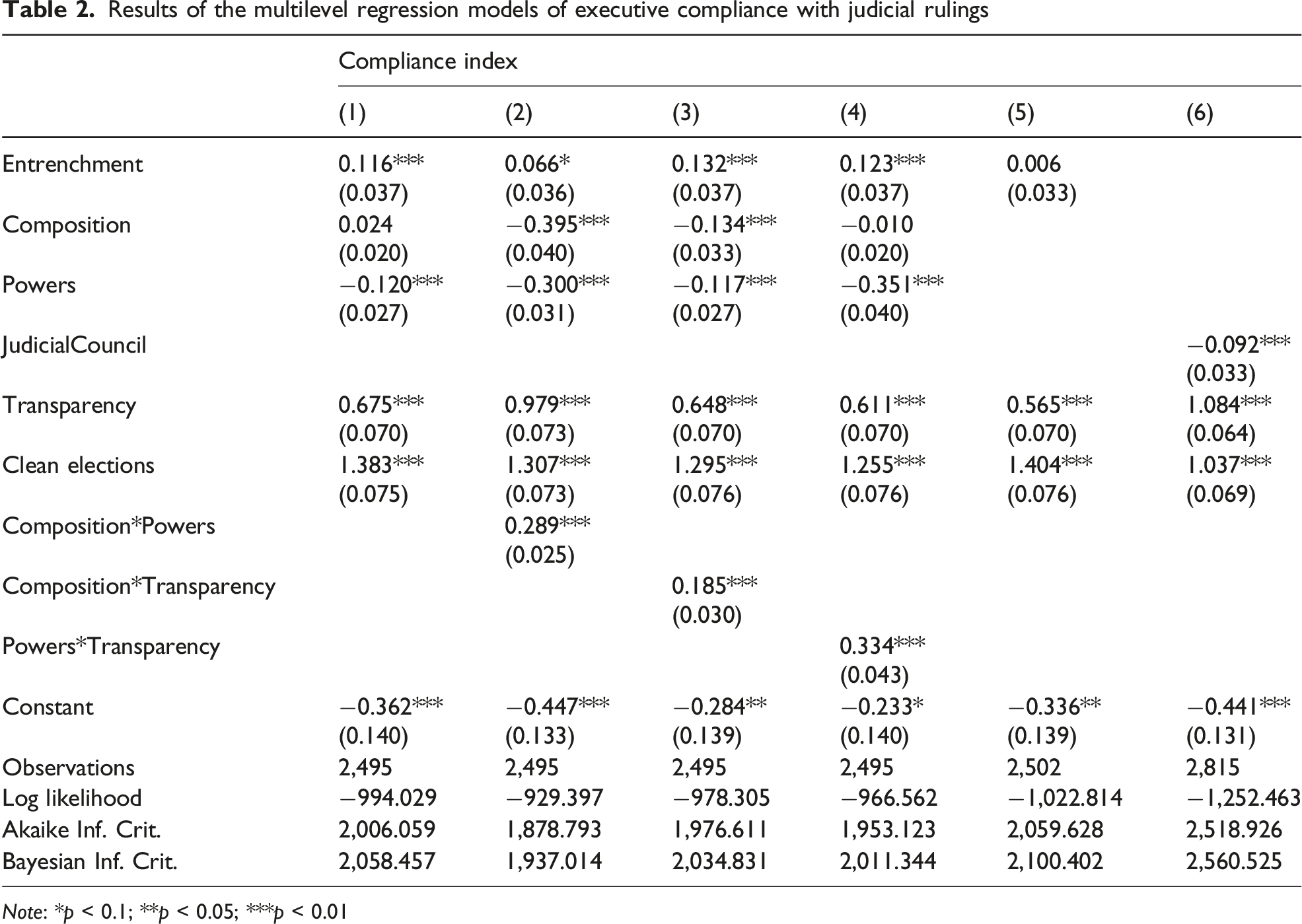
Results of the multilevel regression models of executive compliance with judicial rulings
Note: *p < 0.1; **p < 0.05; ***p < 0.01
Model 1 estimates the additive effects of judicial council design and political context. Council composition has no statistically significant association with executive compliance, while council powers are negatively associated with compliance. By contrast, transparency and electoral integrity exhibit large, positive, and highly significant effects. These results indicate that neither judge participation nor institutional strength produces compliance gains on its own, while political observability and accountability remain central.
Model 2 introduces an interaction between council composition and powers. The results reveal a strong conditional pattern. Both composition and powers display negative main effects, but their interaction is positive and highly significant. As shown in Figure 2, increases in council powers are associated with lower compliance when councils are politically dominated, but with higher compliance as councils become judge-majority. Formal powers thus enhance compliance only when insulated from political control, consistent with H2. Marginal effects of the interaction between composition and powers.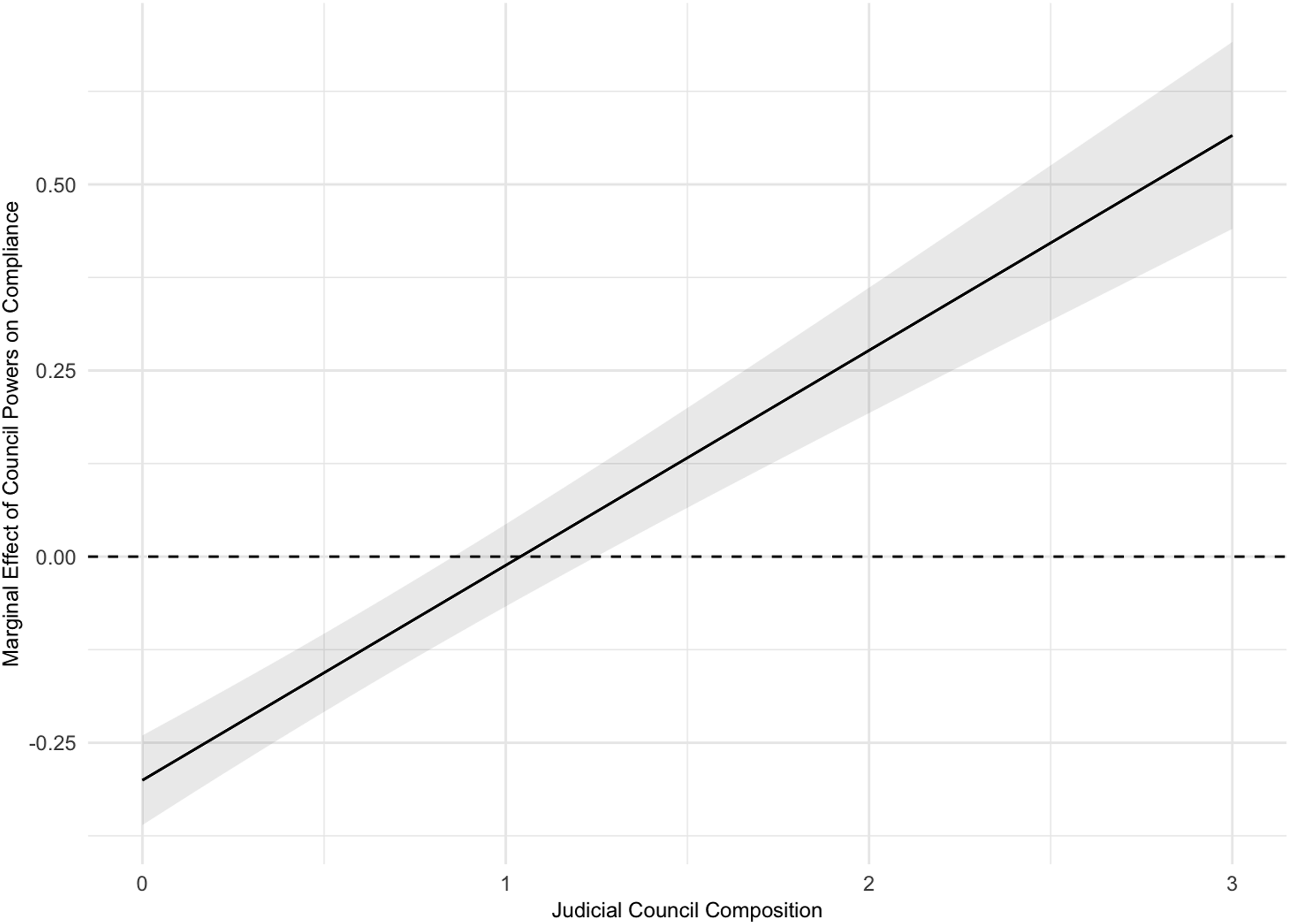
This interaction closely parallels findings in the recent literature on judicial self-governance. In particular, Šipulová et al. (2023) shows that councils with strong formal authority may nonetheless remain politically subordinated, limiting their capacity to affect judicial behavior. The results here similarly suggest that institutional strength alone is insufficient; the allocation of control rights conditions whether powers translate into greater compliance.
Model 3 examines whether the effect of council composition depends on transparency. The interaction between composition and transparency is positive and significant, while the constitutive term for composition is negative. Figure 3 shows that judge-majority councils are associated with higher compliance only in highly transparent environments. In low-transparency contexts, composition has no positive effect. Composition alone is therefore insufficient to induce compliance. Marginal effects of transparency on composition.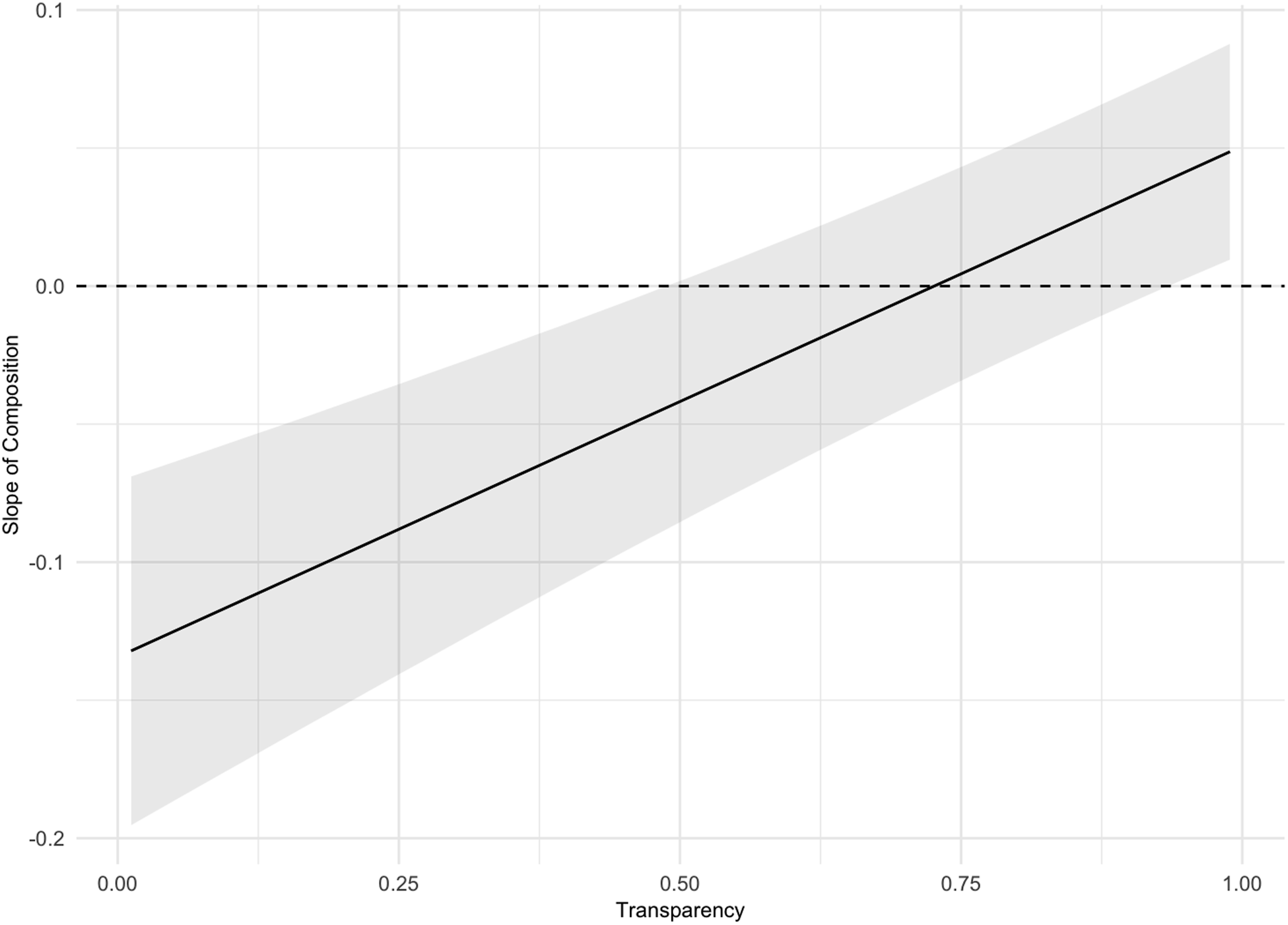
Model 4 evaluates a parallel interaction between council powers and transparency. The results mirror those of Model 2: powers are associated with lower compliance in opaque settings, but the interaction with transparency is positive and significant. Institutional strength becomes compliance-enhancing only when executive behavior is publicly observable, supporting H3.
Models 5 and 6 assess more parsimonious institutional specifications. Model 5 shows that constitutional entrenchment alone has no effect on compliance. Model 6 introduces a binary indicator for the existence of a judicial council; its coefficient is negative and significant, even after controlling for transparency and electoral integrity. This result suggests that councils introduced without meaningful insulation or visibility may be associated with lower compliance rather than higher compliance.
Overall, the results support the paper’s central claim: judicial councils do not exert uniform or additive effects on executive compliance. Their influence is conditional on who controls them, what powers they possess, and whether executive behavior is observable. In the absence of transparency or insulation, institutional strength may backfire, reinforcing executive control while lowering the expected costs of defiance.
Robustness Checks
To assess the credibility and generalizability of the findings, I conduct a set of robustness checks designed to probe the main inferential risks in cross-national panel analysis: unobserved heterogeneity, specification and measurement choices, sample sensitivity, reverse causality, and collinearity. Full results are reported in the Online Appendix.
I begin by addressing unobserved heterogeneity. Although the main models include country- and year-level random intercepts to absorb time-invariant differences across legal systems and common temporal shocks, I re-estimate the baseline and interaction specifications using two-way country and year fixed effects. The central conditional relationship—especially the composition × powers interaction—remains in the same direction and remains statistically distinguishable from zero, though standard errors increase as expected under within-country identification (Online Appendix Figure A.1). I also estimate random-slope models allowing the effect of council powers to vary by country. The average slope remains negative and statistically meaningful, while country-specific slopes show moderate dispersion, indicating that the main result is not driven by a small set of outlier trajectories (Online Appendix Figure A.2).
Next, I examine specification and measurement sensitivity. I recode composition and powers into binary indicators (e.g., judge-majority vs. other; strong vs. weak) and re-estimate the main models; the substantive pattern of interaction effects is robust to this simplification (Online Appendix Table A.1). I also replicate the analysis using each component of the compliance index—V-Dem compliance with ordinary courts (v2jucomp) and with high courts (v2juhccomp)—as separate dependent variables. Across both outcomes, the direction and structure of the conditional relationships persist, supporting the interpretation of the composite index as capturing system-level compliance dynamics rather than court-specific idiosyncrasies (Online Appendix Tables A.2–A.3).
As an additional diagnostic, I assess whether inference is sensitive to correlated shocks across subsets of countries by re-estimating the core interaction specification with standard errors clustered by EU membership. Although this is necessarily a coarse check given the small number of clusters, the point estimates are unchanged in sign and are substantively similar in magnitude (Online Appendix Table A.4). The main conclusions therefore do not depend on assuming independent errors across EU and non-EU contexts. Because this clustering structure is intentionally conservative and low-dimensional, I treat it as a sensitivity check rather than a primary basis for inference.
I further probe sample sensitivity in three ways. First, I re-estimate the main interaction specifications excluding Turkey, Poland, and Hungary, countries that have experienced unusually salient episodes of judicial politicization in recent years. The substantive pattern of conditional effects remains (Online Appendix Table A.5). Second, splitting the sample into pre-2000 and post-2000 periods yields directionally similar interaction patterns, though precision varies across subsamples as expected given differences in institutional prevalence and effective sample size (Online Appendix Table A.6). Finally, I examine whether the results are sensitive to broader features of political competition by incorporating ideological polarization as an additional control in a reduced sample of Western European countries for which longitudinal data are available. While higher levels of polarization are generally associated with lower executive compliance, the core conditional relationships between judicial council design, transparency, and compliance remain substantively unchanged (Online Appendix Table A.7). This suggests that polarization may shape the background difficulty of compliance but does not account for the institutional mechanisms identified in the main analysis. Consistent with the theoretical framework, the effects of judicial councils operate through governance and observability rather than through partisan conflict per se.
To evaluate endogeneity concerns, I conduct two placebo tests aimed at reverse causality and spurious fit. In the first, I regress judicial council features on lagged compliance (one and 2 years). If governments systematically redesign councils in response to recent compliance levels, lagged compliance should predict subsequent institutional change. The results provide no robust evidence of this pattern: a small association appears for powers at a 1-year lag in one specification, but it disappears at lag two, and no association is found for composition (Online Appendix Table A.8). In the second placebo test, I randomly permute the compliance index and refit the model; key coefficients collapse toward zero, consistent with the interpretation that the main findings are not artifacts of chance correlation (Online Appendix Table A.8).
I also test whether the core conditional logic is specific to transparency by estimating parallel interactions between council features and electoral integrity (v2xel_frefair). These models show that the positive association between autonomous, empowered councils and compliance is stronger where electoral accountability is higher, consistent with the broader claim that institutional design is most effective when embedded in environments that raise the political costs of defiance (Online Appendix Table A.9).
Finally, I address multicollinearity between the two main institutional covariates—composition and powers—which are strongly correlated in the full sample (
Discussion and Conclusion
This study revisits widely held assumptions about the role of judicial councils in securing compliance with court rulings. Rather than treating institutional design as producing automatic or uniform effects, the analysis shows that the relationship between judicial councils and executive compliance is deeply conditional. Judicial councils matter not simply because they exist or because they are formally insulated, but because of how their internal design interacts with political transparency and strategic incentives.
The paper makes three contributions to the literature. First, it qualifies institutionalist accounts of judicial independence that emphasize insulation and formal safeguards as primary determinants of judicial effectiveness (Dixon and Ginsburg 2018; Ferejohn and Kramer 2002). The results demonstrate that formal design features—such as constitutional entrenchment, judicial participation, or broad formal powers—do not operate in isolation. Their effects depend on who controls them and on whether executive defiance is observable and politically costly. Second, the paper extends theories of judicial compliance that focus on public accountability and reputational sanctions (Staton 2010; Vanberg 2005) by showing that institutional design conditions the very enforcement mechanisms these theories emphasize. Judicial councils can amplify, mute, or even undermine reputational dynamics depending on their configuration. Third, the findings contribute to strategic theories of institutional design (Carruba 2009; Stephenson 2004) by providing systematic empirical evidence that judicial councils themselves may be designed or reformed as instruments of political control rather than as neutral safeguards.
A central implication of the findings is that judicial councils should not be assumed to be inherently independence- or compliance-enhancing. Judge-majority councils endowed with meaningful powers are associated with higher compliance only when operating in transparent environments where executive behavior is observable. By contrast, politically dominated councils (even when formally strong) are associated with lower compliance, particularly in opaque contexts. Institutional form, in other words, cannot be equated with institutional function.
These results align closely with recent comparative research showing that formal authority does not necessarily translate into effective judicial self-governance when control remains political or symbolic (Garoupa 2025; Kosař and Šipulová 2023; Šipulová et al., 2023). Country-level examples illustrate these dynamics. In Hungary and Poland, governments have restructured judicial governance bodies to concentrate control while preserving the formal appearance of independence, contributing to selective or strategic compliance (Bánkuti, Halmai, and Scheppele 2012; Sadurski 2019). In Turkey, reforms expanded executive influence over judicial councils while reducing the visibility of judicial conflict, limiting the political costs of defiance (Esen 2025). Even in consolidated democracies such as Spain, political control over council composition and prolonged institutional deadlock have weakened judicial governance without eliminating formal safeguards (Castillo-Ortiz 2023; Vallbé 2026a). Across these cases, judicial councils operate less as fixed constraints than as politically embedded instruments whose effects depend on context.
Transparency emerges as a crucial moderator of these dynamics. In highly transparent systems, executive compliance is often high regardless of council design, as defiance is likely to carry immediate reputational costs. In low-transparency systems, even well-designed councils may fail to induce compliance. Judicial councils are therefore most consequential in intermediate contexts, where institutional design shapes whether judicial conflict becomes salient, credible, and politically costly. This finding underscores the importance of observability and monitoring—by the public as well as by political elites—in understanding when courts can effectively constrain executives (Clark 2012; Vanberg 2005).
The analysis also clarifies the relationship between judicial independence and executive compliance. While often treated as closely related, the two are analytically distinct. Judicial independence refers to the capacity of courts to decide cases without political interference, whereas compliance captures whether political authorities implement those decisions in practice (Ferejohn and Kramer 2002; Stephenson 2004). High compliance may occur under conditions of political domination, while independent courts may face systematic noncompliance when defiance is inexpensive. The results thus caution against using compliance as a proxy for independence and reinforce the value of analyzing enforcement as a strategic outcome shaped by incentives and institutional design (Staton 2010; Vanberg 2005).
Several limitations and extensions merit attention. The analysis relies on expert-based indicators of compliance and institutional design, which capture system-level patterns but cannot observe the micro-level behavior of judicial councils or individual judges. Future research could combine longitudinal data with qualitative or case-based evidence to trace how council decisions affect judicial behavior in practice. Moreover, while the analysis focuses on transparency as the central contextual moderator, other factors (such as ideological polarization) may also shape compliance by altering reputational dynamics and elite incentives (Clark 2012; Krehbiel 2021). Preliminary analyses suggest these effects are secondary, but they warrant further investigation.
More broadly, the findings suggest that judicial governance reforms should be evaluated with caution. Creating or strengthening judicial councils does not automatically enhance judicial constraint. Without attention to who controls these institutions and how their actions are monitored, reforms may backfire or serve primarily symbolic purposes. Understanding judicial councils as strategic governance institutions rather than as technocratic solutions offers a more realistic framework for assessing their role in democratic and hybrid regimes alike.
Supplemental Material
Supplemental Material - Institutions of Independence? Judicial Councils and the Strategic Politics of Compliance
Supplemental Material for Institutions of Independence? Judicial Councils and the Strategic Politics of Compliance by Joan-Josep Vallbé in Political Research Quarterly.
Footnotes
Acknowledgments
An earlier version of this paper benefited from insightful comments by Pablo Castillo-Ortiz. The paper was presented at the IPERC kick-off meeting held in Barcelona in July 2025, and I am grateful to Francesc Amat, Pablo Beramendi, Carles Boix, Albert Falcó-Gimeno, and Jordi Muñoz for helpful discussion and feedback. It was also presented at the Courts in Context CwC at the 2026 SPSA Annual Meeting in New Orleans, where I benefited from comments by Amanda Driscoll, Jay Krehbiel, and Michael J. Nelson. I also thank the two anonymous reviewers and the Editor for their constructive and helpful feedback.
Ethical Considerations
Ethical approval and informed consent were not required for this study, as it does not involve human subjects, personal data, or survey-based information.
Funding
The authors received no financial support for the research, authorship, and/or publication of this article.
Declaration of conflicting interests
The author declared no potential conflicts of interest with respect to the research, authorship, and/or publication of this article.
Data Availability Statement
The dataset and replication materials will be made publicly available in a trusted data repository upon acceptance of the article for publication. The data underlying this article are publicly available in the Zenodo open-access repository. The dataset includes country–year information on judicial governance institutions, executive compliance with court rulings, and political context variables for 47 European and neighboring countries between 1945 and 2025. The dataset can be accessed at: Vallbé, J.-J. (2026). Judicial Councils and Executive Compliance (1945–2025) [Data set]. Political Research Quarterly (Version v1). Zenodo. https://doi.org/10.5281/zenodo.18509801, ( ).
).
Supplemental Material
Supplemental material for this article is available online.
Note
References
Supplementary Material
Please find the following supplemental material available below.
For Open Access articles published under a Creative Commons License, all supplemental material carries the same license as the article it is associated with.
For non-Open Access articles published, all supplemental material carries a non-exclusive license, and permission requests for re-use of supplemental material or any part of supplemental material shall be sent directly to the copyright owner as specified in the copyright notice associated with the article.
