







Abstract
Few groups are as poorly represented in Congress relative to their prevalence in the population as are members of the working-class. While working-class members of Congress vote more economically liberally than do other members, the extent to which they are more likely to introduce or write legislation to benefit the working-class is unknown. We test whether legislators from a working-class background provide better substantive representation of the working-class by introducing and writing legislation that advances working-class interests compared to non-working-class legislators. Examining Policy Content Scores and sponsorship measures across four congresses covering 3,491 social welfare bills, we find that working-class members are no more likely to write bills that include more policy tools to ensure their preferences are reflected or introduce bills that addressing working-class issues.
“Government is instituted no less for protection of the property, than of the persons of individuals. The one as well as the other, therefore may be considered as represented by those who are charged with the government” -James Madison, Federalist #54.
In the United States, the wealthy enjoy disproportionate political access and influence, allowing them to achieve policy gains that compound their economic and political advantages (Bartels 2008; Bonica et al. 2013; Gilens 2012; Gilens and Page 2014; Hayes 2013; Stacy 2025; Witko et al. 2021). The outsized influence of the wealthy is unsurprising. After all, as Madison notes, protecting liberty, and particularly the property rights of the elite, was a primary goal of the American founding (Beard 1913; Dahl 2003; Madison 2001).
Even against this backdrop, the dramatic increase in income inequality over the last five decades is among the most striking shifts in American politics (Bartels 2008; Kelly 2009) and has renewed interest in a fundamental question: To what extent are the working-class able to make policy gains in the American system? Despite significant public support for a wide range of policies that might help the working-class and reduce economic inequality (e.g., a higher minimum wage, paid maternity leave, childcare subsidies, and increased access to low-cost health care), relatively few of these policies have become federal law (e.g., Gilens 2012; Gilens and Page 2014).
One explanation is that the preferences of working-class citizens are not well represented in Congress. While the working-class constitutes about 50 percent of the public, the proportion of legislators with a working-class background has never exceeded 5 percent (Carnes 2012). The virtual absence of working-class legislators may limit Congress’s propensity both to write and pass legislation addressing issues important to the working-class and to write legislation in a manner that ensures that working-class legislators’ preferences are followed. The underrepresentation of the working-class affects substantive representation if working-class legislators are more likely to introduce and write bills in a way that address working-class issues.
This paper examines whether working-class representatives are more likely to write and introduce social welfare legislation than are non-working-class legislators and therefore has implications for the underrepresentation of the working-class. We apply recent advances in measuring the quality of bill writing by using Policy Content Scores to examine the extent to which working-class legislators employ statutory tools to enhance fidelity with their policy goals (Lauterbach and Ritchie 2025). In combination with more traditional measures of bill authorship, like bill introductions, these data allow us to assess whether and to what extent members from working-class backgrounds represent the working-class through writing legislation. Applying a variety of measures using a range of estimation strategies, we find no evidence that working-class legislators introduce more bills, or write bills differently on working-class issues, than do legislators who lack a working-class background. These findings, therefore, add nuance to both specific findings about descriptive representation by working-class legislators and to the more general findings about descriptive representation.
Economic Inequality and Democratic Values
Despite broad popular support for policies benefitting the working-class, Congress has passed relatively few bills addressing their concerns over the last four decades (Gilens 2012). Polls show that 62 percent of Americans support increasing the minimum wage (Dunn 2021), 63 percent support the federal government being responsible for health care (Jones 2020), 74 percent oppose decreasing social security benefits (Parker et al. 2019), and 59 percent support a more progressive tax policy and think the wealthy and corporations should pay more in taxes (Dunn and Van Green 2021).
Despite this widespread support for progressive economic policies that would benefit the working-class, the federal government continues to implement policies that advantage the wealthy (Piketty and Saez 2007; Stacy 2025). Top marginal income tax rates have been reduced from 90 percent in the 1950s to 37 percent after passage of the 2017 Trump tax cuts (Fieldhouse 2013; Tax Policy Center 2020a). The capital gains tax rate has also fallen from its peak in the mid 1970s of almost 40 percent to between 15 and 20 percent (Tax Policy Center 2017, 2020b). The Big Beautiful Bill recently made permanent many of these cuts, as well as a $15 million dollar exemption on the estate tax, further benefitting the wealthiest Americans (Egan and Luhby 2025). Additionally, numerous policies weakening organized labor and workers’ rights have become law during this period (Bucci and Jansa 2021).
Policies that increase economic inequality further compound the challenges the working-class face because increased economic inequality leads to significant increases in political inequality (APSA Task Force 2004; Gilens 2012; Jacobos and Skocpol 2005; Kelly 2020; Rigby and Wright 2013). The wealthy are better positioned to make the financial contributions that facilitate access to, and responsiveness by, elected officials (Bonica et al. 2013; Kalla and Broockman 2016). The wealthy are also better able to pay the costs of participating, and much better able to overcome the barriers to participation disproportionately imposed on the poor (APSA Task Force 2004). Specifically, the wealthy are more able to afford the costs of running for office and more likely to be recruited for, run for, and serve in, political office—a job which is often either low or unpaid (Carnes 2013a). Running for office often entails great financial cost and time off from work, costs the working-class are less able to afford for a job that pays a fraction of the cost required to secure election (Carnes 2018). These problems are further compounded for working-class women who often bear a disproportionate role in child-rearing and household responsibilities (Barnes et al. 2021).
Taken together, the underrepresentation of the working-class in Congress and the resulting overrepresentation of those at the top of the income distribution both exacerbate economic and political inequality and undermine core democratic values of political equality and popular sovereignty.
Explaining the Policy Underrepresentation of the Working-Class
Scholars offer a variety of explanations for the lack of policy gains by the working-class. The institutional design of the American system privileges economic elites who benefit from the status quo because it makes policy change difficult (Enns et al. 2014). Reduced rates of organization, participation, and less political knowledge among the working-class reduce the degree to which their views are considered by elected officials (e.g., Jacobs and Skocpol 2005; Rigby and Wright 2013; Schlozman et al. 2018; Soss and Jacobs 2009). Concomitantly, politicians depend more heavily on those with greater financial and political resources to provide the resources needed for re-election (Bonica et al. 2013; Gilens 2012).
Beyond institutional impediments, the paucity of elected officials who come from a working-class background may limit efforts to reduce economic inequality. Studies show that while approximately 50 percent of the American population qualifies as working-class, historically fewer than 5 percent of members of Congress come from positions in blue collar industries or working-class families (Carnes 2013a). Given evidence that a legislator’s occupational background can impact their agenda-setting behavior (Hansen et al. 2019), there is reason to believe the descriptive underrepresentation of the working-class may impede policy advances.
The idea that people with shared experiences may be more sensitive and sympathetic to and knowledgeable about issues affecting their group is widely accepted in studies of representation (e.g., Bishin 2009). Shared experiences may help shape one’s identity. Research on social identity argues that shared group attachments motivate efforts to advance and reflect shared group interests and to oppose the positions and actions taken by members of outgroups (e.g., Bishin and Muttram 2024; Brewer 1999). They may also motivate individuals to run for office.
The Symbolic, Substantive, and Descriptive Representation of Working-Class Legislators
The virtual absence of people with working-class backgrounds in Congress diminishes the influence of the working-class in a variety of ways. Research shows that the inclusion of members of marginalized or stigmatized communities provides symbolic representation by presenting group members as legitimate and full participants in society (e.g., Tate 2003). These members then serve as important symbols and role models (e.g., Mansbridge 2003; Pitkin 1967). Candidates and elected officials from these groups increase both political efficacy and voter turnout among those who perceive shared group membership (e.g., Gay 2002, 2007; Pantoja and Segura 2003; Rocha et al. 2010).
Beyond their symbolic and non-policy benefits, however, these descriptive representatives—those who have the shared experience of being working-class—may provide other benefits to their fellow group members as well. Descriptive representatives bring personal experience to the less public aspects of the law-making process and may be more sensitive to, spend time on, and seek out unaddressed issues that affect fellow group members, and be more likely to act on behalf of fellow group members in their less public capacities (e.g., Hahn 2024; Hall 1996; Lowande et al. 2019).
Researchers find that on economic issues, members of Congress with shared backgrounds are much more likely to act on behalf of the concerns and economic interests of the working-class as well (e.g., Hahn 2024). Nicholas Carnes (2013a), for example, shows that blue collar legislators are more economically liberal than other legislators. In short, legislators from working-class backgrounds, like those from other backgrounds, are more responsive on roll-call votes that affect their group and more likely to act on at least some issues (Krcmaric et al. 2020).
Less well explored is the extent to which they may provide important institutional capacity to advance working-class interests through activities like bill writing, oversight, or opposing harmful policy proposals. Simply put, more working-class legislators may translate to greater capacity to pursue a wide range of working-class interests (e.g., constituent service, oversight, markup, and authorship).
Indeed, absent linkage to other forms of representation, some theorists reject the benefit of descriptive representation on its own (e.g., Pitkin 1967). As Hanna Pitkin (1967) explains, “….the best descriptive representative is not necessarily the best representative or government” (89). Others, however, acknowledge the limits of descriptive representation but argue that it may enhance substantive representation by facilitating deliberation, and increasing symbolic representation by enhancing legitimacy, especially when, for instance, descriptive representatives have strong mutual ties to a traditionally marginalized group (e.g., Dovi 2002; Mansbridge 1999). Jane Mansbridge (1999) notes that descriptive representation may be especially important when marginalized communities have diverse preferences, a condition that may apply to the working-class.
The evidence examining the link between descriptive and substantive representation across issues and groups, however, is perhaps more mixed and nuanced than commonly recognized. While Black members of Congress provide high levels of policy responsiveness (e.g., Stout et al. 2021), Latino members of Congress do not (Wallace 2014). Still other groups, like LGBT members of Congress, show very small but consistently higher levels of responsiveness than do non-LGBT legislators with similar backgrounds and from similar districts (Bishin and Weller 2025). While state legislatures with more women legislators have higher rates of policy innovation, states with larger Black, Latino, AAPI, and LGBT legislators do not (Nickelson and Jansa 2023). While these cases provide just a few examples from remarkably nuanced and deep literature, they also raise questions about whether and when we might expect descriptive representation to translate into substantive representation.
Similarly, heterogeneous findings are seen in the research on class and representation. On the one hand, analyzing both legislators’ roll-call voting records and support for bills rated important by AFL-CIO between the 1960s and 1990s, Carnes (2012) finds that legislators from working-class occupations cast more liberal roll-call votes than do legislators from other occupational backgrounds. Jacob Grumbach (2015) also finds that the class of a legislator’s parent is associated with increased roll-call liberalism for Democrats but not for Republicans.
On the other hand, while Carnes (2012) finds that occupational background and roll-call liberalism are strongly associated, he also finds that other measures commonly associated with class background, like education and financial resources, are not significant predictors of legislator liberalism. Moreover, while some research finds partisan responsiveness as Democrats disproportionately deliver beneficial changes to the distribution of income to the lower classes, more recent work finds no difference in responsiveness between parties in their responsiveness on roll-call votes (e.g., Hayes 2013; Hibbs and Dennis 1988). Thomas Hayes (2013), studying the same period examined in this paper, finds that Democratic Senators are no more likely to vote the interests of those in the lowest third of the income distribution than Republicans.
Understanding how legislators vote is a crucial component of understanding how representation impacts policy responsiveness. However, earlier stages of the policymaking process are less restricted and can shed light on a legislator’s goals and preferences, indicating the care and effort legislators exert to pass their bills (Hall 1996; Wawro 2001). Scholars often look at the bill introduction stage for evidence of substantive representation. Nicholas Carnes (2013a), for example, looks at the link between class and co-sponsorship and finds mixed evidence that blue collar legislators expend more effort on economic issues.
Outside the formal policymaking process, working-class Americans face even more hurdles in gaining representation. Scholars find that both parties largely fail to incorporate the policy preferences of working-class citizens in their campaign platforms (Rigby and Wright 2013). When it comes to providing constituent service, Hayes and Bishin (2020) find no difference between Democratic and Republican state legislators in their service responsiveness to the poor, but they do find that Democrats are significantly more responsive to the middle class on requests for assistance with health care.
Expectations
Research about descriptive representation suggests that legislators from working-class backgrounds will be more likely to introduce legislation that benefits the working-class and also more likely to write legislation that achieves their policy goals. To do so, these legislators may work harder to ensure that downstream political actors will implement legislation as intended by Congress. They can do this by writing legislation that goes to greater lengths to both constrain and incentivize bureaucratic actors to ensure they behave consistent with a legislator’s policy intent. This logic implies the following two hypotheses.
The Introduction Hypothesis
Legislators from working-class backgrounds are more likely to introduce bills on working-class issues than are non-working-class legislators.
The Fidelity Hypothesis
Working-class legislators take more actions to ensure policy is implemented as intended than do legislators from non-working-class backgrounds.
Empirical Strategy and Data
To test these hypotheses, we compare the behavior of working-class legislators with legislators who are not from a working-class background on two key outcomes: bill introduction and the use of statutory tools in the legislation they write.
To examine whether there is a relationship between working-class status and support for social welfare legislation, we use Coarsened Exact Matching (CEM) and post-matching regression. This approach helps to ensure that any inferences we draw are based on comparing similar legislators to each other and that we do not draw inferences based on legislators who are unlike others in the data or on the functional form of the regression model (specification) we use to estimate statistical relationships.
We identify working-class and non-working-class legislators that are similar across district and legislator characteristics that past research shows to be correlated with both legislator’s background and behavior. The approach of CEM is to divide or “coarsen” each continuous variable into multiple categories such that within each “bin” the observations are substantively similar. For discrete variables like political party, bins naturally emerge by category, such as shared party membership (i.e., Democrats and Republicans). After bin creation, observations are assigned to a stratum based on the pattern across bins (e.g., a Democrat, high union membership district), and if a stratum does not contain both working and non-working-class legislators then the observations in that stratum are not used in the analysis. We allow for an unlimited number of matches per stratum to maximize the number of observations used in the regression analysis.
Building on past research, we use the following variables in the matching process measured at either the district level or legislator level (e.g., Carnes 2012): Party membership, median household income, Black share of the district population, Latino share of the district population, percent of the Congressional district that voted Democratic in the most recent presidential election, and district union membership. 1
Even after assigning scores to bins, there may still be some imbalance on the matching variables within a stratum because, although two observations might be assigned to the same bin for matching, they will not necessarily have the exact same value on an underlying continuous variable (Ho et al. 2007). Therefore, we use regression models to account for remaining imbalance on the matched variables. We estimate the influence of working-class background in each Congress separately as the political context changes across sessions, and we also estimate the effect across the pooled data.
Data
We examine legislator behavior over four congresses from 2005 to 2012 (109th–112th Congresses). These congresses represent every configuration of party control of the Congress and presidency. More specifically, these four Congresses cover two presidents (George W. Bush-R and Barack Obama-D), unified government under both parties (109th Republican and 111th Democrat), and divided government under both parties (110th & 112th). This variation allows us to examine working-class effects under different institutional patterns that may affect legislators’ propensity to write and introduce legislation. These congresses include working-class representatives from both parties and at comparable rates to other recent congresses.
Within these congresses, we identify all public lawmaking bills (H.R.) introduced in the U.S. House of Representatives using the Congressional Bills Project (Adler and Wilkerson 2012). We identify bills important to the working-class by applying the Clausen coding criteria (described below) to the Congressional Research Service’s “Policy Area” classifications. We identify working-class legislators based on Morgan (2017) using a combination of the occupation description variables from the Congressional Leadership and Social Class (CLASS) data developed by Carnes (2016) and additional data collection using the Congressional Biographical Directory. 2 In total, our dataset consists of 1,780 legislator-Congress pairs who introduced 26,735 public bills. All variables, sources, and coding are described in Appendices D-G.
Dependent Variables: Bill Introductions and Tools Used in Statute Writing
Few legislative activities offer the potential to influence policy as directly as writing and introducing legislation that helps achieve a member’s policy goals (Wawro 2001). The process of writing effective legislation, however, is mostly hidden. It is difficult to determine the extent to which legislators write legislation to enhance their electoral prospects, achieve their policy goals, or both at the same time (Lee 2022).
Legislators can achieve policy benefits by writing legislation that makes accomplishing their goals more likely. Policy success almost always requires implementation by downstream political actors, giving legislators an incentive to write statutes to induce and constrain these actors to follow their policy goals. Doing so, however, is relatively time consuming. Those who want their policy goals met need to think carefully about how to write legislation to prevent others from subverting their intent while still securing sufficient votes for passage (Epstein and O’Halloran 1999; Huber and Shipan 2002; VanSickle-Ward 2014). The primary way legislators ensure compliance is through use of statutory tools that establish oversight or provide incentives and punishments to these downstream actors. Policy Content Scores (PCS) provide a measure of the extent to which legislation contains these tools and thereby constrain other political actors to narrowly pursue and enforce the author’s policy goals (Lauterbach 2021; Lauterbach and Ritchie 2025). 3
Measuring Bill Introduction and Policy Content
For our primary analyses, we identify all bills introduced in a congressional session that are classified as social welfare bills using the Clausen issue codes obtained from NOMINATE (Poole, 2021). Aage Clausen (1973) identifies five different issue areas that include government management, social welfare, agriculture, civil liberties, and foreign and defense policy (with a miscellaneous category added for remaining uncategorized roll-call votes in NOMINATE). We focus on social welfare policy as these topics are most closely associated with working-class issues, including social security, public housing, labor regulation, employment, and the minimum wage. This category of legislation includes 22 percent of all bills introduced during the 109th–112th Congresses. 4
We test the Introduction Hypothesis by examining whether there is a difference between working-class and non-working-class legislators in introducing working-class bills based on Clausen’s social welfare category. We operationalize this concept in two ways. First, legislators who introduced at least one such bill in a congressional session are coded “1” while those who did not are coded “0.” We also count the total number of social welfare bills a legislator introduces to account for the possibility that working-class legislators may introduce a larger number of these bills.
We test the Fidelity Hypothesis by examining if working-class status is associated with increased use of tools that incentivize and constrain downstream actors to achieve legislative policy objectives on social welfare bills. Specifically, we employ PCS data (Lauterbach 2021) for the social welfare bills that were “initially introduced” during this period. Each piece of legislation receives a score ranging from 0 to 12 indicating the number of different policy tools included in each bill. 5 Bills with higher scores employ a greater range of tools. This analysis focuses on the 1,205 legislators who introduce 3,442 social welfare bills with PCS scores.
Key Independent Variable: Working-Class Background
The key concept motivating our hypotheses is whether a legislator comes from a working-class background. We build on studies of social mobility to identify members with a working-class background, which is a dichotomous variable coded “1” if the legislator held a working-class occupation prior to entering Congress and “0” otherwise. Following Barnes et al. (2021), we focus on the importance of occupational socialization as a key mechanism for understanding legislator behavior (see also Manza and Brooks 2008). Put simply, experiences people have while working jobs can shape their world view (e.g., Mansbridge 1999). As legislators, this can impact the problems they identify, their preferred solutions, and the effort with which they choose to tackle the issue (Hall 1996; Hansen et al. 2019; McCubbins 1985; Wawro 2001).
We code “working-class” occupations using the criteria originally developed by Erikson et al. (EGP) (1979, 1982, 1983; Goldthorpe 1987) as updated by Morgan (2017) which accounts for changes in occupations over time and is tailored to the United States labor market (see also Franko and Witko 2022). 6 This modified EGP coding classifies those in service-oriented jobs (e.g., bus drivers and cashiers) and manual labor oriented jobs (e.g., carpenters, electricians, and food preparation workers) as working-class. 7
As the EGP measure has been widely used and differentiates workers from the owners, it allows us to be confident that we are measuring occupational socialization. The EGP categories capture both the stereotypical occupations associated with the working-class (e.g., bartenders and steelworker) as well as “pink-collar” jobs like dental assistants, preschool teachers, and barbers (Barnes et al. 2021). 8 Only 36 members serving from 2005 to 2012 come from a working-class background starkly illustrating the underrepresentation of working-class members in Congress. 9 Importantly, of these 36 members with a working-class background, 14 (39 percent) are Republican.
Analysis: The Introduction Hypothesis
We begin by estimating whether working-class legislators are more likely to introduce social welfare legislation than non-working-class legislators. To test the Introduction Hypothesis, we estimate a regression using the matched data that includes the same variables used in the matching process. Working-class background may affect either the decision to introduce a single bill or the total number of bills, and we therefore employ two dependent variables. First, we assess whether a legislator introduced a social welfare bill. Those that did are scored “1” while those that did not are scored “0.” Second, we employ a count of the number of social welfare bills each legislator introduced in each Congress.
10
Figure 1 displays the coefficient estimates of the relationship between working-class status and bill introduction on social welfare issues. Regression estimates of introduction of social welfare legislation on legislator class background.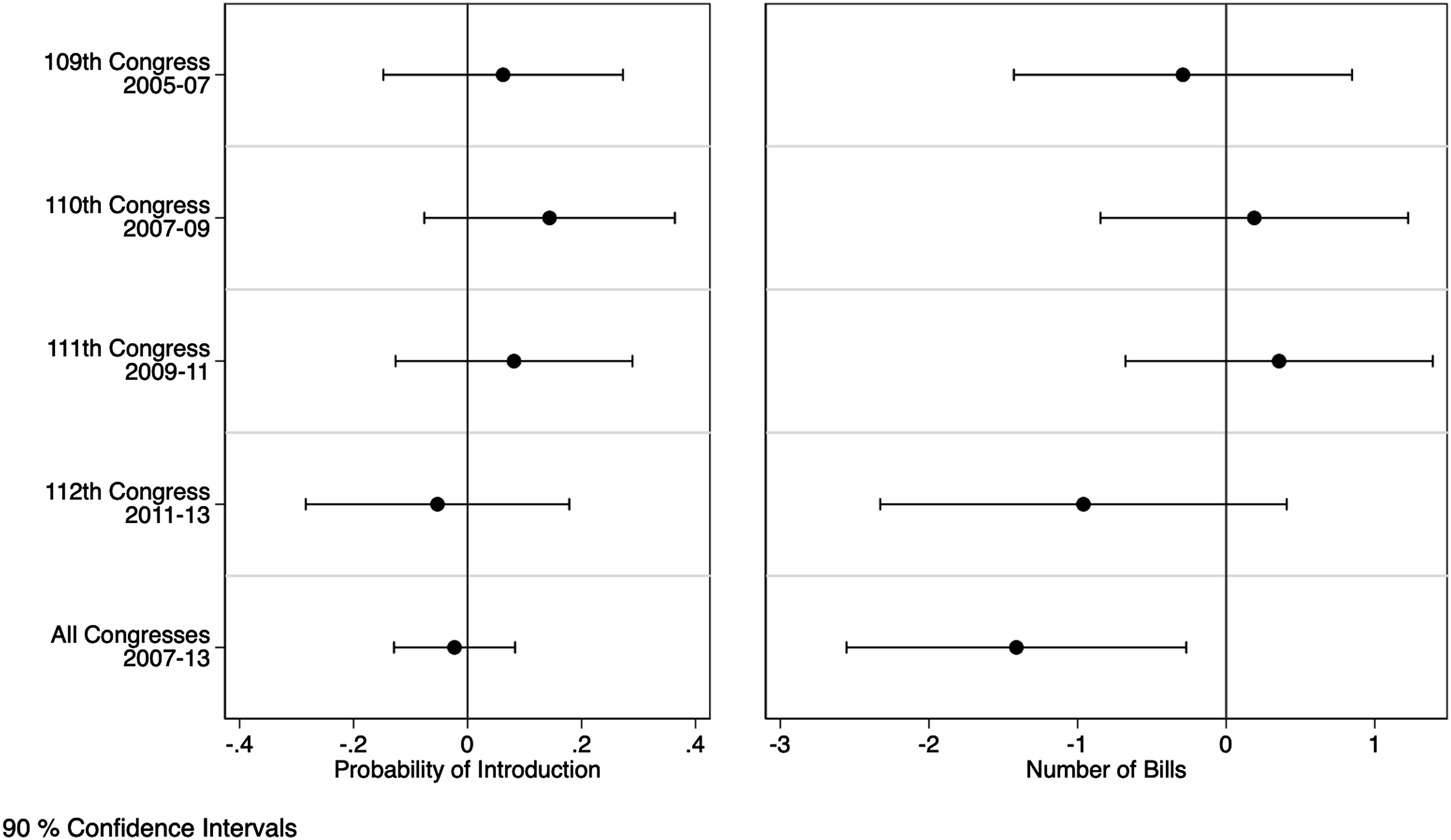
The left panel of Figure 1 depicts the coefficient representing the estimated effect of working-class status on the probability of introducing at least one piece of social welfare legislation in a given congressional session. 11 In none of the legislative sessions is there a significant relationship between working-class status and social welfare bill introduction, and the coefficient estimates are centered more or less at zero for each Congress.
The right panel of Figure 1 presents the estimates of the relationship between legislators’ working-class status and the total number of social welfare bills the legislator introduced. Here too, we find no evidence that working-class status is associated with introducing a larger number of social welfare bills. Overall, these results are inconsistent with the expectation that working-class status is associated with bill introduction.
As a robustness check, we conduct the same analyses on the entire sample of legislators and not just the matched subset. The results are substantively the same as reported for the matched sample and appear in Appendix A. Taken together, we find no evidence that working-class legislators introduce more social welfare legislation.
The Fidelity Hypothesis
We next turn to the Fidelity Hypothesis, which holds that to increase the fidelity of policy implementation by downstream actors, working-class legislators will use more policy tools (PCS) on social welfare legislation than will non-working-class legislators. We employ two dependent variables to investigate this hypothesis. First, we examine whether there is a difference between working and non-working-class legislators in the average number of tools used (i.e., PCS score) on social welfare legislation. Second, as time is a finite resource and the effort put into writing one bill may decrease the time available to spend writing other bills, we examine differences in the maximum number of tools used for any social welfare bill during each Congress. In Figure 2, we report the estimates for the average (in the left panel) and maximum number of tools used (right panel) for each Congress and for the aggregate across all Congresses. OLS regression estimates of policy tools on legislator class background.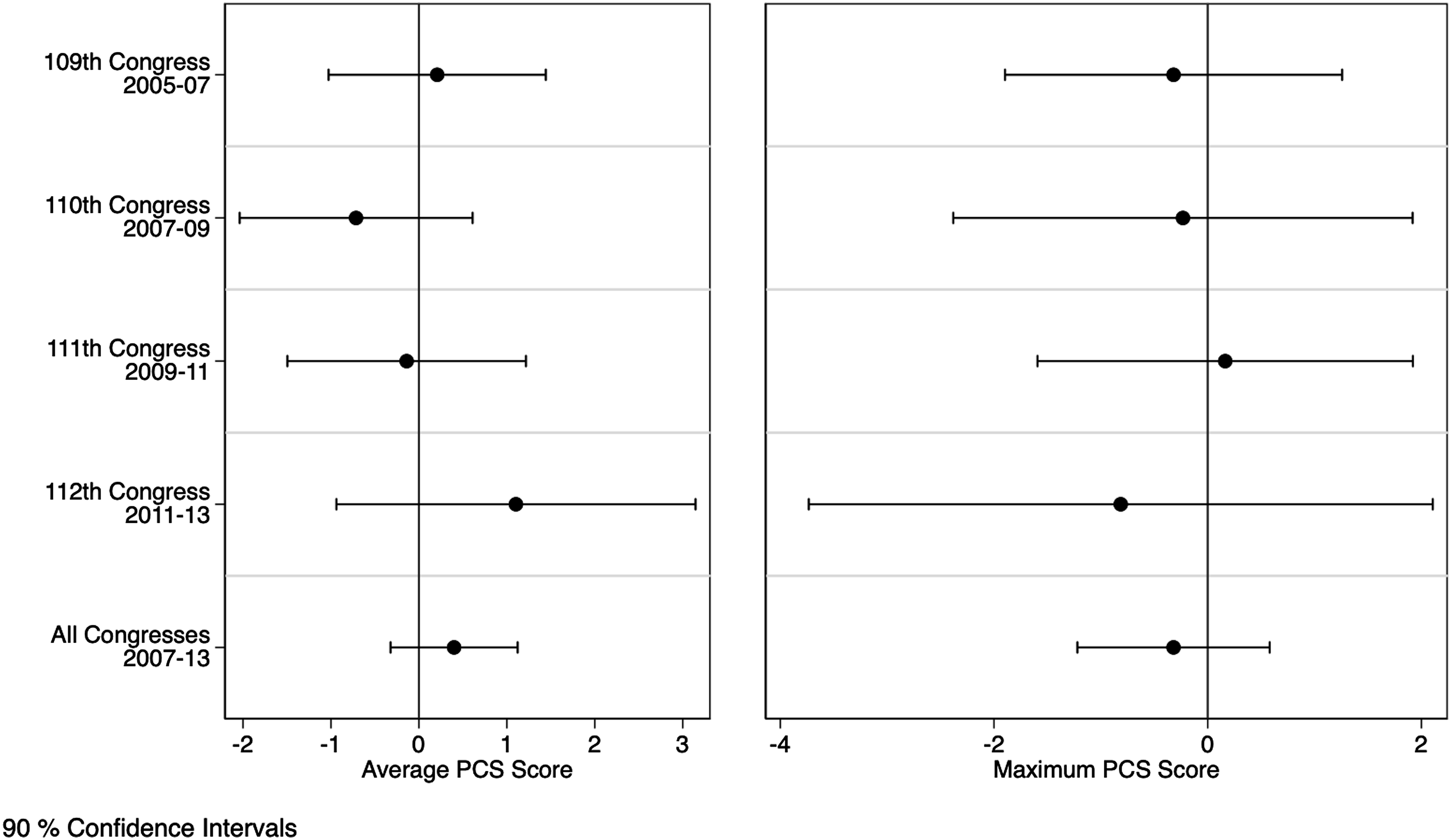
The results in Figure 2 indicate that there is no relationship between working-class background and the number of different policy tools, whether we look at the average or maximum number of tools used. Across all of the estimates, none are statistically significant. Moreover, the null results are not a product of employing matching as we re-estimate the analysis on the full sample do not find a relationship between working-class status and either operationalization of PCS. 12
Robustness Check: Within-District Comparisons
Our matching approach relies on comparisons between legislators to identify the effect of working-class status on our various outcomes. We employ well-known variables to both match legislators and adjust for differences between them in our regression models, but as is standard in observational data it is always possible that unmeasured (un)observables affect a legislator’s propensity to spend effort introducing or writing bills. This can lead to inconsistency in regression estimates with our estimates biased in unknown directions. Therefore, as a robustness check, we estimate the effect of working-class status by examining change within districts rather than across them to account for time-invariant features of a legislative district.
To estimate the effect of working-class legislators, we exploit within-district changes in the class background of representatives across congressional periods. The key predictor is an indicator for whether the district is represented in that Congress by a working-class legislator. Because many districts never elect a working-class representative, and because unobserved district characteristics may confound cross-sectional comparisons, we estimate a linear regression with district and Congress fixed effects. Our regression model adjusts for the subset of variables for which we have sufficient temporal variation, which includes legislator party, district percent union, and district Democratic vote share. The estimated effect of a working-class legislator is identified solely from districts that experience a change in the class background of their representative, and the estimated regression coefficient therefore reflects the average within-district change for a given outcome when a district is represented by a working-class legislator rather than a non-working-class legislator.
The results in Figure 3 display our estimates of the relationship between working-class status and each of four different outcomes. Only for the Bill Introduction outcome do we estimate a significant, albeit small, relationship (p < 0.05). These results provide further evidence, using a different empirical approach, that working-class status has little, if any, effect on the production of social welfare legislation. Regression of social welfare bill introduction and PCS use on working-class background.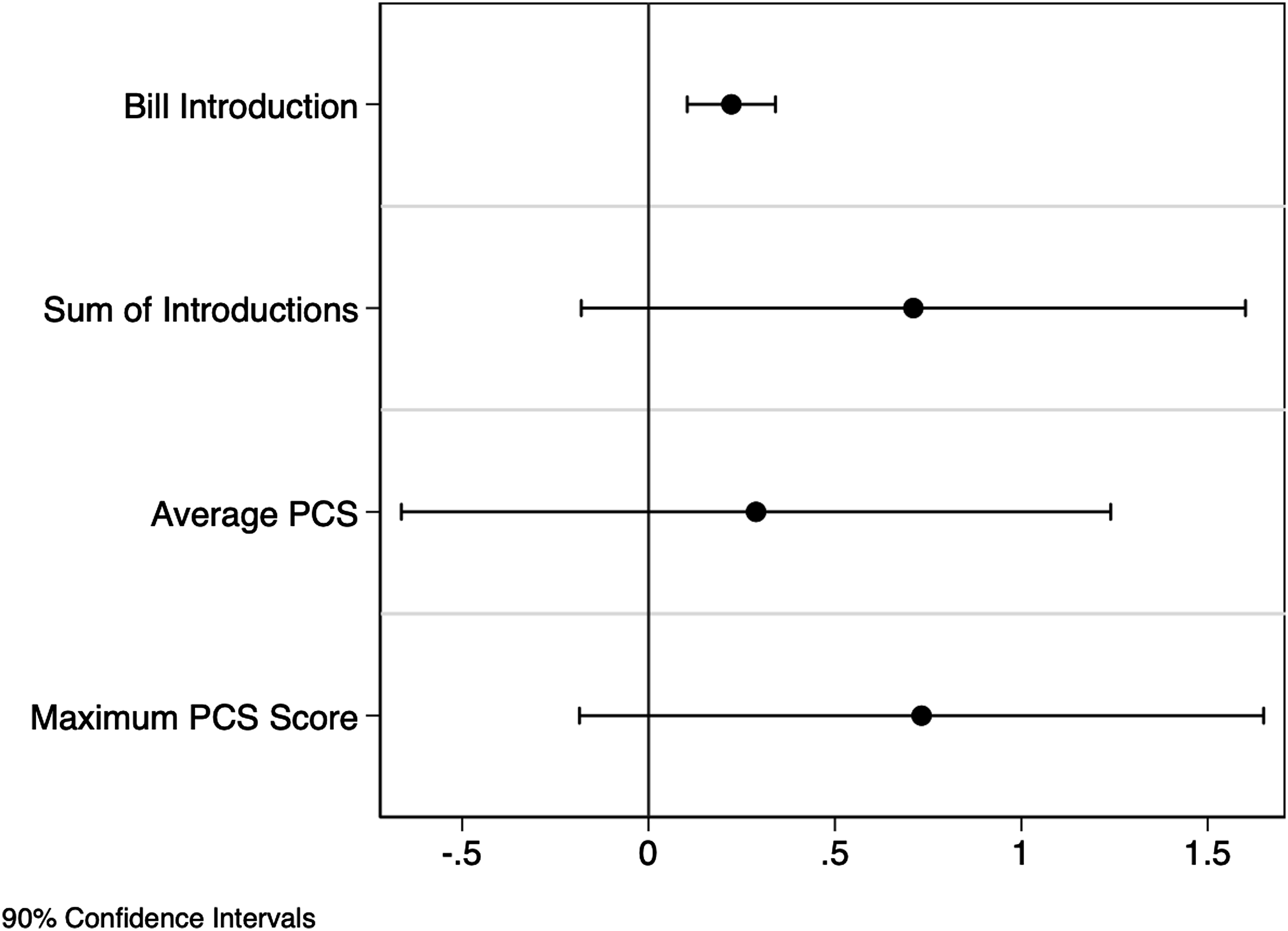
Alternative Explanations
Our results are highly consistent. We find that working-class legislators are no more likely to either introduce bills or write them in a way that increases their ability to ensure compliance with their policy objectives. Moreover, these results are robust to a variety of alternative measurement and estimation strategies. While contrary to expectations, these findings are consistent with research examining the link between descriptive and substantive representation that reports small effects or mixed results within and across groups (e.g., Bishin and Weller 2025; Nickelson and Jansa 2023; Wallace 2014). In fact, these results echo those in Carnes’ (2013a) book examining co-sponsorship and working-class representation. He finds, for example, that “Many of the class-based differences in legislative effort documented in Figures 3.3 and 3.4 fell short of conventional levels of statistical significance....” (75). Therefore, though the results are inconsistent with stated expectations, we are not the only to find limited descriptive representation in this context.
It is worth considering whether our results are driven by the estimation strategy, measure of legislator class background, or by studying a period in which the parties are significantly more polarized than they once were. To investigate these possibilities, we follow Carnes (2012) and others and replicate our matching analysis substituting 1st dimension of NOMINATE scores from the period in our study for the outcome variable (Lewis et al., 2021; Poole and Rosenthal, 2000).
13
If we do not find a significant relationship between working-class status and ideology, then it suggests that either our measure of class background or the period studied may explain why our findings diverge from previous research that focuses on roll-call votes. The results are depicted in Figure 4. OLS regression estimates of roll-call voting conservatism on legislator class background.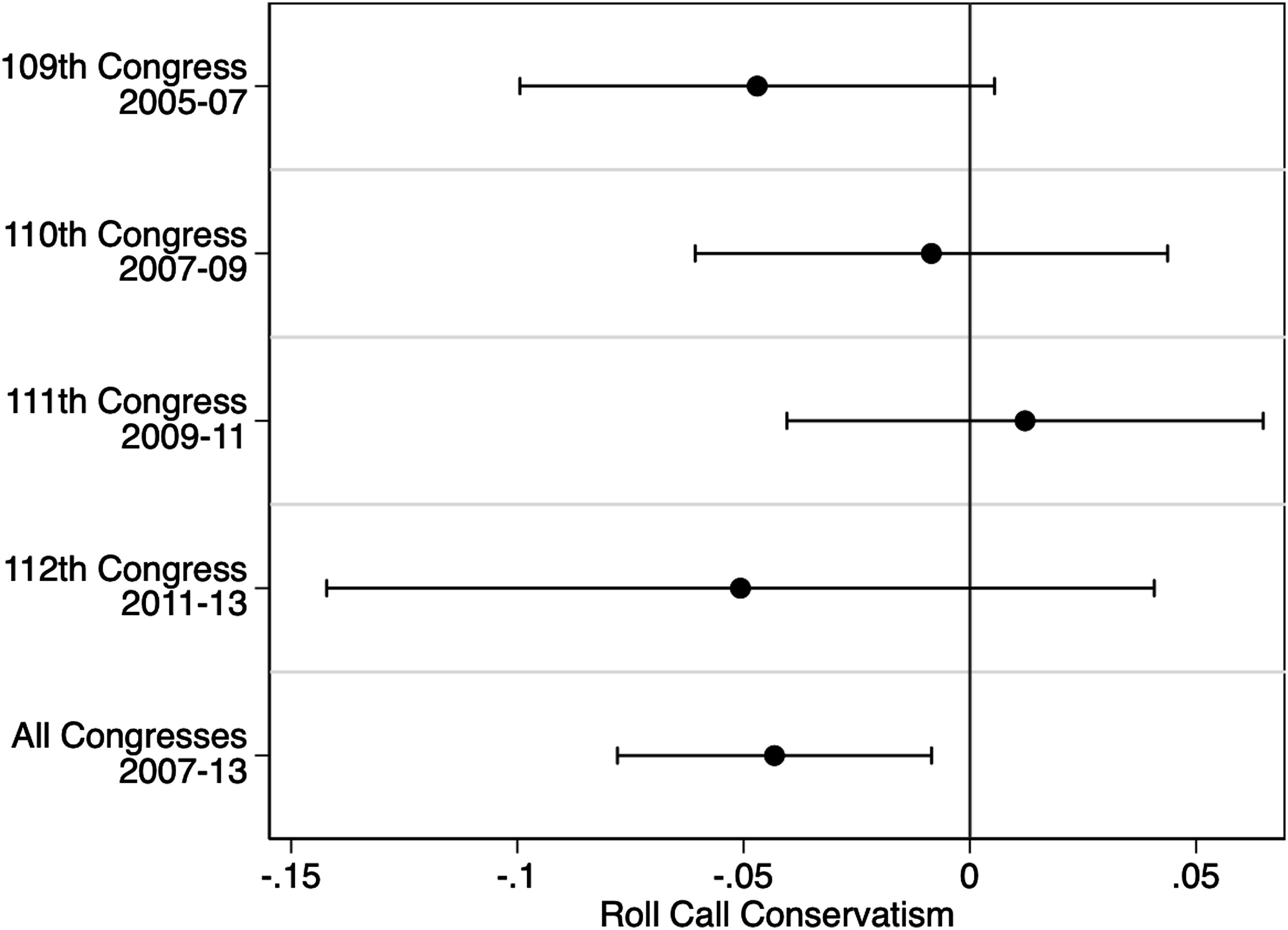
The results in Figure 4 are consistent with past research. Working-class legislators are less conservative than those without a working-class background. Moreover, the magnitude of the effects is very close to those Carnes (2012) estimates across key occupational groups (i.e., farm owners, businesspeople, and other private sector professionals). 14 The differences between our findings about bill introduction and policy tools therefore do not appear to be the product of different measures of class status, periods studied, or the estimation strategy (as shown in Appendices A and B). This combination of results suggests that working-class legislators are more liberal on roll-call votes but importantly, we cannot speak to whether the null results we observe in our main analysis stem from differences in the definitions of the bills studied.
Discussion
Our results raise the question of why working-class (descriptive) representatives do not provide substantive representation in bill introduction and writing? One answer may be that the conditions under which descriptive representation translates into substantive representation are relatively narrow (e.g., Dovi 2002; Mansbridge 1999; Pitkin 1967). In discussing descriptive representation’s focus on ensuring that the legislature accurately reflects the traits and experiences of the public, Pitkin (1967) notes “….if our concern is with political action by our representatives, the idea of accuracy is likely to mislead” (89).
Scholars also note that as underrepresented groups become increasingly diverse in their views, larger numbers of group representatives may be necessary to more fully reflect their interests and achieve their policy goals (e.g., Mansbridge 1999). Working-class members of Congress are both small in number and significantly divided between the two parties (overall across all Congresses in our data, 22 Democrats, 14 Republicans) or about 61 percent to 39 percent. Their small numbers may limit their capacity to advance change through bill writing and introduction, while their partisan or ideological diversity may impede their ability to work together.
The very small number of working-class legislators and the time constraints faced by all members may also increase their relative opportunity costs. Why spend time writing and introducing bills that have little chance of passing when there are so many other ways to provide representation that take less time and effort and will more certainly and immediately help the working-class (e.g., oversight, casting roll-call votes, and serving constituents) (e.g., Lowande et al. 2019)?
These costs are magnified to the extent that philosophical divisions among working-class legislators leave them at odds over how to advance working-class interests. Members from different parties may pursue diverse and even contradictory approaches to advancing working-class interests. Partisan differences may pose similar impediments by incentivizing the minority party to oppose bills that provide legislative victories to the majority for fear of improving their electoral prospects. To the extent that working-class legislators separate into even smaller ideologically homogenous groups, their combined capacity to write and pass legislation may be further reduced.
These explanations might simultaneously explain the lack of activity on bill writing and introduction combined with the modest effect of class background on legislators’ roll-call voting. The lack of sufficient numbers of working-class legislators does not affect their ability to cast more liberal final-passage votes even if few of those bills reflect their ideal policy. Moreover, it takes relatively little effort to cast roll-call votes on the few bills that have broad enough support to make it to the floor and therefore this is a fairly easy activity for working-class legislators, especially compared to bill introduction and writing.
A second explanation follows directly from the literature on descriptive representation. Simply because one shares a group characteristic does not mean the characteristic is important to them or affects how they see or prioritize their group’s issues. Suzanne Dovi (2002), for instance, emphasizes the importance of having representatives with strong mutual ties to dispossessed subgroups. Alternatively, some people with shared ascriptive characteristics may not internalize those attachments and identify psychologically as group members at all (e.g., Bishin and Muttram 2024; Oakes 2002). Even those that do, however, may have other group identifications that they hold more strongly that might trump their class identity should the different identities conflict. In short, descriptive representatives from the working-class under at least some circumstances may not be very good substantive representatives (Pitkin 1967).
Finally, the finding that class background is positively associated with legislator roll-call behavior may in part be an artifact of the assumption that working-class interests are equivalent to more liberal policy positions. There may be some conservative policy positions that do not align particularly well with such one-dimensional roll-call measures. For example, free trade policies that reduce prices for consumers may be opposed for different reasons by generally left-leaning labor unions and right-leaning economic nationalists.
Conclusion
James Madison’s goal, articulated in Federalist 54, of designing a government that advances the interests of property holders as much as people appears to have been achieved. Economic inequality in the US approaches record levels, and the working-class struggles to make policy gains. We examine one possible source of these outcomes: the under-representation of legislators with working-class backgrounds in Congress. For this lack of descriptive representation to matter, however, working-class legislators must legislate more or differently on issues that affect the working-class.
We find no evidence that working-class legislators write more bills or use more policy tools to induce and constrain bureaucrats to follow legislative policy preferences. Despite employing multiple measures of authorship and introduction, operationalizing the measures in a variety of ways, employing multiple estimation approaches, as well as examining districts before and after they are represented by a working-class legislator, we find no evidence that descriptive representation of the working-class enhances the substantive representation of working-class constituents through bill writing. Across our various models we have estimated 24 coefficients, with three being positive and significant and another three being negative and significant. This pattern of results is inconsistent with the expectations that working-class status is associated with a variety of types of substantive representation.
These results are not likely the product of the measures or methods we use. Applying our measures to examine a different form of legislator behavior—summaries of their roll-call voting behavior—we replicate the results of a study from an earlier era that finds a strong association between working-class background and increased support for more liberal roll-call votes (e.g., Carnes 2012).
These findings raise a series of very important but largely overlooked issues about both the underrepresentation of the working-class in Congress and the study of descriptive representation. First, these results suggest that simply electing more representatives from working-class backgrounds provides no assurance that they will write more bills or spend more effort ensuring the bills they do write incentivize or constrain others to fulfill their legislative intent on these working-class issues.
Second, the field of representation often overlooks the variability in the extent to which increases in descriptive representation lead to increased substantive representation across groups. Any hope to build a broader understanding of representation must take into account that descriptive representation translates into substantive representation for only some groups and on some dimensions. Moreover, this research suggests that there may be more variation than previously recognized as substantive responsiveness seems to vary across the type of actions taken by legislators.
These two sources of variation are important because they suggest a need for scholars to develop explanations for when and how descriptive representation translates into policy representation. To date most research examining representation focuses on individual groups. When our study is taken in combination with the body of literature showing variation in the degree to which representation occurs across groups, it suggests a broader lens may be needed to understand when, how, and under what circumstances marginalized and stigmatized groups are able to make policy gains in American politics.
Supplemental Material
Supplemental Material - Working-Class Legislators, Bill Writing, and Introduction: Limited Evidence of Substantive Representation in Congress
Supplemental Material for Working-Class Legislators, Bill Writing, and Introduction: Limited Evidence of Substantive Representation in Congress by Erinn Lauterbach, Thomas J. Hayes, Nicholas Weller, and Benjamin G. Bishin in Political Research Quarterly.
Footnotes
Acknowledgments
We want to thank Mirya Holman, Eduardo Aleman, Tiffany Barnes, Nicolas Carnes, Brian Hamel, Soenke Ehret, John Stephen Ahlquist, panel participants at the 2021 and 2022 APSA and the 2022 MPSA conferences, and the anonymous reviewers for their thoughtful comments and suggestions at various stages of the project. Thanks to Alba Ramos Escobar for her research assistance.
Funding
The authors received no financial support for the research, authorship, and/or publication of this article.
Declaration of Conflicting Interests
The authors declared no potential conflicts of interest with respect to the research, authorship, and/or publication of this article.
Data Availability Statement
Data used in the paper are available at https://dataverse.harvard.edu/dataset.xhtml?persistentId=doi:10.7910/DVN/HBCSCW,  .
.
Supplemental Material
Supplemental material for this article is available online.
Notes
References
Supplementary Material
Please find the following supplemental material available below.
For Open Access articles published under a Creative Commons License, all supplemental material carries the same license as the article it is associated with.
For non-Open Access articles published, all supplemental material carries a non-exclusive license, and permission requests for re-use of supplemental material or any part of supplemental material shall be sent directly to the copyright owner as specified in the copyright notice associated with the article.
