







Abstract
Supreme Court nominations culminate in nearly 24-7, multi-day coverage of the nominee and elected officials discussing the nominee’s views, qualifications, and the Supreme Court. Scholars show that these events shape public attitudes. In this paper, we argue that nominee evaluations, which are largely a function of partisanship, have a significant and enduring effect on public approval of the Court. As a result, we contend that the effect of partisanship on Court approval is mediated through nominee support. To test this, we utilize nationally representative CES data from the last five nominations that included hearings, including over-time data for three of the nominations. We analyze these data using causal mediation analysis shortly after the nominations, and again one to four years later. Our results confirm our theoretical expectations: much of the effect of partisanship on Court approval is transmitted through the support of recent nominees, and the nominee effects often last for years.
In September 2018, more than 20 million people tuned in to Brett Kavanaugh’s Supreme Court confirmation hearing, breaking news records (Richwine 2018). Although that hearing was especially contentious and long, the subsequent hearings of Amy Coney Barrett and Ketanji Brown Jackson also drew millions of viewers nationwide (Joyella 2018). Beyond the hearings themselves, individuals encountered hundreds of related stories each day across print, broadcast, and cable news (Cameron and Kastellec 2023). These hearings attract widespread attention because the nominee receives a lifetime appointment, carrying forward a president’s legacy long after he leaves the White House. And, they offer rare access to future justices, which is significant since most Court proceedings occur behind closed doors.
We argue that the rare, highly publicized, and informative nature of these hearings shape the public’s views of the Supreme Court. In this paper, we test whether nominations affect approval of the Court in lasting ways. We propose that individuals first evaluate a nominee through partisan attachment, a well-supported proposition (see Badas and Stauffer 2023; Krewson and Schroedel 2020, 2023; Sen 2017). Then, they evaluate the Court with the new member in mind (see Armaly, Krewson and Lane 2025). Thus, we theorize that partisanship influences approval of the Court through support for a nominee, and that this positive effect endures well beyond confirmation, making new nominations central to the institution’s public standing. We argue that nominations serve as a major “check in” point for members of the mass public that, much like salient cases (Christenson and Glick 2015), allow individuals to reassess their relationship to the Court. Moreover, nominations are partisanship-laden events that allow individuals to tie their existing predispositions to views of the judiciary.
Scholarship on related questions has mostly examined the influence of nominations on support for nominees separately from their influence on support for the Court. A key exception is Armaly, Krewson and Lane (2025), who find that descriptive representation (shared Black identity) boosts support for a nominee—in this case, Ketanji Brown Jackson—and produces a “downstream” increase in support for the Court. We apply a similar logic to the most dominant political characteristic in American politics: partisanship. Most individuals evaluate potential justices much as they do other political actors (Sen 2017). Although factors like “judiciousness” also matter (Hoekstra and LaRowe 2013), the primary driver of nominee support is shared partisanship (Sen 2017).
To test our theory of partisanship’s mediated influence on Supreme Court approval, we use nationally representative Cooperative Election Study (CES) data from the last five successful nominations: Kagan, Gorsuch, Kavanaugh, Barrett, and Jackson. 1 We focus on these nominations because CES surveys in those years included both support for the nominee and approval of the Court. 2 These cases span multiple decades and presidents, broadening the scope of our theory. Using causal mediation analysis, we find that support for a nominee—largely driven by partisanship—significantly shapes Court approval, accounting for much of partisanship’s total effect. To test whether this effect persists long after confirmation or is limited to the immediate aftermath, we use CES panel data for Kagan and rolling cross-sections for Kavanaugh and Gorsuch. We find that, though diminished in magnitude, the downstream effect of nominations on Court approval endures years after a justice joins the bench. Furthermore, the effect of partisanship persists when considering individual-level ideological disagreement with the Court; partisan identity is not merely a proxy for ideological considerations and has a unique influence on nominee and Court support.
Our study contributes to the growing literature on specific support. Scholars of judicial opinion distinguish between specific support (short-term performance evaluations) and diffuse support (institutional loyalty or legitimacy), but the two have become increasingly intertwined. Job approval—a common measure of specific support—is a key source of political capital that shapes perceptions of legitimacy (e.g., Boston and Krewson 2024). Prior research on specific support focuses on short-term effects of Court decisions (Ansolabehere and White 2020). Other work highlights government approval generally (Durr, Martin and Wolbrecht 2000; Haglin et al. 2021) and presidential co-partisanship specifically (Bartels and Kramon 2022) as explanations for Court approval. In contrast, we show that nominations have systematic and lasting effects on Court approval, distinct from the broader effects of presidential co-partisanship. 3
We also contribute to scholarship showing that extra-judicial activities, such as salient confirmation hearings, shape support for the Court (Gibson and Caldeira 2009a; Krewson 2023; Nelson and Gibson 2019). Studies document that public perceptions are influenced by how justices decide cases (King and Schoenherr 2024; Salamone 2014), and by resulting policies (Bartels and Johnston 2013; Christenson and Glick 2015). Thus, salient decisions are one well-studied opportunity for the mass public to re-evaluate their positions on the institution. However, salient decisions are relatively rare (Collins and Cooper 2012; Cota et al. 2026) and the public is scarcely tuned into everyday Court matters (Franklin 2022).
Like salient decisions, confirmation hearings give the public a chance to “check in” on the Court and re-evaluate it. But unlike decisions, these evaluations follow little direct action by the Court—aside from a justice stepping down. Support, opposition, and politicization of the nominee are driven mainly by extra-judicial actors who shape the narrative (Armaly and Lane 2022; Cameron and Park 2011; Johnson and Roberts 2004). The partisan perceptions formed during this time are significant because they ultimately affect public opinion of the Court (Bartels and Johnston 2011). Both salient cases and nominations are reasonable “flash points” on which to focus. Existing scholarship has focused on salient decisions (Christenson and Glick 2015); we extend this “check in” logic to nominations, a context in which the partisan environment is rich and readily accessible to individuals. We test these mechanisms together in the context of Justice Jackson’s nomination, which was proximate to the Dobbs decision. 4
We also provide important insight on the relationship between partisanship and Court support. Others have found that partisan attachment has little direct influence on support for the Court outside of experimental settings (Gibson 2007, 2024b; Gibson and Nelson 2014). The public requires contexts with clear informational cues to relate partisanship to the Court, such as salient decisions (Christenson and Glick 2015; Levendusky et al. 2024). We believe Supreme Court nominations are a ripe environment with clear partisan signals (Rogowski and Stone 2021), situated in the context of discussions of the Court, which prompt individuals to reconsider the Court via the partisanship-laden addition of a new nominee.
Importantly, the impact of nominations on Court attitudes appears to last for years. There is scant evidence from existing work to understand the durability of the impact which confirmation battles have on public opinion. A number of important scholarly works utilize panel data to examine attitudes pre- and post-nomination or confirmation (Armaly and Lane 2022; Gibson and Caldeira 2009b; Glick 2023; Krewson 2023). Most of these surveys, however, were conducted only weeks or months after the nominee was announced or confirmed. Utilizing CES panel and rolling cross-sectional data allow us to examine how nominee evaluations and subsequent influence on Court evaluations endure one, two, three, and even four years after the hearing took place. To our knowledge, ours is some of the first work to demonstrate the lasting impact the nomination and confirmation process has on public attitudes toward the Court.
Shaping Support for the Supreme Court
Public approval, confidence, and trust are vital sources of social capital for political institutions (Gibson, Caldeira and Spence 2003). As forms of specific support, these performance evaluations help explain how public opinion constrains political behavior. Despite being un-elected and not directly accountable, specific support matters greatly to the U.S. Supreme Court. There is some (albeit uncertain) evidence that judicial behavior is shaped by public support. For example, the Court is less likely to issue liberal rulings when public mood turns conservative (and vice versa; see Durr, Martin and Wolbrecht 2000; Hall 2014); and declines in public confidence alter justices’ behavior to avoid congressional restrictions (Bartels and Johnston 2020; Clark 2009). Justices recognize they must maintain public approval to achieve their goals (Epstein and Knight 1998).
For years, the Court maintained relatively strong and stable levels of specific support. Sinozich (2016, 174) reports “at least [a] slight majority approval of its job performance from 2000 to about 2011,” after which approval fell below 50 percent and stayed there in most polls. Sinozich also notes that confidence in the Court (and other institutions) has declined since the 1970s. Still, specific support for the Court remained higher than for other political institutions and showed little partisan polarization (see Gibson 2007), likely due to a “decision equilibrium” in which the Court did not consistently rule liberally or conservatively in salient cases and public perceptions of its ideological direction remained uncertain (Davis and Hitt 2025).
Recently, the Court has taken a sharp conservative turn that weakened specific support (Jessee, Malhotra and Sen 2022). Gallup polls show trust in the Court fell by 20 percentage points from 2020 to 2022. Levendusky et al. (2024) find steep declines in trust and favorability among Democrats after the 2022 Dobbs decision overturning the constitutional right to abortion, with only slight gains among Republicans. This aligns with the well-known negativity bias in reactions to Court decisions (Fontana and Krewson 2023; Grosskopf and Mondak 1998; Mondak and Smithey 1997). Recent declines in specific support tied to salient decisions like Dobbs highlight the role specific support plays in shaping diffuse support, or broader institutional loyalty (Easton 1965). It was long understood that a string of unfavorable decisions, or a single highly salient one, could reduce legitimacy (Caldeira and Gibson 1992; Gibson 2024b). For years, however, the Court often issued salient rulings that were neither consistently liberal nor conservative, making it unlikely that shifts in specific support spilled into diffuse support (Christenson and Glick 2019; Gibson and Nelson 2014; Nelson and Tucker 2021). This relationship has hardened as the Court has become more closely identified with conservative decisions and the Republican Party. Salient liberal rulings and appointment politics now systematically predict changes in legitimacy, largely mediated by Court approval (Boston and Krewson 2024). Perceived ideological congruence with the Court increasingly shapes legitimacy and has diverged along partisan lines in unprecedented ways (Clark et al. 2024; Davis and Hitt 2025; Levendusky et al. 2024). 5
Given the recent declines in specific support and its relationship with diffuse support, it is crucial to understand why members of the mass public approve or disapprove of the U.S. Supreme Court. There are two commonly replicated sources of approval in the literature. The first is performance evaluations. People express greater approval when they perceive the Court’s decisions to match their preferred outcomes (Ansolabehere and White 2020; Haglin et al. 2021). Boston and Krewson (2024) show that increases in the proportion of past salient liberal decisions consistently predict increases in Court approval among liberals but decreases in approval among conservatives.
Second, research on specific support finds that attitudes toward the other branches of government predict Court approval better than perceptions of congruence with Court outputs—whether through approval of government generally (Ansolabehere and White 2020), thermostatic reactions to presidential partisanship (Haglin et al. 2021), or co-partisanship with presidents (Bartels and Kramon 2022). People rely on presidential partisanship as a heuristic because presidents can influence Court outcomes directly and indirectly. With little information about the Court, its members, or its decisions, this cue is simpler to use. As Zilis (2021a, 78) put it, “Americans pay only limited, intermittent attention to the Court and face a complex informational environment.” 6
The Role of Partisanship in Evaluating Nominees and the Court
We argue that most individuals incorporate partisanship into their Court assessments only when it is clear how to do so—in research settings (e.g., experimental manipulations), major cases with obvious partisan stakes, or publicized controversies. We do not claim partisanship is never relevant; rather, its influence is contextual and tied to salience. Existing scholarship links partisan attachment to support attitudes and shows they are decidedly shaped by partisan rhetoric and clear party cues (Armaly 2018a, 2021; Clark and Kastellec 2015; Nelson and Gibson 2019). Yet in real life these cues are often muddled, made obvious only through experimental treatments.
Other scholarship using real events often highlights salient decisions. Sometimes the signal is clear—as with the 2012 Affordable Care Act challenge or the Court’s 2022 overturning of Roe v. Wade—and support shifts along partisan lines (Christenson and Glick 2015; Gibson 2024b; Levendusky et al. 2024). Other times, even salient rulings fall within the decision equilibrium, making systematic partisan attitudes unlikely. Instead, (often inaccurate) perceptions of congruence with Court outputs predicted support, at least until the Court’s conservative turn beginning in 2016. 7
Unlike other times when signals are ambiguous, nominations are clear moments for political predispositions to shape evaluations. Supreme Court confirmation hearings were once routine and largely nonpartisan; today they are overtly political. Since 1981, when the Senate Judiciary Committee first televised hearings (Farganis and Wedeking 2014), the process has grown more contentious. Senators increasingly ask pointed questions on controversial policies (Schoenherr, Lane and Armaly 2020), and organized interests mobilize to exert influence (Bird, Houston and Shieh 2024), even airing campaign-style ads (Bird, Houston and Shieh 2025). This polarized environment has turned once easy “yea” votes into divisive party-line votes (Cameron and Kastellec 2023).
The nominees at the center of these contentious hearings become the focus of the message. We argue that these elite signals are strong enough for the public to evaluate them. Scholarship shows nominees are judged both legalistically and politically. 8 Legally, most want nominees to be judicious (see Hoekstra and LaRowe 2013), or as Gibson and Caldeira (2009a) put it, to have the “legal and technical qualification” of a “good judge” (65). Politically, individuals assess nominees through shared partisanship and ideological agreement (e.g., Badas and Stauffer 2023; Krewson and Schroedel 2020; Sen 2017). On balance, political factors dominate: expectations about liberal or conservative rulings outweigh qualifications (Hoekstra and LaRowe 2013), and co-partisanship strongly predicts nominee support (Sen 2017).
We are not arguing that ideological disagreement—often triggered by salient decisions (Christenson and Glick 2015)—plays no role in shaping Court support. Individuals dissatisfied with a salient decision update their views toward the Court accordingly. Rather, partisanship is a stronger predictor of both nominee and Court support. Empirically, we are able to account for ideological proximity in our models and inferences about partisanship remain unchanged. Theoretically, extant scholarship in both judicial politics and public opinion leads us to believe that decisions likely play a smaller role (relative to nominations) in the overall mass attitude system. For starters, few decisions are salient enough to warrant much media attention (e.g., Collins and Cooper 2012), and awareness of the institution is low (Ramirez 2008). More importantly, the decision equilibrium suggests individuals can scarcely orient themselves toward the Court in ideological space (Bartels and Johnston 2013; Hetherington and Smith 2007).
Furthermore, robust public opinion scholarship highlights that the American mass public struggles with ideology as a measure of policy-agreement (Converse 1964). As Barber and Pope (2019) put it, “party trumps ideology.” Individuals hold ambivalent and incongruent ideological views (Barber and Pope 2019; Kinder and Kalmoe 2017; Lupton, Myers and Thornton 2015), and ideology is better thought of as an identity than a set of guiding principles (Mason 2018). Additionally, individuals typically respond to survey items with the most salient top-of-head consideration (Zaller and Feldman 1992). While Court decisions surely matter for overall support, most are difficult to incorporate into an attitude system. In short, we argue that stronger signals, like the partisanship of a nominating president via nominee support, are likely to be the most salient top-of-head consideration one makes. Again, we account for perceived ideological disagreement in our statistical models and, in the case of Justice Jackson’s nomination, we can measure abortion attitudes to account for reactions to Dobbs.
Checking in on the Court: Nominations as Partisan Cue
Although the nominee, not the Court, is at the center of the political information environment during confirmation hearings, the Court becomes linked to the discussion because the nominee is likely to join the bench (Armaly and Lane 2022). As Rogowski and Stone (2021) argue, political contestation over confirmations sends clear signals that allow individuals to connect nominees to their preferences. Thus, when asked to evaluate the Supreme Court—especially around a nomination—we expect the public to rely on their assessments of the nominee (i.e., the most salient top-of-head consideration).
Drawing on public opinion research, individuals rely on both a running tally and top-of-head considerations when evaluating institutions like the Court (Gant and Davis 1984; Lodge, Steenbergen and Brau 1995; Lodge, Stroh and Wahlke 1990; Zaller and Feldman 1992). Yet most Americans know little about the justices (Bomboy 2016; Franklin 2022) or the Court itself (Rozansky 2018), complicating evaluation. Because nominations are among the most salient political events with strong elite signaling (Rogowski and Stone 2021), and because the Court issues fewer decisions each term (Lane 2022), we expect nominee evaluations to be the most accessible and influential information on Court approval, even months later. In these moments, individuals “check in” on the Court, add new considerations to their running tallies and re-evaluate their views (a la Zaller and Feldman 1992). During such check-ins, cues are clearer and uncertainty about the Court’s future is reduced.
There is precedent for viewing nominations as moments when non-judicial attitudes shape court evaluations. Armaly, Krewson and Lane (2025), for example, use the nomination of Ketanji Brown Jackson to show that racial descriptive representation boosts support for the nominee and, in turn, the Court itself. Thus, factors influencing nominee evaluations—such as descriptive representation—indirectly shape Court support, even if they do not influence it directly. Crucially, this process occurs in the unique context of a nomination.
We argue this theory of downstream support applies broadly to nominee and Court evaluations, not just when groups gain descriptive representation. Classic accounts of public opinion show most individuals lack deeply held political beliefs (Converse 1964; Freeder, Lenz and Turney 2019; Lupton, Myers and Thornton 2015), and their attitudes are largely shaped by elites and group affiliation (see Bullock 2011; Leeper and Slothuus 2014; Lenz 2012)—a pattern evident for the Court as well (see Armaly 2018a; Christenson and Glick 2015; Nelson and Gibson 2019; Zilis 2021b). Nominations, then, are moments to reassess the Court through a partisan lens. They also provide opportunities for representation from a new member. Prior research highlights nominations as a source of symbolic or descriptive representation based on shared identity (e.g., Armaly, Krewson and Lane 2025; Kaslovsky, Rogowski and Stone 2021). Yet partisanship is itself a major identity (e.g., Huddy, Mason and Aarøe 2015), so co-partisans may expect both symbolic and substantive representation. Thus, the downstream theory applies whenever individuals perceive gains from a new member joining the Court.
To be clear, our argument does not depend on respondents believing that a nominee can immediately affect the Court’s performance, nor does it require respondents to project potential consequences of confirmation in a sophisticated way. Indeed, it is unlikely that individuals are projecting decision expectations onto the Court; as Armaly, Krewson and Lane (2025) state, “...representation does not automatically confer policy congruence or substantive representation...it can provide avenues...for people to feel empowered, elicit feelings of procedural fairness, and create other symbolic, intangible goods.” Thus, we conceptualize nominee support as a symbolic and partisan evaluation that becomes cognitively linked to the Court as an institution once the nomination is salient. Public opinion research has long held that institutional evaluations are not formed through literal causal reasoning about performance, but through heuristic and affective processes that link elites, partisan cues, and salient political events to broader institutional judgments (e.g., Lupia 1994; Lupia and McCubbins 1998; Zaller 1992), including on matters of the Supreme Court (e.g., Armaly 2018a; Haglin et al. 2021). The mechanism we propose is that a salient nomination and confirmation process allows individuals to learn about a nominee, and then use this information, which primarily includes their partisan identity, to evaluate the nominee (a´la Cameron and Kastellec 2023, 240). Then, because the nomination process is a politically salient event in relation to the Court, it has downstream consequences on individuals’ evaluations of the Court; it is the partisanship connection, rather than clear, literal expectations about what that nominee will deliver, that ultimately influences institutional attitudes.
Hypothetical Expectations
We argue that, like descriptive representation, partisanship operates indirectly—through nominee support—on the Court. Accurately assessing the institution is difficult: both Bartels and Johnston (2013) and Hetherington and Smith (2007) show individuals struggle to place the Court in political space, and Overby et al. (2004) hint that few can identify a court’s composition (see also Scherer and Curry 2010). As Armaly, Krewson and Lane (2025) suggest, it is much easier to reassess the institution when a new member joins. Nominations amplify partisanship in American politics, and evaluations of nominees follow suit. Given robust scholarship on partisan identification and nominee support (Sen 2017), we also expect partisanship to have a direct effect on nominee support. Because nominations are salient, nominee evaluations are easily recalled. As a result, partisan affiliation shapes support for the nominee, which then influences approval of the Court. This follows Armaly, Krewson and Lane’s (2025) theory that Court support is indirect, filtered through nominee support. Specifically, we hypothesize:
We also expect this mediated effect to have a lasting impact. The salience of nominations makes nominee evaluations prominent and easy to recall, especially given the rare opportunities for individuals to reassess the Court. Over time, of course, the relevance of nominees will fade as other top-of-head considerations (e.g., major cases, controversies) enter the attitude system. As such, we hypothesize:
Data and Methodology
To test our hypotheses, we use data from the Cooperative Election Study (CES), formerly the Cooperative Congressional Election Study (CCES), fielded between 2010 and 2022. The CES is a 50,000+ person national stratified survey administered annually by YouGov since 2006. 9 Following the second-longest period without a Supreme Court vacancy (1994–2005), several vacancies have coincided with CES surveys. 10 Beginning in 2010, these surveys contained the items needed to test our theory regarding partisanship, nominee support, and Court approval. Some justices were asked about in a single wave, while others appeared across multiple waves. Questions on Justice Kagan were asked of a panel of respondents from 2010 to 2014; Justice Kavanaugh appeared in three consecutive rolling cross-sections; and Justice Gorsuch in two. 11 We return to these over-time data later. Finally, we consider the nomination of Justice Ketanji Brown Jackson separately. Although we theorize that recent nominees are generally top-of-mind for Court evaluations, the singular Dobbs decision—with its intense coverage and vivid moral content (Gibson 2024a, 2024b; Levendusky et al. 2024)—was almost certainly the main top-of-head consideration in 2022, and may have displaced Jackson’s nomination as a mediator of Court approval.
Following Armaly, Krewson and Lane (2025), we test the effects of nominee support on Court approval using both structural equation models and causal mediation analysis. Causal mediation analysis allows us to assess whether partisanship increases Court approval through the mediator of nominee support. In other words, we test whether an independent variable affects a dependent variable indirectly (via a mediator), while accounting for its direct effect and other controls. We follow best practices in causal mediation analysis (Imai et al. 2011), including sensitivity tests to ensure our conclusions are not driven by violations of methodological assumptions. 12
For a visual representation of our theory of mediated partisanship on Court support, see Figure A2 in the supplemental appendix. We analyze data from five separate nominations, employing roughly the same equations for each. As explained below, prior scholarship suggests additional controls are appropriate for Justice Jackson’s nomination (as the first Black nominee in over 30 years and the first Black woman). For our main variables of interest, however, the equations are essentially identical across nominations. Specifically, we estimate structural equation models (SEM) using ordinary least squares. The equations are:

(Mediation model)

(Outcome model)
In the surveys we use, all respondents indicate whether they approve of the Supreme Court on a four-point scale from “Strongly Disapprove” to “Strongly Approve.” 13 We call this measure Court Approval. Respondents are also asked whether they would vote for or against specific Supreme Court nominees, which we label Judge Support. 14 While limited to single-item measures due to data availability, we believe they are appropriate. First, they are straightforward, minimizing response error. Second, prior scholarship also employs single-item measures for data-driven reasons (e.g., Sen 2017).
The two outcome variables are Judge Support (which also serves as an exogenous predictor in the outcome model) and Court Approval. In the structural equation, both variables are modeled as a function an intercept (α), dummy variables accounting for respondents’ partisanship (with independent leaners coded as partisans and counter-partisans of the president excluded as the reference category), a vector of covariates (represented by X and including our control variables), and an error term (ε). 15 SEM allows us to estimate the models simultaneously, treat some variables as both endogenous and exogenous, and correlate error terms. All variables are rescaled 0–1 so coefficient magnitudes can be compared and for ease of interpretation.
Finally, we outline what support for our hypotheses would look like in the models. First, in the Judge Support (mediation) model, we expect co-partisanship to have a positive, statistically significant effect, consistent with existing evidence (Sen 2017). Second, in the Court Approval (outcome) model, we regress Court Approval on Judge Support (plus controls) and expect a significant coefficient for Judge Support, supporting Hypothesis 1. In panel and rolling cross-section analyses, support for Hypothesis 2 requires Judge Support to remain significant across waves, though we expect the coefficient to decline in magnitude without predicting its degree. Finally, in mediation analyses, we expect the direct effect of partisanship to vary in sign and significance, but the mediated effect to remain consistent, providing further support for our theory. This is because the direct path captures a mix of competing mechanisms, such as perceptions of Court ideology or diffuse attitudes, which may not always point in the same direction. By contrast, the mediated path through nominee support reflects a clearer and more stable channel linking partisanship to Court approval.
Empirical Results
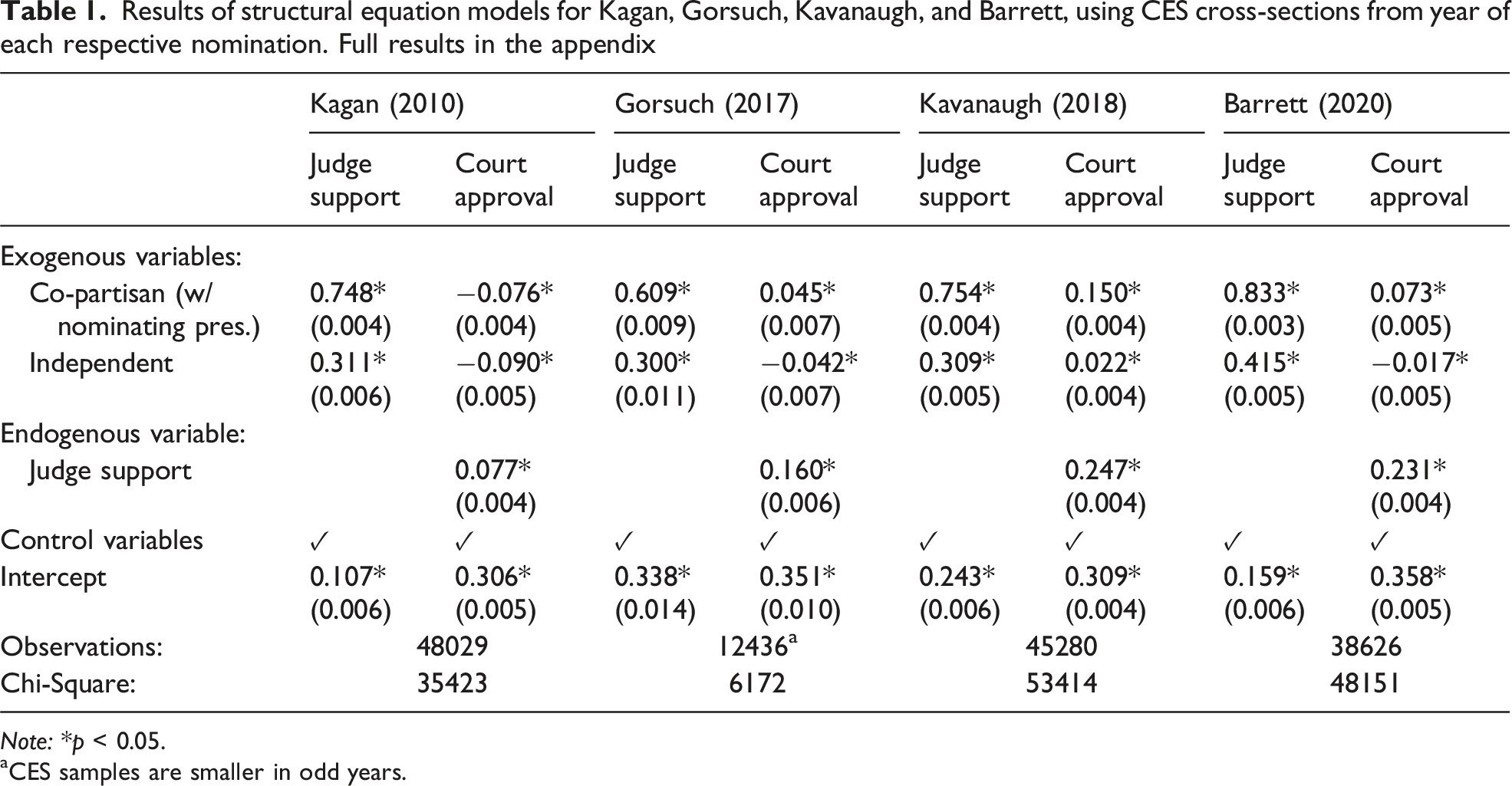
Results of structural equation models for Kagan, Gorsuch, Kavanaugh, and Barrett, using CES cross-sections from year of each respective nomination. Full results in the appendix
Note: *p < 0.05.
aCES samples are smaller in odd years.
Next, consider the Court Approval model in the next column. Here, we test our mediation hypothesis (Hypothesis 1), which predicts a positive and significant coefficient for endogenous Judge Support. This is exactly what we find (0.077). People who support Kagan’s confirmation are also more approving of the Supreme Court. Taken together, the Judge Support and Court Approval results show that those backing Kagan’s confirmation—primarily Democratic respondents—express greater approval of the Court overall. Importantly, these results hold for Gorsuch, Kavanaugh, and Barrett as well (see remaining columns in Table 1). Respondents approve of the Court more when a co-partisan president nominates a justice, even absent a major case, controversy, or other typical trigger for public evaluation of the judiciary.
Next, to more formally test the causal pathway, we employ the methodology outlined in Imai et al. (2011). 16 This approach separates the effect of partisanship (the “treatment”) into (a) its direct effect on Court Approval and (b) its indirect effect on Court Approval through Nominee Support, the mediator. In other words, we estimate the total effect of partisanship, the average direct effect (ADE), and the average causal mediation effect (ACME). Our focus is on the mediation effect (ACME). We use the same specifications as in the earlier SEM models. 17
Figure 1 shows the average direct and mediation effects for the four nominees, distinguished by nominee initials. Across all models, we find further support for Hypothesis 1. The ACME is consistently positive and statistically significant, indicating a mediated effect of partisanship on Court approval through nominee support. If anything, this mediated effect has grown stronger over time (though we make no inferences regarding the strength of the effects). By contrast, the ADE varies: negative in 2010 following Justice Kagan’s appointment (a Democratic nominee) and positive for the Republican nominees. Understandably, Democratic identifiers expressed less approval of a conservative Court, while Republicans expressed more. Yet even Democrats showed increased approval via the mechanism of supporting Kagan, which reduced the total negative effect of partisanship at the time. In other words, a Democratic respondent does not inherently approve of the Court more than a Republican, but when a Democratic president nominates a justice, that respondent will approve of the Court more because they support the nominee.
18
We see a similar mediated effect of partisanship for the remaining nominations. Causal mediation analyses for Kagan (EK), Gorsuch (NMG), Kavanaugh (BMK), and Barrett (ACB), using CES cross-sections from year of each respective nomination.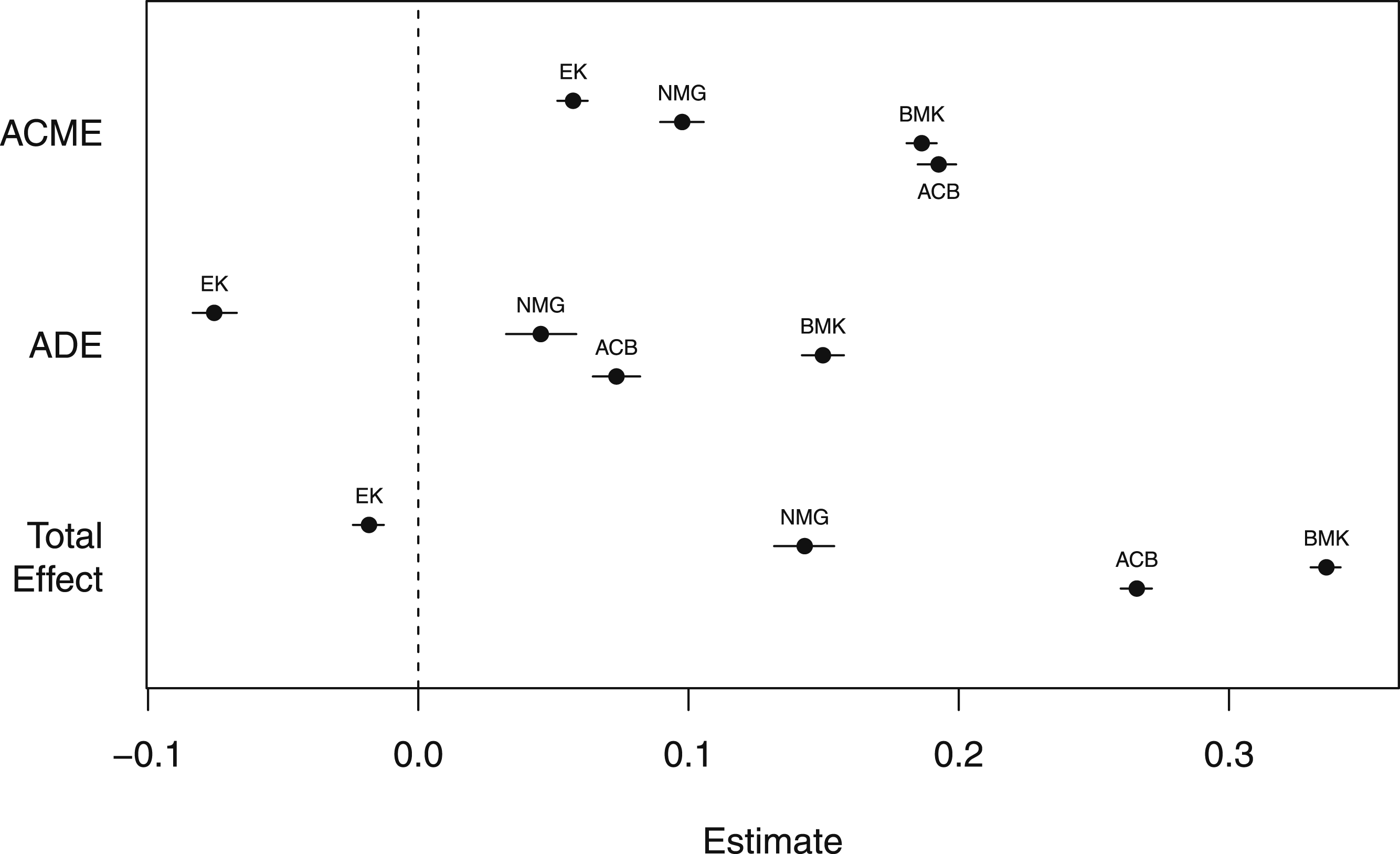
Durability of Nominee Support: Kagan Nomination Panel
One likely criticism of the results above is that the mediated effect of nominee support on Court approval is short-lived—a confirmation honeymoon. Shortly thereafter, people’s evaluations of the Court may no longer be tied to their potentially favorable evaluations of the most recent nominee. The Court is rarely salient, issues few rulings each year, and remains relatively obscure to most Americans. Without reinforcement, the links between partisanship, nominee support, and Court approval could fade quickly. We argue, however, that the Court’s obscurity and shrinking docket heighten the importance of nominations. Nominations are moments for individuals to “check in” on the Court and re-evaluate it. In the absence of landmark cases or extra-judicial controversies, the cognitive connection between a nominee and the Court is likely to persist. To test the durability of the mediated effect of nominee support, we turn to over-time data. We hypothesize that the mediation effect identified above will endure.
In May 2010, President Barack Obama nominated Elena Kagan to replace Justice John Paul Stevens. Obama’s second nominee, she was confirmed by a 63–37 vote in August and took her seat a week later. The 2010 pre-election CES survey measured Court approval, support for Kagan’s appointment, and partisanship in October. A subset of 9,500 respondents was reinterviewed in October 2012 and October 2014. In each wave, respondents were re-asked about their support for Kagan and their support for the Court, allowing us to analyze the persistence of the relationship between partisanship and contemporaneous evaluations of both the Court and a recent nominee. As shown above, partisan alignment with Kagan/Obama strongly shaped Court approval in 2010. Here, we expect meaningful but diminished effects in 2012 and 2014. Using panel data (i.e., tracking the same respondents across time) allows us to make credible claims about the durability of these effects.
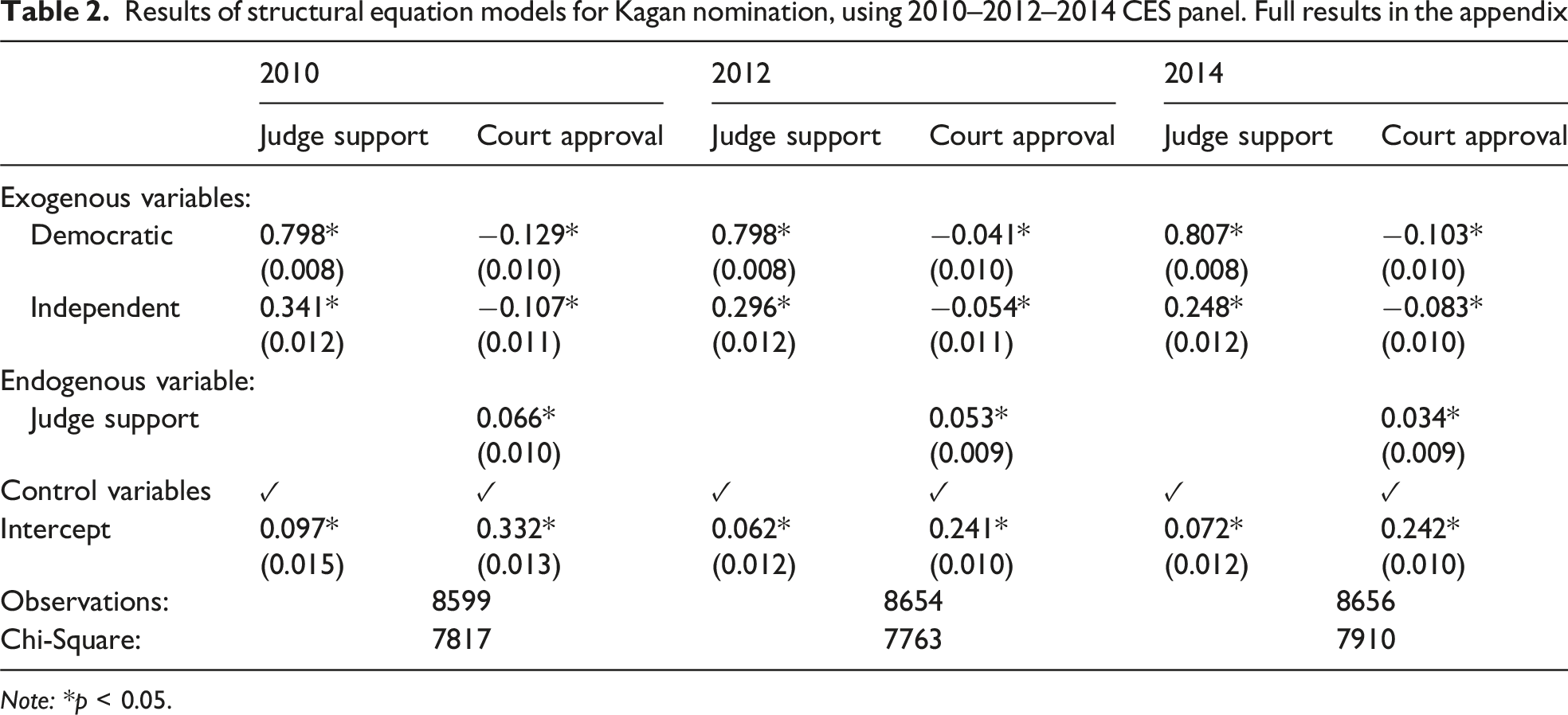
Results of structural equation models for Kagan nomination, using 2010–2012–2014 CES panel. Full results in the appendix
Note: *p < 0.05.
Our most direct test of Hypothesis 2 is the coefficient magnitude of the endogenous Judge Support variable in the 2012 and 2014 models. As hypothesized, the mediated relationship remains statistically significant, even four years after the nomination. Put differently, individuals who support Kagan’s confirmation continue to express higher Court approval in 2012 and 2014 than those who do not. The downstream effects of nominee support on Court approval are thus durable. As expected, the mediated relationship diminishes in magnitude with time since Kagan’s confirmation, but it remains significant.
Figure 2 presents the mediation results. In each year, support for Justice Kagan’s appointment is a stable and consistent predictor of Supreme Court approval. The effect decreases slightly over time, but remains positive and significant. In some years (e.g., 2012), the positive indirect effect of partisanship offsets the negative direct effect, underscoring the role of nominee support in shaping Court approval. Causal mediation analyses for Kagan, using 2010–2012–2014 CES panel.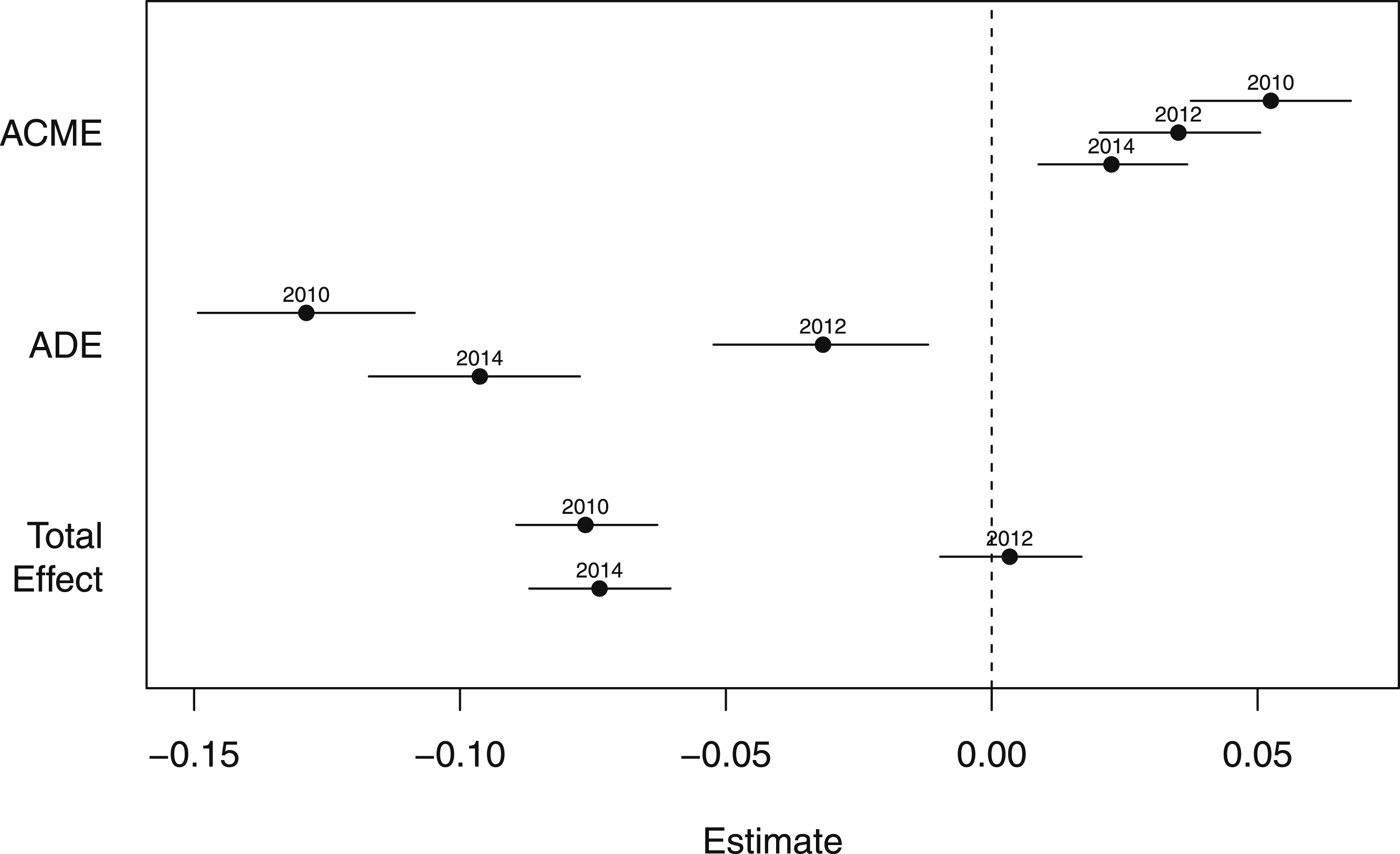
We discuss the broader implications of this finding alongside the Kavanaugh and Gorsuch rolling cross-section results below. Here we emphasize that our results address a common concern about CES surveys: they are sometimes fielded months after a nominee’s confirmation. These findings demonstrate that timing is not problematic. Badas and Stauffer (2018) reach the same conclusion, showing no bias when comparing contemporaneous and post-confirmation CES data. Our results corroborate theirs, and we extend this by showing nominee support has durable, years-long effects, making survey timing immaterial for testing our theory.
Durability of Nominee Support: Kavanaugh and Gorsuch Nominations Rolling Cross-Sections
On October 6th, the Senate confirmed Brett Kavanaugh’s nomination. The 2018 CES was in the field from September 27 to November 5. This means it is highly likely that Justice Kavanaugh was on individuals’ minds when they were taking the survey. While clearly that should shape people’s views of the Court in 2018, our theory argues that it should also matter in 2019 and 2020, though perhaps to a lesser degree. We now employ three rolling cross-sectional waves of CES data (from 2018-2019–2020) with identical survey items. 20 These cross-sections allow us to examine whether the Kagan findings above also apply to other nominees.
Results of structural equation models for Kavanaugh nomination, using 2018–2019–2020 CES rolling cross-sections. Full results in the appendix
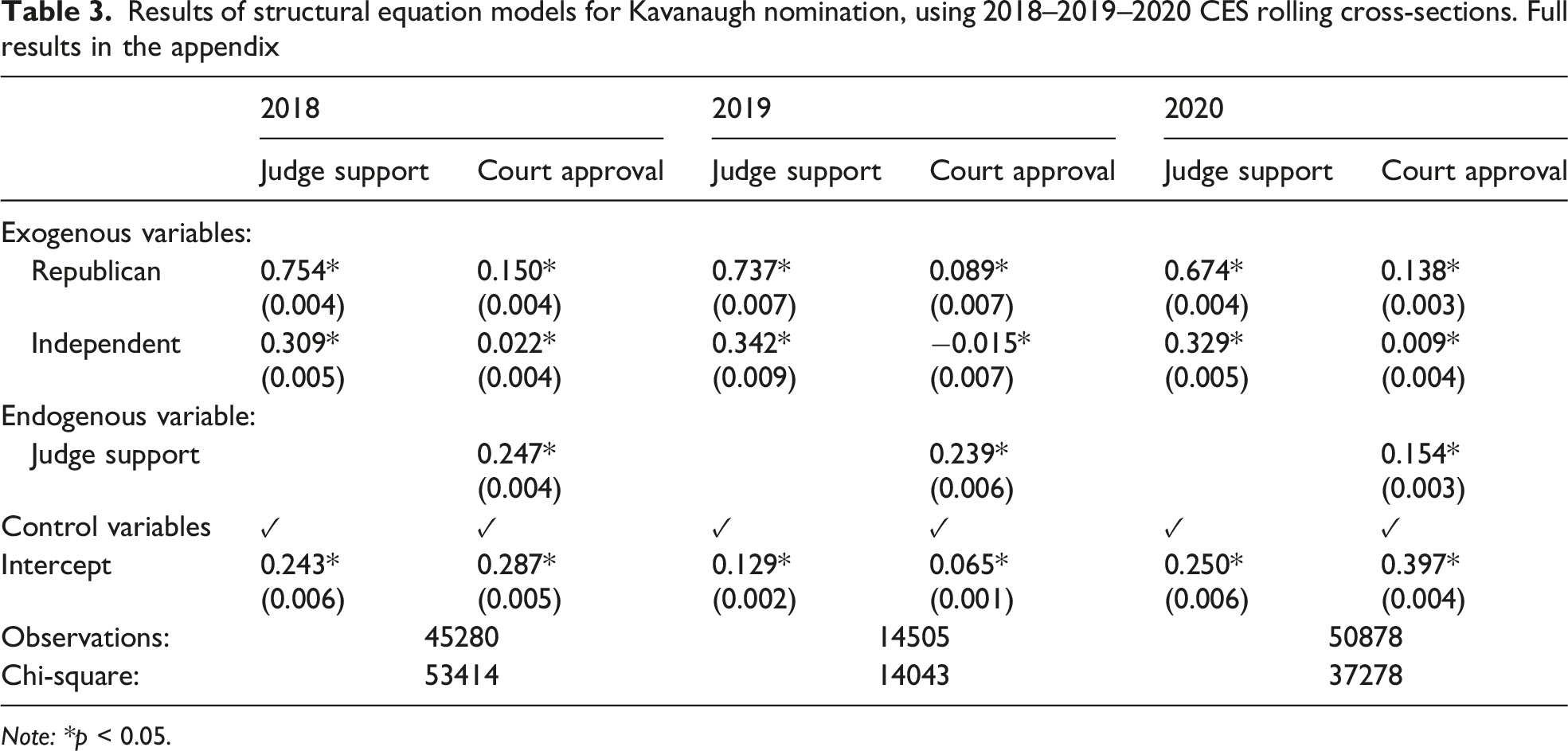
Note: *p < 0.05.
Figure 3 shows that the average causal mediation effect is larger than the direct effect of partisanship in the first two survey waves. By 2020 (two years post-confirmation), the mediated effect of partisan alignment through support for Justice Kavanaugh is only slightly weaker than the direct effect on Court approval. Notably, by the 2020 CES, the controversial nomination of Amy Coney Barrett had occurred. That Kavanaugh support still predicts Court approval highlights the long-lasting impact of nominations on public attitudes toward the Court. Even another vacancy does not fully erase the effect. The mediated effect weakens gradually and consistently, while the direct effect of partisanship fluctuates unpredictably. Overall, while partisanship strongly predicts Court approval in 2018–2020, much of its influence operates through alignment with recent nominees. Causal mediation analyses for Kavanaugh, using 2018–2019–2020 CES rolling cross-sections.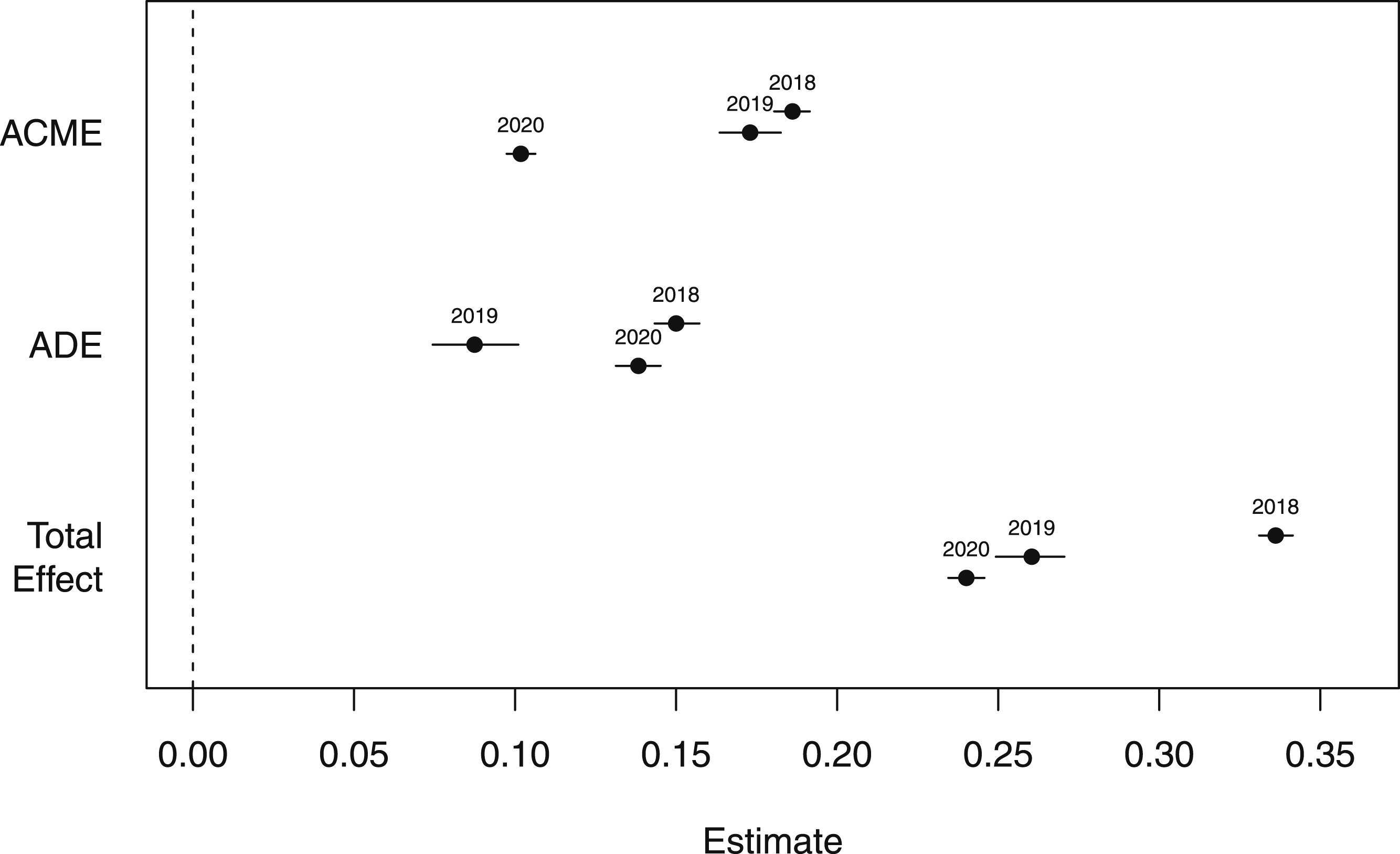
Due to space limitations, we present full results for Justice Gorsuch from the 2017–2018 rolling cross-sections in the appendix. The results are consistent with our expectations. In 2017, the ACME is positive—about 10 percentage points—and larger than the direct effect of partisanship. The mediated effect declines to 6 points in 2018. As in prior analyses, the mediated effect is stable across years, while the direct effect fluctuates. For example, partisanship had a much larger direct effect on Court approval in 2018 than in 2017. 21
Three separate multi-wave analyses, fielded in varied contexts, provide strong evidence for Hypothesis 2 and our broader theory. A substantial portion of Court approval can be explained by partisan alignment with recent nominees. At times, mediated effects exceed the direct effects of partisanship, and they persist years after confirmation. This may reflect feelings of substantive representation by a like-minded nominee, identity-based representation (e.g., partisanship or race), or simply perceiving a co-partisan nominee as a “win.” In any case, a meaningful component of Court approval stems from support for the people nominated to it, which is itself a function of partisanship (Sen 2017).
To contextualize the Kagan, Kavanaugh, and Gorsuch findings, recall that these surveys spanned four, three, and two years, respectively, during which the public encountered salient cases, Court coverage, new justices, controversies, and major elections. Research often highlights support for policy or socialization as key drivers of Court attitudes (Bartels and Johnston 2020; Christenson and Glick 2015; Gibson and Nelson 2014). Our results show that nominee support also has durable effects, even amid these opportunities to “check in” on the Court. While landmark cases like Dobbs clearly shape attitudes (see Gibson 2024a), the durability we identify suggests nominee support—and thus partisanship—is a larger component of Court approval than previously recognized. Finally, we note that models in the appendix control for ideological proximity to the Court. The long-term effect of nominee support remains significant when accounting for this important alternate explanation.
The Dobbs Effect: Ketanji Brown Jackson Nomination
To this point, we have shown that partisanship predicts support for nominees from 2010 to 2020, which in turn predicts approval of the Supreme Court. We have also shown these effects can persist for years. Recall that our theory suggests “check in” points provide individuals the opportunity to re-evaluate the Court. Nominations are one such check in point; salient cases are another well-established check in point (Christenson and Glick 2015). We now turn to the nomination of Justice Ketanji Brown Jackson, which occurred contemporaneously with the Dobbs decision. Jackson’s nomination, unlike the others in our data, allows us to consider our theory in the context of another check in point, a landmark decision.
While prior scholarship (Badas and Stauffer 2018), and our results above, suggest that survey timing does not bias the effects we theorize, Jackson’s case is unique. Confirmed on April 7, 2022, Jackson did not take her seat until Justice Breyer retired on June 30. In the interim, only 25 days after her confirmation, the draft of the Dobbs decision was leaked; the opinion was issued 2 months later. Dobbs has had profound and lasting consequences for the Court’s legitimacy (see Gibson 2024a), and for multiple measures of Court support (Levendusky et al. 2024). Surely the most salient Court ruling in memory shaped institutional evaluations, which we must account for. The proximity of Jackson’s confirmation is particularly important. Although we do not have measures of support for Dobbs specifically, we do include a variable measuring support for abortion. 22
Additional factors are also critical to address. Jackson was the first Black woman nominated to the Court, the first Black nominee in over 30 years, and the first Black Democratic nominee in more than half a century. Given the salience of racial attitudes in U.S. politics (e.g., Jardina 2021; Kam and Burge 2019; Kinder and Sanders 1996), these views must be included in any model of support for a Black nominee. Indeed, Armaly, Krewson and Lane (2025) show that members of the public—Black respondents in particular—were acutely aware of the representation Jackson’s nomination provided. We therefore include controls for racial resentment and Black identification (see the appendix).
Even with these controls, Jackson’s nomination is the first case in which nominee support does not positively predict Court approval. Both SEM and mediation results (located in the supplemental appendix) show that support of Jackson’s confirmation had no relationship with approval of the Court when controlling for alternative explanations related to race and support for Dobbs. We interpret this as a “Dobbs effect,” whereby Democrats who might have welcomed Jackson’s confirmation had already soured on the Court. Indeed, we find a strong direct effect of partisanship on Court approval in November 2022, but the indirect effect does not align with expectations.
Recall our theory holds that confirmation hearings are typically the most recent information people use when evaluating the Court. Here, the hyper-polarizing decision overturning abortion rights appears to have eclipsed the impact of Jackson’s confirmation. In short, Dobbs is “doing the work.” In fact, the effect of pro-abortion attitudes is magnitudes larger than the effect of partisanship when using the 2022 CES data. Still, we believe it is critical to test our theory using Jackson’s case in a manner that can more fully account for “the Dobbs” effect.
To test our theory using Jackson’s nomination while fully accounting for Dobbs, we re-analyze data from Armaly, Krewson and Lane (2025). 23 These data were collected in March 2022, after Jackson’s nomination (February 25) but before her confirmation. Most importantly, they were collected prior to the Dobbs leak (May) or decision (June). Respondents were told that “Ketanji Brown Jackson will likely be confirmed by the U.S. Senate to serve as a judge on the U.S. Supreme Court,” then asked (a) their level of support for Jackson (6-point scale) and (b) their approval of the Court if she were to join (5-point scale). We rescale both to 0–1 and estimate the same mediation and SEM models as above. Our goal is to test whether Democrats, prior to Dobbs, expressed greater approval of the Court when they supported a Democratic nominee, consistent with our hypothesized mediated pathway.
The SEM results (in the supplemental appendix) support our expectations. Democrats are more supportive of Democratic nominees than Republicans are, and this translates to Court approval through the mediator of Nominee Support. Figure 4 shows that, at least prior to Dobbs, the mediated effect of partisanship was consistent with our expectations; Democrats were more supportive of President Biden’s nominee, and such support then bled into Court approval. In fact, two-thirds of the estimated effect of partisanship is mediated through perceptions of the most recent nominee, even when the Court remained the most conservative Court in decades (Jessee, Malhotra and Sen 2022).
24
Causal mediation analysis for Jackson, using pre-Dobbs data from Armaly, Krewson and Lane (2025).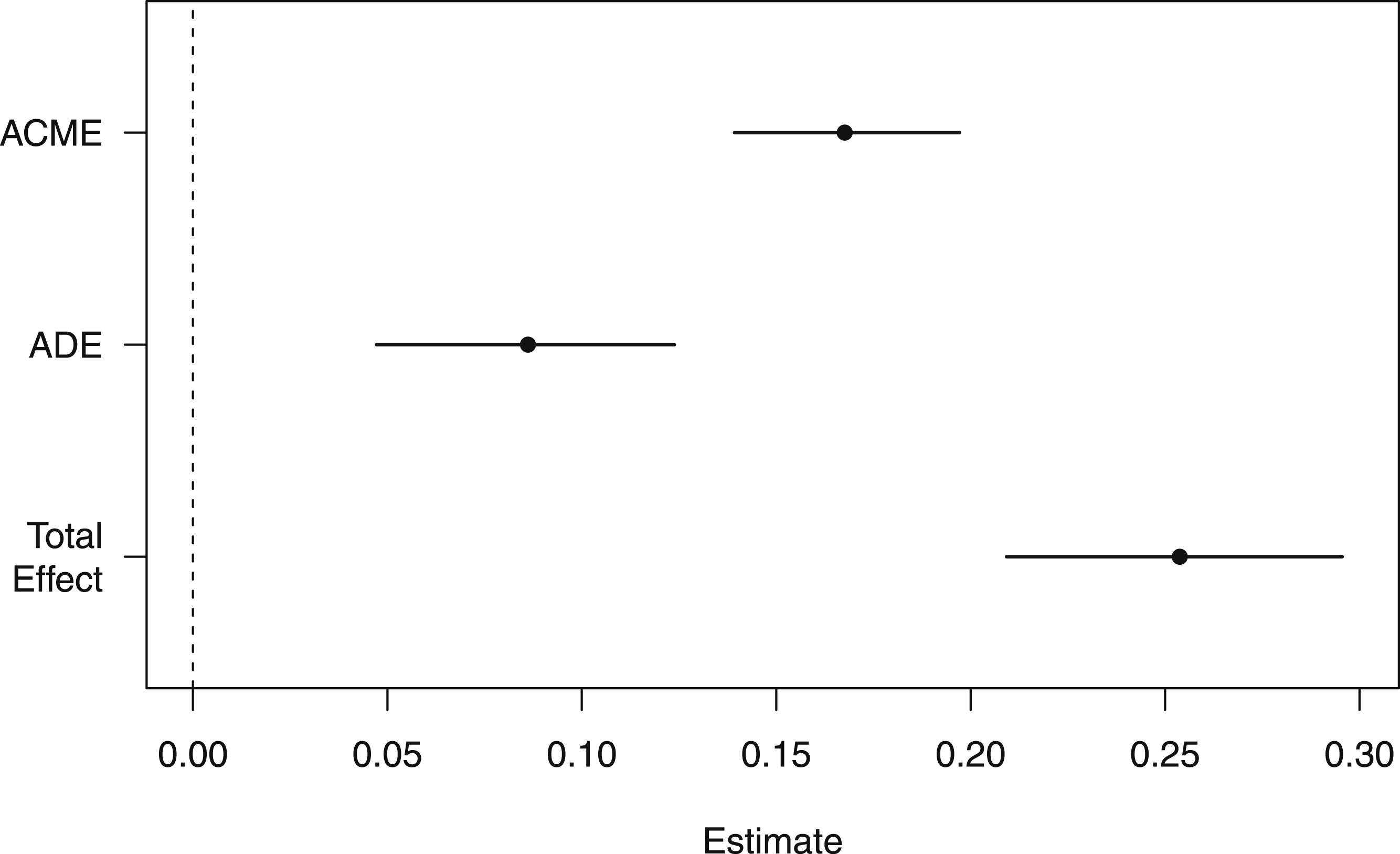
As for Jackson’s nomination, our findings hold prior to Dobbs (i.e., in Armaly, Krewson and Lane's (2025) data) but not after (i.e., CES data). We believe that this is consistent with our overall theory. There are multiple opportunities for individuals to check in on the Court, but they tend to be rare. Transformative, pivotal decisions like Dobbs are, perhaps, even rarer than nominations, but—along with post-decision rhetoric—provide to the mass public all of the information we argue nominations provide. Ultimately, the Jackson results help demonstrate the scope of our theory and findings. As we see in the case of Kavanaugh and Gorsuch, the nomination of another justice was insufficient to entirely nullify the mediated effect of nominee support on Court support. But, it seems Dobbs was sufficient to do just that, which sheds light on the outer limits of nominee support’s influence on Court approval.
Discussion and Conclusion
We set out to better understand how partisanship influences evaluations of the United States Supreme Court. Building on prior work showing (1) partisan attachment strongly predicts nominee support (Sen 2017), and (2) nominee support shapes approval of the Court (Armaly, Krewson and Lane 2025), we theorized that partisan influence on Court support is mediated through nominee support. Individuals who support a co-partisan nominee are also more supportive of the Court, given the prospect of that nominee joining the bench. Using the CES, a large national survey administered by YouGov, we find support for our hypotheses: individuals are more supportive of co-partisan nominees, and approval of the Court is mediated through nominee support. Moreover, by leveraging rolling cross-sections and panel data, we show that nominee support—though diminishing over time—endures as a predictor of Court approval for years and is more stable than partisanship alone.
Our findings shed light on the surprising lack of consistent partisan effects on Court approval. Despite high polarization, partisanship itself is not always a strong predictor of Court support (at least prior to Dobbs; see Gibson 2007). We argue that nominations uniquely combine sustained media attention, importance, information, and partisan cues in ways that prompt individuals to check in on the Court and reassess it. 25
Our study, while consistent with scholarship on presidential co-partisanship, offers a novel theory and test of how partisanship shapes Court evaluations by emphasizing nominations as a key mechanism. 26 Despite the Court’s increasingly partisan output (Levendusky et al. 2024) and external politicization by other branches and the media (Boston and Krewson 2025; Hitt and Searles 2018), the public does not rely on partisanship alone to evaluate the Court. They require strong cues—such as presidential partisanship and nominee selection—to connect their identities to the institution. For a Court long reliant on neutrality to maintain support, this is a mixed bag: its own actions rarely provide strong cues, yet politicization by others often does.
Our findings are not without caveats. Notably, the relationship between nominee support and Court approval did not hold for Justice Ketanji Brown Jackson in the CES data. Supporters of Jackson’s nomination were less likely to approve of the Court. As discussed, this reflects the unique context of the post-Dobbs era. Reproductive freedom is an especially salient issue with stable attitudes (Hernandez et al. 2026; Newport 2022); Dobbs received unprecedented media coverage, including the leaked draft opinion; and the resulting policy change profoundly reshaped attitudes toward the Court (see Gibson 2024a; 2024b). Thus, for many, Dobbs replaced Jackson’s confirmation as the dominant top-of-head consideration. This aligns with our theory: whichever consideration is most salient at the time shapes Court evaluations (see Zaller 1992). Typically, nominations serve this role; in 2022, perhaps Dobbs did.
Looking ahead, scholars should continue to examine confirmation hearings in the post-Dobbs era. Can nominee support overcome declining approval in today’s polarized environment? Does the public now perceive the Court’s 6–3 imbalance differently than the prior 5–4 split, reducing the effect of new personnel? If the balance of the bench were to tip further in the conservative direction, would Republicans still increase support for the Court? Put differently, is there a threshold at which this relationship is no longer significant? Following Armaly, Krewson and Lane (2025), do other ascriptive characteristics of nominees increase support for the Court regardless of ideology? Finally, researchers should more carefully consider whether partisanship is also mediated through landmark rulings such as Dobbs, and whether those effects endure until the next salient event.
Supplemental Material
Supplemental Material - Lifetime Appointments, Lasting Reactions: Partisanship and the Enduring Effect of Nominations on Supreme Court Approval
Supplemental Material for Lifetime Appointments, Lasting Reactions: Partisanship and the Enduring Effect of Nominations on Supreme Court Approval by Miles T. Armaly, Christopher N. Krewson, Elizabeth A. Lane in Political Research Quarterly.
Footnotes
Author Notes
Previously Presented at the 2025 American Institutions and Democracy Conference at the Karsh Institution of Democracy, University of Virginia. We thank Brandon Bartels, Susan Haire, Albert Rivero, and Patrick Wohlfarth for their help on this project.

Funding
The authors received no financial support for the research, authorship, and/or publication of this article.
Declaration of Conflicting Interests
The authors declared no potential conflicts of interest with respect to the research, authorship, and/or publication of this article.
Data Availability Statement
Our data and code are available at this link: https://dataverse.harvard.edu/dataset.xhtml?persistentId=doi%3A10.7910%2FDVN%2F9UAVMS (Armaly et al., 2026)
Supplemental Material
Supplemental material for this article is available online.
Notes
References
Supplementary Material
Please find the following supplemental material available below.
For Open Access articles published under a Creative Commons License, all supplemental material carries the same license as the article it is associated with.
For non-Open Access articles published, all supplemental material carries a non-exclusive license, and permission requests for re-use of supplemental material or any part of supplemental material shall be sent directly to the copyright owner as specified in the copyright notice associated with the article.
