







Abstract
Jury instructions—the rules for jury deliberation approved by the judge and read to the jury during trial—are an important communication between judges, parties, and jurors. Parties and judges draft these instructions with trials in mind and judges possess substantial discretion over this critical process, deciding the law in a case. Given prosecutor power, strategic disadvantages of defense counsel and powerful role of federal magistrate judges, the courtroom provides a unique venue to how judges wield this powerful policy process. Despite substantial research on judicial decision-making, we know little about how a judge’s prior professional experience, like work as a prosecutor, public defender, or federal magistrate judge affects when a judge drafts their own version of jury instructions. To test this, I constructed an original dataset of 1,389 federal criminal trial cases from 23 districts for 2015–2018. Logistic regression analysis suggests experience as a public defender and federal magistrate judge matters in whether a judge files their own draft of the instructions. This finding presents evidence that a judge’s professional background affects their decision-making in this critical stage of a case. This research has broad implications for judicial appointments, judicial decision-making theory, legal policy, and future trial courts research.
Introduction
On March 18, 2024, Judge Aileen Cannon of the Southern District of Florida issued an order in 9:23-cr-080101-AMC requiring the United States and the defendants to file their proposed versions of the jury instructions. The trial date in this case was yet to be determined. In this unusual order, Judge Cannon, a former federal prosecutor, required the parties to engage with two sets of language particular to the prosecution of a former president for retaining official documents. Commentators opined Judge Cannon’s jury instruction order, which presents framing potentially favorable to former President Trump, is troubling at best and biased at worst (Barrett and Stein 2024). While Judge Cannon’s order does not set the language for the final jury instructions, it certainly frames the legal issues in the case in ways that could favor the defense.
In cases like United States v. Trump, jury instructions are an important communication between judges, parties, jurors, and the public. In every trial, after the witness testimony, presentation of evidence, and the arguments of counsel have concluded, judges read to jurors the applicable law. Not only do judges have the final say on the law that applies in the case, they also read instructions to the jury on how to apply the law. This often overlooked and understudied aspect of a trial gives judges, politically motivated government actors, one last bit of power over the jury, a democratic body, before jurors deliberate and render the final verdict in the case. Through jury instructions judges can use their discretion to frame the case in ways that can favor a particular party or result. Judges control the course of cases and decide what evidence and law the jurors use in their deliberations. Federal judges face little real prospect of recall with fairly unrestricted discretion within their courtroom. They make decisions throughout cases from start to finish in deciding bail (Boldt et al. 2021), ruling on motions (Boyd and Hoffman 2013), approving plea agreements (Albonetti 1999; Bibas 2004), and determining what sentence to impose (Harris 2023; Johnson 2014; Schanzenbach 2005; Steffensmeier and Hebert 1999). Judges also control the procedural process parties must navigate in order to prevail. Procedural processes, especially when manipulated, can frustrate one party over another or even level the playing field (Bellin 2019).
Notwithstanding their position as neutral arbiters of justice, judges are still political actors selected in large part for their background and ideology (Binder and Maltzman 2009; Scherer and Curry 2010; Thurber and Yoshinaka 2015). In the morass of procedure, we can see how judges use their discretion, like other street-level bureaucrats, to directly and indirectly influence policy and case results. In the jury instruction process, trial court judges work from a generally blank slate, with appellate courts and standard instructions providing guidelines and, only upon review, clear rulings on what is not legally permissible. Despite the vast influence judges wield over the jury instructions process, scant, if any, attention has been paid to judicial decision-making on jury instructions. Previous research on jury instructions has primarily focused on the effect on jurors rather than using jury instructions as a lens to understand trial court decision-making (Cicchini and White 2015; Devine 2012; Katzev and Wishart 1985; Leverick 2015; Simon 2012; Wetmore et al. 2020; Wissler, Rector, and Saks 2001).
This intersection of substantial discretion and impactful decisions provides a ripe area to research judicial decision-making, at a level that is often overlooked by researchers: trial courts. We know a judge’s identity (Boyd 2016; Collins, Manning, and Carp 2010; Cox and Miles 2008; Haire and Moyer 2015; Hofer and Casellas 2020; Johnson 2014), ideological preferences (Epstein et al. 2007; Giles, Hettinger, and Peppers 2001; Schanzenbach and Tiller 2007; Segal and Spaeth 2002), and background experience (Harris and Sen 2026; Myers 1988) affect how they make decisions. But it is unclear whether a judge’s previous work in a criminal courtroom or experience as a federal magistrate judge influences their decision to get involved in the jury instruction drafting process.
To explore whether professional background differences play a role in a judge’s decision to file their own version of the jury instructions, I utilize an original dataset of 1,389 federal criminal trial cases from 2015 to 2018. This novel dataset combines existing data with newly collected information on the jury instruction activity of judges. Using these data, I regress a judge’s decision to file their own version of the jury instructions on three different professional backgrounds, prosecutor experience, public defender experience, and federal magistrate experience, as well as interactions between these experiences. I find that judges with experience as both a federal magistrate judge and public defender are expected to generate their own version of the instructions in 50% of cases, a result significantly higher than other professional background experiences, even when controlling for other judge and case-specific factors.
These results support the theory that a judge’s legal background can impact how they handle cases, an area of the literature that has received little attention. This analysis is especially timely given the Biden Administration’s selection of record-breaking numbers of former public defenders to the federal bench (The White House 2024). As federal judicial nominations face increased scrutiny in the US Senate, the jobs judges hold before ascending to the bench are an important area for further inquiry.
Trial Courts and Jury Instructions
Trial courts are the first stop for almost all litigants and typically serve as the end of the road for their case, as most litigants do not appeal to a higher court (Carp and Wheeler 1972). Though not every case is destined for trial—in fact nearly all of cases resolve long before a jury is called—trials are the lodestar for litigants. As a result, attorneys examine the merits of their case through the eyes of prospective jurors and marshal their evidence to obtain a favorable verdict. In that vein, jury instructions frame the case from start to finish and allow lawyers to explain the likelihood of success to their clients. Federal District Court Judge Roy B. Dalton of the Middle District of Florida believes jury instructions are “critical to disposition” and “most vital to the process, [but] getting it right is not always easy” (Dalton 2022). Because they are written with lay-people in mind, these instructions can be an educational tool for litigants and their attorneys. They also allow judges to influence how cases are framed for the jury.
Jury Instructions in Federal Criminal Courts
Jury instructions cover a myriad of topics from trial procedure to the elements of a crime. These include detailing how juries should conduct their deliberations, guidance on navigating expert witness testimony, and defenses to charges.
1
Instructions can also elaborate on the elements of a crime, as in United States v. Twitty. In this Colorado case, Andre Twitty faced federal charges for mailing threatening communications. Judge R. Brooke Jackson instructed jurors using his own language that: A true threat means a serious threat, as distinguished from words as mere political argument, idle talk, or jest. It is a declaration of intention, purpose, design, goal, or determination to inflict punishment, loss, or pain on another or to injure another or his property by the commission of some unlawful act (United States v. Twitty, Case 1:13-CR-76-1, (198) Reporter’s Transcript p. 476, (D. Colorado, 2014).
The Federal Rules of Criminal Procedure govern the jury instructions process in federal criminal court, focusing primarily on the timing of rulings and process for objections. 2 With few procedural requirements on the timing and how instructions are drafted, judges can steer the parties or severely limit their involvement in the process. Given the broad discretion trial court judges retain, the process of arriving at the final jury instructions takes many forms.
Judges can require parties to each draft a version of the jury instructions early on in the case and then hold a hearing as to which parties instructions will make the cut. Some judges, like Judge Paul Byron of the Middle District of Florida, issue extensive pretrial orders that require the parties to file a single jointly-proposed set of jury instructions (United States v. Achey, Case 6:17-CR-165-1, Document 33, M.D. Florida 2017). 3 Judges can also provide a draft to the parties or prepare their own version before the end of trial, taking control of the process away from the parties (Bennett 2021).
For example, in United States v. Maurice Withers, Magistrate Judge Stephen Crocker issued an order with the court’s proposed jury instructions during the discovery process (United States v. Withers, Case 3:16-CR-5-1, Document 78, (W. D. Wisconsin 2017). While prosecutors and defense lawyers can later file their own versions or lodge objections, judges ultimately decide the content, likely based in large part on their own initial versions. This discretionary division of labor allows for variation in the preparation of instructions and a window into courtroom practices and information exchange (Boyd and Hoffman 2013).
Trial court judicial discretion does not operate in a vacuum: trial courts are supervised by appellate courts. That said, appellate courts generally do not conduct extensive “quality control” over the jury instruction process, focusing primarily on the legal correctness of instructions. 4 This rests almost exclusive power over jury instructions with trial court judges (Randazzo 2008). In many cases, the meaningful variation in jury instructions stems less from differences over procedural matters and more about the substantive law that applies in the case, like in United States v. Trump or United States v. Twitty. When judges wield their discretion to allow novel framing of legal issues, they can make the most change to case outcomes.
Judges and Procedural Discretion
In pre-adjudicatory procedural decisions and processes, like jury instructions, judges can make a big difference, embodying their role as “street-level bureaucrats” delivering the law (Lipsky 2010). Procedural decisions can have wide-ranging impacts, altering the trajectory of cases. For example, judges decide bail and pretrial release matters with little appellate oversight (Boldt et al. 2021). They also frequently rule on pretrial procedural motions on discovery, forcing parties to disclose information, or substantive legal matters that might end the case altogether. Judges also approve or reject the plea agreements made by prosecutors and defense attorneys (Albonetti 1999; Bibas 2004). Perhaps a judge’s most obvious exercise of power comes at the end of a case, when the judge decides what sentence to impose (Harris 2023; Johnson 2014; Schanzenbach 2005; Steffensmeier and Hebert 1999).
The discretion over jury instructions is similar to these other important trial court decision-points. Like in pretrial detention, discovery, and sentencing decisions, appellate courts give trial courts a wide berth in what they instructions they read to juries. They generally examine the correctness of an instruction (i.e., whether it states the law correctly) and whether a party is entitled to an instruction they requested. Yes, drafting jury instructions can be a more time-consuming, labor-intensive process than these other decisions but it also provides judges the ability to influence the jury and impose their own version of legal doctrine (Wofford 2018). If judges feel empowered to assert themselves in all these procedural decisions, they can really put their “thumb on the scale” to influence outcomes.
Impact of Jury Instructions
But do jury instructions actually matter? And, perhaps just as importantly, do judges believe they matter? To start, jury instructions provide jurors with a meaningful framework by which to evaluate the evidence. Jurors without jury instructions fill in the gaps with their own information (Pfeifer and Ogloff 1991), indicating that on some level, these instructions provide some value to decision-making. Additionally, jurors without instructions are more likely to vote guilty or be unable to decide a verdict (Reed 1980).
Changes to jury instruction language can also impact how much jurors comprehend the instructions themselves, evaluate evidence, and decide verdicts, at least in certain contexts. Jurors with simplified instructions on how to evaluate eyewitness evidence are more knowledgeable on how to weigh this type of evidence and are less likely to convict the defendant (Greene 1988). Additional clarifying instructions on eyewitness testimony can also lead to jurors being less likely to convict defendants (Katzev and Wishart 1985). Jurors also react in line with jury instructions in civil cases where they are instructed not to punish defendant’s conduct on awards (Wissler, Rector, and Saks 2001). Going beyond juror comprehension and utilization, judges also believe these instructions play a meaningful role in juror decision-making, potentially biasing jurors in favor of one party (Greene 1988). Believing the instructions matter, judges can wield their discretion in accord with their own priors.
Judge Background and Decision-Making
Judicial decision-making is influenced by many factors, both institutional and individual. A great deal of empirical and theoretical evidence indicates that judge characteristics affect case outcomes (Boyd 2016; Boyd, Epstein, and Martin 2010; Gibson 1978; Harris 2023; Rowland and Carp 1996; Rowland and Todd 1991; Schanzenbach 2005). Previous research presents compelling evidence that the identity of the judge matters in many ways, including how quickly a case ends (Boyd and Hoffman 2013); which party prevails (Boyd 2016); and what sentence the judge will impose (Gruhl, Spohn, and Welch 1981; Harris 2023; Johnson 2014; Schanzenbach 2005; Steffensmeier and Hebert 1999). While some attention has been given to trial judge decision-making (Boyd 2013, 2016; Harris 2023; Hu¨bert 2019), those studies focus almost exclusively on race and sex. Scant attention has been given to the role of a judge’s professional biography in their decision-making (Boyd 2015; Harris and Sen 2026; Miller and Curry 2023; Myers 1988).
Professional biography likely plays an out-sized role at the trial court level because of the nature of the job. Trial court judges collectively process hundreds of thousands of cases a year and shape national policy in individual cases and in the aggregate (Mather 1995). In many ways, these judges are quintessential “street-level bureaucrats” (Biland and Steinmetz 2017; Lipsky 2010) because of their front-line decision-making constrained by a higher, supervisory power (Biland and Steinmetz 2017). In the absence of strong supervision, street-level bureaucrats frequently implement policy in light of their values and experiences (Lipsky 2010). For judges, experience as a prosecutor, public defender, or federal magistrate judge shapes how they exercise their discretion.
Background matters, in part, because presidents make their appointment decisions based on their expectations of what judges might do in the future. Historically, presidents used a variety of factors in considering who to nominate to the federal bench; however, the modern trend has been focused more on ideology (Bartels 2015; Binder and Maltzman 2009; Scherer and Curry 2010). Since the Reagan administration, ideological reliability has motivated presidents to choose nominees who will implement a president’s policy agenda decades after the president leaves office (Bartels 2015). Presidents evaluate judges in light of their backgrounds, expecting judges would act a certain way, through their process-based conduct on the bench (fairness, impartiality, efficiency) or policy-based conduct (influencing policy outcomes) or both (Goldman 1999).
Lawyer Experience Affects Decision-Making
Nearly all judges ascend to the federal bench after lengthy careers as attorneys. Experience may influence judges in a systematic way, but why? Judges receive similar training, have similar experiences on the bench, and are bound by the same rules. Some argue for a “robes on” theory, suggesting that judges’ shared training will wash away the variable nature of decision-making (Kritzer and Uhlman 1977). Under this approach, judges with different professional experiences will decide cases in the same way. However, others recognize that individuals acquire valuable information from shared experiences because repeated interactions with peers create a sense of shared knowledge and collective beliefs (Sandfort 2000). Prior research has uncovered support for this notion based on judges’ race and sex (Boyd, Epstein, and Martin 2010; Cameron and Cummings 2003; Gryski, Main, and Dixon 1986; Peresie 2005). Essentially, judges draw on their lived experience and socialization as a form of expertise in making decisions.
Working as a public defender or a prosecutor is a prime example of a socializing process and shared experience for lawyers (Braman 2009). Prosecutor and public defender offices generally recruit directly from law schools to provide attorneys a fast-paced and intense level of legal experience. These lawyers are “in the trenches” with each other, with massive dockets and demands on their time. Sharing these experiences and growing as lawyers with other similarly situated prosecutors or public defenders shapes legal views over time, even from experiences as simple as sharing a common lunch room with their co-workers.
There is empirical evidence that previous work as a prosecutor or public defender impacts judicial decision-making. For example, former prosecutor judges tend to sentence defendants more punitively than their colleagues without this experience (Myers 1988). The differences were particularly acute among female and violent offenders. On the public defender side, Harris and Sen (2026) found that experience as a public defender can predict sentencing behavior as well. Former public defenders are less likely to sentence offenders to incarceration and more likely to sentence offenders to some form of community service or probation, even when controlling for ideology (Harris and Sen 2026). Judges with experience as public defenders also sentence offenders to shorter prison sentences, about 16 months less than their colleagues without this experience (Harris and Sen 2026).
Magistrate Judge Experience Affects Decision-Making
There is another potential stop judges can take on their path to the district court bench: work as a federal magistrate judge (FMJ). Federal magistrate judges play a vital role in federal courts, supporting the federal district court judges in case management and decision-making, giving them a comfort level once they are promoted (Boyd and Sievert 2013). In many districts, working FMJs almost serve as the “farm team” for federal district court judgeships, with many of the district court judges having served as FMJs before their promotion.
Federal magistrate judges are Article I judges, appointed by their district’s judges to renewable 8-year terms. Congress created this role in 1968 by statute, with most of the duties allowed by the designation of a federal district court judge. 5 Their responsibilities vary from district to district with the overriding theme being that magistrate judges manage cases before they end up in front of district court judges. This gives FMJs a real sense of how these federal court cases progress. In criminal cases, FMJs make bail decisions, rule on arrest and search warrants, conduct preliminary examinations, and other pretrial matters (Boyd, George, and Yoon 2022).
These early decisions are vital to how cases progress through the court system, giving FMJs particularly powerful insight into the machinations of federal court. In many ways, FMJs serve as shadow judges, working closely with the district court judges throughout cases, finding ways to move cases along efficiently and correctly. And this can be seen in other contexts, where district court judges with experience as magistrate judges have higher levels of pretrial activity and lower appeal rates, likely stemming from their hands-on experience (Boyd 2015).
Judicial Involvement in Crafting Jury Instructions
How do these influences play out in the particular environment of crafting jury instructions? Trial court judges face high caseloads and lots of demands on their time, making the decision to get more involved in the jury instruction process an important one. Judges, like other workers, are influenced by time and effort constraints (Posner, Epstein, and Landes 2013). For example, district court judges who have lighter caseloads or longer tenures are more likely to publish their decisions (Taha 2004). Judges who insert themselves into the process are choosing to take on additional work in order to maintain control over the trial process. Given the combination of discretion and potential impact on case outcomes a judge’s policy preferences can come into play.
When judges submit their own version of the jury instructions, they are setting the tone and the framework for the parties. This turns the adversarial system on its head as judges are typically constrained to responding to actions taken by the parties. Rather than allowing the parties to advocate for their individual versions of the instructions whole cloth (which is the prevalent practice), judges can choose to limit the prosecution and the defense to making objections or edits to the judge’s chosen set of instructions. For example, in United States v. Twitty, Judge R. Brooke Jackson generated jury instructions to fit his understanding of Tenth Circuit law, telling the parties: The Court has done quite a bit of research on the law, as I mentioned…it is for the jury to decide, on proper instructions, whether or not a true threat was made. I’m satisfied now that the instructions that I have crafted, and that both sides have indicated they have no objection to properly instruct the jury on what a true threat is, what free speech is, et cetera (United States v. Twitty, Case 1:13-CR-76-1, (D. Colorado, 2014).
Independently drafting the jury instructions, like Judge Jackson, allows judges to affirmatively shape the law that will be read to the jurors, knowing full well that judicial admonitions can shape juror decision-making (Steblay et al. 2006). Lawyers are trained to frame their cases around these instructions (Hart 2009) and judges are no exception to understanding their impact. The value of shaping the law through instructions dates back to late nineteenth century efforts to rein in unruly juries (Molot 2003). While it is difficult to isolate the exact effect of drafting these instructions empirically because of the strength of evidence or relative capabilities of the lawyers, judges like Judge Jackson and Judge Dalton profess the importance of this process.
Studying the jury instruction process and the important role judges play in it requires understanding the courtroom environment and relationships between legal actors. Criminal courtrooms, in contrast to civil cases, have a unique power dynamic. Judges, prosecutors, and defense attorneys work against, and with, each other throughout cases. Not all of these actors have equal footing though.
Some argue prosecutors, not judges, hold the most powerful position in the criminal justice system (Bishop and Frazier 1984; Davis 2007). Prosecutors choose when to prosecute and choose cases with high likelihoods of success based on professional investigations generated by law enforcement agencies (Bellin 2019). In federal courts, United States Attorneys (mostly) avoid the twists and turns of “everyday” crime brought by civilians and prosecute cases initiated by the police (Bellin 2019).
Prosecutors chose their cases wisely to ensure success, with high conviction rates mattering a great deal to them, even more than sentence length (Fisher 2003). Once cases are charged, prosecutors hedge their bets even further through plea negotiations which ensure a conviction on at least one charge, reduce their caseloads, and avoid the uncertainty and work of a trial (Albonetti 1999; Bibas 2004). Also, in many cases, judges rely on prosecutors to draft an initial version of the jury instructions. As a result of this socializing practice, judges with prosecutor experience and familiarity with this practice will likely rely more on prosecutors to handle this work-intensive process and draft less of their own instructions, especially if the judges hail from the same district (Collins, Dumas, and Moyer 2017). Formally, I hypothesize: Judges with prosecutorial experience are less likely to file a draft of the jury instructions than judges without prosecutorial experience (Hypothesis 1).
The discretionary and substantive powers of the prosecutor stand in stark contrast to the limited power of the defense in federal criminal cases, especially those unrepresented by counsel (Collins and Baker 2023). While their clients cannot be compelled to testify and are presumed innocent (at least in theory), strategic disadvantages abound for defense counsel both before and during trial. Throughout their cases, defense attorneys look to judges to use their discretion to ensure a fair process. No procedural right is self-executing; they require judicial action. 6
The strategic disadvantages are felt sharply by appointed counsel, like public defenders, who do not have the investigatory resources of the prosecutor in developing their cases. Judges with public defender experience are acutely aware of their critical role in between the parties and know the importance of their procedural choices. Their experiences as the underdog in a criminal courtroom will motivate how they approach the jury instruction process, likely increasing their control over the jury instruction process through drafting their own instructions. Because they know the strategic disadvantages facing appointed counsel, they could use jury instructions to shape outcomes to achieve some form of balance. With that in mind: Judges with experience as a public defender are more likely to draft their own version of the jury instructions than judges without experience as a public defender (Hypothesis 2).
Stepping back a bit, all of these procedural battles rely on a judge to make decisions and manage cases. As caseloads have increased over time, judges have taken on a more managerial role in their courtrooms, not merely adjudicating the requests of the parties but moving cases forward through procedural orders (Thornburg 2009). By controlling the parties, be it through pretrial orders or limiting the scope of some arguments, judges can move cases along more effectively. Judges, like other workers, are motivated to maximize their utility by streamlining their work (Taha 2004). In streamlining procedural or even quasi-procedural decisions, judges are likely to lean substantially on their own inclinations and experiences (Thornburg 2009).
With this first-hand knowledge of the federal system, former FMJs would be far more likely to inject themselves into procedurally-driven processes, like jury instructions, where their managerial skill might decrease the amount of time the parties spend disputing these decisions. Judges who have spent significant time managing cases pretrial, regardless of the context, will be inclined to control this trial process for efficiency. Much like work as a public defender or prosecutor familiarizes judges with the ins and outs of federal district courts, district court judges who served as FMJs will be more involved in the jury instruction process. Thus: Judges with federal magistrate judge experience are more likely to file their own version of the jury instructions than judges without experience as a federal magistrate judge (Hypothesis 3).
Research Design, Data, and Variables
As noted above, judicial decision-making has been studied at length across the federal court hierarchy. Appellate courts allow for readily quantifiable data using voting patterns (Hettinger, Lindquist, and Martinek 2006) and opinion length (Moyer et al. 2021) but trial court research requires measurement strategies geared at these judges’ different responsibilities as both case managers and neutral arbitrators. Trial court researchers also face unique challenges given the difficulty in obtaining usable data and the time-consuming nature of analysis (Boyd, Kim, and Schlanger 2020; Boyd and Hoffman 2013; Kim et al. 2009). Previous trial courts research used a variety of approaches to measure trial court behavior in novel ways, like motion practice (Boyd and Hoffman 2013; Kritzer 1986), discovery (Boyd, Kim, and Schlanger 2020; Cox 2019), bail decisions (Boldt et al. 2021), how quickly a case ends (Boyd and Hoffman 2013), traffic court dispositions (Collins and Baker 2023), and sentencing (Gruhl, Spohn, and Welch 1981; Harris, 2023; Johnson 2014; Schanzenbach 2005; Schanzenbach and Tiller 2007; Steffensmeier and Hebert 1999; Tiede 2007).
Jury instructions present a unique research design challenge. With the substantial leeway given to judges by the appellate courts, judicial behavior can vary widely, as some judges take an active role in drafting the instructions and others force the parties to draft sufficient language. And in many ways, a lot of the judicial decision-making behavior in the jury instruction space is unobservable, with some jury instruction exchanges occurring via email, outside of the public record. It is also often unclear which party “prevails” in the jury instruction process as judges do not rule on the content of the bulk of the instructions in an individual way, as they generally do in motion practice. Parties and the judge might win out on portions of the final language and lose other proposals. Because of the murky and messy process, the most consistent way to observe judicial involvement in this process is by observing those times when a judge chooses to file their own version of the jury instructions.
Data Collection
Given the dearth of comprehensive federal district court databases, as well as the unique research questions presented by jury instructions, I constructed an original case-centered dataset for this project. Focusing on individual federal criminal trial court cases, I collected information on case characteristics, federal judge biographical information, and district litigation statistics. This novel dataset of 1,389 cases combines several under-utilized databases along with original data collection.
Federal district courts in data
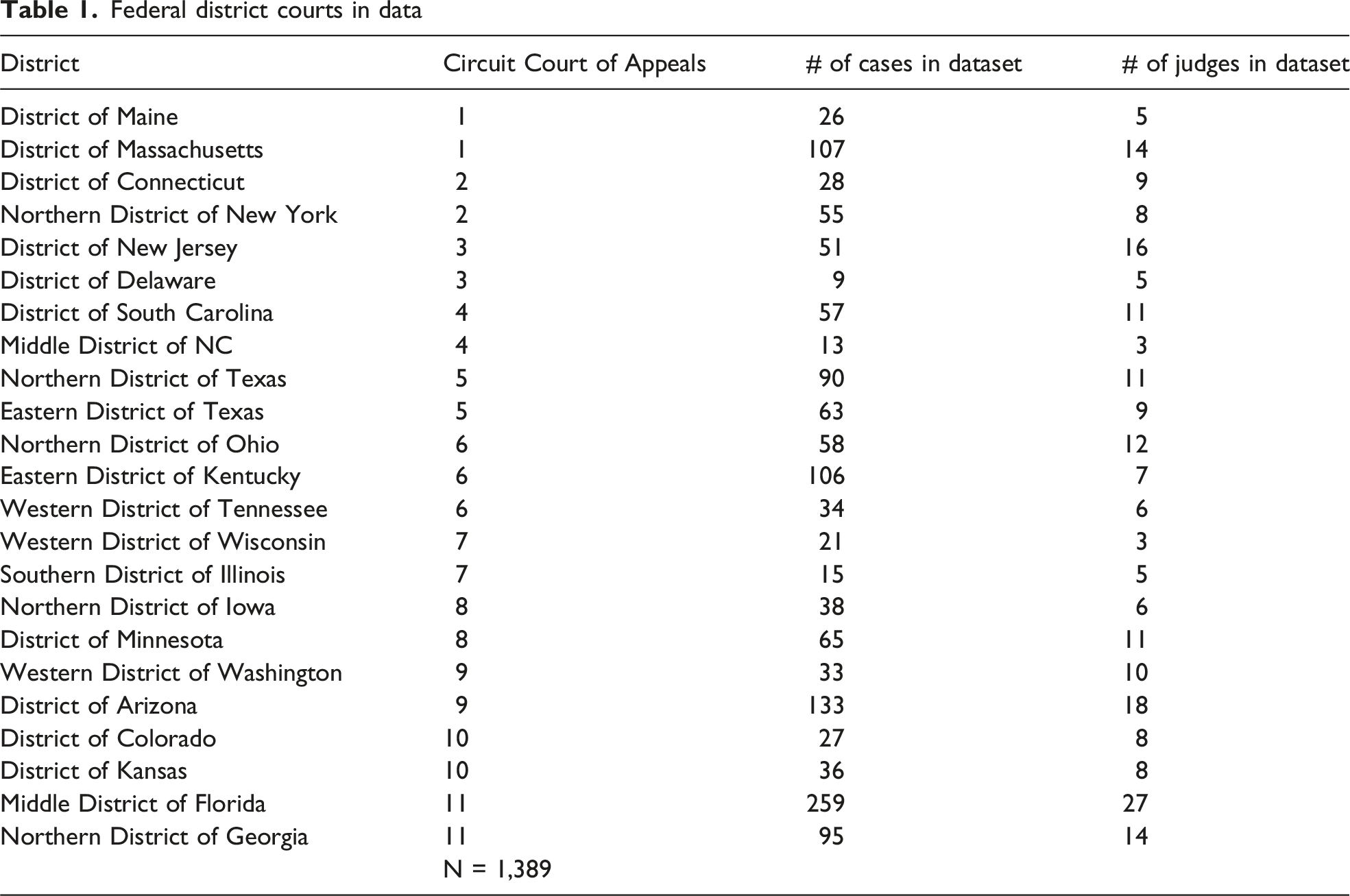
To identify cases that resolved via trial, I used the Federal Judicial Center and Administrative Office of the US Courts’ Integrated Database (IDB) which contains data on every case filing in federal trial courts. From the “IDB for Criminal 1996-present” data, I narrowed the universe of cases down to those disposed in the target districts via jury trial. 8 From the IDB, I also obtained the maximum possible sentence of imprisonment for the first charged offense in each case. 9 As the IDB intentionally omits judicial identifying information, additional data collection was necessary.
After identifying those criminal cases terminating in trial, I then used PACER (“Public Access to Court Electronic Records”) to obtain the docket sheet and case filings for each case. 10 Docket sheets contain a trove of information about the parties and the progression of the case. In addition to the names of the parties, their role in the case (government or defense attorney and the type of defense attorney) and the judge, there is a notation for each filing in the case and the date. Outcomes specific to each charge, as well as the statute number, are at the top of each page.
While the docket sheets label each filing, determining what filings relate to jury instructions presented a challenge. In some jurisdictions, draft copies of jury instructions are called “requests to charge.” Reviewing the docket sheet and utilizing searches (for terms like “jury instr” and “re-quests to charge”) assisted in identifying relevant materials. Some cases have as many as 10 jury instruction related filings.
Once jury instruction filings were identified, they were then coded based on who filed the document within the court filing and the type of jury instruction document. Docket sheets typically identify the party proposing the instructions. For example, in Case no. 2-13-CR-78-1 in the Middle District of Florida, the instructions proposed by the defense counsel are labeled “Proposed Jury Instructions by Ernest Freeman, Jr. (Summers, George)” and the instructions proposed by the government appear as “Proposed Jury Instructions by USA as to Ernest Freeman, Jr. (Viacava, Yolande).” In both instances, the name of the lawyer filing the instructions appears within parentheses. When the judge files their own version of the instructions, it is often labeled as “Court’s Proposed Jury Instructions.” Proposals by the government were coded as “GOV,” those by the defense “DEF,” and by the judge were coded as “C.”
Filings were also coded based on type. If the proposal was a complete version of the final jury instructions, it was labeled by the party who filed the proposal. In some cases, the defense and government filed a joint version of the instructions, which was labeled as a complete joint proposal. Occasionally parties or the court might propose supplemental or special instructions, typically where there is a request for one specific instruction rather than a complete proposal of text, or a party might file an objection to the other party or court’s instructions. Legal memoranda supporting proposals were coded, as well as proposals for preliminary jury instructions.
The next step in the process required linking case information to judges. For this, I utilized the Federal Judicial Center’s (FJC) biographical directory of Article III Judges. The FJC provides detailed information on judges, including their sex, race, their service dates, previous judicial experience, and some information about their legal careers. I supplemented the FJC biographical data with newly collected data from the Federal Judicial Database (FJDB). 11 The FJDB contains a vast amount of data about a judge’s prior legal experience, including service as a prosecutor in any form and work as a public defender. Using these databases, I was able to code judges’ tenure on the federal bench, whether a judge served as a federal magistrate, as well as other judicial characteristics.
Variables
The dependent variable modeled below is Judge Draft of jury instructions. Judge Draft is coded as 0 when judges do not draft and file their own copy of jury instructions in a case and 1 when the court file contains a copy of instructions drafted by the judge. In the dataset of 1,389 cases, judges filed their own version of the jury instructions 181 times, making up 12.76% of the observations. 12 Before moving to the independent variables, it is important to address whether the choice to file a draft of their own jury instructions has a relationship to case outcomes. Quantitatively, this does not seem to be the case. In the 184 cases where judges elected to take charge of the jury instruction process, only 19 (10%) resulted in an acquittal, a similar rate to those cases where judges did not file their own version of the instructions (11.5%). 13 Despite the absence of a statistical relationship between the decision to draft their own version of the instructions and case outcomes, judges openly profess the importance of the jury instruction process and instructions do make a difference in outcomes (Greene 1988; Katzev and Wishart 1985; Wissler, Rector, and Saks 2001).
Summary expectations and statistics for key variables

Judge characteristics in the dataset
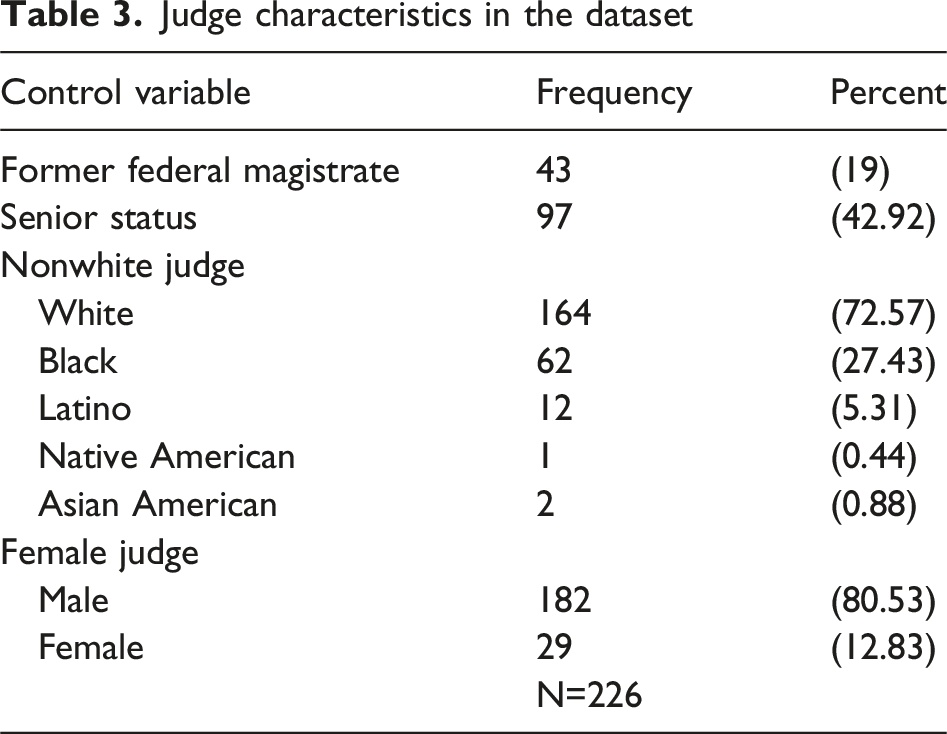
These controls are needed for many reasons. Ideological predispositions impact judicial decision-making at all levels (Epstein et al. 2007; Giles, Hettinger, and Peppers 2001; Keith, Holmes, and Miller 2013; Schanzenbach and Tiller 2007; Segal and Spaeth 2002). Generally, conservatism is tied to less favorable decisions for defendants, especially in the context of sentencing (Cohen and Yang 2019; Rowland, Carp, and Stidham 1984; Schanzenbach and Tiller 2007). In contrast, judges appointed by Democratic presidents tend to favor defendants in sentencing decisions (Tiede, Carp, and Manning 2010).
Judicial Conservatism is the judge’s Judicial Common Space ideology score ranging from (−1 to 1) (Boyd 2015). 15 Among the 226 judges in the sample, the mean ideology score is 0.05 with a standard deviation of 0.41. The most liberal judge’s score is −0.64 and the most conservative judge has a 0.69 ideology score.
Notably, time on the bench can change judicial behavior, with judicial behavior at the beginning and end of a career being more predictable (Hettinger, Lindquist, and Martinek 2003; Kaheny, Haire, and Benesh 2008). Federal Judicial Experience is the length of time a judge has been a federal district court judge in years. The average tenure on the bench for this sample is 17.74 years, with a standard deviation of 10.36 years. The longest serving judge in the sample had served 49 years on the federal bench with the least experienced judge sitting for just over a year. On the other end of the experience spectrum, senior judges may also exhibit distinctive behavior as judges often take senior status in order to reduce their workload while still maintaining a presence on the bench (Vining Jr., 2009; Yoon 2005). 16 Senior Status is coded as 1 for judges who have assumed senior status before or at any point during the observation period. 97 judges in the data had taken senior status.
Knowing the role a judge’s race can have on decision-making (Boyd 2016; Cox and Miles 2008; Haire and Moyer 2015; Hofer and Casellas 2020; Johnson 2014; Welch, Combs, and Gruhl 1988), Nonwhite Judge will indicate whether or not a judge is identified as a racial minority. 17 Over 80% of the judges in the sample are white (182), 12.83% (29) are Black, and 5.31% (12) Latino. Only one judge in the sample was Native American and two were Asian American. Similarly, Female Judge will be measured as 0 for male judges and 1 for female judges given that female judges have been found to decide cases related to gender differently than their male counterparts (Boyd 2016; Boyd, Epstein, and Martin 2010; Collins, Manning, and Carp 2010; Haire and Moyer 2015; Johnson 2014). 72.57% (164) judges are male and 27% (62) are female.
Defense Attorney Type will note the type of defense attorney representing the defendant (private, court-appointed, or federal defender), capturing variation stemming from these differences (Berdejo´ 2018; Roach 2014). Judges may also handle cases differently based on the severity of the charges. Given this possibility, I also include a control variable for Offense Level, corresponding to four different categories based on the potential maximum prison sentence of the first charged offense. 18 District-level differences may also impact judicial decision-making. To account for those differences, I include the total number of trials in the district, Total Trials, 19 and include district-level fixed effects in the model estimations.
Results
To examine the relationship between judicial characteristics and judge drafted jury instructions, I employ logistic regression. This is appropriate given the dichotomous nature of the dependent variable, as well as the selection of several continuous and nominal independent variables. Logistic regression permits interpretations of the likelihood that an observation of an independent variable is related to whether a judge files their own copy of jury instructions. Federal criminal trial courts provide a consistent baseline of procedural rules coupled with geographic variation that makes regression analysis more insightful. 20
Judge draft jury instructions logistic regression models
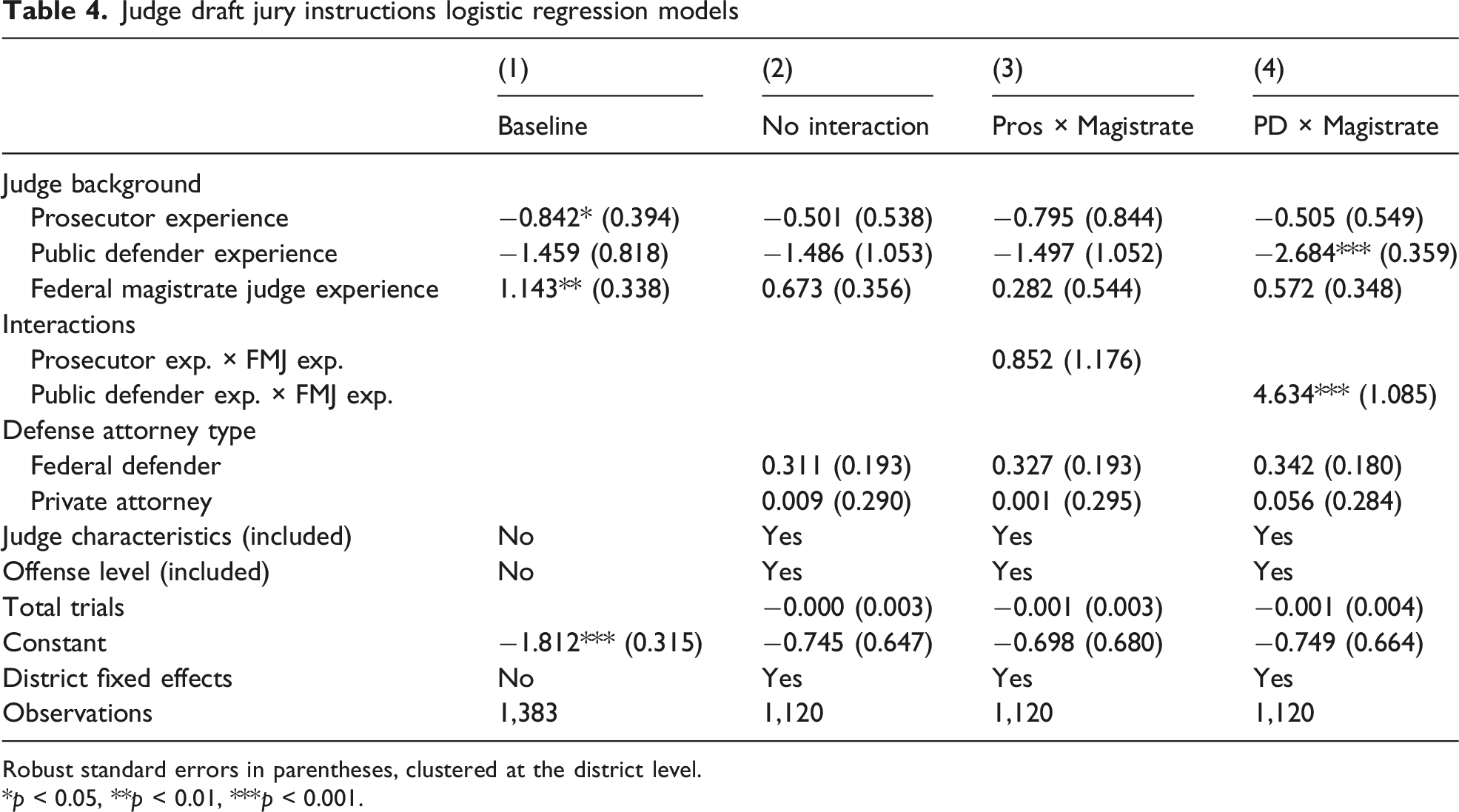
Robust standard errors in parentheses, clustered at the district level.
*p < 0.05, **p < 0.01, ***p < 0.001.
Model 2 includes the control variables (including Judge Characteristics (Judge Conservatism, Judicial Experience, Senior Status, Nonwhite Judge, Female Judge) and Offense Level) and introduces district-level fixed effects. 21 This model estimation does not yield any statistically significant results. With this in mind, an exploration of the interactive effects across these experiences is in order. The impact of these categories of judicial experience might depend on a combination of experiences. For that reason, I estimate models interacting Federal Magistrate Judge Experience with each of the attorney experience variables.
Model 3 interacts Prosecutor Experience with Federal Magistrate Judge Experience. This model estimation does not present any statistically significant relationships, even in the controls. However, when Federal Magistrate Judge Experience is interacted with Public Defender Experience, new effects emerge. With the inclusion of the interaction, both Public Defender Experience and the interactive variable are statistically significant.
Judges with former public defender experience have a predicted probability of 0.146 of filing jury instructions whereas the predicted probability for those without the experience is higher at 0.151. This only tells part of the story though, as the confidence intervals for both observations substantially overlap, reducing the predictive value of this variable. However, the interaction between the variables reveals a very interesting finding. Figure 1 displays the interactive effects between Public Defender Experience and Federal Magistrate Judge Experience. Judges without Public Defender experience do not see any distinguishable difference whether or not they have federal magistrate judge experience. Predicted Probability of Judge Drafted Instructions (with 95% confidence intervals).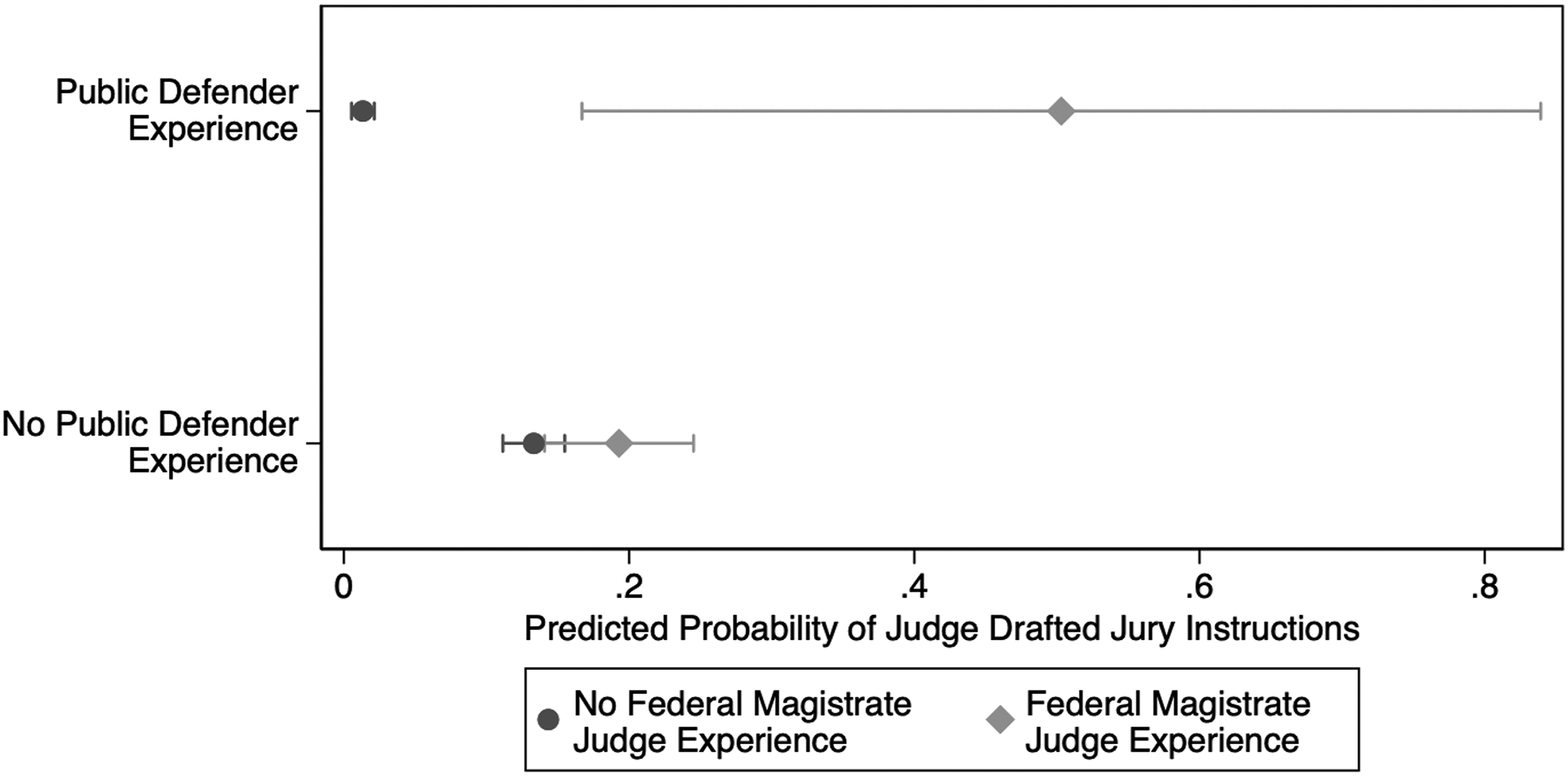
But, when former public defenders are compared based on federal magistrate judge experience, we observe a large effect. Public defenders who also later serve as federal magistrate judges are expected to file their own jury instructions just as often as they do not (predicted probability of 0.503). Judges who only have public defender experience are almost never expected to file their own version of instructions (predicted probability of 0.013).
Standing alone, legal experiences do not reveal differences in judicial behavior in the jury instruction space. The observed effect is nuanced and only emerges under a certain constellation of experiences. Experience as a prosecutor does not seem to serve as a consistent predictor of judicial behavior, especially when accounting for other factors. Only when former public defenders couple that experience with sitting on the bench as a federal magistrate judge do we see greater activity in drafting jury instructions.
Discussion
From these results, we can glean some insights about judges and jury instructions. As expected, legal career characteristics can have an impact on the instruction process, especially in certain combinations. The judges who are most likely to draft their own version of the jury instructions are ones who have personally experienced the strategic disadvantages faced by public defenders and are later empowered to manage cases in their early stages. As “street-level bureaucrats,” these judges can exercise discretion to implement policy in light of their values and prior experiences (Lipsky 2010).
Former public defenders know how the exercise of discretion can change the course of a case. As noted above, defense lawyers are at a constant strategic disadvantage in the courtroom, facing a powerful opponent in the government who wields both resource and procedural edge. Jury instructions can provide a legal benefit to defendants, giving them the chance to shed light on novel legal theories or flesh out favorable caselaw. But not all former public defenders exercise their discretion in the jury instruction arena on the bench.
Only when former defenders also have experience as federal magistrate judges do we see district court judges file their own version of the jury instructions at a high rate. The results of the federal magistrate judge interaction reinforce the importance of studying the variation of judicial professional experience. This makes sense as federal magistrate judges, especially in certain districts, play a meaningful role in litigation, handling a wide variety of tasks delegated by district court judges (Boyd, George, and Yoon 2022). Within the cases in this dataset, a federal magistrate judge had a least some involvement in just over half of the cases (732/1,419).
This seemingly career-driven effect has important implications for nominations and other selection and retention mechanisms across the country. These insights on judicial professional experience are particularly timely. In the past, federal judges came from large law firms or backgrounds as prosecutors. In 2016, as many as 50% of district judges had prior prosecutorial experience while only around 11% had worked as public defenders (George and Yoon 2015).
In stark contrast, President Biden pursued a strategy of diversifying the professional experiences of the judiciary (Gass 2022), with White House Counsel Dana Remus writing to senators in December of 2020 that Biden wanted to grow the professional diversity of the federal judiciary with his nominees. To that end, less than 1/4 of President Biden’s nominees worked as prosecutors or large law firm lawyers, with unprecedented numbers of nominees hailing from public defense or public interest backgrounds (Gass 2022). Nearly 20% of nominees were former public defenders, 11% former civil rights lawyers, and 5% former labor attorneys (The White House 2024), shattering previous records. Examining the impact of professional diversity in judicial decision-making gives policy makers better leverage in debating this new appointments strategy. Policy makers may increase their scrutiny not only of political activities and decisions, but also the jobs judges hold before ascending to the bench.
The policy implications are potentially rather broad. Trial courts are, after all, the “workhorses of the federal judiciary” (Lyles 1997, 11). Despite their role as deciders of individual, discrete cases, the “impact of U.S. district courts is very great for all Americans, touching on our pocketbooks, our liberties, and the overall quality of our lives” (Rowland and Carp 1996, 2). Federal district courts process hundreds of thousands of cases a year and shape national policy in individual cases and in the aggregate (Mather 1995). For example, since July of 2025 federal district court judges have ruled against the Trump Administration’s immigration detention policies more than 10,000 times, setting the stage for a larger policy debate for the Supreme Court (Smith 2026). Procedural decisions like pretrial release, discovery, legal motions, and jury instructions provide opportunities for judicial discretion to result in real changes to law and policy alike.
Even broader than the jury instruction context, this research highlights how little work is being done on trial court judge decision-making. While trial court judges see more of the public, and decide thousands, if not millions, more cases a year than appellate judges, they are overlooked in empirical research. Other highly discretionary decisions, like substantive motions, are similar to jury instructions in many ways and merit additional attention. Research on judicial background and jury instructions allows us to explore these important trial court judge decisions in an appropriate legal context.
As with any project, there are limitations to the analysis. There is inherent selection bias in these cases as all of them resulted in a jury trial that went to a verdict. Cases resolved via plea agreement, dismissal, or a bench trial are intentionally excluded, perhaps excluding some number of cases where the judge might get involved in the process. There is also a strong possibility of “missingness” within the data generating mechanism. Judges may not communicate early drafts of the instructions with the parties formally, they may rely on their law clerks or even email the parties themselves (Lasnik 2023). Informal communications not filed with the clerk of the court likely carry the same weight as a formally filed document in the eyes of the parties but are not part of the formal record.
The jury instruction space could also benefit from future text analysis, on two particular fronts. First, comparing the judge drafts of the instructions to the circuit level model instructions (where available) might yield how much unique language judges are inserting into the final instructions as opposed to relying on the guidance from the higher court. Second, comparing the final drafts of the jury instructions to the initial judge draft of the instructions would allow us to see how much judges who take substantial control over this context let the parties include their language into the final instructions.
Conclusion
Jury instructions provide a promising arena for research, especially on judicial decision-making. This article provides a glimpse into how judges get involved in this important process that can change the outcome of a defendant’s case. Jury trials are the most public-facing roles of the judiciary and research on these instructions allows us to see how judges perform on this public stage. Studying judicial decision-making beyond the traditional outcome variables (i.e., sentencing, motions for summary judgment) also allows scholars and the public to better understand how these powerful decision-makers shape the law. Future research on this topic would benefit from more nuanced measures in the analysis of the jury instruction drafting process and the impact jury instructions have on verdicts. For example, text analysis would be useful to determine how much of each party’s language is used in the final jury instructions, similar to the natural language processing, methods of Hazelton, Hinkle, and Spriggs (2019).
Additionally, judges and lawyers clearly labor over the drafting and shaping of jury instructions but it remains unclear exactly what impact these have on verdicts (Nietzel, McCarthy, and Kern 1999). With strong language, lawyers can even more effectively marshal their evidence and advocate for their clients. Despite some judges’ belief in their importance (Bennett 2021; Dalton 2022) and the number of filings made by the parties, we do not definitively know if jury instructions affect the outcome in actual cases.
Jury instructions allow us to see how judges attempt to influence and control jurors. Better understanding how judges control this process will allow not only an expanded understanding of this jury-judge relationship, but also speaks more broadly to how judges make decisions generally. As judges continue to make more and more substantive policy decisions with national effects, often long before a jury is involved, our understanding of how judges approach their decision-making role grows increasingly salient.
Footnotes
Acknowledgments
I thank Christina Boyd, Jessica Schoenherr, Susan Haire, Roberto Carlos, Geoffrey Sheagley, Morgan Hazelton, and Jeffrey Staton for their helpful comments throughout this project.
Funding
The author disclosed receipt of the following financial support for the research, authorship, and/or publication of this article: The author thanks the Law and Science Dissertation Grant (Funded by the Under NSF SBE #2016661: Doctoral Research: Fram) for supporting this research.
Declaration of Conflicting Interests
The author declared no potential conflicts of interest with respect to the research, authorship, and/or publication of this article.
Data Availability Statement
Data for replication purposes are available at https://doi.org/10.7910/DVN/EPSDSA ( ).
).
Notes
Appendix
Cross-tabs of judicial experience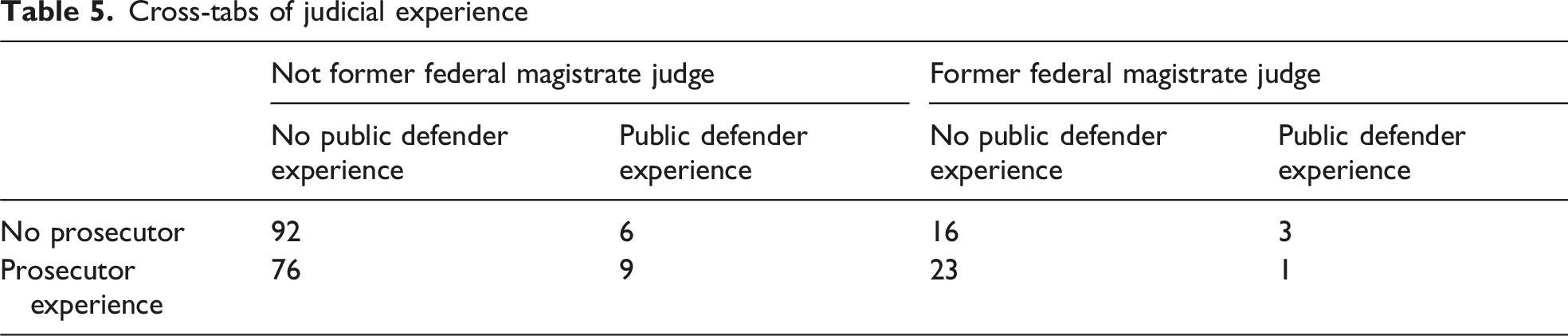
Not former federal magistrate judge
Former federal magistrate judge
No public defender experience
Public defender experience
No public defender experience
Public defender experience
No prosecutor
92
6
16
3
Prosecutor experience
76
9
23
1
Correlations between judge characteristics ***p ≤ 0.001, **p ≤ 0.01, *p ≤ 0.05.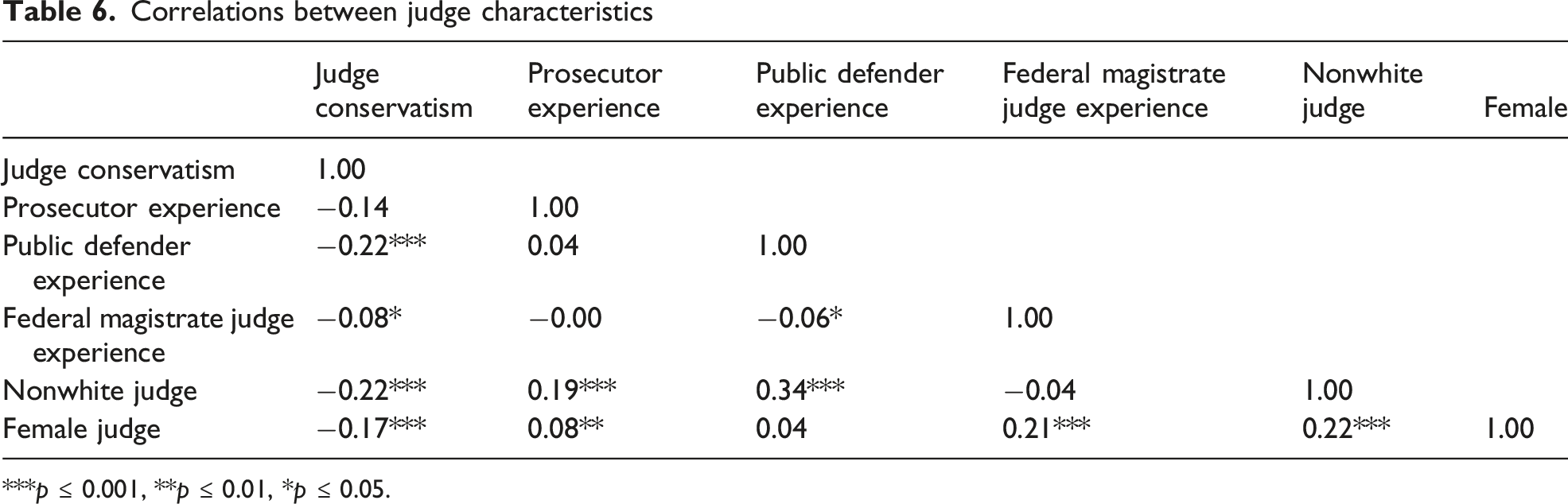
Judge conservatism
Prosecutor experience
Public defender experience
Federal magistrate judge experience
Nonwhite judge
Female
Judge conservatism
1.00
Prosecutor experience
−0.14
1.00
Public defender experience
−0.22***
0.04
1.00
Federal magistrate judge experience
−0.08*
−0.00
−0.06*
1.00
Nonwhite judge
−0.22***
0.19***
0.34***
−0.04
1.00
Female judge
−0.17***
0.08**
0.04
0.21***
0.22***
1.00
Likelihood of conviction logistic regression model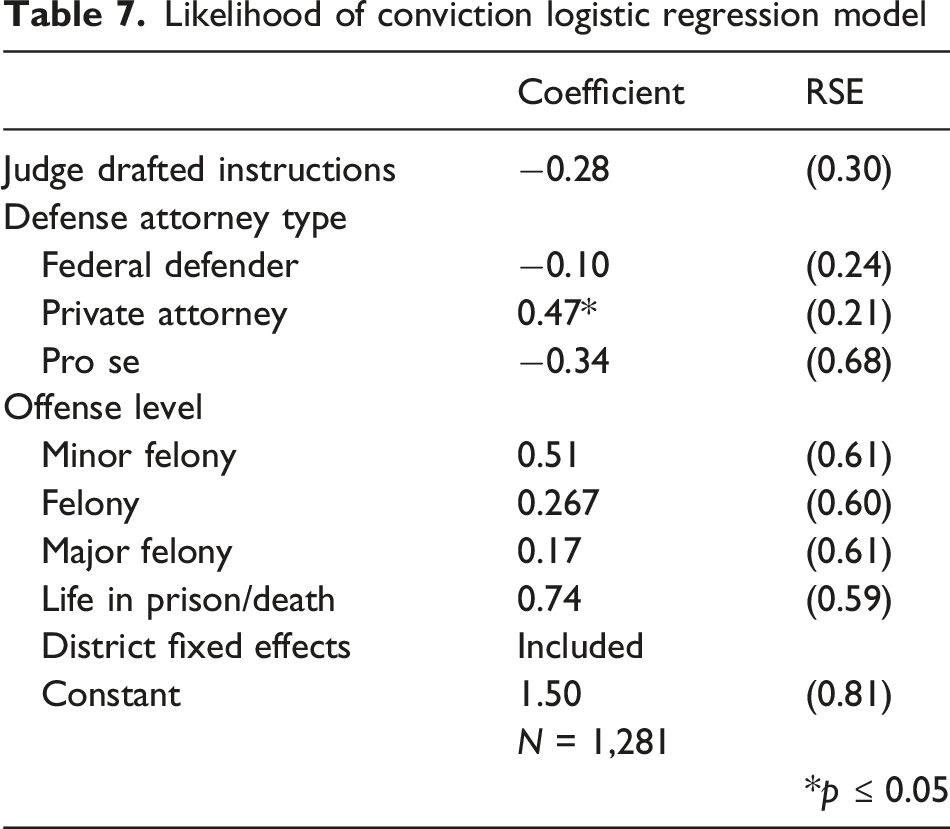
Coefficient
RSE
Judge drafted instructions
−0.28
(0.30)
Defense attorney type
Federal defender
−0.10
(0.24)
Private attorney
0.47*
(0.21)
Pro se
−0.34
(0.68)
Offense level
Minor felony
0.51
(0.61)
Felony
0.267
(0.60)
Major felony
0.17
(0.61)
Life in prison/death
0.74
(0.59)
District fixed effects
Included
Constant
1.50
(0.81)
N = 1,281
*p ≤ 0.05
Judge draft jury instructions: Poisson regression Robust standard errors in parentheses, clustered at the district level. *p < 0.05, **p < 0.01, ***p < 0.001.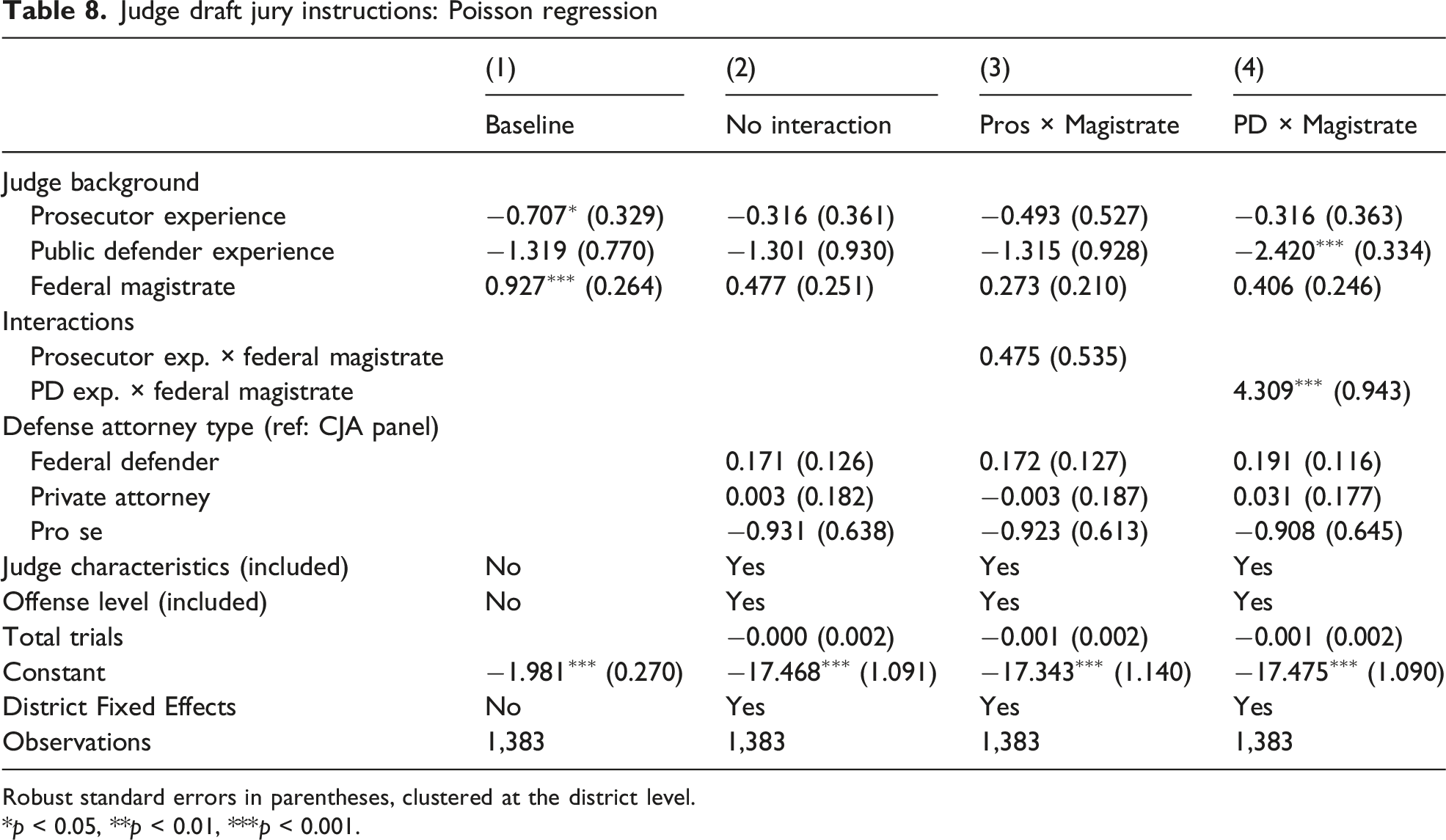
(1)
(2)
(3)
(4)
Baseline
No interaction
Pros × Magistrate
PD × Magistrate
Judge background
Prosecutor experience
−0.707
∗
(0.329)
−0.316 (0.361)
−0.493 (0.527)
−0.316 (0.363)
Public defender experience
−1.319 (0.770)
−1.301 (0.930)
−1.315 (0.928)
−2.420
∗∗∗
(0.334)
Federal magistrate
0.927
∗∗∗
(0.264)
0.477 (0.251)
0.273 (0.210)
0.406 (0.246)
Interactions
Prosecutor exp. × federal magistrate
0.475 (0.535)
PD exp. × federal magistrate
4.309
∗∗∗
(0.943)
Defense attorney type (ref: CJA panel)
Federal defender
0.171 (0.126)
0.172 (0.127)
0.191 (0.116)
Private attorney
0.003 (0.182)
−0.003 (0.187)
0.031 (0.177)
Pro se
−0.931 (0.638)
−0.923 (0.613)
−0.908 (0.645)
Judge characteristics (included)
No
Yes
Yes
Yes
Offense level (included)
No
Yes
Yes
Yes
Total trials
−0.000 (0.002)
−0.001 (0.002)
−0.001 (0.002)
Constant
−1.981
∗∗∗
(0.270)
−17.468
∗∗∗
(1.091)
−17.343
∗∗∗
(1.140)
−17.475
∗∗∗
(1.090)
District Fixed Effects
No
Yes
Yes
Yes
Observations
1,383
1,383
1,383
1,383