







Abstract
Reforms among Republicans in the House of Representatives have led to changes in deciding who should become committee chair. While factors such as party unity and campaign contributions have been demonstrated to matter, bipartisanship has yet to be analyzed. Using party cartel theory and information theory, it is hypothesized that those that are higher in bipartisanship will be more likely to become committee chair on non-power committees but will be less likely to become committee chair on power committees. Conditional logistic analysis of the 107th through the 114th Congress finds bipartisanship has a positive effect on becoming chair of a non-power committee but no effect on power committees. This analysis demonstrates the utility of combining multiple theoretical frameworks for understanding Congress.
Introduction
For years in Congress, seniority had been the primary story surrounding the elevation to committee chairman. With the Republican Revolution in the 1990s, however, the importance of seniority has been reduced when making these decisions. Prior studies have found that new factors have helped to determine who is elevated to chair, including party unity, fundraising, and ideology (Becker and Moscardelli 2008; Cann 2008). This aligns with the party cartel theory of Cox and McCubbins (2007), who argue that, in an era where more power is delegated to leaders to help achieve the goals of the party, leaders would elevate those who can contribute to those same goals. These goals would include re-election and building the party brand: being active fundraisers and showing high levels of support for the party are two examples of this sort of behavior.
Party cartel theory also suggests how parties will view particular committees. Parties will prioritize controlling the committees with broad externalities. Those committees are Rules, Appropriations, and Ways and Means, or what are often referred to as the “power” committees (Volden and Wiseman 2014). These committees have considerable influence over the legislative agenda and are thus viewed as the most important to the success and reputation of the party, though they are often not responsible for the bulk of policy. 1 Therefore, the emphasis is placed on party loyalty when it comes to membership on these committees. Conversely, party leadership will be less concerned with those remaining committees, due to their more parochial interests and lower profiles.
Given these priorities on committee membership, would these same factors be emphasized when it comes to selecting a committee chair? While party loyalty could be assumed to matter for elevation to chair among members of power committees, other factors may be valued elsewhere. To this point, information theory suggests that committees exist to help gather, process, and utilize specialized policy information (Battaglini et al. 2019; Gilligan and Krehbiel 1987; Krehbiel 1992). Non-power committees are the source of the majority of the bills that are signed into law. Lawmakers may attempt to leverage their coalition-building skills to help them advance to positions of leadership within the committee.
Likewise, those on steering committees may view the ability to work across the aisle as a credible signal of potential effectiveness as a chair. The selection choice by steering committees is a reflection of what they believe matters most for being a chair across different committee contexts. Chairs of non-power committees must have the capacity to navigate the informational and procedural challenges of committee leadership, so steering committees may look to those who have demonstrated the ability to work with both parties to legislate. Therefore, it is hypothesized that those higher in bipartisanship will be more likely to be elevated to chair on non-power committees, while those higher in bipartisanship will be less likely to be elevated to chair on power committees. 2
To test these hypotheses, conditional logistic regression will be used to analyze who is elevated to chair from the 107th through 114th Congress. Bipartisanship scores from the prior session will be used as the key independent variable. Support for only one hypothesis was found; while bipartisanship had a positive effect on becoming chair of a non-power committee, it had no effect on becoming chair of a power committee.
This manuscript updates the literature in several ways. It is the first to find a role for bipartisanship in committee chair contests. It is also the first to examine committee contests in several years, adding more recent examples under both Democratic and Republican control. The results also speak to issues of democratic accountability and responsiveness, as policy considerations and concerns about legislating across the aisle continue to shape how Congress operates.
This manuscript proceeds as follows. The literature is reviewed and then the hypotheses are introduced. The data is described and then the results are examined. The implications of the results are detailed in the discussion and conclusion sections.
Literature Review and Hypotheses
The history of committees in Congress shows that the process shaping who becomes chair has been dynamic. In the early 20th century, Speaker Joe Cannon largely assigned both committee membership and chairmanships based on his own preferences. This and other factors related to the Speaker’s control of the House led to a bipartisan revolt against Cannon. After Democrats gained the majority in the House, power devolved from the speakership to committee chairs; for example, the position of Speaker lost its power over committee assignments (Kornberg 2023; Sala 2003).
Against that backdrop, a norm of seniority then developed with respect to the appointment of chairs (Polsby 1968; Polsby et al. 1969). Whomever had served on the committee the longest was elevated to chair when the position became vacant. This became the standard practice for decades as committee chairs became the foci of power in the House.
New rules and new members shifted power as well as norms in the 1970s. The 1970 Legislative Reorganization Act and the 1973 Subcommittee Bill of Rights devolved power away from chairs and to the minority and to subcommittee chairs. The progressive Watergate Babies in the Class of 1974 also pushed for changes, as they were consistently stymied by conservative committee chairs. These changes led, among other things, to the creation of steering committees. These committees would make decisions regarding who would serve on which committee as well as who would be chair (Kornberg 2023). This allowed for secret ballot up-or-down votes for each chair; thus, there were chair nominees who did not follow the norm of seniority (Rohde 1991).
While these changes did lead to the occasional violation of seniority (Cox and McCubbins 2007), reforms in the House during the 1990s created a more holistic appointment process. When Republicans took the majority at the start of the 104th Congress, they made seniority just one of several factors while also instituting a three-term limit on chairs. Additionally, the Republican Steering Committee would recommend chairs, and the conference would then vote on who should serve.
These rule changes prompted several academic studies of this new process. In an analysis of Republicans, Cann (2008a) found that seniority mattered prior to the changes instituted in the 104th Congress, while campaign contributions and party unity dominated following the change through the 109th Congress. Becker and Moscardelli (2008) analyzed the ideological profiles of committee chairs and found that Democrats were more likely to be ideological extremists (as opposed to middleman or bipartisan) in the 103rd and 110th Congresses.
These findings fit within the framework of party cartel theory laid out by Cox and McCubbins (2007). 3 Party leaders work to promote and protect the brand of the party. Often, this is done through means such as promoting loyalists to preferable committees or via agenda control. Those “preferable committees” are Rules, Appropriations, and Ways and Means, which are sometimes referred to as the “power committees.” 4 Thus, once the power of seniority is reduced, it would make sense to promote to committee chair those who had demonstrated prior loyalty to the party or who had contributed financially to it.
The formulation by Cox and McCubbins (2007) of how parties approach committee membership may also be instructive of how the parties may view elevation to chair. If a party is focused on enlarging its share of seats, then it may tolerate or even encourage members to join committees that matter to their respective constituents. Therefore, the party may put less emphasis on controlling those committees with “very narrow jurisdictions--and whose decisions do not adversely affect other members of the party” (Cox and McCubbins 2007, 177). However, those committees with “broad and important jurisdictions” would remain firmly under the watchful eye of the party (Cox and McCubbins 2007, 177). Therefore, these members may be more carefully screened, as these committees are “simply more important to a party’s reputation and electoral success” (Smith and Rickert 2025).
Relatedly, the motivations for being on these committees are different and align with the motivations in this study. Fenno (1973), in his landmark work, noted that members emphasized different reasons for serving on specific committees. Those on the power committees of Ways and Means and Appropriations overwhelmingly said they were there for the purposes of gaining and using power, while those on committees such as Education and Labor and Foreign Affairs said they were there to make good public policy. This provides additional support for the idea that even those on power versus non-power committees see their reasons for serving as distinct.
Given this thinking surrounding the membership of committees, what are the implications for elevation to chair? Party cartel theory suggests that chairs of power committees must serve as reliable agents of party leadership; their members must therefore prioritize brand protection over other considerations. However, for committees with narrower jurisdictions and limited party-wide impact, other factors may become more important in chair selection, such as an ability to manage a committee to aid in the development and passage of legislation.
To help in understanding how someone may become chair of a non-power committee, it is instructive to turn to work that explains the purposes and functions of committees. Information theory argues that committees are “institutional arrangements through which information is aggregated” (Battaglini et al. 2019). By creating committees, the House was able to create an institution that “tapped policy expertise of those who had it and nurtured specialization among those who did not” (Krehbiel 2004, 122). This, in turn, contributed to the development of specialized knowledge among members, which is “a key norm of the House” (Fenno 1966). Therefore, members may be promoted to chair based on their cultivation of the specialized knowledge necessary to make a committee work.
Part of that knowledge may be the demonstrated ability to be bipartisan. 5 Formal models, qualitative studies, and quantitative analysis show that bipartisanship is an important element of legislative success (Curry and Lee 2020; Hitt et al. 2017; Krehbiel 1998). Recently, Harbridge-Yong et al. (2023) found that bipartisanship is not only a key component of legislative effectiveness, but it can also lead to reciprocity in legislating, as those who cosponsor bills across the aisle are more likely to attract bipartisan cosponsors to their own bills. Furthermore, even contemporary “landmark” legislation tends to receive 50 percent support or more from the minority, suggesting an important role for those who can legislate in a bipartisan fashion (Lee and Curry 2020).
The informational benefits of a bipartisan chair have been suggested by other work. For example, Park (2012) argues that the majority party should ensure that committees include members from the minority party in order to extract better information and to enact more preferred policy outcomes. Similarly, the presence of a chair with a history of cross-party collaboration may also assist in the passage of more effective policies due to their knowledge of and engagement with out-partisans. Curry (2022) also documented the power possessed by chairs, specifically in the form of information. Given the demonstrated ambiguity of legislator preferences, it could be advantageous for leaders to understand how to work with those from the opposite party to ensure that legislation is successfully moved out of their committees.
Recent institutional constraints may also support the prioritization of bipartisan committee chairs. As documented by Molly Reynolds in Congress Overwhelmed, congressional staffing levels in the House are now lower than they were in the 1970s (LaPira et al. 2020). More staff is also now devoted to constituent work, leaving less to work on policy. Lacking manpower, it may behoove the policy-making committees to look to leaders that understand how to work with the entirety of their committee for informational purposes.
The informational role of committees may create particular incentives for chair selection on non-power committees. Gilligan and Krehbiel (1987) argue that effective information transmission between committees and the floor depends on credibility and trust. Members who have a history of working across party lines may be particularly valuable as chairs because they can serve as credible information sources to both parties. This bipartisan credibility becomes especially important for committees dealing with technical policy.
The logic reverses for power committees, where bipartisan experience may actually hinder chair selection. Party cartel theory suggests that power committees require chairs who function as reliable agents of party leadership rather than independent policy entrepreneurs (Cox and McCubbins 2007). For these committees with broad party-wide implications, steering committees will likely prioritize loyalty over bipartisan effectiveness. Thus, they may view extensive cross-party cooperation as a potential liability rather than an asset in chair selection.
The mission of the steering committees emphasizes how their members may weigh different factors for chairs across varying committees. They are evaluating the potential leadership capabilities of committee members, which is assessed by analyzing their demonstrated skills. Different committees require different skills. Among non-power committees, bipartisanship may serve as a signal of their ability to build coalitions, gather information, or move legislation.
In summary, while frameworks such as party cartel theory have demonstrated a role for party unity in the selection of committee chairs, extensions of that framework leave room for other considerations to also shape those selections. Applying insights from information theory, this manuscript argues that a legislator’s ability to work across the aisle could determine if they will become chair. This is more likely in committees where the party is not as focused on the protection of the party brand. Conversely, those in more prestigious committees may be punished for this behavior.
Those higher in bipartisanship will be more likely to become committee chair on non-power committees.
Those higher in bipartisanship will be less likely to become committee chair on power committees.
Data and Methods
The period under examination is from the 107th through 114th sessions of Congress. 6 Variables measuring committee chairmanship comes from the Congressional Committee Assignments dataset (Stewart and Woon 2017).
There are two primary models for this manuscript. The dependent variable is elevation to committee chair of either a power committee or non-power committee. Conditional logit models are used to analyze the data. This model is conditioned on the fact that exactly one person is selected per event (a single person fills a vacancy). This is the equivalent to including fixed effects for each selection event, but the event-specific intercepts drop out of the likelihood function (Allison 2009).
The key independent variable is bipartisanship. This is a lagged measure; thus, a legislator’s bipartisanship during congressional session n − 1 will be used to predict ascension to leadership during congressional session n. This is a measure of cosponsorship that captures the proportion of bills that legislators introduce that were supported by the opposing party. This data was gathered by Harbridge-Yong et al. (2023). 7
Based on the literature, a few additional control variables were also added. These include seniority, party unity, campaign spending, and ideology. Cann (2008a) found that increases in party unity and in payments to others increased the likelihood of becoming chair, while Becker and Moscardelli (2008) found that ideologues were more likely to be chairs. Seniority is a count of how long a member has served in the specific committee. Party unity was gathered from Vote View, where it is measured as the frequency with which the member votes with their party on party unity votes. Campaign spending is measured as the total amount an incumbent spent on transfers and contributions to the party and other party members. This spending data came from Hunt (2022) and was obtained from CongressData, which is housed at Michigan State University at the Institute for Public Policy and Social Research. Ideology is a continuous variable based on the absolute value of DW-NOMINATE score by session. All are lagged by congressional session as well.
There may be a concern that party unity and bipartisanship will be collinear. While they are both measures of legislative behavior, the measure of bipartisanship captures behavior near the beginning of the legislative process (bill sponsorship), while party unity captures behavior at the end of the legislative process (votes). The variables were examined and found to be weakly correlated (0.34) with a VIF <2, which did not lead to any methodological problems.
Finally, members are not selected for chair by comparing them across the entire caucus; they are usually compared to the others on their committees. Therefore, committee-relative measures of the independent variables were created. For each selection event, the committee averages for bipartisanship, party unity, transfers, and ideology were created. This committee average was then subtracted from each member’s score, creating relative measures of those variables. For example, a member with a bipartisan score of 0.35 on a committee where the average is 0.25 received a committee-relative bipartisanship score of 0.10. 8
Results
First, the key variables will be inspected. As a reminder, bipartisanship is measured as the average proportion of all cosponsors on a legislator’s sponsored bills who are from the opposite party during a session of Congress. The average for this variable is 0.26. Those in the year prior to their elevation to chair of a power committee had averages of 0.27, which is largely indistinguishable from the House average. However, the comparable value for those prior to their elevation to chair of a non-power committee is 0.33. This does suggest that there may be a relationship between bipartisanship and promotion to chair of non-power committees, but further analysis is warranted. 9
In this analysis, around 150 individuals were elevated to chair. In line with expectations, the number of members that became chair in any given session of Congress varied, with the most change occurring when the out party became the majority. Other sessions often saw single digit changes.
Figure 1 shows the distribution of the measure of bipartisanship by committee variable. The variable has a mean of zero with a standard deviation of 0.17, with slight right skew. Most values are clustered near the mean; the interquartile range ranges from approximately −0.13 to +0.11. Therefore, even small deviations from the mean could have a substantial impact on a member’s relative bipartisanship. Histogram of the bipartisanship relative to committee measure.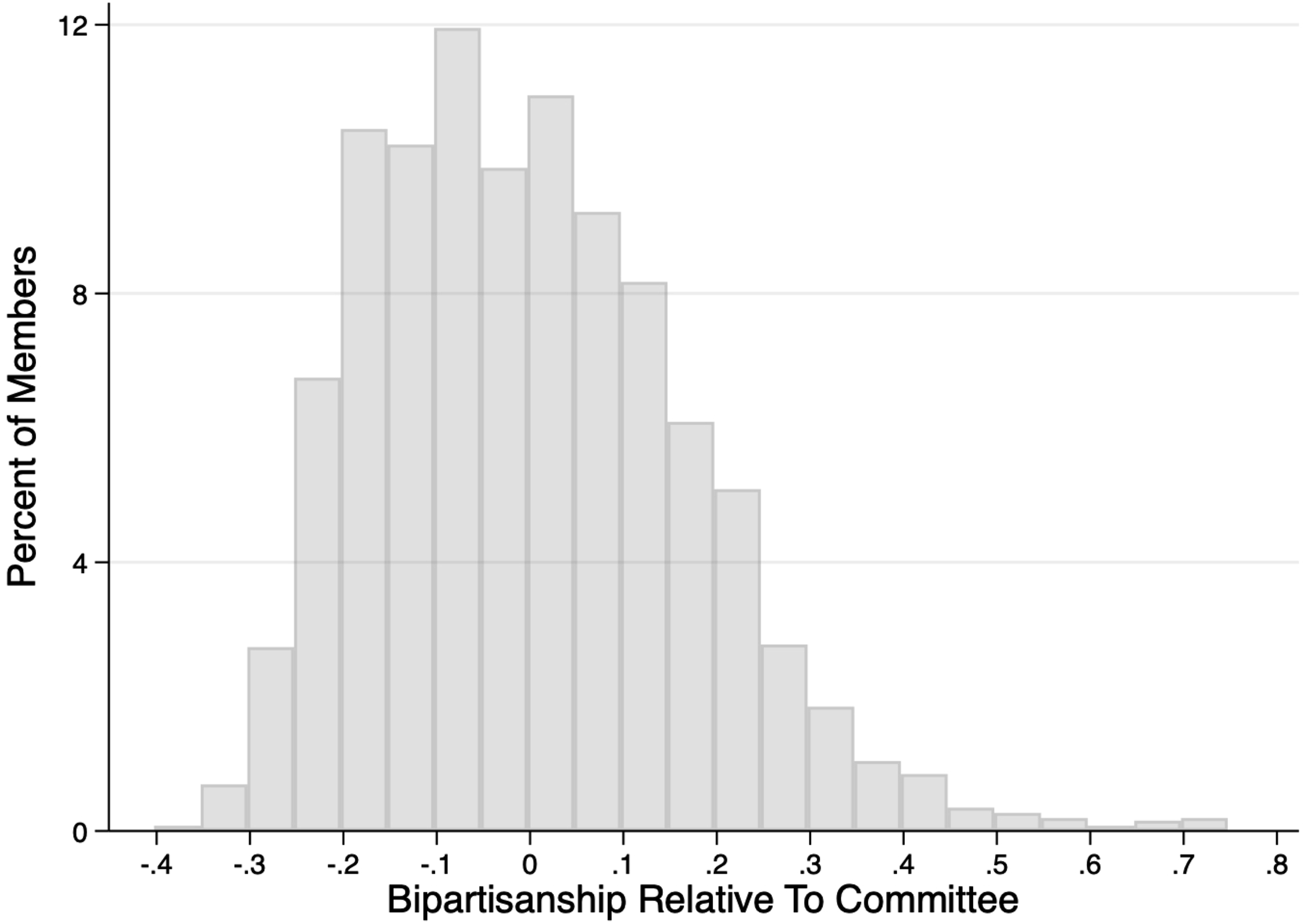
Conditional logit models of committee chair selection
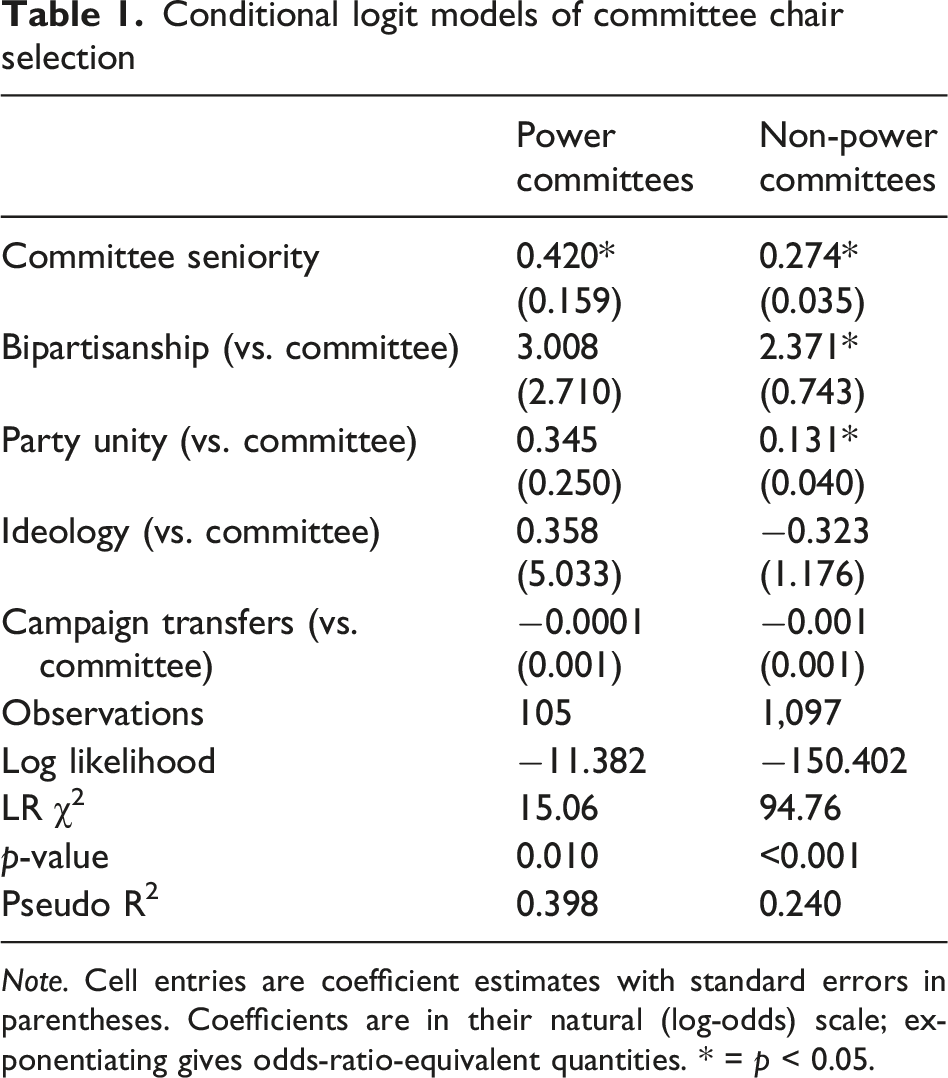
Note. Cell entries are coefficient estimates with standard errors in parentheses. Coefficients are in their natural (log-odds) scale; exponentiating gives odds-ratio-equivalent quantities. * = p < 0.05.
The only significant variable in the model is seniority; those that served on the committee longer are more likely to take over as chair when a vacancy occurs. There is roughly a 50 percent increase in the likelihood of becoming chair for each additional term served. The results of the model also suggest that bipartisanship does not have an effect on chances of becoming chair of a power committee. However, it is also important to note the sample size. During this time period, less than 20 people became chair of a power committee, so it may be challenging to detect smaller effects.
The second column of Table 1 shows the results for the non-power committee model. In keeping with the prior model, seniority still has a positive effect; for each additional term served, a member has around a 30 percent increase in the likelihood of becoming chair. 10 In contrast to the power committee model, party unity also has a positive effect. That is, those who are higher than average in party unity when compared to the rest of their committee are more likely to become chairs. By way of an example, moving from the 25th to the 75th percentile of relative party unity increases the predicted probability of becoming a non-power committee chair by about 0.13, or 20 percent.
In support of the non-power hypothesis, bipartisanship is also positive. Those who are above-average in bipartisanship, when compared to the rest of their committee, are more likely to be elevated to committee chair for non-power committees. As an example, moving from the 25th to the 75th percentile of committee-relative bipartisanship increases the predicted probability of being selected as a non-power committee chair by about 0.11, or around 16 percent.
It is worthwhile to consider in detail the effect of bipartisanship on elevation to chair for non-power committees. As can be seen in Figure 2, moving from two standard deviations below the mean to two standard deviations above the mean changes the predicted probability of becoming chair by almost 0.3 (0.58–0.87). This is roughly a 50 percent increase in the likelihood of becoming chair. This shows that relative bipartisanship can be an important factor in determining if a member is elevated to chair of a non-power committee. Predicted probability of non-power committee chair selection.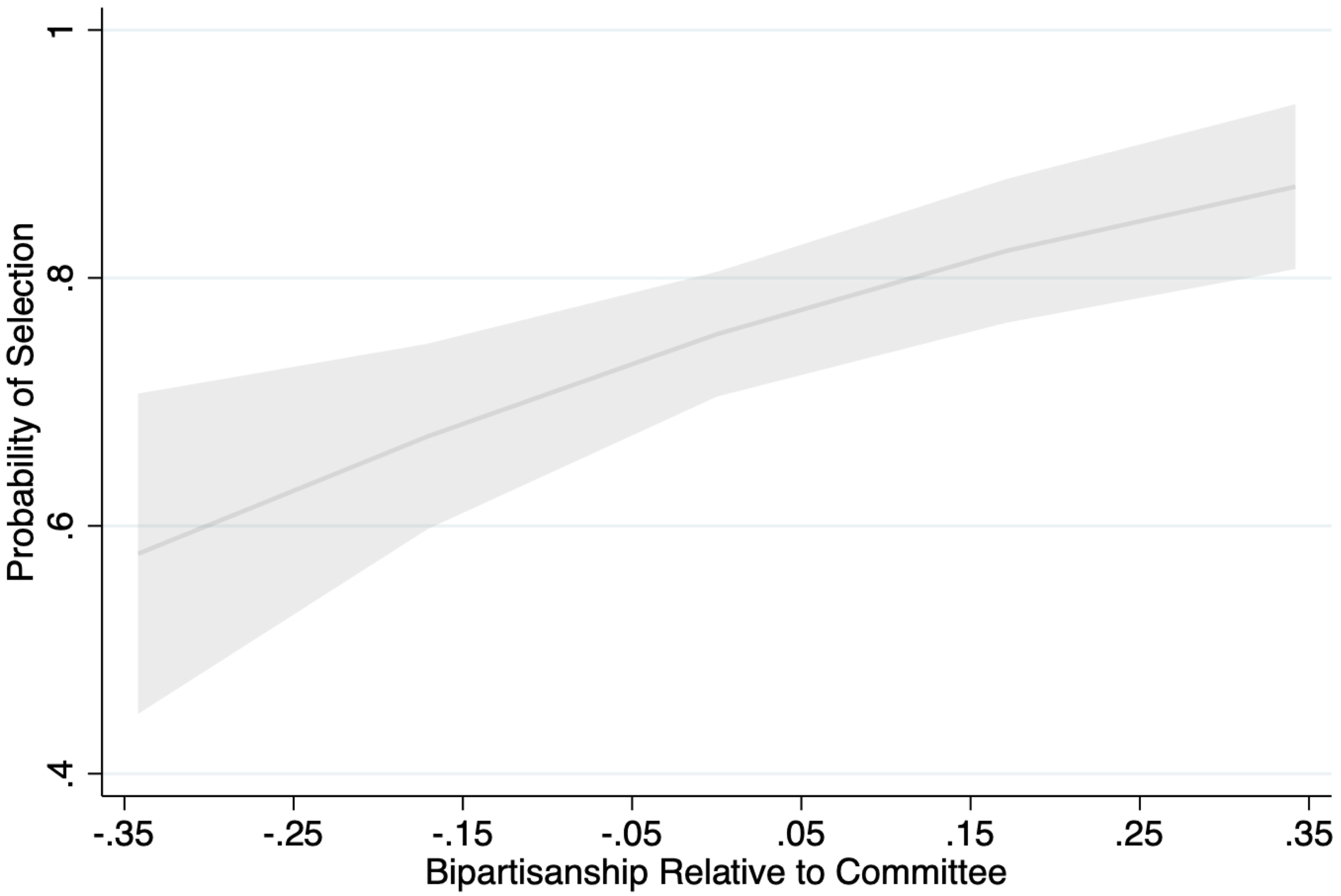
Discussion
Why may there be differences in these models with respect to other studies of post-reform committee chairs? This paper modeled variables in a different form; members were compared to those on their own committees as opposed to their caucus as a whole. This modeling change may also contribute to the divergence in results. Additionally, while other studies included measures of ideology, or of transfers, this analysis extended the analysis to cover additional years; it could be that the inclusion of additional observations as well as variables has attenuated the effect sizes of those findings. For example, in support of the Becker and Moscardelli (2008) study, the ideology variable becomes significant when the non-power committee model omits both the bipartisanship and party unity variables. 11
There is a concern that the results may be biased by members switching chairs; that is, a member may have served as chair of Committee X during session n but served as chair of Committee Y during session n + 1. Therefore, all of those who were in this position were omitted from the data and the analysis was conducted again. There were not substantial differences across these specifications, suggesting that outliers did not drive the effects in the models.
There is also a concern that conventional frequentist approaches are not well suited for data with few selection events, as was noted by earlier studies of committee chair selection (Cann 2008). Therefore, the models were re-estimated using Bayesian conditional logistic regression with weakly informative Cauchy (0, 2.5) priors. This approach imposes minimal substantive constraints while preventing the parameter estimates from being overly influenced by features of the small-sample likelihood. Estimation used 30,000 retained MCMC draws following a burn-in of 10,000 iterations to ensure adequate mixing. The substantive findings for both models were robust to this Bayesian estimation. 12 This suggests that the main results were not artifacts of the frequentist approach.
To further examine the possible mechanism at play in committee chair selection, legislative effectiveness was also included as an independent variable. Legislative effectiveness scores (LES) have been used as a holistic measure of legislative productivity, accounting for every step in the legislative process from bill introduction to law passage (Volden and Wiseman 2014). This allows for a more direct test of the argument that chairs are selected because they are either seen as credible sources of information about what legislation does or because they are more effective at passing legislation. LES was not significant in either the power or the non-power model (see appendix). This provides support for the argument that information theory is guiding this process.
Another possible mechanism centers around electoral vulnerability. It is possible that Steering Committees could see utility in promoting a member from a swing district to chair in order to provide more opportunities for credit claiming or for legislative pork to assuage electoral concerns. Therefore, another model tested this “electoral vulnerability” framework by including the member’s general election vote share relative to their committee. This variable was insignificant in both models (see appendix). This suggests that electoral concerns are unlikely to be paramount in making chair decisions.
It may be argued that these findings sit in tension with the current role of committees in the policy-making process. Once viewed as central to understanding the legislative process, much of their power has since shifted towards leadership (Aldrich and Rohde 2000). These leaders have used this authority to circumvent committees and legislate around them (Bendix 2016; Sinclair 2016). Contemporary scholarship tends to emphasize how committees prioritize roles outside of the creation of legislation, such as conducting oversight (Kornberg 2023; Lewallen 2020).
However, others have found a role for committees in legislating. For example, scholars have noted that committees are treated by special interests as still shaping legislation (Teso 2025), while committee members may also use their specialized knowledge to shape the policy views of their colleagues (Curry 2019). Thus, the findings from this article could be seen as complementing these recent studies and further highlight how legislative behavior can shape committee leadership.
It should also be noted that the policy concerns of the executive have been shown to largely shape the considerations of legislators in Congress (Eissler and Rutledge 2026). Presidents have also used bargaining and veto threats as well as other tools of the executive branch to also shape policy (Baron 2022; McLain 2024). While recent executives have struggled to implement their agenda through Congress (Edwards 2021; Smith 2021), future scholars may wish to extend these findings to see if party leaders continue to care less about the policy coming from non-power committees in an era increasingly shaped by the executive.
Conclusion
This manuscript set out to examine the role of bipartisanship on elevation to committee chair. Given the structure and results from party cartel theory, as well as insights from information theory, it was hypothesized that those higher in bipartisanship would be more likely to become committee chairs on non-power committees but less likely to become committee chairs of power committees. Using conditional logistic models to analyze the 107th through 114th Congress, support was found for the non-power committee hypothesis.
This examination of chairs does not take into account some of the more non-quantifiable components that could shape elevation to chair. Personal relationships between members, for example, might weigh heavily on the minds of those on steering committees. Recent work has fleshed out the importance of more qualitative elements (see Curry 2022), so others are urged to complement the findings from this study with other approaches. Additionally, the division of power versus non-power committees is also crude; there may be other variations for scholars to examine.
This study also relied on cosponsorship data to quantify bipartisanship. Other scholars have also looked beyond variables relying on votes to measure bipartisanship (such as Craig 2023). Future work should continue to adopt innovative approaches to gauge bipartisanship and then attempt to replicate these findings as a test of the robustness of the measure.
These findings speak to the value of information theory. While information theory has primarily been examined through theoretical models and experimental designs (Battaglini et al. 2019; Krehbiel 2004), this study applies it in a more quantitative setting. This study may urge others to attempt to extend theories into novel settings to better examine their insights.
These findings offer a nuanced view of bipartisanship in the contemporary Congress. While hyperpartisanship may dominate headlines, parties still reward cross-aisle cooperation. However, this is a strategic reward, as it is awarded to those on committees where such skills serve policy-making rather than partisan goals. This suggests that institutional design can shape the expression of the democratic value of compromise.
There are extensions from these findings into Congress itself. While those that are bipartisan are more likely to be elevated to committee chair on non-power committees, the impact on their work of the committees remains to be examined. Are more bipartisan chairs more effective in their leadership positions? Might bipartisanship impact the likelihood of selection onto other types of committees, such as joint committees? Relatedly, do legislators alter their behavior in attempts to land leadership positions on particular committees, perhaps by adjusting their bipartisanship or party unity? The use of bipartisanship as a factor in promotion may also spur its cultivation. As noted by Roberts (2010), incentives must be employed to encourage specialization among committee members. If members are rewarded with increased authority by demonstrating bipartisanship, they may be more likely to engage in fostering these cross-party relationships.
The extensions from this study also reach into spheres beyond Congress. First, scholars of other legislatures at either the sub-national or national level should continue to seek out ways of theorizing how bipartisanship can still shape decision-making within institutions that have become increasingly polarized. Where else might bipartisanship serve as a useful signal to others? Beyond institutional incentives, there may be particular types of bipartisanship that are rewarded by the electorate; this may be more likely on issues that are sometimes less tethered to partisanship, such as foreign policy.
These findings also have important implications for the study of Congress. As Congress changes its internal rules, it is incumbent upon political scientists to examine all of the relevant implications of those changes, including causes and consequences. Our institutions are not static; as they adjust, our assessments and understandings of them must also adjust.
Supplemental Material
Supplemental Material - The Strategic Value of Compromise: Bipartisanship and Committee Leadership in the U.S. House
Supplemental Material for The Strategic Value of Compromise: Bipartisanship and Committee Leadership in the U.S. House by Michael E. Bednarczuk in Political Research Quarterly.
Footnotes
Ethical Considerations
This article does not contain any studies with human or animal participants.
Funding
The author received no financial support for the research, authorship, and/or publication of this article.
Declaration of Conflicting Interests
The author declared no potential conflicts of interest with respect to the research, authorship, and/or publication of this article.
Data Availability Statement
The datasets generated during and/or analyzed during the current study are available via the Harvard Dataverse at https://dataverse.harvard.edu/dataset.xhtml?persistentId=doi:10.7910/DVN/OAML4Y,  .
.
Supplemental Material
Supplemental material for this article is available online.
Notes
References
Supplementary Material
Please find the following supplemental material available below.
For Open Access articles published under a Creative Commons License, all supplemental material carries the same license as the article it is associated with.
For non-Open Access articles published, all supplemental material carries a non-exclusive license, and permission requests for re-use of supplemental material or any part of supplemental material shall be sent directly to the copyright owner as specified in the copyright notice associated with the article.
