






Abstract
The Supreme Court relies on public goodwill for its authority, yet its decision-making processes are often hidden from the public eye. Media coverage of oral arguments in prominent cases provides an opportunity for Americans to assess how the Court carries out its procedures. Using a survey experiment conducted around the oral arguments in Trump v. Anderson, we show that depictions of partisan bias by the justices in their oral argument questioning patterns reduce perceptions of procedural fairness, decrease approval of oral argument, and undermine views about the Court’s authority. While these effects are driven by bias against copartisans, bias favoring copartisans does not improve evaluations. Our findings illustrate the responsiveness of the American public to depictions of the Court’s decision-making behavior and highlight procedural fairness as an avenue for the Court to maintain institutional support.
Of the 439 seats available to observe oral arguments at the U.S. Supreme Court, the Court sets aside only approximately 50 seats per argument for members of the public. 1 To be among the lucky few to witness the most public-facing activity in the Court’s decision-making process, you would need to be in line outside by 7:30 on the morning of an argument. From there, you would be ushered in to witness the justices and attorneys spar over the resolution of a case. The rest of the American public can instead learn about the Court’s proceedings from how news sources cover and how other elites discuss oral arguments.
In this article, we examine how learning about the partisan or non-partisan behavior of the justices during Supreme Court oral arguments affects evaluations of the Supreme Court. 2 We focus on the impact of a key but understudied source of this information for the public: elite depictions of the Court’s behavior, such as by the media or a politician. Despite the importance of this question for understanding the link between the public and judiciary and the amount of attention scholars devote to studying oral argument to understand judicial behavior, existing scholarship provides only limited insight into how exposure to information about oral arguments might affect the public. In the state court context, Black et al. (2024) find that whether exposure to video of high court oral argument benefits courts depends on numerous factors, including whether the exchanges between attorneys and judges are neutral or contentious. Further, Cann and Goelzhauser (2024) show that attending oral argument can improve legitimacy evaluations. Krewson (2019) finds similar effects when assessing the impact of public speeches by judges. 3 We contribute to this scholarship by studying how depictions of partisan bias at oral argument at the Court (using different frames of the justices’ behavior) shape these evaluations.
Oral arguments provide an opportunity for the public to learn about the decision-making process of the justices in ways that could bolster support for a foundering institution. 4 The Court is skeptical that the benefits of broad exposure to oral arguments would outweigh its costs. Many justices worry that their arguments will be taken out of context or that holding argument before a worldwide audience could alter the nature of the exchanges that take place (Black et al. 2023). Even justices who initially express support for more public exposure tend to retract after spending some time on the bench. 5 Increased attention to the Court and the widespread availability of live audio streams of oral argument proceedings make it crucial to understand how the public responds to depictions of oral argument.
We can learn whether the justices’ concerns about oral argument are justified by examining how depictions of oral argument shape perceptions of the Court. The media reports on various aspects of oral arguments (Cota et al. 2026), ranging from laughter 6 to ideological divides infiltrating a nominally non-ideological institution. Consider news coverage of the Court’s oral argument in a 2025 case from Oklahoma about the constitutionality of religious charter schools. A story in USA Today highlighted moments from oral argument, noting that “a sharp ideological divide … emerge[d] between the court’s liberals and conservatives” 7 and providing readers a clear understanding of how the justices handled these proceedings, how they interacted with the oral advocates, and the ideological stakes of the case.
In examining the impact of portrayals of the Court’s oral arguments, we expect individuals will react positively to depictions of oral arguments that highlight unbiased procedures and negatively to depictions of biased procedures. Perceptions of procedural fairness are a foundational consideration in determining mass attitudes regarding institutional legitimacy and approval (Benesh 2006; Tyler 2006). Americans tend to express support when the judiciary is portrayed as emphasizing legalistic rather than political decision-making (Baird and Gangl 2006; Hitt and Searles 2018). And the public holds preferences over the legal factors and traits that judges express and employ in carrying out their duties (Krewson and Owens 2021; Rivero and Stone 2025). Oral argument gives “the public a window into the internal dynamics of the Court. … [It can provide] a sense of how the justices operate as a small group” and thereby shapes perceptions of how the Court goes about its business and treats the two parties in the case (Unah 2009, 107–108). This suggests oral arguments can shape how the public evaluates the Court.
Frames varying depictions of bias, however, may play a limited role in shaping views of the contemporary Court as support for the Court has polarized along partisan lines (Davis and Hitt 2026; Levendusky et al. 2024). As the judiciary faces substantial threats to its public standing (e.g., Badas and Justus 2024; Boston et al. 2023; Boston and Krewson 2025; Krewson et al. 2024), it has also inserted itself into contentious issues (e.g., Levendusky et al. 2024). Contemporary research illustrates how politics plays a significant role in shaping attitudes toward institutional legitimacy (Bartels and Johnston 2013; Clark et al. 2024; Rogowski and Stone 2021), in contrast to eras where political divisions in evaluations of the Court were minimal (Gibson and Nelson 2014). Under this perspective, partisanship, rather than an independent evaluation of behavior at oral argument, dominates evaluations of the Court.
In this article, we elaborate a theory that framing the extent to which the Court’s behavior during oral argument (e.g., from the media or prominent politicians) exhibits partisan bias can shape public evaluations of the Court. Such framing informs the public about the extent to which the Court handles these procedures fairly. To test our argument, we employ an online survey fielded in the midst of oral arguments in Trump v. Anderson. The case dealt with President Trump’s access to the ballot in Colorado (and by extension, other states) and had the potential to reshape American history; a counterfactual ruling in this case could have prevented Trump’s second accession to the presidency. The case, thus, had obvious partisan ramifications. The context of a high-profile case offered the opportunity to experimentally vary depictions of oral argument in an externally valid context. Even more, these cases are precisely the types that the public follows. In particular, we randomize exposure to a depiction of oral arguments in the case that were characterized by unbiased questioning or bias by the conservative or liberal justices in favor of or against Trump, respectively. By varying whether the justices exhibit bias during oral argument toward the parties, we can assess the impact of oral arguments on evaluations of the Court. Given the individuals’ pre-existing perceptions of the presidential candidate, this case provides a tough test of whether depictions of oral argument procedures shape attitudes toward the Court. Nevertheless, fielding our experiment in the midst of a high-salience case that presented strong and unavoidable partisan cues may limit its generalizability to other contexts.
We find that portrayals of the behavior of the justices during oral argument affect support for the Court’s behavior, perceptions of fairness in the decision-making process, and support for the Court’s institutional power. Compared to a control condition, exposure to a treatment describing partisan bias by the justices against litigants can harm public support. Further, a description of partisan bias favoring a survey respondent’s party does not benefit the Court. In fact, reporting of neutral procedures can lead to more favorable outcomes among partisans than procedures that would clearly favor those same partisans. Our data demonstrate that the Court benefits from unbiased procedures and, correspondingly, the media portraying the Court’s actions in a neutral light. This suggests that when the media cover a Court that employs fair oral argument procedures and portrays itself in a neutral manner, the Court can make the most out of the public exposure provided by oral argument and thus boost public support for the institution. Our findings advance a large body of scholarship that studies oral argument in the context of judicial behavior (e.g., Black et al. 2012) by illustrating that these procedures have an impact on public evaluations of the courts. So doing, we contribute to a nascent literature that studies the impact of judicial procedures on public attitudes in contexts other than the U.S. Supreme Court (Black et al. 2023; Cann and Goelzhauser 2024).
Oral Argument and Perceptions of the Courts
Given the U.S. Supreme Court’s limited mechanisms for preserving its power, it relies predominantly on public support to induce compliance with and enforcement of its decisions (e.g., Bickel 1986; Hall 2014). Scholars have, in turn, devoted significant attention to the determinants of diffuse support and specific support for the Court (e.g., Ansolabehere and White 2020; Badas 2019; Bartels and Johnston 2013; Bartels and Kramon 2022; Boston and Krewson 2024; Caldeira and Gibson 1992; Christenson and Glick 2015; Gibson and Nelson 2015; Haglin et al. 2021; Nelson and Tucker 2021). Yet we know relatively little about how individuals process the Court’s public and private workings, and how these proceedings shape evaluations of the Court.
Like other political institutions, Supreme Court procedures are often shrouded in mystery. But, understanding these procedures is important for effective democratic governance. Many Americans have basic knowledge about the workings of U.S. political institutions, including the Supreme Court (Delli Carpini and Keeter 1996; Gibson and Caldeira 2009). Politically sophisticated Americans are more likely to be aware of the Court’s procedures prior to the issuance of a decision than those who are less educated or engaged (Hitt et al. 2019). It is harder for the public to determine whether the Court engaged in a normatively desirable decision-making process in any particular case. The Court’s deliberations during the agenda-setting process, conference meetings, and opinion writing are typically shielded from the public eye. By comparison, the Court is unusual—compared to the coequal branches—in the detailed explanations it gives for its decisions. Nevertheless, it is challenging for outsiders to peek behind the curtain during the decision-making process (e.g., Woodward and Armstrong 2011).
Given this, Americans have to rely on various cues to evaluate the justices’ job performance. The justices’ voting behavior can help inform outcome-based evaluations, but votes are less helpful if Americans also care about the Court’s procedures. Existing work demonstrates that the justices’ actions beyond their votes can affect attitudes toward the Court and its members. These include public speaking (Krewson 2019), scandalous behavior (Boston et al. 2023; Krewson et al. 2024), recusal decisions (Giallouri and Menounou 2024), judicial friendships (Armaly and Schoenherr 2025), selection of an opinion author (King and Schoenherr 2024), types of opinion language (Black et al. 2016), and use of legal principles or judicial philosophies (Krewson and Owens 2023; Rivero and Stone 2025). Further, public perceptions of social groups to which judges belong shape evaluations (Badas and Justus 2024), as does how the courts make decisions involving these groups (Zilis 2021).
Beyond the judges’ own actions, elite sources—the news media and prominent politicians—play a critical role in shaping how Americans evaluate judges and the judiciary. While these actors command influence in all areas of American politics, the relatively technical nature of judging and the lack of knowledge the American people have about particular cases and judges in the absence of this information provide these actors with an opportunity to shape attitudes toward the judiciary. Research from the context of judicial nominations (Krewson 2023; Rogowski and Stone 2021) and major cases (Collins and Eshbaugh-Soha 2019) shows that messaging from members of Congress and presidents shapes the environment in which the public evaluates nominees and the judiciary as a whole. Likewise, the media play a crucial role in informing the public about judicial business (Hitt and Searles 2018; Zilis 2015). This behavior is strategic, with the choice of when and how to communicate about the courts serving the electoral goals of politicians (Collins and Eshbaugh-Soha 2019; Kaslovsky et al. 2025; Rivero and Stone 2026) and economic goals of the media (Truscott 2024; Vining and Marcin 2014). Thus, it is essential to study how portrayal of courts’ activities affects public perceptions.
Oral arguments are an unusually transparent part of the Supreme Court’s operations, and thus can serve an important informational function for the public (cf. Krehbiel 2016). In this stage of the process, litigants’ representatives get to make their cases to the Court face-to-face. That process provides insight into the Supreme Court’s decision-making behavior (Black et al. 2012) and can be used to predict the justices’ decisions (Black et al. 2011; Epstein et al. 2010; Johnson et al. 2006; Kaufman et al. 2019). Oral argument has recently also become a more prominent medium through which the Court’s actions are conveyed to the public. While there is limited data on the percentage of Americans who are aware of particular oral arguments, in a 2022 C-SPAN survey 46% of likely voters report that they are aware that the Court provides live audio of its oral arguments, and, of those, 46% say that they themselves listened to an argument at least once; presumably, more have been exposed to media reports about arguments. 8 The Court began live-streaming oral arguments during the COVID-19 pandemic. This did not appear to have substantial effects on media coverage of the Court in the first two full terms after the practice began (Houston et al. 2023); this coincides with a decline in news coverage of the Court’s docket over time (Cota et al. 2026). Nevertheless, in principle, the arguments are more widely available than ever, and in certain contexts—as in the case we study in this article—receive large amounts of media coverage.
Central to oral argument is the verbal exchange of ideas among judges and attorneys. For attorneys, oral argument is a valuable opportunity to shape the justices’ views (Johnson et al. 2006; Scalia and Garner 2008), as it is the one time for attorneys to interact with the justices directly and to engage in the decision-making process through their real-time persuasive arguments. Recognizing its importance, the Court provides extensive guidance to attorneys about how to conduct themselves. 9 Scholarship examining oral arguments has shown that lawyers’ performances can help sway the justices’ votes (Johnson et al. 2006; Ringsmuth et al. 2013). The justices’ own biases shape whether they perceive attorneys as effective. For example, successful strategies for litigants may depend on lawyer gender (King et al. 2025), whether lawyers act in accordance with gender norms (Gleason 2020; Gleason and Ivy 2021), and physical attractiveness (Waterbury 2024). 10
Many factors affect how the justices participate in oral argument, such as the length of their tenure on the bench (Houston et al. 2021) and gender (Feldman and Gill 2019). A major part of how justices behave at oral argument depends on which side of a case they favor. Outside observers can tell if an oral argument is going well or poorly by paying attention to the justices’ patterns of questioning: receiving more and longer questions is a bad sign for an attorney (Epstein et al. 2010; Johnson et al. 2009). Further, the language choices (Black et al. 2011) and vocal pitch (Dietrich et al. 2019) of the justices in oral argument foreshadow their eventual votes.
This bias in questioning—or the appearance of it—emerges during oral argument (Dietrich et al. 2019; Feldman and Gill 2019) and receives popular news coverage. In our introduction, we illustrated these dynamics with USA Today coverage of the Oklahoma charter schools case, which depicted partisan divides in justice questioning of the attorneys. Scholars have identified how unfair and biased processes negatively affect public evaluations across a range of institutional contexts. For example, in Congress, Americans dislike the procedures that lead to gridlock (Flynn and Harbridge 2016). Further, when the Senate provides advice and consent on judicial appointments, Stone (2024) shows that Americans are less supportive of more extreme forms of obstruction of Supreme Court nominees (e.g., blocking consideration of a nominee) than more innocuous versions (e.g., requests for additional documents).
Given the potential for perceptions of procedure to shape institutional evaluations, researchers have long investigated the role of procedural fairness in public attitudes toward the courts (e.g., Baird 2001; Benesh 2006; Gibson 1989, 1991; Mondak 1993; Tyler and Rasinski 1991). A core component of believing that a procedure is fair is the perception of the decision-maker as impartial—that is, “a belief that the authority involved is not behaving in a biased or self-interested manner” (Tyler 2006, 117). It is this aspect of procedural fairness that we focus on in our design. 11 Of particular relevance in a polarized era are beliefs that a decision-maker is not impartial because that decision-maker has political biases. Frames that present the Court as motivated by politics can harm views that the Court’s processes were fair (Baird and Gangl 2006) and decrease specific support for the Court (Hitt and Searles 2018). Indeed, the contemporary media are apt to employ such politicized framing of the Court (Boston and Krewson 2025). Perceptions of impartiality also characterize general public attitudes toward courts elsewhere in the world; experimental evidence from Germany supports the view that the process a court uses can affect public attitudes toward contentious decisions (Cheruvu and Krehbiel 2024), and evidence from Norway and Portugal shows that frames that emphasize the partisan makeup of a court harm perceptions of procedural fairness (Magalhães et al. 2023). 12 This theoretical perspective leads us to predict that depictions of partisan bias at oral argument will harm Americans’ views of the Court’s decision-making. Partisan bias at oral argument suggests that the decision-makers are not impartial; it is difficult to believe that procedures are fair when those procedures were presided over by biased or self-interested adjudicators.
However, is partisan bias always harmful to the Court’s image? While, in general, Americans value fair procedures, this value can be mitigated or set aside when in-group interests are at stake. Americans evaluate politics through a partisan lens and may engage in motivated reasoning that discounts bias in support of a favored group. Indeed, existing scholarly work suggests that questioning patterns at oral arguments that go against one’s partisan in-group are likely more harmful than those that go against the out-group; furthermore, bias against the out-group may be rewarded. First, Armaly (2021) shows that Americans are more accepting of unfair Court behavior when they are beneficiaries of it. Second, Smith and Park (2013) show that attitudes toward congressional procedure vary depending on the clarity of its political consequences. Third, Stone (2024) shows significant differences in support for obstruction of Court nominees depending on one’s partisan alignment with the Court. Fourth, Badas (2016) shows that an individual’s belief that the Court behaved legalistically depends on one’s political support for the decision. Fifth, Americans demand judges who follow the law but also value judges who share their political views and pursue them on the bench (Bartels and Johnston 2012). In this perspective, partisan bias at oral argument may be punished if it is directed toward one’s in-group and tolerated (or rewarded) if used against an out-group.
In sum, extant scholarship does not provide direct insight into how exposure to depictions of the content of oral argument shapes how the American public evaluates the Supreme Court. This is the case despite the important window oral argument provides into how the Court handles its proceedings and the informational role elites can play in shaping public knowledge of this behavior. Research suggests that oral argument has the capacity to shape attitudes, but theoretical perspectives offer differing predictions about whether bias in oral arguments will uniformly harm attitudes or whether this behavior will be interpreted through a partisan lens.
Oral Argument Bias in the Context of Trump v. Anderson
In this article, we consider a particular way in which oral arguments can affect the public: through portrayals of partisan bias in the pattern of the justices’ questions. To evaluate whether such depictions of the justices’ patterns of questioning during oral argument can affect perceptions of the Court’s decision-making, we conducted a survey experiment in February 2024 at the time of oral arguments in Trump v. Anderson. In this case, the Court considered whether Colorado properly excluded Donald Trump from its Republican primary ballot on the grounds that he was ineligible under Section 3 of the Fourteenth Amendment. 13
We conducted our survey experiment in the days surrounding the actual oral argument in Trump v. Anderson. This timing and choice of case provide us with a series of benefits for studying the impact of bias in oral argument on public evaluations. First, this context enhances the external validity of our study as our treatments asked respondents to consider the Court’s behavior in an ongoing, high-salience case. Additionally, conducting an experiment in the context of a specific case—during which time we can plausibly induce different perceptions of decision-maker impartiality—helps us avoid the problem of attempting to measure the impact of institutional behavior in observational studies: in general, it may be “more plausible that people fill in the details about how [an] institution operates largely on the basis of their general attitudes” (Gibson 1991, 633). Here, we are able to present respondents with scenarios of what occurred in a particularly important Court procedure (oral argument) and vary reports of what happened in that oral argument. With this experimental setup, we can then test the impact of media coverage of biased or unbiased procedures on attitudes about the Court’s decision-making. 14
Furthermore, this particular case provides a good test for our theoretical expectations. First, we expect that the public would care deeply about the result, and therefore would be concerned with what happened in oral arguments in Trump v. Anderson. The case directly implicated the upcoming 2024 election and a candidate who appeared very likely to be the Republican nominee. Thus, it is more plausible that our experiment can uncover real attitudes, as it comes in the context of a salient case about a prominent politician.
Additionally, the oral arguments in Trump v. Anderson received extensive media coverage. When coverage like this airs, it means that Americans have the opportunity to learn about how the justices engaged in questioning. The fact that this coverage occurred bolsters the external validity of our experiment; in cases as important as Trump v. Anderson, it is likely that many Americans will hear about the oral arguments and how the justices act toward the parties. Importantly, as we discuss in more detail below, our design guards against real-world coverage biasing our results as we survey respondents both before and after oral argument. 15 To illustrate this coverage, we gathered news transcripts and articles from major print and television news outlets on February 8th and 9th (the day of and after oral argument) and March 4th and 5th (the day of and after the Court’s decision). 16 The number of news stories at the time of oral argument from these outlets (95) is almost the same as the number surrounding the decision itself (97). As one example, consider how a CNN.com story wrote that the conservatives “peppered the lawyers representing Trump’s challengers with a series of questions that suggested they were seeking a way to side with the former president” and “[e]ven some members of the court’s liberal wing posed difficult questions to the lawyers opposed to Trump.” 17
Trump v. Anderson received comparable levels of oral argument coverage to other high-profile cases with clear political consequences. We collected broadcast news transcripts from Nexis Uni about oral arguments in 17 major cases from the 2023 Term (Liptak et al. 2024). In Appendix Section B, we show that a number of cases—including about abortion, guns, and presidential immunity—received similar levels of oral argument coverage on television news to the case we focus on in this paper. In this way, we see our design and findings as generalizable to the other types of cases for which the public is most likely to be exposed to oral argument coverage.
Finally, the high partisan stakes of Trump v. Anderson make it a particularly tough test of the theoretical perspective that Americans would prefer unbiased patterns of questioning, especially given the justices’ greater rates of partisan voting in election cases (Rivero 2026). In particular, it is plausible that bias favoring one’s in-party would generate positive reactions in a case where the partisan implications are clear. While the final vote breakdown in Trump v. Anderson may suggest an elite consensus on the case’s bottom line, existing evidence indicates that sources about the case primed most Americans to think about it through a partisan lens. For example, in the 2024 SCOTUSPoll (Jessee et al. 2024), there is a 76.8 percentage point gap in support for removing Trump from the ballot between Democrats and Republicans. 18 Thus, there is strong reason to believe that motivated reasoning could lead respondents to desire biased questioning in their favor in a case that primes partisan cues so directly.
While we thus see a number of benefits to focusing on Trump v. Anderson in our study, we acknowledge the limitations inherent in focusing on a single case and survey in our analysis. For example, respondents may react differently to similar frames of oral argument behavior in cases about other issues (e.g., respondents may react differently to bias against a nonpartisan actor, or even a partisan actor about whom the public does not have strongly anchored attitudes). Also, a survey conducted in a different political climate might generate different results (e.g., in a less polarized era, Americans may care more about unbiased procedures). That being said, we also have reason to believe that our application here—though it is a challenging test given individuals’ strongly held pre-existing attitudes towards Trump—extrapolates to other contexts. Experimental results from Bartels and Johnston (2013) exhibit that individuals tend to attribute legitimacy conditional on the ideological direction of a decision. Furthermore, the public receives partisan and ideological information about the Court and the justices through media coverage (Boston and Krewson 2025), and politicized elite rhetoric can have detrimental effects on perceptions of the judiciary (Rogowski and Stone 2021). There are thus opportunities in a wide range of cases for the public to update their attitudes about the perceived fairness of the oral argument and the apolitical nature of the decision-making process. To be sure, these dynamics are likely strongest in cases with clear partisan or ideological stakes. Therefore, we see our study as an important contribution to knowledge of how the American public reacts to oral argument proceedings; future studies should consider how our results generalize to other contexts, including other highly salient cases that do not involve political figures as well as less salient cases.
Data and Methods
To assess the relationship between behavior in oral arguments and Court attitudes, we presented survey respondents with hypothetical descriptions of oral argument in Trump v. Anderson in order to gauge how the justices’ questioning of attorneys affects perceptions of the Court and its process. Our treatments mirror how Americans could learn about these proceedings via sources like the media, an important question as Americans will generally not be exposed to oral arguments directly (cf. Black et al. 2024; Cann and Goelzhauser 2024). We expect Americans to respond less positively to depictions of oral argument that indicate the Court is not treating the two sides equitably. If this attitude is driven purely by concerns about the outcome, we should see in-party bias rewarded and out-party bias punished. If we do not see such in-party bias being positively rewarded, that would be evidence that Americans have a preference for fairness at oral argument that goes beyond partisan goals.
We surveyed 1,999 respondents on the survey research platform, Prolific. We allocated approximately half of the sample (999 respondents) to the pre-oral argument group to assess baseline expectations on February 6th, 2024 (2 days before oral argument) and the other half of the sample to the post-oral argument group (1,000 respondents) on February 9th, 2024 (the day after oral argument); all respondents received the same survey, regardless of interview date. 19 Prolific has a large pool of survey respondents, takes active steps to ensure the quality of respondents on the platform, and has been shown to provide quality responses in social science research settings (Peer et al. 2021). For descriptive statistics on our respondents, see Appendix Table A.2. While online samples can have limitations (e.g., our respondents mirror the broader population on gender but skew more educated), research shows that the lessons from experimental work on samples such as ours generalize well to population-based samples (Mullinix et al. 2015).
Surveying respondents in the period surrounding the actual oral argument increases the external validity of our experiment as we query respondents about a contemporaneous case of practical consequence (rather than, e.g., a hypothetical case or case decided in the past). By running our survey over multiple days, we gather data both before and after oral argument in order to take advantage of methodological benefits that occur at each point in time; so doing, we also minimize the drawbacks that sampling solely before or after oral argument would have. The principal benefit of surveying our respondents after oral argument occurred is that the case is at its most salient, and thus it is more likely that the respondents will care about the issue; however, a disadvantage is that respondents may be influenced in their responses to our treatments by what actually happened (although, as we show below, there were only small differences in the treatment effects across the survey dates). On the other hand, surveying right before oral argument has the benefit that no one knows how the real-world oral argument went, at the cost of a lower real-world salience of the case, perhaps lessening respondents’ interest in the issue. By surveying at both times, we can avoid our results being driven by one side of this trade-off or another. Moreover, in our regression analyses, we control for the date respondents took the survey in order to evaluate whether these factors affected survey response. Furthermore, when analyzing subsets of respondents separately before and after actual oral argument, we find little differences (Tables A.8 and A.9), as discussed further below. Had we surveyed respondents only on one date either before or after the survey, we could only have speculated as to how the choice of date affected responses. 20
At the beginning of our survey experiment, we presented our respondents with the following prompt. The prompt serves to inform all respondents about the case and the process of oral argument, ensuring all respondents have a baseline level of knowledge about the topic and context: As you may know, the case Trump v. Anderson is pending before the U.S. Supreme Court. The case is about President Trump’s eligibility to run as a candidate in the 2024 presidential election. Trump has been excluded from the 2024 presidential primary ballot in the state of Colorado, and the U.S. Supreme Court agreed to decide whether former President Trump is ineligible for the ballot. The Supreme Court’s oral arguments in this case, held on February 8, 2024, allow attorneys representing the State of Colorado and Donald Trump to present their arguments before the justices of the Supreme Court.
We then assigned respondents at random to one of four conditions, either a control condition generally describing oral arguments occurring or three treatment conditions that randomized the nature of bias shown by the justices in the case to the parties.
21
Each condition began with “During oral argument, suppose that…” and then presented one of the following prompts:
22
(1) ( (2) ( (3) ( (4) (
To assess our expectations that scenarios suggesting the justices engaged in biased or impartial decision-making might affect multiple attitudes, we measured a series of outcome variables. We asked respondents to evaluate whether, based on the scenario we just gave them, “[t]he Court used a fair process to resolve this case” (Fair Process), “[t]he justices will vote in this case based on their political preferences” (which we reverse code to create Apolitical Decision-making), and “[t]he Court’s decision, regardless of the outcome, should be the final word on the matter” (Final Word). We also asked the respondents’ approval of “the way the Supreme Court handled oral argument in the case” (Oral Argument Approval). 23 The response options to each question are five-point Likert scales (ranging from strongly agree/approve to strongly disagree/disapprove). We rescaled all the outcome variables to range from 0 to 1. We code all items such that higher values reflect greater support for or approval of the Court. 24 We present the results for each variable separately in the main text.
Each of these variables provides us with leverage to test the theoretical expectations we discuss above. First, can the different treatment conditions that report question patterns at oral argument affect views about procedural fairness in general (Fair Process), and furthermore, can these conditions move respondents’ perceptions of partisan bias in particular (Apolitical Decision-making)? These questions capture our theoretical mechanisms whereby partisan bias indicates procedural unfairness and depictions of oral argument questioning could shift views of the Court’s decision-making. Second, does this reporting of behavior at oral argument affect downstream attitudes toward the Court’s institutional power and authority (Final Word) or support for the Court’s behavior in oral argument (Oral Argument Approval)? These questions capture whether our conditions shift not only attitudes about the fairness and impartiality of the Court’s process, but broader evaluations about the Court’s behavior given the media framing. Taken together, our outcome measures allow us to develop a nuanced picture of how depictions of oral argument questioning behavior can shape attitudes toward the Court.
Bias in Oral Argument Harms Court Evaluations
We estimate our treatment effects via OLS regressions with indicators for each experimental condition with respondent-level covariates. The Control condition (the general statement on oral argument occurring) serves as our reference level. The mean level of agreement with the Fair Process question in the Control group was 0.67 (95% confidence interval ranging from 0.65 to 0.69), 0.34 (0.32, 0.37) for the Apolitical Decision-making question, 0.60 (0.58, 0.63) for the belief that the Court should have the Final Word, and 0.62 (0.60, 0.64) for Oral Argument Approval.
Figure 1 presents the treatment effects with 95% confidence intervals for each condition as compared to our Control for each of our four outcome variables (rescaled to range from 0 to 1) for all respondents.
25
We also present the mean response for each outcome variable and treatment condition pairing at the left side of the figure. We find that the No Partisan Bias condition has a negative and statistically significant effect on whether respondents believe the Court used a fair process to resolve the case; the treatment effect is Oral argument fairness and evaluations of the Court. Note: Figure presents the coefficients (with 95% confidence intervals) and means for respondent evaluations of four outcome variables (rescaled to range 0–1) capturing evaluations of the proceedings of oral argument as a function of the treatment condition the respondent received.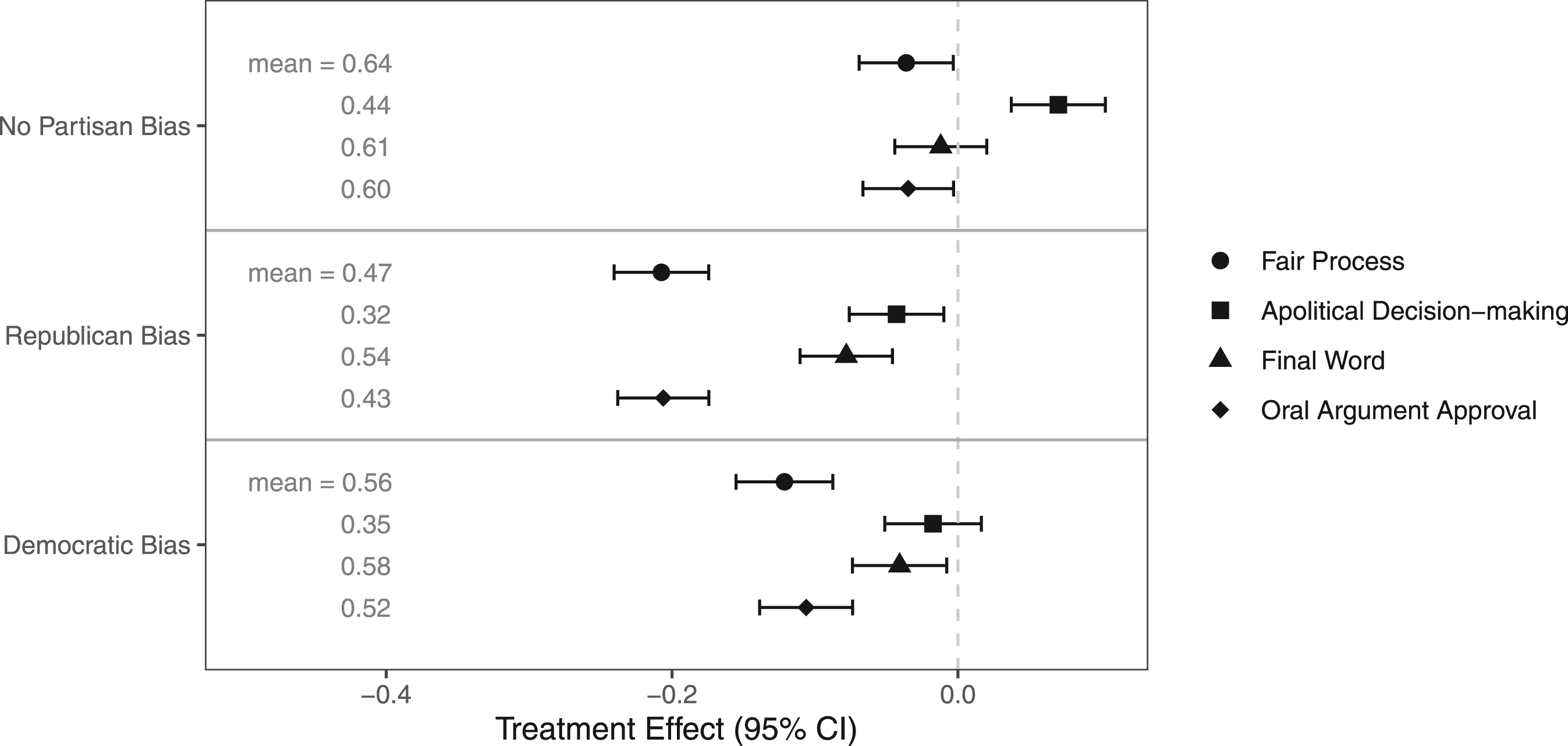
In the Republican Bias condition, however, we find that the treatment has a negative statistically and substantively significant effect across all four of our outcome variables; respondents who received the condition were less likely to believe that the justices used a fair process to resolve the case (Fair Process; treatment effect of
When exposed to the Democratic Bias condition, we also find similar relationships between the depiction of bias and our outcome variables, except for the Apolitical Decision-Making outcome variable, in which we find no statistically distinguishable effect (p
In sum, we find that both the Republican Bias and Democratic Bias conditions generate significantly lower evaluations across the range of our outcome variables than the control. Depiction of partisan bias in questioning patterns harmed perceptions that the Court engaged in a fair process, led respondents to exhibit less support for the Court having the final word in the decision, and generated lower support for how the Court handled oral argument in the case. 26
No Evidence of Rewarding Bias in Support of the In-Group
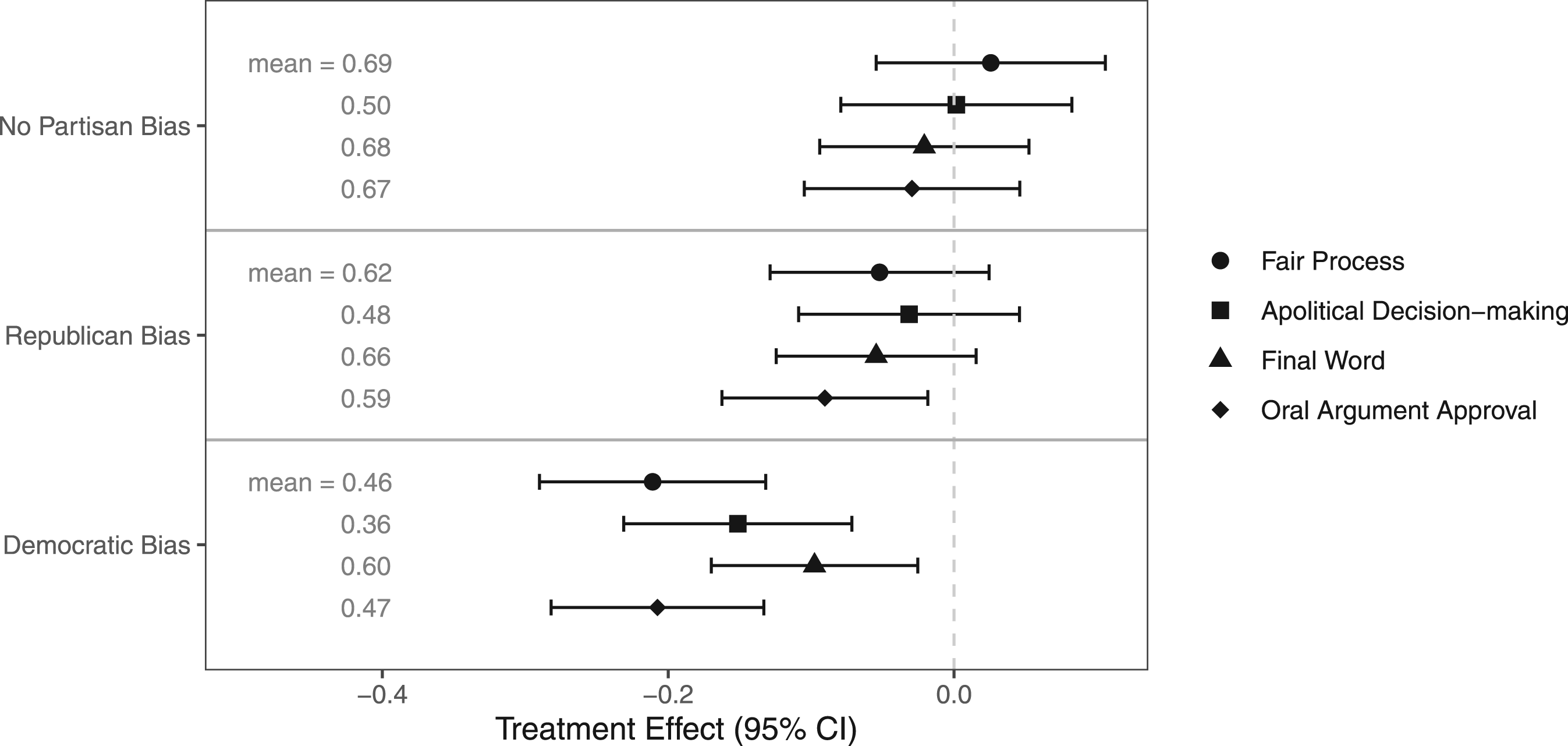
Theoretically, we discussed how bias in support of one’s partisan in-group may be discounted via a process of motivated reasoning and even rewarded. However, we find that our aggregate results presented above are not simply driven by respondents disliking out-party bias but liking in-party bias. Figures 2 and 3 present our results limited to Democrats and Republicans (including leaners); treatment effects are again estimated via OLS regressions.
27
We find that out-party bias is perceived more negatively; across all four outcome variables, Democrats react to the Republican Bias condition worse than control and Republicans similarly react negatively to the Democratic Bias condition across all outcomes. Yet for no conditions do we see improvement relative to control when there is in-group bias; furthermore, in-group bias is harmful to Democrats evaluating whether the process was fair and to both Democrats and Republicans evaluating whether they approve of oral argument.
28
What is more, among Democrats, we observe that exposure to non-bias in oral argument questioning actually bolsters a belief that the Court is apolitical, relative to questioning in oral argument that favors Democrats (treatment effect of 0.06, p Oral argument fairness and evaluations of the Court (Democratic respondents). Note: Figure presents the coefficients (with 95% confidence intervals) and means for respondent evaluations of four outcome variables (rescaled to range 0–1) capturing evaluations of the proceedings of oral argument as a function of the treatment condition the respondent received. Data subset to include only Democratic respondents (coding leaners as partisans). Oral argument fairness and evaluations of the Court (Republican respondents). Note: Figure presents the coefficients (with 95% confidence intervals) and means for respondent evaluations of four outcome variables (rescaled to range 0–1) capturing evaluations of the proceedings of oral argument as a function of the treatment condition the respondent received. Data subset to include only Republican respondents (coding leaners as partisans).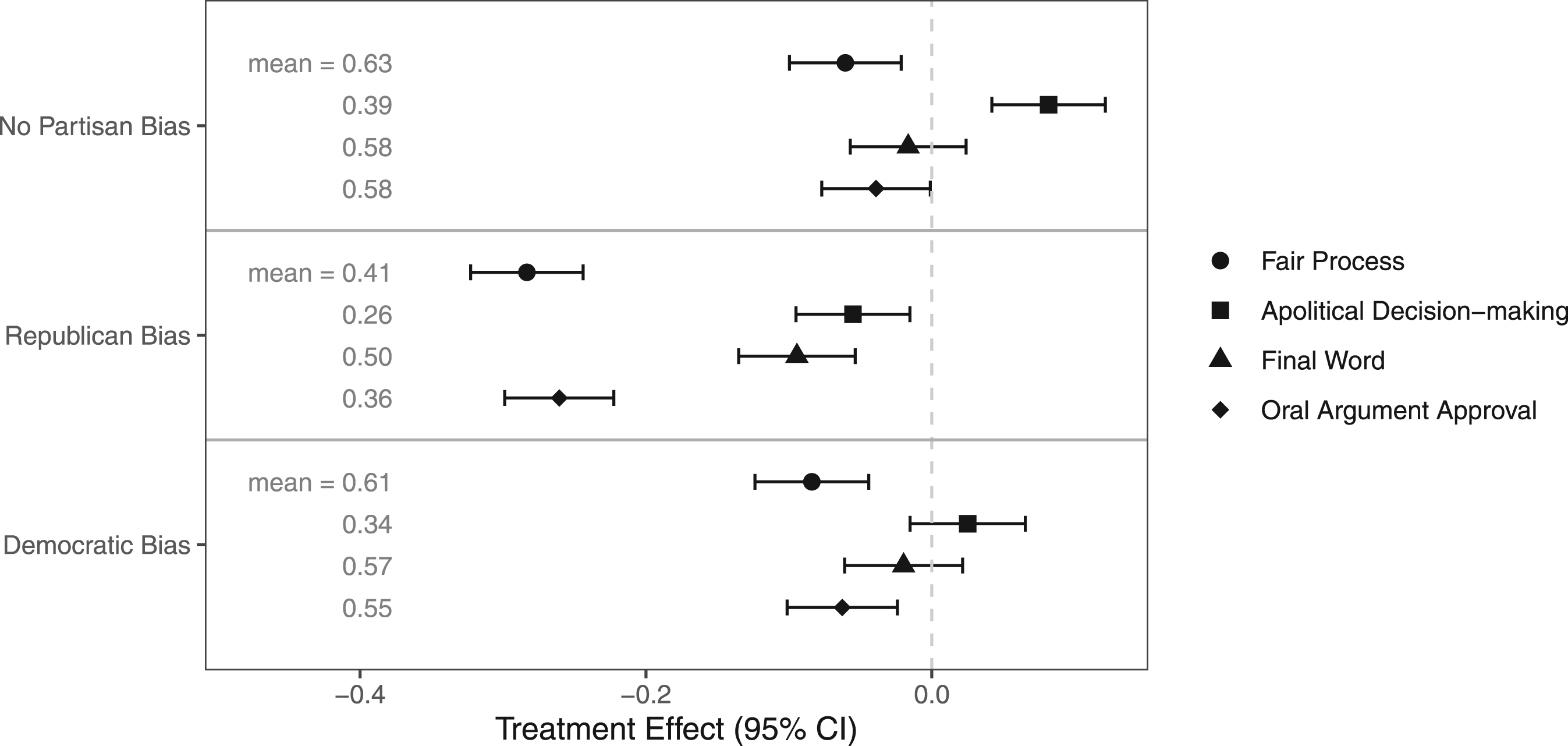
To assess whether living through real-world oral argument shaped the impact of our treatments, we also subset our sample to those who took the survey before (Table A.8) and after (Table A.9) oral argument; results were largely similar across the 2 days, except we see a negative impact for Republican bias on Apolitical Decision-making and a negative impact for Democratic bias on Final Word only on February 6th; 29 thus, even following the real oral argument, respondents still reacted to the frames given in our hypothetical treatment conditions. 30
Conclusion
Oral argument is the one opportunity for the public to observe justices engaged in the process of deciding a case. This information is transmitted to the public via the media and other political elites (e.g., Cota et al. 2026). As such, it presents an opportunity to understand the role of process (versus outcomes) in evaluations of Supreme Court decision-making in the context of how this process is conveyed to the American people. While it is clear that process matters in the context of trial court decisions (Tyler 2006), it is less clear whether citizens place weight on process in the context of the consequential policy decisions of the Supreme Court. Given the importance of procedural fairness to evaluations of the judiciary (Benesh 2006; Gibson 1989), our study provides important insight into how media coverage of this stage of the Court’s decision-making process impacts the American public.
We timed our study to take advantage of ongoing real-world proceedings in Trump v. Anderson, providing us with a particularly useful context to understand the role of process relative to outcomes. More than an abstract exercise, the obvious importance of the case and the timing of our survey maximize the relevance of this decision to respondents. Further, indications of bias for or against Trump provide clear partisan signals for respondents about the outcome of the case. In this context, we test whether people, when exposed to reports about a case, value outcome over process considerations in a case that matters for political representation. As we discuss above, we believe this context—given strongly held attitudes towards the key political actors involved—is a challenging test regarding the public’s preference for unbiased procedures at the Court and apolitical decision-making among the justices.
In sum, our findings illustrate that when public portrayals suggest the justices engaged in biased oral argument questioning, the public indicates displeasure with the Court. We find that the reporting of bias in favor of an out-party does harm to evaluations of the judiciary in a variety of ways, with respondents feeling the process is both unfair and political. Further, in these situations, respondents are less approving (of oral argument) and less willing to accept the final outcome of the case as the final word on the matter. That is, the public punishes the Court when they read about the Court’s out-partisan bias. On the other hand, depiction of in-partisan bias does not benefit the Court. Rather, both reporting of in-partisan bias and non-bias lead to similar levels of support on most of our outcome variables. The data demonstrate a public that forms its evaluations of procedural fairness based on depictions of actual fairness and not just policy alignment alone.
Our experimental data also shed light on the real-world reaction to Trump v. Anderson. News reporting of oral arguments in Trump v. Anderson highlighted unity on the Court in questioning behavior across party lines, with justices appointed by both parties more skeptical of Colorado’s arguments than Trump’s, as seen in the news stories presented earlier in the text. This unity across party lines—and reports of the Court’s behavior in oral argument—may have helped shape public attitudes toward its decision-making in this case; future scholarship should investigate the impact of this specific type of depiction of oral argument.
When respondents read about out-party bias, levels of support among out-partisans drop dramatically. Because “legitimacy is for losers” (Gibson and Nelson 2014, 212, n. 21), this should be particularly concerning for the Court. Further, reports of exhibiting bias in favor of a party in oral argument do not boost support among the favored. Rather, the Court can maximize support by acting neutrally in oral arguments—and thus increase the probability of being portrayed neutrally by the media—because this approach does not harm support among out-partisans. In fact, we find that under some conditions, respondents are more favorable to reports of a Court under non-bias scenarios than when oral argument questioning appears to benefit respondents on purely policy grounds. In an era where the justices confront a polarized political environment external to the judiciary that threatens to destabilize the institution (Rogowski and Stone 2021), our findings illustrate that portrayals of unbiased oral arguments offer a way for the justices to present a palatable image of their behavior to the American public.
How might evidence of a less partial Court reach the public? We see a number of avenues for this to occur. First, the justices could embrace a more transparent oral argument process, for example, by allowing oral arguments to be televised (e.g., Black et al. 2023), although there is strong resistance to this idea among the justices themselves. Second, even if the justices maintain the current oral argument format, they could do more to avoid creating perceptions of bias. Research suggests justices convey favoritism towards one party in various ways (Black et al. 2011; Dietrich et al. 2019; Epstein et al. 2010; Johnson et al. 2009), which journalists seem to recognize. 31 By changing their behavior in response to evidence that it causes institutional harm, we would expect the media to reflect that change in their coverage. 32
Of course, even if the justices were to change their behavior, the media decides which information to report on and how to report it. Oral arguments with less partisan questioning may be less newsworthy and therefore less likely to shape public opinion (Zilis 2015), though, consistent with Trump v. Anderson, we would expect oral argument for the most salient cases will continue to get coverage. Additionally, partisan media may selectively report on Court activities in ways that would limit the effects of a change in judicial behavior (Levendusky 2024), but research suggests that mainstream media continues to exert a disproportionate influence on the information people consume (Li et al. 2023).
We acknowledge limitations induced by our design. While the salience and partisan signaling of Trump v. Anderson allow for a clean test of the role of process, most Court decisions are less salient or include less clear policy signals. Thus, our findings are likely most immediately generalizable to the types of cases that receive comparable levels and types of news coverage. As our study focuses on this single case, it is important for future studies to consider what role procedural fairness plays in other contexts. Further, while we present our treatments directly to respondents, in the real world the public learns about the Court’s behavior from not just one media source, but from various news and social media sources as well as political elites, all of whom have incentives to frame the Court’s behavior in ways that highlight political rather than neutral aspects (Collins and Eshbaugh-Soha 2019; Hitt and Searles 2018). Thus, even if a media source reports that courts engage in unbiased questioning, the effects of that behavior on the public we observe in this study are conditional on that message being transmitted accurately via these elite actors. Future research should also consider whether the effects we uncover are strong enough to carry through to evaluations of the decision once it is released months later.
For now, it is clear that the public cares about process when they read about oral arguments, with clear downstream implications for the degree to which respondents anticipate accepting the final decision as authoritative. As oral argument serves as a major opportunity for the media to communicate to the public about how the Court engages in its judicial processes, the justices would do well to maximize the appearance of neutrality.
Supplemental Material
Supplemental Material - Depictions of Partisan Bias at Oral Argument and Public Evaluations of the U.S. Supreme Court
Supplemental Material for Depictions of Partisan Bias at Oral Argument and Public Evaluations of the U.S. Supreme Court by Joshua Boston, Christopher N. Krewson, Albert H. Rivero, Marcy Shieh, Andrew R. Stone in Political Research Quarterly.
Footnotes
Acknowledgments
We thank Alex Badas, Morgan Hazelton, and attendees of the Junior Law and Politics Research Community for helpful feedback on this paper.
Ethical Considerations
This project adheres to the ethical and transparency obligations outlined in APSA’s “Principles and Guidance for Human Subjects Research.” This research was approved by the Institutional Review Boards at each of our universities. The pre-analysis plan for this research is available at the following link:  .
.
Funding
The authors disclosed receipt of the following financial support for the research, authorship, and/or publication of this article: This research was financially supported by the Department of Political Science at Bowling Green State University and through a grant from the Center for the Study of Elections and Democracy at Brigham Young University.
Declaration of Conflicting Interests
The authors declared no potential conflicts of interest with respect to the research, authorship, and/or publication of this article.
Data Availability Statement
The data and code necessary to replicate the analyses of the paper are available on Dataverse at https://doi.org/10.7910/DVN/3ZMHLU .
Supplemental Material
Supplemental material for this article is available online.
Notes
References
Supplementary Material
Please find the following supplemental material available below.
For Open Access articles published under a Creative Commons License, all supplemental material carries the same license as the article it is associated with.
For non-Open Access articles published, all supplemental material carries a non-exclusive license, and permission requests for re-use of supplemental material or any part of supplemental material shall be sent directly to the copyright owner as specified in the copyright notice associated with the article.
