






Abstract
How do signals sent by women’s political organizations influence the diversity of who seeks them out? Women’s Candidate Training Organizations (WCTOs) are a vast network of political organizations operating in nearly all U.S. states, putting thousands of hours and millions of dollars into recruiting women candidates. These organizations provide an ideal case for understanding the impact of Organizational Identity Signaling. Political organizations vary in the signals they send about whose experiences will be centered in their programming, shaping who sees themselves within political spaces and gets the institutional support to participate in politics as a result. Using interviews with 57 Candidate Training Organizations, I provide evidence that while WCTOs nearly universally center and address women’s material and psychological barriers to running, they are less likely to focus on barriers faced by non-white candidates than equivalent non-gendered organizations. Using an original online survey experiment, I demonstrate the effect of these gendered and racial signals on women’s political ambition and its precedents, across race and ethnicity. This research has implications for understanding the role of identity-specific interest groups is shaping descriptive representation.
Keywords
Introduction
While the gender gap has closed in most forms of political participation (Shames et al. 2025), women remain severely underrepresented as candidates and elected officials. In fact, 49 of 50 states lag behind their state populations in both the gender and racial diversity of their state legislatures (POLITICO 2021). Women face considerable material and psychological barriers to running for political office, barriers that are exacerbated by other identities like race, ethnicity, class, and sexuality. However, increased descriptive representation can shift legislative behavior, increase participation from underrepresented groups, and influence perceptions of government legitimacy (Brown 2014; Campbell and Wolbrecht 2006; Clayton, O’Brien and Piscopo 2019; Gay 2002; Mansbridge 1999; Swers 2020).
Political and social organizations serve as essential pathways for recruitment into political participation (Rosenstone and Hansen 1993; Verba and Nie 1987; Verba et al. 1995). Recruitment is distinctly important for women’s political ambition because it increases beliefs that a run for office is feasible and shapes perceptions of the likelihood of success (Carroll and Sanbonmatsu 2013; Lawless and Fox 2005). However, political organizations vary tremendously in the signals they send about who they are for and what kind of support they provide. How do the signals sent by political organizations shape who seeks them out and gets institutional support as a result?
To explain the role of political organizations in shaping the recruitment of historically excluded groups into politics, I propose a theory of Organizational Identity Signaling. Running for office is a relatively costly form of participation, in terms of time, money, and institutional knowledge. People seek out political organizations to mitigate those barriers. However, the decision to join and engage with a political organization is not random. Feelings of belonging are impactful for political participation (Ocampo 2018a), meaning that people are more likely to participate in groups they believe will support them. Organizations vary in the signals they send about the kinds of candidates they work with, and their ability to address the unique challenges different political candidates face. Ultimately, individuals determine which organizations to engage with, based on these signals, influencing who gets meaningfully supported to run.
Institutional support is essential for increasing descriptive representation, but women are less likely than men to get that support through the parties. While formal party organizations are the largest source of recruitment of first-time candidates (Sanbonmatsu 2002), they are less likely to think of women as potential recruits for office (Crowder-Meyer 2013), and women are more likely to perceive party organizations as biased against them (Butler and Preece 2016).
Instead, Women’s Candidate Training Organizations (WCTOs), make up a major subset of organizations working to recruit, train, and support first-time candidates outside of the party system. These are private-sector organizations, including both non-profits and PACs, whose core mission is increasing women’s descriptive representation (Cooperman and Crowder-Meyer 2020; Kreitzer and Osborn 2020). By examining the gendered and racial signals sent by WCTOs, comparing them to organizations not focused on gender, and testing their effects on individual-level ambition and its precedents, I evaluate the conditions under which recruitment of historically excluded groups is and isn’t successful.
While I expect that WCTOs send uniformly effective signals of their commitment to supporting potential women candidates, I expect variation across race and ethnicity in the effectiveness of signals from WCTOs on women’s individual-level ambition. While these organizations were founded to consider and address women’s unique barriers to candidacy, women’s experiences are deeply heterogeneous and shaped by their many intersecting identities. By focusing broadly on “gendered” barriers to running, some WCTOs may flatten the diversity of women’s experiences, influencing individual-level ambition and state-level representation.
Through 57 interviews with both Women’s and Non-Gender Candidate Training Organizations, I demonstrate that women’s organizations send clearer signals of their commitment to centering women’s experiences and barriers to running, even as they vary in the signals they send about their commitment to racial diversity. I then test the effectiveness of these signals on women’s political ambition and its precedents, with an original online survey experiment. When WCTOs signal a commitment to racial diversity in their candidate recruitment, it increases Black women’s and decreases white women’s positive perceptions of the organization. However, there is no direct effect of a signal of a commitment to gender diversity or a direct effect on political ambition. This project ultimately demonstrates the critical impact of signals sent by political organizations on the diversity of women’s political engagement.
Women’s Barriers to Running for Office
Women run for office at substantially lower rates than men, even as the gender gap in most forms of political participation has closed (Shames et al. 2025). Women overall, and non-white women in particular, are less likely than men to express an interest in running for office and are more likely to express concern about the costs (Lawless and Fox 2005; Shames 2017). This perception that the costs of running are high and the benefits are low, comes from real experiences. Even though women win at similar rates to men (Burrell 1994), running for office can be financially, mentally, and emotionally draining, because of the additional hurdles women face.
The literature on why women do not run for political office highlights the many socioeconomic, structural, and psychological hurdles to running for office. Women are more likely to discuss fundraising as a barrier to running than men (Carroll and Sanbonmatsu 2013), and are more impacted by household economic need (Bernhard et al. 2020). Gender trait stereotypes shape perceptions of who is “fit to run” (Eagly and Karau 2002; Huddy et al. 2007), exacerbated by media (Conroy 2015), the tendency to hold women’s qualifications to a higher standard (Bauer 2020), and perceptions of politicians as power-oriented (Schneider et al. 2016). Women are further demotivated by stereotype threat and information about sexism on the campaign trail (Brooks and Hayes 2019; Pruysers and Blais 2017). Ultimately, women make strategic decisions to run when and where they believe they will be successful (Bledsoe and Herring 1990; Ondercin 2022), meaning that these barriers directly translate into hesitancy about whether a run for office is worthwhile.
Women’s other identities, such as race and partisanship, exacerbate these barriers. Women of color are even more likely than white women to consider and be impacted by the costs of running, and express distinct concerns about discrimination, family privacy, negative media attention, and the impact they can make for their communities (Dowe 2020; Phillips 2021; Sanbonmatsu 2015; Scott 2022; Shames 2017). Black women, in particular, are subjected to specific race-gender stereotypes that influence how they engage in politics and how they present in political spaces (Brown and Lemi 2021; Harris-Perry 2011). Republican women have even less access to relevant donor networks and worry about “party fit” in an increasingly polarized political environment (Thomsen 2015; Thomsen and Swers 2017). Women’s diverse lived experiences thus also translate into a diversity of reasons for shying away from careers in politics.
Organizational Support and Political Ambition
Institutional support can mitigate some of these inequalities in access, because political organizations provide connections to resources, networks, knowledge, and support (Verba et al. 1995). Political and social organizations play a critical role in mobilizing people into further political participation (Rosenstone and Hansen 1993; Verba and Nie 1987; Verba et al. 1995). Very few people know how many signatures you need to get on a ballot, what financial reporting is required to accept political donations, or how to raise thousands of dollars in campaign funds. This support is particularly important for getting underrepresented groups elected, given the additional barriers to running (Carroll and Sanbonmatsu 2013; Ocampo 2018b; Phillips 2021).
The primary source of recruitment of first time candidates is through political parties, institutions that are not well-equipped to increase descriptive representation. Political party activity is negatively correlated with women’s descriptive representation, likely because political parties are incentivized to help incumbents and gatekeep challengers (Sanbonmatsu 2006). Local party leaders are also more likely to be men (Crowder-Meyer 2013; Niven 1998), and more likely to recruit from predominantly male networks (Crowder-Meyer 2013). Women are less likely to believe that party recruitment will lead to meaningful candidate support (Butler and Preece 2016), and local party elites are less likely to perceive non-white individuals as electable (Doherty et al. 2019). Political parties may contribute to gender and racial gaps in who decides to run, because parties are incentivized to protect incumbents and they predominantly rely on pre-existing networks for recruitment. However, relying on the certainty of who has been successful in the past reproduces inequalities in representation.
The long history of women’s exclusion from politics means that gendered political organizations have developed outside of the party system to increase women’s representation in office, through recruitment, training, and resource provision (Cooperman and Crowder-Meyer 2020; Kreitzer and Osborn 2020). These are private-sector political organizations, operating as either 501c3s, 501c4s, or PACs. Some are single, local non-profits, started by groups of women who experienced barriers to political office in their communities. Others are large national networks, operating in 10–20 states. These organizations actively recruit and train women candidates, both overall and within particular racial and ethnic subgroups of women (Bejarano and Smooth 2022; Kreitzer and Osborn 2020). Many are formally nonpartisan, working with both parties’ women’s caucuses in their states, while others explicitly or implicitly align with a political party and serve as gendered entry-points into partisan candidate recruitment networks. Among partisan groups, there are both Democratic and Republican women’s political organizations, but the Democratic organizations are more integrated into the broader Democratic party tent, especially at the federal level (Crowder-Meyer and Cooperman 2018). These organizations operate all across the United States (Figure 1), and are growing in number (Figure 2).
1
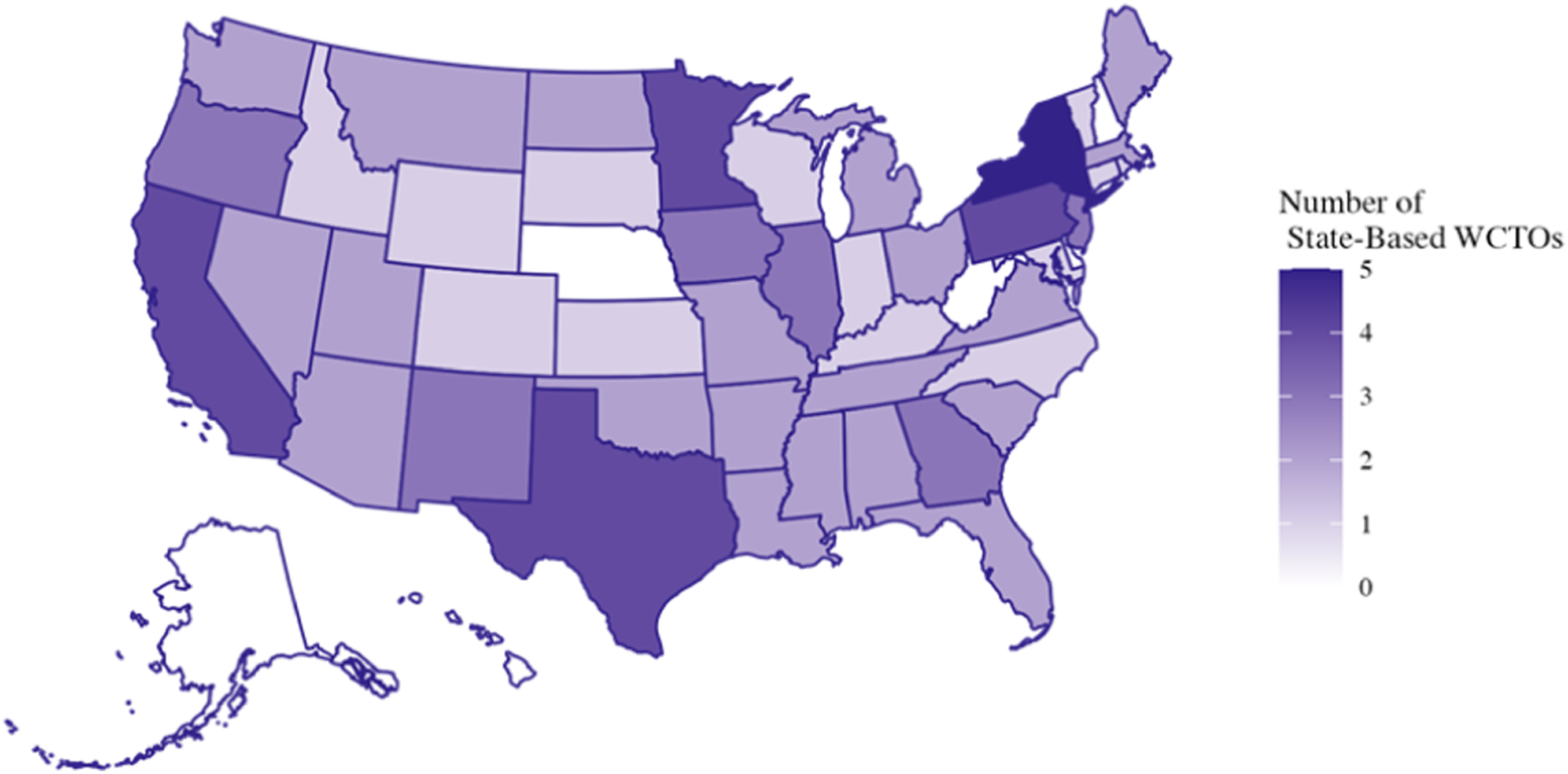
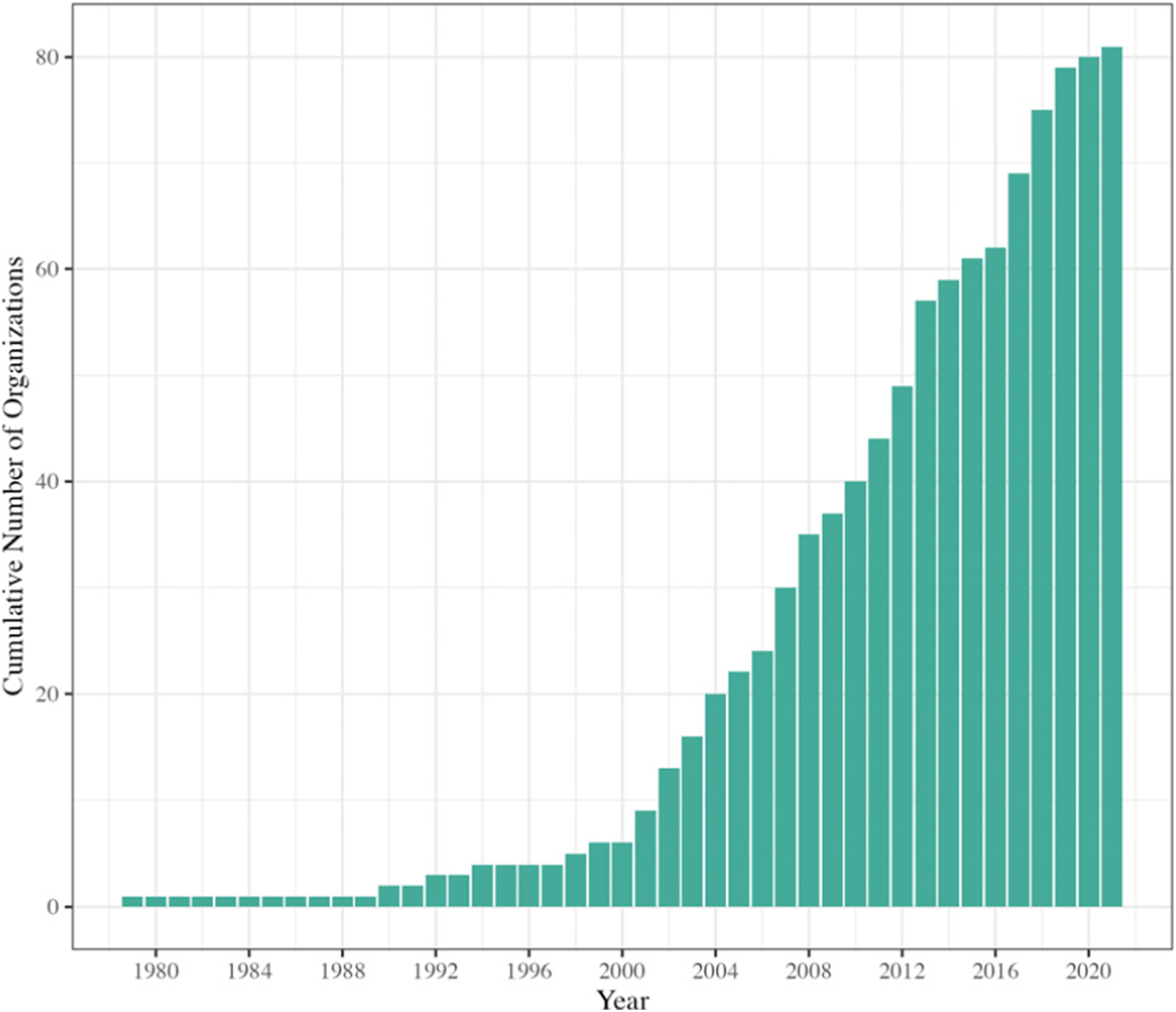
Why might WCTOs be better equipped to center women’s experiences as political candidates? And how effective are WCTOs at supporting the emergence of non-white women candidates? Women are more likely to be influenced by parties and organizations when considering running (Carroll and Sanbonmatsu 2013), highlighting the relationship between institutional support and women’s political ambition. Organizations that center women, overall and across race and ethnicity, can also increase women’s beliefs that a run for office is feasible (Sanbonmatsu 2015; Sweet-Cushman 2019). WCTOs primarily recruit from women-centric networks, changing the pipeline of who gets recruited (Rozell 2000). Furthermore, the presence of state-level WCTOs is associated with increases in the number of women running for state legislature (Hennings 2011; Scott 2018a). When institutions provide resources, mentorship, and networks that directly center the material and psychological barriers women face, they are sending public signals to potential women candidates that these are institutions likely to support people “like them,” shifting who seeks out and receives meaningful institutional support. If part of the hesitation to run comes from the belief that political spaces aren’t “for women,” then spaces that center women’s experiences should be more effective entrypoints to political careers.
However, these institutional signals don’t impact all women equally. Organizations often default to the interests of the majority or more privileged members of their groups (Strolovitch 2008), sending signals of “who” they are for. Institutions are also inherently racialized and gendered (Crenshaw 1989; Ray 2019), influencing how an organization presents itself and who seeks it out as a result. And there is some evidence that WCTOs play lip-service to diversity without evidence that this influences their substantive programming (Kreitzer and Osborn 2020), even as programming that is specific to subgroups of women of color is more motivating for members of those groups (Bejarano and Smooth 2022; Sanbonmatsu 2015). Even organizations seeking to cater to the diversity of women’s experiences may default to white women’s experiences, partially because a desire to appeal broadly to a wide swath of women can result in flattening women’s experiences into a universal gendered experience.
Private-sector women’s organizations have developed their own pipeline for the recruitment and training of political candidates, providing an essential case for understanding how identity-based signals moderate the relationship between political organizations and participation. These organizations were developed in response to perceptions of traditional political organizations as less helpful to potential women candidates. By developing as organizations that specifically center women’s experiences, WCTOs send signals about who they are for and the types of barriers to candidacy that will be addressed. However, given the diversity of women’s experiences, we should expect variation in which women see these spaces as for people like them.
Organizational Identity Signaling
The theory of Organizational Identity Signaling argues that political organizations send signals about who they are for. WCTOs, as women’s organizations, take a distinctly gendered-approach to recruiting and training first-time candidates, sending a signal that they are for potential women candidates. Women face additional barriers to running for political office, causing a gender gap in political ambition. These barriers are shaped by women’s other intersecting identities. While institutional support is critical to encouraging first-time women candidates, potential women candidates will not perceive all organizations as equally supportive of their ambitions.
I expect to see the existence of Organizational Identity Signaling through the recruitment, leadership, and programming done by Women’s Candidate Training Organizations. The faces of these organizations are predominantly women, from the leadership, to the staff, to the political candidates and alumna they bring in to provide expertise and mentorship, making the face of the organization distinctly female. Those women will then develop programming that focuses on navigating gendered barriers to running, based on their own experiences as women, adding legitimacy to the signals they send about who they are for.
WCTOs will be more likely to center women’s barriers and experiences in their programming than NGCTOs.
However, WCTOs may default to treating women as a monolithic group in ways that ignore critical group variation (Crenshaw 1991), particularly because organizations are often led by individuals who have already succeeded, and institutions have a tendency to default to the experiences of their most-advantaged minorities (Strolovitch 2008). Therefore, I expect that WCTOs will be no more likely than NGCTOs to discuss or address barriers faced by racial or ethnic minorities, as both sets of organizations likely default to the experiences of white political candidates. 2
WCTOs will be no more likely than NGCTOs to center barriers and experiences faced by racial and ethnic minorities in their programming, conditional on the other identities they focus on.
These organizational signals shape whether and which women seek out political organizations and the institutional support they provide. When women’s organizations send a signal that they focus on women through their recruitment and programming, this should make women—overall—more likely to believe that the organization is a space where they belong, and where their experiences as women and concerns about running will be centered. I expect that these signals should increase women’s feelings of institutional belonging, interest in seeking out a WCTO, and political ambition. 3
The effect of Organizational Identity Signaling should be conditional on women’s other identities, such as race and ethnicity, as gender is not separable from women’s other identities (Crenshaw 1991). Therefore, signals that an organization focuses on women should not equally increase belonging among all women. I focus on race in this paper, as women’s movements and feminist ideologies are often implicitly grounded in whiteness in ways that can ignore the unique experiences faced by different groups of non-white women, because of both their race and gender (Crenshaw 1989, 1991). All organizations, even those that are nominally race neutral, are embedded in racial systems that uplift white ideologies (Ray 2019). Even identity-based organizations have a tendency to prioritize the interests of the most advantaged members of their groups, both because those individuals are often the most central to organizational networks, and because their experiences are treated as the default (Strolovitch 2008). Therefore, I expect that both the gendered and racialized signals that Candidate Training Organization’s send influence women’s political ambition, and its precedents:
Learning about a Candidate Training Organization interested in helping women candidates will increase both Black and white women’s political ambition, relative to learning about a Non-Gender Candidate Training Organization.
Learning about a Candidate Training Organization interested in supporting racially diverse candidates will increase Black women’s political ambition, relative to learning about a Candidate Training Organization not interested in supporting racially diverse candidates.
Learning about a Candidate Training Organization interested in supporting racially diverse women candidates will increase Black women’s political ambition, relative to learning about a Candidate Training Organization not interested in supporting racially diverse women candidates.
Learning about a Candidate Training Organization interested in supporting white women candidates will increase white women’s political ambition, relative to learning about a Candidate Training Organization interested in supporting racially diverse women candidates.
WCTOs are an ideal case for demonstrating the prevalence of Organizational Identity Signaling and its impact on ambition and belonging, because they are a set of organizations specifically founded with representational aims (Cooperman and Crowder-Meyer 2020). Additionally, WCTOs range from both partisan to nonpartisan and there are a fair number of Republican and center-right WCTOs, making it possible to capture identity-based signals across the partisan spectrum (Kreitzer and Osborn 2020). Across two studies, I will evaluate first how Candidate Training Organizations send signals of their gender and racial focus, and second, what impact these have on the diversity of women’s political ambition, and its precedents.
Study One: Organizational Identity Signaling in Candidate Training Organizations
Data and Methods
To test Hypotheses 1a and 1b, I interviewed both Women’s Candidate Training Organizations (WCTOs) and Non-Gender Candidate Training Organizations (NGCTOs) to understand their approach to the recruitment, training, and support of potential political candidates. I conducted semi-structured interviews with 57 organizations between August 19th, 2020 and October 8th, 2021. This was out of an original sample of 94 organizations actively conducting candidate training in 2020, for a response rate of 60.64 percent. 4 The original population I reached out to included 45 state-based organizations across 24 U.S. states, and 49 national organizations. Of that population, my sample included 30 state-based organizations in 16 U.S. states, spanning all major regions of the country (i.e., the South, West, Midwest and Northeast), and 27 national organizations. Of the 57 organizations interviewed, 57.9 percent train women and 42.1 percent train individuals of all genders. In terms of political leaning, 40.35 percent are left-leaning, 15.79 percent are right-leaning, and 43.86 percent are nonpartisan. 5 Finally, 12.28 percent focused on identities either other than or within gender, including race, sexuality, age, and disability. 6 Organizations were reached out to using a block-randomized design based on partisanship and gender-focus. Interviews were conducted primarily on Zoom.
Interviews were semi-structured, using a predetermined set of initial questions, with tailored follow-ups. To avoid priming interview participants, I did not ask outright about programming focused on non-male or non-white attendees until the end of the interview. Instead, I asked about the structures of their trainings, how they recruit participants, what kind of programming they have, etc. This left it open to the respondent to focus on different aspects of their trainings and the different groups that came to mind for them, letting the interview subject determine for themselves what information was most relevant. Only once I neared the end of the interview, did I specifically ask about women’s experiences in the trainings and what the organization does to increase diversity of political candidates. I noted which organizations did not talk about race at all when asked broadly about “diversity” and which organizations mentioned tailored programming for specific groups. It was notable which organizations only brought up gender once asked, and which organizations emphasized partisan or regional diversity, but never mentioned race or ethnicity. It was also notable which organizations answered even broad questions by discussing specific trainings they developed, sometimes in partnership with other community organizations, alumni, or board members, to address gendered and racial barriers to running for office.
I worked with two undergraduate research assistants to transcribe and code the interview data. 7 I coded whether the organization mentioned barriers faced by racial, ethnic, and gender minorities in the interview, whether they have programming that addresses those barriers, and whether they make conscious efforts to diversify organization leadership or attendees. Intercoder reliability was 0.76, using a set of 10 randomly selected interviews, accounting for 17.54 percent of the total sample. 8
Results: Centering the Experiences of Women Potential Candidates
While some programs last an afternoon and others meet monthly for a full year, the broad content of candidate trainings are similar. Most cover strategies for fund‐raising, volunteers, and door-knocking, developing your narrative, public speaking/speeches/media training, managing a budget, filings and deadlines, and other technical information about running for office. However, organizations tailor their programming about the core aspects of running for office, based on the audience they picture when developing their core programming, ultimately shaping both the specifics of their programming and the public signal they send of their intended candidate pool.
Nearly all WCTOs put considerable thought into how to center their programming around women’s experiences as candidates. Of the WCTOs I interviewed, 96.7 percent—or all but one—spoke about specific barriers women face to running for office, compared with 79.2 percent of NGCTOs (Figure 3). They talk about those barriers more frequently, with an average of 3.64 distinct mentions per interview, compared with 2.38 for NGCTOs. In their programming, 48.5 percent of WCTOs and 41.7 percent of NGCTOs mention at least one training session that covers topics specifically related to gender barriers or women’s experiences, with an average of 0.82 mentions for WCTOs compared to 0.58 for NGCTOs.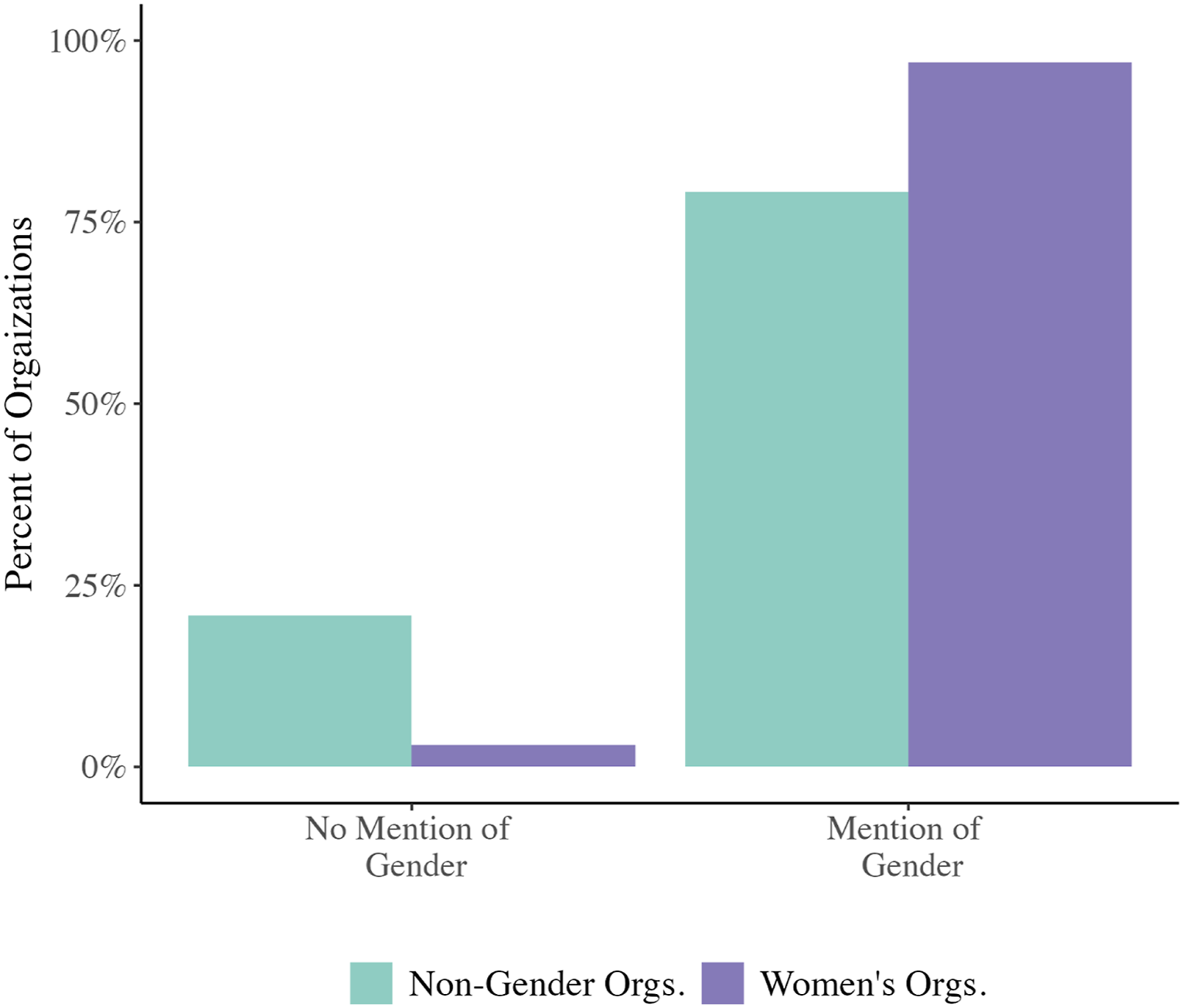
WCTOs discussed a wide range of gendered barriers to political candidacy including access to networks and resources, family obligations, sexism on the campaign trail, and how those barriers decrease women’s confidence. Many women’s organizations have specific trainings on topics like presentation, responding to sexism, and how to fundraise and network when you don’t have access to male-dominated political circles. They were more likely to discuss childcare and spousal considerations. While these organizations cannot single-handedly address the structural inequalities that make women’s campaigns more challenging, many of them provide specific guidance for navigating gendered barriers. Respondent 32, from a left-leaning women’s organization in the South, talks about the frank conversations they have about family and motherhood on the campaign trail:
“And how do we, how do we talk about being, you know, mothers running for office… how do you answer that question when someone asks you: ‘Well, who’s at home with your kids?’ …we really try to take the approach of, you know, what some of our candidates in the past have, have had to go through, and how do we, how do we navigate that, and make it better for the women that are running next?”
In addition to talking about barriers to running for office, the identities of the people doing the training are also a clear signal of institutional focus. Among WCTOs, 51.5 percent made at least one mention of efforts to ensure their programming included women trainers or speakers, compared to 25 percent of NGCTOs. 9 Most often, this consisted of panels of women who had run for office or served in government, but also included women experts leading sessions on specific topics related to campaigning.
WCTOs connected the importance of having women experts to the confidence that comes with seeing people who look like you in elected positions, and the relevance of the expertise they provided women attendees. Respondent 35, from a national, left-leaning women’s candidate training, highlights this second theme:
“Our panelists are all women. Right. So, talking, being able to bring those examples and stories. It also creates a space that when folks do have questions around like: ‘How does this work with childcare?’ Or ‘how does this work with eldercare?’ Or ‘how might this work, if I’m a single woman and trying to date while running for office?’”
Almost every WCTO spoke at length about barriers women face to running, covering a range of specific socioeconomic, psychological, and structural challenges. They often brought up these barriers in response to the first couple questions, when I asked them to talk about their purpose of their organization and how candidate training works at their organization, highlighting the centrality of women’s barriers to the organizational approach of most WCTOs. They also thought about who the “face” of their organization was, making sure that the people providing expertise were women who could speak directly to their own experiences and normalize running for office, in spite of gendered barriers. This demonstrates a core dimension of Organizational Identity Signaling, in that WCTOs send very clear, public signals about being organizations for women, with expertise in supporting women candidates. However, the advice and support provided is also predicated on what has been successful before and the kinds of the women who are in the room providing that advice, shaping the idea of what a successful candidate looks like. This likely informs the types of women who see themselves in candidate recruitment efforts, and provide a contrast to the findings about racial differences discussed below.
Results: Centering the Experiences of Non-White Potential Candidates
Women are not a monolith and their experiences as potential political candidates are shaped by their many intersecting identities. The signals organizations send about their ability to center women’s many, intersecting identities informs who sees themselves within an organization. Therefore, I also evaluated whether WCTOs signaled an interest in addressing the experiences of potential political candidates across race and ethnicity, and how that compared to NGCTOs.
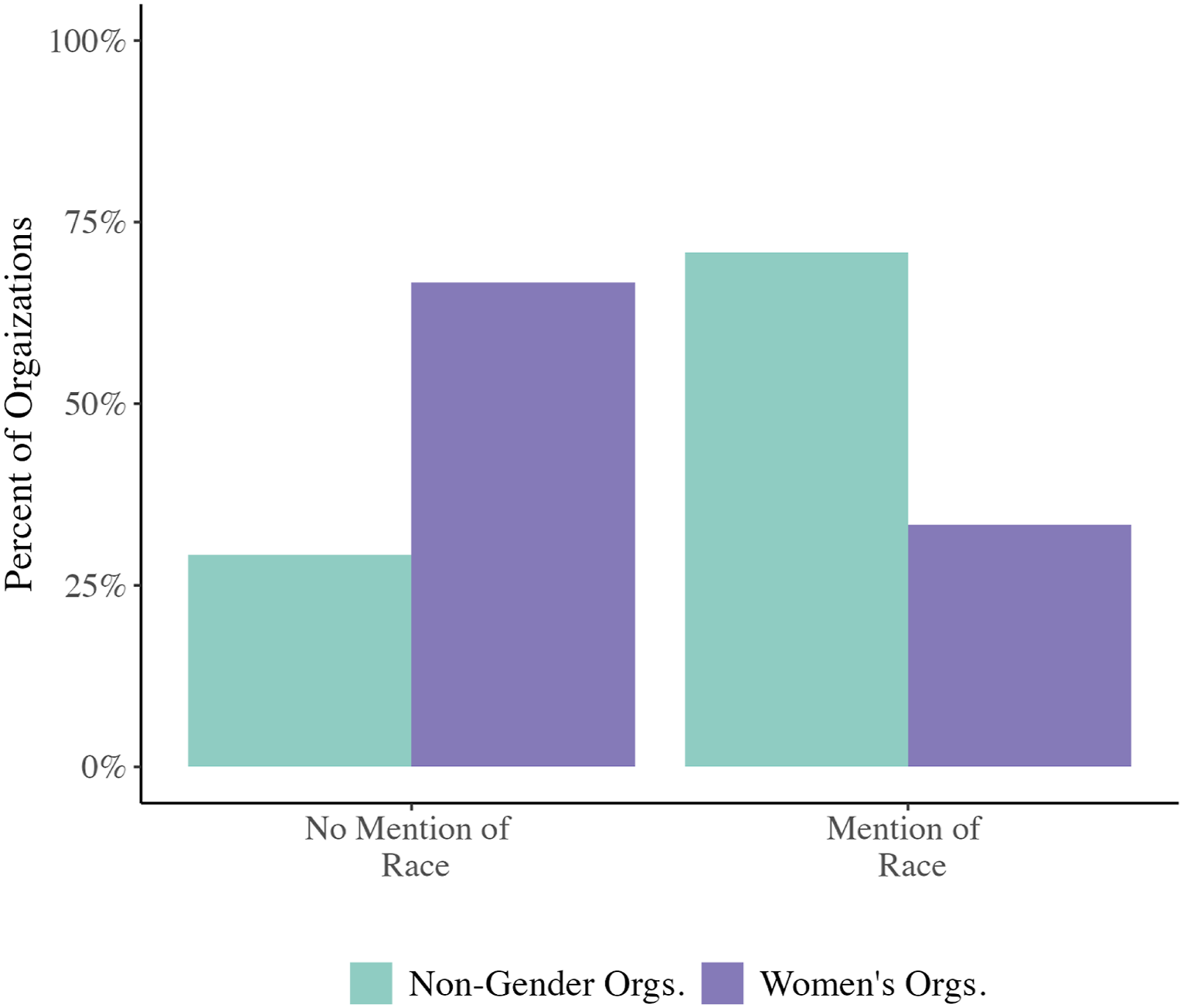
My interviews demonstrated that WCTOs were far less likely than NGCTOs to talk about barriers related to a person’s race and ethnicity. In fact, 33 percent of WCTOS, compared to 70.8 percent of NGCTOs, mentioned additional challenges faced by non-white candidates at least once in the interview (Figure 4). Discussions of barriers based on race and ethnicity are partisan, particularly given the salience of race to interviews conducted throughout 2020 and 2021, as only one of the nine right-leaning organizations I spoke with mentioned barriers based on race/ethnicity, compared to 15 of the 23 left-leaning organizations (or 65.2 percent) and 12 out of 25 nonpartisan organizations (or 48 percent).
10
The relatively even split in nonpartisan organizations mentioning/not mentioning race is also significant, as discussions of racial diversity may be interpreted as partisan or catering to one party’s candidates, disincentivizing some nonpartisan organizations from discussing these topics. Additionally, only 9.1 percent of WCTOs made at least one mention of specific training sessions focused on barriers faced by racial and ethnic minorities compared with 29.2 percent of NGCTOs.
11
A minority of both WCTOs and NGCTOs discussed the importance of racial and ethnic diversity among organization leadership, board-members, trainers, and speakers, shaping the face of their organizations and the signal sent to potential participants. In total, 36.4 percent of WCTOs and 33 percent of NGCTOs made at least one mention of efforts to diversify their leadership across either race or ethnicity. These signals matter, because they influence whether potential participants believe the organization can speak to the experiences of candidates of color. For example, Respondent 33, from a national left-leaning candidate training, highlighted the disconnect that non-white program attendees might feel if everyone giving them advice is white:
“We’ve been also looking at our adjunct trainer pool, and ensuring that our adjunct trainer pool is diverse. And what that means is, right, who’s the face of how you’re learning that information? And so, you know, are you, if you’re BIPOC, and then are we bringing all white trainers, there could be some disconnect.”
Respondent 9, who works for a national organization that recruits and trains Black political candidates, further highlights why this is important. Candidates of color need to see examples of politicians who share their identity in order to feel that a run for office is feasible for someone like them:
“And I would say that’s probably the final part, is the fact that we get so many former endorsed candidates to get involved with the process. To share their experience. And I think, at the end of the day, you can… a few people can dream about where they want to be. But at the end of the day, for you to have a full vision, you have to see it as not just a rarity but a regular occurrence.”
While some organizations spoke at length about the experiences of candidates of color, and devoted particular programming to creating community for either BIPOC candidates or candidates with particular racial or ethnic identities, other organizations avoided the topic entirely or focused on diversity in ways that were meant to appeal to the broadest group of possible attendees. In contrast to the approximately one-third of WCTOs that mentioned racial/ethnic barriers (or the one-third that mentioned racial/ethnic diversity of leadership), 39.4 percent of WCTOs did not bring up race or ethnicity at any point in the interview, including when talking about barriers to running, topics covered in their trainings, or other aspects about how they organize or structure their candidate trainings. In other words, while WCTOs send near universal signals that they are equipped to address gender-based barriers to candidacy, a sizeable minority does not consider the diversity of that experience across race and ethnicity. If the way in which organizations talk about women’s barriers to running centers only white women’s experiences (or if they discuss “all women” in a way that fails to acknowledge how race shapes women’s experiences as political candidates), they may send signals to women of color that their organization cannot address their unique needs.
Additionally, a small handful of WCTOs brought up the experiences of multiply marginalized members as reasons why members of these groups either shouldn’t run or would need to change identity-adjacent aspects of their campaign style in order to appeal to a majority of voters. This included comments about how some people just cannot be good candidates, because of personal/private/family circumstances, as well as comments about how individuals must change a fundamental aspect of their appearance or presentation on the campaign trail, in ways that specifically targeted both non-white and non-straight women. For example, Respondent 21, from a nonpartisan women’s candidate training in the Northeast, talked about the pushback she received from a Black queer candidate:
“
Two years ago, we had our first LGBTQ candidate. And, wonderful woman, brilliant…Anyway, so she gets up and she’s speaking and she’s like: ‘As a queer black woman’. And I’m like: ‘Okay, we can all see that you’re Black. Why do I care if you’re queer?’…I say to her: ‘Okay. Explain this, this, this queer thing to me. Why is it so important within the first 10 seconds of you getting up to do anything, everybody has to know you’re queer?’ So she goes: ‘Well, it’s very important, because the queer population is a fringe population. And it’s never really had any heroes or heroines that are out there advocating for it. So, it’s very important for people to know that I represent this fringe population’. So I, so I sit back. Because I’m like: Okay. That’s a decent answer. However, I don’t care who you go to sleep with. And just like I said to you before I’m in it, as your constituent, as your neighbor, because I want to know who you are what you can do for me.”
I note this tension, because it plays into a challenge minority candidates face—the need to gain majority appeal. Some organizations were very open to engaging with potential candidates in difficult and nuanced conversations about how their identities shape their experiences and challenges as candidates. Other organizations, framed these differences as changes that candidates need to make, which could negatively recruit some program attendees from running. Additionally, when developing broad programming meant to recruit and support large groups of candidates, the incentives will default to focusing on advice that works for the largest groups of participants, often without considering the unique nuances for queer candidates and/or candidates of color.
Overall, the signals organizations send about their approach to training candidates to run for political office shape who feels seen within the training space. How a candidate’s identities are discussed within political organizations can influence who seeks out the ongoing support these organizations provide, and may recruit or derecruit potential attendees based on who leaves the training seeing themselves as a potential candidate. In Study One, I demonstrated that WCTOs were more likely to center gender barriers and women’s experiences than NGCTOs. However, there is high variance in how much these organizations think about what it means to run for office as a non-white woman. In Study Two, I will highlight the effect of this variance by looking at how differences in organizational signals focused on gender and/or race influence women’s ambition and its precedents.
Study Two: The Effect of Organizational Identity Signaling
Data and Methods
Study One demonstrated how political organizations send signals about who they’re “for,” by showcasing how WCTOs signal their commitment to gendered candidate training, even as they are less likely than NGCTOs to signal a commitment to racial and ethnic diversity. Study Two evaluates the impact of the variation in these gender and racial signals sent by Candidate Training Organizations on Black and white women’s political ambition and its precedents.
I conducted a survey experiment using Dynata in October, 2022. 12 The sample consisted of 1,717 Black and white women respondents. This experiment focused on Black and white women, given the centrality of race to Black women’s experiences as political candidates and my interview findings showing that WCTOs default to white women’s experiences. The sample was 44.1 percent Black and 55.3 percent white. In terms of education, 39.7 percent of the sample had a BA or higher, 13.9 percent had a 2-year degree, and 46.4 percent had a high-school degree or less. The median age was 47. The median income was $40,000–$49,000. In terms of partisanship, 53.8 percent were Democrats, 32.1 percent were Republicans, and 14.1 percent were Independents. 13 The experiment is a 2 × 2 factorial design. 14 All respondents learned about a Candidate Training Organization launching a new program in their state geared towards getting first time candidates elected. Respondents were randomly assigned to read about either a WCTO or an NGCTO (Factor One), signaled by whether the organization was called Running and Winning or Women Running and Winning; whether the organization had previously endorsed all women or a mix of men and women candidates; and whether the organization devoted particular attention to the challenges women candidates face or that candidates in general face. The organization also either emphasized racial diversity or not (Factor Two), signaled by whether the organization had previously endorsed a mix of Black and white candidates or only white candidates; and whether the organization devoted particular attention to the challenges Black candidates faced. In order to signal the racial makeup of previously endorsed candidates, each treatment included pretested photos of four previously endorsed candidates. These photos were varied so that they matched the gender/racial composition of the treatment, either two white men and two white women, four white women, one each of a white man/white woman/Black man/Black woman, or two white women and two Black women. 15 This resulted in four possible candidate training organization treatments (white + all gender, Black and white + all gender, white + only women, Black and white + only women).
Study One demonstrated that the primary signals CTOs send operate through the types of people that make up the “face” of the organization and the substance of the programming. Headshots of previously endorsed candidates serve as a signal of the gender and racial diversity of who is in the room, and mentions of programming specific to subgroups of potential candidates serve as a signal of the gendered/racial focus of the programming. This treatment has the added benefit of being a strong enough signal (through both picture and text) that it will be noticeable in a lab setting. 16 This treatment allowed for variation of both the gender and racial composition of the organization, to test the effects of signals about gender and racial diversity. 17
The primary dependent variable is the Political Ambition Scale, consisting of thirteen items measuring political ambition and its precedents. Political ambition was measured directly through interest in running for office and perceptions of one’s qualifications to run, because these are the representational goals of these organizations. Precedents of ambition were also asked including interest in attending the organization, the relevance of information from a candidate training organization for people like them, and interest in participating on behalf of the organization, as these get at the extent to which an individual feels like an organization is “for them.” 18 While the ultimate goal of Candidate Training Organizations is to increase political ambition, people rarely make the decision to run for office in a single moment. And so, it is more likely that Organizational Identity Signaling influences ambition through precedents like belonging and interest. The median on the Political Ambition Scale was 0.342, showing considerable variation in respondent’s likelihood of running for office.
Results
I first tested the effect of signals about the gendered focus of an organization, separately, on Black and white women’s levels of political ambition and its precedents (Figure 5).
19
This is the combined effect of being assigned to either of the women’s organizations conditions (a WCTO that either did or did not signal racial diversity). There was no statistically significant effect of learning about a WCTO on either Black or white women’s political ambition, including across all scale items. In fact, among Black women, there was a negative and marginally significant effect of being assigned to one of the two WCTO conditions on the two questions most directly measuring ambition (i.e., likelihood of and interest in running for office).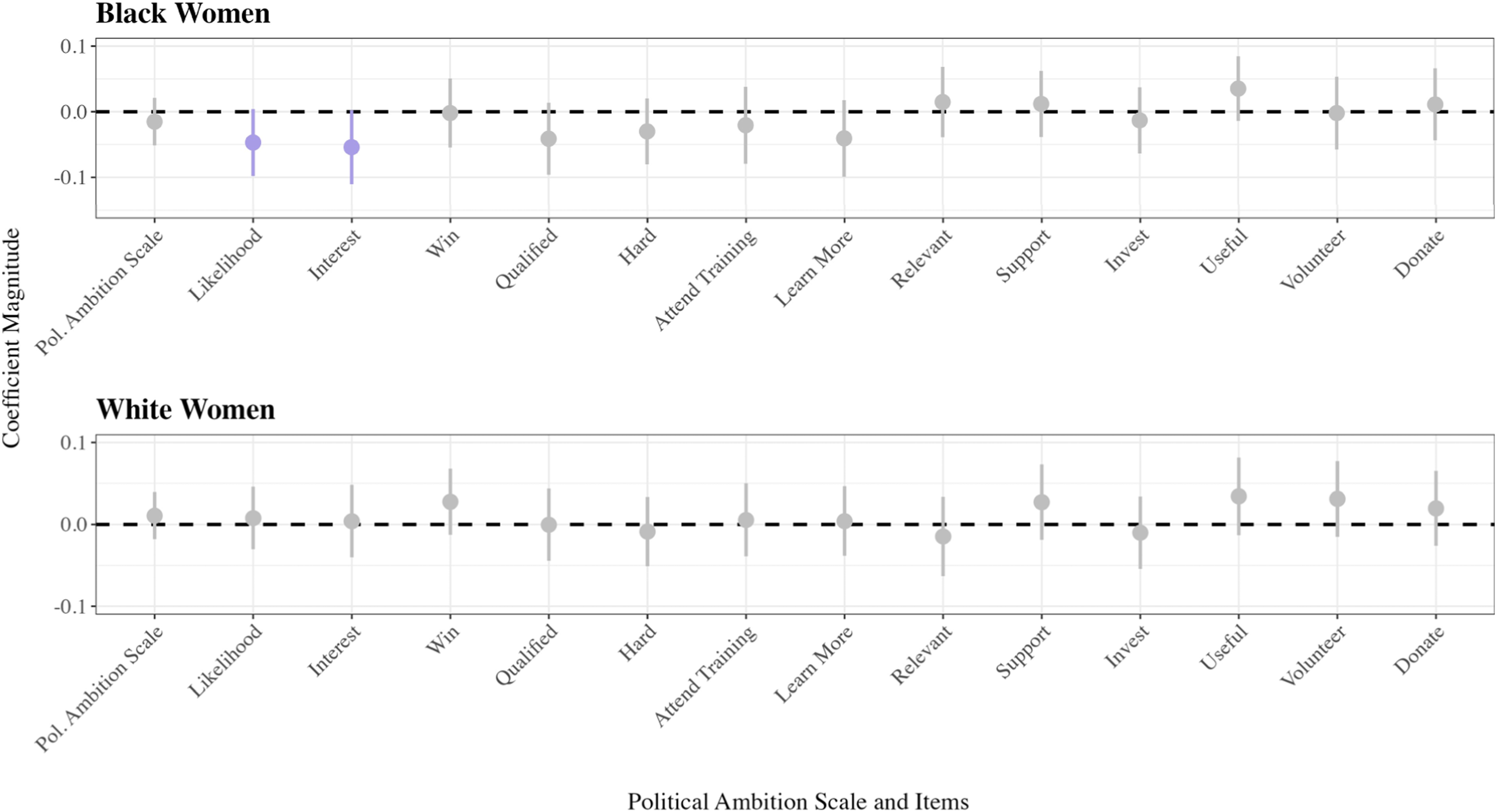
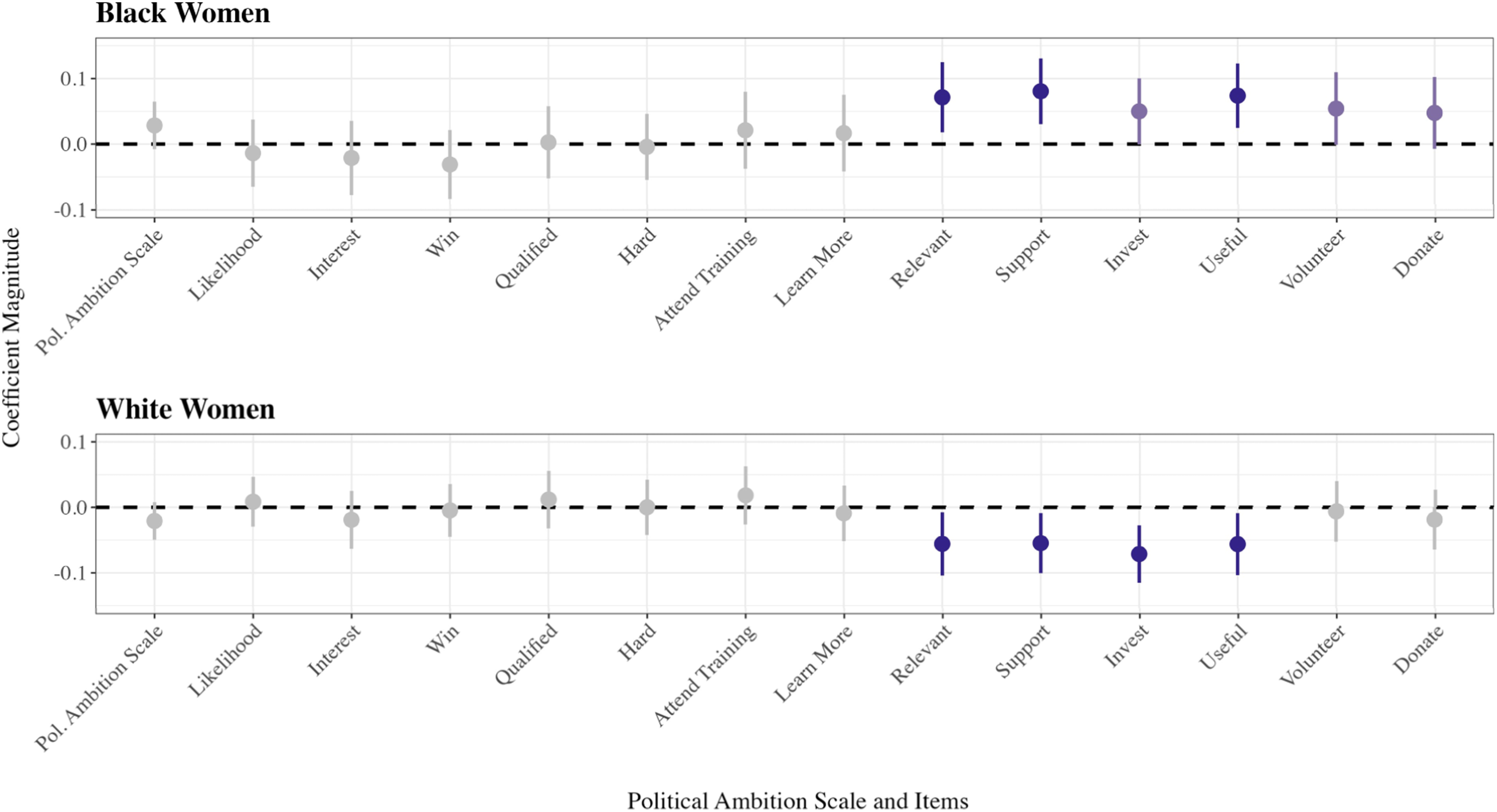
Next, I tested the effects of signals about the racial diversity of a CTO (both the WCTO and NGCTO treatments). As can be seen in Figure 6, there isn’t a significant relationship between being assigned to the race treatments and the overall Political Ambition Scale. However, there is a positive and statistically significant effect among three of the 13 scale items among Black women, all focused on feelings of organizational belonging. Black women assigned to learn about an organization that puts particular effort towards supporting Black candidates were 7.1 percentage points higher in belief that the organization was relevant to people like them, 8.1 percentage points higher in belief that the organization would support people like them, and 7.4 percentage points higher in belief that the organization would be useful for people like them. The race conditions had the opposite effect on white women’s perceptions of belonging. White women were statistically significantly less likely to believe that an organization was relevant to people like them by 5.6 percentage points, would support people like them by 5.5 percentage points, would invest in people like them by 7.1 percentage points, and was useful to people like them by 5.6 percentage points, when the organization signaled a commitment to racial diversity. The effects among Black women for perceptions of whether the organization they read about is “Supportive of” and “Useful for” people like them, hold up with a Bonferroni correction of 0.05/13 = 0.0038. Among white women, the question asking if the organization is likely to “Invest in” people like them held up to the same Bonferroni-corrected p-value. Importantly, the results among white women are driven by white Republican women, ultimately creating a tension between partisan and racial signals (Appendix Six).
20
Finally, I tested the effect of reading about an organization that signals a focus on Black women candidates on Black women respondents, as well as signals of a focus on white women candidates on white women respondents. As can be seen in Figure 7, when Black women learn about a racially diverse women’s organization they are statistically significantly more likely to perceive the organization as relevant for, supportive of, and useful to people like them, which is similar to the effect of the grouped racial treatments.
21
The effect of the racially diverse WCTO condition on Black women's belief the organization would be “Useful for” people like them held up with a Bonferroni correction of 0.05/13 = 0.0038. Among white women in the white WCTO treatment, there is a significant increase in the desire to volunteer for organization-endorsed candidates and a marginally significant increase in the desire to donate to organization-endorsed candidates. However, it did not influence feelings of belonging within organization or overall ambition. It is notable that almost all findings are among the questions asking about perceptions of the organization, a potential precedent for who initially enters these political pipelines.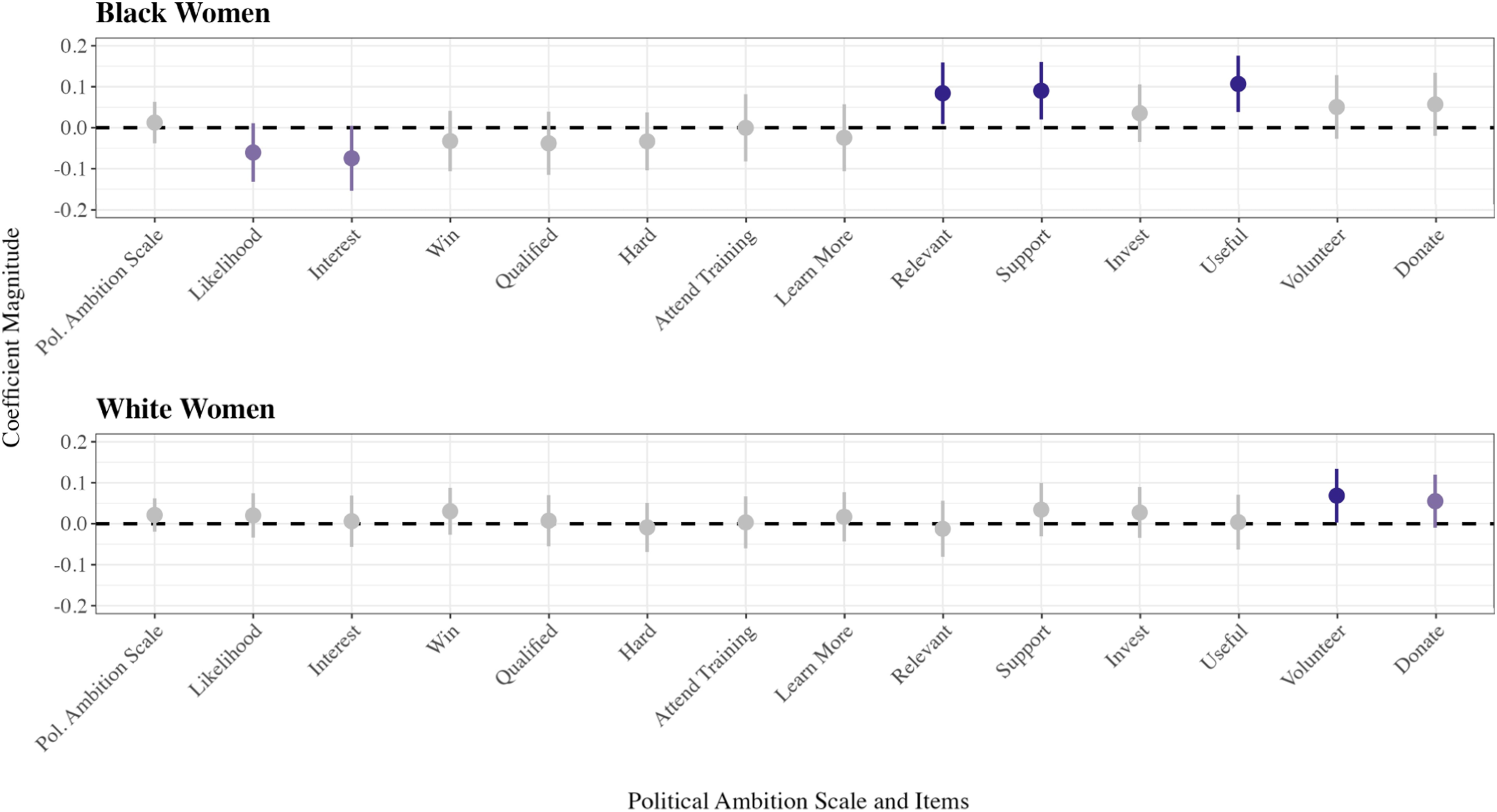
Across two studies, this paper demonstrates that Candidate Training Organizations can impact the political recruitment pipeline through the signals they send about who their organization is for. Having established the variation in organizational signals in Study One, Study Two focused on the effect of those signals on white and Black women’s political ambition. While I find little evidence that centering women candidates and programming has an effect on either White or Black women’s perceptions of an organization, and there is no direct effect of organizational signals on ambition, an emphasis on racially diverse candidates and programming increases Black women’s beliefs the organization is for people like them, while decreasing white, Republican, women’s perceptions of who the organization is for. Perceptions of political organizations are tremendously important, as they shape who seeks out a political organization and gets the institutional support that it provides, critical resources and mentorship that can lower the costly barriers to political participation.
Conclusion
This paper develops and tests the theory of Organizational Identity Signaling, using Women’s Candidate Training Organizations first to demonstrate the gendered and racial signals sent by political organizations and then to provide evidence of their impact on the diversity of the candidate pool. Study One uses 57 interviews to demonstrate that while WCTOs are more likely to send signals of their ability to address women’s material and psychological barriers to running, they are less like than non-gender CTOs to consider racial variation in candidate experiences. These signals are public, in that potential women candidates gain information about whether an organization is for them through the choices organizations make all throughout their recruitment, leadership, and programming.
Study Two showcases the impact of the gendered and racial signals established in Study One, by demonstrating that the signals WCTOs send influence who feels like they belong within a women’s organization. Ultimately, these signals did not influence interest in running, in a survey experiment. Instead, a signal of commitment to racial diversity shaped both Black and white women’s perceptions of whether an organization is “for them.” Organizational perceptions are likely a precedent to seeking an organization out and receiving the mobilization and support that it provides, ultimately shaping individual-level political ambition. This demonstrates a core challenge of intersectional representation. Efforts to increase descriptive representation across one dimension will not impact all members of that group equally, potentially opening up new avenues for the perpetuation in inequality in access to institutional resources and support.
Across two studies, I show how that tension shapes the diversity of the pool of potential political candidates. While previous work has emphasized the ways in which organizations default to advantaged minorities (Strolovitch 2008), a key finding from the theory of Organizational Identity Signaling is the tension when seeking to appeal to a big tent of disparate individuals. Many WCTOs are 501c3 organizations that must remain nonpartisan. In the interviews, some WCTOs discussed the challenge of being nonpartisan when many “women’s issues” are housed within the Democratic party. The experiment demonstrates that when WCTOs signal a commitment to racial diversity it lowers white, Republican women’s perceptions of the organization. The pressure many nonprofit WCTOs face to remain nonpartisan may help to explain why WCTOs were less likely to talk about race than organizations not focused on gender. In a world where programming focused on historically excluded groups is perceived as partisan, it can be difficult to value and center diversity in a nonpartisan way. In a political environment where highlighting the diversity of women’s experiences is perceived as a partisan talking-point, only explicitly partisan organizations may send signals of commitment to recruiting non-white women, further limiting the avenues for non-white women’s recruitment into political candidacy.
Previous work has also emphasized the importance of women of color organizations as spaces that make running for office feasible for non-white women (Bejarano and Smooth 2022; Sanbonmatsu 2015). Future work should also consider how explicitly intersectional organizations engage in recruitment, programming, and support to increase descriptive representation across multiple dimensions. And yet, the majority of WCTOs focus on “all women” rather than a specific group of non-white women, as reflected in the experimental treatments in Study Two. When organizations try to be a big tent for all women, they inevitably highlight some experiences over others, reproducing pre-existing ideas of what successful women candidates are like. Ultimately, this research demonstrates the importance of a diverse and pluralist organizational environment, so that vast and varied organizations can cater to the distinct needs of many different groups seeking to increase their political voice.
Supplemental Material
Supplemental Material - Organizational Identity Signaling: How Women’s Political Organizations Influence Candidate Diversity
Supplemental Material for Organizational Identity Signaling: How Women’s Political Organizations Influence Candidate Diversity by Sara Morell in Political Research Quarterly.
Footnotes
Acknowledgments
Thank you to Nicholas Valentino, Nancy Burns, Angela Ocampo, Abigail Stewart, Erin Cikanek, Francy Luna Diaz, Avery Goods, Hilary Izatt, Maya Khuzam, Anil Menon, James Newberg, and the attendees at the Interdisciplinary Workshop in American Politics at the University of Michigan, the Junior Americanist Workshop Series, the Tulane Women and Politics Conference, and the University of California-Riverside Gender and Political Psychology Conference, who provided feedback on various stages of this work. Additionally, thank you to Elizabeth Goldman and Holly Holland who were essential Research Assistants who transcribed and coded the interview data. The first study for this project received IRB exemption by the University of Michigan Institutional Review Board on July 28, 2020, via study HUM00185621. The second study received IRB exemption by The University of Michigan IRB on May 4, 2022, via study HUM00216745.

Funding
The author disclosed receipt of the following financial support for the research, authorship, and/or publication of this article: The University of Michigan Gerald Ford Fellowship and the University of Michigan Center for the Employment of Women.
Declaration of Conflicting Interests
The author declared no potential conflicts of interest with respect to the research, authorship, and/or publication of this article.
Supplemental Material
Supplemental material for this article is available online.
Notes
References
Supplementary Material
Please find the following supplemental material available below.
For Open Access articles published under a Creative Commons License, all supplemental material carries the same license as the article it is associated with.
For non-Open Access articles published, all supplemental material carries a non-exclusive license, and permission requests for re-use of supplemental material or any part of supplemental material shall be sent directly to the copyright owner as specified in the copyright notice associated with the article.
