






Abstract
While existing research establishes that members’ racial identities are associated with legislative priorities, less is known about whether and under what conditions racial diversity within congressional offices shapes legislative agendas. We examine whether Black legislative staff is associated with members’ sponsorship of civil rights legislation and argue that staff composition influences which civil rights proposals reach members’ legislative agendas. We theorize that staff influence operates under institutional constraints: staff composition matters most in discretion-rich civil rights domains, where offices retain greater discretion over agenda construction, and is attenuated in partisan-constrained domains where sponsorship decisions are more tightly integrated into broader party and coalition agendas. Using data linking racial information on House members’ personal office staffs to civil rights bill sponsorship in the 111th–115th Congresses, we find support for both the descriptive-to-substantive link and its conditional operation across domains. Together, these findings show that staff diversity’s implications for lawmaking depend on institutional context, clarifying when descriptive representation translates into substantive representation.
Introduction
The United States has become increasingly racially and ethnically diverse. In 2024, more than 40 percent of the population identified as non-white, and demographic projections suggest that this share will continue to grow in coming decades, underscoring the importance of understanding race in contemporary American politics (U.S. Census Bureau 2024). This demographic change has been reflected, albeit unevenly, in Congress. Over the past two decades, the number of racial and ethnic minority members in the House of Representatives has grown steadily, and minority members now comprise more than one-fifth of the chamber (Schaeffer 2021). Correspondingly, scholars have devoted substantial attention to the descriptive and substantive representation of racial minorities among elected officials, showing that member race is systematically associated with patterns of issue attention, legislative priorities, and policy advocacy in Congress, including on civil rights and voting rights (Broockman 2013; Griffin 2014; Grose 2005; Hosam 2025; Minta and Sinclair-Chapman 2013). This literature shows that who serves in Congress shapes which issues receive attention and how legislative agendas are constructed.
During this period, congressional policymaking has become increasingly dependent on legislative staff (Crosson et al. 2020; Hertel-Fernandez, Mildenberger, and Stokes 2019). As legislative workloads have expanded and members devote more time to campaigning, fundraising, and constituency service (Grim and Siddiqui 2013; Lee 2016), senior staffers have become central organizational resources—monitoring policy developments, drafting legislative text, coordinating with interest groups, and assessing which proposals are viable for sponsorship. Reflecting institutional changes, a growing body of research examines how staff shape lawmaking, organizational capacity, staff networks, and career advancement (Dittmar 2023; McCrain 2018; Montgomery and Nyhan 2017; Ommundsen 2023). Much of this work treats staff capacity as uniform, rarely treating race as a central dimension. Within the body of research on racial diversity in staff, existing analyses remain largely descriptive—emphasizing staff composition, promotion pipelines, and turnover rather than legislative outputs (Bolton, Hassell, and McCrain 2025; Rutherford and Wu 2025; Ziniel 2020).
Descriptive evidence on staff racial diversity nonetheless underscores why this question matters. Drawing on two waves of reports, the Joint Center for Political and Economic Studies documents persistent racial inequality among senior congressional staffers, even as overall diversity in House personal offices has increased in recent Congresses (Brenson and Victor 2025; Scott et al. 2018). Between 2018 and 2025, the share of people of color in top personal office staff positions rose from 13.7% to 21.6%. 1 Despite these gains, many offices continue to lack any non-white staff in top positions, and representation remains disproportionately concentrated in the offices of minority legislators.
This institutional context therefore motivates our assessment of whether the racial identity of legislative staff is associated with congressional lawmaking. If staff influence which issues are raised, prioritized, and sustained within congressional offices, then staff identity may shape policy attention in issue domains closely tied to group-based political interests (Canon 1999). Civil rights legislation provides a particularly appropriate setting to examine this possibility. For Black Americans, civil rights—including voting rights, anti-discrimination protections, and political inclusion—have long constituted the core of collective political mobilization, and decades of research show that Black members of Congress devote disproportionate attention to these issues (Dawson 1995; Minta and Sinclair-Chapman 2013). If similar dynamics operate within congressional offices, Black legislative staff may likewise shape which civil-rights issues receive attention and priority. In addition, to the extent that staff contribute policy expertise, legislative knowledge, and strategic guidance (Crosson et al. 2020; Ritchie and You 2021), the presence of Black legislative staff may also influence how civil-rights concerns are translated into legislative initiatives and sponsorship activity, even holding member characteristics constant.
Crucially, civil rights legislation varies substantially in the degree to which sponsorship decisions are constrained by party priorities and legislative coalitions. Some civil rights proposals—such as voting rights protections and foundational anti-discrimination statutes—are tightly structured by party agendas and embedded in durable legislative coalitions, with sponsorship decisions often initiated by members or shaped by party leadership (Hosam 2025). In these partisan-constrained domains, opportunities for staff influence over agenda placement are limited. Other civil rights proposals are more discretion-rich, intersecting with adjacent policy areas and subject to fewer institutionalized sponsorship constraints. 2 In such settings, members may rely more heavily on staff to identify policy opportunities, evaluate legislative feasibility, draft legislative language, and recommend which proposals merit scarce agenda space. This variation motivates a conditional expectation about staff influence: Black legislative staff effects should be strongest where agenda discretion is greatest and weakest where sponsorship decisions are most tightly constrained by partisan and coalition structures.
To examine this argument, we link congressional staff records from LegiStorm to bill sponsorship data from the Congressional Bills Project for the 111th through the 115th Congresses. We find a positive association between Black legislative staff and members’ sponsorship of civil rights legislation, but this relationship is conditional. Staff effects are concentrated in discretion-rich civil rights domains, where offices retain greater latitude in agenda-setting, and are largely absent in partisan-constrained domains characterized by strong party ownership and coalition monitoring. These patterns are most consistent with the expectation that staff identity matters most in legislative domains where offices retain greater discretion and rely more heavily on staff expertise. Although these findings cannot definitively distinguish staff influence from selection into hiring, a simple predisposition account does not by itself explain why associations appear primarily in discretion-rich rather than partisan-constrained civil-rights domains.
Together, these results have important implications for the study of legislative politics and political representation. Legislative agendas are not shaped by members alone; they are also influenced by who staffs congressional offices and where those staff are positioned within the policymaking process. By identifying the conditions under which staff composition shapes agenda-setting, our framework moves beyond asking whether staff diversity matters to specifying when and where it matters. This conditional perspective clarifies the institutional contexts in which descriptive representation among unelected actors is most likely to translate into substantive influence over lawmaking. More broadly, the findings suggest that staff diversity may matter not only because staff influence legislative agendas, but also because organizational inequalities shape who occupies influential policy positions within congressional offices. Uneven representation among staff may therefore have consequences for the expertise, experiences, and perspectives that inform legislative agendas and policymaking.
Theoretical Motivations
Race, Descriptive Representation, and Staff Distribution
Descriptive representation refers to the presence of individuals from historically underrepresented groups in policymaking positions. 3 In legislative settings, such representation is normatively important because it shapes which perspectives, experiences, and expertise enter decision-making arenas. As Canon (1999, 206) notes, “to the extent that people have different life experiences based on their racial background, a racially diverse staff is more likely to push the member in different directions than is a racially homogeneous staff.” 4
At the same time, Congress is not a race-neutral workplace. Recruitment networks and informal hiring pipelines often disadvantage minority staff, contributing to persistent underrepresentation in senior legislative positions (Jones 2024). While professional organizations such as the Congressional Black Associates and the Senate Black Legislative Staff Caucus have emerged in response, journalistic accounts continue to document the scarcity of non-white staff in top roles (Forgey and Ferris 2021). Parallel inequalities appear in research on gender dynamics: Ritchie and You (2021) find that women staffers experience slower advancement and lower pay than men. Evidence from the federal bureaucracy points in a similar direction, showing that descriptive representation among leaders can shape organizational priorities and perceptions of substantive representation (Potter and Volden 2021; Wright, Mummolo, and Marr 2026).
Taken together, this literature suggests that racial and ethnic disparities in congressional staffing reflect enduring structural features of legislative employment rather than chance. What remains less clear—and motivates the next section—is how descriptive disparities among congressional staff translate into differences in legislative behavior. 5
Congressional Staff and Lawmaking
Congressional staff are deeply involved in the day-to-day processes that shape legislative agendas and lawmaking. Since the 1970s, members have become increasingly dependent on staff as legislative workloads and fundraising demands crowd out time for policy development (Curry 2015; Lee 2016; Romzek 2000; Romzek and Utter 1997). Senior aides—chiefs of staff, legislative directors, and communications directors—exercise substantial autonomy in setting priorities, drafting legislation, and advising members (Kingdon 1989; Madonna and Ostrander 2014; Rosenthal and Bell 2003). Members frequently acknowledge this influence. Senator Susan Collins, for example, has described how an aide’s personal experience with youth homelessness motivated her sponsorship of the Runaway and Homeless Youth and Trafficking Prevention Act. Representatives Carolyn Maloney and Lois Capps similarly note that staff experiences shaped the issues they pursued (Dittmar 2023, p. 12). As Jackie Speier has put it, aides are “a very strong component of the decision-making” in her office (Dittmar 2023). When John Lawrence, Nancy Pelosi’s longtime chief of staff, retired in 2013, Pelosi remarked that few staff members had comparable impact on enacted legislation. 6
Systematic evidence shows that legislative staff function as political professionals who meaningfully shape the legislative process. 7 Crosson et al. (2020) find that members with more experienced staff are more effective legislators, while Madonna and Ostrander (2014) show that staff priorities filter into members’ agendas. Extending this logic beyond individual offices, Montgomery and Nyhan (2017) demonstrate that staff networks facilitate policy diffusion and legislative collaboration, and Hertel-Fernandez, Mildenberger, and Stokes (2019) show that senior legislative staff shape how constituent preferences are interpreted and conveyed to members, with implications for policy consideration. As Madonna and Ostrander (2014, 4) note, “the priorities and interests of staff are expected to be reflected in the agenda and the approach Congress takes to particular topics,” while Wilson (2013, 167) observes that staff “may catalyze legislative efforts that otherwise would not occur.” Consistent with these accounts, Romzek (2000, 413) emphasizes that congressional staff possess substantial autonomy and opportunity to influence policy.
Members rely on staffers not only for technical expertise but also for identifying issues, framing problems, and sustaining attention over time, and the exercise of these roles may vary with staff backgrounds and experiences. For example, Ritchie and You (2021) find that female staff are more likely than men to handle women’s issues, while Wilson (2013) shows that Latino staff are associated with greater attention to Latino interests. Taken together, this research suggests that staff are not merely extensions of legislators but actors whose expertise, networks, and identities can shape legislative agendas. 8
Black Legislative Staff, Civil Rights Lawmaking, and Recruitment
If staff influence varies by identity, then the racial composition of congressional offices should matter for whether—and how—minority-related issues reach the legislative agenda. 9 Linking racial groups to specific policy domains, however, is often difficult, as group-related concerns tend to span multiple policy areas rather than a single domain, with heterogeneity in priorities across individuals within groups. One notable exception is civil rights and the Black community, for which the connection between group identity and civil rights is historically and institutionally direct. Civil rights have long been at the core of Black political mobilization, encompassing voting rights, equal protection, and anti-discrimination policies central to Black political incorporation (Dawson 1995; Hosam 2025).
Among legislators, this linkage is well established: Black members devote more attention to civil rights and minority welfare policies than their white colleagues, even after accounting for party and constituency demographics (Minta and Sinclair-Chapman 2013). As Canon (1999) emphasizes, the presence of Black legislators expands the range of issues that receive sustained attention in Congress. If similar identity-based dynamics operate within congressional offices, then the presence of Black legislative staff should shape which civil rights issues are raised, prioritized, and sustained on members’ agendas.
This influence may operate through multiple channels, though some appear more consistent with the agenda-setting dynamics examined here than others. Most importantly, identity-linked experiences can coincide with substantive expertise—particularly regarding the legal, administrative, and historical dimensions of civil-rights policy (Ritchie and You 2021; Rosenthal and Bell 2003). Legislative staff are often responsible for identifying policy opportunities, evaluating legislative feasibility, drafting proposals, and advising members on how scarce agenda space should be allocated. Staff possessing greater familiarity with civil-rights issues may therefore be better positioned to identify viable proposals, anticipate implementation challenges, and lower the informational and drafting costs associated with legislative action.
Shared experiences may complement these informational advantages. Black legislative staff may place greater attention on civil-rights concerns rooted in the historical experiences of Black communities, increasing the likelihood that such issues are raised and sustained within congressional offices. In addition, consistent with evidence that staff project their policy preferences onto perceptions of constituent opinion (Hertel-Fernandez, Mildenberger, and Stokes 2019), staff identity may shape how offices interpret constituent demands and evaluate the political viability of potential proposals. Collective organization may further amplify these mechanisms. Professional associations such as the Congressional Black Associates facilitate information-sharing and coordination across offices, helping circulate legislative templates, policy expertise, and emerging issue priorities (Jones 2024). 10
Understanding the role of Black legislative staff also requires recognizing how congressional offices recruit and promote personnel. Although members exercise considerable discretion over staffing decisions, congressional offices operate within labor-market and organizational constraints that shape who becomes available for policy positions and how staff advance within congressional careers. In practice, congressional offices typically rely on relatively stable career ladders rather than extensive external recruitment. Staff turnover across offices is uncommon and often follows retirement or electoral defeat (Marcos 2022). As a result, vacancies are frequently filled through internal promotion, with legislative correspondents advancing to legislative assistant positions and legislative assistants moving into more senior policy roles. Because offices often need to fill vacancies quickly, they frequently draw on existing professional networks and current staff rather than conducting broad searches. As Mike Henry, Chief of Staff to Senator Tim Kaine, explains, offices often face situations where “I need this LC right now,” making internal advancement more practical than external recruitment (Carter 2020).
These dynamics are particularly relevant for Black legislative staff. Because Black staff remain underrepresented in senior congressional positions, the pool of candidates available for promotion into high-level policy roles is comparatively limited (Kavi 2021). Consequently, the racial composition of congressional offices reflects not only members’ preferences but also the availability, expertise, and career trajectories of legislative professionals, making staff composition an important organizational feature of congressional policymaking rather than merely a direct expression of member priorities. 11
When Staff Identity Matters: Partisan-Constrained vs. Discretion-Rich Issues
Whether staff expertise translates into bill sponsorship depends on the costs and constraints associated with placing an issue on a member’s legislative agenda. Legislating—especially bill sponsorship—is costly, involving resource, opportunity, and political trade-offs (Schiller 1995). 12 Members face sharp limits on agenda space: in the 115th Congress, the average legislator sponsored only 16.5 bills. Sponsorship therefore signals which issues members prioritize and choose to elevate on their agendas.
Legislative staff help offices navigate these constraints by gathering policy information, evaluating legislative feasibility, drafting proposals, coordinating with relevant stakeholders, and identifying viable pathways for legislative action (Crosson et al. 2020; Madonna and Ostrander 2014). Staff often serve as an office’s primary source of policy expertise and legislative strategy, helping members determine which proposals are worth advancing and how scarce agenda space should be allocated. Because members face considerable uncertainty regarding the substantive, procedural, and political consequences of legislative action, they frequently rely on trusted staff and policy specialists to evaluate legislative opportunities and identify feasible courses of action (Curry 2015). Accordingly, staff influence should be most visible at the agenda-setting stage, where expertise can reduce uncertainty surrounding both the content and viability of potential legislative initiatives.
Even within civil rights, however, the opportunities for staff expertise to shape agenda construction are not uniform. We distinguish between partisan-constrained issue domains—where agenda placement is tightly structured by party priorities, coalition commitments, and organized interest monitoring—and discretion-rich domains, where offices face fewer institutional and political constraints in selecting which proposals to advance. In the former, sponsorship largely reflects broader party and coalition agendas; in the latter, offices retain greater latitude to prioritize among a wider range of proposals. 13
This distinction is particularly relevant in the civil-rights domain. Following the issue evolution described by Carmines and Stimson (1989), racial issues became increasingly aligned with the party system and transformed from cross-cutting concerns into “an integral part of the normal struggle for political power” (p. 138). Subsequent research suggests that the linkage between race and partisanship has continued to strengthen in recent decades (Tesler 2020). However, not all civil-rights issues are equally central to partisan competition. Issues such as voting rights and racial discrimination have become closely tied to party reputations and coalition commitments, whereas other civil-rights proposals remain less tightly integrated into established partisan agendas. As a result, civil-rights issues vary in the extent to which sponsorship decisions are constrained by party and coalition considerations, creating corresponding differences in the discretion available to congressional offices and their staff.
In partisan-constrained domains, sponsorship decisions are closely tied to broader party and coalition agendas. Because these issues are deeply connected to party reputations and longstanding political commitments, legislative engagement is often shaped directly by members and partisan considerations, leaving less room for staff influence over agenda placement. Even when staff contribute substantively to legislative development and drafting, their role is more likely advisory than agenda-setting, as engagement with such issues is frequently predetermined by institutional and political considerations. When legislative priorities are already established by party leaders and coalition partners, informational uncertainty is reduced and opportunities for staff influence are correspondingly limited.
By contrast, civil-rights proposals situated in discretion-rich domains entail lower political and opportunity costs and afford greater latitude in agenda construction. These issues are less central to longstanding partisan conflicts and therefore provide greater opportunities for individual offices to determine whether and how they are advanced. More generally, this distinction parallels.
Mansbridge (1999)’s argument that descriptive representation is most consequential when group interests are uncrystallized and not fully incorporated into institutional agendas. In such domains, representatives—and by extension their staff—play a greater role in identifying, developing, and advancing group-relevant proposals. Because offices retain greater discretion over agenda construction, determining which proposals merit legislative attention remains more uncertain. As Curry (2015) argues, staff expertise becomes especially valuable under such conditions, helping members evaluate competing proposals and identify feasible courses of action.
Staff can draw on professional and advocacy networks, adapt language from existing legislation, and recommend which initiatives merit advancement. Prior research on Black members similarly suggests that attention to issues directly relevant to Black communities is most constrained where agendas are tightly integrated into party priorities, even as engagement with less central domains remains more flexible (Hosam 2025). To the extent that Black legislative staff possess distinct expertise, networks, or perspectives regarding civil-rights policy, their influence should therefore be most visible in these discretion-rich domains. This logic implies that Black staff influence should be most visible in the selection and advancement of discretion-rich civil-rights proposals, motivating the following hypotheses:
Data and Descriptive Information
We assemble a dataset of 14,861 person–time records corresponding to 8,523 unique congressional staffers serving between 2009 and 2019 (the 111th–115th Congresses) using data from LegiStorm. 14 LegiStorm is a commercial database that compiles detailed information on congressional staff—including employment histories, positions, and demographics—from official House payroll records and publicly available sources. 15 Racial information is available for 7,159 staffers (84 percent of unique individuals in the sample) during this period. Staffers are matched to congressional offices based on the timing (by month) of their employment.
Black Legislative Staff
To examine whether racial identity is associated with lawmaking efforts, we focus on Black staffers serving in key legislative positions: chiefs of staff, legislative directors, and legislative assistants. These roles are most directly involved in lawmaking, as chiefs of staff oversee office priorities, legislative directors coordinate policy development and sponsorship decisions, and legislative assistants draft bill text and briefing materials. 16 Conceptually, these positions occupy the intersection of information, agenda control, and policy formulation within congressional offices, making them the most plausible channels through which staff racial identity shapes legislative attention and sponsorship. Applying these position-based criteria identifies 280 Black legislative staff, of whom racial information for 249 (88.9 percent) is directly reported by LegiStorm, with the remainder identified using publicly available sources. 17
The main independent variable is the presence of Black legislative staff lagged by 1 month. This lag ensures proper temporal ordering, as staff composition is measured monthly while bill introductions occur on specific days and staff may join an office after a bill is introduced. A one-month lag also reflects the short but non-instantaneous process through which staff influence sponsorship decisions. The lagged indicator has a mean of 0.1228. 18
Meanwhile, Black legislative staff exhibit substantial stability within offices. Among top-tier legislative staff (chiefs of staff and legislative directors), average tenure exceeds 53 months, with a median of 34.5 months. 19 For comparison, White chiefs of staff and legislative directors serve an average of 39 months, with a median tenure of 29 months. Legislative assistants have shorter tenures on average (mean = 25.2 months), reflecting within-office career progression rather than exit from offices. Importantly, upward mobility typically occurs within offices: 24 of 280 staffers experience within-office promotion, whereas cross-office mobility is relatively uncommon, with only 18 staffers (6.4 percent) serving more than one member during our sample period.
Civil Rights Legislation
For the dependent variable, civil rights legislation, we follow Adler and Wilkerson (2017)’s classification of bills by topic and policy area, which draws on the Comparative Agendas Project (CAP) coding system (Bevan 2019). Among the 21 major policy topics, we focus on bills coded under Major Topic 2, Civil Rights, Minority Issues, and Civil Liberties.
Within this category, we distinguish between partisan-constrained and discretion-rich civil-rights legislation based on the degree to which sponsorship decisions are embedded in party agendas and durable legislative coalitions. This distinction follows the theoretical framework developed above. As racial issues became increasingly integrated into partisan competition (Carmines and Stimson 1989), some civil-rights domains became central components of party reputations and coalition politics. In these domains, sponsorship decisions are more closely shaped by established party and coalition priorities, leaving less room for individual offices to independently determine which proposals to advance.
Specifically, partisan-constrained bills include CAP subtopics 200 (General Civil Rights), 201 (Ethnic Minority and Racial Group Discrimination), and 206 (Voting Rights). These domains encompass broad civil-rights protections, racial discrimination, and voting rights issues that occupy a prominent place in contemporary partisan conflict and legislative agendas. Major voting-rights proposals such as the Voter Empowerment Act, for example, have repeatedly been sponsored by coalitions that include party leaders and senior members, illustrating the extent to which sponsorship decisions are embedded within broader partisan and coalition structures. 20
Remaining civil-rights subtopics—including privacy rights, age discrimination, disability rights, and related issue areas—are classified as discretion-rich relative to these core domains. Although these issues often attract substantial legislative attention and can generate bipartisan support, they are less consistently incorporated into party platforms, leadership priorities, and longstanding coalition commitments. Consequently, individual offices retain greater latitude in determining whether and how such proposals are advanced. The distinction therefore reflects the degree to which sponsorship decisions are embedded in broader partisan and coalition structures rather than the overall salience or importance of the underlying issue. Across the study period, members introduced 708 civil-rights bills, including 210 (29.7 percent) classified as partisan-constrained and 498 (70.3 percent) classified as discretion-rich. 21
Because members frequently reintroduce identical bills across Congresses (Gelman 2024), the analysis focuses on civil rights bills that are original to a given Congress—bills that exhibit some textual revision rather than verbatim resubmission—where legislative staff identity can plausibly impact lawmaking. 22 To identify reintroductions, we compare bills at the level of their official titles, restricting comparisons to civil rights bills introduced by the same member in Congress (t − 1). 23
Titles are tokenized into overlapping trigrams, and similarity is measured using the Jaccard index. For each bill, we retain the maximum score across all comparisons. The main analyses adopt a moderate cutpoint of 0.50, separating near-duplicate titles from bills with meaningful textual changes, yielding 489 original bills (68.7 percent of all civil rights bills). 24 Following Minta and Sinclair-Chapman (2013), we do not distinguish between progressive and regressive civil rights bills, as such distinctions require context-specific judgment, are prone to measurement error, and most are progressive.
Control Variables
We include two sets of control variables expected to condition civil rights lawmaking: one capturing individual member characteristics and the other reflecting electoral district features. At the member level, the main specification includes five controls: (1) committee chair status; (2) subcommittee chair status; (3) seniority, measured as terms served; (4) electoral safety, defined as receiving more than 55 percent of the vote in the previous election; and (5) membership on the House Judiciary Committee, the primary referral committee for civil rights bills, reflecting issue specialization. At the district level, we include four controls: (1) the poverty rate; (2) the unemployment rate; (3) the percentage of Black residents; and (4) district ideology measured using time-varying MRP-based liberalism scores. Poverty and unemployment capture local economic conditions shaping demand for discretion-rich legislation, particularly workplace and economic rights, while black percentage and ideology measure district-level political interests tied to civil rights. In addition, we include months-in-session controls interacted with session indicators to capture a shrinking legislative window and second-session priority shifts. 25 Table A.4 reports summary statistics for controls.
Descriptive Statistics
Mean civil rights sponsorship by black legislative staff presence

Notes: Entries report average sponsorship rates at the member–month level for original civil rights bills.
Black Legislative Staff and Civil Rights Legislation
In this section, we examine whether the presence of Black legislative staff in a congressional office is associated with civil rights bill sponsorship by the corresponding MC. The unit of analysis is the MC–month, with staff characteristics aggregated to the congressional office level. The outcome variable measures civil rights legislative activity at time t, defined as the number of new (i.e., original) civil rights bills sponsored by MC i in month t. Because the dependent variable is a count and may exhibit over-dispersion, we estimate negative binomial regression models with a log link. The key independent variable is whether MC i employed at least one Black legislative staffer in the previous month (t − 1). The baseline specification is:
Determinants of civil rights bill sponsorship
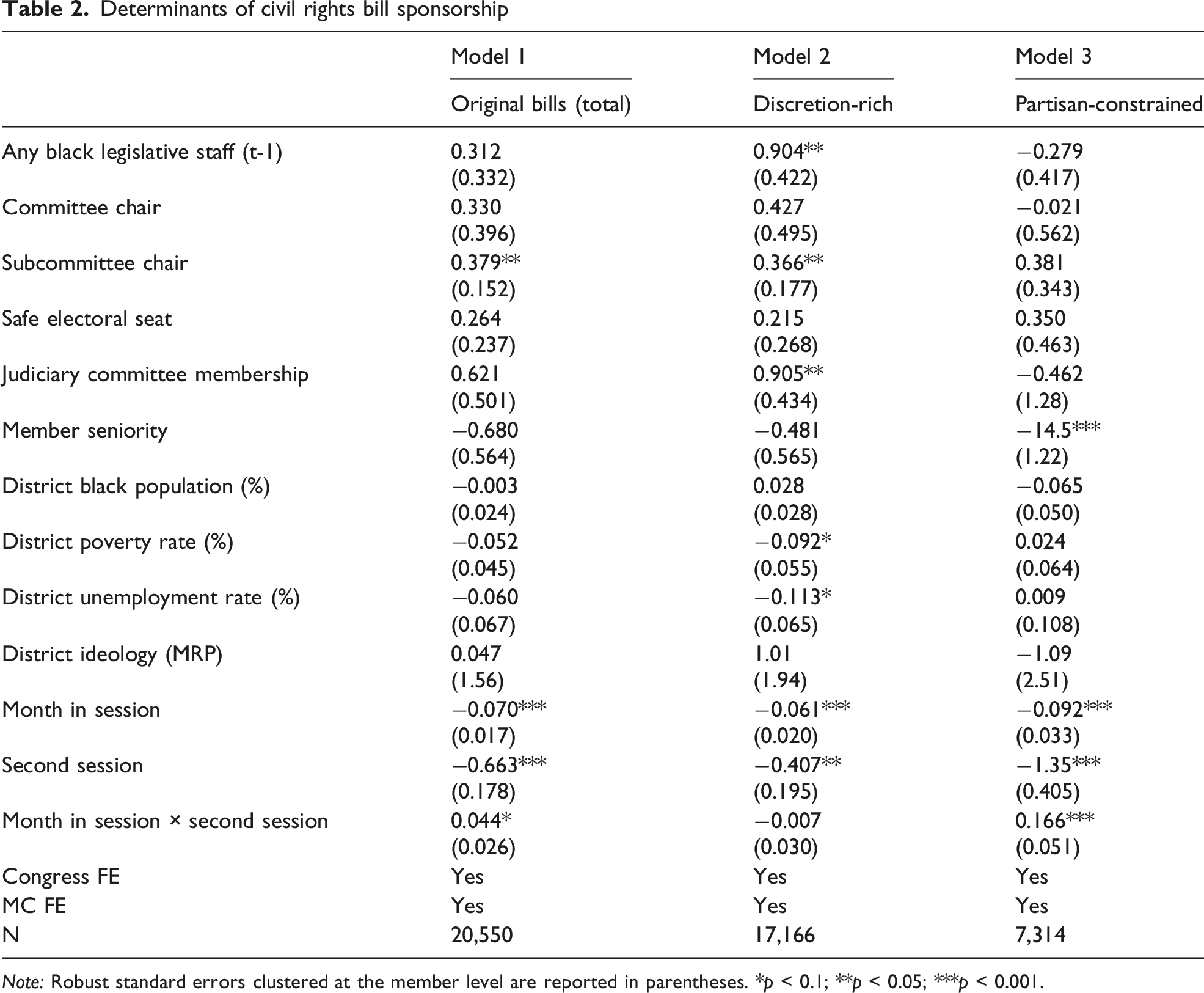
Note: Robust standard errors clustered at the member level are reported in parentheses. *p < 0.1; **p < 0.05; ***p < 0.001.
Stronger evidence emerges for Hypothesis 2, which predicts a larger effect for discretion-rich than for partisan-constrained civil-rights issues. Consistent with this expectation, Model 2 shows a statistically significant association between Black legislative staff presence and discretion-rich civil-rights bill sponsorship. Offices with Black legislative staff exhibit rates of discretion-rich civil-rights bill sponsorship approximately 2.47 times higher than those of offices without such staff. 26
By contrast, Model 3 shows no comparable association for partisan-constrained civil-rights legislation, with estimates that are both statistically imprecise and substantively small. This pattern is consistent with the theoretical expectation that staff identity matters most where offices retain greater discretion over agenda construction. In partisan-constrained domains, sponsorship decisions are more heavily shaped by party agendas, coalition commitments, and established legislative priorities, leaving less room for staff composition to influence legislative activity. Although these findings cannot rule out selection into hiring, the concentration of associations in discretion-rich domains is more consistent with the expectation that staff influence is greatest where offices retain greater agenda discretion. If selection alone were driving the results, similar associations would be expected across both discretion-rich and partisan-constrained civil-rights issues.
Robustness Checks
We conduct a series of robustness checks to assess the sensitivity of the main findings to alternative specifications, measurement choices, and potential sources of selection bias.
First, we re-estimate the models excluding member fixed effects and instead include observed member-level covariates, including indicators for member race, gender, party, seniority, committee assignments, and second-dimension NOMINATE score (Table B.1). For discretion-rich civil-rights legislation, the estimated coefficient on Black legislative staff remains positive but is substantially attenuated and no longer statistically significant. Relative to the baseline specification, removing member fixed effects shifts the analysis from within-member to across-member comparisons, making the estimates more susceptible to unobserved differences between legislators while also introducing additional between-member heterogeneity by including members with no variation in civil-rights sponsorship activity. Although the estimates are less precise and no longer statistically significant, the persistence of a positive coefficient remains directionally consistent with the main findings and does not contradict the baseline interpretation.
We next examine heterogeneity by member race (Table B.2). This analysis addresses the concern that the estimated relationship may simply reflect the policy preferences or representational commitments of Black legislators, who are substantially more likely to employ Black legislative staff. 27 Among non-Black members, Black legislative staff presence is positively associated with discretion-rich civil-rights sponsorship, with the estimate narrowly missing the conventional significance threshold (p = 0.06). Among Black members, the estimated coefficient remains positive but is smaller and not statistically distinguishable from zero. This pattern is consistent with the possibility that Black staff are most consequential in offices where members rely more heavily on staff expertise in identifying and advancing civil-rights proposals. Although these results do not eliminate the possibility of selection effects, they suggest that the main findings are not solely attributable to the concentration of Black staff in offices represented by Black legislators.
We also assess the robustness of our civil-rights issue classification. Our baseline specification classifies CAP subtopics 200 (General Civil Rights), 201 (Ethnic Minority and Racial Group Discrimination), and 206 (Voting Rights) as partisan-constrained. As an alternative specification, we additionally classify CAP subtopic 202 (Gender, Identity, and Sexual Orientation Discrimination) as partisan-constrained, reflecting the increasing incorporation of gender and LGBTQ rights into contemporary party agendas and coalition commitments. Re-estimating the models using this alternative classification yields substantively similar results, with the estimated association between Black legislative staff and discretion-rich civil-rights sponsorship remaining positive and statistically significant and, if anything, becoming slightly stronger (Table B.3).
To assess whether the findings reflect broader ideological tendencies or generalized legislative activism rather than issue-specific staff influence, we conduct a series of placebo tests. Given recent evidence of increasing liberalism among Democratic legislators (Saad 2023), we first examine social welfare legislation. Social welfare legislation provides a useful comparison because it is associated with liberal policy priorities but is less directly connected to the civil-rights expertise and policy networks that Black legislative staff may bring to congressional offices. 28 We also examine energy legislation—an issue area with no theoretical connection to Black descriptive representation—to assess whether Black legislative staff are associated with legislative activity more generally. As shown in Table B.4, the estimated coefficients on Black legislative staff in both domains are small and statistically indistinguishable from zero, providing no evidence that the main findings reflect broader ideological trends or generalized legislative activism.
As an additional assessment of the expertise mechanism, we replace Black legislative staff with Black communications directors. Communications directors occupy prominent positions within congressional offices but generally play a more limited role in policy development and legislative agenda construction. If the observed relationship operates through expertise, issue-specific knowledge, or policy networks, it should be concentrated among legislative staff rather than communications personnel. Consistent with this expectation, we find no comparable association between Black communications directors and civil-rights bill sponsorship (Table B.5), suggesting that the observed relationship is tied to the policy responsibilities associated with legislative staff positions rather than simply the presence of Black staff within an office.
Results are likewise robust to a range of alternative measurement and modeling choices. We re-estimate the models using all bills, without distinguishing between original and reintroduced (Table B.6); apply lenient and stricter Jaccard thresholds for defining original bills (Table B.7); consider alternative functional forms (Table B.8); include issue-specific Legislative Effectiveness Scores (Table B.9); estimate models with a reduced set of controls (Table B.10); replace Congress fixed effects with year or month fixed effects (Tables B.11 and B.12); and exclude office–month observations in which staff racial identity is not directly reported by LegiStorm (Table B.13). Across specifications, the results generally support the main pattern of findings: Black legislative staff are positively associated with discretion-rich civil-rights sponsorship but not with partisan-constrained civil-rights legislation. The primary exception is the specification using all bills, which produces smaller and less precise estimates that do not reach conventional significance levels.
We also examine whether the findings depend on how staff presence is measured. Our baseline specification uses a binary indicator for the presence of at least one Black legislative staff member because Black legislative staff remain relatively uncommon in policy positions and because our theoretical argument centers on whether offices possess access to the expertise, networks, and perspectives associated with Black staff. Nonetheless, we re-estimate the models using staff counts (Table B.14) and percentage measures (Table B.15). We also distinguish staff by position (mid-tier versus top-tier), adopt a narrower definition of legislative staff that excludes legislative assistants and deputies (Hertel-Fernandez, Mildenberger, and Stokes 2019), incorporate gender composition, and extend the baseline one-month lag to 2 months (Tables B.16-B.19). Across these alternative measures, the results continue to provide greater support for an association between Black legislative staff and discretion-rich civil-rights sponsorship than for partisan-constrained civil-rights sponsorship. Although some specifications yield less precise estimates, they generally point in the same substantive direction as the main findings.
Finally, we assess whether the relationship varies across district and party contexts. In Table B.20, we split the sample by the mean Black population share. The association between Black legislative staff and discretion-rich civil-rights sponsorship is positive across district contexts but statistically significant only in districts with higher Black populations (above the sample mean of 12.4 percent). We also estimate the models separately by party, given the concentration of civil-rights sponsorship among Democrats and the rarity of minority staff in Republican offices (Scott et al. 2018). The estimated association remains positive in both Democratic and Republican offices, though it reaches statistical significance only among Democrats (Table B.21). The similar direction of estimates across district and party contexts suggests that the main findings are not driven solely by district-level demand or partisan differences, even as precision varies across contexts.
Conclusion and Implications
This paper examines whether the presence of Black legislative staff within congressional offices is associated with civil-rights lawmaking and, more broadly, when staff diversity matters for legislative agenda-setting. Focusing on bill sponsorship, the analysis reveals a positive association between Black staff presence and members’ sponsorship of civil-rights legislation. Importantly, this relationship is conditional: associations are concentrated in discretion-rich domains, whereas no comparable relationship appears for partisan-constrained proposals. These findings suggest that staff composition matters most where offices retain greater latitude in agenda construction. Although members undoubtedly play a central role in both hiring decisions and legislative priorities, the observed pattern is consistent with the argument that Black legislative staff may help shape legislative agendas at the margin, particularly where offices retain greater discretion in determining which proposals to advance.
These patterns point to an important theoretical implication for research on legislative politics, particularly work on agenda control, issue selection, and bill sponsorship (Curry 2015; Hall 1996; Schiller 1995). Members retain ultimate authority over which bills are introduced, but staff influence appears to operate at the margins of the legislative agenda—shaping which discretion-rich or lower-salience proposals are identified, developed, and advanced. Where agenda control is less centralized and sponsorship decisions remain discretionary, staff expertise and policy knowledge may meaningfully affect which issues receive legislative follow-through. In this sense, staff may function as agenda actors within congressional offices, consistent with research highlighting the growing influence of congressional staff (Crosson et al. 2020; Montgomery and Nyhan 2017; Ommundsen 2023). More broadly, these findings speak to debates about congressional capacity by highlighting how staff composition constitutes an organizational resource that conditions offices’ agenda-setting capacity in discretion-rich domains.
The findings also contribute to research on substantive representation by clarifying the conditions under which congressional staff shape legislative outcomes. While existing work on congressional staff primarily documents descriptive patterns, it offers limited evidence on downstream consequences for legislative outputs (Bolton, Hassell, and McCrain 2025; Rutherford and Wu 2025). Our analysis shows that descriptive representation among unelected participants translates into substantive lawmaking influence primarily in policy domains that afford agenda discretion, specifying when and through what organizational channels such translation occurs. Staff can thus be important—if often overlooked—actors in substantive political representation. More broadly, the findings suggest that inequalities in staff representation may have downstream consequences for legislative agenda setting.
Future research can extend this analysis in several directions. First, it would be valuable to assess whether the role of Black legislative staff changes as civil-rights issues become more salient in national politics. The killing of George Floyd and the subsequent national attention to policing, racial justice, and civil-rights issues may have increased both congressional attention to these topics and the demand for staff expertise. Future work could examine whether heightened issue salience alters the relationship between Black legislative staff and civil-rights agenda setting. Second, progress depends on improved access to staff data. Existing projects face two key constraints: the high cost of purchasing staff data from commercial sources such as LegiStorm and the discontinuation of the Congressional Bills Project. Advances in large language models and computational tools may help address these limitations by enabling scalable inference of staff characteristics from payroll records. Third, beyond sponsorship, future work should examine co-sponsorship and amendments, where staff may shape legislative engagement through alternative channels. Finally, extending this framework to other racial and ethnic groups would clarify whether similar conditional patterns hold across policy domains tied to group-based interests.
Supplemental Material
Supplemental Material - When Staff Identity Matters: Black Legislative Staff and Agenda-Setting in Civil Rights Legislation
Supplemental Material for When Staff Identity Matters: Black Legislative Staff and Agenda-Setting in Civil Rights Legislation by Fred Gui in Political Research Quarterly.
Footnotes
Acknowledgments
The author thanks participants at the 2021 Congress and History Conference and the 2026 PRIEC Meeting at Arizona State University for helpful comments and suggestions. The author also thanks Lawrence Rothenberg, Nichole Bauer, Wendy Schiller, Christian Fong, Mayya Komisarchik, Dan Alexander, Maria Silfa, Muzhi Liu, Melinda Ritchie, and David Canon for their constructive feedback on this version and earlier versions of the manuscript, as well as the anonymous reviewers for their valuable comments and suggestions.

Funding
The author disclosed receipt of the following financial support for the research, authorship, and/or publication of this article: The author received financial support for the research and authorship of this article from the Louisiana State University College of Humanities and Social Sciences Faculty Start-Up Fund.
Declaration of Conflicting Interests
The author declared no potential conflicts of interest with respect to the research, authorship, and/or publication of this article.
Data Availability Statement
Replication materials are available at the Harvard Dataverse: https://doi.org/10.7910/DVN/F0BYE2 (Gui, 2026).
Supplemental Material
Supplemental material for this article is available online.
Notes
References
Supplementary Material
Please find the following supplemental material available below.
For Open Access articles published under a Creative Commons License, all supplemental material carries the same license as the article it is associated with.
For non-Open Access articles published, all supplemental material carries a non-exclusive license, and permission requests for re-use of supplemental material or any part of supplemental material shall be sent directly to the copyright owner as specified in the copyright notice associated with the article.
