






Abstract
Although members of the mass public express support for judicial philosophies--such as originalism--and evaluate nominees and decisions accordingly, it remains unclear whether they apply these philosophies in a coherent and consistent manner. In general, the public rarely employs overarching belief systems when making political judgments. Thus, are individuals philosophically constrained in their thinking about the judiciary? To answer this, we assess philosophical constraint among the mass public and compare it to a relevant baseline: legal professionals. Using two surveys—the 2022 Cooperative Election Study (CES) and a 2025 Prolific sample of legal professionals—we evaluate constraint through multiple metrics, including attitude consistency. Our findings suggest that judicial philosophy functions as an organizing framework for only a small subset of individuals, primarily those with higher levels of political sophistication or legal training. There is a disconnect between philosophy-based support and coherence in one’s understanding of that philosophy.
In legal circles, the media, and everyday politics, much is made of the interpretations of legal text that federal court judges use—or purport to use—when reaching decisions on cases. The most commonly discussed interpretations can broadly be described as originalism (most closely associated with conservative jurists) and a living constitutional theory (associated with liberals), with each categorization having various off-shoots (e.g., textualism, pragmatism). 1 President Trump vowed to choose a “qualified originalist,” “who’s judicial philosophy is one that believes in separation of powers, co-equal branches of government” (Hannity 2018). And in each of his three nominations he emphasized his nominees’ philosophy as a qualification that made them worthy to serve in such a powerful position. For example, he lauded Neil Gorsuch’s “commitment to interpreting the Constitution according to its text” (Archives 2017), and he described Brett Kavanaugh as a “proven textual originalist” (Ellis 2018; Politico 2018). Similarly, while Obama was on the campaign trail in 2008, he touted that he would choose judges that “believe in fidelity to the text of the Constitution, but they also think you have to look at what is going on around you and not just ignore real life” (Lee 2012).
Discussion of judicial philosophy is a significant part of the highly salient and televised Supreme Court confirmation hearings held by the Senate Judiciary Committee. It became a prominent topic of discussion during the infamous hearings of Robert Bork (Walsh and Kamen 1987) and remained prominent ever since (Collins et al., 2023; Comiskey, 1993; Guliuzza et al., 1994; Krewson Christopher and Owens, 2022; Ringhand and Collins, 2010). In fact, questions related to judicial philosophy comprise 10–20% of all hearing comments (Ringhand and Collins 2010, 618). In 2022, Senator Chuck Grassley used his opening statement to warn Judge Jackson that he will ask tough questions about her judicial philosophy. He expressed that, “Some of us believe that judges are supposed to interpret the law as it was understood when written, not make new law … Others believe that courts should make policy. They believe in a so-called living constitution. They think that the Constitution’s text and structure don’t limit what judges can do, [and that only the former is correct]” (Grassley 2021).
These philosophies are abstract and complex, so much so that Justice Antonin Scalia called “the difficulty of applying [philosophy] correctly” its “greatest defect” (1988). Still, scholarship shows that members of the American mass public possess preferences about the interpretations that judges use (e.g., Greene et al. 2011), and evaluate nominees, judges, and decisions through this lens (Krewson Christopher and Owens, 2022; Krewson and Owens, 2021; Rivero and Stone, 2023). For instance, there is a compounding effect of using a disfavored philosophy to reach a disliked outcome. Importantly, these preferences are not driven exclusively by partisan or ideological rhetoric (Krewson Christopher and Owens, 2022). What remains unclear regarding Americans’ preference for judicial philosophy is what those preferences represent, where they emanate from, and whether they are sufficiently complex to mirror the philosophical preferences of “legal elites.”
In this paper, we pursue two goals. First, we assess the extent to which individuals have a meaningful understanding of judicial philosophies—that is, beyond merely recognizing labels—and whether they can independently identify outcomes that align with those philosophies. More specifically, we examine whether the public’s preferences regarding judicial interpretation are constrained: whether they reflect a cohesive belief system that gives rise to, organizes, and connects domain-specific attitudes. We ask whether judicial philosophy functions as a “crowning posture” or “capping abstraction” (Converse 1964), providing structure to individuals’ views on legal and judicial issues.
Second, we argue that answering our central question requires identifying an appropriate baseline for comparison. It is of limited value to conclude that the mass public does not apply judicial philosophy if legal professionals do not apply it either. Much of the existing research linking mass attitudes about courts, the law, and judicial philosophy relies on survey items measuring self-reported support for originalism or living constitutionalism. While this work does not explicitly claim that individuals possess a well-defined understanding of judicial philosophy, it often rests on the implicit assumption that people meaningfully prefer outcomes associated with particular interpretive approaches. We believe this assumption merits direct examination. Such an investigation would be incomplete however, without also assessing how well those “in the know”—those with legal expertise—meet the same standard.
In studies of political attitudes more broadly, researchers often assess constraint in the mass public by comparing it to either a normative ideal (e.g., Converse 1964) or to elite samples (e.g., Lupton et al. 2015). We adopt the latter strategy, as it provides a more concrete benchmark. Accordingly, to evaluate philosophical constraint in the mass public, we also measure it among legal professionals, whom we expect to exhibit more structured and coherent views about the law.
Our examination is motivated, in part, by the lack of attitudinal constraint we observe in other political contexts (Converse 1964; Lupton et al. 2015), the low levels of sophistication and knowledge among the American mass public (Delli Carpini and Keeter 1996; Luskin 1987), and the possession of an inconsistent understanding of the Constitution (Armaly and Enders 2023). At the level of legal elites, we might expect judicial philosophy to represent a constrained set of beliefs which ought to be applied consistently across issues and contexts. Indeed, Justice Scalia spoke of judicial philosophy offering “consistency and predictability … a coherent approach” to the law (Scalia 1988). Although scholars highlight that many evaluate legal stimuli with judicial philosophy in mind, it is important to determine whether the masses actually possess a judicial philosophy, or simply have a general familiarity with the language of, say, originalism. In the parlance of Ellis and Stimson (2012), can the masses link the content of philosophy to other attitudes in concrete ways (a la “operational” ideology), or can they only link labels to definitions (a la “symbolic” ideology)? Is mass philosophy operational or symbolic? Furthermore, how do the masses fare relative to legal professionals?
These literatures illustrate the need to scrutinize public attitudes carefully, especially when the formation of those attitudes is assumed to be consistent and when they appear to explain meaningful variation in the evaluation of elites and political activity. We see three broad possibilities regarding constraint in the realm of judicial philosophy. Individuals’ attitudes on court and legal matters may be: (1) Constrained as a function of judicial philosophy. (2) Constrained as a function of some other orientation or political predisposition, such as ideology. (3) Unconstrained, or constrained by a different, presently unidentified force (e.g., see Uscinski et al. 2021; Lane 1962).
Given the extensive scholarship on constraint (Lupton et al. 2015), attitude formation (Zaller and Feldman 1992), and (un)certainty with respect to legal matters (Armaly and Enders 2023), we are inclined to believe the third option is the likeliest when it comes to the masses. Inasmuch as political sophistication predicts constraint in other realms (e.g., Federico and Schneider 2007), we suspect legal professionals—who, by the nature of their training, are sophisticated in legal matters—will exhibit more constrained attitudes than the masses. Conversely, the masses will appear to show significantly less constraint because judicial philosophy will not act as an organizing force.
We use data from the 2022 Cooperative Elections Survey to measure mass attitudes (N = 1,000) and a 2025 Prolific sample to measures attitudes of legal professionals (N = 483). Following Federico and Schneider (2007) and Lupton et al. (2017), we construct multiple measures of “philosophical constraint,” or “closely interwoven attitudes arising from the same few abstract principles” (Lupton et al. 2017, also see Converse 1964) in an effort to identify whether judicial philosophical constraint exists, from where it is derived, and how the masses compare to elites.
Understanding if judicial philosophy constrains the masses is important for the simple reason that it underscores assessments of judges, courts, and the decisions those actors and institutions reach (e.g., Greene et al., 2011; Krewson Christopher and Owens, 2022; Krewson and Owens, 2021). That is, the philosophy that judges employ clearly matters to the mass public. But, as we demonstrate throughout this paper, when the masses link philosophy to other attitudes, most seem to only connect the labels of philosophy, rather than connecting the content of the philosophy. In other words, individuals prefer (for example) “originalist” outcomes, but on average they are neither certain what “originalism” entails nor are they able to consistently apply the concept in a principled manner. Legal professionals are much more consistently constrained, highlighting that philosophical constraint may be the stuff of “legal elites,” even though the masses employ the labels in their evaluation of courts and the law.
Judicial Philosophy Preferences
The American mass public has long preferred judicial institutions to behave in a rigid, legalistic fashion. Indeed, Gibson et al. (2005) write that the judiciary is supported in large part because of “… its connection to legality; to the extent that the Supreme Court can present its decision as grounded in legality, acquiescence is more likely” (197). And, despite the fact that the majority of the mass public are legal realists and recognize the justices’ decisions are influenced by their personal beliefs, the public still extends legitimacy and support to the institution (Gibson and Caldeira 2011; Gibson and Nelson 2017). Thus, courts are clearly incentivized to couch their decisions in legalistic terms to convey the neutrality of their opinions (see Rivero and Stone 2023).
There are multiple methods by which courts can convey this neutrality, including paying attention to the legal contours of decisions. For instance, Scheb and Lyons (2001) show that individuals strongly prefer legal over political influences on court outcomes. Similarly, Zink et al. (2009) suggest that the treatment of precedent is one way “judges can signal the neutrality” of a decision (909). Using a particular judicial philosophy is another way that judges can suggest that outcomes are a product of a coherent orientation toward the law, rather than idiosyncratic political preferences. Indeed, precedent is used to demonstrate the “use of fair and neutral decision-making procedures, whereby similar cases are consistently treated according to similar legal principles” (Zink et al. 2009, 911).
The purpose of a judicial philosophy is similar. Consider, again, Justice Scalia’s (1988) argument that philosophies are imperative, “If the law is to make any attempt at consistency and predictability,” and that originalism “… by and large represents a coherent approach” (855). Other philosophies similarly try to achieve consistency and predictability. Thus, inasmuch as judicial philosophies indicate consistent, coherent, and replicable legal decisions, it is sensible why the public would support their use. There is clear evidence that people care about both process and policy considerations when evaluating the judiciary (Tyler 2006).
There is some reason to expect that individuals do have some understanding of judicial philosophy. Elites discuss philosophies with some consistency (Asmussen 2011; Post and Siegel 2006; Steigerwalt 2010; Truscott 2023). Judicial philosophy is one of the most consistently discussed topics at salient televised Supreme Court confirmation hearings and interviews with justices, with few topics being discussed more frequently (see Glennon and Strother 2019; Ringhand and Collins 2010). The media tends to highlight the use of various judicial philosophies (Gerstein and Levine 2022; Liptak 2022). Press releases from members of Congress frequently invoke legal principles (Rivero and Stone 2023). Even judges speak, debate, and write about their own philosophies (Breyer and Scalia 2008; Scalia 1988; Scalia and Garner 2012), and commonly use language like “originalism” and “living document” when doing so.
What is more, scholarship reveals that Americans not only support the use of judicial philosophy among judges but support specific judicial philosophies. Greene et al. (2011) note that a “great majority of Americans feel comfortable expressing one or another view” regarding judicial philosophy (370). Although these preferences do align with partisan and ideological considerations—for instance, Krewson Christopher and Owens, 2022 show that Democrats (Republicans) typically prefer living constitutionalism (originalism)—Greene et al. (2011) highlight that people possess “nontrivial levels of legal and political knowledge” (361). They further note that there is substance to these preferences. They are not merely “partisan slogan” but are viewed as “a legal argument and as a culturally embedded meme” (360).
Although scholarship consistently demonstrates that individuals recognize the labels of judicial philosophy and prefer outcomes that stem from their preferred philosophy, many important questions about the public’s understanding of and orientation toward these philosophies remain unanswered. We are particularly interested in the cohesion with which individuals think about judicial philosophy, preferred outcomes, and their interaction. Although individuals seem to have firm preferences on philosophy, they are not always utilized by the masses the way they may be utilized by judges and other elites (who employ them in relatively consistent ways). Consider findings by Krewson Christopher and Owens (2022), who show that nearly 25% of Democrats/liberals support originalism and nearly 40% of Republicans/conservatives support living constitutionalism. 86% of self-identified liberals believe original intent—a legal principle most often utilized by conservative jurists—is important (Rivero and Stone 2023). Even some liberal judges espouse originalism (Elena Kagan stated “we are all originalists” at her confirmation hearing; see Litman 2021), but these findings show that there is some inconsistency in understanding what policies various judicial philosophies are likely to deliver.
Perhaps more pointedly, Greene et al. (2011) write, “… data are consistent with the notion that a preference for originalism in a survey does not just reflect an incoherent reflex, but expresses a substantive legal, political, and cultural preference.” Nevertheless, they continue on to state, “At the same time, popular attitudes toward originalism show a certain incommensurability with other attitudes people hold … These results may well reflect that people simply do not understand questions about constitutional interpretation, or at least that they do not understand what follows from their answers” (417). 2
The observation that many “do not understand what follows from their answers” regarding judicial philosophy and will support a philosophy that appears at odds with their self-identified political predispositions, strikes us as similar to the decades-long debate regarding ideology, ideological constraint, and “symbolic” versus “operational” ideology. Ideology is a structured, cohesive worldview from which attitudes should emanate (Converse 1964), but is also a label to which individuals are attached and which guides political choices (Mason 2018). Stated simply, few possess the overarching belief system (i.e., few exhibit constraint), but most are attached to terms like “liberal” and “conservative” (e.g., Devine 2015; Ellis and Stimson 2012; Mason 2018). Moreover, Ellis and Stimson (2012) demonstrate that many have mismatched ideological self-identification and policy attitudes (also see Lupton et al. 2017). For example, many who label themselves conservatives possess several liberal issue attitudes, such as on government spending. 3 Stated differently, many “do not understand what follows from their answers” about ideology. We suspect the same may be true with respect to judicial philosophy.
The literature on ideological constraint also identifies its main determinant: political sophistication. While the mass public has difficulty identifying “what goes with what” in the political world, this is not the case for political elites or for those in the masses who mirror political elites (as Lupton et al. (2015) call them, “hyper sophisticates”). Those higher in political expertise exhibit greater constraint (Federico and Schneider 2007). The masses possess (unconstrained) multidimensional preferences on policy, while elites possess (more tightly connected) unidimensional preferences (Lupton et al. 2015). Jacoby (1995) shows that those with greater educational attainment, political knowledge, and higher involvement in politics are better able to identify the ideological content of various political stimuli.
Just like with an overarching and structured ideology, judicial philosophies are sophisticated, conceptual, and nuanced. Consider Scalia’s (1988, p. 856) description of applying his preferred philosophy, originalism:
4
… the task requires the consideration of an enormous mass of material—in the case of the Constitution and its amendments … the records of the ratifying debates in all the states … it requires an evaluation of the reliability of that material—many of the reports of the ratifying debates … are thought to be quite unreliable … it requires immersing oneself in the political and intellectual atmosphere of the time—somehow placing out of mind knowledge that we have which an earlier age did not, and putting on beliefs, attitudes, philosophies, prejudices, and loyalties that are not those of our day. It is … a task sometimes better suited to the historian than the lawyer ….
It is no small feat to apply a judicial philosophy, even for members of the highest court. It is sensible, then, that such a feat would approach insurmountability for those with no legal expertise, no training in assessing reliability, and no incentive to “place out of mind” contemporary beliefs and attitudes. For a mass public whose views are often dominated by an increasingly coalescing set of identities (Mason and Wronski 2018), judicial philosophy may take a backseat to any number of other forces that produce public opinion.
We are cautious to neither attribute too much sophistication to the masses (a la Downs 1957), nor set the bar for philosophical constraint too high (a la Converse 1964). Members of the public may well—consistent with extant research—identify with particular philosophies and perhaps even understand the general meaning of those philosophies. Nevertheless, we think they will be less likely to express preferences over judicial outcomes in concrete cases in a manner that is consistent and coherent (per Federico and Schneider (2007), they will be low in “horizontal constraint”) or consistent with their self-reported preferred philosophy (per Lupton et al. (2017), they will be low in “vertical constraint”). Finally, to the extent we observe constraint, we think it will exist predominantly among more politically sophisticated Americans. This would suggest that judicial philosophy offers limited benefit to the masses, as those who are constrained with respect to philosophy are those appearing to employ other forms of sophistication. Thus, we argue that it is those higher in legal/judicial sophistication—in our context, legal professionals and, perhaps, sophisticated masses—that will be better able to connect a philosophy to the individual elements of the legal world.
With these expectations in mind, we hypothesize:
Members of the mass public will exhibit low absolute levels of judicial philosophy constraint (of all measures).
Members of the mass public will exhibit low relative levels of judicial philosophy constraint, compared to legal professionals.
Greater non-legal (i.e., political) sophistication will relate to greater judicial philosophy constraint.
Data and Methodology
We employ two separate samples to study our questions regarding judicial philosophy, though all survey items employed here were identical across surveys to facilitate direct comparisons. First, for the mass public, we collected 1,000 survey responses from adults in the United States as part of the 2022 Cooperative Election Study, 5 which offers nationally representative samples. 6 Demographic details appear in Table A1 of the supplemental materials.
As for legal professionals, we utilized the Prolific platform from March–June, 2025. While Prolific allows researchers to implement their own quota sample based on US census data, our major concern was sufficient power to make sound inferences regarding legal professionals. So, we used Prolific’s “screeners,” which allow researchers to screen on particular respondent characteristics, including employment sector characteristics (e.g., employer type, industry, organizational tenure). From these employment sector options, we opted to allow all who identify their work function as “legal” to take our survey. 7 Screening on work function, Prolific identified nearly 700 potential subjects that had been active in the 90 days prior to initial data collection. In all, our sample contains just under 500 respondents (although statistical analyses are often estimated on fewer respondents).
Of course, we recognize that this sample is not representative of all members of the legal profession. Other scholarship that focuses on members of the legal profession possess larger and potentially more representative samples, but do not employ survey instruments necessary for our analysis (Bonica and Sen 2017). Thus, we are circumspect about generalizing broadly; the sample of legal professionals in Prolific’s pool may not reflect the population of legal professionals. Nevertheless, we believe ours is some of the first scholarship to directly compare mass attitudes to the attitudes of legal professionals. As it relates to the questions under consideration here—that is, whether the masses can utilize judicial philosophy—it is necessary to understand the philosophical attitudes of those in the legal profession. Indeed, previous scholarship on questions of constraint either presume a level of constraint to elites (e.g., Converse 1964) or, as we do, measure it directly (Lupton et al. 2015). So, we do not make broad claims about how well our estimates generalize to legal professionals, but we are comfortable assessing how masses compare.
Occupation of legal professionals sample
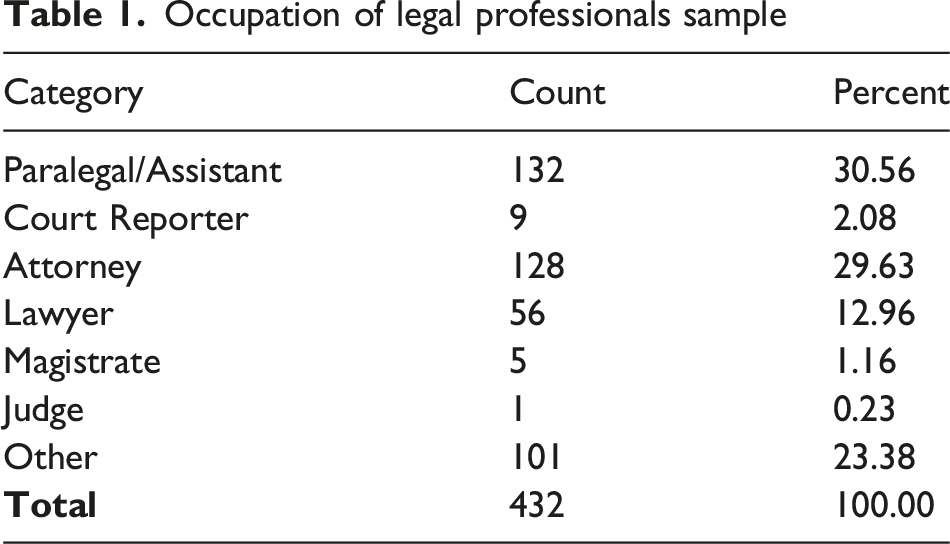
Our empirical examination unfolds in four parts. First, we consider whether individuals have firm preferences about judicial philosophy and whether they can consistently identify what, exactly, comes with philosophical labels. Next, we ask respondents their preferred outcome on a series of constitutional questions and determine their level of consistency (i.e., horizontal constraint). Third, we assess whether individuals consistently apply their self-reported preferences to particular constitutional outcomes (i.e., vertical constraint). Finally, we consider the role political sophistication plays. In all instances, we offer respondents “easy” tests of our theory. For instance, we consistently provide hints regarding which judicial outcome aligns with which philosophy. Thus, should we find relatively low levels of constraint, we would possess strong evidence suggesting judicial philosophy does not constrain mass attitudes on legal issues (given that we designed the survey to maximize conceptual clarity).
Preference Consistency
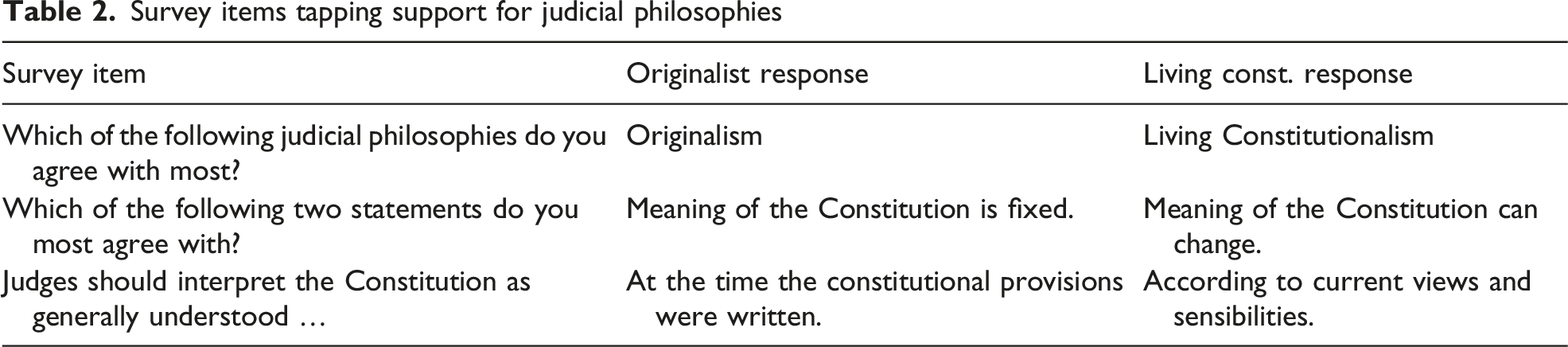
Research on public support for judicial philosophies typically presents respondents with descriptions of those philosophies, often paired with corresponding labels (Greene et al. 2011; Krewson 2022; Rivero and Stone 2023). For example, a survey might ask whether respondents prefer originalism or living constitutionalism, explaining that the former sees constitutional meaning as fixed, while the latter allows it to evolve. Without such definitions, the public may not associate labels with their intended meanings. A respondent, for instance, might endorse originalism while believing the Constitution’s meaning can change.
At the risk of invoking the “no true Scotsman” fallacy, we argue these two positions are incompatible. We accept that judicial philosophies vary, have many practitioners, and even staunch adherents may sometimes deviate (e.g., Scalia 1988). Still, at its core, originalism holds that judicial opinions ought to reflect “what the Constitution originally meant …” (Scalia 1988). To suggest its meaning is malleable—especially when “is fixed” is an option—contradicts a basic tenet of originalism. The same holds for living constitutionalism. Among legal professionals, even those not practicing constitutional law, we expect greater recognition of “what goes with what” in judicial philosophy. Thus, we anticipate different response patterns across our samples.
Survey items tapping support for judicial philosophies
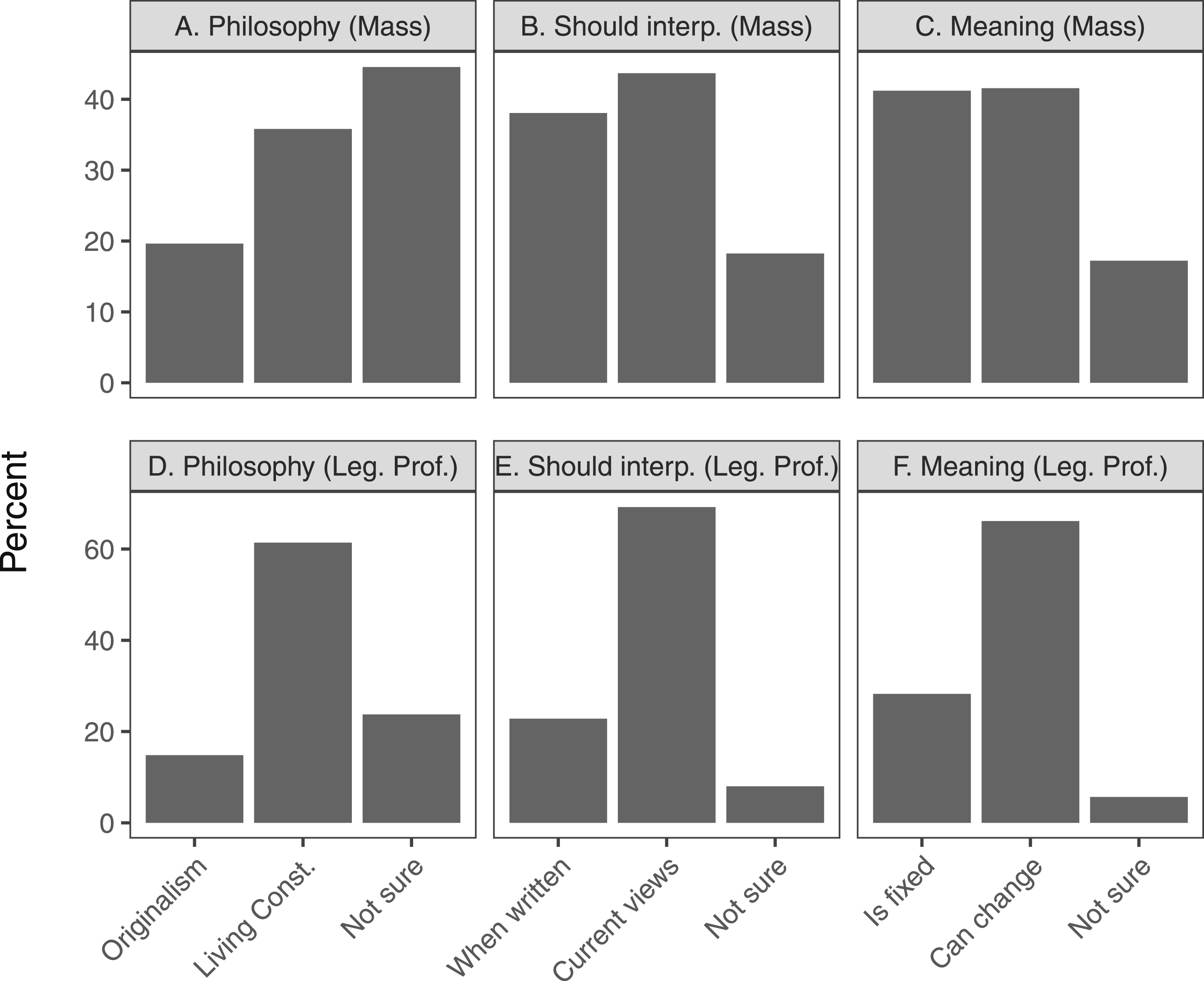
Barchart of responses to three items tapping support for judicial philosophy. “Mass” refers to CES sample and “Leg. Prof.” to Prolific sample.
Mass respondents seem more comfortable stating that they believe the constitution should be interpreted using the values of yesterday or today (Panel B), as well as whether the meaning is fixed or malleable (Panel C). Still, 18.23% of respondents do not register a preference on whether the interpretation ought to be according to current views, and 17.22% are not sure whether the meaning is fixed. Those in the legal profession are, once again, more certain about their position, with only 8.0% stating they are unsure about how the constitution should be interpreted and 5.65% expressing uncertainty about whether the meaning can change.
Consistency of preferences regarding judicial philosophy, among those who did not answer “not sure” to any of the items
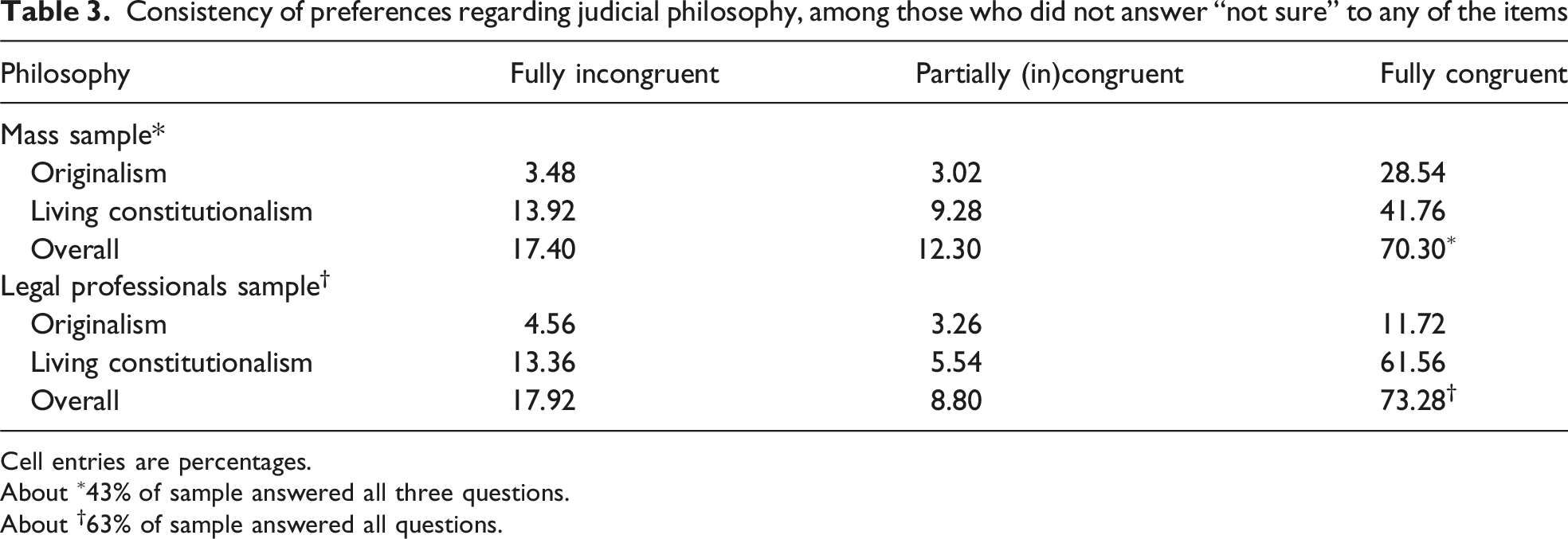
Cell entries are percentages.
About ∗43% of sample answered all three questions.
About †63% of sample answered all questions.
At first glance, there is some cause for optimism. First, over 70% of the mass sample offer fully congruent responses, suggesting that many respondents possess cogent, consistent views on judicial philosophy. And, the elite sample only outpaces the mass sample by about 3%, suggesting that familiarity with the legal field does little to aid the consistency of these preferences. However, only about half of the mass sample registered opinions other than “not sure” on all three items, meaning most respondents necessarily offered (at best) partially incongruent responses. Thus, we estimate that only about 30% of the mass public has preferences regarding judicial philosophy. 11 For the legal professionals sample, nearly half of the (full) sample appears to have congruent preferences. We note that this is a fairly conservative test of our hypothesis regarding constraint. Thus, we move on to measure cohesion in attitudes about philosophy more acutely, using measures of constraint developed by Federico and Schneider (2007) and employed by Lupton et al. (2017).
Horizontal Constraint: How Interrelated Are Attitudes?
One possibility is that individuals hold consistent views about how the Constitution should be interpreted but are confused by labels like “originalist” or “fixed meaning.” Consider an originalist who believes that public floggings are cruel and unusual punishment, despite their use at the time the Eighth Amendment was ratified. This person might interpret “fixed meaning” to imply that such punishments remain acceptable today, and thus select “can change” when asked about constitutional interpretation. To account for this, we move beyond philosophical labels and examine outcome preferences in a series of hypothetical cases. By removing the labels, we may uncover greater consistency in underlying attitudes (given that the “not sure” responses are highest for the philosophy items).
We presented respondents with five different scenarios relating to constitutional interpretation on Miranda rights and Amendments six (right to counsel), four (search and seizure), one (political speech), and two (bear arms). For instance, respondents saw:
Which of the following statements do you most agree with? The Second Amendment right to bear arms should apply … (A) Only to the types of weapons common when the constitution was ratified. (B) To all types of weapons, regardless of whether they existed when the constitution was ratified. (C) Not Sure.
Several things regarding these items are worthy of note. First, we are less concerned with responses to individual items than with patterns across all items, which our measure captures (discussed further below). Second, we deliberately avoided offering respondents clearly incongruent or illogical response options, as these are often confusing. For example, suggesting that the Second Amendment should apply to “all types of weapons” because they were “common when the Constitution was ratified” misrepresents historical reality and risks misleading participants. Moreover, respondents who found the options unclear or ill-fitting could select “not sure.”
We also varied the phrasing of response options to avoid any bias that may arise from particular verbiage. For example, living constitutionalist responses were sometimes framed as “consistent with modern views and sensibilities” and other times as “ingrained in modern society.” Originalist responses were framed as “consistent with traditional views of the Constitution” or “common when the Constitution was ratified.” Full question wording is available in Section C of the supplemental materials.
These design choices constitute a conservative test of the philosophical constraint hypothesis. If respondents cannot align outcomes—even with clear cues about whether an option reflects originalism or living constitutionalism—we must conclude that philosophical constraint is weak, at least in the horizontal sense. Finally, we note that originalist reasoning does not always yield conservative outcomes. For example, interpreting the Second Amendment to apply “only to the types of weapons common when the Constitution was ratified” reflects an originalist logic but leads to a liberal policy outcome.
We first measure horizontal constraint, or the degree to which attitudes on these constitutional questions are interrelated. If attitudes are highly interrelated, we would possess evidence that support for outcomes is a function of some abstract principle (perhaps judicial philosophy). 12 If attitudes are weakly interrelated, we would possess evidence that attitudes are idiosyncratic rather than emanating from an abstract principle. To measure horizontal constraint, we code each originalist response as 1 and each living constitution position as 0. Then, we estimate a measure of entropy, or variability and inconsistency in how individuals responded across items. Intuitively, if one consistently applies a philosophical approach across all items (i.e., all items were a 0 or a 1), entropy will be zero—there is no variability or inconsistency. Thus, to measure horizontal constraint, we take the inverse of entropy such that high values indicate greater constraint. 13 , 14
The left panel of Figure 2 compares the distribution of constraint, represented via kernel density estimation, for both samples. Higher values of constraint indicate more internally consistent response patterns. Both groups exhibit a bimodal distribution, with masses relatively more concentrated low in constraint and legal professionals relatively more concentrated high in constraint. This indicates that legal professionals have more structured and consistent patterns in their responses to our constitutional interpretation items. This implies that, relative to the masses, such individuals hold more coherent and constrained views. In the right panel, we see that the average level of constraint is significantly greater for the legal professionals sample.
15
Substantively, legal professionals exhibit about 32% more constraint than the mass sample. Distribution of horizontal constraint (measured as inverse of entropy across four constitutional interpretations) for mass and legal professionals samples (left panel). Average horizontal constraint by each sample (right panel). High values (i.e., low entropy) correspond to constraint.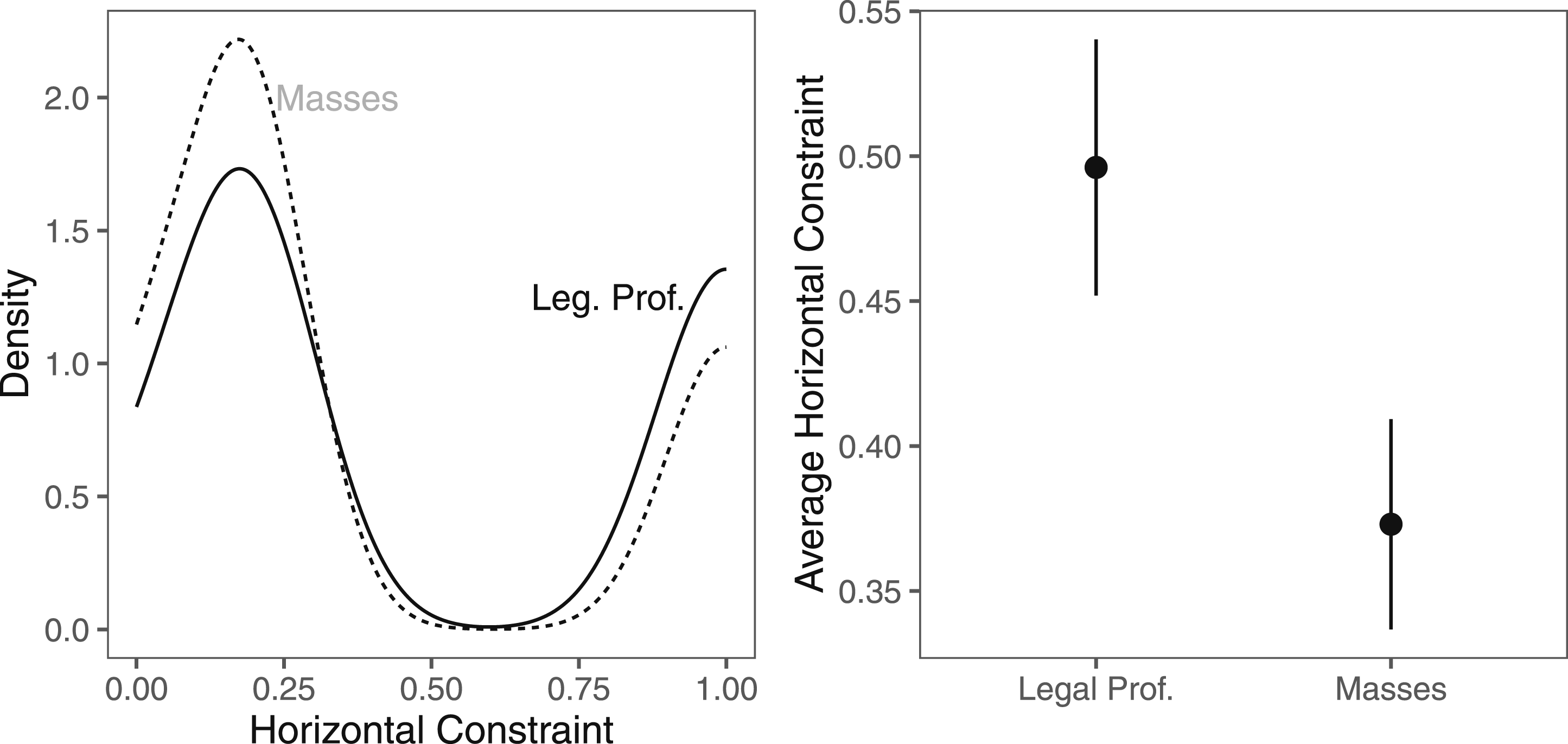
These results comport with Hypotheses 1 and 2 regarding absolute and relative levels of constraint across samples. The masses exhibit very little consistency in their responses. We also stress that this was a fairly “easy” test for respondents. First, there were only four items; one could guess the “correct” response to all four about 6% of the time. Second, the response choices for all items contain hints as to which was the originalist position and which was the living constitutional position (while omitting the labels of each philosophy). Nevertheless, respondents failed to consistently choose one option or the other.
This suggests that the lack of consistency in matching labels with the central ideas of the philosophy—demonstrated in Table 3 above—is not merely a function of the specific labels or terminology used. When confronted with specific options for how to interpret the Constitution, the mass public does not seem to employ an abstract belief system consistently across the scenarios we provided, and professionals fare much better overall. Finally, we would be remiss to ignore the fact that the legal professionals, while performing much better at this task than the masses, are not themselves perfectly constrained. This highlights the importance of assessing a baseline level of constraint, rather than assume “legal elites” excel at the task. Indeed, political elites vary in their levels of constraint as well (Lupton et al. 2017), so this is to be expected among sophisticated samples.
Vertical Constraint: Are Attitudes Connected to Philosophy?
Horizontal constraint is only one component of an overall constrained belief system. Indeed, as Lupton et al. (2017) write, “A truly constrained belief system is … hierarchical, with specific issue attitudes flowing from the broad evaluative ‘yardstick’” (894; also see Peffley and Hurwitz 1985). A constrained liberal, for example, should support government spending because of their liberalism; this is why the attitude exists. In the case of philosophical constraint, attitudes on specific legal/judicial issues ought to emanate from a broad belief system (i.e., philosophy). A constrained originalist should support an originalist decision because of their philosophy. Here, we examine the relationship between one’s attitudes on the five constitutional questions and their stated philosophy. If an individual conceives of judicial outcomes vertically, or in terms of judicial philosophy, then we would expect their issue attitudes to strongly correlate with that philosophy.
Consistent with Lupton et al.’s (2017) measure of vertical (ideological) constraint, we calculate the number of “philosophically correct” attitudes on each of the five hypothetical questions. 16 A “correct” attitude is one that corresponds to one’s stated philosophical preference. 17 So, if one stated they support living constitutionalism and agrees that Miranda rights ought to “be guaranteed because they are ingrained in modern society,” theirs would be a “correct” attitude. Such an attitude would be “incorrect” among those who endorse a fixed meaning interpretation of the constitution. 18 If respondents are correct in most cases, we will possess evidence that their attitudes are a function of the higher-order construct, judicial philosophy. If respondents are incorrect in several cases, we will possess additional evidence that judicial philosophy offers minimal organizing principles to the mass public.
Given the considerable variation in responses across the three items measuring support for judicial philosophy (see Figure 1), we do not rely solely on the item explicitly labeled “philosophy.” Instead, we estimate vertical constraint using all three: the philosophy item, the “meaning … is fixed/can change” item, and the “should interpret the Constitution …” item. To be precise, we assess vertical constraint using 15 possible “correct” responses (5 constitutional interpretation items × 3 philosophy indicators), rather than just 5 (i.e., “correct” on a single indicator). This approach biases our measure toward finding constraint—or against our theoretical expectation—by giving respondents more opportunities to align their preferences with at least one element of a judicial philosophy. Consider a respondent who (1) says the Second Amendment applies to weapons common when the Constitution was ratified (originalist view), (2) endorses living constitutionalism, and (3) states that the Constitution’s meaning is fixed. If we relied solely on response (2), their response to the philosophy label, we would count their interpretation of the Second Amendment as “incorrect.” But since we also consider their answer to the fixed/can change item (3), this individual would have one “correct” attitude, thus appearing more constrained. In short, our measure makes it easier for respondents to appear philosophically consistent than if we assessed correctness based only on a single philosophy item. Importantly, this makes it more difficult for us to find support for our hypotheses regarding low constraint.
Figure 3 compares vertical constraint between legal professionals and the general public. The left panel displays kernel density estimates of constraint scores for each group. The distribution for legal professionals (solid line) is skewed toward higher values, reflecting greater philosophical consistency across issues. In contrast, the mass public (dotted line) clusters more heavily at the lower end of the scale, suggesting less structured or coherent responses. The legal professionals’ distribution is also more concentrated, with several peaks at higher constraint levels, whereas the mass public shows a broader and more diffuse pattern. The right panel presents the average vertical constraint for each group. Legal professionals have a higher mean score—approximately 0.54—compared to about 0.38 for the mass public. This represents roughly 45% more constraint among legal professionals, a difference that is statistically meaningful.
19
Overall, Figure 3 provides evidence that legal professionals, or “legal elites,” demonstrate substantially more structured philosophical reasoning than the general public. This finding aligns with broader research on elite–mass differences in political constraint. Distribution of vertical constraint for mass and legal professionals sample (left panel). Average vertical constraint by sample (right panel). Vertical constraint is the proportion of “correct” attitudes on the five constitutional issues, using each of the three philosophy items as a baseline. Specifically, denominator for the proportion is 15.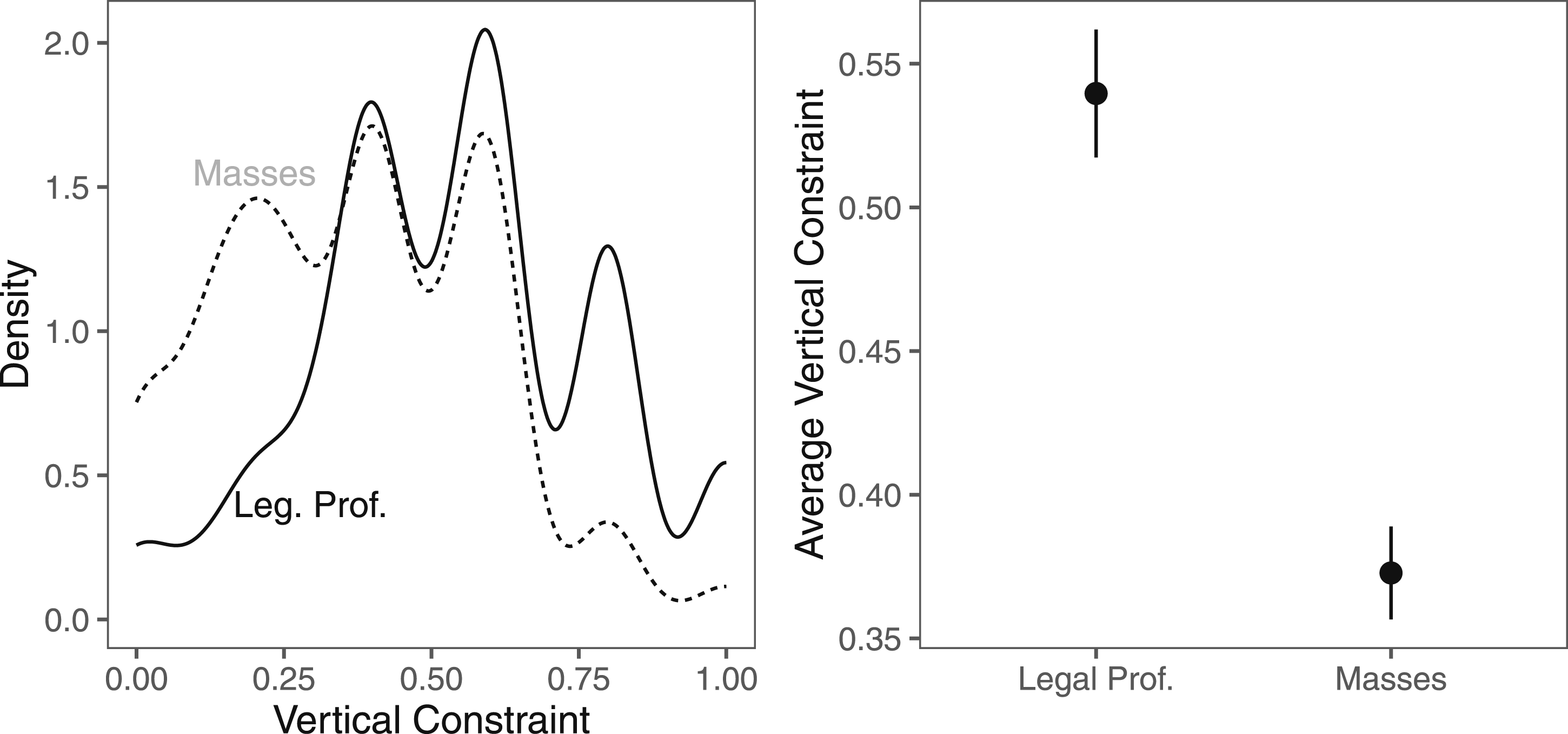
Vertical Constraint With Ideological Baseline
The results above suggest that legal professionals possess greater levels of constraint than the masses. However, it may simply be the case that these professionals can utilize their training to structure legal and judicial attitudes, but the masses use some other, non-philosophical organizing principle to structure theirs. That is, if people ignore philosophy in favor of outcomes, then ideology might explain our results. We therefore consider judicial philosophy constraint in ideological terms, where a correct response to a case outcome is one that matches one’s ideological self-identification. For example, if a conservative selected that the Second Amendment right to bear arms should apply to all types of weapons, their response demonstrates ideological constraint but not philosophical constraint.
20
Figure 4 displays the distribution of vertical constraint for ideologically “correct” responses (left panel) and the average level of constraint (right panel). Distribution of vertical constraint using ideology to determine a “correct” response. Vertical constraint here is the proportion of “correct” attitudes on five constitutional issues.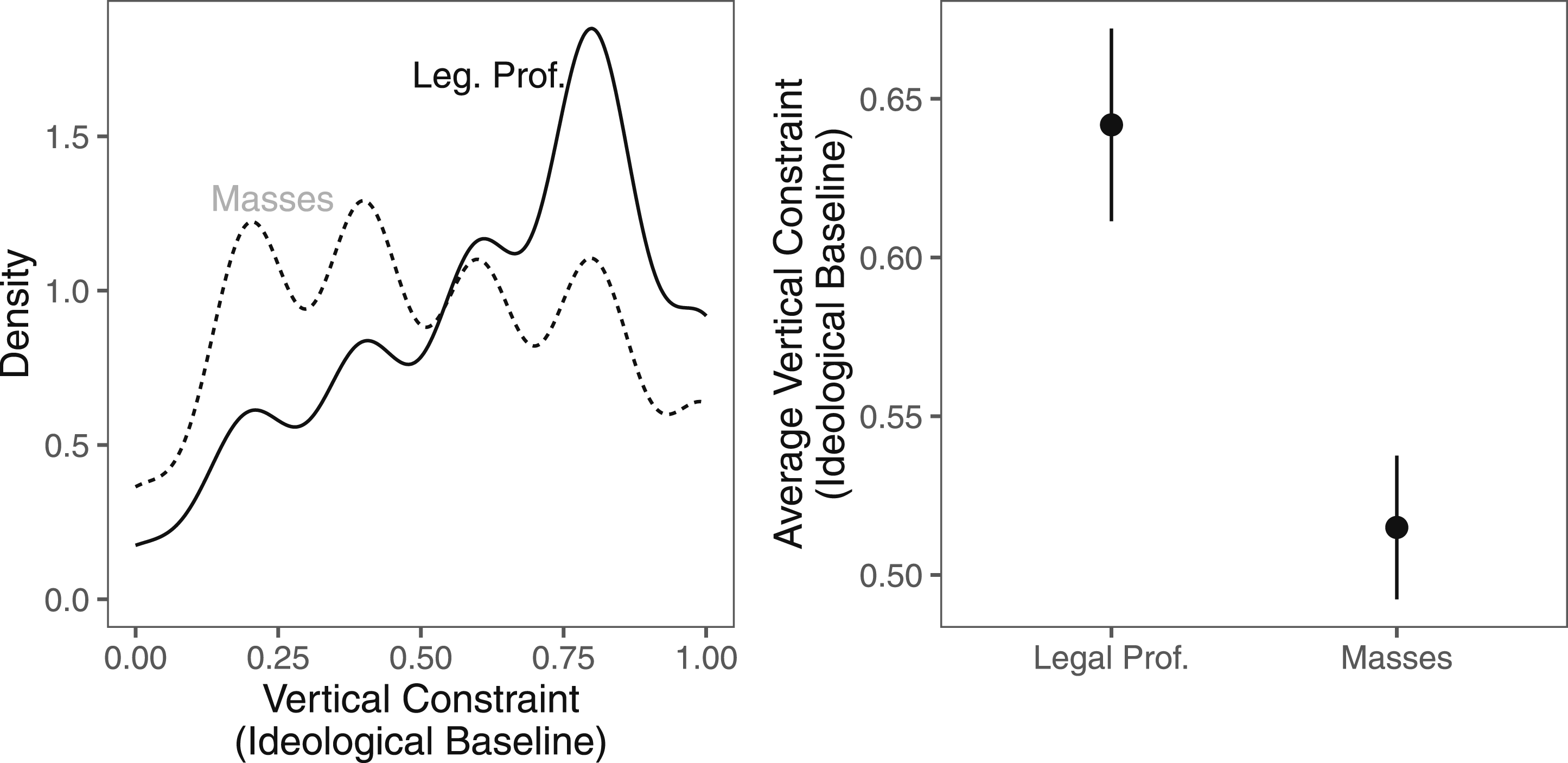
We see nearly identical—indeed, perhaps stronger—patterns here. For the masses, there is little evidence of vertical constraint even in terms of ideology, consistent with extant scholarship (Converse 1964). For legal professionals, who display about 25% more constraint, their level of vertical constraint using an ideological baseline outpaces their constraint using philosophy as a baseline. 21 Legal professionals are constrained in both realms. For the masses, the most common situation is the selection of ideologically inconsistent outcomes or “not sure” responses. Ideology does not seem to serve as an organizing principle when it comes to making legal choices.
The Role of Sophistication in Judicial Philosophy Constraint
As we have shown, many in the mass public who can identify a judicial philosophy do not appear to understand what it entails, and even more cannot apply it. Respondents often “do not understand what follows from their answers” (Greene et al. 2011, 417). In this final empirical section, we consider whether constraint in judicial philosophy is simply a function of political sophistication—that is, confined to those who likely understand the implications of their views. This could explain why many endorse a philosophy but fail to recognize which decisions follow from it (a la “symbolic” ideology; see Ellis and Stimson 2012). Political stimuli vary in ideological content, and only the most politically knowledgeable and engaged are consistently able to recognize such content (Jacoby 1995). Recognizing and adopting ideological labels is easy; consistently applying an ideological belief system is difficult, and few in the public can do so (Lupton et al. 2015). We suspect a similar pattern holds for judicial philosophy.
To examine this, we estimate ideological constraint using responses to 11 CES policy items, including preferences on health care, gun control, immigration, abortion, environmental policy, and policing. This analysis is limited to the mass sample (we assess the legal professional sample below). Note that this is a different measure of ideological constraint than presented earlier. 22 Here, we define constraint as the proportion of correct responses across the 11 policy items, consistent with extant scholarship (e.g., Lupton et al. 2017). 23
Figure 5 displays the level of vertical constraint across levels of ideological constraint. We see that the average level of judicial philosophy constraint is related to one’s level of adherence to ideological principles. In other words, those who are consistent on policy (i.e., display ideological constraint) are the most able to consistently apply a judicial philosophy. However, note that vertical constraint is not particularly high in any instance. Vertical constraint by ideological constraint. Mass sample only. Ideological constraint is measured using 11 general policy items from the CES. Dashed lines are 95% confidence intervals around estimate.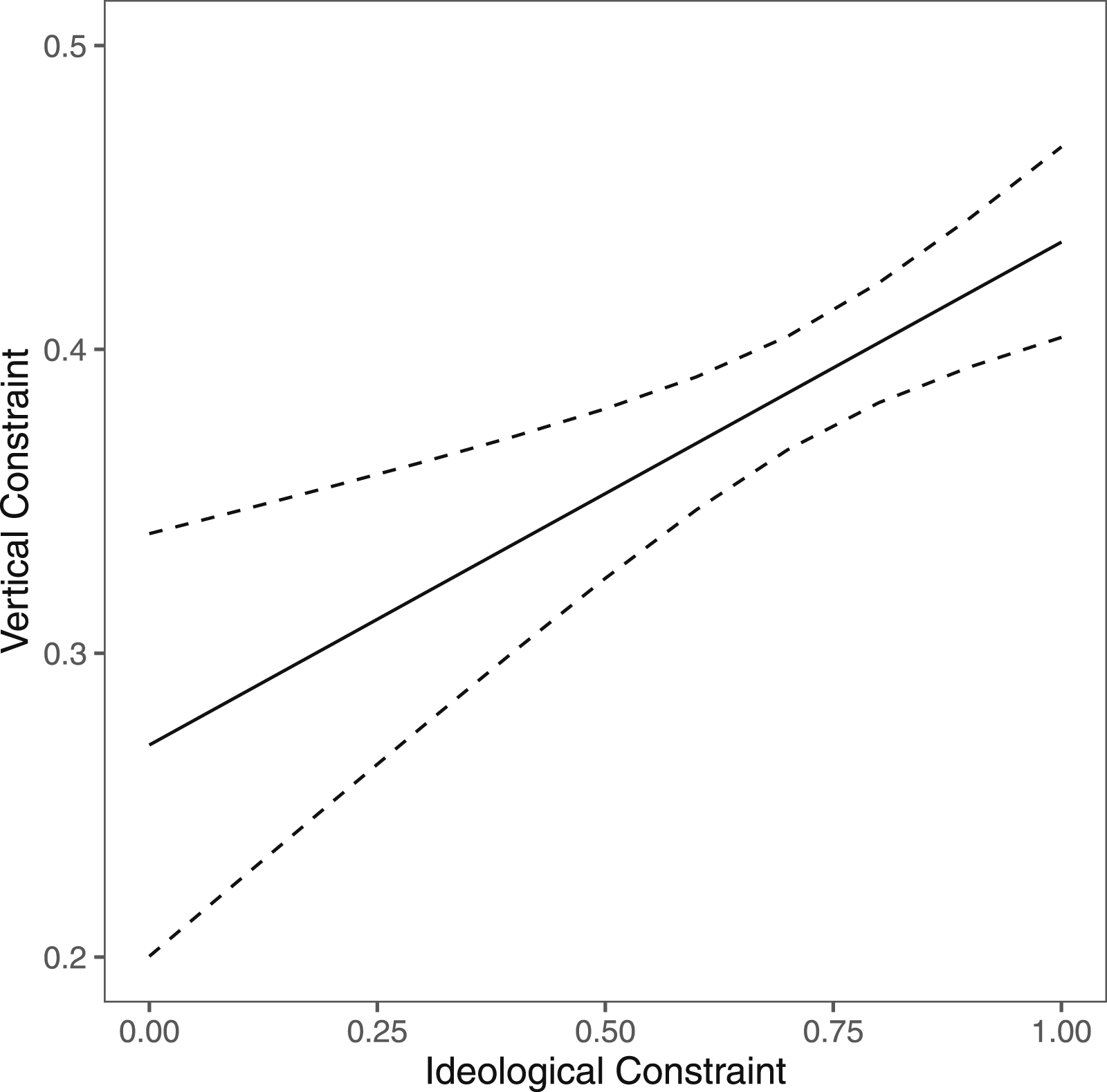
To further probe whether constraint in judicial philosophy is linked to broader political sophistication, we re-examine the “not sure” responses to the three items measuring support for a philosophy (i.e., those detailed in Table 2). If sophistication unrelated to the judiciary predicts whether one registered a preference on the philosophy, fixed/changing meaning, and appropriate interpretation items, we would find support for our contention that sophistication might explain variability in philosophy. To measure political sophistication, we follow advice of Luskin (1987) and utilize multiple measures. Specifically, we extract the first principal component from a principal component analysis (PCA) of three indicators: education, the ability to identify the party in control of the House of Representatives, and ideological constraint. 24 We then estimate separate logistic regression models predicting “not sure” responses using sophistication as a key predictor, along with controls for partisanship, self-reported ideology, sex, and race. (See the supplemental materials for detailed measurement procedures and full model results.)
In Figure 6, we display the predicted probability of a “not sure” response across the range of our measure of sophistication. First, note that the coefficient for sophistication is negative and statistically significant (at the p ≤ .05 level) in all three models. That is, the combination of ideological constraint, political knowledge, and education all decrease the probability that an individual responds “not sure” to each of the three philosophy items. To even register an opinion on questions of philosophy is a function of political sophistication that is, theoretically, orthogonal to judicial philosophy. Model-based predicted probability of “not sure” response on philosophy, interpret, and meaning items, by sophistication. Sophistication is the first principal component following a PCA of knowledge, education, and ideological constraint.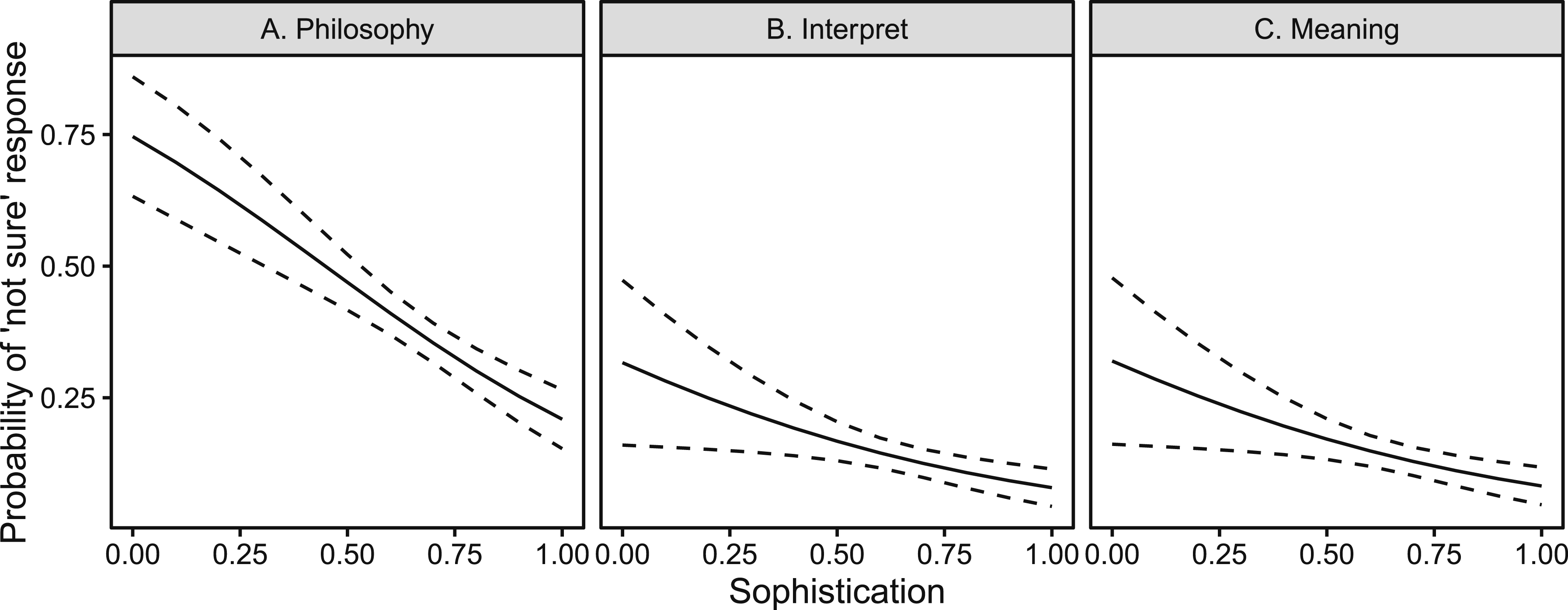
Because of space constraints on our Prolific survey, we were unable to measure the political sophistication and knowledge of the legal professionals sample. However, we still believe it is important to consider how the mass sample compares to legal professionals. To that end, we examine the level of vertical constraint across levels of education. We treat the education variable as categorical, meaning we do not place a priori expectations on who may exhibit greater constraint among those with similar educational attainment the way an ordered variable would. Attorneys, for example, have less educational attainment than medical doctors or those who hold a doctorate; we still expect attorneys to be more philosophically constrained. Similarly, paralegals have less formal education than one who holds a Master’s degree; we expect paralegals to be more constrained.
This is precisely what we find in Figure 7, which shows predicted constraint following an ordinary least squares regression onto a host of theoretically relevant control variables (see the appendix for full results).
25
As expected, those in the legal profession demonstrate greater vertical constraint than even those who may possess more educational attainment than most attorneys (e.g., those who hold a PhD or an MD). This is commensurate with the idea that operating in the legal profession provides some sort of constraining force on constitutional thought. Of course, this suggests that such thought is much more difficult for those who lack that training, even those who are highly skilled in other fields. More pointedly, these results suggest that legal philosophy—as a constraining set of abstract principles—is the stuff of legal professionals. When individuals engage in this philosophical talk or employ this philosophy, it is perhaps more symbolic in nature. Mean vertical constraint by educational attainment, both samples. The paralegal/assistants and lawyer + categories are from Prolific sample only. “Other” category from Prolific sample omitted. Vertical lines are 95% confidence intervals around means.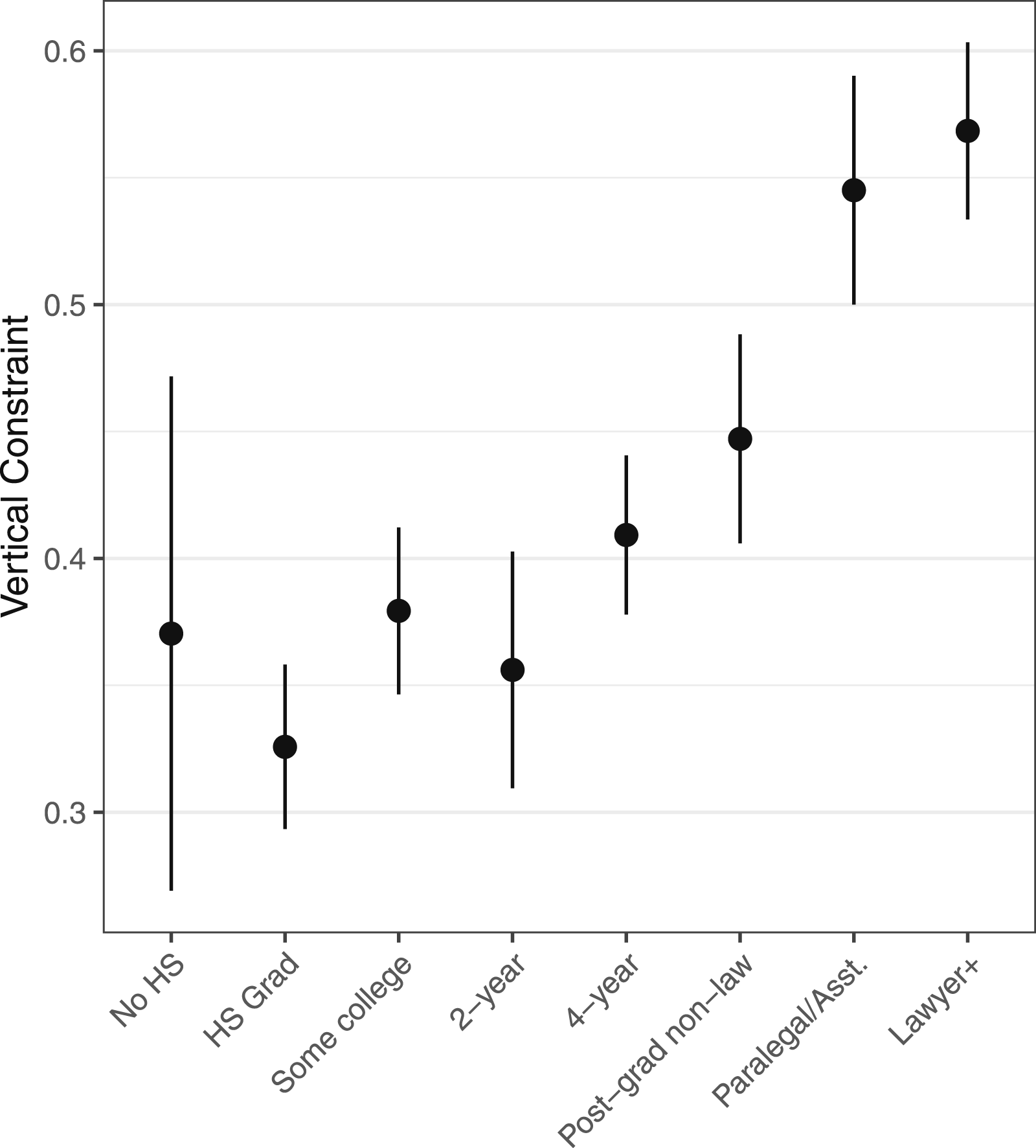
Finally, we consider the role ideological strength plays for masses and legal professionals. Again, we were unable to record ideological constraint for the legal professionals sample using the CES items. Figure 8 shows predicted levels of vertical constraint across levels of self-identified ideological strength, which simply folds the traditional 7-point ideology scale. These model-based estimates are derived from the same OLS regression mentioned above. Greater ideological strength leads to greater constraint for both samples, but legal professionals across all levels are consistently more constrained than the mass sample. This indicates two things. First, legal professionals—once again—outpace the masses in constraint, even when utilizing non-legal and non-philosophical considerations. Second, legal professionals are not constrained exclusively by legal philosophy. Indeed, given the close relationship between ideology and judicial philosophy (at least at the elite level, such as among judges), it is sensible that both serve as capping abstractions for those able to employ them consistently and coherently. Predicted vertical constraint by level of ideological strength, across samples. Horizontal lines are 95% confidence intervals around estimates.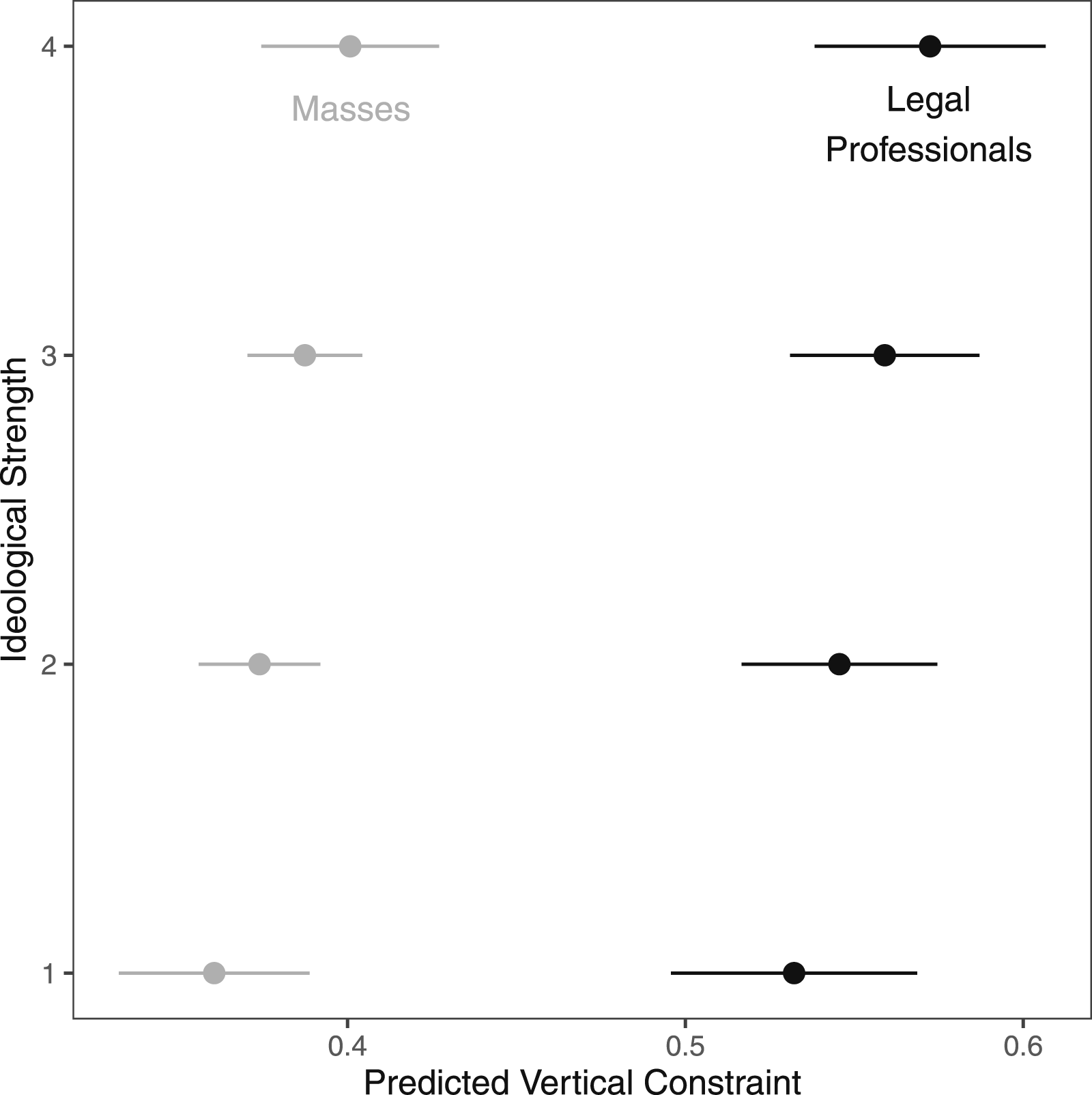
We are left with the question of whether judicial philosophy offers any organizing principles to the mass public when considering judicial outcomes. We are of two minds. On the one hand, it is plausible that the most sophisticated individuals are able to employ both ideological constraint and judicial philosophy constraint. The belief system they bring to bear is domain-specific. Yet, on the other hand, our understanding of the etiology and formation of mass opinion (e.g., Zaller and Feldman 1992) suggests that judicial philosophy constraint may simply be part and parcel of broader sophistication. Given our findings regarding those in the legal profession, there is some evidence in favor of both propositions. Both commitment to an ideology and legal professionalism lend themselves to constraint. In all, we believe judicial philosophy offers organizing principles to only a limited number of Americans.
Conclusion
When judges explain what judges do, they often turn to their preferred philosophy (Breyer and Scalia 2008). When Senators question potential judges, they often ask about their preferred philosophy (Glennon and Strother 2019). When front-page news stories from the New York Times cover oral arguments and decisions, they appear to always give attention to the legal principles and philosophies underlying a decision (Rivero and Stone 2023). The public seems to pay attention. Indeed, only a judge’s ideology and legal qualifications are rated as more important to the public than philosophy. Philosophy is as important to the public as the judge’s partisanship, and it matters more than personality, religion, age, race, or sex (Krewson Christopher and Owens, 2022).
With evidence of elite attention to and public prioritization of a judge’s judicial philosophy, it would be easy to infer that people have well-developed understandings of judicial philosophy and apply them consistently in scenarios. Many scholars present evidence to this effect (Greene et al., 2011; Krewson Christopher and Owens, 2022; Rivero and Stone, 2023). Our findings suggest, however, that preferences regarding judicial philosophy lack the coherence and constraint required to consistently guide their attitudes in a principled manner. Many individuals do not state a preferred philosophy (when able to respond “not sure”), though we find some evidence of consistency in understandings of judicial philosophy for those who do state a view. Yet, when we compare the mass public to the legal professionals baseline, we find that the masses fare poorly. Even if the masses understand the philosophy they support, we find little evidence that people apply their self-reported judicial philosophy preferences in a consistent or coherent manner across issues.
This is significant given the prominence of judicial philosophy in public debates regarding the judiciary. While scholarship establishes that judicial philosophy is at the top of people’s minds when thinking about judges, our findings demonstrate that the public’s preferences regarding judicial philosophy are also incoherent. In the end, public preferences regarding judicial philosophy may be more symbolic than substantial. This means that elites can win public support through invoking these concepts. The president and members of Congress can grow support for nominees (Krewson Christopher and Owens, 2022; Krewson and Owens, 2021), and even judges can grow decision acceptance by describing their decisions in philosophical terms (Rivero and Stone 2023). Yet, our findings show that beyond simple labels, the public cannot validate if what these elites claim is true. This makes it incredibly difficult for the public to hold elites accountable if they use these concepts selectively to promote their agendas, and such accountability is essential for our democratic system of government (canonically, see Tocqueville 1900).
Future researchers should consider how the public’s lack of constraint and true understanding of complex concepts extend to other legal and non-legal attitudes, and how they may influence views of the judiciary, other political institutions, and the political world writ large. Our Framer’s designed federal judges to be isolated and independent from the will of the majority. That is, they are already protected from many traditional mechanisms of democratic accountability. And, the public’s lack of understanding only exacerbates this gap. In addition to our findings, other work demonstrates that many are unable to articulate constitutional rights (Armaly and Enders 2024), despite the fact that our political system relies on “rights talk” (Glendon 1991). This is particularly troublesome when taken in light of Tocqueville’s (1900) warning of the “omnipotence of majority”—support for a particular philosophy or understanding of the Constitution without understanding. Finally, given Americans’ veneration for the United States Constitution (Brown and Pope 2019; McCloskey 2010), evidence that preferences over constitutional interpretation vary by the age of the document being interpreted and other institutional features (Brown and Krewson 2024), and the heavy application of studies of judicial philosophy to the American context (Greene et al., 2011; Krewson Christopher and Owens, 2022; Krewson and Owens, 2021; Rivero and Stone, 2023), it would be fruitful to consider how preferences over legal philosophy and associated levels of constraint might generalize to other countries and contexts.
Supplemental Material
Supplemental Material - Do Americans Understand the Judicial Philosophies They Endorse? Evidence From Mass and Elite Surveys
Supplemental Material for Do Americans Understand the Judicial Philosophies They Endorse? Evidence From Mass and Elite Surveys by Miles T. Armaly, Christopher N. Krewson, Elizabeth A. Lane in Political Research Quarterly.
Footnotes
Author’s Note
Previously presented at the 2023 Annual Meeting of the Midwest Political Science Association, Chicago, IL. We thank Joe Ura for his thoughtful discussant comments.

Funding
The authors received no financial support for the research, authorship, and/or publication of this article.
Declaration of Conflicting Interests
The authors declared no potential conflicts of interest with respect to the research, authorship, and/or publication of this article.
Supplemental Material
Supplemental material for this article is available online.
Notes
References
Supplementary Material
Please find the following supplemental material available below.
For Open Access articles published under a Creative Commons License, all supplemental material carries the same license as the article it is associated with.
For non-Open Access articles published, all supplemental material carries a non-exclusive license, and permission requests for re-use of supplemental material or any part of supplemental material shall be sent directly to the copyright owner as specified in the copyright notice associated with the article.
