






Abstract
In recent years, scholars have grown increasingly attentive to the uneven impacts that individual legislators exert on policy outcomes. These differences may reflect both lawmakers’ intrinsic abilities and the institutional levers at their disposal (e.g., chamber or party positions). Yet disentangling these forces empirically is challenging. We isolate the effects of legislative ability by focusing on members of the Appropriations Committee and its subcommittees. We develop and test hypotheses on how the abilities of subcommittee chairs and other members affect discretionary spending decisions within their jurisdictions. Our findings indicate that higher-ability subcommittee chairs drive larger deviations from the President’s budget, and that minority-party ranking members likewise shape spending outcomes in meaningful ways. By contrast, the abilities of rank-and-file members—whether in the majority or minority party—do not appear to condition budgetary outcomes. Hence, abilities matter, but only in conducive contexts. The results illustrate how ability and position jointly constrain presidential control over policy outcomes.
Introduction
Understanding policymaking and the role of the legislature requires identifying when and which legislators influence institutional outcomes. Addressing this challenge involves answering three key questions: (1) Which institutional positions confer the greatest influence? (2) Among legislators occupying comparable positions, who has the most significant impact? and (3) Are observed differences in influence better explained by variations in legislators’ individual “inputs” or by differences in where they sit within the legislature (e.g., formal positions within the chamber or important party posts)?
The first question has been examined extensively. For our analysis’ focus, the U.S. Congress, an abundant literature establishes that multiple institutional factors, such as majority party status, high-value committee assignments, and top committee positions significantly shape the relative impacts of members of Congress (MCs) (Anderson et al. 2003; Berry and Fowler 2018; Cox and Terry 2008; Volden and Wiseman 2014).
The second and third questions remain less settled. That members vary in abilities is widely acknowledged. Per the former, Volden and Wiseman (2014) find that more than one-third of the differences in MCs’ legislative effectiveness—using their Legislative Effectiveness Scores (LES)—are not explained by institutional factors distinguishing one member from another. Some MCs appear to have higher innate legislative abilities. For instance, Nita Lowey had high LES scores throughout her career (1989–2021), whether she was the House Appropriations chair or a minority party rank-and-file member. In related fashion, MCs can be classified by their legislative styles. Some are policy specialists, focusing their time on particular issues and building corresponding reputations for expertise. Others concentrate on different pursuits, such as advocating district interests and party building (Bernhard and Sulkin 2018). As for the third question, Mayhew (1974) identifies three core functions: legislating, executive oversight, and expressing public opinion and serving constituents. The extent to which members succeed in these functions might be shaped by how they allocate effort. Therefore, interpreting legislative effectiveness measures warrants caution, as observed differences may reflect a combination of legislative inputs and institutional features rather than either in isolation (Guenther and Searle 2019).
Conceptually, higher-ability MCs should have both greater analytic capacities and superior soft skills (e.g., connecting with colleagues, building alliances, efficiently allocating finite time and resources, making timely adjustments under different constraints, and correctly selecting among strategic choices). All should be positively associated with influence (Battaglini et al. 2020; Battaglini and Patacchini 2019). To reiterate, previous measurement conflates effectiveness as a function of institutional position with innate ability, making isolating the independent contribution of the latter difficult.
Also, existing research on MCs’ activities centers around legislators realizing particular goals through their behaviors, such as enacting legislation consistent with their preferences or steering distributive rewards to constituencies (Alvarez and Saving 1997; Bickers and Stein 1996; Butler et al. 2023; Treul et al. 2022). That said, effective pursuit of multiple goals is not mutually exclusive, and empirical research directly linking and testing how achieving them correlate is lacking.
Our analysis focuses on isolating ability-driven legislative effectiveness. We do so by concentrating on legislators sharing a common and influential institutional role—House Appropriations subcommittee membership—and on MCs’ impacts on budgetary outcomes. More specifically, we compare legislators occupying similar institutional positions within the appropriations process, such as subcommittee chairs, ranking members, and rank-and-file appropriators. These legislators operate within a uniform procedural context and bear direct responsibility for shaping federal agency budgets. Our design therefore helps minimize broader institutional heterogeneity and enables us to better assess how variation in individual legislative ability relates to policy outcomes.
We measure influence by examining the absolute difference between the president’s proposed discretionary funding levels and the final enacted appropriations for each agency under a subcom-mittee’s jurisdiction. This metric captures the degree to which Congress alters the executive’s budget proposals, serving as a clear indicator of legislative influence. 1
As the primary institutional units charged with reviewing and revising proposed discretionary spending, Appropriations subcommittees are long recognized as the central locus of congressional budgetary decision-making (Davis and Dempster 2018; Geiger 1994; Kingdon 1966). As is well established, the president—following consultations with executive agencies (Pasachoff 2016)—submits an annual budget proposal to Congress. The relevant House Appropriations subcommittees then review. They conduct hearings, evaluate agency spending requests, and draft appropriation bills for consideration. Consequently, the composition and capabilities of these subcommittees play a critical role in shaping how much of the president’s proposal is accepted, amended or rejected.
Specifically, we examine how congressional appropriators respond to the president’s annual budget requests from FY 2006 to FY 2023 (the 109th to 117th Congresses). We calculate differences between the president’s proposed funding levels for an agency and the enacted appropriations. After matching agencies to the appropriate subcommittees, we assess how effectively subcommittee members modify executive proposals, providing a concrete measure of legislative influence through ability over federal discretionary spending.
Our expectations regarding the relationship between legislative ability and appropriations outcomes are informed by established understandings of congressional committees and the appropriations process. Subcommittee chairs are widely regarded as the pivotal actors in shaping budgetary outcomes (Fenno 1966; White 1989). They hold the formal prerogatives to organize hearings, interact with agency officials, draft bills, and cultivate coalitions—activities that demand abilities such as strategic coordination, negotiation, and policy expertise (Deering and Smith 1997). Ranking minority members, while without the chair’s formal agenda-setting authority, nonetheless exercise leadership within the subcommittee. Their influence derives less from procedural prerogatives than from their position as the principal negotiating partner for the chair and as a coordinator of the minority party’s strategy (Ballard and Curry 2021; Curry and Lee 2022). This role becomes particularly consequential when the chair and president share a party affiliation, in which case the ranking member’s legislative ability often serves as the main counterweight to executive priorities.
Beyond these leadership roles, the abilities of majority and minority rank-and-file members may also matter, albeit more indirectly, by shaping intra-subcommittee cohesion and signaling support for their respective leaders during negotiations (Crupi 2023). 2
Our results are consistent with these expectations. Legislative abilities of subcommittee leaders significantly shape appropriations outcomes, conditioned by whether there is conflict with the chief executive. When the chair and the president represent opposing parties given divided government, higher-ability chairs are associated with larger absolute deviations between the president’s proposed and enacted discretionary budgets. In such circumstances, a one-unit increase in a subcommittee chair’s LES corresponds to a 7.0% increase in the deviation from the president’s proposal. When there is unified government, the ranking member’s legislative ability emerges as the more consequential force. In contrast, the abilities of majority and minority rank-and-file members show no discernible effect on appropriations outcomes, underscoring that legislative skill matters primarily when coupled with leadership positions that confer institutional leverage.
Taken together, these findings suggest that presidential influence over the budget process is neither unilateral nor unbounded. Even within a system often characterized by expanding executive authority, effective legislators can redirect presidential priorities through institutional positions that magnify individual skill. Our evidence thus speaks to the enduring Madisonian concern over the “imperial presidency” (Howell and Moe 2023; Lowande 2018; Rudalevige 2005): congressional capacity to revise or resist executive requests depends on the abilities of key subcommittee leaders. Rather than passive recipients of presidential initiatives, members of Congress—particularly able chairs and ranking members—act as active veto players in the budget process.
Legislative Input and Discretionary Spending
We begin by outlining expectations for how Congress influences discretionary budget allocations. First, we review the appropriations process and summarize existing research on the factors shaping federal discretionary spending. We then detail how the legislative inputs of committee leaders s and rank-and-file members should affect the observed results.
Per Article I, Section 9 of the Constitution: “No money shall be drawn from the Treasury, but in Consequence of Appropriations made by Law.” Congress has the constitutional authority to appropriate federal funds. Within Congress, the House and Senate Appropriations Committees are specifically tasked with exercising this power. Although the executive branch and federal agencies interact in anticipation, the formal budget cycle begins with the President’s annual budget submission, typically delivered in February. While non-binding, this serves as the foundation for the appropriations process, setting broad spending priorities and providing explicit recommendations for agency funding (Kelsh 2016).
Upon receiving the budget proposal, the 12 Appropriations subcommittees in each chamber convene hearings to evaluate the funding needs of programs within their jurisdiction (Tollestrup and Saturno 2014). Subcommittees then propose suballocations, draft appropriations bills, and submit them to the full committee. The latter may revise these proposals before forwarding them to the chamber floor for consideration. In the House, amendments are governed by special rules. 3 After each chamber passes its respective version, differences are typically resolved in conference before final enactment.
The House Appropriations subcommittee stage has long been considered the most decisive point in the congressional budget process. As Kingdon (1966, 68) succinctly observed many years ago, “congressional decisions on agency budgets are made neither by the whole Congress, nor even by the full Appropriations Committees, but by subcommittees of the Appropriations Committee.” These subcommittees are where presidential budget requests receive their most consequential scrutiny.
As indicated, within Appropriations subcommittees, chairs play a central role as agenda setters and legislative experts. 4 Often referred to as the “cardinals” of Congress, subcommittee chairs are viewed as exerting substantial influence over spending decisions through their control of hearings, the drafting of legislation, and the markup process (Berry and Fowler 2016, 2018). More broadly, members of the Appropriations Committee—including rank-and-file legislators—have long been described as the “guardians of the purse” (Wildavsky and Caiden 2003). Holding an Appropriations subcommittee seat signals a member’s policy priorities and creates credit-claiming opportunities through influence over budget allocations (Guenther and Searle 2019).
Indeed, research on distributive politics has consistently shown that both chairs and committee members secure more targeted district benefits and earmarks than non-committee members (Berry and Fowler 2016; Ferejohn 1974; Lazarus 2010). 5 Although debated back and forth over the years, a widely cited view of the institutional importance of committee position was neatly put by Weingast and Marshall (1988, 145): “First, committees are composed of ‘high demanders,’ that is, individuals with greater than average interest in the committee’s policy jurisdiction. Second, the committee assignment mechanism operates as a bidding mechanism that assigns individuals to those committees they value most highly. Third, committee members gain a disproportionate share of the benefits from their policy area.”
Furthermore, studies show that successfully directing distributive benefits to one’s district is associated with higher reelection rates and reduced electoral competition (Alvarez and Saving 1997; Bickers and Stein 1996; Mayhew 1974). In most instances, those on Appropriations subcommittees are viewed as outliers in this respect, suggesting that members can self-select into subcommittees that align closely with their policy interests and constituent needs (Wrighton and Peterson 2003). However, this is not equivalent to high demanders just getting what they want. Rather, assessing influence through the Appropriations Committee is complicated by total discretionary spending typically being capped. Demands will outstrip the ability to appropriate. Also, divergences in budgetary preferences between the President and Congress—such as when a Republican-led Congress faces a Democratic President—can lead to systematic deviations in enacted appropriations from executive proposals. Hence, instead of focusing on budget increases alone, we emphasize the absolute deviation between the President’s proposed budget and the final enactment. These deviations, whether increases or cuts, reflect Congress’s ability to amend, resist, or reframe executive spending proposals. 6
Concentrating absolute differences rather than, for example, intersubcommittee shares of appropriated funds, is especially justified given the skewed and path-dependent distributions of discretionary spending. Some categories, such as defense, are consistently large portions of the budget, while others—like agriculture—remain persistently modest components. Comparisons between subcommittee shares could obscure variations in influence. By contrast, large deviations from presidential requests provide a direct and meaningful indicator of congressional influence in the appropriations process.
Given this framework, we expect deviations from presidential budget proposals to vary systematically with legislator characteristics. We focus on varying legislator abilities; as mentioned, we will not concentrate on ideological divergence between legislators and the president as it has been recently explored (Cha and Rogowski 2025). 7 Many legislator inputs associated with successful policy entrepreneurship may also enhance members’ capacities to shape appropriations.
Hypotheses–Ability and Budgetary Outcomes
We now turn to hypotheses about how member ability shapes subcommittee deviations from the president’s proposed appropriations. We focus on four types of actors within subcommittees: (1) chairs, (2) ranking members, (3) majority-party rank-and-file members, and (4) minority-party rank-and-file members.
As indicated, no representative is likely better positioned for influence than the subcommittee chair. Chairs are widely recognized as the most influential figures within appropriations subcommittees, particularly in shaping discretionary spending decisions. 8 A chair’s formal authority stems from control over markup drafting, the timing of bill release, and management of subcommittee staff and agendas (White 1989). These institutional tools position the chair as the key agent in determining the subcommittee’s response to presidential budget proposals.
Chairs may also be influential due to their individual legislative abilities. More capable chairs are better equipped to navigate procedural constraints, manage intra-committee divisions, and forge cross-party coalitions necessary to move spending bills forward (Berry and Fowler 2018; Wiseman and Volden 2021). These skills are especially critical for appropriations, where members often hold competing partisan and constituency priorities yet must produce a unified subcommittee product (Deering and Smith 1997). Legislative ability should facilitate chairs translating diverse policy preferences into actionable budgetary provisions that attract majority support. Consequently, we expect that a higher legislative ability is associated with greater deviations from the president’s proposed budget. However, such influences should be conditional. Consistent with research highlighting presidential success in appropriations depending heavily on the broader political context, particularly whether government is unified or divided (Cha and Rogowski 2025), ability’s effect should be conditional on partisan alignment. When the chair and president are co-partisans their budgetary goals likely converge, limiting opportunities for the chair to reshape presidential requests. Alternatively, under divided government skilled chairs can leverage procedural expertise and committee networks to resist executive priorities and advance alternative funding agendas.
A subcommittee chair’s legislative ability increases budgetary deviation, particularly under divided government.
An analogous logic suggests that the legislative abilities of ranking minority-party leaders may conditionally influence outcomes. In recent decades, such Appropriations subcommittee leaders have routinely advanced alternative budget proposals, trying to ensure that their preferences remain part of the negotiating agenda. Committee activity reports document this pattern across multiple Congresses. Suballocation votes often divide along party lines, and minority members sometimes produce separate lists of discretionary funding targets. 9 By institutionalizing a competing fiscal blueprint, minority appropriators both signal policy competence and reinforce the deliberative legitimacy of the appropriations process (Crupi 2023). When the minority acts cohesively under deadline pressure, this internal coordination enhances its bargaining power (Ballard and Curry 2021). In response, House majorities may strategically accommodate minority preferences because strictly partisan legislation often faces substantial Senate obstacles (Ryan 2020). Such cohesion enables minority leaders to frame concessions as pragmatic adjustments necessary for timely passage rather than as political defeats.
Whether government is unified or divided should again matter, with the ranking members being especially important under unified government. Even in periods of unified government, cross-party coalitions remain essential to the policymaking process (Curry and Lee 2019, 2020). Majorities often depend on minority participation to sustain deliberative legitimacy, navigate intra-party divisions, and advance complex or contentious legislation. Despite unified government, government, majority leaders may accommodate minority demands on program funding levels and policy riders. Appropriations outcomes may thus reflect not only partisan control but also the organizational capacity and legislative acumen of minority leaders who, leveraging limited procedural tools, extract tangible policy gains within a formally majoritarian institution. Skilled, expert, and institutionally experienced minority leaders may exhibit disproportionate influence in shaping appropriations outcomes.
A subcommittee ranking minority member’s legislative ability increases budgetary deviation, particularly under unified government.
Although rank-and-file members should wield less influence than chairs or ranking members they should not be dismissed either (Savage 1991). 10 As Curry and Lee (2022) show, members can employ amendment activity, provide expertise, and push constituent interests in shaping or constraining leadership-driven outcomes. Similarly, long ago Fenno (1966) characterized committee power as “shared power,” with even junior members influencing results through active participation. Rank-and-file legislators may also exert influence indirectly by signaling coalition strength, thereby placing pressure on leaders to adjust subcommittee allocations. 11
Building on these insights, we emphasize distinguishing between majority- and minority-party rank-and-file members. Influence should not be purely individual but collective as well, as appropriations bargaining depends heavily on coordinated support and coalition maintenance among members within each party on the subcommittee (Ballard and Curry 2021). Specifically, majority-party members may amplify the chair’s initiatives by providing coordinated support during markups, suballocation votes, and negotiations, thereby strengthening the subcommittee’s bargaining position. Minority-party members, in turn, may bolster the ranking member’s position by enhancing the credibility, cohesion, and visibility of alternative proposals advanced in committee deliberations and subsequent negotiations. In both cases, the influence of rank-and-file legislators should stem less from direct procedural authority than from their capacity to signal unity, provide substantive expertise, and lend legitimacy to leadership strategies. These complementary mechanisms yield clear expectations about how legislative ability within the majority and minority ranks may shape budgetary deviations from presidential requests.
Legislative ability among majority-party rank-and-file members strengthens the chair’s influence on appropriations outcomes, especially under divided government.
Minority rank-and-file members’ legislative ability enhances the ranking member’s leverage, increasing budgetary deviation under unified government.
Data and Descriptive Statistics
Our primary outcome variable is Adjusted Monetary Difference, the logged absolute difference between the president’s proposed discretionary budget and the enacted appropriation for the same agency, measured in January 2025 dollars. This captures the extent to which Congress alters the president’s request during the appropriations process. We follow past efforts in measuring this variable (Cha and Rogowski 2025; Howell et al. 2013) by calculating this outcome as:

Detailed account-level information for proposed and enacted discretionary funding are from the Appendix: Budget of the United States Government. Presidential budget requests and enacted appropriations are drawn from the Appendix for fiscal years t and t + 2, respectively. Agencies in our dataset may be measured with one or more budget accounts. For example, the FY 2023 request for the Agricultural Research Service, a subunit of the Department of Agriculture, includes three separate accounts: Salaries and Expenses, Buildings and Facilities, and Miscellaneous Contributed Funds, totaling $2,058 million ($2,013 + $45 + $0). The enacted amount for FY 2023, as reported in the FY 2025 Appendix, is also $2,058 million ($1,926 + $132 + $0), indicating no deviation for that year. 12
To ensure meaningful comparisons, we restrict the sample to agencies with relatively stable subunit structures over time. Specifically, we include agency-year observations when the ratio of the number of discretionary accounts listed in the enacted appropriations (fiscal year t + 2) to the number of accounts in the president’s proposed budget (fiscal year t) falls between 0.5 and 2. This captures moderate structural adjustments while excluding cases likely affected by major reorganizations, mergers, or reclassifications. For instance, an agency with 3 accounts listed in the FY 2023 budget request is retained only if the number of accounts reported in the FY 2025 enacted appropriations falls between 2 (i.e., 0.5 × 3, rounded up) and 6 (i.e., 2 × 3). The Agricultural Research Service, with 3 accounts in both FY 2023 and FY 2025, meets this inclusion criterion. Applying this filter, we retain 248 unique agencies and 3,423 agency-year observations. 13
For our key independent variable of interest, member legislative effectiveness, we rely on the Volden and Wiseman (2014) LES measure. The LES scores a member’s success in advancing bills relative to other members in the same Congress across five stages of the lawmaking process: (1) bills introduced, (2) bills receiving action in committee, (3) bills receiving action beyond committee, (4) bills passing the House, and (5) bills becoming law. Each stage contributes equally to the overall score.
The LES is particularly well-suited for our focus on ability given that our sample is restricted to MCs sharing similar institutional roles. By holding formal characteristics relatively constant, variation in legislative effectiveness is more likely to reflect individual-level components of ability rather than structural advantages. Later, we examine the robustness of results by substituting LES Benchmark (Treul et al. 2022)—which estimates a member’s legislative effectiveness based on institutional characteristics such as seniority, majority status, and committee leadership—and Adjusted LES, measuring deviations from this benchmark. While raw LES scores are designed to capture realized legislative output, LES Benchmark is intended to capture effectiveness expected from a member’s institutional position. Because institutional status is more visible than realized productivity, political actors engaged in interbranch bargaining may rely more heavily on institutional features than actual effectiveness when assessing a member’s influence. 14
We match LES data with subcommittee assignments. We use the dataset compiled by Stewart (2021) on House standing committee memberships to identify those serving on the House Appropriations Committee in each Congress. We link these MCs to their subcommittee assignments with the House Appropriations Committee Annual Report, specifically its Appendix C: Subcommittee Membership and Jurisdiction, and distinguish those who were subcommittee chairs. We then generate several variables of interest from the LES data: (1) the LES of the subcommittee chair, (2) the LES of the subcommittee ranking member, (3) the median LES among majority-party subcommittee members, and (4) the median LES among minority-party subcommittee members. 15 These measures allow us to capture legislative abilities at both the individual and collective levels within each subcommittee. The subcommittee chairs tend to have substantially higher LES scores than the chamber median (the median LES in our sample being 0.244, the mean 0.335). In our dataset, the average subcommittee chair LES is 1.84—placing them within the top 15% of all House members (the 85th percentile threshold is 1.815). Among subcommittee chairs in our sample, Nita Lowey (D-NY), who chaired the Subcommittee on State, Foreign Operations, and Related Programs, scored the highest (10.3 in the 117th Congress). Not all chairs score highly: Robert Aderholt (R-AL), scored the lowest, just 0.16 as chair of the Subcommittee on Agriculture, Rural Development, and Food and Drug Administration in the 115th Congress. 16
Given we are studying elements of agency budgets, we match federal agencies with their appropriations subcommittees using the Subcommittee Membership and Jurisdiction Appendix, which outlines each subcommittee’s formal jurisdiction. For example, in the 117th Congress, the Subcommittee on Agriculture, Rural Development, Food and Drug Administration, and Related Agencies (hereafter, the Agriculture Subcommittee) had jurisdiction over the Department of Agriculture (excluding the Forest Service), the Farm Credit Administration, the Food and Drug Administration, and several related agencies. Thus, for example, for the 117th we assign the Agricultural Research Service to the Agriculture Subcommittee and link it to the legislative effectiveness of subcommittee chair Sanford Bishop (D-GA), as well as the subcommittee’s ranking member and majority and minority memberships.
We follow the literature by including controls related to subcommittee leadership, macroeconomic conditions, and agency characteristics. For both subcommittee chairs and ranking members, we include ideological distance to the president, using first-dimension DW-NOMINATE scores (Lewis et al. 2025), 17 and prior electoral vote share (Cha et al. 2021). We also control for GDP growth rate, unemployment rate (U.S. Bureau of Labor Statistics 2025), and a crisis indicator capturing the 2008 financial crisis and the COVID-19 pandemic. Finally, we include agency-level controls for structural budget changes and baseline proposal size, including Program Deviation, which captures changes in the number of budget accounts under an agency, and the logged Proposed Budget Amount, since larger proposals tend to generate greater absolute deviations. Subcommittee fixed effects absorb time-invariant characteristics by Congress, such as gender and race. Appendix Table B.3 reports variable definitions, summary statistics, and data sources.
Descriptive Statistics
Figure 1 presents total proposed and enacted discretionary budget authorities over time in constant 2025 dollars. Proposed and enacted amounts generally track closely, though enacted spending tends to exceed presidential requests. Largest deviations occur during national crises, particularly the financial crisis (FY 2008–FY 2010) and the COVID-19 pandemic (FY 2020–FY 2021), when emergency legislation substantially expanded enacted appropriations beyond initial proposals.
18
In less tumultuous times, such differences were relatively modest, suggesting that presidential requests often serve as a baseline for congressional appropriations. For instance, in FY 2012 and FY 2014, the differences between the proposed and enacted discretionary budgets were less than 3 billion dollars in each year, representing a less than 1.5% deviation. Of course, these aggregate differences, as they are totals, can reflect much more substantial changes in individual appropriations. Discretionary spending trends: fiscal years 2008–2023. Note: Solid line represents discretionary spending change requested by the president; dashed line shows the enacted discretionary spending.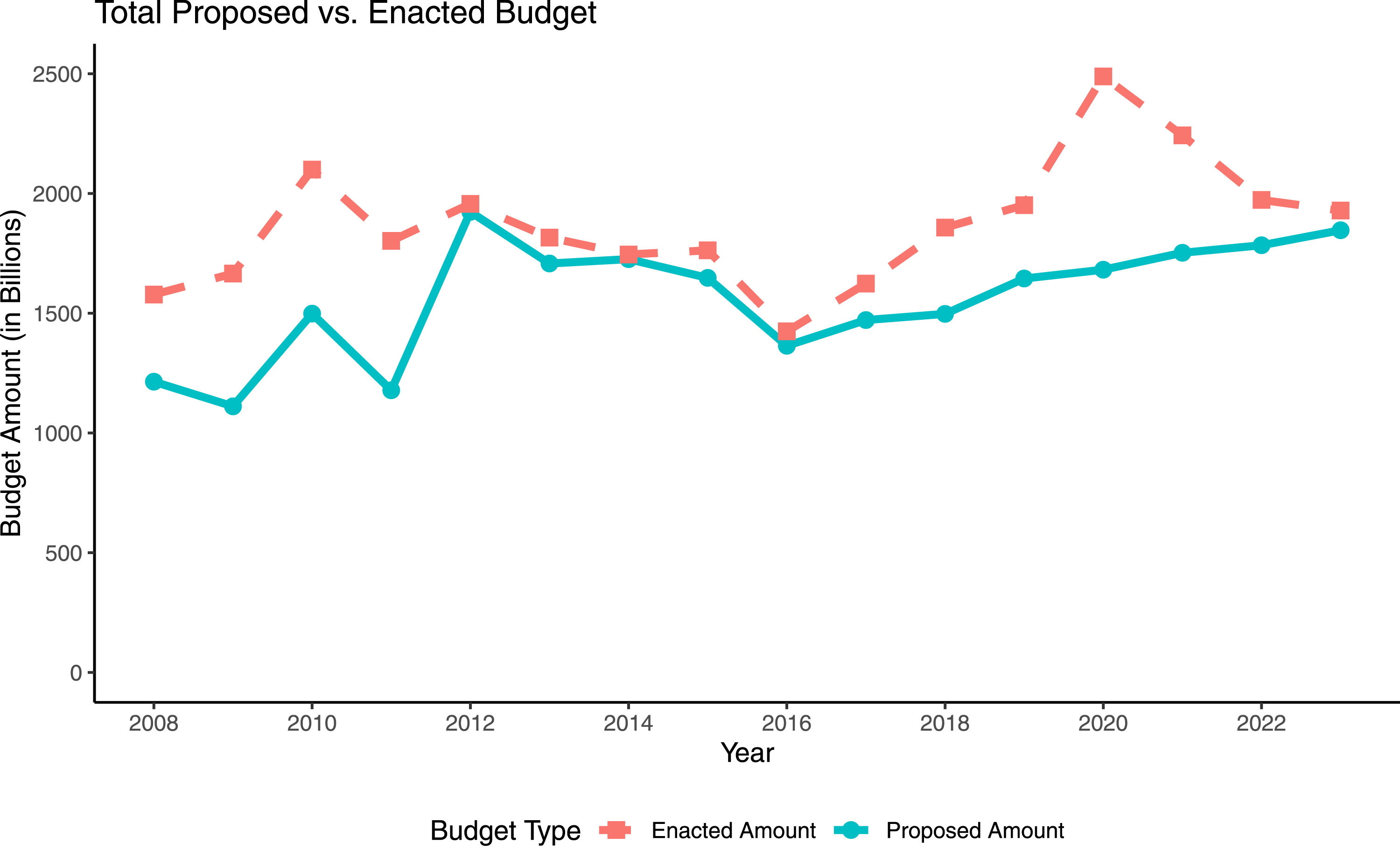
Moving from the aggregate to the subcommittee level, Figure B.2 shows that most subcommittees exhibit relatively stable spending patterns over time. Two notable exceptions stand out. First, the Labor, Health and Human Services, and Education subcommittee experienced a dramatic spike in both proposed and enacted spending in 2020, coinciding with the federal government’s expansive response to the COVID-19 pandemic. Second, the Energy subcommittee saw a sharp increase in 2009, seemingly tied to stimulus spending following the global financial crisis that was focused on simultaneously jumpstarting an energy transition. These deviations illustrate that major national emergencies can drive abrupt and substantial discretionary appropriation shifts within specific policy domains.
As a preliminary step, Figure 2 depicts the bivariate relationships between legislative effectiveness and the adjusted monetary difference between proposed and enacted appropriations, with separate lines distinguishing divided from unified government. These visual patterns also illustrate the distribution of legislative effectiveness across subcommittee roles. Not surprisingly, subcommittee chairs tend to have the highest effectiveness scores (ranging roughly from 0 to 10), ranking members and majority medians occupy an intermediate range (about 0–2), and minority medians cluster at the lower end (about 0–0.75). Bivariate relationships of LES and Adjusted Monetary Difference. Note. Each panel plots the relationship between legislative effectiveness and the adjusted monetary difference, with separate fits for divided and unified government. Each line is based on 20 bins per government type. Divided government is shown with square markers and dashed lines; unified government with round markers and solid lines. Shaded areas represent 95% confidence intervals. Some lines end before the full range of the x-axis because no observations exist in our sample at those higher LES values, reflecting the differing distributions across subcommittee roles.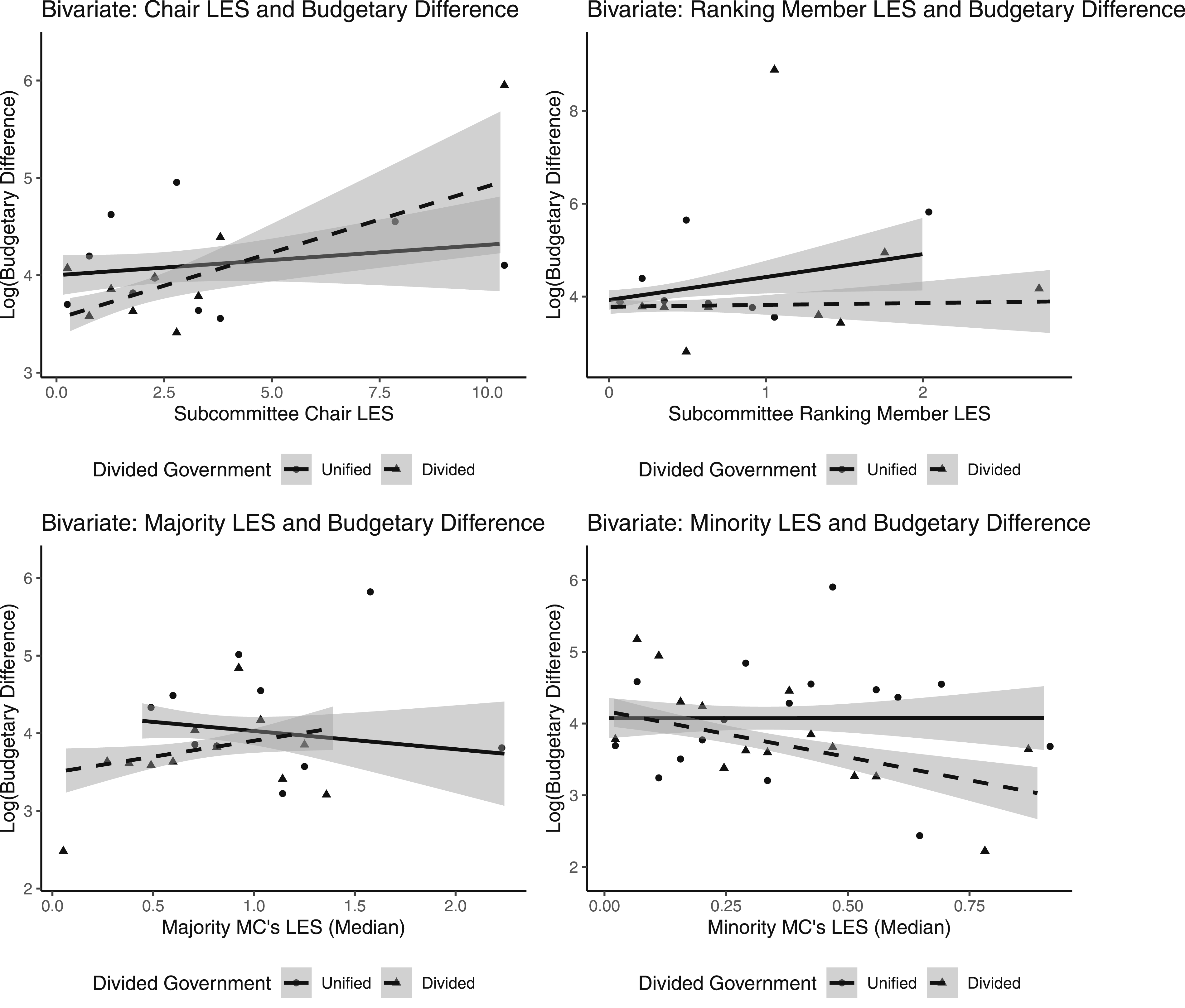
Turning to the substantive patterns in Figure 2, the upper-left panel reveals a clear positive association between the Subcommittee Chair LES and the Adjusted Budgetary Difference. This relationship is pronounced under divided government and not discernible under unified government—lending support to Hypothesis 1. The upper-right panel, in turn, indicates that the Ranking Member LES is weakly and positively associated with budgetary difference under unified government, but not under divided government, consistent with Hypothesis 2. For the remaining panels, the Majority Party Median LES displays a modest positive pattern under divided government but little evidence of association under unified control, providing support for Hypothesis 3. By contrast, the Minority Party Median LES exhibits a weak negative relationship only under divided government, a pattern not in line with Hypothesis 4. These descriptive relationships provide preliminary intuition but require formal testing through our multivariate model, to which we now turn.
Model Results
We estimate models separately for divided and unified government given our expectations stemming from bargaining dynamics differing across these contexts: under divided government, conflict with the president makes the subcommittee chair’s influence most relevant, whereas under unified government the ranking member’s prominence should heighten.
19
As noted earlier, our outcome variable, Adjusted Monetary Difference, captures the logged gap between the president’s request and enacted appropriations for subagency i in fiscal year t, expressed in January 2025 dollars. The key explanatory variables are the contemporaneous LES scores of the subcommittee chair and ranking member, which capture members’ success in advancing sponsored bills within the same Congress. The contemporaneous specification aligns legislative capacity with the institutional conditions of the current Congress.
20
Our model also accounts for other determinants of budgetary outcomes, including seniority, electoral security, baseline program size, macroeconomic context, crisis conditions, and ideological divergence within the party (Cha and Rogowski 2025).
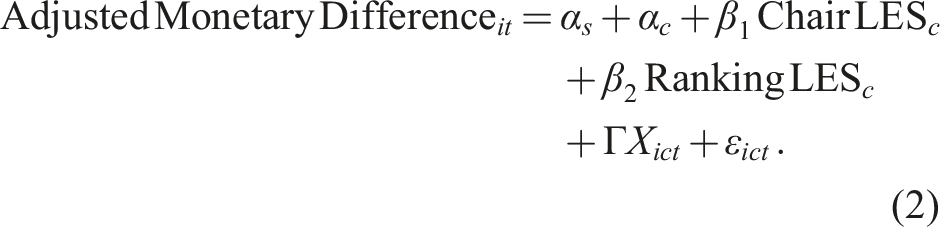
Congress fixed effects (α c ) absorb time-varying legislative conditions, such as polarization, chamber control, and broader leadership dynamics, and subcommittee fixed effects (α s ) account for persistent differences in policy jurisdiction, agency composition, and spending scope across appropriations venues.
Determinants of appropriation changes (overseeing the executive: subcommittee effect)
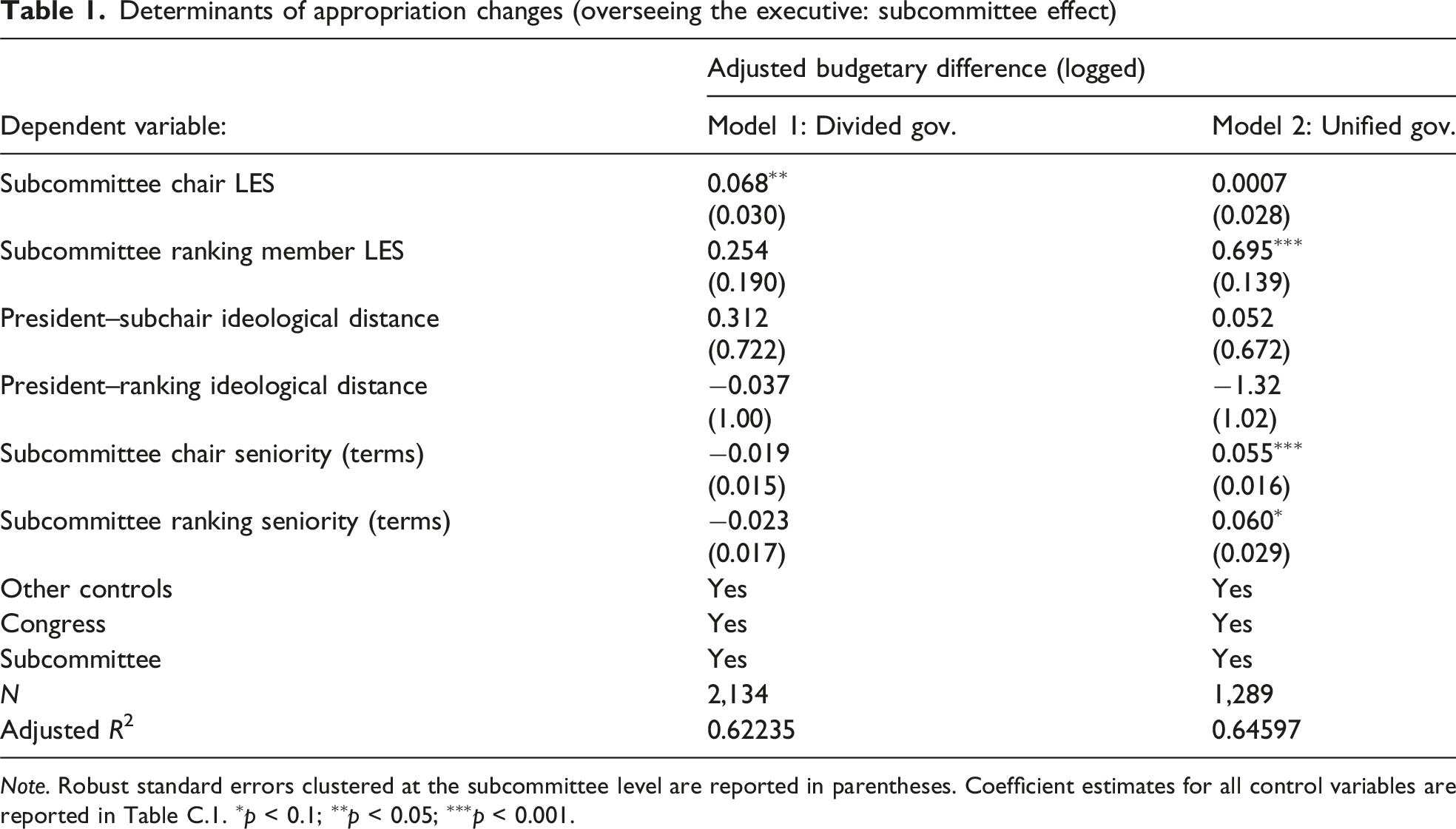
Note. Robust standard errors clustered at the subcommittee level are reported in parentheses. Coefficient estimates for all control variables are reported in Table C.1. ∗p < 0.1; ∗∗p < 0.05; ∗∗∗p < 0.001.
As expected, under unified government (Model 2) the pattern reverses, providing support for Hypothesis 2. When the subcommittee chair and the president belong to the same party, the chair’s LES no longer meaningfully effects the adjusted budgetary difference. The policy alignment between the chair and the executive seemingly reduces the need for deviation. By contrast, the ranking member’s LES is now positive and statistically significant (0.695), indicating that more effective minority members are able to secure larger adjustments to proposed appropriations even under unified control. For instance, moving from the 25th to the 75th percentile in the ranking member’s LES—a 0.262 increase—corresponds to an estimated 19.6% increase in adjusted budgetary difference. Likewise, a one–standard-deviation increase in ranking LES (0.353) is associated with a 27.4% increase. Although the absolute values of minority members’ LES are generally lower, these results suggest that even modest differences in their legislative effectiveness translate into substantively meaningful deviations from the president’s proposed appropriations when partisan alignment reduces majority incentives to contest the executive.
Turning to other results, we find little evidence under our split-sample models that ideological divergence between leader and chief executive meaningfully shapes appropriations outcomes. Coefficients on President–Subchair Ideological Distance and President–Ranking Ideological Distance are highly imprecise and statistically indistinguishable from zero across both political contexts, suggesting that partisan divergence alone does not systematically alter the gap between proposed and enacted appropriations after accounting for government type. However, we do find some evidence that senior members—both chairs and ranking members—are associated with larger budgetary adjustments under unified government.
To examine Hypotheses 3 and 4 we incorporate the median LES of majority and minority-party members on each subcommittee. However, we find no statistically significant evidence at the 0.05 level that the median legislative effectiveness of rank-and-file members systematically shapes appropriations outcomes in either political context (Table C.2). In the divided-government model, the median LES of majority-party subcommittee members is positive but not significant, suggesting only a potential alignment with the chair’s influence. In the unified-government model, the minority-party median LES is positive but not statistically significant, while the majority-party median LES is negative and likewise not statistically significant, providing directional support for the possibility that majority rank-and-file members may partially counterbalance minority-party influence. Overall, the evidence remains inconclusive regarding rank-and-file influence, and the results are substantively unchanged when substituting the median with the mean or the sum of rank and file members’ LES.
As foreshadowed, although institutional heterogeneity is already limited among appropriations subcommittee leaders, we conduct a complementary analysis to ensure that our effectiveness measures capture individual ability rather than structural advantage. Thus, we separate members’ realized impact from what can be attributed to institutional position. We re-estimate our models using both LES Benchmark, capturing expected effectiveness based on institutional characteristics, and Adjusted LES, the deviations from that benchmark. 22
Results (Table C.3) show that members’ adjusted effectiveness—rather than their institutional benchmark—is what consistently drives differences from the President’s proposed appropriations. Under divided government, chairs’ adjusted LES is positively associated with larger deviations (coefficient = 0.072, p < 0.10), while the benchmark component is substantively small and statistically insignificant. Under unified government, ranking members’ adjusted LES also remains positively associated with larger deviations (coefficient = 0.612, p < 0.01), even after accounting for institutional benchmark expectations. These findings suggest that members’ abilities to exceed institutional expectations exert a substantial influence on budgetary outcomes in the appropriations process, underscoring the importance of individual legislative skill and initiative for interbranch bargaining outcomes.
Robustness Checks
Besides those already mentioned, we conduct a variety of additional robustness checks.
To start, focusing on absolute deviation may conflate distinct political dynamics underlying funding increases and decreases. Although securing additional spending is often politically advantageous, achieving budget cuts may be institutionally and politically more difficult, potentially limiting the extent to which legislative effectiveness translates into observable downward appropriations changes. 23 Hence, we estimate conditional effects of legislative effectiveness using a dummy variable for funding decreases, coded 1 when Enacted < Proposed. The interaction estimates provide directional support for this argument, as the coefficients are negative in both models, although neither reaches conventional levels of statistical significance (Table C.4).
A related concern is that more effective chairs may exercise influence under unified government by preserving, rather than altering, presidential proposals. To explore this possibility, we examine the relative strength of the subcommittee chair and ranking member using the difference between their Adjusted LES. Results are directionally aligned with this interpretation, as larger chair-to-ranking-member effectiveness advantages are associated with smaller deviations under unified government (Table C.5). Under divided government, however, the relative strength measure is positively associated with deviations from presidential requests, consistent with the expectation that effective majority-party lawmakers are more capable of reshaping executive proposals.
We further re-examine Hypotheses 3 and 4 concerning the influence of rank-and-file members. Instead of relying solely on median LES, we estimate alternative specifications using the maximum and sum LES of majority- and minority-party rank-and-file members. These measures capture distinct forms of collective influence, including especially effective policy entrepreneurs and broader aggregate legislative capacity. We do not employ mean LES because subcommittee sizes are relatively stable and subcommittee fixed effects render the mean and sum measures nearly proportional within committees. Results (Tables C.6 and C.7) are mixed overall, and do not provide consistent support for the rank-and-file independently amplifying appropriations deviations beyond subcommittee leadership. Under divided government, however, the maximum and sum LES of majority-party rank-and-file members both enter negatively and significantly, although the estimated magnitudes remain smaller than the positive effect associated with subcommittee chairs. 24
As a broader theoretical comparison, we estimate an alternative specification that replaces separate leadership indicators with the subcommittee’s median LES. This follows the informational model of committee behavior (Krehbiel 1992), which emphasizes collective expertise and deliberation rather than hierarchical or partisan control. Results (Table C.8) show no significant association, providing limited support for the informational model. 25
We also account for the increasingly centralized role of party leadership in appropriations (Curry and Lee 2022; Sinclair 2016) by incorporating measures of presidential alignment with House party leaders under unified and divided government. Specifically, we include both President–Speaker ideological distance and President–Minority Leader ideological distance to capture the competing influence of majority- and minority-party leaders over appropriations negotiations. 26 Because these leadership distance measures vary primarily at the Congress level, we replace Congress fixed effects with president fixed effects. Results (Table C.9) are consistent with the main findings in Table 1, with chair LES positively associated with deviations under divided government and ranking-member LES under unified government. We also find evidence that greater President–Speaker ideological distance under divided government is associated with larger appropriations deviations. 27
We also examine whether our findings are robust to alternative fixed-effects specifications. Instead of Congress fixed effects, we estimate models with separate president (Table C.10) and year (Table C.11) fixed effects. We also replace subcommittee fixed effects with broader departmental-level fixed effects (Table C.12) and, more stringently, subagency fixed effects (Table C.13) to account for persistent jurisdictional differences. 28 Results for ranking LES under unified government remain positive and statistically significant under both departmental- and subagency-level fixed effects. By contrast, the effect of chair LES under divided government becomes insignificant once subagency fixed effects are included, possibly because these highly granular fixed effects absorb variation at levels narrower than those at which appropriators typically negotiate funding allocations. 29
We additionally probe whether the findings are sensitive to alternative modeling choices by replacing logged budget deviations with changes in agencies’ shares of total discretionary appropriations. This specification provides a more demanding test because it examines relative allocation outcomes within the broader discretionary budget rather than absolute agency-level deviations. Results (Table C.14) remain broadly consistent with the main findings under both divided and unified government. Although the coefficients are no longer statistically significant in these specifications, their directional patterns remain consistent with the theoretical expectations, suggesting that legislative effectiveness continues to shape appropriations outcomes even when examining relative budget shares rather than absolute funding deviations.
We next consider whether the results are sensitive to alternative control specifications. Member seniority and electoral security are highly correlated with legislative effectiveness, potentially introducing multicollinearity. Hence, we re-estimate the models excluding these variables (Table C.15). Results mirror Table 1, with chair LES remaining positive under divided government and ranking LES remaining robust under unified government. We also assess whether nonlinear electoral security shapes appropriations behavior by including squared vote-share terms (Table C.16), finding results analogous to Table 1.
To ensure that members’ reputations precede the appropriations cycle, we impose temporal ordering by estimating lagged LES from the previous Congress (t – 1). Substantive results remain broadly consistent (Table C.17): under divided government, lagged chair effectiveness remains positively associated with deviations from the president’s proposal; under unified government, the coefficient for ranking members’ LES is positive but misses conventional significance thresholds. 30 To address whether leadership effects vary across institutional contexts, we pool all observations and interact government type with LES (Table C.18: Model 1). Unlike the separate unified-and divided-government specifications, the pooled model directly tests whether the effects of legislative effectiveness differ by partisan control. Although the interaction coefficients are not statistically significant, their signs align with expectations. For instance, the positive interaction term for chair LES and divided government suggests a larger effect under divided government relative to unified government. We further replace the binary government-type indicator with ideological distance to the president (Table C.18: Model 2), allowing partisan conflict to vary more continuously. Results remain substantively similar to Model 1, suggesting that leadership effects are shaped not only by formal partisan control but also by presidential–congressional ideological divergence. 31 Furthermore, although ideological distance exhibits less variation within each government type, Table C.19 estimates separate interactions between LES and ideological distance under unified and divided government. Across specifications, the interaction terms are negative, though not statistically significant, suggesting that the influence of legislative effectiveness attenuates as ideological conflict intensifies and bargaining opportunities narrow.
Finally, we assess robustness through additional sample restrictions. First, we drop Defense appropriations, which constitute roughly half of discretionary spending and are shaped by distinct political dynamics, including long-standing bipartisan support and close executive–legislative coordination (Canes-Wrone et al. 2008). Results (Table C.20) remain consistent with the main findings in Table 1. Second, we remove crisis years—FY 2008–FY 2010 and FY 2020–FY 2021—when appropriations were heavily impacted by emergency spending. As shown in Table C.21, findings remain similar under unified government, where ranking members’ LES continues to predict deviations from presidential proposals. Under divided government, the coefficient for chair LES changes sign and becomes only marginally significant, indicating greater uncertainty in the estimated relationship after excluding crisis-year appropriations.
Conclusion and Implications
Our analysis contributes to two related, though distinct, areas of inquiry.
First, we provide new evidence on how individual ability translates into legislative influence. While prior research highlights broad differences between chairs and rank-and-file members, we isolate ability as a driver of policy outcomes. Legislators occupying similar institutional roles vary markedly in ability (Mattozzi and Merlo 2008), and these differences matter most when paired with procedural leverage. Among Appropriations subcommittees, more able chairs push budgets further from presidential proposals—particularly under divided government—while under unified government, high-ability ranking members become pivotal actors who press for revisions even when the chair and president are politically aligned. The abilities of rank-and-file legislators have no discernible effect. These findings extend the literature on legislative effectiveness beyond lawmaking, suggesting that ability is a generalizable political skill that enhances bargaining capacity in negotiation-intensive arenas such as appropriations.
Second, we situate these findings within the institutional and interbranch context of budgeting. Our results reaffirm that committee leaders remain central in shaping appropriations outcomes (Berry and Fowler 2018), but their influence is mediated by party control and presidential alignment. Growing partisan discipline has constrained opportunities for individual initiative, concentrating authority in majority leadership while limiting opportunities for minority participation (Aldrich and Rohde 2000b; Ballard and Curry 2021; Curry and Lee 2022). Even so, able minority leaders can still exert measurable influence under unified government, where their expertise yields tangible deviations from executive proposals. In short, contemporary appropriations politics reward both position and ability, though the institutional space for the latter has become increasingly selective.
Taken together, our results suggest a conditional model of presidential influence. Presidents initiate the budget process, but able subcommittee leaders—especially under divided government—retain the capacity to reshape outcomes. The modern appropriations process reflects a pragmatic Madisonian balance, in which executive power is bounded not only by formal rules but by the abilities of those occupying key legislative posts. Future research can extend this analysis by examining how legislative ability interacts with other dimensions of legislative capacity—such as staff resources or constituency pressures—to shape bargaining outcomes across policy domains. Scholars might also examine whether legislative ability matters differently across stages of the appropriations process, including beyond committee action and onto the House floor, or across agencies varying in technical complexity, political salience, or administrative independence. Such extensions would help clarify whether legislative ability operates primarily through bargaining, information, coalition management, or agenda control.
Supplemental Material
Supplemental Material - Shaping Appropriations: Legislative Ability and Budgetary Success
Supplemental Material for Shaping Appropriations: Legislative Ability and Budgetary Success by Fred Gui, Lawrence S. Rothenberg in Political Research Quarterly.
Footnotes
Acknowledgments
The authors thank Dongqi Huo and Yichao Sun for their excellent research assistance. The authors also thank participants at the 2022 American Political Science Association Annual Meeting, as well as Geoff Lorenz, Craig Volden, Muzhi Liu, and the anonymous reviewers for their valuable feedback.
Funding
The authors received financial support for the research and authorship of this article from the Louisiana State University College of Humanities and Social Sciences Faculty Start-Up Fund.
Declaration of Conflicting Interests
The authors declared no potential conflicts of interest with respect to the research, authorship, or publication of this article.
Data Availability Statement
Replication materials are available at the Harvard Dataverse: https://doi.org/10.7910/DVN/BR9XXJ,  .
.
Supplemental Material
Supplemental material for this article is available online.
Notes
References
Supplementary Material
Please find the following supplemental material available below.
For Open Access articles published under a Creative Commons License, all supplemental material carries the same license as the article it is associated with.
For non-Open Access articles published, all supplemental material carries a non-exclusive license, and permission requests for re-use of supplemental material or any part of supplemental material shall be sent directly to the copyright owner as specified in the copyright notice associated with the article.
