






Abstract
Professional doctorates have been established in the allied health professions by clinicians seeking the highest levels of independent practice. Allied health professional doctorates include nursing practice (DNP), occupational therapy (OTD), psychology (PsyD), social work (DSW), and marriage and family therapy (DMFT). Lessons learned from the evolution of professional doctorates in nursing and psychology inform the development of the counseling profession. The doctor of professional counseling (DPC) degree affords opportunities for clinical specialization and parity with other allied health professionals. The DPC is the logical next step in the ongoing professionalization of counseling.
Professional doctorates have been established in the allied health professions by clinicians seeking the highest levels of independent practice including specialization. For example, experienced nurse practitioners at Columbia University embarked in 1993 on a plan for advanced training that culminated in the university offering in 2005 the first doctor of nursing practice (DNP) degree (Mundinger, 2009). Allied health professional doctorates include pharmacy (DPharm), physical therapy (DPT), occupational therapy (OTD), and speech and language pathology (DSLP). Professional doctorates also exist in mental health: psychology (PsyD), social work (DSW), marriage and family therapy (DMFT), and DMin (doctor of ministry; ministry–pastoral care). While there are degrees in several mental health disciplines, there is currently no professional doctorate in counseling, one of the fastest growing professions in mental health care.
Recently, professional counseling licensure was implemented in California, marking the passage of licensure in all 50 states (Lum, 2010). In addition, Veteran’s Affairs now recognizes the licensed professional counselor (LPC) credential throughout its health care system (Barstow, 2011). It is likely that LPCs will be included in Medicare and the upcoming national health insurance programs. Health insurance plans include LPCs as providers due to their competence in practice and affordability of services. Increasingly, LPCs will be afforded privileges to practice in hospitals and other health care settings. The doctor of professional counseling (DPC) degree represents movement toward the highest professional standards and parity with other allied health professionals in third-party payments for services. There is also a trend toward multitiered licensure in counseling with opportunities for clinical licensure being reserved for individuals presenting additional hours of specialized graduate training and supervision (Lum, 2010).
The Council for Accreditation of Counseling & Related Educational Programs (CACREP, 2010) accredits graduate degree programs, although there is no designation or category for a DPC. Presently, CACREP recognizes the doctorate (PhD or EdD) in counselor education, a research-based degree program intended to prepare professors who train primarily master’s-level students for entry into the profession. In addition to training future counselors, many individuals with doctorates in counselor education advance the profession through research and scholarship. There is no corresponding doctorate for professional counselors who are interested in practice specialization or attaining the highest levels of clinical competence and recognition. The DPC is the logical next step in the ongoing professionalization of counseling.
Professional Doctorates in Allied Health Care
“A Report on the Potential Impacts of Entry-Level Clinical Doctorate Programs in the Health Professions” was a document distributed in 2008 by the Association of Schools of Allied Health Professions (ASAHP, n.d.) to institutions of higher education and professional accreditation. The impacts of the proliferation of clinical doctorates in allied health, as well as the pros and cons for advocating entry-level doctoral programs in allied health were examined in the report. ASAHP found that clinical doctorates were developed for two basic reasons: to elevate the requirements for entry-level training and to address the needs for advanced practice. Elevation of the requirements for clinical doctoral training impacted recruitment and retention of diverse, qualified faculty members; progression of trainees toward entry-level practice in critical need areas; and burden of tuition upon clinicians pursuing advanced training. The pros and cons addressed the needs for advanced clinical practice in a wide range of allied health professions.
Pros in clinical doctoral training emphasized enhanced professionalization and standards in allied health fields and advancement of clinical expertise among graduates (ASAHP, n.d.). The clinical doctorate as an entry-level credential incorporated recent developments in the knowledge base, as well as applications of research. Doctoral levels of training were viewed as better serving the public in terms of the development of higher standards. Students who gained advanced levels of clinical training and competency were afforded higher status and salary and opportunities for progression up the career ladder. Cons included delays in entry into the professions and higher costs associated with extending classroom and clinical training.
ASAHP observed that institutions advancing clinical doctorates must be prepared to expand the traditional academic mission to incorporate new faculty, clinical training, and services delivery resources. In addition, health care systems must be encouraged to recognize advanced training with higher salaries and privileges. ASAHP noted that the success of the clinical doctorates would be a function of documentation of the advanced skills and competencies acquired by graduates. Movement toward the clinical doctorate appears to be based on the identification of higher professional standards to serve the public well-being and documentation of advanced knowledge, skills, and competencies in the new professionals.
DNP: A Model of Advanced Professionalization
The DNP provides an excellent model for advancing professionalization in counseling. In 1993, experienced nurse practitioner (NP) faculty at Columbia University School of Nursing learned advanced medical and practice management from their physician colleagues in the medical school. This qualified them for admitting privileges at the university hospital and allowed for comparability with MDs in a planned randomized clinical trial examining NP and MD primary care (Mundinger, 2009). The outcomes of the study, published in the Journal of the American Medical Association (Mundinger et al., 2000), showed that NPs, with extended training and experience, could provide care comparable to services from primary care physicians. A 2-year follow-up was subsequently published and confirmed the initial findings (Mundinger, 2001).
The NPs formed a practice association (Columbia Advanced Practice Nurse Associates or CAPNA) that was widely accepted by patients and insurance plans (Mundinger, 2009). In spite of challenges by physicians that they were practicing medicine without a license, the CAPNA nurses maintained a successful practice organization. They subsequently developed and introduced the standards for knowledge and skills needed for advanced nursing practice at the doctoral level. The model doctoral degree program was strongly supported by the profession. Columbia University offered the DNP in 2005 and organized the first national certification examination for graduates in 2008. The National Board of Medical Examiners developed the examination ensuring the highest standards for practice and providing the public with evidence that NPs trained at the doctoral level were highly competent clinicians (Mundinger, 2009).
The American Association of Colleges of Nursing (AACN, 2004) charged a task force on the clinical doctorate to establish the need, content, and trends in the practice-oriented doctorate in nursing practice. This task force offered conclusions and recommendations that apply to the development of the professional doctorate in counseling practice.
The task force recommended that the term practice doctorate would be used instead of clinical doctorate (AACN, 2004). They also recommended that the practice-focused doctoral program would be based on a distinctive model for doctoral education within the profession. Graduates of the new doctoral programs would be prepared to assume duties and responsibilities at the highest level of practice beyond initial, entry-level training in the field.
The task force articulated seven essential areas of content for doctoral programs: Scientific support for practice; Advanced practice approaches; Systems thinking and organizational/leadership; Analytic methodologies used in the evaluation of practice and the application of evidence for practice; Utilization of technology and information for the improvement and transformation of care; Relevant policy development, implementation, and evaluation; and Interdisciplinary collaboration for improving health care outcomes.
The task force continued to describe components of the DNP training program (AACN, 2004). Graduates of practice-focused doctoral training should focus on an area of specialized advanced nursing practice. The DNP would incorporate rigorous practice training in the major recognized specialties within the profession. They agreed that the DNP would be the terminal degree program and that other confusing titles (such as Doctor of Nursing or ND) would be phased out. Clinicians who present the master’s degree and wish to obtain the DNP would be afforded opportunities to earn the practice doctorate through transfer credit for previous graduate studies. The task force recommended that transition or advancement from entry-level to highly independent practice would be guided by the demonstration of validated competencies.
Finally, the task force made some recommendations concerning accreditation and preparation of professional educators for the new doctoral program. They requested that practice-focused doctoral programs be accredited by a nursing accrediting agency recognized by the U.S. Secretary of Education (e.g., the Commission on Collegiate Nursing Education or the National League for Nursing Accrediting Commission). They also indicated that the doctoral program should include some coursework and practical training that would prepare DNP graduates to teach as nurse educators (AACN, 2004).
The DNP has expanded the contributions and roles of highly trained nurse clinicians who have responded to increasing needs for health care in the public interest (Stein, 2011). While there is some concern regarding the proliferation of degrees in nursing (Parse, 2008), the DNP became well established in a relatively short period of time. Having an emphasis upon new models of delivery in patient-centered care, DNP clinicians have also contributed to advances in policy development, evidence-based practice, quality improvement, program evaluation, and competency-based education (Florczac, 2010).
Professional Doctorates in Mental Health
Similar to the proliferation of practice or clinical doctorates in allied health, there has been ongoing development in practice-oriented doctorates in mental health fields. The Doctor of Social Work (DSW) degree emerged to establish a unique social work identity among professional social workers who would be well prepared to pursue evidence-based practice and to train clinicians along the career ladder in social work practice (Howard, Allen-Meares, & Ruffolo, 2007; Rubin, 2011; Rubin & Parrish, 2007). The Doctor of Marriage and Family Therapy (DMFT) degree is a relatively recent innovation in marriage and family therapy training programs. Approximately, 30% of licensed marriage and family therapists have doctoral degrees (American Association for Marriage and Family Therapy [AAMFT], n.d.). In pastoral care within religious and health care settings, the DMin degree represents the pursuit of specialized training to accomplish goals for clinical training. The prototype of professional doctorates in mental health care is the Doctor of Psychology (PsyD). The evolution and proliferation of PsyD programs reflect the trend that is now affecting ongoing professionalization in counseling.
Lessons Learned From the PsyD
The history of the development of the PsyD degree presents some useful lessons for the creation of a DPC degree. Hollingworth (1918) has been credited with the first call for a professional doctorate in consulting psychology, the PsyD (then PsD). She asserted there was “… at present no degree to indicate the completion of a prescribed professional course in psychology, which does not involve intensive research, but which does involve practice in applications” (Hollingworth, 1918, p. 282). Although there were ongoing calls for the creation of such a degree program, the PsyD experienced a long period of hibernation.
After World War II, several universities and the Veterans Administration encouraged the development of clinical training program standards (Donn, Routh, & Lunt, 2000; McConnell, 1984). The American Psychological Association (APA, 1947) formed a committee to study clinical training needs resulting in the development of the scientist–practitioner model which was adopted in 1949 in Boulder, Colorado. The Boulder Model has dominated the training of professional psychologists. However, critics noted that psychologists trained in such programs failed to meet the dual purposes of research and practice (McConnell, 1984; Peterson, 1997). Scientist–practitioner programs were not meeting the needs of students seeking strong professional training (Murray, 2000).
Clark (1965) recommended the creation of a two-track educational system, as well as the establishment of a new doctoral program (i.e., PsyD) to train psychologists for the practice of psychotherapy. The renewed interest in the PsyD was based on the value that research should be consumed and applied, although some research-oriented psychologists considered it a second-rate degree and described it as abandonment of the PhD (Donn et al., 2000; McConnell, 1984; Peterson, 1997). In 1968, Donald R. Peterson established a PsyD program in the Department of Psychology at the University of Illinois. Another program was initiated in 1970 at Hahnemann Medical School in Philadelphia and moved in 1989 to Widener University where it became the first APA-accredited PsyD training program. In 1971, the PsyD program at Baylor University replaced the doctoral dissertation with a demonstration project. Peterson contributed in 1974 to the opening of a PsyD at Rutgers University.
In 1973, a national conference on levels and patterns of professional training in psychology was convened in Vail, Colorado, leading to the official adoption of the PsyD. Korman (1974) summarized the outcomes of the conference. The issue of the highest professional degree label (Doctor of Philosophy [PhD] versus PsyD) was given close examination. Where primary emphasis in training is on the direct delivery of professional services and evaluation and improvement of those services, the PsyD degree is appropriate. Where primary emphasis is on the development of new knowledge in psychology, the PhD degree is appropriate (p. 443).
The PsyD degree developed within psychology to ensure adequate clinical preparation for professionals who would be providing direct services rather than teaching in an academic setting. There was an emphasis upon applications of practice-oriented research instead of the primary research-oriented PhD graduates who completed dissertations to advance knowledge within the science of psychology. Although the counseling profession will continue to benefit from doctoral training that emphasizes dissertation research and knowledge building, the DPC could afford opportunities for professional growth and public service among the majority of counselors who will not pursue research agendas during their careers.
Comparison of Counseling Doctorates
In order to understand the potential contribution of the DPC degree program to the ongoing development of the profession, it would be important to understand the evolution of practice-oriented doctorates within the history of doctoral studies. Professional doctorates arose in response to public needs accompanying societal changes and increasing dissatisfaction with training in research doctorates.
Doctoral degrees were traditionally awarded to recognize original and groundbreaking research contributions within academic disciplines (Bourner, Bowden, & Laing, 2001; Noble, 1994). The PhD degree required students to conceive, design, implement, and report original research held to be a major contribution by a group of professors in the discipline. In 1861, Yale University conferred the first PhD in the United States. By completing the dissertation, the student completed the transformation from novice to independent researcher. Due to the intense nature of research training and limitations of time and resources, admissions to PhD programs have been highly competitive or restrictive, perhaps limiting privilege and power to a few members of the dominant culture. Research doctorates were obtained to establish and pursue careers in the academy.
Critics of research doctorates target the overemphasis upon scientific inquiry and relative neglect of problem solving and public service (Bourner et al., 2001; Noble, 1994). Dissertation research tends to be narrow and time consuming, generating few findings that can be directly translated into applications or practices. In addition, the PhD degree program in professions such as counseling does not produce a good fit for students who are more interested in pursuing clinical than research competence. Even within programs dedicated to balancing research and practice, doctoral degrees evolved to reflect changes in perspective and mission. The rapid growth in the number of professional doctorate degrees in psychology awarded in the United States clearly indicates a degree of dissatisfaction with the traditional scientist–practitioner model as it is applied to professional training in the United States (Helmes & Pachana, 2005, p. 48).
Practice doctorates emerged to address criticism with research oriented, academic degrees in professional disciplines. The first professional doctorate, a doctor of education (EdD), in the United States was awarded in 1921 by Harvard University. Since that time, the professional doctorate, especially in education, has become well established in the United States and other countries such as Australia, New Zealand, and the United Kingdom. The output of professional degrees represented improvements in practices and training of practitioners (Maxwell & Shanahan, 1997). The key features of the professional doctorate include public service through professional work, career development of the trainee, emphasis upon pedagogy and learning outcomes, accreditation of training programs by professional associations, and preparation for entry into the profession, including licensure (Scott, Brown, Lunt, & Thorne, 2004). While research doctorates prepare academics for the rigors of scholarship, professional doctorates present rigorous training for the realities of clinical practice. Lester (2004) observed that the practice doctorate “… needs to be adequate for the ‘swamps,’ ‘messes,’ and ‘wicked problems’ encountered by senior professionals in their practice situations” (p. 764).
Table 1 compares essential characteristics of research-oriented academic degrees and the proposed practice-oriented professional degree in counseling.
Comparison of PhD/EdD and DPC Degrees
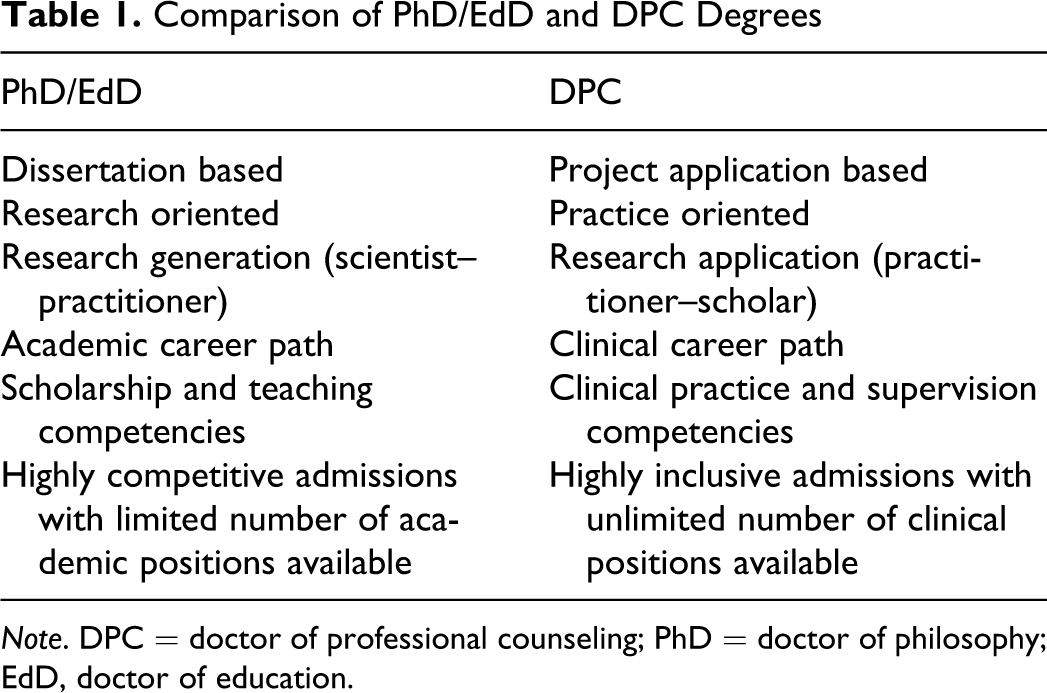
Note. DPC = doctor of professional counseling; PhD = doctor of philosophy; EdD, doctor of education.
Most doctoral students in counseling pursue training to become counselor educators and supervisors (CACREP, 2010) although many will be employed in nonacademic clinical and professional practice settings. Although the PhD and even the EdD offer some learning experiences relevant to practice, the overemphasis upon dissertation research limits training opportunities, as well as the natural development of the profession toward public service through attainment of high levels of clinical competencies. The development of a professional doctorate in counseling would enable the profession to respond to public demand for services by producing more, better trained clinicians.
The success of the professional doctorate rests in large part upon the production of a legitimate alternative to the dissertation. Professional doctoral candidates present breadth and complexity in work products that reflect meaningful applications of scholarship in practice settings. The dissertation is the “gold standard” in academically oriented PhD programs, which emphasize depth of focus and original contribution to a narrow knowledge base. Alternatives to the dissertation in a DPC program include construction of a competency-based portfolio and involvement in participatory action research culminating in a project demonstrating excellence (PDE).
Alternatives to Dissertation Research
Future credibility of the professional doctorate depends upon the extent to which clinical practice is advanced or improved. Therefore, practice research is needed to identify and expand the clinical advances. Similarly, research findings from basic and applied research should be incorporated into best practices within a professional discipline. Lessons learned from the successes of the DNP and PsyD suggest directions for meaningful research and program development in the DCP degree program. Advances in DSW and DMFT also inform the construction of the DCP.
Rapid proliferation of the DNP among schools of nursing substantiated the need for advanced training in clinical nurse specializations (AACN, 2004). In addition, the DNP has stimulated growth of research regarding best practices, innovation in services delivery, evaluation of policy and program effects, and specification of clinical competencies for training (AACN, 2004; Adams & McCarthy, 2007; Sherwood, 2011).
The long history of the PsyD degree is a testimony to an implicit conflict in professional identity within psychology. The PsyD represents a response of clinicians to an overemphasis upon dissertation research and commitment to science in the discipline. Research is present in the PsyD program, but practice itself is viewed as a form of disciplined inquiry (Lester, 2004; Peterson, Reid, & Allen, 1999). The professional doctorate in psychology addressed consumer demand for creation of a niche market based upon increasing specialization and practice competence (Servage, 2009).
The DSW degree developed to establish a firm professional identity in the career ladder within social work from case management as a bachelor of social work (BSW) graduate, through initiation of professional practice as a master of social work (MSW), to the advancement of the practice model in the DSW (Howard et al., 2007; Rubin, 2011; Rubin & Parrish, 2007). The professional doctorates in social work and nursing share a priority with identifying best practices and advancing evidence-based practice. Development of competencies follows from the specification of standards in evidence-based practice.
The DMFT degree is distinguished by its emphasis upon demonstration of competencies in knowledge, attitude, and practice. The competency-based approach to training in marriage and family therapy was facilitated by a professional association, the AAMFT. AAMFT formed in December 2002 a Core Competency Task Force whose recommendations led to the identification of 128 distinct competencies across 6 core competency domains: admission to treatment; clinical assessment and diagnosis; treatment planning and case management; therapeutic interventions; legal issues, ethics, and standards; and research and program evaluation (AAMFT, 2004). Reflection upon competencies needed for successful marriage and family practice, pilot testing of the new educational paradigm, and adoption of competency-based education within a learner-centered pedagogy has promoted advancement of the marriage and family therapy profession (AAMFT, 2002, 2004; Gerhart, 2010; Nelson, 2005).
The CACREP (2009) developed standards and general competencies in professional counseling and counselor education and supervision. The general competencies apply to preparation for professional practice, and basic knowledge and skills across several domains: professional orientation and ethical practice; social and cultural diversity; human growth and development; career development; helping relationships; group work; assessment; and research and program development. These standards seem to reflect the core professional identity of counseling; however, similar to the AAMFT standards for marriage and family therapy practice, the competencies are not easily measured or organized sequentially along a career path leading to doctoral-level practice.
Standards and competencies were identified for professional practice in six areas of specialization: addiction counseling, career counseling, clinical mental health counseling, marriage, couple, and family counseling, school counseling, and student affairs and college counseling (CACREP, 2009). These specializations address highly diverse problems, populations, and settings. Implementation of the 2009 standards may be hampered by difficulties in defining and clarifying the core and specialized competencies. Nevertheless, two recent works are helpful in conceptualizing competencies, implementing standards, and monitoring progress: Core Competencies in Counseling and Psychotherapy: Becoming a Highly Competent and Effective Therapist (Sperry, 2010) and The Professional Counselor: Portfolio, Competencies, Performance Guidelines, and Assessment (Engels, Minton, Ray, & Associates, 2010). Competency-based education using well-defined and consensually validated criteria appears to be a shared characteristic across the practice doctorates in the allied health professions. The portfolio is a promising tool for organizing the learning process, demonstrating competency, and measuring progress toward a capstone or culminating experience in doctoral study, the Project Demonstrating Excellence (PDE).
The Promise of the Portfolio and PDE
The portfolio presents a viable alternative to the dissertation consistent with the diversity of work products, communication modalities, and discourse communities of the professional counselor. A portfolio documents diverse accomplishments organized to reflect professional counselor identity and present increasing competency. Maxwell and Kupczyk-Romanczuk (2009) noted the parallels in the portfolios of artists and professional doctoral candidates. The works within the portfolio enlist various methods and modalities to explore a concept and speak to different audiences of interest. Similar to a Greek temple, the portfolio presents an overarching pediment reflecting a coherence of purpose supported by the peristyles or columns of the different work products. The structure of the professional portfolio represents the linking papers or work products built upon the firm foundation of practice experience. Within the basic structure of the portfolio exists the potential to define a specialization manifested in a culminating or capstone experience, the PDE.
The PDE affords the professional counselor opportunities to define a specialization while contributing to the meaningful resolution of a community problem. The PDE reflects the balance of commitments in professional development: attaining the highest competencies for independent practice and providing valuable services to the community. The PDE is guided by a practitioner–scholar perspective in which research findings are applied in a systematic manner (Dent, 2001; Union Institute & University, 2009). The PDE would be the capstone or concluding experience of the DPC degree program in which each candidate proposes, conducts, and reports the results of meaningful participatory action research and/or program development and evaluation project in an approved clinical setting. The PDE replaces the traditional requirement of a research-oriented dissertation. Instead, the PDE is intended to provide a means for demonstrating high-level clinical competency and serving clients in the community.
Conclusion and Recommendations
Lessons learned from the evolution of professional doctorates in allied health professions, especially the DNP and PsyD indicate that counseling is ready to make the next step in professionalization. Increasingly, clinicians seeking the highest levels of independent practice, parity with other mental health professionals, and opportunities for career advancement within a specialization or niche will seek a professional doctorate in counseling. We recommend the creation of a DPC degree as a viable alternative to research-oriented doctoral programs in counselor education and supervision. The proposed DPC degree training will prepare the next generation of counseling professionals to pursue their dreams while engaging in meaningful public service.
The DPC will be competency-based according to evidence-based practice standards. The degree will involve some preparation for applying or consuming research findings in developing best practices and implementing and evaluating programs and policies in clinical practice. The DPC will be organized through the construction of a portfolio, ongoing demonstration of competency, and culmination in participatory action research. Construction of DPC training will assist the profession in graduating a large number of highly competent clinicians who will be needed to respond to increasing demand for specialized LPC services. Over time, the proliferation of DPC training may affect licensure and accreditation standards to protect consumers and promote advancement of the counseling profession. The characteristics of the proposed DPC degree are listed in Table 2.
Constructing the Doctor of Professional Counseling Degree Program
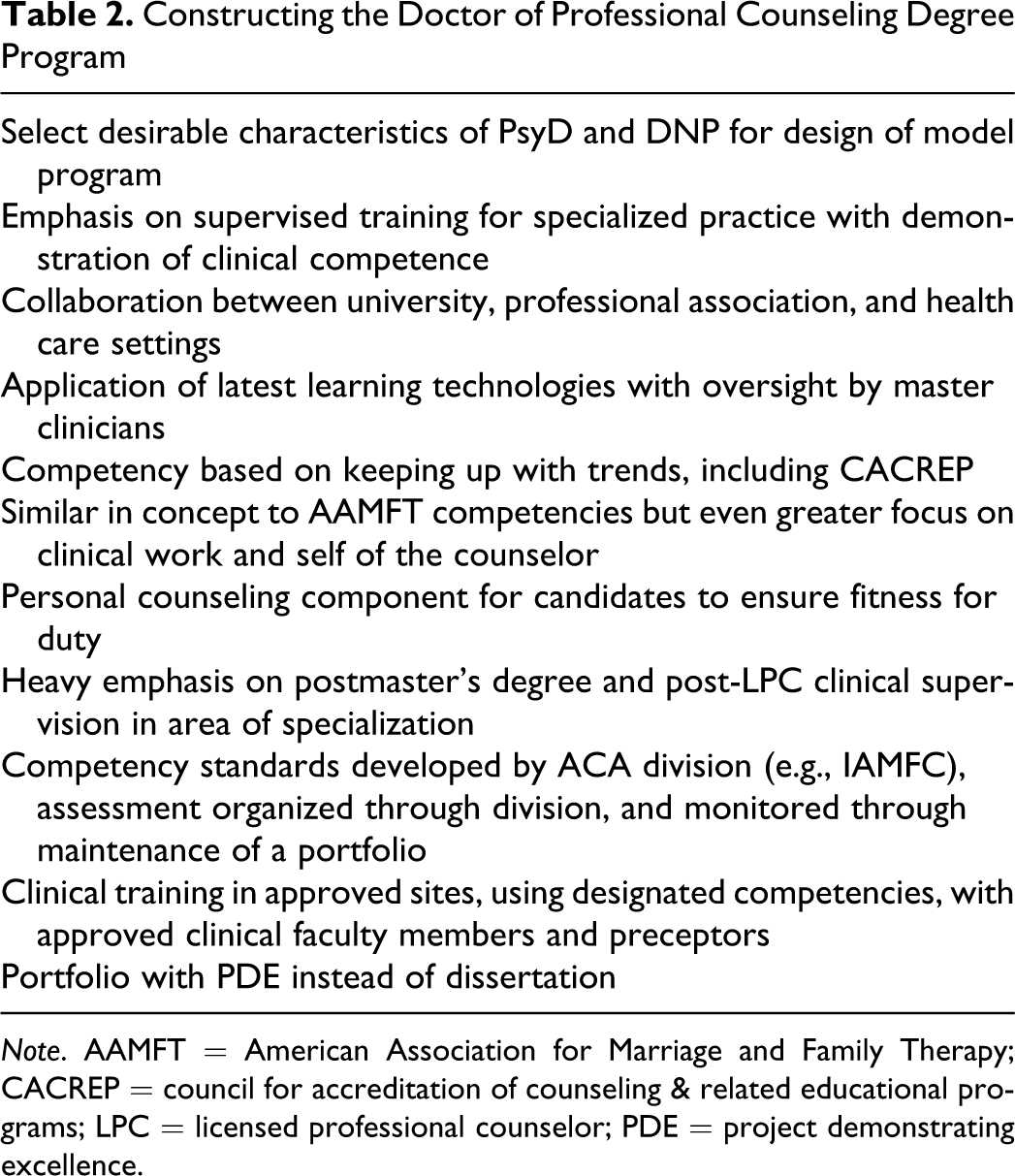
Note. AAMFT = American Association for Marriage and Family Therapy; CACREP = council for accreditation of counseling & related educational programs; LPC = licensed professional counselor; PDE = project demonstrating excellence.
In this issue of The Family Journal, Del Rio and Mieling (2012) present an excellent counterpoint to our proposal, describing the arduous process for obtaining a PhD in counselor education and supervision. They emphasize how the profession of counseling has adapted to respond to societal changes and meet the needs of diverse clients. We believe that construction of the DPC degree will remove barriers to doctoral studies and enhance services delivery in our multicultural society. Therefore, Mississippi College has embarked upon a process that should lead to approval of a DPC degree program, which could be implemented in 2012. We hope to describe our efforts in implementing the DPC program in a future issue and welcome your input as the process unfolds.
Footnotes
The author(s) declared no potential conflicts of interest with respect to the research, authorship, and/or publication of this article.
The author(s) received no financial support for the research, authorship, and/or publication of this article.