







Abstract
The utilization of postadoption services among adoptive families has been an emerging topic of discussion over the last decade. However, what is often not discussed is the utilization rate of services among African American and transracial families who have adopted children from foster care. The purpose of this study was to explore the extent of the use of nonfinancial support services (e.g., participation in support groups or individual/family counseling) by African American, transracial, and White American adoptive families. Implications for family counselors will be presented.
Over the last two decades, the number of adoptions of American children from the U.S. foster care system has increased. Several scholars have documented that this surge was intensified by the passing of the Multiethnic Placement Act (MEPA, 1994) signed by then-President William Clinton (Bradley & Hawkins-Leon, 2002; Butler-Sweet, 2011). The stated purposes of MEPA were (a) to decrease the length of time that children waited to be adopted from foster care; (b) to prevent discrimination in the placement of children on the basis of race, color, or national origin; and (c) to facilitate the identification and recruitment of foster care and adoptive parents who could meet these children’s needs (MEPA, 1994).
Although federal legislation such as the MEPA had the stated purpose of increasing the number of domestic adoptions, counseling and legal scholars alike have noted significant implications to this particular expedited process. For example, Hawkins-Leon and Bradley (2002) argued that due to the MEPA’s removal of race-matching procedures in the placement of children in adoptive families and the shortage of White American infants and toddlers available for adoption placement, more African American children have been permanently placed with White families. This interracial placement process is referred to as transracial adoption (Grow & Shapiro, 1974). However, recent discussions in the field of adoption have concluded that many transracially adopted children and current and potential adoptive parents (both transracial and interracial) have experienced racial identity and adjustment difficulties. For example, Jennings (2006) in her qualitative study of White, middle-class, infertile women found that the so-called race thinking informed the woman’s decision to adopt across racial lines. Specifically, Jennings reported that some women in her study moved from White American infant adoption to a “color-blind approach” in conceptualizing a family relationship with a child of color. Other respondents utilized a race ranking system in that international children (of European and Asian descent and background) were considered as the respondent’s “first choice” because they were perceived by the participants to fit more in a White middle-class lifestyle than African American, Black, or biracial children. Furthermore, several studies (Butler-Sweet, 2011; Feigelman, 2000; McRoy, Zurcher, Lauderdale, & Anderson, 1984; Simon & Alstein, 2002) found that African American children adopted by White American parents were more likely to express a desire to be considered as White (as their racial classification). These children had adjustment problems within their communities and within their own families. As a result, these researchers recommended that agencies provide adoption support for transracial families from time of placement through the children’s adolescence.
The shortened time frame for children to remain in foster has also led to a shift toward older age children being placed in adoptive homes. Several studies have reported that older age children in foster care are often more at risk for developing mental and emotional problems due to abuse or adverse conditions from their biological families or previous foster care placements (Dhami, Mandel, & Sothmann, 2007; Evan B. Donaldson Adoption Institute, 2010). Additionally, Wind, Brooks, and Barth (2007) concluded in their study of risk history among American adoptees that children adopted at older ages may have strong emotions related to the loss of their biological families and fear of abandonment by their adoptive families.
It is important to note that children of color and older children adopted from foster care are also identified as “special needs” adoptees. Although definitions may vary from state to state, in general, special needs children in foster care are children who (1) are of racial minorities; (2) are of older age (over the age of 8); (3) are sibling groups to be adopted together; (4) have a history of unstable placements; and/or (5) are diagnosed with a physical, mental, or emotional disability (Wind, Brooks, & Barth, 2007). The overall increase in special needs adoptions has been accompanied by an increased rate of children and families experiencing adoption problems and dissolved adoptions (Reilly & Platz, 2004). Social service agencies have attempted to prevent or curtail these adjustment problems/challenges by offering adoptive families postadoption support services. Postadoption services have often been described as general support such as ongoing meetings with the social worker or participation in adoption support groups and/or clinical services that often include individual (parent or child), family, and/or crisis counseling (Wind et al., 2007).
The utilization of postadoption services among adoptive families has been the subject of emerging discussion over the last decade. Most noted in this deliberation is the finding that the utilization of postadoption services, especially clinical services is almost triple the rate of the utilization of similar services as reported by birth families (Evan B. Donaldson Adoption Institute, 2010). However, what is often not discussed is the utilization rate of services among African American and transracial families who have adopted children from foster care. Rarely is the race of the adoptive parent addressed in the evaluation of postadoption services. For example, in a recent research-based national report (2010) on postadoption services published by the Evan B. Donaldson Adoption Institute, there was virtually no definitive discussions regarding racial and/or ethnic differences concerning the use of postadoption support services in general and in nonfinancial postadoption support services in particular. This void in the adoption literature is particularly concerning, given the recent demands within most helping professions to address the psychological and social needs of an increasingly diverse society.
Family and mental health counselors have been identified in the social service literature as first responders in either identifying or addressing psychological adjustment issues in families in general and adoptive families in particular (Evan B. Donaldson Adoption Institute, 2008, 2010; U.S. Children’s Bureau, 2007). However, a database search of periodicals published within the Family Journal or the Journal of Counseling and Development produced virtually no journal articles or discussions pertaining to postadoption support services. This lack of information is particularly crucial since family counselors are designated to assist biological and adoptive families with their counseling needs. Family counselors may run the risk of harming adoptive families by only utilizing or offering support services often intended for biological families as a means to address the psychological and adjustment needs of adoptees and their parents.
Hence, the purpose of this study was to examine the utilization of postadoption support services among African American, transracial, and White American parents. Specifically, this study sought to explore the extent of use of nonfinancial adoption support services (e.g., participated in support groups or individual/family counseling) used by African American, transracial, and White American adoptive families. To this end, the following research questions guided this investigation.
What is the extent of the use of postadoption counseling services by adoptive parents?
Is there a relationship between the use of nonfinancial postadoption services and the ethnic structure of the family?
Method
Data Source
The National Survey of Adoptive Parents (NSAP) public data set was used to address the research questions in this study. NSAP cases were screened by the administration of a parent survey—the 2007 National Survey of Children’s Health (NSCH). The NSCH identified households via a telephone interview with a parent. Once the NSCH identified a household as having an adopted child, respondents were invited to also participate in the NSAP interview. The NSAP focused on the characteristics, adoption-related experiences, and postadoption service utilization of adopted children and their adoptive families (Vandivere, Malm, & Radel, 2009).
The NSAP survey was designed to collect data from children adopted through the U.S. foster care system, internationally, and through domestic private sources. Participation in the NSAP was limited to the adoptive mother or adoptive father of the selected child. Most often, the mother of the adopted child completed the NSAP. For the purposes of this study, only the NSAP parents who adopted children within the United States were used in this investigation. A total of 2,089 NSAP interviews were completed from April 2007 to July 2008. The interview completion rate (i.e., cooperation rate) for eligible respondents was 74.4% (Vandivere, Malm, & Radel, 2009). From the total number of participants in the survey (N = 2,089), 1,386 were included in our study. These families were divided into three groups: African American parents who adopted African American children (n = 219), White American parents who adopted White American children (n = 799), and transracial parents (n = 368) defined as those parents who adopted a child whose ethnicity was different from their own.
Variables
To begin, we extracted some demographic data so that we could have a better understanding of the population at large. For example, child-related variables included gender, ethnicity, age, adoption type (foster or private), and special health care needs. On the other hand, parent-related variables basically pertained to the structure of the household: poverty level, relationship to the child, and whether or not there were other children living in the household (see, e.g., Table 1).
Results for Demographic Variables by Adoptive Family Structure
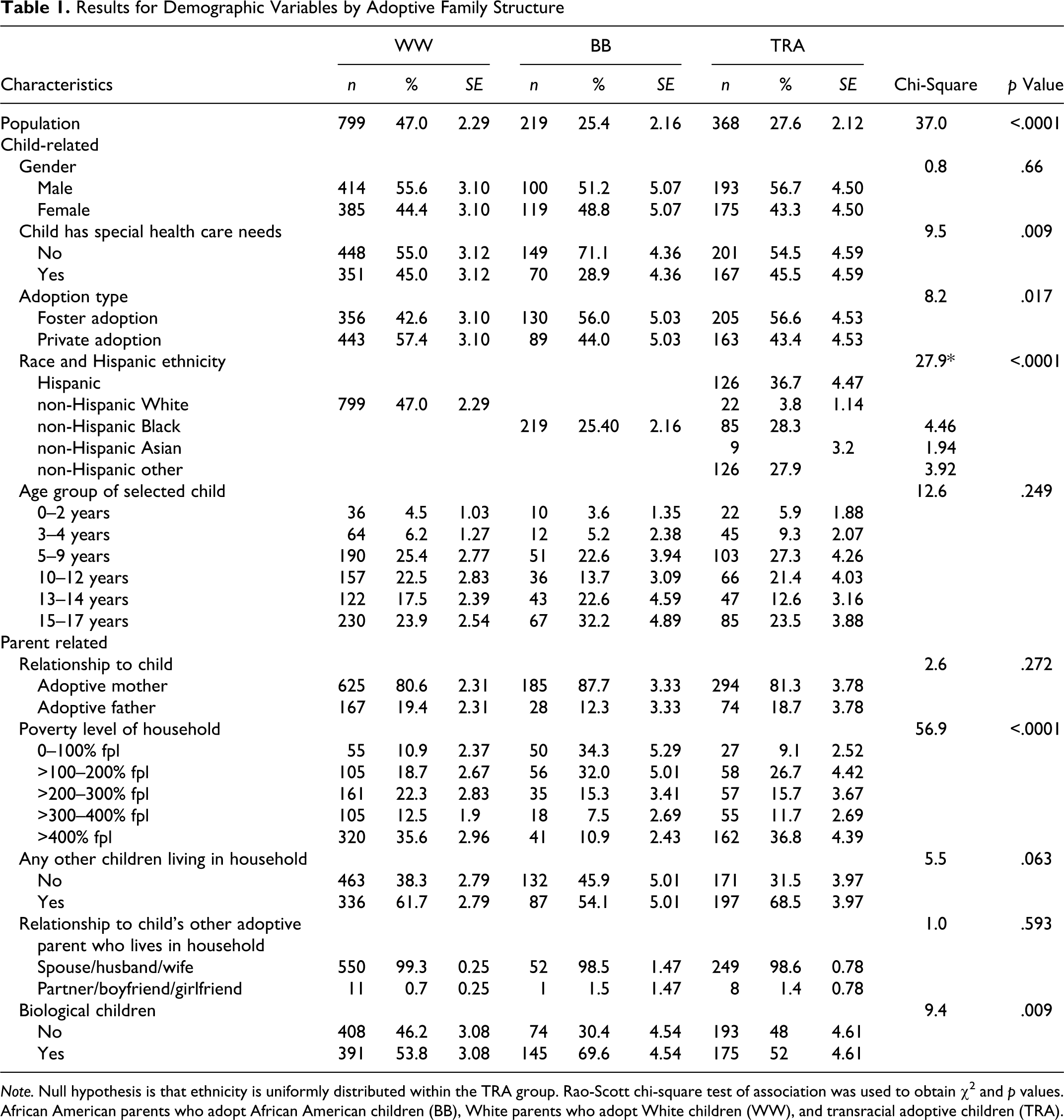
Note. Null hypothesis is that ethnicity is uniformly distributed within the TRA group. Rao-Scott chi-square test of association was used to obtain χ2 and p values. African American parents who adopt African American children (BB), White parents who adopt White children (WW), and transracial adoptive children (TRA).
Next, recall that the fundamental purpose of this article is to investigate the utilization of nonfinancial postadoption counseling services among parents who adopt either a same-ethnicity child or a child with a different ethnic background. Thus, one of the primary variables, which can be considered our independent variable, is the ethnic structure of the family. This variable contains three groups: African American parents who adopted African American children (BB), White American parents who adopted White American children (WW), and transracial adoptive parents (TRA). Once more, the TRA group is defined as those parents who adopted a child whose ethnicity was different from their own. In the United States, TRA is predominantly White American parents adopting non-White American children (Kupenda et al., 1998).
With that said, the dependent variables basically pertain to nonfinancially based postadoption counseling services. For instance, the NSAP contained nine dichotomous response (i.e., 0 = no and 1 = yes) items that related to the utilization of nonfinancial postadoption support services by adoptive parents. These items pertained to such things as participation in support groups, counseling services, and mentoring. The specific questions can be found in Table 2.
Results for Postadoption Support Services by Adoptive Family Structure
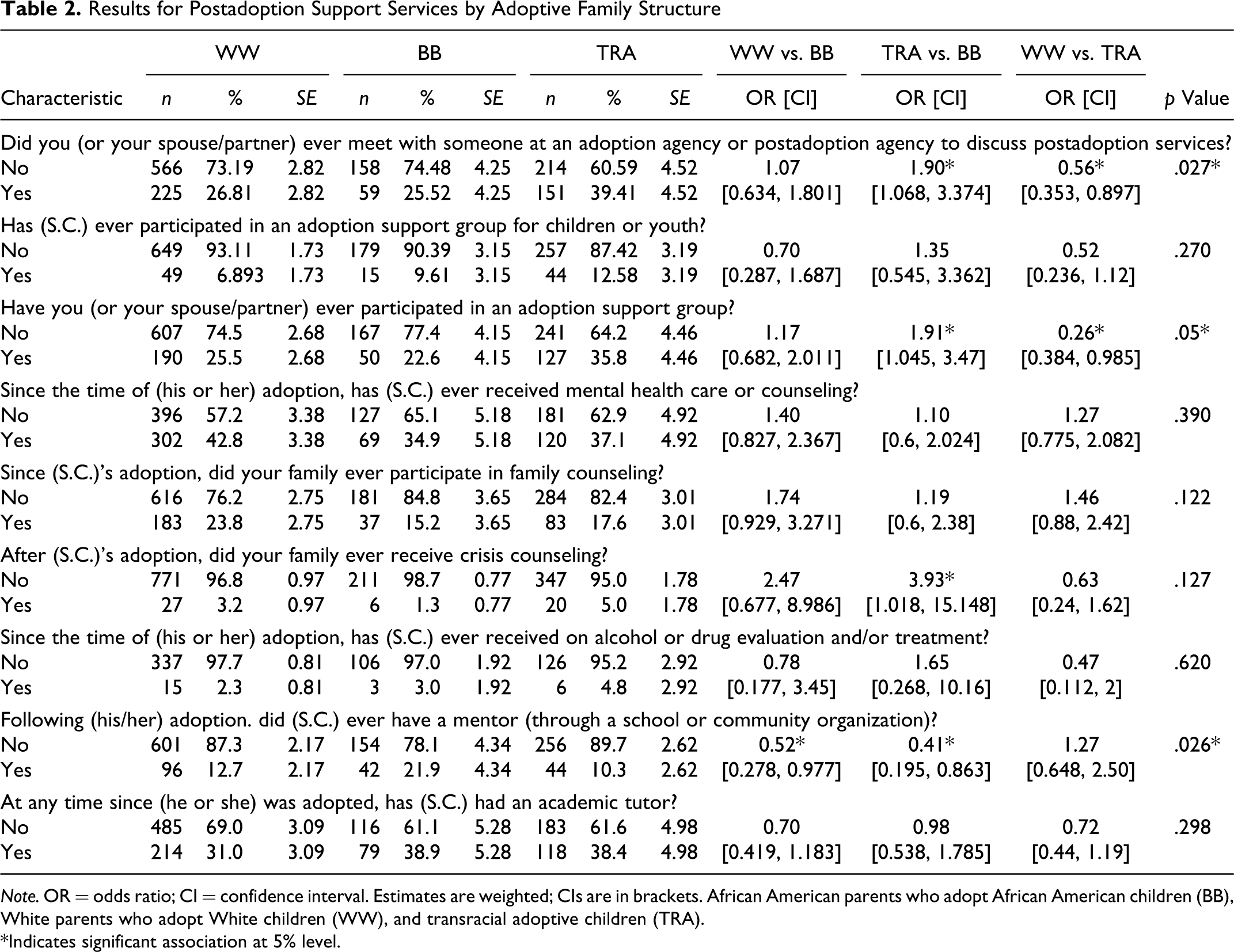
Note. OR = odds ratio; CI = confidence interval. Estimates are weighted; CIs are in brackets. African American parents who adopt African American children (BB), White parents who adopt White children (WW), and transracial adoptive children (TRA).
*Indicates significant association at 5% level.
Data Analysis
To begin, we note that the NSAP data set is based on a complex sampling design that involved both clustering and stratification. To account for this complex sampling design, the NSAP data set contains two variables that pertain to cluster and stratum. In addition, it also contains a weighting variable that accounts for such things as multiple telephone households, unit nonresponse, and other sampling issues. Therefore, in an effort to account for the complex sampling design, we incorporated these variables into all of our analyses and estimates. For example, all proportion estimates and analyses are based on weighted estimates. The statistical analyses were performed with SAS (v 9.1.3).
With regard to the actual analyses, the Rao and Scott (1981) chi-square test of association was used to compare the different demographic and nonfinancial postadoption service variables to the independent variable (i.e., adoption family structure). In addition, we also calculated odds ratios (ORs) and corresponding 95% confidence intervals (CIs) for each of the three possible pairwise comparisons (i.e., WW vs. BB, TRA vs. BB, and WW vs. TRA) for each nonfinancial postadoption service variable.
Results
Table 1 presents the estimated distributions between the various demographic characteristics and the adoptive family structure variable. We begin by noting that there does not appear to be any relationship between the three groups (i.e., WW, BB, and TRA) and the child’s gender or age. On the other hand, five of the variables (child has special health care needs, adoption type, ethnicity distribution for the TRA group, poverty level of household, and biological children) are noteworthy in the sense that their corresponding p values are less than .05. For example, Table 1 indicates that about 45% of WW and TRA adoptions involve children with special health care needs, while 29% of BB adoptions relate to such children. With regard to adoption type, the data indicate that the majority (57%) of WW adoptions are private, whereas the majority of BB and TRA (56% and 57%, respectively) adoptions are foster care adoptions. Concerning poverty level of the household, which was defined as household income relative to the federal poverty level, a near majority of WW and TRA adoptions relate to households where the income is more than 300% greater than the federal poverty level. On the other hand, roughly one third of all BB adoptions occur in households where the household income is actually less than the federal poverty level. We also see that nearly 70% of all BB adoptions involve families that have biological children, whereas this percentage is slightly greater than 50% for all WW and TRA adoptions. Note that a related variable, which pertains to any other children living in the household, also has a comparatively small p value (.063). Here, the percentage of “yes” responses across the three groups (i.e., BB = 62%, WW = 54%, and TRA = 69%) is similar in the sense that the BB group is relatively high. Finally, with regard to the ethnicity distribution for the TRA group, the goodness-of-fit test indicates that the distribution is not uniform across the different categories. For example, there appears to be a disproportionally low percentage of White American and Asian children involved in transracial adoptions.
Table 2 presents p values, ORs, and corresponding 95% CI results pertaining to comparisons between our family structure variable and the nine nonfinancial postadoption support services variables. Since the information presented in this table reflects our primary interest, we decided to also include the pairwise comparisons (i.e., WW vs. BB, TRA vs. BB, and WW vs. TRA) for each of the nine nonfinancial postadoption service variables. Similar to Table 1 though, we associate a notable finding with a p value that is less than .05.
From Table 2 then we see that there are three such variables; namely “met with someone at postadoption agency,” “participation in adoption support group,” and “mentorship.” With regard to the first noteworthy variable, we see that those involved with TRA adoptions are roughly two times more likely (compared to WW and BB adoptions) to meet with someone from an adoption agency or postadoption agency to discuss postadoption services. Similarly, those involved with TRA adoptions are approximately two times more likely to have actually participated in an adoption support group. Finally, concerning an adoptee receiving mentorship via a school or community organization, we see that this is approximately two times more likely for BB adoptions compared to WW and TRA adoptions. On the other hand, there does not appear to be any notable differences corresponding to adoptee participation in a support group, mental health care or counseling for an adoptee, family counseling, crisis counseling, alcohol/drug evaluation/treatment, or adoptee receiving an academic tutor.
We note that the analysis presented in this article involves several comparisons (i.e., tests). Although we recognize and are aware of the many different adjustments corresponding to this issue, we did not incorporate any of these adjustments into our analyses. For instance, because we are analyzing a publically available data set, there is really no practical way to account for the large number of people and corresponding tests performed. In light of this, we feel that the nature of our analyses should be interpreted from a more exploratory perspective. To this end, we identified noteworthy (as opposed to statistically significant) findings via p values that are less than .05 and acknowledge that some noteworthy associations may be due to chance findings stemming from the multiple comparisons.
Discussion
The primary purpose of this investigation was to examine the utilization of postadoption services among African American, transracial, and White American parents. The results of this study provide important insights regarding the types of postadoption support services often used by adoptive parents. For instance, the data analyses revealed that transracial adoptive parents were more likely to use support groups than African American and White American adoptive parents. Although previous studies have reported that parents, in general, who have adopted children are more likely to utilize general services (e.g., follow-up with the adoption social worker, support groups) instead of clinical supports (e.g., individual and family therapy), none of these studies documented the race and/or ethnicity of the responding parents (Wind et al., 2007).
The fact that transracial adoptive families utilize adoption support groups more than African American or White American families is important, given that the transracial families in this study were more likely to consist of White American mothers and fathers who had adopted children who were racially different (e.g., African American and Hispanic). It is important to note that recent national reports and studies (Butler-Sweet, 2011; Evan B. Donaldson Adoption Institute, 2008, 2010) on the experiences of transracially adopted children have revealed that racial minority children who have been adopted by White American parents often struggle with racial identity and other developmental issues. Other investigations have found that transracial parents were more likely to rate their children as more difficult to rear than were parents of same race children (Butler-Sweet, 2011; McRoy et al., 1984). Although the findings in this present study indicate that transracial parents are seeking support from other parents who have adopted children, this particular support method may not directly address the adjustment or psychological issues that the transracial parent or their children may be experiencing.
The finding that the majority of parents in this study underutilize clinical support services is also noteworthy. Although family adoption literature has highlighted an expressed need by adoptive parents for postadoption clinical services (e.g., Dhami et al., 2007; Evan B. Donaldson Adoption Institute, 2010), less than one half of the adoptive children in this study received mental health counseling since adoption. Notwithstanding, only one quarter of the participants received family counseling. At first glance, this finding could indicate that these parents may not be experiencing adjustment issues or concerns or were able to resolve them without clinical intervention. However, a deeper probe into this revelation may indicate a more complex issue concerning adoptive family involvement with the mental health system. More specifically, participants in this study may question the competency of counselors to adequately address adoptive family issues. Several research studies involving adoptive parents have documented their frustration in finding mental health counselors who are knowledgeable of adoption and family-related issues (Festinger, 2006; Riley, 2009; Wind et al., 2007). Moreover, Riley (2009) reported that some parents have sought help from as many as 10 different therapists before finding a counselor who understood the unique needs of adoptive families. Thus, the underutilization of family counseling services could be an indication that adoptive parents are apprehensive about seeking postadoption family counseling.
Finally, the finding that African American parents were more likely to have a mentor for their African American adoptive children is also worthy of discussion. This outcome is not completely unexpected, given that the use of mentors is often cited by researchers as an important tool in rearing African American children (Bradley & Hawkins-Leon, 2002; Hart, McAdams, Hirsch, & Bauer, 2001; Hurd, Moore, & Rogers, 1995). African American parents often use mentors to reinforce important parenting goals such as educational achievement, self-determination, and building a strong racial identity. This finding may reflect that African American parents are intentional in socializing their adoptive children in the same manner as their biological children.
Implications and Future Research
The findings from this investigation suggest important avenues for future research and counselor training. The discovery that less than a quarter of families in this study received family counseling despite frequent reports (e.g., Evan B. Donaldson Adoption Institute, 2010; Wind et al., 2007) that suggest adoptive parents were in need of clinical services warrants further study and deliberation. Future studies could examine the specific postadoption counseling needs of adoptive families. Further, a qualitative approach to this particular type of inquiry would enable researchers to explore the strengths of adoptive families and develop responsive counseling techniques.
It is equally important that future investigations examine the perceptions and training of family counselors regarding adoption and/or foster care in general and adoptive families in particular. Negative attitudes or lack of accurate information regarding adoption may cause undue harm to families who are seeking treatment from professional counselors. It is important to acknowledge that several studies have documented that counseling professionals may not have been adequately prepared to work with adoptive parents and their children. One study (McDaniel & Jennings, 1997) of family therapists in particular found that the majority of the participants (85%) did not mention or address specific adoption concerns in their analysis of a case study involving an adoptive family.
The significance of race in delineating the perspectives of adoptive families should also receive attention. The finding that transracial parents were more likely to use support groups and that African American parents were more likely to secure mentors or role models for their adoptive children provides a compelling reason for future studies to clearly articulate the race/ethnicity and culture of each adoptive family.
Mental health counselors are considered first responders in addressing the postadoption support needs of families. Failure to accurately respond to the counseling needs of adoptive parents could pose a permanent barrier to families receiving much needed psychological attention.
Footnotes
Declaration of Conflicting Interests
The author(s) declared no potential conflicts of interest with respect to the research, authorship, and/or publication of this article.
Funding
The author(s) received no financial support for the research, authorship, and/or publication of this article.