







Abstract
There exists a need to better understand the applicability of Marriage and Relationship Education (MRE) initiatives with diverse populations. This study presents findings from focus groups with Latino men and women (N = 16) who participated in MRE classes. A critical theory approach guided the researchers who used grounded theory methodology to analyze the group transcripts. From the participant’s words, two types of meaning categories were generated. The first category, “Cultural Values,” included shared values or cultural influences that were identified as relevant to how participants experienced the MRE course. These included values such as familismo or cultural obligation. The second category was “group benefits,” which included concepts that described ways that the MRE experience was helpful to the participants (e.g., emotional awareness and motivation for change). These categories and concepts are presented in a model depicting the cultural values as an overlay through which the group benefits were filtered. The model offers implications for class content (e.g., relevant portions of the curriculum) and process (e.g., the importance of offering the courses in Spanish). Other implications for research and practice are given.
Marriage and Relationship Education (MRE) programs are curriculum-guided approaches designed to give couples skills and information needed to develop and maintain successful relationships. More than 100 formal MREs exist today, and even more exist that are informal or adapted from existing curricula (Dion, 2005). Recent research suggests that MRE courses are generally effective, even among diverse populations (Hawkins & Fackrell, 2010). However, it is important to understand what makes these programs applicable to specific populations. For example, Latino populations have been targeted in many curricula and initiatives (Ooms & Wilson, 2004), but there is a gap in our understanding of what makes MREs effective with these populations (Hawkins, Blanchard, Baldwin & Fawcett, 2008). It is assumed that there will be elements of programs that will fit better for some populations than for others, but more needs to be learned about this.
Most MRE curricula address communication, conflict management, and problem-solving skills (Dion, 2005; Duncan, Holman, & Yang, 2007). Other topics addressed in MRE may include sexual intimacy, family-of-origin patterns, developmental changes in long-term relationships, empathy, commitment, forgiveness, negotiation and compromise, power and control, finances, safety, identifying destructive behaviors and patterns, trust, roles, values, and beliefs.
What seems to be lacking in marriage education is the cultural diversity of its curriculum. Since specific aspects of marriage differ according to culture and ethnicity (communication, conflict management, problem-solving, child rearing), it is difficult to tailor MRE classes that benefit each ethnic cultural background. The Hispanic culture is the primary concern of the current study.
MRE classes are usually targeted to heterosexual couple configurations but are sometimes adapted for religious settings, types of couples (e.g., remarried partners), or clinical practice settings (Adler-Baeder, Higgenbotham, & Lamke, 2004). Problems arise when a standard curriculum does not fit the experiences of diverse participants. Most of the implemented MRE programs, thus far, have served primarily White, middle-class, well-educated couples who were engaged or already married (Dion, 2005; Ooms & Wilson, 2004). Seeing this limitation, some MRE curricula have been adapted for other demographics, one of which is the Latino community.
MRE and the Latino Community
The Latino community faces different marriage stressors that result in a need for marital help. Common stressors that many individuals in Latino communities face include the “ … migratory experience, the loss of familiar surroundings and supports, adjustment to a new culture, employment instability, poverty, and substance abuse” (Hancock & Siu, 2009, p. 123). Also, many couples in these communities are from low-income families, which result in extra stress on their marriages. Some marital stresses include financial concerns, quality of relationship (whether they are “ready” to be married due to their financial concerns), and fear of divorce (Gibson-Davis, Edin, & McLanahan, 2005). Since the institution of marriage can be a concern for low-income families, it has been suggested that it may be important to address low levels of trust and commitment, prior abuse, forming and sustaining healthy marriages, high rates of nonmarital births, divorce, single parenting, and lack of exposure to positive role models for marriage (Dion, 2005; Gibson-Davis et al., 2005). Latino families may utilize MRE programs in ways that are specific to their culture, including applying lessons beyond the couple relationship to the broader or extended family (Daire et al., 2012).
Educational programs have begun to address these issues in Latino communities. According to the National Healthy Marriage Resource Center (NHMRC, 2011), “many programs have worked with Latino community leaders on recruitment strategies and hiring/training facilitators who speak the Spanish language and/or are familiar with the local cultures and communities.” Also, the NHMRC has developed a series of Latino curriculum modules that focus on aspects of Latino culture and beliefs that affect marriage and family issues. There needs to be MRE curriculum that addresses Latino communities, and also culturally competent trainers to teach them (Skogrand, Barrios-Bell, & Higginbotham, 2009). Hawkins, Carroll, Doherty, and Willoughby (2004) discussed this:
The more [that] instructors are familiar with the particular issues that participants face, the more credibility they will have. They will also be able to adapt and present curricular content to fit the lived experiences of participants most effectively. Latinos reflect many different cultural traditions related to marriage, and unless marriage educators understand these differences and can tailor instruction and program materials in relevant ways, they will struggle. (pp. 549–550). It is important to understand different values, customs, ways of life, as well as specific couples’ peculiarities related to the community to which they belong … [programs] can be more effective if facilitated by another Latino couple, or someone that has adequately developed cultural awareness and sensitivity to the Latino community—especially Latino men. It is important that couples are able to speak in their own language and relate to the experiences of the presenters.
Although helpful suggestions for Latino-friendly MRE programs exist, little is known about what the participants themselves would suggest. In part, this is because more emphasis has been paid to assessing program outcomes in marriage education than to systematically determining the characteristics of the participants (DeMaria, 2005). Also, the majority of research studies regarding these programs have used quantitative methodologies. While these methodologies are important and even preferable with large-scale data sets, qualitative methods of inquiry can add description and detail to the complex and important nuances that exist among cultures and those who speak about them.
The purpose of this study was to explore the experiences of Latino couples who have attended relationship education programs. Specifically, we addressed the following questions: (a) What was the impact or benefit of attending a relationship education course on their relationship? and (b) What types of cultural components did they identify as relevant to their experience in the MRE? It was expected that exploring these questions would accomplish several things. First, this type of critical research brings representation to these participants, giving voice to their experiences and stories in a way that further explains their uniqueness as participants (Charmaz, 2006). This can challenge the “one-size-fits-all” notion that is sometimes implicit in MRE programming (e.g., the assumption that what works for one relationship will work for all relationships). Second, it was expected that by asking Latino participants about their experiences, future classes might be better informed by this information. Finally, it was hoped that this information would help practitioners and researchers have more detailed information about Latino couples’ experiences with MRE so that future programs can improve and continue to be evaluated effectively.
Method
Daly (2007) suggested that in order to preserve the integrity of a study, researchers should articulate the epistemological stance they espouse before carrying out research. Accordingly, it is important to note that this study was informed by a grounded theory, subjectivist epistemology. By gathering data from the participants, we create a theory that is grounded in their experience of MRE classes, creating a more detailed understanding of the phenomenon (Creswell, 2007). This assumes that separation between what is known and the person seeking knowledge is impossible and that all knowledge is constructed (Daly, 2007). In other words, although we think that what we present is valuable and rich, we acknowledge that the role of those who interviewed and wrote up this report played an important part in shaping it. Also, since we are utilizing a critical theory approach, which can be “defined by the particular configuration of methodological postures it embraces,” it is helpful to be transparent about our assumptions (Morrow & Brown, 1994, p. 241). Also, one of the core components of critical theory is the advancement of the interests and goals of those who may not have equal opportunities due to race/ethnicity, class, or gender (Daly, 2007). Due to the underrepresentation of Latinos in the MRE literature and general paucity of culturally competent MRE programs, critical theory was determined to be a good meta perspective for the current study.
Sample
Participants for this study were eight Latino men and eight Latino women living in a large southwestern city who were in committed heterosexual relationships and had participated in a Preventions and Relationship Enhancement Program for at least 20 hr. Those who participated in the classes were given the opportunity to participate in a focus group to discuss their experiences. For their participation, they were given a gift card. All who participated were in committed relationships, with two cohabiting couples (together for 5 and 10 years), and six married couples (between 6 months and 20 years). All of the couples who participated had children. The relationship education program the couples attended was part of a larger, statewide initiative to provide MRE to low-income couples. Although the majority of these programs are delivered in English, participants for this study were part of a group in which the curricula was delivered in Spanish.
Instruments
Semistructured interviews were conducted during two separate focus groups (male group and female group) by a Spanish-speaking interviewer. It was the intention of the interview to gather as much information as possible with the help of a joining tool created by the meeting of gender. Men and women would possibly be more open and forthright in a same-gendered group. The interview consisted of several broad questions regarding what aspects of the program were helpful, which areas of the curriculum were lacking or nonexistent, what would be helpful if added, and what culturally competent components were useful.
Data Analysis
Analysis of the focus group interview transcripts was conducted using grounded theory techniques and a critical theory perspective, which typically involves collaboration between researchers and participants (Charmaz, 2006; Corbin & Strauss, 2008). One of the goals of the interviews was to solicit participants’ responses in their culture and language. For example, not only were the classes in Spanish, but the focus groups were also conducted in Spanish, which was seen as being very helpful by the participants. After the focus groups were transcribed, two members of the research team who spoke Spanish conducted the initial phase of analysis in consultation with other members of the research team. The two members who spoke Spanish agreed on the primary categories of the data and then consulted with the other members of the team. This involved immersion in the data (carefully reading the interviews) and then labeling them according to conceptual meanings or labels (open coding). Each transcript was read in its entirety using the “beginner’s mind” approach suggested by Corbin and Strauss (2008). As the coding continued, discussions were held between the coders and the other researchers to process the meanings and concepts that were emerging, which led to further grouping of concepts into subcategories (axial coding). Memos were kept throughout that tracked analytic decisions and process, which aided in the clear development of the theory (Charmaz, 2006; Corbin & Strauss, 2008; Creswell, 2007).
Reflexivity and Validity
In qualitative research and critical approaches, it is important to be reflexive about our presence as researchers. This was achieved through self-reflection and open dialogue between researchers about our experiences with this population and topic, as well as our own privilege and power. The memos were helpful in this regard, as we would track reactions, emotions, and thoughts that surfaced. This is also congruent with a subjectivist approach that acknowledges, up front, the constructed nature of research results. These results are presented in part as an effort to bring forth the voices of those who are disenfranchised, and we recognize that the process of researcher goals will, in part, drive this. The authors are all either faculty or doctoral students, and are thus educated with the privilege that comes with that. Three of the authors are Spanish speakers (with two of these having Spanish as their primary language), which was crucial in this study. In addition to using reflexivity, we used verification strategies to ensure trustworthiness and rigor of these results. These included using multiple coders for research triangulation, peer debriefing, and using an internal audit (Creswell, 2007).
Results
The model that resulted from the analysis (see Figure 1) depicts the main concepts organized within two primary categories. In our initial stages, these concepts tended to be divided by gender with some concepts being identified more with the men’s or women’s groups. However, as the analysis proceeded (in the axial coding phase), more overlap between these emerging themes was found and concepts were collapsed and refined. The final model shows the concepts that seemed to be relevant to all participants’ experience. The first category included the cultural values that seemed to influence the way in which participants understood and experienced the classes. The second category included the class benefits that encapsulated what many participants seemed to gain or take away from the MRE. The cultural values are portrayed as a filter or overlay to demonstrate the notion that participants described these values as lenses that influenced their perceptions of the class. These values, although depicted individually, are simultaneously present within most of the benefits experienced. The model is presented below, after which discussion of the various concepts will be presented. Translated quotes from the participants will illustrate the concepts that make up the model.
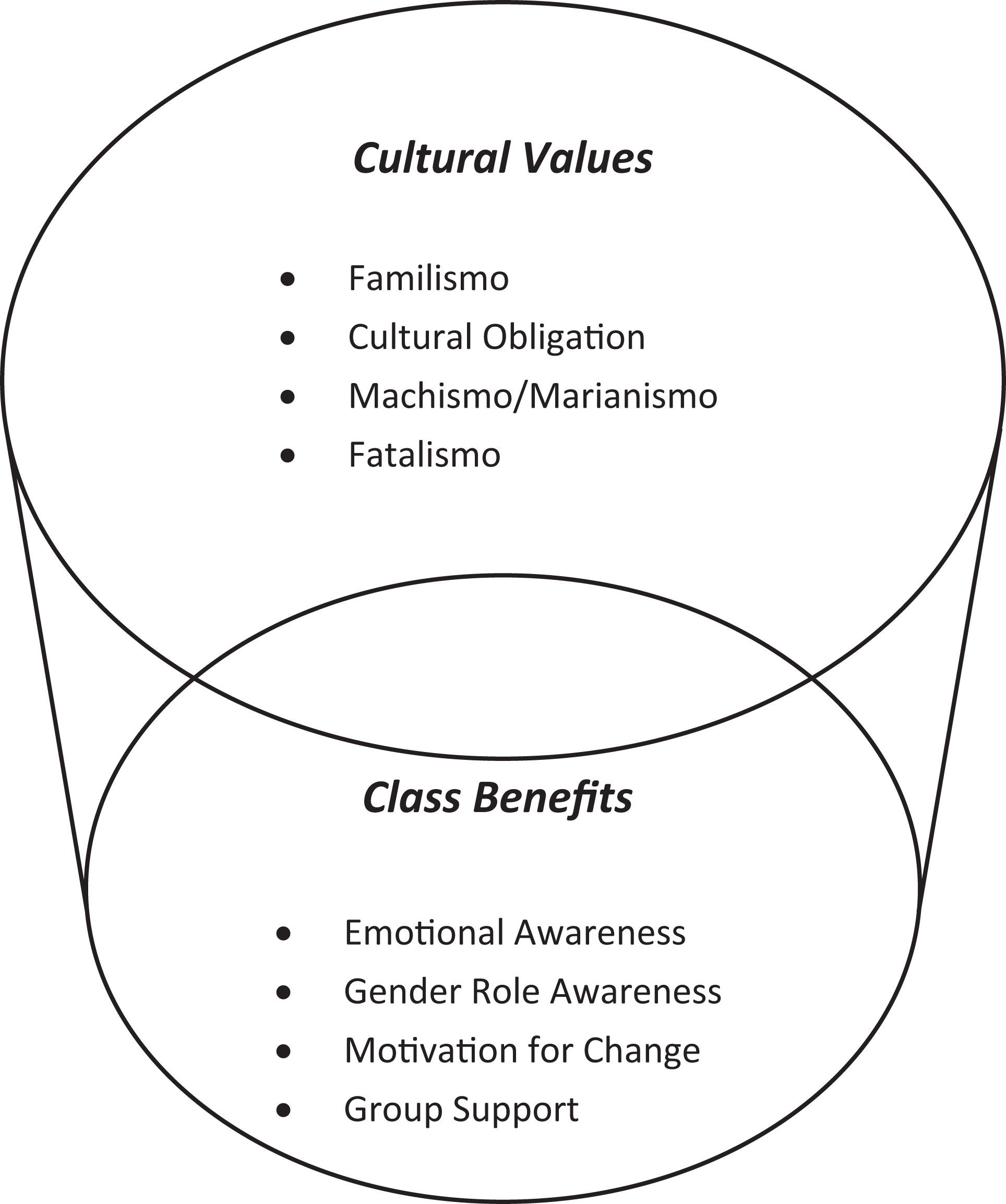
Latino participant’s experiences with MRE programs. MRE = Marriage and Relationship Education.
Cultural Values
Familismo
Although the MRE class that participants attended was specifically focused on couple relationships, the participants often talked about the impact on children and extended family. Not only were these mentioned, they seemed to be an integral part of the definition of familial and couple relationships. In addition, the value of children seemed preeminent above the value of the couple relationship or personal fulfillment. Feelings about the children seemed to dictate the activity of the couple beyond pragmatic considerations (i.e., strict guidelines for finding a babysitter, etc.). For example, one female participant commented experiencing “feeling guilty because we aren’t with the kids [during these classes].” Additionally, participants reported strict guidelines regarding with whom they were willing to leave their children. Another female participant explained this in this way; “If you want to go out to the club or something, you have to leave the kids with someone … but it has to be someone you trust. Because if something happens, it will be your fault.”
The way in which participants defined “family” was also dictated by the preeminence of the role of children. For example, many men were explicit in stating that children come before their partner. This was stated in a way that communicated the permanence of the parent–child relationship in comparison to the couple relationship. One participant stated, “my kids will always be with me, even if I decide to start a [romantic] relationship with someone else.”
Perhaps due to the permanence of this relationship, participants also communicated great concern for the well-being of their children. Specifically, participants seemed keenly aware of the impact of couple interactions and dynamics on their children. One male participant explained when a couple decides to separate “you [the parent] don’t carry the weight, the kids do. Like, when he leaves her or she leaves him.” Additionally, the impact of couple conflict on children seemed to be an important concern. Another male participant shared that conflict “when the kids are around is worse. Fighting in front of them sets a bad example.”
Cultural obligation
As participants discussed specific benefits of the class, many of them talked of how they could extend these benefits to others in their culture. There often was a sense of obligation and responsibility regarding who would benefit from the information they received. There were several specific groups of people participants identified whom they thought would benefit, with the group most frequently referred to being the youth. Many participants shared a desire for programs that would address relationship problems in youth before they began. They also highlighted possible benefits youth would receive by learning from the experiences of those who have gone before. One participant shared it this way:
It has to start with our youth … they’re getting divorced at 17, 18 years old. They already have kids, and they’re looking to start another relationship … and then the first kids can’t see their mom because the new girlfriend doesn’t want her around.
Y hay que empezar con los jóvenes, yo digo que estos programas tienen que empezar con los jóvenes, porque desde que empiezan ya … a los 17, 18 años ya se divorcian, ya tienen dos niños, ya para empezar a hacer otra … le vuelven a hacer otro niño y pues ya no puedes ver a la otra y …
Participants also conveyed instances in which they shared information from the program with specific friends or relatives. One male participant shared his experience this way:
You take what you learn and you share it with others … I have a friend from work who told me he was fighting with his wife. I told him ways to get through it and he just told me he decided to stay with her and work through it.
Pues las pláticas han servido de, pues, bien para uno porque pues lo que uno no sabía antes, pues ahora lo … y lo compartes con los demás, porque la semana pasada, tengo un amigo que trabaja ahí. “Fíjate que me peleé con la ( … )” dice. “Ah, pues.” Y le digo … Uno empieza y le dice de lo que uno … Lo bueno es vuelve con ella, habla con ella y resuelve tu problema
Many participants were willing to help these types of programs get offered to more people. Throughout the discussion, participants shared beliefs that the dissemination of such programs was dependent on community interest and money. Many also shared that despite the lack of resources, they would volunteer their time to ensure these programs reach those who need it. Within this willingness, there seemed to be a sense of obligation to share what was given to them. One participant shared his willingness this way:
If there aren’t enough votes to run another program, call us all up and we’ll all get together, bring food, whatever. Just as long as we can keep this going so others don’t have to wait as long as we did.
Machismo/marianismo
Two of the constructs common in the literature on Latinos in general are machismo and marianismo. Generally, these terms are used to describe gender differences in the Hispanic culture. Machismo is commonly referred to as an excessive display of manliness, from virility to chauvinism, while marianismo is the display of the feminine aspect that stems from virgin virtues—pure, strong, and subdued—as if imitating the Virgin Mary. In this study, machismo was expressed explicitly by several participants as either the cause of certain attitudes or used as a reference for certain examples of behaviors and interactions. For example, one participant stated, “I think before it was the norm for women to stay at home. That was due to machismo.” Several male participants discussed how they tried to transcend traditional machismo-influenced conceptions of Latino manhood by becoming more accepting of their wives working outside the home. One stated his stance on equality, “I’m okay with her working or not working; either way.” Many of the female participants stated that men generally did not offer to help around the house. Men did not bring this up in the same way.
Female participants often reported that their expectations with regard to work in and out of the home were overwhelming. This perceived expectation illustrates marianismo, which appeared often in discussions of men’s and women’s roles in the couple relationship and family. Marianismo included references to various duties women had as part of their culturally designated role. For example, some participants emphasized women’s sacrificing for the good of the family. Similar to the male participants’ flexibility with cultural norms regarding machismo, females seemed as willing to depart from those same cultural norms regarding marianismo. For example, the women acknowledged how they were not bound to household duties—those duties could be shared with their husbands. Further discussion of these themes occurs later in the results discussing gender role awareness from the MRE classes.
Fatalismo
The fatalismo theme emerged from participants’ descriptions of fate as a phenomenon in their relationships. Culturally, fatalismo means that things happen for a reason or that there is a power greater than them at work in their lives. Sometimes this was referred to specifically as “God,” while at other times participants used the phrase “God willing” after sharing news about events (e.g., birth of a baby). Additionally, the term “thank God” was also used frequently, seemingly indicating that the outcomes of certain events were dependent upon God’s will, as in this example, “Only God can prepare me to help [my son].” Some of the participants referred to fatalismo in ways that were not explicitly religious. As one stated, “There is a reason we attended the group.” Others expressed a sense that there was no reason to fight fate or that things were outside of their control and that is just the way life is.
Specific Benefits of the MRE Course
Emotional awareness
Many participants mentioned that the classes were helpful to them in becoming aware of their own emotional experiences during interactions with their partners. Whereas men seemed to emphasize awareness of their own emotions, women seemed to achieve awareness of their own and their spouse’s emotional experience. Additionally, women were able to articulate important gender differences in the way emotions are handled. One female participant shared:
In the program, we started to talk about … how we have to respect each other; the women respect the men and the men respect the women. The reason being men are not as sensitive as women are, and it is difficult for them to understand why we nag, why we are sensitive, and why we cry so easily.
Y en el programa, empezamos a hablar de las diferencias y cómo hay que respetar; la mujer, al hombre y el hombre, a la mujer. Porque el hombre no es tan sensible como la mujer, y es muy difícil que ellos entiendan porque, por qué estamos molestas, por qué estamos tan sentimentales, por qué estamos llorando de repente.
Another female participant suggested:
Men do not share their feelings; that is why we are different. So, this program helped to process those differences, and to help understand that every human is different; each mind is a different world. Couples should say, “okay, you think like that and I think like this. Lets meet in the middle; be in agreement, and live in harmony.”
Que los hombres no comparten porque estamos hechos diferente. Entonces, este programa ayudó a descifrar esas diferencias, pero para ayudar a comprender por qué cada humano es diferente, cada cabeza es otro mundo, hay que sentarse la pareja y “Okay. Tú piensas así. Yo pienso así.
One concept that seemed particularly salient among the women was being left with the emotions. During intense emotional interactions, many women reported that men were able to leave emotions behind by engaging in distracting activities, while the women were left to clean up the emotional mess. One woman said that, “with women, the sentiment stays with us and we want to talk about it, relieve ourselves from it.”
A lot of men keep their anger bottled up, and they don’t want to talk about it because it will make them more angry. They go find ways to blow off steam. With women, we’re stuck with the emotions and all we want to do is talk [and] vent. In the program, we talked about these differences … how we both need to respect our differences. The program helped us to identify and respect our differences, both men and women.
Se enojan y, es muchos hombres pueden tener ese coraje dentro y. No quiero ni tocar el tema. Se van, se enojan … no sé, se van a … jugar billar. No sé. Hagan lo que hagan, verdad, lavar el carro, equis. Eh, revientan y ya se les quitó y uno, como mujer, se te queda el sentimiento y quieres hablar, te quieres desahogar. Entonces, ellos tienen que entender las diferencias. Y en el programa, empezamos a hablar de las diferencias y cómo hay que respetar; la mujer, al hombre y el hombre, a la mujer
What happens a lot of times is you want to be together and you love each other with all your heart, but … [men] don’t want to talk. You are left with strong emotions and they don’t go away. One emotion leads to another. They grow stronger and stronger and you feel his anger, too. You get to a point where, even though you love each other, you can’t work on it any more, you haven’t been able to communicate and bam! You explode. I realized all that in the program.
Es que lo que pasa es que muchas veces deseas estar y amas a la persona con todo tu ser, pero, como dice ella, ellos no quieren hablar, tú lo dejas aquí el sentimiento, no se te quita, pasa otra cosa, otro sentimiento, va creciendo y creciendo y el coraje de él también. Llegas al punto aunque se amen, ya no puedes trabajar nada, no hubo comunicación y zas, explota. Todo esto en el programa yo me di cuenta.
Additionally, the concept of emotional awareness was related to the techniques that participants learned. Participants shared examples of situations in which they would have previously become angry, but no longer do. It seemed as though a deeper understanding of emotional reactions facilitated participant’s ability to identify and avoid counterproductive interactions. One participant described, “You think a little more about things also. That helps you avoid causing bigger problems.” The concept of counterproductive interactions also seemed to be culturally embedded. One participant expressed this in the adage, “en vez de gritar, mejor es calmado, hablar” (it is better to calmly speak than to shout).
Beyond anger, more positive emotions were also an integral part of the emotional awareness category. These emotions seemed, in many instances, to represent the counterparts to anger and frustration. For example, participants emphasized the importance of replacing anger with patience. One participant stated, “What was helpful for me was having more patience with my partner … more patience so bigger problems don’t develop.” The process of managing emotions that could potentially lead to counterproductive interactions and replacing them with emotions that facilitate positive interactions is encapsulated in the statement of one participant: “You need to develop self-control.”
Gender role awareness
Men and women became aware of gender roles in multiple contexts through their participation in the classes. Gender themes presented in other categories are already discussed (i.e., emotional awareness, machismo/marianismo), but this concept of gender role awareness refers to the way participants described the impact of the classes on their perceptions of gender roles. For example, several participants described the difficulty of navigating cultural beliefs about men and women, and how the class helped them address these areas: One female participant described the process:
It has been a battle to get where we are because if I’m doing one thing, I can’t be expected to do something else at the same time. I tell [my husband], “even though you think I’m Superwomen, I’m not. I need your help.”
Pero ha sido una batalla para llegar a ese punto porque si yo ya me estoy haciendo cargo de esto, no puedo hacerme cargo también de esto. “Le dije, “Aunque creas que yo soy Superchica, no soy. Tienes que ayudar.”
I broke my leg and now she is the one who works and takes care of things … in financial matters primarily. I’ve got my little side jobs … I try to help her. When she is on her way home, I’m heating up her food for her … I try to help her as much as I can.
Pues en mi opinión, a mí me ve mucho ( … ) porque me fracturé una pierna, y ella es la que trabaja, se encarga de todo. De pagar, sobre todo. Tengo mi trabajito, … yo trato de ayudarla. Cuando viene en camino, yo estoy comiendo, le caliento … trato de ayudarle un poquito más.
Motivation for change
This is a theme that was more evident in the male participants. It occurred when individuals identified how being in the group and connecting and learning with others was an impetus for trying harder in their relationship. These included direct references to their enthusiasm to change; “[The class was] a good thing … a way to better our marriage. To make it last longer,” but also more abstract ways of conveying a renewed desire for change because of the class. These references are embedded throughout some of the other categories. For example, the way men described achieving emotional awareness also communicated an awareness of personal efforts made to change past behaviors. One participant shared how important he feels it is to “keep myself, and myself only, under control when we fight.” Another shared how he has learned “knowing when to take control of my emotions is something new.” Some of the motivation to change described by participants also illustrated their cultural gender lens. For example, many men claimed to have learned less machismo-driven behaviors from the groups. One participant shared:
I think that [machismo] was used before when women didn’t work, that was machismo. Now, all the women, almost all the women work. In my house, I just work. For me, it’s fine that she doesn’t work or if she does, it’s also fine, blah.
Y pienso que eso que se usaba antes que la mujer no trabajaba, eso era machismo. Ahora todas las mujeres, casi la mayoría trabajan. En mi lugar, pues yo nomás trabajo. Para mí está bien que ella no trabaje y si trabaja ella, también, bah.
Additionally, many women emphasized their efforts in persuading their spouses to attend the program. This involved overcoming preconceived notions the men held prior to attending the classes. Women shared the ways in which they focused on changing as a couple rather than obligating men to change. One participant stated, “You think, ‘I don’t want to go so they can tell me how to behave.’ But once you’re here you realize, ‘they aren’t attacking me.’ They are telling us [we are] both at fault and how we can make it better.”
Group support
Often motivation seemed to arise from another category, which was ultimately labeled group support. For men, the support experienced was related to learning from others and gaining perspective through hearing the problems of other couples. This sharing seemed to help individuals (especially men) feel a sense of familiarity and connection. Not only did this occur in the class, but during the focus group interview as well. For example, throughout the transcript, unique cultural phrases and references were expressed as a way of connecting and supporting one another. One male shared how he “felt good after talking through things with other people, about other families … you leave with something … I don’t know, different.” This highlights how MRE classes have a support component. Some referred to times in which they were in conflictual situations and “remember[ed] what [they] experienced in the group.” Additionally, several of the male participants shared how other’s experiences helped to contextualize their own experience—to put things into perspective. One participant said:
You learn from others’ problems … you think your problems are big, but then you see everyone else’s problems and you say, “Look, he has this problem.” And other’s problems are bigger than yours, and you say, I can overcome my problem.
Aprendes de los problemas … piensas que el problema que tú tienes es grande pero miras a los demás y dices: “Ah, mira, aquél tiene este problema.” Y es más grande el problema de los demás que el tuyo y dices: “Pues el mío lo puedo superar.”
Discussion
According to the literature on the effectiveness of MRE programs, couples who participate benefit on different levels (Adler-Baeder, et al, 2004; Olson, Larson, & Olson-Sigg, 2009). From this research exploration of the benefits of MRE in a Hispanic population, it appeared that these benefits are influenced by Hispanic culture itself. Throughout these interviews, Latino themes, such as religious references, the primacy of family relationships (specifically parent–child relationships), or culturally supported gender roles, shaped the way men and women made sense out of their experiences in their relationships and in the classes. This has implications for those who create and lead these classes.
Implications for Practitioners
Gender
It was interesting to note that despite the focus groups being separated by gender, and each having different facilitators and styles, there was considerable overlap between the concepts that were found between the groups. Nevertheless, there were often differences in the way men and women talked about the themes. For example, the men discussed machismo in an avoidant way—as if other men demonstrated the negative aspects of machismo more than they did. However, when the women referred to machismo, it was a direct reference to their own spouse or partner. This may suggest a disconnect that may be interesting for MRE to address in a Latino-themed curriculum. The themes of machismo/marianismo and gender awareness were among the richest themes in this study, which again suggests that this area may be fruitful for discussion in a class. There was a general sense that these were among the most important discussions and discoveries in the class. Although these women at times reported a reluctance of their male partners to come to a class such as this, it seemed like these men reported having a positive experience with the classes. This may have recruiting implications (e.g., targeting Latino men with testimonials from other men) and also may give encouragement to those who are concerned about reaching this target population.
Culture
Culture is portrayed in this study as an overlay category because of the prominence with which it was mentioned. This is in part because it was a focus of the study, and therefore was asked about, but it genuinely seemed to be important to these participants. For example, multiple times the importance of having the class offered in Spanish was mentioned. There were also multiple references to the fact that several thoughts and emotions did not translate well into English (this was an issue in the analysis as well). Some participants even reported feeling disconnected from the one couple in the program who spoke English.
Other benefits
The positive experience that these participants had with their classes is encouraging for those who are creating and leading them. There were many things that these individuals found helpful that were consistent with other research: raising awareness of emotions, gender, feeling motivated (Hawkins et al., 2008; Olson et al., 2009), but there were also things that seemed particularly relevant for these groups. For example, the finding that many wanted the classes to benefit others in their family and culture was similar to other research that shows that some Latino couples take these classes and pass the information forward to their children to help those not in attendance at the MRE course (Daire et al., 2012).
Another thing that seemed particularly helpful for these participants was the group process component. The act of sharing and being with others in a similar situation was very important and for many was motivating and inspiring. More research would need to be done to verify if indeed the process nature of the group is preferable to a Latino audience than a less process-focused method of content delivery.
Limitations and Future Directions
Although this study highlights several important points in regard to MRE aimed at a Latino population, there were limitations to the study that would be well to address in future work. Considering the size of the current sample, it would be helpful to have additional focus groups to discuss this issue. Also, since the groups were separated by gender, it is possible that themes related to gender were overemphasized since groups of women or men may tend to talk about similarities and differences in a more exaggerated way. Also, the separate groups will inevitably take different directions due to leader differences and systemic dynamics that emerge. This seemed to be the case in as we reviewed these manuscripts. At the same time, however, separating the groups by gender might also encourage less reactivity between couples or between men and women who both indicate having different experiences of the same MRE. Additionally, one of the groups had some limited technical difficulties with the recording, which resulted in some scattered sections that were unintelligible and therefore may have affected the depth of certain quotes or themes. Future research might include individual interviews or mixed gender groups to see what types of group dynamics may have been influencing or reinforcing some of the themes that we found here.
While benefits from the program were appreciated, both the groups expressed the need for a portion of the program that focused on sex and parent education. As mentioned, family is of high importance to the Latino culture, specifically children. Therefore, in considering culturally sensitive programs, it may be helpful to add MRE components that focus on parent education and parent–child relationships. Further, MRE programs targeting a Latino audience would do well to help the couples understand the host of benefits that children receive when their parents are in a healthy, stable relationship. In addition to the filial component, focusing on sexual intimacy may be valuable. As referred to by the men’s group, there are implementations of sexual expectancies that are related to the cultural phenomenon of machismo that can be a significant source of stress between partners.
It is important for future research endeavors with a bilingual population to be sensitive to how language and culture are interrelated. For example, participants in this study repeatedly praised the value of holding classes and interviews in Spanish. This has implications for the overall importance of a curriculum being culturally sensitive. Including a Spanish-speaking facilitator from the same Latino community was also heralded by this group as a manifestation of the “cultural” connection the program made with participants. As researchers, we acknowledge that it is difficult to separate what perceived benefits of participation were the result of offering the courses in Spanish versus offering a curriculum that was specifically designed to speak to the unique cultural experiences of Latinos.
Future quantitative work could address some of the questions that have arisen from this study. For example, are there differences between Latino men and women in the amount of reported satisfaction from MRE classes? Are there different types of benefits gained? How do Latino populations tend to view marriage as compared to other ethnicities and what does this suggest for classes? What are the policy or advocacy implications for culturally competent programs? As mentioned, these participants offered many opinions that highlighted what participants gained from participating in the MRE class. At times, these seemed closely tied to the cultural values as previously discussed, but many of these benefits were typical of others who have attended MRE classes.
Future studies could also benefit by including the couple together in the interview process. In analyzing how MRE is beneficial for a Hispanic population, themes of marianismo and machismo emerged. How different would these themes have looked in the presence of their spouses and other men and women? In addition, how would these themes intersect with expectation of marianismo and machismo in future generations?
Footnotes
Authors’ Note
Any opinions, findings, conclusions, or recommendations expressed in this material are those of the authors and do not necessarily reflect the views of Texas Health and Human Services Commission.
Declaration of Conflicting Interests
The author(s) declared no potential conflicts of interest with respect to the research, authorship, and/or publication of this article.
Funding
The author(s) declared the following financial support for the research, authorship, and/or publication of this article: This research was supported in part by the Texas Health and Human Services Commission # 529-07-0136-00001B at Texas Tech University.