







Abstract
Despite rapid technological development, very few new technology-assisted tools have been developed specifically for use in family services. This article describes a new, mobile-assisted working model designed to enhance the quality of daily family life. The model has its origins in the existing research on daily family life and on the diary method, which has been widely used in data collection in family research. The model provides support for the daily life of client families in the intervals between meetings with family counselors via the use of text messages. The pilot study explored family members’ and family counselors’ experiences of using the model. Data on 26 parents and four children participating in the new mobile-based service were collected via feedback text messages and web questionnaires. The research findings are also based on interviews with family counselors (n = 6). Although clients’ experiences of the model varied widely, the results show that, in general, it was regarded as effective in invoking reflection, keeping the goals of family counseling in mind and implementing family practices at home. On the basis of the experiences of the family counselors, the mobile-based working model offers a new, systematic, and structured tool for use in working with families and monitoring processes in families.
“What positive feedback did you give your child today?” “Describe one situation today at home when you succeeded well in setting your child limits.” Could motivating and reflective diary questions of this kind concerning daily family life, sent to the mobile phones of parents, empower and strengthen them in their role as parents? Could family counseling be enhanced by activating family members at home during the intervals between family counseling sessions? In this article, a new, mobile-assisted working model designed to help families who need support and guidance in parenting and daily family life is presented. This framework for supporting families is based on research on daily family life and the use of diaries in a research context. The article presents results of a pilot study in which the working model was tested among parents and children, who were clients of a family counseling service.
Diary methods are nowadays widely used as research methods in several disciplines. The idea of using the diary method as an intervention tool comes in part from the participants of a previous family study by the authors of this article in which they used diary methods of different types to study daily family life in families with young children (Lämsä, Rönkä, Poikonen, & Malinen, 2012; Malinen, Rönkä, & Sevón, 2010; Rönkä, Malinen, Kinnunen, Tolvanen, & Lämsä, 2010; Rönkä, Malinen, & Lämsä, 2009). In this study, parents were asked, on a daily basis, to report their moods and interaction with their family members. In their feedback, some participants mentioned that they found keeping a diary an inspiring experience. In their own words, they started to pay attention to, for example, the amount of time they spent with their family members or the positivity of the feedback they gave their spouses. Some reported that their behavior had changed. It seemed that, by a happy accident, a new way to support parenting had been found. Inspired by this finding, the authors of this article commenced systematically to develop a new working model for family services. At the same time, other researchers in the areas of health promotion and rehabilitation had come to similar conclusions about the possibilities of using electronic diaries to enhance therapy and self-healing (see Fjeldsoe, Marshall, & Miller, 2009). Currently, mobile diaries are widely used in health promotion and rehabilitation, but research on their effectiveness is scarce. Despite rapid technological development, very few new technology-assisted tools have been developed specifically for use in family services.
Calls for new methods of supporting families have come from family interventions, where the existing programs reach only relatively few families (Sanders, 2008). According to Kumpfer and Alvarado (2003), science-based parenting programs have not been widely enough adopted by community agencies. In particular, there is a need for low threshold family interventions that could target larger populations of families. To achieve these aims requires more cost-effective tools such as are offered by the new social media (Sanders, 2008). One key challenge in developing new methods for clinical work is to improve transfer of the abilities acquired in a therapeutic session to everyday life (Perrez & Hänggi, 2012; Preziosa, Grassi, Gaggoli, & Riva, 2009).
Theoretical Background: Daily Approach to Family Life
The daily (or everyday) approach, utilized in this study to better understand family life, has found increasing favor among family scholars in recent years (Larson & Almeida, 1999; Larson & Richards, 1994). Several researchers (Daly, 2001, 2003; Larson & Almeida, 1999; Rönkä & Korvela, 2009) have contributed to its development with the aim of complementing the so-called traditional family theories (such as family systems theory, life course theory, and ecological theory; see Day, 2010). The aspects highlighted by the daily approach and less emphasized by traditional family theories include, among others, emotions, activities and routines, and their daily and weekly variation (e.g., Almeida, 2005; Larson & Almeida, 1999; Rönkä & Korvela, 2009). Furthermore, an aspect of particular relevance in the daily approach is the use of time and different temporal aspects of family life, such as rhythms, key moments, and rush or calm hours (Matjasko & Feldman, 2006; Schulz, Cowan, Cowan, & Brennan, 2004). One focus made possibly by this approach is on moments or days in the lives of families with a view to finding out why certain periods and moments in family life are hectic and challenging while at other times things go much more smoothly (Sevón, Malinen, & Rönkä, 2014). In trying to seek factors that account for the difference between these two poles, and especially for satisfactory family life, the daily approach offers a solution-oriented perspective on family life useful for developing family interventions, as noted by Rönkä and Korvela (2009).
In applying the daily approach to family life, the following question arises: What generates a satisfactory family life on a daily basis and how might this be enhanced? Recent years have seen tendency for family researchers and practitioners to shift their main focus from challenging situations and problems to positive aspects of family life (e.g., DeFrain, Asay, & Geggie, 2010; Fincham & Beach, 2010). Concepts embracing the positive sides of family life include family resilience (e.g., Farral & Arney, 2010), daily uplifts (e.g., Totenhagen, Serido, Curran, & Butler, 2012), gratitude (Emmons & McCullough, 2003), and relationship flourishing (Fincham & Beach, 2010). Similarly, the literature on relationship maintenance (e.g., Dindia, 2000), positive parenting (Sanders, 2008), and parenting interventions (Kumpfer & Alvarado, 2003) is occupied with finding daily activities that make family relationships work. It could be said that an almost exclusive focus on the negative sides of family life—which was, to a considerable degree, earlier the case—limits our understanding of family life, even at best, to only half of the picture. As Fincham and Beach (2010, p. 7) suggest, “Relationship health is not merely the absence of relationship dysfunctioning, just as the absence of a physical illness is not sufficient to define physical health.” These researchers argue further that in the context of couple therapy, one reason behind the low effectiveness of such treatment and the high prevalence of relapse may be the inability to understand relationship flourishing.
On the basis of the research literature on the daily promotion and maintenance of family relationships (e.g., Fincham & Beach, 2010), there are several things that family members can do to enhance a good atmosphere and a satisfying family life. The following examples, covered by the working model presented in this article, illustrate the wide range of ways in which this can be done. The first is to boost positivity in the family. This includes, for example, giving positive feedback, such as expressing gratitude, to other family members. Constructive communication between family members also includes listening to other family members’ points of view and talking together (see, e.g., Halford, Markman, Klinen, & Stanleys, 2003). This finding has been well documented in research on positive parenting, parental interventions, and couple relationship maintenance (see, e.g., Gordon, Arnette, & Smith, 2011; Rusbult, Olsen, Davis, & Hannon, 2001; Sanders, 2008). Second, there is considerable evidence to show that the amount of time spent together with other family members is related to positive outcomes in both children and couples (see, e.g., Canary, Stafford, Hause, & Wallace, 1993). The existence of common rituals and traditions such as meal times and common activities makes shared family time possible. A third way of enhancing a satisfactory family life is spousal sharing of tasks and responsibilities and working as a team (see, e.g., Malinen et al., 2010). A fourth way concerns coping with daily hassles and recognizing daily uplifts (see, e.g., Totenhagen et al., 2012). These hassles and uplifts can be both family-related and also external to the home context. Family members bring home with them both positive and negative effects of events experienced during the course of the day, indicating the need to be able to manage this emotional transmission (Larson & Almeida, 1999).
The Diary Method in Research and as a Tool for Change
Diaries of various kinds are widely used in data collection in several disciplines, including medicine, psychology, and family research, especially research on daily family life (see Mehl & Conner, 2012). The idea of the diary method is to study the phenomena of interest intensively with repeated measures over a short period of time, such as several times a day over the course of a week (e.g., Bolger, Davis, & Rafaeli, 2003; Laurenceau & Bolger, 2005; Perrez, Schoebi, & Wilhelm, 2000; Schneider, 2006). The diary method, including repeated assessments, is especially suited to the study of daily family dynamics, for example, in terms of rush hours and to emotional spillover and crossover (Rönkä et al., 2010). The main benefit is to obtain memory-unbiased, situation-specific information on, for example, daily emotions, interactions, and use of time. Further strengths of diary methods include the access they give to everyday family situations and the opportunity to hear the different voices in the family (Larson & Almeida, 1999; Larson & Richards, 1994). Huge strides are currently being taken in the development of diary methods and the tools used to gather diary data (Intille, 2012). The paper-and-pencil method has been replaced, or at least complemented, by a variety of new technological tools—in addition to the mobile phone discussed in this article—for data collection such as pagers, palmtops, and iPads (Perrez et al., 2000; Rönkä et al., 2010). Besides diary methods, experience sampling methods or ambulatory assessment methods are used by scholars to refer to tools used for intensive repeated measurements in naturalistic settings (Conner & Mehl, 2012).
Apart from research, mobile diaries have, during the last few years, been increasingly utilized in health care and health promotion, rehabilitation, and therapy (for a review, see Fjeldsoe et al., 2009; Heron & Smyth, 2010; Preziosa et al., 2009; Trull, Ebner-Priemer, Brown, Tomko, & Scheiderer, 2012), for example, in interventions aiming at smoking cessation and self-healing of asthma and diabetes. Mobile diaries have dominantly been used as a tool for information gathering (e.g., using short message services [SMSs] for collecting information about clients’ health behaviors), but some have also utilized the potential of mobile diaries as a tool for change and in implementing interventions (e.g., using SMSs for distributing information about to clients on the consequences of alcohol abuse). In the area of family counseling and other family services, electronic diaries continue to be little used in practical work, despite the rapid development of technology and the fact that their adoption is highly recommended in the most recent discussions in this field (Trull, 2007). Pioneers in the use of new technology-assisted methods in clinical work with families include Meinrad Perrez and his colleagues in Switzerland (see Perrez & Hänggi, 2012), who have used SMSs in preventive work with families, for example, to remind parental training group participants to do their daily homework. Traditional paper-and-pencil diaries have been used, for example, in evaluating and monitoring the parent–child relationship (Dozier, Higley, Albus, & Nutter, 2002). Homework in between family counseling sessions is also common in family therapy and parental groups to enhance between-session therapeutic activity (e.g., Kazantzis & L’Abate, 2007; Kumpfer & Alvarado, 2003), a procedure that shares many features with the use of diaries in the clinical context.
Diaries are useful in the context of family counseling and services for several reasons. Previous studies show that the mobile phone as a way to send supportive text messages to clients offers a good possibility to bridge the gap between inpatient and outpatient care. According to Preziosa et al. (2009), the mobile phone is especially effective in enhancing the therapist–patient bond, so that this does not collapse when the client leave the therapist’s consulting room. Furthermore, mobile phone can assist the client to cope with everyday situations in an autonomous way while improving transfer to everyday life of the abilities acquired by the client in the therapeutic setting. According to Blake (2008), mobile phones as a tool are cost effective and wide reaching, while they easily target large samples and hard-to-reach groups. Blake finds that the method has the potential to make a major contribution to health promotion and patient care, for example, via modification of lifestyle and monitoring. Empirical findings showing that daily reporting of positive experiences seems to strengthen family relationships and increase well-being also support the use of diaries in clinical use. According to Lambert et al. (2013), the strength of daily reporting lies in its ability to enhance or “boost” positive family experiences. They found that the positive effect of daily reporting increased if the positive moment was shared by the couple (Lambert et al., 2013). Emmons and McCullough (2003), in turn, have shown that simply making a daily gratitude list clearly increases a person’s well-being and prosocial behavior. Further, Fincham and Beach (2010) note that the power of positivity lies in its cumulative effects, and thus that a focus on daily life is needed. An association has also been found between daily working to change the couple relationship and good relationship quality (Young, Curran, & Totenhagen, 2012).
Aims of the Study
In this article, a new, mobile-assisted working model for use in supporting families is introduced. The model and the web program are presented in general, and the development and piloting of the model in clinical work with families are described. Results on the usability and significance of the model from the perspectives of different family members and family counselors are also reported: How do clients (parents and children) and family counselors experience the working model? Is it helpful? Does it activate and involve all family members?
Method
Description of the Mobile-Assisted Working Model
The new method described in this article utilizes the software “eFamily coach,” which is a web-based program adapted for mobile devices. eFamily coach comprises a pool of evaluative and interventive questions. The software was developed by the authors of this article in cooperation with a mobile technology firm, and a group of information technology students were also involved in developing the prototype of the program. Family counselors were involved in the development process by commenting on the prototype and giving feedback on the usability of the system.
The new working model provides support for the daily life of client families in between their meetings with the family counselors (see Figure 1). In the ordinary course of events, the family counselor and the client family meet a certain number of times for discussions. What is new is that in the intervals between these meetings, the family members work toward the goals of the counseling as prompted by interventive questions sent as text messages. The questions are drawn from a question pool specially developed by the authors of this article on the basis of the relevant scientific literature (see Introduction of this article for a review). A family counselor using the web program chooses relevant questions for each family from the question pool in the platform and programs the times at which the questions are to be sent. Family members use their own mobile phones. They receive supportive and reflective questions as text messages on their mobile phones. The client’s answers are saved to the database in real time, enabling the counselor to receive current information on the client’s daily life. At the next meeting in the counseling office, the family counselor and family members discuss, on the basis of the responses given by the family members, what they have learnt. The family counselor may, for example, compare different family members’ answers.
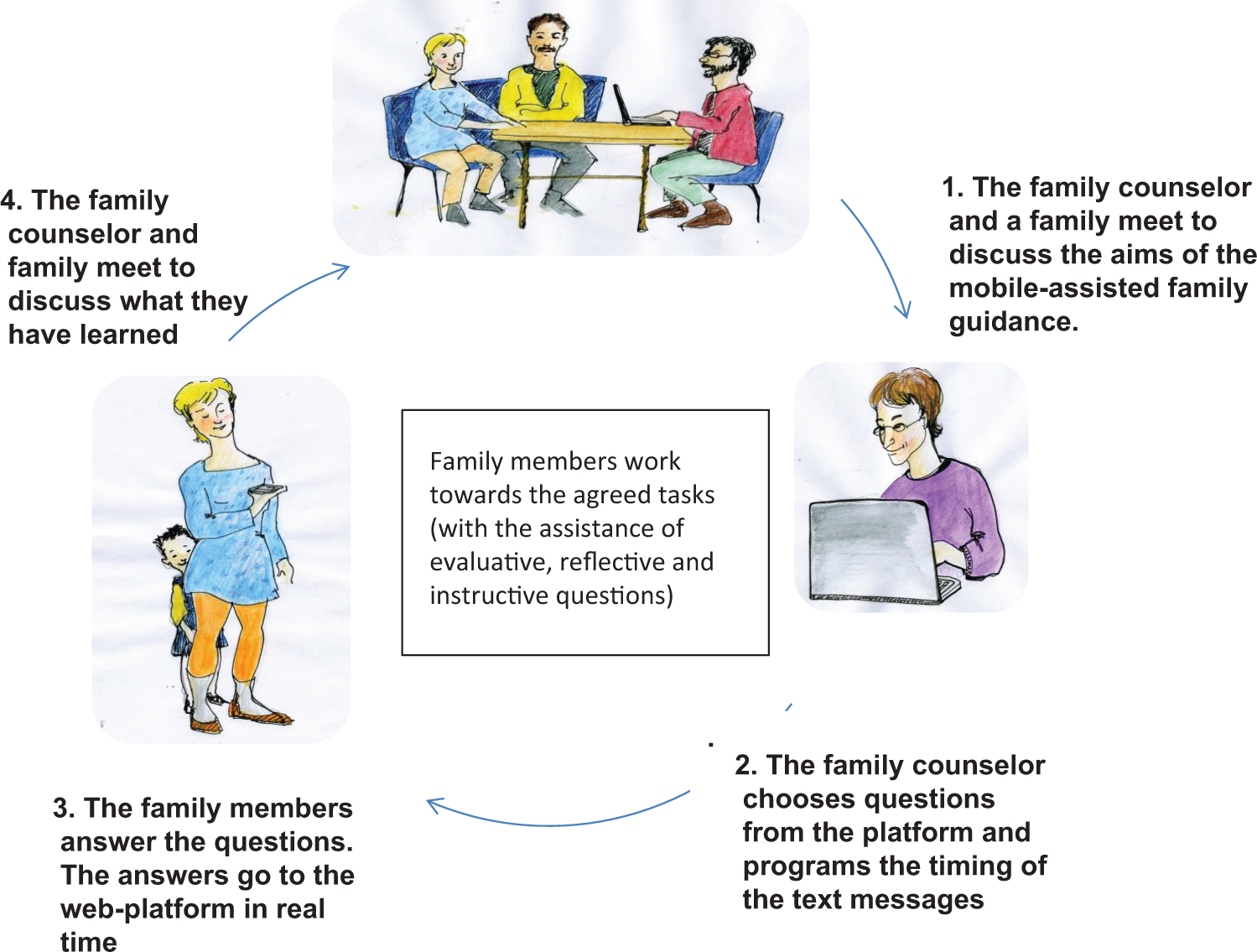
Mobile-assisted family counseling.
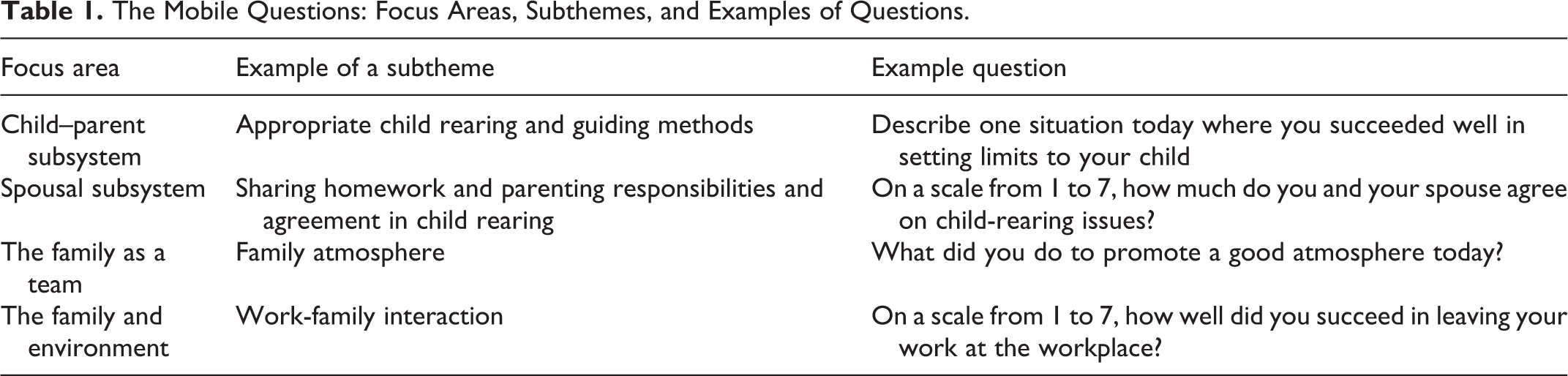
The question pool in the web platform contains questions targeted to different family situations and different family members. The themes and subthemes, and one example of each theme, are shown in Table 1. The following four thematic areas under which the questions are grouped represent the different subsystems of the family: the parent–child relationship, the couple relationship, the family as a team (family as a whole system), and the family and the environment (see, e.g., Cox & Paley, 1997). There are three types of questions: evaluative, reflective, and action-oriented. Whereas the purpose of the evaluative questions is to gain situation-specific information about family life, the reflective questions are formulated to invoke reflection. The purpose of the action-oriented questions is to motivate family members to do something, for example, to give positive feedback or talk to other family members. The questions are linked to the so-called reflexive questioning widely used in family therapy. For example, Karl Tomm (1987) suggests that certain types of questions function well in evoking reflection in clients and opening up new possibilities of self-healing. Such questions can orient clients to think of their own behavior and take into account other family members’ points of view. This may lead to more constructive patterns of cognitions and behavior in the family.
The Mobile Questions: Focus Areas, Subthemes, and Examples of Questions.
Data security and other ethical issues
In developing the mobile-assisted working model, several data security specialists were consulted. It was important to guarantee at least the following: The anonymity of clients who use the mobile system has to be secured also in event of the client losing the mobile phone, no one except family counselors should be able to access clients’ answers and the databases, and clients’ answers should not be revealed accidentally to other client families. Accordingly, each client was given a personal password, which he or she had to provide before answering the diary questions. Each client family has their own response file. No personal information is stored in the program, and the workers access clients’ data only under codes or nicknames.
Alongside the above-mentioned data security issues, the piloting and permanent use of the model also includes other ethical questions. The starting point was to ensure that participating in the mobile-assisted working method should not, under any circumstances, cause harm to the client or his or her family. This would be the case if, for example, working with the method were to overload the client to the point where his or her family relations became inflamed. Therefore, families with severe social problems, depression, family violence, or child abuse were not included in the pilot. Participants in the pilot were told that at any phase of the study, they could terminate or interrupt use of the method. Another, relatively hypothetical, risk related to this working model, especially if the motivation for using the method was to conserve resources, was the possibility of clients being left without sufficient personal contact with a counselor or therapist. For this reason, it was emphasized the need for personal contact as an integral part of this working model. The above-mentioned risks were minimized in the pilot by the fact that it took place in social services controlled by highly educated professionals.
A Pilot Study
Sample
In this article, findings from a pilot study where the participating families were recruited from clients of a local family counseling service are reported. The family counselors involved in the pilot study (n = 6) offered the new working model to families who met the following criteria: The parents needed guidance in parenting, for example, due to the child’s behavioral or emotional problems, and the family did not have any serious social problems such as violence or child maltreatment. The new service was offered to families who, according to the counselors, did not need long-term support. The pilot period was about 6 weeks, with SMS questions sent twice a week and every other week.
Procedure
The pilot study was conducted in 2011–2012. The data collection methods included a short SMS feedback questionnaire sent to the clients’ mobile phones, a web questionnaire filled in by the clients, and focus group interviews with the counselors. The SMS feedback questions concerned the usability and benefits of mobile-assisted working method. The questions were as follows: “On a scale from 1 to 7, to what extent did the mobile-assisted working method meet your needs? (1 = not at all and 7 = very well),” “On a scale from 1 to 7, what was it like working with the mobile-assisted working method?” (1 = difficult and challenging and 7 = very easy and handy), “On a scale from 1 to 7, to what extent did the mobile-assisted working method encourage you to work toward a better family situation? (1 = not at all and 7 = very much),” and “What was best and worst in the mobile-assisted working method?” User experiences were also explored via a web questionnaire to give the participants more space to describe their experiences. There were separate feedback questions for adults and children. The clients were given a web link with a password after the service; however, only very few of the clients filled in the web questionnaire. Focus group interviews with family counselors (n = 6) were also carried out. The interview included, for example, the following questions: What kind of feedback regarding the new working model did the client families give? On the basis of your experiences, what are the benefits of the model to client families? In what kind of family situations does it work best? What benefits, if any, has the new working model brought given to your work? The interviews were transcribed and content analyzed.
Results
Clients’ Experiences of the Mobile-Assisted Working Model
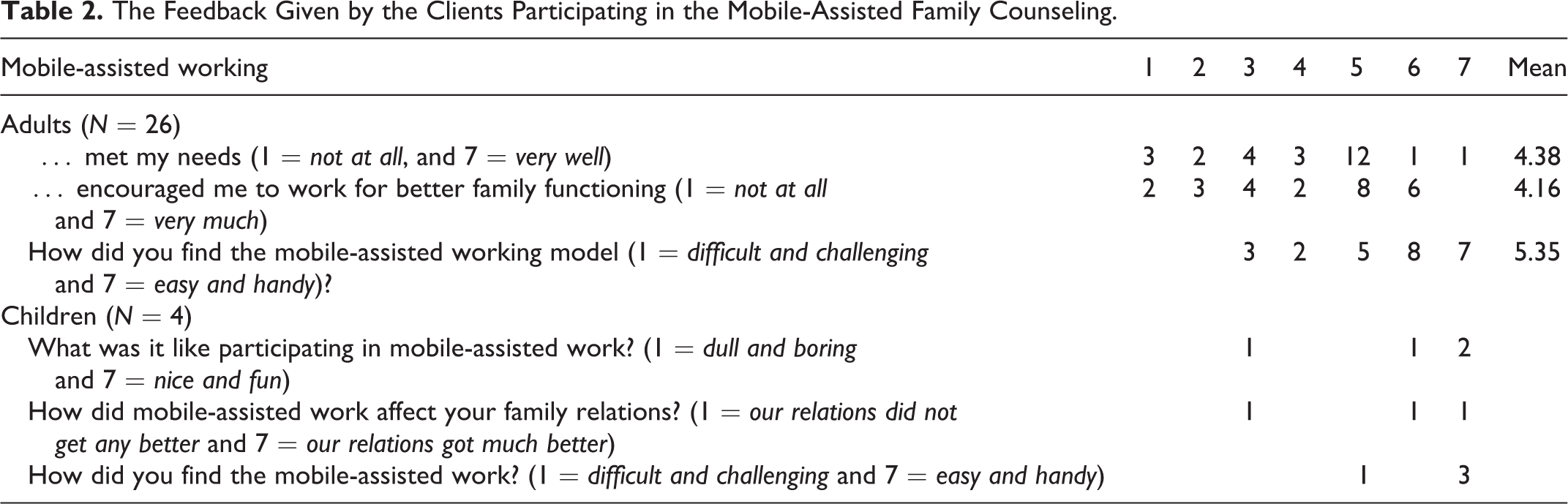
In the pilot study, a total of 36 adults and nine children participated in the mobile-assisted working model. However, owing to a misunderstanding on the part of the family counselors, feedback questions were sent only to 26 adults and four children, all of whom answered them. Almost all the feedback participants reported that working with mobile phones was easy and handy (see Table 2). Over half felt that their needs had been met and the same proportion considered that it encouraged them to work toward a better family situation. Quite a lot of variation was found in these answers relating to the benefits of the method. One third of the participants did not find the method helpful. However, on the basis of the mean scores, the experiences were rather positive. The feedback questions were completed by four children. All of them reported finding the method easy, and three of the four described it as nice.
The Feedback Given by the Clients Participating in the Mobile-Assisted Family Counseling.
An open question was also used to elicit the participant’s opinions on the utility of the working model. In general, the participants reported finding the working model both useful and beneficial. About one half of the respondents mentioned that the working model evoked reflection. The best thing was that you had to think what you do and feel. It was good that you really had to think about daily issues. This did make me think about things—at least a little bit.
First, some parents said that they started to pay attention to the amount or quality of time they invest in their children. You realized how little time you have spent with the child. In normal conditions this kind of working could only be useful, and it helps you to become aware of how much time you really spend with the child and what the quality of this time is like.
Second, many parents mentioned that the messages worked as reminders in their daily life and helped them to keep things in mind. The messages reminded me about important things in daily life and made me to stop and think about these issues. It worked as a good reminder. You couldn’t forget to take the other into account when you were being reminded all the time.
The third point parents mentioned in their feedback was that they felt the method was easy to use. As other, less frequent points, the participants reported, for example, that they had started to see things from another family member’s point of view or think about their own behavior or that it motivated them to do things or promoted discussion at home. In some cases, it also caused them to do, talk about, and see things differently. Have I done anything about these issues myself? It led us to talk at home and was visible within the four walls.
There were also aspects of the model that did not work well or were perceived as frustrating by the clients. These were largely very practical things. Four participants commented on repetition of the same questions (same questions were repeated at least twice). They said that they started to get bored. Three participants did not like answering in a hurry or when they were tired, as was sometimes the case. Likewise, three participants complained that they did not always understand the questions or the point of them. Sometimes the timing of the questions was wrong, despite the fact that the participants were able to influence the timing of the questions beforehand.
Family Counselors’ Opinions on the Working Model
The Experiences of the Family Counselors.

The questions made them think about how little time there is for them to be with children, and another observation was that there are so many good moments in everyday life. The questions really forced them to think about such things.
It really provides material for consideration and talking over and working.
One couple, for example, they said that working with eFamily Coach was good, it worked like a motivator, the questions worked well and the process was really useful.
From their own perspective as family counselors, they considered this to be a modern way to work with families. They found that the model had its advantages: By making the different voices of the family better heard, it opened up new issues for discussion. What was important in it, from my point of view, was that they found out that they were both feeling that they were not talking about important things with each other, and we had a really good discussion in our meeting. At the moment we have families with a lot of problems, it’s a question of many things in these families, and perhaps this method is not suitable for them, it could be experienced as more of a burden than a help, if they have rather limited resources.
Some of the counselors suggested that the working model could be used in cases where families are not willing to visit the official premises. In such a situation, the working model could be used in combination with one or two telephone calls with the counselor.
Discussion
In this article, a mobile-assisted working model and the results of a pilot study in which the model was piloted and evaluated in a family counseling service were presented. The model combines the diary method, which has been largely applied in family research, although also more recently as a tool in interventions in various other areas, and the daily approach to family life. The software developed for this method is a web program adapted for mobile devices and it includes a package of interventive questions developed by the authors of this article.
The results of the study are encouraging. According to the clients and family counselors involved in the pilot study, the working model evoked reflection, reminded clients about important issues at home, and helped clients to keep the aims of family counseling in their minds. On the basis of the experiences of the family counselors, the mobile-based working model offers a new, systematic, and structured tool for use in working with families and monitoring processes in families. It also points to the importance of noticing the needs of every family member and working for their benefit. The family counselors envisaged several situations where a working model of this kind, with its activating text messages between counseling sessions, could make a useful contribution, including cases where distances between the family and counseling service are long or the interval between meetings prolonged. According to the family counselors and children involved in the pilot, the new tool gives children an opportunity to express their own opinions about family issues. The pilot study feedback also included a few criticisms of the mobile-assisted working model. A third of the participating adults did not find the model beneficial for them. The family counselors in turn would not recommend its use with families that lack resources and motivation.
The basic elements of the model—daily reporting of positive family interactions and key events—seemed to be effective as a tool for change. This can be seen as of particular importance, as a good atmosphere, emotionally warm and close relationships, and positive interaction are basic elements in the well-being of families. It seems that the diary questions received at home in the midst of daily family life help parents to recognize these key moments and become aware of their importance for well-being. Furthermore, targeted diary questions can help clients to recognize the point of view of other family members and the importance of their own actions in those situations. It is possible that, when repeated a few times, targeted questions could set in motion a positive chain of the kinds of thoughts and actions needed to promote change. More research is required to find out whether reflecting on it has a long-lasting effect on daily life. Furthermore, keeping a diary is a way of getting to know children better and understanding their perspective. The findings of this study are in line with recent findings on the benefits of diary reporting (Lambert et al., 2013) and the additional profit of using a mobile phone as a reporting tool (Preziosa et al., 2009).
There are several strengths related to this study and the working model described in it. First, the working model is based on scientific knowledge, especially on the daily life approach to families (e.g., Daly, 2003; Rönkä & Korvela, 2009), the research literature on daily family life (e.g., Malinen et al., 2010; Totenhagen et al., 2012), and the use of diary methods in family research and clinical work (e.g., Perrez & Hänggi, 2012; Preziosa et al., 2009). Many parents today are unsure about child rearing and daily family practices, and in need of knowledge on these issues (Kumpfer & Alvarado, 2003; Sanders, 2008). The media and Internet offer a lot of information, but it is difficult for the parents to know what to believe. Instead of giving direct instructions, our model encourages parents to self-discover what to do differently, inspired by resource- and solution-oriented questions. Second, the model was tested in a real-life setting among client families and counselors. Feedback on the working model was received from multiple informants, and all the family members had a possibility to participate. It is very important to study clients’ experiences of the use of new technology, as according to Trull (2007), the integration of technological tools with therapy continues to be lacking. As a consequence, counselors lack the knowledge and skills needed to benefit from such tools. Furthermore, the working model and software were carefully developed to meet the criteria of data security, anonymity, and confidentiality.
This study and the working model described therein also have their limitations. First, the design of the pilot study does not meet the criteria of a proper intervention study. There was neither a comparison group nor a pre–posttest design. In piloting the working model, the aim was to carry out the piloting and the evaluation of the model so as to achieve the best possible integration between the model and existing family counseling practices. The aim of creating a working model from the very beginning was to meet the needs of practitioners and families (rather than focusing on obtaining extensive, comparable research data). For example, to ensure client anonymity, the developers of the working model (i.e., the authors of this article) had no direct contact with the client families, and the counselors, although thoroughly familiarized by the authors in the use of the method, had the freedom to choose relevant questions for each client family using their own judgment. Thus, the piloting was to a large degree a result of cooperation between the authors, family counselors, and, through them, clients. Further, the number of clients and counselors involved in the pilot study was limited. Although in the process of its development the working model has been tested in several contexts (such as parental groups and adolescent after care), the focal context of the pilot study was family counseling.
Future Directions
In Western countries, many parents seek help and guidance in child rearing and daily family life. Not everybody who needs guidance gets it (Sanders, 2008), or they have to wait for months. Municipalities lack resources to offer family services for all those who are in need of support. Mobile-assisted methods could answer these challenges by offering cost-effective, low-threshold preventive help for families. By activating clients in their daily life and mobilizing their own resources and ideas, the model moves the focus of family guidance from the office to daily family life. The model does not replace the worker, but instead offers an additional support structure for families. Mobile-assisted models free workers to invest more time in families with multiple problems. More user experiences and research are needed to determine the optimal conditions for successful use of the working model. Technological development offers many possibilities for further development of the model. One possibility would be to include a feedback system similar to that incorporated in some of the electronic diary interventions used in the field of health care (e.g., immediate feedback messages sent as a reaction to clients’ answers; see Trull et al., 2012). In our model, such a feedback system could, for example, provide text messages tailored to individual answers.
Footnotes
Declaration of Conflicting Interests
The author(s) declared no potential conflicts of interest with respect to the research, authorship, and/or publication of this article.
Funding
The author(s) disclosed receipt of the following financial support for the research, authorship, and/or publication of this article: The study was supported by the Regional Council of Central Finland.