







Abstract
The present qualitative study aimed to better understand common themes in the experiences of intercultural/multilingual couples through a phenomenological approach. Saturation was reached after interviewing eight couples (16 participants in total). Eight common themes related to cultural differences and four related to language differences were found to influence couples’ relationships and communication in this qualitative study. Affection expression, gender roles, religious preferences, importance of food, residency decisions, child-rearing practices, extended family, and handling of finances were all emerged themes of cultural negotiations. In terms of language, communicating with extended family, expressing self and communicating in second language, learning a different language, and lost in translation emerged as themes. Finally, implications for family and couples’ counselors are reviewed.
Keywords
Intercultural/multilingual couples face unique challenges and demonstrate different strengths in their communication and relationships when compared with monocultural/monolingual couples (Molina, Estrada, & Burnett, 2004). As the United States becomes more and more diverse, and the number of couples with partners from a different background increases, the unique experience of these couples deserves more attention. Multilingualism/bilingualism can be enriching for couples and families and can also bring challenges to the therapeutic process when working with a monolingual clinician (Softas-Nall, Cardona, & Barritt, 2015). It is important that mental health professionals who work with this population understand these unique experiences in order to provide effective services (Softas-Nall et al., 2015; Sue, Arredondo, & McDavis, 1992; Sue & Sue, 2012).
Cultural and Language Differences in Intercultural/Multilingual Couples
Intercultural/multilingual couples are couples where each partner was born and raised in a different culture and each has a different first language (Ho, 1990). Culture is a set of concepts that includes many different elements (Hays & Erford, 2010). It is defined as the social heritage of a group or community and includes social norms (such as rules of conduct), social values (beliefs and common understandings), and social practices (what people say and do; Bystydzienski, 2011). When people from different cultural backgrounds live in the same household, cultural differences become more obvious and more challenging to manage (Romano, 2008).
Language differences is a unique issue in intercultural/multilingual couples’ relationships, which needs to be negotiated (Llerena-Quinn & Bacigalupe, 2009). Within relationships, speaking a common language is vital for daily communication (Ho, 1990; Llerena-Quinn & Bacigalupe, 2009). Couples in which both partners speak the same language often have trouble hearing what the other is really expressing (Gottman, 1999), and this can be even more challenging for partners who speak different languages (Softas-Nall et al., 2015). If one partner’s native language is chosen as the primary language to communicate in, it may be necessary for the other partner to learn a whole new language just to communicate (Molina et al., 2004). The same is true for each partner’s extended family; translation may be useful, but they may not be able to communicate effectively when they do not speak each other’s language (Foster, 1998). While these ideas are important in conceptualizing couple dynamics, empirical research is needed to ascertain how these couples perceive and negotiate these differences.
Couples’ Counseling/Therapy With Intercultural/Multilingual Couples
For intercultural couples, cultural differences play out with more complexity in counseling due to the fact that there are not only cultural differences between the couple and counselor but also differences within the couple (Softas-Nall & Baldo, 2000; Sullivan & Cottone, 2006). It is estimated that 13% of the U.S. population is comprised of immigrants (DeAngelis, 2010; Shin & Bruno, 2003; U.S. Census Bureau, 2012), yet there is little research on couples’ counseling/therapy with intercultural couples conducted until recent years (Sullivan & Cottone, 2006). In addition, according to the census bureau, 21% of the population in the United States speak a language other than English in the home (U.S. Census Bureau, 2013).
Multilingualism within a couple occurs when each partner has a different mother tongue. When conducting counseling/therapy with multilingual couples, mental health professionals need to carefully consider the language used and to keep in mind that the language used in counseling/therapy could be a second language for one or both partners (Softas-Nall et al., 2015; Sullivan & Cottone, 2006). Language differences can create a power difference between the therapist and couple and within the couple (Softas-Nall et al., 2015). Further research is needed to help mental health professionals understand the unique constructs and dynamics when working with multilingual and multicultural couples.
Therefore, the purpose of this qualitative study was to explore the cultural and language themes that intercultural/multilingual couples experience and how these differences affect their relationships. Also, as this study has implications for the field of couples’ counseling, it aimed to discover how couples therapists can be the most effective when working with partners in an intercultural/multilingual relationship.
Method
This phenomenological study used constructivism as the theoretical framework. Seward (2008) pointed out that every couple creates their own unique culture throughout their relationship and that this process is never-ending. In accordance with constructivism, this study aims to understand the unique culture of multicultural and multilingual couples by understanding how they have generated meaning through the interaction of their experiences and ideas (Crotty, 1998). Similarly, Moustakas (1994) discussed one of the primary purposes of a phenomenological study is to give voice to and identify how culture has influenced the participant’s experience. Therefore, phenomenology was the most appropriate research approach to gain the most insight into the couple’s shared experience and culture.
Participants
Participants were recruited using a snowball sampling method (Merriam, 2009). Recruitment was conducted through the international students and scholars’ office of a university in the Rocky Mountain Region and personal connections of the lead researcher who had access to this population. All participants met the criteria for participation in the study, which included (a) each partner had to be born and raised in a different country than their partner and spoke a different first language, (b) both partners had to currently live in the United States, (c) the couple had to be in a relationship for at least 2 years and have lived together for at least 6 months to ensure they have had the opportunity to have developed a shared history (Bystydzienski, 2011), and (d) both partners needed to agree to participate and felt comfortable to answer the interview questions in English.
Saturation was met after eight couples (16 participants) were interviewed. Saturation refers to the situation when the new information obtained does not further provide insight into the themes of data analysis (Creswell, 2007). Saturation is reached when, through the process of identifying significant statements and themes from the interviews and analysis, no new information is garnered (Merriam, 2009). Interviews were conducted through face-to-face interviews. The length of each relationship varied from 2 to 39 years, and the length of cohabitation varied from 19 months to 39 years. Table 1 (Appendix A) presents the demographics, ethnicity, native language, ages, and length of relationship for each couple.
Data Collection Procedures
Data collection included audio recordings and field notes of the behavioral observations. The interviews were semistructured, in-depth interviews conducted in English. The changes reflect the change of focus to intercultural/multilingual couples. All interviews were conducted face-to-face, and both audio and visual information were collected to ensure multiple sources of data. During the interview, the couple was interviewed together first and asked about their demographic information and the history of their relationship. The couple was then interviewed separately for the second part of the process in order to obtain responses that were not influenced by the presence of the other partner. Last, the participants were interviewed as a couple in order to gather their experience of combining their culture and creating a shared meaning.
Data Analysis
Each interview was transcribed from the audio recordings after the interview. After the completion of the transcription process, the transcripts were read carefully looking for and highlighting “significant statements” according to each research question to proceed with data analysis (Creswell, 2007). Each of these statements was treated initially as if it had equal importance, through the process of horizontalization (Merriam, 2009; Moustakas, 1994). These statements were divided into categories, narrowing down the most frequent and important details and forming initial codes for each possible theme within each couple’s interview. The initial codes were then compared between couple’s interviews to bracket the emerged themes between each couple interview and ensure these themes were being noticed throughout the different transcripts.
Trustworthiness and Credibility
To ensure trustworthiness, a few different methods were utilized in the study. First, peer review was used by ensuring all transcriptions and themes from the data were examined by a licensed mental health professional trained in both couples therapy and qualitative research methods to comment on the findings as they emerged and to ensure that the analysis and the emerging themes were accurate and not overly influenced by the researcher’s personal bias (Creswell, 2007; Lincoln & Guba, 1985). After the peer review, member checking was utilized by sending a copy of the transcript and theme analysis to each couple (Merriam, 2009). All eight couples confirmed or clarified that the themes matched their experience.
Furthermore, multiple sources of data (i.e., interview recordings and field notes), multiple methods of confirming the merging findings (i.e., peer review and member checking), and multiple methods of data analysis (i.e., narrow codes or themes to broader interrelated themes to more abstract dimensions) were all utilized throughout the study for triangulation, which was a combination of these three sets of techniques to establish the trustworthiness of the study (Creswell, 2007; Polkinghorne, 2005).
Research Questions
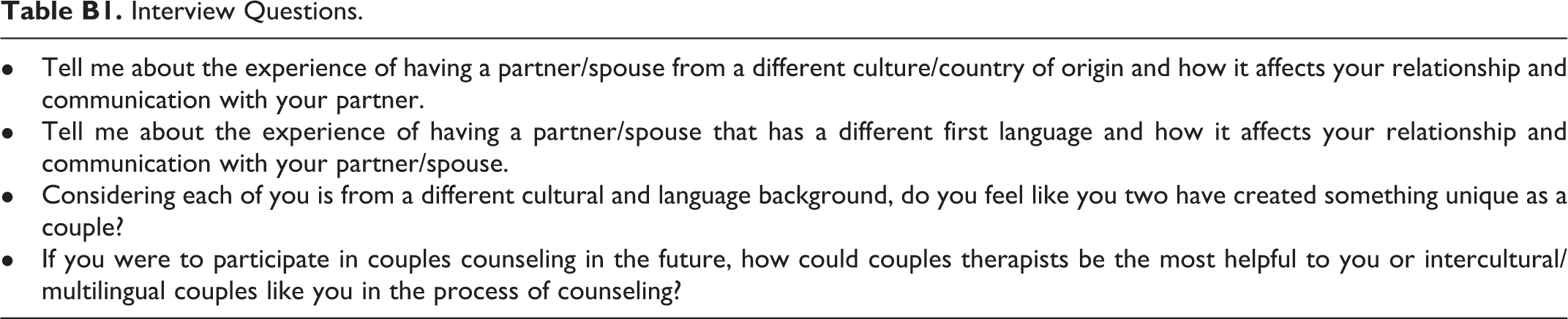
The interview questions (Appendix B) were adapted from the Multiple Heritage Couple Questionnaire (Henriksen et al., 2007) and Psycholinguistic History (Foster, 1998) to explore both the cultural and language-related experiences of the couple. In addition, the primary researcher added two questions related to the creation of the new phenomenon of the intercultural/multilingual relationship and how mental health professionals can work more effectively with intercultural/multilingual couples. The following questions were addressed: How do cultural differences affect intercultural/multilingual couples’ relationships and communication? How do language differences affect intercultural/multilingual couples’ relationship and communication? How do intercultural/multilingual couples integrate their differences and create a unique relationship of their own? If the participants were to participate in couples’ counseling in the future, how can couples’ counselors be the most helpful in the process of counseling?
Results
The following themes emerged as a result of careful analysis of the transcripts of the in-depth interviews.
Research Question 1
Question 1 aimed to identify how cultural differences affect intercultural/multilingual relationships. According to the participants, there were eight different aspects of how cultural differences affect their relationship and communication: Affection expression, gender roles, religion, importance of food, residency, child-rearing practices, extended family, and finances. Each couple also provided a variety of examples they encounter in everyday life.
Affection expression
Seven of the eight couples shared how cultural differences in expression of affection impacted their relationship. Common differences between cultures are nonverbal expression, touching, and kissing, especially in public. Cultural patterns of appropriate expression of affection were described by couples. For instance, Sakura expressed that she has no problem showing affection toward Bob and her children with nonverbal expressions. However, she has a hard time showing affection toward Bob in front of others, especially her Japanese friends and family, because “it makes my parents and friends uncomfortable, they may tease me too.” All seven of the eight couples described that open communication and compromise were necessary for their partner to understand their level of comfort with expressing affection in public. Social expectations of each partner’s culture were not as influential when it came to showing their affection to each other in private.
Gender roles
Seven of the eight couples interviewed shared their similar experiences with traditional gender roles. Couples reported moving away from traditional gender roles and started to find the roles that better fit their personalities and helped make their relationship more successful. In traditional Japanese culture, women are expected to cook and take care of all the household chores. Kani expressed he does not have any expectation of gender roles like that, and Ebi shared she feels relief. The eighth couple, Hadi and Linda stated that they mostly follow the traditional gender role expectations in his culture, Iranian, because that is how they thought they made their relationship work.
Religion
Some of the eight couples interviewed expressed a strong belief that religion is an important foundation of the relationship. These couples agreed that religion was an essential aspect of their relationship and that being in a relationship with someone who had a different religious background would be too challenging. As such, they chose to only date someone who had the same religious views before committing to each other. One of these eight couples did not have the same religious beliefs when they first started seeing each other. Eventually, the wife converted to her husband’s religion and became Muslim after moving to Iran and realizing the importance of Islam to her husband and his family. She also agreed that having the same religious beliefs was a significant foundation of their relationship and made their relationship stronger.
Importance of food
All eight couples mentioned the importance of food and the conscious choice to cook a combination of food from both partners’ cultures. Some of them indicated enjoying the cuisine from one culture more than the other, but they often communicated about it and found a unique combination of cuisine that both partners enjoy. They also created new recipes that combined different elements of both cultures, for example, Bitsy and Hector described their cooking as “Pobodian,” a blending of Polish and Cambodian. All participants described it was essential for both partners to find a unique balance and special recipes that fit the needs of both partners.
Negotiations on residency decisions
All couples interviewed lived in the United States. Seven of these couples had at least one partner who was from the United States, and there was one couple in which both partners were from other countries. Among all couples, negotiations and discussions had occurred about moving to their partner’s country of origin or somewhere outside of the United States, so they could experience a different culture and be closer to the family. For many, the decision to stay in the United States was made based on perceptions of safety or greater opportunity. Angie and Jose discussed moving between the United States and Thailand because “we got to be fair to both of our families because we love them.”
Child-rearing
Three of the couples interviewed had children, and all of them discussed how cultural differences played a significant role in parenting styles and philosophies. Two of them still had children who were young, and they described that rearing children with a partner who was from a different cultural background required continuous communication to find the best way to educate them. For instance, in traditional Taiwanese culture, it is believed that anything that is cold will damage one’s physical health, especially children. Due to this, Kai’s family did not want Annie to give their children anything iced or cold, but her family said that water tastes better when it’s cold. Kai and Annie decided to research online, keep the discussion open, and try to find the best way for their children. Also, decisions about which language or languages the children were taught became an important part of navigating multilingualism for the couples.
Extended family
All eight couples described having a good relationship with their extended family. All stated they felt the freedom to choose their spouse and for some of them it was more important to receive their parent’s blessing. In their culture, marrying someone is not just about two individuals, it is about two families making a connection and turning into one big family.
Handling of finances
All of the couples agreed that the attitude of financial planning was both related to cultural differences and family background. Couples had to learn about each other’s habits of spending and slowly compromised and discussed which way would be the most beneficial for their current financial situation. Angie described that she lives only with the necessities and does not spend extra money if she does not have to. While Jose is used to “randomly utilizing money for different purposes when I have money,” he admitted. Angie said, “I save the money and he spends the money.” They realized the way they manage money is very different from each other, both related to cultural and age differences. They learned how to communicate and compromise. Angie had to be blunt with Jose to show him how wasteful he used to be and help him plan better. Jose also realized that there are ways to be frugal and still live a good life.
Research Question 2
Question 2 aimed to identify how language differences impacted intercultural/multilingual relationships. After analyzing the data, four different themes emerged that showed how language differences can affect couples’ communication and relationships: Communication with extended family, expressing self and communicating in a second language, learning a different language, and lost in translation.
Communication with extended family
Couples reported it was not easy for one partner to communicate with his or her partner’s extended family, especially when they did not speak the same language. For most of the couples, each partner had tried to learn the basics of the other’s language so they could understand his or her partner’s family. At the same time, all couples noticed that communicating is not only about language but also about nonverbal expression. Many of them described communicating with their extended family with body language and some of their native language, which they found was the best way to communicate. All the couples expressed their desire for better communication with their partner’s extended family. For instance, Hector used a dictionary when they visited Bitsy’s family in Poland because she could not be there all the time to interpret or translate for him. During Hector and Bitsy’s wedding ceremony, both English and Polish were used to share vows. The couple thought that both cultures and languages were important for their relationship and families of origin.
Expressing self and communicating in a second language
Couples discussed that it was not easy for anyone to express him or herself in a second language, especially when it comes to expressing feelings and emotions. Furthermore, couples reported it became even more difficult for a partner to understand when specific terms were related to cultural concepts. Each of the couples interviewed had their own way of effective communication, such as using a dictionary, explaining different concepts with more detail, or other tools like showing movies or telling stories and all couples agreed that being patient was essential when communicating with each other. In addition, speaking a second language all the time can be straining, so it was important the other partner understood the need to speak their native language with friends and family.
Learning a different language
All the couples interviewed expressed a desire to learn their partner’s language, if they did not already speak it. As described above, culture and language are two concepts that cannot be separated. When one partner wanted to learn more about the other culture, they realized that they had to also learn the language to fully comprehend the meaning of the language. One challenge couples faced was that the environment they lived in one language was more dominant than in the other. For example, since the couples resided in the United States it was difficult to fully learn the partner’s language when they were not immersed in it. When they could learn their partner’s native language it not only made it easier for them to communicate with each other but also helped them to communicate with their partner’s family. Although it is not easy, all participants felt strongly about it and wanted to strengthen their relationship by learning each other’s language and culture.
Lost in translation
Language and culture are inseparable, and four of the eight couples pointed out that sometimes they felt something was “lost in translation,” due to the lack of understanding of the cultural concept behind the language. These four couples expressed that learning the culture and learning the language were two continuous tasks for their relationship. The lack of understanding of cultural concepts had created stress for the couples. Couples had learned to do a better job explaining not only the language but also the particular cultural concept to each other to decrease the miscommunication not just between them but also between their partner and extended families. Two of these couples also realized that their partner may never fully understand all the different concepts of each other’s culture; they just had to live with it, be patient and accept the differences, but never make assumptions or blame their partner for getting lost in translation from time to time.
To further complicate the matter, each couple integrated their personality, experience, culture, and identity into the ways they speak and use their languages. For example, Daniel and Shata, they were very respectful toward each other and always made sure the other one has enough space to speak and they are always agreeing with each other, which might be related to their acculturation level of integrating more of the U.S. culture in terms of equality between genders, and keep a united front to others. At the same time, it was noticed that Daniel still has somewhat more to say on certain topics and Shata would share her opinion after Daniel finished speaking, giving her side of the story or giving Daniel’s experience more color, which might be related to how husband is respected and given more space if needed by wife in the culture Daniel and Shata are coming from.
Research Question 3
Question 3 aimed to identify how intercultural/multilingual couples negotiate and combine their cultural differences to create a new relationship. Seven of the eight couples described their relationship as unique and exceptional. They provided many different examples of how they integrated elements from both cultures and created unique aspects of their relationships. Some couples had created new recipes, which included both cultures’ cuisines; some couples planned and designed unique wedding ceremonies to incorporate rituals and customs from both cultures. Other couples celebrated the differences instead of seeing them as challenges or invented a new language or nickname that only they would understand. Finally, all the couples integrated each other’s culture into their daily life to different degrees for certain issues, such as Linda and Hadi who follow the more traditional gender roles of Iranian culture but follow the American way of educating their children. Each couple decided on their own to pick the best of both worlds to build a unique relationship, a special phenomenon that no other couple had experienced.
Research Question 4
Question 4 aimed to identify how intercultural/multilingual couples felt couple’s counselors could improve the quality and effectiveness of therapy. After analyzing the data, three themes emerged: understanding and learning both cultures, language barriers, and the purpose of the relationship: love.
Understanding and learning both cultures
All participating couples pointed out that the most important aspect of couples’ counseling for them would be if the therapist had knowledge and experience of both partners’ culture or if he or she was willing to learn about them. Participants believed that it would be almost impossible for counselors to understand the rationale for each partner’s communication style if they lacked knowledge of the cultures that are integrated into the relationship. Furthermore, if the mental health practitioner had experienced the cultures in person, it would be more helpful because they would be able to put themselves into the couple’s shoes and share experiences of when they had faced cultural and language differences in life.
Language barriers
Therapy can be an emotionally intense experience for anyone, especially for people using a second language during this process. Two couples brought up the importance of providing more space and time for the partner who is speaking a second language in counseling. First, it is already challenging to express oneself on an emotional level and be vulnerable; this becomes even more challenging when using a second language. If therapists do not have a strong enough relationship with the couple to ensure safety in expressing his or her thoughts and feelings in a second language, it could build a barrier instead of a healing process. In this case, counseling may not be as effective because the partner who speaks a second language in counseling cannot fully express themselves during the healing process.
The purpose of the relationship: Love
The two couples who had been in their relationship the longest emphasized the importance of love. They agreed that after many years of a relationship or marriage, it is easy for couples to forget the original reason they decided to be together: love. They believe it is important for counselors to remind couples who are facing challenges or issues in their relationship that they are together because they love each other. By reminding them that love is the purpose of their relationship, it will be easier to motivate couples to compromise, to celebrate their differences, and work for the relationship so they can continue their life journey together.
Discussion and Implications for Counseling
Given the prevalence of intercultural/multilingual couples, the purpose of this qualitative study was to explore the cultural and linguistic themes that intercultural/multilingual couples experience and how these differences affect their relationships. Also, the results of this study had implications for the field of couples counseling, as it aimed to discover how couples therapists can be the most effective when working with partners in an intercultural/multilingual relationship.
Systemic/relational theory was used as the theoretical framework for this study. Rosenblatt (2009) pointed out that intercultural/multilingual couples develop their own intricate, multilayered system, which is confirmed by the results of this study. All couples interviewed shared their stories and experiences how they as a couple, were impacted by their personalities, cultures of origin, languages of origin, extended families, and the current culture they live in; all these factors formed a multilayered and unique system that surrounds their relationship and makes it different than any other relationship. The following implications are connected to the emerged themes and can hopefully assist therapists in their counseling work with intercultural/multilingual couples.
Systemically oriented therapists should keep in mind the eight different themes which emerged of how cultural differences impact intercultural/multilingual relationships. These include affection expression in public and private, and issues of tolerance for these expressions to each other, their children, and their families of origin; the intersection of gender roles with culture and levels of comfort or discomfort with flexibility in roles; similarities or dissimilarities of religious beliefs; importance of food as symbolic representation of integration of cultures; residency decisions on whether to live in the United States or the other partner’s country of origin; and child-rearing practice differences such as discipline style, affection expression with children, and preparing different foods for the children. In addition, views on handling finances emerged as a theme. For example, some partners whom were raised in another country talked about their anxiety when they felt recruited by their partner who was raised in the United States to live on credit.
Systemically oriented therapists can benefit their clients through awareness of the themes related to how language differences impact intercultural/multilingual couples which included: Communication with extended family, expressing self and communicating in a second language, learning a different language, and lost in translation. Couples consistently expressed how language and culture were interrelated. Romano (2008) and Rogers and Hart (2002) all pointed out that people not only communicate in different verbal languages, they also communicate in different cultural contexts, which are shared matrices of meaning and include everything people use to exchange meaning with one another (i.e., words, tones of voice, shoulder shrugs, yawns, silences, etc.). Couples’ counselors should be sensitive of the fact that one or even both partners are using a second language in the process of counseling. Couples’ counselors may need to provide enough time and space to help the partner for whom English is a second language to feel comfortable expressing their true self, their feelings, and their thoughts in front of their partner and therapist (Softas-Nall et al., 2015).
Participants recommended that counselors remind couples in distress the feelings of love they felt for each other when they first met. Couples’ counselors can also remind them of the purpose of their relationship, which is to build a unique love phenomenon together as a team.
All eight couples also expressed the importance of multicultural competencies in counselors if they hope to be effective with intercultural/multilingual couples. It was recommended by several of the couples that therapist sought to have at least a basic knowledge of both cultures. It would be even better if they have had personal experience with both cultures. Hsu (2001) pointed out the importance of therapists’ multicultural competence as the basic requirement for working with intercultural couples. During the process of counseling, we need to carefully be aware of our own biases, understand the clients’ worldview, and show our respect to each partner (Ponterotto, 2010).
All eight couples expressed how they felt their relationship was unique and special, as they had form a new culture of their own. This included the interplay of multiple dynamics. For example, how they combined each of their countries’ wedding ceremonies, food, and relationship expectations. Couples therapists need to be aware of the unique multilayered interplay of cultures when working with intercultural/multilingual couples.
Implications for Further Research
The results of this study provided implications for the direction of future research with intercultural/multilingual couples. The following are some recommendations for future research: Future research ought to explore and compare couples who report satisfaction versus dissatisfaction in intercultural/multilingual relationships in order to help couples counselors understand the unique aspects of satisfactory intercultural/multilingual relationships. The couples in the current study reported more satisfaction in their relationship.
It is recommended for future research to explore if a couple’s belief and perspective of their romantic intercultural/multilingual relationship changes throughout time; and if they have different experiences compared to intercultural/multilingual couples who are younger and have shared a shorter relationship history.
Finally, future research ought to focus on the influence of living in a country that is neither of the partner’s country of origin as this may contribute to unique challenges when neither partner is living in their country of origin. Only one couple in this study lived in a country that was neither of their country of origin. This couple expressed unique challenges such as limited social support, a less diverse community, and difficulties procuring food permitted by their religion.
Conclusion
The results of this study provided counseling implications for systemically oriented therapists who wish to be more competent in terms of sensitivity to multiculturalism. The study also provided direction in future research with intercultural/multilingual couples. Intercultural/multilingual relationships can be enriching and rewarding. Each couple develops their own unique culture and beliefs of what makes an intercultural/multilingual relationship work; for one of the participants “the key to overcome the differences is…unconditional acceptance of each other. Don’t dwell on the differences; celebrate the differences.”
Footnotes
Appendix A
Participants’ Demographic Information.
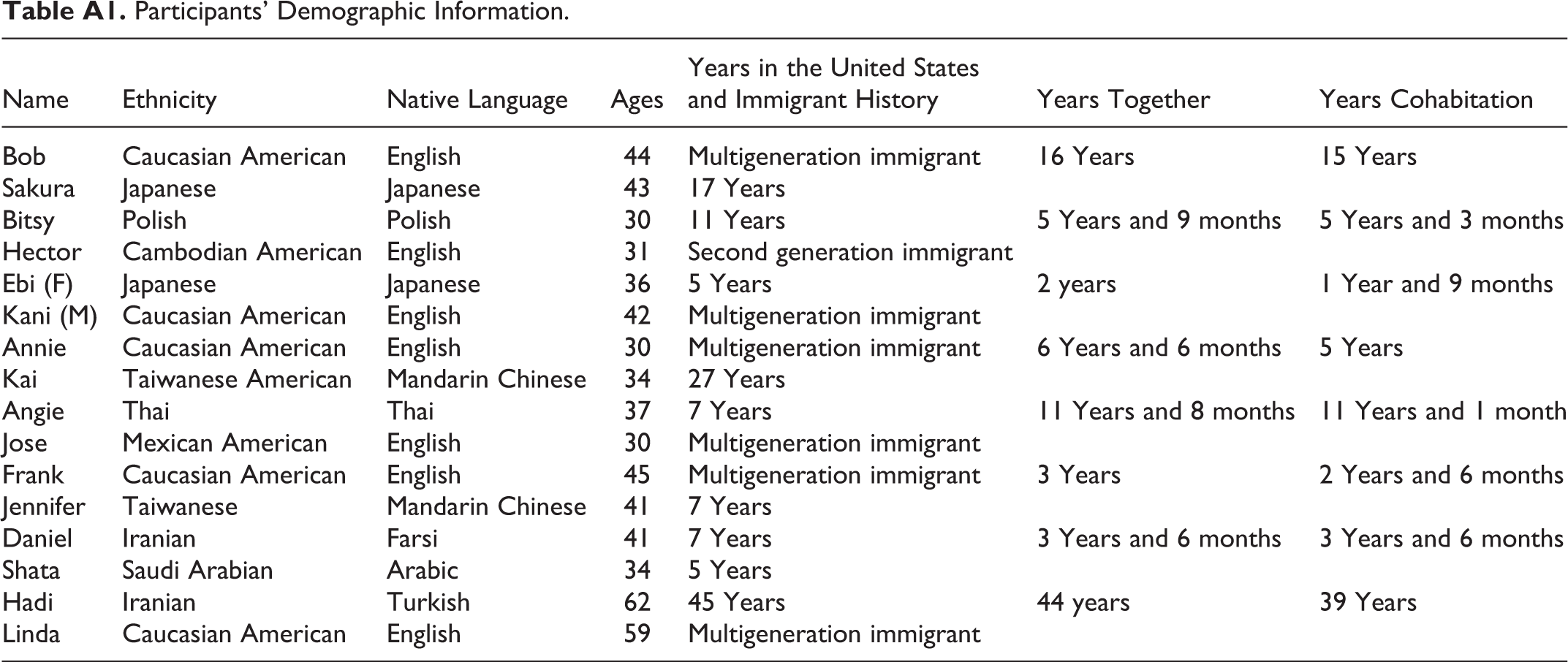
| Name | Ethnicity | Native Language | Ages | Years in the United States and Immigrant History | Years Together | Years Cohabitation |
|---|---|---|---|---|---|---|
| Bob | Caucasian American | English | 44 | Multigeneration immigrant | 16 Years | 15 Years |
| Sakura | Japanese | Japanese | 43 | 17 Years | ||
| Bitsy | Polish | Polish | 30 | 11 Years | 5 Years and 9 months | 5 Years and 3 months |
| Hector | Cambodian American | English | 31 | Second generation immigrant | ||
| Ebi (F) | Japanese | Japanese | 36 | 5 Years | 2 years | 1 Year and 9 months |
| Kani (M) | Caucasian American | English | 42 | Multigeneration immigrant | ||
| Annie | Caucasian American | English | 30 | Multigeneration immigrant | 6 Years and 6 months | 5 Years |
| Kai | Taiwanese American | Mandarin Chinese | 34 | 27 Years | ||
| Angie | Thai | Thai | 37 | 7 Years | 11 Years and 8 months | 11 Years and 1 month |
| Jose | Mexican American | English | 30 | Multigeneration immigrant | ||
| Frank | Caucasian American | English | 45 | Multigeneration immigrant | 3 Years | 2 Years and 6 months |
| Jennifer | Taiwanese | Mandarin Chinese | 41 | 7 Years | ||
| Daniel | Iranian | Farsi | 41 | 7 Years | 3 Years and 6 months | 3 Years and 6 months |
| Shata | Saudi Arabian | Arabic | 34 | 5 Years | ||
| Hadi | Iranian | Turkish | 62 | 45 Years | 44 years | 39 Years |
| Linda | Caucasian American | English | 59 | Multigeneration immigrant |
Appendix B
Interview Questions.
|
Tell me about the experience of having a partner/spouse from a different culture/country of origin and how it affects your relationship and communication with your partner. Tell me about the experience of having a partner/spouse that has a different first language and how it affects your relationship and communication with your partner/spouse. Considering each of you is from a different cultural and language background, do you feel like you two have created something unique as a couple? If you were to participate in couples counseling in the future, how could couples therapists be the most helpful to you or intercultural/multilingual couples like you in the process of counseling? |
Declaration of Conflicting Interests
The author(s) declared no potential conflicts of interest with respect to the research, authorship, and/or publication of this article.
Funding
The author(s) received no financial support for the research, authorship, and/or publication of this article.