







Abstract
Traditional premarital counseling seems threatened and not benefiting the couple as it should be. This has negatively impacted on the establishment of marriage. The purpose of the study was to explore married women lived experiences on the value of traditional premarital counseling, go laya, on marital stability. Traditional premarital counseling has always existed to help prepare couples for the future challenges and expectations in marriage. The study adopted a qualitative phenomenological research design. A purposive sample of 10 married women with varied durations in marriage provided the data through interviews. These interviews were tape-recorded and transcribed. The transcripts assumed a phenomenological approach where bracketing and eidetic reduction were employed. The findings indicate that the traditional premarital counseling is very valuable and has a potential of keeping marriages firm. In addition, although the traditional premarital counseling is an appropriate antidivorce strategy, the main problem is that it has lately lost its meaning. Unlike in the past, it is no longer given the honor and not conducted in depth. Despite the major role go laya has in marriage, its implementation must be reviewed and documented to give direction on how it should be done.
Marriage is generally respected worldwide. While many people marry when their time to marry comes, statistics show that the same marriages break down. The increased divorce rate among couples has lately attracted much attention to researchers across different countries of the world. For instance, Hungary has been reported to have the highest rate of divorce with 67%, Czech Republic 66%, Spain 61%, Luxembourg 60%, Estonia 58%, Cuba 56%, France 55%, and United States 53% (Plunkett, 2014). Joseph and Subhashini (2012) asserted that people find it very easy to get married; they focus on preparations of the wedding day than marriage itself. Botswana, an African country with a different culture from the above countries, is not exception to this concern. There is a rapid escalation of divorce cases (Mmolai, 2015; Moeng, 2009; Moeti, 2015). Table 1 shows the rate of divorce in Botswana.
Statistics of Divorce in the Three High Courts in Botswana.
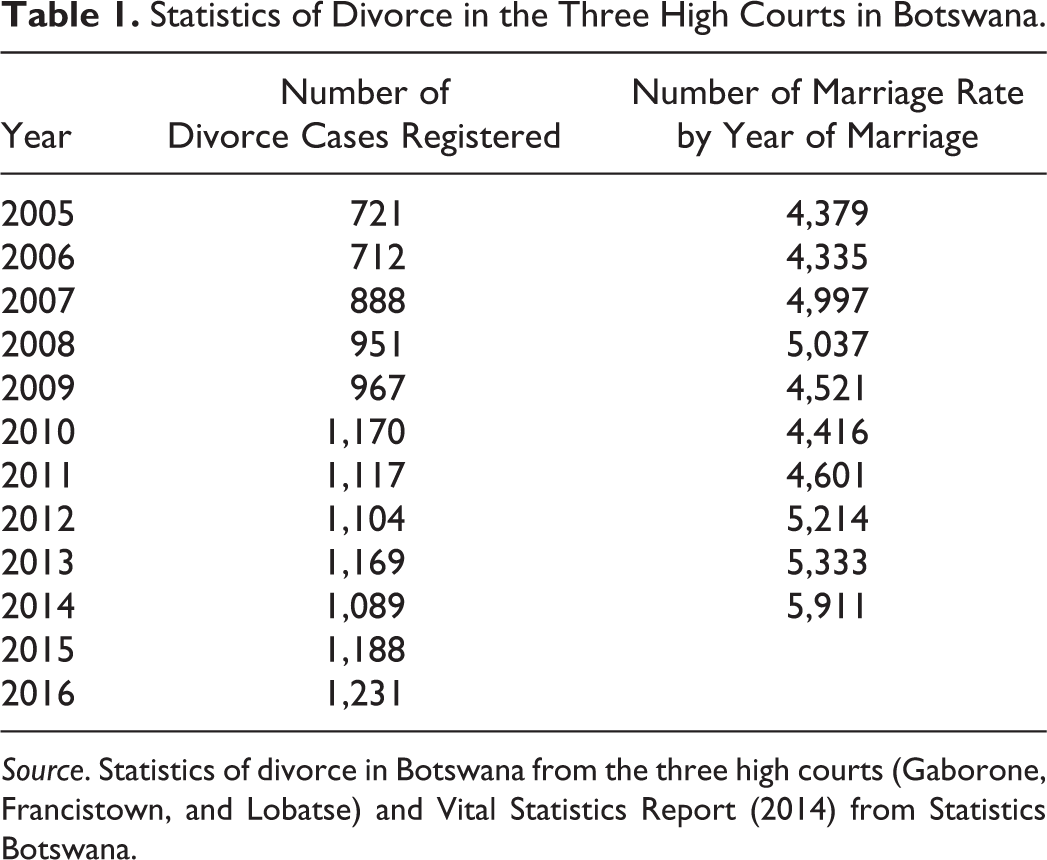
Source. Statistics of divorce in Botswana from the three high courts (Gaborone, Francistown, and Lobatse) and Vital Statistics Report (2014) from Statistics Botswana.
Efforts to address the high divorce rates have been made worldwide. To help maintain marital stability, marriage preparation programs such as premarital counseling to prepare couples for marriage have been provided (Silliman & Schumm, 2000). Stahmann and Salts (1993) argues that premarital counseling should be seen as a process designated to enhance and enrich premarital relationships. According to the authors, this process leads to more satisfactory and stable marriages with intended consequence to prevent divorce. Similarly, Echebe (2010) was certain that premarital counseling should be services provided to assist couples who are planning to marry with a view to reinforce their communication and problem-solving skills in their relationship. In addition, Stahmann (2000) noted that premarital counseling is given as a preventive measure as an attempt to help the newlyweds to transit well into marriage life by providing teachings that can assist them to have happy marriages.
Previous research has shown that Western premarital counseling can be an effective process for marriage stability (Adi, 2008; Echebe, 2010; Otondo, 2008; Sukori, 2011; Tambling & Glebova, 2013; Teibowei, 2011). Stahmann and Salts (1993) have stated that premarital counseling helps couples adjust well from singlehood to married life; increases couples’ stability and satisfaction; enhances skills such as communication, problem-solving, and decision-making among the couples; and increases couples’ friendship, commitment, and intimacy. It is through premarital counseling that couples are provided with strategies to help them reduce cases of divorce and rather have happy, strong, and healthy marriages (Echebe, 2010). Couples adjust fast into marriage because of premarital counseling (Teibowei, 2011). Normally, premarital counseling is provided by licensed therapists known as marriage and family therapists, spiritual leaders, and register officers as an attempt to help couples prepare for marital satisfaction and stability (Stahmann, 2000). The Western premarital counseling in olden days was rarely heard of in Botswana.
From time immemorial, to maintain marriage stability has always been esteemed in many societies because the notion of marriage is taken very seriously. Historically, in Botswana like other African societies, premarital counseling always prepared the couple for marriage. Traditional premarital counseling known as go laya in Setswana was used to suit the traditional culture of Batswana. Go laya involves a series of vigorous negotiations and processes that lasts for some months to complete the Setswana wedding. However, the processes of how it is conducted vary from one society to the other (Mogapi, 1994). There are four processes that are followed in Setswana culture when people get married, which are at the core of the Setswana wedding. The first stage is patlo (marriage negotiations that involve the groom’s family officially asking a woman’s hand in marriage); the second stage is magadi negotiations (payment of bride price); the third stage is moletlo wedding celebration; and the fourth and last stage involves go isiwa ga ngwetsi (taking the bride to the groom’s parents’ place). In all or some of these stages, there is a form of go laya but there are variations in how and when to implement it, depending on the different ethnic groups and families. These differences are due to convenience and current work or job-related conditions. However, this particular study will focus on go laya, which is normally performed at the end during the day of the wedding celebration.
Traditional premarital counseling is one of the crucial parts of Setswana wedding procedures that if absent or lacking, a traditional Setswana wedding would be incomplete (Mogapi, 1994). Go laya is a form of ritual advice that is traditionally performed by people who are married, mature, and knowledgeable about the cultural practices of the tribe for people who want to get married (Ellece, 2011; Moncho, 2000). For counseling to take place, married women from both families (groom’s and bride’s) separate from the men and look for a secluded place, normally a house where there will be complete silence. Within this group, there will be a representative from each family who spearheads the counseling aspect. The experienced women will then in turns share with the prospective bride about the expectations based on their lived experiences. Based on the fact that the bride is still young, the bride’s family on behalf of the bride will emphasize that the groom’s family should guide and teach prospective bride household chores, responsibilities of a married women, child care, and how to take care of the in-laws or any related issues pertaining to family life. During the counseling process, a traditional Motswana bride-to-be does not ask questions concerning what is being said. She gracefully bows her head in submission. This emphasizes that as a married woman, she should always submit to her husband. The bride-to-be is covered with a shawl and told that she will face challenges which may be hard to endure just like the hot shawl. A traditional dress code such as skirt, blouse, shawl, and a head covering is required for one to attend this kind of activity (B. Maema, personal communication, February 15, 2016). Traditionally, the newlywed woman is surrounded by married women who talk to her about what it takes to be a good wife. A newly married woman is in the middle with blue shawl during “go laya” traditional premarital counseling (see Figure 1).
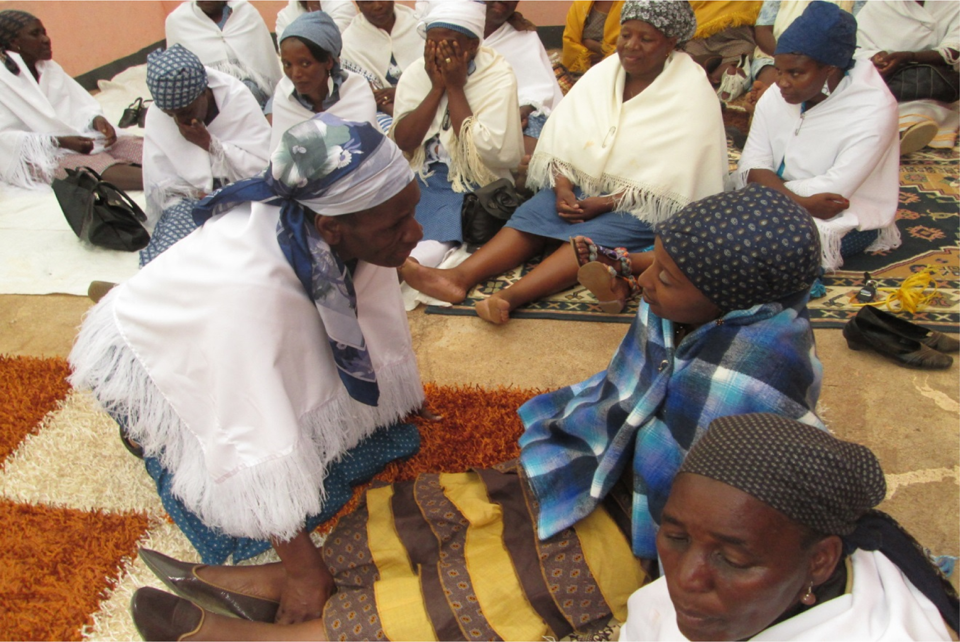
Picture of traditional premarital counseling “go laya.” Used with permission from one of the authors.
In this study, particular attention is given to the last segment of go laya which normally takes place during the day of the wedding. It is usually performed during the height of the Setswana wedding ceremony when men and women group themselves separately (Makhaya, 1991; Moncho, 2000), to perform the counseling segment, primarily to maintain stable families. As part of preparing the bride and the groom for married life, what is emphasized are the guidelines of how to behave in marriage. It is also to instill traditional principles and practices of the tribes so that the couple is cultured into them. The advice is often given through songs, figurative speeches in the form of proverbs or idioms. Hussein (2005) has argued that proverbs have a metaphorical meaning and maintain gender legacies and philosophies they associate male species with firmness and power while female species with weakness, indignity, and humbleness.
Once the woman enters into marriage, the expectation is that she conforms to her new role of being a submissive wife as well as a docile daughter-in-law whose freedom in terms of movement and expression has all of a sudden disappeared (Moloko-Phiri, 2015). The woman is expected to exhibit her best abilities in her new home, such as being a hard worker and a person who lives peacefully with other people. A man on the other hand is encouraged to take care of his new family (Makhaya, 1991).
Lately, despite the exercise of go laya, Botswana is confronted by an increasing trend of divorce. Therefore, to explore the married women’s lived experiences on the value of traditional premarital counseling in marital stability is of utmost significance. Therefore, the status quo necessitated for a study on the lived experiences of married women on marital stability.
Problem of the Study
“Go laya” lately is not properly done as it should. In the past it was performed to give the prospective bride the basics of marriage. It is currently not given enough time, and hence, its value is not felt. However, even after this exercise, the bride still comes out incompetent to handle marital issues as they arise in marriage.
Despite the existence of go laya, little is known of its value on marital stability. Therefore, the status quo necessitated a study that seeks to establish the value of traditional counseling on marriage stability. Ordinarily, people attribute “go laya” to marital stability. It is imperative that when a marriage is contracted, the couple go through the ritual of go laya. It is against this background that the study focused on married women who have been married for less than 5 years and those with more than 5 years in marriage.
Purpose of the Study
The purpose of the study was to investigate the married women’s lived experiences on the value of traditional premarital counseling go laya on marital stability.
Research Questions
The research question that was logically generated from the study is as follows: What are married women views on the value of go laya on marriage stability?
Methodology
Research Design
The study adopted a qualitative approach. Qualitative methods can be used to understand complex social processes, to capture essential aspects of a phenomenon from the perspective of study participants and to uncover beliefs, values, and motivations that underlie individual behaviors. It provides descriptive data in the participant’s own written or spoken words. Qualitative methods are especially useful for exploring the full nature of little-understood phenomena (Bell, 2014; Meterns, 2009). According to Williams (2007), qualitative research is a holistic approach that involves discovery. It is an unfolding model that occurs in a natural setting, thus enabling the researcher to develop a level of detail from high involvement in the actual experiences. Drawing upon the tradition of phenomenology, this exploratory study used qualitative research methods to examine married women’s lived experiences regarding the traditional premarital counseling go laya on marriage stability in Botswana.
The purpose of phenomenological design is to understand what experience or phenomenon or behavior means to a sample of people and how they construct those meanings. The major purpose of phenomenology is to reduce the experiences of persons with a phenomenon to describe it in a universal sense (Van Manen, 1990). In addition, phenomenologists describe what all participants have in common, as they experience phenomenon (Creswell, Hanson, Plano, & Morales, 2007). It also describes the lived experiences for several individuals about a concept or phenomenon. Phenomenological researchers explore small groups of people or social situations by employing face-to-face data collection techniques such as observations and interviews. These designs therefore fit well within the framework of the current study which was aimed at studying the married women’s lived experiences on the value of traditional premarital counseling go laya on marital stability.
Setting
The study was conducted in one of the urban areas in Botswana. The study setting was chosen on the basis that it offers diverse socioeconomic status that has been found to have implications on family stability. For instance, Conger, Conger, and Martin (2010) revealed that “research during the past decade shows that social class or socioeconomic status (SES) is related to satisfaction and stability in romantic unions, the quality of parent–child relationships, and a range of developmental outcomes for adults and children” (p. 685). Hardie and Lucas (2010) found that economic factors are important predictors of conflict for both married and cohabiting couples. In this study, Gaborone city is one of the fast developing cities with complex and diverse socioeconomic class family structures in Botswana hence its use as a study setting.
Population
The target population in this study was married women. Traditionally, in Botswana, every woman who gets married within the Botswana culture is counseled traditionally. It was assumed that all married women participating in this study would have been counseled through go laya as they went through their marriage preparations, and therefore are in a position to share their lived experiences and the value they attach on go laya to bring marriage stability.
Sampling
A multistage sampling procedure was adopted in this study. In Stage 1, purposive sampling was adopted to identify and select key participants. Tongco (2007) argues that “purposive sampling technique is a type of nonprobability sampling that is most effective when one needs to study a certain cultural domain with knowledgeable experts within” (p. 1). In this sampling procedure, the researchers identified women they knew to be married and used them as key participants (Cohen, Manion, & Morrison, 2007). Snowball sampling or a chain referral sampling was created through a series of referrals of people who knew one another were then used (Bell, 2014). At Stage 2, the key participants in Stage 1 were asked to identify any women they knew to be married in the community. This enabled researchers to identify women who have been in marriage for varied times to share their different perspectives regarding their lived experiences on the value of traditional premarital counseling on marriage stability.
Data Collection
In-depth interviews were conducted with a total of 10 married women, 5 were married for less than 5 years and 5 were married for more than 5 years. According to Ritchie, Lewis, Nicholls, and Ormston (2014), in-depth interviews allow personal histories and experiences to be understood as well as different viewpoints to be heard. The interview guide consisted of six main questions: How long have you been married? When you got married, how were you counseled? If you were counseled through go laya, can you describe what you found meaningful about this counseling practice? Now that you are married do you ever attend go laya exercise? In your view, how has this traditional counseling practice added value in promoting stability of your marriage? What role does go laya has on marriage? This type of interviewing was meant to facilitate open dialogue flow, and it allowed participants to share their lived experiences as they reflect on their journey as married women. Interviews were repeated until no more new data emerged from the questions they asked.
Data Analysis
Interviews were tape-recorded and transcribed. Researchers coded and analyzed the data independently. They later shared notes on the emerging themes and resolved any differences on what were found to be important themes. Transcript analysis of data assumed phenomenological approach where both bracketing and eidetic reduction were used. The technique of bracketing involves an attempt for researchers to hold prior knowledge or belief about the phenomenon under study, as they interact with research participants with a view to perceive it more clearly (Powers & Knapp, 1995). Eidetic reduction, on the other hand, is a process of “going beyond, behind, or underneath the conventional patterns or structures of thoughts and actions in order to locate their common grounds. Eidetic reduction was accomplished through the use of intuition and reflection” (p. 355).
The researchers focused on identifying recurring themes that represented the essential meanings of the married women experiences as recipients of go laya as a traditional counseling practice and the significance this practice has on marriage stability. The steps to identify recurring major themes were informed by the process of eidetic reduction where researchers took necessary steps to fully scrutinize and reflected on the perspectives shared by participants regarding the value of go laya and its implications on marriage stability. The eidetic reduction process was carried out within the attitude of bracketing where researchers ensured that being married women themselves and have lived experiences of go laya held their own personal experiences so that they can fully understand the perspectives held by other women on this phenomenon. Eidetic reduction included the following: First, the tape-recorded interviews of each participating woman were listened to and transcribed. Each transcript was read numerous times to obtain an overall understanding of general perspectives held by women regarding the phenomenon go laya as a traditional counseling practice and the significance it has on marriage stability. The main purpose of this first step was not to focus on any specific word but rather to identify the general meanings within each transcribed data. Second, each transcript was then divided into meaningful segments with each married woman’s experiences. Here the goal was not to classify meaningful segments into any specific chronological pattern; the focus was to identify various segments of meaning. At this point, all identified segments were included; even if they were redundant, exact words used by the women were maintained.
Furthermore, the third step involved simplification of identified segments for purposes of eliminating redundant and recurrent information. For example, “knowing what happened” and “understanding the value of why that happened” during the go laya process were combined into interpreting the value of go laya. In the fourth step, simplified segments were then organized into nonrepetitive list emanating from each transcript. In the fifth step, meaningful statements that emanated from each transcript were clustered together to generate interpretive themes that highlighted women’s lived experiences and perspectives of go laya as a traditional marriage counseling practice and its significance in improving marriage stability. Researchers ensured that the language used to label emerging themes were consistent with that of interviewed women. Lastly, major themes that define married women perspectives on the phenomenon go laya were created making use of individual descriptions extracted from original transcripts to arrive at final descriptions of lived experiences. Content that could have been overlooked was used to inform final emerging themes.
Ethical Considerations
Principles of confidentiality, privacy, and anonymity came in during data collection process. The researchers ensured that information provided by participants would in no way reveal their identities. The researchers avoided using participants’ real names as well as using any descriptors during report writing that may reveal the identity of those who participated in the study.
Findings
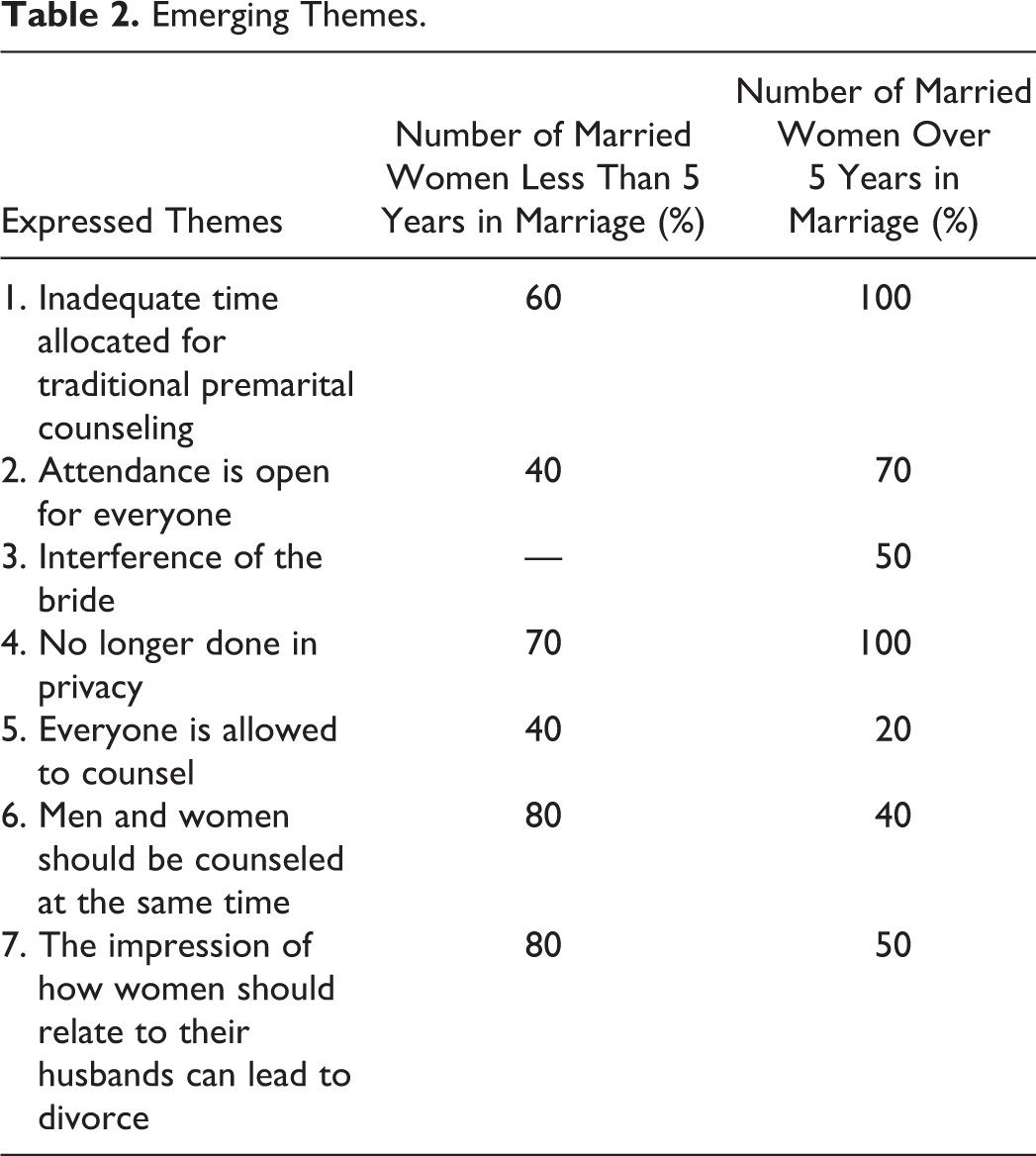
The results indicated that go laya is very valuable and has a potential of keeping marriages stable. However, the exercise is not successfully achieving its goal. Go laya has lost meaning and respect, and therefore, its implementation should be revised (Table 2).
Emerging Themes.
Theme 1: Inadequate Time Allocated for Traditional Premarital Counseling
Participants requested for more time during counseling session. As such, they highlighted that unlike in the past, the traditional premarital counseling is no longer given enough time to be implemented. Results of this qualitative study suggest that the allocated time does not match its value during the wedding ceremony and is inadequate to cover all the content that needs to be covered. Participants revealed that it is done at the end of the wedding celebration when people are exhausted and in a hurry to leave. They further noted that other critical issues are never covered due to inadequate time. A participant expressed that …it is done in the evening when everyone is tired shows that it is not taken seriously, no effort is put in doing the counseling, people will be in a hurry to go to their homes we don’t give it time. In some instances, by the time it is done some of the counselors will already be drunk after a long day. (Mrs. Nare) “I still can’t remember what I was counseled about because it was done at the end of the wedding celebration when I was already tired and I only wanted to rest, I didn’t hear anything.” The other participant concurred with Mrs. Nare and said “during the wedding day it is your big day you cannot concentrate, your focus is not on counseling but on your big day and it will be very difficult to practice and follow what you have not heard when you are in marriage.” (Mrs. Nkwe)
Theme 2: Attendance is Open for Everyone
The participants emphasized that attendance should be strictly for married people only. This theme was highlighted by all the participants but mostly those who were married for more than 5 years. Participants felt that lately go laya is open for everyone even people who are not supposed to attend like the unmarried people. They stressed that it is no longer exclusive and entrance is no longer strict like in the past where it was open for the experienced married people only. A participant noted that “in some cases camera men and even unmarried women are allowed nowadays….” (Mrs. Nkwe). Another participant attributed this as lack of respect, as illustrated: ‘go laya’ is not given the respect like in the past hence the reason why we have so many high rates of divorce is because everyone can attend and hear what is being said even if they are unmarried. (Mrs. Nku)
Theme 3: Interference of the Bride
Interference in this context refers to the bride disturbances made during the counseling session. Participants wanted the brides to listen even if they disapprove some of the teachings, they should not indicate that they are disagreeing during the sessions, as it is lack of respect. Generally, 50% of the participants who had more than 5 years in marriage cited this theme and were unhappy about the fact that people question what they are taught. They underlined that the current generation is full of people who are very inquisitive. They further emphasized the need to listen as the easiest way of learning because their interference impede and disturbs the overall process of the session. Indicating how brides interfere during the session, the following comments suffice to illustrate this point: I think brides nowadays are too inquisitive. In the past we were taught and we never asked anything because we were ready to learn from experienced married people. I once attended the activity where the bride did that, I felt that it was not right because it impedes them from learning. No wonder marriages fail these days because in the past the divorce rate was minimal I think it was mainly because people in those days were willing to learn from their elders. (Mrs. Nku) The problem of this generation is that people believe they have the right to question, others think they are civilized and hence cannot get what they are told. In the past we couldn’t question what we were told by the elders. (Mrs. Nkwe)
Theme 4: No Longer Done in Privacy
The theme was cited by 70%women who were less than 5 years in marriage and 100% women who were more than 5 years in marriage, respectively. They felt that since traditional counseling is done in the open, it compromises its confidentiality as, in an open space, everyone is free to listen. They strongly felt that counseling should be done in a secluded area like in a house to offer it greater privacy and confidentiality than outside. The idea was further emphasized by one participant who noted that “some of the advice require complete privacy….” (Mrs. Tonki). The participants’ concern was that doing it in the open hinders the counselors to cover the very core and sensitive issues with ease because certain topics such as sex-related issues cannot be discussed in public. This was noted as a disadvantage to the overall counseling process. In addition, another participant indicated that in other cultures, it is done in the house but still the fact that it will be during the wedding celebration, there is always too much noise coming from the music that disrupts the counselee to concentrate.
Theme 5: Everyone Is Allowed to Counsel
Although one’s status of marriage qualifies one to be a counselor regardless of whether he or she has experience or not, counseling is not only based on personal experiences but rather from both one’s knowledge and experiences. As Botswana is a communal and relational country, experiences about marriage can come from all angles and therefore those who qualify may offer counseling. Participants emphasized the need to consider the quality of counselors. They felt that only experienced people with reputable marriages should be permitted to counsel. One participant stated that we have to be counseled by people with stable families in the village not people whose marriages are not perfect, for instance, for those with extra marital affairs what do we learn from them. They cannot teach what they cannot practice themselves. The quality of counselors should be considered’ (Mrs. Nku). The other participant stated that ‘some of the counselors are not educated therefore their advice is not even applicable for this generation. (Mrs. Podi) I was shocked the other time when I just got married and had less than a month in marriage. I was told to also give advice; I feel it was not right because at that time I was still trying to learn a lot of things about marriage as well…. (Mrs. Kgomo)
Theme 6: Men and Women Should Be Counseled at the Same Time
Another theme that emerged from the study was the need for both the bride and the groom to receive counseling at the same time. Receiving counseling together was considered significant for the couple. Participants felt strongly that receiving the counseling together ensures that the bride and the groom receive the same information that they can use in building strong families and to be able to come up with preventive measures whenever they face marital challenges. The women in the study stressed that it could help them to revise the teachings and remind each other when they are alone. Even though some participants stated their desire to see both bride and groom counseled at the same time, majority of women who had less than 5 years in marriage indicated this concern. Twenty percent of the participants of this group indicated that they were both counseled at the same time. In confirmation of this assertion, majority of the participants showed their desire to see both men and women to be counseled in one place and the same time as details of the participants are illustrated below: “It is important to receive counseling together, so that they can work on it together and assist one another” (Mrs. Katse). Similarly the other lamented “we desire to see both men and women together in the session, we are not sure whether what the bride is taught is similar to what the groom is taught” (Mrs. Nare). The other said, “we never know what men are told….” (Mrs. Tonki)
Theme 7: The Impression of How Women Should Relate to Their Husbands Can Lead to Divorce
How men and women should relate to each other in marriage was seen as a contributing factor to divorce. Participants emphasized that it is necessary to revise what is taught so that the teachings can be responsive to marital challenges existing in the present-day families. They stressed that although the teachings are good and are in the form of proverbs and songs, they have a hidden and symbolic meaning. Participants therefore preferred that only what is applicable should be utilized. This notion was captured by the statement that “…only what is applicable should be used….” (Mrs. Podi). In addition, the participating women further noted that songs emphasize that marriage is not an easy institution; therefore, it needs perseverance and people who are ready to deal with arising marital challenges. Details of participants’ statements were as follows: “dikuku di monate lenyalo le boima…(celebration is nice but marriage is difficult…).” Songs are part of the counseling such as “mosadi yo montle yo one o mmeile kae…(Where did you get this beautiful woman…?),” “…it prepares one to be aware that they will experience some challenges in the process and be ready to face them and know that it is not the end of the world.” (Mrs. Podi) “It is not good; it contributes to the high rates of divorce as it encourages men to engage in extra marital affairs…” (Mrs. Tonki). “Another one noted ‘Proverbs used during the sessions such as monna ke selepe (a man is axe, he is meant to be shared)…are not helpful, they rather encourages bad behavior and divorce and nowadays people cannot tolerate such. In the past polygamy was allowed but it can no longer be applicable” (Mrs. Katse). “Some teachings are not relevant they encourage ‘small houses’ (concubines)’ (Mrs. Kgomo). I do not like what the young ladies are taught….” (Mrs. Nku)
Discussions
Traditional counseling could be an effective preventive strategy for marital instability and divorce in Botswana. Based on the findings, although the participants viewed go laya as significant, they pointed out that it would not serve its purpose if it is allocated inadequate time. The general sentiments and perceptions acquired from this study give the impression that although go laya is of value, it is not properly implemented to bring out good results. It has lately lost its meaning unlike in the past; it is no longer given honor although it has the potential of preparing couples for the future challenges and expectations in marriage. It is necessary to give more time to traditional premarital counseling and do it early in the morning instead of having the activity at the end of all the activities scheduled for the wedding or it can be slotted days before the wedding to give it more time to cover all that need to be covered. In their opinion, the exercise has lost meaning and respect. It is no longer as important as in the past. From the sentiments, they believe that if this can be implemented, it will help reduce marital instability and divorce. This tends to confirm the argument of Bramlett and Mosher (2001) that most of the marital problems emanate at the earliest time of marriage so by properly doing go laya can minimize the marital problems in a new home.
There is a growing concern of brides who question what is being taught as they think it is a ridiculous thing and tramples upon women’s rights. The women’s argument is that they know more than the counselors. The other concern was that the advice can be given even by people who are still new in marriage contrary to what Moncho (2000) found out that people allowed to counsel should be mature and competent about the cultural practices. In the professional setup, it is done by trained people (Stahmann, 2000). From Norvell’s study (2009), findings exposed that participants revealed that interacting with counselors and mentor couples helped them to learn from their advice and experiences. This indicates that hearing from couples and people who have gone through some stuff is very significant and a good lesson.
The issue of confidentiality when implementing go laya is a concern. This concurs with Durie (1998) who has noted that confidentiality tends to be one of the divine views of modern counseling which has increasingly been interrogated and challenged in nonmodern context. It implies that counselors must ensure that what is discussed is kept secret. This is in line with the recommendation made by the International Association of Marriage and Family Counselors (1993) that what is discussed during a counseling session should be treated as confidential and not disclosed without the permission of the client. The traditional premarital counseling seems to be more prescriptive to the counselee; therefore, confidentiality is compromised.
Study participants advocated that men and women receive counseling at the same time. The study emphasized that receiving counseling at the same time was considered very crucial in ensuring that similar information is shared and learnt by the couples. Both men and women need to be made aware of the important contribution they make toward reducing divorce in their homes together.
Participants were quite happy with some of the songs and proverbs used that they help prepare the couple for the challenges ahead. This excerpt is similar to what Onyewadume (2008) stated that proverbs are very crucial as they enhance communication among people. Proverbs are used to impart marital advice to the newlyweds as the bride is expected to behave humbly and respect her husband as well as the in-laws (Ellece, 2011). However, it is clear that some of these proverbs have a symbolic or hidden meaning which has an influence on the construction of Batswana men and women, even though the songs and proverbs are good and used for teaching fundamental values of the society. Surprisingly, unlike in the past where the bride would just keep quiet and listen, findings revealed that women these days have a tendency to question what is being taught during the sessions. This maybe the fact that nowadays women are educated and therefore are exposed to a wide range of transformations, as they interact with people from different cultures and nationalities. However, it is a great concern that the study revealed that some of the proverbs are not good in building families but rather influence men to live promiscuous lives. This finding is in line with what other scholars have revealed that Batswana men use these proverbs to justify their promiscuity (Dube, 2003; Gabaitse, 2012). For instance, the bride is told never to challenge the husband’s promiscuity. This is implicated in the proverb such as “monna ga a botswe gore o tswa kae” (never ask about the man’s whereabouts; Ellece, 2011), as it is assumed that the man had been trying to find food for the family as a head and provider of the family (Makhaya, 1991). Togarasei (2013) argued that men then use such sayings to deny their spouses the freedom to ask them about their whereabouts and their goings “in and out” (p. 6) “Monna ke selepe o a fapaanelwa” (a man is an axe, he is meant to be shared), “possibly originating in the context where axes were few and therefore shared amongst households, the proverb encourages sharing. A man is compared to an axe with the implication that he can be shared by a number of women” (Togarasai, 2013, p. 5). Participants suggested that some of the proverbs should not be used because they make it very difficult to deal with issues in marriage as the teachings give men the opportunity to misbehave. This implication is in line with Hussein’s argument that men are given much supremacy while women are considered subordinates (Hussein, 2005). Based on these findings, it implies that the content of what should be taught should be revised. Although modern women do not tolerate such things, in the past, it was a norm and wives were submissive to the idea. With the increasing divorce rates in Botswana, this might be a result of the fact that women have realized the oppressive tendency of Setswana culture.
Conclusions and Implications
Go laya could become a very crucial preventive measure of divorce and marital instability. This study has yielded very valuable information to enrich the literature on the value of traditional premarital counseling. It sheds light on its potential of keeping marriages stable. However, considering the increasing rate of divorce, the traditional premarital counseling is not successfully achieving its goal. Counselees need to be made aware of the important contribution it can make toward decreasing the rate of divorce in Botswana. Since go laya is a foundation of marriage in order to transform the implementation aspect, a campaign to encourage people planning to get married to take go laya exercise very seriously should be emphasized. Proverbs applicable to marriage in the twenty-first century should be documented and used. Participants felt that there are issues that impede the overall counseling. Therefore, particular attention could be taken into consideration when drawing the content of the counseling program to minimize issues of concern. Dube (2003) puts it that the proverbs were a cultural bank that assisted in the molding-specific gender qualities. They should be documented to give direction to what is taught. Preserving old cultural norms is ideal. Batswana should go back to the original arrangement, as Otondo (2008) has confirmed that divorce is caused by an erosion of the traditional values and norms. Urgently, the society of Botswana needs approaches to curb this problem; therefore, this calls for a joint attempt by societies to revisit traditional premarital counseling in order to build better families and reduce high divorce rates. Possibly, the results could be used as a tool on which counselors could drive information from, to help them change their way of counseling, and learn something knew that could benefit the institution of marriage in Botswana. This study also implies that counselors should be competent in premarital counseling practices, especially these days where divorce is rampant. As it is the case, it is evident from the findings that there is a problem with the implementation of go laya.
Recommendations
Based on the findings above, one can say that the general family traditional structure and its values in Botswana have changed drastically from what it used to be. The changes are seriously affecting the traditional premarital counseling procedures in marriage. For the family not to wither away, the following recommendations are made: Only experienced elderly married men and women who have reputable marriages should provide traditional premarital counseling. Premarital counseling is for the eminent bride and groom, hence should be confidential. Premarital counseling should be structured well within the marriage preparation to allow adequate interaction between counselors, the bride, and the groom-to-be. Teachings used during go laya must be documented to give direction to what is taught because one can never be sure of the consistency of the word of mouth. All people who get married should be encouraged to go for traditional premarital counseling. Need for a comprehensive review of go laya as a traditional form of counseling with a view to identify gaps that lead to its value toward improving marriage stability. “Go laya” should be looked at in all the stages of marriage on how it can impact marriage because this current study has just concentrated at “go laya” in just one stage, after the wedding celebration.
Footnotes
Declaration of Conflicting Interests
The author(s) declared no potential conflicts of interest with respect to the research, authorship, and/or publication of this article.
Funding
The author(s) received no financial support for the research, authorship, and/or publication of this article.