







Abstract
The purpose of this investigation was to examine the potential contributions of parenting sense of competence and parental psychological symptoms to family functioning in a sample of military-connected families attending public elementary school. Fifty-six parents (61.8% female; 92.9% White; 5.3% Hispanic; mean age = 38.5, SD = 7.03) completed the Depression, Anxiety, and Stress Scale (DASS), the Parenting Sense of Competence Scale (PSOC), and the General Functioning Scale of the Family Assessment Device (GF-FAD). Participants’ GF-FAD scores negatively correlated with their PSOC scores (r = −.48, p < .001). A negative trend between the PSOC scores and DASS scores is observed (r = −.25 p < .06). A multiple regression analysis indicates that both scores on PSOC (β = −.46, p < .001) and DASS (β = 0.3, p = .01) were independently associated with the GF-FAD scores. These results suggest that among military families, a sense of efficacy as a parent may influence family functioning above and beyond the effect of parental distress and that interventions designed to promote sense of parenting competence may improve military family functioning through a process different than that of interventions to alleviate psychological distress.
General Functioning of Military Families Living in the Community
Relationships to Parental Distress and Parenting Sense of Competence
Forty-four percent of the approximately 2.7 million service members deployed since 2001 in support of Operation Iraqi Freedom, Operation Enduring Freedom, and Operation New Dawn identify themselves as parents (Chandra et al., 2011; Office of the Deputy Under Secretary of Defense, 2011). These post-9/11 conflicts have been characterized by multiple, extended deployments with brief periods between homecoming and redeployment, often affording little quality time at home and creating psychological and emotional challenges for service members and their families (Chandra et al., 2011). As parts of an interrelated system, service members and their families, also referred to as “military families,” have an ongoing and mutual impact on one another, which may be referred to as family functioning (Cox & Paley, 1997). Many researchers use a limited definition for military family: spouses and dependent children of those on active duty or in the National Guard and Reserve (Clever & Segal, 2013). However, because the impact of deployment on a family can last well past a service member’s active duty time, this article uses the definition held by the Joint Chiefs of Staff which defines a military family as consisting of the immediate and extended families of active-duty service members, members of the National Guard and Reserve, veterans, and those who lost their lives while in service (Henderson et al., 2012).
Each phase of the deployment cycle places its own unique demands on family functioning, including (1) predeployment, (2) deployment, and (3) postdeployment (Pincus, House, Christenson, & Adler, 2001). Predeployment occurs from the first notification of deployment until deployment occurs. It begins the process of family separation and the associated stressors (e.g., financial concerns, childcare planning, change in sources of social support). Deployment occurs while the service member is deployed and geographically separated from his or her family. If a service member has a partner, the partner now has sole responsibility for maintaining the household, which may include raising children and providing financially for the family. If the service member is a single parent, his or her children adjust to new caregivers, which sometimes includes having to move, change schools, and leave behind friends. These changes in family structure may create shifts in parenting norms such as inconsistencies or alterations in responsibilities and rules. Additionally, all family members cope with decreased communication with the service member and increased worry about the service member’s safety.
The postdeployment phase, despite bringing joy upon reunification, also carries challenges for family members, such as understanding the mixed emotions that may result from having to renegotiate roles, responsibilities, and duties within the home. The family has functioned without the service member by adapting to new structures and roles, which they may be hesitant to give up. Additionally, family members are learning how to cope with service members’ responses to their deployment experiences. Returning service members may cope with feeling unneeded by family, physical injuries, trauma exposure, and the loss of fellow service members. Some service members report mixed emotions upon returning home, they may be navigating how to find meaning and purpose in the civilian environment, and in their role and duties at home following the often life-threatening work of being a warrior (Huebner & Mancini, 2005). The service member’s reintegration into their family and civilian roles can be one of the most stressful periods in the deployment cycle, posing challenges to effective family functioning (Sayers, Farrow, Ross, & Oslin, 2009).
In this study, family functioning includes dimensions such as communication about emotions, support of family members, acceptance of family members, joint decision-making, and ability to get along with one another. The family systems perspective explains that the experience of the service member impacts that of other family members. For instance, family members may be confronted with the need to redefine and negotiate roles, responsibilities, and boundaries that changed in response to the service member’s absence (Pisano, 2010). These changes can include new ways of completing household duties, children taking on more responsibility in the home, children being allowed to engage in new activities and behaviors, and partners developing new relationships and supports.
When the deployment and reintegration stressors that the service member experiences affect the functioning of children in the family, it can lead to a diminished sense of parental competence (Allen, Rhoades, Stanley, & Markman, 2010; Gewirtz, Erbes, Polusny, Forgatch, & DeGarmo, 2011; Gewirtz, Polusny, DeGarmo, Khaylis, & Erbes, 2010). Parental competence has been broadly defined as parents’ self-referent estimations of competence in the parental role (Coleman & Karraker, 2003). It is characterized by parents’ perceptions of their ability to influence their child and the environment to foster their child’s positive development and success (Ardelt & Eccles, 2001; Jones & Prinz, 2005). A sense of parenting competence has been strongly associated with child developmental outcomes, and thereby considered a potential means to improve child well-being (Coleman & Karraker, 1998; Jones & Prinz, 2005; Shumow & Lomax, 2002). Within the general population, a stronger sense of parenting competence has been identified as a protective factor mediating risk factors posed to children’s development, such as maternal depression, child temperament, and the adversity of disadvantaged living conditions (Ardelt & Eccles, 2001; Gondoli & Silverberg, 1997; Jones & Prinz, 2005; Teti & Gelfand, 1991).
The potential independent contributions of parenting sense of competence and parental distress on family functioning in the military have not previously been investigated. Gaining an understanding of this allows for the consideration of points of intervention that may positively impact military family functioning. In the present study, we examine the independent contribution of parenting sense of competence and parental distress on family functioning in a sample of military families. We hypothesized that parenting sense of competence will predict family functioning above and beyond parental psychological symptoms.
Method
Participants
Participants were N = 56 parents of military-connected children in Grades 1 through 6 attending 10 public elementary schools in Massachusetts. Participants were a mix of service members, veterans, spouses, and co-parents (61.8% female; 92.9% White; 5.3% Hispanic; mean age 38.5, SD = 7.03). The majority (60.71%) identified as mothers, with the remainder identifying as fathers. Inclusion criteria included families with a parent who currently serve or has previously served and deployed with the military since September 11, 2001. The majority of the participants (94.5%) reported being married or living with a partner. Although participants’ children did not participate in the present study, demographic information was collected. The mean number of children living in the participants’ households was 2.2. The mean age of the child enrolled in elementary school was 8.2 years (SD = 2.20). The majority (61%) of these children were female.
Procedures
Parents were recruited via a letter from the school principal and district superintendent describing the larger randomized controlled trial study and inviting parents of military-connected children to participate. The letter describes the study’s voluntary and confidential nature and its approval by the hospital’s institutional review board and the school district’s legal counsel. The letter contained a link to the enrollment web page hosted by REDCap, a secure Health Insurance Portability and Accountability Act-compliant web application. Upon clicking the link, parents and teachers were asked to provide electronic consent and prompted to complete demographic information and standardized measures of psychological distress; and parent, child, and family functioning. Families without access to a computer were given the option to participate in the study by mail.
Measures
Psychological distress
The 21-item Depression, Anxiety, and Stress Scale (DASS; Lovibond & Lovibond, 1995) was used to assess parental psychological distress. Total scores on this measure range from 0 to 126, with higher scores indicating greater psychological distress. Cronbach’s αs in the present study for the depression, anxiety, and stress subscales were .92, .88, and .87, respectively.
Parenting sense of competence
The 16-item Parenting Sense of Competence Scale (PSOC; Johnston & Mash, 1989) was used to assess parents’ confidence in their ability to parent. Total scores range from 16 to 96, with higher scores indicating greater sense of competence in parenting. Cronbach’s α in the present study was .85.
Family functioning
The 12-item General Functioning Scale of the Family Assessment Device (GF-FAD; Epstein, Baldwin, & Bishop, 1983) was used in the present study to assess overall level of functioning within the child’s family. It assesses communication, decision-making, support, and acceptance of family members. Total scores on this measure range from 1 to 4, with lower scores indicating better family functioning. The Cronbach’s α for this measure in the present study was .93.
Data Analyses
Pearson’s correlations were used to examine the bivariate association between parental symptoms, parenting sense of competence, and family functioning. Further, a multiple regression analysis was conducted to examine the independent contribution of parental symptoms and parenting sense of competence to family functioning, after controlling for parental age and gender. All analyses were conducted using Stata 12.0. The level of statistical significance was set to .05 (two-tailed).
Results
Table 1 summarizes the descriptive statistics and correlations of these variables. The mean score on the DASS is 18.6 (SD = 20.47). The mean score on the PSOC is 71.95 (SD = 12.47). The mean score on the GF-FAD is 1.66 (SD = 0.47). A negative correlation was found between participants’ scores on the PSOC and their scores on the GF-FAD, r = −.48, p < .001. A positive correlation was found between participants’ scores on the DASS and their scores on the GF-FAD, r = .35, p < .05. A negative correlation was also found between the PSOC and DASS; however, this finding is not quite significant, r = −.25, p = .06.
Descriptive Statistics and Variable Correlations.
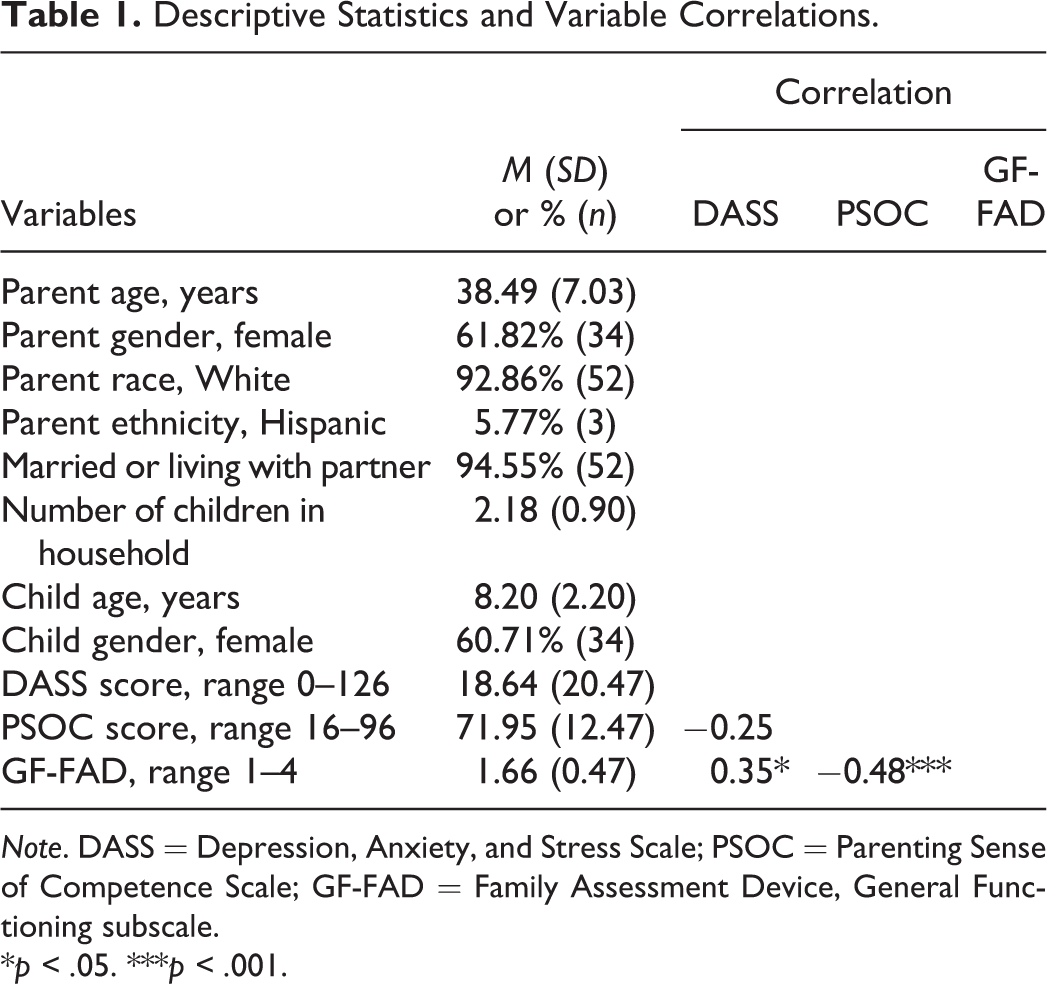
Note. DASS = Depression, Anxiety, and Stress Scale; PSOC = Parenting Sense of Competence Scale; GF-FAD = Family Assessment Device, General Functioning subscale.
*p < .05. ***p < .001.
The multiple regression model with both predictors is significant, R2 = .32, F(4, 49) = 7.15, p < .001. The DASS has a significant positive regression weight, β = .3, p = .01, indicating that military parents who endorsed psychological symptoms reported poorer family functioning when controlling for other predictors, as the GF-FAD is negatively scored. The second predictor variable, the PSOC, has a significant negative regression weight, β = −.46, p < .001. This suggests military parents with a more positive evaluation of their competence as parents also reported more positive overall family functioning.
Discussion
The goal of this study was to examine whether, after controlling for parental age and gender, symptoms of parental psychological distress and parenting sense of competence are each independently associated with family functioning in military families whose children attend civilian elementary schools. Results of this study found both variables to be independently associated with family functioning but not significantly associated with each other.
Based on extant research, the relationship between parental psychological symptoms, as measured by the DASS, and family functioning, as measured by the GF-FAD, was expected, and is consistent with prior studies of civilian and military families (Gewirtz et al., 2010). The association between parental sense of competence, as measured by the PSOC, and family functioning, as measured by the GF-FAD, is similarly in line with previous reports (Ardelt & Eccles, 2001; Coleman & Karraker, 2003; Gondoli & Silverberg, 1997; Jones & Prinz, 2005; Shumow & Lomax, 2002; Teti & Gelfand, 1991).
However, our findings add to the existing literature in that we found parental sense of competence to be independently related to family functioning, above and beyond parental psychological distress. More specifically, our results indicate that parental sense of competence relates to family functioning independent of parental psychological symptomatology, suggesting that interventions that target the sense of parenting competence in military parents may serve to improve family functioning, above and beyond the effects of treating psychological symptoms such as depression, anxiety, or stress.
The results of this study suggest that parental sense of competence may serve as a protective factor against risk factors such as those associated with psychological symptoms (Gondoli & Silverberg, 1997; MacPhee, Fritz, & Miller-Heyl, 1996; Teti & Gelfand, 1991) and thus support the necessity of interventions that address increasing parental competence. This is a promising indication since many service members do not experience psychological symptoms that necessitate treatment, and for those who do, some may be hesitant to engage in treatments due to stigma or lack of access to care. Programs that address this goal have been reported with a range of parental populations including parents of children in Head Start (Webster-Stratton, 1998), parents of children with autism (Keen, Couzens, Muspratt, & Rodger, 2010), and community-based interventions aimed at the prevention of severe behavioral, emotional, and developmental problems in children (Forgatch, Patterson, & Gewirtz, 2013; Sanders, Dadds, & Turner, 2003). Additionally, programs are being examined which aim to increase knowledge and parenting competence in military families, such as After Deployment Adaptive Parenting Tools (ADAPT; Gewirtz, Pinna, Hanson, & Brockberg, 2014). Findings from the ADAPT program indicate that increasing actual parenting competence for military parents significantly improves one’s own sense of parenting competence as well as child adjustment. Thus, enhancing parents’ sense of competence may serve as a protective factor for the stress and challenges that arise with deployment and reintegration of military families (Chesire & Gewirtz, 2015).
The small sample and the sample homogeneity are limitations of this study. There was also a selection bias, as participants who enrolled in the intervention did so on a voluntary basis, thereby limiting the generalizability of the results. Further, as previously discussed, this study was part of a larger study in which information about military service and deployment was collected only at end point and thus is not available for many of the participants of the present study. As deployment is related to familial challenges, understanding the difference in responses from those who experienced a recent deployment, experienced a deployment years prior, and those who had never experienced deployment would better inform the impact of deployment on family functioning. Additionally, the assessment of the main variables of this study was based on self-report measures. Self-reports are subject to participants’ inaccurate memory and response bias, in which socially acceptable responses are given (Kail, 2010).
Conclusions and Future Study
Despite limitations, the findings here provide empirical support for the positive role that one’s sense of parenting competence plays in helping to address the effects of military parents’ deployment and reintegration on family functioning, independent of parental psychological symptomatology. These findings indicate that interventions targeting parental sense of competence in military parents may serve to improve family functioning upon reintegration, independent from interventions which focus on treating psychological symptoms. Further research examining interventions that most effectively address the promotion of parenting sense of competence in military families, such as ADAPT (Gewirtz et al., 2014), as well as research comparing the impact on family functioning among military families who participate in interventions addressing parenting sense of competence versus families who participate in interventions addressing psychological symptomatology will serve to provide greater detail on how best to increase parental sense of competence in military families. This information will aid in providing additional and alternative intervention points to traditional symptom-based treatment for providers working with military families.
Footnotes
Declaration of Conflicting Interests
The author(s) declared no potential conflicts of interest with respect to the research, authorship, and/or publication of this article.
Funding
The author(s) received no financial support for the research, authorship, and/or publication of this article.