







Abstract
This study examined the relationship between implicit family process rules and adolescent prosocial and antisocial communication behaviors. Data came from two-parent families in Wave 5 of the Flourishing Families Project which consisted of 322 families (fathers, mothers, and children ages 13–17). Both observational and questionnaire data were used in data collection. Prosocial and antisocial behaviors were assessed using observational codes from the Iowa Family Interaction Rating Scales. Each of the family members’ perceptions was used to assess constraining family rules and facilitative family rules. Findings showed a direct positive relationship between facilitative family process rules and prosocial communication and a negative relationship with antisocial communication for both girls and boys. Constraining family process rules were also positively related to antisocial communication behaviors in adolescents. Shame was a significant mediator of the relationship between facilitative family rules and prosocial behavior as well as between constraining family rules and antisocial behavior.
When children engage in delinquent behavior, alcohol, or drug use, families, communities, and individuals are affected. It is estimated that nearly 2.3 million juveniles are arrested each year and that almost total US$1 billion is spent in direct and indirect costs for their behaviors (Swenson & Kennedy, 1995). Some theorists have suggested that delinquency is just a part of growing up (Moffitt, 1993). Other research postulates that the catalyst for delinquent behavior stems from peer groups, social context, or a lack of attachment (Sampson & Laub, 1992). Researchers have also examined various factors that take place within a family that influence childhood outcomes. Family communication is one such factor that has shown significant contributions to adolescent behavior. Findings show that positive parent–child communication contributes to lower engagement in delinquent behavior as well as substance abuse (Caprara et al., 1998). Conversely, poor family communication is shown to contribute to adverse adolescent behavior (Lippold et al., 2013). The implications of this research would suggest that understanding how family communication patterns result in lower adolescent delinquent behavior would be beneficial to clinicians identifying pathology and developing treatment plans.
However, a predominance of research has focused on family communication as a general concept and has scarcely identified specific elements of family communication that possibly facilitate or constrain family communication. Stoll (2004) introduced the idea of family implicit rules, as a potential family communication component, that could “underline the creation and maintenance of family process” (p. 18). Minimal research has explored the effects of family implicit rules and its impact on an adolescent’s reluctance or willingness to engage in meaningful and influential conversations within a family.
The aim of this study was to examine the relationship between facilitative and constraining family process rules and prosocial and antisocial communication behavior in preadolescent children. Adolescent internalized shame was examined as a potential mediating variable.
Review of Literature
Family Processes Related to Adolescent Prosocial Behaviors
For years, researchers have investigated how children’s behaviors are influenced by parents’ actions. Specifically, research has shown that parenting styles (Mussen & Eisenberg, 2001), parent–child relationship (Bronte-Tinkew et al., 2006), parental knowledge (Padilla-Walker et al., 2012) modeling, and disciplinary strategies (Mussen & Eisenberg, 2001) are associated with childhood and adolescent prosocial communication behaviors. Recently, Padilla-Walker et al. (2012) examined how proactive parenting influences factors such as drug use, success in school, relationships with friends, and prosocial behavior for more than 300 children. Findings showed connections between specific parental behaviors and childhood outcomes but suggested that the general family climate of autonomy might have more influence over internalization of values and subsequent behaviors. The current study looks to refine the focus of future research by identifying the specific family communication construct of implicit family process rules and examining significant correlations with adolescent communication.
Parents serve as children’s primary socialization agents, particularly for moral development and prosocial behavior (Eisenberg & Murphy, 1995). Lawford et al. (2005) explained that often the parent–child relationship serves as a lifelong context for socialization, thus highlighting the importance of understanding the relationship at an interactional level. The influential development of prosocial communication is but a single side of the socialization coin for adolescents though as antisocial communication also likely develops within the context of family system–level processes.
Antisocial Communication Behavior
The concept of antisocial behavior has been used in family research in many ways. Definitions range from using the term to describe a type of personality disorder to describing delinquency/externalizing behavior to describing a pattern of communication (Murray et al., 2012). In this study, antisocial behavior was defined solely as an individual’s communication in family relationships that is “characteristically self-centered, egocentric, or inappropriate for their age” which tends to disrupt and distract from a smooth relational communication exchange (Melby et al., 1998). Examples of antisocial behavior include a child who fails to accept responsibility, who is uncooperative, or insensitive to the feelings and needs of others. More specifically, a child might declare antisocial communicative behaviors by saying “I’m better than you are at just about everything” or “Mom, you have to help me with my homework. You know I can’t do it by myself” (Melby et al., 1998, p. 137).
Until now, it appears that the preponderance of research relating family processes to adolescent prosocial and antisocial behaviors has only investigated parenting variables. For example, Paat (2011) specifically examined how family factors, such as financial strain and intrapersonal parental discord, affect childhood antisocial outcomes. He concluded that an external factor such as financial strain creates a propensity for antisocial behavior in children. The question then remains that if an external factor has power to influence child antisocial behavior, does a systemic-level process such as family implicit rules have a similar effect? If it does, as the authors predict, there is opportunity to further comprehend the complexity of the parent–child relationship and its influence toward the development of adolescent prosocial and antisocial behavior.
Feinauer et al. (2010) showed that externalized (i.e., hostility) and internalized (i.e., depression, anxiety) behaviors are associated with family implicit rules. Their study investigated how family process rules are related to specific psychological symptoms in adolescents. The findings suggested that particular types of family process rules, such as those that encourage kindness, expressiveness, and disclosure, were related to lower psychological symptoms in adolescents (p. 63). No empirical research could be found that has examined family system–level variables, such as family implicit rules, and their relationship with adolescent prosocial and antisocial communication behaviors
Family Implicit Rules
Family implicit rules have been a part of family therapy theoretical models since the mid-1960s when Jackson (1965) asserted that a family is a rule-governed system meaning that its members behave in organized, repetitive manners, and “such patterns become a governing force in family life” (p. 6). The concept of implicit rules became part of the magnetic resonance imaging approach (Watzlawick et al., 1974), Satir’s communication approach (Satir, 1983) and Minuchin’s structural family therapy (Minuchin et al., 2006). Ford (1983) proposed, “rules provide the connection between family process and individual behavior” (p. 135). Ancillary research adds, “It is believed that implicit family rules underlie the creation and maintenance of family process” (Stoll, 2004). Implicit family rules are the foundational layer in which family relationships and individual personality are built upon; further indicating the need for the current study and others like it.
Families interact in redundant ways that become repetitive patterns, and out of those grows a shared but unexpressed understanding about rules or norms that govern family members’ behaviors. Rarely are such family rules anything but implicit (Riskin, 1963). Seldom are they written down or recorded like laws or rules put up for the public to see. Examples of implicit family rules would include “Share your feelings and encourage others to share their feelings” or “Make decisions together as a family,” or “Have fun and play together.” Over time and with constant repetition, family members come to know what behaviors to expect because the patterns become a shared norm (Ford, 1983). Stoll (2004) stated, “It is believed that implicit family rules underlie the creation and maintenance of family process” (p. 18). These rules are believed to either constrain or facilitate family functioning. To take it one step further, Nuechterlein (1993) explained, “family rules determine behavior to a greater degree than individual needs, drives, or personality characteristics” (pp. 58–59). If implicit rules are part of the rule-governed nature of families, then it follows that family implicit rules would be related to individual family members’ communication behavior, specifically prosocial and antisocial communication.
Constraining Rules
Constraining family process rules are those that impede communication, fragment relationships, and deter familial and personal growth (Ford, 1983; Satir et al., 1988). Specific constraining rules may include “don’t trust yourself, your feelings or conclusions,” “don’t talk about family relationships with family members,” or “don’t grow, change, or in any way ‘rock the family’s boat’” (Harper et al., 2007, p. 91). For example, researchers found that greater proportions of constraining implicit rules were found within eating-disordered families than noneating-disordered families (Gillett et al., 2009). Blevins (1993) believed that constraining family implicit rules produce “dis-ease” among family members. Thusly, constraining family process rules promote a sense of seclusion and isolation, discouraging family members from expressing themselves or relating to each other’s experience.
On a family process level, subsequent consequences of the presence and repetition of constraining family rules include rebellion and chaos, fragmented relationships, alienation, interference with communication and with family growth as well as personal growth (Blevins, 1993; Hoopes & Harper, 1990; Nuechterlein, 1993; Satir et al., 1988). This research suggests a sense of constant distress within the family unit that will go unresolved because of the fundamental constraining rules within the family process. Families then become stuck in a cycle and lack the necessary skills to break free. The presence of constraining family rules is likely related to implied distance between family members which, in turn, may influence the quantity of antisocial communication in children who are frustrated by a distance that is neither acknowledged or labeled but is felt (Harper & Hoopes, 1990).
Facilitative Rules
Facilitative family process rules are those that are flexible, promote openness, confirm all family members’ intrinsic self-worth and dignity, encourage acceptance and love, and so on (Hoopes & Harper, 1992; Nuechterlein, 1993; Satir et al., 1988). Family settings where such facilitative rules can be found likely serve as an incubator for the growth of prosocial communication in children. They provide openness and safety that children need for emotional development with little risk of negative consequences. Simultaneously, such rules buffer or impede development of antisocial communication. Examples of facilitative rules include “be sensitive to others,” “stand up for others in the family,” or “show physical affection within the family” (Harper et al., 2007, p. 91). As part of the examples listed above, there is a theme that invites family closeness and togetherness. The acceptance of emotional expression and thus emotional closeness is one potential theme resulting from facilitative family process rules. For example, a child who receives the message that sharing emotion is accepted in the family may turn to family for emotion support rather than seeking out possible negative coping strategies. Hoopes and Harper (1992) explained that facilitative family process rules not only encourage intimacy and provide emotional support, but they also facilitate greater family functioning by enabling everyday tasks get accomplished by encouraging dependency and autonomy. Fostering cooperation to accomplish family tasks as well as sensitivity through emotional closeness are but two indications of the development of prosocial behavior in preadolescent children
Shame as a Mediational Process
While shame has been used frequently as an outcome variable, some studies have used it as a mediator in the cases of childhood sexual abuse (Donhauser, 2008) and sexually abused women (Hamilton, 2013). Both of the aforementioned studies illustrate the possible benefits of shame as a mediator and not just an outcome. Shame as a mediator in the current study is conceptualized to help explain how family process rules might be related to adolescent communication outcomes.
According to several theorists (Harper & Hoopes, 1990; Kaufman, 1996), the internalization of shame begins in early family life and is developed through the dynamics of interpersonal relationships. Nathanson (1997) conceptualized the neurological capacity for shame may be present in infants and young as 1-day-old. Some amounts of shame can prove to be positive as it may be used for “socialization and teach norms important for survival and interpersonal skills” (Harper, 2011, p. 189). Transitory shame, however, is most often identified as humiliation, embarrassment, and fallen pride (Kaufman, 1996). One danger of internalized transitory shame is that individuals present a false self to others, one in which their internal experience of self and world are incongruent with what they show (Miller, 2008).
Within the family context, shame facilitates hurt, anger, and discouragement and manifests itself through individuals withdraw from family relationships secretly wishing they could internally disappear or even reverse what is shameful about themselves (Harper & Hoopes, 1990). Shame may not be the catalyst for the creation of family process rules, but once it becomes a part of the process, it serves as a conductor through which implied rules may be maintained. It is hypothesized that shame is a mediating individual characteristic that is negatively associated with prosocial behaviors and positively associated with antisocial communicative behaviors.
Aim of the Study
One aim of this study was to examine the relationship between facilitative and constraining process rules and prosocial and antisocial behavior in preadolescent children. In addition, an individual characteristic of the child, internalized shame, was examined as a potential mediating variable. This study was unique in its use of both questionnaire and observationally coded data. It was hypothesized that (1) facilitative family process rules will be positively related to adolescent prosocial communication and negatively related to antisocial communication behaviors, (2) facilitative family process rules will be negatively related to antisocial communication behaviors in adolescents, (3) constraining family process rules will be positively related to antisocial communication in adolescents, (4) constraining family process rules will be negatively related to prosocial behaviors in adolescents, (5) shame will be a significant mediating variable between facilitative family process rules and prosocial communication behavior in adolescents, and (6) shame will be a significant mediating variable between constraining family process rules and antisocial communication behavior in adolescents. The measurement and hypothesized model is shown in Figure 1. The Structural equation model (SEM) model was preferred in this study because it allowed for measurement components, structural components, and multiple respondents.
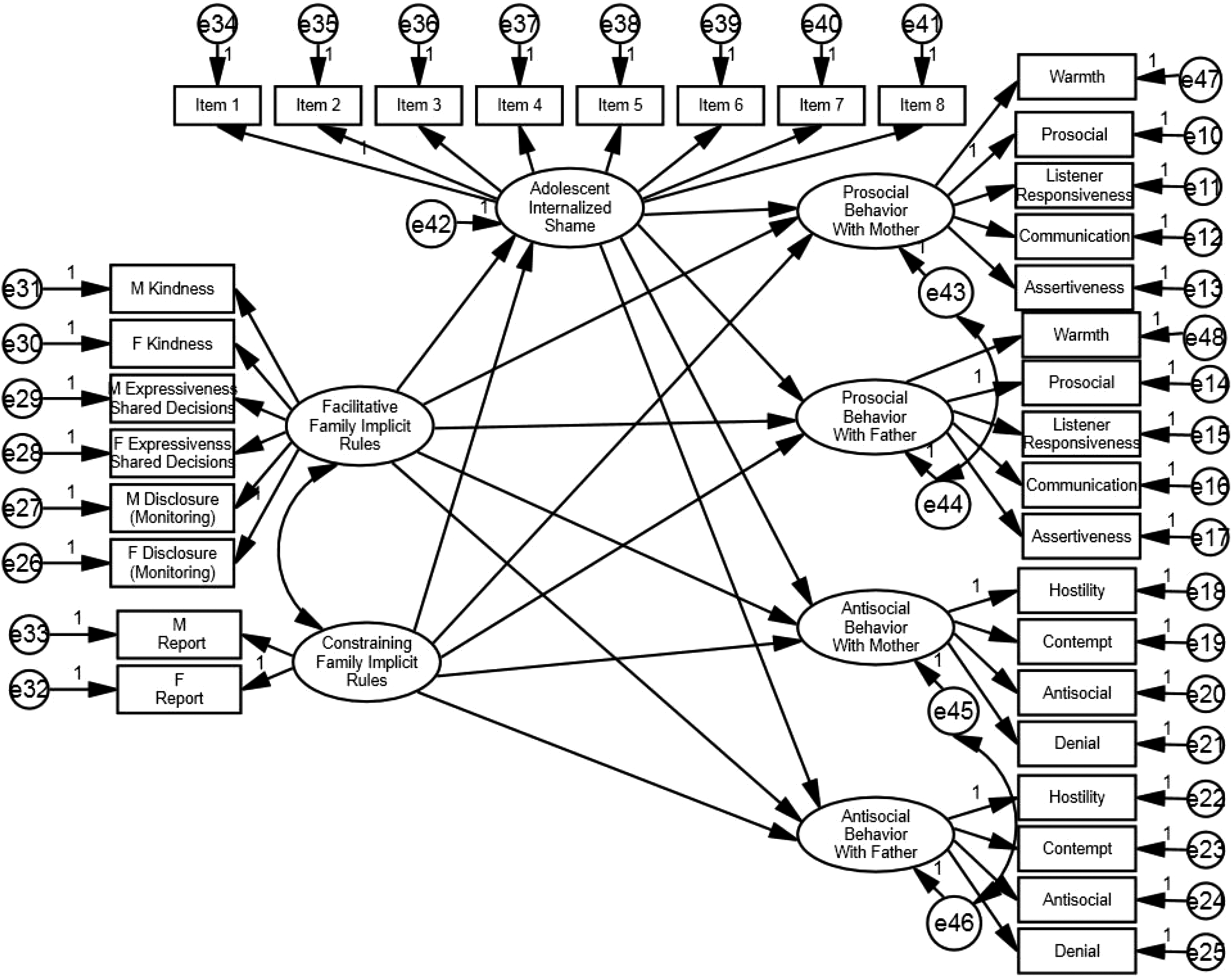
Measurement and structural model with facilitative and constraining family implicit rules as exogenous variables and adolescent prosocial and antisocial behavior with mother and with father as endogenous variables with adolescent internalized shame as a potential mediating variable.
Method
Participants
The participants for this study were taken from Wave 5 of the Flourishing Families Project, a longitudinal study of inner-family life involving families with a child between the ages of 13 and 18. Other waves of data were not used because measures for internalized shame and observational data for prosocial and antisocial communication were not collected in other waves. The sample consisted of 463, 322 of which were two-parent families (92.6% retention from Wave 1).
The mean age of fathers and mothers was 46.2 (SD = 5.93) and 44.3 years (SD = 5.74), and the mean age of girls and boys was 15.24 (SD = 1.02) and 15.23 (SD = .99). In terms of race, 75.5% of the families were all Caucasian, 4.2% all African American, .3% all Hispanic, 1.2% all Asian, and 18.8% Multiracial. The annual household income was approximately US$84,000, and the parents were highly educated with 75.5% of fathers and 67.9% of mothers reporting a bachelor’s degree or higher.
Procedure
Primary recruiting of these families was done through a purchased national telephone survey database (Polk Directories/infoUSA). The database contained socioeconomic status (SES), age of children, and race for the families. Families were randomly selected from census tracts in a large Northwestern city matched to the Polk directory, where socioeconomic and racial stratification of reports lined up with that of local school districts. All families with children ages 10–14 were deemed eligible to participate in the study. Six hundred ninety-two families met the criteria and were contacted. Of that original number, 423 agreed to participate (a 61% response rate). However, the Polk database generated information using telephone, magazine, and Internet subscriptions. Due to the nature of this data collection, low SES families were underrepresented. In order to more accurately represent the population of the city surveyed, additional recruiting of lower socioeconomic families was performed which produced an additional 77 participating families (15% of total sample).
Families were all contacted by use of a multistage recruitment procedure that included sending a letter of introduction to potentially eligible families, followed up with phone calls and home visits to confirm eligibility and willingness to participate in the study. Families who decided not to participate in the study cited concerns about privacy and lack of time. Very little data were missing due to a check and double check screening system employed by interviewers for missing answers.
Measures
Behavioral coders received 90 hr of training that required them to show mastery of the Iowa Family Interaction Rating Scales by consistently 80% agreement with coding of tapes of families done in the Iowa Coding Lab. Twenty-five percent of the tasks were randomly assigned to a second reliability coder. Tasks were assigned in such a way that both coders were blind to the task being coded by a second coder. The interrater reliabilities were determined using intraclass correlations as recommended by the Iowa Lab. These ranged from .83 to .91 for the codes used as indicators of prosocial behavior.
Prosocial
Specific codes including warmth, prosocial, listener responsiveness, communication, and assertiveness from the Iowa Family Interaction Rating Scales (Melby et al., 1998) were used to create a latent outcome variable called prosocial behavior. The individual codes that comprise the latent variable came as a result of coding actual parent–child interactions from Wave 5. Coders watched the entire recorded task and then assigned a rating of 1 (not at all characteristic in the task) to 9 (mainly characteristic of the task) for each behavior. Factor loadings for these indicators ranged from .78 to .95.
Antisocial
A latent variable called antisocial behavior was created using codes hostility, contempt, antisocial, and denial codes from the Iowa Family Interaction Rating Scales (Melby et al., 1998). Each of these observed codes was defined by negative communication interaction behaviors from the adolescent with their parent. Intraclass correlations for interrater reliability ranged from .85 to .94 for these codes. Factor loadings for these indicators ranged from .84 to .92.
Family implicit rules
Two latent variables, facilitative family process rules and constraining family process rules, were created using subscales from the Family Implicit Rules Profile (Harper et al., 2007). Using a 5-point Likert-type scale ranging from 1 (never) to 5 (most of the time), both the mother and father were asked to respond to how much 30 implicit rules operated in their family. This measure contained four subscales: kindness (α = .84), expressiveness and shared problem-solving (α = .94), monitoring (α = .88), and false image and constraining feelings/thoughts (α = .92). The mother’s and father’s reports on Kindness, Expressiveness and Shared Problem-Solving, and Monitoring subscale scores were used as six indicators (three subscale scores × 2 parents) to create a latent variable called facilitating family implicit rules. Factor loadings ranged from .69 to .88.
To create a latent variable called constraining implicit family rules, the mother’s and father’s reports for the 12 items on this subscale were used. The mean score for the mother’s items was one indicator, and the mean score for the father’s items was the other indicator. A sample item from the Constraint subscale is “Do not trust yourself, your feelings, or your conclusions.” Factor loadings ranged from .72 to .89.
Shame
A latent variable called adolescent internalized shame was created using items from the Inferiority subscale of the Internalized Shame Scale (Cook, 2001). Adolescent participants answered 8 items using a 5-point Likert-type scale ranging from 1 (never) to 5 (almost always) with higher scores representing higher levels of shame. Sample items included “I feel like I am never quite good enough,” “I see myself as being very small and insignificant,” and “I feel as if I am somehow defective as a person.” Cook (2001) reported the reliability coefficient for this subscale as .80, and in this sample, reliability coefficient was .92 for girls and .87 for boys. Factor loadings ranged from .74 to .92. This scale has been widely used and has adequate validity as demonstrated in concurrent validity and construct validity studies (Harder et al., 1992; Rybak & Brown, 1996). Control variables included child age, number of siblings, father’s education, mother’s education, and income. However, none of the control variables were significantly related to the outcomes.
Results
Mean Scores and Correlations
Mean scores for all measured variables are shown in Table 1. Table 2 shows the correlations between all latent variables in the study. Significant relationships were found between constraining family implicit rules were significantly and antisocial behavior with the mother, antisocial behavior with the father and shame. Facilitative implicit family rules were correlated with prosocial behavior with the mother prosocial behavior with the father, and shame. Facilitative implicit family rules were also significant correlated with adolescent shame, antisocial behavior with mother, and antisocial behavior with father. Constraining family implicit rules were also inversely correlations with prosocial behavior with mother, and prosocial behavior with father. Shame was significantly correlated with prosocial behavior with mother, prosocial behavior with father, antisocial behavior with mother, and antisocial behavior with father.
Means and Standard Deviations for All Measured Variables.
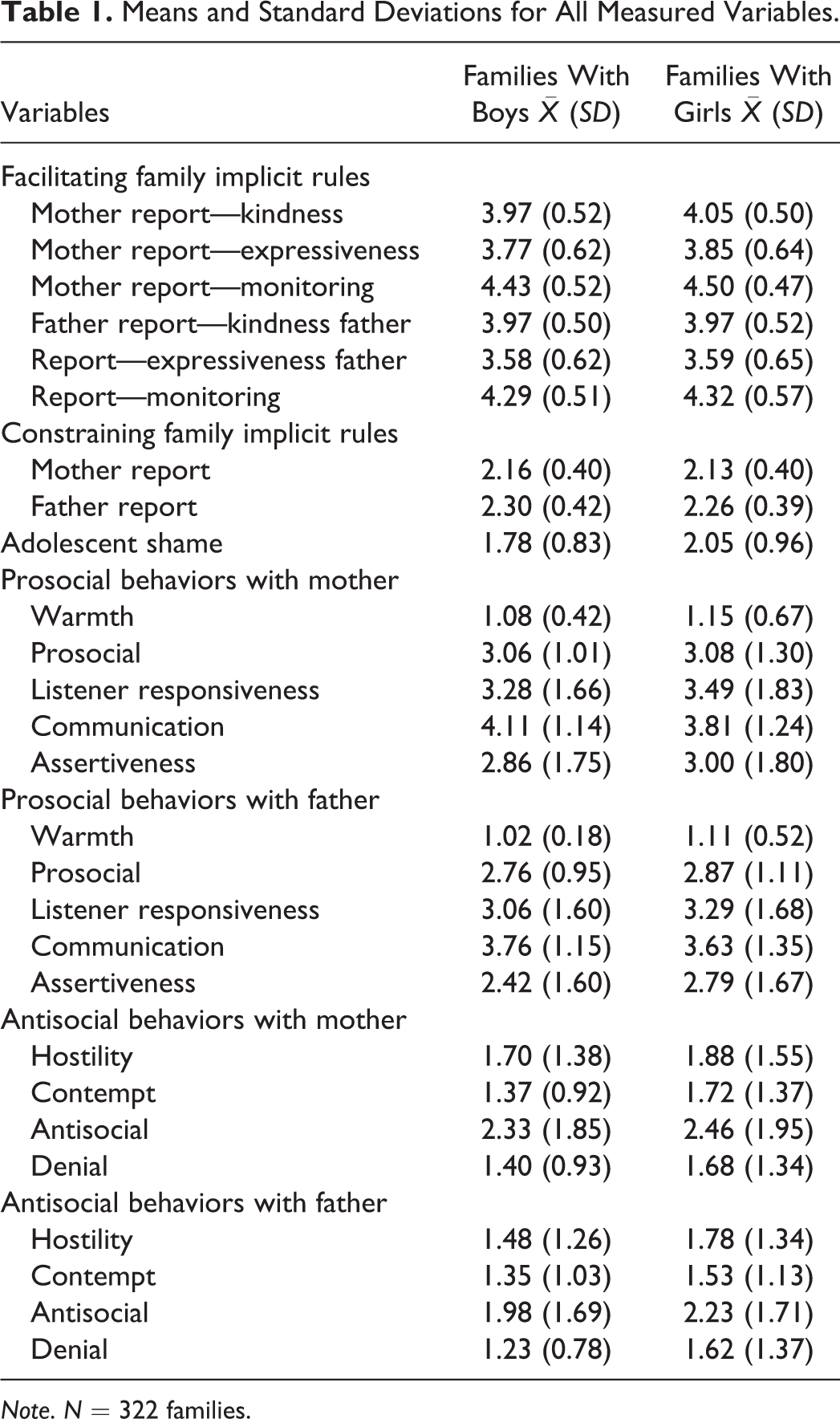
Note. N = 322 families.
Correlations for All Latent Variables in the Model.
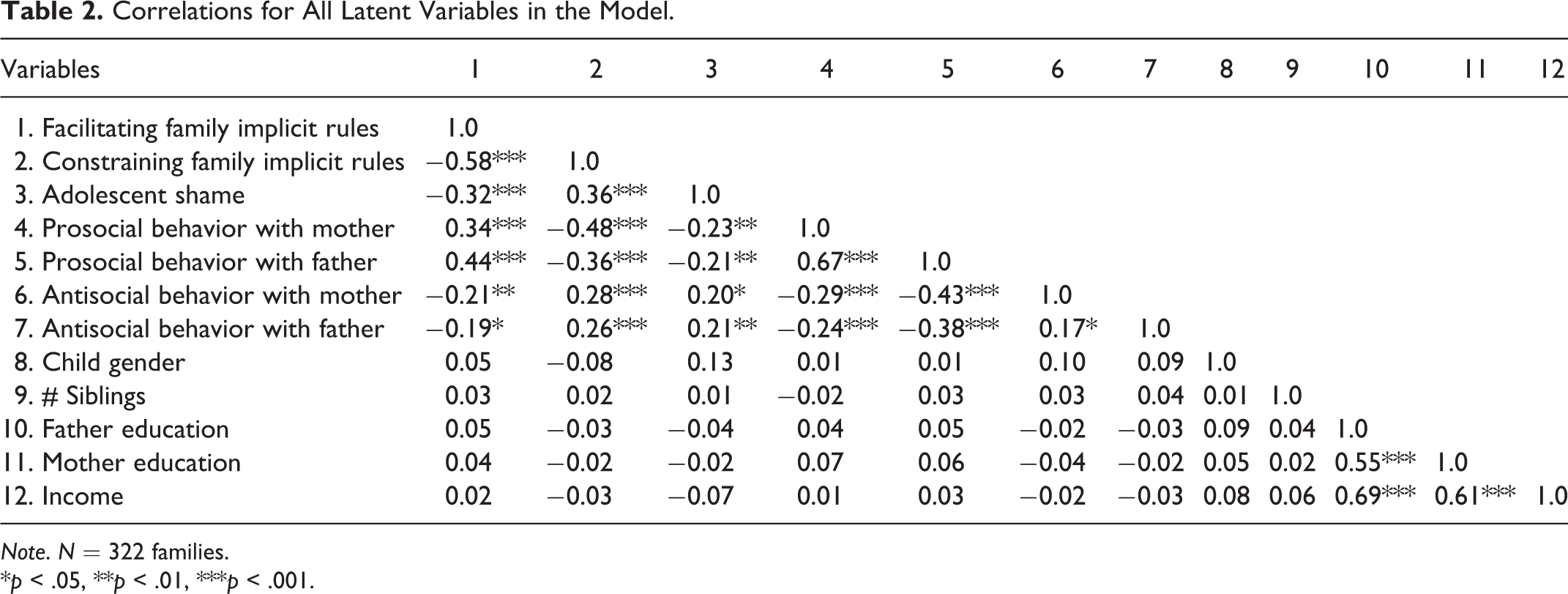
Note. N = 322 families.
*p < .05, **p < .01, ***p < .001.
Path Model Results
Using AMOS Version 22, multiple group comparison allowed for examination of differences between boys and girls in the structural relationships between implicit facilitative and constraining family rules and observed prosocial and antisocial communication behaviors in adolescents as well as the indirect paths through the adolescents’ internalized shame as a potential mediating variable. As shown in Figure 2, the goodness-of-fit indices showed that the hypothesized model fit the data (χ2 = 555.23, df = 502, p = .06, comparative fit index [CFI] = .982, root mean square error of approximation [RMSEA] = .03, standardized root mean squared residual [SRMR] = .038). To be good fit, the χ2 should not be significant, the CFI should be above. 95, and the RMSEA and SRMR should be below .05 (Kline, 2010).
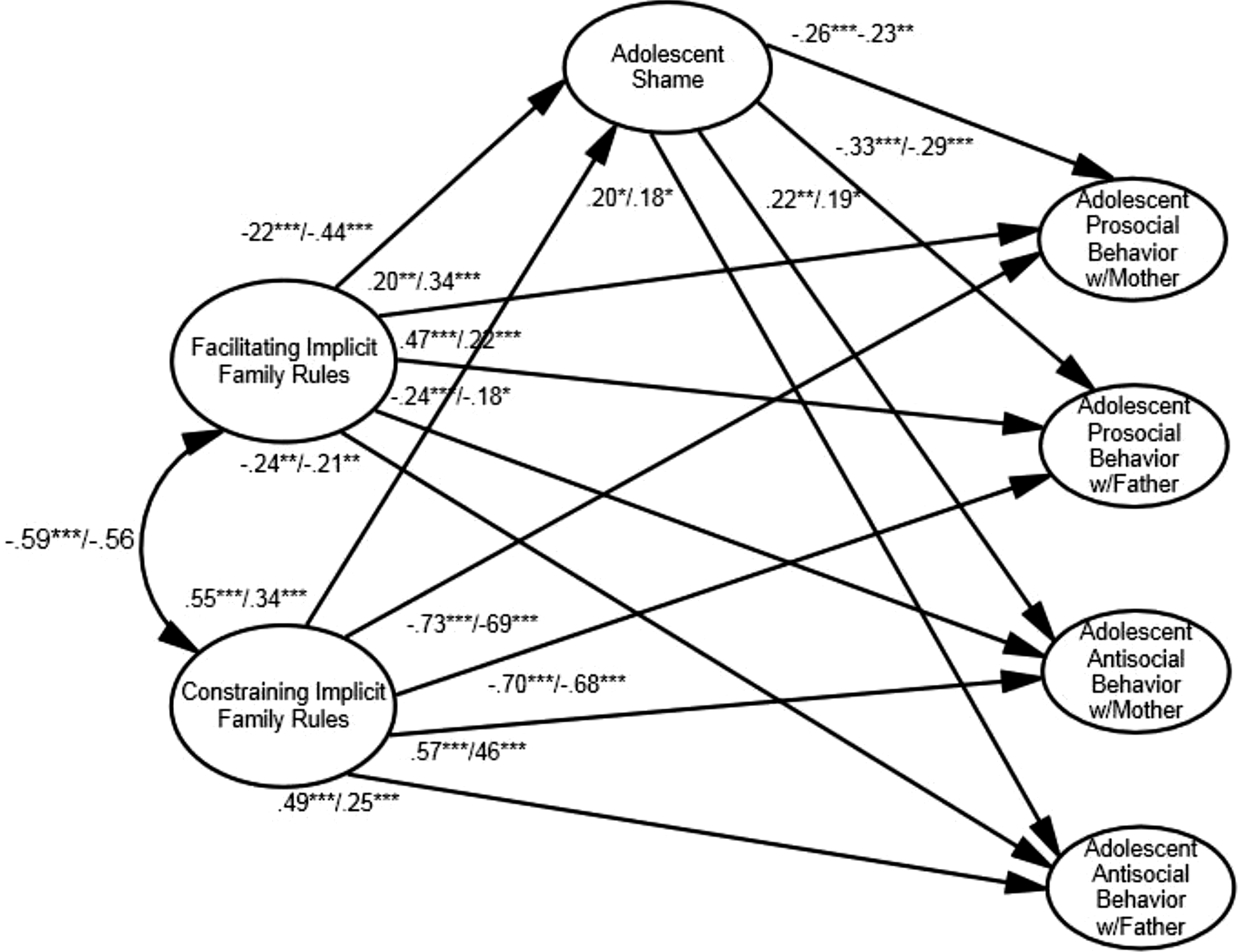
SEM results comparing paths for girls and boys. Coefficients for girls occur first with coefficients for boys after the diagonal on each path. *p < .05. **p < .01. ***p < .001. χ2 = 555.23, df = 502, p = .06, CFI = .982, RMSEA = .03, SRMR = .038.
Facilitating family rules was a significant predictor of adolescent prosocial behavior with mother (β = .20, p < .01 for girls and β = .34, p < .001 for boys), adolescent prosocial behavior with father (β = .47 for girls and β = .22 for boys, both p < .001), adolescent antisocial behavior with mother (β = −.24, p < .01 for girls and β = −.18, p < .05 for boys), and adolescent antisocial behavior with father (β = −.24, p < .01 for girls and β = −.21, p < .05 for boys).
Constraining implicit family rules was a significant predictor of adolescent prosocial behavior with mother (β = −.73 for girls and β = −.69 for boys, both p < .001) and prosocial behavior with father (β = −.70 for girls and β = −.68 for boys, both p < .001), antisocial behavior with mother (β = .57 for girls and β = .46 for boys, both p < .001), and adolescent antisocial behavior with father (β = .49 for girls and β = .25 for boys, both p < .001).
Adolescent Shame as Potential Mediator
Facilitative family rules was negatively related to shame (β = −22 for girls and β = −.44 for boys), and constraining family rules was positively related to shame for both girls (β = .55, p < .001) and boys (β = .34, p < .001). Shame was negatively related to prosocial behavior toward mother (β = −.26, p < .01 for girls and β = −.23, p < .001 for boys) and toward father (β = −.33 for girls and β = −.29 for boys, both p < .001). Shame was positively related to antisocial behavior toward mother (β = .22 for girls, p < .01, and β = .19 for boys, p < .05) and toward father (β = .20 for boys and β = .16 for boys, p < .05 for both).
Bias corrected bootstrapping (Preacher & Hayes, 2008) was used to test whether adolescent shame was a significant mediating variable between facilitative and constraining family implicit rules and adolescent prosocial and antisocial behavior with both parents. Results showed that shame significantly mediated the relationship between family facilitative rules and adolescent prosocial behavior with mother for boys (β = .101, p < .001) but not for girls (β = .057) and prosocial behavior with father for both girls (β = .073, p < .01) and boys (β = .128, p < .001). Shame also mediated the paths between facilitative rules and antisocial behavior with mother and with father for boys (β = −.084 with mothers and β = −.079 with fathers, both p < .01) but not for girls.
In terms of shame mediating the paths between constraining family rules and the outcomes, the coefficients for all paths were significant (prosocial with mother: β = −.143, p < .001 for girls and β = −.078, p < .02 for boys; prosocial with father: β = −.182 for girls and −.099 for boys, both p < .001; antisocial with mother: β = .121, p < .001 for girls and β = .065, p < .05 for boys; antisocial with father: β = .110, p < .001 for girls and β = .061, p < 05 for boys).
Differences in Paths Between Girls and Boys
A χ2 differences test was used to compare a fully constrained model against an unconstrained model, and the difference was significant. Constraints were then released one at a time starting with the largest differences in coefficients until a model with the best fit was determined. In that model, the paths between facilitating rules and adolescent shame and adolescent prosocial behavior with mother were significantly different with the coefficients greater for boys. The paths from facilitating rules and adolescent prosocial behavior with father were stronger for girls than for boys. The paths from constraining family rules to shame and to adolescent antisocial behavior with fathers were also significantly different with girls having the higher coefficients for both paths.
Discussion
Findings in the current study supported the first hypothesis that there would be a direct relationship between facilitative family process rules and prosocial communication. This finding provides empirical support for the conceptual idea of Harper and Hoopes (1990) that when facilitative rules are present in a family there is space for greater emotional connection and closeness. It is likely that the very nature of facilitative rules (i.e., “be sensitive to others,” “stand up for others in the family”; Melby et al., 1998) establish guidelines for more emotional expression and more connection. This finding also lends credibility to the general systems idea that family-level processes are related to individual family members’ behaviors.
Further, findings discovered that facilitative family process rules were also negatively related to antisocial communication behaviors. This would mean that the more a family emphasizes rules like “be sensitive to others,” “stand up for others in the family,” or “show physical affection within the family” (Harper et al., 2007, p. 91), the less you will see patterns of self-centered or egocentric communication behaviors. This seems to support the notion presented by Nuechterlein (1993) that “family rules determine behavior to a greater degree than individual needs, drives, or personality characteristics” (pp. 58–59).
The findings of this study also supported the third hypothesis that constraining family process rules would be positively related to antisocial communication behaviors in adolescents. The current findings support those of both Satir et al. (1988) and Nuechterlein (1993) that constraining family rules inhibit forms of communication and this study shows that they specifically influence antisocial communication. It is possible that the nature of constraining family rules (i.e., don’t share your feelings or thoughts with other family members,” “Be careful to say the right thing when you open your mouth”; Melby et al., 1998) are rules that set boundaries for emotional distance between family members. In a very real sense, the more that families reinforce these types of rules the more emotional distance they may be creating with their children. Consequently, they may find that an already reluctant child becomes even less open and honest in their communication with others and self (Harper & Hoopes, 1990). Additionally, higher levels of antisocial communication would also mean that the individual is listening less to others, less responsive, and facilitative of others’ wants and needs to communicate with them.
It was also found that constraining family process rules were negatively related to prosocial behaviors in adolescents. This finding supports previous research by Blevins (1993) and Harper and Hoopes (1990) that constraining family implicit rules dictate feelings, thoughts, and behaviors to a point where it interferes with communication, produces fragmented relationships, alienation, impedes familial and personal growth, and maintains dysfunction in families. Further, Nuechterlein (1993) added that constraining family process rules dictate behavior rather than serve as a guideline for an individual’s life. It is possible that the repetition of emotional boundary limitations set by constraining family process rules (i.e., don’t share your feelings or thoughts with others) not only reinforce antisocial communication behaviors but also impede the growth and development of alternative prosocial communication behaviors (i.e., cooperation, helpfulness, or sensitivity).
The current study showed that shame was a significant mediating variable between facilitative family process rules and prosocial communication behavior in adolescents. The lower measured amounts of shame correlated with higher levels of prosocial behaviors in interactions with both parents. These findings support the theory of Harper and Hoopes (1990) that family process would be related to shame in individual members. The current study expands on that idea by showing shame is not just influenced by a family-level process but that it may account for the relationship between two family-level processes such as family implicit rules and adolescent communication. The strengths of the paths between shame and the mother’s interaction with the child and shame and the father’s interaction with the child for both prosocial and antisocial behavior outcomes did not appear to be significantly different. The lack of difference supports the idea that family system–level rules are related to individual family member behaviors regardless of the dyadic context in which it occurs.
The last hypothesis that stated shame would be a significant mediating variable between constraining family process rules and antisocial communication behavior in adolescents was supported by the current study. In fact, higher levels of antisocial communication behaviors for the child and parent interaction were observed when higher reports of shame were measured. This is not to say that shame produces more antisocial communication or vice versa but rather that shame accounts significantly for a relationship between antisocial communication and constraining family implicit rules. Kaufman (1996) described transitory shame as humiliation, embarrassment, and fallen pride. These attributes may very likely serve a vehicle through which constraining family implicit rules influence disruptive or antisocial adolescent communication. The current findings support the theoretical offerings of Harper and Hoopes (1990) that within the family context, shame facilitates hurt, anger, and discouragement. All of which, are communication qualities that may lend themselves more toward resistance, defiance, being inconsiderate of others, insensitivity, obnoxiousness, or being unsociable when relating competently and effectively with others.
Theorists (Harper & Hoopes, 1990; Kaufman, 1996) first suggested that the internalization of shame develops through the dynamics of interpersonal relationships early on in family life. The findings of this study build onto the postulates of those theorists by suggesting that shame, as a mediator, does not just begin to develop within the family system but also influences the possible trajectory for both prosocial and antisocial communication behaviors in adolescents. Specific trajectories that have been linked with shame include overt aggression in school (Åslund et al., 2009), bullying (Meier, 2003), victimization (Meier, 2003), and self-harming (Flett et al., 2012). Within the contextual framework of prosocial and antisocial communication behaviors, possible consequential trajectories for the development of shame may include dating, marriage selection, or even success in the workplace which are all context that are heavily influenced by communication.
Clinical Implications
The findings of this study extend beyond just statistical significance. The functionality of constraining implicit family rules and shame may undermine the overall change process in a clinical setting. Counselors would do well to assess for implicit rules and shame that contribute to or hinder the type of change that the therapist is a trying to realize in a clinical setting. An initial attempt to understand family implicit rules may be done through the use of The Family Implicit Rules Profile assessment (Harper et al., 2007). Each family functions under their own specific set of rules and thus it is crucial that the clinical explore additional implicit family rules during each session of therapy.
Once the clinician has inkling that either constraining or facilitative family rules are a part of family functioning they must take special care to assess for elements of shame in the children. One of the most difficult things about working with shame, and maybe one of the reasons why it is not addressed more in therapy, is that it has the ability to trigger shame in the therapist as well as the client (Harper & Hoopes, 1990). When a clinician is working with a client that is dealing with their own issues of shame, the therapist is faced with a sense their own shame or shame they have felt. If they deny or ignore that shame, they will find that their ability to help clients progress is lacking. It becomes crucial that clinicians seek consultation or help from others outside of the client–therapist relationship (Fossom & Mason, 1986). Examples of warning signs would include the therapist being uncomfortable with their own feelings toward the client but deny it, the therapist withdraws emotionally during session, the therapist becomes codependent or displays inappropriate caretaking, or therapist experiences increased self-doubt of self-blaming for the lack of client progress (Harper & Hoopes, 1990).
Future Directions for Research
As this study was a first in that it bridges the gap between family process interaction and adolescent outcomes, there remains a surplus of opportunities for future directions. One in particular would be to use a longitudinal sample to measure changes over time and understand possible trajectories for development during all of adolescence. It would also be useful to understand how early family process rules begin to influence prosocial and antisocial communication and how those might be affected by such factors such as SES, birth order, single-parent versus two-parent families, or even gender.
Limitations
There are several limitations that accompany this study. It was cross-sectional in design which prevents determination of cause and effect. Additionally, the sampled population is much more a representation of an upper middle-class population with the levels of income and education for the parents and may not encompass all the elements that go into lower SES homes. Additionally, the findings cannot be generalized to the larger United States since the sample comes from the greater Seattle area. The demographics of the sample do not mirror those of the United States in the sense that Latino families are underrepresented in the sample.
Conclusion
The aim and purpose of this study was to explore the possible interplay between family implicit rules and adolescent communications outcomes with shame as a possible mediator. Findings showed significant correlations between the types of implicit rules, facilitative or constraining, that are created in family systems and prosocial and antisocial behaviors. Shame proved to be a significant correlate as a mediating variable between family implicit rules and adolescent outcomes. It is important for clinicians and parents alike to be aware of the types of rules that are being structured within families and their possible negative or positive outcomes. To coin a phrase from Whitaker and Bumberry (1988), the therapist must commence in the process of “dancing with the family” in order understand the full scope of family issues and consequent family solutions. As clinicians and families become more aware of family structural and functional implied rules, they will be able to improve overall family functioning as well as adolescent communication behaviors.
Footnotes
Declaration of Conflicting Interests
The author(s) declared no potential conflicts of interest with respect to the research, authorship, and/or publication of this article.
Funding
The author(s) received no financial support for the research, authorship, and/or publication of this article.
