






Abstract
The current research is aimed at investigating the mediating role of emotional neglect and self-injurious behaviors in the association between family satisfaction and depressive symptoms in 312 undergraduates (45% boys and 55% girls) in the age range of 14–19 years (M = 17.23, SD = 1.02). The measures include the Emotional Neglect Scale, Self-Injurious Behaviors Scale, Family Satisfaction Scale, and Depressive Symptomatology Scale for Adolescents and a Demographic Performa. Results indicated that emotional neglect and self-injurious behaviors fully mediated the relationship between family satisfaction and depressive symptoms in college students. These findings have very important implications for counselors to provide tailor-made intervention plans and provide preventative measures to avoid serious consequences of depression.
College years are a transition from adolescence to adulthood associated with profound biological, emotional, and social changes that result in a great turmoil of continuous adjustment and learning of new skills and are at the great vulnerability of different mental health problems (Alloy et al., 2012). Depression is said to be one of the major mental health concerns that are affecting a substantial number of people across the life span with the prevalence rate of between 5% and 20% in young adults with a predominance of females (Bansal et al., 2009; Thapar et al., 2012). Most of the studies are now focusing on the identification of risk and protective factors associated with depression (Liu, 2017). A plethora of empirical evidence suggests that childhood experiences of maltreatment, poor family functioning, abuse, and neglect are associated with depression and other comorbid conditions (Klein & Kotov, 2016; Thomassin et al., 2016; Weber et al., 2016).
Family functioning, family satisfaction, and quality of the parent–child relationship have a particular focus of study in the development of different mental health problems especially depression and self-harm in young adults (Turner et al., 2006). Attachment theory points out that inconsistent and emotionally unavailable parenting can lead to the development of a maladaptive internal working model that can result in different internalizing/externalizing problems and interpersonal problems (Bowlby, 1969; Branje et al., 2009). According to Olson’s (2011) conceptualization of the circumplex model, a cohesive family comprised a mutual emotional bonding and satisfaction among family members that promote family support and a sense of belongingness. Family satisfaction denotes an individual’s subjective evaluation of the quality of satisfaction of different aspects of family functioning and higher life satisfaction (Olson, 2000). Satisfied, open, and interactive communication in the family is associated with emotional responsiveness, mutual support, and positive psychological outcomes (Curran & Allen, 2017). Disruptive family factors such as lack of family cohesion, parental control and authority, low emotional support, parental discord and conflict, poor communication, and less opportunity for expression make a family environment dysfunctional and disruptive that play a critical role in the development of depression in emerging adults (Martin et al., 2015; Sheeber et al., 2007).
Emotional maltreatment is another risk factor for depressive symptoms comprising two components, emotional abuse, verbal insult and assault on an individual’s self-worth and emotional neglect, a lack of emotional response, nurturance, affection, and basic developmental and emotional needs (Hibbard et al., 2012; Proctor & Dubowitz, 2014). Emotional neglect is the most frequently reported form of abuse and neglect; almost one in five children experience emotional or physical neglect worldwide, which is a leading cause of the onset of depression in young adolescents (Finkelhor et al., 2013; Springer et al., 2016). Research evidence suggests that emotional neglect is associated with the fear of criticism, lack of attention, and assault, which predict emotional vulnerability and hopelessness resulting in increased depression level (Liu et al., 2014). Moreover, the child develops certain negative interpersonal schemas of shame, guilt, and vulnerability, which mediate the relationship between emotional neglect and depressive features (Wright et al., 2009).
Self-injurious behaviors (SIB) is another growing concern for researchers used interchangeably with self-utilization, self-harm, or self-injury and refers to a deliberate act of damaging oneself physically without the intension of suicide (Heath et al., 2008). The prevalence of SIB is between 12% to 37% in school-going children and 12% to 20% in young adults (Gollust et al., 2008; Whitlock et al., 2006) with the age of onset of 11–15 years (Jacobson & Gould, 2007). The most commonly reported methods of SIB include scratching, piercing, burning, tearing, and cutting the skin (Klonsky, 2007). SIB is associated with distress, depression, anxiety, and suicidal ideation (Bentley et al., 2015; Hawton et al., 2012). Several studies have demonstrated that family dysfunction, poor attachment, and emotional neglect are associated with SIB (Arens et al., 2012; Sutton, 2018). Insecure attachment and inconsistent parenting hinder the development of emotional regulations and effective coping skills which consequently leads to maladaptive coping to deal with daily life stressors, and suicide attempts serve the purpose of attention-seeking from neglecting parents (Bowlby, 1980).
Since depression is a growing concern associated with disabling life functioning, rich evidence of research is devoted to finding out the risk and protective factors to identify in early and timely manner. The risk factors comprised a combination of biological, personal, emotional, and social factors that contribute to the onset, manifestation, and treatment outcome of depression. Family is a pivotal institute for learning social and emotional skills and influence human being throughout life. Considering the importance of a family, the current research addressed two important factors, family satisfaction and emotional neglect, that a young adult perceive and experience. As we noted earlier that dysfunctional familial relationship, harsh and inflexible environment, and lack of family satisfaction are associated with depression and SIB, which is an inadequate way of coping with the internal vulnerability and stress. Similarly, emotional neglect is associated with many mental health problems. Although several studies have investigated the adverse consequences of child abuse and neglect in children, less is being explored about the continued effects of emotional neglect in young adults.
Based on research evidence, it is demonstrated that the family satisfaction is related to depression, emotional neglect, and SIB, but no comprehensive study has investigated the interrelatedness of these variables. The present research is, therefore, a unique attempt to identify the association between family satisfaction and depressive features in young adults with the mediating role of emotional neglect and SIB. The findings can help counselors to understand the underlying mechanism and thought processes associated with traumatic life experiences like emotional neglect. We hypothesize that there would be a negative relationship between family satisfaction and depressive symptoms and a positive relationship among experience of emotional neglect, SIB, and depressive symptoms in young adults.
Method
Participants
The data of the current study were collected from undergraduate students from three government-run and three private colleges of the city of Lahore. A sample of 312 undergraduates (45% boys and 55% girls) was recruited through a purposive sample technique. The age range was 14–19 years (M = 17.23, SD = 1.02). The inclusion criteria to recruit participants comprise those college students who live in an intact family system with both parents alive and living together. Most of the participants belong to the intact family system with a nuclear family system (48%) and a joint (52%).
Measures
Emotional Neglect Scale (Karamat, 2020) is a 24-item self-report measure used to assess the perception of emotional neglect and comprises two subscales, Dominance and Control (16 items, α = .91) and Lack of Attention (8 items, α = .77). The response options are 0 (not at all), 1 (seldom), 2 (often), and 3 (more often). Possible scores ranged from 0 to 72, and a higher score means more emotional neglect that an individual experience.
Self-Injurious Behavior Scale (Saleem, 2017) is a 17-item (α = .94) self-report scale used to measure SIB with 4 points rating and the response options are 0 (not at all), 1 (seldom), 2 (often), and 3 (more often). The scoring range is 0 to 51, and a high score denotes more SIB.
Family Satisfaction Scale (Olson et al., 2006), a 10-item scale (α = .79) taken from Family Adaptability and Cohesion Scale IV, was used to measure family satisfaction. It was a 5-point Likert-type scale that indicates the degree to which participants agree or disagree with the statements. The response options were 1 (strongly disagree), 2 (generally disagree), 3 (undecided), 4 (generally agree), and 5 (strongly agree). The scoring range is 10–50, and a high score means higher family satisfaction.
Self-Reported Depressive Symptomatology in Adolescents (Saleem et al., 2014)is a self-report measure of 27 items with four subscales: Sadness (seven items, α = .81), Indecisiveness (seven items, α = .79), Irritability (six items, α = .77), and Psychosomatic Symptom (six items, α = .73). The scoring options are 0 (not at all), 1 (rarely), 2 (sometimes), and 3 (often). Possible scores ranged from 0 to 81, and high scores indicate a higher level of depressive symptomatology.
Procedure
Once the permission was obtained, college students were contacted with the help of college authorities with the assurance of confidentiality and anonymity. After obtaining informed consent, participants were tested in a group averaging 25 students and were provided the final research protocol in paper-pencil format, and the time to complete the protocol was 20 min on average. A debriefing session was also provided to all participants.
Statistical Analysis
The Pearson product moment correlation method was used to demonstrate the relationship among emotional neglect, SIB, family satisfaction, and depressive symptoms. Subsequently, Hayes (2018) bootstrapping approach was used to identify that emotional neglect and SIB mediate the association between family satisfaction and depressive symptoms.
Results
The relationships among emotional neglect, SIB, family satisfaction, and depressive symptomatology were explored through the Pearson product moment correlation. Table 1 indicates a significant positive association among emotional neglect, SIB, and depressive symptomatology. Furthermore, findings also indicated a significant negative association of family satisfaction with emotional neglect, SIB, and depressive symptoms.
Intercorrelations Among Emotional Neglect, Self-Injurious Behavior, Family Satisfaction, and Depressive Symptomatology.

Note. N = 312. EN = emotional neglect; SIB = self-injurious behavior; FS = family satisfaction; DS = depressive symptomatology.
*p < .05. **p < .01. ***p < .001. df = 311.
Mediation Analysis
The Pearson product moment correlation indicated a significant relationship among emotional neglect, SIB, family satisfaction, and depressive symptomatology. Hence, the mediating role of emotional neglect and SIB in the relationship between family satisfaction and depressive symptomatology was explored. In this regard, Hayes (2018) bootstrapping approach was used to identify whether the emotional neglect and SIB mediate the association between family satisfaction and depressive symptomatology (Table 2). Figure 1 shows that total effect of family satisfaction on depressive symptomatology (β = −.31, SE = .11, p < .01) was significant. Furthermore, direct effects of family satisfaction on emotional neglect (β = −.41, SE= .07, p < .001) and SIB (β = −.15, SE = .05, p < .05) were significant. The direct effect of the first mediating variable emotional neglect on depressive symptomatology (β = .32, SE = .08, p < .001) was significant, and the direct effect of the second mediating variable SIB on depressive symptomatology (β = .41, SE = .11, p < .001) was also significant. Findings of the current research revealed that emotional neglect and SIB significantly fully mediate the relationship between family satisfaction and depressive symptomatology as c′ model (β = −.15, SE = .10, p = .14) is no more significant.
Regression Coefficient, Standard Error, and Model Summary Information for the Family Satisfaction, Emotional Neglect, Self-Injurious Behaviors, and Depressive Symptomatology.
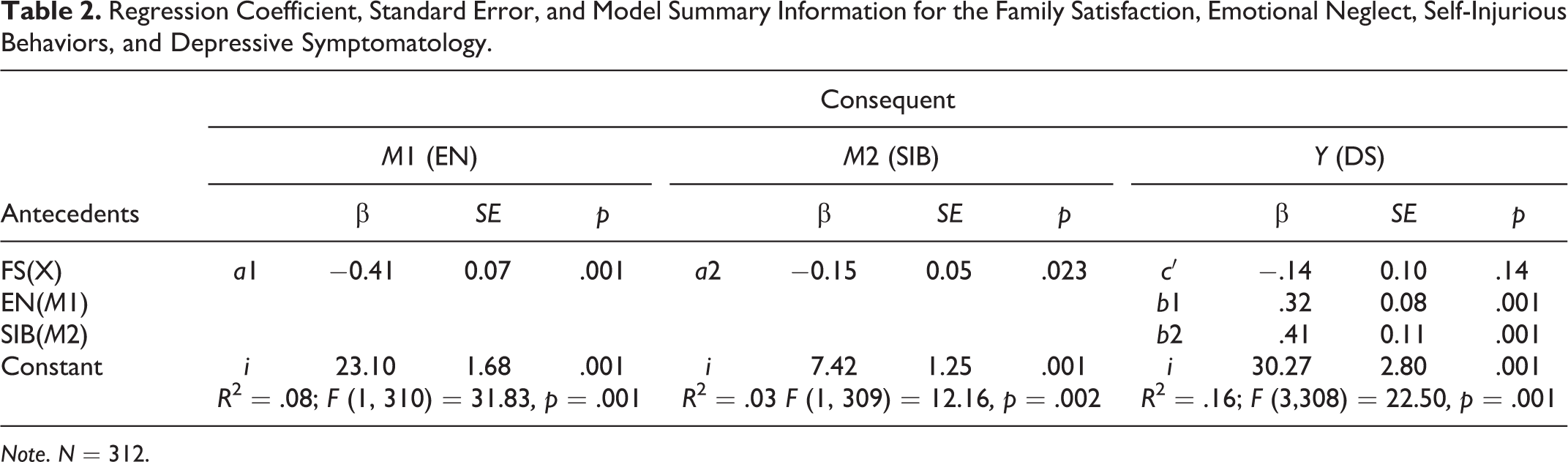
Note. N = 312.
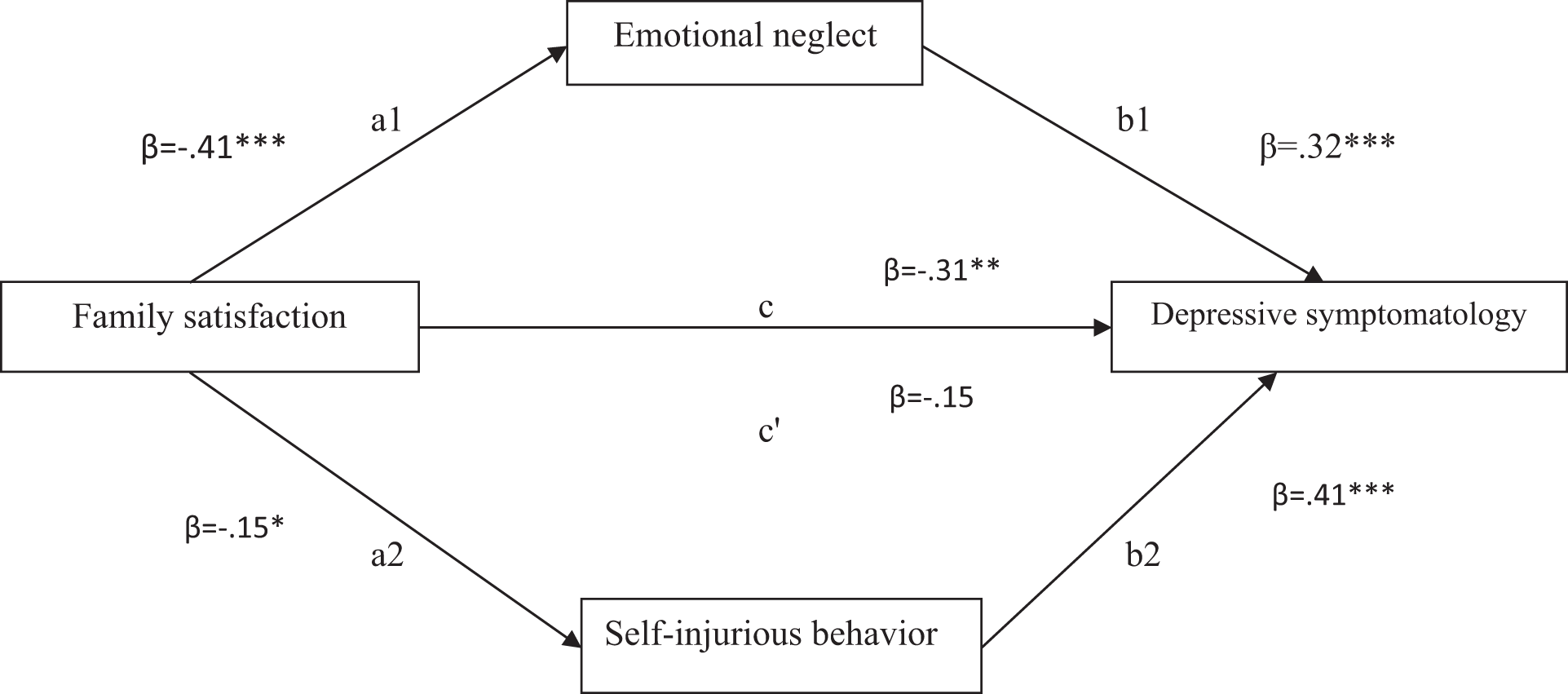
Parallel mediation of emotional neglect and self-injurious behavior in the relationship between family satisfaction and depressive symptomatology.
Indirect effects of family satisfaction on depressive symptomatology through SIB and emotional neglect are shown in Table 3. Indirect effects within the established model in the present study were also investigated over 5,000 bootstrap samples by taking estimates at a 95% confidence interval (CI). The bias-corrected and accelerated CI (BCa CI) findings are described in Table 3. Findings depict that the total indirect effect (the difference between total and direct effects/c − c′) of family satisfaction on depressive symptomatology via SIB and emotional neglect is statistically significant (point estimate = −.17; 95% BCa CI [−.33, −.02]). Within the current tested model, indirect effects of family satisfaction on depressive symptomatology through SIB (point estimate = −.03; 95% BCa CI [−.12, −.03]) and emotional neglect (point estimate= −.13; 95% BCa CI [−.27, −.03]) were also found statistically significant.
Indirect Effects of Family Satisfaction on Depressive Symptomatology Through Self-Injurious Behavior and Emotional Neglect.
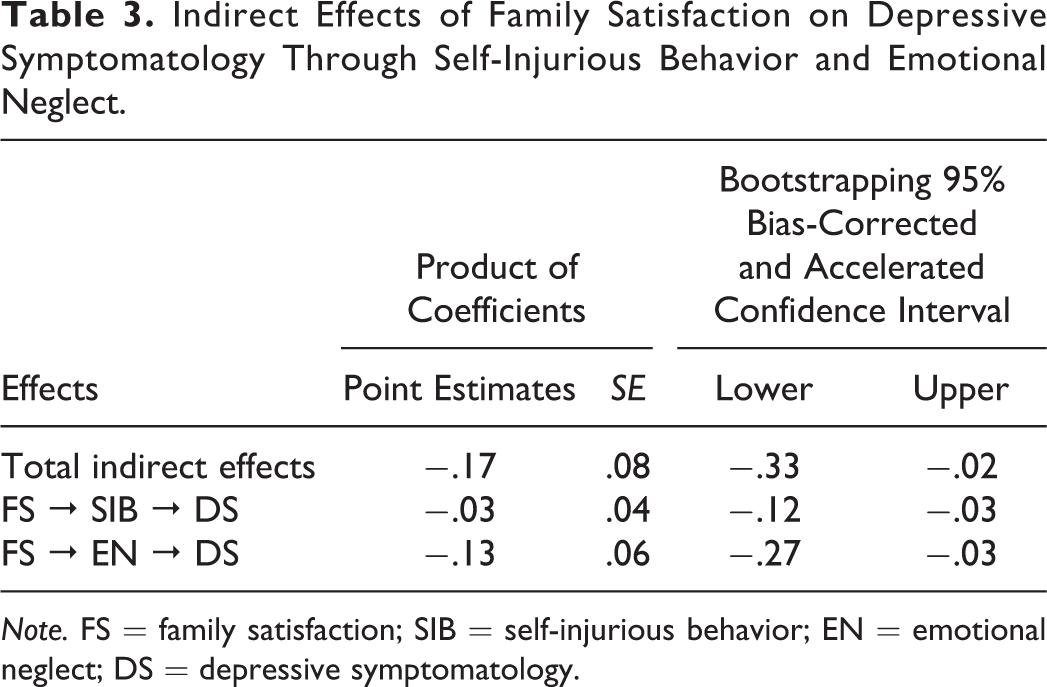
Note. FS = family satisfaction; SIB = self-injurious behavior; EN = emotional neglect; DS = depressive symptomatology.
Discussion
Many studies have been carried out to understand the nature, etiological factors, and treatment options to handle depression that is disabling many lives throughout the world especially our youth. Family environment and family functioning are said to be important risk factors for developing and maintaining depression (Klein & Kotov, 2016; Thomassin et al., 2016; Weber et al., 2016). Most of the literature is devoted to identifying the role of particular parenting or attachment styles in different mental health issues; however, family satisfaction and emotional neglect have attained little if any, frequent attention with the combination of SIB in young college students. This research attempts to identify particularly the mediating role of emotional neglect and SIB in the relationship between family satisfaction and depression in Pakistani culture.
The findings of the current research extend beyond the knowledge about the developmental trajectories and associated features of depression in young adults (Sheeber et al., 2007). The correlation analysis supports our hypothesis consistent with the literature. Also, a significant negative relationship was found between family satisfaction and depressive features in young adults, and a positive relationship was found among emotional neglect, SIB, and depression (Finkelhor et al., 2013; Weber et al., 2016). The results further showed the direct effect of a poor family satisfaction with depressive symptoms, emotional neglect, and SIB in young adults. These findings are consistent with the literature (Martin et al., 2015) which shows that disruptive family which fails to provide cohesiveness, emotional bonding, open communication and disregarding mutual support tend to be associated with depressive features, emotional neglect, and SIB (Arens et al., 2012; Sutton, 2018). These findings can be best understood from the standpoint of attachment theory (Bowlby, 1980). The theory postulates that the absence of an attachment figure, lack of familial support, and ignoring the basic emotional demands of nurturance and affection lead to the development of an inadequate internal working model necessary for efficient coping (Bowlby, 1980). Insecure attachment pattern inhibits the development of social and emotional skills to cope with life stressors. Inadequate coping such as self-harm behaviors can be construed as an escape from challenging situations and reinforce that attention-seeking behavior of parental attention that is otherwise not available (Cassels et al., 2019).
One possible explanation of these findings lies in the cultural and social practices of a traditional collectivistic culture of Pakistan where family plays a pivotal role in the social and emotional functioning of an individual. Parental respect, family bonding, and cohesiveness play a far more significant role than the person’s own social and emotional needs. Consequently, children are more dependent on their parents and live a longer period under shadow than individualistic society, and parental maltreatment and neglect tend to affect a child’s development more drastically increasing the chances of developing mental health problems in later life (Saleem et al., 2019). Furthermore, children have fewer opportunities to express their feelings and emotions in a frank and open way, consequently tend to show a more internalized nature of problems such as depression and SIB (Saleem & Mahmood, 2013).
Lastly, the findings show that emotional neglect and SIB fully mediate the relationship between family satisfaction and depression. Depression is caused and maintained not by a single factor but by an interplay of significant childhood traumas and maltreatment and ineffective coping with stress in terms of SIB. It is important to consider that as a result of inadequate and traumatic childhood experiences, individuals instead of expressing emotions use introjection and internalization of stress. This way they are likely to cause minimal social conflict because they keep inside. However, the problem, in the long run, is not resolved and more likely to end up in self-neglect and self-rejection
The current study has several limitations. First, the study is based on cross-sectional data, which makes it difficult to conclude whether the participant was experiencing emotional neglect or other types of abuse as well and SIB occurred before the depression. Future longitudinal studies can specifically address these questions by including different types of abuse and neglect and establish the relation between stressful life events, emotions, and behavioral problems. Secondly, the current study is based on the self-report measures, which may have related to response bias, and data are based on the perception and emotional neglect. The strength of the study is that we have used a sample that is being neglected in the research to address the sensitive issue of familial factors and psychopathologies. In this research, a respectable sample size, the inclusion of both genders, and more sophisticated analyses have thrown some light on the direct and indirect effects of parental mediation of emotional neglect and SIB in the family environment and depressive symptomatology. In conclusion, the present findings reaffirm that depression in young adults is a combination of various personal, social, and familial factors, and the counseling process needs to address the role of family and empowering the individual to handle life stressors effectively and efficiently.
Footnotes
Declaration of Conflicting Interests
The author(s) declared no potential conflicts of interest with respect to the research, authorship, and/or publication of this article.
Funding
The author(s) received no financial support for the research, authorship, and/or publication of this article.
